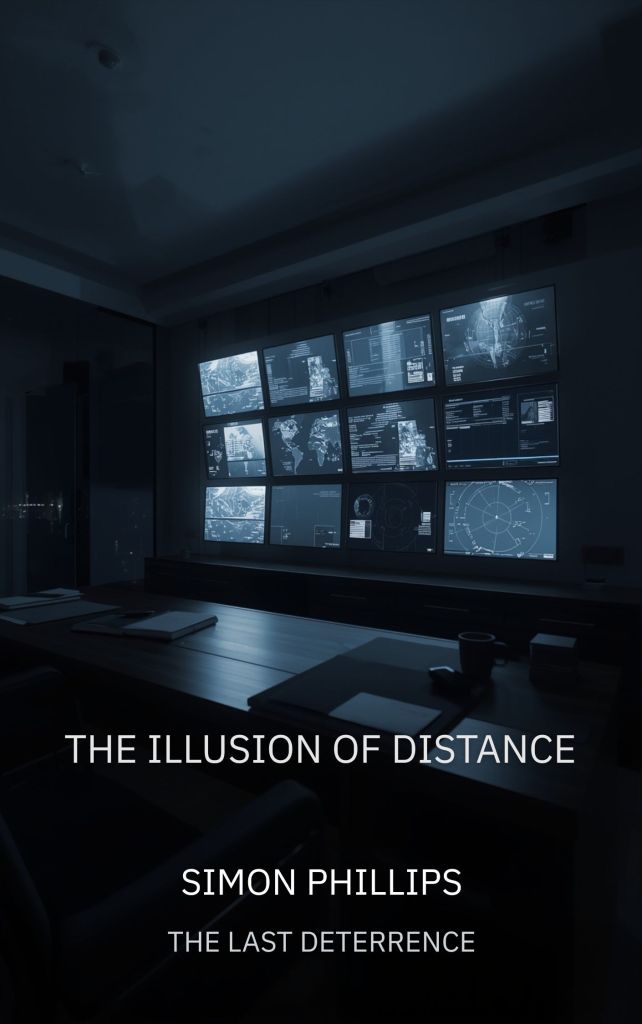
In The Last Deterrence: The Illusion of Distance, the world does not end with sirens or fire. It continues. Kettles boil. Trains run. Radios speak in careful language shaped to sit beside dinner and routine. The disruption arrives through phrasing, updates, and reassurances that feel almost familiar enough to trust.
The novella follows Daniel Mercer, his wife Helen, and their daughter Maya as global escalation begins to press closer to domestic life. Daniel works inside the systems that observe and interpret events unfolding across Eastern Europe. At home, those same events appear only as softened language and revised maps, their edges smoothed to prevent alarm. The distance feels stable at first. That belief carries weight. It shapes how days unfold, how evenings settle, and how much attention feels necessary.
This story focuses on the civilian edge of escalation. It explores how institutions manage uncertainty, how reassurance becomes routine, and how belief in insulation holds until it no longer does. Nothing arrives as a single decisive moment. Change accumulates through continuity. Maps widen by degrees too small to argue with. Language moves forward without announcing itself as movement.
Alongside the novella, a series of flash-fiction scenes and cinematic micro-moments exist as extensions of the same world. These fragments are not summaries or trailers. They are lifted instants from inside the narrative: a pause at a study door, a radio speaking steadily, a screen adjusting itself without comment. Each piece functions as a threshold, offering a way into the larger story without resolving it.
The flash-fiction exists to mirror how escalation enters the lives of the characters themselves. Indirectly. Quietly. Through moments that feel ordinary until they no longer hold. When experienced alongside the novella, these scenes reinforce the sense that the story continues even when the page turns away.
The Illusion of Distance belongs to a broader near-future speculative war sequence concerned with civilian proximity to power, institutional hesitation, and the slow erosion of certainty. It avoids spectacle in favour of process. It remains grounded in domestic spaces where decisions made elsewhere arrive through language long before consequence becomes visible.
The full novella is available here:
https://www.amazon.com/dp/B0GKXBDKVB
Readers drawn to near-future war fiction, political speculative fiction, civilian perspectives on conflict, and restrained narrative tension will find this story unfolds through accumulation rather than shock. The distance feels real. That belief shapes everything that follows.
The Last Deterrence: The Illusion of Distance is near-future speculative fiction about escalation, reassurance, and the moment belief fails.
 Simon J. Phillips