A routine referral brought an independent paranormal investigator to a spare bedroom where objects refused to stay where they were moved.
Case Record
Case file: URC-001 Archive Cycle: Archive Cycle One: The Intake Cases Fictional location: Terraced house, Merewick, fictional England Primary record: Investigation record Recording status: Not applicable Case status: Location Uncleared
The case is based on Ruth Calder’s final controlled examination of an unused spare bedroom whose contents repeatedly returned to earlier positions despite remaining under observation. Recording technology played no evidential role in the disturbance.
What the Room Kept
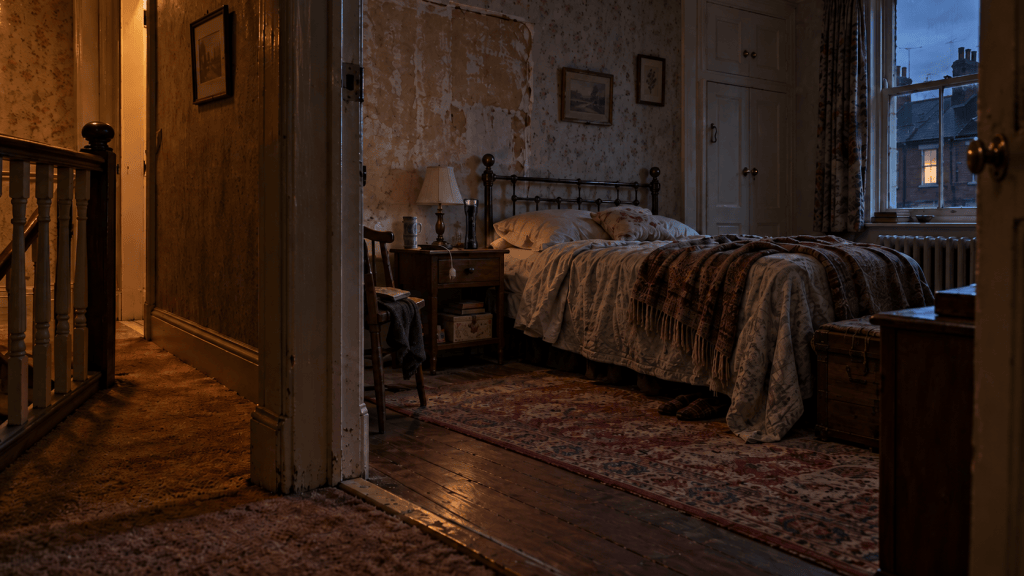
Ruth Calder pressed the last strip of masking tape around the wooden hairbrush, wrote a blue three across it, then held it up for Owen Marr to see. He stood against the landing wall with both shoes planted on the worn carpet, his body angled away from the spare-bedroom threshold. Beyond him, evening had flattened the room into greys and faded browns: floral paper showed where a wardrobe had once stood, the sash window sat crooked beneath an old paint seal, and the shallow cupboard carried mismatched brass handles. Ruth placed the brush beside the unplugged bedside lamp, checked its position once, then picked it up again and stepped backwards onto the landing.
“Three comes out with the mirror and the book,” Ruth said as she lowered the brush into the open equipment case. “You watch the doorway. I’ll keep the case here.”
Owen rubbed his jaw, his gaze staying on the bedroom. “That was the rule before.”
Ruth checked the blue marks on the other two objects. “You moved the towels before.”
“I folded them because you left them on the stairs.” Owen’s tired smile lasted a second. “People still live in houses after investigators arrive.”
Closing the case clips, Ruth glanced up at him. “A surprisingly inconvenient habit.”
The faint laugh she earned eased something in his shoulders. Inside the bedroom, the radiator gave a hollow knock as it cooled. Ruth listened until the sound died, then followed his attention towards the cupboard.
“You said the mirror lived on the top shelf?” Ruth asked, resting one hand against the doorframe.
“For years.” Owen shifted farther from the threshold.
Ruth tipped her head towards the cupboard. “Show me where.”
“From here?” Owen asked, already raising one hand.
“Closer would help.” Ruth left the invitation hanging between them.
Owen lowered his hand again. “You know how close I go.”
During the afternoon she had treated his refusal as part of the problem, a routine built from fear until the threshold carried more authority than the room itself. Now she saw its practical shape. A laundry basket sat against the opposite wall so he could carry it past at arm’s length. The landing light switch bore a polished patch where his fingers reached around the bedroom side of the wall.
“All right,” Ruth said, softening as she stepped aside. “From there.”
Owen pointed towards the left side of the cupboard. “Above the old blankets.”
Keeping her feet on the landing, Ruth leaned through the doorway. Two folded blankets sat on the shelf beside a cardboard box. The space above them was empty. She straightened and opened the equipment case. The mirror and paperback remained where she had placed them, while the space beside them lay bare.
Owen watched her face. “There.”
Ruth looked back into the bedroom. The hairbrush rested beside the unplugged lamp, blue tape visible around its handle.
“You saw me put it in.” Ruth crouched by the case and ran her thumb across the empty lining.
“I watched your hand the whole way.” Owen folded his arms, exhaustion flattening his voice.
“And you stayed here.” Ruth looked towards his shoes.
His eyes met hers. “Ruth, staying here is the one part I know how to do.”
Carrying the case farther along the landing, she began again with the room itself. The sash remained sealed. Dust lay unbroken beneath the cupboard. The boards beside the bed showed no loose edge, and the brush still carried her tape, her number, her handwriting. Each ordinary possibility narrowed until the room’s silence felt less empty than attentive.
By the time Ruth returned to Owen, his arms were still locked across his chest. “That enough?” he asked.
“It should be.” Ruth set the case down, then paused as his attention dropped to her hands.
“Where’s your torch?” Owen asked, uncrossing his arms.
A few minutes earlier he had held it while Ruth checked the cupboard. His hands were empty now. Ruth searched the landing once, then looked at him.
“I gave it back,” Owen said, raising both palms.
Ruth turned towards the spare room, where her torch stood upright beside the unplugged lamp, its black casing caught in the last grey light from the warped sash window.
Owen stayed beside her. “It has never taken anything new before.”
For the first time that evening, Ruth accepted the threshold on his terms. She remained where he remained, both of them on the landing, while her torch stood inside the room.
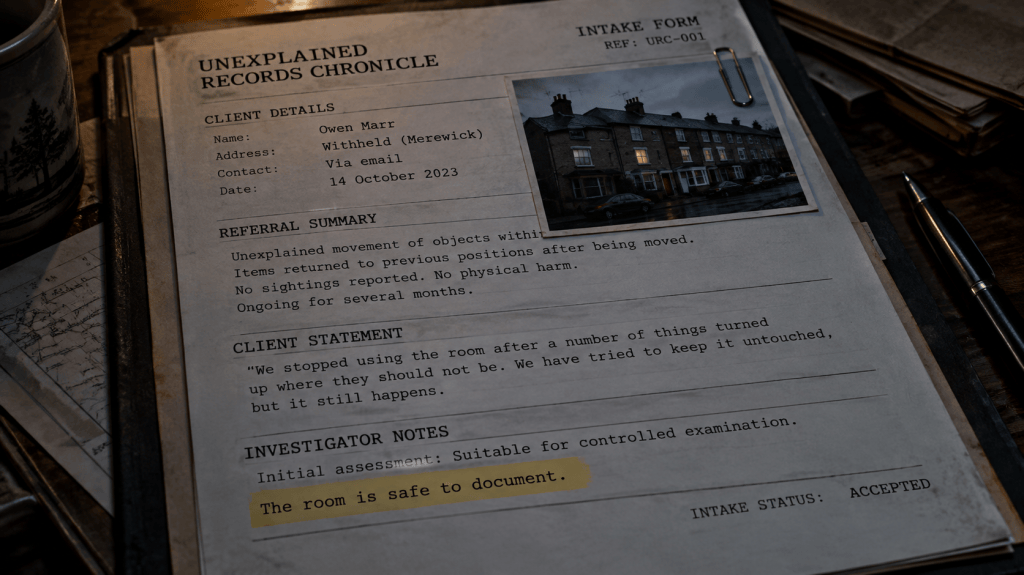
The intake form for URC-001. One line in the investigator notes carried unusual certainty: “The room is safe to document.”
Location and Haunting History
The spare bedroom had remained in ordinary use until Owen Marr began finding small belongings returned to earlier positions after he had moved them elsewhere. A wardrobe was eventually removed, exposing a strip of faded floral paper, while the remaining furniture was reduced to the built-in cupboard, bedside lamp and a few stored items. As the disturbances continued, Owen gradually changed how he used the landing around the room. He stopped crossing the threshold, kept household items away from the doorway and treated the bedroom as a space to be passed rather than entered. No single alteration marked the beginning of the activity, and the available property history offered no reliable explanation for the room’s behaviour.
Investigation Extract
Ruth Calder marked three movable items, removed each from the spare bedroom and placed them together in an open equipment case on the landing. Owen Marr remained outside the threshold throughout the test and retained the investigator’s torch while Ruth checked the cupboard and window. One marked object was later found beside the unplugged bedside lamp inside the room. Ruth recorded the procedure as compromised at that point. The referral paperwork attached to the file carried the sentence: “The room is safe to document.” Its origin was listed only as the referring solicitor.
Next Case
At Fenwick Reach Business Court, Leila Ward joins former caretaker Gareth Pike beside a sealed reception booth that still behaves as though somebody is waiting to be admitted. The building is empty, the phones are dead, and the inner door begins to move.
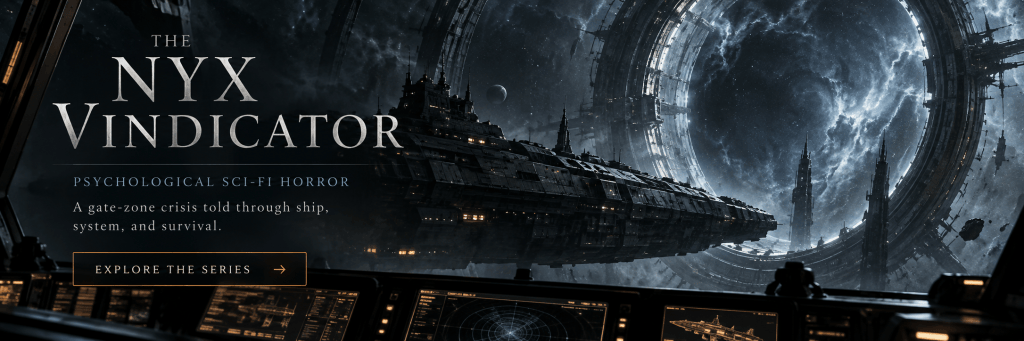
During a routine patrol watch, Krell Vonn faced clean navigation readings while the Nyx began responding as though something was already wrong.
Timeline of Events
Patrol Watch — Nyx Vindicator maintained a stable vector inside all published tolerances.
Early Watch — Krell Vonn confirmed that the long-range plot and comparative drift model showed only baseline noise.
Minutes Later — Elias logged a minor response-curve anomaly for later engineering review.
Acceleration Phase — Predictive corrections began losing their earlier composure as the ship moved into its scheduled profile.
The Reading That Stayed Green
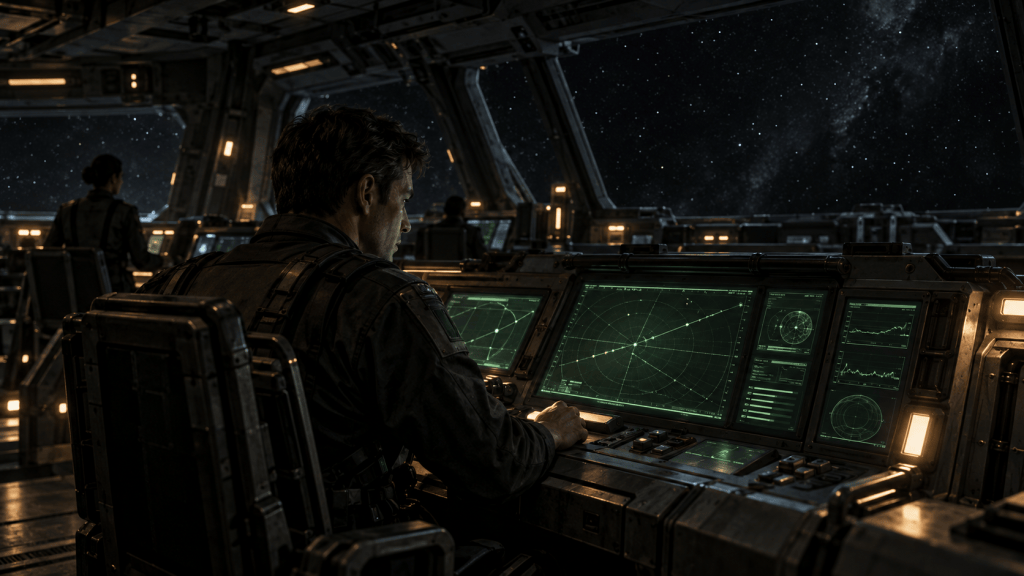
Krell Vonn kept two fingers against the edge of his port console while the Nyx Vindicator crossed the patrol field with the steady confidence he preferred from any ship carrying his name on a watch record. The long-range plot lay clean across the glass, vector lines holding exactly where they belonged, while the comparative drift model glowed green beneath them and offered the sort of answer that usually ended a question before it reached command.
“Course is steady,” Vonn said, sliding one feed aside as he checked the underlying variance. “Baseline noise only. If the universe has developed a grievance, it’s keeping the paperwork tidy.”
Elias glanced towards him from the central navigation console and rested one hand more firmly against the controls. “Run the response curve again,” he said, watching the trace instead of Vonn.
Vonn studied Elias before touching the command. “You’ve already asked me twice,” he said, raising one eyebrow as the same clean line rebuilt itself. “A third pass is unlikely to improve its manners.”
“I felt it soften,” Elias said, flexing his fingers against the interface. “Manual correction, then a delay before the response settled.”
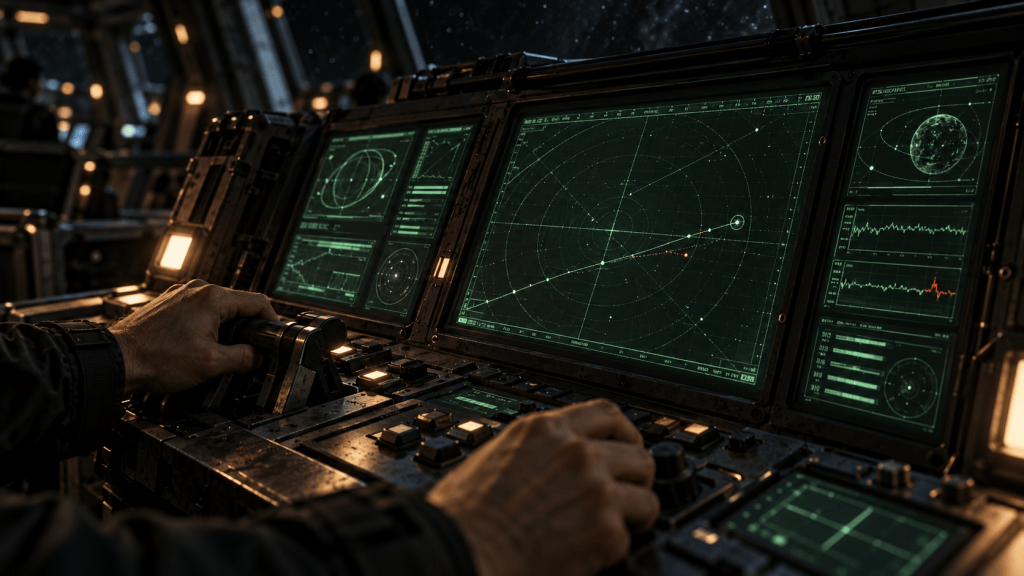
Vonn separated raw input from compensation, expecting the discrepancy to appear once the smoothing fell away, though the result stayed green as latency remained inside specification and power transfer matched the command profile. “Still clean,” Vonn said, easing back in his chair. “Engineering will send this straight back with a smile and a reminder that green means green.”
Captain Halverson shifted in the command chair and watched them both. “Does it affect patrol?” he asked, tapping one finger against the armrest.
Elias watched the response trace settle before lifting his eyes towards command. “No immediate effect, sir,” he said, drawing the diagnostic layer smaller. “I’d log it for review.”
“Then log it and keep us on schedule,” Halverson said, returning his attention to the main display.
Vonn watched Elias tag the anomaly and send it into the ship’s queue, where the record shrank into a minor engineering item that should have finished the matter, yet Elias kept his hands close to the console, his posture carrying the alertness of someone listening for a sound everyone else had accepted as machinery.
The bridge eased back into its familiar rhythm as the patrol advanced. Cooling fans whispered behind the wall panels, restrained status tones marked routine confirmations, and the deck carried the low vibration of the drive through Vonn’s boots. When the Nyx entered the scheduled acceleration profile, that vibration changed first, tightening through the floor before his display acknowledged anything.
Vonn leaned forwards as the predictive overlays began to lose their smooth alignment. “I’ve got drift in the correction model,” he said, pulling the raw feeds apart while green markers continued to declare each individual response acceptable. “Small enough for tolerance. Large enough to keep moving.”
“It’s the same softness,” Elias said, lowering his centre of gravity against the deck as his hands travelled across the navigation interface.
The next correction arrived fractionally behind the model that had predicted it, then the system recalculated and presented the result as orderly while Vonn widened the comparison window. “It’s cleaning itself after the error,” Vonn said, holding the raw trace beside the polished solution. “Every miss gets folded back into green before the next one lands.”
A tremor travelled through the deck plating as Halverson rose from the command chair. “Hold acceleration,” he said, gripping the chairback while the ship’s projected posture wandered across the forward display.
Elias was already moving beneath the upper control layers, feeding corrections directly into the response cycle. Vonn tracked the inputs and felt his stomach tighten as the ship answered Elias faster than the formal model could follow.
“Your inputs are ahead of my displayed response,” Vonn said, bracing one hand against the console. “Keep doing whatever you’re doing.”
“I am,” Elias said, shoulders rigid as he held the ship inside the narrowing interval. “Watch the loads.”
Vonn shifted to structural balance and saw the oscillation collapse, burn parameters settle and course authority return as the Nyx eased into a controlled hold. Green spread across his displays again until the bridge looked almost routine.
“Report,” Halverson said, releasing the chairback as he looked towards Vonn.
Vonn studied the clean plot, then opened the raw response history beside it. “Contained deviation,” he said, keeping the second pane visible as the official log prepared to close the event. “Ship stable. Published tolerances restored.”
Halverson nodded and returned to the forward field, while Vonn left the raw trace open beneath the green summary. The board had recovered its certainty, yet his hand stayed above the control that would dismiss the extra pane, and for the first time in years he chose to leave the question where he could see it.
Vonn kept the raw response history open beneath the green summary, where the ship’s corrections revealed the discrepancy the formal display kept smoothing away.
Inspiration Behind the Story
This Chronicle grew from a simple unease: what happens when every instrument appears individually reliable while the relationships between those instruments begin to fail? Modern transport, navigation and safety systems depend on layers of automation quietly reconciling small errors before a human operator ever sees them. That usually creates confidence. Here, the same process becomes the source of tension.
Krell Vonn gave that idea a human centre because his work depended upon comparison, tolerance and repeatable data. His concern came from professional instinct instead of panic. The more interesting pressure lay in watching a competent person realise that a green display could still conceal something important.
That tension sits at the heart of The Nyx Vindicator: technology remains useful, disciplined and familiar even as the reality beneath it grows harder to trust.
Next Chronicle: The Gate in Three Versions
With the Nyx Vindicator settled into observation posture, Captain Halverson faced a problem no command procedure had been designed to simplify. Lidar, spectral and gravitic readings each described the gate coherently, yet together they refused to describe the same object. As the bridge stripped away smoothing and widened its tolerances, Halverson had to decide how long observation could remain passive when every instrument offered a different version of reality
Related Book or Series
The Reading That Stayed Green runs alongside the opening events of The Nyx Vindicator: Drift, showing the same gate-zone crisis through Krell Vonn’s experience while the book follows the wider incident aboard the Nyx.
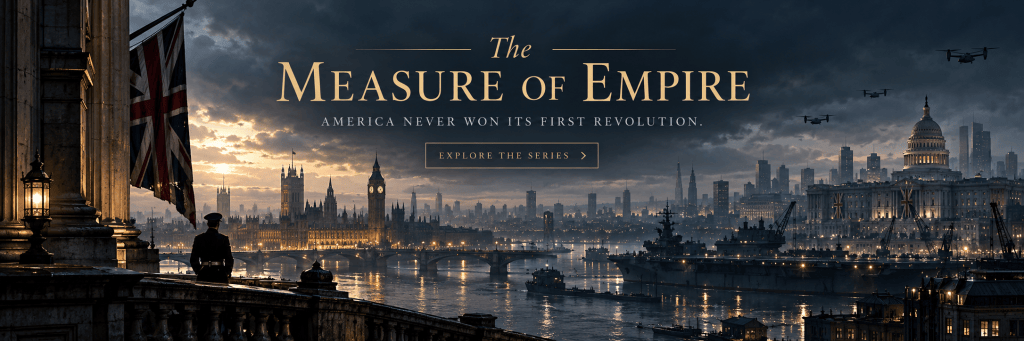
Before London explained the recall, one Ashiya household had already been divided by the instructions arriving at its door.
Timeline of Events
Earlier that day, Ashiya — An urgent instruction from London recalled senior British diplomat Simon Hale from Japan, beginning a departure process measured in hours rather than days.
Later that morning — Embassy transport and official communications reached the Hale residence, turning an otherwise settled household day into preparations for immediate government travel.
Across the same period — Other imperial systems were also receiving new demands, including naval planning and unusual requests for updated information from American administrative offices.
That evening — Simon’s government-directed journey towards Britain began while the reason for the recall remained undisclosed beyond urgent consultation.
The Case by the Door
Thomas Hadley laid the empty travelling case across the cedar bench in Simon Hale’s study and released the brass catches with his thumbs. The embassy motorcar had taken Simon towards Osaka less than an hour earlier, leaving the Ashiya house to settle around an interruption nobody could explain. Hadley preferred instructions before movement, labels before luggage and certainty before anyone touched a family passport, so he opened the case, placed Simon’s document wallet beside it and left every other drawer closed.
Noa appeared at the study door with a wooden ship held against his chest, followed by the nanny who had clearly lost an argument about where he was permitted to wander. “Is Papa going on the government aeroplane?” the boy asked, edging into the room while Hadley checked the empty pockets of the case. Hadley looked across at him and allowed his expression to soften. “At present, Master Noa, your father has gone to speak with the Ambassador. Government aeroplanes usually expect more warning than small boys give their fleets.” Noa lifted the ship with great seriousness. “Mine are always ready.” Hadley inclined his head. “A useful standard for Whitehall, I suspect.”
The house carried that restrained uncertainty through the afternoon until Simon returned with the reserve of a man carrying instructions he had yet to fit around his own life. He removed his coat in the entrance hall while Erina stood beside him, her attention moving from her husband to Hadley. “London this evening,” Simon said, smoothing one cuff after handing over the coat. “One case for now. Formal clothes, the usual papers and enough for several days.” Hadley accepted the instruction with a small nod. “And the family documents, sir?” Simon’s eyes moved briefly towards Erina. “Leave them accessible. I have asked for clarification.” Erina rested one hand on the hall table beside Noa’s abandoned ship. “Accessible is sufficient, Mr Hadley. We can move quickly once someone decides what they are asking us to do.”
That distinction guided the next hour as Hadley packed two formal shirts, a dark suit, shoes, night clothes and the smaller items Simon tended to forget when officials gave him something larger to consider. He placed the passport wallet in the inner compartment, checked the papers Simon had selected from his desk and left space for anything arriving from the chancery. A second case remained upstairs. Erina’s passport and Noa’s sat beside the cabinet key, checked and ready, yet still outside Simon’s case.
As the first lamps came on beyond the garden wall, the gate bell sounded and Hadley reached the entrance ahead of the younger staff. The embassy driver stood beneath the porch light, rain shining across his dark coat, with a sealed envelope held between gloved fingers. “Movement instruction for Mr Hale,” the driver said, offering a small electronic pad. “Receipt, please.” Hadley signed, took the envelope and kept his voice level. “Will transport return for the family?” The driver tucked the pad beneath his arm and shook his head. “Only Mr Hale is cleared on tonight’s movement. Dependants remain pending further direction.”
Carrying the envelope straight into the study, Hadley found Simon and Erina waiting beside the open case. Simon broke the seal, read the instruction once and passed it across to his wife. Erina’s face stayed composed as her eyes reached the final lines. “So they have answered one question,” she said, folding the paper along its original crease. Simon rested his hand against the edge of the desk. “Yes. I travel alone.” Hadley lifted the two unused passport wallets from beside the cabinet key. “I shall return these to their place, my lady.” Erina met his eyes and gave a quiet nod. “Please do.”
When Hadley returned downstairs, one of the housemaids stood beside the entrance with her hands folded uncertainly. “Shall I bring down another case in case the instruction changes?” she asked, glancing towards the staircase. Hadley closed Simon’s travelling case, pressed each catch until it locked and lifted it from the bench. “Leave the others where they are. This instruction concerns Mr Hale, and we shall give it exactly what it asks for.” He carried the case into the entrance hall and set it beside the door where the embassy driver would collect it later that evening.
Noa’s wooden ship still rested on the hall table, one small painted mast leaning towards the black case beneath it. Hadley straightened the case handle, checked that the luggage tag faced outward and stepped back into the quiet of the house. Upstairs, Noa laughed at something the nanny had said, while beyond the garden wall an engine started and faded towards the road. The case remained by the door, ready for London, and everything else stayed where the family had left it
Simon Hale’s packed case waited by the Ashiya entrance while the rest of the household remained under separate instructions.
Inspiration Behind the Story
The appeal of this moment comes from how quickly political authority becomes personal long before anyone understands its purpose. Instruments of Authority establishes Simon Hale’s recall as an abrupt government instruction, with only twelve hours allowed for departure while Erina and Noa remain in Japan.
Next Chronicle
One Cruiser, Two Destroyers
Aboard HMS Sovereign in Victoria Harbour, a fleet planner is asked to remove three warships from the Pacific readiness picture while leaving every remaining commitment looking sustainable. The calculation may fit neatly on the board, yet each reassigned ship consumes another margin the fleet may soon need.
The Case by the Door is connected to The Measure of Empire, beginning with Instruments of Authority and continuing through The Governor’s Commission. The books follow the people at the centre of the political and institutional changes that these Chronicles observe from the surrounding households, offices, fleets and administrative systems.
Before any living hand crossed the threshold, the desert gave back a doorway no surviving record remembered.
Timeline of Events
The Storm A violent storm crossed the western dunes, stripping sand from ground long believed empty beyond the last irrigated fields.
First Light At dawn, a labourer checking damaged channels and boundary markers found black pillars rising from a newly scoured hollow.
The Discovery Worked stone, buried walls and a dark entrance revealed that the storm had exposed something far older than the surrounding settlements remembered.
The Report Word travelled back towards the city. What had been an unremarkable stretch of desert became an official concern, drawing sealed authority, guards and workers towards the western road.
The Black Pillars After the Storm
Hori found the first boundary stake lodged sideways in the irrigation ditch, its red-painted head buried beneath reeds and storm mud. He planted one foot against the bank, hauled until the wood came free with a wet sucking sound, then held it up for the overseer. Beyond them, the western fields shone under spilled water while the desert rose beyond the last green plots in pale, wind-cut ridges.
“Three gone from this line,” the overseer said, rubbing grit from his beard. “Find what the storm left us before the sun climbs.”
Hori looked towards the dunes. “If the storm carried them that far, you can pay me a sand-walker’s wage.”
“Bring me the stakes and I will pay you a labourer’s wage,” the overseer replied, scraping mud from his shin with the edge of his sandal. “Lose the morning arguing and I may pay you half.”
“That sounds more like you,” Hori said, setting the stake beside the channel.
He followed the damaged field edge west, where wet earth hardened beneath his sandals. The storm had stripped thorn scrub from its roots, flattened embankments and carved pale channels through the dunes. Hori knew storms by what they left behind. A hard wind scattered things. A violent one buried them. This one seemed to have done both.
One scoured channel ran farther than the others, so Hori followed it in case a boundary stone had rolled into the cut. As he climbed the ridge, the hiss of wind thinned around him. Sand still streamed from the crest behind his heels, yet the hollow below seemed strangely settled, and from its pale floor rose two pillars of black stone.
Hori stopped with his hooked staff angled across his body. The pillars stood square-sided and dark against the glare. Beyond them ran a wall, its upper stones still buried beneath the slope. A doorway opened at the centre, tall, narrow and filled with shadow.
“Well,” Hori murmured, shifting his grip on the staff, “you are a poor place for a boundary stake.”
The joke sounded small in the hollow. He descended several careful steps, testing each patch of sand before giving it his weight. Wind tugged at his tunic along the ridge. Near the pillars it seemed to slide aside, leaving the air close and strangely still. Hori crouched and pressed his fingertips to exposed paving, where shallow cut marks crossed the surface in straight lines made by tools and hands.
His fingers came away cool, though the sun had already warmed every fieldstone behind him. He rose and moved close enough to study the entrance while keeping several paces of sand between himself and the shadow. Shapes covered the lintel, worn deeply by age. One resembled a long-backed animal. Another might have been a boat or a blade.
“Keep your secrets,” he said, pointing the hooked staff towards the darkness. “I have irrigation channels waiting.”
Curiosity pulled him closer, while years spent repairing other men’s mistakes urged him home. Hori backed away, climbed the ridge and marked the place against a split tamarisk farther east. Once the black stones vanished behind the rise, the ordinary wind struck him again and sent sand rattling against his legs.
The overseer was knee-deep in a broken channel when Hori returned. He looked up, saw the empty hook and frowned as he pushed himself upright.
“You found nothing?” he asked, wiping his muddy palms across his thighs.
“I found worked stone,” Hori said, crouching to rinse dust from his hands. “Black pillars. A wall under the sand. A doorway big enough for a loaded cart.”
The overseer straightened fully and shaded his eyes with one hand. “West of the last plots?”
Hori pointed across the scrub with his wet fingers. “Beyond there. In a hollow the storm cut open.”
The older man’s gaze stayed on the dunes. “You went inside?”
Hori wiped his hands on his tunic and gave him a flat look. “You pay me to mend channels.”
A smile almost reached the overseer’s mouth before his eyes settled again on the western ridge. “Show me.”
They climbed together as the sun rose higher, carrying water, staffs and the overseer’s seal board. When the ridge opened beneath them, the older man stopped so abruptly that Hori nearly walked into him. The black pillars waited below, fixed in pale sand while storm haze still bruised the distant sky.
A runner was on the road towards the city before midday, while Hori returned to the channels and drove a fresh stake into the wet bank. Each time he straightened, his eyes went west. The dunes had always marked the place where useful land ended. Now they held a doorway, and whatever lay behind it had been there through every harvest he remembered.
By evening, people would say the desert had opened its hand. Hori knew only that the storm had moved sand and uncovered stone. Even so, the western edge of his world had changed, and empty ground would never look empty to him again.
Hori hauls a storm-torn boundary stake from the flooded field edge, unaware that the western dunes have already revealed something far older than the land he knows.
Inspiration Behind the Story
This Chronicle grew from the idea of beginning the cycle far from gods, chosen figures and buried truths, with an ordinary labourer whose morning work places him at the edge of something far larger than his own life. The western dunes matter because they mark a practical boundary between cultivated land and the unknown, and the storm changes that boundary in a single night. The black pillars are important less for what they explain than for what they alter: familiar ground becomes uncertain, routine work becomes the first surviving witness account, and a place long absent from living memory suddenly exists again. That shift from ordinary labour into mythic history is exactly where this cycle begins.
Related Book Series
The Forgotten Gods of the Drowned Kingdom
The Black Pillars After the Storm begins at the edge of the events that lead into Book One, Jackal at the Threshold. When rumours of an ancient necropolis uncovered beneath the western dunes reach the river quarter, tomb robber Neris is drawn towards a place the living were never meant to enter. What she finds beyond the black doorway begins a story of judgement, buried gods, guilt and powers returning beneath the sand.
The consequences continue in Book Two, The Scales Beneath the Sand, as the disturbance spreads beyond the desert and into the burial routes, shrines and living streets of the city. Together, the first two books reveal the closer truth behind the events these Chronicles preserve only through witnesses, rumours and incomplete records.
Read Jackal at the Threshold and The Scales Beneath the Sand to discover the story behind the surviving myth.
Next Chronicle
Priest seals and armed guards soon follow the report west. Stone-cutters enter the newly exposed doorway while a junior guard keeps count beneath the black pillars, expecting the workers to return before the light fades. As the hours lengthen, the number coming back grows painfully clear. Tools remain inside. Blood marks the sand. Duty tells him to hold the entrance while every instinct urges him to go after the missing men. By dusk, the excavation has become something else entirely.
Before a single king ruled the Two Lands, communities along the Nile were already being shaped by flood, farming, burial and growing regional rivalry.
Timeline of Events
c. 4000 BC — Farming communities along the Nile depended upon the river’s seasonal cycle, while settlements and burial grounds reveal distinct regional cultures developing in Upper and Lower Egypt.
c. 4000–3500 BC — Naqada I culture flourished in Upper Egypt, with centres such as Hierakonpolis growing in importance.
c. 3500–3200 BC — Trade, specialised crafts and increasingly elaborate burials reflected growing wealth, social distinction and wider connections between communities.
c. 3300–3100 BC — Regional rulers competed for territory as early writing emerged and political consolidation moved the Nile valley towards unification.
Where the River Divided
The river had begun to withdraw when the potter pushed the boat from the mud, his calves sinking into the black edge of the bank while his sister steadied the jars behind him. Water still covered the lower fields, shining between stands of reed, and the village smelled of wet earth, fish smoke and hearth fires. His sister pressed one hand over the woven mat covering their best red vessels. “Keep your feet under you,” she said, watching him struggle with the hull. “If you drown Father’s jars, he will drag you back by the ears himself.” The potter laughed, partly because she expected it, then leaned his weight into the boat until the current caught them.
As they moved downstream, cattle stood in the shallows and families worked along the first strips of exposed silt. On the higher desert edge, low graves lay beyond the reach of the flood. The potter glanced towards them as his sister lifted a chipped jar from beneath the mat. “This one stays with us,” she said, turning the crack towards the light. “Mother can use it for beer. The painted pair goes to the landing, and this time I want copper for them.” He raised an eyebrow. “You want copper every time.” His sister settled the jar against her knees. “One year somebody will finally decide my work deserves it.”
The landing usually announced itself through noise long before they reached it. That morning the shouting had gathered into one hard knot. Three boats crowded the bank with baskets, hides and pottery, while a fourth had been pulled across the easiest approach. Men from an upriver settlement stood beside it carrying flint knives and heavy stone maceheads. Their weapons remained low, though their meaning was plain. An older trader crouched beside his baskets, jaw tight, while a broad-shouldered man pointed towards the goods. “Boats from the southern bend trade here first,” he said, planting his staff in the mud. “Choose what you offer.”
The potter felt his sister shift beside him. She studied the blocked landing, then the painted animal on the strangers’ boat prow. “Last flood they begged for our jars,” she murmured, keeping her voice low. “This flood they tell the river where it may carry them.” He almost answered with a joke, though the words faded as more boats appeared behind them and several families on the bank began moving their baskets towards the newcomers. The painted vessels under their mat suddenly seemed smaller than they had that morning.
His sister touched his arm and nodded towards a shallow channel curling through the reeds. “We can go home,” she said, her mouth tightening in the stubborn way it did whenever a firing went wrong. “Or we can find another landing.” The potter eased the steering pole into the water. Their village had always known other communities by their pottery, their graves, their cattle and the stories traders carried home. Now those differences seemed to be gathering around stronger hands. As the boat slipped into the side channel, the crowded landing remained behind them, and the Nile carried them towards a world in which a village could no longer think only of itself.
Research basis, outside the published Chronicle: the reconstruction uses evidence for Predynastic settlements and low-desert cemeteries, Naqada pottery and boat imagery, stone maceheads, copper objects and large-scale brewing activity. The dramatic window follows the Series III authority’s instruction to make regional difference and growing rivalry tangible through a flood-season exchange or journey.
Predynastic communities along the Nile exchanged pottery, food and valuable materials, linking neighbouring settlements even as regional identities and rivalries grew stronger.
Inspiration Behind the Story
Long before Egypt became a kingdom of pharaohs, pyramids and monumental stone, life along the Nile had already begun shaping the world that followed. Farming, river travel, burial customs, craft and exchange connected communities whose identities were growing stronger as regional centres gathered influence. That quieter beginning deserved its own Chronicle because Egypt emerged from generations of people adapting to the river and to one another, long before royal power gave the land a single political voice. Archaeology offered glimpses of those lives through pottery, graves, settlements and traded materials, allowing the story to begin where pharaonic Egypt itself had yet to exist.
Explore a Different Egypt
For readers who would like to step from real Egyptian history into mythic fantasy, The Forgotten Gods of the Drowned Kingdom follows tomb robber Neris into a darker world of burial rites, divine relics, judgement and a hidden conflict among the Egyptian gods. It shares the Nile, tombs and sacred traditions of ancient Egypt, while telling an entirely fictional story shaped by Egyptian mythology.
Next Chronicle
Along the Nile, rival centres had grown stronger, their rulers reaching beyond the communities that first gave them power. Around 3100 BC, that long struggle entered a new stage as the kingship associated with Narmer claimed authority over both Upper and Lower Egypt. The surviving evidence leaves the exact path to unification uncertain, yet the political idea was unmistakable: the Two Lands could be imagined under one ruler. In The Two Lands Become One, the Chronicle moves from regional rivalry towards the birth of a unified Egyptian state.
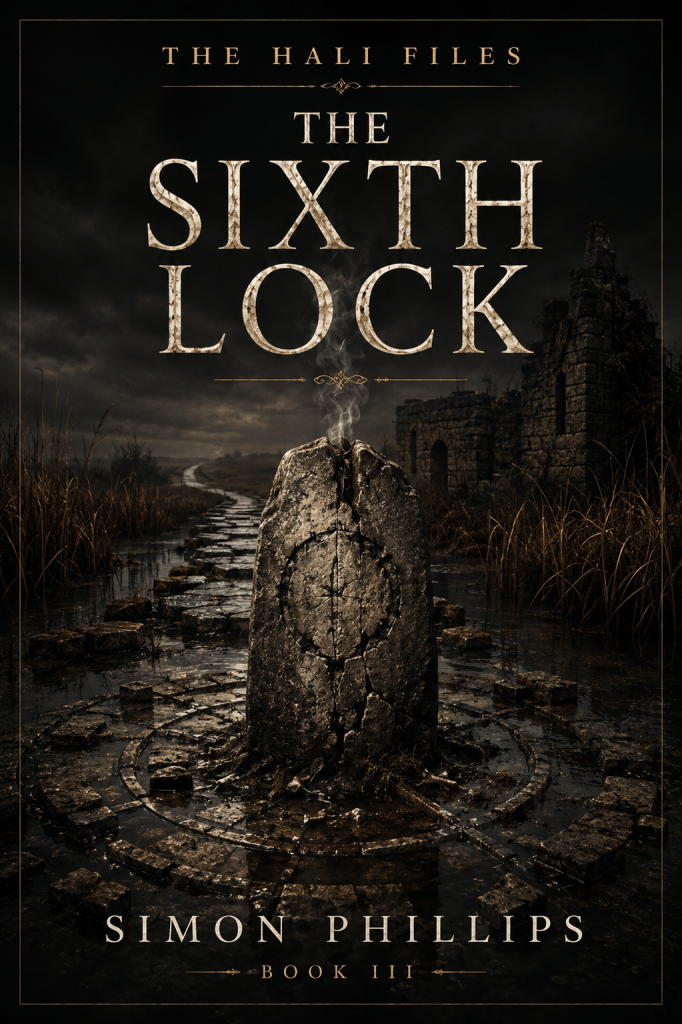
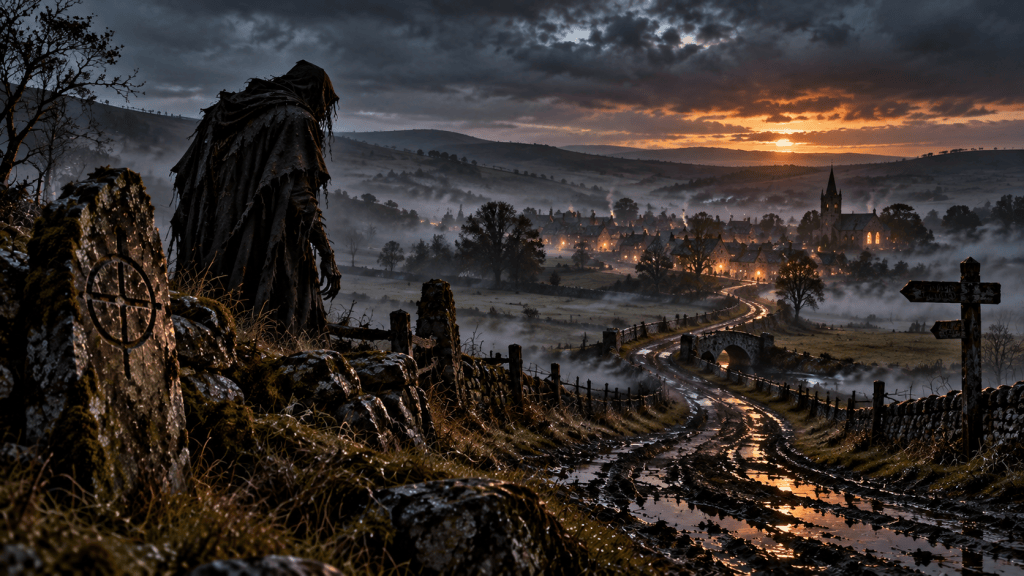
Before sunrise, the bakery ovens had already warmed the walls, flour dust sat across the tables, and the village had begun moving towards another market day. Beyond the first houses, an old boundary stone stood where the road divided, its broken halo softened by rain, moss and generations of people who had stopped asking why somebody once carved it there. A stranger crouched beside that forgotten mark while animals watched from a distance, and the smell of incense travelled through the cold air even though the chapel remained closed.
Hester, the baker, approached because ordinary life demanded ordinary explanations. Travellers became lost, thieves watched roads, pilgrims carried strange habits, and damaged village property eventually became somebody’s problem to repair. The figure offered none of those familiar explanations. It traced the halo, studied the roads and asked when the bells called people together, how many answered them, and which routes carried movement through the settlement. The Sixth Lock
That encounter established the pressure running through The Sixth Lock, Book Three of The Hali Files. This dark fantasy horror story moved beyond buried rooms and corrupted sacred sites into farmland, old roads and settlements whose inhabitants still used the physical remains of a supernatural war while understanding almost nothing about their original purpose. The danger arrived quietly enough for people to continue baking bread, repairing pumps, opening stalls and arguing over whether anything unusual had happened at all.
The village survived the first warning by making it smaller, which was exactly what generations of peace had taught people to do.
A Demon Interested in Roads Rather Than Blood
The creature moving through the western country disturbed Kael because its behaviour carried purpose. It had the strength to attack villagers, kill livestock or turn the settlement into a place of immediate panic, yet no such violence followed the early sightings. Instead, it watched bells, roads, boundary stones, markets and the movement of people through familiar spaces.
Kael recognised the pattern from the old war. A creature driven by hunger would take whatever came close, while something frightened would hide from attention. A soldier studied response, distance and weakness, and the reports reaching Brother Carrow described something behaving much more like a scout than an isolated predator. Carrow eventually brought Kael and Maris a secret bounty because the Church could no longer dismiss the possibility that a complete manifested demon had crossed into the human world. Book 3 Report
That distinction gave The Sixth Lock much of its occult horror. The stranger had no need to terrorise the village when ordinary behaviour provided more useful information. Market bells revealed how quickly people gathered, roads showed where carts and travellers moved, old marks revealed which defensive structures still survived, and the Church’s eventual response showed whether anyone recognised what those structures once meant.
The investigation gradually turned scattered village unease into a deliberate system. Hester’s testimony, disturbed boundary stones, animal behaviour, unusual footprints and sightings along western tracks led Kael and Maris towards an abandoned store overlooking several routes. Inside, they found a body-shaped hollow in straw, blackened material, bone grit and marks aligned towards roads and gathering places. The building had become an observation post, and the creature had spent its time studying the village rather than hunting it. Book 3 Report
The horror lay in the patience behind that choice. Something from the old war had returned to a world that believed the crossings were finished, and its first concern had been learning how much humanity had forgotten.
Old Roads Remembered What People Had Lost
The countryside surrounding the village carried its own evidence. Drainage channels had once helped slow approaching enemies, bridges had been widened across older defensive crossings, boundary stones had become gateposts, and old shelters had changed purpose often enough for their first use to disappear from local memory. Farmers and road workers maintained these structures because they remained useful, even after the knowledge that created them had faded.
That made the landscape itself part of the supernatural mystery. Modern life had grown across the remains of war without fully removing them, leaving physical systems in place after their meaning had been stripped away. The series dossier describes the wider Hali world in similar terms, with visible society operating above older ruins, sealed spaces and suppressed structures that continue affecting people who no longer understand them. Series Report
Kael could read some of those remnants because he remembered fighting when roads, mills, chapels and drainage lines had all become pieces of defence. Maris approached them differently, sensing pressure through structures whose magical purpose had survived more clearly than their history. Together, they moved through a countryside where practical use had preserved the shape of the past while ordinary survival had erased its explanation.
The demon understood that weakness as well. Forgotten protections were still there, yet a protection nobody recognised could be tested, crossed or studied before anyone thought to raise an alarm.
Six Locks Beneath the City
Brother Carrow’s fear forced another piece of the old war into the open. Beneath the city lay a containment zone built around a high-ranking warrior demon that human forces had been unable to destroy safely. Hali fighters held the creature while mages completed the binding, and four High Mages died during the work after the structure continued drawing power from them. The Sixth Lock
The central prison was considered too dangerous to leave behind a single defence. Six separate protections were built around it, each covering a different path towards release and overlapping strongly enough that one failure should never free the prisoner. Carrow regarded their survival as proof that the containment remained secure after generations of peace. The Sixth Lock
Kael heard a different meaning in the same history. Six locks also meant six admissions that the first binding could never be trusted alone, while an imprisoned enemy remained an enemy even after cities, markets and homes grew across the ground above it. His experience of war had taught him to distinguish between killing something and postponing its next opportunity to move.
Carrow’s defence of the Church remained more complicated than simple deceit. Humanity had lived through years when fields went untended, roads carried soldiers and burial carts, and children grew up inside permanent defences. Once the crossings ceased, civilisation needed to rebuild, and an endless state of alarm would eventually have destroyed much of what the war had left alive. The Sixth Lock
The Church therefore gave people an ending that allowed them to live again. The growing danger inside The Hali Files came from the possibility that this necessary ending became stronger than the evidence supporting it.
The Church Preserved the Warning and Removed Its Meaning
The western parish records revealed that contradiction in a smaller and more human form. The old scratched halos had once marked guarded ground, and early instructions required local holders to keep those marks visible while reporting strange smells, abnormal animal behaviour and changes along the roads. Later authorities stopped maintaining the warning marks because they feared preserving superstition and wartime anxiety.
The reporting mechanism survived even after the public meaning disappeared.
Hester’s family had preserved another fragment in behaviour. Her grandmother had warned her against tracing the old halo with a finger, though the reason behind that warning had faded long before Hester inherited it. The action remained because families often carried habits farther than explanations.
The Mage Order possessed its own incomplete memory. Maris knew the story of four High Mages destroyed by a shared binding, although the Order’s surviving account had lost the location and wider circumstances surrounding their deaths. Carrow held the Church version, Kael carried the memories of Hali fighters, and village records preserved practical instructions whose original danger had been stripped from public understanding. Book 3 Report
None of those accounts stood entirely alone as the truth. Together, they showed a history broken into pieces because different survivors preserved whatever their institutions, families or bodies could carry forward.
Kael’s Hali Sickness Was Becoming Harder to Leave Behind
The old war survived most painfully inside Kael. By the beginning of The Sixth Lock, sleep had become unreliable, food often remained untouched, alcohol had lost much of its ability to dull the pressure, and phantom incense reached him even inside rooms where nothing burned. His hands trembled, his eyes changed under strain, heat moved beneath old scars, and the sword remained close enough to reach before conscious thought caught up.
The Hali Sickness made him capable of meeting a creature built for supernatural war, while every use of that capability pushed him closer to the condition he feared. During conflict, pain became distant, perception sharpened and strength increased. The deeper danger appeared after violence ended, when the part of him awakened for battle became increasingly reluctant to settle again. Book 3 Report
That tension separated Kael from a cleaner demon hunter fantasy figure. His power carried no comfortable division between weapon and wound because the same condition allowing him to protect others also threatened the restraint that kept him human. The hunt west therefore became a confrontation with something beyond the outrider. Kael was being forced to recognise how easily his body still remembered what the war required from him.
The fear sharpened during the final pursuit. His fatigue receded, movement accelerated and pain lost its urgency while the sword responded more strongly than Maris had previously witnessed. Killing the demon became possible; stopping once the creature was dead became the more frightening uncertainty. Book 3 Report
Maris Was Learning That Control Could Become Another Form of Risk
Maris carried a different instability into the same fight. Her magic recognised pressure before conscious memory could always explain it, leaving her with instincts connected to systems she had only partly been taught to understand. When Carrow described the four dead mages, her hands reacted before she fully recalled the surviving Order account, suggesting that her body understood something her education had preserved only as history.
At the old boundary station, that instinct became genuine control. Maris used damaged stone, wet earth and the surviving shape of wartime defences to build two pressure-seals around the outrider. Both held long enough for Kael and Maris to question the creature, proving that her magic could operate with far greater structure than either of them had previously trusted.
The failure came when she tried to strengthen that success. A third working joined too deeply with the first two, allowing pressure to move through the entire system and break the containment. Maris suffered the backlash while the demon escaped, turning a successful magical structure into the route through which the creature regained freedom. Book 3 Report
Her response mattered more than the mistake alone. During the pursuit she abandoned the attempt to recreate the larger cage and began using smaller workings to alter footing, expose buried stone and influence the road beneath the fight. Greater control came from understanding how much structure the situation could bear, instead of assuming that another layer of power would automatically make the first success safer.
Kael and Maris Were Becoming Part of the Same Supernatural Pressure
The outrider exposed another possibility while trapped between Maris’s seals. Kael’s Hali response appeared to intensify when distance opened between them and narrow when Maris focused her fear and attention towards him. The demon recognised something resembling the relationship between wartime mages and Hali fighters, suggesting that Maris might already be influencing Kael through magic she had never consciously chosen to cast. Book 3 Report
That discovery changed the meaning of their partnership. Kael had spent years treating the Hali as a condition he managed inside himself, while Maris feared magic that acted ahead of deliberate choice. Their growing dependence suggested that each person’s instability might now affect the other’s ability to remain in control.
The relationship remained grounded in quieter behaviour long before either could explain the supernatural connection. Maris brought Kael food when he stopped caring for himself, watched the signs of his sleeplessness and learned how his body changed before the Hali fully surfaced. Kael increasingly trusted her judgement, recognised the success inside her failed containment and refused to let one mistake erase what she had achieved. Book 3 Report
They were becoming stronger together, although that strength carried its own danger. Dependence could preserve them during the next encounter, while the same connection might expose both of them to forces neither yet understood.
The War Had Begun Measuring the World Again
The death of the outrider completed the bounty while leaving the larger problem unresolved. Its body destroyed itself from within, flesh burning as bone collapsed into grit and white-flecked residue spread through the wet ground. Maris managed to preserve a small sample, creating another piece of evidence that might eventually reach the Mage Order instead of disappearing completely into Church custody. Book 3 Report
More troubling was what the creature’s presence had already proved. The six locks beneath the city remained intact, meaning the imprisoned warrior had stayed contained while the outrider entered the human world through another route. The immediate danger had therefore come from somewhere beyond the prison that had dominated so much of Kael and Maris’s recent fear.
Kael chose to seek surviving Hali who might remember the war before later institutions shaped its history into safer forms. Maris chose to approach the Mage Order because her hands, her bindings and her effect upon Kael had become too significant to leave unexplored. They agreed to pursue those answers together, carrying different fragments of the same unfinished history towards people who might preserve pieces the Church had lost or buried. Book 3 Report
The village continued behind Kael and Maris as they prepared to leave, with ovens warming, carts moving and bells marking an hour most people had no reason to fear. The scratched halo remained beside the road, carrying a warning whose meaning had almost disappeared while the road beyond the worked fields stretched back into wet country. Somewhere within that ordinary landscape, the old war had already tested the boundaries, measured the response and learned how much the world still remembered.
ESC command had gathered enough evidence to suspect the incidents were connected, yet political pressure forced the warning into provisional language while another contaminated debris alert arrived from the Verge.
Chronicle Opening: The Words They Could Use
Restricted Correlation Suite Two sat beneath the command deck of the Leda Ark, close enough to the cruiser’s tactical spine for every change in speed to reach the room through the floor before the displays acknowledged it. Dark composite panels surrounded a long metal table, suspended readers hung above the work surface, and three narrow ventilation grilles drew processed air across the ceiling with a steady pull that flattened paper corners beneath the clinical light. Beyond the sealed hatch, officers crossed between command stations under brighter corridors, their movement reduced to muted pressure through the bulkhead, while inside the room ten incident files waited across the main wall in pale columns that refused to remain separate.
Tessa Vey stood at the lower end of the table with her sleeves folded to the elbow and a stylus resting between two fingers, watching the summary title change for the fourth time that watch. Each revision arrived from another authority branch, carrying a fresh layer of caution over the same evidence. The first version had read DISTRIBUTED CONTAMINATION EVENT. Republic liaison struck the phrase before the document reached operational law. The second used COORDINATED INFRASTRUCTURE SABOTAGE, which treaty counsel removed because intent remained unproven. The third referred to POSSIBLE NON-HUMAN MATERIAL ORIGIN. Command review returned that version beneath a red evidentiary warning, leaving the current heading to offer less danger because it offered less meaning.
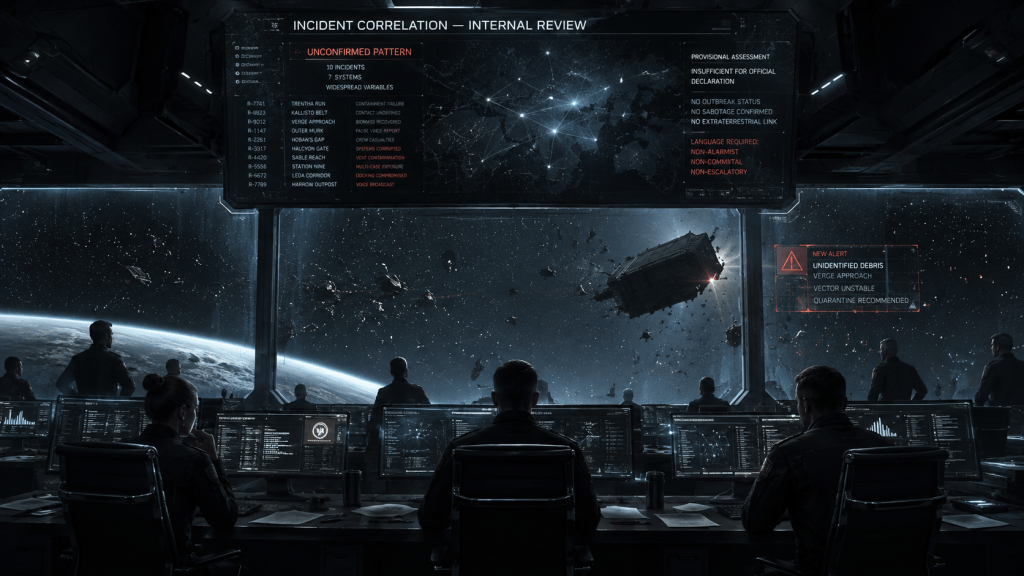
PROVISIONAL CORRELATION OF INDEPENDENTLY REPORTED INDUSTRIAL AND ENVIRONMENTAL INCIDENTS.
Tessa read it again while the cruiser held course towards the Kheled Verge. Kestrel Relay sat beside Quarantine Hold One, Route Station R-17, the Jennah’s Pride recording, the Kordell Wake salvage review, Kheled-Three, Morrow Auxiliary Four, and Harrow Outpost H-09. The Red Titan and Station Nine occupied the final two columns beneath higher seals, their full records reduced to grey reference blocks beyond her clearance. Different offices had named each event, different governments claimed pieces of the evidence, and different crews had carried the loss. The same traces moved through every column once the safer language was stripped away.
Lieutenant Marris entered as the hatch completed its inward seal, a stack of printed amendments held beneath one arm and a fresh cup balanced in his other hand. He placed the papers beside Tessa’s slate and eased the cup into a recessed holder.
“Treaty counsel has returned the title again,” Marris said as he drew the upper sheet free. “They accept provisional correlation. They want independently reported kept in the final line.”
Tessa touched the first six files and brought their shared timing markers into view. “That phrase preserves separation,” she said as she looked towards him. “The whole reason for this summary is that separation has stopped surviving comparison.”
Marris rested both palms on the table. “Their concern is legal endurance,” he said as his gaze moved towards the Harrow file. “The Republic has challenged the Grey Mantle interdiction, the Meridian Way diversion, and Lieutenant Serrin’s authority to issue a full traffic denial before sector control joined the channel. If this summary declares connection too strongly, they will argue the ESC built a pattern to justify command overreach.”
Tessa opened the raw docking packets from Harrow Nine. Valid house keys, pressure fields, berth assignment, course correction, and survivor language spread across the wall. The outpost’s damaged collar appeared beside them, one docking arm fixed beyond safe alignment while guidance lights formed a clean path towards torn structure.
“The carrier had thirty-eight people aboard,” Tessa said as she enlarged the third packet. “The outpost called them by name, changed the route after a survey drone moved, and sent them towards a berth our own images showed as unsafe.”
Marris tapped the upper margin where his approval mark sat beneath operations review. “I agree with Serrin,” he said as the printed amendment settled beneath his hand. “Agreement survives badly once jurisdiction enters the sentence.”
The hatch opened again, allowing Commander Edda Pell and Deputy Review Officer Cassian Holt into the room together, though the space between them suggested their corridor discussion had offered little settlement. Pell carried a route slate beneath one arm. Holt entered with his hands free and his expression composed, as if every objection had already been arranged somewhere behind his eyes.
Pell stopped beside the Harrow display. “Keep the third packet visible,” she said as she placed her slate near Tessa. “Command needs to see how the wording changed after civilian traffic accepted the berth.”
Holt read the summary title from the opposite side of the table. “Command needs a document capable of reaching command,” he said as he rested one hand beside the amendments. “A title that triggers immediate dispute will stay trapped in legal circulation before an operational officer sees the first page.”
Pell opened the Meridian Way track, and the carrier’s interrupted approach traced across the wall. “A title that hides the relationship gives operations another collection of isolated faults,” she said as her jaw tightened. “We already have enough isolated faults to fill a fleet archive.”
Holt turned towards her. “Outbreak asserts propagation. Sabotage asserts intent. Alien asserts origin,” he said with patient restraint. “The record supports shared markers across several incidents. It has yet to support any of those three conclusions.”
Doctor Sel Ardan entered behind him carrying a narrow medical case. She closed the hatch through her wrist control, glanced across the ten files, then came to stand beside Pell.
“The record supports consequence,” Ardan said as she set the case on the table. “People hear human-shaped sound near air systems. Crews approach vents, hatches, and grilles. Residue remains quiet in cold conditions and changes when heat, pressure, or power increases. Systems correct themselves after witnesses have already reacted. Those consequences recur even where origin remains beyond reach.”
Holt gave her a measured look. “Recurring consequence still requires defensible limits.”
Ardan rested her fingertips against the sealed case. “Defensible limits should keep uncertainty around the cause,” she said as her eyes returned to the wall. “They should avoid cutting the incidents apart.”
Tessa brought the shared markers onto the main display one by one. Cold preservation. Thermal activation. Airflow proximity. Pressure delay. Self-correcting scans. Voice-range acoustic events. Movement towards ventilation infrastructure. Trusted system output continuing after physical conditions had changed. Each line crossed more than one file, and several reached nearly every column. The display remained calm, pale, and exact, turning frightened testimony, lost crews, corrupted machines, and sealed evidence into a geometry that looked manageable from the centre of the room.
Pell stepped closer and moved her finger from the Red Titan reference block towards Kestrel Relay. “Recovered salvage, dark or pale residue, cold suppression, changing scan results,” she said as the linked files brightened. “Then quarantine audio, delayed drone responses, voices through damaged vents, contaminated filters, crew movement towards grilles, and docking guidance from silent stations. Different routes, different authorities, the same operational pressure.”
Holt looked along the remaining files. “Kheled-Three reported conduit contamination before entering preservation load,” he said as he followed the lines. “Morrow Four held fourteen dead beside ventilation grilles. Harrow Nine issued adaptive guidance after local control had gone silent.”
“And Station Nine?” Tessa asked as she kept her hand near the sealed reference block.
Silence tightened around the table while the ventilation grilles continued drawing air above them, steady enough to fade into the room until every person became aware of the sound at once.
Marris looked towards Holt before drawing the authorised Station Nine layer across the lower edge of the wall. “The full file remains under command seal,” he said as the summary opened. “The authorised record gives us structural contamination, personnel-board corruption, voice-like audio, cold suppression, and active docking guidance after crew loss.”
Tessa held his gaze. “That is the pattern.”
Holt’s eyes moved from her to the wall. “That is a pattern,” he said as he laid careful weight on the article. “The distinction protects the document from claiming exclusivity before we understand the wider field.”
Pell folded her arms. “We are searching for language while traffic keeps moving through the same routes.”
“We are searching for language because traffic keeps moving,” Holt replied as he turned towards her. “One careless declaration could close Republic lanes, strand civilian ships outside fuel margins, freeze contract habitats, and place armed patrols across contested boundaries. A warning delivered in a form every authority rejects becomes another sealed file.”
Ardan opened her medical case and removed a printed testimony strip from Review Chamber Four. “Then use language strong enough to preserve action and narrow enough to preserve uncertainty,” she said as she placed the strip beneath the title. “Call it a correlated hazard. State that shared environmental, material, acoustic, and system-response markers indicate probable connection. Leave cause and origin unresolved.”
Marris read the line, then drew an authority tree beside it. “Probable connection gives route control grounds for precautionary holds,” he said as he looked towards Pell. “It avoids declaring spread as established fact.”
Pell leaned over the table while Harrow Nine’s guidance lights continued their patient sequence on the wall. “Add infrastructure,” she said as she touched the phrase. “The danger keeps entering through working systems. Freight handling, quarantine, air circulation, traffic response, docking guidance. Officers need to understand that a green board can carry the hazard.”
Tessa entered the revision.
PROVISIONAL CORRELATED INFRASTRUCTURE HAZARD.
Shared environmental, material, acoustic, and system-response markers indicate probable connection across multiple civilian and industrial incidents. Cause, origin, and full propagation mechanism remain unresolved. Precautionary route, quarantine, and recovery controls are advised pending expanded evidence review.
The wording carried no declaration of outbreak, no accusation of sabotage, and no claim of alien origin. The summary remained smaller than the evidence, though for the first time it held the incidents inside one frame instead of returning each loss to a separate office.
Holt read the paragraph twice and reached towards the approval field. His fingers paused before contact as a soft priority tone entered through the command link, low enough to preserve the room’s discipline while changing every face around the table.
Pell turned first. Her route slate had already woken beneath her hand, filling with a live alert from the outer Verge. “Debris report,” she said as she opened the packet across the lower wall. “Republic-affiliated tug, two-person crew, recovery in progress near the Morrow transit line. Salvage beacon valid. Ownership chain incomplete.”
Tessa felt the cruiser alter course through the floor, the pressure arriving beneath her boots before the navigation strip recognised the movement. On the wall, a rotating container emerged from darkness beneath the tug’s external lamps, its plating scored along one side and frost gathered around a sealed access seam. A narrow band of dark residue held against the metal where the recovery light warmed the edge, while the tug’s scanner corrected its first material reading into harmless industrial deposit.
Marris looked towards Tessa as the alert added a delayed pressure response and an unresolved sound inside the recovery vessel’s intake channel. “How long ago?” he asked while he pulled the raw timing field onto the table.
Pell read the transmission stamp, and the colour left her face by a fraction. “Seventeen minutes,” she said as she opened the emergency contact path. “The tug has already brought it inside.”
Above them, the ventilation grilles drew another measured pull through the suite. Tessa looked from the new container to the provisional summary waiting for approval, and the pattern no authority wanted stood complete across the wall, gathering another incident while the officers were still deciding which words could carry the first ten.
Station Record: Restricted Correlation Suite Two
Restricted Correlation Suite Two formed part of the sealed command-review section aboard the ESC peacekeeping cruiser Leda Ark, positioned beneath the tactical deck where route intelligence, treaty law, cognitive forensics, and operational command could examine politically sensitive incidents beyond the reach of ordinary ship archives.
The suite had originally served as a restricted planning room for events involving several authorities at once. Republic-linked traffic disputes, contested salvage claims, quarantine appeals, civilian vessel seizures, and emergency route closures could be assembled there before command issued instructions capable of crossing jurisdictional boundaries. Its construction reflected that purpose. Local memory remained isolated from the wider cruiser network, the wall readers accepted evidence under separate clearance seals, and every revision to a summary preserved the identity and authority of the officer who entered it.
Rooms of this kind became essential along the outer routes because danger rarely arrived beneath one government’s ownership. A civilian hauler might carry Republic registration while crossing an ESC-monitored corridor. A salvage object could retain several incomplete contract claims. A silent outpost could remain Republic property while its docking guidance threatened vessels from several neighbouring systems. Any response strong enough to protect traffic could also be interpreted as seizure, interference, or an expansion of military authority.
Restricted Correlation Suite Two therefore existed to shape evidence into language capable of surviving those pressures. Officers could compare route packets, quarantine records, medical findings, testimony extracts, acoustic analysis, docking telemetry, maintenance logs, and recovery images while legal reviewers assessed how each conclusion might affect trade, public order, diplomatic relations, or command responsibility. The room offered no automatic resolution. Its purpose was to preserve a conclusion long enough for authority to act upon it.
During the earliest Harbinger incidents, that task became increasingly difficult. The files entering ESC review arrived from different ships, stations, routes, and offices, each carrying a classification designed around the conditions first observed. Residue along a cargo seam became industrial deposit. A delayed reply from an empty drone became authentication variance. A human-shaped sound inside a vent became acoustic artefact. Crew movement towards service grilles became welfare disturbance under environmental stress. Structural contamination inside processing conduits became cold-stress interference after the station board corrected its own warning.
Each phrase remained defensible when viewed alone. The difficulty emerged once the files were placed beside one another.
The summary prepared inside Correlation Suite Two gathered records from Kestrel Relay, Quarantine Hold One, Route Control Station R-17, the civilian carrier Jennah’s Pride, the salvage tug Kordell Wake, Processing Relay Kheled-Three, Review Chamber Four, Morrow Auxiliary Four, Harrow Outpost H-09, the Red Titan, and Processing Station Nine. Several of those records remained partially sealed, while others carried disputed evidence chains or incomplete authority transfer. Even so, the same operational markers continued returning across the separate files.
Cold conditions appeared to slow or preserve the material. Heat, power restoration, airflow, and pressure change appeared close to later activity. Scanners corrected uncertain readings into familiar categories. Warnings reached formal records after workers had already sensed a change. Voice-like sounds travelled through vents, damaged communication channels, and environmental systems. Crews moved towards spaces where those sounds seemed to originate. Automated infrastructure continued issuing valid guidance after the people responsible for that infrastructure had stopped answering.
The Harrow Nine incident gave the comparison new urgency. The damaged outpost transmitted recognised docking packets after being declared silent, adjusted its approach guidance around live traffic movement, and directed the civilian carrier Meridian Way towards an unsafe receiving collar. The packets retained valid authority fields, current route information, and familiar service language, creating a hazard through the same systems civilian crews depended upon for protection. Lieutenant Talia Serrin’s emergency interdiction prevented the carrier from completing its approach, yet the decision triggered an immediate jurisdictional dispute because formal Republic approval had yet to reach the Grey Mantle when she issued the warning.
By the time the Harrow file entered Correlation Suite Two, ESC command possessed enough evidence to accept probable connection across the incidents. It still lacked language free from political consequence. The term outbreak implied a confirmed mechanism of spread and could close freight routes across several jurisdictions. Sabotage implied deliberate hostile action and risked accusation between governments already contesting salvage and evidence rights. A declaration of alien origin placed certainty beyond anything the surviving material could prove.
The officers therefore settled upon a provisional correlated infrastructure hazard. The phrase acknowledged recurring environmental, material, acoustic, and system-response markers while leaving cause, origin, and full propagation unresolved. It gave route-control officers grounds for precautionary holds, expanded quarantine, and stricter salvage handling, although its restraint also revealed how far the official record remained behind the people who had encountered the pattern directly.
Before the summary received final approval, a new alert reached the suite from the outer Verge. A Republic-affiliated tug had recovered a drifting container carrying an incomplete ownership chain, valid salvage beacon, scored plating, and residue along a sealed access seam. Its first scanner reading corrected into harmless industrial deposit. The tug had already brought the object aboard.
The alert became the final attachment to the restricted summary, preserving the moment when ESC command found language for the connected incidents while the same pattern continued moving through another trusted recovery system.
About the Creator
The Future Chronicle is written and curated by Simon Phillips, a writer of science fiction and speculative storytelling who explores the fragile edges of human expansion, where freight routes, inspection bays, patrol vessels, and isolated industrial stations continue their ordinary work while larger dangers gather quietly beneath routine procedure.
Many of the stories presented in these Chronicles exist within wider fictional worlds shaped by workers, survivors, officers, and investigators who encounter the first signs of events far greater than they are prepared to understand. These settings remain grounded in lived environments, where machinery, bureaucracy, and human judgement often shape the path of catastrophe long before anyone can give it a name.
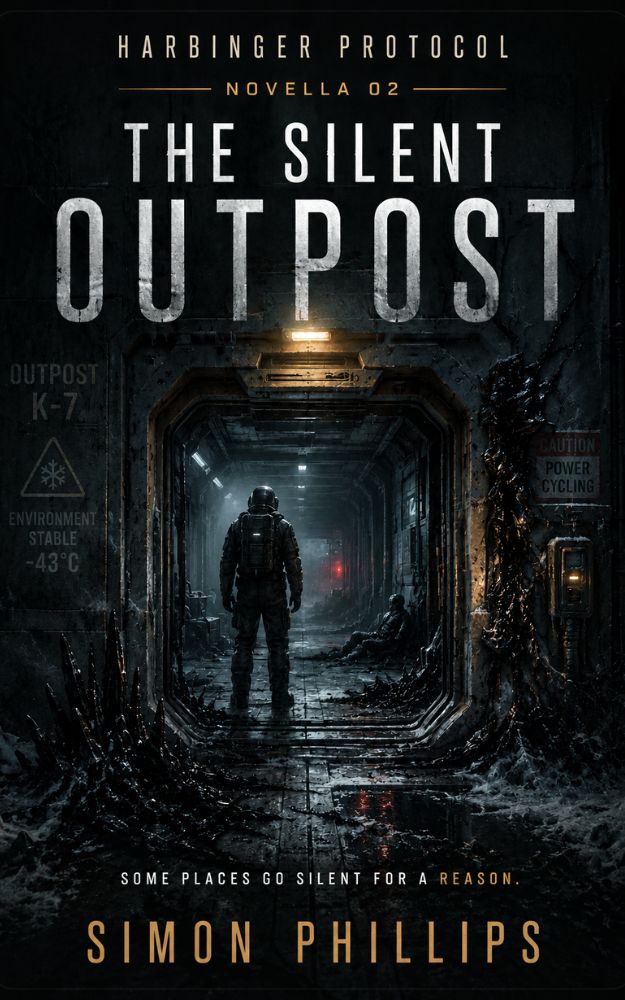
The Harbinger Protocol follow that unfolding pressure through the experiences of Soren Vale, beginning with the civilian freighter disaster recorded in The Ash in Transit and continuing into the colder, more procedural dread of The Silent Outpost, where isolated incidents begin to reveal the outline of something spreading across human routes and systems.
Readers who wish to explore the full opening phase of the Harbinger crisis can find the below.
The alert widened across the wall while Correlation Suite Two adjusted its displays around the new priority. The ten earlier files contracted into a narrow band above the table, leaving the centre to the Republic-affiliated tug and the rotating container secured inside its recovery bay. External imagery showed a compact industrial vessel with an ageing drive collar, twin salvage arms, and repair plates layered along the forward spine. Its registry identified it as the Orison Bell, licensed for debris recovery and contract towing across the Morrow transit line. Three crew identifiers remained active. One moved between the bridge and central passage, one held inside engineering, and one stood within the recovery section less than six metres from the captured unit.
Pell opened a direct traffic channel as the Leda Ark entered a harder burn. “Orison Bell, this is ESC Route Liaison aboard the Leda Ark,” she said while her fingers moved through the emergency authority fields. “Hold all recovery work, reduce bay temperature, isolate local airflow, and keep every crew member clear of the container.”
A carrier tone returned, followed by a man whose voice carried engine vibration and the cautious irritation of a captain receiving distant orders after a profitable recovery. “Leda Ark, this is Captain Harel Vos,” he said as a faint alarm sounded behind him. “The unit is secured under salvage procedure, our atmosphere reads clean, and we have Republic claim authority pending. State your hazard basis before I freeze a working bay and damage whatever is inside.”
Pell leaned closer to the pickup. “Your exterior scan shows residue along the lower access seam, delayed material correction, and a pressure response outside expected tolerance,” she said as she sent the raw comparison packet through the channel. “Those markers overlap with restricted incidents under current ESC review. Lower the bay to preservation temperature and close the recovery section now.”
Vos looked away from the camera as someone spoke beyond the bridge feed. “My engineer says the residue is cold-bound industrial ash,” he said while his eyes returned to Pell. “The scanner cleared it twice.”
The words moved through the suite before anyone answered. Kestrel Relay and the Red Titan carried the same classification, while Kheled-Three had softened structural contamination after its own boards corrected the warning. The earlier incidents brightened across the upper wall around the captain’s sentence.
Marris drew the tug’s scan path beside the Kestrel record. “First pass unresolved, second pass industrial deposit, third pass stable,” he said as he traced the correction times. “Seven-point-one seconds between uncertainty and acceptance.”
Ardan opened the acoustic layer from the recovery bay. “There is an event beneath the intake fan,” she said while she lowered the playback gain. “It begins after the bay heater rises.”
A soft mechanical wash entered the suite, carrying pump vibration, clamp load, and the hollow resonance of a cargo space under pressure. Several seconds passed before a narrow tone gathered inside the airflow, close enough to a human vowel for Tessa’s shoulders to tighten. The shape faded, returned in a lower register, then disappeared beneath tool noise from the crew member beside the container.
Pell kept the direct link open. “Captain, your recovery bay is warming the object while drawing air across the residue,” she said as she shifted the thermal graph into his feed. “Your scan corrections are arriving late, and your intake channel carries an unresolved acoustic event. Seal the bay and cut local heat.”
Vos studied the graph, his earlier irritation giving way to concentrated concern. “Bay Six, confirm heater state,” he called as he turned towards someone beyond the camera.
A woman answered through the bridge speaker, her voice thinned by the tug’s internal system. “Recovery heaters rose automatically after pressure lock,” she said while metal struck lightly near her pickup. “I have frost lifting from the casing and a black line forming along the lower clamp.”
“Step away from the unit,” Pell said as she placed one hand flat against the table. “Seal the section from your side and leave every tool where it is.”
The woman’s camera feed opened in the corner of the wall. Recovery Bay Six appeared under pale lamps, narrow enough for the container to dominate the centre of the chamber. Frost had receded from its upper plating. Along the lower seam, dark residue had spread beyond the original band and entered the textured surface of the clamp cradle in fine branching lines. Engineer Savi Ren stood near the yellow boundary with a thermal case beside her boots and one gloved hand raised towards the local controls.
Ren turned her helmet towards the overhead grille as airflow shifted through the bay. “Captain, someone is on the maintenance channel,” she said while her other hand reached for the seal command. “I can hear Lio in the return duct.”
Vos looked sharply towards an empty bridge station. “Lio is in engineering,” he said as he opened the internal line. “Lio, answer bridge.”
A younger man appeared from the engine room, his face bright with sweat beneath emergency strips. “I am here,” Lio said as he leaned towards his pickup. “I have been here since capture.”
In Bay Six, Ren remained facing the grille. The black line around the clamp deepened where warm metal met the container shell. Her suit microphone caught a faint sound beneath the fan, a drawn human shape carrying the beginning of her name.
Pell pressed the channel wider. “Savi, keep your eyes on the hatch and move out of the bay,” she said as her voice hardened. “The sound in that duct is an environmental artefact. Lio is on the line from engineering.”
Ren took one step towards the exit, then stopped as the local seal indicator changed from green to amber. “The hatch says pressure review,” she said while her glove moved over the manual release. “It has taken local control.”
Tessa followed the tug’s air route from Bay Six into the central return. A contamination warning appeared at the bay sensor, cleared itself, then returned under a softer equipment-fault label. The system had already begun translating danger into maintenance language.
“Captain Vos, cut recovery-bay power at the distribution trunk,” Pell said as she highlighted the correct control on his bridge plan. “Keep ventilation low. Keep the rest of the ship cold.”
Vos moved both hands across his console. “Bay power is dropping,” he said while the bridge lights dimmed around him. “Savi, manual hatch release should clear once the local bus falls.”
The recovery lamps faded to weak amber. Heater output collapsed, fan speed lowered, and the dark branching around the cradle slowed beneath the camera. Ren worked the manual wheel with both hands until the hatch gave a fraction. Cold vapour crossed the gap from the passage.
The voice in the grille returned, softer through the reduced airflow and shaped closely enough to Lio’s tone that Ren looked back over her shoulder. Her hand loosened on the wheel.
Lio struck his engine-room console with an open palm. “Savi, look at me on your wrist feed,” he said as he raised his face towards the camera. “I am in engineering. Whatever you hear, keep moving.”
Ren lowered her eyes to the small display on her sleeve. Lio’s live image flickered there, delayed by less than a second, while the sound above her formed the same voice through metal and falling air. Her posture tightened as two versions of the same man reached her from different parts of the ship.
“I see you,” Ren said as she forced the wheel through another turn. “Keep talking.”
Lio shifted closer to his pickup. “You left your blue mug beside the port regulator this morning,” he said while his hands gripped the console edge. “You threatened to throw it at me when I moved it. You still owe me a clean filter report from yesterday, and I still hate the tea you make.”
A strained laugh escaped Ren as the hatch opened wide enough for her shoulder. “That is because you boil it until it tastes like insulation,” she said while she pushed herself through the gap.
Vos sealed the passage side after she cleared the bay. The camera remained inside, showing the container beneath reduced light while the dark line held around the chilled clamp. The acoustic trace flattened as the fan slowed, leaving hull vibration and the small ticking sounds of metal losing heat.
Pell released the edge of the table. “Keep Bay Six isolated under cold draw,” she said as she looked towards Vos. “Move your crew into sealed suits, close the central return, and alter course away from inhabited traffic. The Leda Ark will establish escort distance and transfer handling instructions through a narrow data path.”
Vos sat back from his console, the colour drained from his face. “What have we brought aboard?” he asked while his gaze stayed on the sealed bay status.
Holt’s eyes moved towards the provisional summary waiting above the table. Tessa saw the answer he could give and the answer the files demanded pressing against each other behind his still expression.
Pell glanced towards him before speaking. “You have recovered material linked to a provisional correlated infrastructure hazard,” she said as she returned her attention to Vos. “Cold and isolation appear to slow its activity. Heat, airflow, and system wake appear to increase risk. Follow those controls and keep your crew away from every voice whose source you cannot see.”
Vos absorbed the phrasing with tired disbelief. “That sounds like a name built to avoid naming anything,” he said as he secured the course order.
“It is the strongest name cleared for use,” Pell said while her fingers rested beside the channel. “For now, it may be strong enough to keep your people alive.”
The Orison Bell began turning away from the Morrow transit line. Its drive output remained low, and its recovery bay temperature descended by steady degrees. Tessa watched the dark branching remain fixed around the cradle as the cold deepened. No further voice crossed the intake channel. The silence offered relief with no promise behind it.
Marris opened the summary approval field once the tug settled on its diversion course. “The live incident supports every operational clause,” he said as he added Bay Six to the restricted attachments. “Recovered debris, incomplete chain, cold inactivity, thermal response, airflow event, delayed correction, voice-range sound, and crew movement towards the source.”
Ardan stood beside the wall with her arms folded close. “Add human-response risk,” she said as she looked at Ren’s helmet recording. “The acoustic event used no clear sentence. Recognition supplied the rest. Savi heard a colleague because the sound reached the shape her mind expected.”
Holt touched the summary and revised the caution line. “Human interpretation of unresolved acoustic output may increase exposure through rescue, verification, or maintenance response,” he said as he read the sentence aloud. “That gives quarantine teams a usable instruction while preserving uncertainty around mechanism.”
Pell turned from the tug feed. “Add trusted infrastructure as a primary hazard route,” she said as Harrow Nine’s packets reappeared above the table. “The threat enters through green pressure fields, valid house keys, maintenance classifications, clean registry codes, and familiar voices. Every system that reassures a crew can become part of the exposure.”
Tessa entered the line beneath the shared markers. The summary grew heavier as each cautious sentence joined it, still provisional, still restricted, yet finally capable of carrying action beyond the room.
Holt read the title once more while the approval field waited beneath his name. “Public declaration remains unsupported, origin remains unresolved, and deliberate action remains unsupported,” he said as he looked from Pell to Ardan. “A connection between events has reached probable status. Will route control act on this wording?”
Pell gave a slow nod. “It supports precautionary holds, cold salvage handling, narrow-system response, and immediate challenge of automated guidance from silent infrastructure,” she said while she reopened the Harrow file. “It gives officers grounds to warn civilian traffic before every jurisdiction finishes arguing over ownership.”
Ardan rested one hand beside the acoustic clause. “Medical containment can use it for sealed suits, isolation from vent routes, source verification, and cold suppression,” she said as Ren’s recording remained frozen behind her. “Responders also need to understand that empathy can become an exposure path.”
Marris gathered the final amendments and looked towards Holt. “Every authority named in the attachments will challenge it,” he said while a weary half-smile touched his mouth. “The wording gives them fewer clean places to break.”
Holt lowered his hand to the approval field. “Then the routes receive it before the committees finish deciding what it means,” he said as his seal entered the record.
Pell followed, then Ardan and Marris added their authority marks beneath the operational clauses. Tessa’s name remained at the bottom under preparation and evidence correlation, smaller than the command approvals above it, yet present inside the record that had begun with six files arranged across Review Chamber Four.
The wall compressed the ten incidents and the new Orison Bell alert into a single restricted package. Transmission paths opened towards patrol groups, quarantine holds, route-control stations, salvage authorities, and selected Republic liaison desks. Some channels accepted the file at once. Others returned legal-review holds. Two requested softer language around probable connection. One rejected the title and asked whether correlated infrastructure hazard implied ESC jurisdiction over civilian ports.
Tessa watched the responses gather beneath the summary while the cruiser continued towards the Verge. “They are already pulling it apart,” she said as her stylus lowered to the table.
Holt stood beside her, his expression held in familiar controlled lines. “That is how a record proves it can travel,” he said as he looked across the objections. “Truth inside one sealed room has little operational value.”
Tessa turned towards the Orison Bell feed. The tug remained cold, isolated, and under escort approach. Bay Six held steady. Ren sat in the passage outside the sealed hatch with Lio beside her, both visible through a suit camera while Vos worked the diversion from the bridge. Three people remained alive because a warning had reached them before the words achieved full certainty.
A new marker entered at the edge of the route display, small and amber beneath the spread of command traffic. Another salvage beacon had appeared beyond the tug’s original recovery line, drifting among fragments too scattered for ownership confirmation. Its signal carried a recognised registry prefix and a damaged claim packet. The nearest civilian vessel altered course by two degrees before the warning summary reached its board.
Pell saw the movement and opened the traffic channel. Around her, the suite returned to work while the approved document travelled outward beneath cautious authority, carrying no declaration of outbreak, no accusation of sabotage, and no claim about origin. It carried only the pattern, the conditions that appeared to wake it, and the instruction that every trusted answer now required a second look.
Across the wall, the newest beacon continued pulsing from the Verge, patient inside the dark while another crew began deciding whether recovery remained worth the risk.
The Orison Bell drew the recovered container towards Bay Six under cold work lights, while its crew watched the frost recede and the dark residue along the sealed edge begin to spread.
The Idea Behind the Chronicle
Modern societies depend upon layers of infrastructure that most people rarely see. Freight systems, quarantine protocols, traffic control, automated guidance, maintenance networks, and legal authority work together to keep movement safe across enormous distances. In a future spread across many star systems, those systems would become even more important, because every civilian ship would rely upon recognised codes, route instructions, pressure readings, and docking permissions before approaching an unfamiliar station or recovering an object from deep space.
The central idea behind this Chronicle is that danger may enter through those trusted systems long before anyone understands its physical nature. A contaminated container can appear harmless while cold. A damaged outpost can continue transmitting valid docking instructions after its crew has vanished. A scanner can correct an uncertain reading into a familiar category, while a route-control board accepts the answer because every recognised code remains in place. The machinery has followed its design, yet the conditions around it have changed beyond anything the design expected.
This creates a different form of science-fiction horror. The threat does not need to attack openly. It only needs to exist inside the same channels that human beings use to recognise safety. A green pressure field, a valid registry chain, or a familiar voice can carry greater persuasive force than visible damage, because generations of workers have been trained to trust those signals. Once that trust becomes unreliable, every ordinary procedure gains a second meaning.
The Chronicle also explores the pressure placed upon institutions when evidence arrives before language. Governments and military organisations depend upon precise terms because words can close trade routes, trigger quarantines, create diplomatic disputes, or place responsibility upon officers acting across contested jurisdictions. Calling an event an outbreak implies a known method of spread. Calling it sabotage suggests deliberate intent. Naming an alien origin claims certainty far beyond the surviving evidence. Caution may protect political stability, yet excessive caution can delay the warnings needed by people facing the danger directly.
This tension reflects a real problem within complex organisations. Early reports of unfamiliar events often arrive as isolated maintenance faults, medical anomalies, equipment failures, or witness accounts that appear too uncertain to justify wider action. Each report can be explained alone. Only comparison reveals the pattern. By the time enough evidence has gathered for official recognition, the event may already have moved through systems designed to contain it.
The human element remains equally important. People respond to voices, distress calls, and signs that another person may need help. That response is one of humanity’s strongest qualities, though it can become a source of exposure when sound and machinery produce something close enough to human speech for empathy to complete the meaning. The Harbinger contamination never needs conscious intention for this to happen. Airflow, damaged systems, stored audio, pressure shifts, and human expectation create the tragedy together.
The Pattern No One Wanted therefore closes the early incident sequence at the moment when scattered losses finally enter one official frame. ESC command has found a phrase capable of travelling beyond a sealed review room, though the phrase remains smaller than the reality it describes. The pattern has been recognised, yet recognition arrives while another salvage crew is already bringing the next object aboard.
From the Author’s Desk
The Harbinger Protocol began with a simple question: what happens when humanity encounters something dangerous through the systems it already trusts? Freight routes, quarantine holds, docking guidance, salvage law, and environmental controls exist to make life beyond Earth possible, yet each one also creates a pathway through which an unknown threat can travel before anyone understands what has entered the network.
The Early Incident Files allowed me to explore that crisis beyond the central story, following inspectors, analysts, salvage crews, route officers, medical teams, and station workers who encountered separate pieces of the same pattern. Each Chronicle remained focused on one contained event, while the wider sequence gradually revealed how those isolated reports began moving towards official recognition.
The Ash in Transit opens the Harbinger Protocol through the disaster aboard the civilian freighter Red Titan, where Soren Vale witnesses contaminated salvage spread through heat, airflow, and failing ship systems. The Silent Outpost continues that pressure aboard the Leda Ark and Processing Station Nine, where the crisis becomes colder, more institutional, and harder to contain within a single explanation.
The Pattern No One Wanted closes this first Chronicle sequence at the point where scattered evidence can finally be placed inside one restricted summary. The danger remains unresolved, the language remains cautious, and another recovery vessel has already carried the next object aboard. That ending reflects the larger Harbinger world, where understanding always arrives a little later than exposure.
Alongside these Chronicles, I continue developing the Harbinger Protocol books and other science-fiction projects shaped by industrial environments, distant human settlements, institutional pressure, and ordinary people facing events far beyond the limits of their authority.
Readers interested in exploring the opening phase of the Harbinger crisis can find the books through the links below.
A civilisation spread across many star systems would generate an enormous volume of operational data. Civilian freighters, patrol vessels, route stations, salvage ports, mining relays, medical holds, and automated cargo networks would each produce their own logs, sensor records, maintenance warnings, traffic packets, and crew reports. Most of this material would remain local because local systems could handle the event that created it.
The difficulty would begin when several small incidents shared the same underlying behaviour while carrying different official descriptions. One station might record pressure lag. Another might report unstable scanner correction. A quarantine team could preserve voice-shaped audio from a damaged vent, while a route-control office recorded a vessel responding several seconds late with perfect identification codes.
Each event could appear ordinary enough when reviewed alone. Correlation systems would therefore need to compare more than final classifications. Investigators would examine raw timing, environmental conditions, system corrections, crew movement, temperature changes, airflow routes, and the order in which warnings appeared. The pattern might emerge through relationships that local reports were never designed to preserve.
Restricted suites such as Correlation Suite Two represent that deeper level of review. Their purpose would be to place politically sensitive records beside one another while preserving evidence chains, access controls, and the identity of every officer altering the summary. The room would function as part archive, part operations centre, and part legal chamber, because any conclusion formed there could change traffic policy across several governments. The early Harbinger files become significant only after officers begin comparing raw details beneath the separate classifications.
Provisional Hazard Language
Emergency language carries practical power. A formal outbreak declaration could close ports, divert civilian traffic, freeze cargo movement, and trigger quarantine authority across entire regions. A sabotage classification might imply deliberate hostile action and create political pressure for retaliation. A declaration of non-human origin could produce public fear long before investigators possessed evidence strong enough to support the claim.
For this reason, officers facing an unknown hazard would rely upon provisional terminology. Such language allows action while preserving uncertainty. A phrase such as correlated infrastructure hazard gives route control grounds to halt traffic, quarantine teams grounds to isolate recovered material, and salvage crews grounds to maintain cold handling. At the same time, it avoids claiming a confirmed origin or mechanism.
This caution serves a genuine purpose. False certainty can cause panic, diplomatic confrontation, and harmful decisions across systems far beyond the original incident. Yet cautious wording also carries risk. If a summary becomes too narrow, officers receiving it may treat the event as a collection of unrelated maintenance faults instead of a wider danger.
The Chronicle explores that tension through the officers inside Correlation Suite Two. They are trying to produce language capable of surviving legal and political review while remaining strong enough to protect people who may encounter the next container, silent station, or damaged vessel. The final phrase is imperfect because the evidence remains incomplete. Its value lies in giving scattered responders a shared operational frame before full understanding arrives.
Cold Suppression and Environmental Control
Cold storage would play a central role in deep-space salvage, quarantine, and industrial transport. Reduced temperatures can slow chemical reactions, preserve unstable cargo, reduce biological activity, and limit damage while crews assess an unknown object. Remote stations would also use preservation modes to protect machinery during power shortages, coolant failures, or long periods between maintenance visits.
Within the Harbinger Protocol setting, cold has a more unsettling function. Contaminated residue often appears quiet under low-temperature conditions. Its stillness encourages crews to accept scanner classifications and proceed with recovery. Once heat rises, airflow increases, or systems return to fuller power, visible changes begin appearing along seams, vents, clamps, conduits, and damaged surfaces.
Cold therefore acts as suppression instead of removal. It may hold the contamination in a slower state while leaving the underlying hazard intact. The infected marine aboard Station Nine remained under cold treatment long enough for spread to slow, though the process continued once contamination had crossed into suit fabric and made contact with the station. The outpost itself remained quiet under low power until the attempted system wake fed energy into contaminated infrastructure.
This creates a practical contradiction for future crews. Warming a bay may help workers, protect equipment from freeze damage, and restore reliable control. The same action may also provide energy, airflow, and pressure conditions that allow hidden contamination to become active. Emergency procedure would therefore favour low heat, minimal airflow, narrow power use, and remote observation until the recovered material could be transferred under stronger containment.
Trusted Infrastructure
Interstellar travel would depend upon trust in machine-generated information. Civilian captains could never inspect every station, route marker, or cargo unit personally. They would rely upon verified house keys, valid registry chains, pressure fields, berth assignments, clamp reports, and recognised authority codes.
That trust makes large transport networks possible. It also creates vulnerability when a system continues operating after the physical reality behind it has changed.
Harrow Outpost H-09 remained convincing because its docking packets came from the correct source and carried valid authentication. The station recognised the approaching carrier, calculated its mass, adjusted the route around local traffic, and offered a berth through familiar traffic language. The broken collar and missing crew existed outside the information the carrier’s systems were trained to prioritise.
The same principle applies to scanners that correct uncertain readings into recognised materials, personnel boards that assign familiar labels to distorted returns, and cargo systems that accept valid beacon codes from dangerous salvage. The machinery follows the structure of its design. The danger appears when that design encounters conditions its builders never imagined.
The Pattern No One Wanted brings these failures together because the contamination rarely enters through dramatic destruction first. It arrives through a working route, an accepted scan, a recognised voice, or a green status field. The systems remain useful enough to earn trust while becoming unreliable in the exact places where trust matters most.
Human Interpretation Under Pressure
Human perception completes many of the Harbinger incidents. Air passing through damaged ducts, corrupted announcements, pressure changes, stored audio, and system interference can produce sounds close enough to speech for listeners to recognise a voice. Once that recognition occurs, memory and emotion supply identity, intention, and meaning.
A crew member may hear a colleague calling from an empty compartment. A responder may believe survivors remain beyond a sealed grille. A route officer may hear a welcome instruction inside damaged docking telemetry. The physical sound remains ambiguous, while the human response becomes immediate.
This is why acoustic procedure would require source verification before rescue action. Responders would need to confirm the speaker through a visible channel, compare live location tags, isolate environmental noise, and resist opening vents or hatches solely because a sound resembles a plea.
The tragedy lies in the conflict between survival and empathy. Human beings are inclined to answer voices that sound frightened, injured, or familiar. The Harbinger contamination gains no conscious intention through these events. The danger grows from machinery, environment, memory, and compassion converging at the wrong moment.
By the end of the Early Incident Files, ESC command has learned enough to warn crews about that convergence. It still lacks a full explanation. What it possesses is a list of conditions, repeated markers, and practical instructions strong enough to keep some people alive while the larger truth remains beyond the reach of the official record.
The Leda Ark continued towards the Kheled Verge, carrying within its sealed archives the first official shape of a crisis that had already travelled beyond the words chosen to contain it.
Smoke rose above an RAF transfer site, roads closed across the surrounding district, and those waiting beyond the perimeter were told that essential operations continued under revised control.
The Phone That Stayed Silent
The first tremor reached Martin Hales through the kitchen window, a low pressure against the glass that made the teaspoon shift inside Corinne’s mug and sent a faint shiver through the framed school photograph on the dresser. He had been standing at the worktop cutting two slices from the end of a loaf, watching rain gather along the patio doors while the evening news murmured from the radio beside the kettle. The sound arrived a heartbeat later, deeper than thunder and too contained to belong to the weather, followed by the sudden rising note of car alarms across the estate and a flock of starlings lifting from the roofs in one dark, startled sheet.
Martin set the knife beside the bread and moved towards the back window, his palm leaving a damp mark on the glass as he looked beyond the gardens towards the airfield. The site lay several miles away behind fields, hedges, low industrial roofs, and the long grey line of the bypass, usually present only through aircraft lights and the distant working weight of engines after dusk. A dark column had begun climbing above the horizon, broadening as it rose beneath the rain clouds, its lower edge carrying a brown-orange glow that appeared, vanished, then appeared again through the weather.
The radio presenter continued speaking about parliamentary business for several seconds before her voice broke beneath a producer’s interruption. Martin reached for his phone beside the fruit bowl and called Corinne. The line opened, held its silence, then moved to voicemail.
“Come on, love,” Martin said as he crossed towards the front room, keeping the phone pressed to his ear while the recorded greeting finished. “Pick up when you see this. I heard something from the airfield, and there is smoke above the eastern side. Send anything, even one word.”
He ended the message and stood beside the front window as neighbours emerged from houses along the close. A woman opposite held a baby against her shoulder while speaking into her mobile, and two boys near the corner had already raised their phones towards the smoke. An older man in slippers stepped onto his drive, looked towards the horizon, then hurried inside when the first sirens began moving along the bypass.
Corinne had left home shortly after two with a replacement control housing, three sealed junction units, and a crate of fittings Northgate Systems had marked for same-day delivery. She had laughed at the word urgent while pulling on her coat, saying the site had begun treating every bracket, cable, and weatherproof box as though the country might lean sideways if one arrived after tea. Martin had watched her reverse the van from the drive, one hand lifted through the rain-streaked windscreen, expecting her back before seven.
Her shift message at four thirty had been brief.
Held at inner compound. Delivery accepted. Home after clearance.
He called again, listened to the line ring, and opened the local traffic page while the voicemail greeting began for a second time. The map refreshed slowly, then filled with red bands around the service road, the village junction, and the freight turn near the eastern perimeter. A police notice advised drivers to avoid the area because of an emergency-services response, while a second notice from the county fire service asked residents near the airfield to keep windows closed as a precaution.
Martin moved through the house closing each latch while the smoke thickened beyond the gardens. At the upstairs landing window, he saw blue lights threading along the bypass in both directions, some moving towards the site, others taking positions at junctions where ordinary traffic had begun to stall. A transport aircraft crossed low above the western fields, its landing lights bright against the rain, then climbed away from the smoke in a wide turn that carried it behind the clouds.
His phone rang while he stood on the stairs. The screen showed Northgate Systems, and for one second relief weakened his knees before he answered.
“Martin Hales speaking,” he said as he gripped the banister and listened to office noise moving behind the caller.
“Mr Hales, this is Jenna Price from Northgate duty support,” the woman said as paper shifted close to her microphone. “Mrs Hales is registered on a live delivery at the transfer site. We have received notice of an emergency access restriction, and the site has asked employers to hold family enquiries through company channels.”
“Have you spoken to her?” Martin asked as he reached the hall and took Corinne’s coat from the peg simply to have something of hers in his hand.
Jenna paused long enough for voices to cross behind her. “We have confirmation that the Northgate vehicle entered before the restriction. We are waiting for a personnel update from site access.”
“That tells me where the van is,” Martin said as he pressed the coat against his side. “I asked whether anyone had spoken to Corinne.”
Jenna lowered her voice, the professional smoothness thinning beneath the strain. “No direct contact has reached us yet. The mobile network around the site is heavily loaded, and personnel inside may have been asked to keep lines clear.”
Martin looked through the glass panel beside the door, where rain had begun running in crooked streams. “There was an explosion.”
“We have seen the smoke,” Jenna said as a keyboard clicked beneath her next breath. “The instruction we received described an incident within the site boundary. Emergency services are attending, and Northgate staff are to remain where directed.”
“Staff,” Martin repeated as he pulled the door open and stepped onto the drive. “You keep saying staff as though there are fifty of them in there. Corinne is the only Northgate driver on that run.”
“I understand,” Jenna said as her chair moved across the office floor. “I have your number at the top of the family contact list, and I will ring the moment we receive verified information.”
The call ended with the politeness of a conversation that had carried no useful answer. Martin stood in the rain with Corinne’s coat over one arm while more sirens passed beyond the houses, their sound swelling against the wet brick and falling away towards the airfield. The woman opposite had begun fastening her baby into a car seat. She looked across the road and saw the phone in Martin’s hand.
“Is Corinne working there tonight?” Rachel Dunn asked as she straightened beside the open rear door, rain darkening her hair.
“She went in before five,” Martin said as he crossed towards the pavement, holding Corinne’s coat against his chest. “Northgate know the van entered. They are waiting for the site to tell them who is safe.”
Rachel closed the car door gently, leaving the baby visible through the steamed window. “My brother’s with the county fire service. He sent Mum one message saying they were heading towards the eastern gate, then his phone went quiet.”
Martin looked towards the bypass, where the blue light had become almost continuous between the rooftops. “Are you driving there?”
“I was,” Rachel said as she placed both hands on the roof of the car. “The police page says every approach is closed. Mum is already halfway down the main road because waiting in her kitchen became impossible.”
A heavy engine note rolled above them. Both looked up as another transport aircraft crossed from the airfield, lower than Martin expected, its lights passing beneath the smoke before the machine climbed towards the east. The sight held him more firmly than any barrier could have managed. Fire engines were moving in, roads were closing, families were being asked to wait, and somewhere behind the smoke the runway was still sending aircraft into the sky.
Martin returned Corinne’s coat to the house and took his keys. Rachel called after him from beside her car, asking where he intended to go, and he lifted one hand towards the road while walking.
“As close as they let me,” Martin said as he opened the driver’s door. “Sitting beside her mug is making me useless.”
The traffic slowed before he reached the bypass and stopped completely near the petrol station, where police had placed a vehicle across the eastbound lane and directed arriving cars into the supermarket access road. Drivers stood beside open doors in the rain, looking towards the smoke while officers moved from vehicle to vehicle asking for destinations and turning each answer into the same instruction. A fire appliance forced its way along the cleared centre, followed by an ambulance and an unmarked dark van carrying blue lamps behind the grille.
Martin left his car near the supermarket loading bay and walked towards the police line. A constable met him before the cones, one arm extended across his path while her radio spoke against her shoulder.
“Sir, this road is closed through to the northern freight turn,” the constable said as she shifted sideways to block the gap between two barriers. “You need to return to your vehicle and leave through the western exit.”
“My wife is inside the transfer site,” Martin said as he showed Corinne’s Northgate contact card on his phone. “She entered with a technical delivery before the incident. Her company has no personnel update.”
The constable looked at the card, then towards a sergeant speaking with two ambulance officers beside the marked car. “What is her name?”
“Corinne Hales,” Martin said as he moved close enough for rain from her cap to strike the screen. “Northgate Systems. White van, registration ending seven-three-kilo.”
The constable wrote the details on a damp page held inside a clear sleeve. “I can pass this to the family liaison desk being established at the village hall.”
“Is there a casualty point?” Martin asked as the fire glow moved through the clouds behind her.
“The village hall is receiving relatives and employer contacts,” the constable said as she folded the sleeve against her vest. “Medical information will come through the liaison route once identities are confirmed.”
Martin searched her face for the sentence she had avoided. “How bad is it?”
The constable held his gaze while another emergency vehicle approached behind him. “There has been a serious incident inside the perimeter. Crews are working, and the site remains under military control. I need this lane clear.”
A man beside the barrier raised his phone and called towards the officers, asking whether the reports of a drone strike were true. The sergeant turned at once, ordering him back from the road, while a cameraman near the petrol station lifted his lens towards the smoke. Martin saw the scene gathering its public shape around him: live streams, shouted questions, police tape, people pointing at aircraft, official phrases arriving slower than the fire.
His phone vibrated in his hand.
The message came from Corinne.
Safe. Held on site. I will call when cleared.
Martin read it once, then again, pressing his thumb against her name as though the screen could carry warmth back through the network. Relief reached him in a sudden wave that left his breath unsteady, yet the smoke still climbed above the perimeter and another aircraft was already moving beneath it, lights bright across the rain.
The constable saw the change in his face and lowered her pen. “Was that your wife?” she asked as she stepped a little closer.
“She says she is safe,” Martin replied, turning the screen towards her while his eyes remained on the airfield. “She also says they are keeping her inside.”
The constable read the message, gave a small nod, and opened a narrow space beside the barrier so an emergency vehicle could pass. “Take that to the family desk,” she said as the blue lights washed across both of them. “They will add her to the confirmed contact list.”
Martin moved back towards the supermarket road with Corinne’s message still open. Above the roofs, the smoke had spread into the cloud base, flattening across the evening until the whole eastern sky looked bruised. Behind the cordon, engines continued to rise and fall, emergency crews entered through gates closed to everyone else, and the airfield kept moving through the fire with the strained determination of a system whose importance could no longer hide behind the fence.
Restricted Emergency Movement Report
Extract from Defence Movement and National Resilience Coordination Record Subject: Eastern Air Movement Site / Fuel-Handling Incident and Continuity Measures Initial Reporting Window: 18:12–21:05 Handling: OFFICIAL-SENSITIVE Circulation: Station Command / Defence Movement Desk / Cabinet Office Resilience Cell / Regional Police Liaison / Fire and Rescue Coordination / Ministry of Defence Communications
Purpose
To record the initial response to a hostile unmanned-platform incident affecting a fuel-handling point at a defence-linked air movement site, together with the resulting emergency-road controls, contractor holds, freight disruption, family-contact arrangements, media pressure, and measures taken to preserve essential operations.
This record covered the first response period, beginning with the reported impact inside the station perimeter and ending after limited air and ground movement resumed under a revised control plan.
Approved Public Position
A hostile incident involving a small unmanned platform occurred within the boundary of a military-linked facility.
Emergency services attended promptly, protective measures were activated, and the affected area was secured. Localised disruption occurred across nearby roads and contractor access points while police, fire, military, and technical personnel completed their initial response.
The site remained operational under revised control. Essential air movement continued, and there was no wider danger identified for surrounding communities.
The incident remained under investigation. Attribution, launch location, platform origin, and intended purpose remained unresolved.
Initial Situation
At approximately 18:12, station personnel reported a low aerial track approaching the south-eastern perimeter during active fuel, loading, and aircraft-movement operations.
The platform passed below parts of the established surveillance arc and entered the fuel-handling approach at low level. Counter-unmanned-aircraft measures were activated before impact, although the device reached the pump housing beside the primary lane.
The impact caused fire, smoke, local blast damage, camera loss, and temporary disruption to the auxiliary fuel-control system. Station fire crews attended the fuel point while RAF Police widened the inner cordon and secured the approach lanes.
Several personnel were assessed for blast exposure and minor injuries. Casualty information remained subject to medical confirmation and next-of-kin handling during the initial reporting window.
Emergency Movement Measures
Regional police closed the public service road between the village junction and the northern freight turn after smoke became visible beyond the perimeter.
Traffic was redirected through the western supermarket access road and the bypass diversion. Emergency vehicles received priority passage through the eastbound lane, while commercial traffic, contractor vans, local buses, and private vehicles were held beyond the outer cordon.
Contractor entry was suspended at the eastern and secondary service gates. Vehicles already inside the station remained at assigned holding points until access teams completed personnel checks and movement clearance.
A family-contact point was established at the village hall in coordination with police liaison officers, local authority staff, station welfare personnel, and employer representatives. Names submitted by relatives and contractors were checked against gate records, delivery manifests, shift lists, and local movement logs.
Employers were instructed to avoid issuing independent casualty assessments before station confirmation.
Site Continuity Position
The damaged fuel-handling point remained isolated throughout the first response period. Fire crews applied foam across the pump housing, bowser approach, and affected control area while technical teams isolated the auxiliary feed.
Fuel traffic was redirected through an alternate lane under enhanced supervision. Aircraft already inside movement windows were held, resequenced, or transferred to revised servicing points.
Portable camera systems were moved towards the south-eastern approach after fixed coverage was lost near the strike area. Mobile patrols maintained observation across the affected perimeter until temporary technical coverage became available.
Air movement resumed in restricted stages after station command confirmed safe separation between the emergency cordon and the revised loading route.
The continuation of movement depended upon reduced fuel flexibility, additional fire cover, manual verification, portable surveillance, controlled contractor access, and the reassignment of personnel from secondary tasks.
Regional Freight Effect
The Regional Movement Desk received the first site restriction notice within minutes of the road closure.
Three scheduled freight arrivals were held at their originating depots, two protected consignments were moved to alternate staging, and civilian loads approaching the district were redirected away from the emergency corridor.
A local dispatch centre reported immediate loss of confidence in published arrival windows after police controls closed both the service-road approach and the northern freight turn. Drivers already inside the district were instructed to remain at marked holding areas until revised release times became available.
The transfer site’s reduced fuel and gate capacity created further pressure across linked road, rail, and port sequences. Regional coordinators were advised to preserve strategic movement while limiting visible congestion near the station perimeter.
Media and Public Handling
Images of smoke above the airfield began circulating before the first coordinated government statement.
Local broadcasters received reports describing an explosion near the fuel lanes, emergency aircraft activity, road closures, injured personnel, and a possible drone strike. Newsrooms were advised that several claims remained unverified and that footage recorded from public roads could reveal active emergency positions.
The approved description remained:
A hostile unmanned-platform incident under investigation.
Communications staff were authorised to confirm emergency-service attendance, local road restrictions, protective measures, and the continuation of essential operations under revised control.
Questions concerning the exact impact point, platform route, counter-unmanned-aircraft response, fuel capacity, aircraft destinations, casualty identity, or prior reconnaissance activity were to be referred to the Ministry of Defence communications desk.
Lines to Avoid
Avoid describing the incident as an attack on Britain pending ministerial clearance.
Avoid confirming that the platform reached its intended target.
Avoid identifying the affected pump housing, approach route, surveillance gap, or alternate fuel lane.
Avoid confirming the number or destination of aircraft moving during the incident window.
Avoid linking the incident publicly to earlier unmanned-platform recoveries near the site or at other fuel-linked infrastructure.
Avoid suggesting that eastbound support movement depended upon continued operation of the facility.
Avoid speculation concerning state direction, foreign sponsorship, launch method, or operator identity.
Avoid language implying that Britain had entered open hostilities.
Internal Assessment
The incident represented the first confirmed physical strike against the transfer site during the current protection period.
The platform reached a fuel-linked support area after earlier aerial activity had already drawn attention to perimeter response, camera positioning, access routes, and movement priorities. Investigators were therefore instructed to examine whether previous incidents had supplied useful information concerning the station’s defensive behaviour.
Damage remained localised, although the operational effect extended beyond the impact point. Police closures disrupted civilian roads, contractor access stopped, freight timings deteriorated, family-contact systems activated, media attention intensified, and protected movement required immediate resequencing across several linked systems.
The rapid restoration of air movement remained operationally necessary. It also created a significant communications risk. Continued activity beneath visible smoke could lead observers to conclude that the site held greater strategic importance than public statements had previously acknowledged.
The station remained functional because emergency, technical, military, contractor, transport, and policing systems absorbed the damage around the failed fuel point. Continued function should therefore be understood as a controlled recovery under pressure, rather than evidence of minor impact.
Attribution remained unresolved. The event’s timing, approach, target selection, and relationship to earlier unmanned activity increased the likelihood of deliberate hostile action against infrastructure supporting eastbound movement.
Further Action
Station command to preserve debris, control-system records, camera footage, radio logs, and counter-unmanned-aircraft data for joint examination.
Regional police to maintain road controls until emergency access and public traffic could be separated safely.
Defence Movement Desk to issue revised fuel, freight, and aircraft sequencing through the next operational window.
Contractor liaison teams to confirm the status of all personnel held inside the station and provide verified updates through employer contact lists.
Cabinet Office Resilience Cell to prepare revised cross-government language in advance of the next media briefing.
Public-facing wording to remain limited to a hostile incident under investigation, localised disruption, protective measures, and essential operations continuing under revised control.
About the Creator
The Modern Chronicle is written and curated by Simon Phillips, an author of modern speculative fiction and contemporary crisis-driven storytelling who explores the point where ordinary life begins to tighten beneath political strain, military movement, institutional caution, and the public language used to keep dangerous realities at a distance.
Many of the records presented in these Chronicles sit alongside Simon’s wider modern-war novella series, where governments, soldiers, families, and civilian systems are forced to absorb a world changing faster than its official explanations. The stories remain grounded in recognisable places: ports, school corridors, freight yards, government rooms, roadside queues, transfer sites, and homes where the news has started to feel too close.
One such world unfolds through The Last Deterrence, a modern-war novella sequence beginning with Managed Distance Breaking and continuing in The Quiet Strike. Together, the first two books follow Britain as support language begins to fracture under freight pressure, European escalation, domestic infrastructure strain, and the growing sense that distance from war has already begun to fail.
Readers who wish to explore the wider published story world connected to this Chronicle can find the novellas below.
At Moorland Regional Dispatch, the first sign of the strike arrived as a grey block spreading across the eastern movement board, swallowing three arrival windows and turning the service-road approach beside the transfer site into a route marked unavailable. The change came through at eighteen seventeen, six minutes after the night controller had finished rebuilding a schedule already weakened by rain, driver shortages, and two protected loads that had entered the system with less warning than the paperwork claimed. Sophie Rennick watched the block settle across her screen while the office continued around it, phones ringing beneath fluorescent light, printers feeding revised sheets into crowded trays, and drivers calling from lay-bys where they had been sent to wait for instructions that kept changing before anyone could repeat them.
She leaned closer to the monitor and opened the incident layer. The service road had closed first, followed by the northern freight turn and the eastbound slip from the bypass. A police-control symbol appeared beside the village junction, then another near the supermarket access road. The transfer site remained green at the centre of the map, which meant operational according to the data feed, although every route leading towards it had begun turning red.
“Pete, look at Station East,” Sophie said as she rolled her chair away from the desk and pointed towards the wall display.
Peter Lang came over with his headset hanging around his neck and a half-eaten cereal bar held in one hand. He had managed dispatch rooms for fifteen years and carried alarm through smaller movements than most people used for thought. His eyes travelled across the closed roads, the held arrivals, and the green site marker at the centre.
“Who placed the police hold?” Peter asked as he set the cereal bar beside Sophie’s keyboard and reached for the incident log.
“County control issued the first closure, then Defence Movement overlaid a protected restriction,” Sophie said as she enlarged the freight list. “Keane is on the southern approach with chilled medical stock, Hargreaves has electrical cabinets, and PDL Four is carrying sealed drums due through the contractor gate at eighteen forty.”
Peter touched the green marker with one finger, as though the screen might yield more truth through pressure. “And the site still says live.”
“The site says essential operations continue under revised control,” Sophie replied as a fresh message opened in the lower corner. “That arrived thirty seconds ago.”
A silence travelled across the office as the television mounted above the lockers changed from weather to a live picture of smoke rising behind an airfield fence. Someone had muted the screen during the afternoon shift, yet the caption beneath the footage supplied enough: emergency response at military-linked facility; public advised to avoid area. The camera shook as blue lights crossed the foreground, and a transport aircraft climbed behind the smoke with its lamps bright against the darkening sky.
Peter looked from the television to the green marker and gave a quiet breath through his nose. “Operational is earning its wage tonight.”
Sophie’s headset rang before she could answer. She accepted the call and brought up the driver record as Gareth Keane’s voice filled one ear with rain, engine noise, and anger held close to the surface.
“Dispatch, this is Keane on load M-seven-two,” Gareth said as his cab indicator blinked on Sophie’s screen. “Police have turned us off the bypass and pushed twenty vehicles into the old livestock lay-by. My temperature line is holding, though the remaining window is forty-eight minutes and falling.”
Sophie read the diversion note and saw no released route beyond an instruction to hold. “Keep the unit running and preserve the cold-chain log,” she said as she opened the customer contact panel. “I am asking for a new acceptance time.”
Gareth shifted in his seat, leather creaking close to the microphone. “Ask them whether they still have a gate. The smoke is visible from here.”
“The site remains active under revised control,” Sophie said as Peter looked towards her from the wall display.
Gareth gave a tired laugh that dissolved beneath the wipers. “The road is shut, fire engines are passing every few minutes, and they remain active. That sounds like a sentence written by someone sitting farther away than us.”
Sophie watched his temperature reading hold steady. “You have enough fuel for the refrigeration unit?”
“I have enough for four hours if traffic control lets the engine run,” Gareth said as a horn sounded behind him. “The police officer wants all cabs quiet unless we need heat or medical support, and three lads behind me have already decided their deliveries outrank national security.”
“Stay where you are, Gareth,” Sophie said as she marked the load for continuous review. “I will ring before the temperature margin reaches thirty minutes.”
Gareth lowered his voice, and the anger inside it gave way to something less protected. “Was anybody hurt?”
Sophie looked up at the television, where the smoke had spread into the cloud base. “No confirmed personnel information has reached this desk,” she said as she rested one hand against the console. “I will pass anything cleared for drivers.”
“You do that,” Gareth said as a police loudhailer carried faintly through his cab. “Half the vehicles here have regulars inside that place. People remember names once the gates close.”
The call ended, leaving Sophie with the live temperature line and a question her system had no field to hold. Around her, the dispatch room divided the crisis into manageable pieces. One controller rang a depot near Coventry and asked them to retain a protected load. Another moved two civilian consignments towards a rail holding yard farther north. Peter spoke with regional coordination while writing timings on the glass board in red marker, each number recording a promise already slipping beyond reach.
At the village hall, Martin Hales carried Corinne’s message through a room full of people reading their phones as though each screen had become a private border between safety and grief. Folding tables had been arranged beneath noticeboards advertising a summer fête, a pension advice morning, and a children’s dance class postponed from the previous week. Police liaison officers worked near the stage with laptops, printed gate lists, and paper cups left untouched beside their hands. Relatives sat on plastic chairs beneath the basketball hoops, coats steaming in the overheated room while rain struck the high windows and aircraft passed above the roof in long, heavy climbs.
Rachel Dunn saw Martin near the entrance and hurried across, her mother following several steps behind with both hands wrapped around her handbag. Martin raised his phone before either woman could ask.
“She is safe,” he said as Rachel reached him, turning the message so both could read it. “Corinne sent this from inside. They are holding her until clearance.”
Rachel pressed her palm against his forearm and closed her eyes for a moment. “Thank God,” she said as her shoulders loosened. “Mum has heard from Jamie as well. He is with the second fire crew and can only send one line at a time.”
A police liaison officer named Amina Shah came from the stage carrying a clipboard sealed inside a clear cover. She had already spoken with Martin near the entrance and wore the careful expression of someone repeating partial reassurance to people who needed whole answers.
“Mr Hales, Northgate have confirmed Mrs Hales against the contractor shelter list,” Amina said as she pointed to a marked line on the page. “She remains inside the inner compound because the eastern gate route is reserved for emergency access. We expect controlled contractor release once the fire service hands the outer lane back to station security.”
“Has she been examined?” Martin asked as he kept his eyes on Corinne’s name beneath Amina’s finger.
Amina shifted the clipboard closer. “The welfare check records her as uninjured and accounted for. That is the strongest verified wording available to me.”
Martin watched a young man at the far wall pace beneath a poster about local flood resilience, his phone pressed against his mouth while he left the same message again. “The television says hostile incident,” he said as the hall doors opened and carried in a fresh wash of wet air. “The police officer on the road said serious incident. Northgate said emergency restriction. Which one is true?”
“All three may describe the same event from different responsibilities,” Amina said as she lowered the clipboard. “I know that answer offers very little comfort.”
“It offers a great deal of language,” Martin replied as an aircraft passed above the roof and made the window frames tremble. “Comfort appears to have missed its slot.”
Amina looked towards the ceiling until the engine sound moved east. “The aircraft are part of why the release is taking time,” she said as she returned her attention to Martin. “Movement has resumed across one section of the site, and the emergency routes have to remain clear.”
Rachel looked towards the dark windows. “They are still flying after a strike?”
Amina adjusted her grip on the clipboard. “Essential operations are continuing under revised control.”
In the village hall, surrounded by families waiting beneath paper decorations left from a school fundraiser, the words carried a harder weight. The site had taken a hit serious enough to close roads, summon fire crews, hold contractors, and establish a family centre. Its work still had to continue.
Across the region, Meridian Public News producer Hannah Crowe stood behind the assignment desk with three screens carrying three versions of the same evening. The first showed a live camera near the petrol station, where police tape cut across the road and smoke rose beyond a line of roofs. The second carried phone footage from a driver who claimed a drone had crossed above the service lane seconds before the explosion. The third showed the Ministry of Defence inbox, refreshing every few moments beneath a subject line marked holding response to emerging incident.
Reporter Lewis Grant sat opposite with headphones around his neck and rain still shining on the shoulders of his jacket. He had returned from the outer cordon ten minutes earlier after police moved the media line farther west. A notebook lay open beneath his hand, filled with names, times, vehicle descriptions, and arrows linking claims that refused to settle into one account.
“We can lead on the smoke and road closures,” Lewis said as he turned the notebook towards Hannah. “We have two residents who heard a blast, one contractor partner who received a safe message, and footage of aircraft leaving after the emergency response began.”
Hannah watched the driver video again, slowing the image near the top of the frame. A dark speck crossed above a lamp, vanished behind a vehicle, and the picture swung towards the smoke before anything useful could be fixed.
“We have a shape on a phone camera and a witness saying drone after hearing other people say drone,” Hannah said as she paused the clip. “That gives us rumour with pixels.”
Lewis rubbed rain from his eyebrow and drew a line beneath the word aircraft. “The police closed both approaches. Fire crews entered through the east gate. The family centre is active. Something struck the site.”
“I agree something happened,” Hannah said as she opened the latest police statement. “Our problem is the noun.”
News editor Malcolm Reed came from the studio gallery with his reading glasses held in one hand. Behind him, the evening presenter was recording a short introduction against a map showing the district and the closed roads.
“MOD have sent a line,” Malcolm said as he placed a printed page between them. “Hostile unmanned-platform incident under investigation. Localised disruption. Protective measures active. Essential operations continue under revised control.”
Lewis read the page and looked towards the live feed, where a further aircraft rose behind the smoke. “They have given us hostile and taken away attack.”
“They have given us a platform and left out where it came from,” Hannah said as she marked the page with a pen. “That is usable if we keep attribution open.”
Malcolm rested both hands on the desk and studied the live picture. “Can we say Britain has been struck?”
Hannah looked at the public line again. “We can say a military-linked facility in Britain has experienced a hostile incident involving an unmanned platform. Going further turns interpretation into fact.”
Lewis tapped the road-closure note with one finger. “People watching that plume already think the sentence is hiding from them.”
“Our job is to keep the picture and the sentence in the same report,” Malcolm said as he put on his glasses. “We show what we can verify, label what remains unclear, and leave the government to explain why an operational site needs fire crews, police cordons, family liaison, and continued flights in the same hour.”
Hannah looked towards the studio clock. “We have four minutes.”
The newsroom tightened around the deadline. Graphics staff changed explosion near airfield to hostile incident at military-linked site. The presenter rewrote her opening line to keep attribution unresolved. Lewis recorded a live introduction from beside the assignment desk because the cordon had moved too far from a stable signal. Hannah called the village hall liaison number and received the same approved wording that had already reached Martin. Across every screen, the fire became language by degrees.
At Moorland Dispatch, Sophie watched the nine o’clock bulletin with the sound raised while Peter held a phone between shoulder and ear and rebuilt the night movement sheet. The presenter stood beside footage of the smoke and explained that officials were investigating a hostile unmanned-platform incident at a military-linked facility. Protective measures remained active. Roads around the site stayed closed. Essential operations continued under revised control.
On Sophie’s screen, the green site marker remained in place while every connected timing carried amber or red.
Gareth called again from the livestock lay-by, his refrigeration margin reduced to twenty-nine minutes and his patience reduced further. Sophie answered as Peter waved a fresh route authorisation across the desk.
“They are opening the northern freight turn for controlled releases,” Sophie said as she read the instruction. “You are second in sequence behind an emergency engineering load.”
Gareth started his engine, and the vibration entered his voice. “Second sounds almost luxurious.”
“You will proceed under police escort to Holding Gate Three,” Sophie said as she marked his release. “Acceptance remains provisional until station control confirms the lane.”
Gareth paused before answering, his wipers moving fast across the cab glass. “The news says the place stayed operational.”
Sophie watched the site marker, the delayed freight, the diverted vehicles, and the road opening for two selected loads while the wider district remained closed.
“It stayed operational because everyone around it stopped doing something else,” Sophie said as Peter looked towards her from the next desk.
Gareth let the engine idle for a moment. “That line will never reach television.”
“No,” Sophie said as she moved his load into the controlled-release column. “It still has to reach the gate.”
The police escort pulled into the lay-by, blue lights turning across lorry cabs and wet fencing. Gareth joined the short line behind the engineering vehicle, while farther back the civilian loads remained parked with their drivers waiting for another version of the night. At the village hall, Martin received a second message saying Corinne would leave through the western contractor gate after ten. In the newsroom, Hannah watched the official phrase settle beneath pictures that remained larger than it. Across the airfield, engines continued through smoke, floodlight, fire cover, and the reduced space left by the damaged lane.
By the time the first controlled freight reached Holding Gate Three, the public record had taken its final shape for the evening. A hostile incident had caused localised disruption. Protective measures had worked. Operations had continued under revised control. Each sentence held a measurable truth, while the roads, families, dispatch boards, emergency crews, and aircraft carried the cost required to keep it standing.
Inside the regional dispatch room, routes failed across the screens while the airfield burned beyond the glass and essential movement was rebuilt one delayed load at a time.
The Idea Behind the Chronicle
Military sites are often presented through the most visible parts of their purpose: aircraft lifting from runways, uniformed personnel moving through secure gates, or large vehicles travelling beneath escort. Their true ability to function depends on a quieter architecture of fuel points, access roads, loading areas, contractor systems, communications links, maintenance teams, emergency crews, dispatch offices, and people whose names rarely enter the public account. A single damaged component inside that architecture may carry consequences far beyond the place where the impact occurred.
This Chronicle grew from the idea that the meaning of an attack can be measured through everything forced to move around it. The damaged fuel lane matters because it sits inside a larger chain. Aircraft require fuel, freight requires acceptance windows, contractors require controlled entry, emergency vehicles require clear roads, and every delay passes backwards through dispatch boards, depots, drivers, police controls, employers, and families waiting for information. The fire remains inside the perimeter, while its consequences spread across systems that may sit many miles away.
That wider movement is central to modern infrastructure pressure. A site may continue operating after damage, although continued operation rarely means the incident carried little importance. It may mean staff were reassigned, alternate routes opened, civilian deliveries held, emergency crews placed beside active movement, technical checks reduced to their most urgent form, and workers asked to carry several responsibilities at once. The public statement records continuation because continuation offers reassurance. The people inside the system understand how much labour, delay, and risk were required to keep that statement true.
The phrase operations continued under revised control therefore became the centre of this Chronicle. It sounds measured and stable, yet every word contains strain. Revised control may mean a gate closed to contractors, a freight route lost, a family liaison point opened, a fuel load transferred, an aircraft held beneath smoke, or a driver sent into a lay-by while his delivery window collapses. The phrase describes success at the level of national messaging, while the lived reality appears in the people who absorb the revision.
The Chronicle also explores how a modern incident becomes public knowledge. Smoke can be filmed within seconds. Drivers share road closures. residents hear the blast, relatives receive fragments through private messages, and newsrooms begin assembling a report before the official account has settled. Institutions then face a difficult task. They must confirm enough to preserve trust, protect information that may still carry operational value, avoid premature attribution, and maintain public calm while images already show a response larger than the first statement can comfortably explain.
That tension shaped the newsroom scenes. The journalists saw fire, emergency movement, continued aircraft activity, and families directed towards a liaison centre. The official wording described a hostile unmanned-platform incident under investigation. Both accounts carried truth, although each revealed a different layer. The image showed consequence. The statement controlled meaning. The Chronicle remained in the space between them, where the public could see that something serious had happened while still lacking permission to name its full importance.
Martin Hales, Sophie Rennick, Gareth Keane, Hannah Crowe, and the people waiting inside the village hall carry that gap through ordinary responsibilities. Martin wanted one message from his wife. Sophie needed to preserve freight movement through collapsing timings. Gareth had to keep a temperature-controlled load viable while police controlled the road. Hannah had to decide which words could survive broadcast. Each person stood outside the central military event, yet each became part of its consequence. Their experience showed how a strike against one protected site could enter homes, offices, lorry cabs, newsrooms, and public buildings within minutes.
The earlier Chronicles in The Eastbound Line followed a corridor becoming visible through containers, capacity statements, freight yards, controlled roads, fuel compounds, hardened gates, public-order pressure, and aerial reconnaissance. This Chronicle marked the point where observation became physical damage. The systems established across the series were forced to respond at once, revealing the transfer site’s importance through the scale of the effort used to keep it functioning.
The deeper idea behind The Fuel Lane Remained Operational is that resilience and vulnerability can exist in the same place at the same time. The airfield kept moving, which proved the strength of the people and systems supporting it. The roads closed, freight timings failed, families gathered, emergency crews entered, and public language narrowed, which revealed how close that strength had come to being tested beyond its prepared limits.
The official record could therefore say that operations continued. The wider Chronicle recorded everything that had to stop, change, wait, or carry additional weight in order for that sentence to remain true.
From the Author’s Desk
The Eastbound Line grew from a question that remained with me while I was writing the opening books of The Last Deterrence: how would a country recognise that war had reached it when every institution still depended upon language designed to keep that admission at a distance?
The answer seemed likely to emerge through ordinary systems before it appeared through any formal declaration. Ports would change priority. Freight yards would tighten. Roads would close for movements that carried no public explanation. Contractors would wait outside hardened gates. Families would receive fragments of reassurance while newsrooms tried to fit smoke, rumour, and official statements into the same account.
This Chronicle reached the point where those pressures became physical. The fuel-lane strike mattered through the damage inside the perimeter, though its wider meaning appeared through the people beyond it: a husband waiting for one message, a dispatcher rebuilding failed timings, drivers held on closed roads, journalists searching for a word strong enough to match the images, and officials trying to preserve uncertainty while aircraft continued moving beneath the smoke.
The wider books, Managed Distance Breaking and The Quiet Strike, followed the same worsening national reality through the Mercer family, government decision-making, civilian strain, military movement, and the gradual collapse of distance from the conflict. These Chronicles remained beside that central story, recording adjacent lives and public accounts that revealed how deeply the same crisis had entered Britain’s roads, workplaces, institutions, and homes.
Alongside The Last Deterrence, I continue writing modern speculative stories shaped by political pressure, institutional failure, military escalation, and the human cost carried beneath official language.
Readers interested in those stories can explore more through the links below.
Fuel infrastructure often appears as a supporting detail beside aircraft, vehicles, freight, and personnel, yet every movement across a military-linked site depends upon it. Aircraft require planned quantities, safe separation, working pumps, trained crews, tested control systems, clear access lanes, and enough spare capacity to absorb delay. A fuel point therefore functions as more than a collection of pipes and tanks. It becomes part of the timing structure holding the entire site together.
That structure is especially vulnerable during periods of sustained movement. A damaged pump housing may close one lane, though the effect quickly travels elsewhere. Aircraft wait longer. Bowsers cross routes originally assigned to freight. Fire crews occupy movement space. Technical teams isolate power. Portable lighting and surveillance move towards the damaged area. Contractors lose access while emergency traffic takes priority. Each adjustment preserves one form of activity by narrowing another.
Article Nine sits inside that chain of dependency. The physical damage remains localised around the fuel-handling area, while the operational shock reaches roads, depots, dispatch offices, contractor lists, family-contact systems, and newsrooms. The wider effect reveals why fuel infrastructure carries strategic value. Its importance comes from everything else that struggles once the lane loses capacity.
The Chronicle therefore treats the fuel point as a pressure system instead of a spectacle. Fire and smoke draw the eye, though the deeper story appears through revised arrival windows, closed approaches, resequenced freight, held workers, and aircraft continuing under reduced flexibility. The site remains active because every surrounding system accepts additional strain. That distinction reflects the published world of The Quiet Strike, where the fuel-lane blast causes damage, partial camera loss, reduced flow, contractor suspension, technical risk, and a wider political recognition that British-linked infrastructure has become exposed.
The Meaning of Revised Control
Official language carries unusual weight after an incident at a protected site. Public statements must reassure nearby communities, preserve operational security, prevent unsupported attribution, maintain confidence in national systems, and leave ministers room to respond as evidence develops. A phrase such as operations continued under revised control serves all those purposes at once.
The sentence sounds calm because it records the outcome instead of the effort required to achieve it. Revised control may involve an alternate fuel route, additional fire cover, manual checks, changed aircraft sequencing, reduced contractor access, portable camera coverage, police closures, or the reassignment of staff from secondary duties. Every measure belongs to continued operation, although each also reveals that the previous operating condition has already been lost.
That tension matters across The Eastbound Line. Earlier Chronicles described ports remaining operational while civilian freight waited, roads remaining open while ordinary traffic was held, fuel compounds remaining secure while cameras failed, and airfields continuing their work while gates hardened around them. Article Nine carries the same institutional language into a more serious stage. The site has suffered a hostile incident, yet the public line still emphasises continuity, localised disruption, and protective measures.
Continued operation therefore becomes evidence of importance. A minor facility could pause, close, or transfer its work elsewhere. A site required to keep moving through smoke, emergency access, damaged infrastructure, and public scrutiny reveals its place within the wider support corridor through the urgency of its recovery. The approved series plan makes that pressure central to Article Nine: Britain has been hit in a strategically meaningful way, and the insistence upon continued movement exposes how vital the transfer site has become.
Families, Contractors, and Personnel Confirmation
Military-linked infrastructure depends upon a wide civilian workforce. Contractors maintain cameras, lighting, electrical systems, catering, communications, vehicles, fuel equipment, security technology, and the small practical components that keep large sites usable. During an emergency, those workers enter the same personnel-accounting system as service members, emergency crews, drivers, and technical staff, although their information may travel through separate employers, gate records, delivery manifests, and liaison channels.
That separation creates delay at the moment families need certainty most. A partner at home may know that a van entered the site, yet the employer may only hold a scheduled delivery reference. The employer then waits for station access staff. Station staff compare contractor lists against gate records and holding areas. Police liaison teams gather names from relatives. Medical confirmation moves through its own controlled route. A single message saying safe may arrive before the formal system has completed its checks, leaving families caught between private reassurance and official silence.
Article Nine uses that gap through Martin and Corinne Hales. Corinne’s presence inside the site has no strategic significance by itself. She carries technical equipment, follows access instructions, and waits where she is directed. Her importance lies in the way the emergency becomes human through Martin’s need for one verified sentence. The state sees personnel categories. Northgate sees an employee on a live delivery. Police see a name requiring confirmation. Martin sees his wife inside a column of smoke.
Family liaison centres often occupy ordinary civic spaces because emergencies require places large enough for tables, records, welfare staff, and controlled contact. A village hall used for fêtes, advice sessions, classes, and local meetings becomes part of national resilience within an hour. That transformation carries the wider Modern Chronicle idea especially well: ordinary buildings acquire new functions as pressure spreads, while people learn that national security can enter their lives through a plastic chair, a damp coat, and a name checked against a printed list.
The inability to provide immediate family certainty also reflects one of the state’s limits within The Quiet Strike. Officials can protect information, coordinate movement, and control public phrasing, yet they struggle to give relatives a full account while the incident remains active.
Smoke, Newsrooms, and the Public Record
Modern incidents become visible long before their official meaning settles. Smoke rises above a perimeter. Drivers film road closures. Residents hear a blast and post from upstairs windows. Emergency vehicles appear on local feeds. Aircraft continue moving through the background. Newsrooms begin assembling these fragments while government departments, police commands, and military communications teams are still agreeing which details can safely enter public language.
The visual record creates immediate pressure because images appear complete even when the information around them remains partial. A plume above an airfield suggests scale. A closed road suggests danger. A family centre suggests casualties. Continued aircraft movement suggests operational importance. Each image may be genuine, though the conclusion drawn from it can still exceed the confirmed record.
Newsrooms therefore work inside the same narrow space as government communications, though their duties differ. Journalists need language strong enough to reflect visible events, careful enough to preserve unresolved facts, and clear enough to separate eyewitness accounts from confirmed information. The phrase hostile unmanned-platform incident under investigation provides a usable centre. It confirms hostile character and an unmanned system while leaving origin, operator, intention, launch point, and state direction open.
That restraint protects accuracy, though it also creates tension with the pictures. Viewers see smoke, fire appliances, closed roads, and aircraft moving beneath emergency lighting. The official sentence speaks of localised disruption and revised control. The Chronicle lives between those two records, preserving what people saw while respecting how little had been established publicly.
Attribution remains especially sensitive. Earlier drone incidents around the support corridor suggested observation, testing, and deliberate probing, yet the published record still stops short of naming an operator. Article Eight established that the airfield’s routines and defensive reactions may already have been measured. Article Nine advances from observation to physical damage while keeping origin unresolved.
Britain as Exposed Rear Infrastructure
The traditional idea of a secure rear depends upon distance. Front-line forces face direct danger, while ports, airfields, depots, fuel sites, roads, and government systems behind them provide movement and support. Modern long-range weapons, unmanned platforms, cyber access, commercial surveillance, and civilian logistics networks weaken that distinction. A country may remain outside declared war while its infrastructure already carries the risks of participation.
The Eastbound Line has traced that change through practical systems. Containers moved first. Capacity statements concealed displacement. Germany altered freight logic inside Britain. Protected routes changed civilian time. Fuel-linked infrastructure came under observation. Airfield gates hardened. Public-order policing absorbed wider strain. A damaged unmanned device revealed how much the site exposed when it reacted.
Article Nine marks the point where that pressure becomes physical. The transfer site is struck, roads close, freight timings collapse, families gather, emergency crews enter, and the public account narrows around controlled language. The event remains limited in scale, yet its meaning extends across the whole cycle. Britain’s support system has become significant enough to attract hostile action and resilient enough to keep moving after damage.
The official success lies in continuation. Aircraft still depart. Freight reaches controlled gates. Personnel are accounted for. Fire crews contain the damaged area. Public order holds around the cordon. The deeper record lies in the cost of that success: reduced capacity, diverted labour, family uncertainty, public confusion, and a national support corridor behaving increasingly like infrastructure inside an active conflict.
Article Nine therefore occupies the final stage before the cycle’s closing threshold. The country still uses the language of support, resilience, investigation, and protective action. Its roads, fuel systems, airfields, police lines, and emergency structures already carry a heavier reality. The site remained operational, while the nation around it moved closer to an admission its public language had yet to make.
Next Chronicle
In the hours after the strike on the transfer site, ministers and officials began preparing a new public account of Britain’s response. The language centred on defensive support, allied air movement, logistics resilience, and risk reduction, each phrase chosen to describe a widening commitment while keeping one heavier word beyond the statement.
Across the eastbound line, the practical meaning appeared before the announcement had settled. Port rosters changed again, sealed loads received fresh movement orders, protected routes tightened, and aircraft were prepared beneath floodlights while families received calls offering destinations, timings, and very little certainty. The same people who had watched containers wait, roads close, gates harden, and freight priorities shift could now see those separate pressures joining into a single national movement.
The public record would describe enhanced defensive support for allied logistics and air-movement infrastructure. Beneath that language, Britain had reached the threshold where support had become participation in practice, and the word deployment remained absent because saying it aloud would have revealed how far the country had already travelled.
The next Chronicle follows the statement and the movement beneath it, as aircraft began carrying Britain east under language still shaped to suggest the country remained safely behind the conflict.
Next Week: The Word They Kept Out of the Statement
By midnight, the smoke had thinned above the transfer site, though aircraft still climbed east through the dark, carrying a decision the country had yet to name.
A court-side account of the first dispatches from Vaeldring, where smoke entered Bremyra’s records before the kingdoms understood the war gathering beyond them.
Before War Had a Name
By the hour before dawn, the guarded-return bells had fallen silent above Bremyra, leaving rain to move against the eastern windows while the lesser chancery kept its lamps burning beneath a night already crowded with fear. The western stair remained closed around Princess Elana, the wounded magician, physicians, guards, and servants sworn to quiet, while below those sealed rooms clerks continued the ordinary labour by which kingdoms attempted to hold calamity inside ruled lines of ink.
Edran Vale sat at the third desk from the fire, his shoulders drawn beneath a woollen mantle and his fingers stained where wet wax had softened against them. The receipt ledger lay open before him, filled with entries from the evening: three bells rung under guarded-return authority, western passage closed, physicians admitted, outer gates secured, road patrols recalled. Each line possessed the grave tidiness of court record, giving shape to events whose truth remained elsewhere, behind doors and along roads, within the memories of those who had watched two figures appear upon rain-dark stones where no gate had opened.
Across from him, old Mairen warmed her hands around a cup whose contents had long since cooled. She watched the eastern door whenever wind pressed through its frame. “That hinge has spoken six times since midnight,” Mairen said as she rubbed one thumb along the rim. “If it speaks a seventh, someone will enter carrying trouble.”
“Perhaps the castle has emptied its trouble for one night,” Edran said as he turned the page beneath his hand. “Even ill fortune must tire.”
Mairen settled her spectacles upon her nose. “Trouble rests only while men prepare a larger table,” she said, and the latch struck before Edran could answer.
Cold air entered with wet leather, horse sweat, mud, and the sharp smell of winter roads. A guard came through with one arm around a rider whose cloak hung dark and heavy from his shoulders. Behind them followed a lower-ward clerk clutching a narrow case bound in cracked red leather and sealed with green wax.
“Vaeldring dispatch,” the guard said as he steadied the rider near the bench. “Received at the eastern post before the fourth watch. His horse fell beneath him in the outer ward.”
Master Pellor emerged from the archive screen with his night robe drawn over court linen, his silver hair loose around a face sharpened by interrupted sleep. “Set him near the fire,” Pellor said as he cleared the ledger stand. “Mairen, send for hot water. Vale, prepare receipt under foreign distress.”
The rider resisted the guard’s attempt to lower him fully. Blood had dried along one temple, and mud lay pressed into the seams of his face. “The case goes upward,” he said as his hand closed around the guard’s sleeve. “It was placed under oath for Prince Patrick. I was told it must reach him before daylight.”
“It will reach His Highness through lawful hands,” Pellor said as he rested both palms upon his cane. “Your oath has carried it inside the royal walls. Give us the sender, the road, and the condition in which you received it.”
The rider looked towards the leather case as the clerk placed it upon the desk. “I received it at the southern Vaeldring relay from a watch captain out of the northern coast,” he said as his wet fingers worked against one another. “The captain had ridden from a settlement whose name I never heard clearly. His mouth was burned by smoke. He said ships had entered before sunrise, long and shallow through the water, with shields along their sides. Men came ashore while the fishing bells were ringing.”
Edran’s quill slowed above the receipt line. Mairen rose from her chair, the forgotten cup still held between both hands. Pellor gave no sign of surprise, though his grip deepened around the cane.
“How many ships?” Pellor asked as he inclined his head towards the clerk taking witness.
“The captain named twelve, then said more lay beyond the headland,” the rider replied as the guard eased a blanket around his shoulders. “He counted smoke after that instead of sails. Three villages. A watchtower taken. Storehouses opened or burned. Men moving inland in separate companies.”
“Raiders often take the shore and return to the sea before a levy gathers,” Mairen said as she reached for a fresh sheet. “Were these men carrying plunder back towards their ships?”
The exhaustion in the rider’s face hardened around memory. “They carried food and iron inland,” he said as his hand pressed against the blanket. “They drove captured carts before them. The captain said the greater number followed the north road towards the river country.”
Rain continued upon the windows, the fire settled in the grate, and somewhere above them a barred door closed along the western passage. Edran looked towards the map shelf, where surveys of Vaeldring rested among marriage routes, harvest boundaries, bridge tolls, and the careful lines by which courts imagined another kingdom could be understood.
“Bring the Vaeldring road map,” Pellor said as he extended one hand for the sealed case. “The marriage copy, western scale.”
Edran unlocked the cabinet and drew out the blue-corded roll prepared only days earlier for Princess Elana’s journey. He opened it across the long table, weighting each corner with seal cups while Mairen brought the nearest lamp closer.
“The first smoke stood here, perhaps farther east,” the rider said as one shaking finger found the coast. “The captain spoke of a river mouth shaped like a hooked blade. I passed another messenger two relays south. He claimed smoke above the inland farms before nightfall.”
Edran followed the road beneath the rider’s finger. A faint ink line continued south-west through villages and woodland before joining the route intended for Elana’s bridal procession. He felt the connection before any clerk gave it words, though distance remained upon the map, and the night had already taught him the danger of forcing separate wounds into one shape.
Mairen placed a second parchment beside the map. “This came before midnight from the harbour watch,” she said as she smoothed the page. “A merchant vessel out of Vaeldring reported fire along the northern horizon and empty signal towers. Master Pellor entered it as uncertain coastal disturbance.”
“That wording remains until authority changes it,” Pellor said as he drew the seal lamp nearer. “One merchant saw fire. One captain named ships. One rider repeated what a wounded man placed in his keeping. We preserve each distance between witness and event.”
The rider gave a low sound that carried more anger than strength. “Call it distance if that helps the ink lie flat,” he said as he shifted beneath the blanket. “The road behind me filled with families travelling south. One woman carried a child wrapped in sailcloth because every blanket had burned. They called the men sea wolves, frost sons, dead kings returned from the north. By the third relay, people swore the raiders rode white beasts and carried axes bright enough to split church stone. I saw only smoke, Master. I saw enough to hide the stars.”
Pellor studied him, then looked towards Edran. “Enter the account exactly,” he said as he laid the leather case upon the map. “Keep the witness words apart from the receipt. No title of war. No naming of tribes. No joining of this report to the violence upon Her Highness’s road.”
“How shall the movement inland be described?” Edran asked as ink gathered at the point of his quill.
“Armed northern movement under uncertain strength,” Pellor said after a silence. “Add coastal settlements under violent seizure. Smoke observed across more than one district.”
The eastern door opened again before Edran completed the line. Master Vaynor entered with two guards and a folded order held beneath his arm, his face drawn by the hours spent between the western chamber and the court rooms. A faint stain of medicinal smoke clung to his sleeve. He took in the rider, the opened map, the green seal, and the harbour report beside it.
“How many?” Vaynor asked as he crossed to the table.
“One sworn dispatch, one merchant account, and a second messenger reported upon the southern relay,” Pellor said as his finger traced the coast. “Ships along the northern shore. Settlements taken. Armed companies moving inland.”
Vaynor rested both palms upon the map and followed the roads towards the south. “His Highness receives every northern paper at once,” he said as his eyes remained upon Vaeldring. “Copy each report separately, then prepare a common sheet of locations, times, and witness distance. Send word to Captain Rylas that the eastern roads require riders beyond Grey Ash.”
“What heading shall stand upon the common sheet?” Pellor asked as his hand remained near the sealed case.
Vaynor raised his gaze, and Edran saw a man who had passed beyond exhaustion into the harder country where movement continued because too many others depended upon it. “Northern reports,” Vaynor said as he gathered the map’s edge beneath his fingers. “Nothing greater until the council has enough truth to carry the word.”
The rider laughed once, softly and with little mirth. “The word is already travelling,” he said as he lowered his head beneath the blanket. “It reached the roads ahead of me.”
No one answered him. Edran returned to the ledger while Mairen opened fresh sheets, Pellor warmed the green seal above the lamp, and Vaynor stood over the map where separate trails of ink began to gather towards Bremyra. Outside, the rain thinned along the eastern windows, revealing colourless light above the city roofs. The bells remained silent, the western chamber remained closed, and the people of Bremyra slept beneath the fading memory of impossible return while smoke from a kingdom beyond their watch entered the castle one report at a time.
Before Prime, servants below the chancery had heard that northern fleets covered the sea. Before the noon bell, men in the harbour spoke of burned Vaeldring towers and armies walking south beneath black banners, though no such banner appeared in any page Edran had seen. The official heading remained small and provisional: Northern Reports, Uncertain Strength.
The lesser chancery remembered the moment differently, for those present saw how each fragment arrived alone and settled beside the others, until the spaces between them became more fearful than the words themselves. Long before any council named an invasion, the smoke had found its way into Bremyra’s ledgers, and war had begun to take shape in the margins where certainty failed.
Royal Chancery Register: The Northern Smoke Reports
The northern reports entered Bremyra Castle through separate hands, their seals bearing the marks of Vaeldring road stations, coastal watch posts, merchant harbours, and minor officers whose names appeared only once before vanishing from the surviving record.
The earliest dispatch referred to shallow vessels sighted beyond the northern headlands, followed by smoke rising from fishing settlements whose warning bells ceased before the nearest levy could gather. A second report recorded storehouses opened or burned, signal towers left empty, and armed companies carrying food, iron, and captured carts away from the coast towards the inland roads.
No agreed number of vessels or raiders appeared across the surviving copies. One captain entered twelve ships beneath the headland, while later witnesses claimed the sea itself had darkened beneath their hulls. Reports of white beasts, black banners, dead kings, and axes bright enough to break consecrated stone were preserved only upon attached witness sheets and excluded from the common chancery summary.
The royal copy described the disturbance as armed northern movement under uncertain strength, with instruction that each location, time, and witness distance remain separately entered until the council possessed enough evidence to assign a fuller name. A later hand amended movement to incursion, though the alteration was scraped thin before the register passed into sealed storage.
The reports continued after the first page had been filled, arriving from roads farther south and settlements farther inland, until smoke appeared upon maps whose earlier purpose had been marriage passage, harvest measure, bridge duty, and royal travel. The register closed without naming war, while a lesser chancery copy preserved the phrase the north had already entered Vaeldring before Bremyra learned what to call it.
About the Creator
The Mythic Chronicle is written and curated by Simon Phillips, a writer of mythic and speculative fantasy whose work explores forgotten kingdoms, fractured records, old institutions, and the moments when history begins to shift before those living through it understand what has changed.
The accounts preserved within these Chronicles form part of a wider body of work in which castles keep older secrets beneath familiar rooms, roads carry rumours ahead of armies, and ordinary witnesses preserve fragments of events whose true meaning remained sealed from them at the time.
One such account survives in a separate record, following the return of a magician to Bremyra during a season of court unease, royal absence, Church suspicion, and gathering danger beyond the kingdom’s roads. What the servants, clerks, and watchers of the city remembered only in fragments is followed more closely in The Unmarked Path, the opening book of The Veil of Kings and Gods within The Chronicles of the Spiral Realms.
Readers who wish to examine that fuller account may find the record below.
The first packet left the lesser chancery while morning still lay colourless across Bremyra, carried beneath Edran Vale’s arm through passages smelling of wet wool, lamp oil, ash, and the faint medicinal herbs rising from the western rooms. Servants pressed close to the walls as he passed, their trays and coal baskets held against their chests, while every face turned for an instant towards the red leather case borne ahead by Master Vaynor. The guarded-return bells had given the household one fear to carry through the night. The Vaeldring papers arrived before that fear had found any settled place.
At the upper landing, two royal guards stood beside the council doors with rain darkening their cloaks. Captain Rylas waited between them, mud dried pale along his boots after his return from Grey Ash Rise, his bruised face drawn beneath a night of roads, bodies, and unanswered tracks. He looked towards the case in Vaynor’s hands, then towards Edran’s ledger.
“Another road has opened,” Rylas said as he drew one glove tighter across his wrist. “I can read that much from the way you carry it.”
Vaynor halted before the doors and studied the captain. “The road lies north of Vaeldring’s coast,” he said as one hand remained beneath the case. “Ships, burned settlements, inland movement, and numbers that alter with every witness.”
Rylas’s jaw tightened. “How far inland?”
“Far enough for three separate stations to send warning,” Vaynor replied as he glanced towards the sealed council chamber. “Near enough for rumour to reach our harbour before the riders.”
Edran shifted the ledger beneath his arm. “The first report names twelve vessels,” he said as Rylas’s attention settled upon him. “The same witness believed more waited beyond the headland. A second account speaks only of smoke.”
“Smoke gives a truer count than frightened men,” Rylas said as he rested his palm against the sword at his side. “Each column means somebody lost a roof.”
The inner guard opened the doors, releasing firelight across the passage and revealing Prince Patrick at the map table with Archbishop Alaric standing near the hearth. Patrick still wore the dark tunic from the previous evening, its collar loosened and one sleeve marked by a narrow smear of blood that had escaped every servant’s attempt at order. His face had gained the stillness Edran had seen in older rulers during crop failure and siege petition, the expression of a man who understood that weariness could no longer be offered as an excuse.
Patrick looked first to Vaynor, then to Rylas, and at last to the leather case. “Bring it here,” he said as he drew the Vaeldring marriage map away from the other papers. “Tell me what reached us before the court invents its own answer.”
Vaynor placed the case upon the table and untied the outer strap. Edran opened his ledger beside it, while Rylas took the place nearest the northern coast. Archbishop Alaric watched from the hearth with both hands gathered into his sleeves, his white stole catching the low flames.
“The earliest sealed report came from a coastal captain through the southern relay,” Vaynor said as he laid the first sheet flat. “Long vessels entered before sunrise. Fishing settlements and at least one watchtower fell under attack. Armed companies moved inland carrying stores, tools, carts, and prisoners.”
Patrick traced the coastline with one finger. “Raiders take coin, grain, livestock, and people they can sell,” he said as his gaze followed the river road. “They return towards the ships before levies close the shore. Why carry iron inland?”
Rylas bent over the map. “Because they mean to hold ground, repair what breaks, or arm men who arrive after them,” he said as his finger moved from the headland towards the river country. “A raiding party feeds itself from the coast. An army opens a road.”
Alaric left the hearth and approached the table, the hem of his robe moving across the rushes. “One captain’s fear has become an army before the wax has cooled,” he said as he examined the green seal. “The Church has received no formal plea from Vaeldring, and its northern houses maintain their own wardens.”
Rylas lifted his eyes towards the Archbishop. “Those wardens may already hang above their own gates.”
Patrick raised one hand before the exchange sharpened. “We keep each claim beside its source,” he said as his fingers rested upon the map. “Captain Rylas gives military reading. His Grace gives the absence of formal appeal. The ledger preserves both.”
Edran entered the distinction while the room settled around the Prince’s order. The quill sounded small against the page, yet the words changed the shape of the table. Coastal violence. Armed movement inland. Strength uncertain. Purpose unconfirmed. Each phrase narrowed what could safely be declared while leaving the larger fear untouched.
A knock sounded from the outer chamber. Ser Caldus entered with a harbour officer whose blue coat hung open over a salt-stiff tunic. The officer bowed too quickly, caught himself, then placed a rolled witness sheet beside Vaynor’s hand.
“Your Highness,” Caldus said as rain glistened along his shoulders, “the harbour watch detained a grain master from Vaeldring after his crew began spreading alarm among the lower quays. His statement concerns the same smoke.”
Patrick looked towards the officer. “You heard him yourself?”
“I questioned him with two watch clerks present,” the officer said as he kept his cap between both hands. “His vessel left the river mouth before the first fire rose. By dusk, smoke stood across the northern horizon in five separate columns. He passed fishing boats moving south with wounded aboard, then a river barge carrying families from inland farms.”
“How many armed men had he seen?” Rylas asked as he leaned one knuckle against the map.
“None with his own eyes, Captain,” the officer answered as he glanced towards the witness sheet. “One fisherman spoke of shield lines near the shore. A wounded boy claimed horned giants came through the surf. The grain master rejected that part, though his crew kept repeating it.”
Alaric’s mouth tightened. “Fear places horns upon every enemy before giving him a name.”
The harbour officer bowed his head. “By the time they reached Bremyra, Your Grace, the giants had become dead kings from beneath the ice.”
Patrick closed his eyes for a moment, then opened them upon the map. “Enter the grain master as witness to smoke, refugee vessels, and reported wounded,” he said as he looked towards Edran. “The shield lines remain second-hand. The giants and dead kings stay upon the attached sheet.”
Edran wrote while Caldus placed a second report beside the first. Across the table, Vaeldring changed from a kingdom of marriage roads and border promises into a spread of inked warnings, each one arriving through a different mouth. Patrick’s sister had been travelling towards those same lands only a day earlier, carried beneath royal colours towards a marriage meant to strengthen both kingdoms. Now she lay behind guarded doors, and the country prepared to receive her had begun sending smoke southward instead of wedding couriers.
Patrick’s hand came to rest over the road marked for Elana’s journey. “Has any report come from the Vaeldring court?” he asked as the fire shifted behind him.
Vaynor drew a sealed packet from beneath the others. “Only an older message received before the ambush,” he said as he laid it near the prince. “It concerns her reception, lodging, and ceremonial approach. No northern warning appears within it.”
“Then their court either lacks the news, cannot send it, or has chosen silence,” Patrick said as his thumb pressed against the old seal. “Every answer carries its own danger.”
Rylas studied the distance between Grey Ash Rise and the northern coast. “The men upon the Princess’s road spoke a foreign tongue and carried weapons outside our common make,” he said as his forefinger tapped the map. “The dead in Tanner’s Row carried broad axes and round shields. Now long vessels enter Vaeldring from the north.”
Alaric’s gaze sharpened. “Similarity invites certainty where evidence remains thin.”
“I spoke of connection, Your Grace,” Rylas said as he straightened. “I offered no judgement upon who placed them there.”
Patrick looked from one man to the other. “The formal record keeps the incidents separate,” he said as his hand closed around the edge of the table. “Privately, we compare every weapon mark, every word remembered from the alley, every bottle taken from the field, and every sign carried from Vaeldring. If one hand moved through all three places, I want its shape before it reaches for us again.”
Vaynor inclined his head. “The foreign axe remains under watch. The arrowheads from Grey Ash are sealed. Captain Maeran’s lesser copy preserves the witness words more fully than the court transcript.”
“Bring them together under guard,” Patrick said as he turned towards Rylas. “You choose the officers. No chapel inquiry, no Order claim, and no Guild agent enters the room alone.”
Alaric’s expression cooled. “The Church holds knowledge of poisons older than this crown.”
“And the Order holds arts that may draw memory from the dead,” Patrick said as he met the Archbishop’s gaze. “Both institutions may assist when I know what assistance costs.”
For several heartbeats, the room held only fire, rain, and the light scrape of Edran’s quill. Alaric lowered his chin by a measured degree, accepting the boundary while leaving his displeasure visible. Rylas stepped back from the map, though tension remained along his shoulders.
Another knock came before the council resumed. This time a page entered with a strip of wax tablet wrapped in linen. His cheeks were flushed from running, and one stocking had slipped below the knee.
“Message from the east tower, Your Highness,” the page said as he crossed to Vaynor and held out the bundle. “A rider from the chapel road reached the lower ward. He carried no seal, only a tally mark from the Vaeldring border post.”
Vaynor unfolded the linen and read the scratched lines. His eyes moved once across the tablet, then again more slowly. “The border post received displaced families from two inland settlements,” he said as he placed the tablet beside the map. “They reported armed men crossing the north road in separate columns. Carts moved with them. Fires followed behind.”
“How many families?” Patrick asked as he looked towards the page.
“The rider named thirty at the first post and more upon the road,” the page replied as he pressed his hands against his sides to still their shaking. “He said one old woman carried a door key from a house that had already burned.”
The image entered the room more deeply than the number. Edran saw it in Patrick’s face, in Rylas’s lowered gaze, and even in the brief closing of Alaric’s fingers beneath his sleeves. A door key survived because people carried the shape of return long after return had become impossible.
Patrick reached for the tablet and turned it towards the lamp. “Was the rider admitted to the infirmary?”
“Yes, Your Highness,” the page said as he bowed. “His horse had blood beneath the saddle, though the rider claimed the wound belonged to another mount.”
“Send food, dry clothing, and a clerk after he has slept,” Patrick said as he returned the tablet to Vaynor. “No questioning while exhaustion speaks in his place.”
The page withdrew, leaving the council with the old woman’s key among seals, maps, and military estimates. Vaynor took a stick of red wax from the writing tray and placed a small mark beside the northern road. Rylas added another at the river branch, then a third near the inland farms. The map slowly filled with red points whose exact positions remained uncertain, each one a place where smoke, movement, or flight had been witnessed.
Edran watched the pattern grow and understood why later copies disagreed over the morning. Some claimed the red marks formed a claw descending through Vaeldring. Others remembered a serpent, a broken crown, or a spiral tightening towards Bremyra. From where he stood, they formed no sacred sign. They were only warnings placed by tired hands, though fear had already begun teaching the court to see more.
Patrick stepped away from the table and crossed towards the eastern window. Dawn had strengthened over the city, revealing wet roofs, harbour masts, and the old Order manor upon its hill. “How long before these accounts reach the market?” he asked as one hand rested against the stone frame.
“They have arrived already,” Vaynor said as he gathered the loose sheets. “The harbour crews speak of northern kings. The lower gate speaks of fleets beyond counting. Kitchen servants have heard that Vaeldring’s sky has burned black.”
Rylas moved beside the map, his face turned towards the red points. “By noon, Bremyra will believe an army stands beyond Grey Ash.”
“Then the guards keep their mouths measured,” Patrick said as he looked back towards them. “The court issues no proclamation until the next riders arrive. We strengthen the eastern watches, prepare grain tallies, and send quiet warning to the western posts. Vaeldring receives an offer of riders, physicians, and road escort under royal seal.”
Alaric drew closer to the window, candlelight fading from his white stole beneath the growing day. “And what shall the people be told when they ask why the gates carry twice their usual guard?”
Patrick’s gaze travelled across the city below. “Tell them northern reports have reached the court and that Bremyra watches its roads,” he said as his hand tightened upon the stone. “Give them enough truth to prepare, never enough emptiness for fear to fill with monsters.”
Edran lowered his quill after entering the order. He knew the weakness within it, as every clerk knew the limits of royal wording once bells, blood, ships, and smoke had entered common speech. Before midday, stallholders would swear Vaeldring had fallen. Before evening, taverns would name a northern king whose face no witness had seen. By the following morning, the burned settlements would become a hundred, the long vessels a thousand, and the armed columns a host older than the kingdoms they threatened.
The council understood this as well. Their task remained narrower: seals checked, witnesses separated, distances marked, and uncertainty preserved where certainty had yet to earn its place. Patrick returned to the table and set his hand over the northern coast, covering three red marks beneath his palm.
“We keep the heading as Northern Reports,” he said as he looked towards Edran. “When the truth grows large enough to demand another name, the record may change.”
Edran bowed over the ledger and entered the Prince’s words in the margin. Years later, copies would claim that Patrick named the invasion that morning, that bells rang across Bremyra, that smoke appeared upon the sea, or that a black-winged omen circled the castle tower while the court watched Vaeldring burn upon a map. The surviving chancery account preserved a quieter beginning.
A tired prince stood beside his father’s empty chair. A captain placed red wax upon unfamiliar roads. An archbishop questioned each report. A master of court kept every witness at the proper distance from what they claimed to know. A clerk wrote a heading small enough to contain uncertainty.
Beyond Bremyra, armed men continued inland through Vaeldring while the kingdoms searched for a word equal to the danger. Within the castle, the reports lay side by side until their separate smoke became one dark shape in memory, and war entered legend before law, council, or crown had gathered courage enough to name it.
Families fled the northern settlements beneath a sky darkened by smoke, carrying children, keys, and the last possessions they could save, while Vaeldring’s burning roads sent their first warning south towards Bremyra.
The Idea Behind the Chronicle
Wars rarely enter history beneath the name later generations give them. Their earliest presence is often smaller and harder to judge: smoke seen beyond a ridge, fishing boats crowded with wounded families, watchtowers falling silent, roads carrying people south with keys to houses already lost, and riders arriving at court with accounts gathered from other frightened mouths. By the time rulers recognise the shape of invasion, ordinary witnesses have already begun turning scattered violence into memory.
This Chronicle draws upon that uncertain threshold between report and war. Bremyra stands beyond the first northern landings, protected for a time by distance, weather, and another kingdom’s roads. The people receiving the dispatches see no longships, shield lines, burned villages, or armed columns with their own eyes. They encounter the invasion through cracked seals, exhausted messengers, harbour testimony, road tallies, and smoke marked upon maps once prepared for marriage, harvest, and royal passage.
Court records are built to separate witness from rumour. They preserve names, hours, places, seals, and the distance between an event and the person describing it. Such discipline offers a kingdom protection against panic, though it also creates a strange delay between danger and recognition. One clerk records coastal disturbance. Another enters armed movement under uncertain strength. A harbour officer preserves reports of refugees. Each entry remains cautious on its own, while the growing space between them begins to reveal something larger than any single page is willing to declare.
Across old accounts of invasion, rumour often moves ahead of formal knowledge. Raiders become giants, unfamiliar warriors become dead kings, and twelve ships become a sea hidden beneath sails. These changes arise through fear, distance, and the human need to give shape to danger before authority has supplied one. The stories may lose accuracy as they travel, yet they often preserve the emotional truth of the moment more faithfully than the final proclamation: homes have burned, roads have broken, and the world beyond the familiar border has changed.
The Sealed Road of Bremyra has followed a kingdom through signs that gathered slowly around it. An old manor appeared to wake before its guest arrived. A gold-wax letter altered the mood of the court. Church doors closed around buried suspicion. Servants remembered a boy beneath a magician’s robes. Hidden stone shifted behind library shelves. Foreign weapons entered the streets, a princess vanished upon the road, scorched earth resisted ordinary explanation, and guarded bells carried rumours of impossible return. The northern reports bring those separate disturbances beneath one widening shadow, while preserving the uncertainty that has shaped the entire cycle.
The world of The Unmarked Path remains at the edge of open continental war. Vaeldring has begun to suffer northern attack, armed forces are moving inland, royal travel has already broken beneath organised violence, and Bremyra’s institutions remain reactive, measuring danger after it has crossed each earlier boundary. The court understands that something larger has begun, although its surviving language still belongs to reports, border disturbance, uncertain strength, and guarded preparation.
This Chronicle therefore closes the Bremyra cycle through records instead of battle. The invasion remains distant from the chancery windows, though its smoke has already entered the castle through parchment, testimony, rumour, and fear. Clerks continue to preserve careful distinctions while the people beyond their desks begin shaping legend from fragments. The court waits for evidence strong enough to name war, while the roads have already carried its consequences south.
The northern smoke becomes the final threshold of the series. What began with one old house preparing itself ends with whole kingdoms facing a movement whose full shape remains beyond sight. Bremyra has received every warning in pieces, and those pieces now lie close enough for the truth to cast a shadow across them, even as the official record keeps its smallest heading: Northern Reports, Uncertain Strength.
From the Author’s Desk
Thank you for continuing into this Chronicle.
This final account was shaped around the way war often reaches those beyond its first violence: through scattered testimony, damaged seals, exhausted messengers, smoke upon distant horizons, and rumours that grow larger as they travel. Bremyra’s court receives no complete vision of what has begun in Vaeldring. Its clerks hold fragments, compare locations, preserve uncertainty, and wait for enough evidence to give the gathering danger a name.
Across The Sealed Road of Bremyra, each Chronicle has remained close to those standing beside the larger events: servants opening an old manor, clerks receiving sealed authority, chapel attendants guarding uncertain foundations, cooks remembering a vanished boy, librarians recording movement behind familiar shelves, guards examining foreign steel, and road keepers watching royal passage disappear into silence. Their accounts preserve what the world noticed around the story, while the fuller truth remained beyond their reach.
The Northern Smoke Reports brings that movement to its final threshold. The dangers that entered Bremyra as isolated disturbances now appear within one widening pattern, though those recording them still lack the knowledge needed to understand their full meaning. The cycle closes before certainty arrives, leaving the court with maps, warnings, and smoke carried south from a kingdom already facing war.
Beyond the Chronicle, The Unmarked Path follows these events more closely through Simion, Prince Patrick, Týrnan, Elana, and the forces beginning to move through the kingdoms of Ældorra. The book preserves the direct experience behind the partial records gathered throughout this series, while the Chronicle remains among those who witnessed only fragments of what had begun.
Readers who wish to explore further may find my books and additional work through the links included below.
From the sealed chancery folios of Bremyra, copied from Vaeldring dispatches of uncertain origin. Several lines were entered by later hands, while portions of the first witness sheet show signs of smoke damage and water staining.
The first warning entered under coastal seal and spoke of long vessels passing the northern headlands before sunrise, their hulls lying low upon the water and their shields fixed along the rails. The watch captain who supplied the account gave twelve as the number clearly seen, though his final line referred to further sails beyond the curve of the coast, where mist and smoke had already closed the horizon.
A second entry recorded the silencing of three warning bells, one above a fishing settlement, one beside the river mouth, and one upon a stone tower whose fire had served the northern road for more years than the surviving tally preserved. The tower remained visible after the settlement below had begun to burn, though no answering flame rose from its summit and no warden came down to meet those fleeing towards the inland track.
The reports that followed disagreed over the number of armed men, the colour of their banners, and the order in which the coastal settlements fell. Several witnesses described round shields, heavy axes, pale hair, and iron rings woven through the beards of certain warriors. Others remembered only figures moving between smoke and water, their shapes made larger by flame and distance until the first written copies referred to sea-born giants and warriors returned from older graves.
One road account preserved the movement of captured carts away from the shore, laden with grain, tools, barrels, and lengths of worked iron. The writer marked this as unusual conduct for raiders expected to return quickly to their vessels, adding that armed companies had divided beyond the river crossing and continued inland by separate routes. This observation was copied into the Bremyran court summary under the guarded phrase movement of uncertain purpose.
A later sheet gathered statements from families who reached the southern relay after their homes had burned. One woman carried the iron key to a house already lost, while an elderly man held a strip of sailcloth marked with the name of a fishing boat whose crew had vanished before the warning bell. Their accounts supplied no clear number of attackers, though each described smoke rising behind them from more than one direction.
The final chancery line entered the disturbances as coastal seizure, armed inland movement, and displacement of the northern settlements. The word war appeared nowhere within the primary folio. A smaller hand later placed it beside the closing seal, then scraped the letters thin enough to preserve only their pressure upon the parchment.
Beneath that erasure, another annotation remained untouched:
The smoke had already crossed the kingdom while the court still searched for a name worthy of carrying it.
Marginal Notes & Interpretations
Collected from later annotations preserved along the outer edges of the northern folio.
One annotation described the first landings as a familiar pattern of northern raiding, arguing that winter hunger, weak coastal defences, and the promise of Vaeldring grain offered sufficient cause for the attacks. The writer treated the inland movement as an attempt to gather supplies before returning to the sea, though the same hand offered no explanation for the captured carts, divided companies, or occupied road stations recorded upon the following pages.
A second note challenged that reading and drew attention to the transport of iron, tools, prisoners, and stored food away from the coast. Its writer argued that such movement belonged to men preparing roads, camps, and future supply, with the long vessels serving as the first opening through which a larger force might pass. The note ended beside a rough map of the river country, where three dark lines had been drawn southward from the northern shore.
A third annotation, written in faded brown ink, concerned the stories carried by the displaced families. The writer dismissed the horned giants and dead kings as shapes created by fear, firelight, and distance, yet preserved the accounts in full because each version agreed upon the same lesser details: the bells ceased early, the towers gave no answer, and the armed men continued inland after the first settlements had fallen.
Another hand, firmer and darker, added that legend often begins where official language grows cautious. The court recorded uncertain movement, while the roads remembered an army. The court counted seals, witnesses, and distances, while those fleeing south counted columns of smoke.
The last marginal note had suffered damage along the edge of the page. Its surviving words read:
When every witness offers a different enemy, examine the direction in which they all flee.
The remainder had been lost with the corner of the folio.
World Notes
The Northern Coast of Vaeldring
Vaeldring’s northern shore held fishing settlements, shallow river mouths, scattered watchtowers, and road stations linking the coast with the kingdom’s inland farms. Warning bells and signal fires carried danger between these isolated communities, though winter mist, broken weather, and distance often slowed any wider response.
The Southern Relay Roads
Messages from the northern districts travelled through a chain of small posts where horses, seals, and witness statements changed hands. Each transfer increased the distance between the original event and the court receiving it, creating records shaped by exhaustion, repetition, partial memory, and the fears of those already moving south.
Northern Warbands
The first Bremyran reports described long shallow vessels, round shields, heavy axes, and warriors moving inland through Vaeldring. Their names, loyalties, and full strength remained uncertain within the court record, though the surviving accounts confirm that the movement extended beyond a single coastal raid and had begun carrying war into the southern kingdoms before Bremyra fully understood its scale.
Bremyra remained beneath its guarded towers, its ledgers ordered and its roads watched, while beyond the northern horizon the smoke continued to rise, carrying the first shape of a war the kingdoms had yet to understand and the records had only begun to name.
How Edward’s son took York and gathered the lands that would become England beneath one crown.
The Gates of York
The Ouse moved beneath York’s walls with the slow weight of summer rain, carrying branches, foam, and the broken reflection of the city towards the marshes beyond. Along the southern road, men and horses emerged through the morning haze in a column darkened by mud, their shields wrapped against the damp and their spears rising above them like a travelling wood. The bells inside the city had already sounded, though their voices carried no clear warning. They rolled across the roofs, faded over the river, and left the people upon the walls listening for the first order that would decide whose king entered York before the day was done.
Æthelstan rode near the front beneath a plain royal banner, his cloak heavy across his shoulders as he studied the gate ahead. Three years had passed since Edward’s death, years shaped by disputed succession, Mercian support, and the careful gathering of authority across the lands his father had ruled. York remained beyond that inheritance. Its Scandinavian kings had governed a city of merchants, craftsmen, warriors, and churches, guarding the last great centre of power between the Humber and the kingdoms farther north. King Sihtric’s death had loosened that hold, and Æthelstan had come before another ruler could fasten it again.
A household warrior urged his horse alongside the king and wiped rain from the rim of his helmet. “The gates stand open, lord, yet armed men remain above them,” he said as he glanced towards the figures lining the parapet. “They may be waiting to measure how close we ride before choosing their answer.”
Æthelstan kept his gaze upon the entrance, where water ran in thin streams down the timber doors. “Then they shall see an army prepared for war and a king prepared to receive their oath,” he replied as he loosened the reins enough for his horse to pick a careful path through the rutted ground. “York has watched rulers come and vanish. We must give its people reason to believe this arrival will endure.”
Near the gate, a small group came forward beneath a cross-topped staff. Their leader wore a woollen mantle pinned at one shoulder, and the silver upon his belt caught what little light reached the road. He halted several paces from Æthelstan and lowered his head, while the men behind him watched the West Saxon and Mercian warriors filling the road.
“My lord king,” the envoy said as he lifted both empty hands where the army could see them, “the city seeks peace, its markets protected, its churches left under their own keepers, and its people judged by the laws they know.”
Æthelstan dismounted, passing his reins to a waiting attendant before crossing the wet ground. The mud closed over the edges of his boots as he stopped before the envoy. “Peace will hold where loyalty holds,” he answered, resting one hand against the clasp of his cloak. “Your markets will open, your churches will keep their lands, and every man who gives his oath will receive the king’s protection. York will answer to one crown, and that crown will answer for York.”
The envoy’s expression shifted as he looked beyond Æthelstan towards the army, where Mercian nobles rode beside West Saxon household men and warriors from recovered Danish towns carried shields marked by older loyalties. “Many peoples stand behind you,” he said, his voice lowered as the rain softened around them.
“They stand within the same realm now,” Æthelstan replied as he turned towards the gate. “The work lies in teaching every road, shire, borough, and hall what that realm requires.”
The royal banner moved forward, its wet cloth stirring above the first riders as they passed beneath York’s defences. Townspeople watched from doorways and upper windows while hooves struck the timbered street, carrying the king towards the churches, halls, and storehouses of a city whose allegiance had changed more than once within living memory. Some faces showed fear, others calculation, and a few the guarded relief of people who had learned that conquest mattered less than the peace that followed it.
Behind Æthelstan, the gates remained open as the long column entered. Ahead lay oaths still to be demanded, rulers beyond the city still to be confronted, and lands whose submission would need more than a single morning beneath York’s walls. Even so, the old division had narrowed to the width of that gateway. Wessex, Mercia, East Anglia, and the former Danelaw had been carried to its threshold, and as Æthelstan rode into York, the scattered inheritance of generations began to take the shape of England.
Timeline of Events
924 AD – Edward the Elder dies at Farndon in Mercia, leaving Æthelstan supported by Mercian leaders while the West Saxon succession remains uncertain.
925 AD – Æthelstan is crowned at Kingston upon Thames, bringing the West Saxon and Mercian inheritance beneath his kingship.
926 AD – Æthelstan arranges the marriage of one of his sisters to Sihtric, the Scandinavian king of York, creating a brief alliance between the two realms.
927 AD – Following Sihtric’s death, Æthelstan takes York and receives the recognition of northern rulers at Eamont Bridge, allowing him to rule across the lands that would become England.
937 AD – Æthelstan defeats a coalition of Norse, Scottish, and Strathclyde forces at the Battle of Brunanburh, defending the kingdom created through his conquest of York.
The King Who Gathered England
When Edward died at Farndon in 924, the realm he had built stood wide, powerful, and vulnerable. His campaigns had carried West Saxon authority through Mercia, East Anglia, and much of the former Danelaw, yet the succession opened along old political seams. Æthelstan, his eldest son, had been raised among the Mercians, where Æthelflæd’s court had shaped his education and introduced him to the men who had fought beside her. Mercian leaders recognised him quickly. In Wessex, support gathered more slowly around rival branches of the royal house, and the crown passed through a season of uncertainty before Æthelstan secured his position.
At a Mercian hall, as messengers moved between Tamworth, Gloucester, and the southern shires, an older thegn placed both hands upon the table and studied the prince across the fire. “Your father left many lands beneath one protection, lord, though each remembers the road by which it came there,” he said as sparks rose into the rafters. “Mercia will stand with you, since you were raised among us and know the weight our people carried.”
Æthelstan drew the edge of a wax tablet towards him and looked over the names already marked there. “Then Mercia must stand beside Wessex as a partner,” he answered as the hall quietened around them. “My father recovered towns and roads; I must persuade the men within them that his realm can survive the passing of its king.”
His coronation at Kingston in 925 brought sacred language, royal ritual, and political settlement together. The place lay near the boundary between Wessex and Mercia, a fitting threshold for a ruler whose strength rested upon both. Bishops anointed him, nobles gave their assent, and a crown passed to a king whose inheritance remained unfinished. Ceremony confirmed authority, yet the realm could only endure through loyalty from shires shaped by West Saxon law, Mercian custom, Danish settlement, and memories of former independence.
York remained the greatest challenge. The city stood at the centre of a Scandinavian kingdom whose rulers looked across the Irish Sea, through Northumbria, and towards the courts farther north. In 926, Æthelstan strengthened his position through marriage diplomacy, arranging for one of his sisters to marry Sihtric, king of York. The alliance offered peace across the old frontier and bound two royal houses for a brief season.
At the meeting where the agreement was settled, a churchman leaned towards Æthelstan and lowered his voice while attendants carried wine between the benches. “Some in your court will say the marriage gives too much honour to a king whose people once fought your father,” he warned as he watched the York envoys. “Others will fear that peace makes Sihtric stronger.”
Æthelstan rested his hand upon the carved arm of his chair. “A marriage may hold a road more securely than an army camp,” he replied as Sihtric’s men conferred across the hall. “If peace lasts, both kingdoms gain breathing space. If it fails, every oath made here will reveal who broke it.”
Sihtric died in 927, and the balance changed before another ruler could secure it. Æthelstan moved quickly into Northumbria, drove out Sihtric’s successor, and brought York beneath his authority. The act carried him beyond the achievements of Alfred, Æthelflæd, and Edward. Their wars had broken the power of the Danelaw south of the Humber; Æthelstan now removed the final Scandinavian kingship within England.
His advance drew other rulers towards negotiation. At Eamont Bridge, near Penrith, Constantine of Alba, Owain of Strathclyde, and other leading figures recognised Æthelstan’s supremacy through promises whose exact force remains debated. The agreements grew from military pressure, mutual fear, and the need to define boundaries before another campaigning season began.
A northern envoy looked across the assembled tents towards Æthelstan’s guards and folded his cloak against the wind. “My lord offers peace across the border and friendship where friendship is returned,” he said as clerks prepared the words of the settlement. “He will guard his own people, as every king must.”
Æthelstan stepped closer to the table where a cross and gospel book had been placed. “Let him guard them beneath an oath that keeps armed men from my roads,” he replied as the gathered nobles listened. “I seek no empty words. Let every ruler here leave knowing which peace he has sworn and what its breaking will bring.”
From 927 onward, Æthelstan’s charters increasingly presented him as king of the English and, at times, ruler over a wider Britain. Titles carried ambition, though his kingship also rested upon practical government. Royal assemblies drew bishops, ealdormen, Welsh kings, abbots, and leading landholders into gatherings where land grants were witnessed and decisions made visible before the political community. The long witness lists surviving in his charters reveal a court that travelled widely and gathered men from regions once divided by war.
Law followed conquest. Æthelstan issued measures against theft, disorder, and the failure of local communities to produce offenders. Tithings, oath-taking, sureties, and collective responsibility brought neighbours into the work of royal justice. The severity of some penalties revealed the difficulty of imposing order across a kingdom that had expanded faster than any earlier English realm. A stolen animal, a concealed fugitive, or a broken oath could test the king’s authority as surely as a border raid.
During one council, a reeve placed a bundle of complaints before the king and rubbed tired fingers across his brow. “Men know the law, lord, yet they hide kin and neighbours when the sheriff arrives,” he said as murmurs passed along the benches. “A village will swear ignorance while the stolen cattle stand in a field beyond its own hedge.”
Æthelstan opened the first complaint and traced the mark of the local court. “Then the village must learn that protection carries obligation,” he answered as the reeve waited. “A king’s peace cannot reach every lane by horseback. It reaches through men who understand that silence may serve the thief today and destroy their own safety tomorrow.”
His court also looked beyond Britain. Æthelstan fostered royal children, arranged marriages with continental dynasties, exchanged gifts with foreign rulers, and gathered relics and manuscripts that strengthened the sacred image of his kingship. His sisters married into leading European houses, while exiled princes found shelter at his court. These relationships placed England within a wider network of Christian monarchy.
Yet York’s submission never ended resistance. Scandinavian power remained strong across the Irish Sea, and northern rulers feared the reach of a king who now commanded the whole English realm. In 934, Æthelstan campaigned into Scotland, carrying his army and fleet deep into Constantine’s lands. The expedition demonstrated strength, though lasting submission remained elusive. Three years later, the challenge returned in a far greater form.
In 937, Olaf Guthfrithson of Dublin joined Constantine of Alba and Owain of Strathclyde in a coalition aimed at breaking Æthelstan’s supremacy. Their armies entered England, and Æthelstan marched to meet them with his brother Edmund beside him. The battlefield known as Brunanburh has never been located with certainty, yet the struggle was remembered as one of the fiercest encounters of the age.
Before the fighting, as men tightened shield straps and priests moved along the lines, Edmund approached his brother beneath a sky dulled by autumn cloud. “They have come believing York will rise behind them once our line breaks,” he said as he looked towards the distant mass of the coalition army. “Every promise made since Eamont stands upon what happens here.”
Æthelstan lifted his shield and watched the standards settle above the English ranks. “Then we hold more than ground,” he replied as horns sounded along the line. “We hold the years our father and aunt spent opening these roads. Let every man remember that retreat would carry the war back to his own gate.”
The English victory shattered the coalition’s immediate hope. Olaf escaped across the sea, Constantine lost a son, and the northern armies withdrew after heavy slaughter. The Old English poem preserved in the Anglo-Saxon Chronicle celebrated the battle as a defence of the homeland, linking Æthelstan and Edmund to a shared English identity. Brunanburh proved that the kingdom created in 927 could survive a coordinated assault.
Æthelstan died in 939, and York soon returned to Scandinavian rule, revealing how much the unity of the realm still depended upon a strong king. Even so, the political claim he had established survived the temporary fracture. His successors fought to recover the north because Æthelstan had made its inclusion within the English kingdom appear rightful, achievable, and worth defending.
Alfred had preserved Wessex through fortified survival. Æthelflæd and Edward had carried recovery across Mercia and the Danelaw. Æthelstan inherited their roads, burhs, armies, and alliances, then drove their work through York and into the language of one English kingship. England remained a kingdom whose borders would face future war, rebellion, and conquest, yet after 927 its rulers could imagine the land from the Channel to the north as a single political inheritance.
The crown Æthelstan carried was still new enough to feel uncertain, though the kingdom beneath it had crossed a threshold. What earlier generations had defended in fragments now possessed a name, a ruler, and a memory of standing together.
Æthelstan’s crown rests beside the kingdoms brought beneath his authority, symbolising the moment when Wessex, Mercia, East Anglia, and Northumbria began to take the shape of a single England.
Inspiration Behind the Story
Æthelstan’s achievement begins long before he entered York. It begins in the marshes where Alfred preserved Wessex, in the burhs raised across Mercia, and in the roads, rivers, and fortified towns secured by Edward and Æthelflæd. That inheritance gives this Chronicle its power. The taking of York in 927 appears decisive, yet the kingdom gathered beneath Æthelstan’s crown had been shaped through decades of survival, recovery, and patient expansion.
What fascinates me about this moment is how unity emerged from lands that still carried separate memories. Wessex, Mercia, East Anglia, and Northumbria possessed their own loyalties, customs, rulers, and experiences of war. Æthelstan could claim authority across them, though a crown alone could never erase those differences. England had to be created through law, assemblies, oaths, protection, and the belief that one king could hold together what earlier generations had known as separate realms.
For storytelling, this creates a stronger ending than simple conquest. Æthelstan’s victory at York completed one journey while beginning another. The walls could be entered, oaths could be sworn, and rival kings could submit, yet the deeper work of turning conquest into belonging still waited beyond the ceremony.
This Chronicle matters because it reveals that nations rarely appear fully formed. They gather slowly, through inherited struggles, fragile loyalties, and the moment when scattered histories begin to recognise a shared future.
From the Author’s Desk
What stayed with me while writing this Chronicle was the distance between conquering a kingdom and persuading its people that the kingdom truly existed. Æthelstan could enter York, receive oaths, summon rulers to his court, and place his name upon charters stretching across lands his ancestors had once known as separate realms. Even so, those actions marked the beginning of unity as much as its completion.
That tension made him especially interesting to write about. Alfred’s struggle carries the drama of survival, Æthelflæd and Edward possess the momentum of reconquest, while Æthelstan inherited the harder task of gathering those victories into something that could endure. He ruled people shaped by West Saxon, Mercian, Northumbrian, and Scandinavian traditions, each carrying memories that a royal title could never erase. His achievement rested upon convincing those communities that one crown could offer law, protection, and order across old boundaries.
I also found myself thinking about how easily history remembers the visible moment and overlooks the years that made it possible. The capture of York in 927 created a clear landmark, though the road towards it passed through marshes, fortified towns, disputed successions, family alliances, and generations of people whose names have faded from the record. Æthelstan stood at the end of that long movement, carrying the labour of Alfred, Æthelflæd, Edward, and countless others into a new political age.
Reaching the final Chronicle of this series has made that accumulation feel especially clear. The England that emerged beneath Æthelstan’s rule came from kingdoms that once possessed their own courts, ambitions, rivalries, and futures. Across these ten Chronicles, those separate worlds have gradually drawn closer through war, survival, alliance, and necessity.
The crown may belong to Æthelstan in this final chapter, though the kingdom beneath it was built by generations.
Æthelstan’s succession after Edward’s death in 924 appears to have exposed a division between Mercian and West Saxon support. Mercian leaders accepted Æthelstan quickly, while his half-brother Ælfweard may have held stronger backing within Wessex before dying only weeks after their father. Æthelstan’s coronation followed at Kingston upon Thames on 4 September 925, close to the old boundary between Wessex and Mercia. The setting carried political meaning for a ruler whose authority depended upon joining both traditions beneath his crown.
The conquest of York in 927 transformed the scale of Æthelstan’s kingship. York had remained the centre of the last Scandinavian kingdom within England, and its fall brought the territory south of the northern frontier under one ruler for the first time. Soon afterwards, Constantine of Alba, Owain of Strathclyde, and other northern rulers met Æthelstan at Eamont Bridge. Their promises recognised his supremacy, though they represented negotiated overlordship and immediate political settlement more than direct English government over their kingdoms.
Æthelstan’s charters and coinage reveal how deliberately his court expressed this enlarged authority. He appeared as rex Anglorum, king of the English, and also as rex totius Britanniae, king of the whole of Britain. Such titles proclaimed a reach extending beyond the territory he governed directly, presenting him as the leading ruler among the kings of the island. Surviving grants also show large assemblies where bishops, ealdormen, abbots, Welsh rulers, and other leading figures witnessed royal decisions together.
His law codes reveal a kingdom facing practical difficulties beneath its new unity. Theft, the concealment of offenders, oath-breaking, poor enforcement, and the responsibilities of local communities received repeated attention. Some penalties were severe, then adjusted when their consequences appeared excessive. The laws also strengthened collective responsibility through sworn groups and local officials, showing how royal peace depended upon communities enforcing authority far beyond the king’s immediate presence.
Related Events
Æthelstan’s authority reached far into continental Europe through the marriages of his half-sisters and the presence of exiled princes at his court. These relationships connected England to ruling houses across Francia and the German lands, strengthening the king’s reputation as a Christian monarch whose influence extended beyond Britain. His court also became known for manuscripts, relics, religious patronage, and learned visitors, linking political power with sacred kingship.
The campaign of 934 carried Æthelstan’s army and fleet into Scotland after relations with Constantine deteriorated. The surviving record offers limited detail about fighting, though the scale of the mobilisation demonstrated the king’s ability to draw forces from across England. The campaign failed to create a permanent northern settlement, and the coalition that formed three years later revealed how strongly neighbouring rulers resisted Æthelstan’s expanding supremacy.
At Brunanburh in 937, Æthelstan and his brother Edmund defeated an alliance led by Olaf Guthfrithson of Dublin, Constantine of Alba, and Owain of Strathclyde. The battle’s location remains uncertain, despite several proposed sites. Its significance survives more clearly than its geography: the victory prevented the coalition from breaking Æthelstan’s kingdom and inspired the great Old English battle poem preserved in the Anglo-Saxon Chronicle.
Æthelstan died at Gloucester on 27 October 939 and was buried at Malmesbury, a religious house he had strongly supported. Scandinavian rule soon returned to York, showing that the unity achieved during his reign still required defence. His successors spent years recovering the north, yet they pursued that recovery within the political framework Æthelstan had established: York had become part of the English kingdom, even when control of it temporarily slipped away.
Further Reading
Æthelstan: The First King of England — Sarah Foot
The Making of England: A New History of the Anglo-Saxon World — Mark Atherton
The Battle of Brunanburh: A Casebook — Michael Livingston, editor
The Anglo-Saxon World — Nicholas J. Higham and Martin J. Ryan
England did not emerge in a single victory. It gathered slowly through marshes, walls, roads, oaths, and generations who carried an unfinished kingdom towards one crown.
Simon J. Phillips
Author of Chronicles, Dark Fiction and Speculative Worlds