Science-fiction horror set across a fractured interstellar civilisation, where contamination spreads through the machinery of survival and humanity mistakes an ancient cosmic defence for its greatest enemy.
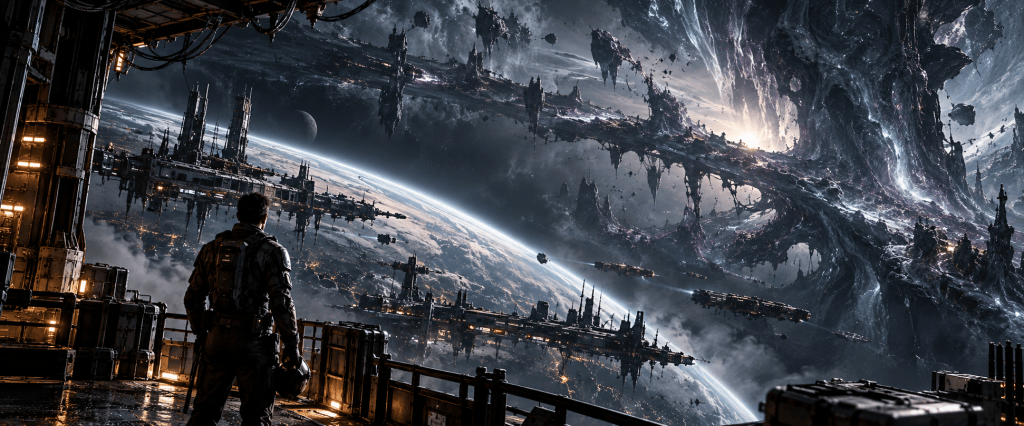
Across hundreds of inhabited star systems, humanity has built a civilisation dependent upon cargo fleets, industrial stations, military protection and an immense network of interstellar gates. Goods move between governments that distrust one another, ships cross borders under complex agreements, and entire populations rely upon distant infrastructure continuing to function. The arrangement has endured long enough for its weaknesses to become familiar parts of daily life. Then an unexplained crystalline residue begins appearing inside the very machinery holding human space together. At first, the warnings resemble routine failures: an irregular pressure reading, a delayed system response, an unexplained change in temperature, a voice where every communications channel should be silent. The consequences eventually reach far beyond any vessel, station or government, forcing humanity to confront a catastrophic process whose purpose lies outside its understanding.
A civilisation held together by vulnerable systems
Harbinger Protocol follows a human civilisation that has travelled far beyond Earth while retaining the rivalries, obligations and competing interests that shaped its earliest expansion. Trade routes connect mining settlements with industrial worlds and wealthy central systems. Long-haul crews work through ageing machinery, military vessels patrol politically sensitive corridors, and distant authorities negotiate access to the gates that have made interstellar society possible. Vast distances have become manageable through human engineering, although the stability of everyday life depends upon thousands of linked systems operating as expected. When one part fails, the damage rarely remains confined to the place where it began.
The series moves through those connections as a developing crisis spreads from an ordinary salvage decision into inhabited systems, contested borders and the foundations of interstellar travel. Each emergency presents itself to the people involved in a recognisable form: industrial contamination, suspected sabotage, disputed military evidence, a breakdown in quarantine or an escalating territorial confrontation. Investigators work with incomplete records, commanders make decisions under time pressure, and governments filter frightening evidence through existing political concerns. The growing disaster is shaped as much by humanity’s response as by the strange material at its centre. The more desperately civilisation attempts to restore order through its established systems, the more those systems become involved in the spreading catastrophe.
The first warning: The Red Titan
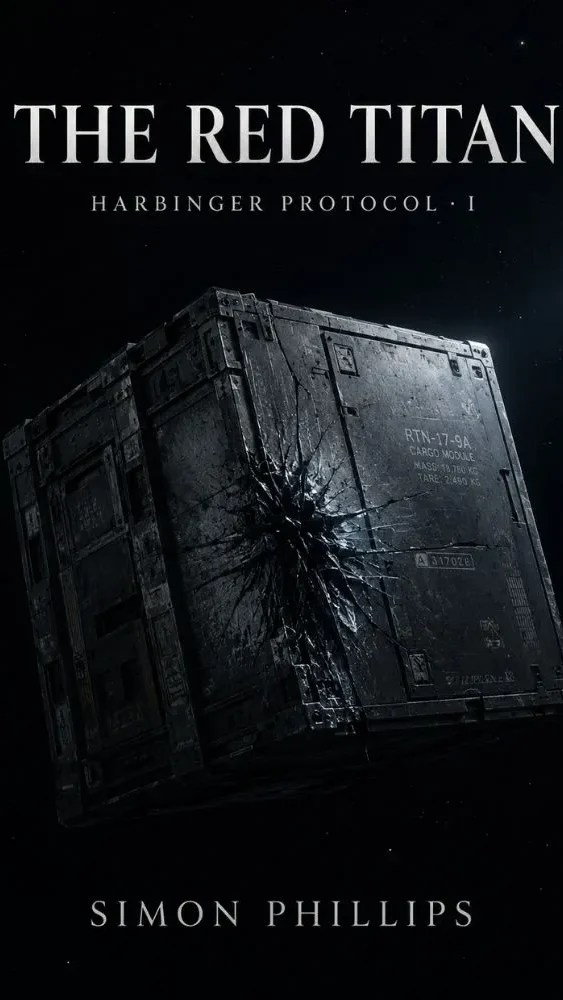
The story begins aboard the Red Titan, an ageing civilian freight vessel whose crew understand the small failures and compromises of life along the outer routes. Soren Vale serves among people accustomed to difficult schedules, worn equipment and the practical demands of keeping cargo moving. When the freighter recovers a drifting container near a Republic border route, its surface carries dark residue that appears harmless in the cold. Bringing the salvage aboard exposes the contents to a working ship’s warmth, air and pressure. From that point, minor anomalies begin gathering into a pattern: instruments return uncertain readings, crew members experience unexplained symptoms, and black crystalline growth reaches the ventilation and engineering systems. A vessel built to sustain life gradually becomes an environment its crew can barely recognise.
The disaster establishes the human scale of Harbinger Protocol. People respond according to their training, their loyalty to one another and the limited evidence available at the time. Routine concerns over schedules and quarantine delay decisions that may have contained the first exposure, while the ship’s circulation systems provide routes far beyond the original cargo bay. Soren recognises changes in heat, airflow and structure before the instruments can offer a complete explanation, yet recognition offers little protection when authority and machinery begin failing together. His survival carries the story beyond the wreck of a single freighter and into a growing body of incidents scattered across human space.
Soren Vale: a witness inside the collapse
Soren Vale remains the human centre of the twenty-book saga. He begins as a trained security officer whose strongest ability lies in paying attention to the physical details people learn to overlook. A hesitation in a door mechanism, a slight change in recycled air or an instrument correcting itself too quickly can matter more to him than an apparently reassuring status report. These instincts give him an unusual ability to recognise the earliest signs of contamination, although his position places him among the people expected to follow orders and carry out the decisions of others. His journey is shaped by the distance between seeing what is happening and possessing the authority to prevent its consequences.
After the Red Titan, Soren’s testimony becomes valuable to the Earth Strategic Coalition. Protective review leads to restricted movement, repeated questioning and a provisional role alongside military and technical personnel investigating related incidents. Aboard the peacekeeping cruiser Leda Ark, he encounters officers who understand the weight of command, engineers whose equipment can awaken the danger they are studying, and legal specialists attempting to preserve evidence across hostile jurisdictions. Commander Rhys, Major Teren Voss, engineer Kell, Lieutenant Marris and Commander Edda Pell bring different forms of expertise and responsibility into that world. Their professional judgement matters, and so do the human costs of decisions made under uncertain conditions.
As the disaster extends from isolated ships to the collapse of entire systems, Soren becomes an investigator, a reluctant operational asset and eventually the Last Witness of the Harbinger Protocol. He observes military action from within the limited perspective of the people living through it, learns how classified reports can conceal the suffering recorded beneath them, and carries the memory of individuals whose deaths have become brief entries in official files. His resilience comes through endurance, observation and an increasingly independent moral judgement. By the final movement, the knowledge he carries reaches further than the governments that once controlled his testimony, even as his power over the approaching events remains painfully limited.
The pattern widens: silent stations and damaged warships
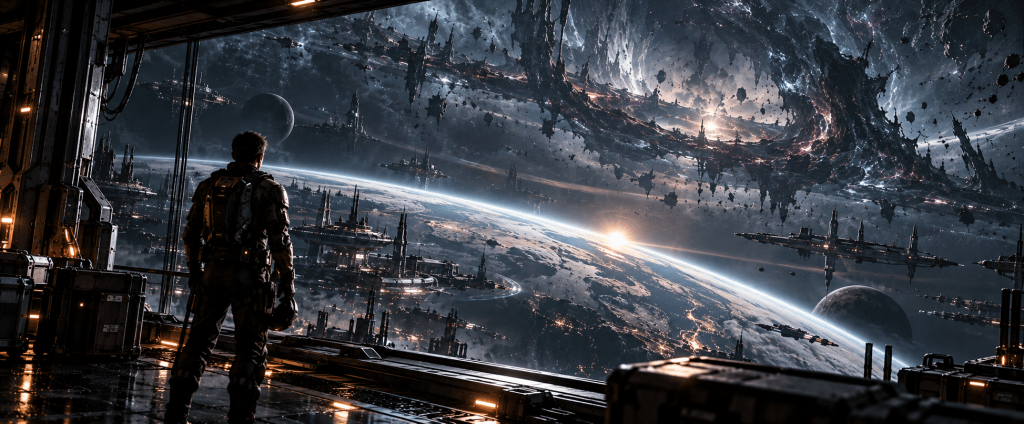
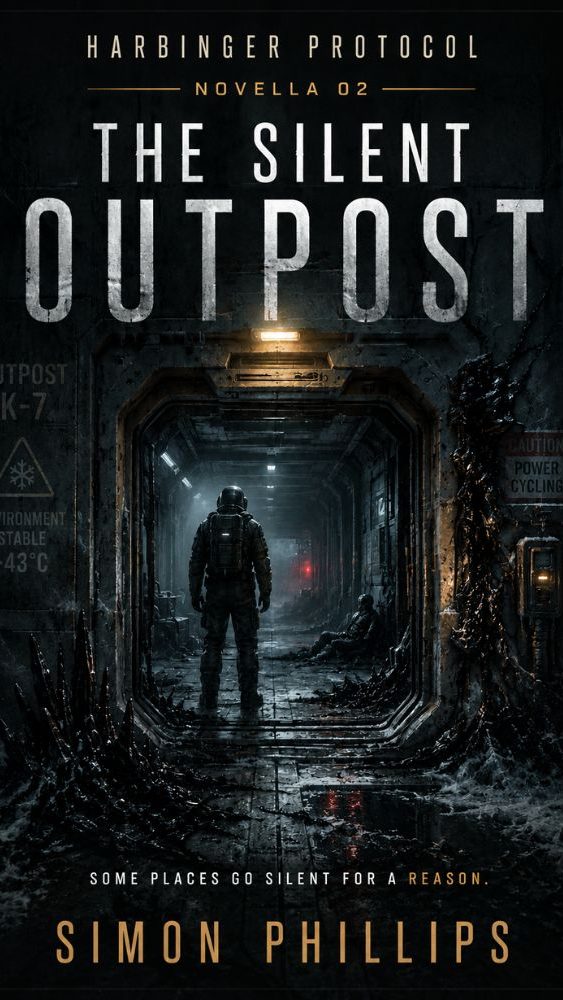
The next incidents reveal the danger extending through human industry and military infrastructure. At Kheled Verge Processing Station Nine, an outpost falls silent while sections of its machinery remain suspended in a state of apparent inactivity. The investigative team discovers people frozen near ventilation grilles, personnel records that place human bodies inside structural cavities, and old systems responding as though the boundaries between crew and station have dissolved. A limited attempt to restore power turns the outpost into a far more dangerous environment. The need to search for survivors comes into direct conflict with the risk of carrying contamination back into inhabited traffic, leaving the people involved to live with the consequences of containment.
Beyond the outpost, a damaged Federation battleship becomes the centre of a confrontation with Star Kingdom forces. Its surviving compartments hold crew remains, active machinery, protected military information and evidence that contamination has reached deeply into the ship’s structure. Ordinary preservation procedures supply power and environmental conditions to systems already changed by the growth. Investigators must distinguish genuine human survival from biological activity sustained by machines, while rival authorities disagree over ownership, evidence and the right to destroy a suspected hazard. The incident exposes a wider danger: an infected vessel can be lost in battle while contaminated wreckage enters the repair and recovery networks intended to keep other ships alive. Each successive disaster makes the original freighter incident feel like the first visible part of a process already moving across human space.
The biomass: a living change in the machinery
At the centre of Harbinger Protocol lies a crystalline-organic substance whose behaviour emerges through contact with its environment. Its earliest form can resemble lifeless dust or industrial residue. Heat, oxygen, pressure and electromagnetic activity provide conditions for growth, allowing the material to attach itself to metal, tissue, conduits and the countless surfaces inside working vessels. Cooling and isolation may slow its activity, while a restored power circuit or reopened ventilation route can bring apparent safety to an abrupt end. As contamination develops, human bodies, medical equipment, doors, coolant systems and control machinery can become parts of a shared altered structure. The result is intimate physical horror arising from familiar places: a maintenance passage, an occupied bunk, a medical bay or a pressure door that has continued carrying out its ordinary function.
As the series advances, the biomass begins forming increasingly complex patterns across ships, industrial installations, cities and planetary environments. Distributed networks appear where once there were separate machines and living organisms. Structures develop connections that reach across entire settlements, and the phenomenon eventually interacts with the electromagnetic systems governing interstellar transit. Human observers interpret this growing coherence as evidence of planning or strategic intelligence. Its underlying behaviour, however, follows adaptation, environmental pressure and large-scale pattern formation. What appears to be a campaign against humanity is part of a much older process whose scale has exceeded the categories used to investigate it.
Voices that reach through the walls
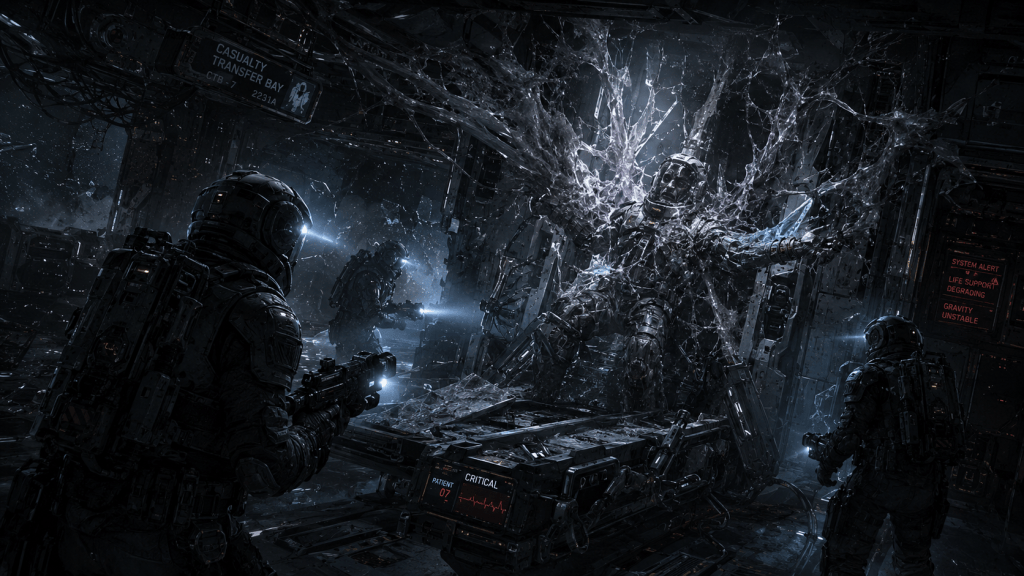
One of the most disturbing signatures of the contamination is the appearance of human voices in places where reliable human communication has ceased. A name seems to pass through a ventilation grille, an old order emerges from a damaged speaker, or the sound of somebody pleading for help reaches a sealed compartment. Airflow, corrupted recordings, electrical activity and remnants of biological response can combine to produce sounds close enough to speech for a frightened person to recognise them. Someone approaches a hatch because they believe a survivor remains beyond it; a rescue team hesitates because a dying voice appears to be answering its call. The phenomenon exploits a vulnerability created by human perception and compassion, even though the process itself has no human intention. For Soren, each unanswered voice becomes part of the moral burden he carries from one incident into the next.
Governments with power and too little understanding
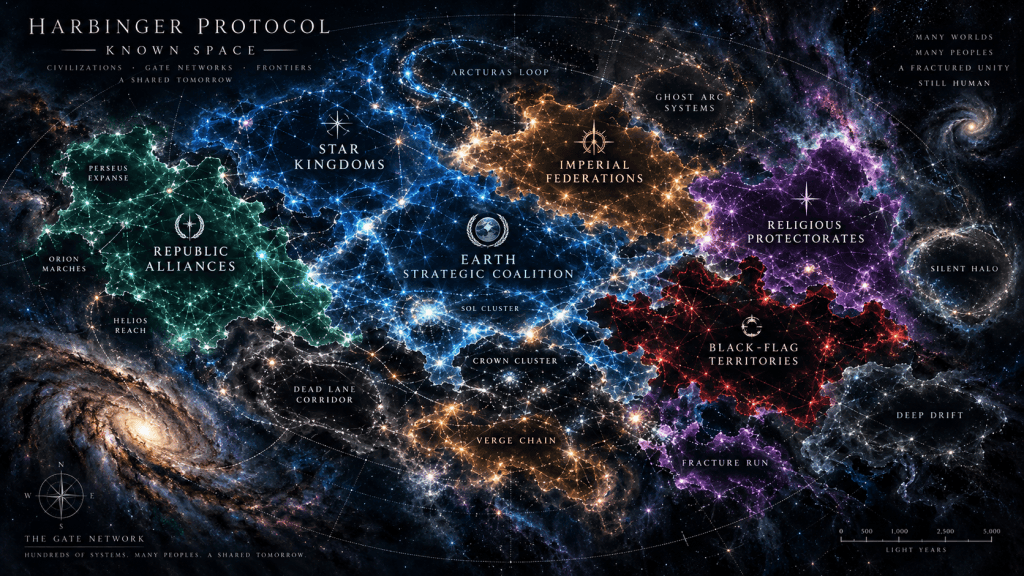
The Earth Strategic Coalition stands at the centre of much of humanity’s interstellar order. Originating from Earth and the Solar System, it commands formidable naval strength, operates peacekeeping stations and exercises considerable influence over security, emergency response and gate regulation. Its reach allows it to send investigators and containment forces into crises that smaller governments struggle to manage. That same reach produces suspicion, resentment and disputes over whose laws apply when a vessel, station or world becomes dangerous. The Coalition’s officers are capable of courage, care and professional restraint, yet the institution often turns uncertainty into classified procedure long before anyone has understood the event being classified.
Beyond the Coalition lies a patchwork of competing powers. The Star Kingdoms protect hereditary authority and territorial sovereignty, while the Imperial Federations combine industrial interests, corporate control and powerful political families. Republic Alliances depend upon autonomy, trade and negotiated cooperation, creating humanitarian strengths alongside difficulties in achieving a common response. Religious Protectorates approach contamination through strict isolation and doctrines of purity, while the Black-Flag Territories sustain salvage and transport networks operating beyond dependable regulation. Each government sees the same threat through its own history and obligations. A contaminated ship may be treated as stolen property, a weapon, a quarantine violation or evidence of an enemy’s aggression, and the disagreement can become dangerous before the underlying facts emerge.
Across the saga, political fragmentation moves from background tension into one of the central forces of disaster. A quarantine decision can strand civilian ships belonging to rival authorities. Destroying a compromised station may protect a trade route while creating a diplomatic crisis over the people left behind. Military action against contaminated wreckage can place other vessels at risk, and the resulting accusations encourage secrecy at precisely the moment when shared evidence becomes essential. The governments possess ships, weapons, surveillance systems and the power to impose extraordinary restrictions on their populations. Their difficulty lies in recognising a phenomenon whose behaviour continues changing beyond the assumptions on which that power was built.
The gates: civilisation’s greatest strength and deepest vulnerability
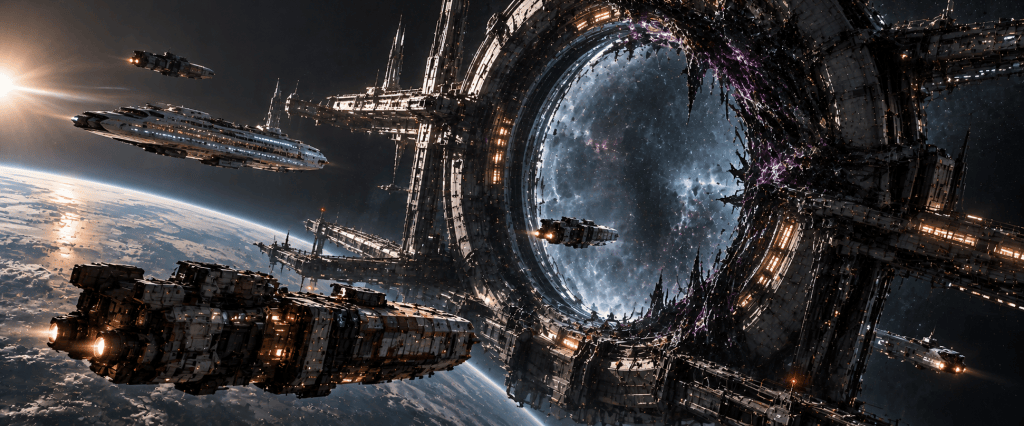
Human space depends upon an extensive network of fixed interstellar gates capable of transferring vessels between connected systems almost instantly. Civilian ships following slower routes may spend weeks or months in transit, while military fast-burn vessels can answer emergencies across far greater distances. The gates compress the practical size of civilisation, linking distant families, supply chains, commercial markets and political territories through shared passage. Around them sit customs stations, transit holding areas, maintenance crews, quarantine authorities and the administrative systems needed to control constant movement. The network is an achievement of human engineering, and its operation shapes almost every aspect of the societies built around it.
Once contamination begins interacting with gate infrastructure, the practical meaning of distance changes. A failure in one part of the network can isolate inhabited worlds, divert refugee movements, strand military formations and disrupt the flow of food, medicine and industrial supplies. Attempts to seal routes may preserve some populations while abandoning others to conditions beyond their control. Later incidents bring wider electromagnetic disturbances, unstable transit geometry and corridors that behave in ways existing models struggle to explain. The structures that made civilisation possible become sites of uncertainty on a scale few governments can manage. Every gate closure carries a human cost, and every attempt to preserve the remaining routes risks drawing the disaster closer to the systems still connected.
When containment becomes a catastrophe of its own
Harbinger Protocol follows the decisions people make when every available response carries danger. Quarantine can slow an outbreak while separating families and leaving trapped crews beyond rescue. A containment strike may destroy an immediate hazard while scattering contaminated fragments across a crowded route. Weapons powerful enough to disable a warship may spread crystalline material through the surrounding environment, and military commanders can find themselves fighting rival fleets over evidence they barely understand. These events unfold through restricted communications, delayed reports, damaged vessels and the people waiting for orders that will change their lives. The consequences remain long after the tactical situation has passed.
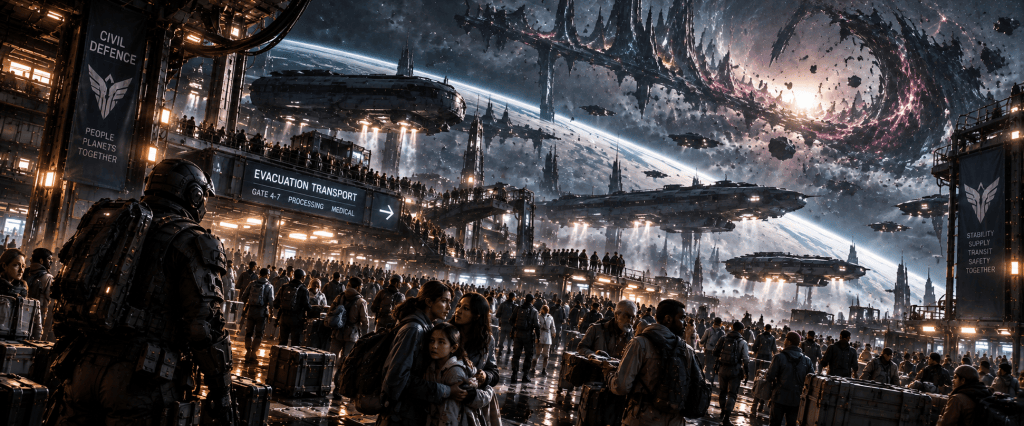
As the crisis reaches inhabited planets, emergency doctrine becomes an examination of political legitimacy. Governments authorise the destruction of stations, habitats and transport infrastructure in the hope of holding a contaminated boundary. The saga eventually reaches the point where an infected world is destroyed under the authority of its own government, a decision that carries profound consequences for the relationship between a state and the people it exists to protect. Elsewhere, refugees gather around failing routes while neighbouring powers debate who possesses responsibility for receiving them. The machinery of survival has become a source of coercion and abandonment, exposing the cost of applying familiar solutions to a danger whose true purpose remains hidden.
Beyond the scale of human civilisation
The later books push the crisis beyond the industrial spaces where it first appeared. Contaminated cities and dead systems develop vast patterns of connected structure, and disturbances in the gate network begin affecting the experience of space and time. Corridors repeat, gravity becomes unreliable, signals arrive under impossible conditions, and journeys once measured by dependable routes acquire disturbing uncertainties. Even here, the experience remains grounded in the people travelling through these places: crews checking their instruments, families waiting aboard evacuation vessels and investigators trying to preserve a coherent record as their surroundings change. The scale expands through what people can touch, hear and lose.
Eventually, the Harbinger Objects emerge: immense formations of biomass incorporating the remnants of ships, cities, living systems and matter gathered across earlier stages of transformation. To human observers, their movement and apparent organisation suggest deliberate hostile power. Evidence gradually points towards a very different explanation. The objects are components of a defensive system created by a vanished civilisation confronting a cosmic collapse wave, a threat capable of disrupting reality at a scale beyond the reach of human warfare. The biomass has been developing the structures required to resist that approaching event. Humanity has spent generations building its civilisation in the path of an ancient mechanism now assembling to perform the work for which it was created.
The final revelation changes the meaning of the entire disaster. The crystalline growth that consumed crews, altered worlds and compromised the gate network is part of a protective firewall whose operation places the survival of civilisation far below the demands of its larger purpose. The Harbinger Objects gather into the Luminous Veil as the collapse wave approaches, forming a barrier that allows humanity to endure a catastrophe it could never have defeated through its own weapons or political authority. That survival comes after irreparable losses, broken governments and the destruction of much of the world humanity knew. Even as the Veil holds, signs of fracture remain, and Soren’s final warning travels beyond mapped space towards whatever may still be capable of receiving it.
Published Books
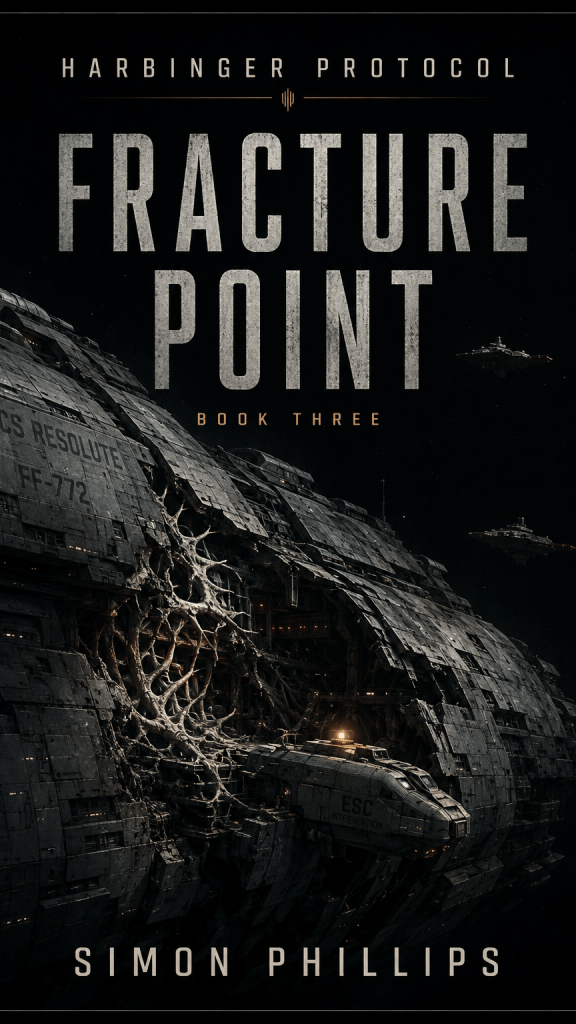
Read the Series on Amazon
If you are beginning Harbinger Protocol, start with The Ash in Transit, then continue directly into The Silent Outpost. The first two entries establish the series’ core horror: industrial environments turning unsafe, systems lagging behind truth, false voices reaching through vents and speakers, and Soren Vale becoming the witness who understands that each incident belongs to something larger.
Latest from the Harbinger Protocol World
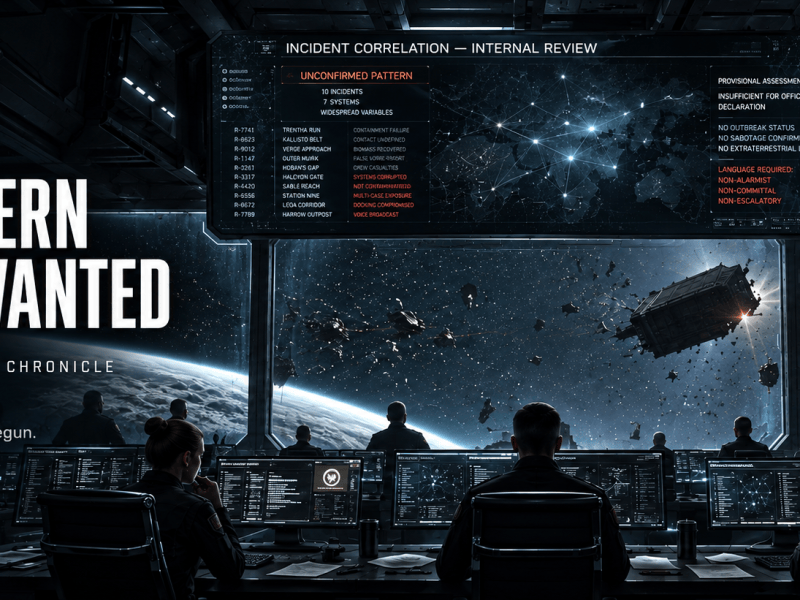
The Future Chronicle: The Pattern No One Wanted
Ten incidents. Different ships, stations and authorities. The same residue, delayed systems, cold suppression, distorted voices and trusted machinery behaving just slightly wrong. ESC command can finally see the pattern. The problem is finding words strong enough to warn people without claiming more than the evidence can prove. Then another salvage alert arrives. Read The…
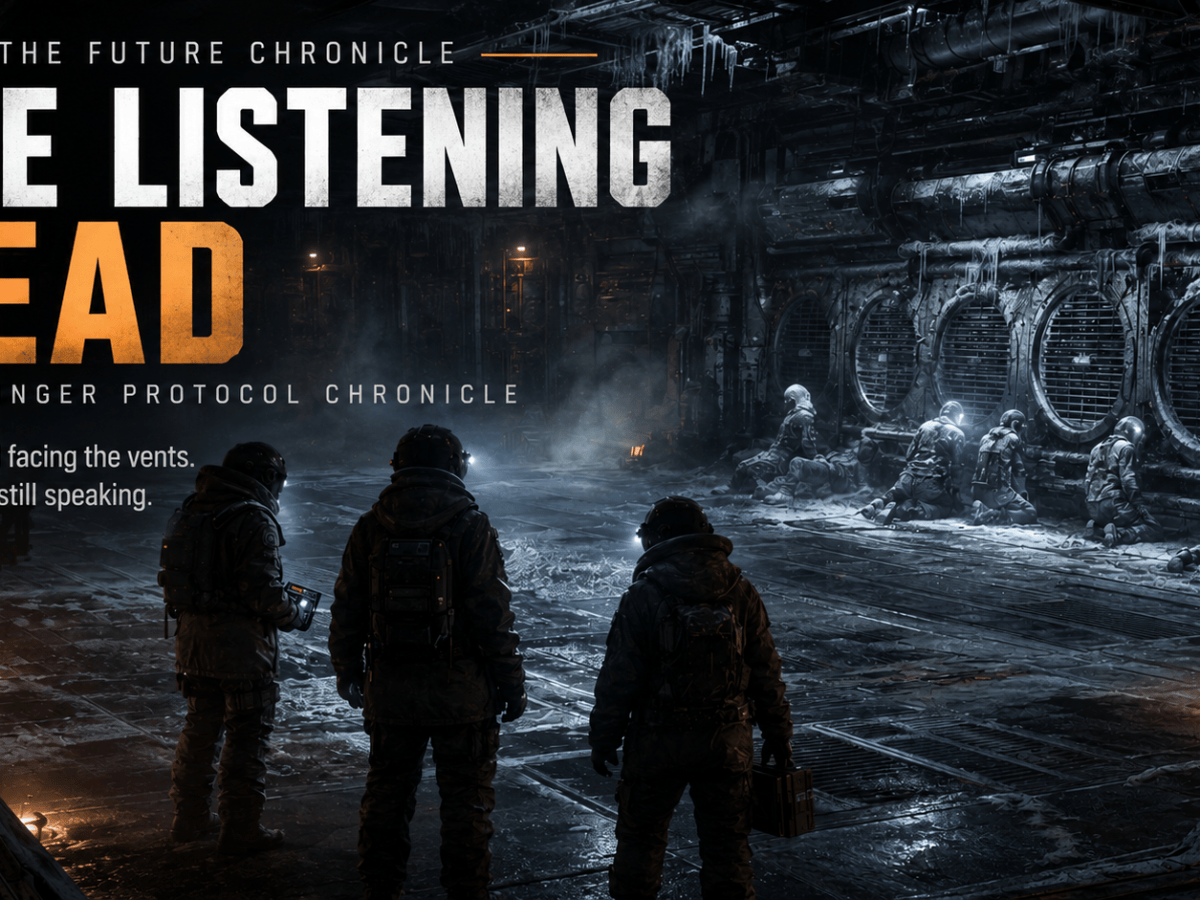
Harbinger Protocol Chronicle: The Listening Dead
Fourteen workers vanished from Morrow Auxiliary Four without an evacuation alarm, decompression event or distress call.
When an ESC response team entered the frozen station, they found the missing crew gathered beside ventilation grilles, their bodies turned towards the machinery as though they had spent their final hours listening.
Then the responders heard it too.
…
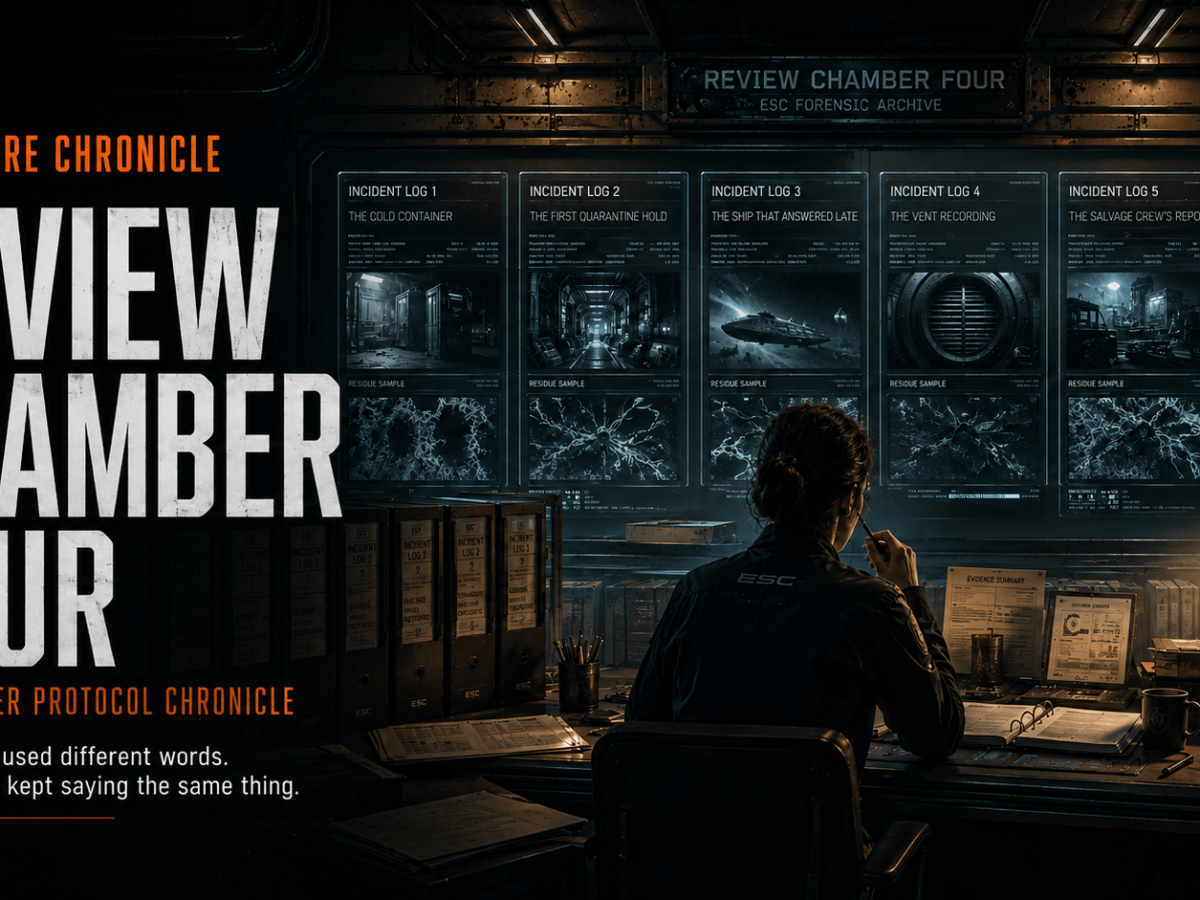
The Future Chronicle: Review Chamber Four
Six incidents. Six departments. Six carefully chosen explanations.
A cold container. A quarantine pod. A cargo drone answering late. A voice in a vent. A salvage crew hearing the dead. A mining relay correcting its own warnings.
Inside Review Chamber Four, the files are finally placed side by side, and the language designed to keep…
