Ashfall Station Still Works, Which Is Part of the Problem
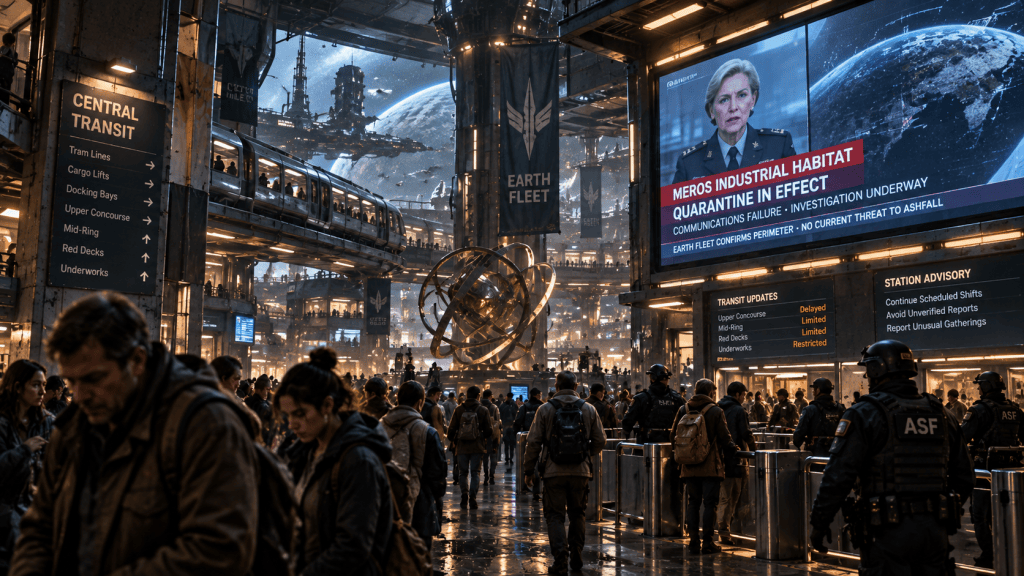
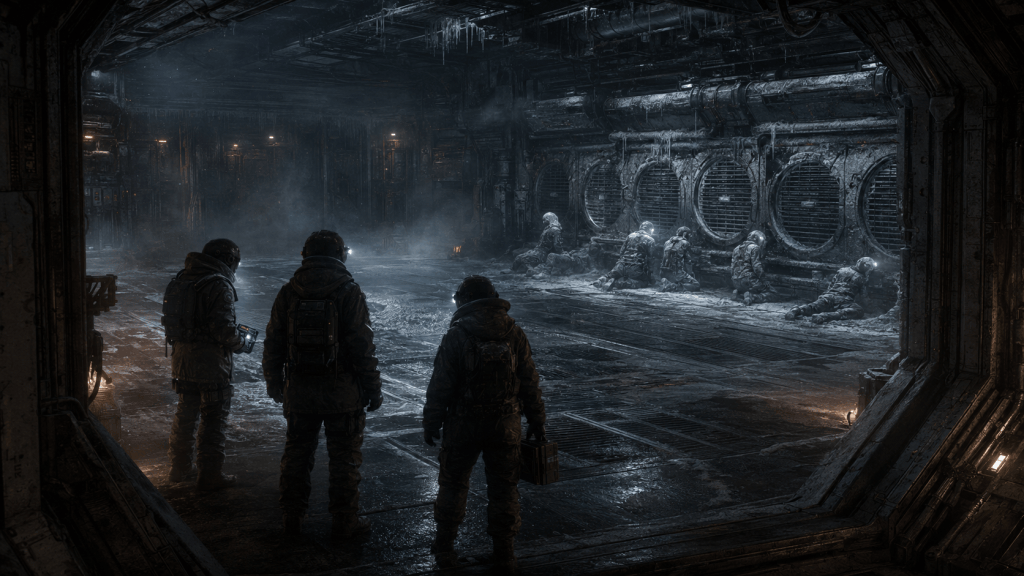
Ashfall Station has never needed complete collapse to become dangerous. Its lights still come on, even if some sectors receive steadier power than others. Lifts continue to move through the structure, workers report for shifts, ration systems issue allowances, security checkpoints recognise approved credentials and Earth Fleet broadcasts arrive with carefully measured assurances. The station survives because enough of its machinery continues functioning to keep more than a hundred thousand lives moving through another cycle, even while confidence in the institutions controlling that machinery steadily weakens.
That tension lies at the centre of Ashfall Files, a science fiction noir series built around Detective Ruff Kale and his partner, Lena Marik. Their investigations take place aboard an ageing orbital station where overcrowding, ration pressure, damaged infrastructure and political control have become part of ordinary life. Crime rarely arrives from outside that environment. It grows from the same shortages, employment fears, hidden transactions and institutional compromises that shape the lives of the people Ruff questions every day.
The result is a form of dystopian detective fiction where solving an immediate crime rarely repairs the conditions that allowed it to happen. A missing person can reveal weaknesses in an employment system. A damaged wall can expose who controls access to information. A frightened witness may know more than an official record because the witness still remembers the person whom the record has begun turning into an administrative problem.
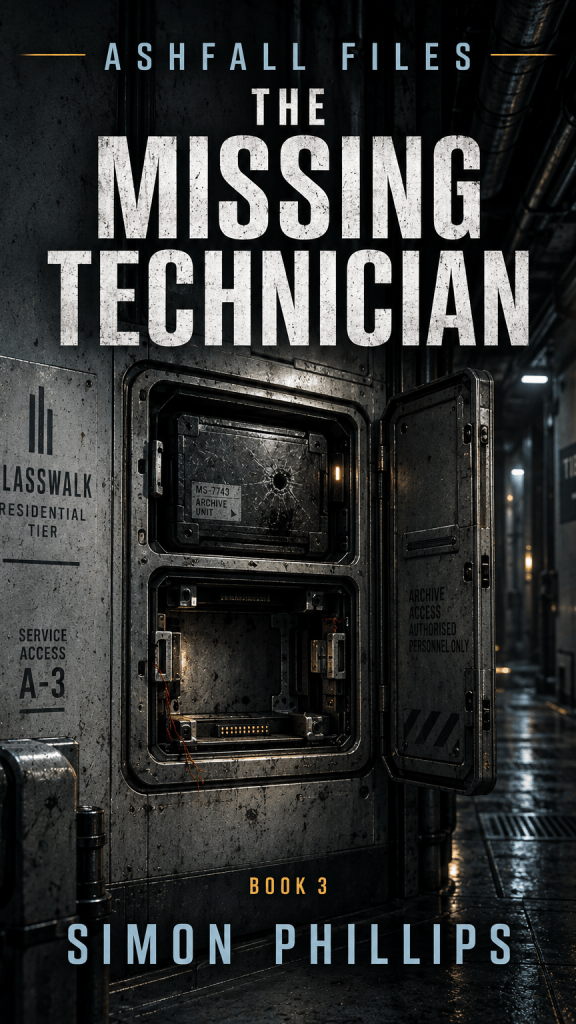
In The Missing Technician, the third Ashfall Files book, that conflict begins in one of the station’s most protected environments.
A Gunshot Behind Glasswalk’s Closed Doors
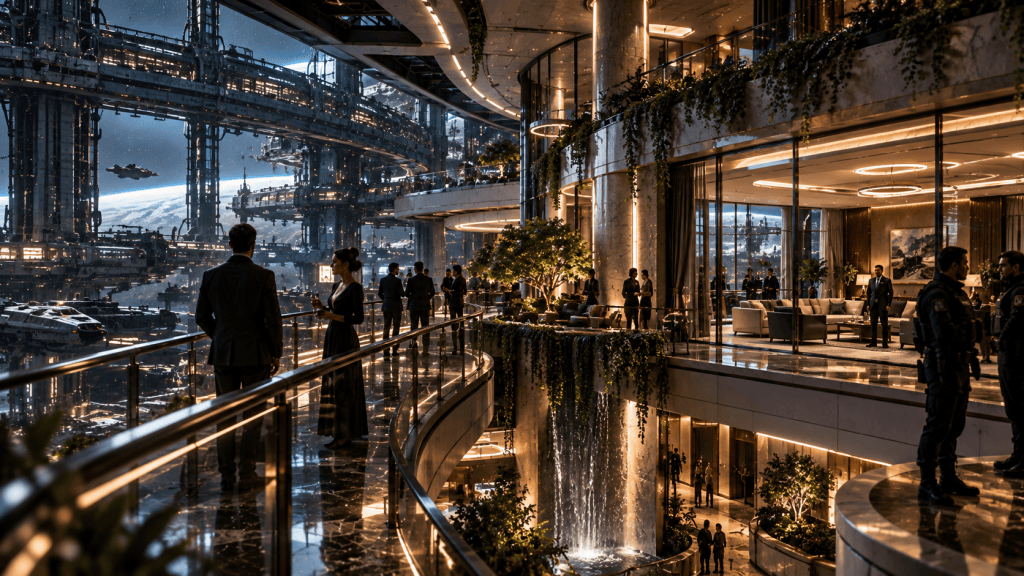
Glasswalk feels almost separate from the Ashfall surrounding it. The lighting remains steady. Ventilation works quietly enough to disappear into the architecture. Real soil supports carefully maintained plants, corridors have room to breathe, and fitted surfaces hide the industrial skeleton that remains visible across poorer parts of the station. Ruff enters the district while Earth Fleet broadcasts continue describing the loss of contact with Meros Industrial Habitat as a communications irregularity under temporary quarantine, language calm enough to create suspicion rather than reassurance.
Inside that controlled environment, a live firearm has been discharged in the home of Ilan Mercer, a wealthy resident with political connections and influence over infrastructure contracts. Mercer believes an armed intruder entered his study and attempted to kill him. Glasswalk security begins treating the incident as an assassination attempt almost immediately, while wider anxiety around Meros encourages political explanations before Ruff and Lena have reached the room.
The physical evidence refuses to settle comfortably into that version.
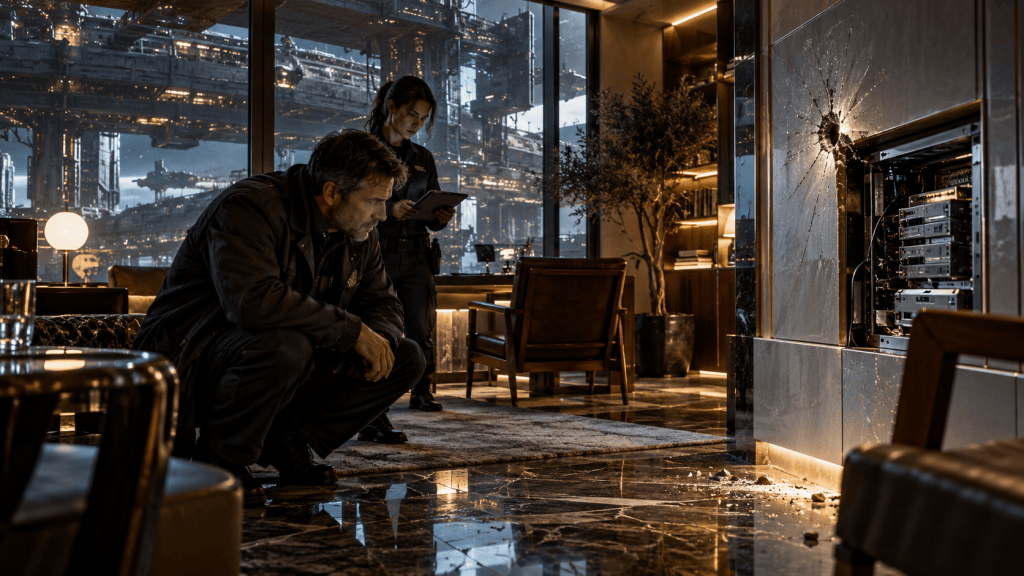
Cleaning solution has been worked into the floor near the threshold. A chair has been moved and returned close to its original position. The line between Mercer’s claimed attacker, his own position and the bullet strike becomes increasingly difficult to reconcile. When Lena reconstructs the trajectory and Ruff studies what the room itself has retained, the probable firing position shifts away from the outer doorway and further inside the study.
The bullet has also struck something more important than a decorative wall.
Behind the fitted panel sits Mercer’s residential access archive, a system holding local records of residence entries, visitor clearances and security validations. Its two mirrored stores should protect the archive against a single damaged component. One has been hit by the round. The other has already been removed.
The technician sent to inspect the damage was Niko Sarr.
By the time Ruff and Lena ask where he went, the station’s records have started producing answers that fail to describe any place where a human being can actually be found.
When a Missing Worker Becomes Employment Language
Sarr’s disappearance carries much of the book’s pressure because it occurs inside systems designed to record movement.
His service history confirms that he accepted the emergency inspection, reached the rear of Mercer’s archive and completed work there. The surviving archive store was released using his credentials, yet no ordinary custody chain records where it went. Soon afterwards, his rota changes, his access is suspended and his location disappears. Administrative entries begin describing leave, reassignment and an eventual external transfer, while people who worked beside him remember a technician who arrived for his shift and expected to return to his ordinary routine.
That contrast gives The Missing Technician its strongest form of institutional menace. Nobody needs to announce that Sarr has been erased. His disappearance can be absorbed into apparently ordinary processes. A supervisor receives an instruction. A locker is cleared. A tool return appears under the missing worker’s credentials. A record describes voluntary leave. Another field prepares a destination that lacks a receiving department.
Each alteration makes the absence easier to explain while making the person harder to find.
For Ruff, that distinction matters. Sarr cannot simply become an unavailable contractor because the words fit comfortably inside a report. Somebody saw him carrying a protected archive sleeve. Somebody saw a security escort beside him. His tools tell their own story, including a diagnostic bridge returned under circumstances that contradict his habits and an archive key that remains missing. Workers remember what the system is beginning to deny.
Ashfall’s technology therefore becomes part of the detective work rather than an effortless answer to it. Live systems can be altered. Local records can preserve fragments. Physical components retain marks long after an authorised screen has changed its account. The investigation has to move between those forms of evidence while Ruff and Lena decide which version deserves trust.
The Working Station Behind the Polished Walls
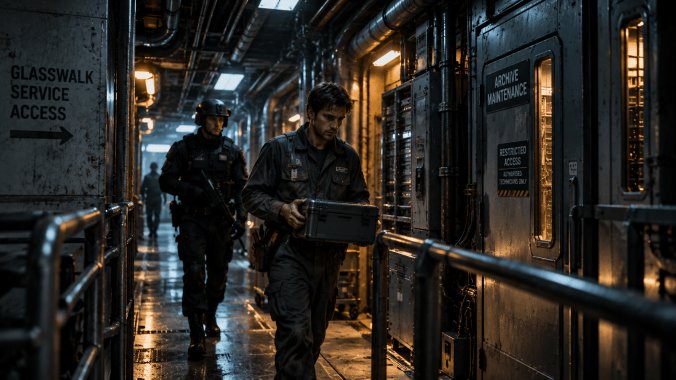
Glasswalk also reveals one of Ashfall Files’ recurring social divisions. Its residents experience the station through clean surfaces, privacy rules and layered protection, while the people maintaining those comforts travel through narrower service passages behind the walls.
Once Ruff, Lena and their Glasswalk liaison Eris Quell move into those spaces, the district begins looking much more familiar. Exposed conduits replace decorative panels. Equipment cages line worker routes. Shift notices change under Fleet readiness orders. Staff worry about delayed transport into Mid-Ring and what another extended shift will mean for their ration allowances, while residents continue moving through rooms designed to keep the supporting machinery out of sight. The book repeatedly allows the political world to enter through these practical consequences rather than through distant speeches or military spectacle.
That difference matters because Ashfall’s inequalities are structural. Work, housing, food, medical access and security vary according to where someone lives and what value the station assigns to their labour. Lower-sector workers can lose access to rations or housing when employment changes, while protected residents have legal offices, privacy classifications and institutional channels ready to respond when their interests are threatened.
Sarr exists on the vulnerable side of that arrangement.
Mercer remains surrounded by representation even while his account develops contradictions. Sarr can disappear while his employment history changes behind him.
The investigation never needs to state that difference as a slogan. It emerges through who receives time, whose records are protected, whose belongings are packed away and whose absence can be converted into routine administration.
Ruff Kale Reads What the System Leaves Behind
Ruff remains useful because he understands Ashfall through years of accumulated experience rather than through the confidence of its databases.
He notices discomfort in people who have rehearsed the correct answer. He studies marks on floors and equipment before accepting the record attached to them. He recognises when cleaning has removed too much, when an object has returned almost to the place where it began, and when somebody’s concern has shifted away from the danger they claim matters most.
His approach gives Ashfall Files its noir foundation. The station is full of systems capable of presenting authority, yet Ruff has spent too long watching those systems fail ordinary people to believe that an official result carries truth simply because it appears on a screen.
In The Missing Technician, his attention repeatedly returns to physical disturbance. The chair inside Mercer’s study matters because somebody moved it. The cleaned threshold matters because residue once existed there. The empty archive cradle matters because the bullet never touched it. The fibre caught beneath Sarr’s returned diagnostic bridge matters because it suggests how the tool travelled after its owner vanished.
These are small details compared with the wider political pressure surrounding Ashfall, yet they are precisely where the story remains grounded. Ruff reaches larger questions through the damage left in front of him.
The Book 3 continuity report describes his strength as an ability to recognise where a controlled environment has been physically disturbed, even while exhaustion, a persistent headache and a tremor in his hand remind the reader that the detective himself is carrying the cost of everything that has already happened.
Lena Marik Preserves What Others Would Separate
Lena approaches the same environment differently.
Where Ruff sees the inconsistency, Lena works to keep that inconsistency from disappearing.
She records access refusals, secures witness statements, preserves changing timestamps and distinguishes between what the evidence proves and what suspicion merely suggests. When Sarr’s terminal continues altering his employment history during an active investigation, she isolates the system while preserving its local cache. When supervisors stand close enough to influence nervous workers, she keeps individual accounts separate. When Glasswalk challenges the investigation, she records who issued the restriction and under what authority.
Her procedure has changed considerably from the simple confidence in rules that defined her earlier place within Ashfall. By this stage, she understands that procedure can protect evidence while another part of the same institution uses procedure to protect power. The value lies in recognising that difference.
That gives Ruff and Lena a partnership built around complementary weaknesses and strengths. Ruff reads human behaviour, physical spaces and the station’s unofficial habits. Lena creates a record capable of surviving the challenge that follows. The series dossier establishes this gradual movement from an unequal working arrangement towards real interdependence, with Lena becoming increasingly active while Ruff begins relying upon the stability her presence provides.
Their success also remains limited by the system surrounding them. Preserving evidence does not guarantee public truth. Sometimes it only ensures that the truth still exists somewhere after somebody has finished rewriting the explanation.
Earth Fleet, Meros and the Management of Uncertainty
Beyond the immediate investigation, Meros continues exerting pressure without becoming the case itself.
Earth Fleet confirms communications loss, a quarantine perimeter and regional restrictions while leaving crucial questions unanswered. No confirmed casualty count reaches the public. Rescue movements remain classified. Rumours pass through civilian channels more quickly than official information, encouraging crowds to gather around screens and forcing ASF officers away from ordinary patrols.
Ashfall already has an information culture built around that distrust. Fleet bulletins and station broadcasts compete with dockside rumours, whispered accounts, black-market data and conversations passed between workers who have learned to judge official language against what they can see happening around them.
The Missing Technician uses that atmosphere carefully. Meros never becomes a convenient explanation for Mercer’s shooting, and Ruff, Lena and Pike repeatedly resist attempts to force the larger crisis into evidence that has yet to support it. Instead, Meros changes the conditions around the investigation. Patrols move elsewhere. Transport becomes restricted. Workers remain on extended shifts. Rumours create political fear. Glasswalk gains another reason to tighten access.
The external crisis therefore makes local concealment easier.
That is how political pressure often enters Ashfall Files. The wider world rarely arrives as spectacle. It appears through a closed lane, a delayed medicine shipment, a reassigned officer or an official phrase that gives frightened people less information than the rumour already moving through the queue beside them.
The Missing Technician and the Wider Ashfall Files Story
The Missing Technician is Book 3 of Ashfall Files, continuing the investigation that began with the unidentified woman found in Sector Twelve and developed through the hidden routes crossing parts of the station.
The third book moves that larger mystery into a different social environment. The trail reaches Glasswalk, where records, professional access and protected institutions carry greater authority than anything available in Ashfall’s poorer sectors. Sarr’s disappearance creates the immediate case, while the evidence he was examining begins reconnecting that disappearance to the unanswered questions Ruff has carried from Sector Twelve.
The connection remains controlled. The wider conspiracy is still incomplete. The encrypted material at the centre of the earlier case has yet to surrender all of its meaning, and the institutions operating beyond Ashfall remain only partly visible. What changes is the scale of the concealment Ruff can now recognise.
The first cases taught him that people and movements could vanish from ordinary station systems. The Missing Technician shows how sophisticated that disappearance can become when multiple records, employment structures and protected authorities begin reinforcing the same convenient account.
This is where the larger space station conspiracy grows from detective work instead of replacing it.
What Ashfall Chooses to Preserve
The most unsettling version of Ashfall is not a station plunged into darkness.
It is Ashfall with the lights still working.
A worker can disappear while his terminal continues producing administrative explanations. A protected resident can return to public respectability while questions remain inside a restricted file. A broadcast can reassure the population while carefully avoiding the questions creating the fear. Evidence can survive inside official custody while the public account loses almost everything that gave it meaning.
The station continues because people still maintain the air, repair the doors, move cargo, clean rooms, inspect archives and return to overcrowded homes at the end of shifts that keep growing longer. Those ordinary acts hold Ashfall together even as the institutions above them become increasingly concerned with managing the appearance of control.
Ruff and Lena work somewhere inside that gap.
They can preserve a witness statement. They can follow a damaged archive. They can prove that records changed. They can refuse to let a missing man become a line of employment terminology simply because somebody with greater authority has supplied the wording.
Whether any of that is enough remains a more difficult question.
Ashfall has entered the stage where truth rarely disappears all at once. It is divided, restricted, relabelled and moved far enough apart that most people never see the complete shape. The machinery carries on around it, the corridors remain occupied and the next shift begins beneath another official announcement, while somewhere inside the working station another record waits for somebody to notice that the story attached to it no longer matches the person who lived it.
A castle-side account of the hour Princess Elana returned beside a fallen magician, and the bells of Bremyra carried whispers of golden light through every guarded hall.
When the Inner Court Answered
Rain had begun to gather in the inner courtyard before the evening bell, laying a dark sheen across the paving and drawing warmth from every archway beneath Bremyra Castle’s western wall. Servants crossed between kitchen, armoury, stable, and upper hall with shoulders raised against the weather, while guards changed watch beneath dripping banners whose blue cloth clung heavily around the carved beasts of the royal house. Beyond the gate passage, the city descended towards the harbour through roofs, smoke, and mist, its lamps appearing one by one as daylight thinned across the sea, and within the courtyard the castle continued through ordinary burdens carried under cover: bread, coal, sealed messages, folded linen, and broth sent towards the council rooms where Prince Patrick had remained since news came from the Vaeldring road.
Maren Saye had spent the afternoon moving between the lower laundry and the western guest chambers, carrying sheets warmed near the drying hearth because the household expected survivors before nightfall. She was broad through the shoulders, grey beginning at her temples, and trusted with work that required a steady hand around blood, birth, fever, or noble grief. Beside her hurried Nessa, a chambermaid in her first winter of service, whose arms were filled with rolled blankets tied by blue cord. The girl watched every messenger who crossed the yard, reading calamity in mud-dark boots and closed faces, until Maren caught her staring towards the eastern passage.
“Keep your eyes upon the stones beneath you,” Maren said as she guided the girl around a widening puddle, her voice carrying the firmness of long practice. “A broken ankle will serve the royal house poorly, even on a night when every whisper claims the kingdom has ended.”
Nessa tightened her grip around the blankets and glanced towards the gate, where two mounted guards waited beneath the arch. “My cousin came from Grey Ash before the third bell,” she said as she walked close beside Maren. “He swore the Princess’s carriage lay upon its side and the grass burned green beneath the rain.”
“Your cousin swore last harvest that a white stag drank ale from the cooper’s trough,” Maren answered as she mounted the shallow steps towards the west door, though her gaze remained upon the waiting riders. “Carry what your hands can prove. Leave the rest for those paid to write frightened things into ledgers.”
The door ahead opened before they reached it, and Master Vaynor emerged beneath the arch with a clerk, two household guards, and a physician whose leather case struck against his knee as he walked. Vaynor wore no cloak despite the rain blowing through the passage, and the controlled stillness of his face placed silence around him more effectively than any shouted order. He spoke briefly to the captain at the gate, then turned towards the servants crossing the yard.
“Clear the western stair and prepare the old queen’s chamber,” Vaynor said as his hand settled upon the folded warrant carried by the clerk. “Fresh water, warmed linen, two braziers, and every lamp filled. The passage from this court to the upper rooms remains open for the wounded alone.”
Maren lowered the sheets against her apron and bowed. “The linen is ready, Master Vaynor,” she said as rain gathered along the loose strands of her hair. “Shall the Princess’s rooms be opened as well?”
Vaynor’s gaze paused upon her, and something beneath his restraint revealed how little certainty the castle possessed. “Her Highness returns to her own chamber once the physicians release her,” he said as he folded the warrant more tightly. “Until then, the old queen’s room receives whoever reaches us first.”
The answer travelled through every servant who heard it. A groom near the stable lowered the bridle he had been oiling. The kitchen boy carrying broth stopped beneath the covered walk. One of the gate guards turned towards the eastern road, his hand resting upon the pommel of his sword. The castle had spent hours preparing for riders, litters, bodies, perhaps a shattered carriage brought home under guard. No order had spoken of uncertainty over who might arrive first.
Nessa moved nearer to Maren as they crossed beneath the arch. “They have no word of her,” the girl murmured, shaping the fear carefully while the household officers remained close. “They have lamps, beds, and physicians, yet no word.”
Maren set the linen upon the passage bench and began untying the blue cord. “Then give your hands to the work waiting before them,” she said as she passed two folded sheets into Nessa’s arms. “Fear grows quickest in idle fingers.”
They had reached the first turn of the western stair when the air changed behind them.
The sound came as a deep inward rush, as though the whole courtyard had drawn breath through its gates. Lamps under the arcade bent towards the centre stones, rain lifted in a pale circle from the paving, and every horse beneath the stable roof pulled hard against its tether. Maren turned with one hand upon the stair rail as pressure passed through the archway, closing her ears and pressing cold against the roots of her teeth. A cry rose from the yard, followed by the scrape of boots and the bright ring of a sword half drawn before recognition stayed the hand that held it.
Two figures stood where the courtyard had been empty.
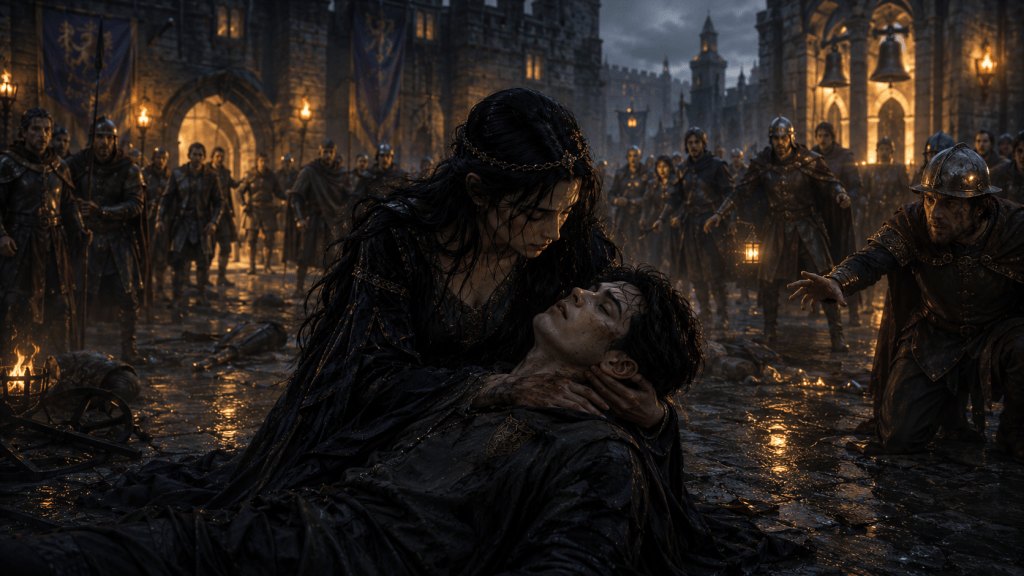
Princess Elana appeared first within the mind because midnight-black hair, torn court blue, and the silver clasp at her shoulder still carried royal identity through mud, ash, and rain. She leaned beneath the weight of the man beside her, one arm locked around his waist while his black robe hung scorched and wet around his legs. For a single breath they remained upright together, caught in the centre of the open court as guards, servants, clerks, and grooms stared across the stones. Then the magician’s knees failed, and Elana went down with him, turning his fall so his head came against her arm instead of the paving.
“Help me,” Elana called as she gathered him closer, her voice sharpened by exhaustion and command. “He is failing.”
Prince Patrick crossed the courtyard before the nearest guard had fully lowered his sword. He came from the council passage with his mantle unfastened and one hand bare where he had left his glove behind, his face altering as he saw his sister kneeling in the rain. He dropped beside her, reached once towards her shoulder, then drew his hand back as his gaze found the dark branching marks beneath Simion’s jaw.
“Elana, look at me,” Patrick said as he bent near enough to search her face while keeping the fallen man within sight. “Are you wounded?”
Elana lifted her eyes towards him, rain and ash streaking her cheeks as her hand remained beneath Simion’s head. “The blood on me belongs to others,” she said as she pressed two fingers against the magician’s throat. “Send for every healer in the keep. The poison has begun again.”
Patrick turned upon the gathered yard, and the brother who had reached for his sister vanished behind the prince required by the hour. “Physicians to the old queen’s chamber,” he ordered as he rose upon one knee. “Clear the western stair, close this court, and ring the inner bells for guarded return. Anyone carrying rumour beyond the gates answers to the crown.”
Master Vaynor pointed the waiting physician towards Simion, sent the clerk to bar the lower passage, and called two guards forward. “Maren Saye,” Vaynor said as he caught sight of her beneath the arch, his voice cutting through the rising confusion. “Take your linen upward. Keep the chamber ready and remove every servant who lacks direct purpose.”
Maren gathered the sheets while Nessa stood frozen beside her, the blankets sliding lower in her arms. “Move, child,” Maren said as she caught the bundle before it reached the wet flags. “You have seen enough to remember all your life. Give the rest of this hour room to pass.”
The physician knelt beside Simion and cut the robe away from the wounded shoulder, revealing flesh darkened around the broken shaft and veins stained like ink beneath the skin. His fingers hovered above the injury before he opened his case and drew out a narrow knife, waxed thread, and a packet of grey powder. Elana watched every movement, her posture held rigid through fatigue.
“He was struck beyond Grey Ash,” Elana said as the physician examined the wound, her hand closing around Simion’s cold fingers. “The arrow carried poison beneath the iron. It slowed once, then rose again when he brought us here.”
The physician looked towards her as rain traced the lines of his face. “What slowed it, Your Highness?” he asked while his thumb rested near the discoloured vein.
A stillness moved through those close enough to hear.
Elana lowered her gaze to Simion and drew his hand against the torn folds of her dress. “He fought it,” she said, each word quiet and controlled. “He remained alive long enough to bring us home.”
Patrick studied her for a breath, his expression carrying a question held behind royal discipline. He removed his mantle and spread the heavy wool across his sister’s shoulders, covering the ash, torn cloth, and blood upon her sleeves. “The rest waits until you are warm,” he said as he fastened the clasp beneath her throat. “Stay beside him if that is what keeps you standing.”
The guards lifted Simion upon a cloak stretched between their arms, moving with the care owed to a man whose life appeared to hang from every uneven breath. Elana rose beside them and swayed once before Patrick steadied her at the elbow. She refused the hand of the waiting maid and followed the litter towards the western passage, her black hair lying wet across the prince’s mantle while her gaze remained fixed upon the magician’s face.
The first bell sounded as they crossed beneath the arch, deep enough to shake rain from the stone tracery around the passage. A second answered from the inner tower, then a third from the ward beyond, each carrying the guarded signal across roofs and stairwells before spreading into Bremyra below. Servants paused in kitchens, galleries, laundries, and chapel aisles while guards closed doors whose bars had stood open since morning. Those in the courtyard watched the wounded magician disappear into the western stair beside the princess whom the road had already given up to rumour, and each person carried away a different memory of the return.
Nessa stood near the bench with one blanket held against her chest. “They came from the empty stones,” she said as Maren gathered the remaining linen. “No gate opened. No horse brought them. They were simply there.”
Maren looked across the rain-dark paving where water had already begun smoothing every mark around the place of their arrival. “Then speak only of what your own eyes held,” she said as she took the blanket from the girl and turned towards the stairs. “A princess came home. A wounded man came beside her. The bells rang after.”
Above them, the western passage filled with feet, commands, the clatter of basins, and the opening of a chamber long kept for royal illness. Below, the courtyard settled beneath rain and guarded silence, while the bells continued over Bremyra, carrying news farther than any officer could follow and giving the city a shape for its wonder before the castle had chosen which part of the truth it could safely preserve.
A Visual Chronicle
The gates stayed closed, the bell rang by itself, and beneath a sealed chamber door Bremyra witnessed a light the castle refused to name.
Castle Register: The Guarded Return
The inner courtyard of Bremyra Castle was entered in the household record as the place where Princess Elana and the Lord Magician appeared following the breaking of the royal escort beyond Grey Ash Rise, their arrival being recorded after the evening watch while the western gate remained closed and no mounted party had crossed the outer ward.
The first entry named the Princess as conscious, clothed in torn court blue, and supporting the magician when his strength failed upon the paving. He was carried to the old queen’s chamber under physician’s care, with darkening around an arrow wound, corruption visible beneath the skin, and repeated failure of breath noted among the signs observed before the chamber doors were secured.
Three bells were rung under the guarded-return signal, beginning in the inner tower and passing through the lower ward before the household order could be fully distributed. The register attributed the ringing to the safe recovery of royal blood, though several service copies stated that the bells began while uncertainty remained over whether either returned traveller would survive the hour.
No official witness described magic within the courtyard. A separate servant account, copied in a hand later removed from the western chamber roll, referred to a fading warmth around the Princess’s hands and a pale gold stain seen upon the magician’s torn robe. The same account stated that the colour vanished beneath rain before any physician entered the court, leaving no mark upon cloth, stone, or skin that could be preserved for examination.
The Princess was recorded as unharmed beyond exhaustion, smoke exposure, and blood belonging to other persons, while questions concerning the poisoned wound were deferred under royal authority. Later copies reduced the incident to the return of two survivors through arcane passage, though one damaged margin retained the phrase brought home by forbidden light, written beside the bell entry and scraped away before the household register was sealed.
About the Creator
The Mythic Chronicle is written and curated by Simon Phillips, a writer of mythic and speculative fantasy whose work explores forgotten kingdoms, fractured records, old institutions, and the moments when history begins to shift before those living through it understand what has changed.
The accounts preserved within these Chronicles form part of a wider body of work in which castles keep older secrets beneath familiar rooms, roads carry rumours ahead of armies, and ordinary witnesses preserve fragments of events whose true meaning remained sealed from them at the time.
One such account survives in a separate record, following the return of a magician to Bremyra during a season of court unease, royal absence, Church suspicion, and gathering danger beyond the kingdom’s roads. What the servants, clerks, and watchers of the city remembered only in fragments is followed more closely in The Unmarked Path, the opening book of The Veil of Kings and Gods within The Chronicles of the Spiral Realms.
Readers who wish to examine that fuller account may find the record below.
The western stair received them beneath a confusion of rainwater, lamp smoke, hurried feet, and orders repeated so quickly that each voice seemed to carry fragments of three others. Maren climbed ahead with the warmed linen held against her breast, while Nessa followed close enough for the blankets in her arms to brush the older woman’s back whenever the press of guards narrowed around them. Above, the old queen’s chamber stood open for the first time since the fever winter, its carved doors drawn wide, its bed stripped and remade beneath the hands of servants who worked with their eyes lowered towards the coverlet, as though the room itself might punish curiosity.
Two guards bore Simion through the doorway upon the stretched cloak. The physician walked beside them with one hand against the magician’s throat, counting each weak beat beneath his fingers, while Princess Elana kept pace at the other side, rain dripping from the ends of her midnight-black hair and Prince Patrick’s mantle hanging heavily around her shoulders. Patrick followed close enough to catch her when the strain in her steps drew her towards the wall, though she straightened before his hand reached her.
“Place him near the fire, away from the window,” the physician said as he swept instruments from the bedside table and opened his case upon the cleared wood. “Maren, bring every linen strip you have. Nessa, fetch boiled water from the western brazier and carry it level, because spilled heat will serve us poorly.”
Nessa lowered the blankets on the bench and fled with both hands gathered beneath her apron. Maren crossed to the bed, spread one sheet over the mattress, then helped the guards lower Simion upon it. His face had turned grey beneath the soot and rain, while the dark veins around his wound reached towards his neck in branching lines that appeared to deepen whenever his breath faltered.
Elana stood at the bedside with one hand fixed upon the carved post. “The arrowhead came free in the field,” she said as the physician cut through the scorched robe. “A piece may remain beneath the flesh.”
The physician glanced towards her, his knife held above the wound. “Your Highness saw its removal?” he asked as he leaned closer to the darkened opening.
“I felt it leave him,” Elana said as her fingers tightened around the bedpost. “He had already grown cold.”
Patrick watched her from the hearth, where rain steamed faintly from his sleeves. “You carried him from the hollow?” he asked as he stepped nearer, keeping his voice low while servants moved around them.
Elana turned her face towards her brother. Weariness had hollowed the skin beneath her eyes, yet the gaze she gave him remained steady. “He came for me,” she said as her free hand settled over the torn cloth near her heart. “I kept him alive long enough to bring us home.”
The words held more than the room received. Maren heard it in the silence that followed, in the physician’s brief stillness, and in the way Master Vaynor closed the chamber doors until only a narrow space remained for servants carrying water, coal, and bandages. Outside, the guarded-return bells continued through the castle, their deep voices crossing one another above the roofline until the stone beneath Maren’s feet seemed to remember each stroke.
Nessa returned with the basin braced against her hips. Steam touched her frightened face as she approached the bed. “The water is fresh from the brazier,” she said while lowering it to the stand with careful hands. “Mistress Arven sent willow bark, honey, and a pot of broth in case either wakes hungry.”
Maren took the cloth from the basin and pressed it into the girl’s palms. “Hold this near the physician’s hand and watch his fingers,” she said as she unfolded the first linen strip. “He will ask before your fear has time to understand him.”
The physician cleaned the wound until the water clouded red and grey. Simion stirred once beneath the cloth, his back arching as a sound escaped him through clenched teeth. Elana moved before anyone else, placing both hands around his wrist and speaking his name close to his ear.
“Simion, remain here,” she said as her thumb pressed against the pulse below his palm. “You have crossed enough distance for one night.”
The dark veins near his throat appeared to throb beneath the skin. The physician drew back, touched the stain with two fingers, then lifted his hand towards the lamp. “The poison is moving again,” he said as he reached into his case for a narrow glass vial. “I can slow fever and keep the wound open, though this corruption answers poorly to the remedies I carry.”
Patrick turned towards Master Vaynor near the doors. “Send for the cathedral healers and the Order manor,” he said as one hand closed over the wet edge of his sleeve. “Use separate messengers. Each carries only the need for aid.”
Vaynor inclined his head, then held the door while a guard stepped into the passage. “The lower halls remain sealed until the household account is agreed,” he said as he passed the instruction onward. “Anyone who saw the arrival waits under watch, and every servant leaving this floor gives a name to the clerk.”
Elana’s head lifted sharply. “The Archbishop stays beyond this chamber,” she said as her hand remained around Simion’s wrist. “Send his healer if one comes. His Grace waits elsewhere.”
Patrick looked towards her, and Maren saw the prince’s concern harden into caution. “The Church will ask why,” he said as he moved to the other side of the bed.
“Then give him the poisoned arrow and the bodies upon the road,” Elana replied as she drew Patrick’s mantle closer around herself. “He has enough questions for one evening.”
A bell sounded directly above them, nearer and heavier than the others, and dust slipped from the carved beam across the ceiling. Nessa started, spilling a few drops from the cloth onto the floor. Maren steadied the girl’s wrist before the physician turned.
“That bell belongs to the old queen’s passage,” Nessa whispered as she looked towards the shuttered window. “It has stayed silent since her burial.”
Maren followed the sound into the stones. “A rope runs through the western gallery,” she said as she folded another strip. “Some guard has pulled the wrong line in haste.”
“The western gallery was barred at sunset,” Nessa answered as she lowered her voice further. “My brother keeps lamps there.”
Maren gave the girl a look that placed work above wonder, though the bell’s fading tremor remained in her bones. Across the chamber, Simion’s breathing ceased for the length of one terrible pause. The physician bent over him, pressed both hands against his chest, and called for the grey powder. Elana moved close enough that her hair fell across the pillow, hiding part of Simion’s face from those standing at the foot of the bed.
“Open your eyes,” Elana said as her voice broke against the final word. “You heard me in the field, and you will hear me here.”
The physician mixed powder into water and tried to pass it between Simion’s lips. Most ran across his cheek. Patrick held his shoulders while Maren placed fresh linen beneath his head, and Nessa stood with the lamp lifted above them, its flame shaking inside the glass.
Then Elana asked them to leave.
Her voice carried little strength, yet the room answered as if royal command had entered through a trumpet. “All except the physician and my brother,” she said as she rose beside the bed, one hand resting on the mattress for balance. “Master Vaynor will keep the passage. Maren, wait beyond the door with water and cloth.”
The physician looked from Simion to the Princess. “Your Highness, every hand here has purpose,” he said as he closed his fingers around the glass vial.
Elana met his gaze. “Then your purpose remains,” she replied as she lifted her chin. “The others have heard enough fear for one chamber.”
Patrick studied his sister for several breaths before turning towards the servants. “Do as she asks,” he said as he drew a chair beside the bed. “Maren, keep the passage clear. Nessa stays with you.”
Maren collected the stained basin and guided Nessa through the doors. Master Vaynor drew them shut until the iron latch settled, leaving the corridor divided between torchlight, waiting guards, frightened servants, and the muffled labour continuing beyond the carved oak. The old queen’s passage had once been among the quietest places in the castle, a narrow gallery of faded tapestries and tall windows overlooking the western wall. That evening it filled with people who tried to occupy less space than their bodies required.
A cathedral healer arrived first, an elderly brother named Calven whose white robe showed rain along the hem. Master Vaynor received him near the stair and spoke in a voice too low for the gathered servants, though the brother’s answer travelled clearly.
“Poison of foreign making falls under body and spirit alike,” Calven said as he held a leather satchel before him. “His Grace sent prayer oils, bitter root, and instruction that the wounded man’s condition be witnessed under Church seal.”
Vaynor kept one hand upon the chamber latch. “The oils and root may enter,” he said as his gaze settled on the satchel. “The seal waits until Prince Patrick requests it.”
Brother Calven’s face tightened beneath the passage lamps. “A magician lies near death inside a royal chamber, Master Vaynor, while the Princess returned from a road where fire crossed wet earth. The Church has cause to witness.”
“The crown has cause to preserve life before argument begins,” Vaynor replied as he accepted the satchel and passed it to Maren. “You will wait in the western solar, where warmth and wine have been prepared.”
Calven looked towards the closed doors, then towards the old bell rope hanging untouched beside the window arch. “Your bells speak beyond every seal you place,” he said as he gathered his wet sleeves. “By morning the city will have chosen its own witness.”
A second messenger arrived from the Order manor with no healer beside him, carrying a cedar box marked by a plain black seal. He bowed to Vaynor and placed the box upon a small table near the door.
“The house held no physician of the Order,” the messenger said as he removed his rain-dark hood. “Master Verlan left these remedies under instruction for wounds touched by corrupted iron. The note says the black vial serves last, once ordinary measures fail.”
Vaynor opened the written instruction, read it twice, and passed it through the narrow space beneath the door. A hand took the paper from within. The latch closed again, and the corridor returned to waiting.
Time lost its clean divisions after that. Servants carried fresh water upward and red water down. The bells ceased one by one across the castle, leaving the western tower last, its single repeated stroke separated by long spaces of rain. Guards changed at the stair. Brother Calven remained in the solar with his prayer oils unopened. Nessa sat upon the bench beside Maren and stared at the line of light beneath the chamber door.
“What happens to a woman who carries magic?” she asked as she kept her hands folded tightly in her apron.
Maren turned towards her. “You have seen no such woman,” she said as she rested the cedar box across her knees.
“I saw the Princess in the court,” Nessa replied as her gaze stayed upon the threshold. “Her hands were warm enough to steam in the rain.”
“You saw fear, blood, and a journey ending upon wet stone,” Maren said as she reached across and covered the girl’s fingers. “Memory takes strange shapes when rank, grief, and magic stand together. Choose carefully which shape you feed.”
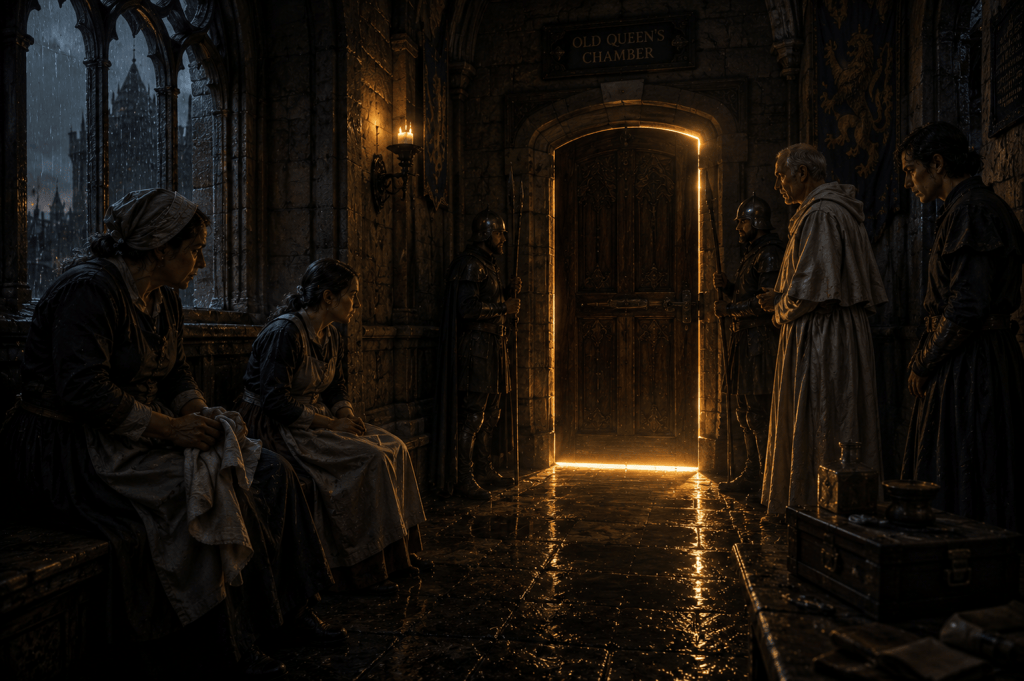
A pale glow gathered beneath the door.
At first Maren took it for firelight shifting across the chamber floor, though the hearth lay beyond the bed and cast amber through the lower crack. This light came softer and clearer, the colour of winter sun passing through old gold glass. It spread along the threshold by the width of a hand, touched the toes of Master Vaynor’s boots, then strengthened until every scratch in the oak appeared edged in pale radiance.
Nessa drew breath through parted lips. One guard crossed himself. The second stepped away from the door, his spear held close against his shoulder. From inside came no cry, no physician’s order, and no movement of furniture, only a low sound like breath released after pain had held it too long.
Brother Calven appeared from the solar and stopped beneath the arch. “Open that chamber,” he said as he gripped the prayer cord at his waist. “Whatever moves inside falls under holy witness.”
Vaynor placed himself before the latch. “You will remain where the Prince set you,” he said as the golden line brightened across the floor.
The final western bell rang above them.
Its sound rolled through the passage, entered the chamber door, and seemed to return from the other side in a softer vibration felt through wood, iron, and stone. The light faded with it, drawing inward until the threshold held only ordinary amber from the hearth. For several breaths the whole passage remained still.
The latch lifted.
Patrick opened the door far enough to step into the corridor. His face carried the exhaustion of a man who had watched death approach someone he had only begun to trust. Behind him, the physician bent over Simion while Elana sat beside the bed with her head bowed and both hands hidden beneath Patrick’s mantle.
“He breathes more strongly,” Patrick said as he looked first to Vaynor, then to those gathered beyond. “The corruption has withdrawn from his throat. The chamber remains sealed until morning.”
Brother Calven advanced one step. “By what remedy?” he asked as his eyes moved past the prince towards the bed.
Patrick drew the door closer behind him. “By every remedy offered under this roof,” he said as his hand stayed upon the latch. “That is the account the castle will keep.”
The prince returned inside, and the doors closed again.
By dawn, three versions had already travelled beyond the western stair. One claimed the Order’s black vial had pulled the poison from Simion’s blood. Another placed Brother Calven inside the chamber, praying over the magician while a saint’s light filled the room. The third spoke only of Princess Elana, her hidden hands, and the old bell answering above her while death loosened its hold.
Maren gave no judgement when the household clerk asked for her statement. She recorded the arrival, the wound, the physician’s labour, the sealed chamber, and the light seen beneath the door. Nessa gave the same account in fewer words, though her hand trembled when she reached the final line. Beyond the window, Bremyra woke under rain and bells, while the castle kept its doors closed around a truth already escaping through every servant passage, chapel stair, guardroom, and kitchen hearth.
The official copy later declared that the Lord Magician survived through swift treatment, royal care, and remedies sent from both Church and Order. The lesser record preserved one further detail: when Elana left the chamber after sunrise, her hands remained hidden within her sleeves, and the servants nearest the door stepped aside as though warmth still moved around her, carrying a colour none among them felt safe enough to name.
Golden light gathered beneath the old queen’s chamber while guards, servants, and a waiting Church witness stood beyond the sealed door, each carrying away a different account of what had passed inside.
The Idea Behind the Chronicle
A castle rarely keeps panic within the room where it begins. A wounded man may lie behind one guarded door, a princess may speak only to those she trusts, and a prince may order every servant to silence, yet fear travels through stone by older routes. It passes beneath doors, along stairwells, through kitchens, chapels, guardrooms, and servant corridors, gathering shape each time another witness carries it onward.
This Chronicle draws upon that movement of rumour through a royal household. Simion and Elana returned to Bremyra after the broken road, appearing within the inner court while the gates remained closed and the castle still waited for riders bearing news of their fate. Those present saw a princess stained by blood and ash, a magician failing in her arms, and a courtyard thrown suddenly into motion. They saw no clear miracle, though the manner of the return gave ordinary explanation little ground upon which to stand.
The bells became central because bells carried authority beyond sight. They announced death, danger, worship, victory, and royal arrival, shaping the meaning of an event before most listeners had learned what had happened. In this account, the guarded-return signal passed across Bremyra while uncertainty remained inside the castle. The city heard that royal blood had come home, while those nearest the western chamber still feared that the magician might die before morning.
Across old household records, moments of healing often become divided between official language and servant memory. Physicians write of wounds, fever, remedies, and recovery. Clerks preserve names, hours, and sealed orders. Those waiting beyond the chamber remember different details: light beneath a door, warmth where no brazier stood, a bell moving above an empty passage, or a patient’s breathing strengthening after every known treatment had failed. Such fragments endure because each stands close enough to truth to resist dismissal, while remaining too incomplete to form proof.
The secrecy surrounding Elana deepens that uncertainty. Within the world of Bremyra, a woman carrying magic would face more than fear. Her gift would challenge the authority of the Order, disturb the Church, and place the royal house beneath scrutiny at the very hour when the kingdom already stood under strain. The castle therefore had reason to protect her, while those who witnessed traces of golden light had reason to guard their words. Silence became an act of loyalty for some, fear for others, and invitation for rumour among those left beyond the door.
The Sealed Road of Bremyra follows a kingdom learning that events can return home before their explanations do. The road had already produced burned grass, poisoned bodies, missing tracks, and conflicting testimony. When Simion and Elana appeared inside the castle, the uncertainty of the field crossed the walls with them. The danger no longer belonged to a distant bend beyond Grey Ash Rise. It entered the royal household, passed beneath a chamber door, and found a voice in the bells above.
This Chronicle therefore turns away from the visible act of healing and preserves what the castle remembered around it. Servants carried linen and water. Guards closed passages. A Church witness waited beyond the room. Prince Patrick chose which account the household would keep, while a different account had already begun moving through the lower halls. By sunrise, the official record spoke of physicians, royal care, and remedies sent under seal. The quieter record remembered golden light, hidden hands, and bells that seemed to answer before anyone dared name what had occurred.
From the Author’s Desk
Thank you for continuing into this Chronicle.
This account was shaped around the way a single event can divide into several remembered truths before the people closest to it have even left the room. Simion and Elana returned to Bremyra carrying the marks of the broken road, yet the castle received only fragments: a wounded magician, a princess beneath a bloodstained mantle, bells sounding across the inner ward, and a guarded chamber where recovery came under questions no servant could safely ask.
The western passage allowed the Chronicle to remain beyond the hidden truth. Those waiting outside saw light beneath a door, heard the old bell answer above them, and watched Prince Patrick decide which version of the night would enter the royal record. Their testimony preserved the uncertainty surrounding Elana, whose actions had to remain concealed in a world where her gift could place her beneath the judgement of both Church and Order.
Across The Sealed Road of Bremyra, each Chronicle has followed the people and places left at the edges of Simion’s path: servants reopening an abandoned manor, clerks receiving sealed authority, chapel attendants guarding old foundations, road keepers recording vanished travellers, and watchmen trying to give lawful shape to burned fields and foreign violence. Their accounts remain incomplete, yet together they reveal a kingdom beginning to understand that its familiar walls can no longer keep older powers at a distance.
Beyond the Chronicle, The Unmarked Path follows these events more closely, entering the lives of Simion, Elana, Patrick, and those whose choices shaped the first turning of the wider conflict. The Chronicle preserves what Bremyra believed it witnessed. The book carries the reader nearer to the truth hidden behind those records.
Readers who wish to explore further may find my books and continuing visual Chronicles through the links included below.
From the sealed western household folios of Bremyra Castle, copied during the reign of King Cedric. The surviving leaves show several changes of hand, with portions of the chamber account darkened by later ink and one witness line removed from the lower edge.
The guarded-return bells were rung after the Princess entered the inner courtyard in the company of the Lord Magician, though the outer gate remained secured and the watch stationed beneath the western arch recorded no rider, carriage, escort, or messenger passing through the ward before their appearance upon the stones.
The Princess was entered as conscious and capable of speech, her clothing damaged by travel, smoke, and blood belonging chiefly to others. The Lord Magician was recorded as wounded beneath the shoulder, weakened by a preparation carried upon foreign iron, and unable to remain standing after reaching the court. He was taken under royal protection to the chamber once kept for the old queen during her final illness, where the household physician received him under closed authority.
The chamber doors were sealed after the first examination. Prince Patrick, Princess Elana, the royal physician, and two attendants were named within the earliest copy, though one attendant’s name was later removed and the second reduced to a mark beside the linen count. Servants assigned to the passage carried boiled water, clean cloth, lamp oil, willow bark, bitter root, and remedies delivered from the upper Order house, while a healer sent from the cathedral remained beyond the threshold under instruction from the Master of Court.
The physician’s first entry described blackening beneath the skin, repeated weakness of breath, and a corruption that had resumed its movement after the wounded man entered the castle. A later line stated that ordinary measures brought limited response, though the hand responsible for this sentence differed from the physician’s own script and appeared to have been added after the folio was bound.
Near the final western bell, those stationed outside the chamber observed light beneath the door. The colour was recorded in three surviving copies as pale gold, old amber, and winter brightness, while the formal household duplicate described only an increase in hearth illumination caused by movement within the room. The passage lamps remained unchanged during the same interval, and the brazier positioned outside the chamber showed no rise in flame.
One guard testified that warmth travelled across the threshold and reached the opposite wall. A servant seated near the western window stated that the stone beneath her shoes became warm while rain continued against the glass. The cathedral healer referred to the light as a matter requiring sacred witness, though the Master of Court refused entry until the Prince himself opened the door.
The bell above the old queen’s passage sounded once while the rope remained untouched. Its movement was confirmed by two guards and one servant, though the tower clerk later amended the occurrence to an error arising from strain within the upper mechanism. The old bell had received no maintenance since the queen’s burial, and the line recording its condition ended before any inspection result was entered.
When Prince Patrick emerged from the chamber, he declared that the wounded man’s breathing had strengthened and that the corruption had withdrawn from his throat. He named the recovery as the result of combined treatment, royal care, and remedies supplied under Church and Order authority. No further cause was entered within the sealed account.
Princess Elana left the chamber after sunrise with her hands concealed inside her sleeves. Several servants recorded warmth around her passage, while one younger witness described a faint gold colour along the edge of the cloth near her wrists. The statement was crossed through in the formal copy, and the witness was transferred from the western rooms before the next household rotation.
The final entry named the Lord Magician alive, the Princess restored to her own chamber, and the western passage returned to ordinary service. The household was instructed to preserve a single account of the night, though the order itself survives in four differing forms, each carrying a separate explanation for the light beneath the door.
Marginal Notes & Interpretations
Collected from later annotations written along the outer edges of the same folio.
One marginal hand attributed the light to the opening of the chamber fire after fresh coal had been added, suggesting that polished metal, wet stone, and movement around the bed enlarged the glow beyond its ordinary appearance. The writer gave no account of why the light travelled beneath the door in a narrow, steady line while the hearth stood across the room.
A second annotation connected the recovery to an Order remedy delivered in a sealed cedar box. According to this interpretation, the foreign poison reacted visibly when met by arcane medicine, producing warmth and coloured vapour before withdrawing from the wounded man’s blood. The inventory of the box recorded four vials, three of which remained sealed when returned to the upper manor.
A cathedral note, copied beside the physician’s entry, argued that the light belonged to Christiana’s mercy and that the old queen’s bell answered the passage of healing through a chamber once dedicated to suffering. A later Church hand softened this claim, replacing certainty with the phrase possible grace witnessed under royal distress.
Another annotation challenged both Order and Church accounts, stating that the Princess alone remained beside the wounded man when the light reached its greatest strength. The writer referred to heat around her hands, a gold stain upon the inner sleeve, and a servant’s report that the magician answered only after she spoke his name. The final words of the note were scraped deeply enough to damage the page beneath.
A fifth hand, smaller and pressed close to the binding, warned that any claim concerning the Princess carried danger for the witness. It stated that women accused of arcane practice fell under Order judgement, while royal blood offered protection only so long as the crown denied the accusation. The writer advised silence, then added that silence had already allowed the rumour to spread more widely than open testimony might have done.
The faintest surviving note appeared beside the record of the bell. It contained only one line:
The sound came after the light, as though the castle answered what the household refused to name.
World Notes
The Old Queen’s Chamber
A royal sickroom within the western passage of Bremyra Castle, maintained after the death of King Cedric’s mother and opened only during severe illness, childbirth, or injury involving members of the royal household. Its position near the inner courtyard allowed wounded persons to be carried from the ward while avoiding the public halls.
The chamber retained its own hearth, water closet, physician’s table, prayer niche, and bell line connecting the passage to the western tower. Household records treated it as a place of privacy and royal protection, though servant copies frequently associated it with final vigils, unanswered prayers, and illnesses concealed from the wider court.
The Guarded-Return Bells
A three-bell signal used when members of the royal house returned under danger, injury, or uncertain circumstance. The first bell belonged to the inner tower, the second to the lower ward, and the third carried the signal towards the city-facing wall.
The signal announced the return of royal blood while withholding details concerning condition, threat, or survival. Its use often produced rumour before formal proclamation, since citizens heard the bells long before clerks completed the court account.
Closed-Chamber Authority
A household order allowing Prince Patrick or the Master of Court to seal a royal chamber against servants, guards, clergy, and visiting officials. The order protected privacy during medical treatment and prevented competing institutions from claiming authority over a wounded member of the royal household.
During the guarded return, this authority kept the cathedral healer outside the old queen’s chamber and limited the number of witnesses able to speak directly about Simion’s recovery.
Golden Healing Rumour
A phrase found in servant copies, chapel notes, and later court gossip concerning warmth or pale light associated with recovery from grave injury. Official records usually attributed such accounts to lamplight, prayer, fever, or arcane medicine supplied by recognised practitioners.
Within the sealed western folios, the phrase appeared only once in full. It was written beside Princess Elana’s name and later removed so heavily that the fibres of the page remained broken around it.
Next Chronicle
In the days after the guarded-return bells sounded across Bremyra, further reports reached the castle from the north, carried by riders whose accounts spoke of smoke above Vaeldring, emptied roads, coastal settlements taken under sudden violence, and armed movements passing inland before the kingdoms had gathered any single understanding of what had begun.
The court received these fragments separately, recording each beneath its own seal and assigning them to border disturbance, raiding, or uncertain movement beyond Bremyra’s direct watch. Yet the reports shared the same direction, and the smoke named in one district appeared again in another, spreading across the records long before any council agreed to call the danger war.
No formal connection was made between the violence upon Elana’s road, the foreign weapons found in Bremyra, and the northern forces entering Vaeldring.
Next Chronicle: The Northern Smoke Reports
The bells of Bremyra fell silent before dawn, the western passage returned to guarded quiet, and behind the sealed chamber door the official account settled into ink, while through kitchens, stairwells, and chapel corridors the memory of golden light continued to move, untouched by the record that refused to give it a name.
On the final crossing before winter, an ageing ferryman carries a young woman towards an island that disappeared from the marsh generations ago.
Estimated reading time: 5 minutes.
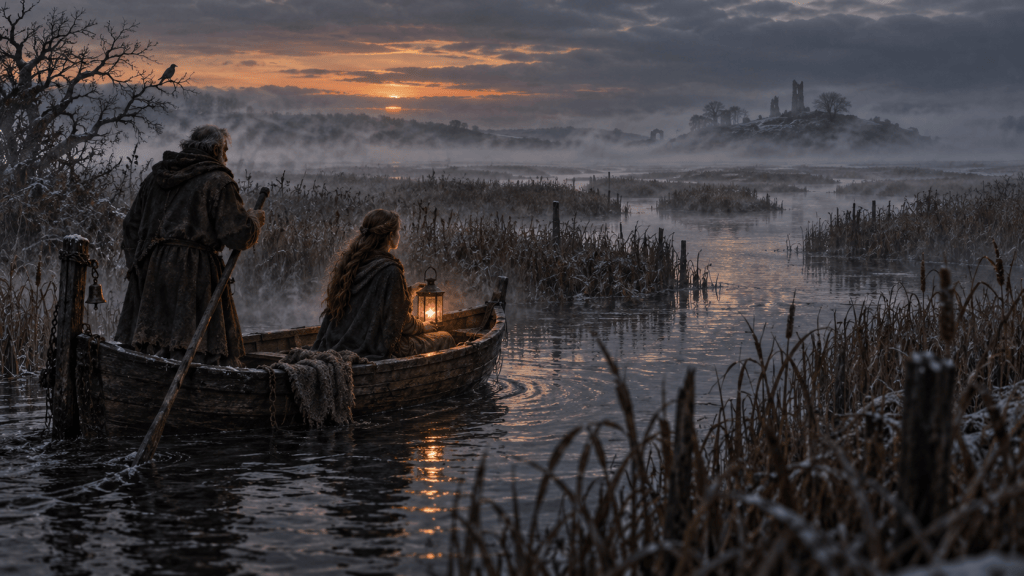
By the time Jory Venn hauled the last mooring rope through the iron ring, dusk had flattened the Greyfen marsh into pewter channels between black reeds, and the first skin of winter ice had begun to gather along the shore. He had covered the ferry lantern and stacked his pole beneath the gunwale when footsteps came down the plank path behind him.
The young woman stopped beside the weathered post, carrying a hooded lantern in one hand and a leather case in the other. Her cloak was travel-stained, and when she looked across the marsh she seemed to be measuring distance against something only she could see.
“You’ve left it late,” Jory said, keeping one hand on the rope while his eyes moved towards the thickening mist. “Where are you trying to reach?”
“The island beyond the Crown Reach,” she said, giving a small inclination of her head. “My name is Elianor.”
Jory rested the rope against the post and studied her. “No island has stood beyond that reach in my lifetime, and I’ve spent most of it crossing these waters.”
“There was a landing there once,” Elianor replied, taking a dark silver seal from the leather case. “Perhaps this will persuade you that I know the place I mean.”
It was worn smooth at the edges, with the old split crown of Greyfen pressed deep into its face. Jory had seen the same mark half-erased on stones beneath newer jetties and carved into the oldest timber in his ferry shed. He looked from the seal to Elianor, then towards the mist swallowing the far bank.
“If I take you out there and find reeds, you’ll still owe the fare,” Jory said as he loosened the rope again.
The young woman answered with a faint smile and stepped aboard. Jory freed the ferry from the post, and the marsh closed around them quickly, the landing lamp shrinking behind the reeds as he worked the long pole through water he knew by depth, pull and resistance. She settled near the bow with the old lantern between her feet, speaking only when the channels divided, and each turning she named made the familiar water shift beneath his understanding.
“Take the left fork after the drowned gate,” Elianor said, leaning forward as broken stone appeared beside the reeds.
Jory eased the ferry round with a practised turn of the pole. “That’s Marsh Hook. Always has been.”
Elianor kept her gaze on the stones as they passed. “It was a gate before the road sank.”
Her words carried the quiet correction of someone remembering where a chair had once stood in a room. As they moved farther into the marsh, she called a low ridge of masonry the eastern landing, though Jory had crossed above those stones since boyhood and thought of them only as a place where nets snagged. When the lantern’s covering shifted in the breeze, a narrow gold line moved across the water, and for several breaths he saw squared foundations beneath the black surface where he had always believed the marsh bed lay empty.
“What are you carrying?” Jory asked, slowing the ferry until the pole rested against his shoulder.
Elianor placed one hand over the lantern’s warm metal crown, and the composure in her face softened as she looked down. “The last light of Greyfen.”
Jory waited for more, though none came. The flame behind the glass was small and steady, yet wherever its glow touched the marsh, old shapes gathered briefly through the water and mist, a blackened post rising beside steps that descended beneath the channel before the broken edge of a causeway appeared farther on.
He pushed them onwards, watching those vanished traces appear and fade beside the ferry while Elianor kept one hand upon the lantern. Ahead, the mist thinned so gradually that he first took the darker mass for reeds, until stone steps rose from the water, followed by a low landing and bare trees whose branches lifted around fragments of wall that should have lain generations beneath the marsh. Jory knew this stretch through summer drought and winter flood, and there had never been land beneath his boat.
“Do you want me to wait?” he asked, catching the landing with his pole, though he already knew there would be no return fare.
Elianor stepped ashore and turned towards him, the lantern casting warmth over her tired face. “No, Jory. You have already brought me farther than anyone else could.”
He watched her walk between the ruined walls until the mist reduced her to a moving glow, then to a single point of gold among the stones. The light faded there, softly enough that Jory almost missed the moment it went, and as darkness settled, the landing, bare trees and broken walls thinned with it, dissolving into reeds and open water around the ferry. Jory remained in the channel until cold worked through his gloves, then turned towards home.
The royal seal lay on the bench where Elianor had been sitting, solid beneath his thumb when he picked it up, while the marsh stretched around him exactly as it had every winter of his life. As he guided the ferry back through the dark, the broken stones beside the channels no longer looked like debris, only the last traces of roads, doorways and crossings that had once carried people home, and Greyfen felt older in its absence than it ever had in ruin.
Author Note
The Last Lantern of Greyfen grew from the idea of a place that had already disappeared from history, yet had one final thing left to surrender. I liked the thought of an ordinary ferryman travelling through a landscape he believed he knew completely, only to discover that the ruins and old stones around him had once belonged to a living world.
At its heart, this is a story about memory, disappearance, and the quiet moment when something finally passes beyond anyone’s keeping.
Monthly Free Stories is a project where I publish complete pieces of fiction here on my website. The stories can move between fantasy, horror, science fiction, historical fiction, mystery, and anything else that suits the idea. Each one is written to stand as a finished story in its own right and is freely available to read.
If you enjoyed this story, you can explore more free fiction on the website or take a look at my published books.
How Alfred’s son carried the Anglo-Saxon recovery into the Danelaw and prepared the ground for England
The Rider from Tamworth
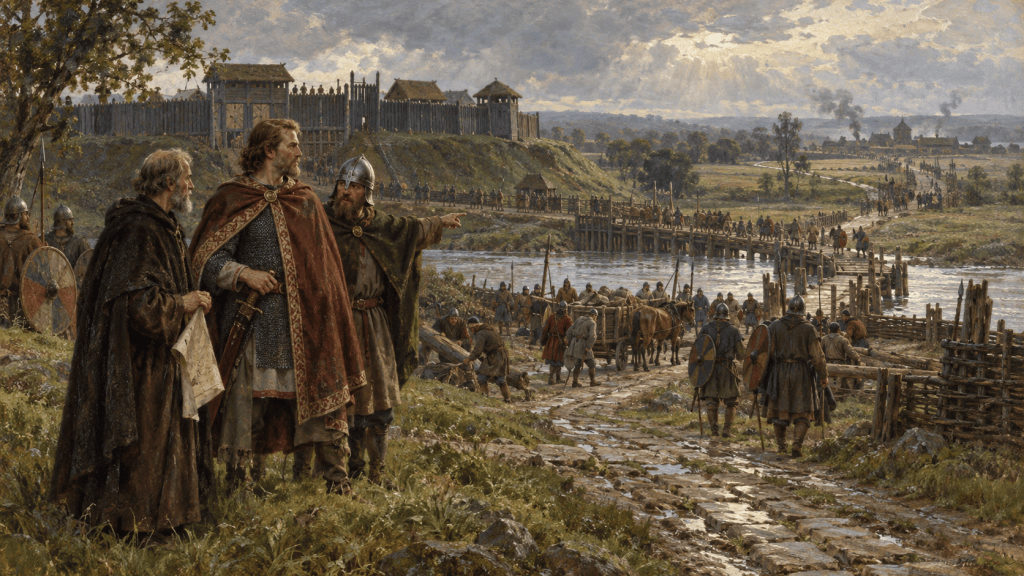
Morning mist lay across the River Welland, gathering among the reeds and whitening the raw earth where Edward’s men had driven a new line of stakes into the southern bank. Across the water, Stamford rose behind its older defences, a Danish borough whose people had watched the West Saxon army arrive, secure the crossing, and turn captured ground into something intended to endure. Axes struck oak, baskets of soil passed from hand to hand, and the breath of men and horses mingled above the unfinished rampart as the king’s frontier took shape beneath a pale summer sky.
“Pack the earth close against the timber, or the river will find every hollow before an enemy reaches us,” the foreman said as he pressed one mud-darkened heel into the bank. A young spearman rested upon his shovel and glanced towards the roofs beyond the water. “If Stamford has yielded, why are we raising a second wall when the first already stands?” he asked as he wiped rain from his cheek. The foreman drew his thumb along the sharpened edge of a stake before answering. “A town may yield for a day, lad, while a strong wall reminds every man what tomorrow will cost.”
Edward stood above them, his cloak drawn close against the wet breeze as he studied the ford, the bridge, and the road leading through the fields. He had learned the value of such places from Alfred, whose burhs had preserved Wessex when open battle could have destroyed it, and he had carried that lesson into enemy country. Every ditch guarded a crossing, every garrison secured a road, and every new enclosure allowed an army to move farther while leaving strength behind. Stamford had become a fresh fastening in a chain stretching through lands once held by Danish armies.
A lone rider came into view before the gate watch called out, his horse dark with sweat and river mud as it struggled across the broken ground. “A Mercian messenger has come from Tamworth, lord king,” one of Edward’s household warriors said as he descended the rampart. Edward turned from the river as the rider dismounted and crossed the yard. “Bring him forward, then see that his horse is watered and rubbed down,” he replied, resting one hand upon his sword belt. The messenger bowed with the weary care of a man who had ridden through much of the night before drawing breath. “My lord king, the Lady of the Mercians died at Tamworth, and news of your sister’s death is already travelling through Mercia,” he said, holding Edward’s gaze as grief tightened his face.
For a moment, the labour around the new burh seemed to recede behind the rush of the Welland. Æthelflæd had been more than Edward’s sister, for she had ruled Mercia, raised fortresses, recovered towns, and pressed the war forward beside him. Her death opened a space across the Midlands while their combined campaigns were breaking Viking power. Her daughter Ælfwynn remained within the Mercian succession, while loyalties shaped in Tamworth and Gloucester could never be treated as possessions passing quietly between rulers.
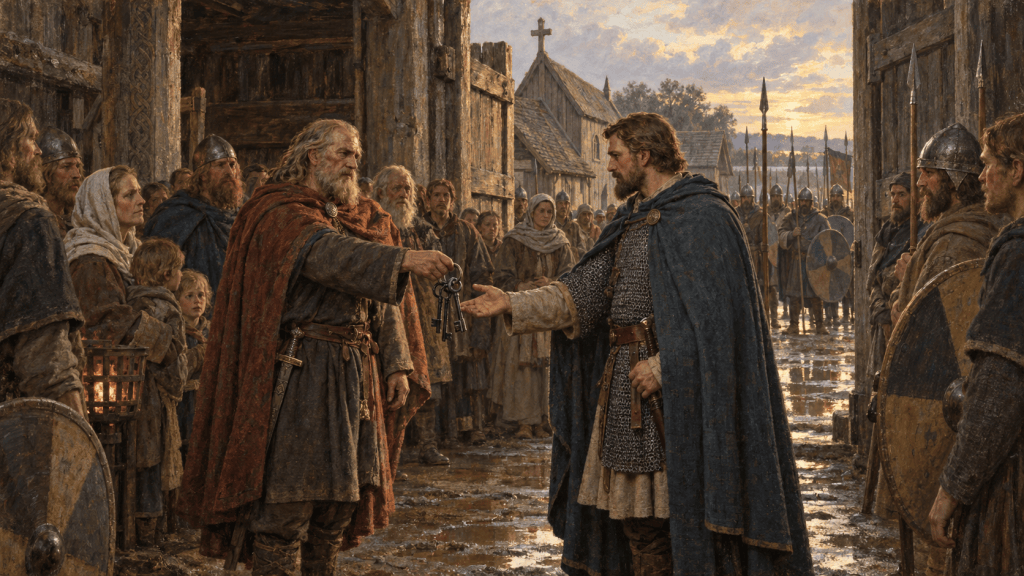
Edward looked towards Stamford’s roofs, where submission had been secured through patience and the promise of overwhelming strength. “Have fresh horses made ready, and summon every man who can ride before sunset,” he said as he stepped towards the hall where his commanders waited. “We go to Tamworth, and these works will continue until this crossing can hold against any army that approaches it.”
The axes beside the river resumed their steady labour as preparations spread through the camp, carrying Edward from one hard-won frontier towards the uncertain heart of Mercia. Behind him stood a burh of wet earth and newly cut timber, one strongpoint among many, yet the kingdom emerging from those walls would reach far beyond Stamford. Alfred had built so Wessex could survive; Edward was preparing to discover how far that inheritance could advance.
A Visual Chronicle
Edward inherited Alfred’s walls, turned them into weapons of reconquest, and then faced the decision that could reshape the future of England.
Timeline of Events
899 AD – Edward succeeds Alfred as king, inheriting a strengthened Wessex and an unfinished struggle against Viking power.
910 AD – A combined West Saxon and Mercian army defeats a Northumbrian Viking force at Tettenhall, weakening the northern armies that had threatened the Midlands.
912–916 AD – Edward establishes burhs at Hertford, Witham, Buckingham, Bedford and Maldon, securing rivers and roads as his frontier advances into Danish-held territory.
917 AD – Coordinated campaigns led by Edward and Æthelflæd break Danish power across East Anglia and much of the southern Danelaw as strongholds fall or submit.
918 AD – Æthelflæd dies at Tamworth, after which Edward takes control of Mercia and receives the submission of further Danish-held towns, including Stamford and Nottingham.
920 AD – Edward builds a burh near Bakewell, where the Anglo-Saxon Chronicle records northern rulers recognising him as father and lord, signalling the widening reach of his authority.
924 AD – Edward dies at Farndon in Mercia, leaving Æthelstan to inherit the reconquest and carry it towards the creation of a single English kingdom.
About the Creator
This Chronicle is written by Simon Phillips, author of several historical and speculative fiction works exploring forgotten worlds, myth, and the turning points of history.
The account that follows moves back through the campaigns that carried Edward’s authority beyond Wessex and into the Danelaw, where fortified towns, secured roads, river crossings, and coordinated armies transformed Alfred’s defensive inheritance into a sustained reconquest. It follows the fall of Viking strongholds, the partnership between Edward and Æthelflæd, and the difficult absorption of Mercia after her death, as separate victories began to shape a kingdom wider than either ruler had inherited.
Readers supporting The Forgotten Chronicle may continue into the full record below.
The War of Roads and Walls
Before the southern wall at Stamford rose above the Welland, and before the rider from Tamworth carried grief into Edward’s camp, the reconquest had begun with a disputed crown and a kingdom still shadowed by Alfred’s achievement. When Alfred died in 899, Edward inherited fortified towns, trained armies, and the allegiance of men who had survived the worst years of the Viking war. He also inherited a royal house whose older branches retained their own claims, while Danish rulers remained powerful across East Anglia, eastern Mercia, and Northumbria.
News soon reached Edward that his cousin Æthelwold had seized the royal estates at Wimborne and Christchurch. “He has chosen his ground carefully, lord,” an ealdorman said as he set a wooden tally beside the king’s cup. “Wimborne holds his father’s grave, and every man who enters that hall will understand the claim he is making.” Edward ran one thumb along the tally before returning it to the table. “Then we answer the claim in daylight, where every oath may be heard,” he replied as men gathered their cloaks and prepared to ride.
Æthelwold escaped before Edward could close around him, travelling north into territory governed by Danish armies, where men hostile to Wessex accepted him as king. His return brought war across East Anglia, Mercia, and the northern borders of Wessex. The struggle ended at the Holme in 902, where the Danish army held the field after savage fighting, yet Æthelwold lay among the dead. Edward’s crown had survived its first challenge, though the cost revealed how easily an English claimant could turn Viking power against an English king.
For several years an uneasy peace followed, until a Northumbrian Viking army raided deep into Mercia and began its journey home in 910. A combined West Saxon and Mercian force intercepted it near Tettenhall, where marshy ground and broken routes of retreat turned the encounter into a disaster for the raiders. Several Viking kings and leaders fell during the fighting, and the northern armies lost much of their ability to strike south with the same confidence. The victory opened space for a different kind of war, one measured through timber, earth, guarded bridges, and the patient occupation of routes which had once carried raiders inland.
Edward used that hard-won breathing space with the discipline of an experienced builder. At Hertford his men enclosed both sides of the River Lea, while Witham secured a road through Essex and Buckingham guarded a crossing of the Great Ouse. Bedford, Maldon, Towcester, and other strongpoints followed as each new burh protected settlers, housed a garrison, and allowed the next army to advance beyond the last secure wall. These places grew from Alfred’s defensive system, yet their purpose had changed, since Edward planted them ahead of settled West Saxon power and made the frontier move with him.
“The river gives us three approaches and an enemy will search for the weakest,” a surveyor said as he pushed a willow rod into the wet bank at Hertford. Edward stepped across the marked line and looked towards the higher ground beyond the water. “Then place the gate where our men can reach every approach before the alarm has crossed the town,” he answered as labourers waited beside their spades. The surveyor shifted the rod uphill and called the ditch gangs forward, turning a king’s instruction into another day of mud, timber, and aching hands.
North of Edward’s advancing line, Æthelflæd carried the same method through Mercia after her husband Æthelred died in 911. She fortified Tamworth, Stafford, Warwick, Chirbury, Runcorn, and other exposed places, creating a Mercian network joined to Edward’s campaigns while remaining rooted in Mercian loyalties. Their partnership joined two armies and two political traditions, and its strength came from coordination more than submission. Edward pressed through the east and south as Æthelflæd closed roads from the west, leaving Danish strongholds facing pressure from directions their rulers had once treated as separate kingdoms.
During a meeting before the campaigning season, a map of roads and rivers lay between brother and sister beneath the wavering light of tallow lamps. “If Derby is allowed to draw men from Leicester, the road into northern Mercia stays open,” Æthelflæd said as she rested two fingers beside the crossing. Edward moved a carved marker towards the Ouse and studied the distance between their armies. “Then I shall keep Bedford and Northampton looking east while you close upon Derby,” he replied as a clerk bent over the wax tablet. Æthelflæd lifted her gaze from the map as the lamp flame trembled between them. “Keep them looking towards you long enough, brother, and they may realise too late where the wall has closed.”
The year 917 brought the method to its fiercest test. Danish forces attacked Towcester and other defended places, seeking to break the new chain before it hardened, while garrisons held until help arrived from nearby burhs. Edward’s armies struck Tempsford and Colchester, repaired captured defences, and received the submission of East Anglia and Cambridge. Æthelflæd’s Mercians entered Derby after bitter fighting that killed four of the thegns dearest to her, then gained Leicester through submission during the following year. Each fall loosened the next alliance, since a Danish town facing a fortified enemy on every road could expect less aid from neighbours already fighting for their own survival.
By the summer of 918, Edward had reached Stamford and ordered a second borough raised on the southern bank of the Welland. The town’s northern population accepted his lordship while men worked upon the new defences, bringing another of the Five Boroughs beneath Anglo-Saxon power. Then the messenger arrived from Tamworth with word that Æthelflæd had died, and the partnership that had driven the reconquest forward ended within sight of its greatest success.
Edward rode into Mercia while grief and uncertainty moved through its halls. Æthelflæd’s daughter Ælfwynn possessed a claim to succeed her mother, and Mercian leaders had long memories of their kingdom’s former independence. “The lady’s oaths were given to Mercia as well as to her kin,” a Mercian thegn said as Edward’s household gathered at Tamworth. Edward removed his riding gloves and placed them beside the hall fire. “Her towns will keep their laws, their markets, and their protection,” he replied as rain ran from the hem of his cloak. “The army beyond those walls will judge us by whether those protections endure.”
The settlement carried a harder truth beneath such assurances. Edward received the allegiance of Mercian communities, secured Nottingham, and placed English and Danish inhabitants together inside its repaired defences. Later that year, Ælfwynn was deprived of authority and taken into Wessex, ending the separate Mercian rulership her mother had preserved. What had begun as a partnership between Wessex and Mercia became direct kingship, and the reconquest drew lands of differing custom, memory, and loyalty beneath a single royal centre.
Edward continued north-west, repairing Thelwall and Manchester before strengthening Nottingham’s southern bank and building near Bakewell. The Anglo-Saxon Chronicle later described Scottish, Northumbrian, and Strathclyde rulers choosing him as father and lord, language that proclaimed enormous prestige while falling short of direct government over their peoples. These recognitions were alliances, submissions, and promises shaped by immediate danger, yet they showed how far the political horizon had widened. A king who had begun his reign defending a disputed succession could now summon rulers far beyond Wessex into negotiation around his power.
When Edward died at Farndon in 924, he left a realm broader and more tightly governed than the one Alfred had entrusted to him. His victories had rarely rested upon a single celebrated battlefield, for they had grown through guarded rivers, repaired towns, disciplined garrisons, negotiated oaths, and walls raised close enough to support the next advance. Mercia’s separate court had vanished, East Anglia had submitted, and Danish authority south of the Humber had been broken into communities increasingly tied to Edward’s rule.
The kingdom was still unfinished, and York remained beyond the lasting reach of the West Saxon house. Edward’s son Æthelstan would inherit that final northern challenge, together with every tension created by conquest and consolidation. Alfred had preserved the ground from which recovery became possible, while Æthelflæd and Edward carried that recovery through the Midlands until the old borders could hold it no longer. England had yet to receive its single crown, though the roads leading towards it now passed through Edward’s gates.
The gates of a Danelaw borough were surrendered to Edward the Elder, as fortified campaigns and steady pressure carried Anglo-Saxon authority deeper into Viking-held territory.
Inspiration Behind the Story
Edward’s reconquest draws much of its power from the absence of one decisive moment. His victories gathered through fortified towns, guarded crossings, reopened roads, patient alliances, and armies able to advance while leaving strength behind them. Alfred’s defences had preserved Wessex during its greatest danger; Edward took the same principles and turned them outwards, carrying survival into conquest.
What fascinates me about this period is how visibly power altered the landscape. A burh raised beside a river could secure an entire district. A garrison placed along an old road could allow merchants, messengers, and soldiers to move through land once exposed to attack. Each strongpoint became more than a wall, for it changed which ruler could offer protection and whose authority local communities were prepared to accept.
For storytelling, this creates a quieter form of momentum. Edward lived beneath Alfred’s formidable legacy and worked beside Æthelflæd’s Mercian achievements, yet his reign became more than a continuation of theirs. Her death brought grief, uncertainty, and political opportunity together, forcing him to hold Mercia while the wider reconquest remained unfinished.
This Chronicle matters because it reveals that England emerged through accumulation. The kingdom took shape through walls, roads, oaths, submissions, and repeated campaigns, until separate victories began to resemble a single design.
From the Author’s Desk
While writing this Chronicle, I kept returning to the strange position Edward occupies within the story of England. Alfred towers behind him, Æthelflæd stands beside him, and Æthelstan waits ahead as the king who would complete the conquest. Edward can seem caught between those more familiar names, even though the political landscape inherited by his son had been transformed during his reign.
That position made him especially interesting to write about. Edward inherited a system built for survival and discovered how to use it for expansion. He seems to have understood that lasting conquest depended upon more than winning a battlefield. Territory had to be held, roads guarded, rivers controlled, towns defended, and local loyalties drawn towards a ruler capable of protecting them.
I also found myself thinking about the personal weight carried through these campaigns. Edward worked alongside Æthelflæd as ruler, ally, and brother, while their separate armies pressed against Viking power from different directions. Her death in 918 brought grief into a moment of opportunity and uncertainty. Mercia had followed her leadership, and Edward now faced the delicate task of absorbing her kingdom while continuing the struggle they had shared.
Historical memory often gathers around the ruler who begins a great work or the one who completes it. Edward belonged to the more easily overlooked space between those two moments. Yet England could scarcely have emerged in the form it did without the roads he secured, the burhs he raised, and the territories he brought beneath his authority. His reign reminds me that some of history’s most important figures are found in the difficult middle, carrying an inheritance forward until an unfinished ambition becomes a political reality.
Edward inherited a realm strengthened by Alfred’s reforms, yet his succession in 899 remained vulnerable. His cousin Æthelwold, the son of Alfred’s elder brother, claimed the throne and found support among Danish forces in East Anglia. The rebellion ended after Æthelwold was killed at the Battle of the Holme in 902, allowing Edward to secure his kingship before turning towards the wider struggle beyond Wessex.
The principal narrative source for Edward’s reign is the Anglo-Saxon Chronicle, whose surviving versions differ in chronology and emphasis. The West Saxon record presents the expansion of Edward’s authority as a steady series of submissions, while the Mercian Register preserves a stronger sense of Æthelflæd’s independent leadership. These accounts reveal the broad sequence of events, though the political negotiations behind each oath, surrender, and transfer of power remain largely hidden.
Edward’s burhs served as more than defensive refuges. Positioned beside rivers, roads, bridges, and frontier settlements, they allowed garrisons to protect territory while royal armies advanced farther into the Danelaw. Their construction also brought administration, trade, taxation, and military service beneath expanding royal control. The reconquest therefore changed the government of recovered land as deeply as it changed the battlefield. The surviving Chronicle entries record this advance through Hertford, Witham, Buckingham, Bedford, Towcester, Stamford, and other strongpoints.
Related Events
The victory at Tettenhall in 910 weakened the Northumbrian Viking armies that had threatened Mercia and opened greater freedom for Anglo-Saxon expansion. Edward and Æthelflæd then advanced along connected fronts, with West Saxon pressure moving through East Anglia and the southern Danelaw while Mercian forces pushed towards Derby and Leicester. Their campaigns worked through coordination, fortified positions, and the gradual isolation of Danish-held boroughs.
Æthelflæd’s death at Tamworth on 12 June 918 created a difficult question of succession. Her daughter Ælfwynn briefly held authority in Mercia before Edward removed her and brought her into Wessex later that year. A peaceful union would be too simple a description. Edward gained direct control, though Mercian identity, loyalties, and political traditions remained powerful, shaping the succession that followed his death.
An entry generally assigned to 920 records that rulers from Scotland, Strathclyde, Northumbria, and Scandinavian York accepted Edward as “father and lord” near Bakewell. The statement reflected the wide reach of his power, though it should be understood as a claim of overlordship and negotiated recognition rather than permanent conquest. Edward died at Farndon in Mercia in 924, leaving Æthelstan to secure the succession, take York, and carry the unfinished making of England into its decisive final stage.
Further Reading
Edward the Elder, 899–924 – N. J. Higham and David Hill, editors The Making of England: A New History of the Anglo-Saxon World – Mark Atherton Æthelstan: The First King of England – Sarah Foot The Anglo-Saxon World – Nicholas J. Higham and Martin J. Ryan
Next Chronicle
Edward’s death in 924 left the Anglo-Saxon world transformed, though its final shape remained unsettled. West Saxon authority had spread across Mercia, East Anglia, and much of the former Danelaw, while the Viking kingdom of York still guarded the road towards a realm united beneath one crown.
At the centre of the next stage stood Æthelstan, Edward’s son, a prince raised among the Mercians and shaped by the military world created by Alfred, Æthelflæd, and Edward. His succession carried its own uncertainty, yet his ambitions soon reached beyond the lands his father had recovered, drawing him towards York and the last great centre of Scandinavian power in England.
What makes this next Chronicle so important is that Æthelstan’s reign carried the making of England towards its defining moment. When York fell beneath his authority in 927, the old division between the Anglo-Saxon south and the Viking north appeared to close, allowing one king to claim dominion across the lands that would become England.
The next Chronicle moves into the final act of this series, where decades of survival, fortified recovery, and patient reconquest converged beneath Æthelstan’s rule. The kingdom that earlier generations had preserved through marshes, walls, roads, and battlefields was ready to emerge beneath a single English crown.
Next Chronicle: Athelstan and the Birth of England
Alfred had taught Wessex how to survive; Edward carried its strength across roads, rivers, and fortified towns until a divided land stood close enough for Æthelstan to gather beneath one crown.
A first-response team entered a silent auxiliary station and found its frozen crew gathered beside the ventilation grilles, as though listening to something the official record could not call a voice.
Where the Air Was Still Moving
Morrow Auxiliary Four hung beneath the shadow of a stripped iron moon, turning through the scattered light of the Kheled Verge with its guidance lamps reduced to a single pale line along the docking collar. From the forward glass of the ESC response cutter Ardent, the station resembled a piece of discarded machinery caught above the moon’s broken horizon, its habitation drum dark, its service spine edged with frost, and its two external relay vanes locked at different angles as though work had ended in the middle of an ordinary adjustment. The stars remained clear around it, sharp against the absence of local traffic, while the cutter moved closer under restrained thrust and received only the same faint carrier pulse repeating every eleven seconds from a communications array that had missed three scheduled reports. Morrow Four still held power somewhere inside its hull, although every system meant to welcome an approaching vessel had fallen silent.
Medical Response Officer Lena Oras watched the station grow across the glass while cold gathered through the soles of her boots from the cutter’s forward deck. The Ardent had left a Republic-linked freight lane six hours earlier with a four-person response team, a sealed medical cradle, and an initial failure notice describing fourteen missing workers as a probable life-support casualty. That description had followed them through the dark in clean official lettering, joined by estimates for coolant loss, communications collapse, and evacuation delay, each possibility familiar enough to fit inside the equipment stacked behind Lena’s seat. Even so, the station ahead carried an order that the report had failed to describe, because the docking arms remained folded, the maintenance crawler sat secured in its rail, and every outer hatch showed green seal integrity while the people responsible for those systems had vanished from the network together.
“Range is four hundred metres, and the collar still refuses an active handshake,” pilot-specialist Corin Jale said as he leaned over the approach board and reduced the cutter’s forward drift. He ran two fingers along the response trace, then glanced towards Lieutenant Harun Cade at the rear of the flight deck. “I can place us against the passive guides, Lieutenant, although the station will be accepting us from stored instruction. If the clamps close, they may have no live controller behind them.”
Cade tightened the seal at his right wrist and studied the docking image from beside Lena’s chair. The lieutenant had spent most of the approach speaking in the even practical tone of someone refusing to let uncertainty set the pace of a room. “Bring us in on mechanical capture and keep our data link narrow,” he said as he rested one hand against Corin’s seat. “If Morrow tries to widen the exchange after contact, isolate the cutter first and ask questions once our own systems are clear.”
Engineer Sera Quill shifted inside her harness near the rear equipment rack and raised the station diagram across her forearm slate. “The carrier pulse includes a valid house key from the previous shift,” she said while the habitation layout opened in dim blue lines. “That gives us access through Dock Two and the central service passage. It also tells us somebody left the communications shell running long enough to load the current key before the reports stopped.”
Lena turned from the station and checked the fourteen crew identifiers waiting on her medical display, where each name held the same unresolved grey field beside life status. “A valid key tells us the station remembered its last instruction,” she said as she secured the display against her sleeve. “It gives us very little about the people who entered it.”
The Ardent crossed the remaining distance with the low vibration of manoeuvring jets passing through its frame. Morrow Four slid above the forward glass until the docking collar filled the view, scarred by mineral dust and old repair plates whose Republic contract markings had faded into dull red bars. Corin brought the cutter between the passive guides with small measured corrections, and the hull answered each thrust with a pressure that moved through Lena’s ribs. Contact came as a firm metallic knock, followed several seconds later by the deeper pull of clamps closing around the cutter’s docking lugs one after the next.
Corin held his hands above the controls while a thin status line travelled across the board and stopped short of completion. “Mechanical capture is secure,” he said as he watched the unfinished line remain in place. “The station accepted our mass and sealed the collar. Its traffic system still refuses to acknowledge that we arrived.”
Cade released his harness and stepped into the narrow aisle between the seats. “Then we treat the collar as unsecured beyond our own hatch,” he said while drawing his helmet forward from the equipment rail. “Closed suits, local air, cold lights, and a fixed line back to the cutter. Sera reads systems, Corin holds the link from this side, and Lena stays behind me until the receiving lock gives us a clear environmental picture.”
“I heard the order,” Lena replied as she lifted the medical pack onto her shoulders and met his eyes through the rising edge of her faceplate. “If someone is alive in there, I move when the reading supports it. You may complain after I bring them back.”
Cade’s expression softened for a moment as he locked his helmet ring into place. “Bring them back first, Officer Oras,” he said while the suit display painted a faint amber reflection across his face. “I will prepare a thorough complaint for the return flight.”
The docking passage opened ahead of them beneath two strips of emergency light that brightened slowly from red to weak amber. Lena followed Cade through the cutter hatch with Sera close behind, their boots crossing the flexible collar while the metal around them carried a distant shiver from Morrow Four. The station-side seal showed full pressure, although the indicator took three attempts to settle on a stable figure, sliding from breathable mix to sensor review and back again before Sera placed her glove against the manual reader. A line of frost had formed around the inner frame, pale and delicate across hinges that had seen years of freight dust, coolant vapour, and human hands.
Sera angled her helmet lamp across the lock and traced the pressure feed to its local panel. “Temperature sits at nine below, oxygen is low yet serviceable, and air movement is holding at preservation draw,” she said as she expanded the environmental reading. “The habitat heaters dropped out in stages. Ventilation kept running at reduced load after the main grid fell away.”
Cade looked through the small window set into the inner hatch, where a reception passage extended beyond the glass in blue shadow. “Any atmosphere event strong enough to kill the full crew?” he asked as he raised one gloved hand towards the manual release.
Lena checked the pressure history moving along her wrist. “No rapid loss, no fire purge, and no toxic warning preserved in the local buffer,” she said while the final six hours arranged themselves into a descending temperature curve. “Cold could have killed them after prolonged exposure. It fails to explain why every medical tag disappeared from the station board before the habitat reached freezing.”
Cade held her gaze for a second through the faceplate, then turned the release wheel. The inner hatch withdrew with a slow grinding pull, allowing a blade of colder air to cross their suits and carry the smell of metal, stale filtration, and something faintly sweet from the unheated passage. Their helmet lamps reached over wall cabinets, two empty pressure-suit cradles, and a row of work boots left beneath the crew board. One boot lay on its side near the centre of the deck, its laces open, while a thermal coat remained hooked above it with a station badge fixed neatly to the breast.
Sera stepped through after Cade and swept her system reader along the walls. “Local current is present in the emergency run, and the habitat door reports sealed open,” she said as she stopped beside the abandoned boot. “The board has erased crew location data. I can see the memory blocks where the tags should sit, all of them cleared within the same minute.”
Lena crouched beside the boot and moved her lamp across the deck. A shallow crescent of frost marked the floor around its heel, interrupted by a dragged line leading towards the habitat passage, while the thermal coat above it showed no sign of hurried removal. “Someone came through here after the temperature fell,” she said as she rose and followed the line with her light. “They lost the boot, kept moving, and left the warmest coat on the wall.”
Cade faced the dark passage beyond the reception lock and increased his lamp until the beam reached a junction thirty metres ahead. “Morrow Response, this is ESC Lieutenant Cade aboard the Ardent,” he called through his suit speaker while his free hand remained close to the restraint weapon at his hip. “We are inside Dock Two and moving towards habitation. Any crew member receiving this call, answer through local comms or strike a bulkhead three times.”
His voice travelled into the station and returned as a thin reflection from the metal walls. For several seconds the only reply came from the ventilation system, a low pull of air passing through service channels behind the panels with enough force to stir fine frost from a grille near the ceiling. Then a softer sound moved beneath it, carrying the rounded shape of a human vowel before pressure flattened it into the hum of the duct.
Sera lifted one hand and turned her helmet towards the grille. “Hold your next call,” she said as she brought the acoustic trace onto her slate and watched a narrow band rise through the airflow noise. “There was something inside the return line. It could be a damaged announcement fragment crossing from the habitat speakers.”
Cade kept his lamp on the grille while he opened a local record marker. “Log it as an untraced acoustic event,” he said as his thumb moved across the suit control. “We follow the crew search route and leave the duct sealed until you have a source.”
Lena remained beneath the grille long enough to hear the airflow draw through it again. The sound carried no clear word, only a fragile lift and fall that resembled a person speaking from the far side of a closed door, and her training supplied a dozen mechanical causes before memory could offer a human face. She turned towards the habitat corridor, where Cade had begun moving under the emergency lights, and followed with her medical scanner open across the centre of her visor.
They passed the galley first, finding cups secured in their wall recesses and a half-completed shift list waiting on a table beneath a film of frost. The next compartment held six sleep berths with their curtains drawn back, blankets folded at the foot of four mattresses, and one personal lamp still glowing beside an unfinished message slate. Every room carried the marks of people expecting to return within minutes, while the dragged frost lines on the deck led deeper towards Habitation Junction South, crossing each other at corners and converging along the route taken by the station’s main return ducts.
Sera slowed beside a wall panel where the service diagram showed three ventilation branches joining beyond the next hatch. “All return airflow passes through the south junction before it reaches the exchange stack,” she said as she placed her glove against a vibration in the metal. “The pressure is low, although this panel feels warmer than the corridor. Something in the exchange route still carries load.”
Cade reached the junction hatch and studied the narrow darkness beyond its window. “Officer Oras, I have a possible casualty,” he said as he shifted to one side and directed his lamp through the glass. “Three metres inside, seated against the left wall. I need your reading before we enter.”
Lena moved beside him and lifted the medical scanner towards the window. The beam crossed a figure wearing station overalls, knees drawn close to the chest, one bare foot resting against the deck where frost had closed around the skin. The figure’s head leaned towards a service grille at shoulder height, and one hand remained pressed flat across the mesh with the fingers spread as though feeling for air. Her scanner searched through the hatch, returned no cardiac activity, and placed the time of death somewhere inside the long fall of the station’s temperature.
“Adult male, preserved by cold, with no visible suit breach or external injury,” Lena said as she forced her breath into a slower rhythm and widened the scan. More shapes appeared beyond the first body, soft grey outlines gathered along the far wall and beneath the ceiling returns. “Harun, there are at least seven people inside that junction, and every one of them is facing a grille.”
Cade lowered his head for half a second, then raised it as duty settled back across his posture. “Record before entry and keep the hatch between us and the room until Sera checks the air path,” he said while his lamp moved from one frozen face to the next. “These people came here together, so we learn what brought them before we follow the same route.”
The ventilation shifted beyond the glass, drawing a veil of frost from the nearest grille and carrying the sound through the sealed hatch with startling softness. This time the shape lasted longer, rising beneath the mechanical pull as though a tired speaker had formed two words and lost them inside the metal. Lena saw the dead man’s hand against the mesh, the waiting turn of his head, and the seven pale faces angled towards the same narrow opening while her suit recorder struggled to decide whether it had captured airflow or speech.
Sera stepped back from the hatch, her system reader trembling slightly in her grip. “The station archive will call that duct resonance,” she said as she looked towards Cade through the blue light. “Lieutenant, it sounded like someone asking us to come closer.”
Cade kept his eyes on the people gathered beyond the glass and sealed the junction access beneath a restricted-entry marker. “Then we stay here,” he said as his hand remained firm against the manual lock. “We listen from this side until we understand why fourteen experienced workers chose the other one.”
Station Record: Morrow Auxiliary Four
Morrow Auxiliary Four occupied a narrow maintenance orbit above an iron-rich moon on the southern edge of the Kheled Verge, positioned where three freight routes crossed before separating towards the outer extraction fields. The station had been built to support the civilian haulers, mineral carriers, maintenance cutters, and survey vessels working beyond the reach of the larger Republic-linked ports.
Its original structure consisted of a docking collar, a service spine, and two rotating relay vanes assembled from prefabricated industrial sections. Later contracts added a habitation drum, an equipment store, and an environmental exchange stack large enough to sustain twenty-two workers. Permanent staffing rarely exceeded fourteen, with most shifts divided between traffic monitoring, relay maintenance, hull inspection, and emergency support for vessels crossing the Verge.
Life aboard Morrow Four followed the requirements of the freight lanes. Crews worked irregular shifts around convoy arrivals, equipment failures, and the long communication delays common beyond the central routes. The station possessed a compact galley, six shared sleeping compartments, a medical room intended for stabilisation work, and a narrow observation gallery overlooking the moon. Personal space remained limited, and most of the crew lived within hearing distance of the machinery that kept the station functioning.
The ventilation system formed one of its oldest surviving networks. Air drawn through the habitation compartments passed along three return branches before meeting at Habitation Junction South, where the combined flow entered the exchange stack beneath the service spine. Years of repairs had left the ducts lined with replacement filters, pressure regulators, and mismatched acoustic baffles installed under several different maintenance contracts.
Crew reports from earlier rotations occasionally mentioned vibration passing through the southern grilles when the exchange fans moved between operating levels. The station engineer had classified the effect as pressure flutter caused by the age of the return channels. Repair work had been scheduled twice and postponed after inspections found airflow within acceptable limits.
Morrow Four also carried a preservation cycle intended to protect critical equipment during power loss. When the main grid failed, the station reduced heat, lighting, and residential power while maintaining a controlled draw through the ventilation network. The system could slow corrosion, preserve medical supplies, and prevent moisture damage until a repair crew arrived. It had never been designed to keep the habitation compartments safe for prolonged human occupation.
The final routine report from Morrow Four described a minor irregularity inside the environmental exchange stack. One pressure sensor had begun correcting its own readings after each diagnostic pass, while a second registered short changes in airflow during periods when the fans remained at fixed output. The duty engineer opened a maintenance file and requested replacement components from the next scheduled supply vessel.
Two hours later, the station transmitted its last complete traffic update.
Over the following shift, all fourteen medical tags disappeared from the local crew board within the same minute. The main heaters then failed in stages, internal communications fragmented, and the preservation cycle assumed control of the remaining environmental systems. No decompression alarm, evacuation order, or fire warning entered the emergency archive.
The station continued transmitting a valid carrier pulse every eleven seconds.
When the ESC response cutter Ardent reached Morrow Four, the outer seals remained intact, the docking equipment accepted mechanical capture, and reduced ventilation still moved air through the darkened habitation drum. Inside, the crew’s abandoned rooms suggested an interruption measured in minutes. Cups remained secured beside unfinished meals, personal displays waited beside open messages, and thermal clothing hung where the workers had left it.
Every trace of movement led towards Habitation Junction South.
There, beside the oldest ventilation grilles aboard the station, the response team found the missing crew gathered in the cold.
About the Creator
The Future Chronicle is written and curated by Simon Phillips, a writer of science fiction and speculative storytelling who explores the fragile edges of human expansion, where freight routes, inspection bays, patrol vessels, and isolated industrial stations continue their ordinary work while larger dangers gather quietly beneath routine procedure.
Many of the stories presented in these Chronicles exist within wider fictional worlds shaped by workers, survivors, officers, and investigators who encounter the first signs of events far greater than they are prepared to understand. These settings remain grounded in lived environments, where machinery, bureaucracy, and human judgement often shape the path of catastrophe long before anyone can give it a name.
The Harbinger Protocol follow that unfolding pressure through the experiences of Soren Vale, beginning with the civilian freighter disaster recorded in The Ash in Transit and continuing into the colder, more procedural dread of The Silent Outpost, where isolated incidents begin to reveal the outline of something spreading across human routes and systems.
Readers who wish to explore the full opening phase of the Harbinger crisis can find the below.
The following Chronicle reconstructs the first-response search inside Morrow Auxiliary Four, where the crew of the Ardent found fourteen station workers gathered beside the ventilation grilles and began tracing the sound that had drawn them into the cold.
Readers supporting The Future Chronicle can continue the record below.
Subscribe to continue reading
Subscribe to get access to the rest of this post and other subscriber-only content.
After a damaged unmanned device was found beyond an RAF transfer site, the road was sealed, contractors were held at the gate, and the official explanation became smaller than the response around it.
The Road That Closed Before the Gate
The first blue light appeared in Corinne Hales’s windscreen before the airfield came into view, turning through the rain at the far bend of the service road and throwing a pale pulse across the hedges, the standing water, and the low branches dragged towards the verge by the wind. She eased the Northgate Systems van below twenty, expecting an ambulance or a stranded car, then saw a marked police vehicle angled across both lanes beside a line of cones that had been laid from the ditch to the outer fence. Beyond them, the transfer site continued beneath its hard white floodlights, transport tails rising above the wire and loading lamps glowing through the weather, yet the familiar approach had been divided into pieces: civilian road, police line, closed gate, armed figures, and a strip of wet ground between the hedge and the perimeter where every available light appeared to be pointing.
Corinne stopped behind a catering van and lowered her window as a constable came towards her under a black waterproof cap. Rain swept into the cab, cold against her cheek, carrying the smell of diesel, wet grass, and aviation fuel from the other side of the fence.
“Please switch off your engine and remain inside the vehicle,” the constable said as she raised one gloved hand towards the queue forming behind Corinne. “Keep your phone away from the windows, and leave enough space for emergency traffic to pass on your right.”
Corinne turned the key and held up her contractor pass between two fingers. “I have a scheduled delivery for the technical compound, reference Northgate seven-one-six. The gate office should have me at seventeen-thirty.”
The constable glanced at the pass, then towards the outer gate, where a second barrier was sliding across the entrance. “The site has suspended contractor access, Mrs Hales. Someone from the gate team will speak with you when they are able.”
“How long are they expecting us to sit here?” Corinne asked as she looked past the police car towards the dark verge.
The constable adjusted the radio clipped high on her jacket. “I have no reliable time for you yet. Please stay in the van and follow any instruction given over the loudhailer.”
She moved towards the next vehicle before Corinne could ask what had happened, leaving rain to collect along the open edge of the window. Corinne raised the glass and watched the road change around her. Another police car arrived from the village direction and stopped behind the growing queue, sealing the approach from both ends. Two RAF Police officers crossed outside the gate with torches held low, while a man in a heavy green jacket stood near the ditch beside a wheeled case and a folded screen. No one approached the patch of grass under the brightest lamp. Their distance from it gave the ground a shape Corinne could feel even while the object itself remained hidden.
Her phone vibrated in the dashboard cradle. The depot had sent three messages, each more urgent than the last, asking whether the replacement camera housing had reached the site and whether the engineer would still receive it before the evening installation window closed. Corinne read them, locked the screen, and left the phone face down beside the gear lever. Four days earlier she had delivered the brackets that now held some of the portable cameras above the contractor yard. She recognised one mast near the inner lane, its head turning in a slow mechanical sweep until it reached the service road, where it stopped and held.
A knock sounded against the passenger window. Tom Grady, the catering driver ahead, stood beside the van with his hood flattened against his head and one hand braced on the door mirror. Corinne lowered the glass a few inches.
“The officer told everyone to stay inside,” Corinne said as she leaned across the passenger seat. “She looked serious enough to remember faces.”
Tom wiped water from his eyebrows and pointed towards his rear doors. “I have chilled food in there, and the refrigeration warning came on near the bypass. If they keep me here for an hour, the kitchen can argue over warm yoghurt tomorrow.”
“Get back in and ring your dispatcher,” Corinne said as a dark vehicle moved through the gate behind two armed escorts. “This has passed the point where yoghurt carries authority.”
Tom followed her gaze towards the verge. “One of the lads up front heard the police say drone. He reckons it came down beside the road.”
Corinne felt her attention sharpen, although she kept her voice level. “One of the lads up front heard half a radio call through rain. Those stories usually improve each time they travel backwards.”
“You think it is rubbish?” Tom asked as he tucked his hands beneath his arms.
Corinne watched an RAF officer raise a torch towards the hedge, then lower it when the man beside the wheeled case spoke to him. “I think you should return to your van before somebody writes your registration into a report.”
Tom gave the verge another glance, then hurried back through the rain. His brake lights glowed red when he climbed inside, painting the wet road between their vehicles. Beyond the perimeter, an announcement broke across the airfield tannoy, thinned by distance until Corinne could catch only assigned positions and outer line. Movement changed at once. A forklift stopped beside a pallet stack. Ground staff stepped away from an open lane. Two figures crossed towards the fence at a run, then dropped from view behind concrete sections. The transport aircraft remained lit and open, its rear ramp a bright rectangle facing the weather, while every smaller movement around it became faster, tighter, and harder to follow.
Corporal Reeve came through the pedestrian gate ten minutes later with his hood raised and a clipboard sealed inside a clear cover. Corinne recognised his careful walk along the queue, pausing at each cab, checking names, giving drivers the same measured explanation. When he reached her window, the brief warmth of recognition in his face disappeared beneath the strain of the evening.
“Mrs Hales, Northgate Systems,” Reeve said as he checked the first sheet. “You have the weatherproof camera housing and replacement junction kit?”
“They are in the back, dry and increasingly expensive by the minute,” Corinne said as she passed her movement paper through the narrow gap. “The police officer says access has been suspended.”
Reeve held the paper beneath the lamp fixed to his shoulder. “All contractor arrivals are being held while the outer road remains controlled. Your delivery window will be reissued once the site access officer clears movement.”
Corinne looked towards the cluster of lights near the ditch. “What is lying in the grass?”
Reeve kept his eyes on the movement reference. “Debris was reported beyond the perimeter. A specialist team is assessing it.”
“Debris from what?” Corinne asked as a gust shook water from the hedge across the road.
Reeve returned the paper and pressed its damp corner flat against the clipboard. “The approved description is a possible small unmanned platform. There has been no detonation, and there is no current indication of danger to the public.”
“Then why have local police closed both ends of the road?” Corinne asked as she gestured towards the blue lights behind the queue.
Reeve looked past her towards the vehicles, each driver visible through a bright phone screen or rain-streaked windscreen. “Because possible becomes expensive near an active airfield, and because leaving the road open would place people where the assessment team needs space.”
The answer carried more honesty than the line before it, which made Corinne study him closely. Rain ran from his hood onto the shoulders of his jacket. A radio spoke somewhere beneath the fabric, too low for sense, and Reeve turned his head as though one phrase had reached him through the noise.
“Were the cameras working?” Corinne asked as the mast above the inner lane remained fixed on the service road.
Reeve tightened his grip on the clipboard. “Which cameras?”
“The ones Northgate spent all week mounting because somebody decided this gate needed more eyes.” Corinne nodded towards the mast. “That one has been staring at the same piece of road since I arrived.”
Reeve followed her glance for less than a second. “All questions about site surveillance go through the access office. Please keep your phone inside the cab, avoid taking photographs, and speak only with your employer about the delay.”
“That sounds less like advice than an instruction,” Corinne said as she set both hands on the steering wheel.
“It is an instruction,” Reeve said as he stepped back from the van. “I am asking politely because we have met before.”
He continued down the queue, leaving Corinne with the hum of the refrigeration unit ahead and the softened blue light moving across her mirrors. On the far side of the fence, the response gathered its own order. A white-suited figure appeared near the wheeled screen, followed by two officers who kept several paces behind. Portable lamps shifted until the ditch, verge, and lower fence shone with the flat brightness of an operating theatre. A small shape became visible for a moment in the beaten grass, dark at its centre, one thin arm raised at an angle, before a technician blocked the view.
Tom rang her instead of leaving his van again. Corinne answered through the dashboard speaker, keeping her eyes on the activity ahead.
“My dispatcher wants a reason for the delay,” Tom said as refrigeration machinery rattled behind his voice. “Temporary security hold sounds as if I have lost my pass.”
Corinne watched a technician kneel near the small shape while an officer turned his face towards the gate. “Tell him the service road is closed during an official assessment, then leave every other word alone.”
“Do you think they were watching the airfield?” Tom asked as his voice fell quieter.
Corinne looked at the gate cameras, the police cars, the halted vans, the armed figures beside the fence, and the loading lanes that had revealed their order one movement at a time. “I think everyone close enough to see this road now knows which parts of the place move first.”
The call ended as Flight Lieutenant Harcourt emerged from the gate cabin and spoke with the local police sergeant beside the cones. Their conversation lasted less than a minute. Harcourt handed over a printed sheet, the sergeant read the first page under her torch, and both looked towards the waiting vehicles before the police loudhailer carried a woman’s voice along the road.
“The site remains secure, and there is no reported danger to the public,” the sergeant announced as she stood beside the marked vehicle. “Contractor access will remain suspended while enquiries continue. Drivers will receive individual movement instructions from site personnel.”
The words settled over the queue with the rain. Engines stayed off. Doors stayed closed. Behind the fence, a forklift started moving again, then another, and the aircraft ramp remained open as loading resumed under the same floodlights that covered the ditch. Operations continued, just as the statement would later say, although the service road remained sealed, the cameras held their altered positions, and every person at the gate had already seen how much movement one damaged object could command.
A Visual Chronicle
A damaged drone outside an RAF airfield revealed no explosives, only the unsettling possibility that someone had been watching the base reveal how it defended itself.
Airfield Perimeter Incident Summary
Extract from Station Security and Resilience Cell Initial Record Incident Reference: ES-17/08-4 Location: Outer service road, eastern transfer site Time Opened: 17:16 Record Updated: 20:35 Handling: OFFICIAL-SENSITIVE
Purpose
To provide a consolidated initial record for station command, Service Police, regional police liaison, specialist recovery personnel, and Ministry of Defence press handling following the discovery of a suspected unmanned platform beyond the outer perimeter.
Initial Record
At 17:16, a perimeter patrol reported an irregular object lying within long grass between the public service road and the eastern security fence. The object was located approximately thirty metres beyond the vehicle gate and close to the sightline of a recently installed surveillance mast.
The item appeared damaged and remained motionless. Patrol personnel observed a compact central housing, fractured composite arms, exposed wiring, and one incomplete propulsion assembly. There was no visible smoke, heat, fire, or ground disturbance consistent with an explosive event.
At 17:21, regional police closed the service road between the village junction and the northern freight turn. Station access staff suspended contractor admissions, secured the outer vehicle barrier, and directed all waiting drivers to remain inside their vehicles.
Operational Effect
Core air movement continued under revised local controls. Loading activity within the outer lane was paused while the initial cordon was established and resumed once specialist personnel confirmed a safe working distance.
Contractor vehicles remained outside the gate throughout the examination period. Deliveries requiring access to the technical compound, catering area, and maintenance stores were placed under temporary hold. Gate staff recorded driver names, employers, movement references, and scheduled delivery windows for later review.
Portable cameras were redirected towards the service road, while counter-unmanned-aircraft personnel moved from the central compound to the eastern perimeter. These adjustments were logged as precautionary security measures.
Specialist Examination
At 18:04, the object was provisionally identified as a small battery-powered unmanned platform. Its sensor housing had suffered impact damage, while elements of its radio and storage assembly remained present.
The initial examination found no explosive payload. Country of manufacture, launch location, flight path, operator, and intended purpose remained unresolved. The device was transferred under controlled evidence procedures for technical exploitation.
Damage to the platform prevented any immediate conclusion concerning whether it had crashed through mechanical failure, been forced down, or reached the verge under deliberate control.
Personnel Handling
Contractors waiting outside the gate were instructed to avoid photography, external comment, and speculation concerning the object or the station response. Employers were advised only that access had been suspended during an official security assessment.
Compliance appeared general, although individual telephone use inside private vehicles remained unverified.
Approved Public Line
A small unmanned object was recovered near a secured defence site after being reported by station personnel. There was no identified danger to the public, essential operations continued, and enquiries remained ongoing.
Internal Assessment
The position of the device may have allowed observation of the contractor gate, outer loading lanes, surveillance coverage, and the movement of security personnel following detection.
If the platform remained operational before reaching the ground, its operator may have recorded the interval between discovery and road closure, the direction from which reinforcement arrived, the relocation of camera coverage, and the duration of the loading interruption.
No perimeter breach would have been required to obtain those indicators.
Handling Direction
Avoid confirming the condition of recovered recording equipment.
Avoid describing the incident as hostile reconnaissance before technical exploitation was completed.
Avoid identifying response times, camera positions, internal movement routes, or counter-unmanned-aircraft procedures.
Avoid language suggesting the security response had removed every possible intelligence value from the incident.
All external communication should remain limited to recovery, public safety, continued operations, and ongoing enquiries.
About the Creator
The Modern Chronicle is written and curated by Simon Phillips, an author of modern speculative fiction and contemporary crisis-driven storytelling who explores the point where ordinary life begins to tighten beneath political strain, military movement, institutional caution, and the public language used to keep dangerous realities at a distance.
Many of the records presented in these Chronicles sit alongside Simon’s wider modern-war novella series, where governments, soldiers, families, and civilian systems are forced to absorb a world changing faster than its official explanations. The stories remain grounded in recognisable places: ports, school corridors, freight yards, government rooms, roadside queues, transfer sites, and homes where the news has started to feel too close.
One such world unfolds through The Last Deterrence, a modern-war novella sequence beginning with Managed Distance Breaking and continuing in The Quiet Strike. Together, the first two books follow Britain as support language begins to fracture under freight pressure, European escalation, domestic infrastructure strain, and the growing sense that distance from war has already begun to fail.
Readers who wish to explore the wider published story world connected to this Chronicle can find the novellas below.
The following Chronicle reconstructs the discovery of a damaged unmanned device beyond an RAF transfer site, the tightening security response around the sealed service road, and the growing concern that the aircraft may have recorded more than its operators intended to reveal.
Readers supporting The Modern Chronicle can continue the record below.
Subscribe to continue reading
Subscribe to get access to the rest of this post and other subscriber-only content.
Beyond the broken road, poisoned men lay amid fire without torches, and something believed lost was said to have returned.
Beyond the Pine Hollow
The light was already thinning beyond Grey Ash Rise when Captain Rylas led the first measured line of guards down from the pines, each man placing his boots inside the marks ahead while smoke lay close to the field and winter damp gathered along the blackened grass. From the upper road, the clearing had appeared wounded by the overturned carriage, yet the slope revealed a harsher order as they descended: bodies among the wheel ruts, arrows buried in frozen earth, and a broad darkness where no brazier, torch, or vessel of pitch had been found.
Rylas carried a hooded lamp in his left hand and kept his sword free in his right. Corporal Maeran Holt followed with marking cord across one shoulder, his bruised ribs bound beneath his tunic, while four watchmen came behind them with linen, wax tablets, stakes, litters, and the road surgeon’s leather case held above the smoke.
“Set every lamp low and keep to the wheel line until I give you ground of your own,” Rylas said as he stopped where pale winter grass yielded to the first scorched patch. He lowered his lamp towards blades burned into curled black threads beside others still wet with meltwater. “Any man who moves a weapon, body, buckle, scrap of cloth, or arrow before the clerk marks its place will answer before Prince Patrick with memory as his only witness.”
Maeran planted the first stake beside the burn line, then crouched and pressed two gloved fingers into the soil. Moisture shone across the leather when he raised his hand, while the grass beneath his knuckles crumbled into ash. “This field carried winter water from the ditch,” Maeran said as he rubbed the residue between finger and thumb. “A common flame would have crawled, failed, then smoked itself dead before crossing ten paces of ground this wet.” Rylas watched the scorched edge curve away from the carriage. “Then mark what the earth gives,” the captain said, “because a common flame would have left a common account.”
The burn had travelled in a broad arc through the field, bending away from the carriage instead of spreading outward from its broken timbers. Its western edge stopped sharply where green-brown grass stood untouched beside a blackened hollow once thick enough to reach a man’s knees. The breeze came from the east and carried smoke towards the pines, although the scorched path ran against it, climbing a slight rise before opening into a fan where several bodies lay among the cinders. Some had fallen face first, while others rested on their backs with arms drawn close and clothing burned into the shapes beneath.
Pell, the youngest watchman among them, swallowed against the smell as his lamp shook across every still face in turn. Rylas steadied the iron frame with one hand and drew the guard’s scarf higher across his mouth. “Keep your breath through the cloth and your eyes upon the ground,” the captain said. “The dead have finished fearing this place, and we serve them best by carrying away the part that still speaks.” Pell angled the light towards a round shield half buried beneath ash. “That man bears no royal colour, Captain,” Pell said as his gaze settled on the corpse. “His boots and beard rings match the stranger from Tanner’s Row.”
Beside the corpse lay a short bow tipped with pale horn and three arrows whose heads had escaped the fire beneath the mud. Rylas reached towards one shaft, then withdrew when the road surgeon caught his sleeve. “Leave the iron until I wrap it,” the surgeon said as he opened his case. “The rider carried darkness around his wound before fever took his senses, and a pinprick from the same preparation may purchase a grave.” He lifted the arrow with folded wax linen, revealing dark paste inside the socket. “Watch the lips, fingers, and veins around every wound,” the surgeon said as he turned the head beneath the lamp. “Blue-black branches under the skin reveal corruption of the blood.” Maeran looked towards the fallen escort as his hand tightened around the cord. “Then poison crossed the road before the fire,” the corporal said. The surgeon tied the linen around the iron before meeting his gaze. “Poison came here prepared, and fire found it waiting,” he replied as he returned the wrapped arrow to his case.
They found the first poisoned guard beside the carriage door, lying on one shoulder with both hands drawn hard against his chest. Fire had passed within three paces of his boots while sparing his cloak, and dark lines rose below his jaw from a wound near the collar. The road surgeon examined the stain as the branching disappeared beneath the dead man’s clothing. Rylas drew linen over the guard’s face while Maeran fixed the covering beneath his shoulder. “Enter him as royal escort, fallen by foreign arrow and corruption of the blood,” the captain said as the clerk scratched the words into wax. “His name waits for the castle roll, while his service already stands before it.”
Beyond the carriage, the field gave stranger signs. Fire had consumed a near-perfect sweep of grass, while torn cloth survived at its centre and the earth remained pressed beneath knees, heels, and one larger shape stretched across the soot. Two trails entered that hollow from different directions. One came from the wreck, light and uneven, with the narrow heel of a court shoe sinking deep where its wearer had stumbled. The other began near the upper field where the mud held no approaching path, its first boot mark cut sharply into damp soil as if the traveller had entered between one breath and the next.
“Here is the man who came after the killing,” Maeran said as he held his lamp over the deeper prints. “One stride, then a turn beside the burned grass, though the ground behind him gives no road, ditch, hoof cut, or broken stem.” Rylas followed the marks to the long impression in the soot, where spread fingers remained visible beside two deep knee marks. A patch of earth held dull warmth through his glove after the surrounding fire had cooled. The narrow shoes ended on one side, and the heavier boots ended on the other. Beyond that place, the field offered no departure.
Pell moved his lamp across the untouched grass. “They may have carried the wounded one between them,” Pell said as he bent near the edge. Maeran pointed towards the unmarked soot as fatigue roughened his voice. “Then show me the feet that bore him,” the corporal said. “Three bodies may leave confusion, lad, yet they still owe the earth a heel, a dragged toe, or one crushed blade.” The road surgeon knelt beside the long impression and studied the disturbed ash near the shoulders. “Someone lay here while a second person braced them,” the surgeon said as he held his palm above the mark. “The weight lessened where the shape ends, and this ground gives the form of care followed by absence.”
Rylas looked back across the field towards the overturned carriage, the covered guards, the foreign bows, and the black arc cut through winter grass. Every part of the ambush held violence a soldier could enter into record: arrows loosed from concealment, wheels forced from the road, men killed at close quarters, poison prepared for certainty, and fire driven across the cover where hidden attackers had waited. The hollow alone resisted such order, preserving the pressure of bodies, hands, and urgent movement before releasing them into empty ground beyond the claim of any path.
From the upper road came a watch horn, answered faintly from Grey Ash Rise as daylight thinned behind the pines. Rylas drew blue cord from the clerk’s satchel and tied it between two stakes around the hollow. “Place two guards here where they can watch each other through the night,” the captain said as the cord stirred above the impressions. “The report will say that fire crossed wet ground, foreign poison entered Bremyran flesh, and tracks belonging to two living persons ended where the ash remained warm. Finer truth can wait until those who left choose to return and speak it.”
Maeran gathered the unused stakes and looked westward towards the city beyond the mist. “And if they have already returned before us, Captain?” the corporal asked as smoke drifted between them. “If the road lost them here and Bremyra opened its gates before any rider carried word?” Several men later swore they felt a faint trembling underfoot while Rylas listened to the fading horn. “Then this field holds only the lesser half of what happened,” the captain said as he lowered his gaze to the tracks. “Keep the lamps burning, because by morning every road in Bremyra will claim it carried them home.”
Night gathered slowly across the clearing while linen settled over the fallen and ash clung to the guards moving among them. Above the blackened hollow, the blue cord lifted and fell in the cold air, guarding two trails that reached their meeting place from different parts of the ruined field and departed by no direction any watchman could follow. Long before the bodies were counted, long before the poisoned arrows entered the castle stores, the first whisper had already taken shape among those standing beneath the pines: fire had crossed the grass with no torch before it, and the lost had returned by a road the earth itself could never mark.
A Visual Chronicle
A royal ambush, poisoned arrows and two trails that end in the ash, discover the mystery of Grey Ash Rise in The Field of Burned Grass, a recovered account from The Mythic Chronicle.
Field Examination Register: Grey Ash Rise
The field beyond Grey Ash Rise was entered into the road register following discovery of the royal carriage, its frame overturned beside the western verge and its upper timbers damaged by flame. The surrounding ground held the bodies of royal guards and foreign assailants, though the surviving record supplied no complete number and referred several times to remains removed before formal examination had concluded.
Scorched grass extended across the clearing in a broad curve whose direction opposed the wind recorded that evening. Surveyors found no vessel of oil, pitch, lamp fuel, or other substance capable of carrying fire across the winter-soaked earth, while the carriage itself showed less damage than several patches of open ground lying beyond its wheels.
Foreign arrows recovered from the field bore a dark preparation beneath their iron heads. The road surgeon identified signs of blood corruption among the fallen, including blackened veins, discolouration around the wounds, and a rapid stiffening of the hands. Samples were ordered sealed within the castle stores, though a later inventory listed only two wrapped arrowheads where the original field account recorded seven.
Near the centre of the burned ground, examiners marked impressions belonging to two persons believed living when they entered the hollow. One trail led from the ruined carriage. The second began within the field itself, where no approach could be identified across the mud, grass, or ash. Both ended beside the impression of a body laid upon the earth, and the ground beyond held no departure towards the road, pines, or lower ditch.
The soil inside the marked hollow remained warm after the surrounding ash had cooled. Guards assigned to preserve the site recorded a faint trembling beneath the stakes during the first night, though this observation was removed from the official copy and survived only in a clerk’s unfinished duplicate.
The field was thereafter declared cleared for passage, while the central hollow remained excluded from grazing, burial, and further survey. No reason for that restriction appeared beside the order, and the register closed with the statement that every person sought upon the road had already been accounted for within Bremyra.
About the Creator
The Mythic Chronicle is written and curated by Simon Phillips, a writer of mythic and speculative fantasy whose work explores forgotten kingdoms, fractured records, old institutions, and the moments when history begins to shift before those living through it understand what has changed.
The accounts preserved within these Chronicles form part of a wider body of work in which castles keep older secrets beneath familiar rooms, roads carry rumours ahead of armies, and ordinary witnesses preserve fragments of events whose true meaning remained sealed from them at the time.
One such account survives in a separate record, following the return of a magician to Bremyra during a season of court unease, royal absence, Church suspicion, and gathering danger beyond the kingdom’s roads. What the servants, clerks, and watchers of the city remembered only in fragments is followed more closely in The Unmarked Path, the opening book of The Veil of Kings and Gods within The Chronicles of the Spiral Realms.
Readers who wish to examine that fuller account may find the record below.
What follows is taken from later watch accounts concerning the field beyond Grey Ash Rise, where poisoned bodies lay beside the overturned royal carriage, fire had crossed the winter-soaked grass, and two living trails ended within the ash before word of an impossible return reached Bremyra.
Subscribe to continue reading
Subscribe to get access to the rest of this post and other subscriber-only content.
The daughter of Alfred who helped turn Mercia from a wounded kingdom into a force of recovery against Viking power.
The Daughter of Alfred and the Wounded Kingdom
The morning mist lay low over Tamworth, gathering in pale folds along the river and softening the edges of the timber halls, the church roof, and the watchmen moving along the palisade. Smoke rose slowly from the hearths of the town, grey against a sky still carrying the last colour of dawn, while beyond the walls the fields stretched damp and silent toward the roads that led east, where Viking power still held its grip upon much of the land.
Æthelflæd stood above the gate with her cloak drawn close around her shoulders, watching the world wake beneath her. The men below her moved with practised purpose, loading carts, checking spearheads, leading horses from their stalls. A messenger had ridden through the night, his mount white with foam, bringing word from the frontier. Another crossing had been tested. Another settlement had sent for reassurance. Another road needed guarding before fear could travel faster than soldiers.
Mercia had once been the great power of the Midlands, a kingdom whose name carried weight from the Welsh borderlands to the eastern rivers. Its kings had ruled with confidence, its churches had held learning and wealth, and its armies had stood among the strongest in Britain. Yet greatness could be wounded. Viking armies had broken through old certainties, taken towns, carved settlements into the land, and left Mercia divided between memory and survival. What remained now had to be held with timber, earthworks, oaths, and the steady nerve of those willing to rebuild under pressure.
“My lady,” a reeve said as he climbed the steps behind her, one hand gripping the rail while the other held a folded strip of parchment against his chest, “the riders from the west reached us before sunrise. They say scouts have been seen near the old road, moving in twos and threes, watching the crossings.”
Æthelflæd turned slightly, enough for the man to see that she had heard every word, though her gaze returned at once to the land beyond the gate.
“The crossings will be watched,” she answered, her voice calm as the cold morning air. “Send word to Stafford. The burh is to remain provisioned, and every bridge is to be counted before nightfall. If men are moving through the lanes, I want their path known before they believe themselves unseen.”
The reeve bowed his head, relief passing across his face as though certainty itself had been given to him. “As you command, my lady,” he said, before descending the steps with fresh urgency.
She remained where she was, listening as the order moved through the yard below. A scribe repeated the message. A rider called for his horse. Somewhere near the smithy, a hammer struck iron, sharp and steady, its sound carrying across the morning like a promise being forged.
Æthelflæd knew the weight that rested upon her name. She was Alfred’s daughter, raised in the shadow of a king who had dragged Wessex back from ruin and turned defence into design. She was Edward’s sister, bound by blood to the house that now carried the hopes of the West Saxons. She had been wife to Æthelred, lord of the Mercians, and through years of illness, war, counsel, and governance, she had learned the shape of this wounded realm from within.
Yet Mercia was more than an inheritance passed through marriage or alliance. It was a land of roads and rivers, border towns and old churches, proud nobles and anxious villages, each one looking toward Tamworth for strength. The people here remembered former greatness, though memory alone could guard no gate. If Mercia was to endure, it needed more than remembrance. It needed walls raised in the right places, armies sent at the right hour, and a ruler whose authority could settle fear before fear became collapse.
Below her, the gates opened, and the first riders passed out into the mist.
Æthelflæd watched them go, her face still, her thoughts already travelling beyond the river and the road. The struggle that had shaped her father’s life had entered a new generation. Wessex had survived. Mercia now had to rise.
A Visual Chronicle
Æthelflæd inherited a wounded Mercia, rebuilt its defences, and carried the fight back into Viking-held lands on the road towards England.
Timeline of Events
c. 879 AD – Æthelflæd, daughter of Alfred of Wessex, is married to Æthelred, Lord of the Mercians, strengthening the alliance between Wessex and Mercia.
886 AD – Alfred takes control of London and entrusts the city to Æthelred, placing Mercia at the centre of renewed Anglo-Saxon defence.
911 AD – Æthelred dies, and Æthelflæd becomes Lady of the Mercians, ruling Mercia in her own authority.
913–914 AD – Æthelflæd strengthens Mercia through a chain of fortified burhs, including Tamworth, Stafford, Eddisbury, Warwick, and Chirbury.
917–918 AD – Æthelflæd leads Mercian recovery against Viking power, taking Derby and receiving the submission of Leicester before her death at Tamworth in 918.
A Visual Chronicle
Watch a short visual telling of the Lindisfarne raid.
[Embedded Video]
About the Creator
This Chronicle is written by Simon Phillips, author of several historical and speculative fiction works exploring forgotten worlds, myth, and the turning points of history.
The account that follows moves deeper into the wounded heart of Mercia, where Æthelflæd stepped from the shadow of Alfred’s world into authority of her own, and where the defence of fortified towns, river roads, borderlands, and old Mercian memory helped turn survival into advance against Viking power.
Readers supporting The Forgotten Chronicle may continue into the full record below.
Subscribe to continue reading
Subscribe to get access to the rest of this post and other subscriber-only content.
An ESC forensics assistant prepared unrelated incident files for testimony review, and found the same pattern waiting inside every cautious phrase.
Chronicle Opening: The Files That Would Not Stay Apart
Review Chamber Four kept its cold beneath the table surface, inside the wall panels, and around the recessed evidence drawers where the older cases waited in sealed trays. The chamber sat below the legal review deck of the Leda Ark, away from the brighter corridors where officers spoke in controlled voices and witnesses passed between escort points under soft ship light. Down here, the cruiser had stripped comfort to its most practical form, with floor panels that swallowed footfall, ceiling lamps that held a steady clinical wash over every chair, and narrow grilles pulling dry filtered air through the room with the scents of warmed circuitry, sterilised polymer, and paper sleeves brought out for people who still trusted physical records more than screens. It was a room built to steady the living while arranging the dead into sentences.
Tessa Vey stood alone beside the chamber wall with both hands wrapped around a stack of evidence wafers and felt the ship change speed through the soles of her boots. The movement arrived as a slow pressure along the deck plates, smooth enough for command officers to ignore and heavy enough for anyone raised around freighters to recognise. Leda Ark had entered a harder burn, and somewhere above, route control had shifted its boards towards the Verge, while down here Review Chamber Four continued holding its polite temperature, its legal silence, its prepared chairs, as though history would wait until the proper file headings had been assigned.
She set the first wafer into the wall reader and watched the chamber wake.
Six files opened in sequence across the display, each given a separate authority branch, a separate seal, and a separate phrase engineered to hold fear inside acceptable language. The first line named freight inspection at Kestrel Relay, the second quarantine intake aboard an ESC corvette, the third route control at R-17, the fourth acoustic review in Chamber Nine, the fifth salvage testimony from the Kordell Wake, and the sixth mining relay maintenance from Kheled-Three. Kestrel Relay had used non-reactive industrial deposit. Quarantine Hold One had used unresolved biological material. R-17 had used delayed authentication variance. Review Chamber Nine had used acoustic artefact. The Kordell Wake file had used stress response and comm distortion. Kheled-Three had used structural contamination risk, then casing irregularity after the relay systems corrected themselves. The language spread across the wall in clean columns, each phrase polished into a shape fit for committee, each one placed far enough from the next to preserve the fiction of separation.
Tessa lifted her slate and began aligning the testimony panels.
“Room status,” Doctor Sel Ardan called from the corridor before she appeared, her voice entering ahead of her through the open hatch.
Tessa turned as Ardan stepped into the chamber with a slim medical case tucked beneath one arm and her hair pinned close at the back of her head. “Local memory is sealed, the wall reader is isolated from ship archive, chair sensors are live, and the cognitive strain overlay is ready if you choose to use it.”
Ardan stopped beside the table and studied the six open files. “If I choose,” she said, placing the case beside the central chair. “Deputy Holt will insist.”
Tessa gave a small smile as she moved one panel higher. “Deputy Holt insists with unusual stamina.”
Ardan’s mouth softened for an instant, then settled back into professional stillness. “He survives by using words until reality grows tired.”
Tessa looked back at the wall, where the Kheled-Three maintenance burst refreshed at the bottom of the sixth column. A maintenance node flagged structural contamination, cleared itself, then reclassified the warning before the central board accepted the milder wording. She had read the line three times during preparation. Each pass left the same pressure behind her ribs.
“Doctor,” Tessa said, keeping her voice low as she enlarged the relay log, “this entry corrected twice before review received it.”
Ardan crossed the chamber and stood beside her. The older woman leaned close enough for the blue display light to edge her cheek. “Show me the raw path.”
Tessa dragged the sequence wider. The warning appeared first as a local node report, then shifted into a stable casing entry, then entered the official summary as cold stress interference around lower exchange conduits. Beside it, a small audio marker blinked with the restraint of a thing command preferred unopened.
Ardan rested one finger against the table edge. “That came from the mining relay.”
“Yes,” Tessa said as she opened the waveform beneath it. “Hab South return duct, recorded before the crew movement markers gathered around the vents.”
Ardan turned her head slightly. “Gathered.”
“That is the maintenance supervisor’s word.” Tessa checked the attached witness line, then corrected herself because accuracy mattered in rooms like this. “Her second word. The first report said drawn.”
The chamber seemed to grow colder while the waveform stabilised. Tessa had learned to distrust that feeling, because review rooms carried emotion through suggestion, through silence, through the careful staging of light against data. Fear found shapes when the mind had too much detail and too little rest. She had been trained in cognitive filtration, witness drift, stress interpretation, memory repair, and the countless ways human perception offered meaning where machinery supplied noise. Still, when she played the relay audio at low volume, every rule in her training stepped back for half a second.
A soft pull of air crossed the speakers. Metal shifted under cold pressure. Static rose beneath the signal, and then came a narrow human-shaped sound, almost a syllable, almost a plea, carried through the return duct with the fragile intimacy of someone speaking through a wall.
Tessa stopped the playback with one hand hovering over the controls.
“Again,” Ardan said, holding her position beside the table.
Tessa played the fragment a second time. The same airflow moved, the same cold metal answered, and the same almost-human shape slipped through the sound before sinking into the station noise.
Ardan looked at the six columns. “Put it beside Jennah’s Pride.”
Tessa opened the Review Chamber Nine file and brought the vent recording into line with Kheled-Three. Two waveforms appeared side by side. Different ship, different structure, different pressure condition, different evidence chain. The shapes should have refused each other. Instead, the middle band lifted in a similar place, the peaks stretching with a patience close enough to speech for the body to answer before the mind could build a defence.
The hatch opened again, and Lieutenant Marris entered carrying two sealed document sleeves. He paused when he saw the audio comparison on the wall.
“I thought today covered testimony stabilisation,” Marris said as he crossed to the table.
Ardan glanced towards him. “It does.”
Marris set the sleeves down. “That looks like correlation work.”
Tessa kept her eyes on the waveforms. “Correlation work was already inside the testimony packet.”
Marris looked at her with a faint tilt of the head, giving the answer more attention than her rank usually received. “That is a dangerous sentence for a junior assistant.”
Tessa swallowed and touched the Kordell Wake file. “It is also accurate.”
He moved beside her, and for a few seconds the three of them looked across the wall while the files held their pale order. The salvage tug testimony carried a captain’s statement about a voice from an empty compartment. The route drone had answered commands seven seconds late with perfect codes while refusing course movement. The quarantine pod had repeated open the lower door across a damaged emergency buffer. Kestrel’s recovered container had remained inert only while cold. Kheled-Three had entered preservation load before its crew movement markers collected near return vents. Every file used separate language. Every file had been handled by a separate office. Every file had arrived with a phrase designed to make it smaller.
Marris opened one of the sealed sleeves and removed a printed summary with a red treaty marker across the top edge. “Holt wants the spread reduced before the witness comes in.”
Ardan’s eyes stayed on the wall. “Reduced how?”
“Remove unresolved files lacking direct evidence chain. Keep Red Titan primary, Kheled alert secondary, Arcturas salvage tertiary. Drone and vent records remain in reserve unless requested.”
Tessa turned from the display. “That removes the timing pattern.”
Marris looked at her again, longer this time. “Explain.”
She forced her hands to remain still around the slate. “The drone answers late. The relay warning populates late. The cargo scanner at Kestrel corrected after the material classification. The quarantine burst repeats origin fields that change after each pass. Jennah’s Pride gives us audio after pressure reversal. Kordell Wake registers the compartment event after the crew member reports hearing it.” She touched each column in order, letting thin lines connect across the wall. “Different terms, different systems, same behaviour around delay. The record catches up after people have already reacted.”
Silence entered the room with weight.
Ardan studied the linked files, her expression held under strict control, although Tessa saw the smallest change in her mouth. Marris looked from one panel to the next, then to the sealed sleeves in his hand. The ship’s ventilation drew through the chamber grilles above them with a steady measured sound.
“Say that again,” Ardan said.
Tessa kept her gaze on the wall. “The record catches up after people have already reacted.”
Marris lowered the printed summary to the table. “That phrasing will cause trouble.”
Ardan gave him a dry look. “Most useful phrasing does.”
The chamber’s door light changed from white to amber as an internal status call reached the corridor. Deputy Review Officer Cassian Holt had entered the lower deck. His clearance marker advanced along the small side display with patient administrative certainty, one sealed access after another opening ahead of him.
Marris gathered the sleeves, then paused. “If Holt asks who built that comparison?”
Tessa felt the question strike with more force than she expected. Her role rarely reached rooms beyond preparation. She arranged files, checked time stamps, aligned testimony fragments, preserved raw entries where she could, and watched senior officers turn witness memory into survivable record. Junior assistants saw patterns because they spent long hours close to the unsmoothed material, yet seeing carried less value than speaking in a voice command could accept.
Ardan answered before Tessa could choose caution. “Mister Holt can ask me.”
Tessa looked towards her. Ardan kept her attention on the wall, already adjusting the chamber state for the coming session.
The hatch opened, and Holt entered with a slate tucked beneath one arm and the composed patience of a man who trusted systems because systems had rewarded him for decades. He took in the wall at once: the six files, the linked timing markers, the audio comparisons, and the phrase Tessa had typed beneath them in a small field near the bottom of the board.
DELAY PRECEDES FORMAL RECOGNITION.
Holt’s eyes settled there before moving to Ardan. “I requested a testimony packet,” he said as the hatch sealed behind him.
Ardan clasped her hands behind her back. “You received one.”
“This is wider than requested.”
“The witness is wider than requested,” Ardan said. “So is the problem.”
Holt crossed to the table and placed his slate down with deliberate care. “Wide problems require narrow language.”
Tessa watched the words reach the room and take their place among all the other careful labels. Narrow language sounded sensible and safe, like every file on the wall before the raw material began undoing the comfort around it.
From the corridor beyond the sealed hatch, two marines took position outside Review Chamber Four. Their boots came through the floor as dull pressure instead of sound. The chamber prepared itself around the table, around the chairs, around the open files that now seemed less like records and more like fragments of a single object seen through different windows.
Holt looked towards Tessa for the first time. “Assistant Vey, remove the visible linkage lines before Mister Vale arrives.”
Tessa’s fingers hovered over the slate. The order belonged to the hierarchy of the room, to the discipline that kept evidence usable and language defensible. Yet the six files remained before her, each carrying its own cautious title, each preserving the same small delay between danger and recognition.
Ardan spoke quietly from beside the wall. “Leave the raw markers.”
Holt turned towards her. “Doctor.”
“Leave them,” Ardan said, her voice calm enough to hold the room. “We can argue over phrasing after we stop pretending the files arrived alone.”
Tessa let her hand fall from the control without changing the display. Above them, the ventilation system shifted by a fraction, and the soft pull of air passed over the chamber grilles with a sound close enough to ordinary machinery to survive any record. The six files glowed on the wall beneath the clinical light, separate in wording, joined by delay, waiting for the witness who had lived through one part of the pattern before anyone in authority could safely name the rest.
A Visual Chronicle
Six unrelated incidents entered Review Chamber Four under different classifications, but when Tessa Vey placed the evidence side by side, the same pattern emerged just as a seventh alert arrived.
Station Record: Review Chamber Four
Review Chamber Four formed part of the legal and cognitive-forensics section aboard the ESC peacekeeping cruiser Leda Ark, a restricted review space used during the earliest attempt to compare scattered contamination records from civilian ships, salvage routes, cargo drones, quarantine holds, and isolated industrial outposts.
The chamber had originally served as a testimony stabilisation suite, where survivor accounts could be arranged beside damaged telemetry, pressure logs, medical traces, ship schematics, route authority records, and partial environmental data. Its first purpose was controlled and procedural, built around the careful repair of sequence after accidents, combat incidents, disputed rescues, or contested emergency actions along politically sensitive lanes.
As the Red Titan case moved into formal review and additional incidents began reaching ESC channels, Review Chamber Four gained a second role. It became a place where separate files could be placed beside one another before command had accepted any formal connection between them. The room’s displays were upgraded for comparative overlays, its local memory was sealed from wider ship archive, and access to raw timing data required cleared review authority.
Rooms of this kind carried unusual pressure during the first Harbinger-related inquiries because the crisis entered official knowledge through fragments. One file described contaminated freight. Another described a quarantine pod. Another described a cargo drone answering late. Another preserved a voice-shaped recording from a damaged vent. Another held testimony from a salvage captain who heard someone calling from an empty compartment. Another came from a mining relay that flagged structural contamination before lowering itself into cold preservation load.
Each record arrived with its own safer language. Residue became industrial deposit. Voice-like sound became acoustic artefact. Crew movement became welfare disturbance. Delayed system response became authentication variance. Structural contamination became casing irregularity. The terms allowed officers, lawyers, route authorities, and treaty desks to handle each event in isolation while avoiding a wider declaration that might spread panic across freight lanes and contested jurisdictions.
Review Chamber Four became significant because its work depended on placing those safe phrases beside the raw evidence they softened. Junior assistants, analysts, doctors, and review officers could see what separate offices had struggled to name: heat, cold, airflow, delayed correction, vent movement, false voice-range audio, pale or dark residue, pressure lag, self-clearing warnings, and records that seemed to recognise danger only after people had already reacted.
The chamber’s purpose therefore shifted from stabilising a witness to testing the integrity of a pattern. If the incidents remained separate, ESC procedure could continue assigning narrow classifications. If they joined, every previous phrase became too small. A cargo problem would become a contamination problem. A contamination problem would become a route-control problem. A route-control problem would become a political crisis.
The Review Chamber Four comparison was never meant to offer a clean explanation. Its value lay in preserving the moment before official recognition, when the files still carried different names and yet began to answer one another across the wall. The chamber records show a system trying to protect evidence from exaggeration while the evidence itself pressed steadily towards a larger shape.
Later ESC summaries would reduce the session into restrained language, describing it as preliminary incident correlation under restricted review authority. The raw chamber log preserved something colder: the first time several cautious records were opened together, and the same delay appeared inside them all.
About the Creator
The Future Chronicle is written and curated by Simon Phillips, a writer of science fiction and speculative storytelling who explores the fragile edges of human expansion, where freight routes, inspection bays, patrol vessels, and isolated industrial stations continue their ordinary work while larger dangers gather quietly beneath routine procedure.
Many of the stories presented in these Chronicles exist within wider fictional worlds shaped by workers, survivors, officers, and investigators who encounter the first signs of events far greater than they are prepared to understand. These settings remain grounded in lived environments, where machinery, bureaucracy, and human judgement often shape the path of catastrophe long before anyone can give it a name.
The Harbinger Protocol follow that unfolding pressure through the experiences of Soren Vale, beginning with the civilian freighter disaster recorded in The Ash in Transit and continuing into the colder, more procedural dread of The Silent Outpost, where isolated incidents begin to reveal the outline of something spreading across human routes and systems.
Readers who wish to explore the full opening phase of the Harbinger crisis can find the below.
The following Chronicle reconstructs the restricted session inside Review Chamber Four, where scattered ESC incident files were opened beside Soren Vale’s testimony and separate phrases began forming a pattern no review officer could safely name.
Readers supporting The Future Chronicle can continue the record below.
Subscribe to continue reading
Subscribe to get access to the rest of this post and other subscriber-only content.
A planned demonstration was rerouted in the name of public safety, but those caught between the barriers saw a city where foreign policy, policing, media pressure, and ordinary fear had begun occupying the same street.
The Street ThatChangedDirection
The first barrier moved before the children understood that the pavement had ceased to be theirs, lifted by two officers in fluorescent jackets and carried across the wet stone with the slow, awkward care of people trying to rearrange a city while it watched them. Rain had been falling since mid-morning, fine at first and then harder, collecting along the kerbs near Kensington High Street, shining on the black railings, blurring the red brake lights of traffic held behind cones, and turning the press vans into bright rectangular shapes beneath the trees. The march had been due to pass along the agreed route after eleven, with stewards in orange bibs at the front, police horses farther back, and counter-protest groups contained across a separate line. By ten forty-seven the first route change had already moved two streets into the plan. By eleven twelve the second had begun moving through radios, hand signals, school phones, and the faces of teachers who had entered the area under instructions already out of date.
Hannah Vale had brought thirty-one Year Ten pupils from Bracknell to London for a citizenship trip that had looked harmless on the booking form in February and gradually acquired more warnings in the week before departure. The museum visit had survived. The coach company had survived. The packed lunches had survived in torn paper bags and softening foil, although most of the children had eaten the crisps before Slough. What had altered was the city around them, which had seemed at first merely busy and then increasingly arranged by forces Hannah could see only through their effects: a line of metal barriers appearing across a crossing, a police van reversing into a side street, a steward waving a group away from a junction, a broadcast camera turning towards the same gap Hannah was trying to use.
“Keep close to the wall, please,” Hannah called, raising one hand while the pupils gathered under the shallow cover of a stone frontage. “Phones away unless you are contacting home, and stay where I can see your coats.”
Beside her, David Phelps had the attendance sheet held inside a plastic sleeve, his thumb pressed against the names as though pressure could keep the group intact. He taught history, wore a tie with tiny blue ships on it, and had spent the coach ride explaining that public protest formed part of democratic life. He looked less confident now, standing beside a bin overflowing with wet cardboard while sirens moved somewhere beyond the next turn.
“I make it thirty,” David said as he scanned the line of pupils again, his voice low enough to keep the concern between the adults.
Hannah looked across the hoods, rucksacks, headphones, and half-raised faces. “Saira is with Mrs Ellison.”
“She went for the toilets with Ellie and Grace,” David said, checking the bottom of the sheet. “They came back after the first hold.”
Hannah found Saira near the pillar, hands tucked inside her blazer sleeves, eyes wide under damp fringe, and she allowed herself one breath before the crowd noise rose from the far side of the barriers. It came as a layered sound, chants, whistles, engines, shouted instructions, and the strange hollow applause that moved through large crowds when a chant changed shape. A Palestinian flag lifted above the people at the corner, soaked dark by rain, and beyond it a smaller line of Union flags and Israeli flags showed above a row of police helmets. The two groups were still apart, separated by vans, barriers, mounted officers, and a space the police seemed to treat as something alive enough to slip.
A young constable came towards them from the crossing with water running from the brim of her cap. Her name badge read SEN, and her cheeks had reddened with cold. She held her radio close to her shoulder and kept glancing towards the junction as she spoke.
“You are the school party from Berkshire?” PC Sen asked, angling her body so the pupils heard a calm voice before they saw the tension in her face.
“Yes,” Hannah said, lifting the visitor folder. “We were directed this way by an officer at the previous crossing.”
PC Sen looked towards the old route printed on the sheet, then towards the barriers. “That route has changed. We need you to hold here until the next safe crossing opens.”
David shifted the plastic sleeve beneath his arm. “How long will that be?”
PC Sen listened to her radio for a moment, her eyes still on the group. “A few minutes, we hope.”
One of the pupils, a tall boy named Callum Price, looked past her towards the line of cameras gathering near the barrier. “Miss, is this going on the news?”
Hannah turned towards him before his worry could spread through the group. “Callum, keep your voice down and stay with Kai.”
PC Sen followed his gaze and saw the camera crew as well. Two reporters stood beneath umbrellas near the corner, speaking to their producers while a cameraman filmed across the top of the barrier. A second crew had moved closer to the school group because children in uniform beside police tape made a clean image, easier for an editor to understand than route revisions, protest permits, ministerial pressure, and every instruction moving invisibly through the morning.
Hannah saw the same calculation at the same time. “Officer, I would prefer the children moved away from the cameras.”
“So would I,” PC Sen said, touching her radio key. “Control, this is Sen at West Link Two. School group present beside Queen’s Gate frontage. Request movement away from media line when safe crossing opens.”
The reply came through as a burst of static and a voice too clipped for Hannah to catch, although Sen’s expression tightened by a degree.
“Received,” PC Sen said into the radio, then lowered it. “They are opening a crossing behind the second van as soon as the counter group has cleared the side street.”
David looked along the line of pupils, his jaw set hard. “That sounds like a great deal depending on as soon as.”
PC Sen gave him the briefest glance. “Yes, sir.”
A chant rolled closer, louder through the wet air, and several pupils turned towards it at once. Hannah stepped forward, placing herself between the group and the barrier, with one hand lifted in the school gesture that meant listen because I am still calm enough for both of us. In the road, officers were speaking into radios, stewards were holding their arms out to slow the front of the march, and a police horse shifted sideways as a steward waved people back from the kerb. Traffic had been emptied from the nearest lane, yet buses and taxis were still trapped farther down, their windows full of faces watching the city argue around them.
“Miss Vale,” Saira said from near the pillar, her voice thinned by embarrassment and fear, “my mum has messaged four times.”
Hannah turned just enough to see her. “Send her one message saying you are with staff and safe. Then put the phone back in your pocket.”
Saira’s fingers moved quickly over the screen. “She says there are videos online already.”
“Then give her the truth before the videos do,” Hannah said, keeping her eyes on the junction.
David moved closer, speaking from the side of his mouth while pretending to count the pupils again. “The school office has rung twice. Reception says parents have started calling.”
Hannah kept her face steady for the children. “Tell reception we are held near a police cordon and awaiting movement to a safe crossing.”
“They will ask whether they should send that to parents.”
“Tell them to send exactly that,” Hannah said, then added after a breath, “and remove police cordon. Say supervised public-safety hold.”
David looked at her, rain shining along the edge of his glasses. “You have started writing like the council.”
“I have started writing for parents who are refreshing news clips,” Hannah said as a shout rose at the corner and vanished beneath a louder chant.
The second barrier line shifted again. Two officers dragged a section of fencing across the side road while a sergeant pointed towards the school group and then towards the crossing beyond the van. PC Sen stepped away to listen, one hand pressed against her earpiece, her other hand open at waist height as if holding the situation in place by gesture alone. The reporter under the black umbrella saw the movement and touched her cameraman’s sleeve. The lens turned a fraction towards the children.
Hannah felt anger rise through her, sharp and immediate, then forced it into usefulness. “David, put yourself on the camera side. Mrs Ellison, bring the back half forward. Everyone hoods up, bags on, eyes on me.”
Mrs Ellison, the teaching assistant, gathered the rear pupils with a briskness born from playgrounds, bus queues, fire drills, and years of moving teenagers through spaces designed by adults who rarely had to count them. “You heard Miss Vale,” she said, clapping once above the rain. “Pairs, please. We are walking, which means nobody becomes dramatic for TikTok.”
A few pupils laughed, brittle at first and then with relief enough to loosen their shoulders. Callum put his phone away after David gave him a look that required very few words. Saira stayed close to Ellie. Kai pulled his hood down so far he could see only his shoes, and Hannah reached out to lift the front edge enough for him to walk safely.
PC Sen returned at a fast walk. “We are moving you now. Stay tight. Teachers front and rear. Cross behind the van, then left along the service frontage. A liaison officer will take you through to the coach point.”
“Has the route changed again?” Hannah asked, already lifting her hand to signal movement.
PC Sen glanced towards the corner, where stewards had begun turning the front of the march away from the first agreed line while counter-protesters surged against their own barrier in complaint. “The route is being adjusted for public safety.”
David gave a small, strained laugh as he folded the attendance sheet and tucked it inside his coat. “That sounds familiar.”
“It has had practice today,” PC Sen said, and her honesty lasted only a second before the radio pulled her back into duty.
The group moved in pairs between the barriers, shoes slipping on wet paving, rucksacks knocking against hips, staff counting aloud beneath the crowd noise as though arithmetic could keep the city from changing shape around them. On one side, the march pressed against its own delay, voices rising under flags and umbrellas. On the other, cameras tracked movement, police held the gap, and an official explanation waited somewhere ahead, clean enough for a statement and thin enough to pass through every room that needed it. Hannah kept counting as the children crossed behind the van, thirty-one pupils, three staff, all present, all moving, all officially safe, while the city rearranged itself around them for the second time that morning.
A school trip to Kensington became caught between shifting protest lines, police control, media pressure, and an official explanation that concealed more than it revealed.llowing Visual Chronicle presents a cinematic reconstruction of the events described above.
Extract from Public Order Command and Local Authority Movement Record
Subject: Kensington Protest Route Adjustment / School Group Hold Time: 10:41–11:26 Circulation: Public Order Command / Local Authority Liaison / Transport Coordination Desk / Government Communications Duty Cell / Media Handling Group
Purpose
To record the route adjustment applied during a planned central London demonstration and associated counter-protest activity, with particular reference to public-safety barriers, media positioning, school-party movement, traffic displacement, and the maintenance of separation between participant groups.
This extract covered the first instruction window after the agreed march route required revision owing to crowd density, counter-protest movement, and reduced safe crossing capacity near Kensington High Street.
Approved Public Position
Police, stewards, local authority teams, and transport partners worked together to support lawful protest, maintain public safety, and minimise disruption across the affected area.
The march route was adjusted during the morning in response to live crowd conditions. The change formed part of standard public-order management and allowed officers to preserve safe movement for pedestrians, road users, nearby businesses, and organised groups present within the area.
Members of the public were advised to follow officer instructions, allow additional journey time, and use marked crossing points where available.
Operational Position
At 10:41, officers began adjusting the initial barrier layout after crowd pressure increased along the western approach. Stewards reported slowed movement at the front of the march, while officers monitoring the counter-protest line requested greater separation near the side-street junction.
At 10:56, local traffic was held across two lanes to allow the movement of barriers and police vehicles. Several bus services were delayed or diverted during the adjustment period. Pedestrian movement remained possible through controlled gaps, although safe crossing capacity narrowed around the museum frontage and adjacent stone walkway.
At 11:08, a school group became held beside the temporary barrier line after being directed away from the first crossing point. Teachers remained with the pupils throughout the hold. Officers identified the group as vulnerable to media exposure owing to camera crews positioned along the revised route.
At 11:13, Public Order Command authorised a controlled movement of the school group behind a police van and through the service frontage. The group was transferred towards the coach point under officer direction.
At 11:26, the second route adjustment was confirmed as active, with the march redirected through the cleared frontage and the counter-protest line held behind the secondary barrier set.
Handling Guidance
Members of the public should be advised that the route changed owing to live public-safety conditions. Officers should describe the decision as an adjustment to preserve safe movement and reduce crowd pressure.
Questions concerning the school group should be answered with confirmation that the pupils remained supervised, were moved under police guidance, and continued towards their planned transport point.
Questions concerning media access, counter-protest movement, embassy security, diplomatic premises, or ministerial involvement should be referred to the media handling group.
Lines to Avoid
Avoid language implying loss of route control.
Avoid speculation regarding foreign-policy pressure, embassy-security requests, or government direction.
Avoid identifying school name, pupil details, staff names, or exact coach location.
Avoid confirming operational separation distances between protest groups.
Avoid suggesting the route change resulted from intelligence beyond live public-safety assessment.
The route adjustment remained operationally contained, although visibility was high owing to broadcast teams, social-media filming, and the presence of school pupils near a temporary barrier line.
The incident demonstrated increased public sensitivity around protest management where diplomatic premises, counter-protest groups, media crews, traffic holds, and vulnerable civilian groups converged within the same instruction window.
The school group’s position beside the barrier line created a short-duration reputational risk, especially where camera angles could imply pupils had been trapped between opposing groups. Officers acted appropriately by moving the group through a controlled gap once safe crossing became available.
The revised route reduced immediate pressure on the side-street junction, although continued crowd density and shifting participant behaviour required further monitoring across the next instruction window.
Safeguarding Note
Local authority education contacts were advised that pupils had remained supervised throughout the public-safety hold. Schools with planned visits inside the affected area should be advised to maintain direct staff-to-pupil counts, preserve coach contact, and follow police instructions where routes altered at short notice.
Operational Note
Further route changes may require earlier liaison with school-trip organisers, coach marshals, nearby cultural venues, and transport operators. Media teams should assume that footage of pupils, barriers, flags, and police movement will circulate ahead of any formal public explanation.
About the Creator
The Modern Chronicle is written and curated by Simon Phillips, an author of modern speculative fiction and contemporary crisis-driven storytelling who explores the point where ordinary life begins to tighten beneath political strain, military movement, institutional caution, and the public language used to keep dangerous realities at a distance.
Many of the records presented in these Chronicles sit alongside Simon’s wider modern-war novella series, where governments, soldiers, families, and civilian systems are forced to absorb a world changing faster than its official explanations. The stories remain grounded in recognisable places: ports, school corridors, freight yards, government rooms, roadside queues, transfer sites, and homes where the news has started to feel too close.
One such world unfolds through The Last Deterrence, a modern-war novella sequence beginning with Managed Distance Breaking and continuing in The Quiet Strike. Together, the first two books follow Britain as support language begins to fracture under freight pressure, European escalation, domestic infrastructure strain, and the growing sense that distance from war has already begun to fail.
Readers who wish to explore the wider published story world connected to this Chronicle can find the novellas below.
The following Chronicle continues the morning in Kensington, where a revised march route, a held school group, media crews, police barriers, and competing public explanations turned a planned demonstration into another record of a city being forced to manage more pressure than its official language could safely hold.
Readers supporting The Modern Chronicle can continue the record below.
Subscribe to continue reading
Subscribe to get access to the rest of this post and other subscriber-only content.