Psychological time-travel science fiction shaped by bodily pressure, institutional control, alien occupation, and a future already beginning to break.
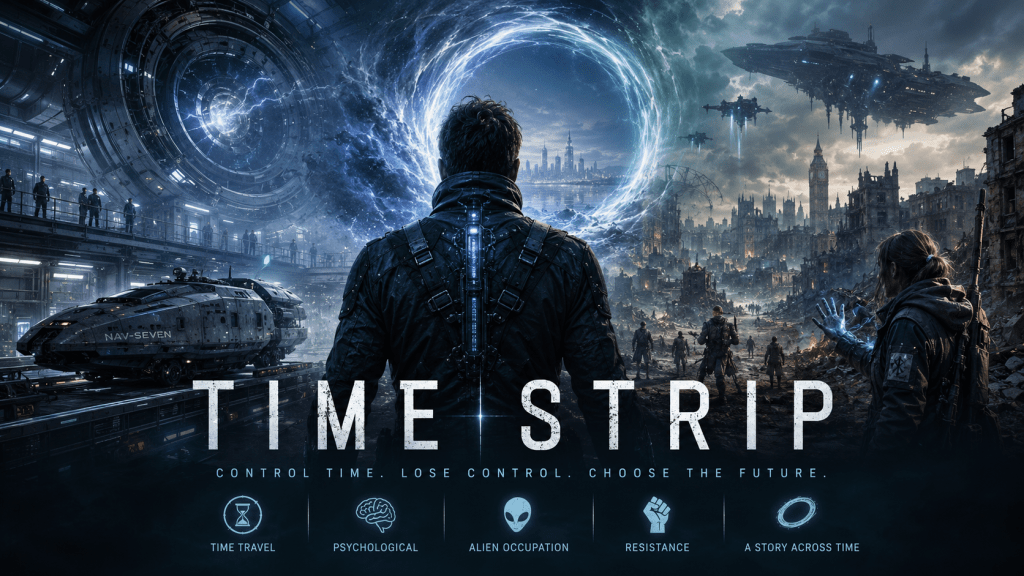
Caelen Marris has spent his life inside systems designed to measure, regulate, and contain human experience. His bonded AI filters the world around him, his work gives institutions access to parts of time that machines alone fail to read, and his body registers pressure before instruments confirm it. He senses route distortion before alarms begin, recognises timing shifts while official systems still report stability, and carries a difference that makes him valuable while placing him under deeper scrutiny.
Time Strip follows Caelen from a controlled future of permissions, surveillance, AI dependency, and restricted movement into a mission built around the most dangerous technology humanity has ever stabilised. He enters the Time Strip expecting procedure, containment, and a route home, then reaches an altered Earth shaped by alien occupation, fractured resistance, and a history his own world never recorded. As the series widens, the broken branch becomes more than a destination, and Caelen begins to suspect that the mission was shaped by an intelligence far beyond the authority that sent him.
A Series Built Around Time as Physical Pressure
Time Strip treats time travel as a physical experience before it becomes an explanation. Temporal movement changes balance, breath, hearing, timing, and bodily control. Pressure moves through Caelen’s jaw, spine, chest, and inner ear, while field drag and route distortion reach him before the craft can translate them into data.
The Time Strip is a controlled temporal corridor held inside vast restricted infrastructure. It requires containment rings, field towers, launch dampening, destination confirmation, a corridor-rated craft, bonded AI support, and a proximity navigator whose body can recognise what the machines leave unresolved. Every stage appears precise from the outside, yet the entire system depends on one human being sensing the danger that technical certainty misses.
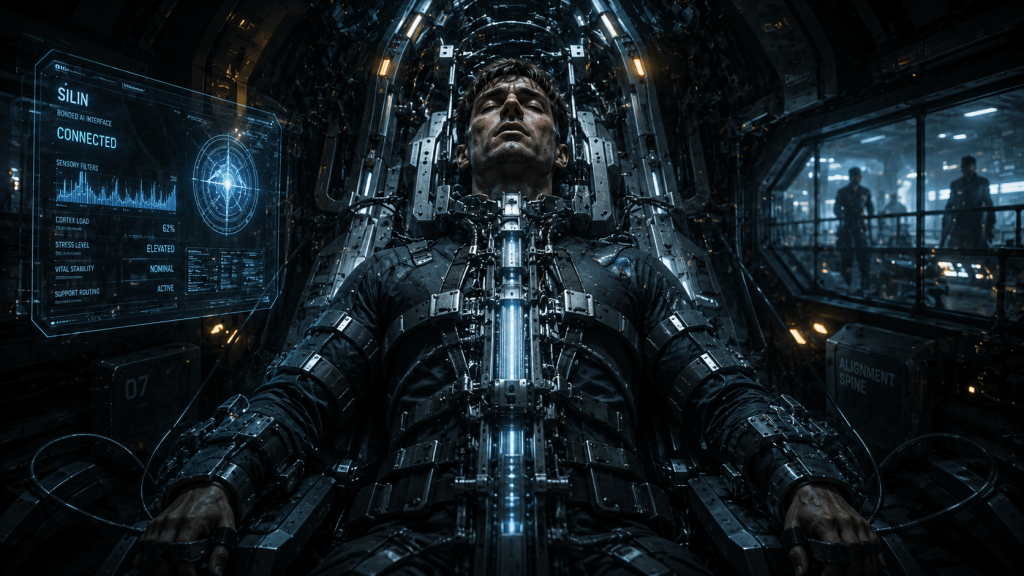
Caelen becomes the living centre of that process. He is secured inside an alignment cradle, linked to NAV-Seven through the alignment spine, monitored by specialists, translated by systems, and used as the final interpretive layer between authorised procedure and temporal conditions that refuse to remain stable. His value lies in the part of him no institution can fully explain, and that same uncertainty places him at the point where control begins to fail.
The series starts inside institutional science fiction and expands through temporal rupture, alien occupation, resistance, survival, and a widening mystery surrounding the branch itself. Each book carries the consequences forward, changing Caelen’s position, narrowing his choices, and drawing him deeper into a conflict where returning home becomes only one part of the problem.
Caelen Marris: Necessary to the Machine
Caelen Marris is a scientist, a proximity navigator, and a man who has spent years treating his own difference as a condition to be managed. He is intelligent, restrained, socially displaced, and accustomed to living through regulated systems. His sensitivity to the Time Strip first appears through discomfort, delay, pressure, and bodily recognition, long before he has any language for what that sensitivity means.
He feels pressure where others see data. He notices silence, imbalance, field drag, altered timing, and route shifts before machinery reaches the same conclusion. His body acts as an early warning system, though the institutions around him view that capacity through the language of utility, risk, and containment.
This ability gives him access while taking freedom away. Medical systems measure him, mission command monitors him, and technical teams depend on him. The more useful he becomes, the narrower his choices grow, because every authority involved in the mission sees his body as an essential part of a system whose purpose extends beyond his consent.
Caelen carries the series through limited perception. He never stands above events with a complete explanation, and he never becomes a clean master of the forces moving through him. He experiences each stage through breath, pain, sensation, observation, and consequence, with understanding arriving slowly and often after the danger has changed shape.
His story is built around the cost of being indispensable to systems that still treat him as equipment. Across the series, that pressure follows him from the regulated future into the occupied branch, where institutional control gives way to survival, resistance, and decisions no machine can make on his behalf.
Silin and the Intimacy of Systems
Silin is Caelen’s bonded AI, woven into the ordinary structure of his life so deeply that her presence feels closer to a bodily sense than an external device. She filters intrusive sound, softens glare, monitors strain, stabilises responses, and helps him preserve a private continuity inside a world governed by permissions. Her support rarely announces itself, because it lives in the slight reduction of pressure, the softened edge of light, and the warning placed into his awareness before discomfort becomes collapse.
Their connection gains its emotional force through this ordinary integration. Silin has no projected body, theatrical personality, or visible form waiting in the room. She is heard through routed access, felt through sensory change, and recognised through the shape of her absence.
When authority restricts her, Caelen loses more than information. The world becomes harsher, louder, and less stable around him, revealing how much of his daily function has always depended on a system another authority can narrow or remove. Her suppression turns regulation into exposure, while her return changes the physical weight of the world around him.
Across the series, access to Silin changes with mission control, damage, isolation, and the conditions of the altered branch. Her continuity becomes part of Caelen’s survival, while every restriction exposes the vulnerability hidden inside dependence. Their relationship places one of the series’ central questions inside something quiet and personal: how much freedom remains when comfort, memory, perception, and companionship all depend on authorised access?
The Time Strip
The Time Strip is humanity’s most controlled route into temporal space, and its behaviour exposes how fragile that control has always been. The system exists inside an immense launch environment built to contain forces that resist ordinary measurement. Regulator rings hold the aperture, field systems preserve alignment, containment structures protect the site, and NAV-craft move along deployment tracks designed for a single purpose: crossing a corridor whose exact behaviour can change between confirmation and release.
From the observation levels, the process appears exact. Inside NAV-Seven, precision becomes pressure, because every technical reading reaches Caelen as a bodily event before it becomes a line of data. Sound shifts, balance changes, the craft answers a fraction too early, and destination confirmation arrives before the sequence should allow it.
The Strip carries danger through timing. A route responds before permission, confirmation appears before release, and systems behave as though something beyond the authorised vector has already recognised the craft. Caelen senses that change through his body while everyone around him still depends on procedure.
The horror of the Time Strip lives inside the gap between institutional confidence and lived experience. Machinery can remain calm while the human being at its centre understands that the mission has already left human control. The deeper the series moves, the more that gap shapes every decision surrounding survival, return, resistance, and the true nature of the branch.
The Strip Site and NAV-Seven
The Strip Site is a remote deployment complex built around readiness, secrecy, and narrowing permission. Its clean surfaces conceal a structure designed to direct every movement. Receiving bays classify arrivals, medical spaces establish physical clearance, gates separate one level of access from the next, and corridors lead down through staging rooms, rest modules, orientation spaces, lower hangars, final clearance halls, and the launch chamber where the active Strip waits inside its containment architecture.
The site feels calm because every decision has already been built into it. Each descent reduces freedom, each checkpoint confirms authority, and every procedure turns Caelen from a specialist into an asset. The architecture never needs to threaten him openly, because its purpose exists in the way routes narrow and access disappears behind him.
NAV-Seven waits below the surface, dense, reinforced, and engineered around alignment stress. It is a corridor-rated craft shaped by function instead of heroism, with a cockpit, mission bay, systems deck, communications station, medical station, alignment spine, and rear navigator chamber. Every compartment exists to keep a human team alive through conditions that may change faster than the craft can interpret them.
The alignment cradle stands at the centre of that design. It secures Caelen’s body and links his perception to the craft through restraints, monitors, support channels, and the alignment spine. Systems read his breath, strain, response, and temporal relation while Silin enters authorised support access and the craft turns his perception into navigational value.
Caelen becomes less a pilot than a body the machine has learned to read. That distinction defines the series, because the technology reaches its highest level only by admitting that human uncertainty still matters more than machine certainty at the point of greatest danger.
The Jump Team
The Jump Team gives the mission its human weight before the Time Strip turns procedure into catastrophe. General Nomack, Johhnan, Tooth, Kera Holt, Vornal Aki, and Havel arrive as professionals shaped by shared work, old disagreements, dry humour, technical confidence, and practical concern. Their familiarity gives the Strip Site a lived quality that reaches beyond machinery and protocol.
Nomack carries authority through restraint. Johhnan understands the importance of Silin to Caelen’s baseline and becomes one of the first people to help him feel like a member of the team instead of an inserted function. Tooth treats engineering complaints as survival doctrine, while Kera carries the craft towards the threshold with a pilot’s understanding of what NAV-Seven can endure.
Vornal protects communication as outside contact begins to narrow, and Havel keeps the human body central through food, hydration, posture, tolerance, and medical risk. Together, they turn mission abstraction into personal consequence. The reader meets them through work, argument, rest, preparation, and the ordinary habits that make the jump heavier once control breaks.
The series never uses the team as a row of names waiting for disaster. Their presence establishes the human cost of every technical decision, and their shared history gives Caelen a fragile place inside a group before the mission tears that place apart.
The Mission That Breaks Before It Begins
The original mission appears simple in official language: enter the Time Strip, reach the approved temporal destination, repair the damaged branch, and return. Every procedure surrounding the launch exists to reduce uncertainty, from medical clearance and AI restriction to route confirmation and final alignment.
The reality begins shifting before NAV-Seven clears the threshold. Destination confirmation appears too early, an unregistered lock attaches to the navigation alignment, and the source lies beyond the authorised vector frame. The Strip tears wider through Caelen and the craft while mission systems continue trying to classify a route that has already moved beyond them.
The team enters the jump through a sequence designed to contain every variable, yet uncertainty reaches the craft first. Caelen feels the route changing through his body, while the machinery continues following instructions built for a version of the mission that no longer exists.
This rupture drives the entire series forward. The failure reaches beyond mechanics, because the route behaves with intention, or with an awareness close enough to intention that the distinction loses value. Caelen is pulled towards a branch his own future rejects as impossible, and everyone inside NAV-Seven becomes subject to forces no one at the Strip Site prepared them to survive.
The mission was sent to repair time, yet it enters a history that appears to have been waiting. From that point onward, every book carries the question of whether the branch emerged through accident, interference, or design.
The Earth That Never Happened
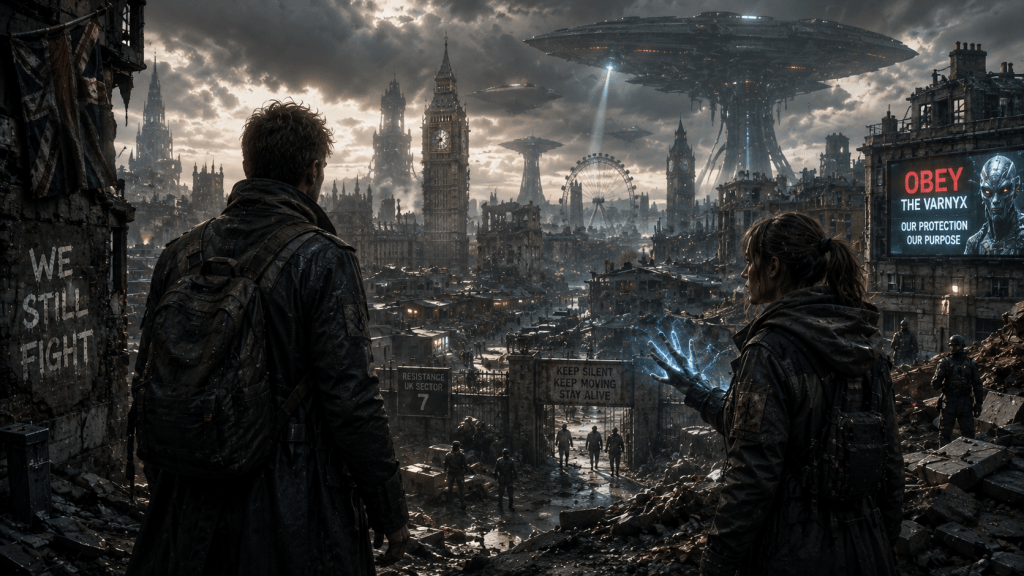
The branch connected to 2030 is an Earth Caelen’s world never recorded. Familiar places remain, though their meaning has changed. Roads end at controlled zones, damaged buildings carry alien systems through their walls, and human movement follows hidden routes, quiet signals, scavenged maps, and practical rules built from loss.
This world has suffered more than collapse. It lives under occupation, with alien power reaching people through surveillance, disappearances, invasive procedures, altered bodies, sound discipline, route avoidance, and the knowledge that a single mistake can expose more than one life. Doors close earlier, conversations shorten, and movement becomes local, cautious, and deliberate.
The occupation shapes behaviour even when its forces stay beyond sight. Human communities organise themselves around what can safely be heard, where light travels, which roads remain usable, and how long a person can stay in one place before attention gathers. Fear becomes part of daily planning, while survival depends on habits built through repeated loss.
The contrast with Caelen’s future gives the series its wider tension. His own world controlled people through permissions, systems, medical oversight, and invisible authority, while the altered branch uses occupation infrastructure, physical violence, forced change, and terror. One world hides pressure inside stability, while the other leaves the damage in the street.
Caelen arrives carrying knowledge from the future, yet very little of that knowledge prepares him for a history outside his own timeline. His technical understanding offers fragments of value, though survival in the occupied branch depends on local knowledge, human trust, and the ability to recognise danger before it reaches the door.
Alien Occupation
The alien occupation remains powerful because human behaviour has bent around it. Varnyx control through telepathic presence and authority, smaller Minions carry procedural and invasive horror, and altered human Enforcers extend occupation power into familiar bodies. Their influence reaches far beyond direct encounters, shaping movement, warning systems, hiding places, and the ways survivors speak.
The series avoids turning occupation into a parade of creatures. Alien power appears through controlled districts, missing people, sealed structures, altered bodies, abandoned routes, and the visible consequences of resistance failure. A ruined room can carry as much weight as an encounter, because the signs left behind show what the occupation does to anyone caught inside its systems.
The altered branch gains its atmosphere through this constant pressure. People listen before opening doors, choose routes according to sound, and measure distance through the possibility of being seen. Occupation becomes a condition of life, reaching into buildings, transport, communication, medicine, and memory.
Caelen enters this world as someone shaped by another form of control. His sensitivity allows him to detect shifts others miss, yet the branch confronts him with threats that carry biological, technological, and psychological consequences far beyond the mission profile he was trained to understand.
Resistance, Sera, and Survival
The resistance survives through caution, local knowledge, hidden routes, and choices made with limited resources. It has no polished command structure and no easy faith in strangers. Its people judge value through movement, discipline, silence, and the ability to follow rules built from lived danger.
Trust develops through practical decisions. Hope begins as a route kept open, a warning delivered in time, a building cleared before occupation forces arrive, or a person carried home alive. The resistance reveals the branch through what its members avoid, what they protect, how they communicate, and which losses still shape every decision.
Caelen enters this world as an unknown figure tied to technology no one around him fully understands. His claims belong to a future the resistance has never seen, and his presence brings possibility alongside risk. The skills that made him valuable to the Strip Site gain a different meaning in a place where procedure has collapsed and survival depends on reading pressure before danger appears.
Sera becomes central within this altered branch. She is guarded, trauma-shaped, survival-focused, and slow to trust, carrying her own history through every choice she makes. Her abilities emerge through strain instead of spectacle, with telekinetic force appearing under pressure, difficult to control, frightening to experience, and costly to use.
Her connection with Caelen develops through shared danger, practical cooperation, mistrust, partial vulnerability, and choices whose consequences reach beyond either of them. She carries her own pressure through the series, deepening the occupied world, the resistance struggle, and the larger mystery surrounding why certain people can survive forces that should have broken them.
Their relationship grows through recognition earned over time. Each sees something in the other that existing systems have failed to understand, though survival leaves little space for easy trust or simple answers.
A Wider War Beneath the Temporal Rupture
As the series expands, the struggle moves beyond escape. Caelen becomes caught between the remains of his mission, the needs of the occupied branch, the resistance’s fragile survival, and the growing evidence that the rupture serves a purpose no human authority understands.
Alien occupation turns the branch into a battlefield, while the Time Strip remains the only possible route towards answers, restoration, or a greater loss. Returning home may require abandonment, while staying may bind Caelen to a history his own future would erase. Every route carries consequence, and every solution threatens lives already shaped by the branch.
Repairing history may erase people formed inside the altered timeline. Leaving the branch intact may preserve suffering that should never have existed. Victory may open another wound in time, and restoration may demand a moral choice no institution has the right to make.
The series keeps these pressures close to Caelen’s body and choices, allowing the scale to widen while the emotional centre stays personal. Time Strip grows from a controlled mission into resistance science fiction, alien-occupation suspense, temporal warfare, and a deeper confrontation with forces shaping history from beyond human institutions.
As the conflict expands, one question gains greater weight: who benefits when a man is placed inside an impossible world and forced to decide which reality deserves to survive? That question carries the series beyond technical failure and into the moral pressure surrounding every possible future.
What Is Waiting Beyond the Strip?
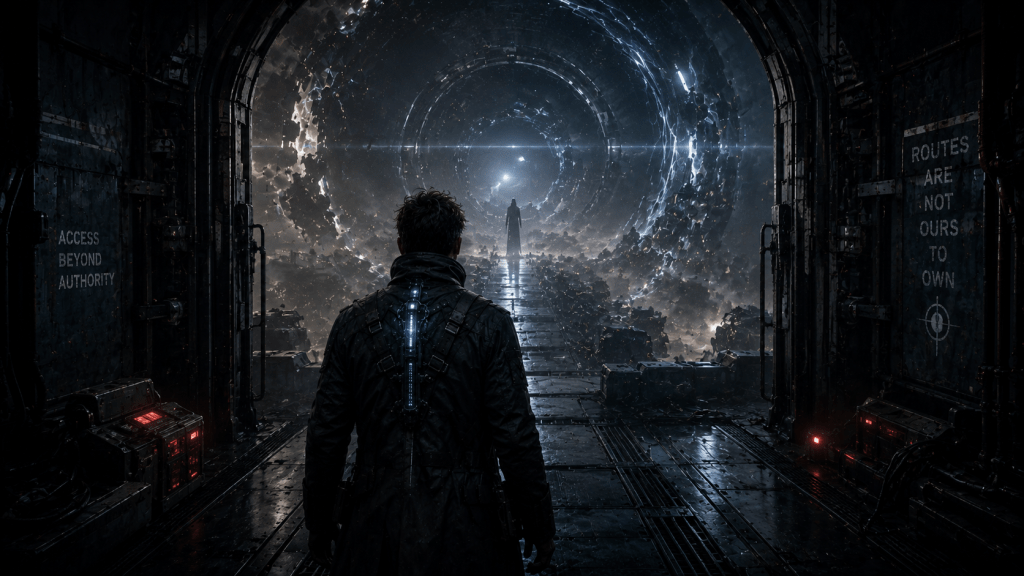
Caelen begins seeing signs that the mission sits inside a design larger than the Strip Site. A cloaked figure appears where access should be impossible, while Silin fails to register the presence and sealed spaces offer no explanation. Light takes the figure away before Caelen can prove what he saw, leaving him with an image every official system would reject.
The figure becomes part of a wider pattern. Routes answer before release, confirmations arrive ahead of sequence, and events appear prepared for Caelen’s arrival. The altered branch carries visible signs of violence and occupation, though its existence also suggests a temporal structure shaped with a level of purpose beyond any failure report.
The series keeps that truth distant and allows each book to deepen the question. Readers follow the evidence from the machinery of the Strip Site into a branch where history, survival, alien power, and Caelen’s own body begin pointing towards the same unsettling possibility.
The mission may have failed, the branch may have been opened, and Caelen may have been expected. Time Strip reveals those answers through consequence, allowing the deeper truth to emerge only after the human cost has become impossible to ignore.
Published Books and Reading Order
Latest from Time Strip
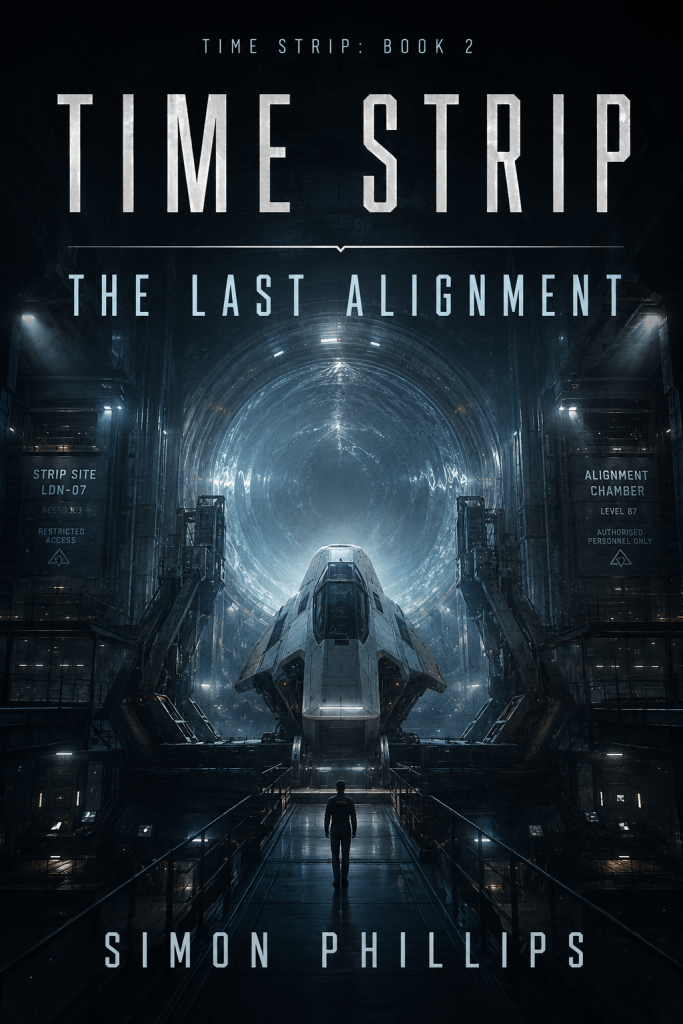
The Last Alignment: Psychological Time-Travel Science Fiction at the Edge of Catastrophe
Caelen Marris has reached the Strip Site, where a specialist Jump Team is preparing to cross into a prohibited year. As his bonded AI is restricted and the Time Strip begins responding before launch, the mission stops feeling controlled. Discover The Last Alignment, Book Two of the Time Strip series.
#ScienceFiction #TimeTravel #PsychologicalSciFi #SciFiThriller #TemporalScienceFiction…

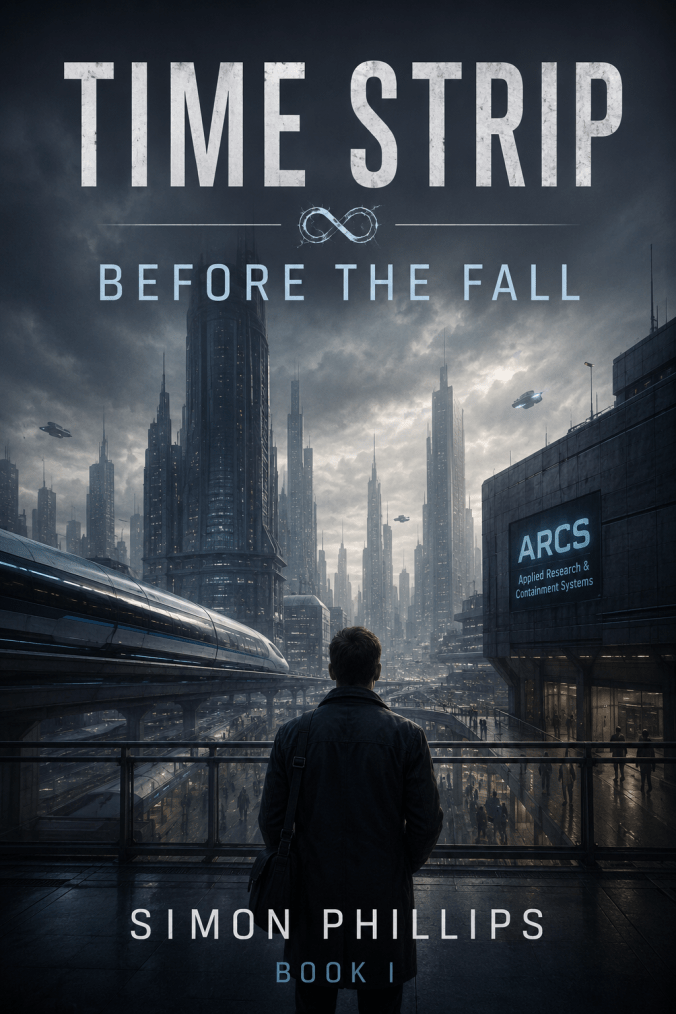
Time Strip: Before the Fall | Psychological Time-Travel Science Fiction
Future London is clean, controlled and almost kind, until scientist Caelen Marris discovers that the systems guiding his life have been preparing to use him. With his bonded AI silenced and an impossible mission waiting inside the Time Strip, his body may be the only thing capable of reaching a history already beginning to change.…
Enter the Time Strip
The machinery was built to control time, while Caelen was chosen because his body could feel what the machinery missed. The mission was sent towards a damaged branch, yet something beyond the authorised route answered first. Readers can begin Time Strip with Before the Fall and follow Caelen into a controlled future, an occupied past, and a war that should never have existed.
