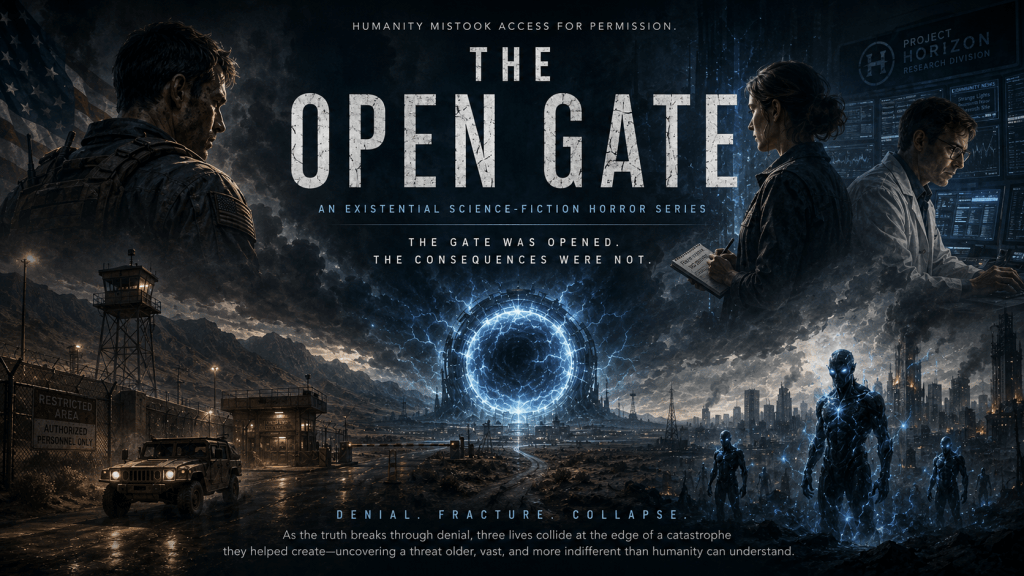
Existential science-fiction horror about dimensional trespass, institutional denial, and the cost of believing access grants permission
Humanity built the gate because every calculation said the barrier could be crossed. Inside a remote research facility, technicians studied unstable readings, security teams followed familiar routes, and officials reduced each contradiction to an issue that could be measured, filed, and corrected. Beyond the perimeter fence, a neighbouring town continued through brownouts, delayed deliveries, restless nights, and rumours that never remained solid long enough to become proof.
The experiments reached into another reality. The damage began long before the people responsible understood what their equipment had touched.
The Open Gate follows a contemporary world as scientific confidence gives way to dimensional horror. A soldier, a reporter, and a scientist move through different parts of the same widening crisis, each carrying fragments that resist the explanations offered by the systems around them. Their lives remain grounded in patrol roads, newsrooms, laboratories, kitchens, bars, checkpoints, service corridors, and ordinary streets, even as reality begins to fail inside those familiar places.
The gate opened because humanity could open it. Everything that follows grows from the belief that the right to reach was already assumed.
Humanity Mistook Contact for Permission
The first breach arrives through quiet irregularities instead of public disaster. It enters through readings that drift beyond their expected range, lights that dip across the town, vehicles seen on roads at impossible hours, reports returned for clarification, and figures that seem human until movement gives them away. Each disturbance receives an explanation. Each department keeps working. Each person finds a reason to continue through the day.
The facility treats instability as an engineering problem. Security personnel are told that glare, fatigue, hardware interference, or local conditions have affected what they saw. Scientists are asked to correct the model, stabilise the readings, and remain inside the limits of their assigned work. Civilian reports are divided into power faults, supply delays, road closures, and unreliable testimony. The explanations remain plausible when examined alone. Together, they begin to describe a reality that official language can no longer contain.
The horror of The Open Gate grows through that distance between lived experience and accepted explanation. Human beings sense the change before they understand it. Institutions recognise the contradiction before they admit its scale. Procedure continues because procedure has always carried people through uncertainty, even after the systems behind it have lost the authority they still claim.
The Foundational Lie
Humanity believes it belongs everywhere, and that belief sits beneath the research programme long before the first visible fracture appears. The gate is treated as a frontier opened by intelligence, funding, technical discipline, and national power. The ability to create access becomes its own justification. Risk is measured through containment plans, security clearances, projected tolerances, and language designed to make every warning sound temporary.
Curiosity alone carries too little force to create the catastrophe. The danger grows from curiosity supported by institutions powerful enough to continue after the warnings have gathered. Scientists remain focused on isolated technical tasks. Military systems protect the work through routine. Political oversight depends upon controlled information. The town accepts each disruption because ordinary life still appears to function. Every layer keeps the programme moving while responsibility becomes harder to place.
Existence grants no automatic right of entry. Intelligence grants no permission. The Open Gate follows the long collapse of a civilisation that learns this truth after the machinery has already crossed the boundary.
Three Lives Inside the Same Contradiction
The series unfolds through three connected human perspectives. Each person occupies a different part of the crisis, carries a different form of authority, and encounters a different reason to doubt what the world around them insists remains under control. Their knowledge stays divided, leaving the reader to recognise connections that each individual can only approach through incomplete evidence.
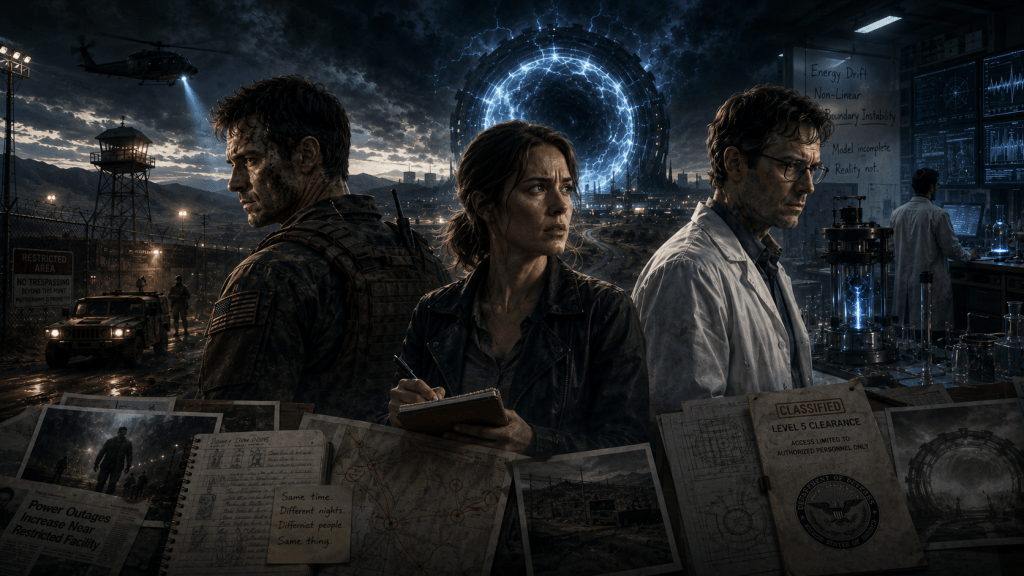
The Soldier
The Soldier knows the perimeter through repetition. He travels the same service roads, passes the same guard posts, checks the same fencing, and completes the same patrols beneath floodlights that flatten the desert into concrete, dust, and shadow. He is competent enough to absorb minor irregularities and careless enough to let routine explain what deserves closer attention.
His world is physical. A gate arm rises too slowly. A vehicle appears where no movement was scheduled. A figure stands beyond the practical reach of the lights. A report returns with language that reduces the event to equipment, fatigue, or distance. He feels unease through the body before he gives it a name, then carries that pressure into a bar, a quiet home, another shift, and another journey through the same controlled landscape.
He has been trained to continue. The series asks how long continuation can resemble control once the orders remain familiar and the world around them has changed.
The Reporter
The Reporter works among stories that remain too small to command attention. A shop loses power at the same hour on three separate nights. A delivery driver sees black vehicles moving towards the facility before dawn. Residents speak of vibrations beneath their floors, windows that rattle during clear weather, and stretches of road where sound seems to fall away. Each account appears weak in isolation. The pattern becomes harder to dismiss once the same details begin returning from people who have never met.
Her struggle begins with credibility. Editors require proof that survives legal review, public pressure, and the needs of a town whose livelihoods depend upon the facility. Witnesses change their wording after official visits. Records become harder to obtain. A story that feels increasingly urgent remains impossible to publish in any complete form.
She sees truth gathering around ordinary lives while the machinery of public explanation breaks it apart. Her role across the series reaches beyond exposing a secret. She becomes a witness to events whose scale may exceed the power of journalism to alter them.
The Scientist
The Scientist works inside controlled rooms where every uncertainty arrives as data. He studies models, system behaviour, energy drift, and architecture whose full purpose sits beyond his clearance. His intelligence makes him valuable because he can solve the problem placed directly before him. His isolation keeps the wider moral question beyond the edge of his assigned task.
He corrects instability. He finds hidden connections between systems. He sees that the experiment carries a scale the official diagrams fail to acknowledge. Each successful adjustment brings the gate closer to stability, even as the readings suggest that stability may be the most dangerous outcome available.
His pressure grows through complicity. The work remains precise, the equipment remains functional, and every decision arrives through reasonable technical language. The series follows what happens when intellectual honesty finally demands more than another correction to the model.
The Facility
The research installation stands deep within the Southwestern United States, remote enough to control access and close enough to a working town to remain part of ordinary life. Low buildings sit behind metal fencing and guarded checkpoints. Service roads cross dry ground towards laboratories, maintenance yards, cooling systems, observation rooms, and restricted sections whose purpose is divided across departments.
The facility carries no theatrical face. Its corridors are bland, its signs practical, its rooms built for work. Badge readers blink beside reinforced doors. Trucks arrive through scheduled routes. Monitor light settles across tired faces. Air-conditioning moves stale air through internal spaces where access depends upon rank, task, and clearance. Every part of the installation appears credible because every part serves a function.
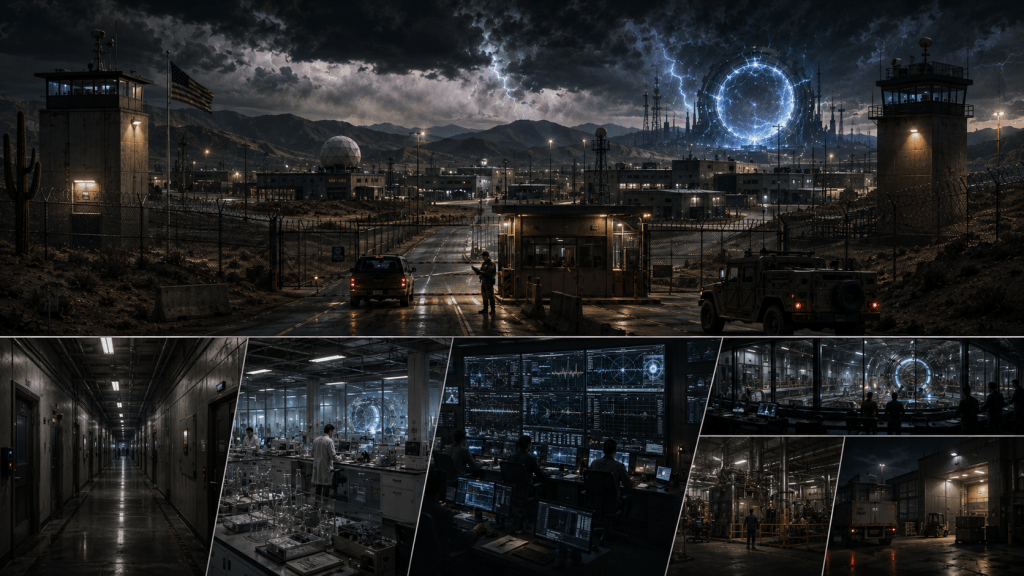
Its horror comes from what it accepts as normal, since an impossible reading becomes acceptable variance. A sighting becomes visual interference. A worker’s unease becomes fatigue. A structural change becomes an update. The language remains calm while the meaning beneath it shifts. As the crisis widens, the facility continues to process each contradiction through the same systems that helped create it.
The Town Outside the Fence
The town lives in the economic and psychological shadow of the facility. Families depend upon its wages. Shops depend upon its staff. Roads, deliveries, local reporting, and community life all carry some connection to the installation, even when residents prefer to keep its work at a distance.
Daily life continues through bakery lights before sunrise, coffee poured in diners, local meetings, parked cars warming beneath the desert heat, and neighbours exchanging fragments of concern across counters and garden fences. The disturbances arrive inside that familiarity. Brownouts interrupt evening meals. Supply vehicles miss expected routes. Windows tremble with no storm nearby. Black vehicles pass through streets where official traffic rarely travels. People remember unusual lights, silent periods, and shapes seen near the road, then lower their voices when someone asks for detail.
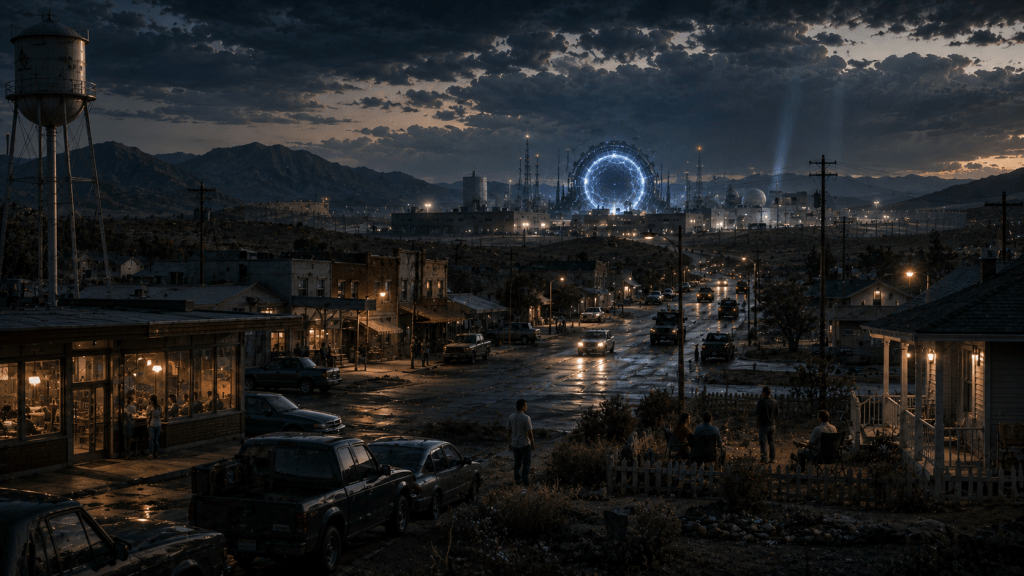
The town can absorb one strange event. It can absorb several when each receives a separate explanation. The pressure changes when the events begin to share timing, direction, and proximity to the facility. Ordinary people become the first public record of a crisis that official systems have already learned to divide into harmless pieces.
The House That Still Looks Whole
The widening crisis enters a home already shaped by grief, distance, work, and avoidance. The Soldier and the Reporter share a domestic life whose structure remains visible through meals, keys left on familiar surfaces, late returns, unfinished conversations, and the habits that allow two people to occupy the same rooms while carrying separate versions of the truth.
Their marriage gives the series an intimate form of denial. One person avoids what responsibility might demand. The other pursues evidence that keeps drawing attention away from the life waiting at home. Each recognises absence in the other. Each has learned how to continue around it.
The house remains standing while trust grows thin. Beyond its walls, institutions perform the same act on a larger scale. The facility remains operational. The town remains open. The reports remain orderly. Structure survives long after certainty has begun to leave it.
The Gate
The first dimensional experiments produce openings too unstable to resemble a doorway. Instruments register brief distortions, incomplete patterns, environmental changes, and movements that fail to remain present long enough for comfortable interpretation. Sensors disagree with human witnesses. Recorded images lose the detail people remember seeing. Sounds appear where no source can be found. Shapes form at the edge of perception, then collapse back into glare, static, heat, or shadow.
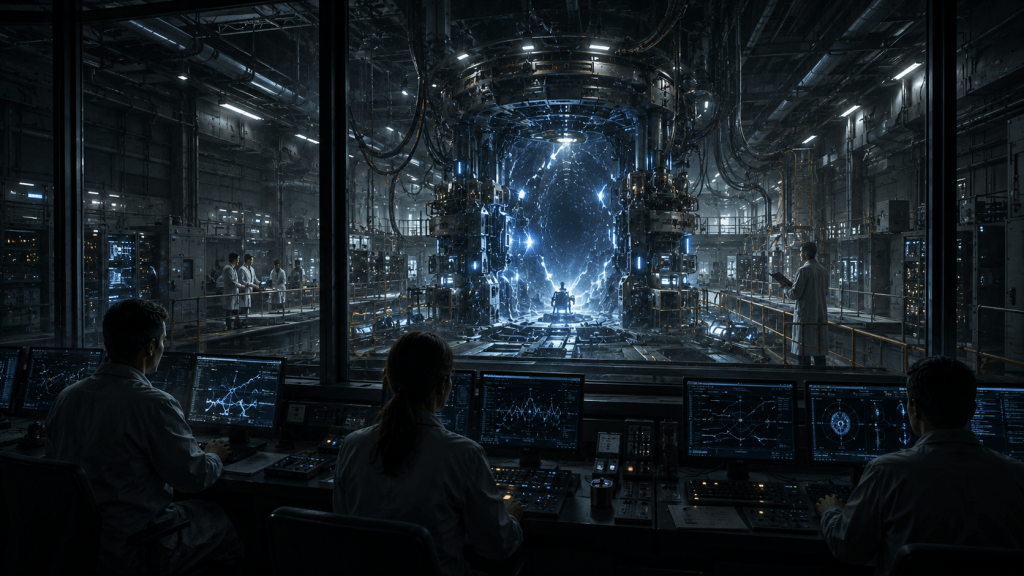
The programme treats instability as proof that the technology requires refinement. A smaller opening that shifts, tears, and closes becomes an engineering failure awaiting a stronger solution. The institutional answer is greater control, greater energy, deeper integration, and a larger gate designed to remain stable.
That decision changes the scale of the series because humanity approaches the boundary as though nature has supplied another technical obstacle. The gate reveals a harsher condition. Opening a path says nothing about whether the traveller belongs on the other side, whether a human body can survive the transition, or whether the reality being entered can survive the wound.
What Humanity Damaged
The beings glimpsed around the experiments carry a shape close enough to humanity to awaken recognition, then move in ways that disturb it. Their posture feels wrong. Their outlines resist a fixed edge. Blue-white pressure gathers around them as a visible trace of physical laws that human senses can only partly receive.
To those guarding the facility, they appear as intruders. To those studying the gate, they become unknown subjects. To the town, they exist as stories that collapse under repetition. Every human system approaches them through the assumption that Earth stands at the centre of the event.
The wider truth carries greater weight. The experiments have reached into a living reality and caused damage there. The figures approaching Earth may have reasons grounded in survival, fear, and defence, even while their presence remains terrifying to every human who encounters them.
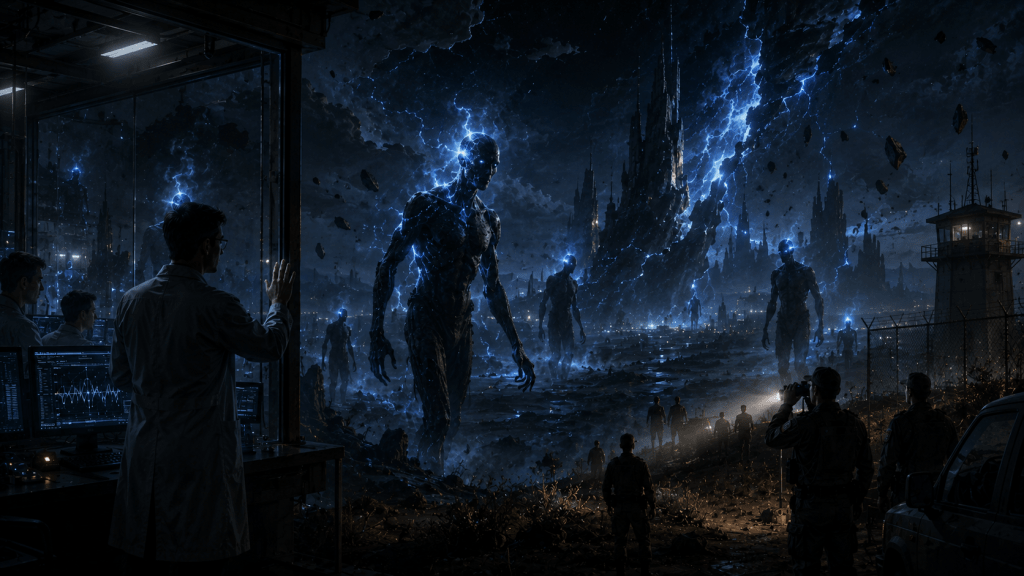
The Open Gate holds that tension across the series. The beings beyond the breach resist the comfort of a simple enemy, while the conflict surrounding them points towards a scale of danger that humanity has yet to understand.
A Witness From Elsewhere
Across the pressure surrounding the gate, a damaged human figure appears with knowledge that no living institution can verify. He carries the impression of someone who has seen similar worlds reach the same threshold, then watched the consequences move beyond recovery.
His condition is unstable. His words arrive in fragments. His presence creates more uncertainty than guidance, since every warning raises questions he lacks the strength, access, or complete knowledge to answer. He offers no secure path through the crisis. He stands as evidence that Earth may be entering a history already endured elsewhere.
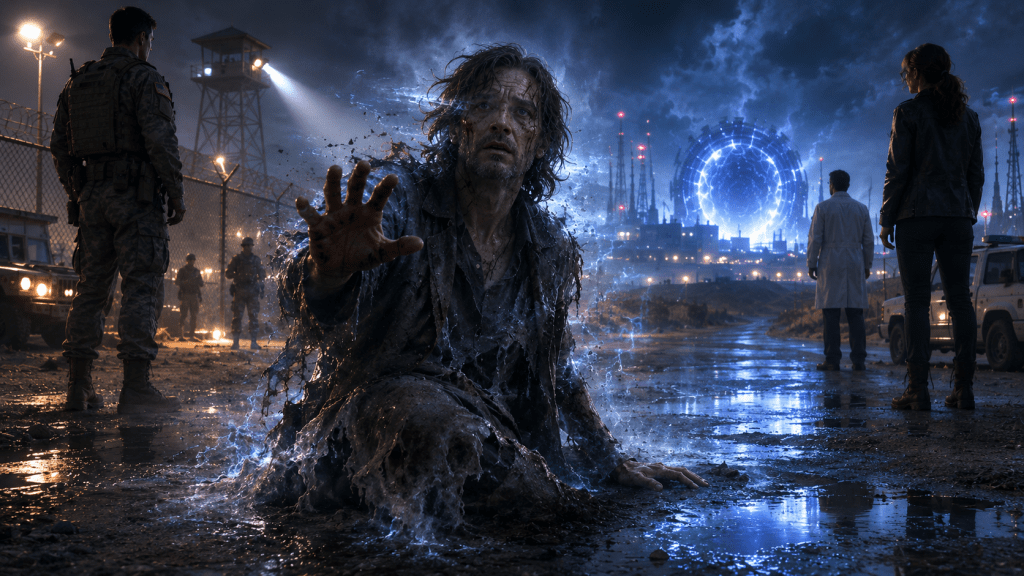
The Grey Man brings the possibility of repetition into the series. Humanity may regard its discovery as unprecedented, while the witness suggests that the gate belongs to a pattern far older than the people who opened it.
Denial Protocol
The opening movement of The Open Gate begins while civilisation still trusts its own systems. The facility operates. The town works. Reports pass through official channels. Security teams complete their shifts. Scientists continue adjusting models. Journalists seek confirmation. Homes retain the shape of ordinary life.
Across Denial Protocol, each explanation demands greater effort. Events once dismissed as isolated begin to share a structure. Confidence survives through controlled language even as lived reality moves beyond it. The Soldier sees procedure fail to account for physical experience. The Reporter finds evidence that becomes less publishable as it becomes more urgent. The Scientist discovers that technical success may deepen the danger he has been asked to solve.
The series expands through the erosion of certainty. Containment becomes harder to believe. The apparent enemy becomes harder to define. Knowledge grows while its practical value contracts. Human systems continue moving because stopping would require an admission that every safeguard, model, and command structure was built around the wrong understanding of the gate.
The wider crisis carries the story beyond the first breach, beyond the first official failures, and beyond the belief that intelligence alone can restore control. Each book removes another shelter from the human explanation of events, leaving the characters closer to the truth and further from any assurance that truth can save them.
The Widening Crisis
The Open Gate is a connected series about reality becoming impossible to deny inside a world that still expects tomorrow to resemble today. Its scale grows from a remote installation and a neighbouring town towards a conflict whose boundaries reach beyond any single department, government, or human interpretation.
The books follow the consequences through people who remain human in scale. They still drive through familiar roads, wait beneath fluorescent lights, carry grief into their work, search for missing records, follow orders, make technical decisions, and return to rooms where silence has accumulated. The cosmic pressure gains force because it enters through lives already shaped by compromise, habit, and the need to believe that ordinary structure will hold.
The deeper danger remains beyond the first visible conflict. The beings approaching Earth may carry their own fear. The stable opening may attract attention from a presence older than the struggle surrounding the facility. Humanity may eventually face a force for which conquest, hatred, and revenge are concepts too small to describe its interest.
The series asks what remains of courage when victory becomes uncertain, what evidence means when power controls the accepted version of reality, and how much humanity can survive once survival itself begins to change meaning. Those questions carry the story beyond the immediate breach while preserving the discoveries that belong inside the books.
Published Books and Reading Order
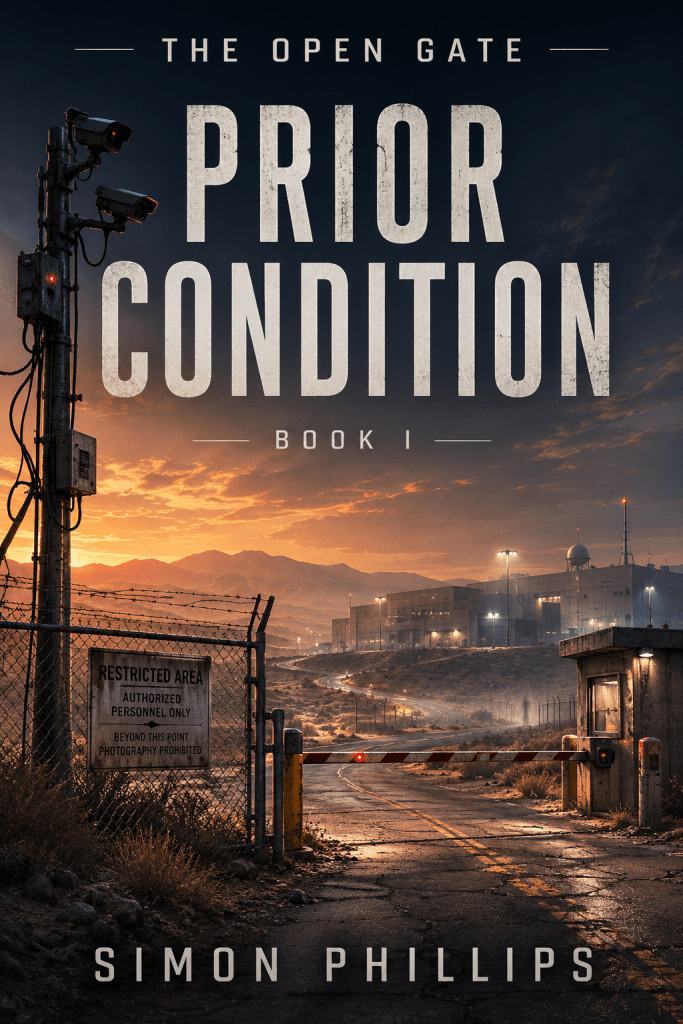
Enter The Open Gate
The series begins inside a world that still believes every anomaly can be measured, every risk can be contained, and every boundary can be crossed once the equipment becomes precise enough. Beyond the fence, the town has begun to feel the change. Inside the facility, the systems are already translating danger into acceptable language. Across the gate, something has been injured. Further away, something older may have sensed the opening. Begin with Book One and follow the collapse from its first deniable signs, through every explanation that fails and every fragment of truth that arrives too late to restore the old certainty.
Latest from The Open Gate
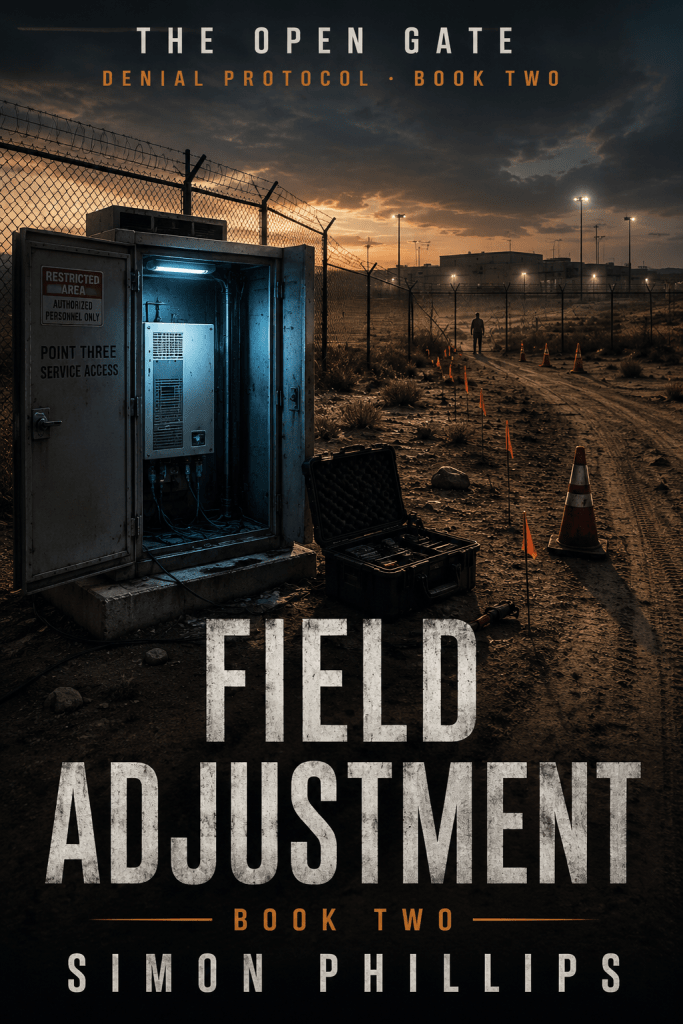
Field Adjustment: Dimensional Horror and Institutional Denial in The Open Gate Book Two
The equipment activates before it is connected. A reporter’s sanctioned tour becomes a professional liability, while a scientist is rewarded for stabilising a system he is not permitted to understand. In Field Adjustment, Book Two of The Open Gate, every procedure keeps working as reality begins to resist the official record.
#TheOpenGate #FieldAdjustment #ScienceFictionHorror #DimensionalHorror…
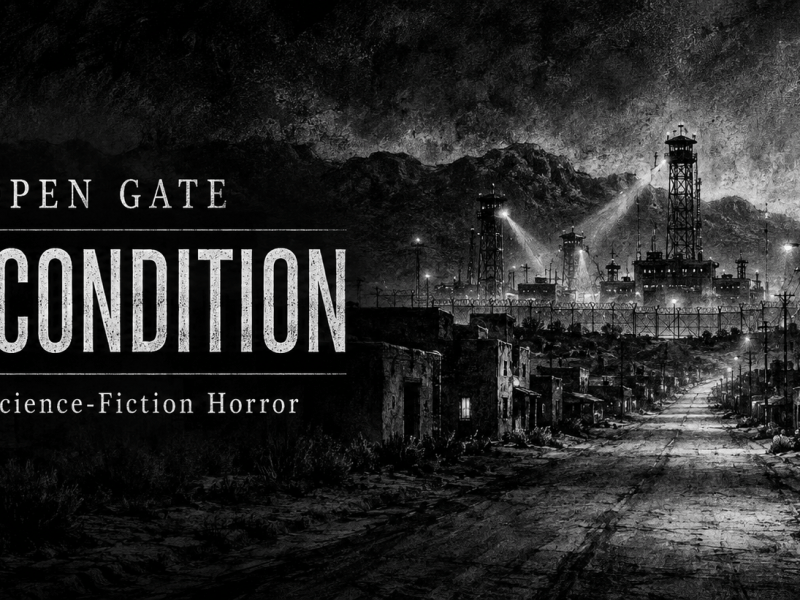
Prior Condition: Slow-Burn Science-Fiction Horror Built on Institutional Denial
The perimeter is secure. The cameras are working. The reports have been filed. Yet beyond the fence, something moves in a way the ground cannot explain.
In Prior Condition, a soldier, a reporter and a scientist encounter different fragments of the same emerging crisis while every institution around them finds another reason to call it…
