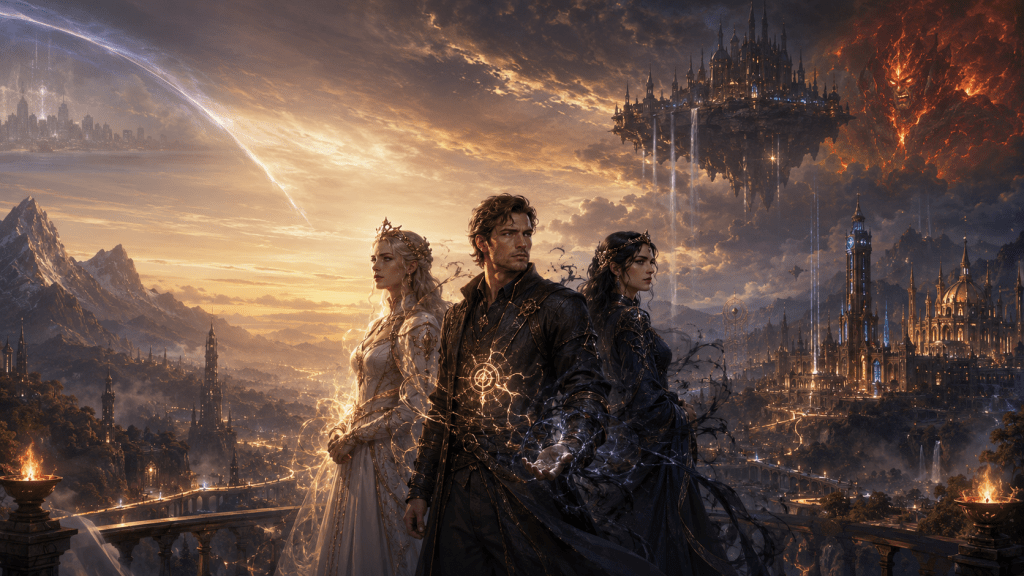
The Hollow Flame Cycle
A British book restorer, two royal sisters, and a prophecy no institution can control stand at the centre of an epic fantasy series shaped by hidden realms, inherited magic, royal power, and an ancient war whose influence still moves beneath the present.
Silas Thorn spent his life repairing damaged books and preserving the evidence left by earlier hands. He understood cracked leather, loosened thread, altered pages, erased marks, and the small signs that revealed where a text had been disturbed. When an ancient volume connected to his own family inheritance draws him across the Veil, those quiet professional instincts become the first tools he carries into a civilisation that has remained sealed from Earth for thousands of years.
The realm receives him as an impossibility. He appears within warded royal space, close to foundations and sigils built to answer only to Crown authority. The Crown sees a breach of sovereignty. The Guild of Mages sees a disturbance within histories it has spent centuries guarding. The Veil Bureau sees a security threat linked to forbidden crossings and prophecy. The Loyalists see the possibility of return.
Silas sees a world he has no language to understand, and a growing sense that the damaged book which carried him there has opened more than a passage.
An Epic Fantasy of Hidden Realms, Prophecy, and Fractured Authority
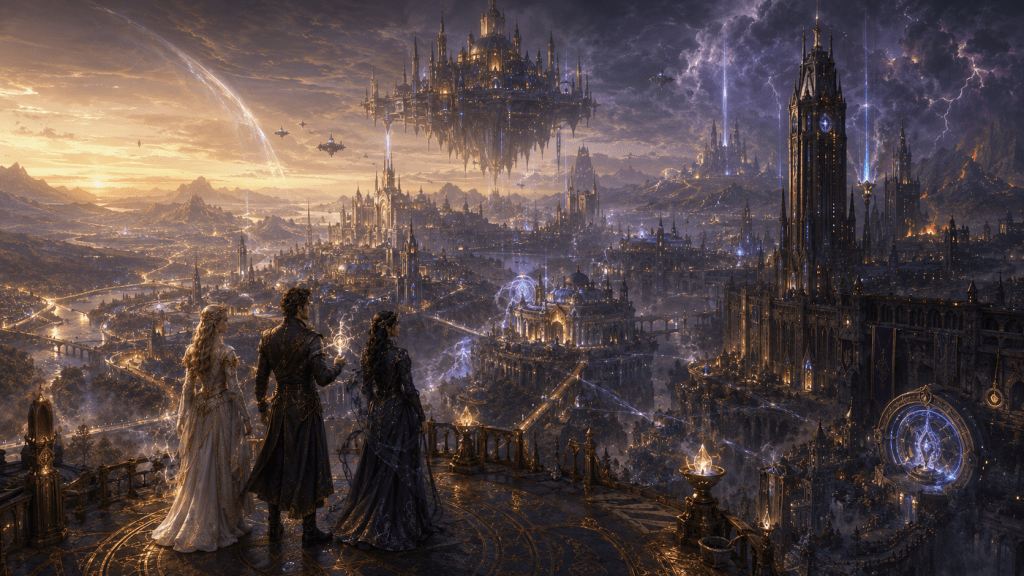
The Echo of Fire and Shadow follows a magical civilisation whose separation from Earth shaped its kingdoms, institutions, laws, transport, cities, and understanding of power. Its people live among glyph-lit streets, leyline routes, powered ships, warded archives, royal halls, restricted portals, and ancient systems whose original makers have passed into history. Beyond the organised centres lie long roads, wild territories, ruined borders, storm coasts, blighted ground, and places where old magical conflict still marks the land.
This realm carries the appearance of order because generations have learned to live inside limits created after catastrophe. Royal authority governs through law, lineage, council, and ritual. The Guild preserves magical learning under restrictions imposed after the Mage War. The Veil Bureau turns fear into procedure, watching for illegal glyphwork, rogue mages, forbidden records, prophecy-linked individuals, and signs of disturbance along the barrier between worlds.
Silas enters that order as a contradiction. His family inheritance reaches into the realm’s oldest guilt, while his own life belongs to modern Britain. He carries no royal claim, no formal training, and no desire to become the meaning others place upon him. His presence still draws every institution towards the same question: whether he represents balance, danger, return, or the first sign that the ancient settlement has begun to fail.
Across the series, that question grows through the lives of Silas Thorn, Lirael Vaerenthis, and Seréne Vaerenthis. Their stories move together through political containment, private recognition, magical strain, inherited responsibility, and the fear that truth may arrive before any of them possesses the freedom to choose what it means.
Silas Thorn: The Man Between Worlds
Before the crossing, Silas worked among objects damaged by time and human intervention. His profession required patience, restraint, close observation, and respect for the difference between preservation and alteration. A repaired binding could reveal where a volume had been forced open. A change in ink could expose a later hand. Pressure in the paper could preserve the shape of words removed from the visible page. Every object carried a history beyond the account written on its surface.
That way of seeing travels with him into the hidden realm. Silas approaches magic, royal ritual, and ancient architecture with the instincts of a conservator. He studies material, pattern, age, and interruption. He notices where a symbol has been repaired, where a record has passed through several hands, and where an institution speaks with greater certainty than its evidence allows. In a civilisation ruled by inherited explanations, his attention to damage becomes quietly dangerous.
Silas remains human throughout the widening scale of the story. He feels fear, displacement, frustration, curiosity, and the ache of being separated from everything familiar. He has no training for royal scrutiny, magical testing, or the attention of people who view his existence as a political event. His courage grows through endurance and moral pressure, shaped by what he chooses to protect when every available answer carries a cost.
His ancestry connects him to an ancient magical inheritance, though blood alone offers no clean explanation. The realm reads old danger into him. Prophecy reads balance. The Guild reads an impossible survival of history. The Loyalists read opportunity. Silas carries light and shadow within the same soul, leaving him beyond the categories designed to keep each power separate.
The deeper danger lies in the way others attempt to define him before he can understand himself.
The Hidden Realm Beyond the Veil
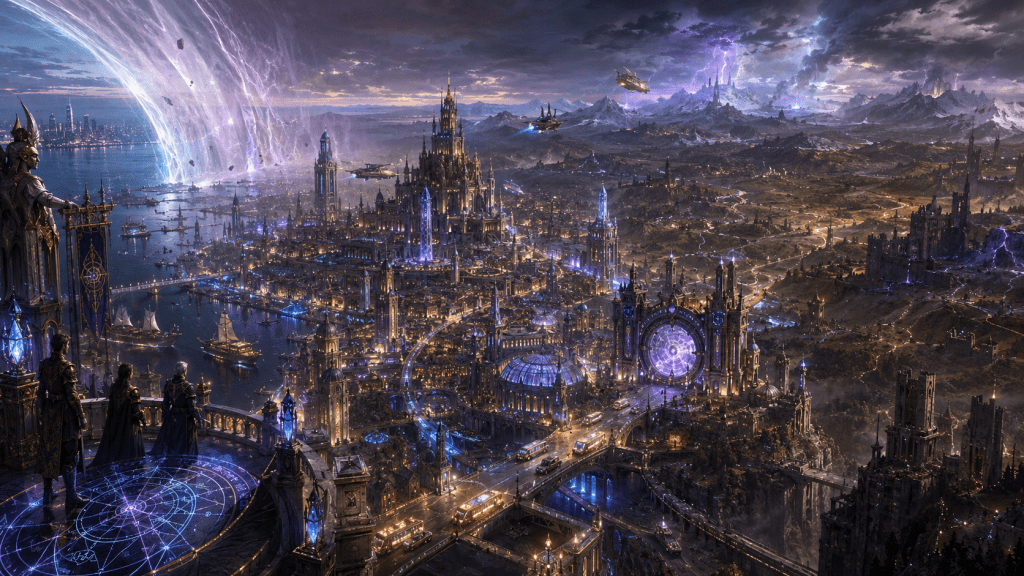
Earth and the magical realm have existed beside one another for thousands of years, separated by the Veil and shaped by that division. While Earth followed scientific and industrial paths, the hidden civilisation developed through magic, glyphwork, leyline engineering, inherited disciplines, and political systems built around the control of forces capable of altering bodies, memory, architecture, and reality.
Its cities combine old stone, metal, glass, ritual design, and functional enchantment. Vehicles move through powered roads and leyline routes. Buses and cars serve ordinary travel. Ships carry people and cargo between ports shaped by magical engineering. Communication devices exist through enchanted systems, while portals remain restricted by authority, wealth, rank, and necessity. Everyday life contains convenience and sophistication, though access remains unequal and every system bears the influence of Crown law, Guild knowledge, local custom, or military control.
The realm also retains vast distances beyond those centres. Roads pass through lightly settled land. Forests conceal abandoned structures and older territorial claims. Ruins survive beyond the reach of present governments. Borders carry memories of conflict that treaties never fully erased. Some regions flourish under stable authority, while others remain scarred by blight, isolation, or the collapse of earlier powers.
This is a civilisation with its own history, class divisions, technologies, rival kingdoms, and moral failures. Its people have lived for centuries under the belief that Earth belongs beyond reach. Silas’s arrival changes that belief before anyone can agree upon the scale of the danger.
The Veil once represented separation, safety, and the end of an age of conquest. Once a single man crosses through an ancient book, every promise attached to it begins to weaken.
Lirael Vaerenthis: Duty Given Human Form
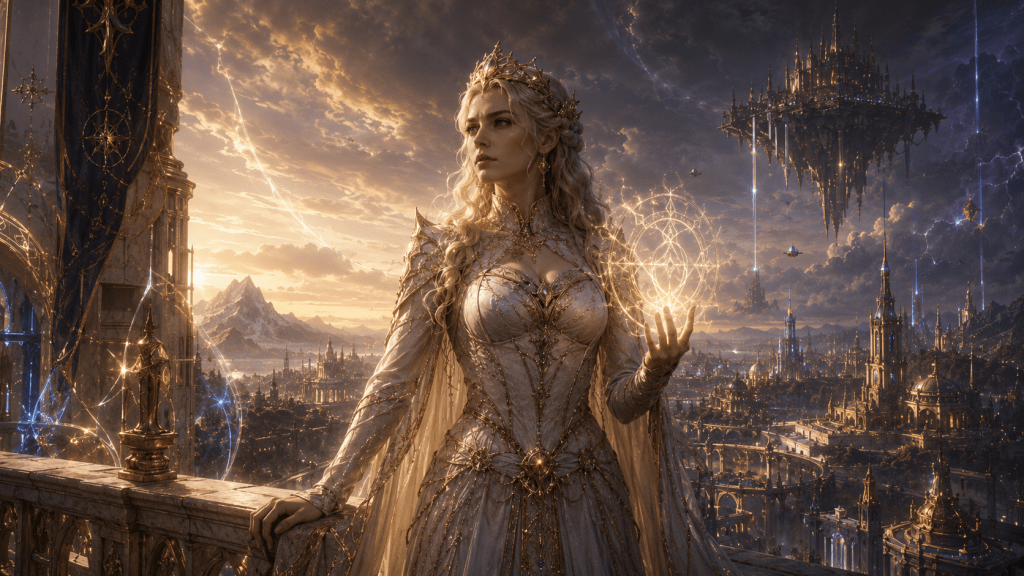
Lirael Vaerenthis was raised inside royal responsibility. She understands that decisions made within guarded rooms travel outward into courts, streets, borders, and lives far beyond the palace. Her composure comes from training, observation, and an awareness that private feeling can become public consequence once it belongs to a daughter of the Crown.
She approaches Silas through jurisdiction and risk. His appearance within protected royal space threatens the credibility of wards, laws, and institutions meant to secure the kingdom. His origin raises questions about Earth, the Veil, the Guild, and the history that shaped the realm’s present order. His inherited magic introduces a danger which cannot be separated from prophecy, political fear, or the ambitions of those already moving beyond royal sight.
Lirael’s connection to light reflects healing, protection, clarity, restoration, and formal order. Those qualities carry their own dangers when certainty hardens into control. She understands that authority must act, yet Silas gradually becomes more than a matter placed before the Crown. Recognition develops through restraint, disagreement, watchfulness, shared pressure, and the slow discovery that his humanity survives beneath every interpretation placed upon him.
Her central struggle lies between the responsibility she carries and the truth she begins to recognise. She cannot cast aside the realm for private desire. She also cannot preserve order by reducing a living man to an object of policy once she has seen the fear, judgement, and endurance behind his silence.
Through Lirael, the series asks whether duty can protect a realm after the structures supporting it have concealed too much.
Seréne Vaerenthis: The Meaning Beneath the Record
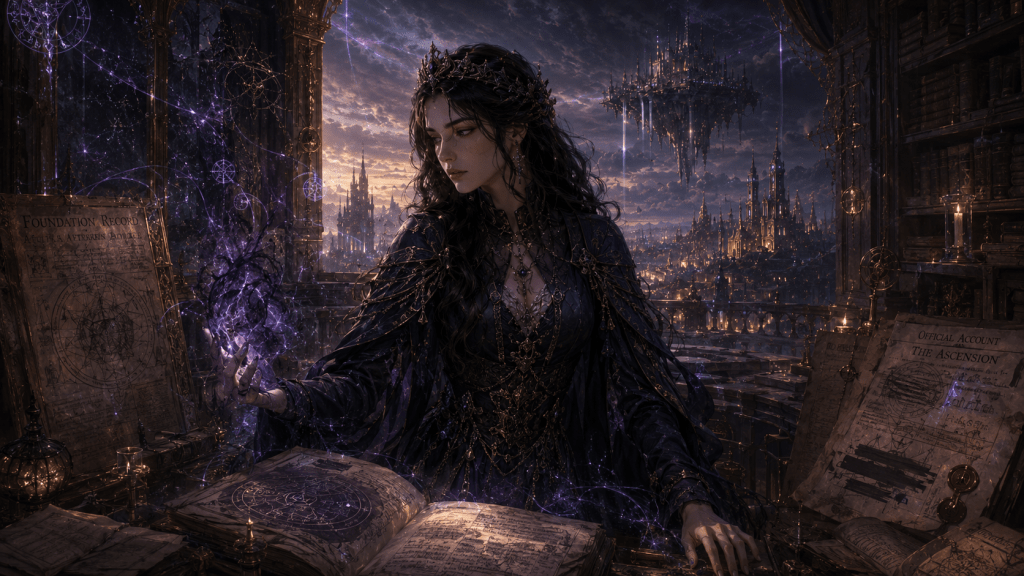
Seréne Vaerenthis moves towards the parts of history that official language leaves unfinished. She is drawn to old texts, symbolic disturbances, foundation lore, restricted knowledge, and the spaces where a clean account begins to fracture. She senses implication before explanation settles around it, giving her an intimacy with danger that others often mistake for recklessness.
Her connection to shadow carries depth, concealment, memory, fear, longing, and the truths pushed beyond public speech. Shadow can hide and bind, yet it can also preserve what bright authority would expose, simplify, or erase. Seréne understands that the unseen holds its own evidence.
She recognises Silas through fracture. Where officials see an incident and the Guild sees a magical anomaly, Seréne sees a displaced man carrying uncertainty inside his body. She notices the meanings others turn into procedure. She senses the pressure placed upon him by prophecy, ancestry, and the expectations of people who need him to become something they can use.
Her willingness to approach hidden knowledge brings emotional insight and serious risk. Every answer she pursues may disturb a seal, expose a buried history, or awaken attention from forces that have survived through secrecy. Her bond with Silas grows through this shared proximity to meanings that institutions fear.
Through Seréne, the series explores the danger of understanding too much before authority grants permission for the truth to exist.
Two Sisters, Two Ways of Seeing
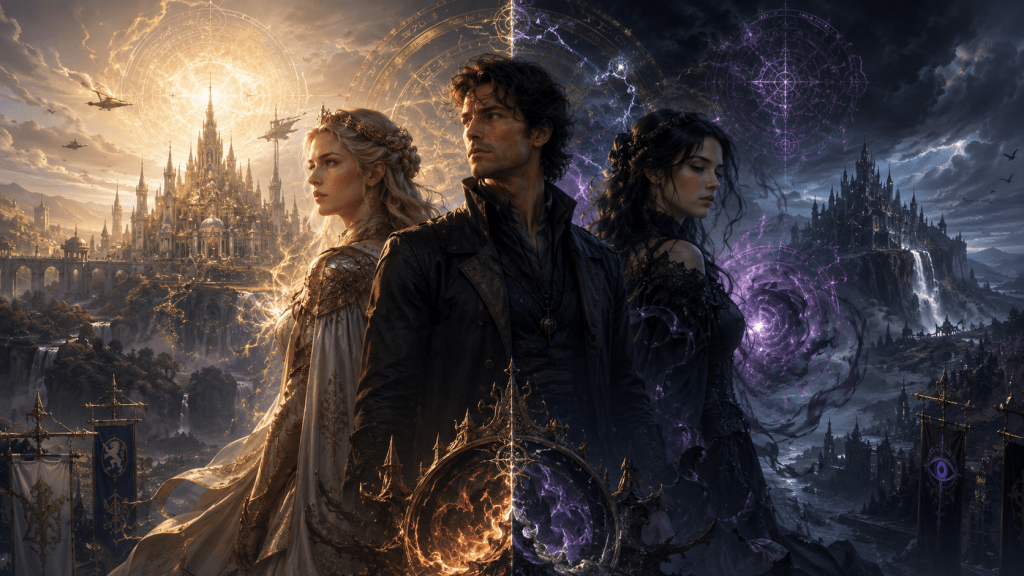
Lirael and Seréne stand within the same royal family, yet each understands power through a different form of attention. Lirael sees the structure surrounding an event: the law it threatens, the people it may endanger, the political reaction it will provoke, and the responsibility carried by anyone who chooses to act. Seréne sees the meaning beneath the event: the old symbol returning through a new shape, the silence inside a record, and the hidden fear concealed beneath official certainty.
Their differences create pressure across the central relationship with Silas, though the series treats each character as an equal presence with independent agency, duty, fear, and desire. The emotional movement grows through trust and conflict, shaped by what each person sees in the others and by the public meanings imposed upon every private exchange.
Prophecy complicates that connection. It gives officials, mages, Loyalists, and observers a language through which affection can be interpreted as magical function. It turns tenderness into evidence, jealousy into danger, and loyalty into a matter of political consequence. The characters still make human choices inside that pressure, carrying feelings which possess value beyond any ancient text.
The central braid of Silas, Lirael, and Seréne is therefore larger than romance while remaining deeply personal. Their connection becomes a place where light, shadow, duty, intuition, inheritance, and choice meet. Every bond offers strength. Every fracture carries consequences no institution can measure safely.
The Thread Between Flames
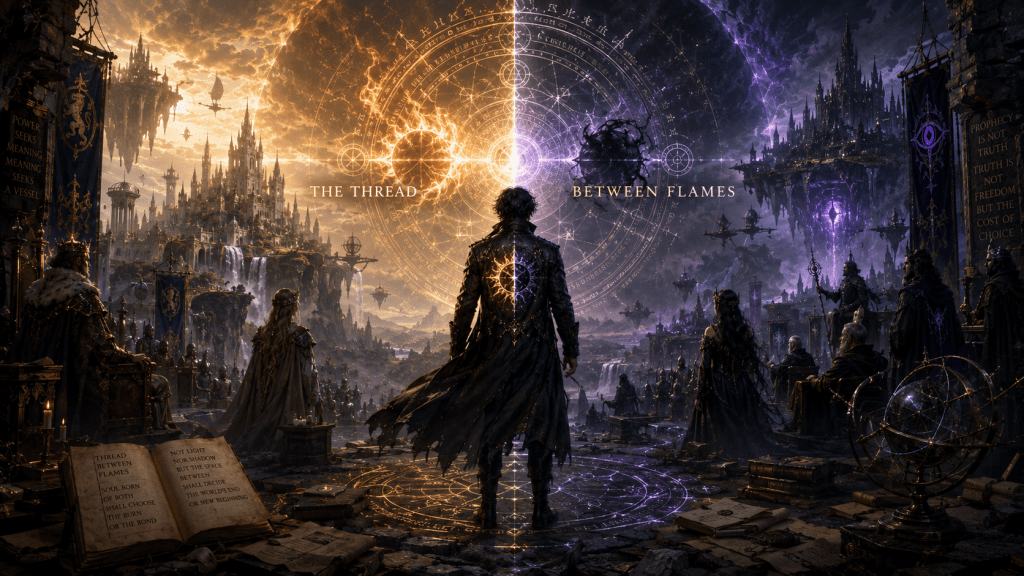
Fragments of prophecy identify Silas as the Thread Between Flames, a soul capable of holding light and shadow where the realm has learned to treat them as separate powers. The phrase offers no peaceful answer. It creates a struggle over meaning.
The Crown must decide whether prophecy can enter governance. The Guild must face records that challenge its understanding of Soul Magic and inherited affinity. The Veil Bureau must decide whether Silas can move freely while his existence attracts magical risk. The Loyalists must determine whether he is a vessel, catalyst, rival, or sign that their long-awaited return has begun.
Silas has his own response. He resists the idea that an ancient text can claim authority over his choices, relationships, or identity. His power emerges through conditions he barely understands, carrying bodily strain and emotional consequence. Each revelation brings him closer to a history linked to his family, while also proving how easily prophecy can distort the people who depend upon it.
The series treats prophecy as pressure, interpretation, and political danger. Its words may preserve truth, yet every institution reads them through its own fears. The greater threat may come from the people who believe they already understand what the prophecy requires.
Crown, Guild, and Veil Bureau
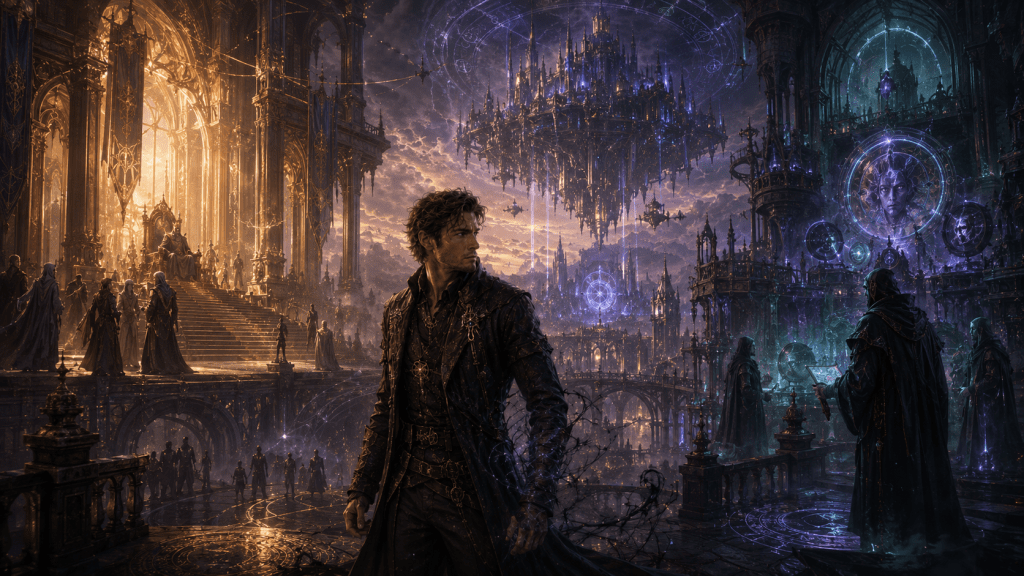
The Crown, the Guild of Mages, and the Veil Bureau form three powerful systems around Silas, each carrying a different relationship with authority, knowledge, and fear.
The Crown governs through sovereignty, lineage, law, council, and public responsibility. King Aldarion meets the impossible with a calm curiosity shaped by political experience. His interest in Earth and Silas’s origin never erases the danger of the crossing. He understands that a breach inside protected royal space can become a national crisis, a challenge to royal legitimacy, and an invitation for rival powers to test the kingdom’s control.
The Guild of Mages exists beyond the rule of any single kingdom. It guards magical training, glyph scholarship, dangerous archives, and the accumulated knowledge of a civilisation built through forces Earth never possessed. Eight centuries of restraint shape every decision it makes. The Binding Pact, created after the Mage War, limits Guild intervention and preserves a peace built partly from fear of the power mages once wielded openly.
The Veil Bureau occupies the ground between magical danger and royal security. Its work includes surveillance, containment, investigation, ritual examination, and the control of knowledge judged dangerous to the kingdom. Its officers watch illegal glyph use, Loyalist movement, forbidden records, rogue mages, prophecy risks, and disturbances connected to the Veil. Procedure gives form to fear, though procedure can also become a means of hiding uncertainty.
Each institution believes it acts to preserve stability. Each carries evidence the others cannot fully access. Each suspects that the others have concealed part of the truth. Silas enters their conflict as the one person who belongs to none of them, while carrying a history that reaches into all three.
Aetherion: The City Above the World
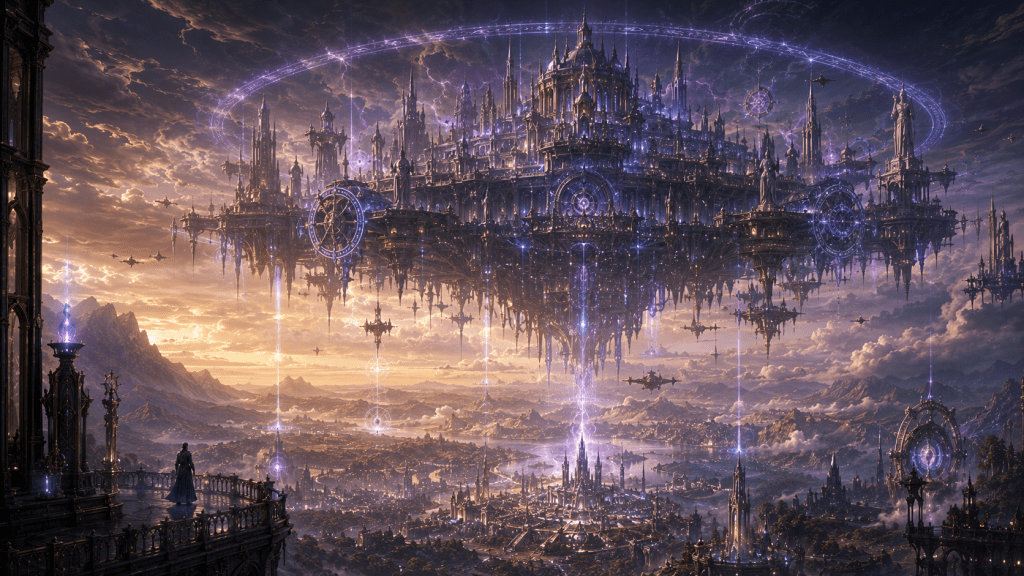
Aetherion moves above the realm along ancient leyline routes, held aloft through gravitational glyphwork and systems whose complete design may lie beyond the knowledge of the modern Guild. It is the centre of magical learning, governance, testing, and restricted scholarship, carrying academy rings, administrative halls, archive vaults, warded chambers, Skyguard defences, and structures used to guide the city through the Skymarch.
From below, Aetherion represents wonder and distance in equal measure. It holds knowledge gathered across kingdoms, yet its elevation separates its decisions from many of the lives affected by them. Its neutrality protects the Guild from royal control, while also allowing kings, officials, and ordinary citizens to question what the city withholds.
Its beauty carries historical weight. The same institution that preserves healing, protection, scholarship, and magical discipline also lives beneath the memory of the Mage War and the settlement that followed. Some within the Guild view restraint as wisdom earned through catastrophe. Others see humiliation, paralysis, and betrayal of magic’s purpose.
When Silas reaches the attention of Aetherion, the floating city becomes more than a place of study. Its archives may contain fragments of his inheritance. Its testing chambers may expose powers that resist classification. Its governing halls must decide whether knowledge can remain neutral once the past has crossed the Veil in human form.
Aetherion stands above the world, though the consequences of its choices always fall somewhere below.
The Magic of Light, Shadow, Glyph, and Soul
Magic within The Echo of Fire and Shadow follows structure, training, affinity, emotion, and consequence. It can heal, shield, conceal, bind, restore, manipulate, preserve, destroy, and reshape the relationship between a person and the world around them. Every form carries limits, and every powerful act leaves pressure upon the body, the mind, the law, or the people forced to live with its result.
Light Magic is associated with healing, clarity, shielding, restoration, protection, and truth. Its beauty can inspire trust, though light can also expose what another person has tried to protect. In royal and institutional hands, the language of clarity may become a claim to authority over meanings which remain uncertain.
Dark Magic moves through concealment, binding, shadow, decay, domination, and emotional influence. Its history has made it feared, controlled, and easily associated with corruption. The series treats shadow with greater depth. Concealment can protect. Darkness can preserve memory. Power becomes dangerous through purpose, imbalance, coercion, and the refusal to recognise cost.
Glyph Magic forms the structured language through which much of the civilisation operates. Glyphs function as ritual grammar, symbolic logic, architectural instruction, magical circuitry, inherited marks, and practical systems. They appear in buildings, wards, transport, weapons, archives, domestic tools, and the foundations of political power.
Soul Magic remains exceptionally rare. It draws upon identity itself, allowing light and shadow to exist within the same vessel. In Silas, that balance brings possibility and instability together. His power arrives before training, placing his body and spirit under strain while every observer attempts to decide what he may become.
Forbidden Magic reaches into realm-breaking, memory alteration, resurrection, necromancy, time distortion, and manipulation of the soul. Its presence carries the memory of catastrophe. Such magic rarely enters the story as spectacle alone. It leaves evidence in law, ruins, damaged records, institutional fear, and lives changed by forces no authority could fully reverse.
The Mage War and the Binding Pact

Eight centuries before Silas crossed the Veil, a corrupted High Mage attempted to break the barrier between worlds and bring the kingdoms and Earth beneath magical dominion. The conflict that followed forced rival powers into unity and changed the relationship between magic and government across the realm.
The kingdoms survived, though survival required a new settlement. The Binding Pact restricted the Guild’s military power and its freedom to interfere in disputes between kingdoms. Aetherion became politically neutral. Archives were sealed. Magical knowledge moved behind layers of permission. Suspicion entered law and remained there.
The war still shapes the present through more than monuments and remembered names. It lives in the way royal officials speak to mages, the way the Guild debates intervention, the way the Veil Bureau treats forbidden glyphs, and the way ordinary people understand power. It survives in old buildings, restricted vaults, border wounds, inherited resentment, and the belief that peace depends upon keeping certain truths beyond reach.
Silas’s arrival unsettles that settlement because his inheritance reaches towards the very history the Pact was designed to contain. He is evidence that exile, secrecy, and separation never erased every surviving line. His presence forces the realm to confront a possibility it has avoided for centuries: the old war may have ended in law while continuing through blood, memory, and unfinished magical purpose.
The Hollow Flame
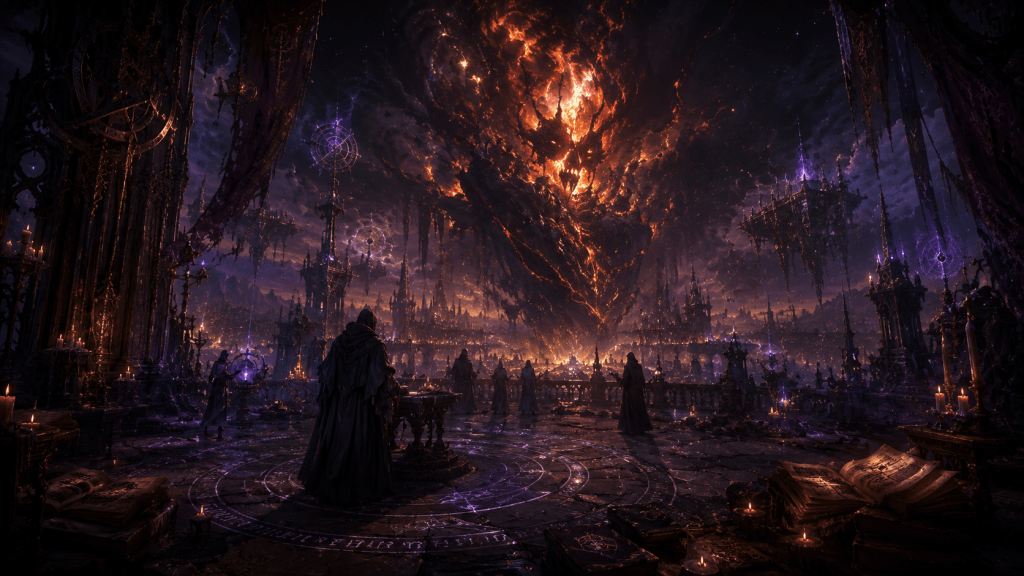
The Hollow Flame survives as a historical wound, a fractured influence, an ideology, and a promise carried by people who believe the present magical order was built upon betrayal. Its origin reaches back to the High Mage who sought to tear down the Veil and free magic from royal and institutional restraint.
Centuries of containment changed the shape of that danger. The Hollow Flame moves through old symbols, damaged prophecy, forbidden records, hidden patronage, bloodline fear, and the patient work of Loyalist cells. It remains felt before it can be fully seen, giving the past a presence inside contemporary politics and magical law.
Its followers believe the Guild abandoned the true purpose of magic when it accepted restraint. They reject royal limits, seek the destruction of the Veil, and imagine a new order rising through rupture. Silas may represent proof that the old power survived, a catalyst capable of opening what was sealed, or an obstacle whose existence changes the prophecy they have spent generations preparing to fulfil.
The Hollow Flame carries greater danger than simple destruction because its purpose contains a recognisable grievance. The Guild has hidden knowledge. The Crown has controlled access. The Binding Pact has preserved peace at a cost. The Loyalists take those truths and turn them towards domination, convinced that freedom can be created through the collapse of every limit.
Across the series, the Hollow Flame grows through influence, certainty, and the fear that history was contained more successfully than it was ended.
The Hollow Flame Cycle

The Hollow Flame Cycle begins with the arrival of Silas Thorn and expands through the consequences of a crossing which should have been impossible. His presence disturbs the Crown, unsettles the Guild, draws the attention of the Veil Bureau, and gives the Loyalists a living figure around whom old expectation can gather.
Each book carries its own immediate conflict while moving the wider story deeper into the pressure surrounding Silas, Lirael, and Seréne. Magical training brings danger alongside knowledge. Royal protection becomes inseparable from political control. Guild uncertainty opens divisions shaped by eight centuries of restraint. Loyalist activity moves through hidden cells and institutional weakness. The Veil, once treated as a settled boundary, begins to feel like a structure under strain.
The cycle remains grounded in personal consequence as its scale widens. Silas must live inside a body answering forces older than his own life. Lirael must decide how long structure can protect people once structure becomes part of the concealment. Seréne must weigh the value of truth against the danger awakened by pursuing it. The Guild must face the difference between preserving knowledge and allowing fear to govern its use.
Every book draws the three central characters closer to a truth that Crown authority, Guild law, prophecy, and love can no longer hold in separate chambers. The realm has spent centuries surviving through division: Earth from magic, Crown from Guild, light from shadow, public order from forbidden history. The Hollow Flame Cycle follows the moment when those divisions begin answering one another again.
Books in The Hollow Flame Cycle
Latest from The Echo of Fire and Shadow
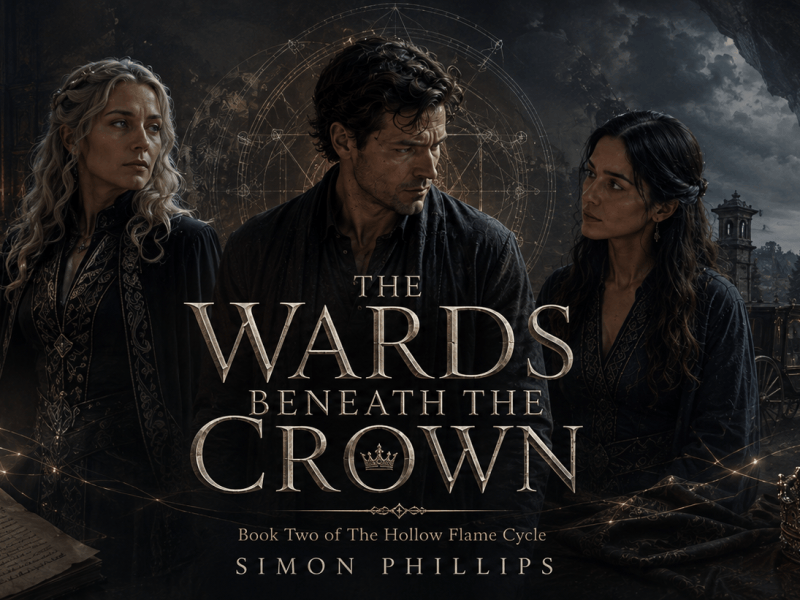
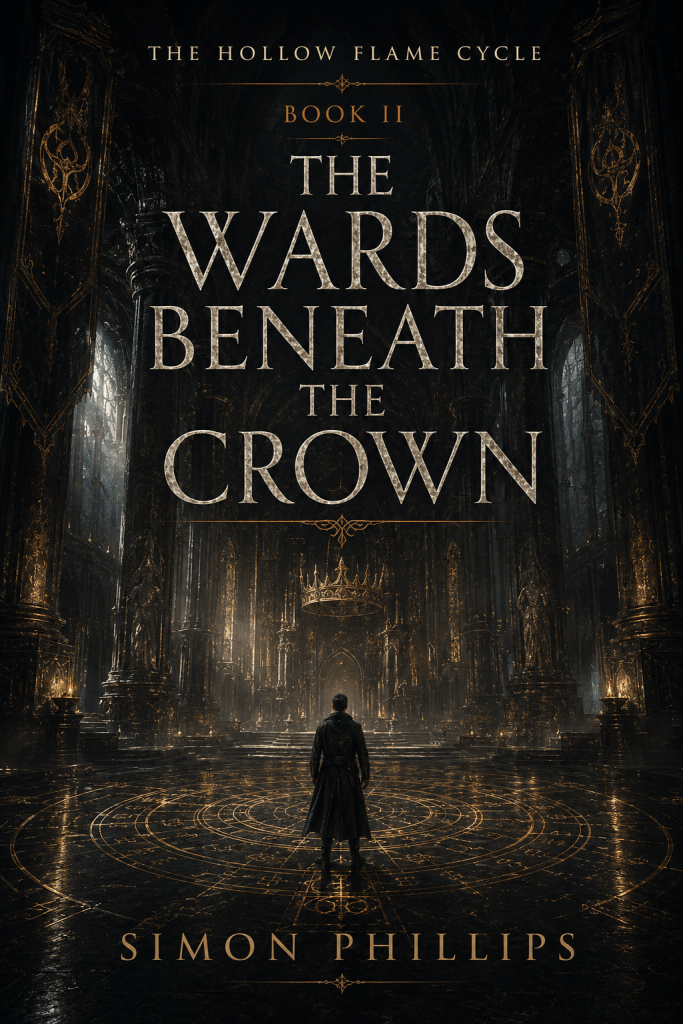
The Wards Beneath the Crown: Slow-Burn Epic Fantasy of Living Wards, Royal Power and a Realm That Refuses Its Stranger
Silas Thorn crossed through an ancient book and awakened inside a royal palace. Now his handwritten questions are changing the light, sealed corridors are remembering buried roads, and the Crown must move him before the foundations answer again.
The Wards Beneath the Crown continues The Hollow Flame Cycle with political intrigue, living wards, hidden history…
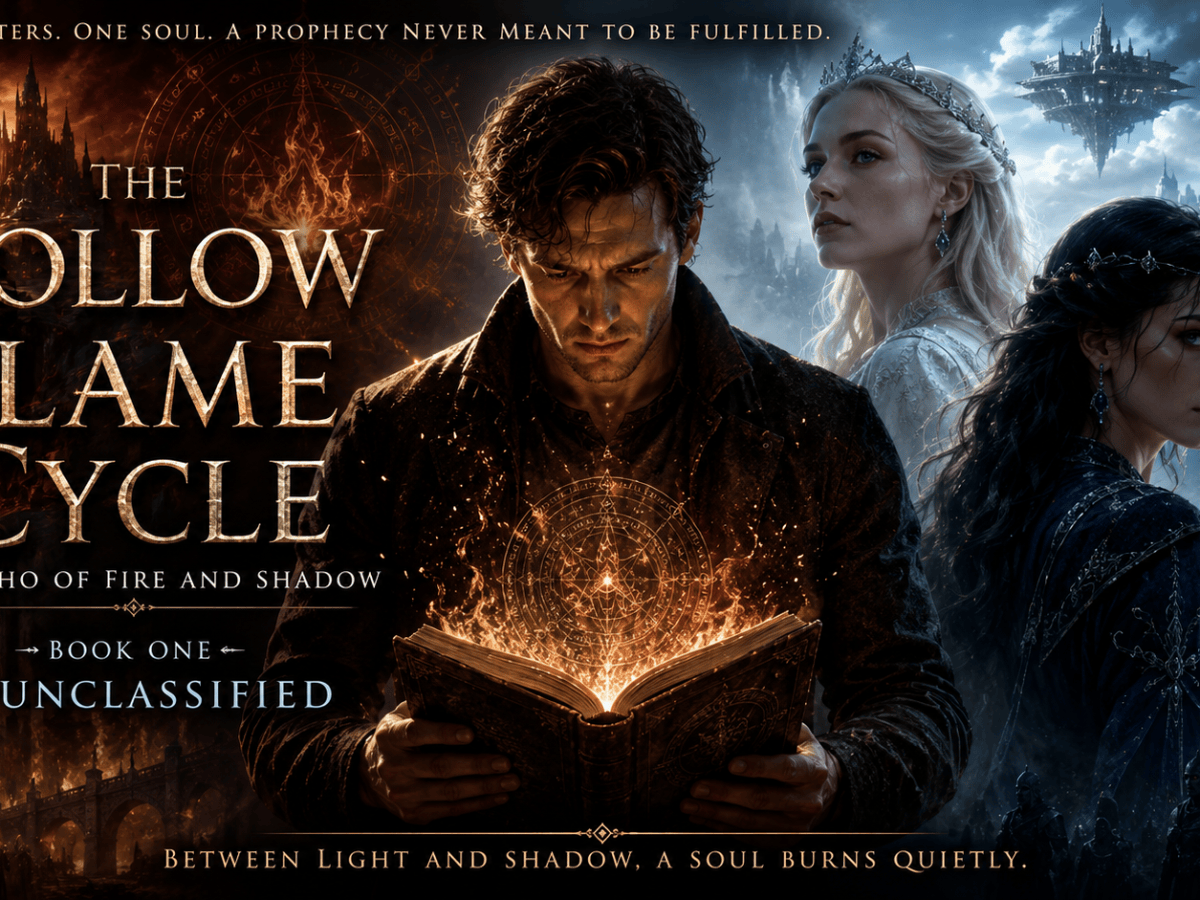
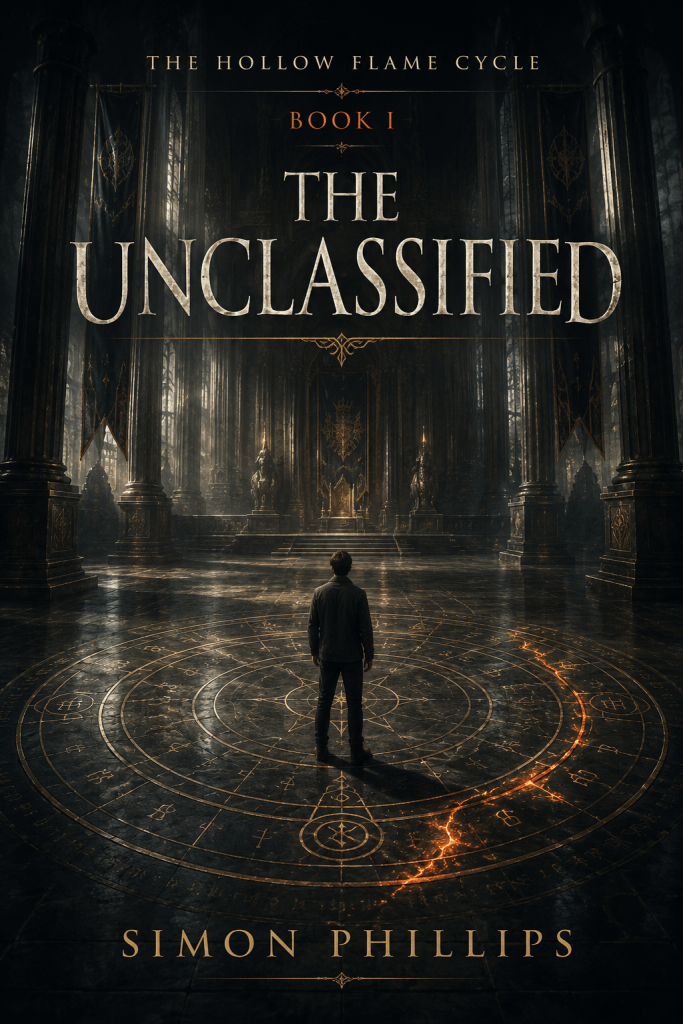
The Unclassified: Slow-Burn Epic Fantasy Where an Ancient Book Opens into a Hidden Magical Realm
Silas Thorn restores damaged manuscripts for a living, trusting ink, paper and careful evidence to reveal what history has concealed. Then an untitled leather book begins to warm beneath his hands, bends the lamplight around its pages, and draws him from London into the warded foundations of a royal palace.
The Unclassified opens The Hollow…
