An old book rests beneath the controlled light of a London conservation studio, surrounded by brushes, weights, linen thread, magnifying lenses, and the accumulated certainty of professional knowledge. Its leather carries no title. Its script belongs to no language its reader recognises. Darker marks sit between the lines, holding the lamplight longer than ordinary ink should ever manage.
Silas Thorn understands damaged books. He understands altered bindings, hidden repairs, brittle fibres, fading ink, and the patient labour required to preserve something that has survived the carelessness of previous generations. What he does not understand is why the book feels warm beneath his hand, why its markings appear to draw light inward, or why the page begins to open into a depth that cannot exist within paper.
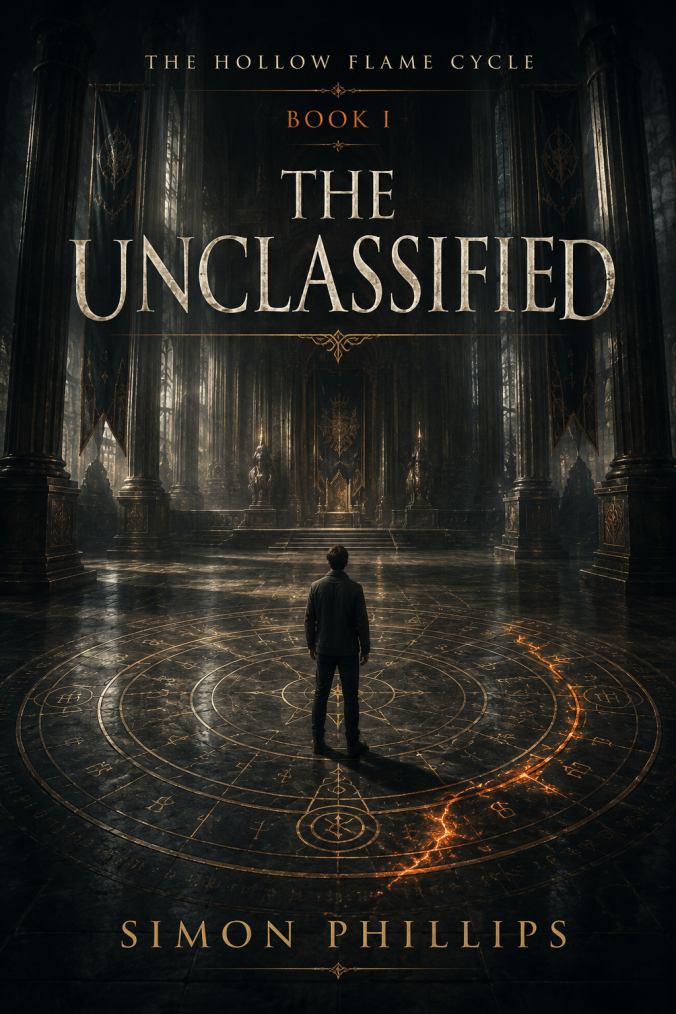
The Unclassified, Book One of The Hollow Flame Cycle, begins as an atmospheric fantasy about old books and buried history before widening into a slow-burn epic fantasy of hidden realms, royal authority, magical institutions, and a man whose arrival threatens every accepted explanation surrounding him.
The crossing does not welcome Silas into an adventure. It removes him from everything he knows and places him inside a civilisation that already believes his presence must mean something.
A Book That Refuses the Rules of Preservation
Silas approaches the unidentified volume as a manuscript conservator, rather than as someone searching for magic. That distinction shapes the entire story.
He does not open the book because he longs to escape modern life, discover secret powers, or fulfil an old prophecy. His father finds it among family possessions connected to Silas’s grandmother, wrapped and hidden behind an old trunk. Silas takes it back to his studio because careful examination is his profession. The response is completely reasonable within the life he understands.
That ordinary foundation gives the impossible greater weight.
The book’s transformation develops through physical details that Silas would naturally notice. Its construction seems unusually intact. The script carries discipline despite resisting identification. Darker marks hold light differently from the surrounding ink. Heat rises through the page and into the tools placed near it. The air above the surface shifts. Straight lines begin to bend.
Every stage moves Silas further from professional curiosity towards the recognition that the object is answering him.
The resulting tension belongs partly to supernatural fantasy, partly to hidden-world fantasy, and partly to the intimate unease of an intelligent person watching reliable knowledge fail beneath his hands. Silas has spent his working life bringing damaged history back into stable form. He now faces an artefact that seems to have been waiting for him to touch it.
The book does not merely contain a doorway. Its behaviour suggests intention, recognition, or some buried connection that Silas cannot yet name.

Silas Thorn Carries the Logic of London into the Impossible
Silas is an unusual centre for an epic fantasy story because his first strength is attention.
He is neither a trained fighter nor an ambitious seeker of power. He is a British manuscript conservator whose habits have been shaped by restraint, evidence, and respect for material history. He notices how an object has been handled. He recognises when thread belongs to a later repair. He understands that damage often carries several generations of human decisions within it.
Those skills continue to matter after the crossing.
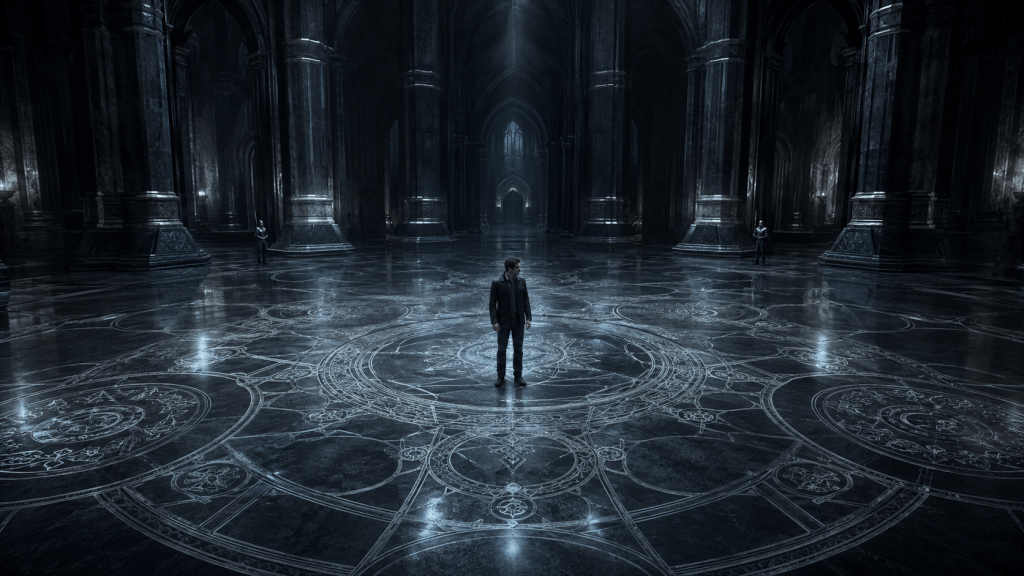
When Silas is drawn through the altered page and falls onto the polished stone of an enormous foundation chamber, he does not suddenly adopt the language or confidence of a fantasy hero. He searches for a door. He looks for the vanished book. He studies the architecture surrounding him and tries to find something that will return the world to measurable proportions.
The book has disappeared. London is beyond reach. Beneath him lies an intricate inlay of unknown sigils, set within the secured foundations of a royal palace.
Silas’s displacement remains personal even as it becomes political. He has a father who expects him to return. He has a profession, a familiar city, and an ordinary life that continues somewhere beyond the crossing. The story allows that loss to remain present. His first desire is not to master the hidden realm. He wants to understand what happened and find a path home.
That human response makes him a stronger emotional anchor. Readers enter the magical civilisation through someone who observes before claiming knowledge and admits uncertainty instead of disguising it. He cannot explain the book, the crossing, or the foundation chamber. He can only describe what he saw and insist upon the limits of what he knows.
The realm, however, has little patience for an answer that leaves so much unresolved.
The Palace Foundations Receive What the Crown Never Summoned
Silas does not appear at an abandoned ruin, an unguarded border, or a forgotten doorway. He arrives inside the protected heart of royal authority.
The palace foundations are layered with ward-lines and structural sigils that should answer only to recognised invocation. Their purpose is political as well as magical. They protect Crown space, carry the weight of inherited authority, and form part of a system whose reliability has endured across generations.
Then the east quadrant records a brief deviation.
The ward-lines move away from their expected pattern before returning to stability. No physical breach is found. None of the outer seals show disturbance. No authorised ritual has been conducted. When the palace guards enter the foundation chamber, they find an unknown man standing at the centre of the inlay.
The foundations have received Silas even though the Crown never summoned him.
That detail changes the crossing from a private supernatural event into a crisis of authority. Silas may be frightened and confused, yet his confusion cannot remove the political meaning of where he has appeared. If the palace wards admitted him, either the protections have failed or they recognised something their current keepers do not understand.
Both possibilities are dangerous.
This is where The Unclassified separates itself from fantasy stories that treat arrival in another world primarily as an invitation. Silas’s crossing creates procedure, investigation, jurisdiction, and fear. The hidden realm is a functioning civilisation with laws, offices, guards, archives, councils, and competing forms of magical authority. An impossible person appearing inside its protected centre cannot remain a private curiosity.
His existence has become a matter of state before he has learned the name of the kingdom holding him.
Lirael Vaerenthis Turns Fear into Law and Procedure
Princess Lirael Vaerenthis encounters the disturbance first through a report.
Her morning begins with questions of administration, disputed authority, altered ward-stones, and the Guild’s habit of acting before consulting the Crown. She is politically trained, disciplined, and acutely aware that small procedural changes can conceal larger claims of power.
When the foundation ward-lines fluctuate, Lirael does not respond through panic or superstition. She orders a quiet inspection. She requests a physical survey independent of the magical sentinel array. She insists that even the absence of visible evidence must be recorded.
Her response reveals one of the book’s most compelling ideas: competent institutions can behave rationally and still remain dangerously incomplete.
Lirael does many things correctly. She keeps the disturbance controlled. She prevents rumours from moving ahead of evidence. When Silas is found, she orders that no harm should come to him. She provides food, water, guarded accommodation, and formal inquiry instead of allowing frightened officials to decide his fate in a corridor.
Yet every careful response places Silas more firmly inside Crown authority.
Protection and restriction arrive together. He is treated humanely, while his freedom depends upon people who cannot classify him. Lirael recognises that fear could lead to dangerous decisions, but she also knows that compassion cannot erase the security implications of his arrival.
Their first conversation carries that conflict. Silas speaks as a displaced man who wants to return home. Lirael listens as a royal official responsible for a palace whose foundations have behaved impossibly. He insists that he invoked nothing. She knows the inlay should never answer by accident.
Neither is unreasonable. Their difficulty lies in the fact that both may be telling the truth.

Seréne Vaerenthis Listens for Meaning Beneath the Stone
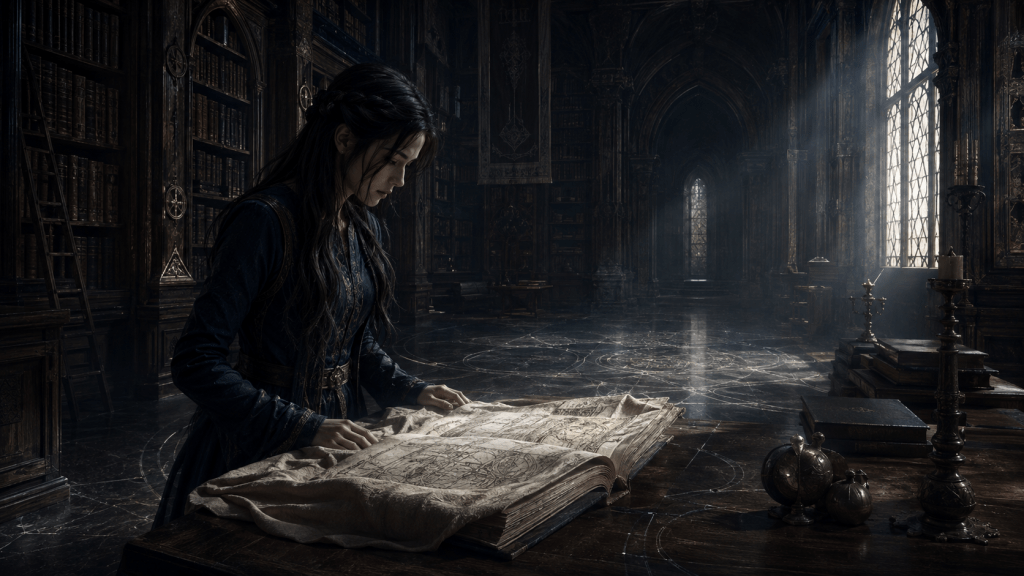
Where Lirael approaches the crossing through law and structure, Princess Seréne Vaerenthis approaches it through older texts and meanings that formal authority has allowed to recede.
Before she sees Silas, Seréne is studying first-generation accounts of the palace foundations. Those records describe thresholds as structures that do more than keep danger outside. They suggest the foundations were designed to sense what pressed against them and that the stones listen as well as seal.
The difference is subtle, yet it changes the meaning of Silas’s arrival.
If the foundations are only barriers, his appearance represents a failure or breach. If they possess some older responsive function, they may have admitted him deliberately.
Seréne carries this possibility into the royal hearing. She watches Silas differently from the councillors who search for deception and differently from Lirael, whose duty requires an immediate policy response. Seréne notices the effort beneath his stillness, the scholar’s bearing within his unfamiliar clothing, and the way he studies the hall as someone seeking stable ground.
Her response remains restrained. She does not declare him innocent, prophetic, or trustworthy. When asked for judgement, she says that she would hear more because the questions raised by his arrival cannot be exhausted within the first hour.
That decision establishes her place within the central character braid. Lirael gives the crisis structure. Seréne preserves the possibility that the structure itself may be based upon an incomplete understanding of the past.
Silas stands between them, unaware that their differing responses may shape far more than the terms of his confinement.
London Becomes the Impossible World Inside the Royal Hall
One of the most distinctive movements in The Unclassified occurs when Silas is questioned before the sovereign and assembled court.
From Silas’s perspective, the palace is impossible. Its sigils, ward-lines, magical foundations, ritual authority, and vast architecture belong to stories. From the court’s perspective, London is equally difficult to comprehend.
Silas describes elected officials, Parliament, written law, archives, universities, steel bridges, electrical power, and streets illuminated without flame. He explains a society where authority can be challenged through debate and where scientific systems provide functions the court associates with magic.
The exchange turns familiar modern life into a form of speculative worldbuilding.
Electricity sounds implausible to people who understand illumination through magical craft. Government without succession binding seems structurally insecure. A world that dismisses magic as fiction becomes difficult to reconcile with the man who has crossed from it through a book.
Silas cannot prove London exists. The court cannot dismiss him because its own foundations received him.
The scene allows both worlds to remain strange. Modern Britain is not treated as the unquestionably superior civilisation, while the magical realm is never reduced to an archaic kingdom awaiting modern instruction. Each possesses systems, traditions, assumptions, and forms of knowledge that the other finds difficult to accept.
Silas has crossed between worlds, yet the more significant divide may lie between the explanations each civilisation has learned to trust.
Crown and Guild Gather Around an Unclassifiable Man
The Crown can decide where Silas sleeps, who guards him, and which questions he must answer. It cannot explain why he arrived.
That limitation brings the Guild into the palace.
The Guild exists beside royal authority rather than beneath it. Its knowledge of sigils, ward-lines, and magical structures gives it a necessary role, although its independence also makes every intervention politically sensitive. Lirael already suspects the Guild of treating technical expertise as permission to act within Crown territory. Silas’s arrival gives both institutions a legitimate claim to involvement.
The sovereign therefore chooses controlled residence and supervised inquiry. Silas will be protected, watched, and questioned while Crown and Guild attempt to understand the crossing.
Then High Mage Elarion enters the hall.
His arrival carries no extravagant display. The court shifts because everyone recognises what his presence represents. The Crown possesses Silas physically, while the Guild may possess the knowledge required to interpret him. Neither institution can proceed comfortably without the other.
Silas remains at the centre while older powers arrange themselves around him.
This political tension gives the story a scale larger than its immediate events. No battle is required to demonstrate the instability beginning within the realm. The disturbance exists in jurisdiction, withheld knowledge, altered foundations, and the quiet recognition that established authorities may no longer understand the systems they govern.

The Hidden Realm Feels Like a Civilisation Rather Than an Escape
The magical realm of The Echo of Fire and Shadow is introduced through institutions and ordinary activity rather than spectacle alone.
The palace contains clerks, petitioners, ledgers, archivists, servants, maps, formal hearings, restricted libraries, administrative chambers, and layers of working authority. People dispute grazing rights and river levies while ancient ward-lines rest beneath their feet. Political life continues around magic because magic has already become part of civilisation.
That approach gives the hidden realm credibility.
Silas has not entered a decorative medieval landscape waiting for an outsider to transform it. He has entered another form of organised society, one whose magical systems have shaped government, architecture, security, communication, and inherited law. Its people possess knowledge he lacks, while remaining blind to possibilities their own history may have concealed.
The palace itself becomes part of the story’s pressure. Its foundations hold older meanings. Its corridors control movement. Its great hall converts uncertainty into judgement. Its libraries preserve versions of history that official doctrine has narrowed over time.
Nothing has visibly collapsed by the end of Book One. The palace still stands. The ward-lines remain intact. The sovereign has issued a measured decree. The Guild has been called.
Yet the civilisation has been forced to acknowledge a man who should never have reached its centre.
Three Perspectives Surround a Single Unanswered Crossing
The story moves through Silas, Lirael, and Seréne because no single perspective can contain what has happened.
Silas gives the crossing its human cost. He remembers London, his father, the conservation studio, and the ordinary certainty of a world where pages remain pages.
Lirael reveals the political consequences. She understands that an unexplained person inside royal wards may create fear, rumour, and institutional conflict long before anyone discovers the truth.
Seréne senses the historical depth beneath the event. She recognises that the foundations may carry meanings that modern authority has preserved imperfectly.
Together, their viewpoints create a character-driven epic fantasy in which mystery develops through interpretation. The central question is larger than identifying who opened the passage. The deeper pressure comes from the different meanings attached to Silas before anyone has truly learned who he is.
To himself, he is a conservator who fell through a book.
To the Crown, he is an uninvited presence inside protected space.
To the Guild, he may be evidence of a magical event outside recognised boundaries.
To Seréne, he may be connected to something the foundations remembered even after the realm forgot.
Each interpretation brings consequences, and none yet provides an answer.
Epic Fantasy Built from Restraint, Memory and Political Consequence
The Unclassified will appeal especially to readers who enjoy atmospheric epic fantasy, hidden magical realms, ancient books, royal politics, magical institutions, slow-burn character development, and mysteries that widen through consequence instead of immediate explanation.
Its tension comes from competence meeting the impossible. Silas behaves intelligently. Lirael responds responsibly. The sovereign maintains order. Seréne refuses premature certainty. The Guild arrives when its expertise becomes necessary.
The danger persists because sensible decisions cannot resolve a truth that lies outside the systems making them.
This gives the opening of The Hollow Flame Cycle its particular identity. Magic is never presented as a convenient route to effortless power. Authority is neither foolish nor all-knowing. History is preserved, although preservation cannot guarantee that its meaning has survived intact.
At the centre remains Silas Thorn, a quiet man from London whose professional life has taught him that old damage must be handled carefully. He has now entered a realm shaped by an ancient history that may recognise him before he can recognise anything within it.
Begin The Hollow Flame Cycle with The Unclassified
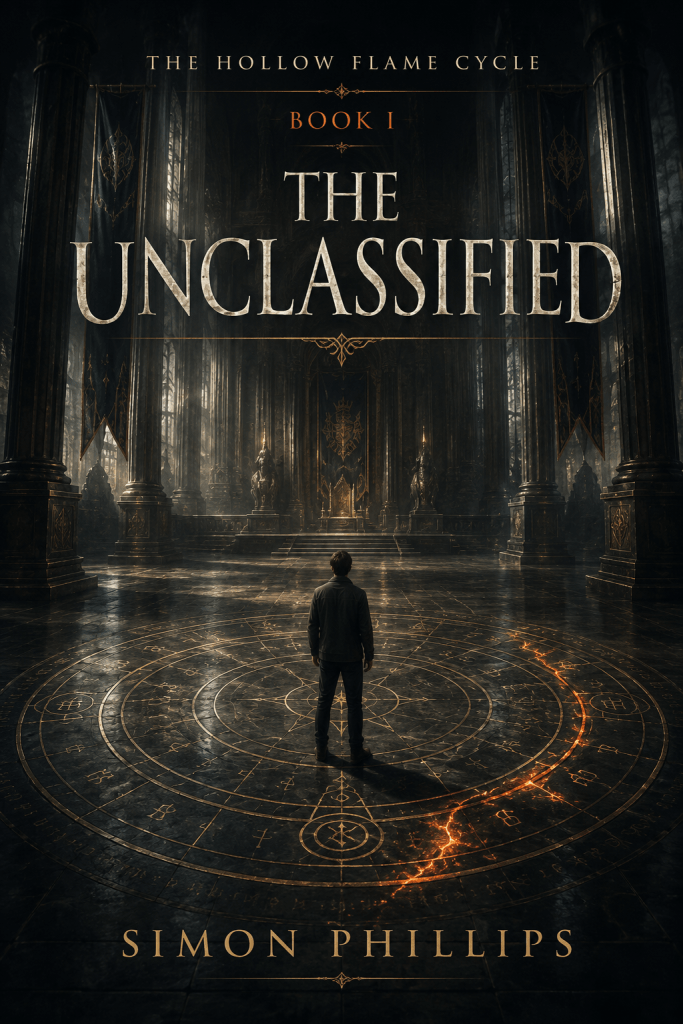
Book One closes its immediate movement with Silas contained, protected, watched, and surrounded by questions. The Crown has acted. The Guild has entered the palace. Lirael has imposed structure. Seréne has begun looking beneath the official explanation.
The crossing remains unresolved.
Readers can begin The Echo of Fire and Shadow through The Unclassified: A Story from The Hollow Flame Cycle on Amazon Kindle.
The story begins with an old book beneath a conservator’s hands, yet its true disturbance reaches far beyond the page. A hidden realm has received someone it never summoned, and the institutions built to control magical uncertainty must now decide whether Silas Thorn represents a breach, a warning, or the return of something their own history no longer knows how to name.
Discover more from Simon J. Phillips
Subscribe to get the latest posts sent to your email.
