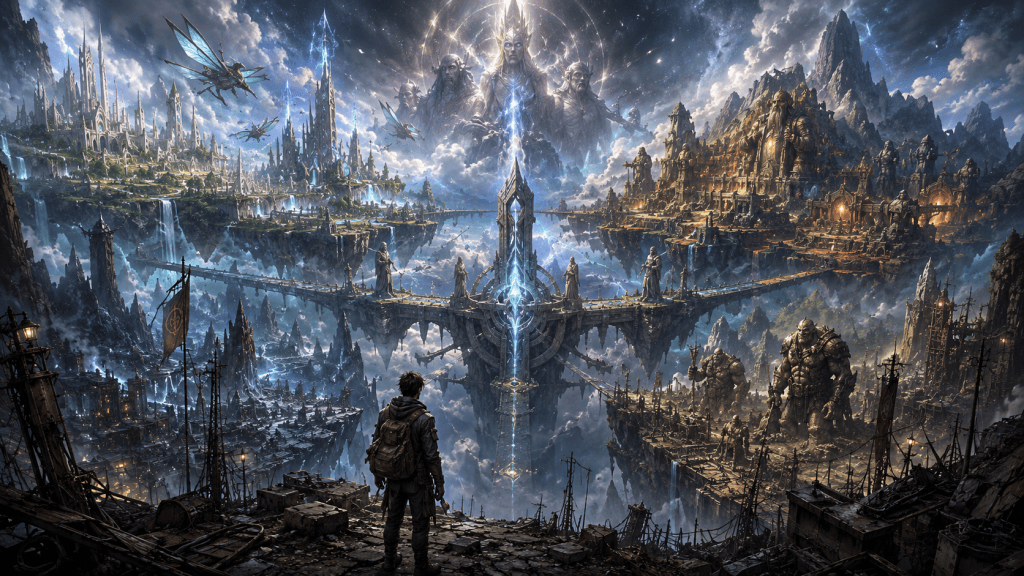
He survived by staying unnoticed. Then the crystals answered him.
Zone Thirteen taught Aeloria to live at the edges: along broken roadways, beneath leaning pylons, through salvage routes where a careful eye mattered more than strength and where attention carried a price. He knew how to read damaged machinery, failing ground and the small signs that warned when a place had become dangerous. He understood scarcity, repair, trade and the quiet discipline of getting through another day. Then a dormant crystal system responded to his touch, dead infrastructure began waking around him, and the obscurity that had protected him for most of his life collapsed in a matter of hours.
What begins in a neglected human edge-zone widens into a mythic science-fantasy journey across fractured realms, unstable pathways, ancient systems and cultures that have spent generations surviving with only pieces of the truth. Aeloria enters that wider world carrying no grand ambition. He carries the habits of a scavenger, the memory of the life torn away from him, and a connection to crystal structures that seem to recognise something in him before any living authority can explain what that recognition means.
A World Already Broken Before Aeloria Arrived
The realms of Aeloria’s world have lived apart for so long that separation has become part of how each culture understands reality. Humans, elves, dwarves and trolls have inherited different fragments of history, different ways of using power and different explanations for the ancient structures threaded beneath their lives. Pathways have weakened. Records have become partial. Old warnings have survived after their original meaning faded. Every culture has learned enough to endure inside its own boundaries, yet none holds a complete understanding of the system connecting them.
That fracture gives the series its scale. Aeloria’s story expands across worlds already carrying old suspicion, inherited fear and incompatible assumptions. Each realm sees the same human through its own history. One group may see a dangerous accident, another a violation of old safeguards, another a source of leverage, another a warning that forgotten systems are beginning to move again. His existence becomes disruptive because the crystals answer across divisions that have shaped politics, culture and survival for generations.
The larger story grows through this widening pressure. A boy who once measured danger by broken concrete, bad salvage and watched trade routes gradually becomes a question that institutions, elders, engineers and entire realms have to face. The journey moves from survival into scrutiny, from scrutiny into strategic fear, and from fear towards a deeper question: what happens when a world built upon fragments encounters someone capable of reaching across them?
Aeloria: The Survivor at the Centre of the Fracture
Aeloria begins with practical intelligence. He reads surfaces before stepping on them. He notices when machinery sounds wrong, when a route has changed, when someone is watching too closely, when an object carries more value than safety allows. His skills come from living in a place where failure is common and where survival depends on understanding the physical world in front of him. He has no training for prophecy, inter-realm politics or Ancient inheritance. His first instinct is always grounded in what he can test, carry, repair, escape or endure.
That background remains essential long after Zone Thirteen falls behind him. Strange realms, living crystal, old pathway systems and unfamiliar cultures enter his life at a scale far beyond anything he has known, yet Aeloria continues to approach them with the habits that kept him alive when he possessed almost nothing. He watches. He tests. He mistrusts easy explanations. He searches for the point where a system stops behaving as expected, because damaged systems are the only kind he has ever truly understood.
His importance grows from compatibility. Crystal structures respond to him across boundaries that constrain everyone else. Ancient pathways react too strongly. Systems built for other peoples begin treating his presence as meaningful. That response brings no easy certainty. Each new capability exposes him further, draws greater attention and increases the distance between the person he was and the role other people begin constructing around him.
The central movement of the series follows that cost. Aeloria grows from an overlooked scavenger into an anomaly, then into a threat, a strategic problem, a possible bridge and eventually something the fractured world may be unable to function around or move beyond. The scale rises steadily, yet the human question remains close: how much of an ordinary life can survive when every new answer demands more from the person carrying it?
Zone Thirteen: Where the Story Begins
Zone Thirteen is a place built from residue. Roads remain after the systems that maintained them have failed. Pylons lean over routes still used because people have learned where the ground holds. Old machines survive in partial states, stripped for components, patched into new purposes or left where the effort of recovery costs more than the material inside them. Salvage has become an economy because waste from older systems still possesses value, even when the people living among it hold little value to the authorities beyond the Zone.
Aeloria belongs to this environment because he understands its rules. He moves through neglected spaces, trades only what he can afford to reveal and survives close to technologies whose deeper workings remain beyond the reach of ordinary people. Around him, human civilisation possesses advanced systems, transport, engineering and crystal-powered infrastructure, yet that capability has produced confidence far faster than understanding. People know how to use what survives. They know how to adapt it. They know how to force old systems into useful service. The original logic beneath those systems remains largely inaccessible.
This makes Zone Thirteen more than a starting location. It is the first expression of the contradiction that follows Aeloria across the series. Enormous power exists around him in damaged forms, inherited from structures older than his society’s comprehension, while he begins life with almost no access to the protection or authority built upon that power. His awakening occurs in the exact place where a larger system has already decided that people like him can be overlooked.
When the crystals answer him, the meaning of Zone Thirteen changes. The same pylons, buried conduits and ruined machinery that once formed the background of his life become evidence that something deeper has always existed beneath the surface. Aeloria’s first loss is therefore larger than a home. He loses the belief that the broken world around him is all there is.
The Fractured Realms
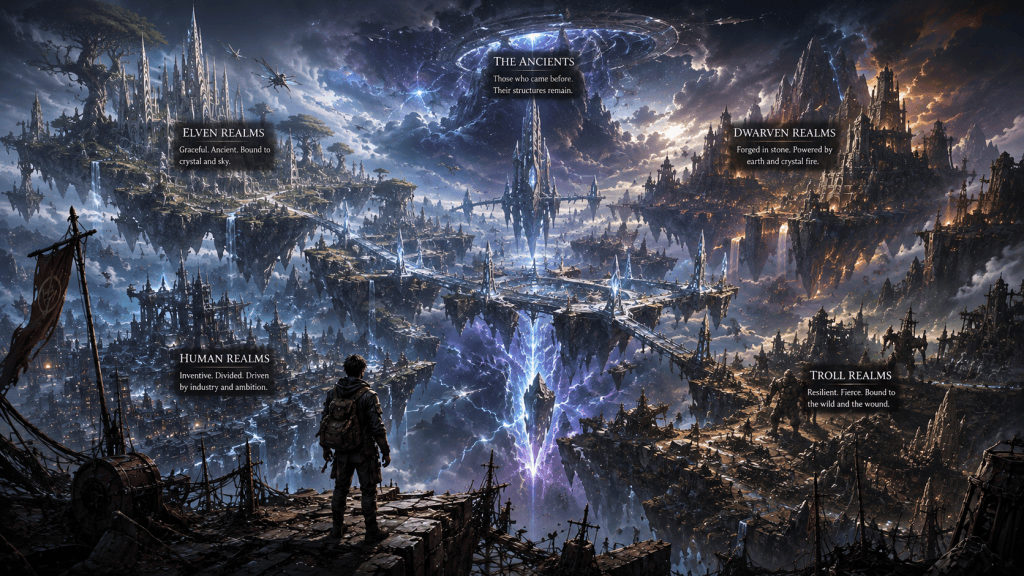
Beyond the human edge lie realms shaped by different histories, environments and relationships with crystal power. Their separation reaches deeper than geography. Isolation has changed language, belief, technology, memory and the limits of what each people considers possible. Elven knowledge follows paths humans barely perceive. Dwarven understanding reaches into material structure and transformation. Trolls carry the burden of fear and simplification imposed by cultures that understand them through distance. Human civilisation excels at applied engineering and control while remaining detached from much of the deeper resonance architecture beneath the world.
This creates a setting where contact carries risk even before open conflict begins. A pathway reopening can become a political event. A crystal response can look like an attack. A human moving through an elven system can trigger alarm long before anyone understands the cause. Every realm has inherited enough truth to recognise danger, yet those truths overlap imperfectly. Misunderstanding becomes structural because each culture interprets evidence through a history that developed in isolation.
Aeloria moves through this fractured reality as someone who belongs fully to none of its established explanations. His humanity remains visible in his fear, hunger, caution, attachment and anger. The systems around him respond to something wider. That gap between the person and the meaning imposed upon him becomes one of the central pressures of the series.
Power Without Safety
Crystal power sits beneath the visible world in many forms. It moves through machines, pathways, environmental systems, living structures and ruins whose original purposes have faded from common knowledge. Some cultures approach it through inherited discipline. Others build practical technologies around what can be controlled. Every civilisation has developed its own language for the part it can reach, and those languages have hardened into assumptions about where power begins, who can touch it and what should happen when it responds.
Aeloria disrupts those assumptions because crystal systems react to him across expected boundaries. The response begins as danger long before it resembles control. His body bears the strain of resonance. Environments answer before he understands why. Ancient pathways can pull towards him with a force trained users struggle to moderate. The consequences spread outward through every witness, because any public display raises the same questions among people who fear different answers.
The series treats power as entanglement. Every step deeper into crystal systems creates new capability and new exposure. Aeloria may survive forces that would reject another person, yet survival leaves marks: physical strain, fear, political attention, responsibility for consequences he never intended and increasing dependence on systems whose deepest logic remains hidden. Mastery, where it comes, carries the memory of everything required to reach it.
For Aeloria, the most dangerous part of power is the way it changes how other people see him. A scavenger can be ignored. An unexplained resonance event becomes an incident. A human who activates a failing path becomes a problem. A person who crosses boundaries once considered fixed begins to look like a weapon, a resource, a threat or a sign. The crystals change his place in the world before they ever give him a secure place within himself.
Seresin: The Person Who Keeps Seeing Aeloria
Seresin comes from a culture with a deeper relationship to crystal systems and inherited warnings than Aeloria has ever known. Discipline shapes the way she watches, moves and responds. She understands dangers that remain invisible to him, yet her own knowledge arrives from a culture carrying its share of partial history. That difference creates tension from the beginning because Aeloria enters her world as both a frightened human and an event that established rules struggle to contain.
Her importance grows through recognition. Many people encounter Aeloria first as a function: anomaly, witness, risk, possible weapon, political problem. Seresin becomes one of the few people able to hold the danger and the person in view at the same time. Her trust develops through exposure, shared risk and repeated choices made under pressure, building a relationship that matters because it preserves human connection as Aeloria’s wider significance begins stripping ordinary choices away from him.
Their bond carries emotional weight across the series, yet the world around them remains larger than romance. Cultural obligation, inherited fear, political pressure and the dangers of crystal resonance all shape what they can give each other. Seresin has her own responsibilities, loyalties and understanding of the systems Aeloria is disturbing. She stands beside him as a counterpart with her own centre of gravity, and the strength of their connection comes from how difficult that shared ground is to reach.
As Aeloria becomes increasingly useful to people who may never understand him, Seresin helps hold open a space where usefulness is only one part of who he is. That role becomes more important as the scale expands, because a person surrounded by institutions, myths and strategic interests can lose the right to define himself long before he loses his life.
A Fellowship Built Under Pressure
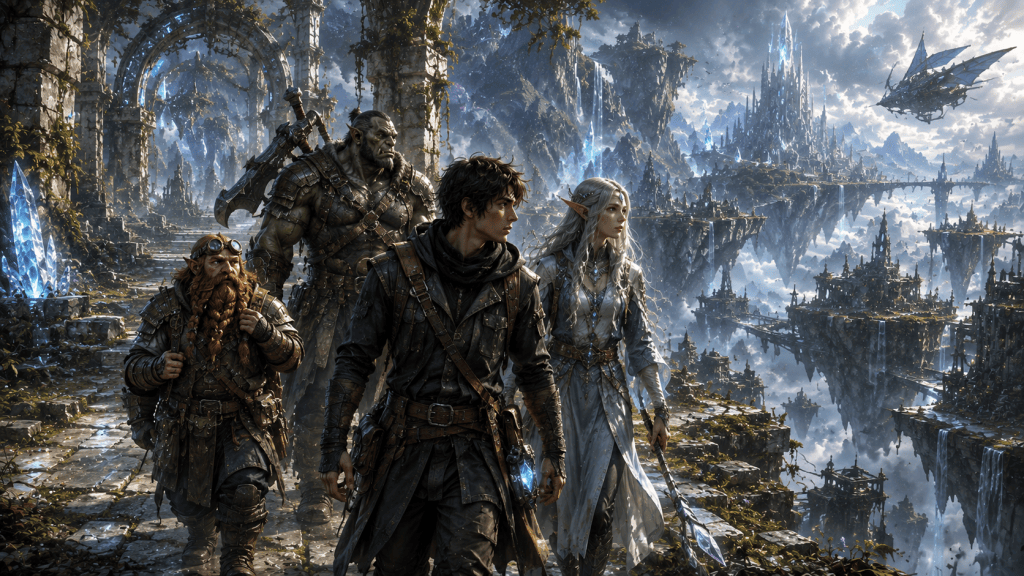
The wider group that forms around Aeloria grows from necessity. Different peoples bring different knowledge, old suspicions and private reasons for staying close to a human whose presence keeps disturbing systems they thought they understood. Cooperation begins under strain. Trust has to survive cultural prejudice, competing priorities and the fear that every new discovery may change the balance between them.
Brikka brings technical curiosity and an instinct to understand what others might fear. That curiosity can place Aeloria under a different kind of scrutiny, because being studied can feel uncomfortably close to being controlled when the subject of that interest has already spent too long under observation. Over time, warmth and genuine friendship give the relationship a more human shape.
Tharn brings suspicion, strength and a harder moral presence. His trust carries weight precisely because it arrives through difficulty. He is never valuable simply as muscle beside a central hero. His place in the group comes from the way wariness, judgement and eventual loyalty create a point of resistance against easier choices.
Others carry their own loyalties, fears and ambitions into the fellowship, leaving fractures inside the group even as the wider world pushes them towards cooperation. This gives the series a human-scale reflection of the political conflict growing across the realms. Unity becomes meaningful because it has to survive real mistrust, private resentment and the constant possibility that power will expose something in a person that friendship alone cannot contain.
The Ancient System Beneath the World
Every realm lives among fragments of something older. Ruins sit inside landscapes that later peoples have claimed as their own. Crystal technologies continue functioning after the knowledge that shaped them has faded. Defensive systems, pathways, relics and structures survive in partial forms, often treated as sacred, dangerous or simply useful according to the culture that inherited them. The living world has built itself inside the remains of an order it can only partly read.
The Ancients stand behind that inheritance as a presence felt through consequence. Their importance comes through systems that still respond, architecture that still exerts control and pathways whose behaviour suggests rules extending far beyond the assumptions of current civilisations. Present-day powers possess fragments of the old structure. None possesses complete interpretive authority, which means every attempt to claim certainty carries risk.
Aeloria’s awakening matters because the inherited system responds to him across divisions that have become foundational to the modern realms. Each response reveals another gap between what living cultures believe and what the deeper structure appears to recognise. The mystery grows through experience: a path behaving differently, a node stabilising under the wrong person, an ancient mechanism making a choice no current authority expected.
At the far edge of that mystery lies the deeper centre of the fractured system, a place tied to the oldest surviving truths and to the question of whether the world can be stabilised before fear drives its peoples further apart. The series approaches that truth slowly, preserving the scale of what lies ahead while each book exposes another piece of the structure beneath the visible world.
Nexus Sites and the Widening Journey
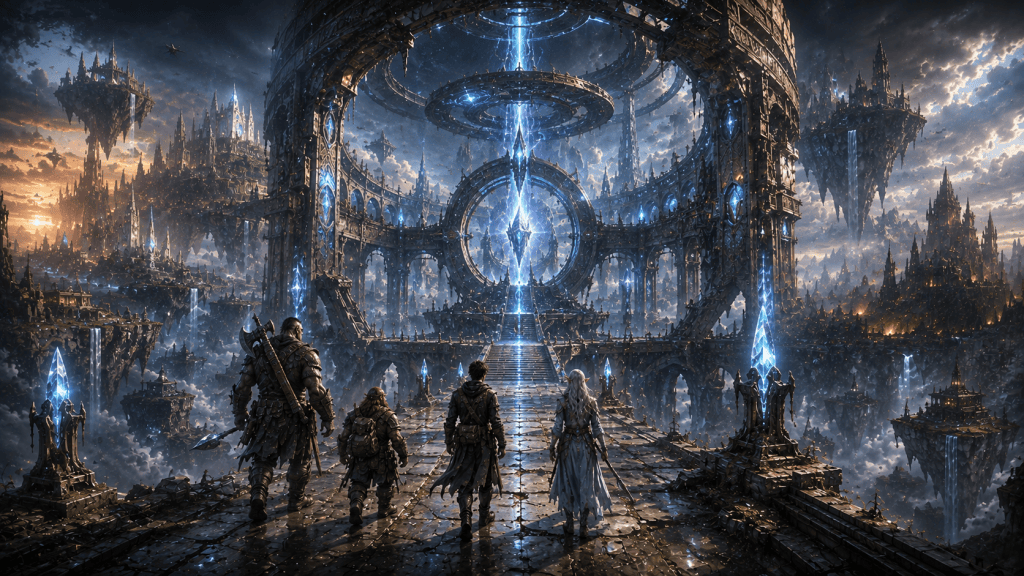
As Aeloria moves further from Zone Thirteen, the journey carries him through places where old systems become harder to dismiss as relics. Nexus sites, failing pathways and Ancient structures function as points of revelation because each encounter changes what the group understands and alters the pressure surrounding Aeloria. These places carry history in their physical behaviour. They respond, resist, classify, destabilise or open according to rules that living cultures inherited only in fragments.
Every such crossing carries a cost. Aeloria’s compatibility may allow access, yet access can expose him to forces his body can barely carry. A site may reveal a deeper layer of the world while also making his existence known to another authority. A pathway can save the group and place them under greater scrutiny at the same time. Discovery therefore keeps widening the story in two directions: outward across the realms and inward towards the question of what Aeloria is becoming.
The series uses these places to turn mythic scale into lived experience. Ancient systems are encountered through heat, pressure, altered ground, physical strain, damaged routes and the reactions of people who understand enough to be frightened. Aeloria rarely receives a clean explanation before consequence arrives. The world reveals itself through what happens when he touches it.
When Every Realm Begins Watching
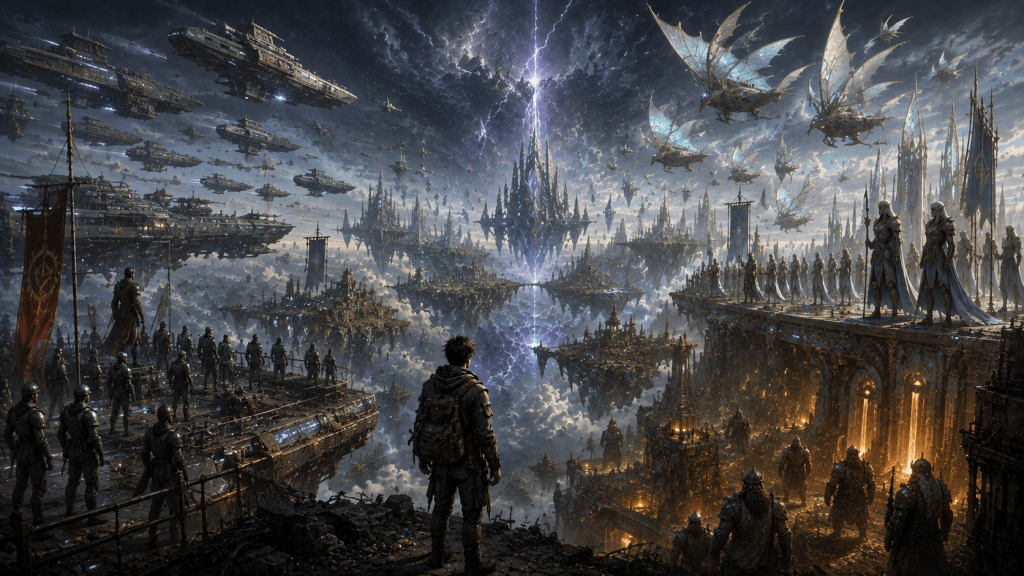
Aeloria first becomes visible as an incident. Something happened in a neglected human zone. A crystal responded. Systems woke. Search teams moved. A rupture opened. From there, attention spreads as each new event becomes harder to contain inside a local explanation.
Rumour becomes surveillance. Surveillance becomes strategic interest. Strategic interest creates pressure for containment, study, protection or control. Different realms begin building interpretations around Aeloria before they possess enough information to understand him, and those interpretations carry political weight because fear can move faster than evidence. A single human becomes a screen onto which older rivalries, inherited warnings and future ambitions are projected.
The danger grows as those interpretations harden. Human authorities can see technological or military leverage. Elven authorities can see imbalance and intrusion into systems guarded through older disciplines. Other peoples respond from their own histories, local needs and fears. Aeloria becomes politically dangerous because any group that controls him could alter the balance, while any group that harms him may trigger systems whose limits remain unknown.
This is where the series grows from personal survival into inter-realm consequence. Open conflict arrives only after suspicion has had time to become policy and fear has had time to become certainty. By then, Aeloria’s problem is larger than escaping the people watching him. He has to survive what they may do to one another because of what they believe he represents.
What Power Costs
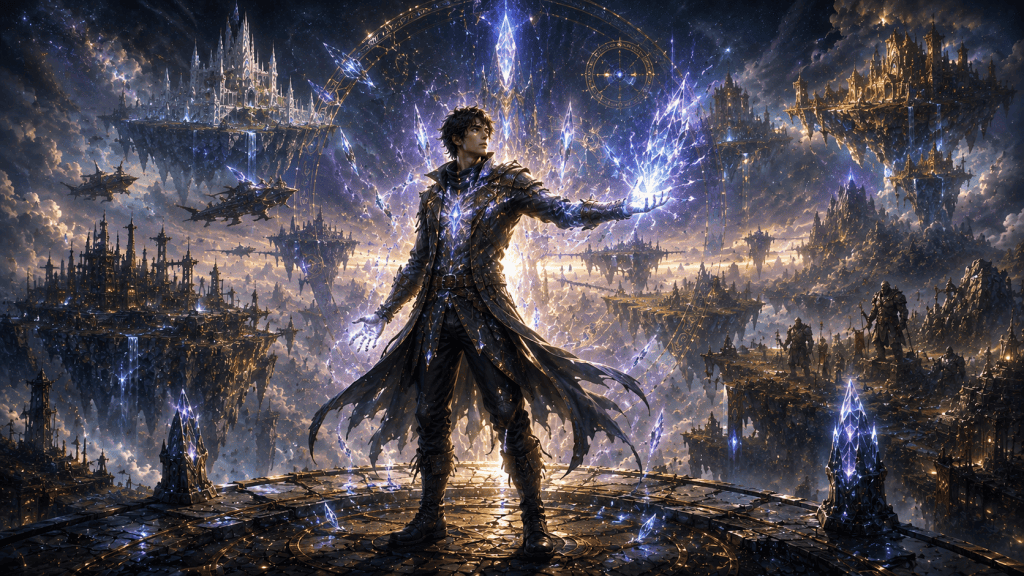
Aeloria’s growth carries no clean ascent. Each gain closes part of the road behind him. Greater control means deeper connection to forces he once experienced only as pain and overload. Greater understanding means greater awareness of what can fail. Greater importance means fewer places where he can move as an unknown human being.
The physical cost remains close to the surface. Resonance strains the body. Ancient systems can overwhelm the senses. Aeloria’s compatibility exposes him to pressures other people rarely face because the structures themselves allow him further inside. Even survival can become frightening when it proves that another boundary has shifted.
The emotional cost reaches further. Zone Thirteen remains part of him because it represents the last life in which his choices could stay small. Relationships become more precious as freedom contracts. Trust becomes harder once people have reasons to value his capability. Every act of loyalty has to exist beside the possibility of fear, strategy or obligation.
That is the deeper promise running beneath the whole series. Aeloria becomes more capable as the world becomes less willing to let him belong only to himself. The closer he comes to understanding why the ancient systems answer him, the further he travels from the ordinary anonymity that once kept him alive.
Published Books and Reading Order
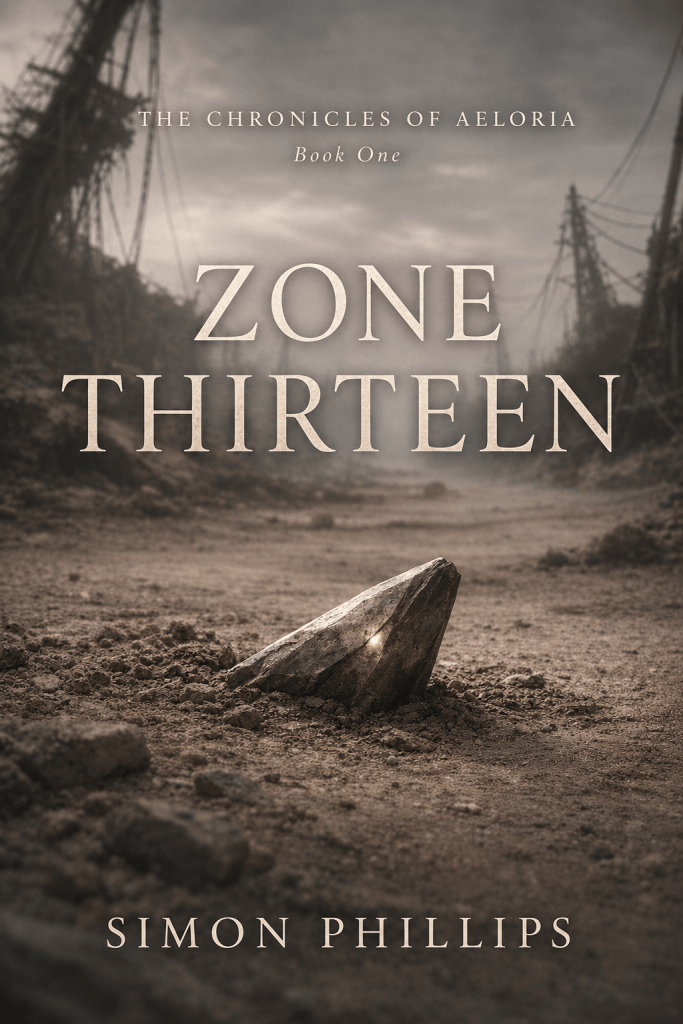
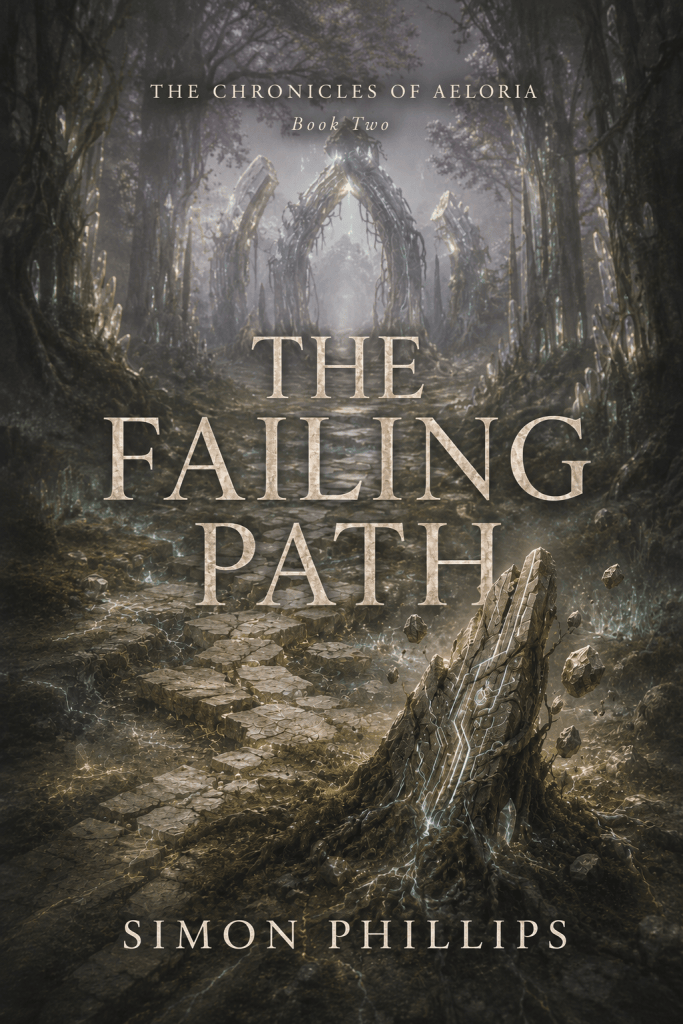
Latest from the Series
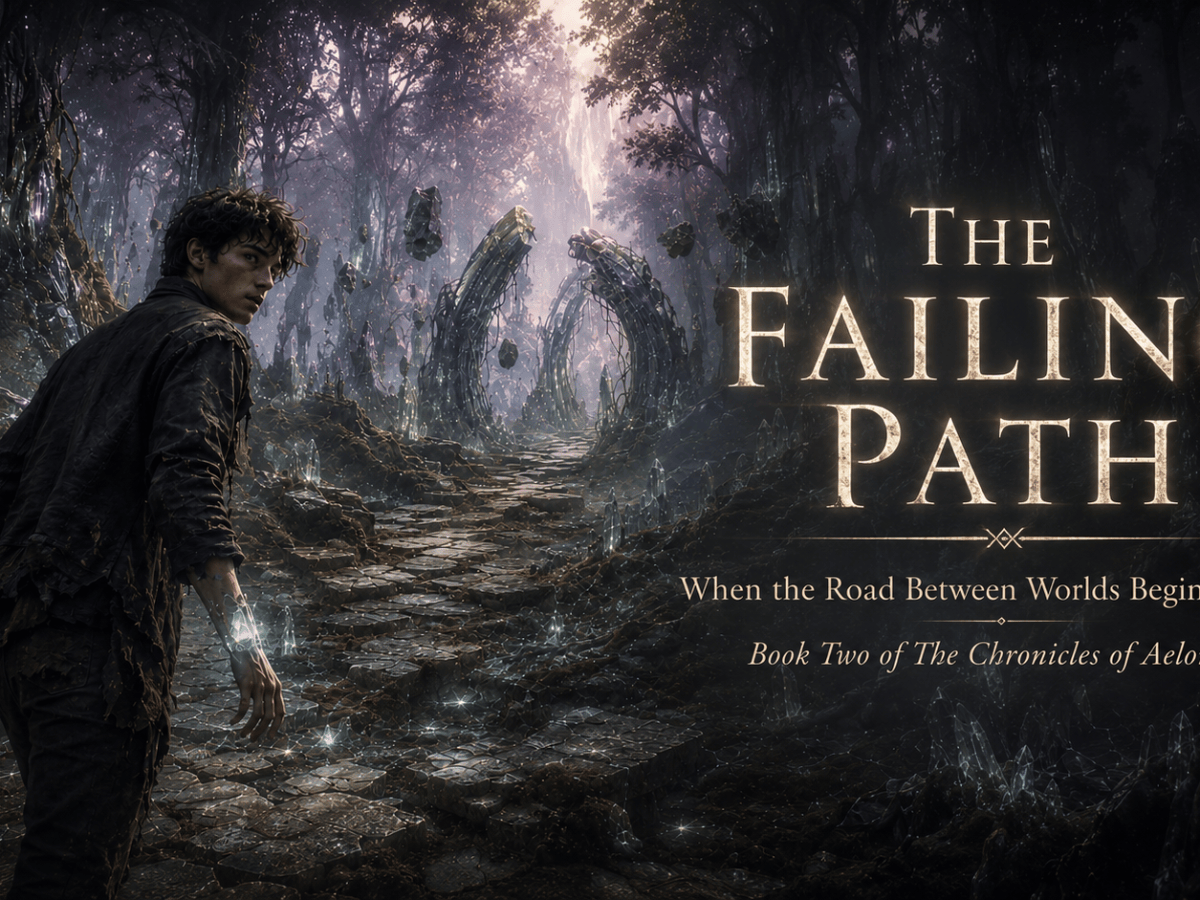
When the Road Between Worlds Begins to Fail: Crystal Pathways and Fractured Realms in The Failing Path
Aeloria has escaped Zone Thirteen, only to awaken somewhere far stranger. In The Failing Path, ancient crystal pathways shift beneath his feet, living systems respond to his presence, and his first encounter with the elves leaves one question increasingly difficult to answer: are they helping him survive, or leading him somewhere he was never meant…
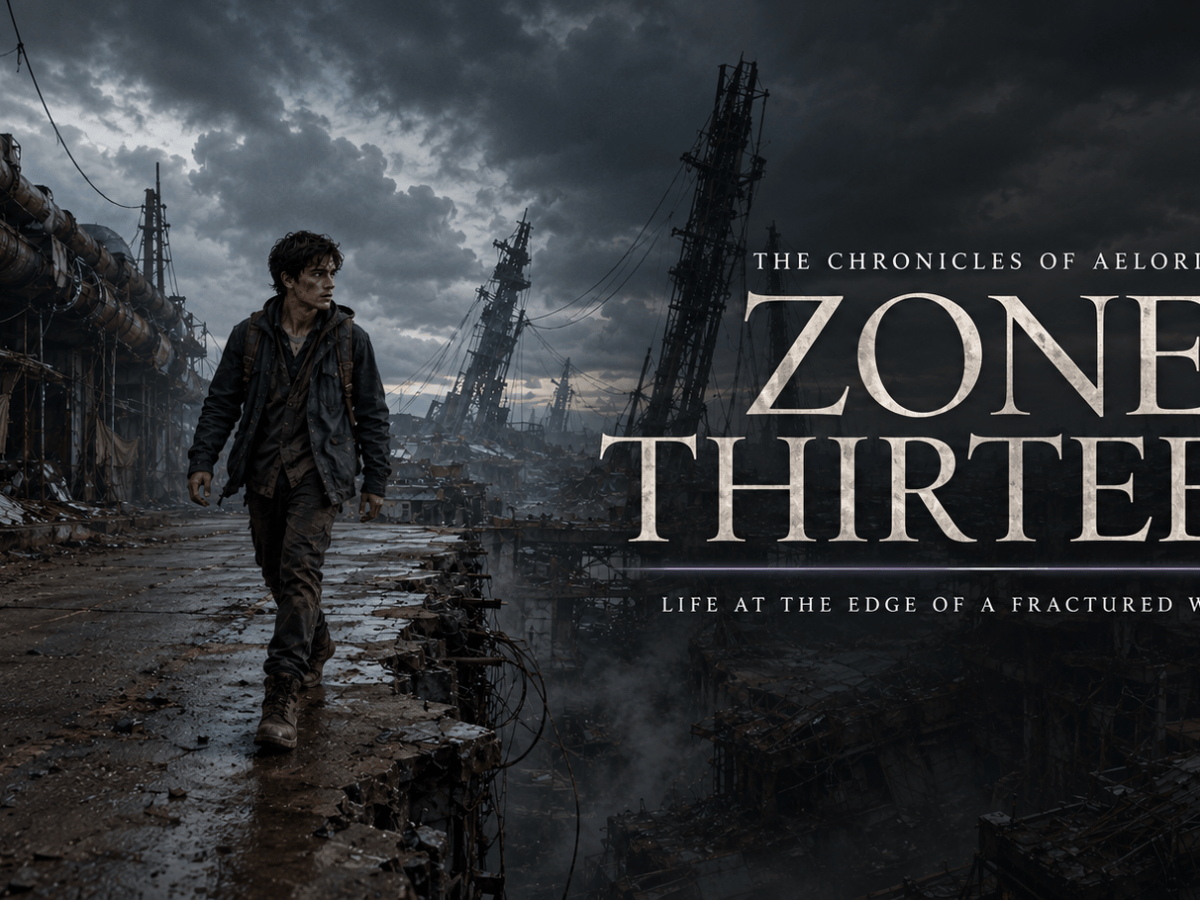
Salvage Culture and Crystal Technology in the Mythic Science Fantasy of Zone Thirteen
Zone Thirteen survives by stripping value from broken machines, abandoned pylons, and systems left to fail. Aeloria knows how to judge every fragment until a flawless crystal answers his touch and the forgotten technology around him begins to wake. Explore how salvage culture, crystal-powered technology, and human neglect shape the mythic science fantasy world of…
