Where Survival Begins with What Others Left Behind
Aeloria began each morning with an empty pack and a clear understanding of how much attention an ordinary journey could attract. He moved along the broken edge of the roadway, tested fractured concrete before trusting his weight to it, and kept away from the open centre where other people might remember seeing him. Around him, leaning pylons carried loose wires above habitation shells patched with fabric, old pipe, and salvaged metal, while the faint hum of failing systems travelled through a settlement that had learned to survive on partial function. This was daily life in Zone Thirteen, where advanced technology remained everywhere and reliable technology had become a scarce resource.
That distinction gives the setting its place within mythic science fantasy. Zone Thirteen belongs to a technologically advanced human civilisation, even though its inhabitants live among damaged infrastructure and neglected systems. Scanners, relay units, heat assemblies, surveillance machines, conduits, crystal nodes, and engineered structures form part of ordinary experience. The hardship comes from abandonment, uneven maintenance, and the knowledge that stability elsewhere has never reached this edge of human territory with the same strength.
The people of the Zone have therefore built a culture around recovery. Almost every useful object carries the marks of an earlier purpose, followed by removal, repair, resale, and adaptation. A housing panel may become a windbreak, a discarded door may become a trader’s table, and mismatched power units may be joined into a working domestic system. Survival depends upon seeing continued use inside apparent failure, which makes salvage far more than a convenient element of science fantasy worldbuilding.
Salvage as Labour, Knowledge, and Risk
Aeloria’s work required patience before strength. When he opened a damaged service unit, he judged the condition of the seal, the remaining wiring, the likelihood of charge, the time required for removal, and the trace his presence might leave behind. A coil of reusable wire could still be abandoned when the effort carried too much exposure for too little return. Every choice placed value beside danger, and skill lay in recognising when an object deserved the minutes it would cost.
This practical intelligence shaped the way he moved through the Zone. Existing footprints offered a route across fine dust, shallow channels provided cover from open ground, and the edges of busy spaces allowed passage with less notice. Aeloria read structures through wear, vibration, resistance, and sound. His knowledge came from repeated contact with systems whose failures could injure him long before they offered anything worth carrying home.
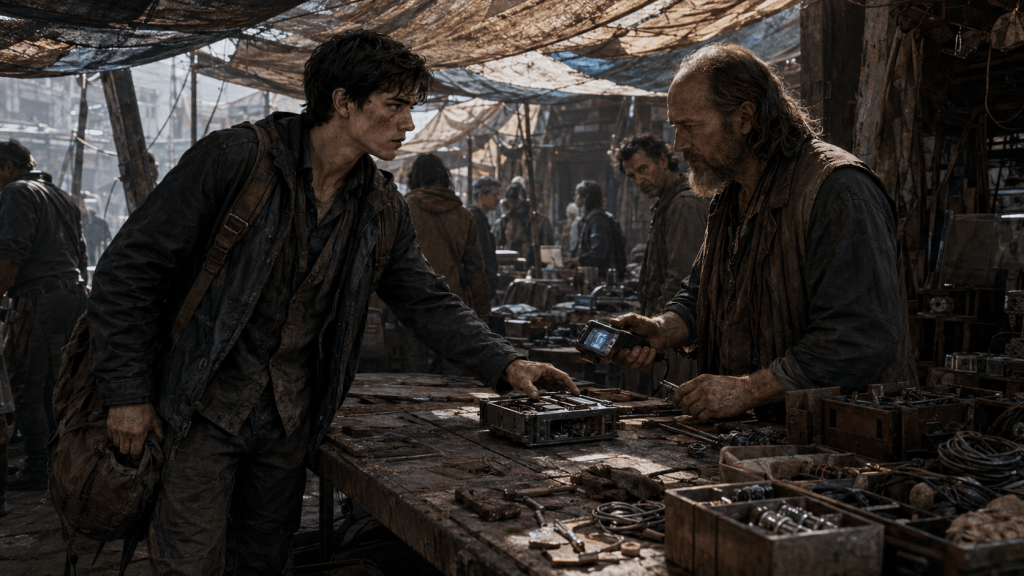
Salvage also supported a local economy built around tokens, uncertain prices, and guarded information. At Merrow’s trade station, stripped wiring sat beside cracked housings, wrapped glass tubes, worn tools, and components whose value depended upon function more than appearance. A clean assembly drew interest because cleanliness suggested rarity, while rarity changed the behaviour of everyone close enough to see it. Negotiation became part valuation, part concealment, with both trader and scavenger aware that curiosity could carry its own cost.
Merrow understood the social pressure surrounding valuable material. His stall offered Aeloria a familiar place to trade, yet familiarity never removed calculation from the exchange. A damaged seam lowered the offered price, an intact internal assembly raised it again, and a prolonged argument risked revealing how much the object mattered. In this part of the fractured world, economic survival depended upon reading faces as carefully as machinery.
Advanced Human Technology at the Edge of Order
The degradation of Zone Thirteen never makes humanity primitive. Its roads, pylons, scanning devices, powered tools, surveillance systems, and engineered dwellings reveal a civilisation capable of sophisticated construction and control. The Zone receives the remains of that capability in uneven condition, which creates a sharper tension than complete technological collapse could provide. People live close enough to advanced systems to understand their practical use, while access to dependable infrastructure remains limited by geography, neglect, and power.
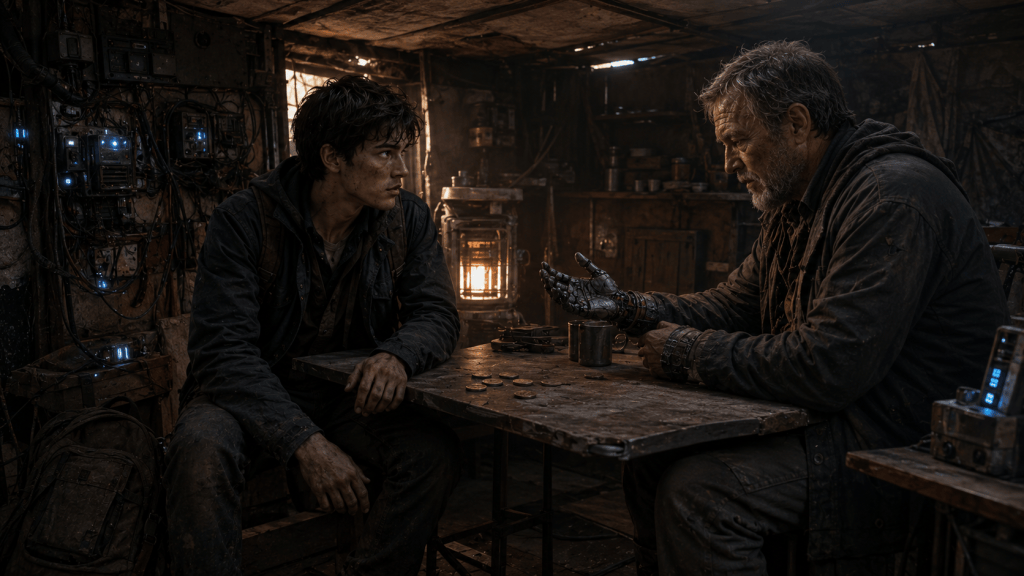
Larn’s shack shows this tension at its most intimate. Sections of the floor carry visible replacement lines, the roof consists of layered repairs, and old parts fill the room in ordered groups. Along one wall, salvaged units have been integrated into a working system through a lattice of cables and small crystal nodes, allowing heat and power to move through components that were never designed to serve together. The result feels improvised and sophisticated in equal measure, shaped by knowledge accumulated through necessity.
Larn himself carries the same relationship between body and machinery. His ageing mechanical hand continues to function through care, adjustment, and an acceptance that every repair has limits. Tokens earned through Aeloria’s scavenging may become food, a filter frame, a pack strap, or another attempt to keep that hand working. Technology remains personal here because its condition enters the body, the home, and the decisions made around a worn table.
This approach allows fantasy with advanced technology to remain materially grounded. Machines possess weight, heat, seals, damaged relays, delayed responses, and repair histories. Crystal-powered technology belongs beside those physical realities, serving ordinary needs before its deeper possibilities emerge. The world gains its science fantasy identity through the way machinery and crystal systems share the same lived environment, each carrying layers of knowledge beyond the reach of the people currently using them.
When Familiar Systems Begin to Behave Differently
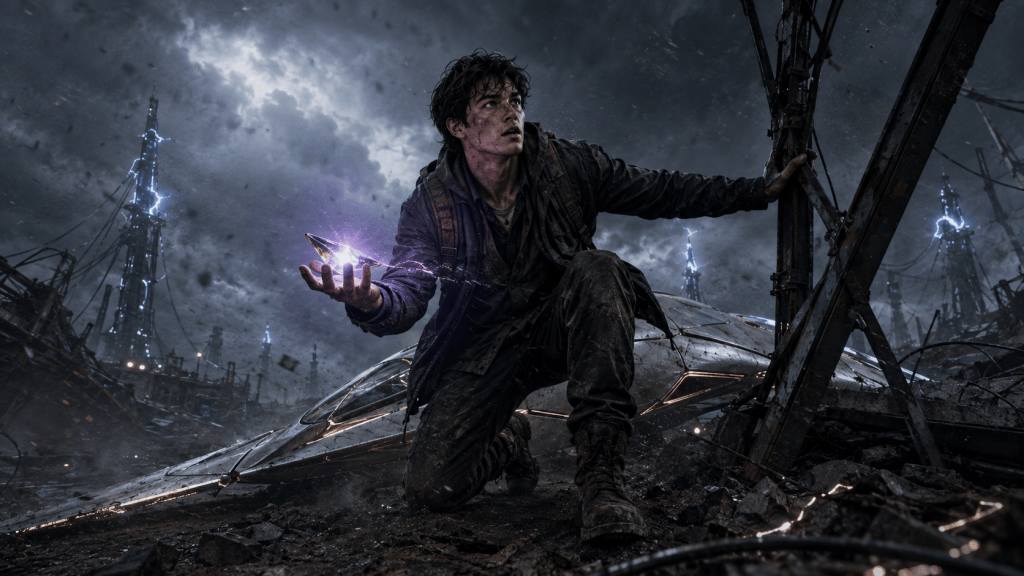
Aeloria’s ability to recognise danger depended upon knowing how the Zone usually behaved. Pylons hummed irregularly, old metal carried vibration, structures settled, and the ground shifted where buried spaces had weakened. These conditions belonged to familiar risk. The true disturbance began when familiar failures changed their pattern, allowing a hum to fall out of alignment, a surface to answer a fraction too late, or a distant pylon to flare where no working connection should have carried power.
This is where the story’s crystal technology gains weight. Aeloria encounters the impossible through differences in systems he already understands, which means wonder arrives through recognition before explanation. The fallen glider appears too clean for its surroundings, with precise panels, deliberate curves, and an intact structure that holds steady while the ground around it slips. The shard within carries the same unsettling precision, placing an object beyond known human salvage into the hand of someone trained to judge value through touch.
His first contact with the shard offers no easy mastery. Heat moves through his palm, buried systems respond, and dormant pylons awaken across distances their damaged network should never bridge. The crystal’s resonance reaches through body, machinery, and environment as one connected event, turning an act of salvage into a signal that extends far beyond the Zone. Aeloria survives the response before he gains any language capable of containing it.
The strength of this moment grows from everything that came earlier. A boy who has spent years opening casings, testing conduits, and listening to the condition of old systems knows when machinery has crossed into unfamiliar behaviour. He carries no scholarly theory of crystal resonance, though his body recognises the change as pressure, resistance, heat, and altered balance. Myth and technology meet through lived consequence, preserving mystery while keeping the experience physically clear.
The Human Cost of Living Through Repair
Salvage culture keeps Zone Thirteen alive, yet it also reveals how completely the settlement has been left to manage its own decline. Repairs preserve heat, shelter, movement, and trade while offering little sense of lasting improvement. Each successful recovery buys time for a household or replaces one failing part, and the wider infrastructure continues to lean, split, and lose function around the people depending upon it. Survival becomes an ongoing negotiation with systems already moving towards another failure.
That pressure shapes relationships as deeply as it shapes buildings. Aeloria and Larn speak through practical concerns because practical concerns carry affection inside the shack. The state of Larn’s hand, the price of a filter, the number of tokens on the table, and the condition of Aeloria’s pack strap express the care they rarely state directly. Their home endures through attention, shared labour, and an understanding that every small choice affects how long the other person can continue.
The wider community carries its own forms of connection. Traders remember families, warnings pass beneath casual speech, and familiar exchanges provide brief stability inside watched spaces. Scarcity can sharpen suspicion, yet it also creates networks of recognition among people who understand the same limits. Zone Thirteen feels inhabited because its residents have routines, judgements, skills, and loyalties that extend beyond the damaged landscape surrounding them.
Why Zone Thirteen Matters to The Chronicles of Aeloria
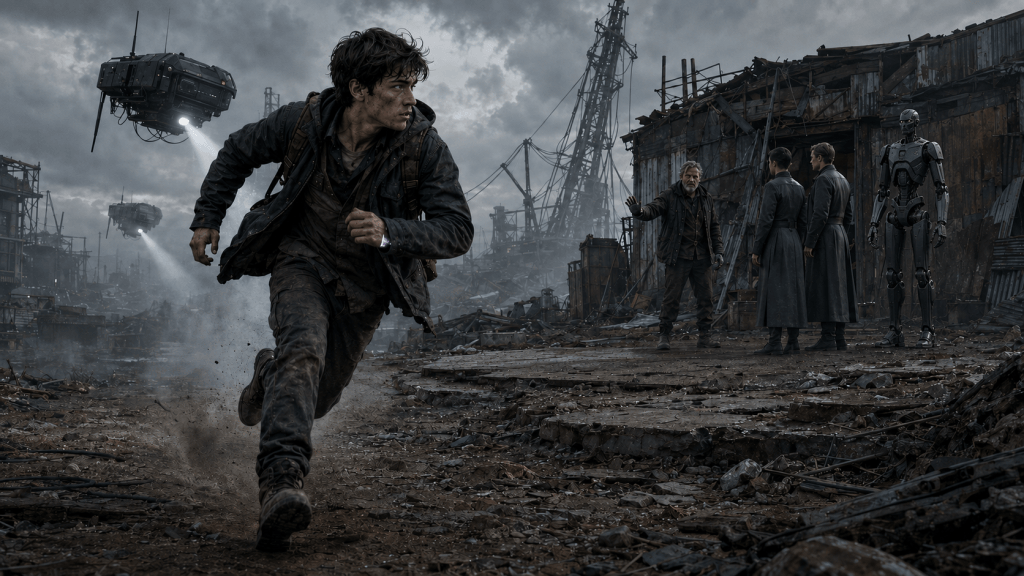
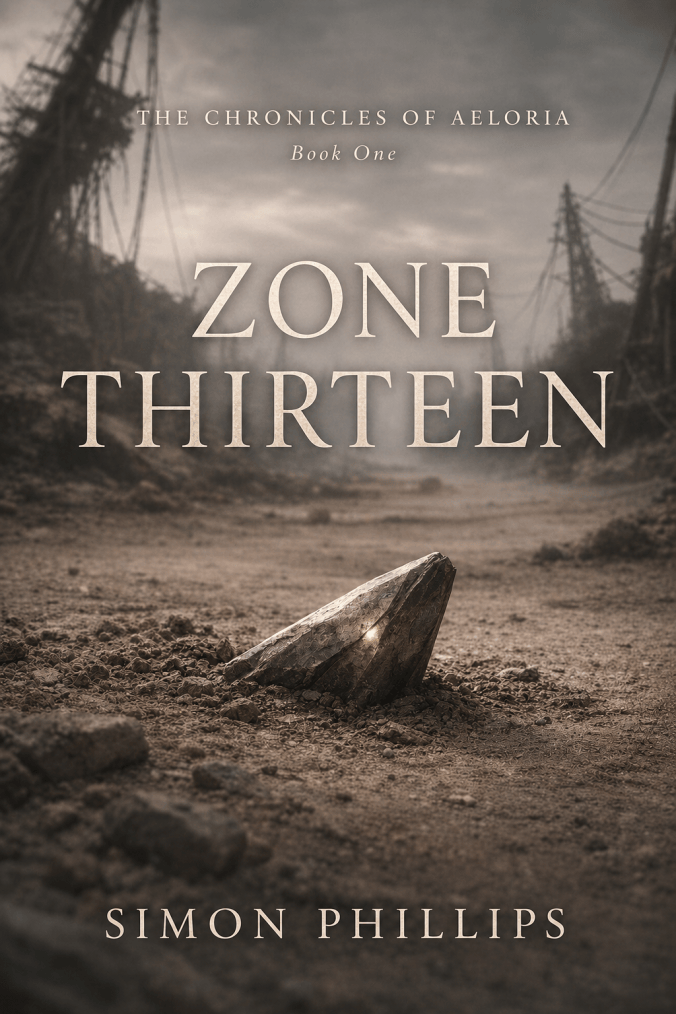
Zone Thirteen, Book One of The Chronicles of Aeloria, begins with a scavenger whose greatest ability appears to be remaining useful while escaping notice. Aeloria possesses no public importance within his settlement, and his ambitions remain tied to food, repairs, safe routes, and the person waiting for him at home. The story allows that ordinary pressure to settle fully before crystal resonance widens the scale of his life.
His scavenger experience gives the larger mythic science fantasy story a human foundation. Aeloria approaches strange systems through observation before theory, and he judges power by what it changes around him. A crystal reaction matters because pylons awaken, ground loses alignment, machines begin searching, and the safety of home collapses under outside attention. The world grows larger through consequences that reach the life already established on the page.
This foundation also protects the fractured realms from becoming a collection of decorative locations. Zone Thirteen teaches the reader that culture emerges through the way people travel, work, trade, repair, fear, and remember. As the wider world opens, every civilisation will carry its own relationship with crystal systems, technology, inheritance, and separation. Aeloria enters that pressure with habits learned among broken roads and stripped machines, carrying the knowledge of a place accustomed to surviving with incomplete answers.
What Broken Technology Preserves
Salvage begins with the belief that failure has left something usable behind. In Zone Thirteen, that belief keeps homes warm, machinery active, trade moving, and people connected to a human civilisation whose stability has passed them by. It also mirrors the deeper condition of the world, where current cultures continue to live through systems inherited from an older order whose full purpose has slipped beyond memory.
The danger begins when those systems cease behaving like passive remains. A dormant connection may still carry power, an abandoned structure may retain a purpose, and a crystal may respond to a person whom every visible authority has learned to overlook. Zone Thirteen gives those possibilities material weight through dust, tokens, patched walls, worn mechanisms, and the careful hands of a scavenger measuring what the day has left him.
The world of The Chronicles of Aeloria grows from that meeting between survival and inheritance. Technology carries memory through continued use, crystals carry forces that resist easy classification, and forgotten structures retain connections across fractures that present civilisations only partly understand. Before Aeloria can face any larger meaning, he must survive the moment when the broken world around him begins to answer again, and the skills that once kept him unseen become the only means he has of recognising how much has changed.
Discover more from Simon J. Phillips
Subscribe to get the latest posts sent to your email.
