Before any living hand crossed the threshold, the desert gave back a doorway no surviving record remembered.
Timeline of Events
The Storm A violent storm crossed the western dunes, stripping sand from ground long believed empty beyond the last irrigated fields.
First Light At dawn, a labourer checking damaged channels and boundary markers found black pillars rising from a newly scoured hollow.
The Discovery Worked stone, buried walls and a dark entrance revealed that the storm had exposed something far older than the surrounding settlements remembered.
The Report Word travelled back towards the city. What had been an unremarkable stretch of desert became an official concern, drawing sealed authority, guards and workers towards the western road.
The Black Pillars After the Storm
Hori found the first boundary stake lodged sideways in the irrigation ditch, its red-painted head buried beneath reeds and storm mud. He planted one foot against the bank, hauled until the wood came free with a wet sucking sound, then held it up for the overseer. Beyond them, the western fields shone under spilled water while the desert rose beyond the last green plots in pale, wind-cut ridges.
“Three gone from this line,” the overseer said, rubbing grit from his beard. “Find what the storm left us before the sun climbs.”
Hori looked towards the dunes. “If the storm carried them that far, you can pay me a sand-walker’s wage.”
“Bring me the stakes and I will pay you a labourer’s wage,” the overseer replied, scraping mud from his shin with the edge of his sandal. “Lose the morning arguing and I may pay you half.”
“That sounds more like you,” Hori said, setting the stake beside the channel.
He followed the damaged field edge west, where wet earth hardened beneath his sandals. The storm had stripped thorn scrub from its roots, flattened embankments and carved pale channels through the dunes. Hori knew storms by what they left behind. A hard wind scattered things. A violent one buried them. This one seemed to have done both.
One scoured channel ran farther than the others, so Hori followed it in case a boundary stone had rolled into the cut. As he climbed the ridge, the hiss of wind thinned around him. Sand still streamed from the crest behind his heels, yet the hollow below seemed strangely settled, and from its pale floor rose two pillars of black stone.
Hori stopped with his hooked staff angled across his body. The pillars stood square-sided and dark against the glare. Beyond them ran a wall, its upper stones still buried beneath the slope. A doorway opened at the centre, tall, narrow and filled with shadow.
“Well,” Hori murmured, shifting his grip on the staff, “you are a poor place for a boundary stake.”
The joke sounded small in the hollow. He descended several careful steps, testing each patch of sand before giving it his weight. Wind tugged at his tunic along the ridge. Near the pillars it seemed to slide aside, leaving the air close and strangely still. Hori crouched and pressed his fingertips to exposed paving, where shallow cut marks crossed the surface in straight lines made by tools and hands.
His fingers came away cool, though the sun had already warmed every fieldstone behind him. He rose and moved close enough to study the entrance while keeping several paces of sand between himself and the shadow. Shapes covered the lintel, worn deeply by age. One resembled a long-backed animal. Another might have been a boat or a blade.
“Keep your secrets,” he said, pointing the hooked staff towards the darkness. “I have irrigation channels waiting.”
Curiosity pulled him closer, while years spent repairing other men’s mistakes urged him home. Hori backed away, climbed the ridge and marked the place against a split tamarisk farther east. Once the black stones vanished behind the rise, the ordinary wind struck him again and sent sand rattling against his legs.
The overseer was knee-deep in a broken channel when Hori returned. He looked up, saw the empty hook and frowned as he pushed himself upright.
“You found nothing?” he asked, wiping his muddy palms across his thighs.
“I found worked stone,” Hori said, crouching to rinse dust from his hands. “Black pillars. A wall under the sand. A doorway big enough for a loaded cart.”
The overseer straightened fully and shaded his eyes with one hand. “West of the last plots?”
Hori pointed across the scrub with his wet fingers. “Beyond there. In a hollow the storm cut open.”
The older man’s gaze stayed on the dunes. “You went inside?”
Hori wiped his hands on his tunic and gave him a flat look. “You pay me to mend channels.”
A smile almost reached the overseer’s mouth before his eyes settled again on the western ridge. “Show me.”
They climbed together as the sun rose higher, carrying water, staffs and the overseer’s seal board. When the ridge opened beneath them, the older man stopped so abruptly that Hori nearly walked into him. The black pillars waited below, fixed in pale sand while storm haze still bruised the distant sky.
A runner was on the road towards the city before midday, while Hori returned to the channels and drove a fresh stake into the wet bank. Each time he straightened, his eyes went west. The dunes had always marked the place where useful land ended. Now they held a doorway, and whatever lay behind it had been there through every harvest he remembered.
By evening, people would say the desert had opened its hand. Hori knew only that the storm had moved sand and uncovered stone. Even so, the western edge of his world had changed, and empty ground would never look empty to him again.
Hori hauls a storm-torn boundary stake from the flooded field edge, unaware that the western dunes have already revealed something far older than the land he knows.
Inspiration Behind the Story
This Chronicle grew from the idea of beginning the cycle far from gods, chosen figures and buried truths, with an ordinary labourer whose morning work places him at the edge of something far larger than his own life. The western dunes matter because they mark a practical boundary between cultivated land and the unknown, and the storm changes that boundary in a single night. The black pillars are important less for what they explain than for what they alter: familiar ground becomes uncertain, routine work becomes the first surviving witness account, and a place long absent from living memory suddenly exists again. That shift from ordinary labour into mythic history is exactly where this cycle begins.
Related Book Series
The Forgotten Gods of the Drowned Kingdom
The Black Pillars After the Storm begins at the edge of the events that lead into Book One, Jackal at the Threshold. When rumours of an ancient necropolis uncovered beneath the western dunes reach the river quarter, tomb robber Neris is drawn towards a place the living were never meant to enter. What she finds beyond the black doorway begins a story of judgement, buried gods, guilt and powers returning beneath the sand.
The consequences continue in Book Two, The Scales Beneath the Sand, as the disturbance spreads beyond the desert and into the burial routes, shrines and living streets of the city. Together, the first two books reveal the closer truth behind the events these Chronicles preserve only through witnesses, rumours and incomplete records.
Read Jackal at the Threshold and The Scales Beneath the Sand to discover the story behind the surviving myth.
Next Chronicle
Priest seals and armed guards soon follow the report west. Stone-cutters enter the newly exposed doorway while a junior guard keeps count beneath the black pillars, expecting the workers to return before the light fades. As the hours lengthen, the number coming back grows painfully clear. Tools remain inside. Blood marks the sand. Duty tells him to hold the entrance while every instinct urges him to go after the missing men. By dusk, the excavation has become something else entirely.
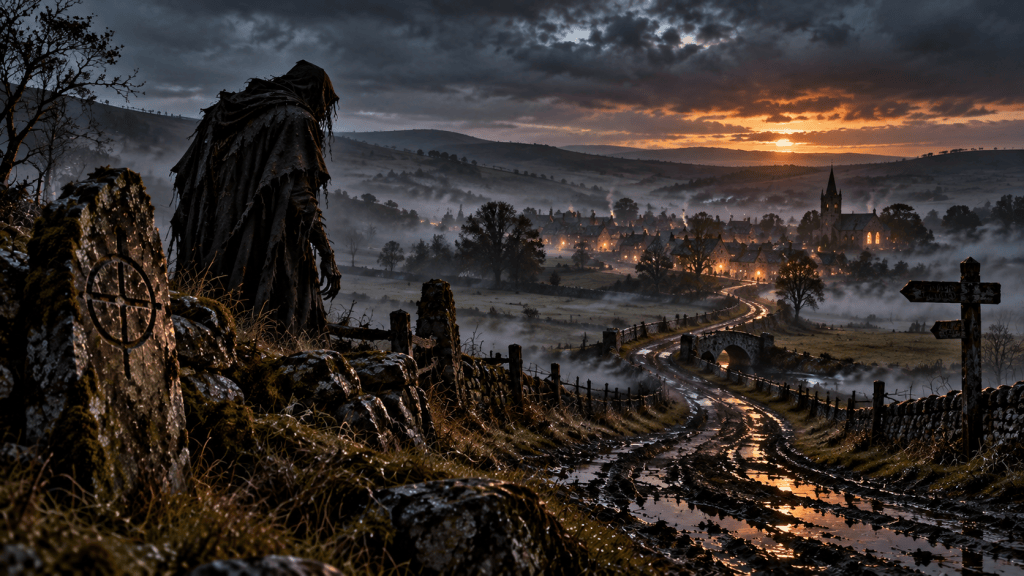
Before sunrise, the bakery ovens had already warmed the walls, flour dust sat across the tables, and the village had begun moving towards another market day. Beyond the first houses, an old boundary stone stood where the road divided, its broken halo softened by rain, moss and generations of people who had stopped asking why somebody once carved it there. A stranger crouched beside that forgotten mark while animals watched from a distance, and the smell of incense travelled through the cold air even though the chapel remained closed.
Hester, the baker, approached because ordinary life demanded ordinary explanations. Travellers became lost, thieves watched roads, pilgrims carried strange habits, and damaged village property eventually became somebody’s problem to repair. The figure offered none of those familiar explanations. It traced the halo, studied the roads and asked when the bells called people together, how many answered them, and which routes carried movement through the settlement. The Sixth Lock
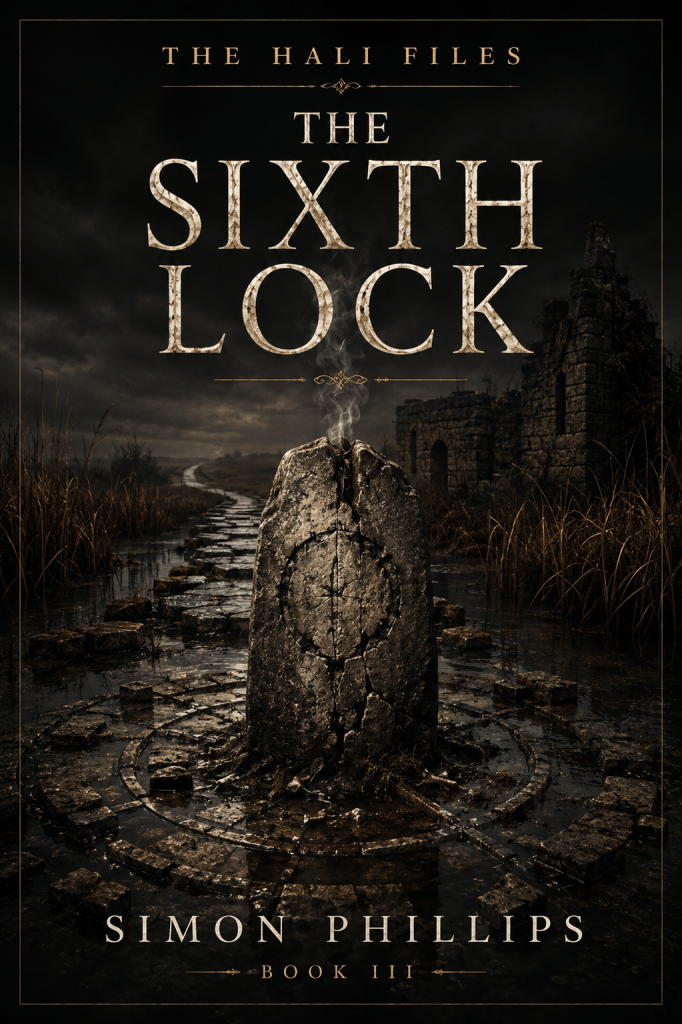
That encounter established the pressure running through The Sixth Lock, Book Three of The Hali Files. This dark fantasy horror story moved beyond buried rooms and corrupted sacred sites into farmland, old roads and settlements whose inhabitants still used the physical remains of a supernatural war while understanding almost nothing about their original purpose. The danger arrived quietly enough for people to continue baking bread, repairing pumps, opening stalls and arguing over whether anything unusual had happened at all.
The village survived the first warning by making it smaller, which was exactly what generations of peace had taught people to do.
A Demon Interested in Roads Rather Than Blood
The creature moving through the western country disturbed Kael because its behaviour carried purpose. It had the strength to attack villagers, kill livestock or turn the settlement into a place of immediate panic, yet no such violence followed the early sightings. Instead, it watched bells, roads, boundary stones, markets and the movement of people through familiar spaces.
Kael recognised the pattern from the old war. A creature driven by hunger would take whatever came close, while something frightened would hide from attention. A soldier studied response, distance and weakness, and the reports reaching Brother Carrow described something behaving much more like a scout than an isolated predator. Carrow eventually brought Kael and Maris a secret bounty because the Church could no longer dismiss the possibility that a complete manifested demon had crossed into the human world. Book 3 Report
That distinction gave The Sixth Lock much of its occult horror. The stranger had no need to terrorise the village when ordinary behaviour provided more useful information. Market bells revealed how quickly people gathered, roads showed where carts and travellers moved, old marks revealed which defensive structures still survived, and the Church’s eventual response showed whether anyone recognised what those structures once meant.
The investigation gradually turned scattered village unease into a deliberate system. Hester’s testimony, disturbed boundary stones, animal behaviour, unusual footprints and sightings along western tracks led Kael and Maris towards an abandoned store overlooking several routes. Inside, they found a body-shaped hollow in straw, blackened material, bone grit and marks aligned towards roads and gathering places. The building had become an observation post, and the creature had spent its time studying the village rather than hunting it. Book 3 Report
The horror lay in the patience behind that choice. Something from the old war had returned to a world that believed the crossings were finished, and its first concern had been learning how much humanity had forgotten.
Old Roads Remembered What People Had Lost
The countryside surrounding the village carried its own evidence. Drainage channels had once helped slow approaching enemies, bridges had been widened across older defensive crossings, boundary stones had become gateposts, and old shelters had changed purpose often enough for their first use to disappear from local memory. Farmers and road workers maintained these structures because they remained useful, even after the knowledge that created them had faded.
That made the landscape itself part of the supernatural mystery. Modern life had grown across the remains of war without fully removing them, leaving physical systems in place after their meaning had been stripped away. The series dossier describes the wider Hali world in similar terms, with visible society operating above older ruins, sealed spaces and suppressed structures that continue affecting people who no longer understand them. Series Report
Kael could read some of those remnants because he remembered fighting when roads, mills, chapels and drainage lines had all become pieces of defence. Maris approached them differently, sensing pressure through structures whose magical purpose had survived more clearly than their history. Together, they moved through a countryside where practical use had preserved the shape of the past while ordinary survival had erased its explanation.
The demon understood that weakness as well. Forgotten protections were still there, yet a protection nobody recognised could be tested, crossed or studied before anyone thought to raise an alarm.
Six Locks Beneath the City
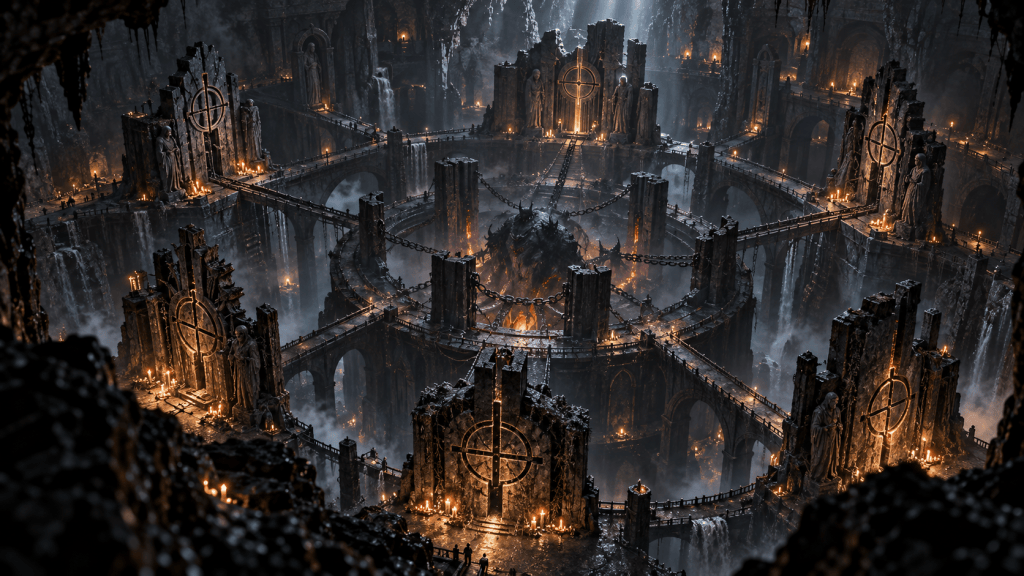
Brother Carrow’s fear forced another piece of the old war into the open. Beneath the city lay a containment zone built around a high-ranking warrior demon that human forces had been unable to destroy safely. Hali fighters held the creature while mages completed the binding, and four High Mages died during the work after the structure continued drawing power from them. The Sixth Lock
The central prison was considered too dangerous to leave behind a single defence. Six separate protections were built around it, each covering a different path towards release and overlapping strongly enough that one failure should never free the prisoner. Carrow regarded their survival as proof that the containment remained secure after generations of peace. The Sixth Lock
Kael heard a different meaning in the same history. Six locks also meant six admissions that the first binding could never be trusted alone, while an imprisoned enemy remained an enemy even after cities, markets and homes grew across the ground above it. His experience of war had taught him to distinguish between killing something and postponing its next opportunity to move.
Carrow’s defence of the Church remained more complicated than simple deceit. Humanity had lived through years when fields went untended, roads carried soldiers and burial carts, and children grew up inside permanent defences. Once the crossings ceased, civilisation needed to rebuild, and an endless state of alarm would eventually have destroyed much of what the war had left alive. The Sixth Lock
The Church therefore gave people an ending that allowed them to live again. The growing danger inside The Hali Files came from the possibility that this necessary ending became stronger than the evidence supporting it.
The Church Preserved the Warning and Removed Its Meaning
The western parish records revealed that contradiction in a smaller and more human form. The old scratched halos had once marked guarded ground, and early instructions required local holders to keep those marks visible while reporting strange smells, abnormal animal behaviour and changes along the roads. Later authorities stopped maintaining the warning marks because they feared preserving superstition and wartime anxiety.
The reporting mechanism survived even after the public meaning disappeared.
Hester’s family had preserved another fragment in behaviour. Her grandmother had warned her against tracing the old halo with a finger, though the reason behind that warning had faded long before Hester inherited it. The action remained because families often carried habits farther than explanations.
The Mage Order possessed its own incomplete memory. Maris knew the story of four High Mages destroyed by a shared binding, although the Order’s surviving account had lost the location and wider circumstances surrounding their deaths. Carrow held the Church version, Kael carried the memories of Hali fighters, and village records preserved practical instructions whose original danger had been stripped from public understanding. Book 3 Report
None of those accounts stood entirely alone as the truth. Together, they showed a history broken into pieces because different survivors preserved whatever their institutions, families or bodies could carry forward.
Kael’s Hali Sickness Was Becoming Harder to Leave Behind
The old war survived most painfully inside Kael. By the beginning of The Sixth Lock, sleep had become unreliable, food often remained untouched, alcohol had lost much of its ability to dull the pressure, and phantom incense reached him even inside rooms where nothing burned. His hands trembled, his eyes changed under strain, heat moved beneath old scars, and the sword remained close enough to reach before conscious thought caught up.
The Hali Sickness made him capable of meeting a creature built for supernatural war, while every use of that capability pushed him closer to the condition he feared. During conflict, pain became distant, perception sharpened and strength increased. The deeper danger appeared after violence ended, when the part of him awakened for battle became increasingly reluctant to settle again. Book 3 Report
That tension separated Kael from a cleaner demon hunter fantasy figure. His power carried no comfortable division between weapon and wound because the same condition allowing him to protect others also threatened the restraint that kept him human. The hunt west therefore became a confrontation with something beyond the outrider. Kael was being forced to recognise how easily his body still remembered what the war required from him.
The fear sharpened during the final pursuit. His fatigue receded, movement accelerated and pain lost its urgency while the sword responded more strongly than Maris had previously witnessed. Killing the demon became possible; stopping once the creature was dead became the more frightening uncertainty. Book 3 Report
Maris Was Learning That Control Could Become Another Form of Risk
Maris carried a different instability into the same fight. Her magic recognised pressure before conscious memory could always explain it, leaving her with instincts connected to systems she had only partly been taught to understand. When Carrow described the four dead mages, her hands reacted before she fully recalled the surviving Order account, suggesting that her body understood something her education had preserved only as history.
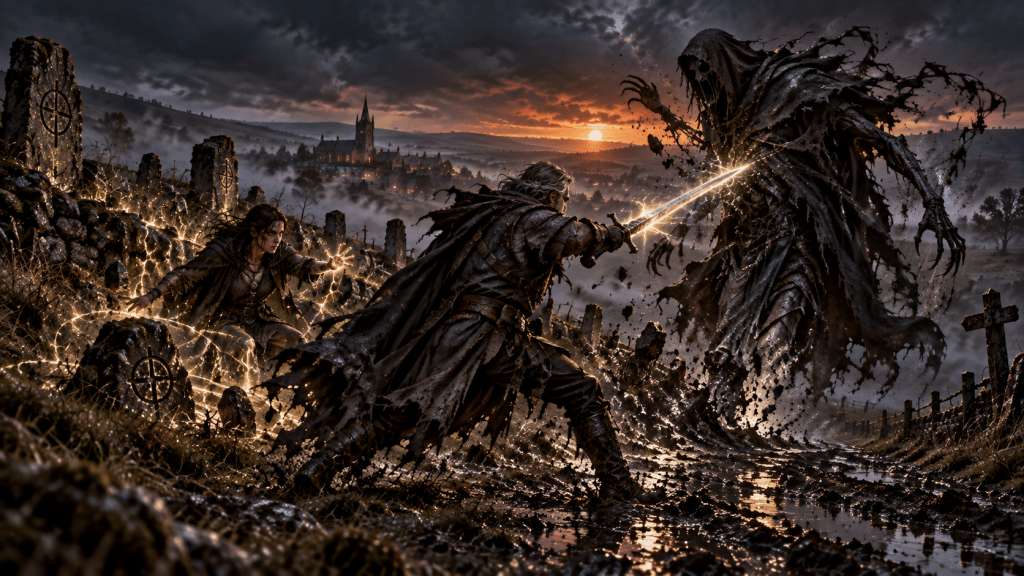
At the old boundary station, that instinct became genuine control. Maris used damaged stone, wet earth and the surviving shape of wartime defences to build two pressure-seals around the outrider. Both held long enough for Kael and Maris to question the creature, proving that her magic could operate with far greater structure than either of them had previously trusted.
The failure came when she tried to strengthen that success. A third working joined too deeply with the first two, allowing pressure to move through the entire system and break the containment. Maris suffered the backlash while the demon escaped, turning a successful magical structure into the route through which the creature regained freedom. Book 3 Report
Her response mattered more than the mistake alone. During the pursuit she abandoned the attempt to recreate the larger cage and began using smaller workings to alter footing, expose buried stone and influence the road beneath the fight. Greater control came from understanding how much structure the situation could bear, instead of assuming that another layer of power would automatically make the first success safer.
Kael and Maris Were Becoming Part of the Same Supernatural Pressure
The outrider exposed another possibility while trapped between Maris’s seals. Kael’s Hali response appeared to intensify when distance opened between them and narrow when Maris focused her fear and attention towards him. The demon recognised something resembling the relationship between wartime mages and Hali fighters, suggesting that Maris might already be influencing Kael through magic she had never consciously chosen to cast. Book 3 Report
That discovery changed the meaning of their partnership. Kael had spent years treating the Hali as a condition he managed inside himself, while Maris feared magic that acted ahead of deliberate choice. Their growing dependence suggested that each person’s instability might now affect the other’s ability to remain in control.
The relationship remained grounded in quieter behaviour long before either could explain the supernatural connection. Maris brought Kael food when he stopped caring for himself, watched the signs of his sleeplessness and learned how his body changed before the Hali fully surfaced. Kael increasingly trusted her judgement, recognised the success inside her failed containment and refused to let one mistake erase what she had achieved. Book 3 Report
They were becoming stronger together, although that strength carried its own danger. Dependence could preserve them during the next encounter, while the same connection might expose both of them to forces neither yet understood.
The War Had Begun Measuring the World Again
The death of the outrider completed the bounty while leaving the larger problem unresolved. Its body destroyed itself from within, flesh burning as bone collapsed into grit and white-flecked residue spread through the wet ground. Maris managed to preserve a small sample, creating another piece of evidence that might eventually reach the Mage Order instead of disappearing completely into Church custody. Book 3 Report
More troubling was what the creature’s presence had already proved. The six locks beneath the city remained intact, meaning the imprisoned warrior had stayed contained while the outrider entered the human world through another route. The immediate danger had therefore come from somewhere beyond the prison that had dominated so much of Kael and Maris’s recent fear.
Kael chose to seek surviving Hali who might remember the war before later institutions shaped its history into safer forms. Maris chose to approach the Mage Order because her hands, her bindings and her effect upon Kael had become too significant to leave unexplored. They agreed to pursue those answers together, carrying different fragments of the same unfinished history towards people who might preserve pieces the Church had lost or buried. Book 3 Report
The village continued behind Kael and Maris as they prepared to leave, with ovens warming, carts moving and bells marking an hour most people had no reason to fear. The scratched halo remained beside the road, carrying a warning whose meaning had almost disappeared while the road beyond the worked fields stretched back into wet country. Somewhere within that ordinary landscape, the old war had already tested the boundaries, measured the response and learned how much the world still remembered.
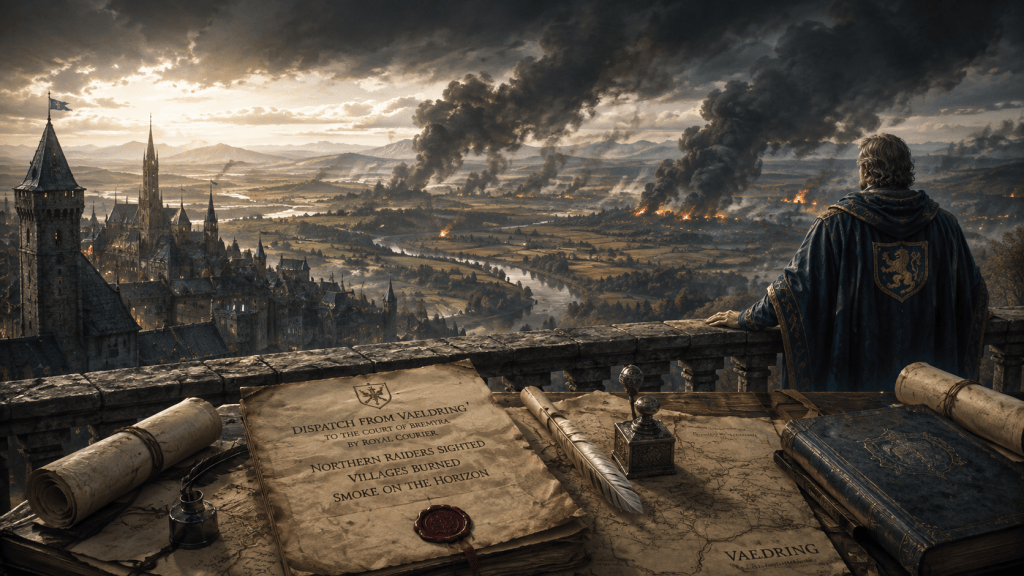
A court-side account of the first dispatches from Vaeldring, where smoke entered Bremyra’s records before the kingdoms understood the war gathering beyond them.
Before War Had a Name
By the hour before dawn, the guarded-return bells had fallen silent above Bremyra, leaving rain to move against the eastern windows while the lesser chancery kept its lamps burning beneath a night already crowded with fear. The western stair remained closed around Princess Elana, the wounded magician, physicians, guards, and servants sworn to quiet, while below those sealed rooms clerks continued the ordinary labour by which kingdoms attempted to hold calamity inside ruled lines of ink.
Edran Vale sat at the third desk from the fire, his shoulders drawn beneath a woollen mantle and his fingers stained where wet wax had softened against them. The receipt ledger lay open before him, filled with entries from the evening: three bells rung under guarded-return authority, western passage closed, physicians admitted, outer gates secured, road patrols recalled. Each line possessed the grave tidiness of court record, giving shape to events whose truth remained elsewhere, behind doors and along roads, within the memories of those who had watched two figures appear upon rain-dark stones where no gate had opened.
Across from him, old Mairen warmed her hands around a cup whose contents had long since cooled. She watched the eastern door whenever wind pressed through its frame. “That hinge has spoken six times since midnight,” Mairen said as she rubbed one thumb along the rim. “If it speaks a seventh, someone will enter carrying trouble.”
“Perhaps the castle has emptied its trouble for one night,” Edran said as he turned the page beneath his hand. “Even ill fortune must tire.”
Mairen settled her spectacles upon her nose. “Trouble rests only while men prepare a larger table,” she said, and the latch struck before Edran could answer.
Cold air entered with wet leather, horse sweat, mud, and the sharp smell of winter roads. A guard came through with one arm around a rider whose cloak hung dark and heavy from his shoulders. Behind them followed a lower-ward clerk clutching a narrow case bound in cracked red leather and sealed with green wax.
“Vaeldring dispatch,” the guard said as he steadied the rider near the bench. “Received at the eastern post before the fourth watch. His horse fell beneath him in the outer ward.”
Master Pellor emerged from the archive screen with his night robe drawn over court linen, his silver hair loose around a face sharpened by interrupted sleep. “Set him near the fire,” Pellor said as he cleared the ledger stand. “Mairen, send for hot water. Vale, prepare receipt under foreign distress.”
The rider resisted the guard’s attempt to lower him fully. Blood had dried along one temple, and mud lay pressed into the seams of his face. “The case goes upward,” he said as his hand closed around the guard’s sleeve. “It was placed under oath for Prince Patrick. I was told it must reach him before daylight.”
“It will reach His Highness through lawful hands,” Pellor said as he rested both palms upon his cane. “Your oath has carried it inside the royal walls. Give us the sender, the road, and the condition in which you received it.”
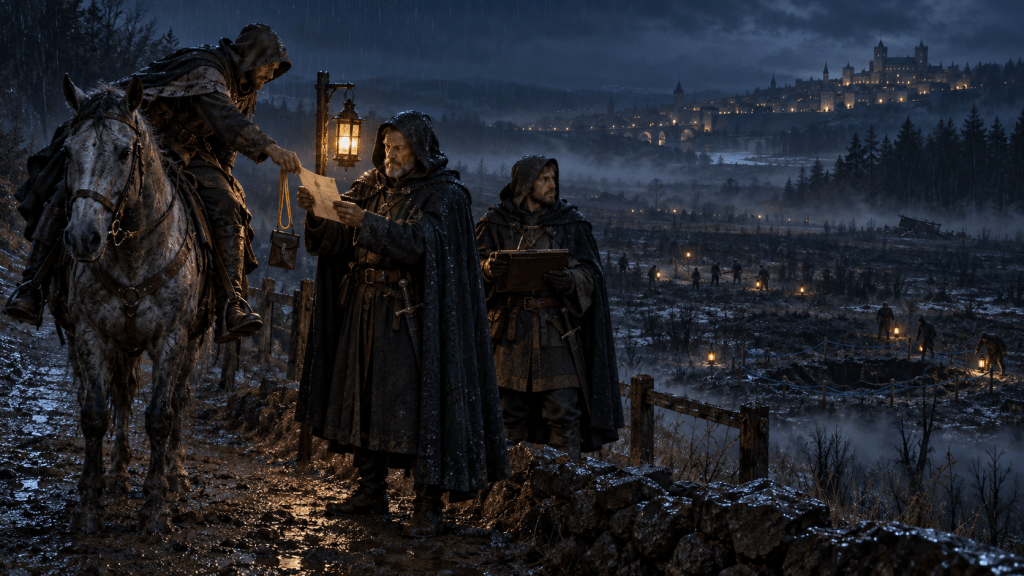
The rider looked towards the leather case as the clerk placed it upon the desk. “I received it at the southern Vaeldring relay from a watch captain out of the northern coast,” he said as his wet fingers worked against one another. “The captain had ridden from a settlement whose name I never heard clearly. His mouth was burned by smoke. He said ships had entered before sunrise, long and shallow through the water, with shields along their sides. Men came ashore while the fishing bells were ringing.”
Edran’s quill slowed above the receipt line. Mairen rose from her chair, the forgotten cup still held between both hands. Pellor gave no sign of surprise, though his grip deepened around the cane.
“How many ships?” Pellor asked as he inclined his head towards the clerk taking witness.
“The captain named twelve, then said more lay beyond the headland,” the rider replied as the guard eased a blanket around his shoulders. “He counted smoke after that instead of sails. Three villages. A watchtower taken. Storehouses opened or burned. Men moving inland in separate companies.”
“Raiders often take the shore and return to the sea before a levy gathers,” Mairen said as she reached for a fresh sheet. “Were these men carrying plunder back towards their ships?”
The exhaustion in the rider’s face hardened around memory. “They carried food and iron inland,” he said as his hand pressed against the blanket. “They drove captured carts before them. The captain said the greater number followed the north road towards the river country.”
Rain continued upon the windows, the fire settled in the grate, and somewhere above them a barred door closed along the western passage. Edran looked towards the map shelf, where surveys of Vaeldring rested among marriage routes, harvest boundaries, bridge tolls, and the careful lines by which courts imagined another kingdom could be understood.
“Bring the Vaeldring road map,” Pellor said as he extended one hand for the sealed case. “The marriage copy, western scale.”
Edran unlocked the cabinet and drew out the blue-corded roll prepared only days earlier for Princess Elana’s journey. He opened it across the long table, weighting each corner with seal cups while Mairen brought the nearest lamp closer.
“The first smoke stood here, perhaps farther east,” the rider said as one shaking finger found the coast. “The captain spoke of a river mouth shaped like a hooked blade. I passed another messenger two relays south. He claimed smoke above the inland farms before nightfall.”
Edran followed the road beneath the rider’s finger. A faint ink line continued south-west through villages and woodland before joining the route intended for Elana’s bridal procession. He felt the connection before any clerk gave it words, though distance remained upon the map, and the night had already taught him the danger of forcing separate wounds into one shape.
Mairen placed a second parchment beside the map. “This came before midnight from the harbour watch,” she said as she smoothed the page. “A merchant vessel out of Vaeldring reported fire along the northern horizon and empty signal towers. Master Pellor entered it as uncertain coastal disturbance.”
“That wording remains until authority changes it,” Pellor said as he drew the seal lamp nearer. “One merchant saw fire. One captain named ships. One rider repeated what a wounded man placed in his keeping. We preserve each distance between witness and event.”
The rider gave a low sound that carried more anger than strength. “Call it distance if that helps the ink lie flat,” he said as he shifted beneath the blanket. “The road behind me filled with families travelling south. One woman carried a child wrapped in sailcloth because every blanket had burned. They called the men sea wolves, frost sons, dead kings returned from the north. By the third relay, people swore the raiders rode white beasts and carried axes bright enough to split church stone. I saw only smoke, Master. I saw enough to hide the stars.”
Pellor studied him, then looked towards Edran. “Enter the account exactly,” he said as he laid the leather case upon the map. “Keep the witness words apart from the receipt. No title of war. No naming of tribes. No joining of this report to the violence upon Her Highness’s road.”
“How shall the movement inland be described?” Edran asked as ink gathered at the point of his quill.
“Armed northern movement under uncertain strength,” Pellor said after a silence. “Add coastal settlements under violent seizure. Smoke observed across more than one district.”
The eastern door opened again before Edran completed the line. Master Vaynor entered with two guards and a folded order held beneath his arm, his face drawn by the hours spent between the western chamber and the court rooms. A faint stain of medicinal smoke clung to his sleeve. He took in the rider, the opened map, the green seal, and the harbour report beside it.
“How many?” Vaynor asked as he crossed to the table.
“One sworn dispatch, one merchant account, and a second messenger reported upon the southern relay,” Pellor said as his finger traced the coast. “Ships along the northern shore. Settlements taken. Armed companies moving inland.”
Vaynor rested both palms upon the map and followed the roads towards the south. “His Highness receives every northern paper at once,” he said as his eyes remained upon Vaeldring. “Copy each report separately, then prepare a common sheet of locations, times, and witness distance. Send word to Captain Rylas that the eastern roads require riders beyond Grey Ash.”
“What heading shall stand upon the common sheet?” Pellor asked as his hand remained near the sealed case.
Vaynor raised his gaze, and Edran saw a man who had passed beyond exhaustion into the harder country where movement continued because too many others depended upon it. “Northern reports,” Vaynor said as he gathered the map’s edge beneath his fingers. “Nothing greater until the council has enough truth to carry the word.”
The rider laughed once, softly and with little mirth. “The word is already travelling,” he said as he lowered his head beneath the blanket. “It reached the roads ahead of me.”
No one answered him. Edran returned to the ledger while Mairen opened fresh sheets, Pellor warmed the green seal above the lamp, and Vaynor stood over the map where separate trails of ink began to gather towards Bremyra. Outside, the rain thinned along the eastern windows, revealing colourless light above the city roofs. The bells remained silent, the western chamber remained closed, and the people of Bremyra slept beneath the fading memory of impossible return while smoke from a kingdom beyond their watch entered the castle one report at a time.
Before Prime, servants below the chancery had heard that northern fleets covered the sea. Before the noon bell, men in the harbour spoke of burned Vaeldring towers and armies walking south beneath black banners, though no such banner appeared in any page Edran had seen. The official heading remained small and provisional: Northern Reports, Uncertain Strength.
The lesser chancery remembered the moment differently, for those present saw how each fragment arrived alone and settled beside the others, until the spaces between them became more fearful than the words themselves. Long before any council named an invasion, the smoke had found its way into Bremyra’s ledgers, and war had begun to take shape in the margins where certainty failed.
Royal Chancery Register: The Northern Smoke Reports
The northern reports entered Bremyra Castle through separate hands, their seals bearing the marks of Vaeldring road stations, coastal watch posts, merchant harbours, and minor officers whose names appeared only once before vanishing from the surviving record.
The earliest dispatch referred to shallow vessels sighted beyond the northern headlands, followed by smoke rising from fishing settlements whose warning bells ceased before the nearest levy could gather. A second report recorded storehouses opened or burned, signal towers left empty, and armed companies carrying food, iron, and captured carts away from the coast towards the inland roads.
No agreed number of vessels or raiders appeared across the surviving copies. One captain entered twelve ships beneath the headland, while later witnesses claimed the sea itself had darkened beneath their hulls. Reports of white beasts, black banners, dead kings, and axes bright enough to break consecrated stone were preserved only upon attached witness sheets and excluded from the common chancery summary.
The royal copy described the disturbance as armed northern movement under uncertain strength, with instruction that each location, time, and witness distance remain separately entered until the council possessed enough evidence to assign a fuller name. A later hand amended movement to incursion, though the alteration was scraped thin before the register passed into sealed storage.
The reports continued after the first page had been filled, arriving from roads farther south and settlements farther inland, until smoke appeared upon maps whose earlier purpose had been marriage passage, harvest measure, bridge duty, and royal travel. The register closed without naming war, while a lesser chancery copy preserved the phrase the north had already entered Vaeldring before Bremyra learned what to call it.
About the Creator
The Mythic Chronicle is written and curated by Simon Phillips, a writer of mythic and speculative fantasy whose work explores forgotten kingdoms, fractured records, old institutions, and the moments when history begins to shift before those living through it understand what has changed.
The accounts preserved within these Chronicles form part of a wider body of work in which castles keep older secrets beneath familiar rooms, roads carry rumours ahead of armies, and ordinary witnesses preserve fragments of events whose true meaning remained sealed from them at the time.
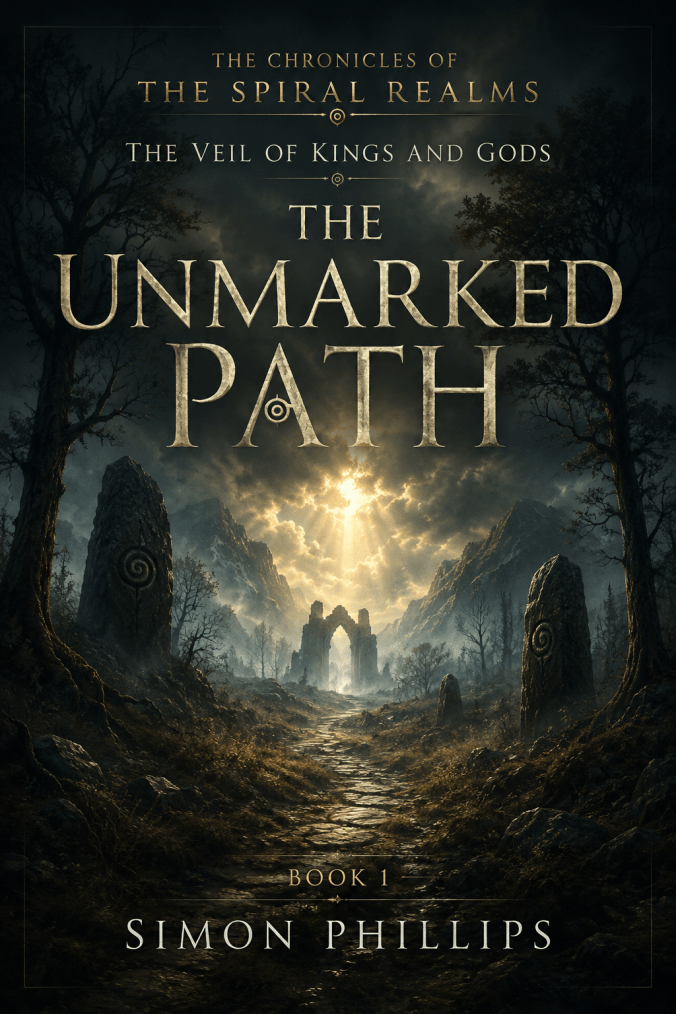
One such account survives in a separate record, following the return of a magician to Bremyra during a season of court unease, royal absence, Church suspicion, and gathering danger beyond the kingdom’s roads. What the servants, clerks, and watchers of the city remembered only in fragments is followed more closely in The Unmarked Path, the opening book of The Veil of Kings and Gods within The Chronicles of the Spiral Realms.
Readers who wish to examine that fuller account may find the record below.
The first packet left the lesser chancery while morning still lay colourless across Bremyra, carried beneath Edran Vale’s arm through passages smelling of wet wool, lamp oil, ash, and the faint medicinal herbs rising from the western rooms. Servants pressed close to the walls as he passed, their trays and coal baskets held against their chests, while every face turned for an instant towards the red leather case borne ahead by Master Vaynor. The guarded-return bells had given the household one fear to carry through the night. The Vaeldring papers arrived before that fear had found any settled place.
At the upper landing, two royal guards stood beside the council doors with rain darkening their cloaks. Captain Rylas waited between them, mud dried pale along his boots after his return from Grey Ash Rise, his bruised face drawn beneath a night of roads, bodies, and unanswered tracks. He looked towards the case in Vaynor’s hands, then towards Edran’s ledger.
“Another road has opened,” Rylas said as he drew one glove tighter across his wrist. “I can read that much from the way you carry it.”
Vaynor halted before the doors and studied the captain. “The road lies north of Vaeldring’s coast,” he said as one hand remained beneath the case. “Ships, burned settlements, inland movement, and numbers that alter with every witness.”
Rylas’s jaw tightened. “How far inland?”
“Far enough for three separate stations to send warning,” Vaynor replied as he glanced towards the sealed council chamber. “Near enough for rumour to reach our harbour before the riders.”
Edran shifted the ledger beneath his arm. “The first report names twelve vessels,” he said as Rylas’s attention settled upon him. “The same witness believed more waited beyond the headland. A second account speaks only of smoke.”
“Smoke gives a truer count than frightened men,” Rylas said as he rested his palm against the sword at his side. “Each column means somebody lost a roof.”
The inner guard opened the doors, releasing firelight across the passage and revealing Prince Patrick at the map table with Archbishop Alaric standing near the hearth. Patrick still wore the dark tunic from the previous evening, its collar loosened and one sleeve marked by a narrow smear of blood that had escaped every servant’s attempt at order. His face had gained the stillness Edran had seen in older rulers during crop failure and siege petition, the expression of a man who understood that weariness could no longer be offered as an excuse.
Patrick looked first to Vaynor, then to Rylas, and at last to the leather case. “Bring it here,” he said as he drew the Vaeldring marriage map away from the other papers. “Tell me what reached us before the court invents its own answer.”
Vaynor placed the case upon the table and untied the outer strap. Edran opened his ledger beside it, while Rylas took the place nearest the northern coast. Archbishop Alaric watched from the hearth with both hands gathered into his sleeves, his white stole catching the low flames.
“The earliest sealed report came from a coastal captain through the southern relay,” Vaynor said as he laid the first sheet flat. “Long vessels entered before sunrise. Fishing settlements and at least one watchtower fell under attack. Armed companies moved inland carrying stores, tools, carts, and prisoners.”
Patrick traced the coastline with one finger. “Raiders take coin, grain, livestock, and people they can sell,” he said as his gaze followed the river road. “They return towards the ships before levies close the shore. Why carry iron inland?”
Rylas bent over the map. “Because they mean to hold ground, repair what breaks, or arm men who arrive after them,” he said as his finger moved from the headland towards the river country. “A raiding party feeds itself from the coast. An army opens a road.”
Alaric left the hearth and approached the table, the hem of his robe moving across the rushes. “One captain’s fear has become an army before the wax has cooled,” he said as he examined the green seal. “The Church has received no formal plea from Vaeldring, and its northern houses maintain their own wardens.”
Rylas lifted his eyes towards the Archbishop. “Those wardens may already hang above their own gates.”
Patrick raised one hand before the exchange sharpened. “We keep each claim beside its source,” he said as his fingers rested upon the map. “Captain Rylas gives military reading. His Grace gives the absence of formal appeal. The ledger preserves both.”
Edran entered the distinction while the room settled around the Prince’s order. The quill sounded small against the page, yet the words changed the shape of the table. Coastal violence. Armed movement inland. Strength uncertain. Purpose unconfirmed. Each phrase narrowed what could safely be declared while leaving the larger fear untouched.
A knock sounded from the outer chamber. Ser Caldus entered with a harbour officer whose blue coat hung open over a salt-stiff tunic. The officer bowed too quickly, caught himself, then placed a rolled witness sheet beside Vaynor’s hand.
“Your Highness,” Caldus said as rain glistened along his shoulders, “the harbour watch detained a grain master from Vaeldring after his crew began spreading alarm among the lower quays. His statement concerns the same smoke.”
Patrick looked towards the officer. “You heard him yourself?”
“I questioned him with two watch clerks present,” the officer said as he kept his cap between both hands. “His vessel left the river mouth before the first fire rose. By dusk, smoke stood across the northern horizon in five separate columns. He passed fishing boats moving south with wounded aboard, then a river barge carrying families from inland farms.”
“How many armed men had he seen?” Rylas asked as he leaned one knuckle against the map.
“None with his own eyes, Captain,” the officer answered as he glanced towards the witness sheet. “One fisherman spoke of shield lines near the shore. A wounded boy claimed horned giants came through the surf. The grain master rejected that part, though his crew kept repeating it.”
Alaric’s mouth tightened. “Fear places horns upon every enemy before giving him a name.”
The harbour officer bowed his head. “By the time they reached Bremyra, Your Grace, the giants had become dead kings from beneath the ice.”
Patrick closed his eyes for a moment, then opened them upon the map. “Enter the grain master as witness to smoke, refugee vessels, and reported wounded,” he said as he looked towards Edran. “The shield lines remain second-hand. The giants and dead kings stay upon the attached sheet.”
Edran wrote while Caldus placed a second report beside the first. Across the table, Vaeldring changed from a kingdom of marriage roads and border promises into a spread of inked warnings, each one arriving through a different mouth. Patrick’s sister had been travelling towards those same lands only a day earlier, carried beneath royal colours towards a marriage meant to strengthen both kingdoms. Now she lay behind guarded doors, and the country prepared to receive her had begun sending smoke southward instead of wedding couriers.
Patrick’s hand came to rest over the road marked for Elana’s journey. “Has any report come from the Vaeldring court?” he asked as the fire shifted behind him.
Vaynor drew a sealed packet from beneath the others. “Only an older message received before the ambush,” he said as he laid it near the prince. “It concerns her reception, lodging, and ceremonial approach. No northern warning appears within it.”
“Then their court either lacks the news, cannot send it, or has chosen silence,” Patrick said as his thumb pressed against the old seal. “Every answer carries its own danger.”
Rylas studied the distance between Grey Ash Rise and the northern coast. “The men upon the Princess’s road spoke a foreign tongue and carried weapons outside our common make,” he said as his forefinger tapped the map. “The dead in Tanner’s Row carried broad axes and round shields. Now long vessels enter Vaeldring from the north.”
Alaric’s gaze sharpened. “Similarity invites certainty where evidence remains thin.”
“I spoke of connection, Your Grace,” Rylas said as he straightened. “I offered no judgement upon who placed them there.”
Patrick looked from one man to the other. “The formal record keeps the incidents separate,” he said as his hand closed around the edge of the table. “Privately, we compare every weapon mark, every word remembered from the alley, every bottle taken from the field, and every sign carried from Vaeldring. If one hand moved through all three places, I want its shape before it reaches for us again.”
Vaynor inclined his head. “The foreign axe remains under watch. The arrowheads from Grey Ash are sealed. Captain Maeran’s lesser copy preserves the witness words more fully than the court transcript.”
“Bring them together under guard,” Patrick said as he turned towards Rylas. “You choose the officers. No chapel inquiry, no Order claim, and no Guild agent enters the room alone.”
Alaric’s expression cooled. “The Church holds knowledge of poisons older than this crown.”
“And the Order holds arts that may draw memory from the dead,” Patrick said as he met the Archbishop’s gaze. “Both institutions may assist when I know what assistance costs.”
For several heartbeats, the room held only fire, rain, and the light scrape of Edran’s quill. Alaric lowered his chin by a measured degree, accepting the boundary while leaving his displeasure visible. Rylas stepped back from the map, though tension remained along his shoulders.
Another knock came before the council resumed. This time a page entered with a strip of wax tablet wrapped in linen. His cheeks were flushed from running, and one stocking had slipped below the knee.
“Message from the east tower, Your Highness,” the page said as he crossed to Vaynor and held out the bundle. “A rider from the chapel road reached the lower ward. He carried no seal, only a tally mark from the Vaeldring border post.”
Vaynor unfolded the linen and read the scratched lines. His eyes moved once across the tablet, then again more slowly. “The border post received displaced families from two inland settlements,” he said as he placed the tablet beside the map. “They reported armed men crossing the north road in separate columns. Carts moved with them. Fires followed behind.”
“How many families?” Patrick asked as he looked towards the page.
“The rider named thirty at the first post and more upon the road,” the page replied as he pressed his hands against his sides to still their shaking. “He said one old woman carried a door key from a house that had already burned.”
The image entered the room more deeply than the number. Edran saw it in Patrick’s face, in Rylas’s lowered gaze, and even in the brief closing of Alaric’s fingers beneath his sleeves. A door key survived because people carried the shape of return long after return had become impossible.
Patrick reached for the tablet and turned it towards the lamp. “Was the rider admitted to the infirmary?”
“Yes, Your Highness,” the page said as he bowed. “His horse had blood beneath the saddle, though the rider claimed the wound belonged to another mount.”
“Send food, dry clothing, and a clerk after he has slept,” Patrick said as he returned the tablet to Vaynor. “No questioning while exhaustion speaks in his place.”
The page withdrew, leaving the council with the old woman’s key among seals, maps, and military estimates. Vaynor took a stick of red wax from the writing tray and placed a small mark beside the northern road. Rylas added another at the river branch, then a third near the inland farms. The map slowly filled with red points whose exact positions remained uncertain, each one a place where smoke, movement, or flight had been witnessed.
Edran watched the pattern grow and understood why later copies disagreed over the morning. Some claimed the red marks formed a claw descending through Vaeldring. Others remembered a serpent, a broken crown, or a spiral tightening towards Bremyra. From where he stood, they formed no sacred sign. They were only warnings placed by tired hands, though fear had already begun teaching the court to see more.
Patrick stepped away from the table and crossed towards the eastern window. Dawn had strengthened over the city, revealing wet roofs, harbour masts, and the old Order manor upon its hill. “How long before these accounts reach the market?” he asked as one hand rested against the stone frame.
“They have arrived already,” Vaynor said as he gathered the loose sheets. “The harbour crews speak of northern kings. The lower gate speaks of fleets beyond counting. Kitchen servants have heard that Vaeldring’s sky has burned black.”
Rylas moved beside the map, his face turned towards the red points. “By noon, Bremyra will believe an army stands beyond Grey Ash.”
“Then the guards keep their mouths measured,” Patrick said as he looked back towards them. “The court issues no proclamation until the next riders arrive. We strengthen the eastern watches, prepare grain tallies, and send quiet warning to the western posts. Vaeldring receives an offer of riders, physicians, and road escort under royal seal.”
Alaric drew closer to the window, candlelight fading from his white stole beneath the growing day. “And what shall the people be told when they ask why the gates carry twice their usual guard?”
Patrick’s gaze travelled across the city below. “Tell them northern reports have reached the court and that Bremyra watches its roads,” he said as his hand tightened upon the stone. “Give them enough truth to prepare, never enough emptiness for fear to fill with monsters.”
Edran lowered his quill after entering the order. He knew the weakness within it, as every clerk knew the limits of royal wording once bells, blood, ships, and smoke had entered common speech. Before midday, stallholders would swear Vaeldring had fallen. Before evening, taverns would name a northern king whose face no witness had seen. By the following morning, the burned settlements would become a hundred, the long vessels a thousand, and the armed columns a host older than the kingdoms they threatened.
The council understood this as well. Their task remained narrower: seals checked, witnesses separated, distances marked, and uncertainty preserved where certainty had yet to earn its place. Patrick returned to the table and set his hand over the northern coast, covering three red marks beneath his palm.
“We keep the heading as Northern Reports,” he said as he looked towards Edran. “When the truth grows large enough to demand another name, the record may change.”
Edran bowed over the ledger and entered the Prince’s words in the margin. Years later, copies would claim that Patrick named the invasion that morning, that bells rang across Bremyra, that smoke appeared upon the sea, or that a black-winged omen circled the castle tower while the court watched Vaeldring burn upon a map. The surviving chancery account preserved a quieter beginning.
A tired prince stood beside his father’s empty chair. A captain placed red wax upon unfamiliar roads. An archbishop questioned each report. A master of court kept every witness at the proper distance from what they claimed to know. A clerk wrote a heading small enough to contain uncertainty.
Beyond Bremyra, armed men continued inland through Vaeldring while the kingdoms searched for a word equal to the danger. Within the castle, the reports lay side by side until their separate smoke became one dark shape in memory, and war entered legend before law, council, or crown had gathered courage enough to name it.
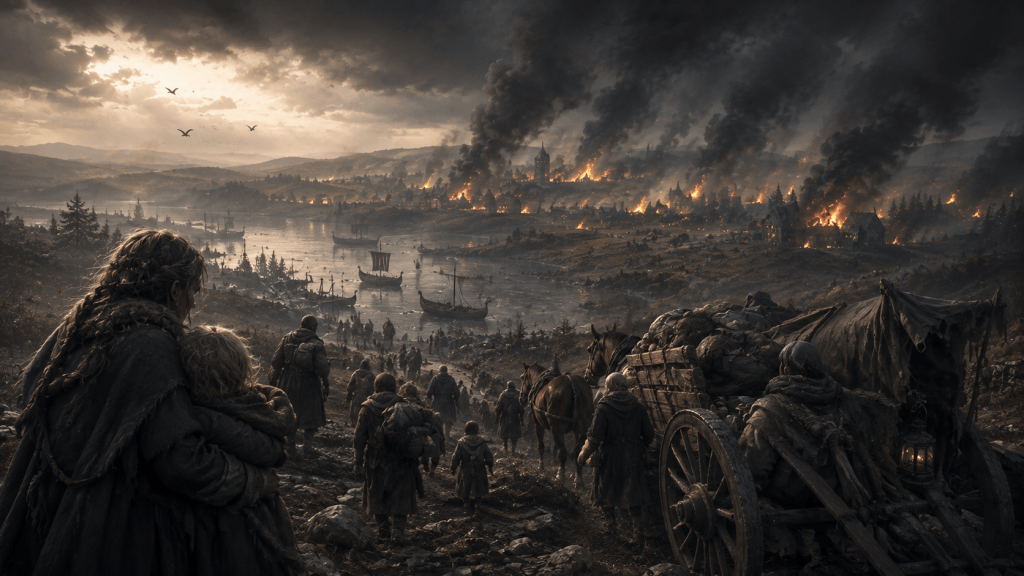
Families fled the northern settlements beneath a sky darkened by smoke, carrying children, keys, and the last possessions they could save, while Vaeldring’s burning roads sent their first warning south towards Bremyra.
The Idea Behind the Chronicle
Wars rarely enter history beneath the name later generations give them. Their earliest presence is often smaller and harder to judge: smoke seen beyond a ridge, fishing boats crowded with wounded families, watchtowers falling silent, roads carrying people south with keys to houses already lost, and riders arriving at court with accounts gathered from other frightened mouths. By the time rulers recognise the shape of invasion, ordinary witnesses have already begun turning scattered violence into memory.
This Chronicle draws upon that uncertain threshold between report and war. Bremyra stands beyond the first northern landings, protected for a time by distance, weather, and another kingdom’s roads. The people receiving the dispatches see no longships, shield lines, burned villages, or armed columns with their own eyes. They encounter the invasion through cracked seals, exhausted messengers, harbour testimony, road tallies, and smoke marked upon maps once prepared for marriage, harvest, and royal passage.
Court records are built to separate witness from rumour. They preserve names, hours, places, seals, and the distance between an event and the person describing it. Such discipline offers a kingdom protection against panic, though it also creates a strange delay between danger and recognition. One clerk records coastal disturbance. Another enters armed movement under uncertain strength. A harbour officer preserves reports of refugees. Each entry remains cautious on its own, while the growing space between them begins to reveal something larger than any single page is willing to declare.
Across old accounts of invasion, rumour often moves ahead of formal knowledge. Raiders become giants, unfamiliar warriors become dead kings, and twelve ships become a sea hidden beneath sails. These changes arise through fear, distance, and the human need to give shape to danger before authority has supplied one. The stories may lose accuracy as they travel, yet they often preserve the emotional truth of the moment more faithfully than the final proclamation: homes have burned, roads have broken, and the world beyond the familiar border has changed.
The Sealed Road of Bremyra has followed a kingdom through signs that gathered slowly around it. An old manor appeared to wake before its guest arrived. A gold-wax letter altered the mood of the court. Church doors closed around buried suspicion. Servants remembered a boy beneath a magician’s robes. Hidden stone shifted behind library shelves. Foreign weapons entered the streets, a princess vanished upon the road, scorched earth resisted ordinary explanation, and guarded bells carried rumours of impossible return. The northern reports bring those separate disturbances beneath one widening shadow, while preserving the uncertainty that has shaped the entire cycle.
The world of The Unmarked Path remains at the edge of open continental war. Vaeldring has begun to suffer northern attack, armed forces are moving inland, royal travel has already broken beneath organised violence, and Bremyra’s institutions remain reactive, measuring danger after it has crossed each earlier boundary. The court understands that something larger has begun, although its surviving language still belongs to reports, border disturbance, uncertain strength, and guarded preparation.
This Chronicle therefore closes the Bremyra cycle through records instead of battle. The invasion remains distant from the chancery windows, though its smoke has already entered the castle through parchment, testimony, rumour, and fear. Clerks continue to preserve careful distinctions while the people beyond their desks begin shaping legend from fragments. The court waits for evidence strong enough to name war, while the roads have already carried its consequences south.
The northern smoke becomes the final threshold of the series. What began with one old house preparing itself ends with whole kingdoms facing a movement whose full shape remains beyond sight. Bremyra has received every warning in pieces, and those pieces now lie close enough for the truth to cast a shadow across them, even as the official record keeps its smallest heading: Northern Reports, Uncertain Strength.
From the Author’s Desk
Thank you for continuing into this Chronicle.
This final account was shaped around the way war often reaches those beyond its first violence: through scattered testimony, damaged seals, exhausted messengers, smoke upon distant horizons, and rumours that grow larger as they travel. Bremyra’s court receives no complete vision of what has begun in Vaeldring. Its clerks hold fragments, compare locations, preserve uncertainty, and wait for enough evidence to give the gathering danger a name.
Across The Sealed Road of Bremyra, each Chronicle has remained close to those standing beside the larger events: servants opening an old manor, clerks receiving sealed authority, chapel attendants guarding uncertain foundations, cooks remembering a vanished boy, librarians recording movement behind familiar shelves, guards examining foreign steel, and road keepers watching royal passage disappear into silence. Their accounts preserve what the world noticed around the story, while the fuller truth remained beyond their reach.
The Northern Smoke Reports brings that movement to its final threshold. The dangers that entered Bremyra as isolated disturbances now appear within one widening pattern, though those recording them still lack the knowledge needed to understand their full meaning. The cycle closes before certainty arrives, leaving the court with maps, warnings, and smoke carried south from a kingdom already facing war.
Beyond the Chronicle, The Unmarked Path follows these events more closely through Simion, Prince Patrick, Týrnan, Elana, and the forces beginning to move through the kingdoms of Ældorra. The book preserves the direct experience behind the partial records gathered throughout this series, while the Chronicle remains among those who witnessed only fragments of what had begun.
Readers who wish to explore further may find my books and additional work through the links included below.
From the sealed chancery folios of Bremyra, copied from Vaeldring dispatches of uncertain origin. Several lines were entered by later hands, while portions of the first witness sheet show signs of smoke damage and water staining.
The first warning entered under coastal seal and spoke of long vessels passing the northern headlands before sunrise, their hulls lying low upon the water and their shields fixed along the rails. The watch captain who supplied the account gave twelve as the number clearly seen, though his final line referred to further sails beyond the curve of the coast, where mist and smoke had already closed the horizon.
A second entry recorded the silencing of three warning bells, one above a fishing settlement, one beside the river mouth, and one upon a stone tower whose fire had served the northern road for more years than the surviving tally preserved. The tower remained visible after the settlement below had begun to burn, though no answering flame rose from its summit and no warden came down to meet those fleeing towards the inland track.
The reports that followed disagreed over the number of armed men, the colour of their banners, and the order in which the coastal settlements fell. Several witnesses described round shields, heavy axes, pale hair, and iron rings woven through the beards of certain warriors. Others remembered only figures moving between smoke and water, their shapes made larger by flame and distance until the first written copies referred to sea-born giants and warriors returned from older graves.
One road account preserved the movement of captured carts away from the shore, laden with grain, tools, barrels, and lengths of worked iron. The writer marked this as unusual conduct for raiders expected to return quickly to their vessels, adding that armed companies had divided beyond the river crossing and continued inland by separate routes. This observation was copied into the Bremyran court summary under the guarded phrase movement of uncertain purpose.
A later sheet gathered statements from families who reached the southern relay after their homes had burned. One woman carried the iron key to a house already lost, while an elderly man held a strip of sailcloth marked with the name of a fishing boat whose crew had vanished before the warning bell. Their accounts supplied no clear number of attackers, though each described smoke rising behind them from more than one direction.
The final chancery line entered the disturbances as coastal seizure, armed inland movement, and displacement of the northern settlements. The word war appeared nowhere within the primary folio. A smaller hand later placed it beside the closing seal, then scraped the letters thin enough to preserve only their pressure upon the parchment.
Beneath that erasure, another annotation remained untouched:
The smoke had already crossed the kingdom while the court still searched for a name worthy of carrying it.
Marginal Notes & Interpretations
Collected from later annotations preserved along the outer edges of the northern folio.
One annotation described the first landings as a familiar pattern of northern raiding, arguing that winter hunger, weak coastal defences, and the promise of Vaeldring grain offered sufficient cause for the attacks. The writer treated the inland movement as an attempt to gather supplies before returning to the sea, though the same hand offered no explanation for the captured carts, divided companies, or occupied road stations recorded upon the following pages.
A second note challenged that reading and drew attention to the transport of iron, tools, prisoners, and stored food away from the coast. Its writer argued that such movement belonged to men preparing roads, camps, and future supply, with the long vessels serving as the first opening through which a larger force might pass. The note ended beside a rough map of the river country, where three dark lines had been drawn southward from the northern shore.
A third annotation, written in faded brown ink, concerned the stories carried by the displaced families. The writer dismissed the horned giants and dead kings as shapes created by fear, firelight, and distance, yet preserved the accounts in full because each version agreed upon the same lesser details: the bells ceased early, the towers gave no answer, and the armed men continued inland after the first settlements had fallen.
Another hand, firmer and darker, added that legend often begins where official language grows cautious. The court recorded uncertain movement, while the roads remembered an army. The court counted seals, witnesses, and distances, while those fleeing south counted columns of smoke.
The last marginal note had suffered damage along the edge of the page. Its surviving words read:
When every witness offers a different enemy, examine the direction in which they all flee.
The remainder had been lost with the corner of the folio.
World Notes
The Northern Coast of Vaeldring
Vaeldring’s northern shore held fishing settlements, shallow river mouths, scattered watchtowers, and road stations linking the coast with the kingdom’s inland farms. Warning bells and signal fires carried danger between these isolated communities, though winter mist, broken weather, and distance often slowed any wider response.
The Southern Relay Roads
Messages from the northern districts travelled through a chain of small posts where horses, seals, and witness statements changed hands. Each transfer increased the distance between the original event and the court receiving it, creating records shaped by exhaustion, repetition, partial memory, and the fears of those already moving south.
Northern Warbands
The first Bremyran reports described long shallow vessels, round shields, heavy axes, and warriors moving inland through Vaeldring. Their names, loyalties, and full strength remained uncertain within the court record, though the surviving accounts confirm that the movement extended beyond a single coastal raid and had begun carrying war into the southern kingdoms before Bremyra fully understood its scale.
Bremyra remained beneath its guarded towers, its ledgers ordered and its roads watched, while beyond the northern horizon the smoke continued to rise, carrying the first shape of a war the kingdoms had yet to understand and the records had only begun to name.
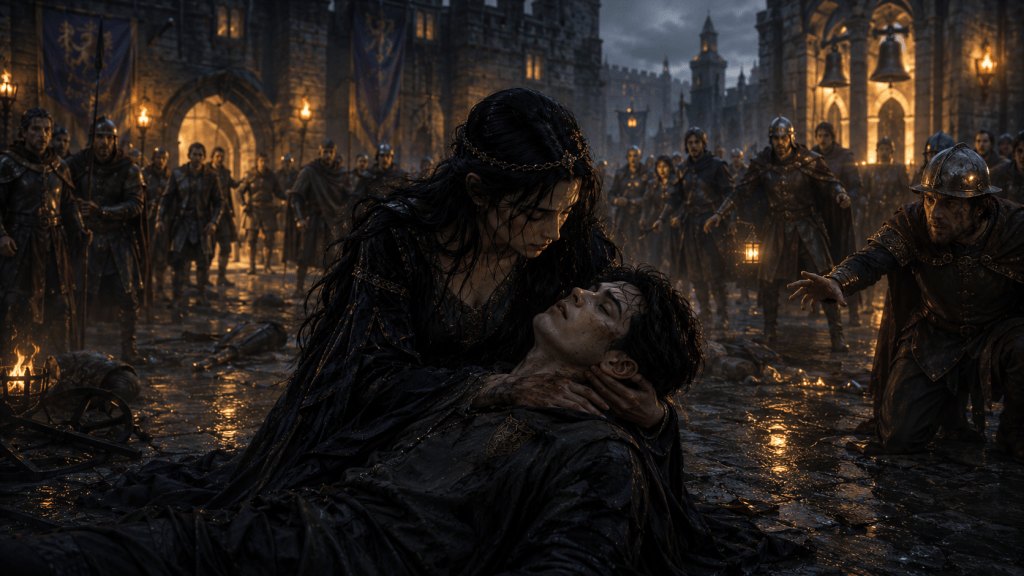
A castle-side account of the hour Princess Elana returned beside a fallen magician, and the bells of Bremyra carried whispers of golden light through every guarded hall.
When the Inner Court Answered
Rain had begun to gather in the inner courtyard before the evening bell, laying a dark sheen across the paving and drawing warmth from every archway beneath Bremyra Castle’s western wall. Servants crossed between kitchen, armoury, stable, and upper hall with shoulders raised against the weather, while guards changed watch beneath dripping banners whose blue cloth clung heavily around the carved beasts of the royal house. Beyond the gate passage, the city descended towards the harbour through roofs, smoke, and mist, its lamps appearing one by one as daylight thinned across the sea, and within the courtyard the castle continued through ordinary burdens carried under cover: bread, coal, sealed messages, folded linen, and broth sent towards the council rooms where Prince Patrick had remained since news came from the Vaeldring road.
Maren Saye had spent the afternoon moving between the lower laundry and the western guest chambers, carrying sheets warmed near the drying hearth because the household expected survivors before nightfall. She was broad through the shoulders, grey beginning at her temples, and trusted with work that required a steady hand around blood, birth, fever, or noble grief. Beside her hurried Nessa, a chambermaid in her first winter of service, whose arms were filled with rolled blankets tied by blue cord. The girl watched every messenger who crossed the yard, reading calamity in mud-dark boots and closed faces, until Maren caught her staring towards the eastern passage.
“Keep your eyes upon the stones beneath you,” Maren said as she guided the girl around a widening puddle, her voice carrying the firmness of long practice. “A broken ankle will serve the royal house poorly, even on a night when every whisper claims the kingdom has ended.”
Nessa tightened her grip around the blankets and glanced towards the gate, where two mounted guards waited beneath the arch. “My cousin came from Grey Ash before the third bell,” she said as she walked close beside Maren. “He swore the Princess’s carriage lay upon its side and the grass burned green beneath the rain.”
“Your cousin swore last harvest that a white stag drank ale from the cooper’s trough,” Maren answered as she mounted the shallow steps towards the west door, though her gaze remained upon the waiting riders. “Carry what your hands can prove. Leave the rest for those paid to write frightened things into ledgers.”
The door ahead opened before they reached it, and Master Vaynor emerged beneath the arch with a clerk, two household guards, and a physician whose leather case struck against his knee as he walked. Vaynor wore no cloak despite the rain blowing through the passage, and the controlled stillness of his face placed silence around him more effectively than any shouted order. He spoke briefly to the captain at the gate, then turned towards the servants crossing the yard.
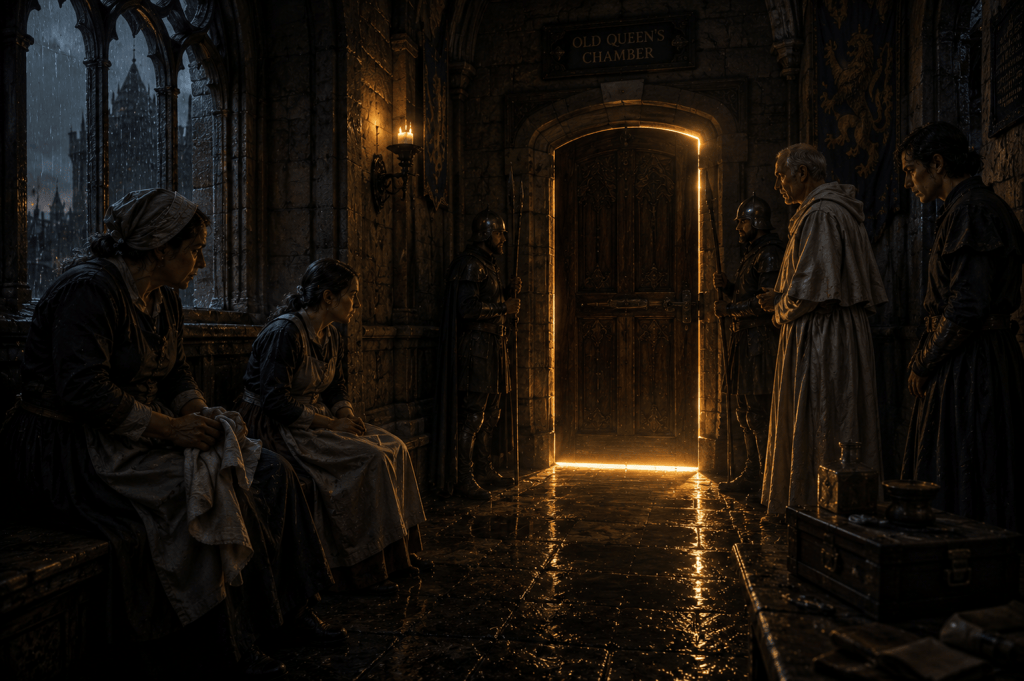
“Clear the western stair and prepare the old queen’s chamber,” Vaynor said as his hand settled upon the folded warrant carried by the clerk. “Fresh water, warmed linen, two braziers, and every lamp filled. The passage from this court to the upper rooms remains open for the wounded alone.”
Maren lowered the sheets against her apron and bowed. “The linen is ready, Master Vaynor,” she said as rain gathered along the loose strands of her hair. “Shall the Princess’s rooms be opened as well?”
Vaynor’s gaze paused upon her, and something beneath his restraint revealed how little certainty the castle possessed. “Her Highness returns to her own chamber once the physicians release her,” he said as he folded the warrant more tightly. “Until then, the old queen’s room receives whoever reaches us first.”
The answer travelled through every servant who heard it. A groom near the stable lowered the bridle he had been oiling. The kitchen boy carrying broth stopped beneath the covered walk. One of the gate guards turned towards the eastern road, his hand resting upon the pommel of his sword. The castle had spent hours preparing for riders, litters, bodies, perhaps a shattered carriage brought home under guard. No order had spoken of uncertainty over who might arrive first.
Nessa moved nearer to Maren as they crossed beneath the arch. “They have no word of her,” the girl murmured, shaping the fear carefully while the household officers remained close. “They have lamps, beds, and physicians, yet no word.”
Maren set the linen upon the passage bench and began untying the blue cord. “Then give your hands to the work waiting before them,” she said as she passed two folded sheets into Nessa’s arms. “Fear grows quickest in idle fingers.”
They had reached the first turn of the western stair when the air changed behind them.
The sound came as a deep inward rush, as though the whole courtyard had drawn breath through its gates. Lamps under the arcade bent towards the centre stones, rain lifted in a pale circle from the paving, and every horse beneath the stable roof pulled hard against its tether. Maren turned with one hand upon the stair rail as pressure passed through the archway, closing her ears and pressing cold against the roots of her teeth. A cry rose from the yard, followed by the scrape of boots and the bright ring of a sword half drawn before recognition stayed the hand that held it.
Two figures stood where the courtyard had been empty.
Princess Elana appeared first within the mind because midnight-black hair, torn court blue, and the silver clasp at her shoulder still carried royal identity through mud, ash, and rain. She leaned beneath the weight of the man beside her, one arm locked around his waist while his black robe hung scorched and wet around his legs. For a single breath they remained upright together, caught in the centre of the open court as guards, servants, clerks, and grooms stared across the stones. Then the magician’s knees failed, and Elana went down with him, turning his fall so his head came against her arm instead of the paving.
“Help me,” Elana called as she gathered him closer, her voice sharpened by exhaustion and command. “He is failing.”
Prince Patrick crossed the courtyard before the nearest guard had fully lowered his sword. He came from the council passage with his mantle unfastened and one hand bare where he had left his glove behind, his face altering as he saw his sister kneeling in the rain. He dropped beside her, reached once towards her shoulder, then drew his hand back as his gaze found the dark branching marks beneath Simion’s jaw.
“Elana, look at me,” Patrick said as he bent near enough to search her face while keeping the fallen man within sight. “Are you wounded?”
Elana lifted her eyes towards him, rain and ash streaking her cheeks as her hand remained beneath Simion’s head. “The blood on me belongs to others,” she said as she pressed two fingers against the magician’s throat. “Send for every healer in the keep. The poison has begun again.”
Patrick turned upon the gathered yard, and the brother who had reached for his sister vanished behind the prince required by the hour. “Physicians to the old queen’s chamber,” he ordered as he rose upon one knee. “Clear the western stair, close this court, and ring the inner bells for guarded return. Anyone carrying rumour beyond the gates answers to the crown.”
Master Vaynor pointed the waiting physician towards Simion, sent the clerk to bar the lower passage, and called two guards forward. “Maren Saye,” Vaynor said as he caught sight of her beneath the arch, his voice cutting through the rising confusion. “Take your linen upward. Keep the chamber ready and remove every servant who lacks direct purpose.”
Maren gathered the sheets while Nessa stood frozen beside her, the blankets sliding lower in her arms. “Move, child,” Maren said as she caught the bundle before it reached the wet flags. “You have seen enough to remember all your life. Give the rest of this hour room to pass.”
The physician knelt beside Simion and cut the robe away from the wounded shoulder, revealing flesh darkened around the broken shaft and veins stained like ink beneath the skin. His fingers hovered above the injury before he opened his case and drew out a narrow knife, waxed thread, and a packet of grey powder. Elana watched every movement, her posture held rigid through fatigue.
“He was struck beyond Grey Ash,” Elana said as the physician examined the wound, her hand closing around Simion’s cold fingers. “The arrow carried poison beneath the iron. It slowed once, then rose again when he brought us here.”
The physician looked towards her as rain traced the lines of his face. “What slowed it, Your Highness?” he asked while his thumb rested near the discoloured vein.
A stillness moved through those close enough to hear.
Elana lowered her gaze to Simion and drew his hand against the torn folds of her dress. “He fought it,” she said, each word quiet and controlled. “He remained alive long enough to bring us home.”
Patrick studied her for a breath, his expression carrying a question held behind royal discipline. He removed his mantle and spread the heavy wool across his sister’s shoulders, covering the ash, torn cloth, and blood upon her sleeves. “The rest waits until you are warm,” he said as he fastened the clasp beneath her throat. “Stay beside him if that is what keeps you standing.”
The guards lifted Simion upon a cloak stretched between their arms, moving with the care owed to a man whose life appeared to hang from every uneven breath. Elana rose beside them and swayed once before Patrick steadied her at the elbow. She refused the hand of the waiting maid and followed the litter towards the western passage, her black hair lying wet across the prince’s mantle while her gaze remained fixed upon the magician’s face.
The first bell sounded as they crossed beneath the arch, deep enough to shake rain from the stone tracery around the passage. A second answered from the inner tower, then a third from the ward beyond, each carrying the guarded signal across roofs and stairwells before spreading into Bremyra below. Servants paused in kitchens, galleries, laundries, and chapel aisles while guards closed doors whose bars had stood open since morning. Those in the courtyard watched the wounded magician disappear into the western stair beside the princess whom the road had already given up to rumour, and each person carried away a different memory of the return.
Nessa stood near the bench with one blanket held against her chest. “They came from the empty stones,” she said as Maren gathered the remaining linen. “No gate opened. No horse brought them. They were simply there.”
Maren looked across the rain-dark paving where water had already begun smoothing every mark around the place of their arrival. “Then speak only of what your own eyes held,” she said as she took the blanket from the girl and turned towards the stairs. “A princess came home. A wounded man came beside her. The bells rang after.”
Above them, the western passage filled with feet, commands, the clatter of basins, and the opening of a chamber long kept for royal illness. Below, the courtyard settled beneath rain and guarded silence, while the bells continued over Bremyra, carrying news farther than any officer could follow and giving the city a shape for its wonder before the castle had chosen which part of the truth it could safely preserve.
A Visual Chronicle
The gates stayed closed, the bell rang by itself, and beneath a sealed chamber door Bremyra witnessed a light the castle refused to name.
Castle Register: The Guarded Return
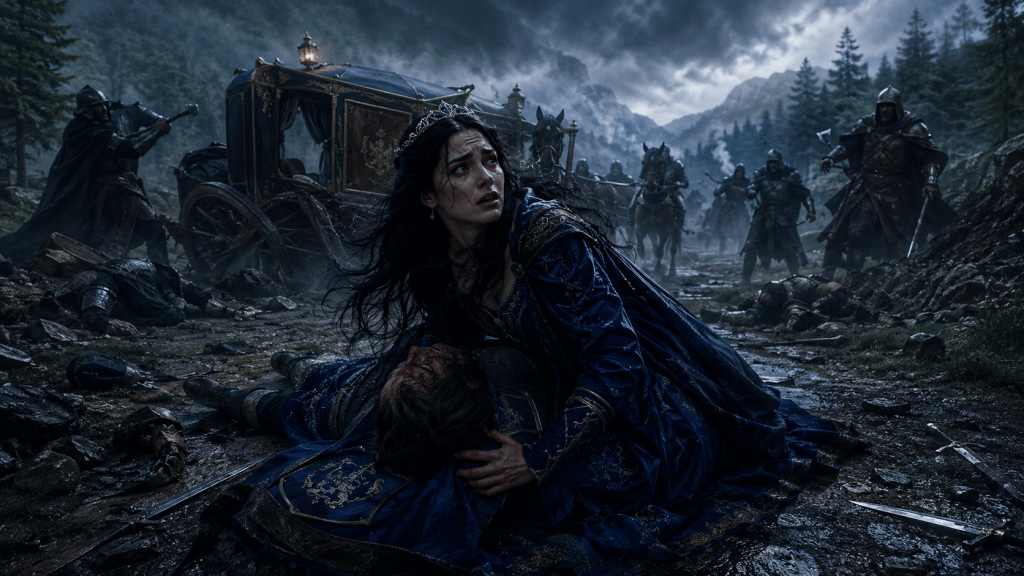
The inner courtyard of Bremyra Castle was entered in the household record as the place where Princess Elana and the Lord Magician appeared following the breaking of the royal escort beyond Grey Ash Rise, their arrival being recorded after the evening watch while the western gate remained closed and no mounted party had crossed the outer ward.
The first entry named the Princess as conscious, clothed in torn court blue, and supporting the magician when his strength failed upon the paving. He was carried to the old queen’s chamber under physician’s care, with darkening around an arrow wound, corruption visible beneath the skin, and repeated failure of breath noted among the signs observed before the chamber doors were secured.
Three bells were rung under the guarded-return signal, beginning in the inner tower and passing through the lower ward before the household order could be fully distributed. The register attributed the ringing to the safe recovery of royal blood, though several service copies stated that the bells began while uncertainty remained over whether either returned traveller would survive the hour.
No official witness described magic within the courtyard. A separate servant account, copied in a hand later removed from the western chamber roll, referred to a fading warmth around the Princess’s hands and a pale gold stain seen upon the magician’s torn robe. The same account stated that the colour vanished beneath rain before any physician entered the court, leaving no mark upon cloth, stone, or skin that could be preserved for examination.
The Princess was recorded as unharmed beyond exhaustion, smoke exposure, and blood belonging to other persons, while questions concerning the poisoned wound were deferred under royal authority. Later copies reduced the incident to the return of two survivors through arcane passage, though one damaged margin retained the phrase brought home by forbidden light, written beside the bell entry and scraped away before the household register was sealed.
About the Creator
The Mythic Chronicle is written and curated by Simon Phillips, a writer of mythic and speculative fantasy whose work explores forgotten kingdoms, fractured records, old institutions, and the moments when history begins to shift before those living through it understand what has changed.
The accounts preserved within these Chronicles form part of a wider body of work in which castles keep older secrets beneath familiar rooms, roads carry rumours ahead of armies, and ordinary witnesses preserve fragments of events whose true meaning remained sealed from them at the time.
One such account survives in a separate record, following the return of a magician to Bremyra during a season of court unease, royal absence, Church suspicion, and gathering danger beyond the kingdom’s roads. What the servants, clerks, and watchers of the city remembered only in fragments is followed more closely in The Unmarked Path, the opening book of The Veil of Kings and Gods within The Chronicles of the Spiral Realms.
Readers who wish to examine that fuller account may find the record below.
The western stair received them beneath a confusion of rainwater, lamp smoke, hurried feet, and orders repeated so quickly that each voice seemed to carry fragments of three others. Maren climbed ahead with the warmed linen held against her breast, while Nessa followed close enough for the blankets in her arms to brush the older woman’s back whenever the press of guards narrowed around them. Above, the old queen’s chamber stood open for the first time since the fever winter, its carved doors drawn wide, its bed stripped and remade beneath the hands of servants who worked with their eyes lowered towards the coverlet, as though the room itself might punish curiosity.
Two guards bore Simion through the doorway upon the stretched cloak. The physician walked beside them with one hand against the magician’s throat, counting each weak beat beneath his fingers, while Princess Elana kept pace at the other side, rain dripping from the ends of her midnight-black hair and Prince Patrick’s mantle hanging heavily around her shoulders. Patrick followed close enough to catch her when the strain in her steps drew her towards the wall, though she straightened before his hand reached her.
“Place him near the fire, away from the window,” the physician said as he swept instruments from the bedside table and opened his case upon the cleared wood. “Maren, bring every linen strip you have. Nessa, fetch boiled water from the western brazier and carry it level, because spilled heat will serve us poorly.”
Nessa lowered the blankets on the bench and fled with both hands gathered beneath her apron. Maren crossed to the bed, spread one sheet over the mattress, then helped the guards lower Simion upon it. His face had turned grey beneath the soot and rain, while the dark veins around his wound reached towards his neck in branching lines that appeared to deepen whenever his breath faltered.
Elana stood at the bedside with one hand fixed upon the carved post. “The arrowhead came free in the field,” she said as the physician cut through the scorched robe. “A piece may remain beneath the flesh.”
The physician glanced towards her, his knife held above the wound. “Your Highness saw its removal?” he asked as he leaned closer to the darkened opening.
“I felt it leave him,” Elana said as her fingers tightened around the bedpost. “He had already grown cold.”
Patrick watched her from the hearth, where rain steamed faintly from his sleeves. “You carried him from the hollow?” he asked as he stepped nearer, keeping his voice low while servants moved around them.
Elana turned her face towards her brother. Weariness had hollowed the skin beneath her eyes, yet the gaze she gave him remained steady. “He came for me,” she said as her free hand settled over the torn cloth near her heart. “I kept him alive long enough to bring us home.”
The words held more than the room received. Maren heard it in the silence that followed, in the physician’s brief stillness, and in the way Master Vaynor closed the chamber doors until only a narrow space remained for servants carrying water, coal, and bandages. Outside, the guarded-return bells continued through the castle, their deep voices crossing one another above the roofline until the stone beneath Maren’s feet seemed to remember each stroke.
Nessa returned with the basin braced against her hips. Steam touched her frightened face as she approached the bed. “The water is fresh from the brazier,” she said while lowering it to the stand with careful hands. “Mistress Arven sent willow bark, honey, and a pot of broth in case either wakes hungry.”
Maren took the cloth from the basin and pressed it into the girl’s palms. “Hold this near the physician’s hand and watch his fingers,” she said as she unfolded the first linen strip. “He will ask before your fear has time to understand him.”
The physician cleaned the wound until the water clouded red and grey. Simion stirred once beneath the cloth, his back arching as a sound escaped him through clenched teeth. Elana moved before anyone else, placing both hands around his wrist and speaking his name close to his ear.
“Simion, remain here,” she said as her thumb pressed against the pulse below his palm. “You have crossed enough distance for one night.”
The dark veins near his throat appeared to throb beneath the skin. The physician drew back, touched the stain with two fingers, then lifted his hand towards the lamp. “The poison is moving again,” he said as he reached into his case for a narrow glass vial. “I can slow fever and keep the wound open, though this corruption answers poorly to the remedies I carry.”
Patrick turned towards Master Vaynor near the doors. “Send for the cathedral healers and the Order manor,” he said as one hand closed over the wet edge of his sleeve. “Use separate messengers. Each carries only the need for aid.”
Vaynor inclined his head, then held the door while a guard stepped into the passage. “The lower halls remain sealed until the household account is agreed,” he said as he passed the instruction onward. “Anyone who saw the arrival waits under watch, and every servant leaving this floor gives a name to the clerk.”
Elana’s head lifted sharply. “The Archbishop stays beyond this chamber,” she said as her hand remained around Simion’s wrist. “Send his healer if one comes. His Grace waits elsewhere.”
Patrick looked towards her, and Maren saw the prince’s concern harden into caution. “The Church will ask why,” he said as he moved to the other side of the bed.
“Then give him the poisoned arrow and the bodies upon the road,” Elana replied as she drew Patrick’s mantle closer around herself. “He has enough questions for one evening.”
A bell sounded directly above them, nearer and heavier than the others, and dust slipped from the carved beam across the ceiling. Nessa started, spilling a few drops from the cloth onto the floor. Maren steadied the girl’s wrist before the physician turned.
“That bell belongs to the old queen’s passage,” Nessa whispered as she looked towards the shuttered window. “It has stayed silent since her burial.”
Maren followed the sound into the stones. “A rope runs through the western gallery,” she said as she folded another strip. “Some guard has pulled the wrong line in haste.”
“The western gallery was barred at sunset,” Nessa answered as she lowered her voice further. “My brother keeps lamps there.”
Maren gave the girl a look that placed work above wonder, though the bell’s fading tremor remained in her bones. Across the chamber, Simion’s breathing ceased for the length of one terrible pause. The physician bent over him, pressed both hands against his chest, and called for the grey powder. Elana moved close enough that her hair fell across the pillow, hiding part of Simion’s face from those standing at the foot of the bed.
“Open your eyes,” Elana said as her voice broke against the final word. “You heard me in the field, and you will hear me here.”
The physician mixed powder into water and tried to pass it between Simion’s lips. Most ran across his cheek. Patrick held his shoulders while Maren placed fresh linen beneath his head, and Nessa stood with the lamp lifted above them, its flame shaking inside the glass.
Then Elana asked them to leave.
Her voice carried little strength, yet the room answered as if royal command had entered through a trumpet. “All except the physician and my brother,” she said as she rose beside the bed, one hand resting on the mattress for balance. “Master Vaynor will keep the passage. Maren, wait beyond the door with water and cloth.”
The physician looked from Simion to the Princess. “Your Highness, every hand here has purpose,” he said as he closed his fingers around the glass vial.
Elana met his gaze. “Then your purpose remains,” she replied as she lifted her chin. “The others have heard enough fear for one chamber.”
Patrick studied his sister for several breaths before turning towards the servants. “Do as she asks,” he said as he drew a chair beside the bed. “Maren, keep the passage clear. Nessa stays with you.”
Maren collected the stained basin and guided Nessa through the doors. Master Vaynor drew them shut until the iron latch settled, leaving the corridor divided between torchlight, waiting guards, frightened servants, and the muffled labour continuing beyond the carved oak. The old queen’s passage had once been among the quietest places in the castle, a narrow gallery of faded tapestries and tall windows overlooking the western wall. That evening it filled with people who tried to occupy less space than their bodies required.
A cathedral healer arrived first, an elderly brother named Calven whose white robe showed rain along the hem. Master Vaynor received him near the stair and spoke in a voice too low for the gathered servants, though the brother’s answer travelled clearly.
“Poison of foreign making falls under body and spirit alike,” Calven said as he held a leather satchel before him. “His Grace sent prayer oils, bitter root, and instruction that the wounded man’s condition be witnessed under Church seal.”
Vaynor kept one hand upon the chamber latch. “The oils and root may enter,” he said as his gaze settled on the satchel. “The seal waits until Prince Patrick requests it.”
Brother Calven’s face tightened beneath the passage lamps. “A magician lies near death inside a royal chamber, Master Vaynor, while the Princess returned from a road where fire crossed wet earth. The Church has cause to witness.”
“The crown has cause to preserve life before argument begins,” Vaynor replied as he accepted the satchel and passed it to Maren. “You will wait in the western solar, where warmth and wine have been prepared.”
Calven looked towards the closed doors, then towards the old bell rope hanging untouched beside the window arch. “Your bells speak beyond every seal you place,” he said as he gathered his wet sleeves. “By morning the city will have chosen its own witness.”
A second messenger arrived from the Order manor with no healer beside him, carrying a cedar box marked by a plain black seal. He bowed to Vaynor and placed the box upon a small table near the door.
“The house held no physician of the Order,” the messenger said as he removed his rain-dark hood. “Master Verlan left these remedies under instruction for wounds touched by corrupted iron. The note says the black vial serves last, once ordinary measures fail.”
Vaynor opened the written instruction, read it twice, and passed it through the narrow space beneath the door. A hand took the paper from within. The latch closed again, and the corridor returned to waiting.
Time lost its clean divisions after that. Servants carried fresh water upward and red water down. The bells ceased one by one across the castle, leaving the western tower last, its single repeated stroke separated by long spaces of rain. Guards changed at the stair. Brother Calven remained in the solar with his prayer oils unopened. Nessa sat upon the bench beside Maren and stared at the line of light beneath the chamber door.
“What happens to a woman who carries magic?” she asked as she kept her hands folded tightly in her apron.
Maren turned towards her. “You have seen no such woman,” she said as she rested the cedar box across her knees.
“I saw the Princess in the court,” Nessa replied as her gaze stayed upon the threshold. “Her hands were warm enough to steam in the rain.”
“You saw fear, blood, and a journey ending upon wet stone,” Maren said as she reached across and covered the girl’s fingers. “Memory takes strange shapes when rank, grief, and magic stand together. Choose carefully which shape you feed.”
A pale glow gathered beneath the door.
At first Maren took it for firelight shifting across the chamber floor, though the hearth lay beyond the bed and cast amber through the lower crack. This light came softer and clearer, the colour of winter sun passing through old gold glass. It spread along the threshold by the width of a hand, touched the toes of Master Vaynor’s boots, then strengthened until every scratch in the oak appeared edged in pale radiance.
Nessa drew breath through parted lips. One guard crossed himself. The second stepped away from the door, his spear held close against his shoulder. From inside came no cry, no physician’s order, and no movement of furniture, only a low sound like breath released after pain had held it too long.
Brother Calven appeared from the solar and stopped beneath the arch. “Open that chamber,” he said as he gripped the prayer cord at his waist. “Whatever moves inside falls under holy witness.”
Vaynor placed himself before the latch. “You will remain where the Prince set you,” he said as the golden line brightened across the floor.
The final western bell rang above them.
Its sound rolled through the passage, entered the chamber door, and seemed to return from the other side in a softer vibration felt through wood, iron, and stone. The light faded with it, drawing inward until the threshold held only ordinary amber from the hearth. For several breaths the whole passage remained still.
The latch lifted.
Patrick opened the door far enough to step into the corridor. His face carried the exhaustion of a man who had watched death approach someone he had only begun to trust. Behind him, the physician bent over Simion while Elana sat beside the bed with her head bowed and both hands hidden beneath Patrick’s mantle.
“He breathes more strongly,” Patrick said as he looked first to Vaynor, then to those gathered beyond. “The corruption has withdrawn from his throat. The chamber remains sealed until morning.”
Brother Calven advanced one step. “By what remedy?” he asked as his eyes moved past the prince towards the bed.
Patrick drew the door closer behind him. “By every remedy offered under this roof,” he said as his hand stayed upon the latch. “That is the account the castle will keep.”
The prince returned inside, and the doors closed again.
By dawn, three versions had already travelled beyond the western stair. One claimed the Order’s black vial had pulled the poison from Simion’s blood. Another placed Brother Calven inside the chamber, praying over the magician while a saint’s light filled the room. The third spoke only of Princess Elana, her hidden hands, and the old bell answering above her while death loosened its hold.
Maren gave no judgement when the household clerk asked for her statement. She recorded the arrival, the wound, the physician’s labour, the sealed chamber, and the light seen beneath the door. Nessa gave the same account in fewer words, though her hand trembled when she reached the final line. Beyond the window, Bremyra woke under rain and bells, while the castle kept its doors closed around a truth already escaping through every servant passage, chapel stair, guardroom, and kitchen hearth.
The official copy later declared that the Lord Magician survived through swift treatment, royal care, and remedies sent from both Church and Order. The lesser record preserved one further detail: when Elana left the chamber after sunrise, her hands remained hidden within her sleeves, and the servants nearest the door stepped aside as though warmth still moved around her, carrying a colour none among them felt safe enough to name.
Golden light gathered beneath the old queen’s chamber while guards, servants, and a waiting Church witness stood beyond the sealed door, each carrying away a different account of what had passed inside.
The Idea Behind the Chronicle
A castle rarely keeps panic within the room where it begins. A wounded man may lie behind one guarded door, a princess may speak only to those she trusts, and a prince may order every servant to silence, yet fear travels through stone by older routes. It passes beneath doors, along stairwells, through kitchens, chapels, guardrooms, and servant corridors, gathering shape each time another witness carries it onward.
This Chronicle draws upon that movement of rumour through a royal household. Simion and Elana returned to Bremyra after the broken road, appearing within the inner court while the gates remained closed and the castle still waited for riders bearing news of their fate. Those present saw a princess stained by blood and ash, a magician failing in her arms, and a courtyard thrown suddenly into motion. They saw no clear miracle, though the manner of the return gave ordinary explanation little ground upon which to stand.
The bells became central because bells carried authority beyond sight. They announced death, danger, worship, victory, and royal arrival, shaping the meaning of an event before most listeners had learned what had happened. In this account, the guarded-return signal passed across Bremyra while uncertainty remained inside the castle. The city heard that royal blood had come home, while those nearest the western chamber still feared that the magician might die before morning.
Across old household records, moments of healing often become divided between official language and servant memory. Physicians write of wounds, fever, remedies, and recovery. Clerks preserve names, hours, and sealed orders. Those waiting beyond the chamber remember different details: light beneath a door, warmth where no brazier stood, a bell moving above an empty passage, or a patient’s breathing strengthening after every known treatment had failed. Such fragments endure because each stands close enough to truth to resist dismissal, while remaining too incomplete to form proof.
The secrecy surrounding Elana deepens that uncertainty. Within the world of Bremyra, a woman carrying magic would face more than fear. Her gift would challenge the authority of the Order, disturb the Church, and place the royal house beneath scrutiny at the very hour when the kingdom already stood under strain. The castle therefore had reason to protect her, while those who witnessed traces of golden light had reason to guard their words. Silence became an act of loyalty for some, fear for others, and invitation for rumour among those left beyond the door.
The Sealed Road of Bremyra follows a kingdom learning that events can return home before their explanations do. The road had already produced burned grass, poisoned bodies, missing tracks, and conflicting testimony. When Simion and Elana appeared inside the castle, the uncertainty of the field crossed the walls with them. The danger no longer belonged to a distant bend beyond Grey Ash Rise. It entered the royal household, passed beneath a chamber door, and found a voice in the bells above.
This Chronicle therefore turns away from the visible act of healing and preserves what the castle remembered around it. Servants carried linen and water. Guards closed passages. A Church witness waited beyond the room. Prince Patrick chose which account the household would keep, while a different account had already begun moving through the lower halls. By sunrise, the official record spoke of physicians, royal care, and remedies sent under seal. The quieter record remembered golden light, hidden hands, and bells that seemed to answer before anyone dared name what had occurred.
From the Author’s Desk
Thank you for continuing into this Chronicle.
This account was shaped around the way a single event can divide into several remembered truths before the people closest to it have even left the room. Simion and Elana returned to Bremyra carrying the marks of the broken road, yet the castle received only fragments: a wounded magician, a princess beneath a bloodstained mantle, bells sounding across the inner ward, and a guarded chamber where recovery came under questions no servant could safely ask.
The western passage allowed the Chronicle to remain beyond the hidden truth. Those waiting outside saw light beneath a door, heard the old bell answer above them, and watched Prince Patrick decide which version of the night would enter the royal record. Their testimony preserved the uncertainty surrounding Elana, whose actions had to remain concealed in a world where her gift could place her beneath the judgement of both Church and Order.
Across The Sealed Road of Bremyra, each Chronicle has followed the people and places left at the edges of Simion’s path: servants reopening an abandoned manor, clerks receiving sealed authority, chapel attendants guarding old foundations, road keepers recording vanished travellers, and watchmen trying to give lawful shape to burned fields and foreign violence. Their accounts remain incomplete, yet together they reveal a kingdom beginning to understand that its familiar walls can no longer keep older powers at a distance.
Beyond the Chronicle, The Unmarked Path follows these events more closely, entering the lives of Simion, Elana, Patrick, and those whose choices shaped the first turning of the wider conflict. The Chronicle preserves what Bremyra believed it witnessed. The book carries the reader nearer to the truth hidden behind those records.
Readers who wish to explore further may find my books and continuing visual Chronicles through the links included below.
From the sealed western household folios of Bremyra Castle, copied during the reign of King Cedric. The surviving leaves show several changes of hand, with portions of the chamber account darkened by later ink and one witness line removed from the lower edge.
The guarded-return bells were rung after the Princess entered the inner courtyard in the company of the Lord Magician, though the outer gate remained secured and the watch stationed beneath the western arch recorded no rider, carriage, escort, or messenger passing through the ward before their appearance upon the stones.
The Princess was entered as conscious and capable of speech, her clothing damaged by travel, smoke, and blood belonging chiefly to others. The Lord Magician was recorded as wounded beneath the shoulder, weakened by a preparation carried upon foreign iron, and unable to remain standing after reaching the court. He was taken under royal protection to the chamber once kept for the old queen during her final illness, where the household physician received him under closed authority.
The chamber doors were sealed after the first examination. Prince Patrick, Princess Elana, the royal physician, and two attendants were named within the earliest copy, though one attendant’s name was later removed and the second reduced to a mark beside the linen count. Servants assigned to the passage carried boiled water, clean cloth, lamp oil, willow bark, bitter root, and remedies delivered from the upper Order house, while a healer sent from the cathedral remained beyond the threshold under instruction from the Master of Court.
The physician’s first entry described blackening beneath the skin, repeated weakness of breath, and a corruption that had resumed its movement after the wounded man entered the castle. A later line stated that ordinary measures brought limited response, though the hand responsible for this sentence differed from the physician’s own script and appeared to have been added after the folio was bound.
Near the final western bell, those stationed outside the chamber observed light beneath the door. The colour was recorded in three surviving copies as pale gold, old amber, and winter brightness, while the formal household duplicate described only an increase in hearth illumination caused by movement within the room. The passage lamps remained unchanged during the same interval, and the brazier positioned outside the chamber showed no rise in flame.
One guard testified that warmth travelled across the threshold and reached the opposite wall. A servant seated near the western window stated that the stone beneath her shoes became warm while rain continued against the glass. The cathedral healer referred to the light as a matter requiring sacred witness, though the Master of Court refused entry until the Prince himself opened the door.
The bell above the old queen’s passage sounded once while the rope remained untouched. Its movement was confirmed by two guards and one servant, though the tower clerk later amended the occurrence to an error arising from strain within the upper mechanism. The old bell had received no maintenance since the queen’s burial, and the line recording its condition ended before any inspection result was entered.
When Prince Patrick emerged from the chamber, he declared that the wounded man’s breathing had strengthened and that the corruption had withdrawn from his throat. He named the recovery as the result of combined treatment, royal care, and remedies supplied under Church and Order authority. No further cause was entered within the sealed account.
Princess Elana left the chamber after sunrise with her hands concealed inside her sleeves. Several servants recorded warmth around her passage, while one younger witness described a faint gold colour along the edge of the cloth near her wrists. The statement was crossed through in the formal copy, and the witness was transferred from the western rooms before the next household rotation.
The final entry named the Lord Magician alive, the Princess restored to her own chamber, and the western passage returned to ordinary service. The household was instructed to preserve a single account of the night, though the order itself survives in four differing forms, each carrying a separate explanation for the light beneath the door.
Marginal Notes & Interpretations
Collected from later annotations written along the outer edges of the same folio.
One marginal hand attributed the light to the opening of the chamber fire after fresh coal had been added, suggesting that polished metal, wet stone, and movement around the bed enlarged the glow beyond its ordinary appearance. The writer gave no account of why the light travelled beneath the door in a narrow, steady line while the hearth stood across the room.
A second annotation connected the recovery to an Order remedy delivered in a sealed cedar box. According to this interpretation, the foreign poison reacted visibly when met by arcane medicine, producing warmth and coloured vapour before withdrawing from the wounded man’s blood. The inventory of the box recorded four vials, three of which remained sealed when returned to the upper manor.
A cathedral note, copied beside the physician’s entry, argued that the light belonged to Christiana’s mercy and that the old queen’s bell answered the passage of healing through a chamber once dedicated to suffering. A later Church hand softened this claim, replacing certainty with the phrase possible grace witnessed under royal distress.
Another annotation challenged both Order and Church accounts, stating that the Princess alone remained beside the wounded man when the light reached its greatest strength. The writer referred to heat around her hands, a gold stain upon the inner sleeve, and a servant’s report that the magician answered only after she spoke his name. The final words of the note were scraped deeply enough to damage the page beneath.
A fifth hand, smaller and pressed close to the binding, warned that any claim concerning the Princess carried danger for the witness. It stated that women accused of arcane practice fell under Order judgement, while royal blood offered protection only so long as the crown denied the accusation. The writer advised silence, then added that silence had already allowed the rumour to spread more widely than open testimony might have done.
The faintest surviving note appeared beside the record of the bell. It contained only one line:
The sound came after the light, as though the castle answered what the household refused to name.
World Notes
The Old Queen’s Chamber
A royal sickroom within the western passage of Bremyra Castle, maintained after the death of King Cedric’s mother and opened only during severe illness, childbirth, or injury involving members of the royal household. Its position near the inner courtyard allowed wounded persons to be carried from the ward while avoiding the public halls.
The chamber retained its own hearth, water closet, physician’s table, prayer niche, and bell line connecting the passage to the western tower. Household records treated it as a place of privacy and royal protection, though servant copies frequently associated it with final vigils, unanswered prayers, and illnesses concealed from the wider court.
The Guarded-Return Bells
A three-bell signal used when members of the royal house returned under danger, injury, or uncertain circumstance. The first bell belonged to the inner tower, the second to the lower ward, and the third carried the signal towards the city-facing wall.
The signal announced the return of royal blood while withholding details concerning condition, threat, or survival. Its use often produced rumour before formal proclamation, since citizens heard the bells long before clerks completed the court account.
Closed-Chamber Authority
A household order allowing Prince Patrick or the Master of Court to seal a royal chamber against servants, guards, clergy, and visiting officials. The order protected privacy during medical treatment and prevented competing institutions from claiming authority over a wounded member of the royal household.
During the guarded return, this authority kept the cathedral healer outside the old queen’s chamber and limited the number of witnesses able to speak directly about Simion’s recovery.
Golden Healing Rumour
A phrase found in servant copies, chapel notes, and later court gossip concerning warmth or pale light associated with recovery from grave injury. Official records usually attributed such accounts to lamplight, prayer, fever, or arcane medicine supplied by recognised practitioners.
Within the sealed western folios, the phrase appeared only once in full. It was written beside Princess Elana’s name and later removed so heavily that the fibres of the page remained broken around it.
Next Chronicle
In the days after the guarded-return bells sounded across Bremyra, further reports reached the castle from the north, carried by riders whose accounts spoke of smoke above Vaeldring, emptied roads, coastal settlements taken under sudden violence, and armed movements passing inland before the kingdoms had gathered any single understanding of what had begun.
The court received these fragments separately, recording each beneath its own seal and assigning them to border disturbance, raiding, or uncertain movement beyond Bremyra’s direct watch. Yet the reports shared the same direction, and the smoke named in one district appeared again in another, spreading across the records long before any council agreed to call the danger war.
No formal connection was made between the violence upon Elana’s road, the foreign weapons found in Bremyra, and the northern forces entering Vaeldring.
Next Chronicle: The Northern Smoke Reports
The bells of Bremyra fell silent before dawn, the western passage returned to guarded quiet, and behind the sealed chamber door the official account settled into ink, while through kitchens, stairwells, and chapel corridors the memory of golden light continued to move, untouched by the record that refused to give it a name.
Beyond the broken road, poisoned men lay amid fire without torches, and something believed lost was said to have returned.
Beyond the Pine Hollow
The light was already thinning beyond Grey Ash Rise when Captain Rylas led the first measured line of guards down from the pines, each man placing his boots inside the marks ahead while smoke lay close to the field and winter damp gathered along the blackened grass. From the upper road, the clearing had appeared wounded by the overturned carriage, yet the slope revealed a harsher order as they descended: bodies among the wheel ruts, arrows buried in frozen earth, and a broad darkness where no brazier, torch, or vessel of pitch had been found.
Rylas carried a hooded lamp in his left hand and kept his sword free in his right. Corporal Maeran Holt followed with marking cord across one shoulder, his bruised ribs bound beneath his tunic, while four watchmen came behind them with linen, wax tablets, stakes, litters, and the road surgeon’s leather case held above the smoke.
“Set every lamp low and keep to the wheel line until I give you ground of your own,” Rylas said as he stopped where pale winter grass yielded to the first scorched patch. He lowered his lamp towards blades burned into curled black threads beside others still wet with meltwater. “Any man who moves a weapon, body, buckle, scrap of cloth, or arrow before the clerk marks its place will answer before Prince Patrick with memory as his only witness.”
Maeran planted the first stake beside the burn line, then crouched and pressed two gloved fingers into the soil. Moisture shone across the leather when he raised his hand, while the grass beneath his knuckles crumbled into ash. “This field carried winter water from the ditch,” Maeran said as he rubbed the residue between finger and thumb. “A common flame would have crawled, failed, then smoked itself dead before crossing ten paces of ground this wet.” Rylas watched the scorched edge curve away from the carriage. “Then mark what the earth gives,” the captain said, “because a common flame would have left a common account.”
The burn had travelled in a broad arc through the field, bending away from the carriage instead of spreading outward from its broken timbers. Its western edge stopped sharply where green-brown grass stood untouched beside a blackened hollow once thick enough to reach a man’s knees. The breeze came from the east and carried smoke towards the pines, although the scorched path ran against it, climbing a slight rise before opening into a fan where several bodies lay among the cinders. Some had fallen face first, while others rested on their backs with arms drawn close and clothing burned into the shapes beneath.
Pell, the youngest watchman among them, swallowed against the smell as his lamp shook across every still face in turn. Rylas steadied the iron frame with one hand and drew the guard’s scarf higher across his mouth. “Keep your breath through the cloth and your eyes upon the ground,” the captain said. “The dead have finished fearing this place, and we serve them best by carrying away the part that still speaks.” Pell angled the light towards a round shield half buried beneath ash. “That man bears no royal colour, Captain,” Pell said as his gaze settled on the corpse. “His boots and beard rings match the stranger from Tanner’s Row.”
Beside the corpse lay a short bow tipped with pale horn and three arrows whose heads had escaped the fire beneath the mud. Rylas reached towards one shaft, then withdrew when the road surgeon caught his sleeve. “Leave the iron until I wrap it,” the surgeon said as he opened his case. “The rider carried darkness around his wound before fever took his senses, and a pinprick from the same preparation may purchase a grave.” He lifted the arrow with folded wax linen, revealing dark paste inside the socket. “Watch the lips, fingers, and veins around every wound,” the surgeon said as he turned the head beneath the lamp. “Blue-black branches under the skin reveal corruption of the blood.” Maeran looked towards the fallen escort as his hand tightened around the cord. “Then poison crossed the road before the fire,” the corporal said. The surgeon tied the linen around the iron before meeting his gaze. “Poison came here prepared, and fire found it waiting,” he replied as he returned the wrapped arrow to his case.
They found the first poisoned guard beside the carriage door, lying on one shoulder with both hands drawn hard against his chest. Fire had passed within three paces of his boots while sparing his cloak, and dark lines rose below his jaw from a wound near the collar. The road surgeon examined the stain as the branching disappeared beneath the dead man’s clothing. Rylas drew linen over the guard’s face while Maeran fixed the covering beneath his shoulder. “Enter him as royal escort, fallen by foreign arrow and corruption of the blood,” the captain said as the clerk scratched the words into wax. “His name waits for the castle roll, while his service already stands before it.”
Beyond the carriage, the field gave stranger signs. Fire had consumed a near-perfect sweep of grass, while torn cloth survived at its centre and the earth remained pressed beneath knees, heels, and one larger shape stretched across the soot. Two trails entered that hollow from different directions. One came from the wreck, light and uneven, with the narrow heel of a court shoe sinking deep where its wearer had stumbled. The other began near the upper field where the mud held no approaching path, its first boot mark cut sharply into damp soil as if the traveller had entered between one breath and the next.
“Here is the man who came after the killing,” Maeran said as he held his lamp over the deeper prints. “One stride, then a turn beside the burned grass, though the ground behind him gives no road, ditch, hoof cut, or broken stem.” Rylas followed the marks to the long impression in the soot, where spread fingers remained visible beside two deep knee marks. A patch of earth held dull warmth through his glove after the surrounding fire had cooled. The narrow shoes ended on one side, and the heavier boots ended on the other. Beyond that place, the field offered no departure.
Pell moved his lamp across the untouched grass. “They may have carried the wounded one between them,” Pell said as he bent near the edge. Maeran pointed towards the unmarked soot as fatigue roughened his voice. “Then show me the feet that bore him,” the corporal said. “Three bodies may leave confusion, lad, yet they still owe the earth a heel, a dragged toe, or one crushed blade.” The road surgeon knelt beside the long impression and studied the disturbed ash near the shoulders. “Someone lay here while a second person braced them,” the surgeon said as he held his palm above the mark. “The weight lessened where the shape ends, and this ground gives the form of care followed by absence.”
Rylas looked back across the field towards the overturned carriage, the covered guards, the foreign bows, and the black arc cut through winter grass. Every part of the ambush held violence a soldier could enter into record: arrows loosed from concealment, wheels forced from the road, men killed at close quarters, poison prepared for certainty, and fire driven across the cover where hidden attackers had waited. The hollow alone resisted such order, preserving the pressure of bodies, hands, and urgent movement before releasing them into empty ground beyond the claim of any path.
From the upper road came a watch horn, answered faintly from Grey Ash Rise as daylight thinned behind the pines. Rylas drew blue cord from the clerk’s satchel and tied it between two stakes around the hollow. “Place two guards here where they can watch each other through the night,” the captain said as the cord stirred above the impressions. “The report will say that fire crossed wet ground, foreign poison entered Bremyran flesh, and tracks belonging to two living persons ended where the ash remained warm. Finer truth can wait until those who left choose to return and speak it.”
Maeran gathered the unused stakes and looked westward towards the city beyond the mist. “And if they have already returned before us, Captain?” the corporal asked as smoke drifted between them. “If the road lost them here and Bremyra opened its gates before any rider carried word?” Several men later swore they felt a faint trembling underfoot while Rylas listened to the fading horn. “Then this field holds only the lesser half of what happened,” the captain said as he lowered his gaze to the tracks. “Keep the lamps burning, because by morning every road in Bremyra will claim it carried them home.”
Night gathered slowly across the clearing while linen settled over the fallen and ash clung to the guards moving among them. Above the blackened hollow, the blue cord lifted and fell in the cold air, guarding two trails that reached their meeting place from different parts of the ruined field and departed by no direction any watchman could follow. Long before the bodies were counted, long before the poisoned arrows entered the castle stores, the first whisper had already taken shape among those standing beneath the pines: fire had crossed the grass with no torch before it, and the lost had returned by a road the earth itself could never mark.
A Visual Chronicle
A royal ambush, poisoned arrows and two trails that end in the ash, discover the mystery of Grey Ash Rise in The Field of Burned Grass, a recovered account from The Mythic Chronicle.
Field Examination Register: Grey Ash Rise
The field beyond Grey Ash Rise was entered into the road register following discovery of the royal carriage, its frame overturned beside the western verge and its upper timbers damaged by flame. The surrounding ground held the bodies of royal guards and foreign assailants, though the surviving record supplied no complete number and referred several times to remains removed before formal examination had concluded.
Scorched grass extended across the clearing in a broad curve whose direction opposed the wind recorded that evening. Surveyors found no vessel of oil, pitch, lamp fuel, or other substance capable of carrying fire across the winter-soaked earth, while the carriage itself showed less damage than several patches of open ground lying beyond its wheels.
Foreign arrows recovered from the field bore a dark preparation beneath their iron heads. The road surgeon identified signs of blood corruption among the fallen, including blackened veins, discolouration around the wounds, and a rapid stiffening of the hands. Samples were ordered sealed within the castle stores, though a later inventory listed only two wrapped arrowheads where the original field account recorded seven.
Near the centre of the burned ground, examiners marked impressions belonging to two persons believed living when they entered the hollow. One trail led from the ruined carriage. The second began within the field itself, where no approach could be identified across the mud, grass, or ash. Both ended beside the impression of a body laid upon the earth, and the ground beyond held no departure towards the road, pines, or lower ditch.
The soil inside the marked hollow remained warm after the surrounding ash had cooled. Guards assigned to preserve the site recorded a faint trembling beneath the stakes during the first night, though this observation was removed from the official copy and survived only in a clerk’s unfinished duplicate.
The field was thereafter declared cleared for passage, while the central hollow remained excluded from grazing, burial, and further survey. No reason for that restriction appeared beside the order, and the register closed with the statement that every person sought upon the road had already been accounted for within Bremyra.
About the Creator
The Mythic Chronicle is written and curated by Simon Phillips, a writer of mythic and speculative fantasy whose work explores forgotten kingdoms, fractured records, old institutions, and the moments when history begins to shift before those living through it understand what has changed.
The accounts preserved within these Chronicles form part of a wider body of work in which castles keep older secrets beneath familiar rooms, roads carry rumours ahead of armies, and ordinary witnesses preserve fragments of events whose true meaning remained sealed from them at the time.
One such account survives in a separate record, following the return of a magician to Bremyra during a season of court unease, royal absence, Church suspicion, and gathering danger beyond the kingdom’s roads. What the servants, clerks, and watchers of the city remembered only in fragments is followed more closely in The Unmarked Path, the opening book of The Veil of Kings and Gods within The Chronicles of the Spiral Realms.
Readers who wish to examine that fuller account may find the record below.
What follows is taken from later watch accounts concerning the field beyond Grey Ash Rise, where poisoned bodies lay beside the overturned royal carriage, fire had crossed the winter-soaked grass, and two living trails ended within the ash before word of an impossible return reached Bremyra.
Subscribe to continue reading
Subscribe to get access to the rest of this post and other subscriber-only content.
A road-side account of the broken escort that left Bremyra’s witnesses speaking in fragments, and of the princess whose passage vanished into rumour before the truth could be gathered.
Before the Road Fell Silent
The road to Vaeldring left Bremyra by the high eastern gate and climbed through winter pasture before bending towards darker country, where pines gathered close to the banks, broken milestones leaned into frost-soft grass, and the nearer watch of the kingdom gave way to distance, weather, and the uncertain trust placed in royal seals. By midmorning the sky had settled into a pale iron colour, the kind that pressed sound close to the earth and made every hoofbeat travel farther than seemed proper, so that those waiting at the toll cottage below Grey Ash Rise heard Princess Elana’s escort long before its banners came into view.
Tovan Mere, keeper of the road tally, stood beneath the dripping eaves with his wax board tucked inside his coat and one hand resting against the post where travellers usually leaned to count out road dues. He had kept that place through fifteen winters, marking merchants, drovers, pilgrims, soldiers, mourners, and bridal parties with the same patient strokes, since a road remembered rank less through faces than through wheels, hoofprints, and the manner in which people crossed it. Beside him, his wife Sella held a basket of oat cakes under a cloth, offered for sale to guards and drivers whenever court traffic passed, while their eldest son watched from the stable door with the solemn hunger of a boy who wished to see splendour and feared being seen by it.
“They are late for such a road,” Sella said as she adjusted the cloth against the steam rising from the cakes, her eyes following the line of trees where the highway vanished into mist. “A princess should pass before frost loosens and makes a mire of the ruts.”
“Royal wheels choose their own hour,” Tovan answered as he lifted his gaze towards the slope, speaking with the mildness of a man accustomed to correcting worry by giving it ordinary clothing. “The escort will have fresh horses, dry cloaks, and enough steel around the carriage to shame a border gate.”
Sella looked towards him, then towards the higher road where harness grew clearer beneath the hush of the morning. “Steel has been busy in Bremyra of late,” she said as her fingers tightened around the basket handle. “Men spoke yesterday of foreign axes in the market, and my cousin swore the Prince himself came home pale as church wax.”
Tovan drew his thumb along the edge of the tally board and kept his face towards the road. “Market men always add a second corpse before supper and a third before dawn,” he said, though his voice carried less certainty than the words required. “We write what passes before us, Sella. That is the duty of this post.”
The first riders emerged slowly, dark against the grey slope, their cloaks marked by the colours of Bremyra and their horses stepping high through the thawing snow along the road’s crown. Two rode ahead with lances upright, more followed nearer the carriage, and the rearguard came in a careful spread that made Tovan straighten before he realised he had done so. The carriage itself appeared between them as the mist thinned, lacquered black and deep blue, with its wheels muddied by the lower road and a small royal device fixed beneath the front lamp. It moved with the grave restraint of a thing carrying more than one kingdom’s hope, and every man near it looked outward as though each hedge, ditch, and crow might have learned betrayal.
The captain at the front drew rein by the toll post, a square-shouldered officer with a narrow scar crossing one cheek and wet road grit along the hem of his cloak. His eyes moved over Tovan, Sella, the boy at the stable door, the closed barn, the ash grove beyond the cottage, and the ditch line running towards the bridge. “Road clear ahead?” the captain asked as his horse stamped once and sent brown water across the stones.
“It was clear at dawn, Captain,” Tovan replied as he bowed with the tally board held against his breast. “Two wool carts for Eastmere, one chapel rider, a pair of muleteers carrying salt, and a peddler with cracked wheels. All passed under account.”
The captain’s gaze rested on him longer than comfort allowed. “Any riders leaving the road before the bridge?”
“One muleteer watered his beasts at the lower stream,” Tovan said as he tilted the board and found the proper line. “The peddler swore his axle would fail by noon and cursed every stone between here and the ford. I saw none take to the trees.”
A guard riding near the carriage leaned down from his saddle, his hand resting close to the hilt at his side. “You heard none speak in a foreign tongue?” he asked, and the manner of the question made Sella lower her eyes to the oat cakes as if words themselves had become dangerous wares.
Tovan looked from the guard to the captain, then shook his head slowly. “I heard Bremyran complaint, Vaeldring coin talk, and one muleteer’s prayers against winter mud. If stranger speech passed here, it kept its mouth closed.”
The captain nodded once, though the answer appeared to ease little in him. He raised his hand for the escort to continue, and the lead riders began to move, their horses taking the incline with breath steaming pale around their bridles. As the carriage passed the cottage, the curtain stirred where a hand inside had drawn it back by the width of two fingers. Tovan saw the Princess only for a breath, enough to mark the midnight black of her hair against the blue shadow within, the pale line of her cheek, and the steadiness of eyes turned towards the road ahead instead of the cottage folk bending beneath her passage. She seemed younger than marriage duty allowed and older than childhood stories had left her, held between departure and whatever waited beyond the borders men wrote on maps.
Sella saw her too. After the carriage had gone by, she stood with the basket against her hip and watched the rear guards pass, her face softened in a way Tovan had seen when she looked upon brides leaving poorer houses with dowries tied in cloth. “Her hair is black as the harbour water after moonset,” Sella said in a low voice, as if any louder speech might reach the carriage and burden the girl inside it. “My mother said royal children were born with sunlight in them.”
“That one carries night well enough,” Tovan answered, and the words came more gently than he intended.
The escort climbed beyond Grey Ash Rise and disappeared by degrees, first the rear lances, then the carriage roof, then the final flash of a horse’s pale tail where the road turned among the pines. For a while their passing remained in the world through sound alone, softened hoofbeats, leather creak, wheel strain, the faint call of one guard to a second as the trees took them in. Then even that withdrew, and the toll cottage settled again beneath winter’s low hand.
Midday came slowly. A wool cart returned empty from Eastmere, its driver claiming a fallen branch had blocked the upper bend and that he had chosen caution over profit. A chapel rider came through at speed with mud sprayed up to his knees and refused oat cakes, blessing, and conversation alike. Near the second bell, a peddler limped back towards Bremyra leading his cracked-wheeled cart by hand, his face drawn tight around anger that had curdled into fear.
“Road’s gone queer above the bridge,” the peddler said as Tovan moved to help lift one side of the axle from a rut. “Birds flew out of the trees all together, then every sound dropped flat, as if someone had laid a blanket across the woods.”
Sella stepped from the cottage doorway, flour dust pale across her sleeve. “You saw the royal escort?”
The peddler glanced towards the high road and licked his lips before answering. “I saw wheel marks turn hard near the bend,” he said as he shifted his grip on the cart shaft. “Maybe the driver fought the mud. Maybe horses shied. I saw a strip of blue cloth caught on thorn near the ditch, finer than any cloth a man like me could pay for.”
Tovan felt the cold enter him in a place the weather had failed to reach. “You left it there?” he asked, keeping his voice level as his hand tightened around the axle.
“Aye,” the peddler said, meeting his eyes for the first time. “A man leaves royal cloth where royal trouble has placed it, unless he wants blame tied to his own fingers.”
Before Tovan could answer, a sound carried down from the upper road, faint and broken by distance. It might have been a horn. It might have been a shout torn by trees. Marek came from the stable at once, his face pale beneath the straw caught in his hair. Sella set the oat cake basket down beside the door and took two steps into the yard, listening with her chin raised and both hands folded against her apron.
The second sound came lower, closer to the earth, a dull concussion that seemed to roll through root, ditch, and frozen stone before fading beneath the bridge. The horse in the stable screamed and struck its stall. From the ash grove rose a cloud of birds, black against the grey sky, wheeling above the road as though released from a single hidden hand. The peddler backed away from his cart and made Christiana’s sign across his chest.
“Tovan,” Sella said as she turned towards her husband, her voice stripped of all its earlier household warmth. “Close the boy inside.”
Marek began to protest, though the words faltered when his father seized him by the shoulder and guided him firmly towards the cottage. “Bar the rear door and stay with your mother,” Tovan said as he pushed the boy across the threshold, keeping his eyes on the road above. “If any rider comes down, you open only to my voice.”
Sella caught Tovan’s sleeve before he could turn away. “You are keeper of the tally, my heart, far from captain of the road,” she said as she pressed the words through fear, her grip fierce enough to crease the wool beneath her fingers.
“I am the nearest hand with a horn,” Tovan answered as he reached for the old watch horn hanging beside the post, its leather strap stiff with age and damp. “If royal blood has met trouble above Grey Ash, Bremyra must hear before rumour does.”
The peddler shook his head as Tovan lifted the horn from its peg. “You go up there and you may find men who dislike witnesses,” he said, drawing his cart between himself and the high road. “You heard that sound. Woods make many noises, Master Mere, though that one came from no branch.”
Tovan looked at him, then towards the bend where the escort had vanished. “Then the record begins here,” he said as he set the horn strap across his shoulder and took the short spear kept for wolves near the toll gate. “Sella, mark the time by the hearth glass and write that the road gave sound after the second bell.”
He had taken only three steps beyond the post when the first rider appeared above the rise. The horse came riderless, foam white at its bit, one stirrup broken, the saddle twisted sideways, a torn length of blue cloth dragging from a buckle darkened by mud and something redder than mud. It stumbled at the bend, recovered, and came down the road with eyes rolling wide, while behind it the pines held their counsel and the royal wheel tracks vanished upward into mist.
Sella stood in the cottage doorway with Marek pressed behind her skirts, her face empty of colour as the horse thundered past the toll post and fled towards Bremyra. Tovan remained in the road, horn in one hand, spear in the other, staring at the place where Princess Elana’s carriage had gone beyond sight. Later accounts would quarrel over the horn call, the birds, the cloth, the riderless horse, and the sound that passed beneath the bridge, yet every copy preserved the same uneasy fact: after Grey Ash Rise, the princess’s road ceased to behave like a road and became a wound through which every witness heard a different truth.
A Visual Chronicle
A princess vanished beyond Grey Ash Rise, and the road gave back only blood, broken steel, and questions no witness could answer.
Road Register: Grey Ash Rise
Grey Ash Rise was entered among the eastern road stations of Bremyra as the last regular tally point before the Vaeldring road passed into pine country, with a toll cottage, stable post, bridge marker, and winter horn maintained there under royal authority for the recording of court traffic, merchant wagons, chapel riders, and guarded escorts leaving the kingdom.
A winter entry preserved in the road ledger recorded the passage of Princess Elana’s bridal escort beyond the rise after the second morning watch, naming the lead captain, the number of visible riders, the carriage device, and the road condition as wet, thawing, and fit for cautious travel. The same line stated that the escort continued eastward under full guard and vanished from view at the upper bend.
The following addition, written in a darker hand, recorded disturbance along the road after the escort had passed, including a sound described as horn, cry, or impact according to differing witnesses, a sudden flight of birds from the pine line, and the arrival of a riderless horse bearing torn blue cloth at the saddle. The colour of the cloth was entered twice, once as court blue and once as Vaeldring blue, with the second phrase later crossed through.
A separate witness sheet attached to the ledger gathered statements from the toll keeper, his wife, a returning peddler, and one chapel rider, though their accounts failed to agree on the order of events. One heard steel before the birds rose. One claimed the trees had grown silent before any horn sounded. One spoke of a wheel mark turning sharply towards the ditch. One refused to swear that the cloth came from the royal carriage, though the refusal itself was preserved beside his name.
The first formal road report gave the princess as delayed under armed incident upon the Vaeldring road, while a later court copy amended the phrasing to passage interrupted under uncertain cause. The place beyond Grey Ash Rise was searched under guard before nightfall, yet the earliest road ledger retained the plainer wording used by those closest to the sound: the princess vanished after the bend.
Later copies of the register reduced the disturbance to escort disruption during travel, though a damaged margin beside the toll keeper’s line preserved the phrase the road closed behind her, written in a smaller hand and left uncorrected in the surviving winter copy.
About the Creator
The Mythic Chronicle is written and curated by Simon Phillips, a writer of mythic and speculative fantasy whose work explores forgotten kingdoms, fractured records, old institutions, and the moments when history begins to shift before those living through it understand what has changed.
The accounts preserved within these Chronicles form part of a wider body of work in which castles keep older secrets beneath familiar rooms, roads carry rumours ahead of armies, and ordinary witnesses preserve fragments of events whose true meaning remained sealed from them at the time.
One such account survives in a separate record, following the return of a magician to Bremyra during a season of court unease, royal absence, Church suspicion, and gathering danger beyond the kingdom’s roads. What the servants, clerks, and watchers of the city remembered only in fragments is followed more closely in The Unmarked Path, the opening book of The Veil of Kings and Gods within The Chronicles of the Spiral Realms.
Readers who wish to examine that fuller account may find the record below.
What follows is taken from a later road account concerning Grey Ash Rise, where Princess Elana’s bridal escort passed beyond the last tally post before the Vaeldring road entered pine country, and where witnesses first spoke of a riderless horse, torn blue cloth, and a sound from the upper bend that no record managed to hold in one agreed shape.
Subscribe to continue reading
Subscribe to get access to the rest of this post and other subscriber-only content.
A path through a fractured world can resemble a road only until the ground beneath it begins behaving according to rules the traveller has never learned. In The Failing Path, Book Two of The Chronicles of Aeloria, Aeloria wakes far beyond Zone Thirteen in a place where moss restores itself after being disturbed, stones drift above the soil, water reacts to the shard at his wrist, and ancient structures respond to his movement before he has any understanding of what they were built to do.
The environment is beautiful in ways his former home never allowed, though beauty offers little reassurance when every part of the landscape seems tied to systems older than the people still moving through them. The fractured realms are separated by more than distance, with surviving routes running through unstable spaces where crystal, architecture, living growth and forgotten infrastructure continue functioning together even after much of their original purpose has been lost.
Travel between such worlds becomes an act of exposure. Every crossing places a traveller inside a structure whose rules may be understood only partially, and every surviving pathway carries the possibility that something built long ago still remembers how to respond.
A World Where Travel Has Physical Consequences
Fantasy often treats roads as the quiet space between significant locations, giving characters room to move from one place of consequence to another. Within The Awakening of Power, the road itself can become one of those places, because the old pathways between realms retain enough function to shape movement, alter the environment and place pressure directly upon anyone trying to cross them.
The bridge-realm Aeloria enters after leaving Zone Thirteen remains active despite its deterioration. Causeways lie beneath living growth, marker points still react to trained handling, damaged nodes continue regulating routes, and transfer stones retain enough of their purpose to carry travellers beyond the fragment when the surrounding systems can be held together for long enough.
Every surviving element also carries evidence of failure. The ground can settle late beneath Aeloria’s weight, dust hangs where gravity should pull it down, roots shift position after he passes, and passages that appear usable can begin closing as the fragment changes around those moving through it. Heat, cold and pressure can alter across short distances, leaving the body to register instability before the mind has any language for what is happening.
Aeloria approaches those conditions with instincts formed in Zone Thirteen, where a scavenger survives by testing uncertain surfaces, watching before entering open ground, judging whether damaged machinery is worth approaching, and distrusting anything that seems too easy. Those habits remain useful, though the fragment forces him to confront something his old environment never prepared him for, because broken infrastructure in the human world rarely appeared to notice who was walking across it.
The Bridge-Realm Is a Living Place, Even While It Fails
The fragment between worlds never behaves like an empty corridor separating two more important locations. It contains its own ecology, its own damaged structures and its own long relationship between living growth and ancient construction, creating a landscape that feels inhabited by history even where no settlement remains.
Crystal-veined trees rise through old architecture until it becomes difficult to judge where the built environment ends and the forest begins. Water passes through worked channels while roots and moss reclaim the stone around them, and small creatures move through conditions shaped by altered gravity and unusual atmospheric behaviour that would appear impossible within Aeloria’s familiar human world.
The effect is important because the fractured worlds are built upon inheritance rather than clean archaeological remains. Structures continue performing fragments of their original functions, landscapes grow around them, and later cultures maintain systems that have become necessary to survival even where their deepest logic remains uncertain.
The bridge-realm therefore holds more than one history at once. One belongs to whoever first shaped the pathways, while another belongs to the people who learned how to cross, maintain and survive those pathways after their original certainty had already begun to disappear.
That second history becomes visible through the elven field team Aeloria encounters beside the failing node. They carry markers, slivers and specialised crystal equipment, and their movements reveal a working culture built around unstable routes rather than a civilisation approaching them as mysterious ruins for the first time.
Their knowledge is practical and highly developed, yet it remains knowledge shaped by use. The fragment can still surprise them, which prevents elven familiarity with crystal systems from becoming the same thing as complete understanding.
Elven Technology Begins with Resonance
Aeloria’s first sustained encounter with elven culture arrives through work rather than ceremony. Thalorien’s team is already attempting to stabilise a failing node when he reaches them, which means his first view of another civilisation is shaped by technicians, route-readers, guards and field equipment rather than temples, rulers or formal introductions.
Ilyr works with crystal slivers and damaged sockets while Caerun reads route behaviour through markers placed along unstable ground. Vaelen watches the surrounding terrain and manages immediate physical danger, while Serenis carries a white shard whose controlled response differs sharply from the unpredictable pressure surrounding Aeloria.
Their tools belong naturally to the same environment as the roots, crystal growth and living structures surrounding them. Nothing feels bolted onto the landscape as a separate layer of machinery, because elven technology has developed through resonance, cultivation and integration with the materials that already shape their civilisation.
That difference becomes one of the clearest expressions of the series’ science-fantasy identity. Human engineering tends towards machinery, applied systems and technical control, while elven systems rely more heavily upon resonance and cultivated crystal structures that can behave almost like extensions of the surrounding environment.
Aeloria recognises that the elves are doing technical work even when the methods feel impossible to him. Ilyr understands the failing node well enough to intervene when its behaviour worsens, yet even his knowledge reaches a limit once Aeloria’s presence causes the system to respond in a way he never expected.
Different cultures therefore carry different kinds of competence without any single people possessing the full truth. That balance allows the fractured realms to remain genuinely divided by experience rather than merely separated by appearance.
When Old Systems Recognise Someone They Should Ignore
The most unsettling aspect of the fragment lies in the way old systems respond to Aeloria before anyone around him has decided what his presence means. The causeway lights beneath his steps, the node reaches towards him, Ilyr’s slivers begin turning in his direction, and a stabilising root responds when Aeloria catches himself against it during the node’s failure.
Later, the transfer stones begin treating him as though his position matters more than the arrangement chosen by the trained elven team. The route attempts to take him as its centre even though he has deliberately been placed away from that position, creating a danger that Serenis and the others can reduce only through coordinated action.
Aeloria never commands these events. His importance within the system appears before his ability to influence that importance deliberately, which keeps recognition separate from mastery and makes every reaction more threatening than empowering.
That distinction is central to the wider world of The Awakening of Power. Crystal interaction carries physical consequence first, placing strain upon the body and exposing the user to forces that may respond far beyond expectation before knowledge or control have developed.
For Aeloria, this means heat through the wrist, pressure through his body, loss of balance and the growing fear that structures around him recognise something he cannot identify. His problem is therefore larger than simply possessing unusual power, because every response makes other people more interested in understanding why the old systems react to him at all.
Rescue and Containment Begin to Look Similar
Once Thalorien’s team becomes responsible for Aeloria’s survival, first contact develops into something more uncomfortable than simple hostility or immediate friendship. The elves repeatedly keep him alive, yet they also watch him closely, restrict his movement and treat his presence as a potential danger to systems already under strain.
Vaelen catches him when unstable ground gives way and physically moves him clear when the path threatens to close. From Vaelen’s perspective, that behaviour is practical protection, while from Aeloria’s perspective the same hand can feel uncomfortably close to restraint after everything that happened in Zone Thirteen.
Thalorien explains enough for Aeloria to survive each immediate danger, while still placing him under direction because allowing an unknown human to move freely through a damaged crystal pathway could endanger everyone nearby. The resulting tension never requires either side to behave irrationally, because the conflict comes from the fact that their reasonable actions mean very different things depending upon who is experiencing them.
Even kindness carries that uncertainty. During a brief field halt, Caerun gives Aeloria concentrated elven travel food after recognising how depleted he has become, and Aeloria eats too quickly because hunger has already pushed caution aside. Serenis quietly contributes drink through Caerun while maintaining the silence she has kept throughout their journey.
The scene reveals cultural difference through the body rather than through explanation. Elven field food is designed for sustained travel through difficult terrain, their containers and supplies belong to the same cultivated technological culture as their path equipment, and Aeloria’s reaction exposes how far he has been reduced by displacement before he ever enters an elven city.
He accepts their help because survival requires it, though accepting assistance never becomes the same thing as trusting the people providing it. That distinction carries the emotional pressure of the entire crossing.
Isolation Changes the Way Cultures Read One Another
The fractured realms have remained divided long enough for cultural difference to become more than custom. Language, technology, risk, naming and even ordinary movement through dangerous spaces have developed according to separate histories, leaving first contact vulnerable to misunderstanding before anyone acts with deliberate hostility.
Aeloria gives his name because Thalorien asks for it, then learns afterwards that names carry particular weight within active path-space. The elves use a protective name-warding gesture as part of their established practice, while Aeloria has no reason to recognise the custom until he has already crossed its boundary.
From his perspective, rules keep appearing after they have already cost him something. From the elves’ perspective, they are trying to manage an unknown human whose arrival has disrupted systems that their own trained specialists approach with caution.
The tension grows from incomplete knowledge on both sides. Aeloria comes from a place where being noticed by organised authority can mean being taken, while the elves encounter someone who has appeared inside unstable route-space after old systems begin responding to him in unusual ways.
That kind of separation creates the deeper political pressure of a fractured world. Every realm develops its own explanation for danger, and those explanations become harder to challenge when generations have lived with little direct contact beyond unstable pathways and inherited warnings.
The Full Elven Realm Changes the Scale of Everything
The arrival in the full elven realm brings one of the strongest visual and cultural contrasts in The Failing Path. Zone Thirteen survived through repair, salvage and adaptation, while the elven civilisation Aeloria enters rises through living crystal, enormous trees, layered bridges, controlled water systems and field-balanced craft moving through open air.
For Aeloria, the contrast reaches beyond beauty. Structures hold their weight, water flows where it has been guided, pathways remain maintained, and light runs through living architecture as part of ordinary function rather than as the unpredictable residue of a failing human system.
The experience reveals what stability looks like from someone raised in a place where almost everything had already been repaired too many times. It also demonstrates why material prosperity and personal safety should never be treated as the same thing.
The path-stones continue glowing after Aeloria arrives, ordinary elves begin watching, and six elders come to meet the field team. Serenis then reveals that she has understood Aeloria’s English throughout the crossing, changing the meaning of every earlier silence between them and leaving him aware that he has been observed far more closely than he realised.
The full elven realm therefore expands the scale of the story while narrowing Aeloria’s personal freedom. He has left the collapsing fragment behind, yet arrival places him before institutions capable of giving his presence a meaning he has never chosen for himself.
A Science-Fantasy World Built on Inheritance
The fractured realms of The Awakening of Power exist where technology, resonance, archaeology and myth can no longer be separated into simple categories. Crystals shape tools, architecture, transport and pathway systems, while structures left by older civilisations continue carrying functions that later cultures can use more easily than they can fully explain.
Human civilisation develops through technological adaptation and applied engineering, whereas the elves have built a closer relationship with crystal resonance and cultivated systems. Neither approach makes one culture inherently wiser, because each represents knowledge grown inside the limits of a separated world.
That partial understanding gives the series much of its atmosphere. Ancient structures matter because current lives still depend upon them, crystal systems matter because different peoples have built cultures around different forms of access, and pathways matter because their deterioration threatens the fragile connections that still exist between otherwise isolated realms.
The Failing Path places Aeloria directly inside that pressure for the first time. He enters the fragment carrying the survival instincts of Zone Thirteen and expecting damaged ground to behave according to the familiar logic of damaged machinery, only to discover that some old systems remain active enough to recognise movement, resonance and presence in ways no scavenger training could have prepared him to understand.
By the time he reaches the elven realm, the most unsettling truth is no longer simply that the path is failing. It is that parts of the ancient structure beneath the fractured worlds still appear capable of remembering what they were built to do, even when the people living among them have inherited only fragments of that knowledge.
Where Survival Begins with What Others Left Behind
Aeloria began each morning with an empty pack and a clear understanding of how much attention an ordinary journey could attract. He moved along the broken edge of the roadway, tested fractured concrete before trusting his weight to it, and kept away from the open centre where other people might remember seeing him. Around him, leaning pylons carried loose wires above habitation shells patched with fabric, old pipe, and salvaged metal, while the faint hum of failing systems travelled through a settlement that had learned to survive on partial function. This was daily life in Zone Thirteen, where advanced technology remained everywhere and reliable technology had become a scarce resource.
That distinction gives the setting its place within mythic science fantasy. Zone Thirteen belongs to a technologically advanced human civilisation, even though its inhabitants live among damaged infrastructure and neglected systems. Scanners, relay units, heat assemblies, surveillance machines, conduits, crystal nodes, and engineered structures form part of ordinary experience. The hardship comes from abandonment, uneven maintenance, and the knowledge that stability elsewhere has never reached this edge of human territory with the same strength.
The people of the Zone have therefore built a culture around recovery. Almost every useful object carries the marks of an earlier purpose, followed by removal, repair, resale, and adaptation. A housing panel may become a windbreak, a discarded door may become a trader’s table, and mismatched power units may be joined into a working domestic system. Survival depends upon seeing continued use inside apparent failure, which makes salvage far more than a convenient element of science fantasy worldbuilding.
Salvage as Labour, Knowledge, and Risk
Aeloria’s work required patience before strength. When he opened a damaged service unit, he judged the condition of the seal, the remaining wiring, the likelihood of charge, the time required for removal, and the trace his presence might leave behind. A coil of reusable wire could still be abandoned when the effort carried too much exposure for too little return. Every choice placed value beside danger, and skill lay in recognising when an object deserved the minutes it would cost.
This practical intelligence shaped the way he moved through the Zone. Existing footprints offered a route across fine dust, shallow channels provided cover from open ground, and the edges of busy spaces allowed passage with less notice. Aeloria read structures through wear, vibration, resistance, and sound. His knowledge came from repeated contact with systems whose failures could injure him long before they offered anything worth carrying home.
Salvage also supported a local economy built around tokens, uncertain prices, and guarded information. At Merrow’s trade station, stripped wiring sat beside cracked housings, wrapped glass tubes, worn tools, and components whose value depended upon function more than appearance. A clean assembly drew interest because cleanliness suggested rarity, while rarity changed the behaviour of everyone close enough to see it. Negotiation became part valuation, part concealment, with both trader and scavenger aware that curiosity could carry its own cost.
Merrow understood the social pressure surrounding valuable material. His stall offered Aeloria a familiar place to trade, yet familiarity never removed calculation from the exchange. A damaged seam lowered the offered price, an intact internal assembly raised it again, and a prolonged argument risked revealing how much the object mattered. In this part of the fractured world, economic survival depended upon reading faces as carefully as machinery.
Advanced Human Technology at the Edge of Order
The degradation of Zone Thirteen never makes humanity primitive. Its roads, pylons, scanning devices, powered tools, surveillance systems, and engineered dwellings reveal a civilisation capable of sophisticated construction and control. The Zone receives the remains of that capability in uneven condition, which creates a sharper tension than complete technological collapse could provide. People live close enough to advanced systems to understand their practical use, while access to dependable infrastructure remains limited by geography, neglect, and power.
Larn’s shack shows this tension at its most intimate. Sections of the floor carry visible replacement lines, the roof consists of layered repairs, and old parts fill the room in ordered groups. Along one wall, salvaged units have been integrated into a working system through a lattice of cables and small crystal nodes, allowing heat and power to move through components that were never designed to serve together. The result feels improvised and sophisticated in equal measure, shaped by knowledge accumulated through necessity.
Larn himself carries the same relationship between body and machinery. His ageing mechanical hand continues to function through care, adjustment, and an acceptance that every repair has limits. Tokens earned through Aeloria’s scavenging may become food, a filter frame, a pack strap, or another attempt to keep that hand working. Technology remains personal here because its condition enters the body, the home, and the decisions made around a worn table.
This approach allows fantasy with advanced technology to remain materially grounded. Machines possess weight, heat, seals, damaged relays, delayed responses, and repair histories. Crystal-powered technology belongs beside those physical realities, serving ordinary needs before its deeper possibilities emerge. The world gains its science fantasy identity through the way machinery and crystal systems share the same lived environment, each carrying layers of knowledge beyond the reach of the people currently using them.
When Familiar Systems Begin to Behave Differently
Aeloria’s ability to recognise danger depended upon knowing how the Zone usually behaved. Pylons hummed irregularly, old metal carried vibration, structures settled, and the ground shifted where buried spaces had weakened. These conditions belonged to familiar risk. The true disturbance began when familiar failures changed their pattern, allowing a hum to fall out of alignment, a surface to answer a fraction too late, or a distant pylon to flare where no working connection should have carried power.
This is where the story’s crystal technology gains weight. Aeloria encounters the impossible through differences in systems he already understands, which means wonder arrives through recognition before explanation. The fallen glider appears too clean for its surroundings, with precise panels, deliberate curves, and an intact structure that holds steady while the ground around it slips. The shard within carries the same unsettling precision, placing an object beyond known human salvage into the hand of someone trained to judge value through touch.
His first contact with the shard offers no easy mastery. Heat moves through his palm, buried systems respond, and dormant pylons awaken across distances their damaged network should never bridge. The crystal’s resonance reaches through body, machinery, and environment as one connected event, turning an act of salvage into a signal that extends far beyond the Zone. Aeloria survives the response before he gains any language capable of containing it.
The strength of this moment grows from everything that came earlier. A boy who has spent years opening casings, testing conduits, and listening to the condition of old systems knows when machinery has crossed into unfamiliar behaviour. He carries no scholarly theory of crystal resonance, though his body recognises the change as pressure, resistance, heat, and altered balance. Myth and technology meet through lived consequence, preserving mystery while keeping the experience physically clear.
The Human Cost of Living Through Repair
Salvage culture keeps Zone Thirteen alive, yet it also reveals how completely the settlement has been left to manage its own decline. Repairs preserve heat, shelter, movement, and trade while offering little sense of lasting improvement. Each successful recovery buys time for a household or replaces one failing part, and the wider infrastructure continues to lean, split, and lose function around the people depending upon it. Survival becomes an ongoing negotiation with systems already moving towards another failure.
That pressure shapes relationships as deeply as it shapes buildings. Aeloria and Larn speak through practical concerns because practical concerns carry affection inside the shack. The state of Larn’s hand, the price of a filter, the number of tokens on the table, and the condition of Aeloria’s pack strap express the care they rarely state directly. Their home endures through attention, shared labour, and an understanding that every small choice affects how long the other person can continue.
The wider community carries its own forms of connection. Traders remember families, warnings pass beneath casual speech, and familiar exchanges provide brief stability inside watched spaces. Scarcity can sharpen suspicion, yet it also creates networks of recognition among people who understand the same limits. Zone Thirteen feels inhabited because its residents have routines, judgements, skills, and loyalties that extend beyond the damaged landscape surrounding them.
Why Zone Thirteen Matters to The Chronicles of Aeloria
Zone Thirteen, Book One of The Chronicles of Aeloria, begins with a scavenger whose greatest ability appears to be remaining useful while escaping notice. Aeloria possesses no public importance within his settlement, and his ambitions remain tied to food, repairs, safe routes, and the person waiting for him at home. The story allows that ordinary pressure to settle fully before crystal resonance widens the scale of his life.
His scavenger experience gives the larger mythic science fantasy story a human foundation. Aeloria approaches strange systems through observation before theory, and he judges power by what it changes around him. A crystal reaction matters because pylons awaken, ground loses alignment, machines begin searching, and the safety of home collapses under outside attention. The world grows larger through consequences that reach the life already established on the page.
This foundation also protects the fractured realms from becoming a collection of decorative locations. Zone Thirteen teaches the reader that culture emerges through the way people travel, work, trade, repair, fear, and remember. As the wider world opens, every civilisation will carry its own relationship with crystal systems, technology, inheritance, and separation. Aeloria enters that pressure with habits learned among broken roads and stripped machines, carrying the knowledge of a place accustomed to surviving with incomplete answers.
What Broken Technology Preserves
Salvage begins with the belief that failure has left something usable behind. In Zone Thirteen, that belief keeps homes warm, machinery active, trade moving, and people connected to a human civilisation whose stability has passed them by. It also mirrors the deeper condition of the world, where current cultures continue to live through systems inherited from an older order whose full purpose has slipped beyond memory.
The danger begins when those systems cease behaving like passive remains. A dormant connection may still carry power, an abandoned structure may retain a purpose, and a crystal may respond to a person whom every visible authority has learned to overlook. Zone Thirteen gives those possibilities material weight through dust, tokens, patched walls, worn mechanisms, and the careful hands of a scavenger measuring what the day has left him.
The world of The Chronicles of Aeloria grows from that meeting between survival and inheritance. Technology carries memory through continued use, crystals carry forces that resist easy classification, and forgotten structures retain connections across fractures that present civilisations only partly understand. Before Aeloria can face any larger meaning, he must survive the moment when the broken world around him begins to answer again, and the skills that once kept him unseen become the only means he has of recognising how much has changed.
A guard-side account of the day foreign steel was found in Bremyra’s streets, and death was said to have risen from the stones before
Beneath the Market Snow
The first blood reached the gutter before the bell, running black through old snow beneath the lower market eaves while the lamps along Tanner’s Row struggled against the thickening dusk. Winter had pressed Bremyra into a low, grey hush since morning, and by the hour the cry rose near the grain steps, the street had already emptied of its softer life. Shutters hung half drawn across the houses above the workshops, stall cloths had been dragged inward from the slush, and a woman gathering turnips from the frost-slick stones froze with both hands full as she stared down the narrow way where a guard’s horn gave one strained call, then broke into breath and shouting.
Corporal Maeran Holt came from the west watch post with four men behind him, his cloak dragging wet across his boots and his gloved hand closed around the haft of his spear. He had served in Bremyra’s streets for seventeen winters, long enough to know the difference between tavern steel, debtor’s rage, hired knives, and the sharper silence that followed an attack meant for rank. The cry in Tanner’s Row belonged to the last kind. It scattered people first, then drew them back by inches, face after face appearing in upper windows, children pulled behind doorframes, apprentices peering through the slats of closed stalls while pretending courage came from distance.
“Keep them back,” Maeran said as he reached the mouth of the alley and raised his spear across the passage, his voice steady enough for the men behind him to borrow from it. “Joren, set yourself along the left wall where the shadows gather, and Pell, keep your bow towards the roofline until every window and drain mouth has answered your eye. Any man with a blade in hand answers to me before he answers to fear.”
Joren, broad-faced and young beneath his iron cap, swallowed hard as he set himself beside the stone wall, his eyes fixed beyond Maeran’s shoulder. “Christiana preserve us,” Joren said as his knuckles whitened around his spear. “That one has been lifted clean from his own bones, Corporal, as if the stones themselves grew hands and threw him down.”
Maeran gave him one sharp look, then turned into the alley and saw what had stolen the boy’s colour. The place lay between a cooper’s yard and the rear wall of a dye house, paved with uneven stones that held rainwater, soot, and streaks of red in every hollow. A royal guard crouched near the far wall, breathing through clenched teeth while blood ran from a cut beneath his ribs into the leather of his belt. Two pages huddled beside him, their faces ashen, their hands pressed over wounds they lacked the skill to bind. Farther along the alley, near the overturned crate of kindling, a stranger lay twisted across the stones with a round shield fallen under one arm and a broad axe beside him, its iron head blackened where wet blood clung along the edge.
The dead man’s face had changed in the final moment. Maeran had seen men die in alleys, at gates, on coastal roads, and beneath castle walls during riot years when hunger made every rumour sharp. Faces slackened, hardened, gaped, or grew still according to pain, prayer, wine, or terror. This one looked as if a hand much larger than any mortal hand had caught him by the chest and drawn the last breath upward before releasing flesh back to earth. His eyes remained open towards the grey strip of sky between the roofs. His mouth stretched around a sound that had escaped into the cold and left only its shape behind.
“Where is His Highness?” Maeran asked as he crossed the stones, lowering himself beside the injured guard while one of his men knelt with bandage cloth.
The wounded guard gripped Maeran’s wrist with surprising force, his breath rough as gravel. “Gone upward,” the guard said as his eyes fought to hold focus. “Prince Patrick walks. The Lord Magician walks beside him. I saw the axe rise towards the Prince, Corporal, and I saw the hour turn before the blade could fall.”
Pell came closer from the alley mouth, keeping his bow angled low as snowmelt dripped from the brim of his helmet. “For the Prince?” Pell asked as his gaze moved from the fallen stranger to the blood trail near the crate.
The wounded guard turned his head with effort, his fingers still locked around Maeran’s sleeve. “Aye, for the Prince,” the guard said as pain pulled the words thin. “The beast came through my guard like I was straw. His Highness had steel half drawn. Then the air changed around us, and every sound in the alley went small.”
Maeran felt the words settle against the wet stone around them. Behind him, the crowd pressed nearer until Joren struck the butt of his spear against the paving and barked for space. The noise withdrew by half, leaving breath, whispers, and the thin drip of water from a broken gutter. Maeran looked towards the axe, then towards the stranger’s boots, shield, cloak pins, and the strange cut of his tunic. He wore leather layered in a fashion Maeran knew from no Bremyran forge, no Arvendral patrol, no Thalosian envoy guard who had crossed these streets under record. A short blade sat near his left hand, curved at the tip, its grip bound in dark cord. The axe itself held the room’s attention, broad as a butcher’s block, shaped for a killing stroke in close passage, ugly in its efficiency and made by hands raised outside the western kingdoms.
“Fetch Captain Rylas,” Maeran said as he rose. “Send word to the castle that one attacker lies here whole enough for examination, and one royal guard needs a litter before his blood takes him from us.”
A grey-haired cooper had edged close to the alley mouth with both hands held open, his apron streaked with sawdust and old ale. “Corporal,” the cooper said as his eyes darted towards the corpse, “I heard the shout from my yard. Two men came through, both large enough to fill the lane, and their speech had iron in it from some shore I have never heard named.”
Maeran turned towards him, studying the man’s face for ale, panic, or invention. “You saw them come?” Maeran asked as he stepped nearer, leaving just enough distance to keep authority between them.
The cooper rubbed sawdust from his palm across his sleeve and kept his gaze low, as if the dead man might resent being named. “I saw the first one cross from the grain steps with his hood down,” the cooper said, forcing himself to look towards the body. “Pale hair, beard rings, axe under cloak. The second came along the dye wall. They moved like men who knew where the Prince would pass.”
“Who stood with His Highness?” Maeran asked as his gaze moved towards the far stones where the blood had spread.
“The black-robed one,” the cooper said, lifting his eyes at last. “The magician. He raised his hand, Corporal. That is what I saw. He raised his hand, and the large one stopped in the air as if the street itself had caught him.”
A murmur moved through the gathered faces, quick and fearful, until Joren swung his spear across the mouth of the alley again. Maeran heard the word magician pass from one mouth to the next, carrying awe first, then dread, then something close to hunger. People loved a tale once danger had chosen some other body to inhabit. By nightfall, if care failed, the whole lower market would have the dead stranger flying above rooftops, his axe melting into flame, Prince Patrick crowned with saint-light, and the Lord Magician speaking words that cracked the dye house stones from wall to wall.
Maeran glanced at the corpse and took in the details before the street could turn them fully into story. The cooper’s account had already found roots in the shape of the body. One leg bent beneath the dead man at a useless angle. One hand curled claw-like above his breast, fingers sunk into the air even in death. Around him, the spatter on the stones rose in a strange arc across the wall, higher than a wound made by ordinary fall should have carried it. A man lifted, then dropped, might have left such signs. So might a crowd’s imagination once fear had done its work. Maeran kept both thoughts behind his teeth.
A young woman came from the dye house door with a basin in her hands, her sleeves rolled above her elbows and her hair escaping its pins. She took one look at the injured guard and moved forward before Joren could stop her. “My mother kept a surgery table when fever passed through Mill Lane,” the woman said as she knelt beside the wounded man and set the basin down. “That cloth is too loose, and he will bleed through it before your captain comes unless somebody with sense presses harder.”
Pell shifted uncertainly, then looked to Maeran. Maeran gave a single nod, and the woman pressed clean linen against the wound with firm, practised hands. The guard groaned, teeth bared, and she leaned closer, her voice low enough for him alone, though Maeran heard each word. “Stay with the bell, soldier, and hear it when it rings above the market, because you follow that sound back to us.”
The wounded guard’s eyes fluttered towards her. “I failed him,” the guard said through shallow breath.
“You lived near enough to tell us where steel came from,” the woman said as she tightened the fold beneath his belt and held his gaze with a steadiness that softened the fear around him. “That is service enough for one winter evening.”
Maeran looked away from them and turned his attention to the axe. He crouched near it, careful to keep his cloak from the blood, and studied the iron head in the gloom. The edge bore fresh nicks from shield or stone. Near the socket, three marks had been punched into the metal, angular strokes arranged around a line that might have been a maker’s sign, a clan mark, or a word in a tongue beyond his reach. Snow gathered along the haft where the attacker’s hand had gripped it. Maeran reached for the weapon, then stopped as a faint ripple of unease passed through the alley, though no wind had entered between the walls. The axe seemed less abandoned than waiting, a foreign thing lying in Bremyra’s blood as if it had come ahead of its own war.
“Corporal,” Joren said from the alley mouth as hoofbeats sounded on the street beyond, “castle riders have turned from the grain steps, and Captain Rylas rides with them.”
Maeran stood slowly. “Then make way for them,” Maeran said as he stepped back from the axe and lifted his hand towards the gathered crowd. “Keep every witness within reach, keep every tale tied to the ground, and let the dead man lie where the truth has left him.”
The crowd stirred, parting around the arrival of mounted guards whose lanterns threw gold across wet stone and frightened faces. Snow had begun again, fine and pale, settling upon shoulders, roof tiles, crates, the round shield, the spilled blood, and the dead man’s open eyes. The axe lay at Maeran’s feet, its broad blade catching lamplight in a dull red gleam. He knew then that the official report would have its proper shape by morning, with time, place, witnesses, wounds, weapon, royal party, dead attacker, and surviving guard entered in serviceable lines. Yet the street had already chosen a different record, one carried in lowered voices from shutter to stair, from market to kitchen, from guardroom to chapel step: foreign steel had reached for Bremyra’s prince, and some unseen force had lifted death from the stones before death could finish its work.
A Visual Chronicle
A foreign axe fell towards a prince in Bremyra’s winter streets, yet before the blow could land, witnesses swore an unseen force lifted the attacker from the stones and left the city asking who had sent him.
Guard Register: The Lower Market Alley
The lower market alley behind Tanner’s Row was entered in the watch ledger as the site of an assault upon Prince Patrick during the winter sitting of his regency, the record naming two armed strangers, one fallen royal guard, one surviving guard of the Prince’s escort, and one foreign axe recovered from the stones beside the dead attacker.
The weapon was described as broad-headed, heavy through the haft, and unlike the common war axes carried by Bremyran guards, Arvendral border men, or Thalosian household soldiers, with three marks punched near the socket in a script or maker’s sign that the watch officers left untranslated within the first entry.
The formal report stated that the Prince survived the attack and was removed from the alley under guard, while the Lord Magician who had accompanied him was recorded only as present at the disturbance, with no further description of his action entered into the primary watch copy.
A lesser street witness account preserved by the west watch referred to sudden pressure in the air before the attacker fell, and to the dead man rising from the stones as though seized by a force unseen by those gathered near the grain steps, though the wording was later reduced in the official duplicate to irregular movement during armed struggle.
The body and weapon were placed under castle authority before nightfall, with instruction that the corpse be examined swiftly while memory remained close to flesh, though the name, origin, and purpose of the attacker were absent from the surviving guard register.
Later copies retained the axe under the phrase foreign steel found within Bremyra’s street, while one damaged margin beside the weapon entry carried the words lifted before death struck, written in a hand never identified by the watch clerks.
About the Creator
The Mythic Chronicle is written and curated by Simon Phillips, a writer of mythic and speculative fantasy whose work explores forgotten kingdoms, fractured records, old institutions, and the moments when history begins to shift before those living through it understand what has changed.
The accounts preserved within these Chronicles form part of a wider body of work in which castles keep older secrets beneath familiar rooms, roads carry rumours ahead of armies, and ordinary witnesses preserve fragments of events whose true meaning remained sealed from them at the time.
One such account survives in a separate record, following the return of a magician to Bremyra during a season of court unease, royal absence, Church suspicion, and gathering danger beyond the kingdom’s roads. What the servants, clerks, and watchers of the city remembered only in fragments is followed more closely in The Unmarked Path, the opening book of The Veil of Kings and Gods within The Chronicles of the Spiral Realms.
Readers who wish to examine that fuller account may find the record below.
What follows is taken from a later watch account concerning the lower market alley behind Tanner’s Row, where foreign steel was recovered after the assault upon Prince Patrick, and where witnesses first spoke of a death lifted from the stones before it could fall upon him.
Chronicle Record: The Axe Under Watch
Captain Rylas Fennar reached Tanner’s Row as the last of the daylight drained from the low clouds above Bremyra, leaving the market caught between lantern glow, winter slush, and the kind of strained quiet that followed violence closely enough to remain warm from it. His horse slowed before the grain steps, where stallholders, carters, dye-house women, apprentices, and two frightened children had been gathered beneath guard watch, each face turned towards the alley with that same hungry dread by which common folk measured danger once rank had survived it. The captain dismounted near the cooper’s yard, passed the reins to a rider at his side, and looked first at the people, then at the stone passage where Corporal Maeran Holt stood with spear grounded, cloak spattered dark along the hem, and eyes fixed upon the broad axe lying beside the dead stranger.
“Report it from the ground upward,” Captain Rylas said as he stepped beneath the overhanging eaves, drawing one glove from his hand while snow began again in thin drifting flecks. “Leave wonder for the chapel and shame for men who earn it later. I want the stones, the steel, the wounds, and the witnesses before the street teaches each of them how to lie.”
Corporal Maeran bowed with the stiffness of a man who had held himself steady long past comfort. “The Prince had already been led clear when I arrived, Captain,” Maeran said as he gestured towards the far wall. “One guard dead before our coming. One wounded, still breathing when the litter took him. One attacker dead upon the stones, armed with axe and shield of foreign make. Street witnesses speak of two assailants, perhaps more eyes hidden above the passage, although none here claims a clean count.”
Rylas walked deeper into the alley. The place narrowed around him, stone walls rising close enough that a drawn sword might strike plaster from either side. Meltwater ran down the middle channel and carried watered blood towards the gutter, where it gathered in red-brown ribbons beneath a crust of dirty snow. A broken crate lay near the cooper’s door. Splinters had scattered beneath the dead man’s boots. Three marks scored the far wall at shoulder height, fresh and pale against old grime, as if iron had scraped there during the struggle. Higher still, a spatter of blood reached the dye-house plaster in an arc that drew Rylas’s gaze and held it.
He crouched beside the dead attacker, careful of the slush around the body. The man was powerfully built, broad through shoulder and jaw, with pale hair braided near one temple and small iron rings worked into his beard. His cloak had been cut short for movement. His boots were sealed against wet by dark pitch. Beneath leather and fur, his tunic carried stitching unfamiliar to Bremyran hands, and along his belt hung a pouch of bone toggles, a whetstone, and a strip of dried meat wrapped in skin. Rylas lifted the edge of the round shield with his boot and found its inner grip worn smooth by long use.
“This came from across water,” Rylas said as he angled the shield towards Maeran. “River men carry different wood. Border raiders favour lighter boards. Whoever made this expected shield-wall pressure and close killing.”
Maeran glanced towards the weapon. “The axe bears three marks near the socket,” the corporal said as one hand rested near his spear. “None of the watch knew them.”
Rylas bent over the axe. It lay with the haft angled towards the gutter, as though dropped mid-swing, its head broad, wedge-heavy, and ugly in purpose. Near the socket, three angular cuts had been stamped into the metal around a narrow line. He looked long enough for the shape to settle into memory, then reached into his belt pouch for a waxed cloth and folded it around the haft before lifting the weapon. Its weight surprised even him.
A boy among the gathered witnesses made a strangled sound, and one of the guards turned at once. Rylas looked over his shoulder. “Bring him forward,” the captain said, his voice level. “Fear runs fastest when it hides behind taller backs.”
The boy came between two watchmen, thin as a reed, perhaps twelve years old, with sawdust caught in his hair and a coat too large for his arms. He tried to bow and nearly stumbled. Rylas lowered the axe back to the stones before speaking.
“Name yourself,” Rylas said as he crouched enough to meet the boy’s eyes. “Speak plainly, and take your time.”
“Tavin Reed, Captain,” the boy said as his fingers twisted in the edge of his coat. “I work in Master Holl’s yard. I was by the back gate when the shouting came.”
Rylas held his gaze. “You saw the dead man move?”
Tavin’s mouth trembled. “I saw him rise, Captain,” the boy said, and his eyes slid towards the corpse before darting away. “He had the axe high. Then he was above the street, maybe a handspan, maybe more. His boots left the stones. His face went red. He clawed at his own throat.”
A murmur pressed in from the alley mouth. Maeran stepped across it with a hard glance, and the nearest witnesses lowered their voices.
Rylas kept his tone gentle. “Who stood before him when that happened?”
“The Prince had fallen back,” Tavin said as he rubbed at his sleeve. “The black-robed lord stood near him. His hand was out. I thought he meant to push the man away from where he stood, only the hand never touched him.”
A woman near the dye-house door crossed herself, and the movement rippled among those around her. Rylas let the silence linger, allowing the boy’s words to settle inside the cold air. The account matched what the wounded guard had given before pain took him into muttering. It matched the shape of the blood on the wall. It matched the broken angle of the dead man’s leg and the terror left in his face. A report could carry all such things and still leave judgement for those seated higher than the watch.
“Did you hear the foreign man speak?” Rylas asked as he rose.
Tavin nodded quickly. “Before he swung, Captain. He shouted something. It sounded like stones in a bucket.”
“Repeat what you can,” Rylas said, lifting one hand when the boy shrank. “Even a broken piece may serve.”
The boy shaped sounds with care, rough syllables caught from fear and distance. The words meant little to the guards. Rylas listened, then looked towards Maeran. “Enter the sound as given,” he said. “Send the line to the castle scribes and to Intelligence before midnight. I want the corpse held under guard and the memory-men warned that delay will thin what remains.”
Maeran dipped his head. “Aye, Captain. Shall the Lord Magician be named in full?”
Rylas turned back towards the alley, where the last light had left the corpse’s open eyes glass-dark beneath falling snow. “He is to be entered as attendant upon His Highness during the disturbance,” the captain said after a pause. “His action will be recorded through witness statement, with guard judgement left aside. The watch saw aftermath. The court may name power as it pleases.”
The corporal’s jaw tightened as he glanced towards the crowd. “The market has already named it.”
“The market names storms after the roofs they tear away,” Rylas said as he took the wax tablet from the clerk who had arrived behind him. “We record where the rain entered.”
The clerk, a narrow man wrapped in a fur-edged hood, rested his tablet against a leather board and began marking the ordered lines. Date, hour, place, officer present, royal person endangered, dead attacker, weapon recovered, wounds observed, witnesses held. Rylas watched the signs take shape. Ink and wax made events smaller, at least for those trained to trust them. A blade became a measure. A death became a position on stone. Magic, when present, became irregular force unless a lord, bishop, or Council hand gave it a finer name.
The wounded guard’s blood still streaked the paving where the litter bearers had knelt. Rylas followed the marks to the wall, then studied the gouges at shoulder height. “Maeran,” he said as he touched one pale scrape with his bare thumb, “stand where the Prince stood according to the first account.”
Maeran moved reluctantly to the patch beside the overturned crate. His boots settled into slush darkened by trampled blood. Rylas stood where the dead man had fallen and lifted one hand towards the wall.
“If the axe came down from here,” Rylas said, moving his arm through the path of a swing, “the scrape should sit lower after the blow met shield or stone. This mark climbed.”
Maeran looked from the wall to the body. “As if the arm rose while the stroke failed.”
“As if the man rose with it,” Rylas said, his voice quiet enough that only the corporal and clerk heard. He lowered his hand and drew his glove back on finger by finger. “Write the scrape height, the wall position, and the body’s distance from the Prince’s last marked place.”
The clerk looked up from his board. “Shall I write lifted, Captain?”
Rylas studied him until the man’s eyes dropped back to the tablet. “Write displaced upward before fall, as reported by witnesses,” Rylas said. “The word lifted belongs to tongues by firesides unless a higher seal wants it.”
Hoofbeats sounded again beyond the market steps, followed by the arrival of a household officer and two men bearing a covered handcart. The officer entered the alley with a household seal visible on his cloak clasp and a face pale beneath his trimmed beard. He looked first towards the corpse, then towards the axe, then towards Rylas.
“Captain Fennar,” the officer said as he inclined his head. “The Master of House requests the body, weapon, and first witness marks under castle authority. His Highness has returned to the inner ward. The Lord Magician remains with him.”
“The body stays here until my clerk has finished the primary watch lines,” Rylas said as he folded his arms. “Castle authority receives what the watch has first named.”
The officer’s expression tightened. “The Prince was attacked under open street conditions. The household has interest.”
“The kingdom has interest,” Rylas said as he stepped nearer, calm in the manner men used when anger might grant too much. “The watch keeps the first blood where it fell until the blood has been read. Then you may carry the body upward with witnesses and seal.”
The officer looked towards the crowd, perhaps measuring who would repeat this exchange. His hand moved to the seal at his clasp, then fell. “Then read swiftly, Captain,” he said. “The court is already full of voices.”
Rylas gave a short nod. “Courts are made of voices. Streets are made of eyes. Tonight we need both.”
The work continued under lanterns while snow thickened on the roofs. The axe was wrapped in oiled cloth and sealed with a lead tag. The shield followed. The short blade, pouch, cloak pin, boot bindings, and belt contents were listed in order. The corpse was turned once beneath four guards, and the mark across his throat drew all speech from the alley for several breaths. No blade had cut there. A dark pressure bruise circled the skin, uneven and deep, with the flesh beneath the jaw mottled almost black. Tavin began to cry when he saw it. The dye-house woman who had tended the wounded guard pulled him against her apron and shielded his face.
“He should go home,” the woman said as she looked towards Rylas, one hand firm on the boy’s shoulder. “He has given more truth than his bones can hold.”
Rylas softened his voice. “Take his name and dwelling,” he said to the clerk, then gave the woman a measured bow. “Mistress, see him to his people. A guard will come by morning for formal witness, and he will be questioned gently.”
The woman held his gaze. “Gentleness after fear still feels like fear to a child, Captain.”
“Aye,” Rylas said as he looked at the boy’s shaking hands. “Then tell his mother the first question has already been answered, and tomorrow asks only for memory.”
She nodded once and led Tavin away through the parted crowd. That small mercy did more to calm the watchers than any command. People made room. Faces lowered. The alley seemed to exhale, though the corpse still lay at its centre and the foreign axe had already begun its climb towards rumour.
Near the sixth bell, the body was covered and placed upon the cart. Rylas walked beside it as far as the grain steps, where the market opened into a wider street climbing towards the castle. From there, the towers of Bremyra rose through veils of snow, their windows burning with scattered lamps. Somewhere within those walls, Prince Patrick lived because steel had failed to finish its stroke. Somewhere near him, the Lord Magician carried whatever silence followed such power. The captain had met magicians only at distance before this winter, men wrapped in old law and older unease. Now one had stood in a poor alley and turned a killing blow into a tale the city would carry for years.
The household officer took the cart under seal at the first rise of the road. Rylas watched the body go upward, then returned to the alley for the closing mark. Maeran stood near the wall, shoulders bowed with cold and strain.
“Will they tell us what he was?” Maeran asked as he looked towards the dark line the cart had left in the slush.
Rylas picked up a pinch of snow and rubbed blood from his glove. “They may tell us where his axe was forged, who sent him, and what tongue he carried,” the captain said as he turned towards the market. “What he was has already entered Bremyra. Foreign steel in a prince’s path. That is enough to change how men bolt their doors.”
Maeran followed his gaze towards the shuttered houses. “And the Lord Magician?”
Rylas drew his cloak closer as the wind pushed snow beneath the eaves. “He will change how they speak inside those doors,” the captain said. “That may travel farther than steel.”
By full dark, the alley had been washed only enough to keep the blood from freezing in ridges along the passage. Maeran sealed the watch line with two guards for the night. The cooper closed his yard. The dye-house lamps went out one by one. Still, when Rylas passed the mouth of Tanner’s Row on his way back towards the barracks, he saw three figures standing in the market snow, looking towards the place where the axe had lain. They spoke softly, then parted in different directions, carrying the account into the lower city.
The official copy entered the assault as a royal street disturbance involving foreign assailants of unidentified origin, one recovered axe, witness statements pending, and arcane intervention unclassified. The lesser watch copy held a fuller shape, written in Maeran Holt’s stiff hand after midnight, when the barracks fire had sunk low and the wounded guard still breathed under the healer’s cloth. It recorded that death had entered the alley with a foreign blade raised high, that Prince Patrick had stood within reach of its fall, and that before the blow could claim him, the attacker rose from the stones as though some hidden judgement had taken him by the throat.
In later winters, when the sea-raids had given Bremyra harsher names for pale hair, round shields, and heavy axes, people returned to the Tanner’s Row account as the first small wound in the city’s certainty. The alley remained ordinary by daylight, with barrels stacked against the cooper’s wall and dyed cloth hung from upper lines in summer. Yet watchmen walking there after dusk often lowered their voices, and market children learned to point towards the stones where foreign steel had lain. Some said the Prince had been saved by Order craft. Some said the dead man had been seized by the castle’s own old memory. Others, speaking only when lamps burned low, said Bremyra itself had rejected the axe before the kingdoms understood whose war had reached the street.
A foreign axe rose in Bremyra’s lower streets, and before its fall could claim the Prince, witnesses swore that death itself was lifted from the stones.
The Idea Behind the Chronicle
Weapons carry memory long before records give them names. A blade found upon familiar stones can alter the meaning of a street more quickly than any proclamation, for people understand danger first through what has been left behind. An axe beside a body, a shield marked by an unknown hand, blood running between market stones, and a prince hurried away under guard all speak before clerks begin their careful work.
This Chronicle draws upon that first intrusion of foreign violence into Bremyra’s ordinary life. The lower market was a place of trade, labour, errand, and household movement, far from the formal weight of throne rooms and council chambers. When the attack came there, among cooper’s yards, dye-house walls, market steps, and winter slush, danger crossed from rumour into the city’s daily body. The threat ceased to belong only to borders, letters, or northern reports. It had reached a street where common people stood close enough to see the shape of the axe.
The guard account matters because it preserves aftermath rather than certainty. Those who arrived after the blow saw blood, weapon marks, a dead attacker, injured men, frightened witnesses, and a Prince already carried back towards the protection of the castle. Their duty was to measure, secure, question, and record. Yet every practical act took place beside something harder to name, since the body, the wall marks, and the words of those gathered in the alley suggested that ordinary force had failed to finish its work.
Across the Bremyran cycle, the Chronicle keeps its distance from the fuller truth. It does this here through watch testimony, market rumour, weapon inventory, and the careful language of officers who understood that records could steady a kingdom only when they kept wonder at the edge of the page. The Lord Magician remained present in the account, yet the record avoided turning him into explanation. The witnesses spoke of a hand raised, a body lifted, and death interrupted, while the official register reduced the matter into terms safer for governance.
The foreign axe therefore becomes more than a weapon. It is the first hard sign that Bremyra’s trouble had widened beyond Church suspicion, Order secrecy, and hidden rooms beneath familiar walls. Something from outside the kingdom had entered its streets with intent, knowledge, and steel. The marks upon the axe remained unread, which made the object more unsettling. It could be held, weighed, wrapped, sealed, and carried to the castle, yet its meaning still escaped the men ordered to preserve it.
This Chronicle stands at the point where Bremyra begins to understand that old power and foreign violence have arrived together. The manor had waited, the letter had come, the cathedral had guarded its foundations, the kitchens had remembered the boy, and the library had stirred behind its shelves. Now the street itself carried witness. A prince survived, a stranger died, and the city learned that the roads beyond its gates had already begun sending their war inward.
From the Author’s Desk
Thank you for continuing into this Chronicle.
This account was shaped around the moment when danger enters a familiar place and leaves behind an object too plain to ignore. A foreign axe upon Bremyra’s stones carries a different kind of disturbance from a sealed letter, an uneasy chapel, or a hidden shelf. It is physical, visible, and immediate. It can be weighed by the watch, wrapped in cloth, entered into a ledger, and still remain mysterious.
Across this series, each Chronicle follows the fragments left around the true events of The Unmarked Path. The records come from servants, clerks, chapel attendants, librarians, guards, and street witnesses: people close enough to feel history moving, yet too far from the centre to understand its full shape. Their accounts preserve uncertainty, rumour, fear, and small details that formal histories often smooth away.
This Chronicle belongs to the streets of Bremyra, where royal danger crossed into ordinary ground. The attack upon Prince Patrick is remembered here through guard procedure and market testimony, through what was found after violence passed, and through the way witnesses tried to describe power they had seen only for a breath. The axe matters because it suggests that the kingdom’s troubles were already widening beyond court chambers and old foundations.
Beyond The Mythic Chronicle, my writing continues across fantasy and speculative worlds that explore forgotten histories, buried power, old institutions, and the fragile moment when ordinary lives are drawn into something larger than they can name. Some accounts follow events directly, while others, like these Chronicles, preserve the edges of those events through recovered memory and partial record.
Readers who wish to explore further may find additional work through the links included in this publication.
From a damaged watch folio held among the lesser guard copies of Bremyra Castle, copied from an earlier street report concerning the lower market assault during Prince Patrick’s regency. Several lines show later compression by a household hand.
The weapon was first entered under sealed watch custody after its recovery from the stones behind Tanner’s Row, where it had fallen beside the dead stranger whose body was removed under castle order before full dark. The axe was described as heavy through the haft, broad across the blade, and made for close killing in confined passage, its edge bearing fresh damage from stone or armour and its socket marked by three angular cuts that the watch clerks left untranslated.
A second entry records that the fallen man carried a round shield of unfamiliar timber, a short curved blade, and leather bindings pitched against wet weather, with clothing judged unsuitable to the usual western companies known to Bremyran patrols. The first officer to inspect the body marked the attacker as foreign by craft, speech, and equipment, though the folio preserves no agreed kingdom, clan, or harbour of origin.
Witness testimony was entered in broken sequence. One account, attributed to a cooper’s boy, stated that the attacker raised his axe against the Prince before being drawn upward from the stones by a force the witness could neither see nor name. Another account, given by a wounded royal guard before removal to the castle infirmary, recorded a sudden pressure in the alley and the failure of the killing stroke before the attacker struck the ground.
The official copy reduced these statements to unusual displacement during armed struggle, yet the lesser folio retained the earlier phrasing in the margin, where the words lifted before death struck appear beside the weapon entry in a smaller hand. The identity of that hand was never entered, and later correction marks suggest an attempt to scrape the phrase away while preserving the remainder of the report.
The corpse was carried under guard to the castle for examination, with instruction that those trained in memory extraction be summoned before flesh cooled past useful recall. The result of that examination appears absent from the surviving watch bundle, leaving the weapon, the witness statements, and the blood marks upon the alley wall as the principal remnants of the event.
A final line, added after the weapon had been wrapped and sealed, records the axe as foreign steel recovered within Bremyra’s street. The phrase passed into later copies with little alteration, and by the next winter several guardroom summaries used foreign axe as shorthand for the first confirmed sign that outside violence had entered the lower city under purpose rather than chance.
Marginal Notes & Interpretations
Collected from later annotations found beside the weapon entry in the west watch copy and two damaged household duplicates.
One annotation argues that the accounts of the attacker rising from the stones arose from confusion during a close struggle, citing poor light, snow, fear, and injury among the witnesses. The writer places emphasis on the narrowness of the alley, the uneven stones, and the possibility that the attacker stumbled against the wall after his killing stroke failed, though this reading leaves the higher blood arc and throat bruising unexplained.
A second annotation challenges the safer interpretation, stating that the dead man’s final position, the angle of his leg, and the marks along the wall suggest movement inconsistent with a simple fall. The writer avoids naming magic directly, instead referring to force applied upward and inward before collapse, language unusually precise for a marginal correction.
A third annotation, written in a looser hand, records that the wounded guard repeated the same account during fever, saying that the axe had already begun to fall before the air took hold of the attacker. The same line adds that the guard grew silent whenever asked what he saw in the Lord Magician’s face, and that he made the sign of Christiana before each answer.
A final marginal fragment, badly stained along its lower edge, states that the weapon felt colder than the room when unwrapped in the castle stores, despite having been kept near a brazier after recovery. The comment ends with the phrase as if the road still clung to it, after which the lower portion of the page has been lost.
World Notes
Tanner’s Row
A lower market passage in Bremyra associated with cooper’s yards, dye-house walls, grain steps, and service movement between the commercial quarter and the castle road. Its narrow lanes made it suitable for ambush, concealment, and sudden escape, while its ordinary use gave the attack particular weight in later city memory.
Foreign Steel
A watch phrase later used for weapons recovered from assailants whose craft, markings, or use suggested origin beyond the familiar western kingdoms. In early Bremyran records, the phrase carried uncertainty as much as identification, marking a weapon as alien to local manufacture while leaving its wider source unresolved.
Watch Folios
Working records kept by street officers before formal court copies were prepared. These folios often preserved rougher witness statements, practical observations, and phrases later removed from official duplicates, making them valuable where rumour, fear, and formal record crossed over one another.
Memory Extraction
A specialised intelligence practice referenced in guard and court records, usually requested when a corpse was believed to contain information too urgent to await ordinary inquiry. The process remained rare, time-bound, and closely controlled, especially where royal danger, foreign speech, or arcane presence entered the same account.
Next Chronicle
In the days after foreign steel was recovered from the lower streets of Bremyra, road reports began to arrive from the northern route, each one carrying unease in a different hand. A royal escort had passed beyond the safer reach of the city, bound towards Vaeldring under marriage duty and court expectation, yet the accounts that followed gave no single shape to what had occurred beyond the watched roads.
Some records spoke of broken wheel tracks and scattered harness leather. Others preserved mention of riderless horses, torn cloaks, and signs of struggle found where the road bent through poorer ground for defence. A few witnesses claimed they heard shouting before the trees fell silent, though none agreed upon the number of voices, the direction of flight, or the tongue carried by those who struck.
The formal entries preserved the matter as disruption upon Princess Elana’s road, though later copies treated the same event with greater fear, naming the place as one where royal passage vanished from ordinary record and returned only through fragment, rumour, and blood-darkened snow.
Next Chronicle: The Road Where the Princess Vanished
Tanner’s Row returned to its trade after the blood was washed from the stones, its barrels stacked, its shutters opened, and its market voices restored beneath the winter sky, while somewhere within the castle a foreign axe lay wrapped under seal, carrying into Bremyra’s records the first hard proof that violence from beyond the known roads had already found its way inside the city.
Along the Northumbrian coast, a monastery bell could carry across water and open ground, yet the meaning of the raid on Lindisfarne travelled far beyond the reach of any bell. On 8 June 793, Scandinavian raiders attacked the church of St Cuthbert on Holy Island, killing, plundering, and violating a place held among the most sacred centres of Northumbrian Christianity. English Heritage describes the assault as a shock that reached far beyond the island itself, while the response of the Northumbrian scholar Alcuin shows how deeply the attack unsettled Christian assumptions about sanctuary, divine protection, and the security of holy places.
The physical destruction formed only one part of what followed. News had to leave the island in the mouths of survivors, travellers, clergy, fishermen, and messengers, crossing stretches of coast and inland road where certainty could weaken with every retelling. A man several days away might hear first of smoke above the sea, then of monks killed beside their church, then of treasure carried towards waiting ships, with each account arriving through someone who had heard the story from another frightened voice. Long before any distant household understood exactly what had happened, people could understand something simpler and more immediate: the coast had become less certain, and holiness alone offered no protection against men arriving from the water.
For readers drawn to Viking Age Britain, that wider shock matters as much as the violence of the raid itself. Lindisfarne was bound closely to the cult of St Cuthbert and to the religious identity of Northumbria, which meant its violation carried a message that required no formal proclamation: a sacred place could be reached, its treasures could be taken, its clergy could be killed, and communities beyond the island had to reconsider what safety meant once that knowledge entered their roads, chapels, halls, and households.
That change would have been felt through ordinary decisions long before anyone could see the larger historical pattern forming around them. A priest might wonder whether valuable church objects should remain near the coast, a farmer might listen more carefully when unfamiliar voices approached his gate, and travellers carrying Church business could find hospitality mixed with questions that would once have seemed unnecessary. The raid belonged to Lindisfarne, yet its consequences travelled with every person who carried word away from Holy Island, entering communities that had seen no longship and heard no weapon strike, while still learning that the sea could bring a danger their older habits of safety had failed to imagine.
When a Holy Place Could Be Broken
The modern image of a monastery can become too still, with stone, manuscripts, prayer, and isolation arranged into a peaceful picture that belongs more to memory than lived early medieval experience. Lindisfarne was a religious community, a centre of devotion, and the home of Cuthbert’s cult, with spiritual importance extending far beyond its shoreline. Its sacred status made the attack especially disturbing because the raid struck at a place whose meaning rested upon holiness, continuity, and the expectation that Christian order had substance in the world.
Alcuin’s surviving reaction gives that disturbance a human voice. Writing from the Frankish world, he wrestled with the question of how such a place could suffer so violently, framing the disaster through faith, judgement, sin, and the search for meaning inside catastrophe. He was living within a culture where theology shaped the interpretation of public disaster, so the fall of a sanctuary demanded more than military explanation and pressed upon belief itself.
The deeper historical pressure lay in what happened after the attackers had gone, when survivors, clergy, rulers, farmers, traders, and families had to continue living inside a world whose boundaries had changed. Christian life on Lindisfarne survived the raid, and later sculpture points to continued Christian presence after 793, which creates a more complex picture than destruction followed by silence. The sanctuary had been violated, while the community and its memory endured.
Roads Carried Fear Faster Than Certainty
Early medieval Britain had no single mechanism through which reliable news travelled evenly across the country. Information moved with people, through clerical networks, royal households, merchants, messengers, travellers, river routes, and roads whose condition varied greatly from place to place. Some Roman roads remained in use long after Roman government had disappeared, and Historic England notes that such routes continued to matter in later periods as lines of movement, commerce, settlement, and property definition.
A report leaving the coast could change as it passed through several mouths, especially where fear had prepared listeners for worse news. One person might know of smoke, another of missing clergy, another of a vessel seen offshore, while someone farther inland might receive only a fragment joined to an older rumour. Medieval communication could carry urgency over distance, while certainty moved more slowly and became harder to preserve beyond major centres of authority.
This is why the world surrounding The Broken Sanctuary, Book Two of The Last Rune Keeper, is built around roads, crossings, names, guarded approaches, and the problem of deciding which account deserves belief. The completed book keeps Lindisfarne behind the characters once the scale of danger becomes clear, allowing the raid to be experienced through second-hand testimony, frightened households, Church messages, watched routes, and the gradual hardening of local caution into procedure. The Book Two report identifies this as one of the story’s central pressures, where fear travels through roads, farms, chapels, ferry crossings, and Church houses while the historical event remains fixed.
The exact checkpoints, households, and encounters belong to the fiction, while the wider landscape of inherited roads, local authority, river crossings, clerical communication, and uncertain travel is historically grounded. Historical fantasy gains strength when invention occupies spaces the record leaves open and allows recorded history to retain its own weight.
Sanctuary Meant People as Much as Walls
A sanctuary can be imagined as a protected building, yet early medieval safety depended upon relationships as much as timber or stone. A traveller needed shelter, food, water, local knowledge, a usable crossing, and people willing to recognise his purpose. A church or religious house could provide spiritual authority and practical support, while the value of that support still depended upon the condition of the surrounding country and the people responsible for maintaining it.
Lindisfarne exposes the fragility inside that idea. Its sacred standing could never make the island physically unreachable, and the raid forced contemporaries to confront the distance between holiness and earthly security. English Heritage describes the attack as physically and psychologically devastating, which helps explain why its significance endured beyond the immediate loss of treasure or life.
A broken sanctuary therefore means more than damaged doors. It can mean a family wondering whether the chapel near its fields remains safe, a cleric deciding whether sacred objects should be moved inland, a messenger carrying names because the road ahead has become uncertain, or a traveller discovering that welcome now comes after questions. These are smaller pressures than a raid seen from the shoreline, yet they are the pressures through which historical change becomes intimate.
Christianity After Violence
Christianity in Anglo-Saxon Britain belonged deeply to public and private life, shaping kingship, literacy, burial, memory, moral order, and the language through which suffering could be understood. The raid on Lindisfarne gained much of its force because the target was sacred, and Alcuin’s reaction shows that the attack was interpreted through a Christian search for meaning as well as through anger at foreign violence. The question reached beyond how armed men had reached an island and into how believers should understand a world in which such an event could happen.
That religious response deserves care in historical fantasy, since easy modern caricature strips early medieval people of the seriousness with which they understood faith. Prayer could coexist with fear, grief, practical defence, political calculation, and uncertainty. A priest could believe completely in God while still recognising that a door required barring, a road required watching, and frightened people still needed food, direction, and somewhere to sleep.
This tension sits close to the heart of The Broken Sanctuary. Father Oswin remains a man of faith and Church duty, yet the story places that faith inside exhaustion, responsibility, and the need to protect Eadric from dangers that include human curiosity as well as the sealed relic under their charge. The Book Two report describes Oswin as the story’s moral centre, with his role shifting towards active protection while Church order continues through writs, records, guarded gates, storage, witnesses, and procedure.
Seeing the Norse World Beyond the Raid
The word Viking can dominate modern discussion so completely that Scandinavians appear only at the moment of attack. Historical reality widened across the generations that followed, with raiding joined by trade, migration, settlement, political ambition, family life, cultural exchange, and communities that became permanent parts of Britain. Even in the early phase, Scandinavians should never be reduced to a single motive or social type.
The attack on Lindisfarne deserves its full violent weight, while the North Sea also connected communities through movement and exchange. English Heritage notes that Anglo-Saxon England already had peaceful links with Scandinavian lands before the best-known raids, a useful reminder that contact across the sea carried more than warfare.
That complexity shapes the fictional treatment of Sigrun in The Broken Sanctuary. Her presence is restrained, first as an armed young woman watching Eadric from the willows, then through a vision that places her among people tending animals, repairing equipment, carrying arrows, cleaning blood from clothing, keeping watch, and enduring rain. Danger remains present throughout the scene, yet Eadric is forced to see human labour and community where fear had encouraged him to imagine only an enemy.
This matters because cultural collision becomes far more compelling once every side is allowed ordinary life. Norse people can raid, trade, farm, migrate, worship, negotiate, fight, raise children, and seek advantage, just as Anglo-Saxon communities can pray, defend land, fear strangers, offer hospitality, and misunderstand what approaches them. History becomes inhabited when broad labels loosen enough for people to appear inside them.
The Broken Sanctuary and the World of The Last Rune Keeper
The Last Rune Keeper follows Eadric through a Britain still divided among kingdoms, local powers, religious networks, and competing identities, with the long formation of England lying beyond the understanding of people living through the earliest pressures that will eventually help shape it. The series dossier places him inside a landscape where movement is uncertain, authority is experienced locally, Scandinavian presence arrives in different forms, and Church structure offers one of the strongest networks capable of carrying belief, records, instruction, and institutional memory across unstable territory.
The fantasy layer sits beside that history instead of claiming to explain it. Eadric’s relic work, his strange sensitivity to old objects, the rare presence of magic, and the fictional tensions surrounding sacred material belong wholly to the story world. The historical Lindisfarne raid remains the historical Lindisfarne raid, while the fantasy asks what it might feel like to carry an additional hidden burden through a society already learning that holy places, familiar roads, and inherited certainties can all be placed under pressure.
That separation allows the real history to keep its force. Lindisfarne mattered because people believed the place mattered, because St Cuthbert mattered, because Christian institutions mattered, and because violence against such a centre unsettled far more than a single religious community. The fictional magic of The Last Rune Keeper adds another layer of fear and memory at the edges, while the human centre remains recognisable through tired travellers, guarded thresholds, conflicting testimony, faith under strain, and the search for safety in a landscape where safety has ceased to feel permanent.
When Safety Changes Meaning
The deepest consequence of the Lindisfarne raid may lie in the questions it forced upon people who still had to wake, travel, pray, work, and care for others after hearing what had happened. A sanctuary could be sacred and vulnerable together, a road could connect refuge with danger, and a rumour could shape behaviour long before anyone possessed a complete account. The Christian community at Lindisfarne endured beyond 793, which makes the event a story of continuity under pressure as much as a story of devastation.
That is the historical ground beneath The Broken Sanctuary. The world has changed before most people have had time to understand the change, and the first response is made through small acts: a gate watched more closely, a name written down, a traveller questioned, a sacred burden moved, a stranger viewed with greater suspicion, or a prayer spoken by someone who still believes while fear sits beside belief. England lies generations away and the long Viking Age has barely begun, yet the pressures that will reshape kingdoms are already entering roads, households, churches, and memory, where history is usually felt first.