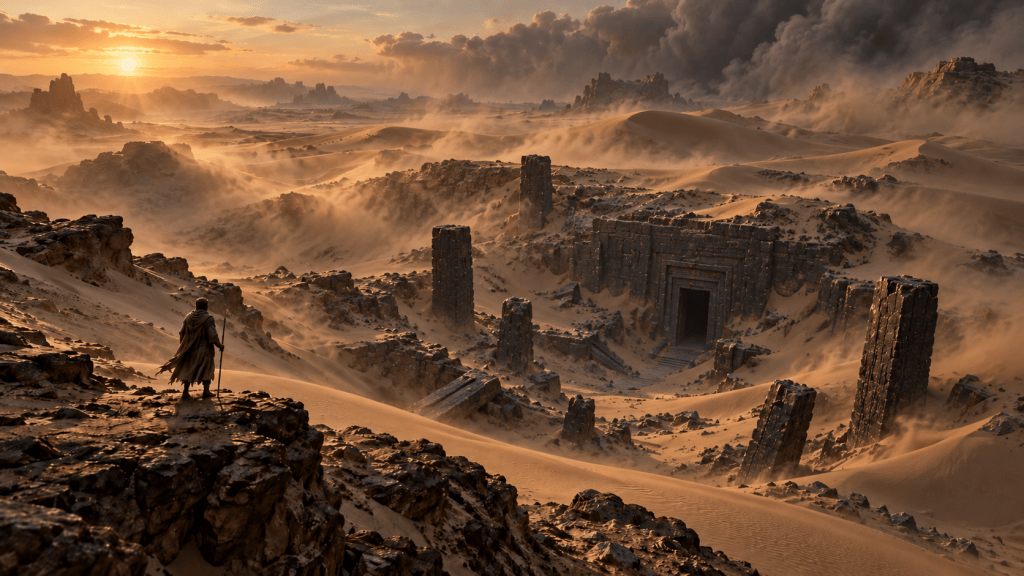
Before any living hand crossed the threshold, the desert gave back a doorway no surviving record remembered.
Timeline of Events
The Storm
A violent storm crossed the western dunes, stripping sand from ground long believed empty beyond the last irrigated fields.First Light
At dawn, a labourer checking damaged channels and boundary markers found black pillars rising from a newly scoured hollow.The Discovery
Worked stone, buried walls and a dark entrance revealed that the storm had exposed something far older than the surrounding settlements remembered.The Report
Word travelled back towards the city. What had been an unremarkable stretch of desert became an official concern, drawing sealed authority, guards and workers towards the western road.
The Black Pillars After the Storm
Hori found the first boundary stake lodged sideways in the irrigation ditch, its red-painted head buried beneath reeds and storm mud. He planted one foot against the bank, hauled until the wood came free with a wet sucking sound, then held it up for the overseer. Beyond them, the western fields shone under spilled water while the desert rose beyond the last green plots in pale, wind-cut ridges.
“Three gone from this line,” the overseer said, rubbing grit from his beard. “Find what the storm left us before the sun climbs.”
Hori looked towards the dunes. “If the storm carried them that far, you can pay me a sand-walker’s wage.”
“Bring me the stakes and I will pay you a labourer’s wage,” the overseer replied, scraping mud from his shin with the edge of his sandal. “Lose the morning arguing and I may pay you half.”
“That sounds more like you,” Hori said, setting the stake beside the channel.
He followed the damaged field edge west, where wet earth hardened beneath his sandals. The storm had stripped thorn scrub from its roots, flattened embankments and carved pale channels through the dunes. Hori knew storms by what they left behind. A hard wind scattered things. A violent one buried them. This one seemed to have done both.
One scoured channel ran farther than the others, so Hori followed it in case a boundary stone had rolled into the cut. As he climbed the ridge, the hiss of wind thinned around him. Sand still streamed from the crest behind his heels, yet the hollow below seemed strangely settled, and from its pale floor rose two pillars of black stone.
Hori stopped with his hooked staff angled across his body. The pillars stood square-sided and dark against the glare. Beyond them ran a wall, its upper stones still buried beneath the slope. A doorway opened at the centre, tall, narrow and filled with shadow.
“Well,” Hori murmured, shifting his grip on the staff, “you are a poor place for a boundary stake.”
The joke sounded small in the hollow. He descended several careful steps, testing each patch of sand before giving it his weight. Wind tugged at his tunic along the ridge. Near the pillars it seemed to slide aside, leaving the air close and strangely still. Hori crouched and pressed his fingertips to exposed paving, where shallow cut marks crossed the surface in straight lines made by tools and hands.
His fingers came away cool, though the sun had already warmed every fieldstone behind him. He rose and moved close enough to study the entrance while keeping several paces of sand between himself and the shadow. Shapes covered the lintel, worn deeply by age. One resembled a long-backed animal. Another might have been a boat or a blade.
“Keep your secrets,” he said, pointing the hooked staff towards the darkness. “I have irrigation channels waiting.”
Curiosity pulled him closer, while years spent repairing other men’s mistakes urged him home. Hori backed away, climbed the ridge and marked the place against a split tamarisk farther east. Once the black stones vanished behind the rise, the ordinary wind struck him again and sent sand rattling against his legs.
The overseer was knee-deep in a broken channel when Hori returned. He looked up, saw the empty hook and frowned as he pushed himself upright.
“You found nothing?” he asked, wiping his muddy palms across his thighs.
“I found worked stone,” Hori said, crouching to rinse dust from his hands. “Black pillars. A wall under the sand. A doorway big enough for a loaded cart.”
The overseer straightened fully and shaded his eyes with one hand. “West of the last plots?”
Hori pointed across the scrub with his wet fingers. “Beyond there. In a hollow the storm cut open.”
The older man’s gaze stayed on the dunes. “You went inside?”
Hori wiped his hands on his tunic and gave him a flat look. “You pay me to mend channels.”
A smile almost reached the overseer’s mouth before his eyes settled again on the western ridge. “Show me.”
They climbed together as the sun rose higher, carrying water, staffs and the overseer’s seal board. When the ridge opened beneath them, the older man stopped so abruptly that Hori nearly walked into him. The black pillars waited below, fixed in pale sand while storm haze still bruised the distant sky.
A runner was on the road towards the city before midday, while Hori returned to the channels and drove a fresh stake into the wet bank. Each time he straightened, his eyes went west. The dunes had always marked the place where useful land ended. Now they held a doorway, and whatever lay behind it had been there through every harvest he remembered.
By evening, people would say the desert had opened its hand. Hori knew only that the storm had moved sand and uncovered stone. Even so, the western edge of his world had changed, and empty ground would never look empty to him again.
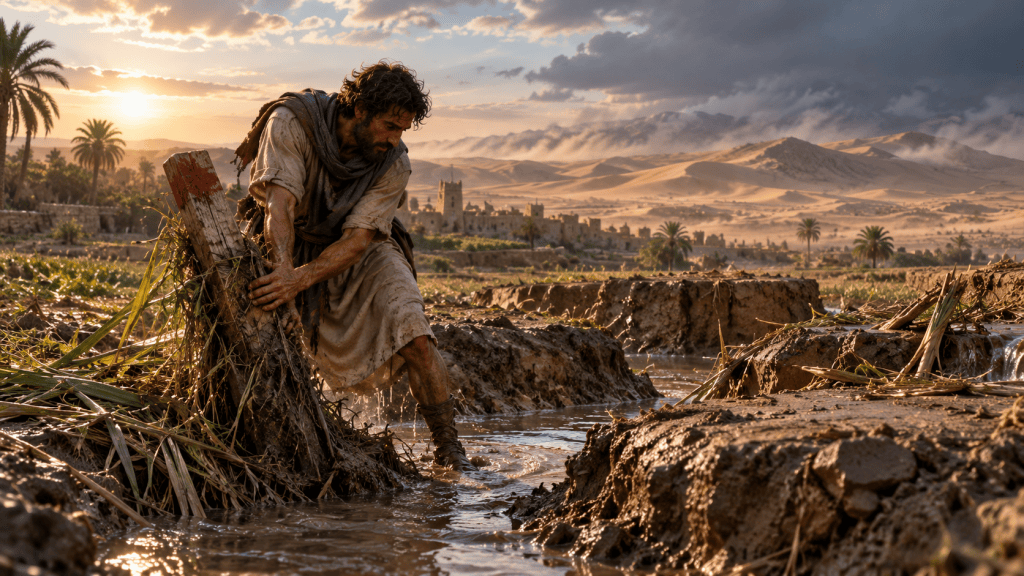
Hori hauls a storm-torn boundary stake from the flooded field edge, unaware that the western dunes have already revealed something far older than the land he knows.
Inspiration Behind the Story
This Chronicle grew from the idea of beginning the cycle far from gods, chosen figures and buried truths, with an ordinary labourer whose morning work places him at the edge of something far larger than his own life. The western dunes matter because they mark a practical boundary between cultivated land and the unknown, and the storm changes that boundary in a single night. The black pillars are important less for what they explain than for what they alter: familiar ground becomes uncertain, routine work becomes the first surviving witness account, and a place long absent from living memory suddenly exists again. That shift from ordinary labour into mythic history is exactly where this cycle begins.
Related Book Series
The Forgotten Gods of the Drowned Kingdom
The Black Pillars After the Storm begins at the edge of the events that lead into Book One, Jackal at the Threshold. When rumours of an ancient necropolis uncovered beneath the western dunes reach the river quarter, tomb robber Neris is drawn towards a place the living were never meant to enter. What she finds beyond the black doorway begins a story of judgement, buried gods, guilt and powers returning beneath the sand.
The consequences continue in Book Two, The Scales Beneath the Sand, as the disturbance spreads beyond the desert and into the burial routes, shrines and living streets of the city. Together, the first two books reveal the closer truth behind the events these Chronicles preserve only through witnesses, rumours and incomplete records.
Read Jackal at the Threshold and The Scales Beneath the Sand to discover the story behind the surviving myth.

Next Chronicle
Priest seals and armed guards soon follow the report west. Stone-cutters enter the newly exposed doorway while a junior guard keeps count beneath the black pillars, expecting the workers to return before the light fades. As the hours lengthen, the number coming back grows painfully clear. Tools remain inside. Blood marks the sand. Duty tells him to hold the entrance while every instinct urges him to go after the missing men. By dusk, the excavation has become something else entirely.
Next: Only Half Came Back
Discover more from Simon J. Phillips
Subscribe to get the latest posts sent to your email.
