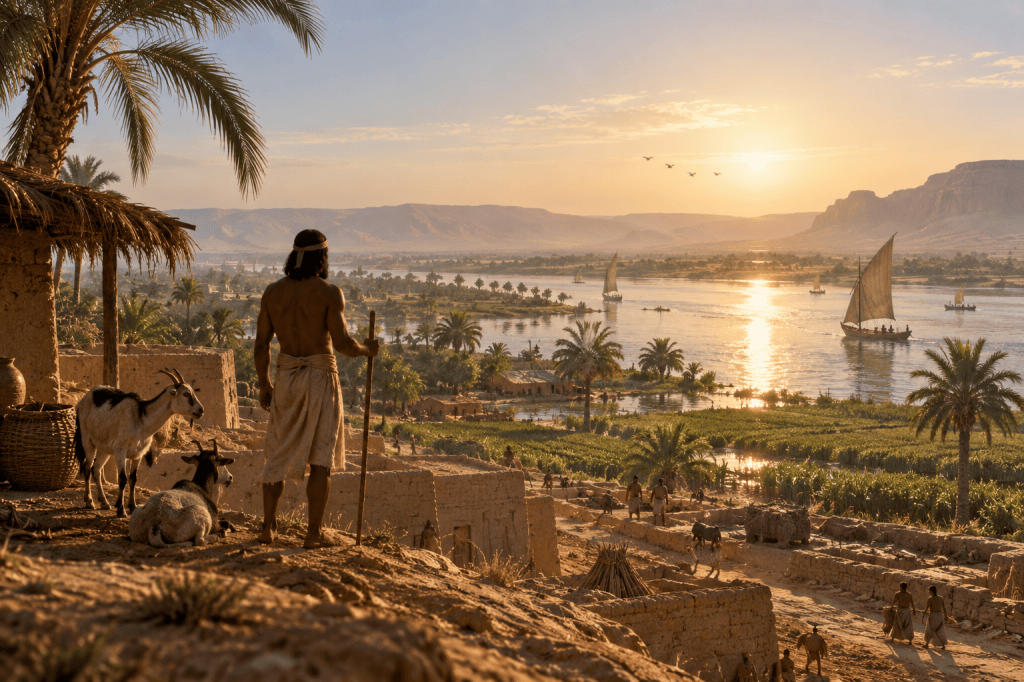
Before a single king ruled the Two Lands, communities along the Nile were already being shaped by flood, farming, burial and growing regional rivalry.
Timeline of Events
c. 4000 BC — Farming communities along the Nile depended upon the river’s seasonal cycle, while settlements and burial grounds reveal distinct regional cultures developing in Upper and Lower Egypt.
c. 4000–3500 BC — Naqada I culture flourished in Upper Egypt, with centres such as Hierakonpolis growing in importance.
c. 3500–3200 BC — Trade, specialised crafts and increasingly elaborate burials reflected growing wealth, social distinction and wider connections between communities.
c. 3300–3100 BC — Regional rulers competed for territory as early writing emerged and political consolidation moved the Nile valley towards unification.
Where the River Divided
The river had begun to withdraw when the potter pushed the boat from the mud, his calves sinking into the black edge of the bank while his sister steadied the jars behind him. Water still covered the lower fields, shining between stands of reed, and the village smelled of wet earth, fish smoke and hearth fires. His sister pressed one hand over the woven mat covering their best red vessels. “Keep your feet under you,” she said, watching him struggle with the hull. “If you drown Father’s jars, he will drag you back by the ears himself.” The potter laughed, partly because she expected it, then leaned his weight into the boat until the current caught them.
As they moved downstream, cattle stood in the shallows and families worked along the first strips of exposed silt. On the higher desert edge, low graves lay beyond the reach of the flood. The potter glanced towards them as his sister lifted a chipped jar from beneath the mat. “This one stays with us,” she said, turning the crack towards the light. “Mother can use it for beer. The painted pair goes to the landing, and this time I want copper for them.” He raised an eyebrow. “You want copper every time.” His sister settled the jar against her knees. “One year somebody will finally decide my work deserves it.”
The landing usually announced itself through noise long before they reached it. That morning the shouting had gathered into one hard knot. Three boats crowded the bank with baskets, hides and pottery, while a fourth had been pulled across the easiest approach. Men from an upriver settlement stood beside it carrying flint knives and heavy stone maceheads. Their weapons remained low, though their meaning was plain. An older trader crouched beside his baskets, jaw tight, while a broad-shouldered man pointed towards the goods. “Boats from the southern bend trade here first,” he said, planting his staff in the mud. “Choose what you offer.”
The potter felt his sister shift beside him. She studied the blocked landing, then the painted animal on the strangers’ boat prow. “Last flood they begged for our jars,” she murmured, keeping her voice low. “This flood they tell the river where it may carry them.” He almost answered with a joke, though the words faded as more boats appeared behind them and several families on the bank began moving their baskets towards the newcomers. The painted vessels under their mat suddenly seemed smaller than they had that morning.
His sister touched his arm and nodded towards a shallow channel curling through the reeds. “We can go home,” she said, her mouth tightening in the stubborn way it did whenever a firing went wrong. “Or we can find another landing.” The potter eased the steering pole into the water. Their village had always known other communities by their pottery, their graves, their cattle and the stories traders carried home. Now those differences seemed to be gathering around stronger hands. As the boat slipped into the side channel, the crowded landing remained behind them, and the Nile carried them towards a world in which a village could no longer think only of itself.
Research basis, outside the published Chronicle: the reconstruction uses evidence for Predynastic settlements and low-desert cemeteries, Naqada pottery and boat imagery, stone maceheads, copper objects and large-scale brewing activity. The dramatic window follows the Series III authority’s instruction to make regional difference and growing rivalry tangible through a flood-season exchange or journey.
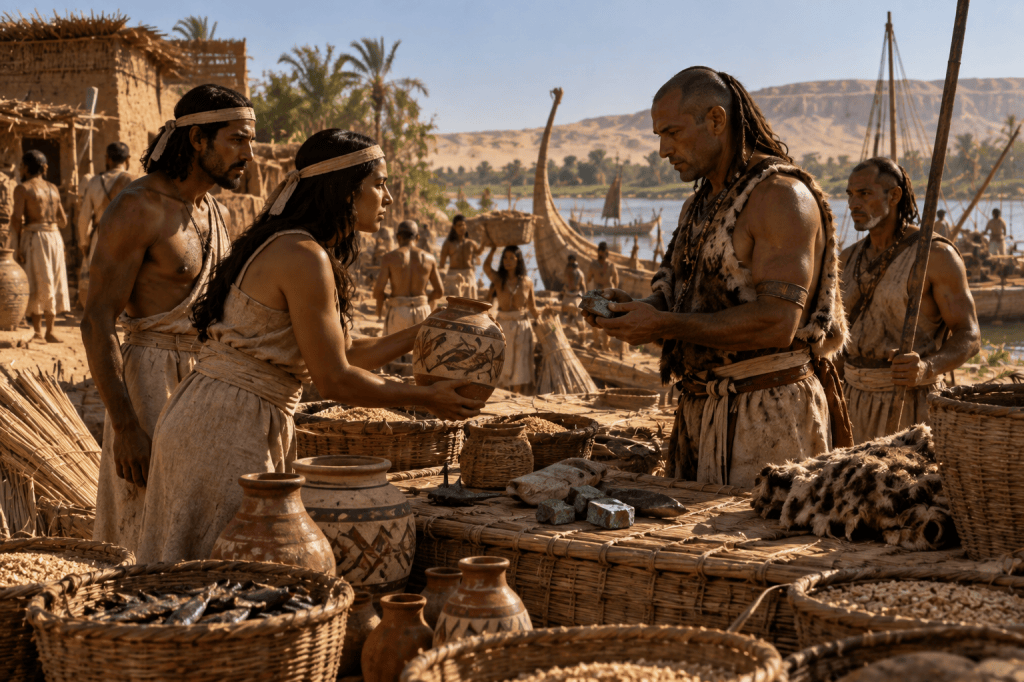
Predynastic communities along the Nile exchanged pottery, food and valuable materials, linking neighbouring settlements even as regional identities and rivalries grew stronger.
Inspiration Behind the Story
Long before Egypt became a kingdom of pharaohs, pyramids and monumental stone, life along the Nile had already begun shaping the world that followed. Farming, river travel, burial customs, craft and exchange connected communities whose identities were growing stronger as regional centres gathered influence. That quieter beginning deserved its own Chronicle because Egypt emerged from generations of people adapting to the river and to one another, long before royal power gave the land a single political voice. Archaeology offered glimpses of those lives through pottery, graves, settlements and traded materials, allowing the story to begin where pharaonic Egypt itself had yet to exist.
Explore a Different Egypt
For readers who would like to step from real Egyptian history into mythic fantasy, The Forgotten Gods of the Drowned Kingdom follows tomb robber Neris into a darker world of burial rites, divine relics, judgement and a hidden conflict among the Egyptian gods. It shares the Nile, tombs and sacred traditions of ancient Egypt, while telling an entirely fictional story shaped by Egyptian mythology.
Next Chronicle
Along the Nile, rival centres had grown stronger, their rulers reaching beyond the communities that first gave them power. Around 3100 BC, that long struggle entered a new stage as the kingship associated with Narmer claimed authority over both Upper and Lower Egypt. The surviving evidence leaves the exact path to unification uncertain, yet the political idea was unmistakable: the Two Lands could be imagined under one ruler. In The Two Lands Become One, the Chronicle moves from regional rivalry towards the birth of a unified Egyptian state.
Discover more from Simon J. Phillips
Subscribe to get the latest posts sent to your email.
