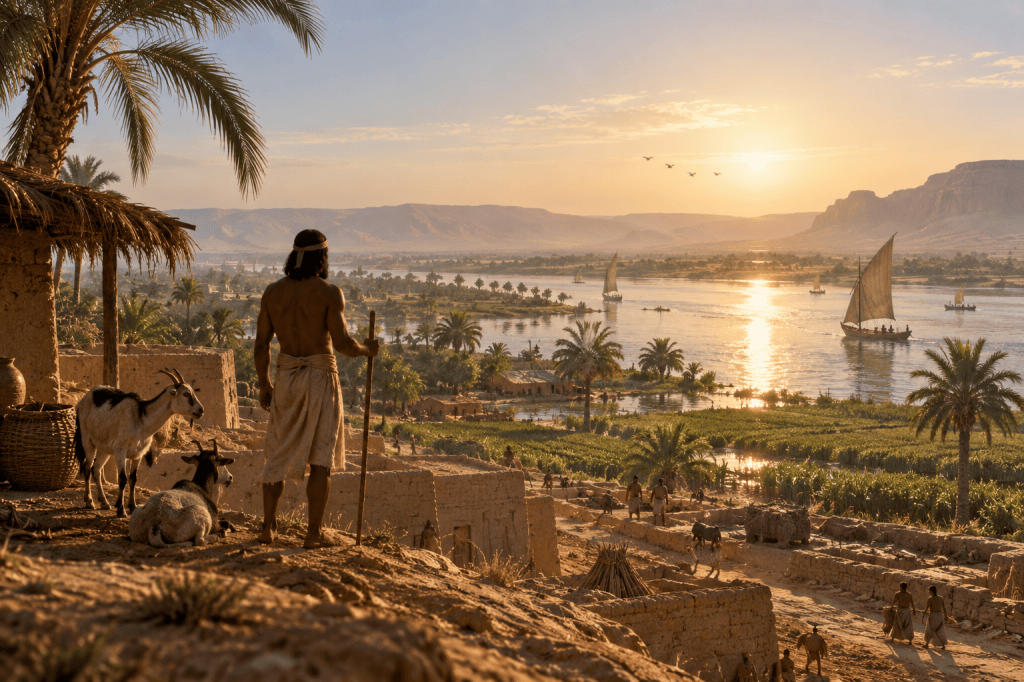
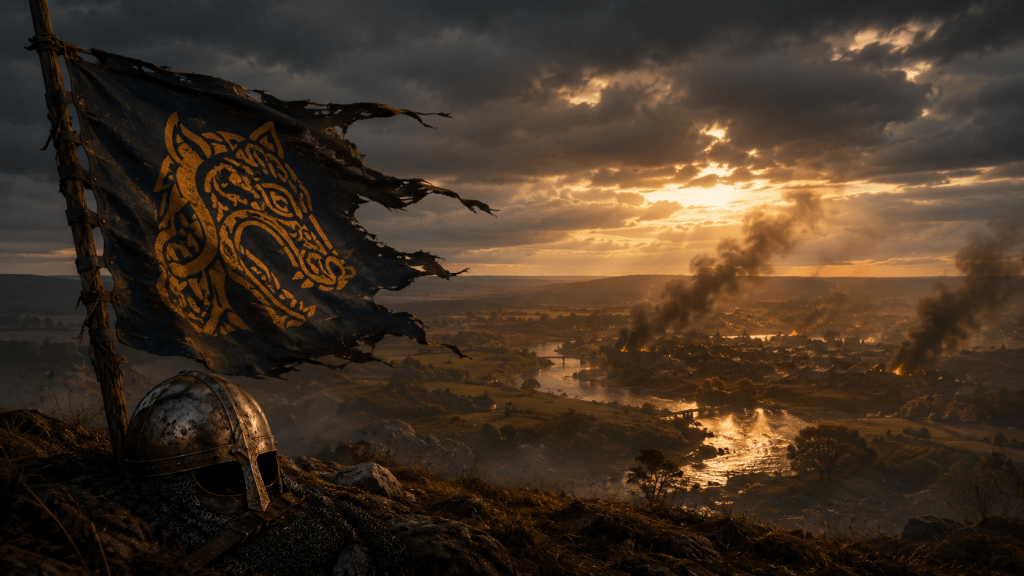
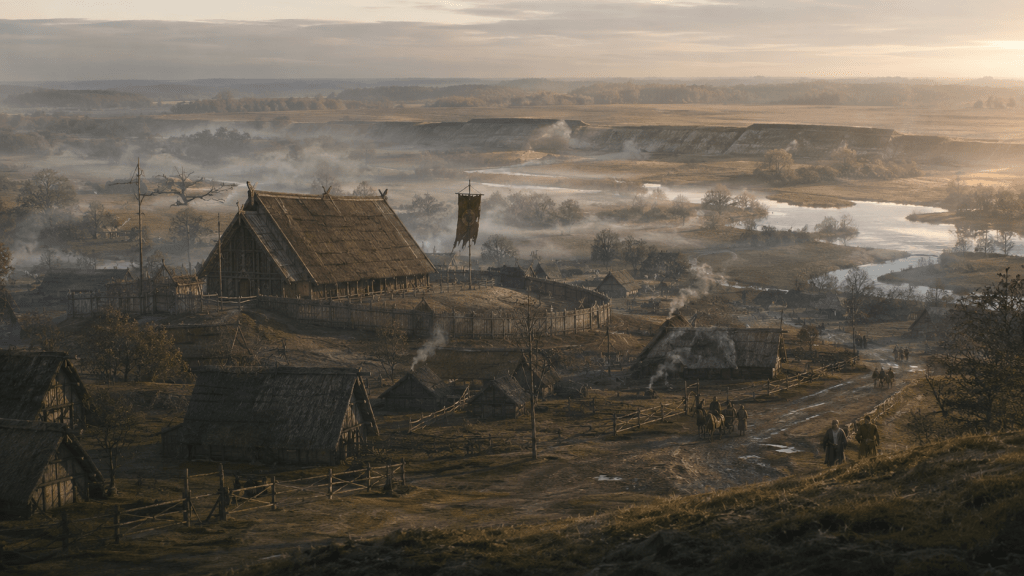
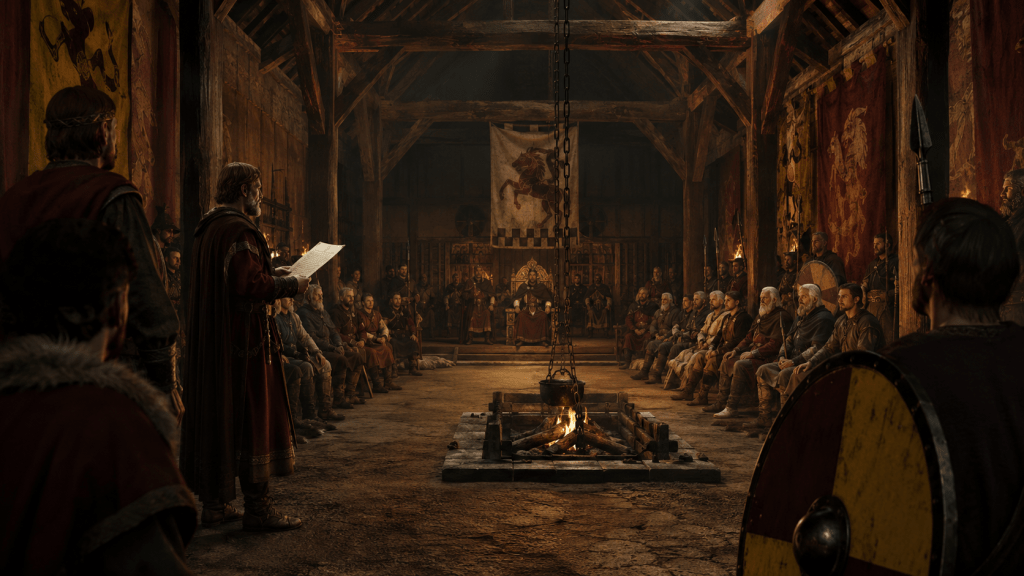
Before a single king ruled the Two Lands, communities along the Nile were already being shaped by flood, farming, burial and growing regional rivalry.
Timeline of Events
c. 4000 BC — Farming communities along the Nile depended upon the river’s seasonal cycle, while settlements and burial grounds reveal distinct regional cultures developing in Upper and Lower Egypt.
c. 4000–3500 BC — Naqada I culture flourished in Upper Egypt, with centres such as Hierakonpolis growing in importance.
c. 3500–3200 BC — Trade, specialised crafts and increasingly elaborate burials reflected growing wealth, social distinction and wider connections between communities.
c. 3300–3100 BC — Regional rulers competed for territory as early writing emerged and political consolidation moved the Nile valley towards unification.
Where the River Divided
The river had begun to withdraw when the potter pushed the boat from the mud, his calves sinking into the black edge of the bank while his sister steadied the jars behind him. Water still covered the lower fields, shining between stands of reed, and the village smelled of wet earth, fish smoke and hearth fires. His sister pressed one hand over the woven mat covering their best red vessels. “Keep your feet under you,” she said, watching him struggle with the hull. “If you drown Father’s jars, he will drag you back by the ears himself.” The potter laughed, partly because she expected it, then leaned his weight into the boat until the current caught them.
As they moved downstream, cattle stood in the shallows and families worked along the first strips of exposed silt. On the higher desert edge, low graves lay beyond the reach of the flood. The potter glanced towards them as his sister lifted a chipped jar from beneath the mat. “This one stays with us,” she said, turning the crack towards the light. “Mother can use it for beer. The painted pair goes to the landing, and this time I want copper for them.” He raised an eyebrow. “You want copper every time.” His sister settled the jar against her knees. “One year somebody will finally decide my work deserves it.”
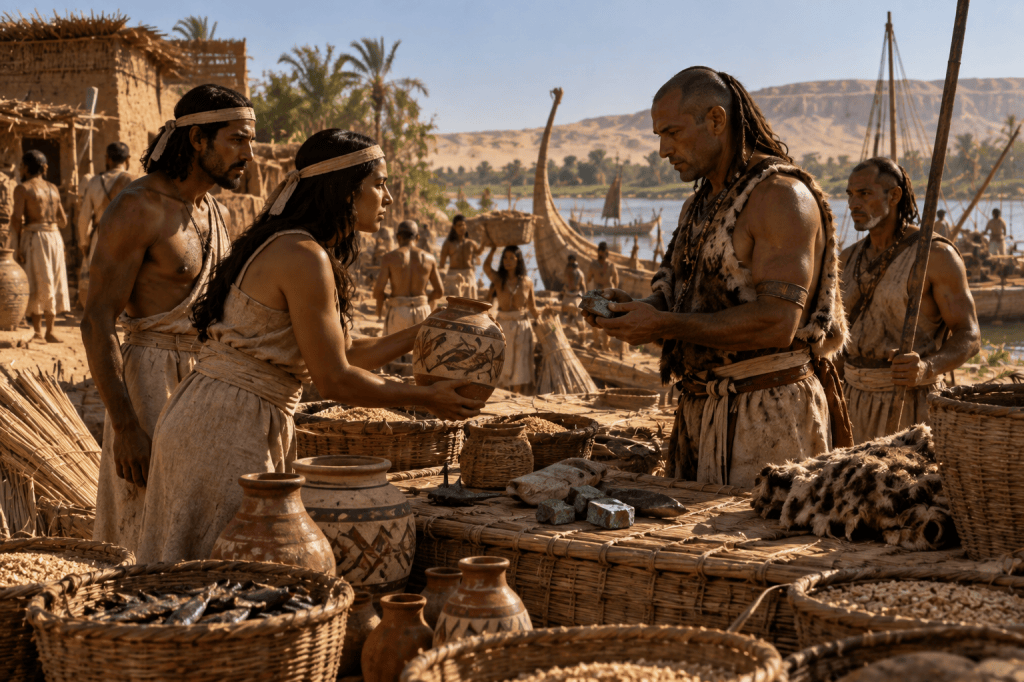
The landing usually announced itself through noise long before they reached it. That morning the shouting had gathered into one hard knot. Three boats crowded the bank with baskets, hides and pottery, while a fourth had been pulled across the easiest approach. Men from an upriver settlement stood beside it carrying flint knives and heavy stone maceheads. Their weapons remained low, though their meaning was plain. An older trader crouched beside his baskets, jaw tight, while a broad-shouldered man pointed towards the goods. “Boats from the southern bend trade here first,” he said, planting his staff in the mud. “Choose what you offer.”
The potter felt his sister shift beside him. She studied the blocked landing, then the painted animal on the strangers’ boat prow. “Last flood they begged for our jars,” she murmured, keeping her voice low. “This flood they tell the river where it may carry them.” He almost answered with a joke, though the words faded as more boats appeared behind them and several families on the bank began moving their baskets towards the newcomers. The painted vessels under their mat suddenly seemed smaller than they had that morning.
His sister touched his arm and nodded towards a shallow channel curling through the reeds. “We can go home,” she said, her mouth tightening in the stubborn way it did whenever a firing went wrong. “Or we can find another landing.” The potter eased the steering pole into the water. Their village had always known other communities by their pottery, their graves, their cattle and the stories traders carried home. Now those differences seemed to be gathering around stronger hands. As the boat slipped into the side channel, the crowded landing remained behind them, and the Nile carried them towards a world in which a village could no longer think only of itself.
Research basis, outside the published Chronicle: the reconstruction uses evidence for Predynastic settlements and low-desert cemeteries, Naqada pottery and boat imagery, stone maceheads, copper objects and large-scale brewing activity. The dramatic window follows the Series III authority’s instruction to make regional difference and growing rivalry tangible through a flood-season exchange or journey.
Predynastic communities along the Nile exchanged pottery, food and valuable materials, linking neighbouring settlements even as regional identities and rivalries grew stronger.
Inspiration Behind the Story
Long before Egypt became a kingdom of pharaohs, pyramids and monumental stone, life along the Nile had already begun shaping the world that followed. Farming, river travel, burial customs, craft and exchange connected communities whose identities were growing stronger as regional centres gathered influence. That quieter beginning deserved its own Chronicle because Egypt emerged from generations of people adapting to the river and to one another, long before royal power gave the land a single political voice. Archaeology offered glimpses of those lives through pottery, graves, settlements and traded materials, allowing the story to begin where pharaonic Egypt itself had yet to exist.
Explore a Different Egypt
For readers who would like to step from real Egyptian history into mythic fantasy, The Forgotten Gods of the Drowned Kingdom follows tomb robber Neris into a darker world of burial rites, divine relics, judgement and a hidden conflict among the Egyptian gods. It shares the Nile, tombs and sacred traditions of ancient Egypt, while telling an entirely fictional story shaped by Egyptian mythology.
Next Chronicle
Along the Nile, rival centres had grown stronger, their rulers reaching beyond the communities that first gave them power. Around 3100 BC, that long struggle entered a new stage as the kingship associated with Narmer claimed authority over both Upper and Lower Egypt. The surviving evidence leaves the exact path to unification uncertain, yet the political idea was unmistakable: the Two Lands could be imagined under one ruler. In The Two Lands Become One, the Chronicle moves from regional rivalry towards the birth of a unified Egyptian state.
How Edward’s son took York and gathered the lands that would become England beneath one crown.
The Gates of York
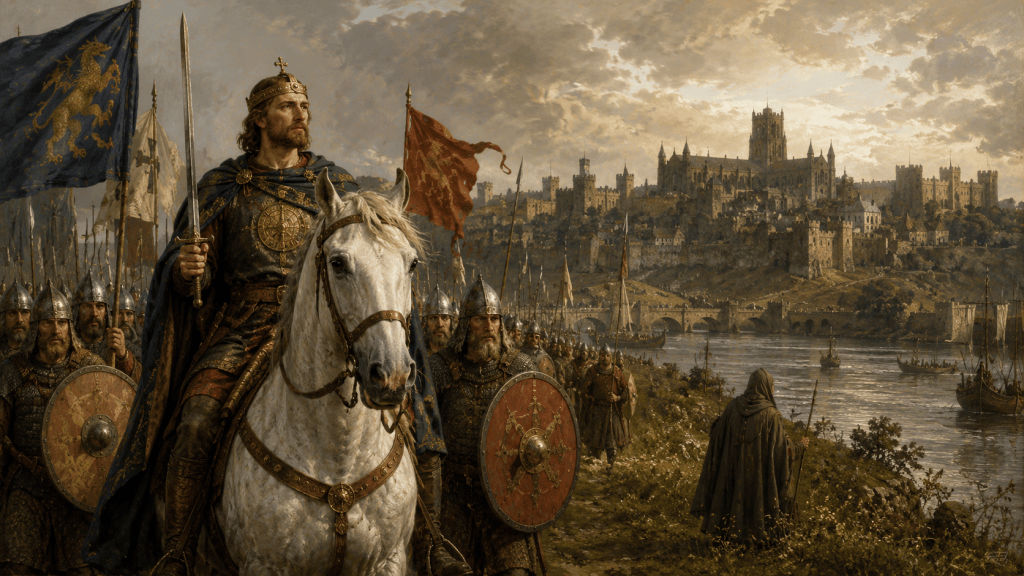
The Ouse moved beneath York’s walls with the slow weight of summer rain, carrying branches, foam, and the broken reflection of the city towards the marshes beyond. Along the southern road, men and horses emerged through the morning haze in a column darkened by mud, their shields wrapped against the damp and their spears rising above them like a travelling wood. The bells inside the city had already sounded, though their voices carried no clear warning. They rolled across the roofs, faded over the river, and left the people upon the walls listening for the first order that would decide whose king entered York before the day was done.
Æthelstan rode near the front beneath a plain royal banner, his cloak heavy across his shoulders as he studied the gate ahead. Three years had passed since Edward’s death, years shaped by disputed succession, Mercian support, and the careful gathering of authority across the lands his father had ruled. York remained beyond that inheritance. Its Scandinavian kings had governed a city of merchants, craftsmen, warriors, and churches, guarding the last great centre of power between the Humber and the kingdoms farther north. King Sihtric’s death had loosened that hold, and Æthelstan had come before another ruler could fasten it again.
A household warrior urged his horse alongside the king and wiped rain from the rim of his helmet. “The gates stand open, lord, yet armed men remain above them,” he said as he glanced towards the figures lining the parapet. “They may be waiting to measure how close we ride before choosing their answer.”
Æthelstan kept his gaze upon the entrance, where water ran in thin streams down the timber doors. “Then they shall see an army prepared for war and a king prepared to receive their oath,” he replied as he loosened the reins enough for his horse to pick a careful path through the rutted ground. “York has watched rulers come and vanish. We must give its people reason to believe this arrival will endure.”
Near the gate, a small group came forward beneath a cross-topped staff. Their leader wore a woollen mantle pinned at one shoulder, and the silver upon his belt caught what little light reached the road. He halted several paces from Æthelstan and lowered his head, while the men behind him watched the West Saxon and Mercian warriors filling the road.
“My lord king,” the envoy said as he lifted both empty hands where the army could see them, “the city seeks peace, its markets protected, its churches left under their own keepers, and its people judged by the laws they know.”
Æthelstan dismounted, passing his reins to a waiting attendant before crossing the wet ground. The mud closed over the edges of his boots as he stopped before the envoy. “Peace will hold where loyalty holds,” he answered, resting one hand against the clasp of his cloak. “Your markets will open, your churches will keep their lands, and every man who gives his oath will receive the king’s protection. York will answer to one crown, and that crown will answer for York.”
The envoy’s expression shifted as he looked beyond Æthelstan towards the army, where Mercian nobles rode beside West Saxon household men and warriors from recovered Danish towns carried shields marked by older loyalties. “Many peoples stand behind you,” he said, his voice lowered as the rain softened around them.
“They stand within the same realm now,” Æthelstan replied as he turned towards the gate. “The work lies in teaching every road, shire, borough, and hall what that realm requires.”
The royal banner moved forward, its wet cloth stirring above the first riders as they passed beneath York’s defences. Townspeople watched from doorways and upper windows while hooves struck the timbered street, carrying the king towards the churches, halls, and storehouses of a city whose allegiance had changed more than once within living memory. Some faces showed fear, others calculation, and a few the guarded relief of people who had learned that conquest mattered less than the peace that followed it.
Behind Æthelstan, the gates remained open as the long column entered. Ahead lay oaths still to be demanded, rulers beyond the city still to be confronted, and lands whose submission would need more than a single morning beneath York’s walls. Even so, the old division had narrowed to the width of that gateway. Wessex, Mercia, East Anglia, and the former Danelaw had been carried to its threshold, and as Æthelstan rode into York, the scattered inheritance of generations began to take the shape of England.
Timeline of Events
924 AD – Edward the Elder dies at Farndon in Mercia, leaving Æthelstan supported by Mercian leaders while the West Saxon succession remains uncertain.
925 AD – Æthelstan is crowned at Kingston upon Thames, bringing the West Saxon and Mercian inheritance beneath his kingship.
926 AD – Æthelstan arranges the marriage of one of his sisters to Sihtric, the Scandinavian king of York, creating a brief alliance between the two realms.
927 AD – Following Sihtric’s death, Æthelstan takes York and receives the recognition of northern rulers at Eamont Bridge, allowing him to rule across the lands that would become England.
937 AD – Æthelstan defeats a coalition of Norse, Scottish, and Strathclyde forces at the Battle of Brunanburh, defending the kingdom created through his conquest of York.
The King Who Gathered England
When Edward died at Farndon in 924, the realm he had built stood wide, powerful, and vulnerable. His campaigns had carried West Saxon authority through Mercia, East Anglia, and much of the former Danelaw, yet the succession opened along old political seams. Æthelstan, his eldest son, had been raised among the Mercians, where Æthelflæd’s court had shaped his education and introduced him to the men who had fought beside her. Mercian leaders recognised him quickly. In Wessex, support gathered more slowly around rival branches of the royal house, and the crown passed through a season of uncertainty before Æthelstan secured his position.
At a Mercian hall, as messengers moved between Tamworth, Gloucester, and the southern shires, an older thegn placed both hands upon the table and studied the prince across the fire. “Your father left many lands beneath one protection, lord, though each remembers the road by which it came there,” he said as sparks rose into the rafters. “Mercia will stand with you, since you were raised among us and know the weight our people carried.”
Æthelstan drew the edge of a wax tablet towards him and looked over the names already marked there. “Then Mercia must stand beside Wessex as a partner,” he answered as the hall quietened around them. “My father recovered towns and roads; I must persuade the men within them that his realm can survive the passing of its king.”
His coronation at Kingston in 925 brought sacred language, royal ritual, and political settlement together. The place lay near the boundary between Wessex and Mercia, a fitting threshold for a ruler whose strength rested upon both. Bishops anointed him, nobles gave their assent, and a crown passed to a king whose inheritance remained unfinished. Ceremony confirmed authority, yet the realm could only endure through loyalty from shires shaped by West Saxon law, Mercian custom, Danish settlement, and memories of former independence.
York remained the greatest challenge. The city stood at the centre of a Scandinavian kingdom whose rulers looked across the Irish Sea, through Northumbria, and towards the courts farther north. In 926, Æthelstan strengthened his position through marriage diplomacy, arranging for one of his sisters to marry Sihtric, king of York. The alliance offered peace across the old frontier and bound two royal houses for a brief season.
At the meeting where the agreement was settled, a churchman leaned towards Æthelstan and lowered his voice while attendants carried wine between the benches. “Some in your court will say the marriage gives too much honour to a king whose people once fought your father,” he warned as he watched the York envoys. “Others will fear that peace makes Sihtric stronger.”
Æthelstan rested his hand upon the carved arm of his chair. “A marriage may hold a road more securely than an army camp,” he replied as Sihtric’s men conferred across the hall. “If peace lasts, both kingdoms gain breathing space. If it fails, every oath made here will reveal who broke it.”
Sihtric died in 927, and the balance changed before another ruler could secure it. Æthelstan moved quickly into Northumbria, drove out Sihtric’s successor, and brought York beneath his authority. The act carried him beyond the achievements of Alfred, Æthelflæd, and Edward. Their wars had broken the power of the Danelaw south of the Humber; Æthelstan now removed the final Scandinavian kingship within England.
His advance drew other rulers towards negotiation. At Eamont Bridge, near Penrith, Constantine of Alba, Owain of Strathclyde, and other leading figures recognised Æthelstan’s supremacy through promises whose exact force remains debated. The agreements grew from military pressure, mutual fear, and the need to define boundaries before another campaigning season began.
A northern envoy looked across the assembled tents towards Æthelstan’s guards and folded his cloak against the wind. “My lord offers peace across the border and friendship where friendship is returned,” he said as clerks prepared the words of the settlement. “He will guard his own people, as every king must.”
Æthelstan stepped closer to the table where a cross and gospel book had been placed. “Let him guard them beneath an oath that keeps armed men from my roads,” he replied as the gathered nobles listened. “I seek no empty words. Let every ruler here leave knowing which peace he has sworn and what its breaking will bring.”
From 927 onward, Æthelstan’s charters increasingly presented him as king of the English and, at times, ruler over a wider Britain. Titles carried ambition, though his kingship also rested upon practical government. Royal assemblies drew bishops, ealdormen, Welsh kings, abbots, and leading landholders into gatherings where land grants were witnessed and decisions made visible before the political community. The long witness lists surviving in his charters reveal a court that travelled widely and gathered men from regions once divided by war.
Law followed conquest. Æthelstan issued measures against theft, disorder, and the failure of local communities to produce offenders. Tithings, oath-taking, sureties, and collective responsibility brought neighbours into the work of royal justice. The severity of some penalties revealed the difficulty of imposing order across a kingdom that had expanded faster than any earlier English realm. A stolen animal, a concealed fugitive, or a broken oath could test the king’s authority as surely as a border raid.
During one council, a reeve placed a bundle of complaints before the king and rubbed tired fingers across his brow. “Men know the law, lord, yet they hide kin and neighbours when the sheriff arrives,” he said as murmurs passed along the benches. “A village will swear ignorance while the stolen cattle stand in a field beyond its own hedge.”
Æthelstan opened the first complaint and traced the mark of the local court. “Then the village must learn that protection carries obligation,” he answered as the reeve waited. “A king’s peace cannot reach every lane by horseback. It reaches through men who understand that silence may serve the thief today and destroy their own safety tomorrow.”
His court also looked beyond Britain. Æthelstan fostered royal children, arranged marriages with continental dynasties, exchanged gifts with foreign rulers, and gathered relics and manuscripts that strengthened the sacred image of his kingship. His sisters married into leading European houses, while exiled princes found shelter at his court. These relationships placed England within a wider network of Christian monarchy.
Yet York’s submission never ended resistance. Scandinavian power remained strong across the Irish Sea, and northern rulers feared the reach of a king who now commanded the whole English realm. In 934, Æthelstan campaigned into Scotland, carrying his army and fleet deep into Constantine’s lands. The expedition demonstrated strength, though lasting submission remained elusive. Three years later, the challenge returned in a far greater form.
In 937, Olaf Guthfrithson of Dublin joined Constantine of Alba and Owain of Strathclyde in a coalition aimed at breaking Æthelstan’s supremacy. Their armies entered England, and Æthelstan marched to meet them with his brother Edmund beside him. The battlefield known as Brunanburh has never been located with certainty, yet the struggle was remembered as one of the fiercest encounters of the age.
Before the fighting, as men tightened shield straps and priests moved along the lines, Edmund approached his brother beneath a sky dulled by autumn cloud. “They have come believing York will rise behind them once our line breaks,” he said as he looked towards the distant mass of the coalition army. “Every promise made since Eamont stands upon what happens here.”
Æthelstan lifted his shield and watched the standards settle above the English ranks. “Then we hold more than ground,” he replied as horns sounded along the line. “We hold the years our father and aunt spent opening these roads. Let every man remember that retreat would carry the war back to his own gate.”
The English victory shattered the coalition’s immediate hope. Olaf escaped across the sea, Constantine lost a son, and the northern armies withdrew after heavy slaughter. The Old English poem preserved in the Anglo-Saxon Chronicle celebrated the battle as a defence of the homeland, linking Æthelstan and Edmund to a shared English identity. Brunanburh proved that the kingdom created in 927 could survive a coordinated assault.
Æthelstan died in 939, and York soon returned to Scandinavian rule, revealing how much the unity of the realm still depended upon a strong king. Even so, the political claim he had established survived the temporary fracture. His successors fought to recover the north because Æthelstan had made its inclusion within the English kingdom appear rightful, achievable, and worth defending.
Alfred had preserved Wessex through fortified survival. Æthelflæd and Edward had carried recovery across Mercia and the Danelaw. Æthelstan inherited their roads, burhs, armies, and alliances, then drove their work through York and into the language of one English kingship. England remained a kingdom whose borders would face future war, rebellion, and conquest, yet after 927 its rulers could imagine the land from the Channel to the north as a single political inheritance.
The crown Æthelstan carried was still new enough to feel uncertain, though the kingdom beneath it had crossed a threshold. What earlier generations had defended in fragments now possessed a name, a ruler, and a memory of standing together.
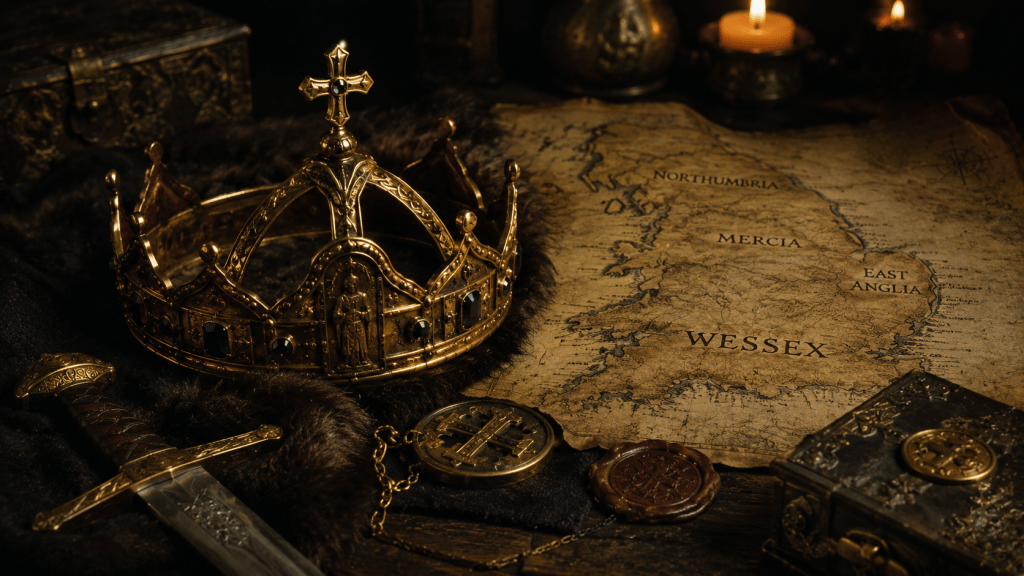
Æthelstan’s crown rests beside the kingdoms brought beneath his authority, symbolising the moment when Wessex, Mercia, East Anglia, and Northumbria began to take the shape of a single England.
Inspiration Behind the Story
Æthelstan’s achievement begins long before he entered York. It begins in the marshes where Alfred preserved Wessex, in the burhs raised across Mercia, and in the roads, rivers, and fortified towns secured by Edward and Æthelflæd. That inheritance gives this Chronicle its power. The taking of York in 927 appears decisive, yet the kingdom gathered beneath Æthelstan’s crown had been shaped through decades of survival, recovery, and patient expansion.
What fascinates me about this moment is how unity emerged from lands that still carried separate memories. Wessex, Mercia, East Anglia, and Northumbria possessed their own loyalties, customs, rulers, and experiences of war. Æthelstan could claim authority across them, though a crown alone could never erase those differences. England had to be created through law, assemblies, oaths, protection, and the belief that one king could hold together what earlier generations had known as separate realms.
For storytelling, this creates a stronger ending than simple conquest. Æthelstan’s victory at York completed one journey while beginning another. The walls could be entered, oaths could be sworn, and rival kings could submit, yet the deeper work of turning conquest into belonging still waited beyond the ceremony.
This Chronicle matters because it reveals that nations rarely appear fully formed. They gather slowly, through inherited struggles, fragile loyalties, and the moment when scattered histories begin to recognise a shared future.
From the Author’s Desk
What stayed with me while writing this Chronicle was the distance between conquering a kingdom and persuading its people that the kingdom truly existed. Æthelstan could enter York, receive oaths, summon rulers to his court, and place his name upon charters stretching across lands his ancestors had once known as separate realms. Even so, those actions marked the beginning of unity as much as its completion.
That tension made him especially interesting to write about. Alfred’s struggle carries the drama of survival, Æthelflæd and Edward possess the momentum of reconquest, while Æthelstan inherited the harder task of gathering those victories into something that could endure. He ruled people shaped by West Saxon, Mercian, Northumbrian, and Scandinavian traditions, each carrying memories that a royal title could never erase. His achievement rested upon convincing those communities that one crown could offer law, protection, and order across old boundaries.
I also found myself thinking about how easily history remembers the visible moment and overlooks the years that made it possible. The capture of York in 927 created a clear landmark, though the road towards it passed through marshes, fortified towns, disputed successions, family alliances, and generations of people whose names have faded from the record. Æthelstan stood at the end of that long movement, carrying the labour of Alfred, Æthelflæd, Edward, and countless others into a new political age.
Reaching the final Chronicle of this series has made that accumulation feel especially clear. The England that emerged beneath Æthelstan’s rule came from kingdoms that once possessed their own courts, ambitions, rivalries, and futures. Across these ten Chronicles, those separate worlds have gradually drawn closer through war, survival, alliance, and necessity.
The crown may belong to Æthelstan in this final chapter, though the kingdom beneath it was built by generations.
Æthelstan’s succession after Edward’s death in 924 appears to have exposed a division between Mercian and West Saxon support. Mercian leaders accepted Æthelstan quickly, while his half-brother Ælfweard may have held stronger backing within Wessex before dying only weeks after their father. Æthelstan’s coronation followed at Kingston upon Thames on 4 September 925, close to the old boundary between Wessex and Mercia. The setting carried political meaning for a ruler whose authority depended upon joining both traditions beneath his crown.
The conquest of York in 927 transformed the scale of Æthelstan’s kingship. York had remained the centre of the last Scandinavian kingdom within England, and its fall brought the territory south of the northern frontier under one ruler for the first time. Soon afterwards, Constantine of Alba, Owain of Strathclyde, and other northern rulers met Æthelstan at Eamont Bridge. Their promises recognised his supremacy, though they represented negotiated overlordship and immediate political settlement more than direct English government over their kingdoms.
Æthelstan’s charters and coinage reveal how deliberately his court expressed this enlarged authority. He appeared as rex Anglorum, king of the English, and also as rex totius Britanniae, king of the whole of Britain. Such titles proclaimed a reach extending beyond the territory he governed directly, presenting him as the leading ruler among the kings of the island. Surviving grants also show large assemblies where bishops, ealdormen, abbots, Welsh rulers, and other leading figures witnessed royal decisions together.
His law codes reveal a kingdom facing practical difficulties beneath its new unity. Theft, the concealment of offenders, oath-breaking, poor enforcement, and the responsibilities of local communities received repeated attention. Some penalties were severe, then adjusted when their consequences appeared excessive. The laws also strengthened collective responsibility through sworn groups and local officials, showing how royal peace depended upon communities enforcing authority far beyond the king’s immediate presence.
Related Events
Æthelstan’s authority reached far into continental Europe through the marriages of his half-sisters and the presence of exiled princes at his court. These relationships connected England to ruling houses across Francia and the German lands, strengthening the king’s reputation as a Christian monarch whose influence extended beyond Britain. His court also became known for manuscripts, relics, religious patronage, and learned visitors, linking political power with sacred kingship.
The campaign of 934 carried Æthelstan’s army and fleet into Scotland after relations with Constantine deteriorated. The surviving record offers limited detail about fighting, though the scale of the mobilisation demonstrated the king’s ability to draw forces from across England. The campaign failed to create a permanent northern settlement, and the coalition that formed three years later revealed how strongly neighbouring rulers resisted Æthelstan’s expanding supremacy.
At Brunanburh in 937, Æthelstan and his brother Edmund defeated an alliance led by Olaf Guthfrithson of Dublin, Constantine of Alba, and Owain of Strathclyde. The battle’s location remains uncertain, despite several proposed sites. Its significance survives more clearly than its geography: the victory prevented the coalition from breaking Æthelstan’s kingdom and inspired the great Old English battle poem preserved in the Anglo-Saxon Chronicle.
Æthelstan died at Gloucester on 27 October 939 and was buried at Malmesbury, a religious house he had strongly supported. Scandinavian rule soon returned to York, showing that the unity achieved during his reign still required defence. His successors spent years recovering the north, yet they pursued that recovery within the political framework Æthelstan had established: York had become part of the English kingdom, even when control of it temporarily slipped away.
Further Reading
Æthelstan: The First King of England — Sarah Foot
The Making of England: A New History of the Anglo-Saxon World — Mark Atherton
The Battle of Brunanburh: A Casebook — Michael Livingston, editor
The Anglo-Saxon World — Nicholas J. Higham and Martin J. Ryan
England did not emerge in a single victory. It gathered slowly through marshes, walls, roads, oaths, and generations who carried an unfinished kingdom towards one crown.
How Alfred’s son carried the Anglo-Saxon recovery into the Danelaw and prepared the ground for England
The Rider from Tamworth
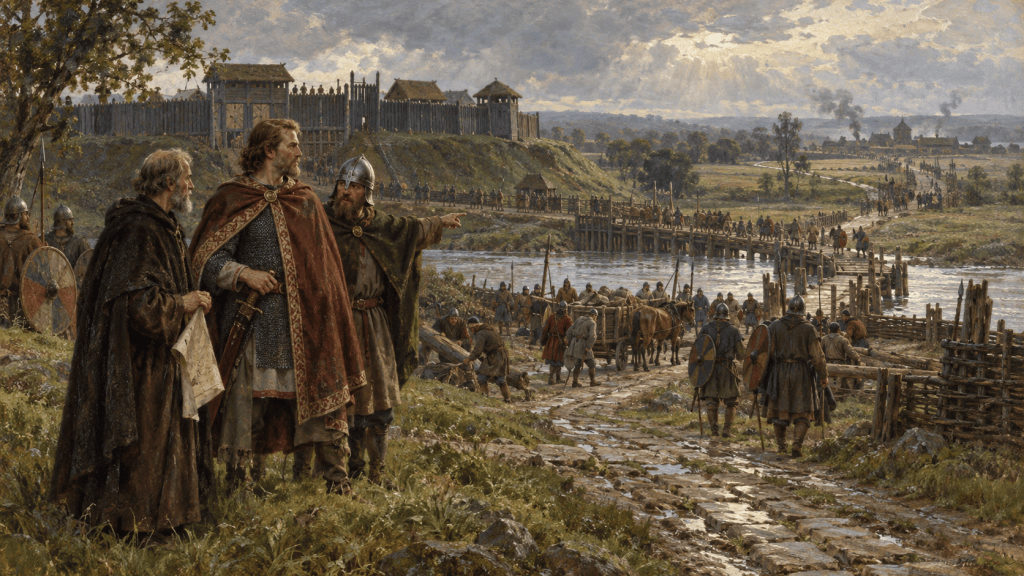
Morning mist lay across the River Welland, gathering among the reeds and whitening the raw earth where Edward’s men had driven a new line of stakes into the southern bank. Across the water, Stamford rose behind its older defences, a Danish borough whose people had watched the West Saxon army arrive, secure the crossing, and turn captured ground into something intended to endure. Axes struck oak, baskets of soil passed from hand to hand, and the breath of men and horses mingled above the unfinished rampart as the king’s frontier took shape beneath a pale summer sky.
“Pack the earth close against the timber, or the river will find every hollow before an enemy reaches us,” the foreman said as he pressed one mud-darkened heel into the bank. A young spearman rested upon his shovel and glanced towards the roofs beyond the water. “If Stamford has yielded, why are we raising a second wall when the first already stands?” he asked as he wiped rain from his cheek. The foreman drew his thumb along the sharpened edge of a stake before answering. “A town may yield for a day, lad, while a strong wall reminds every man what tomorrow will cost.”
Edward stood above them, his cloak drawn close against the wet breeze as he studied the ford, the bridge, and the road leading through the fields. He had learned the value of such places from Alfred, whose burhs had preserved Wessex when open battle could have destroyed it, and he had carried that lesson into enemy country. Every ditch guarded a crossing, every garrison secured a road, and every new enclosure allowed an army to move farther while leaving strength behind. Stamford had become a fresh fastening in a chain stretching through lands once held by Danish armies.
A lone rider came into view before the gate watch called out, his horse dark with sweat and river mud as it struggled across the broken ground. “A Mercian messenger has come from Tamworth, lord king,” one of Edward’s household warriors said as he descended the rampart. Edward turned from the river as the rider dismounted and crossed the yard. “Bring him forward, then see that his horse is watered and rubbed down,” he replied, resting one hand upon his sword belt. The messenger bowed with the weary care of a man who had ridden through much of the night before drawing breath. “My lord king, the Lady of the Mercians died at Tamworth, and news of your sister’s death is already travelling through Mercia,” he said, holding Edward’s gaze as grief tightened his face.
For a moment, the labour around the new burh seemed to recede behind the rush of the Welland. Æthelflæd had been more than Edward’s sister, for she had ruled Mercia, raised fortresses, recovered towns, and pressed the war forward beside him. Her death opened a space across the Midlands while their combined campaigns were breaking Viking power. Her daughter Ælfwynn remained within the Mercian succession, while loyalties shaped in Tamworth and Gloucester could never be treated as possessions passing quietly between rulers.
Edward looked towards Stamford’s roofs, where submission had been secured through patience and the promise of overwhelming strength. “Have fresh horses made ready, and summon every man who can ride before sunset,” he said as he stepped towards the hall where his commanders waited. “We go to Tamworth, and these works will continue until this crossing can hold against any army that approaches it.”
The axes beside the river resumed their steady labour as preparations spread through the camp, carrying Edward from one hard-won frontier towards the uncertain heart of Mercia. Behind him stood a burh of wet earth and newly cut timber, one strongpoint among many, yet the kingdom emerging from those walls would reach far beyond Stamford. Alfred had built so Wessex could survive; Edward was preparing to discover how far that inheritance could advance.
A Visual Chronicle
Edward inherited Alfred’s walls, turned them into weapons of reconquest, and then faced the decision that could reshape the future of England.
Timeline of Events
899 AD – Edward succeeds Alfred as king, inheriting a strengthened Wessex and an unfinished struggle against Viking power.
910 AD – A combined West Saxon and Mercian army defeats a Northumbrian Viking force at Tettenhall, weakening the northern armies that had threatened the Midlands.
912–916 AD – Edward establishes burhs at Hertford, Witham, Buckingham, Bedford and Maldon, securing rivers and roads as his frontier advances into Danish-held territory.
917 AD – Coordinated campaigns led by Edward and Æthelflæd break Danish power across East Anglia and much of the southern Danelaw as strongholds fall or submit.
918 AD – Æthelflæd dies at Tamworth, after which Edward takes control of Mercia and receives the submission of further Danish-held towns, including Stamford and Nottingham.
920 AD – Edward builds a burh near Bakewell, where the Anglo-Saxon Chronicle records northern rulers recognising him as father and lord, signalling the widening reach of his authority.
924 AD – Edward dies at Farndon in Mercia, leaving Æthelstan to inherit the reconquest and carry it towards the creation of a single English kingdom.
About the Creator
This Chronicle is written by Simon Phillips, author of several historical and speculative fiction works exploring forgotten worlds, myth, and the turning points of history.
The account that follows moves back through the campaigns that carried Edward’s authority beyond Wessex and into the Danelaw, where fortified towns, secured roads, river crossings, and coordinated armies transformed Alfred’s defensive inheritance into a sustained reconquest. It follows the fall of Viking strongholds, the partnership between Edward and Æthelflæd, and the difficult absorption of Mercia after her death, as separate victories began to shape a kingdom wider than either ruler had inherited.
Readers supporting The Forgotten Chronicle may continue into the full record below.
The War of Roads and Walls
Before the southern wall at Stamford rose above the Welland, and before the rider from Tamworth carried grief into Edward’s camp, the reconquest had begun with a disputed crown and a kingdom still shadowed by Alfred’s achievement. When Alfred died in 899, Edward inherited fortified towns, trained armies, and the allegiance of men who had survived the worst years of the Viking war. He also inherited a royal house whose older branches retained their own claims, while Danish rulers remained powerful across East Anglia, eastern Mercia, and Northumbria.
News soon reached Edward that his cousin Æthelwold had seized the royal estates at Wimborne and Christchurch. “He has chosen his ground carefully, lord,” an ealdorman said as he set a wooden tally beside the king’s cup. “Wimborne holds his father’s grave, and every man who enters that hall will understand the claim he is making.” Edward ran one thumb along the tally before returning it to the table. “Then we answer the claim in daylight, where every oath may be heard,” he replied as men gathered their cloaks and prepared to ride.
Æthelwold escaped before Edward could close around him, travelling north into territory governed by Danish armies, where men hostile to Wessex accepted him as king. His return brought war across East Anglia, Mercia, and the northern borders of Wessex. The struggle ended at the Holme in 902, where the Danish army held the field after savage fighting, yet Æthelwold lay among the dead. Edward’s crown had survived its first challenge, though the cost revealed how easily an English claimant could turn Viking power against an English king.
For several years an uneasy peace followed, until a Northumbrian Viking army raided deep into Mercia and began its journey home in 910. A combined West Saxon and Mercian force intercepted it near Tettenhall, where marshy ground and broken routes of retreat turned the encounter into a disaster for the raiders. Several Viking kings and leaders fell during the fighting, and the northern armies lost much of their ability to strike south with the same confidence. The victory opened space for a different kind of war, one measured through timber, earth, guarded bridges, and the patient occupation of routes which had once carried raiders inland.
Edward used that hard-won breathing space with the discipline of an experienced builder. At Hertford his men enclosed both sides of the River Lea, while Witham secured a road through Essex and Buckingham guarded a crossing of the Great Ouse. Bedford, Maldon, Towcester, and other strongpoints followed as each new burh protected settlers, housed a garrison, and allowed the next army to advance beyond the last secure wall. These places grew from Alfred’s defensive system, yet their purpose had changed, since Edward planted them ahead of settled West Saxon power and made the frontier move with him.
“The river gives us three approaches and an enemy will search for the weakest,” a surveyor said as he pushed a willow rod into the wet bank at Hertford. Edward stepped across the marked line and looked towards the higher ground beyond the water. “Then place the gate where our men can reach every approach before the alarm has crossed the town,” he answered as labourers waited beside their spades. The surveyor shifted the rod uphill and called the ditch gangs forward, turning a king’s instruction into another day of mud, timber, and aching hands.
North of Edward’s advancing line, Æthelflæd carried the same method through Mercia after her husband Æthelred died in 911. She fortified Tamworth, Stafford, Warwick, Chirbury, Runcorn, and other exposed places, creating a Mercian network joined to Edward’s campaigns while remaining rooted in Mercian loyalties. Their partnership joined two armies and two political traditions, and its strength came from coordination more than submission. Edward pressed through the east and south as Æthelflæd closed roads from the west, leaving Danish strongholds facing pressure from directions their rulers had once treated as separate kingdoms.
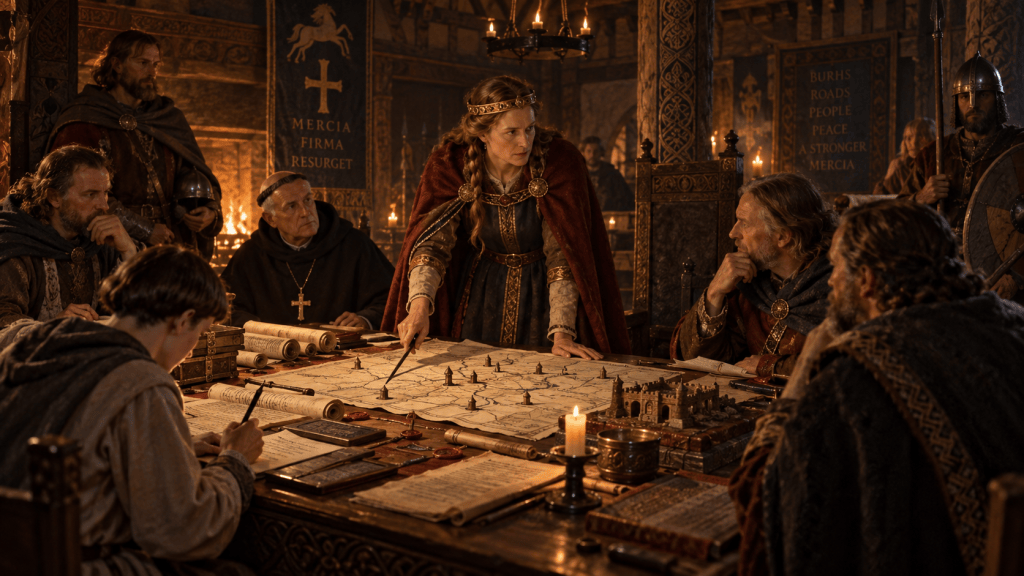
During a meeting before the campaigning season, a map of roads and rivers lay between brother and sister beneath the wavering light of tallow lamps. “If Derby is allowed to draw men from Leicester, the road into northern Mercia stays open,” Æthelflæd said as she rested two fingers beside the crossing. Edward moved a carved marker towards the Ouse and studied the distance between their armies. “Then I shall keep Bedford and Northampton looking east while you close upon Derby,” he replied as a clerk bent over the wax tablet. Æthelflæd lifted her gaze from the map as the lamp flame trembled between them. “Keep them looking towards you long enough, brother, and they may realise too late where the wall has closed.”
The year 917 brought the method to its fiercest test. Danish forces attacked Towcester and other defended places, seeking to break the new chain before it hardened, while garrisons held until help arrived from nearby burhs. Edward’s armies struck Tempsford and Colchester, repaired captured defences, and received the submission of East Anglia and Cambridge. Æthelflæd’s Mercians entered Derby after bitter fighting that killed four of the thegns dearest to her, then gained Leicester through submission during the following year. Each fall loosened the next alliance, since a Danish town facing a fortified enemy on every road could expect less aid from neighbours already fighting for their own survival.
By the summer of 918, Edward had reached Stamford and ordered a second borough raised on the southern bank of the Welland. The town’s northern population accepted his lordship while men worked upon the new defences, bringing another of the Five Boroughs beneath Anglo-Saxon power. Then the messenger arrived from Tamworth with word that Æthelflæd had died, and the partnership that had driven the reconquest forward ended within sight of its greatest success.
Edward rode into Mercia while grief and uncertainty moved through its halls. Æthelflæd’s daughter Ælfwynn possessed a claim to succeed her mother, and Mercian leaders had long memories of their kingdom’s former independence. “The lady’s oaths were given to Mercia as well as to her kin,” a Mercian thegn said as Edward’s household gathered at Tamworth. Edward removed his riding gloves and placed them beside the hall fire. “Her towns will keep their laws, their markets, and their protection,” he replied as rain ran from the hem of his cloak. “The army beyond those walls will judge us by whether those protections endure.”
The settlement carried a harder truth beneath such assurances. Edward received the allegiance of Mercian communities, secured Nottingham, and placed English and Danish inhabitants together inside its repaired defences. Later that year, Ælfwynn was deprived of authority and taken into Wessex, ending the separate Mercian rulership her mother had preserved. What had begun as a partnership between Wessex and Mercia became direct kingship, and the reconquest drew lands of differing custom, memory, and loyalty beneath a single royal centre.
Edward continued north-west, repairing Thelwall and Manchester before strengthening Nottingham’s southern bank and building near Bakewell. The Anglo-Saxon Chronicle later described Scottish, Northumbrian, and Strathclyde rulers choosing him as father and lord, language that proclaimed enormous prestige while falling short of direct government over their peoples. These recognitions were alliances, submissions, and promises shaped by immediate danger, yet they showed how far the political horizon had widened. A king who had begun his reign defending a disputed succession could now summon rulers far beyond Wessex into negotiation around his power.
When Edward died at Farndon in 924, he left a realm broader and more tightly governed than the one Alfred had entrusted to him. His victories had rarely rested upon a single celebrated battlefield, for they had grown through guarded rivers, repaired towns, disciplined garrisons, negotiated oaths, and walls raised close enough to support the next advance. Mercia’s separate court had vanished, East Anglia had submitted, and Danish authority south of the Humber had been broken into communities increasingly tied to Edward’s rule.
The kingdom was still unfinished, and York remained beyond the lasting reach of the West Saxon house. Edward’s son Æthelstan would inherit that final northern challenge, together with every tension created by conquest and consolidation. Alfred had preserved the ground from which recovery became possible, while Æthelflæd and Edward carried that recovery through the Midlands until the old borders could hold it no longer. England had yet to receive its single crown, though the roads leading towards it now passed through Edward’s gates.
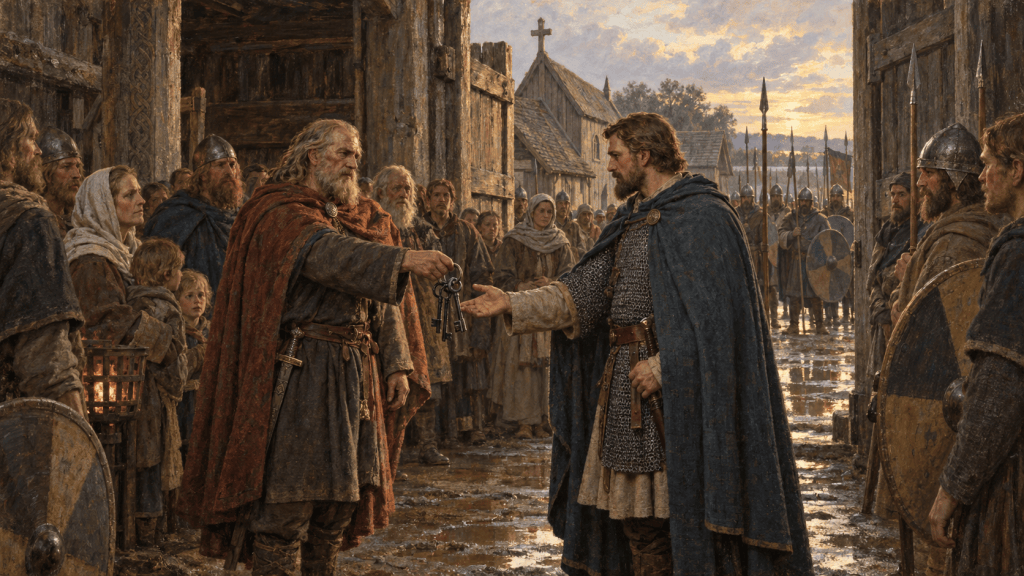
The gates of a Danelaw borough were surrendered to Edward the Elder, as fortified campaigns and steady pressure carried Anglo-Saxon authority deeper into Viking-held territory.
Inspiration Behind the Story
Edward’s reconquest draws much of its power from the absence of one decisive moment. His victories gathered through fortified towns, guarded crossings, reopened roads, patient alliances, and armies able to advance while leaving strength behind them. Alfred’s defences had preserved Wessex during its greatest danger; Edward took the same principles and turned them outwards, carrying survival into conquest.
What fascinates me about this period is how visibly power altered the landscape. A burh raised beside a river could secure an entire district. A garrison placed along an old road could allow merchants, messengers, and soldiers to move through land once exposed to attack. Each strongpoint became more than a wall, for it changed which ruler could offer protection and whose authority local communities were prepared to accept.
For storytelling, this creates a quieter form of momentum. Edward lived beneath Alfred’s formidable legacy and worked beside Æthelflæd’s Mercian achievements, yet his reign became more than a continuation of theirs. Her death brought grief, uncertainty, and political opportunity together, forcing him to hold Mercia while the wider reconquest remained unfinished.
This Chronicle matters because it reveals that England emerged through accumulation. The kingdom took shape through walls, roads, oaths, submissions, and repeated campaigns, until separate victories began to resemble a single design.
From the Author’s Desk
While writing this Chronicle, I kept returning to the strange position Edward occupies within the story of England. Alfred towers behind him, Æthelflæd stands beside him, and Æthelstan waits ahead as the king who would complete the conquest. Edward can seem caught between those more familiar names, even though the political landscape inherited by his son had been transformed during his reign.
That position made him especially interesting to write about. Edward inherited a system built for survival and discovered how to use it for expansion. He seems to have understood that lasting conquest depended upon more than winning a battlefield. Territory had to be held, roads guarded, rivers controlled, towns defended, and local loyalties drawn towards a ruler capable of protecting them.
I also found myself thinking about the personal weight carried through these campaigns. Edward worked alongside Æthelflæd as ruler, ally, and brother, while their separate armies pressed against Viking power from different directions. Her death in 918 brought grief into a moment of opportunity and uncertainty. Mercia had followed her leadership, and Edward now faced the delicate task of absorbing her kingdom while continuing the struggle they had shared.
Historical memory often gathers around the ruler who begins a great work or the one who completes it. Edward belonged to the more easily overlooked space between those two moments. Yet England could scarcely have emerged in the form it did without the roads he secured, the burhs he raised, and the territories he brought beneath his authority. His reign reminds me that some of history’s most important figures are found in the difficult middle, carrying an inheritance forward until an unfinished ambition becomes a political reality.
Edward inherited a realm strengthened by Alfred’s reforms, yet his succession in 899 remained vulnerable. His cousin Æthelwold, the son of Alfred’s elder brother, claimed the throne and found support among Danish forces in East Anglia. The rebellion ended after Æthelwold was killed at the Battle of the Holme in 902, allowing Edward to secure his kingship before turning towards the wider struggle beyond Wessex.
The principal narrative source for Edward’s reign is the Anglo-Saxon Chronicle, whose surviving versions differ in chronology and emphasis. The West Saxon record presents the expansion of Edward’s authority as a steady series of submissions, while the Mercian Register preserves a stronger sense of Æthelflæd’s independent leadership. These accounts reveal the broad sequence of events, though the political negotiations behind each oath, surrender, and transfer of power remain largely hidden.
Edward’s burhs served as more than defensive refuges. Positioned beside rivers, roads, bridges, and frontier settlements, they allowed garrisons to protect territory while royal armies advanced farther into the Danelaw. Their construction also brought administration, trade, taxation, and military service beneath expanding royal control. The reconquest therefore changed the government of recovered land as deeply as it changed the battlefield. The surviving Chronicle entries record this advance through Hertford, Witham, Buckingham, Bedford, Towcester, Stamford, and other strongpoints.
Related Events
The victory at Tettenhall in 910 weakened the Northumbrian Viking armies that had threatened Mercia and opened greater freedom for Anglo-Saxon expansion. Edward and Æthelflæd then advanced along connected fronts, with West Saxon pressure moving through East Anglia and the southern Danelaw while Mercian forces pushed towards Derby and Leicester. Their campaigns worked through coordination, fortified positions, and the gradual isolation of Danish-held boroughs.
Æthelflæd’s death at Tamworth on 12 June 918 created a difficult question of succession. Her daughter Ælfwynn briefly held authority in Mercia before Edward removed her and brought her into Wessex later that year. A peaceful union would be too simple a description. Edward gained direct control, though Mercian identity, loyalties, and political traditions remained powerful, shaping the succession that followed his death.
An entry generally assigned to 920 records that rulers from Scotland, Strathclyde, Northumbria, and Scandinavian York accepted Edward as “father and lord” near Bakewell. The statement reflected the wide reach of his power, though it should be understood as a claim of overlordship and negotiated recognition rather than permanent conquest. Edward died at Farndon in Mercia in 924, leaving Æthelstan to secure the succession, take York, and carry the unfinished making of England into its decisive final stage.
Further Reading
Edward the Elder, 899–924 – N. J. Higham and David Hill, editors The Making of England: A New History of the Anglo-Saxon World – Mark Atherton Æthelstan: The First King of England – Sarah Foot The Anglo-Saxon World – Nicholas J. Higham and Martin J. Ryan
Next Chronicle
Edward’s death in 924 left the Anglo-Saxon world transformed, though its final shape remained unsettled. West Saxon authority had spread across Mercia, East Anglia, and much of the former Danelaw, while the Viking kingdom of York still guarded the road towards a realm united beneath one crown.
At the centre of the next stage stood Æthelstan, Edward’s son, a prince raised among the Mercians and shaped by the military world created by Alfred, Æthelflæd, and Edward. His succession carried its own uncertainty, yet his ambitions soon reached beyond the lands his father had recovered, drawing him towards York and the last great centre of Scandinavian power in England.
What makes this next Chronicle so important is that Æthelstan’s reign carried the making of England towards its defining moment. When York fell beneath his authority in 927, the old division between the Anglo-Saxon south and the Viking north appeared to close, allowing one king to claim dominion across the lands that would become England.
The next Chronicle moves into the final act of this series, where decades of survival, fortified recovery, and patient reconquest converged beneath Æthelstan’s rule. The kingdom that earlier generations had preserved through marshes, walls, roads, and battlefields was ready to emerge beneath a single English crown.
Next Chronicle: Athelstan and the Birth of England
Alfred had taught Wessex how to survive; Edward carried its strength across roads, rivers, and fortified towns until a divided land stood close enough for Æthelstan to gather beneath one crown.
The daughter of Alfred who helped turn Mercia from a wounded kingdom into a force of recovery against Viking power.
The Daughter of Alfred and the Wounded Kingdom
The morning mist lay low over Tamworth, gathering in pale folds along the river and softening the edges of the timber halls, the church roof, and the watchmen moving along the palisade. Smoke rose slowly from the hearths of the town, grey against a sky still carrying the last colour of dawn, while beyond the walls the fields stretched damp and silent toward the roads that led east, where Viking power still held its grip upon much of the land.
Æthelflæd stood above the gate with her cloak drawn close around her shoulders, watching the world wake beneath her. The men below her moved with practised purpose, loading carts, checking spearheads, leading horses from their stalls. A messenger had ridden through the night, his mount white with foam, bringing word from the frontier. Another crossing had been tested. Another settlement had sent for reassurance. Another road needed guarding before fear could travel faster than soldiers.
Mercia had once been the great power of the Midlands, a kingdom whose name carried weight from the Welsh borderlands to the eastern rivers. Its kings had ruled with confidence, its churches had held learning and wealth, and its armies had stood among the strongest in Britain. Yet greatness could be wounded. Viking armies had broken through old certainties, taken towns, carved settlements into the land, and left Mercia divided between memory and survival. What remained now had to be held with timber, earthworks, oaths, and the steady nerve of those willing to rebuild under pressure.
“My lady,” a reeve said as he climbed the steps behind her, one hand gripping the rail while the other held a folded strip of parchment against his chest, “the riders from the west reached us before sunrise. They say scouts have been seen near the old road, moving in twos and threes, watching the crossings.”
Æthelflæd turned slightly, enough for the man to see that she had heard every word, though her gaze returned at once to the land beyond the gate.
“The crossings will be watched,” she answered, her voice calm as the cold morning air. “Send word to Stafford. The burh is to remain provisioned, and every bridge is to be counted before nightfall. If men are moving through the lanes, I want their path known before they believe themselves unseen.”
The reeve bowed his head, relief passing across his face as though certainty itself had been given to him. “As you command, my lady,” he said, before descending the steps with fresh urgency.
She remained where she was, listening as the order moved through the yard below. A scribe repeated the message. A rider called for his horse. Somewhere near the smithy, a hammer struck iron, sharp and steady, its sound carrying across the morning like a promise being forged.
Æthelflæd knew the weight that rested upon her name. She was Alfred’s daughter, raised in the shadow of a king who had dragged Wessex back from ruin and turned defence into design. She was Edward’s sister, bound by blood to the house that now carried the hopes of the West Saxons. She had been wife to Æthelred, lord of the Mercians, and through years of illness, war, counsel, and governance, she had learned the shape of this wounded realm from within.
Yet Mercia was more than an inheritance passed through marriage or alliance. It was a land of roads and rivers, border towns and old churches, proud nobles and anxious villages, each one looking toward Tamworth for strength. The people here remembered former greatness, though memory alone could guard no gate. If Mercia was to endure, it needed more than remembrance. It needed walls raised in the right places, armies sent at the right hour, and a ruler whose authority could settle fear before fear became collapse.
Below her, the gates opened, and the first riders passed out into the mist.
Æthelflæd watched them go, her face still, her thoughts already travelling beyond the river and the road. The struggle that had shaped her father’s life had entered a new generation. Wessex had survived. Mercia now had to rise.
A Visual Chronicle
Æthelflæd inherited a wounded Mercia, rebuilt its defences, and carried the fight back into Viking-held lands on the road towards England.
Timeline of Events
c. 879 AD – Æthelflæd, daughter of Alfred of Wessex, is married to Æthelred, Lord of the Mercians, strengthening the alliance between Wessex and Mercia.
886 AD – Alfred takes control of London and entrusts the city to Æthelred, placing Mercia at the centre of renewed Anglo-Saxon defence.
911 AD – Æthelred dies, and Æthelflæd becomes Lady of the Mercians, ruling Mercia in her own authority.
913–914 AD – Æthelflæd strengthens Mercia through a chain of fortified burhs, including Tamworth, Stafford, Eddisbury, Warwick, and Chirbury.
917–918 AD – Æthelflæd leads Mercian recovery against Viking power, taking Derby and receiving the submission of Leicester before her death at Tamworth in 918.
A Visual Chronicle
Watch a short visual telling of the Lindisfarne raid.
[Embedded Video]
About the Creator
This Chronicle is written by Simon Phillips, author of several historical and speculative fiction works exploring forgotten worlds, myth, and the turning points of history.
The account that follows moves deeper into the wounded heart of Mercia, where Æthelflæd stepped from the shadow of Alfred’s world into authority of her own, and where the defence of fortified towns, river roads, borderlands, and old Mercian memory helped turn survival into advance against Viking power.
Readers supporting The Forgotten Chronicle may continue into the full record below.
Subscribe to continue reading
Subscribe to get access to the rest of this post and other subscriber-only content.
How a king shaped by exile rebuilt Wessex into a kingdom strong enough to endure.
After the Marshes
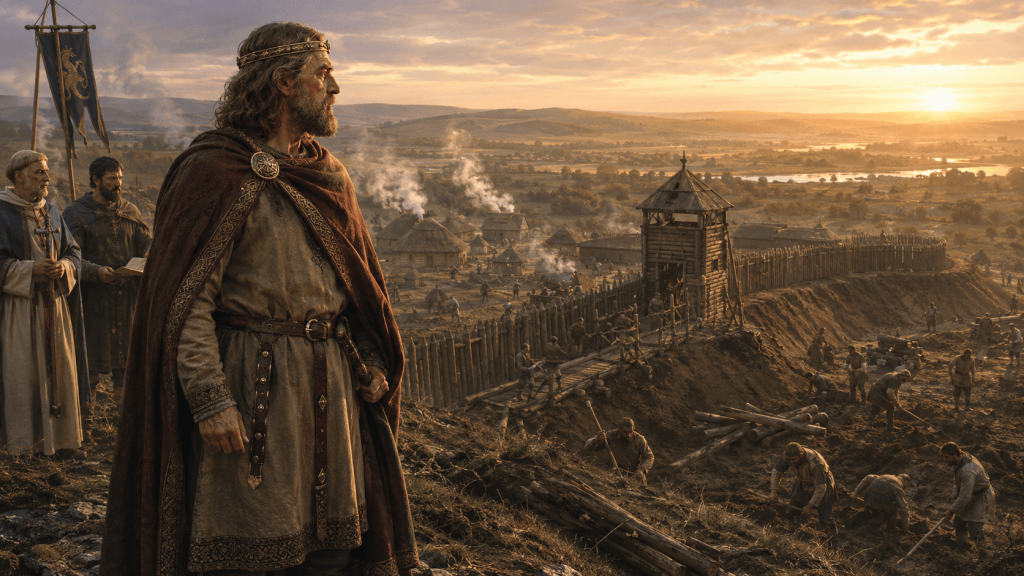
Morning settled over Wessex with the pale patience of a land that had survived too much to greet the light with ease. Across the low fields, mist clung to the grass in silver folds, and smoke rose from hearths where families had returned to homes once emptied by fear. The roads still bore the memory of war. Cart ruts cut through damp earth, fences leaned where men had torn timber for firewood, and church bells rang across villages where prayer had become a habit of endurance as much as devotion. In the distance, beyond the fields and grazing land, men worked along the line of a new defence, driving posts into the ground while others hauled stone, timber, and earth beneath the watchful eyes of royal officials.
Alfred watched from a slight rise above the settlement, his cloak drawn close against the morning chill. He had come through marsh water, hunger, secrecy, and the long shadow of defeat, and Edington had given him victory enough to breathe. Yet the king’s gaze rested less on the memory of battle than on the men below him, the labourers setting walls where open ground had once invited danger, the clerks marking supplies upon wax tablets, the priests moving between workmen with quiet words of encouragement. A kingdom could be saved by courage in a single hour, though it could only endure through labour repeated day after day until fear itself found fewer doors left open.
“My lord,” one of his companions said as he stepped closer, boots dark with wet grass. “The men ask where the next ditch should be cut.”
Alfred turned, studying the line of ground that sloped toward the road. His face carried the weariness of a man whose triumph had offered duty instead of rest.
“There,” Alfred said, lifting his hand toward the lower ridge. “The road must remain watched from the gate. A wall that guards only itself serves the enemy more than the town.”
The official bowed his head and hurried away, calling orders across the work line. Voices answered, rough and practical, and soon the dull thud of tools began again. Each strike seemed small against the wide morning, yet together they made a sound unlike battle. It was steadier, heavier, shaped by purpose instead of panic.
Beside Alfred, a priest wrapped in a plain woollen cloak looked over the settlement with tired eyes. “The people still speak of the Danes,” he said, his fingers resting upon the small cross at his breast. “They ask whether Guthrum’s baptism will hold, whether peace has truly come.”
Alfred’s expression shifted only slightly. “Peace has come for a season,” he replied, his voice low. “A season must be used wisely.”
The priest looked at him then, as though hearing the king beneath the survivor.
“And if the storm returns?”
Alfred kept his gaze on the rising timber wall, where men strained together beneath the weight of a beam. “Then it will find a kingdom with gates, roads, law, learning, ships, and men ready to answer. We have lived too long as scattered fires. It is time Wessex burned as one hearth.”
The priest said no more. Below them, the settlement continued to take shape, rough and incomplete, its future still vulnerable to weather, hunger, ambition, and the sea. Yet something had changed. The years before had taught Alfred how swiftly a kingdom could be broken. The years ahead would show whether one could be rebuilt strongly enough to stand.
Timeline of Events
878 AD – Alfred defeats Guthrum at Edington, ending the immediate Viking threat to Wessex and giving the kingdom space to recover.
878 AD – Guthrum accepts baptism after his defeat, creating a fragile peace between Alfred’s Wessex and the Viking ruler who had nearly destroyed it.
c. 879–880s AD – Alfred begins strengthening Wessex through fortified burhs, organised defence, improved administration, and renewed royal authority.
886 AD – Alfred takes control of London, restoring a major centre of trade and power while drawing wider English loyalty toward his rule.
c. 890s AD – Alfred promotes law, learning, translation, and written wisdom, shaping a kingdom built for memory as well as defence.
A Visual Chronicle
Alfred survived the Vikings, but rebuilding Wessex would help shape the future of England.
About the Creator
This Chronicle is written by Simon Phillips, author of several historical and speculative fiction works exploring forgotten worlds, myth, and the turning points of history.
The account that follows moves beyond the marshes of Athelney and into the years after Edington, when Alfred turned survival into structure and began rebuilding Wessex through fortified towns, renewed law, learning, defence, and royal authority strong enough to withstand the storms that had almost broken the kingdom.
Readers supporting The Forgotten Chronicle may continue into the full record below.
Subscribe to continue reading
Subscribe to get access to the rest of this post and other subscriber-only content.
The fugitive king of Wessex, the hidden refuge of Athelney, and the fragile resistance that kept Anglo-Saxon England from disappearing.
The King Among the Reeds
The winter light lay thin across the marshes, silvering the reed beds and the slow black water that wound through the hidden places of Somerset. Mist gathered low over the channels, drifting between alder roots and drowned grass, softening the world until land and water seemed to fold into one muted expanse. Somewhere beyond that quiet reach, Viking fires burned in captured halls, and the roads of Wessex carried rumours of defeat from village to village. The king who had once ridden beneath the protection of household men, priests, messengers, and royal expectation now moved through wet earth and secrecy, wrapped in the rough cloak of a man hunted by the enemies who had broken into the heart of his kingdom.
Alfred had reached the marshes after the blow at Chippenham, when Guthrum’s army struck deep into Wessex during the cold season and shattered the confidence that remained around the royal house. The attack came during a time when men expected feasting, rest, and the slower duties of winter, yet war seldom honoured the habits of Christian kingdoms. Royal halls emptied into fear. Companions scattered into the countryside. Oaths bent beneath pressure as families weighed survival against loyalty, while across Wessex some submitted, some fled, and others waited in silence to see whether the house of Cerdic still possessed a king worth following.
Athelney offered little splendour to a ruler born into sacred ancestry and trained amid the burdens of command. It was a low island amid water and reeds, half-hidden from the roads that carried armies, surrounded by marshland that swallowed careless footsteps and confused strangers who lacked local knowledge. To those who knew its paths, it offered concealment, and to Alfred it became refuge, fortress, chapel, and council chamber within the same narrow refuge. Here, kingship shed its gold. Authority became a damp cloak, a shared fire, a whispered message carried after dusk, a blade kept dry beneath cloth, and a prayer spoken softly while enemies held the roads beyond the wetlands.
The men who gathered around him came in fragments from the broken edges of the kingdom. A loyal thegn came by one hidden path, a household warrior by another, a messenger crossing through mist and water with news from estates and villages still willing to resist. Each arrival mattered because each man brought more than strength. He brought proof that Wessex still remembered itself. A kingdom could lose towns, treasure, open roads, and royal halls, yet endure for a time if its people still believed the centre lived somewhere beyond sight.
In later memory, Alfred’s time in the marshes gathered stories around itself: the hidden king, the poor shelter, the cakes left to burn while his thoughts remained fixed upon war and survival. Whether every detail belonged to truth or legend, the deeper meaning endured. A king had been driven to the edge of his realm and stripped almost bare, and that edge became the place where endurance hardened. In the reeds of Athelney, beneath winter sky and watchful silence, the future of Anglo-Saxon England rested upon a fugitive king who still refused to yield.
Timeline of Events
871 AD – Alfred becomes king of Wessex after the death of his brother Æthelred, inheriting a kingdom already strained by repeated Viking attacks.
876 AD – Guthrum’s Viking army enters Wessex and takes Wareham, forcing Alfred into negotiation while the threat to his kingdom deepens.
877 AD – Viking pressure continues across southern England, leaving Wessex increasingly isolated as other Anglo-Saxon kingdoms weaken or fall under Scandinavian control.
January 878 AD – Guthrum launches a surprise winter attack on Chippenham, driving Alfred from the royal centre and scattering much of the West Saxon resistance.
878 AD – Alfred withdraws into the marshes of Athelney, where he gathers loyal men, rebuilds his strength, and prepares the resistance that will soon return from hiding.
A Visual Chronicle
Driven from his kingdom and hidden among the reeds of Athelney, Alfred the Great began gathering the scattered resistance that would keep Wessex alive.
About the Creator
This Chronicle is written by Simon Phillips, author of several historical and speculative fiction works exploring forgotten worlds, myth, and the turning points of history.
The account that follows moves deeper into the marshes of Athelney, where Alfred’s kingship passed through its darkest test after the winter attack on Chippenham, and where the survival of Wessex depended upon hidden paths, loyal men, and the quiet endurance of a fugitive king gathering strength among the reeds.
Readers supporting The Forgotten Chronicle may continue into the full record below.
The Hidden King of Athelney
The marshes of Athelney lay far from the clean roads and open halls of Wessex, hidden among water, reed beds, alder roots, and low islands where a stranger’s horse could sink into black earth before its rider understood the ground beneath him. In winter, mist rose from the channels and moved across the wetland in pale sheets, softening the edges of trees, banks, and paths until the whole place seemed shaped for secrecy. Alfred came into that silence stripped of the splendour that usually surrounded kingship. The royal hall had fallen behind him, his household had scattered, and Guthrum’s men held the advantage gained through sudden winter violence. Around the fugitive king gathered only the few who had found their way through fear, water, and darkness to reach him.
The blow at Chippenham had cut deep into Wessex at the opening of 878, when the cold season should have slowed the business of war. The Christmas feasts had only recently passed, and men across the kingdom would have expected hearths, prayers, repairs, and the hard quiet of winter. Guthrum chose that moment for speed. His army struck into the royal centre and shattered the fragile order Alfred had fought to preserve since taking the crown. In the confusion that followed, loyalty became a test carried in each man’s chest. Some sought safety under Viking authority. Some vanished into the countryside. Others watched the roads and waited for a rumour that might prove the king still lived.
In Athelney, the world narrowed to survival. Firewood had to be gathered where smoke would draw few eyes. Food had to be carried across wet ground and shared among men whose strength would soon be needed. Weapons had to be wrapped against damp and held close through long nights. The men around Alfred slept lightly, waking at the shift of reeds or the distant call of birds, hearing danger in every broken sound from the marsh. A king who had heard Latin in royal instruction, who had ridden beside warriors and spoken with bishops, now shared the same cold, hunger, and watchful silence as the companions who stayed with him. The marshes allowed no illusion of grandeur. They accepted only endurance.
Athelney’s strength lived in its hidden nature. Roads rarely favoured it. Armies could find little ease there. Water divided the land into passages known best by local people, and each pool, bank, and channel worked against those who came in haste. To Viking warriors used to speed along roads and rivers, the wetland offered frustration. To Alfred and those who guided him, it became a shield wider than any wall. The place guarded him by confusion, by distance, by the plain difficulty of moving through a landscape that seemed to shift beneath the weather. There, among the reeds, royal power survived by becoming small enough to escape notice.
The first men who gathered around Alfred came by fragments, each arrival bringing more than a body to the hidden camp. A thegn crossing by a secret path brought news from estates still loyal. A household warrior carried memory of the king’s earlier battles. A messenger arriving through dusk brought word of villages where men still kept weapons close and waited for a summons. These men arrived cold, tired, and careful, yet every arrival strengthened the same quiet truth. Wessex had lost its centre in sight of the world, yet its centre still breathed somewhere in the marshes. A kingdom could lose halls, treasure, and open roads, while its will survived inside men who still answered their king.
Alfred’s task in those weeks reached beyond concealment. He had to become a living sign that the kingdom had a future. A dead king would have ended much. A king lost to silence might have achieved almost the same. A king hidden, breathing, planning, and sending messages through the wetland edge became something far more dangerous to Guthrum than a defeated ruler fleeing through winter mud. He became a promise that Wessex had only bent beneath the blow. The work around him must have been patient and exacting: names remembered, loyalties tested, meeting places chosen, food secured, scouts sent, and hope passed quietly from one trusted hand to the next.
Later memory placed one of its most human stories within this hardship. The tale of the burned cakes showed Alfred sheltering in a poor woman’s dwelling, so burdened by thought that he allowed cakes beside the fire to blacken while his mind remained fixed upon war and survival. The story belonged to legend as much as record, shaped through generations that wished to see the great king humbled before his return. Its exact shape lay beyond certainty, yet its meaning endured because it brought Alfred close to ordinary life. In that tale, he was a weary man beside a hearth, subject to rebuke, weighed down by a kingdom’s ruin while small domestic labour continued around him.
The deeper truth of the marshes required no legend. Alfred held fast while the land around him remained uncertain. The men who supported him worked through shadows, carrying news through Somerset and beyond, keeping alive the channels of obedience that had once flowed openly through the kingdom. Priests, local landholders, warriors, guides, and families whose names slipped from record all helped preserve the line of resistance. Their part rarely received the brightness of battle, yet the recovery of Wessex depended upon such hidden labour. The future being formed in Athelney rested as much upon quiet service as upon the king’s own resolve.
As winter loosened and spring approached, Alfred’s refuge became more than a place of escape. A small stronghold rose there, giving shape to the resistance that had gathered in secrecy. From Athelney, men could raid, watch, and prepare, striking at the edges of Viking control while Alfred rebuilt the confidence needed for open war. Each act carried meaning beyond its immediate gain. A road watched again, a band of men gathered again, a message answered again; these signs told Wessex that the royal line had regained movement. The Vikings had seized the visible heart of the kingdom, yet the heart beyond sight had begun to beat with greater force.
Then came the moment when hiding could turn toward action. Alfred sent word for the fighting men of Somerset, Wiltshire, and Hampshire to gather at Egbert’s Stone. The summons carried the weight of everything endured in the marshes. Men who had waited through fear now had a place to go. Those who had doubted the kingdom’s survival now had proof of its return. The gathering at Egbert’s Stone would lead toward the field at Edington, where Alfred would face Guthrum in open battle and change the course of the war. Yet that visible victory began in the hidden places, in the damp nights and secret paths of Athelney, where defeat had been held back one breath at a time.
The marshes stripped kingship down to its last foundation. A crown held meaning only while men still believed in the one who wore it, and Alfred’s authority survived because enough people chose to carry that belief through danger. He entered Athelney as a fugitive, pursued by the consequences of a shattered kingdom. He emerged with resistance gathered around him and the road to renewal opening ahead. The reeds and mist had sheltered more than a hidden king. They had guarded the remaining will of Wessex, and through that fragile endurance, the making of England continued.
Alfred stands among the marshes of Athelney, where the hidden strength of Wessex began to gather again beneath mist, water, and winter light.
Inspiration Behind the Story
Alfred’s time in the marshes holds its power because it begins with loss instead of triumph. The image of a king hidden among reeds, water, mist, and uncertain paths carries a quieter force than any battlefield. Wessex had been wounded almost to breaking, its royal centre shaken, its loyalties strained, and its future reduced to the survival of one hunted ruler in a place far from splendour.
What fascinates me about this moment is how history sometimes turns in hidden spaces before it returns to the open field. The marshes of Athelney gave Alfred more than shelter. They gave him time, concealment, and the chance to gather scattered courage into something that could move again. The great victory that followed at Edington began here, in hardship, secrecy, and endurance.
For storytelling, this is one of the strongest images in Anglo-Saxon history. A king who had nearly lost everything survived in a landscape that seemed poor, cold, and forgotten, while the future of a kingdom gathered around him in fragments. That contrast gives the Chronicle its emotional centre.
This Chronicle matters because it reminds us that survival can become its own form of command, and that a kingdom’s future can sometimes begin again in the places where power appears to have vanished.
From the Author’s Desk
What stayed with me while writing this Chronicle was the image of kingship reduced to its barest form. Alfred’s story in the marshes carries none of the splendour usually attached to royal power. There were no shining halls, no easy procession of loyal nobles, no visible centre from which command could be seen. There was water, cold ground, hidden paths, and the quiet labour of staying alive long enough for resistance to gather again.
That is what makes Athelney so powerful to me. It shows history at the point where everything grand has fallen away, leaving only endurance. Alfred’s authority survived because men still chose to answer him, even when the roads were dangerous and the kingdom’s future looked uncertain. A crown meant very little in the reeds unless loyalty still moved through the hands of those willing to carry messages, food, weapons, and hope.
There is a strong storytelling truth inside this moment. The turning point arrives before the famous battle. It begins in secrecy, hardship, patience, and the decision to keep going when defeat appears almost complete. Athelney reminds us that survival can become the foundation of renewal.
This series continues to interest me because the making of England passed through fragile places. Before unity, before victory, before later memory shaped Alfred into a legendary king, there was a hunted ruler in the marshes, waiting for the moment when Wessex could rise again.
Alfred’s withdrawal into the Somerset marshes followed Guthrum’s surprise attack on Chippenham in early 878 AD. The attack struck at the royal centre of Wessex during the winter season, scattering Alfred’s followers and placing the kingdom under severe pressure. The Anglo-Saxon Chronicle records that Alfred escaped with a small company into the woods and marsh-fastnesses, a detail that gives this episode its enduring sense of danger and isolation.
Athelney itself lay within the wetland landscape of the Somerset Levels. Its value came from concealment, difficult access, and local knowledge. To an army seeking swift movement, the marshes formed a frustrating and uncertain environment. To Alfred and his supporters, they offered protection, time, and a base from which resistance could survive. Later tradition remembered Alfred building a stronghold there, turning a hidden refuge into the centre of renewed West Saxon resistance.
The famous story of Alfred and the burned cakes came from later tradition, especially through accounts associated with Alfred’s growing legend. Its historical detail remains open to question, yet its symbolic force explains why it survived. It presents Alfred as humbled, distracted, and human during a moment of extreme pressure, far from royal splendour and close to ordinary life. Whether literal event or moral tale, it deepened the image of a king tested in hardship before his return.
Related Events
Alfred had become king of Wessex in 871 AD after the death of his brother Æthelred. His early reign was shaped by repeated conflict with Viking forces, including the battles and negotiations that followed the arrival of large Scandinavian armies in southern England. By 878 AD, Wessex stood as the main surviving Anglo-Saxon kingdom still capable of organised resistance.
Guthrum’s attack at Chippenham marked one of the greatest crises of Alfred’s reign. The Viking leader came close to breaking Wessex as an independent kingdom, forcing Alfred into hiding and compelling many West Saxons to submit or wait in uncertainty. The months at Athelney became the bridge between near-collapse and renewed action.
After gathering strength in the marshes, Alfred summoned men from Somerset, Wiltshire, and Hampshire to Egbert’s Stone. From there, the restored West Saxon force moved toward the Battle of Edington, where Alfred defeated Guthrum and forced a settlement that reshaped the struggle between Saxon and Viking power. Athelney therefore stands as the hidden beginning of the victory that followed.
Further Reading
Alfred the Great: Asser’s Life of King Alfred and Other Contemporary Sources – translated by Simon Keynes and Michael Lapidge
Alfred the Great: War, Kingship and Culture in Anglo-Saxon England – Richard Abels
The Anglo-Saxon World – Nicholas J. Higham and Martin J. Ryan
The Viking Wars of Alfred the Great – Paul Hill
Next Chronicle
Alfred had survived the marshes, gathered the strength of Wessex from hidden places, and prepared to return from the edge of ruin. Athelney had stripped kingship down to endurance, secrecy, loyalty, and faith, yet survival alone could never secure a kingdom for long. Once the danger had passed its darkest hour, Alfred faced a greater task: rebuilding a realm strong enough to endure the next storm.
The victory that followed at Edington gave Wessex breathing space, although it also revealed how fragile the old order had become. Roads, towns, defences, learning, law, and royal authority all required renewal. Alfred’s greatness rests in more than the defeat of Guthrum. It rests in what came after, when a king shaped by hardship began turning survival into structure.
What makes this next Chronicle so important is that Alfred’s England shows the making of a kingdom through deliberate repair. The burhs strengthened defence. Law gave order. Learning restored memory. Ships, roads, fortified towns, and written wisdom became part of a wider vision in which Wessex could stand firm while the wider Anglo-Saxon world continued to change around it.
The next Chronicle moves from the hidden refuge of Athelney into the rebuilding of a kingdom, where Alfred’s rule became more than resistance and began to shape the foundations of an England that could outlast invasion, fear, and the broken years that had almost consumed it.
Next Chronicle: Alfred’s England
The marshes kept their silence, yet from that silence Wessex began to rise again.
Before the marshes, before the legend, there was a youngest son growing inside a kingdom learning how close disaster could come.
The Prince Before the Legend
The morning light came gently over Wessex, spreading across chalk ridges, timber halls, church roofs, sheep pasture, wooded valleys, and the long roads that tied royal estates to bishoprics, river crossings, and borderlands. This was still a divided island, shaped by rival crowns, older British territories, Mercian memory, church learning, and the restless pull of the sea, yet Wessex already carried a harder outline than many realms around it. Its kings understood that power lived in movement as much as inheritance, in marriage, pilgrimage, battle, counsel, and the slow gathering of loyalty from halls where men listened closely whenever travellers arrived with news from beyond the horizon.
Into that world Alfred was born, youngest son of King Æthelwulf, a child placed deep within the royal household of a kingdom that expected its princes to serve long before any crown came near them. His elder brothers stood before him in the line of succession, each shaped by duty and watched by those who measured the future through blood, land, and alliance. Alfred’s earliest years would have seemed small beside theirs, framed by prayer, instruction, household discipline, and the nearness of power carried by others, yet childhood inside a royal hall was never a quiet thing. Even a youngest son learned the sound of armour being lifted from pegs, the murmur of priests beside candlelit manuscripts, and the way adult voices lowered whenever danger entered the room by rumour.
Those rumours travelled quickly through the Anglo-Saxon world. A merchant from the coast might bring word of ships sighted in hard weather, their sails cutting through mist where only fishermen should have been. A cleric might speak of monasteries stripped of treasure, of frightened communities watching the sea with new dread, of sacred places discovering that prayer alone could never bar an oar-driven hull from shore. Names that once belonged to distant politics began to gather the weight of warning. The northern kingdom had fractured before York fell. Mercia’s old dominance had thinned beneath the strain of changing power. East Anglia had suffered beneath Viking violence, and Edmund’s death had already begun its passage from royal tragedy into sacred memory.
Wessex listened to these stories from the west, close enough to understand their meaning and far enough away to imagine time still remained. In Alfred’s childhood, faith and rulership pressed close together. A prince could be taught scripture in one chamber while armed men spoke of levies, borders, and ships in another. The journey to Rome, remembered in later tradition, placed him within the wider world of Christian authority while he was still young, giving the boy a vision of kingship that reached beyond the halls and fields of his own people. Sickness also followed him through life, according to the accounts that later shaped his memory, and even before kingship claimed him, his body carried its own private struggle.
Before the marshes, before Edington, before burhs, laws, learning, and the name that later generations would bind to greatness, Alfred was a boy growing inside a kingdom that had begun to understand how near ruin could come. His story opened in childhood, family, faith, illness, and inheritance, while the shadow moving across the Anglo-Saxon kingdoms crept ever closer to Wessex.
A Visual Chronicle
Before Alfred became the defender of Wessex, he was a young prince growing beneath the shadow of a Viking threat moving ever closer.
Timeline of Events
c. 849 AD – Alfred is born at Wantage, youngest son of King Æthelwulf of Wessex, far from the direct line of royal expectation.
853 AD – Alfred is sent to Rome as a child, where later tradition records that Pope Leo IV received him with honour.
855–856 AD – King Æthelwulf travels to Rome, taking Alfred with him, placing the young prince within the wider world of Christian kingship and continental power.
858 AD – Æthelwulf dies, leaving Alfred’s elder brothers to rule in succession while Wessex faces a changing and dangerous political world.
865 AD – The Great Heathen Army lands in East Anglia, turning Viking pressure from coastal raiding into a deeper threat to the Anglo-Saxon kingdoms.
About the Creator
This Chronicle is written by Simon Phillips, author of several historical and speculative fiction works exploring forgotten worlds, myth, and the turning points of history.
The account that follows moves deeper into Wessex and the royal household that shaped Alfred’s early life, from the rule of King Æthelwulf and the journey to Rome to the burden of illness, inheritance, and Viking pressure gathering beyond the borders of the kingdom.
Readers supporting The Forgotten Chronicle may continue into the full record be
Subscribe to continue reading
Subscribe to get access to the rest of this post and other subscriber-only content.
How King Edmund’s death became the wound and witness of a fallen kingdom.
Where rumour reached the marshes before the army
The eastern sky had begun to pale over a low country of river bends, reed beds, grazing fields, and winter mist, where the chill gathered softly across the open land before the first hearth smoke rose above the settlements. East Anglia had always lived with water close at hand, with the sea beyond the flat horizon and the rivers carrying life inland through fields, churches, royal estates, and small communities shaped by tide, trade, and prayer. Ships could arrive kindly in such a place, bringing merchants, pilgrims, messages, and goods from distant shores, yet the same waters could also bear men whose purpose had hardened long before their keels touched land.
Across the kingdom, rumours moved faster than certainty. Northumbria had already been broken by the armies from over the sea, and York had fallen into hands that understood how to turn a raid into possession. Mercia, once the great weight of Anglo-Saxon power, had begun to bend beneath pressures gathering beyond its control. Travellers carried these stories in lowered voices beside hearths, in church porches, at river crossings, and along muddy roads where packhorses slipped beneath their loads. What had first come as raiding now moved like occupation, and each tale carried the same uneasy truth: the Viking armies had learned how England could be entered, crossed, and held.
East Anglia stood in their path with its wealth spread through fields, minsters, market routes, and riverways. It lacked the broad strength of Mercia and the hardening frontier spirit that would later shape Wessex under Alfred, yet it held grain enough to feed warriors, horses enough to serve a campaign, and land open enough to become a base for further war. A smaller kingdom could still matter greatly when larger forces needed shelter, supplies, and obedience. That knowledge gave the eastern land its value, and value, in such years, drew violence as surely as carrion drew ravens.
At the centre of the kingdom’s remembered sorrow stood Edmund, king of East Anglia, whose name would pass from the uncertain politics of the ninth century into the deeper realm of sacred memory. Later generations would picture him as a martyr, a ruler faced by heathen power and remembered through death with a force greater than any victory he could have claimed in life. The details would be shaped by chronicles, devotion, and legend, yet beneath them lay a harsher historical truth: East Anglia faced an army whose arrival could strip a kingdom of its ruler, its security, and its future within a single season of fear.
Perhaps the first warning came as smoke along a distant track. Perhaps it came through a rider, mud-spattered and exhausted, bringing news that armed strangers had crossed land once thought safely removed from the old centres of power. However the message reached Edmund’s court, it belonged to the same age of unravelling that had already consumed kingdoms to the north and shaken those to the west. A decision would soon be forced upon him, shaped by faith, kingship, survival, and the terrible limits of resistance.
The story of East Anglia’s fall began in that narrowing space between rumour and arrival, where a kingdom could still hear its church bells, gather its people, and imagine endurance, while beyond the mist the road carried an army towards it.
A Visual Chronicle
As the Great Heathen Army moved through the winter mist, East Anglia waited beneath the rule of a king whose defeat would become one of the most enduring memories of Anglo-Saxon England.
Timeline of Events
855 AD – Edmund is traditionally remembered as becoming king of East Anglia, entering a reign later preserved through devotion, coins, and the memory of his death.
865 AD – The Great Heathen Army enters England and winters in East Anglia, where the local people make peace and provide horses to the invaders.
866 AD – The Viking army leaves East Anglia and moves north to capture York, turning Northumbria’s division into conquest.
869 AD – The army returns to East Anglia, overruns the kingdom, and Edmund is killed during the Viking campaign.
c. 870s–900s AD – Edmund’s memory begins to grow beyond defeat, with later tradition shaping him as a martyr and sacred symbol of East Anglian endurance.
About the Creator
This Chronicle is written by Simon Phillips, author of several historical and speculative fiction works exploring forgotten worlds, myth, and the turning points of history.
The account that follows moves deeper into East Anglia’s final season of independence, where Edmund’s kingship met the force of an army that had already learned how to break kingdoms, gather horses, and turn wintering ground into conquest. What began as pressure upon the eastern roads would become the fall of a realm, and from that defeat Edmund’s memory would rise as one of the strongest symbols of Anglo-Saxon endurance.
Readers supporting The Forgotten Chronicle may continue into the full record below.
Subscribe to continue reading
Subscribe to get access to the rest of this post and other subscriber-only content.
How the kingdom that once bent Anglo-Saxon Britain around its will began to lose its place at the centre of power.
When Old Power Began to Slip
Mist lay low across the Mercian heartland, caught in the hollows of the fields and gathered along the slow bends of the rivers. It softened the shape of timber halls, church roofs, cattle tracks, and royal roads until the kingdom seemed half-remembered even by those who lived within it. Smoke rose from village hearths in thin grey lines. Hooves pressed damp earth into the lanes. Somewhere beyond the morning haze, a reeve counted dues owed to a lord whose lord owed service to a king, and the old machinery of Mercian power turned on as it had for generations.
There had been a time when that machinery moved much of Anglo-Saxon Britain. Under Æthelbald and Offa, Mercia had stood at the centre of the island’s politics with a force few rivals could ignore. Its kings had reached south and east through pressure, alliance, war, and marriage, binding lesser rulers to their will and making distant courts measure their choices against Mercian ambition. Along the western border, Offa’s great dyke rose through the landscape like a wound cut into earth and memory, facing the hills beyond as a reminder that Mercia had once shaped the very edges of its world.
By the middle years of the ninth century, the kingdom still carried the marks of that greatness. Its estates fed royal households. Its churches held learning, wealth, and influence. Its nobles gathered in halls where carved posts darkened with smoke and blades hung close to hand. A Mercian king could still sit among his counsellors beneath a roof heavy with old authority, hearing disputes, weighing tribute, receiving messengers from neighbouring kingdoms. From a distance, little seemed broken. The banners still rose. The roads still carried orders. The language of power remained familiar.
Yet the island around Mercia had changed. Rival kingdoms had grown harder to bend. Wessex, once watched and pressed by Mercian strength, had begun to stand with a firmer spine. The northern kingdoms had shown how quickly ambition could tear a realm inward. Across the sea, longships had started turning rumour into fear, and each year brought fresh stories of sails appearing where peace had once been assumed. Mercia’s danger came through this slow rearranging of the world, through influence lost by degrees, through obedience that arrived later than before, through neighbours who listened with courtesy while making their own calculations.
That was the quiet tragedy of fading power. It rarely broke in a single blow. It lingered in titles, in ceremonies, in oaths repeated because custom demanded them, in the confidence of men raised beneath stories of older greatness. Mercia remained alive, wealthy, proud, and dangerous, still strong enough to matter in every struggle ahead. Even so, beneath the mist and the smoke, beneath the tolling bells and the footsteps on the roads, the ground had begun to shift. The giant still stood over the centre of England, yet the world beneath its feet had started moving away.
A Visual Chronicle
Mercia still stood at the heart of England, yet the world was already learning to move beyond its power.
Timeline of Events
757 AD – Offa becomes king of Mercia, beginning a reign that turns the kingdom into the dominant power across much of Anglo-Saxon Britain.
796 AD – Offa dies, leaving Mercia with a powerful legacy, yet also a harder struggle to preserve the authority his reign had built.
825 AD – Ecgberht of Wessex defeats King Beornwulf of Mercia at the Battle of Ellandun, breaking Mercian influence over much of southern England.
829 AD – Ecgberht briefly takes control of Mercia, showing how sharply the balance of power had shifted toward Wessex.
868 AD – Viking forces occupy Nottingham, drawing Mercia and Wessex into uneasy cooperation against a threat neither kingdom could ignore.
About the Creator
This Chronicle is written by Simon Phillips, author of several historical and speculative fiction works exploring forgotten worlds, myth, and the turning points of history.
The account that follows moves deeper into Mercia’s fading centre of power, where the memory of Offa’s greatness still shaped royal ambition, even as Wessex rose, rival kingdoms slipped beyond Mercian command, and Viking pressure began to expose the limits of an older supremacy.
Readers supporting The Forgotten Chronicle may continue into the full record below.
Subscribe to continue reading
Subscribe to get access to the rest of this post and other subscriber-only content.
The rival kings, broken loyalties, and deepening fractures that left England’s northern power exposed before the fall of York
The Kingdom That Had Begun to Fracture
Rain darkened the roofs of York and slid from the timber eaves in steady threads as men gathered inside the royal hall, their cloaks heavy from the road and their boots carrying the grit of the city across the rush-strewn floor. Beyond the doors, Northumbria’s greatest settlement moved through another cold morning beneath a low northern sky. Smoke lifted from workshops near the river. Traders called beside carts of wool, grain, and worked metal. Bells sounded from churches raised among older Roman stone, their voices rolling across streets shaped by centuries of rule. York still looked like the heart of a powerful kingdom, yet within the hall its strength had begun to loosen.
King Ælla sat beneath the high beams while nobles arranged themselves before him with measured care, each bow offered correctly, each expression guarded a shade too long. His crown had come through upheaval, after Osberht was driven from power, and the memory of that break remained alive among the men who filled the chamber. Some had accepted the new king because the realm required order. Some carried older loyalty beneath closed mouths. Others watched for advantage, weighing which name might serve them best if the balance shifted again. Spears rested against the walls. Scribes waited beside wax tablets. Priests stood near the edge of the gathered court, their faces composed, their attention fixed upon every hesitation that passed between lord and king.
Northumbria had once seemed able to hold the north through force, sanctity, and reputation alone. Its rulers had commanded armies across wide territories. Its monasteries had preserved learning admired far beyond Britain’s shores. Lindisfarne, Wearmouth, Jarrow, Hexham, and York had placed sacred weight upon the kingdom’s name, binding royal authority to a landscape of saints, scholars, and kings. Yet such splendour carried little comfort when allegiance thinned inside the ruling house itself. The hall remained warm from hearth fire, yet unease moved through it like cold air slipping under a door.
A messenger entered while the court still murmured around a dispute over land and tribute, dropping to one knee as rainwater darkened the floor beneath him. Ælla turned towards the man, one hand resting upon the carved arm of his seat, while nearby nobles shifted with the faint restlessness of men expecting unwelcome news. The message concerned another estate, another refusal, another local quarrel sharpened by divided loyalty. Nothing within it sounded large enough to threaten a kingdom on its own, yet the room received it with weary recognition. Such fractures had become familiar. Authority had to be argued, carried, reinforced, and watched.
Far beyond the hall, across the eastern water, other men prepared for movement of a very different kind. Their presence had touched Britain before in swift raids along exposed coasts, and memories of burned monasteries still lingered in prayer and rumour. Even so, the danger approaching Northumbria would strike a realm already strained by its own disputes. When the decisive pressure came, it would meet warriors divided by recent rivalry, nobles cautious in their loyalties, and a kingdom whose crown had lost the full weight of shared confidence.
York still rang with trade, prayer, and daily labour that morning. Its walls remained upright, its churches held their candles, and its kingship still wore the outward shape of command. Yet beneath that appearance, Northumbria had begun to separate along lines few could repair. The fall remembered in later years would arrive through battle, though its first shadow had gathered earlier, in halls where men spoke softly, watched one another closely, and served a kingdom already struggling to stand with one voice.
Before Viking armies reached York, Northumbria was already weakening from within, and this visual Chronicle captures the uneasy silence before the kingdom broke.
Timeline of Events
759 AD – King Oswulf of Northumbria is murdered soon after taking the throne, revealing how violently royal succession had begun to fracture.
796 AD – King Æthelred I is killed, another sign of the instability that had gripped Northumbrian kingship through the late eighth century.
806 AD – King Eardwulf is driven from power, continuing the repeated cycle of deposition, exile, and contested rule.
c. 862–866 AD – Osberht is removed from the throne and Ælla rises in his place, leaving Northumbria divided between rival royal claims.
866 AD – The Great Heathen Army captures York while Northumbria remains weakened by internal division, setting the kingdom on the edge of disaster.
About the Creator
This Chronicle is written by Simon Phillips, author of several historical and speculative fiction works exploring forgotten worlds, myth, and the turning points of history.
The account that follows moves deeper into Northumbria’s troubled royal house, where rivalry between Ælla and Osberht weakened the kingdom from within and left its greatest city exposed at the very moment danger began to gather from across the sea.
Readers supporting The Forgotten Chronicle may continue into the full record below.
The Chronicle: When Northumbria Turned Against Itself
York remained busy beneath the gathering strain. Carts creaked through its streets with sacks of grain and bundles of wool, traders called near the river, smiths struck iron in smoky yards, and bells rose from churches set among the older stone of the Roman city. From a distance, Northumbria’s heart still seemed secure, wrapped in sacred memory and the habits of power, yet the hall above those streets carried a different weather. Men lowered their heads before King Ælla, then lifted their eyes again too quickly. Others kept their loyalty hidden behind careful silence, as though the wrong glance might betray which crown they truly favoured. Osberht had been driven from rule, Ælla had taken his place, and the kingdom continued its daily life while the wound between them remained open.
Northumbria had endured troubled kings before. Its throne had passed through murder, exile, and sudden reversals often enough for noble families to learn caution as a form of survival. Oaths still carried weight, yet memory carried weight as well, and men remembered who had prospered beneath Osberht, who had gained under Ælla, who had lost land, favour, or kin when the crown changed hands. Priests prayed for peace. Reeves gathered dues from estates whose loyalties had begun to shift. Warriors remained available for service, though service depended upon trust, and trust had thinned across the kingdom like ice under a thawing sky.
The greatness of Northumbria had once seemed almost untouchable. Its monasteries at Lindisfarne, Wearmouth, and Jarrow had carried learning far beyond Britain. Its scholars had written with a clarity that endured across generations. Its kings had ruled over a northern realm feared by rivals and respected by distant courts. Even York, busy with merchants, clergy, and royal officers, still wore that inheritance openly. Yet inherited splendour offered little shelter when leadership frayed from within. A kingdom could possess saints, books, fortifications, and proud memory, while losing the shared certainty required to act as one body when danger came.
That danger had already crossed the sea. The raiding age had left scars along Britain’s coasts, sacred places struck by men who appeared from the water and vanished before resistance could gather. The army that entered England in 865 carried a heavier purpose. It moved through East Anglia, secured horses, took winter quarters, and advanced with the patience of men seeking territory instead of brief plunder. When its leaders turned towards Northumbria, they approached a kingdom rich in prestige and divided in command, a realm whose strength lay scattered among rival loyalties at the very hour it needed swift agreement.
Word travelled north through roads softened by rain and across crossings swollen by late-season water. Riders reached halls where men already distrusted one another, bringing news of a great heathen force moving towards the Humber and beyond. In York, the city’s walls still stood, aged yet visible, reminders of older imperial power. Watchmen looked outward from them. Priests gathered in prayer. Merchants listened for rumour while continuing their trade with restless hands. Across the wider kingdom, royal authority struggled to gather itself quickly enough. Ælla commanded the throne. Osberht still commanded allegiance. Northumbria possessed warriors, yet its leadership remained divided at the moment every day of hesitation carried cost.
The army reached York in 866 and took the city. Later generations would remember the capture as a turning point in the Viking conquest of England, yet for those living through it the shock must have felt immediate and immense. York was more than a fortified place. It stood as the northern kingdom’s political heart, its commercial centre, and one of its great sacred cities. Raiders had burned places before and sailed away. This army entered York and remained. Foreign power settled inside the streets where Northumbrian kings had issued commands, and the humiliation spread through the realm faster than any messenger could ride.
Only after that loss did Ælla and Osberht set aside their quarrel. Rival kings who had divided the kingdom now faced a threat that rendered their dispute smaller than survival. Their supporters gathered into one host, shields repaired, spear shafts checked, horses readied, prayers murmured in chapel shadows before the march. Across cold ground and winter-worn roads, the Northumbrian force moved towards York with the urgency of men seeking to recover more than a city. They came to reclaim honour, authority, and the hope that the kingdom’s fracture might still be sealed through common action.
The assault began with force enough to stir confidence. Northumbrian warriors struck the city and broke through, surging into York as steel rang against shield rims and cries echoed between timber walls. Streets once crowded by traders turned into cramped channels of battle. Men pressed forward beneath the weight of anger and shame, while others stumbled over fallen bodies in lanes too narrow for clean formations. Ælla and Osberht had arrived together through necessity, their armies joined by the same fear, and for a fleeting moment Northumbria seemed to have found the unity it had lacked.
Then the fight tightened around them. The army holding York answered with brutal discipline, turning the city’s confined streets into a trap. Shields jammed against doorways. Spears thrust from close quarters. Men who had entered with momentum found themselves hemmed in by enemies who knew exactly where to stand and when to strike. The sounds of the battle rose above the roofs in broken waves, clashing iron, shouted commands, cries of the wounded, until the struggle lost all shape beyond survival. By the end, both kings were dead. Ælla fell. Osberht fell. The two rival claims that had strained Northumbria through its final years of independence ended upon the same field of ruin.
The loss reached far beyond the deaths of those kings. Survivors made peace with the victors. A new ruler acceptable to the conquerors emerged within Northumbria, while York remained under Scandinavian control and would become one of the great centres of Viking power in England. The kingdom endured in altered form, yet the older independence that had linked royal authority, ecclesiastical prestige, and northern dominance had suffered a blow from which it never truly recovered. Northumbria had faced a formidable invading army, though it had faced that army after spending precious strength upon itself.
The fall of York belonged to the history of Viking conquest, yet it also belonged to the history of Northumbria’s own unraveling. The invaders brought force, planning, and fierce resolve. Internal fracture gave that force a clearer path. In halls where nobles hesitated, in loyalties divided between deposed king and reigning king, in months when unity should have gathered earlier, the kingdom’s weakness had already begun shaping the outcome. York’s walls failed in 866. Northumbria’s unity had begun failing long before.
Within Northumbria’s halls, royal authority had begun to fracture long before the kingdom faced the storm gathering beyond its walls.
Inspiration Behind the Story
Northumbria’s fall begins in a quieter place than the clash at York. It begins in rivalry, in weakened trust, in a kingdom still rich with sacred memory and royal prestige while its centre had already begun to loosen. That tension gives this Chronicle its power. The danger from across the sea mattered, yet the deeper unease came from within, from the sense that a realm could carry greatness openly while losing the unity required to preserve it.
What fascinates me about this moment is how history rarely breaks in a single instant. Collapse often gathers slowly through decisions, grudges, contested claims, and loyalties divided too long. By the time the decisive blow arrives, part of the ruin has already taken shape. Northumbria’s story reveals that truth with unusual clarity.
For storytelling, this creates a stronger kind of tragedy than simple defeat. The kingdom facing York’s capture still possessed warriors, churches, wealth, and memory, yet those strengths had become harder to gather beneath one purpose. The enemy entered through force, though division had already opened the way.
This Chronicle matters because it reminds us that kingdoms can begin to fall before their walls are breached.
From the Author’s Desk
What stayed with me while writing this Chronicle was the sense of a kingdom still wearing the appearance of strength even as its centre had begun to weaken. Northumbria possessed almost everything that should have made it formidable: sacred places, learned monasteries, an important royal city, and a history of rulers whose influence had reached far beyond the north. Yet power can appear solid long after confidence has started to drain from beneath it.
That is what makes this part of the story so compelling to me. York’s later fall is often remembered through the arrival of the Great Army, and rightly so, yet the tragedy feels sharper when seen against Northumbria’s own divisions. The kingdom had strength. What it lacked, at the crucial moment, was unity. Rival kings eventually stood together, though only after the ground beneath them had already shifted.
There is a human truth inside that pattern which reaches well beyond royal politics. Fracture rarely announces itself with a single dramatic sound. It gathers through delayed decisions, inherited grievances, and loyalties that grow uncertain by degrees. By the time crisis becomes visible, much of the damage has already been carried quietly for years.
This series continues to interest me because the making of England passed through kingdoms that still believed in their own permanence. Each Chronicle follows a world before the outcome became clear, when survival remained uncertain and history had yet to settle into the shape we recognise now.
Northumbria entered the later ninth century with a reputation far greater than its political stability. Earlier generations had made the kingdom one of the intellectual and religious centres of early medieval Britain, with monasteries such as Lindisfarne, Wearmouth, and Jarrow shaping Christian learning far beyond the north. By the time Ælla and Osberht struggled over the throne, that inherited prestige remained powerful, yet royal authority had grown increasingly fragile.
The sources for this period are limited, and the precise chronology of Ælla’s rise remains uncertain. Later accounts agree that Osberht was removed from power and Ælla replaced him, while several traditions portray Ælla as an unlawful or harsh ruler. Whatever the exact sequence, Northumbria clearly faced the Great Army during a moment of internal division, with its kingship weakened by rival claims and unsettled loyalties.
York’s capture in 866 carried immense significance. It was one of Northumbria’s principal political centres, rooted in Roman foundations and central to the kingdom’s authority. When Ælla and Osberht joined forces in 867 to retake the city, their alliance came only after the loss had already occurred. Both kings died in the assault, and surviving Northumbrians made peace with the invaders, opening the way for Scandinavian dominance in York and much of the kingdom.
Related Events
The Great Heathen Army had entered England in 865 and first wintered in East Anglia, where it secured horses before moving north. This marked a change from earlier raiding patterns. The force carried the capacity to occupy, manoeuvre, and target kingdoms in sequence, turning the Scandinavian presence in England into a struggle for territory and rule.
Northumbria’s crisis formed part of a wider pattern across the Anglo-Saxon world. East Anglia would fall soon after, Mercia would face growing pressure, and Wessex would eventually become the chief centre of organised resistance. The events at York therefore belong to more than one kingdom’s tragedy; they marked an early stage in the wider remaking of political power across England.
The memory of Ælla later became entangled with Scandinavian legend, especially the saga tradition surrounding Ragnar Lodbrok and his sons. Anglo-Saxon and near-contemporary accounts instead record a more grounded sequence: York was taken, Ælla and Osberht briefly reconciled, both kings died in the attempt to recover the city, and Northumbria’s older order broke under the pressure of invasion.
Further Reading
The Kingdom of Northumbria: AD 350–1100 – N. J. Higham Kings and Kingdoms of Early Anglo-Saxon England – Barbara Yorke The Anglo-Saxon World – Nicholas J. Higham and Martin J. Ryan Viking Kings of Britain and Ireland: The Dynasty of Ívarr to A.D. 1014 – Clare Downham
Next Chronicle
Mercia had once stood as the dominant power among the Anglo-Saxon kingdoms, its rulers commanding influence across much of central and southern Britain. Under kings such as Æthelbald and Offa, Mercian authority had reached far beyond its own heartlands, shaping alliances, pressuring rivals, and leaving behind monuments of ambition that still marked the landscape.
Yet power rarely disappears in a single moment. By the time Viking armies began moving through England, Mercia’s earlier supremacy had already started to fade. Rival kingdoms had grown stronger, especially Wessex, while Mercia’s ability to command the political balance of the island weakened beneath changing fortunes and the strain of new threats.
What makes this next Chronicle so important is that Mercia’s decline reveals another stage in the making of England. Northumbria fractured through internal rivalry. Mercia faced a different danger: the slow loss of dominance, as a kingdom once accustomed to shaping events found itself struggling to preserve its place within them.
The next Chronicle moves into that fading centre of Anglo-Saxon power, where old greatness still lingered, yet the ground beneath it had begun to shift, preparing the way for a future in which Mercia would no longer stand above the other kingdoms as it once had.
Next Chronicle: Mercia: The Fading Giant
Northumbria still carried the memory of greatness in its churches, its halls, and the old stone of York.
Yet kingdoms can begin to fall long before their walls are broken.
In the north, division had opened the first wound, and history was already moving towards it.