How the kingdom that once bent Anglo-Saxon Britain around its will began to lose its place at the centre of power.
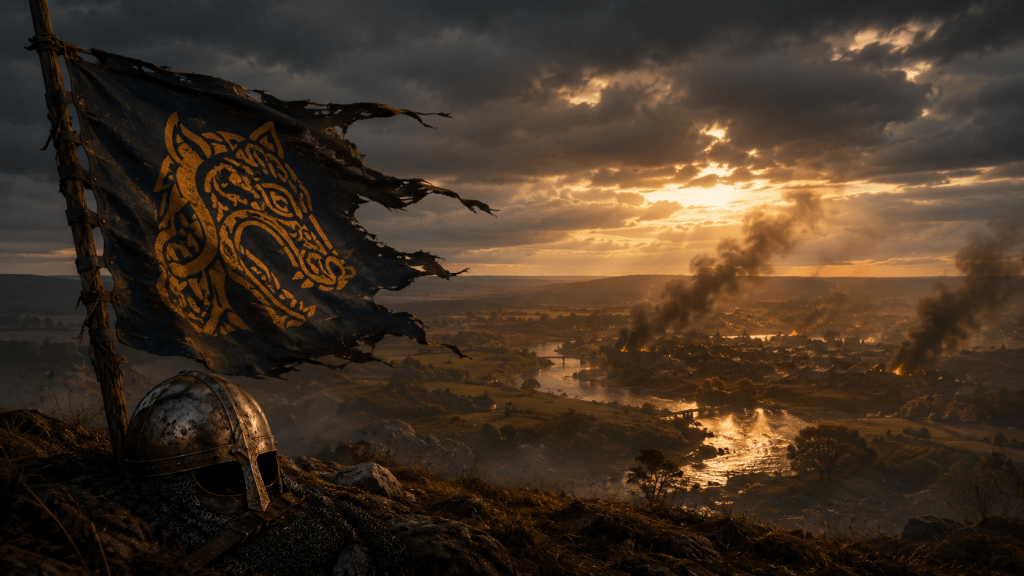
When Old Power Began to Slip
Mist lay low across the Mercian heartland, caught in the hollows of the fields and gathered along the slow bends of the rivers. It softened the shape of timber halls, church roofs, cattle tracks, and royal roads until the kingdom seemed half-remembered even by those who lived within it. Smoke rose from village hearths in thin grey lines. Hooves pressed damp earth into the lanes. Somewhere beyond the morning haze, a reeve counted dues owed to a lord whose lord owed service to a king, and the old machinery of Mercian power turned on as it had for generations.
There had been a time when that machinery moved much of Anglo-Saxon Britain. Under Æthelbald and Offa, Mercia had stood at the centre of the island’s politics with a force few rivals could ignore. Its kings had reached south and east through pressure, alliance, war, and marriage, binding lesser rulers to their will and making distant courts measure their choices against Mercian ambition. Along the western border, Offa’s great dyke rose through the landscape like a wound cut into earth and memory, facing the hills beyond as a reminder that Mercia had once shaped the very edges of its world.
By the middle years of the ninth century, the kingdom still carried the marks of that greatness. Its estates fed royal households. Its churches held learning, wealth, and influence. Its nobles gathered in halls where carved posts darkened with smoke and blades hung close to hand. A Mercian king could still sit among his counsellors beneath a roof heavy with old authority, hearing disputes, weighing tribute, receiving messengers from neighbouring kingdoms. From a distance, little seemed broken. The banners still rose. The roads still carried orders. The language of power remained familiar.
Yet the island around Mercia had changed. Rival kingdoms had grown harder to bend. Wessex, once watched and pressed by Mercian strength, had begun to stand with a firmer spine. The northern kingdoms had shown how quickly ambition could tear a realm inward. Across the sea, longships had started turning rumour into fear, and each year brought fresh stories of sails appearing where peace had once been assumed. Mercia’s danger came through this slow rearranging of the world, through influence lost by degrees, through obedience that arrived later than before, through neighbours who listened with courtesy while making their own calculations.
That was the quiet tragedy of fading power. It rarely broke in a single blow. It lingered in titles, in ceremonies, in oaths repeated because custom demanded them, in the confidence of men raised beneath stories of older greatness. Mercia remained alive, wealthy, proud, and dangerous, still strong enough to matter in every struggle ahead. Even so, beneath the mist and the smoke, beneath the tolling bells and the footsteps on the roads, the ground had begun to shift. The giant still stood over the centre of England, yet the world beneath its feet had started moving away.
A Visual Chronicle
Mercia still stood at the heart of England, yet the world was already learning to move beyond its power.
Timeline of Events
757 AD – Offa becomes king of Mercia, beginning a reign that turns the kingdom into the dominant power across much of Anglo-Saxon Britain.
796 AD – Offa dies, leaving Mercia with a powerful legacy, yet also a harder struggle to preserve the authority his reign had built.
825 AD – Ecgberht of Wessex defeats King Beornwulf of Mercia at the Battle of Ellandun, breaking Mercian influence over much of southern England.
829 AD – Ecgberht briefly takes control of Mercia, showing how sharply the balance of power had shifted toward Wessex.
868 AD – Viking forces occupy Nottingham, drawing Mercia and Wessex into uneasy cooperation against a threat neither kingdom could ignore.
About the Creator
This Chronicle is written by Simon Phillips, author of several historical and speculative fiction works exploring forgotten worlds, myth, and the turning points of history.
You can explore his books here:
Books by Simon Phillips
You can watch his YouTube channel here:
Author Simon Phillips
Continuing the Chronicle
The account that follows moves deeper into Mercia’s fading centre of power, where the memory of Offa’s greatness still shaped royal ambition, even as Wessex rose, rival kingdoms slipped beyond Mercian command, and Viking pressure began to expose the limits of an older supremacy.
Readers supporting The Forgotten Chronicle may continue into the full record below.

Subscribe to continue reading
Subscribe to get access to the rest of this post and other subscriber-only content.
