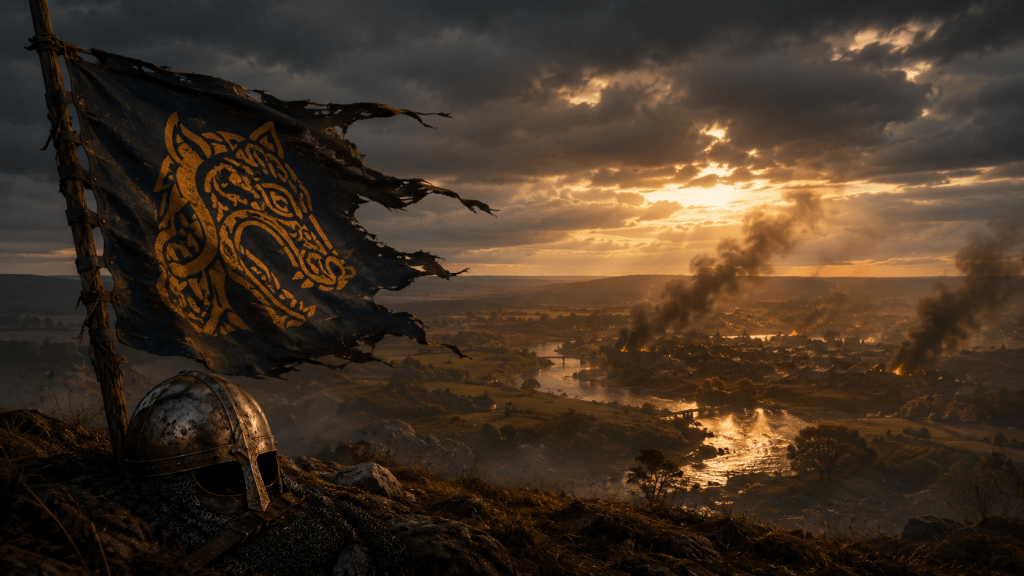
The daughter of Alfred who helped turn Mercia from a wounded kingdom into a force of recovery against Viking power.
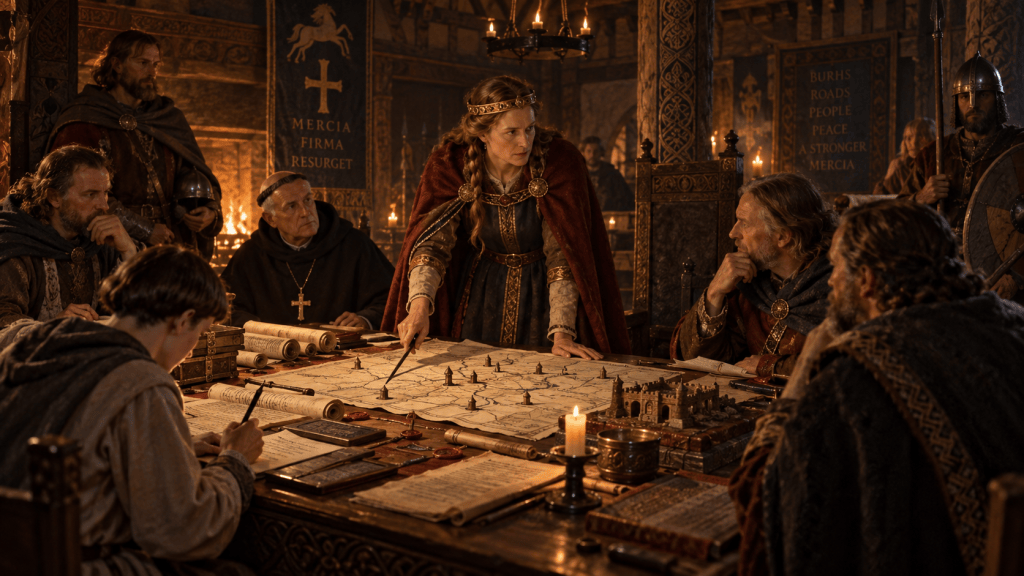
The Daughter of Alfred and the Wounded Kingdom
The morning mist lay low over Tamworth, gathering in pale folds along the river and softening the edges of the timber halls, the church roof, and the watchmen moving along the palisade. Smoke rose slowly from the hearths of the town, grey against a sky still carrying the last colour of dawn, while beyond the walls the fields stretched damp and silent toward the roads that led east, where Viking power still held its grip upon much of the land.
Æthelflæd stood above the gate with her cloak drawn close around her shoulders, watching the world wake beneath her. The men below her moved with practised purpose, loading carts, checking spearheads, leading horses from their stalls. A messenger had ridden through the night, his mount white with foam, bringing word from the frontier. Another crossing had been tested. Another settlement had sent for reassurance. Another road needed guarding before fear could travel faster than soldiers.
Mercia had once been the great power of the Midlands, a kingdom whose name carried weight from the Welsh borderlands to the eastern rivers. Its kings had ruled with confidence, its churches had held learning and wealth, and its armies had stood among the strongest in Britain. Yet greatness could be wounded. Viking armies had broken through old certainties, taken towns, carved settlements into the land, and left Mercia divided between memory and survival. What remained now had to be held with timber, earthworks, oaths, and the steady nerve of those willing to rebuild under pressure.
“My lady,” a reeve said as he climbed the steps behind her, one hand gripping the rail while the other held a folded strip of parchment against his chest, “the riders from the west reached us before sunrise. They say scouts have been seen near the old road, moving in twos and threes, watching the crossings.”
Æthelflæd turned slightly, enough for the man to see that she had heard every word, though her gaze returned at once to the land beyond the gate.
“The crossings will be watched,” she answered, her voice calm as the cold morning air. “Send word to Stafford. The burh is to remain provisioned, and every bridge is to be counted before nightfall. If men are moving through the lanes, I want their path known before they believe themselves unseen.”
The reeve bowed his head, relief passing across his face as though certainty itself had been given to him. “As you command, my lady,” he said, before descending the steps with fresh urgency.
She remained where she was, listening as the order moved through the yard below. A scribe repeated the message. A rider called for his horse. Somewhere near the smithy, a hammer struck iron, sharp and steady, its sound carrying across the morning like a promise being forged.
Æthelflæd knew the weight that rested upon her name. She was Alfred’s daughter, raised in the shadow of a king who had dragged Wessex back from ruin and turned defence into design. She was Edward’s sister, bound by blood to the house that now carried the hopes of the West Saxons. She had been wife to Æthelred, lord of the Mercians, and through years of illness, war, counsel, and governance, she had learned the shape of this wounded realm from within.
Yet Mercia was more than an inheritance passed through marriage or alliance. It was a land of roads and rivers, border towns and old churches, proud nobles and anxious villages, each one looking toward Tamworth for strength. The people here remembered former greatness, though memory alone could guard no gate. If Mercia was to endure, it needed more than remembrance. It needed walls raised in the right places, armies sent at the right hour, and a ruler whose authority could settle fear before fear became collapse.
Below her, the gates opened, and the first riders passed out into the mist.
Æthelflæd watched them go, her face still, her thoughts already travelling beyond the river and the road. The struggle that had shaped her father’s life had entered a new generation. Wessex had survived. Mercia now had to rise.
A Visual Chronicle
Æthelflæd inherited a wounded Mercia, rebuilt its defences, and carried the fight back into Viking-held lands on the road towards England.
Timeline of Events
c. 879 AD – Æthelflæd, daughter of Alfred of Wessex, is married to Æthelred, Lord of the Mercians, strengthening the alliance between Wessex and Mercia.
886 AD – Alfred takes control of London and entrusts the city to Æthelred, placing Mercia at the centre of renewed Anglo-Saxon defence.
911 AD – Æthelred dies, and Æthelflæd becomes Lady of the Mercians, ruling Mercia in her own authority.
913–914 AD – Æthelflæd strengthens Mercia through a chain of fortified burhs, including Tamworth, Stafford, Eddisbury, Warwick, and Chirbury.
917–918 AD – Æthelflæd leads Mercian recovery against Viking power, taking Derby and receiving the submission of Leicester before her death at Tamworth in 918.
A Visual Chronicle
Watch a short visual telling of the Lindisfarne raid.
[Embedded Video]
About the Creator
This Chronicle is written by Simon Phillips, author of several historical and speculative fiction works exploring forgotten worlds, myth, and the turning points of history.
You can explore his books here:
Books by Simon Phillips
You can watch his YouTube channel here:
Author Simon Phillips
Continuing the Chronicle
The account that follows moves deeper into the wounded heart of Mercia, where Æthelflæd stepped from the shadow of Alfred’s world into authority of her own, and where the defence of fortified towns, river roads, borderlands, and old Mercian memory helped turn survival into advance against Viking power.
Readers supporting The Forgotten Chronicle may continue into the full record below.

Subscribe to continue reading
Subscribe to get access to the rest of this post and other subscriber-only content.