America never won its first revolution. The second will be fought with drones, missiles, aircraft and cyber warfare.
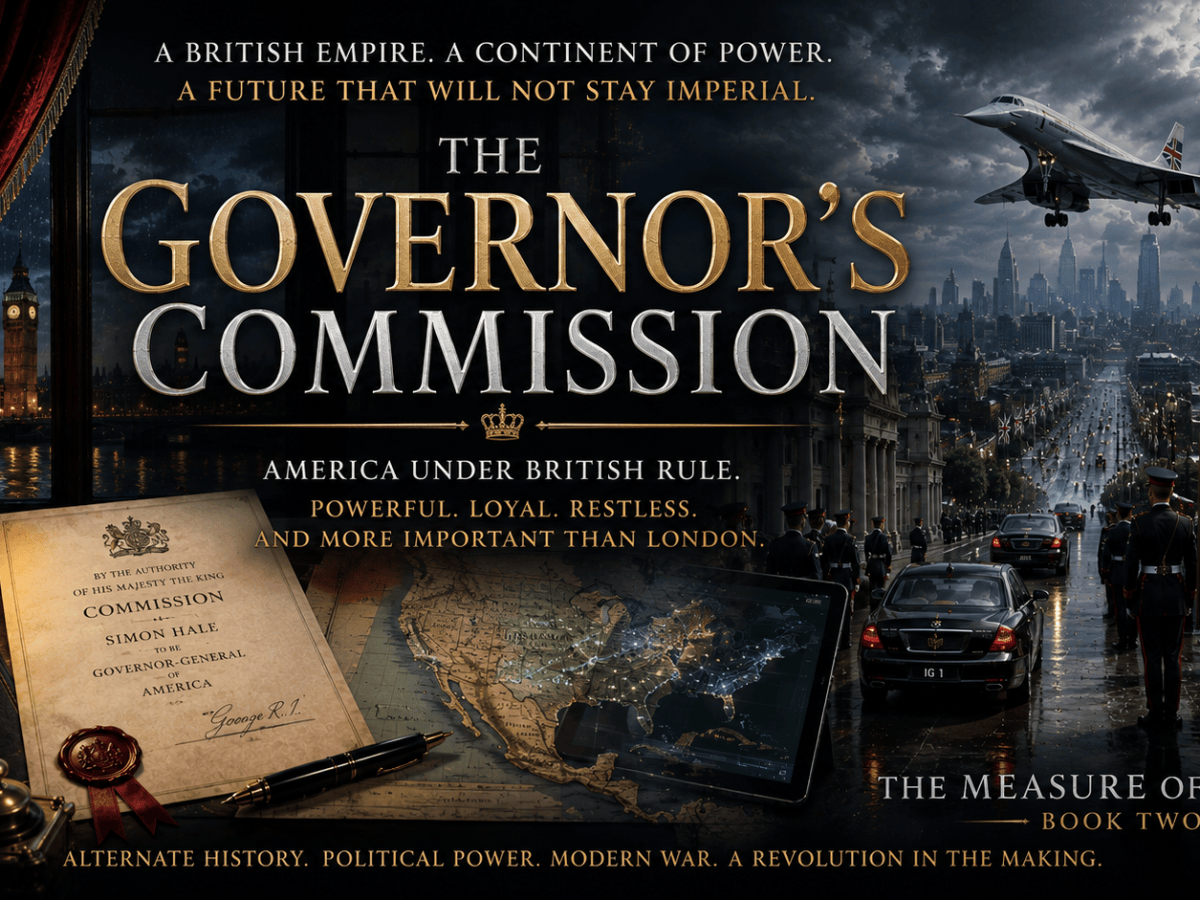
The British Empire survived into the modern age as the greatest political and military power on Earth. Its fleets cross every ocean, its institutions reach across continents, and its alliances hold together a world shaped by imperial authority. At the centre of that power lies America, a vast British possession whose factories, research centres, airfields, shipyards, universities, cyber commands and military formations have become essential to the Empire’s strength.
America has spent centuries growing inside the imperial system. It has learned to govern cities, organise industry, build armies, move fleets and sustain a continent. British authority still stands above its assemblies and institutions, yet the territory beneath that authority has already begun to think, work and fight on a national scale.
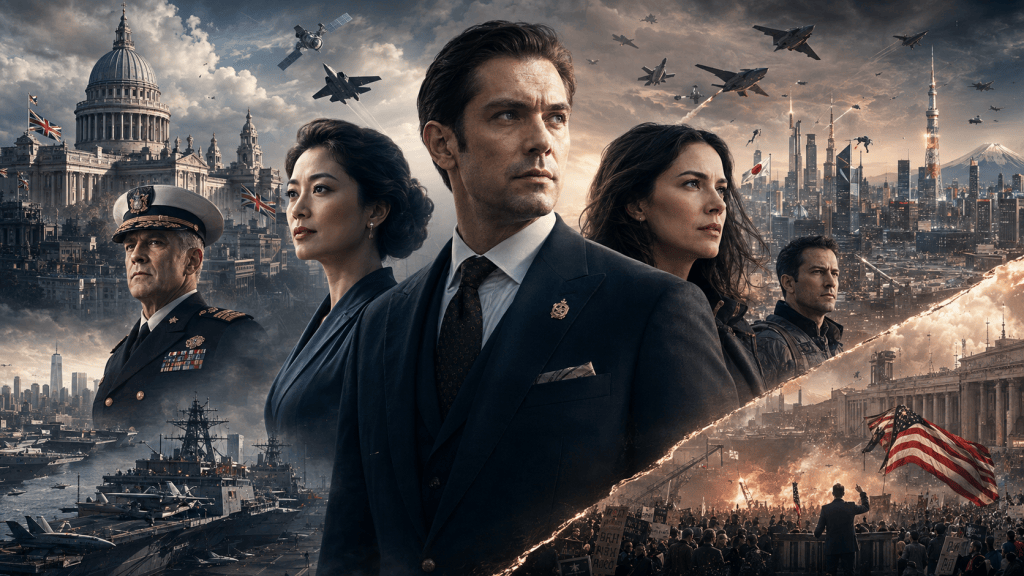
The Measure of Empire follows the people living inside that contradiction as reform, war, family loyalty and political ambition begin pulling the imperial world apart. Simon Hale believes a stronger, more responsive Empire can survive the pressures gathering around it. Charlotte Mercer sees an America approaching the moment when reform will cease to be enough. Admiral Edward Halstead commands the military power expected to hold the wider system together. Erina Takahashi Hale understands that political collapse reaches the home long before statesmen admit that history has changed.
This is a modern alternate-history saga about imperial power at its height, the nation growing inside it, and the people whose private choices become part of a global fracture.
The World That Never Let America Go
The history behind The Measure of Empire turns on one immense difference: America never achieved independence, and the British Empire continued developing around the wealth, manpower and geography of the American continent.
Centuries later, empire has become ordinary life. British flags hang above modern government buildings. Imperial ministries work through encrypted communications, aircraft cross the Atlantic in hours, military commands watch satellite feeds, and colonial assemblies argue beneath constitutional arrangements inherited from an older age. London remains the recognised centre of imperial government, even as the practical foundations of its power have spread far beyond Britain.
America has become the most dangerous example of that change. What began as colonies along the Atlantic has developed into a continent-wide political, industrial and military system. Its cities support global finance and research. Its ports service imperial fleets. Its aerospace industries build aircraft used across the imperial world. Its military facilities defend a continent whose strategic needs increasingly differ from London’s priorities.
The contradiction has grown slowly enough for generations to accept it. America belongs to the Empire, while the Empire increasingly depends upon America.
That balance can endure only while Americans continue believing imperial authority deserves obedience.
Simon Hale: The Man Who Builds the Door

Simon Hale enters the series far from the American crisis that will eventually define him. He lives in Japan with his wife, Erina, and their young son, Noa, after building a reputation as a gifted imperial administrator in East Asia. His world is one of diplomatic residences, government briefings, family breakfasts, formal obligations and the quiet confidence of a man who has spent his adult life learning how large systems hold together.
Simon believes in the Empire because he understands its machinery. He sees how trade, law, military protection, diplomacy and administration can bind distant territories into a functioning whole. He also sees weaknesses that older officials have learned to live around. Reports move too slowly. Regional authorities wait for distant permission. Local governments understand problems that London sees only after they have hardened. Simon believes reform can solve those failures while preserving the system itself.
His ability to see those weaknesses brings him closer to the centre of power, then towards America. He begins to treat the American territories as a connected continental system whose government, infrastructure and military command need greater flexibility. From Simon’s perspective, such reforms strengthen imperial rule. They give local authorities room to respond quickly while keeping the Crown above the structure.
The danger lies in the success of the idea.
Every improvement that allows America to govern itself more effectively also gives America greater confidence in its own capacity. Every local military authority created for practical defence reduces the distance between colonial command and national command. Every institution strengthened in the name of imperial stability becomes something America could one day use for itself.
Simon never sets out to free America. He helps create the structures that make freedom possible, and the tragedy grows from the fact that he is intelligent enough to build them well.
His story also remains deeply personal. Simon is a husband and father before history begins turning him into a public figure. Every rise in office changes the life of Erina and their children. Every political relationship carries into the family home. Every decision that wins approval in London creates a second consequence among people whose safety depends upon his judgement.
The Empire sees Simon as a man capable of preserving authority through reform. America will come to see the same reforms from a very different direction.
Empire as Normality
The British Empire at the opening of the series is powerful because it works.
Its institutions move goods, money, soldiers, information and law across vast distances. Governors-general manage territories that would rank among the world’s great powers in any other political order. Colonial assemblies provide local representation while remaining beneath imperial authority. Naval stations, air bases and strategic facilities give Britain reach across the Atlantic, Pacific, Indian Ocean, Africa and the Middle East. A global diplomatic network keeps allies close and rivals under watch.
For millions of people, this order offers stability. Trade routes function. Courts operate. Infrastructure expands. Military power discourages external threats. Careers, families and entire communities have grown inside imperial systems that feel older and more permanent than the people serving them.
That strength creates the Empire’s deepest weakness.
London has governed for so long that continuity begins to resemble consent. Imperial officials can measure output, taxation, troop strength, shipping capacity and political representation, while the quieter question of legitimacy remains harder to quantify. A territory may obey the law, supply the army and contribute to imperial prosperity while its people gradually stop seeing London as the natural source of authority.
America brings that problem into its most dangerous form because Britain relies upon the very territory whose political maturity it struggles to recognise. The Empire can issue orders across the Atlantic. It can move troops, appoint governors, enforce legislation and draw upon American wealth. Each act proves the scale of imperial power while revealing how much of that power now depends upon American cooperation.
The Measure of Empire approaches imperial decline through this tension. Britain begins from a position of enormous strength. The coming fracture matters because the system has genuine achievements, capable servants and people who believe it deserves to survive.
Its failure comes when power can still compel action, while legitimacy can no longer secure loyalty.
America: Colony, Continent, Unborn Nation
America is the industrial and technological heart of the imperial world. Its factories feed military production, its shipyards support global naval power, its universities and laboratories drive research, and its transport systems connect cities, airfields, ports, defence zones and manufacturing centres across the continent.
Its political life has matured along the same path. Colonial assemblies handle local realities that London can never experience directly. Territorial governments manage populations and economies larger than many independent states. Colonial Defence Command oversees forces trained for American geography, American infrastructure and American threats. Civil institutions have grown around the practical needs of a continent that increasingly behaves as one connected political space.
The legal language still says colony. Daily reality says something far larger.
That difference shapes the American side of the series long before open revolution. Independence begins through arguments over representation, taxation, surveillance, military obligation and political dignity. It moves through private rooms, assembly corridors, printers, civic networks, officers’ conversations and secure communications. Some people seek stronger rights within the Empire. Others favour wide autonomy. A smaller circle sees full independence as the only future that matches the country America has already become.
This gradual development matters because revolution arrives through pressure, compromise and lost faith. America begins with deep connections to Britain, generations of imperial service and institutions shaped by British rule. Separation therefore carries uncertainty alongside ambition. Families, officers and public figures have to decide where duty ends and national loyalty begins.
The series asks a question that grows harder for London to answer with every passing crisis: if America builds the Empire’s future, why should London decide how that future is used?
Three Lives Inside Imperial Fracture
Simon Hale, Admiral Edward Halstead and Charlotte Mercer carry the central political movement of the series from three very different positions inside the same world.
Simon sees empire through government, diplomacy, appointment, reform and family consequence. He believes authority can adapt if capable people are given room to act, and his confidence places him close to decisions that reshape America.
Halstead sees the same system through ships, aircraft, bases, logistics, intelligence and orders that have to survive contact with distance and war. He knows what imperial power costs in fuel, crews, readiness, damaged equipment, frightened civilians and exhausted personnel. Where ministers speak about strategic reach, Halstead experiences the limits of maintaining it.
Charlotte sees America from inside the political life that official reports can only partly capture. She understands resentment as lived experience, reform as both opportunity and delay, and Simon’s administrative confidence as something the independence movement can learn to use. Her strength comes through organisation, political intelligence and her ability to recognise where people, institutions and ideas are already moving.
Their stories draw together as the Empire attempts to reform, fight and preserve itself at the same time. Each believes they understand a part of the world clearly. History begins forming in the spaces between those understandings.
Erina Hale: Family Inside History

Erina Takahashi Hale gives the series a second measure of power, one that rarely appears on official maps.
She comes from Japanese elite society and understands the world Simon serves through reputation, access, timing, family expectation and the quiet signals that accompany political change. Her marriage to Simon places their household inside the British-Japanese alliance at a personal level, where diplomatic culture, imperial duty and private life share the same rooms.
Erina sees political danger through details Simon can dismiss while his attention remains fixed on institutions. A changed invitation, a delayed answer, a careful phrase from an old contact or a shift in who is willing to speak openly can reveal more than a formal briefing. She understands that public confidence often survives after private certainty has already vanished.
Her place in The Measure of Empire reaches far beyond the role of a governor’s wife. As Simon rises, the pressures around the Hale family widen. Office affects where they live, how they travel, who watches them and which relationships become politically useful. Children turn decisions about duty into decisions about safety. Simon’s public reputation becomes something Erina must read from inside the household as well as through the societies surrounding it.
Her strength is calm, practical and deliberate. She understands when dignity protects a family and when survival requires preparation. As the imperial order becomes less secure, she increasingly holds together the part of Simon’s life that government can never manage for him.
The political story may be measured in laws, wars and governments, yet the cost reaches homes first. Erina ensures that The Measure of Empire never loses sight of that truth.
Britain and Japan: The Imperial Alliance
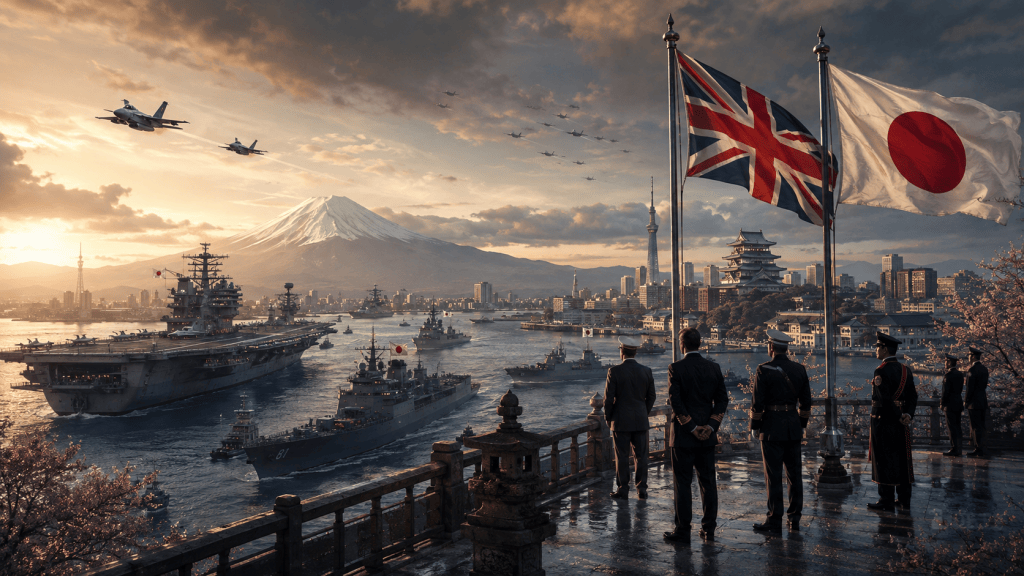
The modern world of the series rests partly upon the alliance between Britain and Japan, two imperial powers whose strategic partnership shapes East Asia and the Pacific.
Japan emerged into the modern age as a major military, industrial and political power. Its influence stretches through territories and sea lanes that make it central to the balance of power across the region. British and Japanese naval forces operate within a shared strategic order, while diplomats, military planners and political families sustain an alliance built over generations.
For Simon, that alliance is personal. Japan is where his career developed, where his marriage to Erina formed a family, and where the opening of the series gives him a life that feels settled enough to endure. He knows Japan through government offices and diplomatic relationships, yet also through Ashiya mornings, family rooms, local streets and the routines surrounding Noa.
That intimacy gives the wider geopolitical strain greater weight. A challenge to Japanese power touches British strategy, American military production and the Hale household at the same time.
China’s rise begins changing the balance. Russia’s alignment with China gives that pressure military depth. Britain faces an increasingly difficult choice between protecting the alliance that supports its global order and demanding more from territories already questioning the price of imperial responsibility.
The alliance therefore becomes one of the routes through which a distant war reaches America.
The War That Pulls the Empire Apart
The East Asian conflict places the British imperial system under the kind of pressure that maps can hide only for so long.
China has become powerful enough to challenge Japanese dominance across East Asia. Russia remains dangerous despite its own historical collapse and adds military weight to the challenge against the British-Japanese order. Naval forces move, aircraft patrol contested spaces, submarines watch sea lanes, cyber units probe infrastructure, satellites become strategic assets, and governments begin planning around escalation that could spread across several regions.
Britain possesses enormous military reach, yet every front draws upon the same underlying systems. Ships require yards, aircraft require parts, bases require supply, armies require transport, and global operations require communications and industrial capacity. Much of that capacity comes from America.
The result is a political trap. The more dangerous the Asian war becomes, the more urgently London needs American factories, technology, personnel and military formations. The more London demands, the more Americans are forced to ask whose security their strength truly serves.
For London, American deployment is part of shared imperial responsibility. For a growing number of Americans, the same demand looks like proof that their continent remains an asset to be used according to priorities set elsewhere.
War exposes that difference faster than ordinary politics ever could.
The Question America Can No Longer Avoid
The Imperial Conscription Act turns a long political argument into something immediate and personal.
As the East Asian war intensifies, London seeks the manpower and military capacity required to sustain the British-Japanese position. American soldiers, pilots, engineers, naval personnel and support formations become part of that demand. The policy reaches beyond abstract constitutional debate because it asks American families to accept overseas service in a war defined by imperial strategy.
The question at the centre of the crisis is simple enough to move through assembly halls, military bases, homes and secure political networks alike: is America a partner within the Empire, or a possession whose people and resources remain available whenever London calls?
The answer divides institutions as much as communities. Officers who have served the Empire must consider whether obedience still matches their duty to the continent they defend. Political moderates face pressure from people who once accepted reform as sufficient. Independence organisers discover that arguments previously confined to small circles now have an audience shaped by fear, anger and personal risk.
Daniel Mercer becomes increasingly important within that environment. His military experience gives him a clear understanding of the cost of premature rebellion, while his connection to the emerging Continental Movement places him close to the political argument over America’s future. His caution gives weight to the crisis because he understands exactly what armed separation could demand.
The Act becomes explosive because it forces people to choose before they feel ready.
A Modern American Revolution
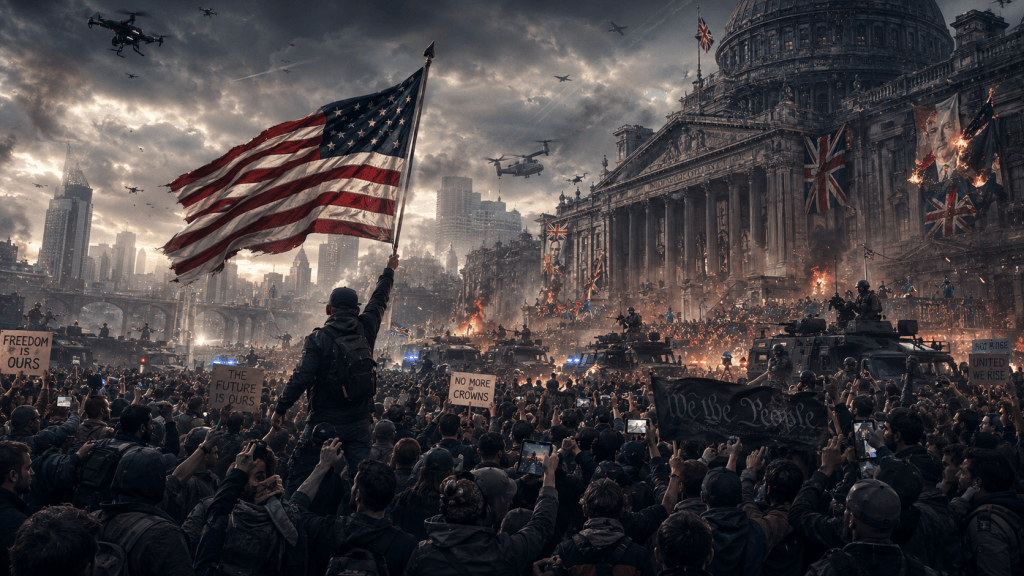
The coming American Revolution carries none of the visual comfort of eighteenth-century history. This America has airfields, carrier facilities, cyber centres, armoured formations, satellite links, missile systems, modern cities, continental logistics and officers trained inside the most powerful military structure in the world.
When political resistance reaches the armed forces, Britain faces a problem no previous imperial rebellion has presented at this scale. American units understand imperial doctrine because they helped develop and practise it. American industries know how to build and sustain the equipment used by imperial forces. American cyber specialists understand communications systems funded through the same government they may come to resist. American naval and air facilities were constructed to defend imperial power across a continent.
The Empire spent centuries making America strong enough to protect the global order.
That same strength gives America the capacity to challenge it.
The military struggle therefore grows from shared systems, shared training and shared history. Commanders face people who once served under related structures. Families can be divided by loyalty. Equipment on opposing sides may come from the same industrial lineage. Decisions made in London, Philadelphia, naval command centres and military bases carry consequences for civilians who have lived their whole lives inside imperial normality.
Modern warfare in The Measure of Empire remains grounded in the pressure behind action. Aircraft, drones, missiles, naval forces and cyber operations matter because people have to decide when and why to use them. The series follows the frightening moment when a political argument gains the machinery of a continental war.
Charlotte Mercer and the Continental Movement

Charlotte Mercer stands close to the point where political dissatisfaction becomes organised purpose.
She is intelligent, observant and deeply committed to the idea that America has grown beyond the political status imposed upon it. Her strength comes from understanding people as carefully as she understands institutions. She sees ambition, fear, pride and hesitation, then recognises how those private qualities can influence public decisions.
That ability makes Simon Hale important to her.
Simon arrives in America believing reform can preserve imperial authority. Charlotte sees that his ideas could also strengthen the very institutions an independent America would need. She encourages the parts of his thinking that give America greater administrative confidence and local capacity, while allowing Simon to believe those changes prove the value of his own approach.
Their relationship becomes dangerous through access, admiration, argument and judgement. Simon loves Erina and remains anchored to his family, while Charlotte’s commitment remains centred on America. The tension comes from the fact that Simon and Charlotte can understand parts of each other too well. Respect creates access. Access creates influence. Influence creates consequences that may reach far beyond either of them.
Around Charlotte, the Continental Movement grows through lawyers, civic leaders, assembly figures, officers, printers, communications networks and people who have begun imagining a political future outside London’s authority. The movement contains reformists and committed independence supporters, cautious figures and people prepared to accept harsher methods. Its moral complexity matters because national birth carries compromise, fear and guilt alongside hope.
Charlotte represents an America learning how to turn belief into organisation. Her danger lies in knowing that history sometimes moves through a conversation long before it moves through an army.
Admiral Edward Halstead: Winning Battles, Losing History

Admiral Edward Halstead carries the military scale of the series through the lived reality of command.
He serves an Empire whose reach depends upon ships moving on time, aircraft remaining serviceable, crews receiving supplies, intelligence reaching the right room and orders surviving distance. He understands the difference between political confidence and military capacity because every promise made by government eventually becomes a requirement placed upon people, equipment and logistics.
Halstead is loyal, experienced and professionally capable. He has spent his career inside a system that taught him order could be preserved through preparation, discipline and controlled force. Across Africa, the Pacific and wider imperial theatres, he sees the cost of that belief as more crises demand attention from the same fleets and commands.
His perspective becomes essential as the East Asian war widens. Britain and Japan need American industrial support to sustain their position. American bases and production appear everywhere inside the practical machinery of imperial defence. The deeper the crisis becomes, the clearer it grows that America has ceased to be a distant colonial contributor. It has become part of the Empire’s military nervous system.
When American loyalty begins to fracture, Halstead faces the limit of everything he has been trained to do. A fleet can secure a sea lane. Aircraft can strike a target. Troops can seize ground. None of those achievements can force a population to believe London still possesses the right to rule.
Halstead’s tragedy comes from understanding warfare while history changes the meaning of victory around him.
The Measure of Empire
Across the series, imperial collapse grows through accumulation. One reform changes how authority moves. One appointment alters the relationship between London and America. One war increases the demand placed upon the colonies. One family feels the consequences of office. One political movement learns how to use institutions that already exist. One military order asks people to decide where loyalty truly belongs.
The story remains centred on people because systems become history only when human beings act inside them.
Simon wants to strengthen the Empire and protect the future he believes it can still provide. Erina measures danger through family, reputation and survival. Charlotte wants America to possess political authority equal to the country it has already become. Halstead tries to hold together a strategic order whose scale is becoming impossible to defend through force alone. Daniel understands that independence may eventually require a war whose cost will reach far beyond speeches and declarations.
Around them, Britain, Japan, China, Russia, America and the wider imperial world continue moving through trade, diplomacy, military planning, domestic life and public argument. The Empire still appears permanent to people looking at its fleets, institutions and territories.
The deeper question is whether permanence ever meant more than obedience.
Published Books and Reading Order