Morning reaches Ashiya through the ordinary movement of a prosperous modern city. Cargo ships cross Osaka Bay towards Kobe, cranes work along the distant waterfront, aircraft descend towards Kansai, and the streets below the Hale residence begin filling with delivery vans and bicycles. Inside, Simon Hale studies reports from London while his young son, Noa, commands an imaginary fleet across the breakfast table. Simon’s wife, Erina Takahashi Hale, observes the same wider political world that occupies her husband’s thoughts, although she reads its apparent stability with considerably greater caution.
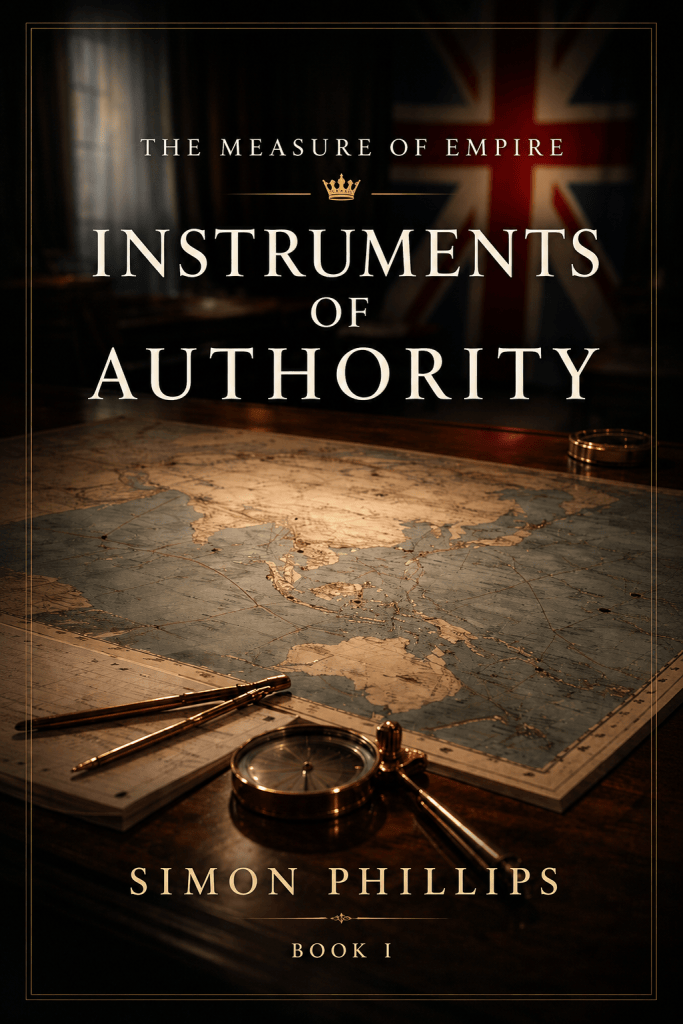
This is where Instruments of Authority, Book One of The Measure of Empire, opens. The British Empire survived into the modern age as the dominant global power, the United States never formed, and America developed within the imperial system until it became one of its greatest centres of industry and technology. Japan survived as a major empire and stands beside Britain as its principal strategic ally in East Asia, while China is becoming increasingly capable of challenging the established order. The world Simon inhabits is recognisably modern in its aircraft, communications systems, container ports, political institutions and military technology, yet its history produced a radically different distribution of power.
The tension of Instruments of Authority begins before any public crisis announces itself. Simon sees a global system that has survived because it continually adjusts. Erina sees the possibility that constant adjustment may reveal pressure as much as strength. Their disagreement remains quiet, affectionate and intelligent, yet it introduces the question that sits beneath the whole book: how long can a political structure continue appearing permanent once the conditions supporting that permanence have begun to change?
A Modern Empire Built on Movement
The British Empire of The Measure of Empire survived by continuing to develop rather than remaining trapped in the age that created it. Its government crosses continents through encrypted communications, official aircraft, diplomatic networks, military commands and administrative institutions capable of moving decisions between London, Asia, Africa and America with extraordinary speed. Its economic strength depends on vast shipping corridors, advanced industrial regions and ports that connect territories separated by entire oceans. Imperial authority therefore appears in contemporary forms, carried as readily through data, logistics and bureaucracy as through warships and military bases.
That modernisation gives the world of Instruments of Authority much of its credibility. Simon does not live among relics of nineteenth-century imperial government. He works inside a sophisticated diplomatic structure in Japan, surrounded by economic forecasts, strategic assessments, trade negotiations and British-Japanese military coordination. His confidence in the Empire emerges from experience rather than simple patriotism. He has watched its systems operate across borders, absorb problems and maintain relationships between distant territories whose economic and political interests often differ sharply.
Erina sees the same machinery through another perspective. Her family connections and experience of Japanese political society have taught her to listen for changes beneath official reassurance. When Simon describes stability as the ability of a system to absorb pressure while remaining coherent, Erina answers through quieter observations about foundations, currents and structures that may change before the people living inside them fully recognise the direction of movement. Their conversation establishes the intellectual tension of the book while also grounding those ideas inside a marriage and household that feel lived rather than symbolic.
This approach allows empire to become something more complex than a flag over a government building. It exists in the routes followed by merchant vessels, the expectation that alliances will hold, the authority carried by an official message, and the assumption that London may redirect a man’s life through a single instruction. The Empire feels powerful because its institutions function, and that functioning makes the first irregularities much more significant when they begin to appear.
Simon Hale Before History Reaches Him

Simon enters the series as an ambitious and capable imperial administrator, yet the story first places him inside his home. His life with Erina and Noa gives the opening a quiet centre that becomes increasingly important once London intervenes. Ashiya has become a genuine family home, shaped by Simon’s British background, Erina’s Japanese world and the diplomatic culture surrounding both of them. Their morning moves between political discussion, family teasing and the ordinary interruptions of a young child whose greatest concern is the imaginary voyage of a wooden ship.
The family gains another layer when Erina tells Simon she is expecting their second child. Simon receives the news with warmth and characteristic composure, and the conversation naturally turns towards the future. Ambassador Whitmore is approaching retirement, Simon believes continuity in Japan may favour his own career, and Ashiya appears likely to remain the place where their growing family will live. That sense of an ordered future gives the interruption that follows much greater force.
An embassy motorcar arrives at the Hale residence with instructions requiring Simon’s immediate presence at the chancery. Ambassador Whitmore eventually gives him the message London has sent: Simon must return to Britain within twelve hours, travelling alone while Erina and Noa remain in Japan until further instructions arrive. The directive contains no explanation, and Whitmore offers no suggestion that Simon’s work has caused difficulty. The absence of accusation makes the summons more unsettling because it signals that something elsewhere has changed quickly enough for London to move him across half the world before telling him why.
Simon’s response reveals much about the man who will carry the central political perspective of the series. He experiences concern, thinks immediately of his family and understands the disruption the order creates, yet he accepts the authority behind it. Imperial service has shaped the assumptions through which he understands duty. London may demand his presence, and Simon assumes that a coherent reason must exist somewhere inside the machinery of government, even when that reason remains hidden from him.
Edward Halstead and the Machinery of Imperial Power
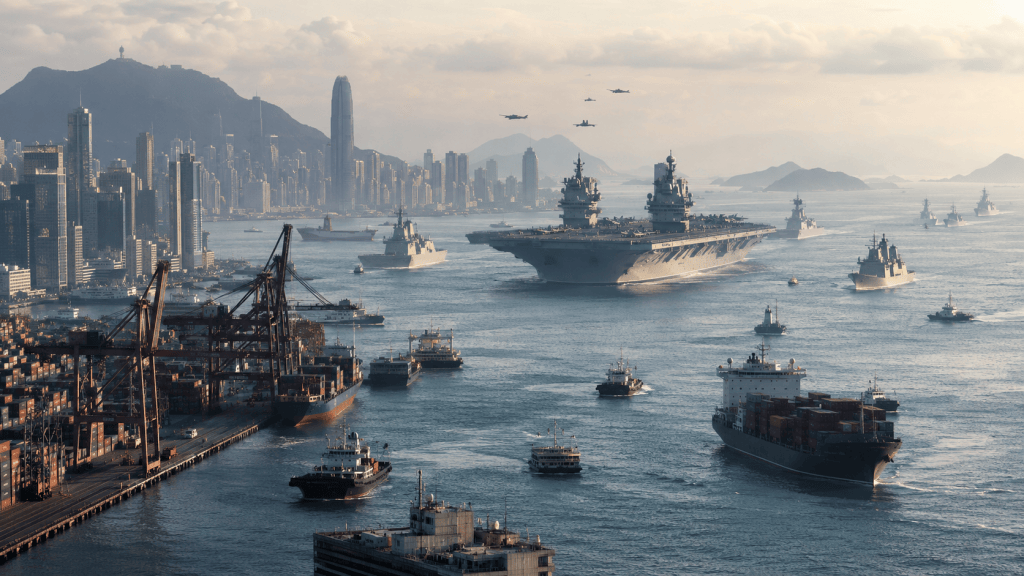
The perspective then widens from Simon’s household to Victoria Harbour in Hong Kong, where Admiral Edward Halstead commands the Imperial Second Fleet. The shift changes the scale of the story while preserving its central concern with systems of authority. HMS Sovereign dominates the anchorage alongside guided-missile destroyers and stealth frigates, while reconnaissance drones, advanced aircraft and satellite-linked command systems turn naval power into a vast network of information and logistics extending far beyond the horizon.
Halstead represents the military confidence of the Empire in its mature form. He sees commercial shipping and naval security as parts of the same structure because the trade flowing through Hong Kong depends upon predictable seas, protected routes and an alliance system capable of discouraging rivals from testing its limits. Japanese forces coordinate with British units across the Pacific, Chinese patrol activity is monitored carefully, and the fleet maintains a readiness that makes imperial stability appear almost mechanical in its reliability.
Yet Halstead’s command also reveals how widely imperial responsibility has spread. While East Asian forces watch Chinese activity and prepare for continuing British-Japanese coordination, Admiralty messages draw attention towards instability in the Mozambique Channel. Merchant shipping moving through East African routes faces interference, creating pressure for reinforcement from naval forces already serving elsewhere. Halstead can respond because the Empire remains immensely powerful, although every redeployment demonstrates how many distant regions depend upon that power being available at the same time.
Simon Hale’s name enters this military world through a Foreign Office communication concerning his sudden recall. Fleet command is asked to assist with his movement if circumstances require it, linking a diplomat’s unexplained journey with the wider machinery of naval authority. Halstead sees only one piece of the same pattern Simon has begun encountering, and the reader is allowed to recognise that several imperial systems are moving simultaneously even while their connection remains unclear.
America Under British Rule

Philadelphia introduces the central political contradiction that gives The Measure of Empire its distinctive alternate-history identity. America exists as a prosperous and technologically advanced part of the British imperial system. Its government offices process communications with London, its cities participate in global trade, and its political institutions have matured across generations of continued British rule. The continent therefore carries none of the atmosphere of an eighteenth-century colony preserved unchanged into modern times.
Charlotte Mercer works inside Philadelphia’s Colonial Administrative Offices, where correspondence moves between American institutions and the imperial authorities overseeing them. Her position allows her to recognise patterns that would pass unnoticed by someone unfamiliar with the ordinary rhythms of government work. Requests arriving from London have increased, encrypted transmissions are becoming more frequent, and officials in higher departments appear increasingly interested in updated information concerning America.
The importance of Charlotte’s introduction lies in how little outward disruption accompanies those signals. Clerks continue sorting documents, senior officials attend conferences, government vehicles enter the courtyard, and cargo continues moving through the city beyond the administrative buildings. America remains part of a functioning imperial world, and daily life carries the confidence of a society accustomed to that arrangement.
A small folded message among Charlotte’s official correspondence introduces another layer of political awareness. Its language is deliberately indirect, referring to changing weather across the continent and the value of recognising the direction of the wind. Charlotte understands enough to conceal the message immediately, while the story leaves the scale of the network behind it deliberately uncertain. The effect is one of pressure gathering beneath institutions that continue carrying out their ordinary work.
Later conversations reinforce the wider significance of what Charlotte has begun seeing. America is described as the most technologically advanced region of the Empire, and London’s renewed attention reflects the strategic importance of a continent whose industry, infrastructure and administrative maturity have become central to imperial strength. That relationship creates a powerful question for political alternate history: what happens when a territory becomes essential to a system while still remaining subordinate to the authority governing it?
Political Tension Before Open Crisis
Instruments of Authority builds its suspense through accumulation rather than immediate confrontation. Simon receives an unexplained summons from London. Halstead sees naval assets being considered for movement between distant theatres. Charlotte detects unusual interest from Whitehall and receives a message suggesting that others across America are already watching the same changes. Every event is manageable in isolation, yet their proximity creates a larger sense that the imperial world has begun tightening.
This gives the book a different kind of momentum from an alternate-history story built around a battlefield or dramatic historical divergence. The world already changed generations before the opening pages. The reader enters after that divergence has become normal life and experiences the consequences through people who have inherited its institutions. Simon has no reason to find the British presence in America extraordinary, Halstead treats global naval power as an ordinary responsibility of command, and Charlotte works every day inside an American government whose connection to London has existed throughout her life.
That normality allows political uncertainty to carry real weight. A request for information matters because Charlotte knows the usual volume of correspondence. A fleet movement matters because Halstead understands how naval resources are balanced across oceans. A recall matters because Simon had every reason to expect his career and family life to continue in Japan. The story asks the reader to pay attention to small institutional movements because the characters themselves understand that governments often begin changing direction through internal decisions long before those changes reach public view.
Erina Takahashi Hale and the Political Meaning of Home
Erina gives the opening book an emotional and political intelligence that extends well beyond her role in Simon’s household. Her marriage to Simon places their family naturally within the world of the British-Japanese alliance, and their home reflects the cultural confidence of two imperial societies whose strategic partnership has shaped both public life and private relationships. Erina understands that Simon’s work carries obligations beyond the office, and she also understands that political systems rarely reveal all of their intentions through formal language.
When the recall arrives, Simon searches for the administrative logic behind it while Erina focuses on the speed with which London has acted. She recognises that such urgency usually means events elsewhere have already gathered momentum. Her advice before Simon leaves is personal because she knows his confidence and ambition, yet it also carries the caution of someone who has spent years watching powerful institutions speak through omission as much as through direct instruction.
Their farewell also keeps the political story firmly connected to family consequence. Noa views the aircraft journey through the imagination of a child fascinated by travel, while Erina understands that Simon is leaving during a moment whose meaning remains uncertain. Simon carries both reactions with him during the long journey towards Britain, and the memory of home prevents his summons from becoming an abstract transition between plot locations. London has called an official back to Westminster, while the human reality is that a husband and father has left a pregnant wife and young son in Japan with no clear idea when he will return.
Where The Measure of Empire Begins

The final movement carries Simon across the northern world towards Britain aboard a government aircraft while the unanswered question surrounding his recall grows heavier. He thinks about Erina’s warning, remembers Noa’s request that he describe the clouds, and watches the British coastline emerge beneath the aircraft as London draws closer. The capital appears as both home territory and political centre, a city whose ministries send instructions outward across the same global network Simon has spent his career serving.
RAF Northolt provides one final disruption to his expectations. Simon anticipates official transport and the beginning of a formal briefing, yet his brother David Hale has come to meet him personally. David offers only the information that matters immediately: circumstances changed during Simon’s flight, and Westminster requires him at once.
That arrival brings together everything the book has been building. Simon has travelled from a secure family life in Japan towards an unexplained political summons. Halstead remains in Hong Kong, watching military and commercial pressures appear across different regions of the Empire. Charlotte remains in Philadelphia, where London’s growing interest in America has already become visible through the administrative system. Britain still possesses enormous political, military and economic strength, and the institutions supporting that power continue functioning with impressive efficiency, yet several people inside those institutions have begun recognising that something has shifted.
For readers drawn to British Empire alternate history, modern alternate history, political fiction, geopolitical tension, Imperial America and modern military fiction, Instruments of Authority opens a world where history is already different before the first page begins. Its interest lies in watching another change begin from inside that established reality, carried through family decisions, diplomatic instructions, naval calculations and the early movement of political ideas through an America that has grown powerful while remaining under British rule.
Instruments of Authority, Book One of The Measure of Empire, is available on Amazon Kindle.
The book closes with Simon travelling towards Westminster and an explanation that has remained beyond his reach since the summons first arrived in Ashiya. Behind him lies the family life he expected to continue, while ahead stands the political centre of an Empire whose decisions still shape much of the modern world. Somewhere between those two points, the first movement of The Measure of Empire has already begun.
Discover more from Simon J. Phillips
Subscribe to get the latest posts sent to your email.
