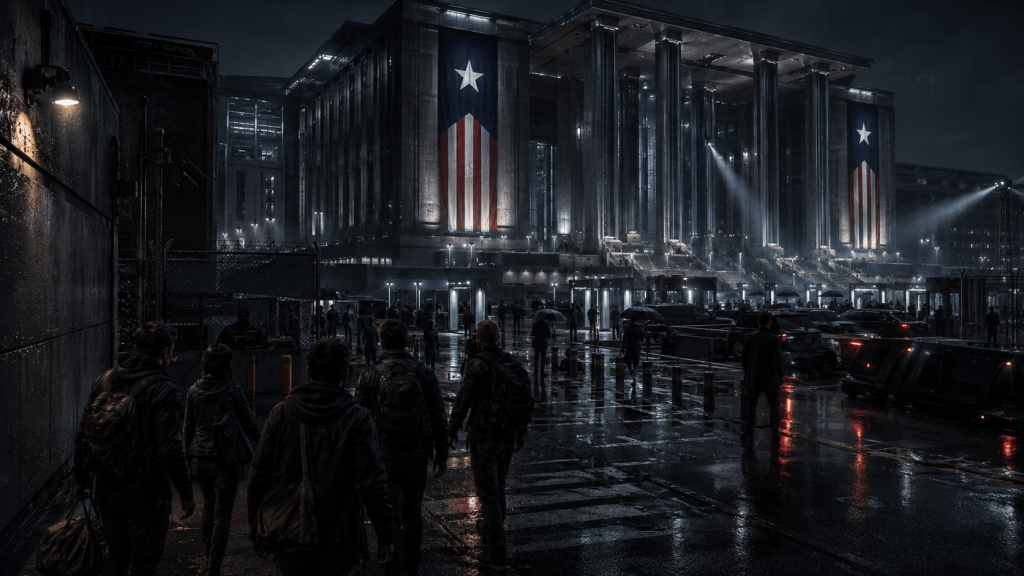
Before London explained the recall, one Ashiya household had already been divided by the instructions arriving at its door.
Timeline of Events
Earlier that day, Ashiya — An urgent instruction from London recalled senior British diplomat Simon Hale from Japan, beginning a departure process measured in hours rather than days.
Later that morning — Embassy transport and official communications reached the Hale residence, turning an otherwise settled household day into preparations for immediate government travel.
Across the same period — Other imperial systems were also receiving new demands, including naval planning and unusual requests for updated information from American administrative offices.
That evening — Simon’s government-directed journey towards Britain began while the reason for the recall remained undisclosed beyond urgent consultation.
The Case by the Door
Thomas Hadley laid the empty travelling case across the cedar bench in Simon Hale’s study and released the brass catches with his thumbs. The embassy motorcar had taken Simon towards Osaka less than an hour earlier, leaving the Ashiya house to settle around an interruption nobody could explain. Hadley preferred instructions before movement, labels before luggage and certainty before anyone touched a family passport, so he opened the case, placed Simon’s document wallet beside it and left every other drawer closed.
Noa appeared at the study door with a wooden ship held against his chest, followed by the nanny who had clearly lost an argument about where he was permitted to wander. “Is Papa going on the government aeroplane?” the boy asked, edging into the room while Hadley checked the empty pockets of the case. Hadley looked across at him and allowed his expression to soften. “At present, Master Noa, your father has gone to speak with the Ambassador. Government aeroplanes usually expect more warning than small boys give their fleets.” Noa lifted the ship with great seriousness. “Mine are always ready.” Hadley inclined his head. “A useful standard for Whitehall, I suspect.”
The house carried that restrained uncertainty through the afternoon until Simon returned with the reserve of a man carrying instructions he had yet to fit around his own life. He removed his coat in the entrance hall while Erina stood beside him, her attention moving from her husband to Hadley. “London this evening,” Simon said, smoothing one cuff after handing over the coat. “One case for now. Formal clothes, the usual papers and enough for several days.” Hadley accepted the instruction with a small nod. “And the family documents, sir?” Simon’s eyes moved briefly towards Erina. “Leave them accessible. I have asked for clarification.” Erina rested one hand on the hall table beside Noa’s abandoned ship. “Accessible is sufficient, Mr Hadley. We can move quickly once someone decides what they are asking us to do.”
That distinction guided the next hour as Hadley packed two formal shirts, a dark suit, shoes, night clothes and the smaller items Simon tended to forget when officials gave him something larger to consider. He placed the passport wallet in the inner compartment, checked the papers Simon had selected from his desk and left space for anything arriving from the chancery. A second case remained upstairs. Erina’s passport and Noa’s sat beside the cabinet key, checked and ready, yet still outside Simon’s case.
As the first lamps came on beyond the garden wall, the gate bell sounded and Hadley reached the entrance ahead of the younger staff. The embassy driver stood beneath the porch light, rain shining across his dark coat, with a sealed envelope held between gloved fingers. “Movement instruction for Mr Hale,” the driver said, offering a small electronic pad. “Receipt, please.” Hadley signed, took the envelope and kept his voice level. “Will transport return for the family?” The driver tucked the pad beneath his arm and shook his head. “Only Mr Hale is cleared on tonight’s movement. Dependants remain pending further direction.”
Carrying the envelope straight into the study, Hadley found Simon and Erina waiting beside the open case. Simon broke the seal, read the instruction once and passed it across to his wife. Erina’s face stayed composed as her eyes reached the final lines. “So they have answered one question,” she said, folding the paper along its original crease. Simon rested his hand against the edge of the desk. “Yes. I travel alone.” Hadley lifted the two unused passport wallets from beside the cabinet key. “I shall return these to their place, my lady.” Erina met his eyes and gave a quiet nod. “Please do.”
When Hadley returned downstairs, one of the housemaids stood beside the entrance with her hands folded uncertainly. “Shall I bring down another case in case the instruction changes?” she asked, glancing towards the staircase. Hadley closed Simon’s travelling case, pressed each catch until it locked and lifted it from the bench. “Leave the others where they are. This instruction concerns Mr Hale, and we shall give it exactly what it asks for.” He carried the case into the entrance hall and set it beside the door where the embassy driver would collect it later that evening.
Noa’s wooden ship still rested on the hall table, one small painted mast leaning towards the black case beneath it. Hadley straightened the case handle, checked that the luggage tag faced outward and stepped back into the quiet of the house. Upstairs, Noa laughed at something the nanny had said, while beyond the garden wall an engine started and faded towards the road. The case remained by the door, ready for London, and everything else stayed where the family had left it
Simon Hale’s packed case waited by the Ashiya entrance while the rest of the household remained under separate instructions.
Inspiration Behind the Story
The appeal of this moment comes from how quickly political authority becomes personal long before anyone understands its purpose. Instruments of Authority establishes Simon Hale’s recall as an abrupt government instruction, with only twelve hours allowed for departure while Erina and Noa remain in Japan.
Next Chronicle
One Cruiser, Two Destroyers
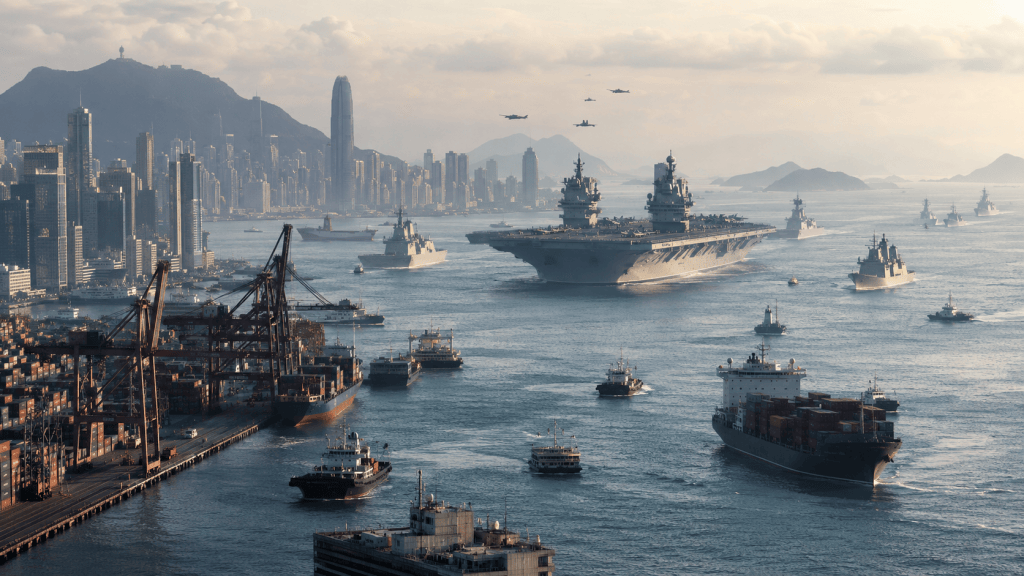
Aboard HMS Sovereign in Victoria Harbour, a fleet planner is asked to remove three warships from the Pacific readiness picture while leaving every remaining commitment looking sustainable. The calculation may fit neatly on the board, yet each reassigned ship consumes another margin the fleet may soon need.
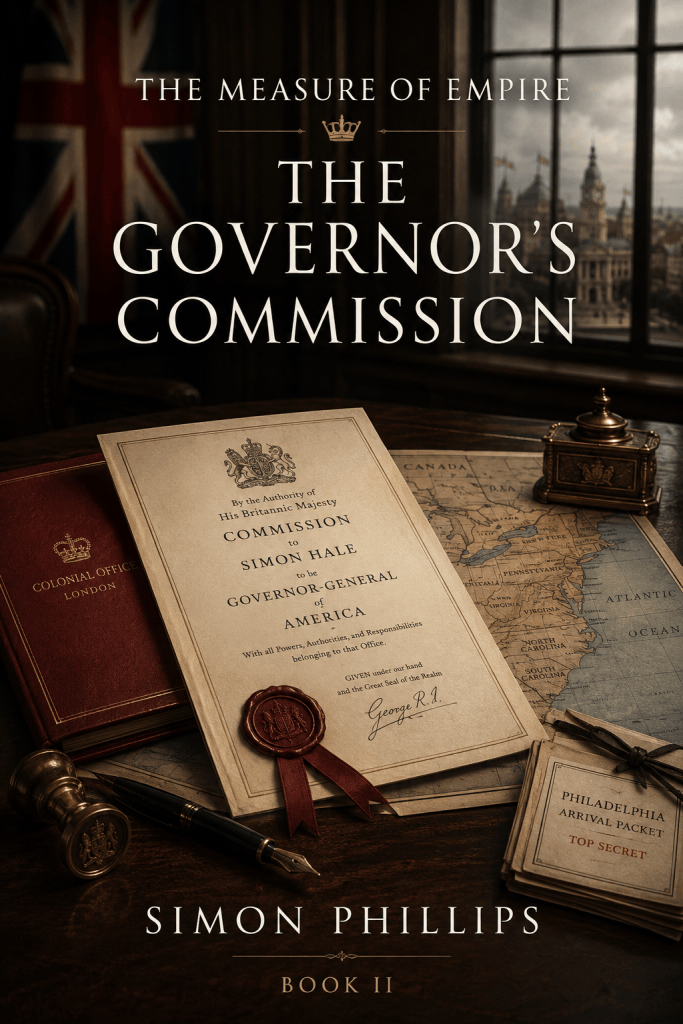
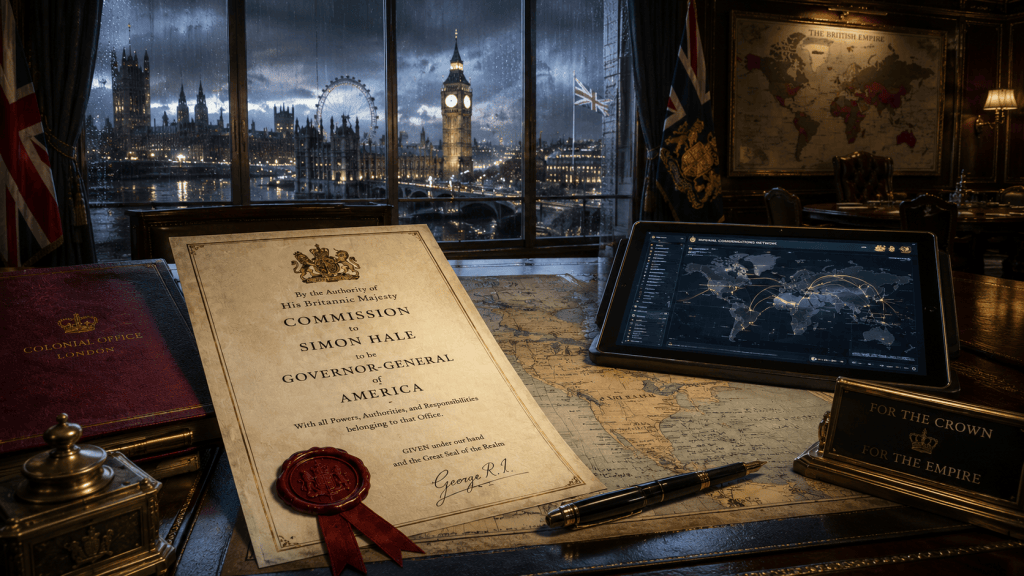
The Case by the Door is connected to The Measure of Empire, beginning with Instruments of Authority and continuing through The Governor’s Commission. The books follow the people at the centre of the political and institutional changes that these Chronicles observe from the surrounding households, offices, fleets and administrative systems.
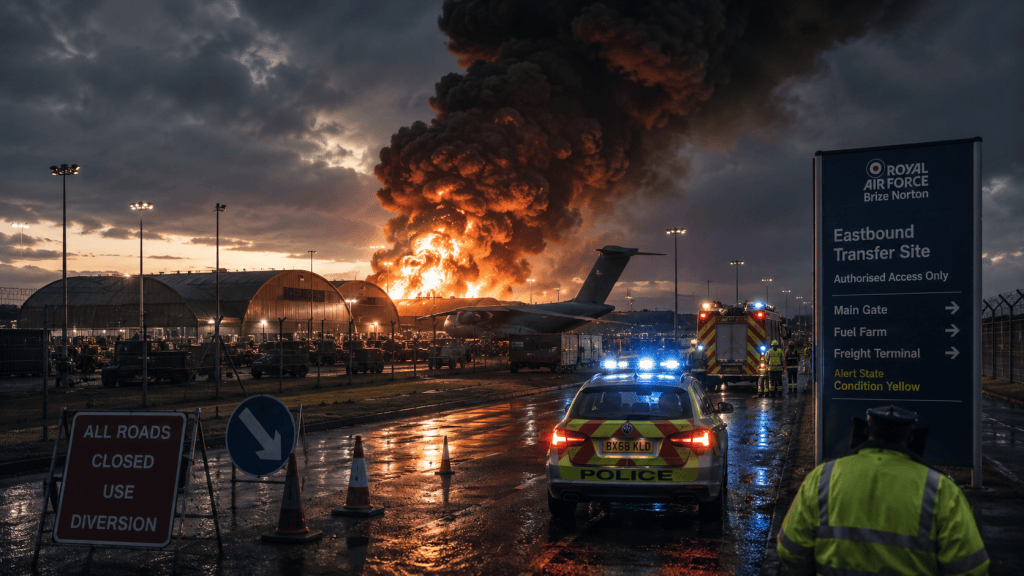
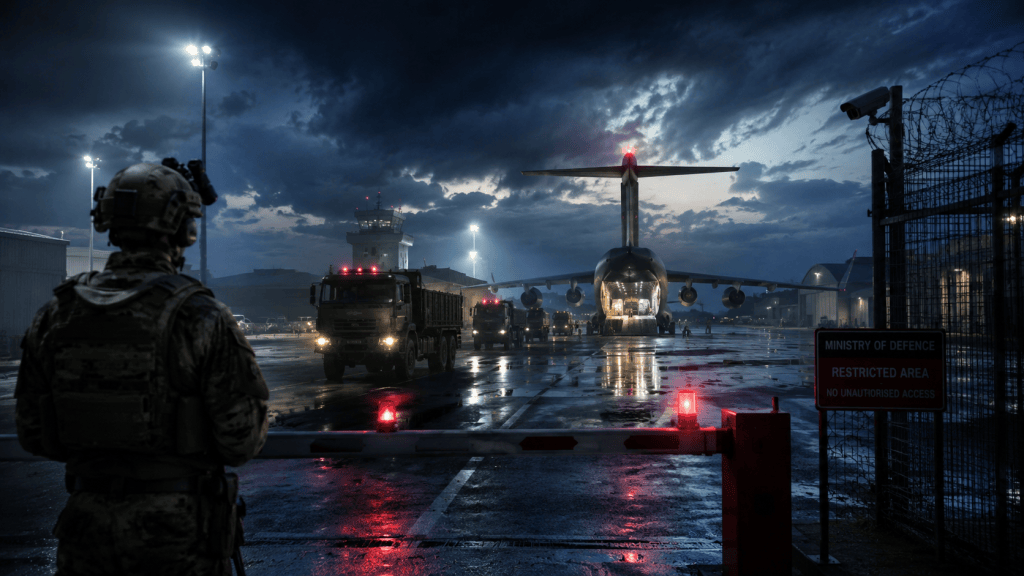
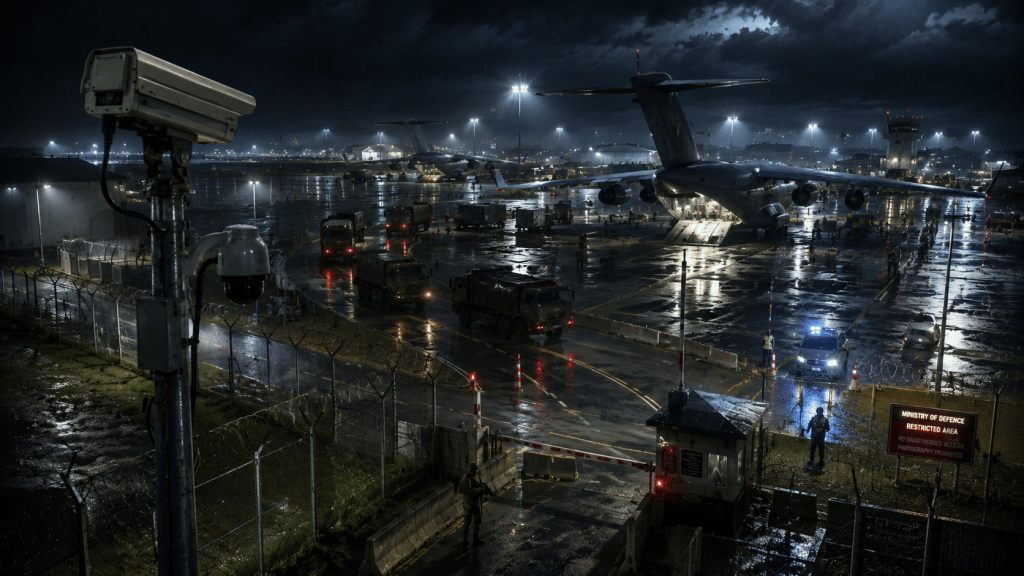
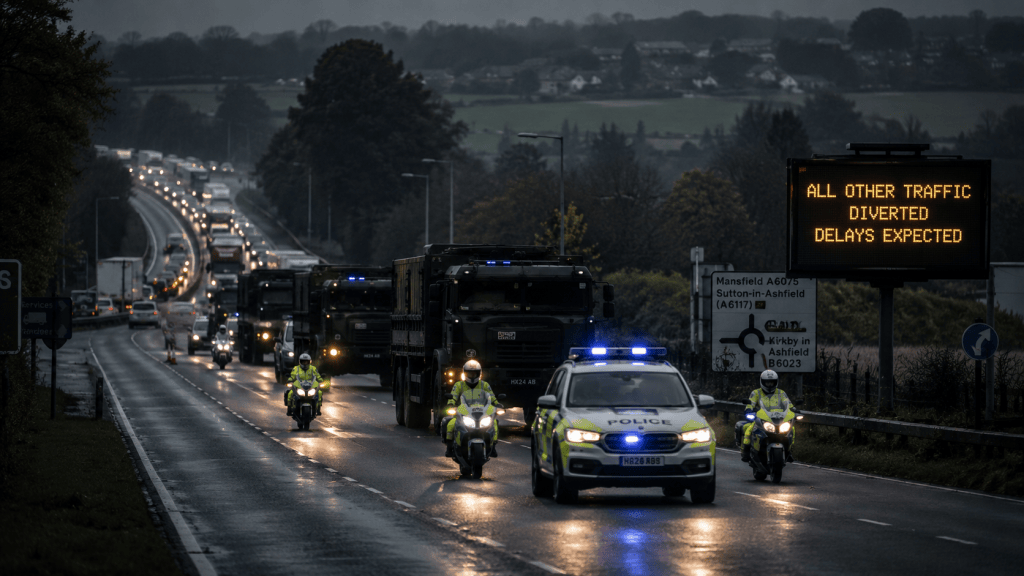
Smoke rose above an RAF transfer site, roads closed across the surrounding district, and those waiting beyond the perimeter were told that essential operations continued under revised control.
The Phone That Stayed Silent
The first tremor reached Martin Hales through the kitchen window, a low pressure against the glass that made the teaspoon shift inside Corinne’s mug and sent a faint shiver through the framed school photograph on the dresser. He had been standing at the worktop cutting two slices from the end of a loaf, watching rain gather along the patio doors while the evening news murmured from the radio beside the kettle. The sound arrived a heartbeat later, deeper than thunder and too contained to belong to the weather, followed by the sudden rising note of car alarms across the estate and a flock of starlings lifting from the roofs in one dark, startled sheet.
Martin set the knife beside the bread and moved towards the back window, his palm leaving a damp mark on the glass as he looked beyond the gardens towards the airfield. The site lay several miles away behind fields, hedges, low industrial roofs, and the long grey line of the bypass, usually present only through aircraft lights and the distant working weight of engines after dusk. A dark column had begun climbing above the horizon, broadening as it rose beneath the rain clouds, its lower edge carrying a brown-orange glow that appeared, vanished, then appeared again through the weather.
The radio presenter continued speaking about parliamentary business for several seconds before her voice broke beneath a producer’s interruption. Martin reached for his phone beside the fruit bowl and called Corinne. The line opened, held its silence, then moved to voicemail.
“Come on, love,” Martin said as he crossed towards the front room, keeping the phone pressed to his ear while the recorded greeting finished. “Pick up when you see this. I heard something from the airfield, and there is smoke above the eastern side. Send anything, even one word.”
He ended the message and stood beside the front window as neighbours emerged from houses along the close. A woman opposite held a baby against her shoulder while speaking into her mobile, and two boys near the corner had already raised their phones towards the smoke. An older man in slippers stepped onto his drive, looked towards the horizon, then hurried inside when the first sirens began moving along the bypass.
Corinne had left home shortly after two with a replacement control housing, three sealed junction units, and a crate of fittings Northgate Systems had marked for same-day delivery. She had laughed at the word urgent while pulling on her coat, saying the site had begun treating every bracket, cable, and weatherproof box as though the country might lean sideways if one arrived after tea. Martin had watched her reverse the van from the drive, one hand lifted through the rain-streaked windscreen, expecting her back before seven.
Her shift message at four thirty had been brief.
Held at inner compound. Delivery accepted. Home after clearance.
He called again, listened to the line ring, and opened the local traffic page while the voicemail greeting began for a second time. The map refreshed slowly, then filled with red bands around the service road, the village junction, and the freight turn near the eastern perimeter. A police notice advised drivers to avoid the area because of an emergency-services response, while a second notice from the county fire service asked residents near the airfield to keep windows closed as a precaution.
Martin moved through the house closing each latch while the smoke thickened beyond the gardens. At the upstairs landing window, he saw blue lights threading along the bypass in both directions, some moving towards the site, others taking positions at junctions where ordinary traffic had begun to stall. A transport aircraft crossed low above the western fields, its landing lights bright against the rain, then climbed away from the smoke in a wide turn that carried it behind the clouds.
His phone rang while he stood on the stairs. The screen showed Northgate Systems, and for one second relief weakened his knees before he answered.
“Martin Hales speaking,” he said as he gripped the banister and listened to office noise moving behind the caller.
“Mr Hales, this is Jenna Price from Northgate duty support,” the woman said as paper shifted close to her microphone. “Mrs Hales is registered on a live delivery at the transfer site. We have received notice of an emergency access restriction, and the site has asked employers to hold family enquiries through company channels.”
“Have you spoken to her?” Martin asked as he reached the hall and took Corinne’s coat from the peg simply to have something of hers in his hand.
Jenna paused long enough for voices to cross behind her. “We have confirmation that the Northgate vehicle entered before the restriction. We are waiting for a personnel update from site access.”
“That tells me where the van is,” Martin said as he pressed the coat against his side. “I asked whether anyone had spoken to Corinne.”
Jenna lowered her voice, the professional smoothness thinning beneath the strain. “No direct contact has reached us yet. The mobile network around the site is heavily loaded, and personnel inside may have been asked to keep lines clear.”
Martin looked through the glass panel beside the door, where rain had begun running in crooked streams. “There was an explosion.”
“We have seen the smoke,” Jenna said as a keyboard clicked beneath her next breath. “The instruction we received described an incident within the site boundary. Emergency services are attending, and Northgate staff are to remain where directed.”
“Staff,” Martin repeated as he pulled the door open and stepped onto the drive. “You keep saying staff as though there are fifty of them in there. Corinne is the only Northgate driver on that run.”
“I understand,” Jenna said as her chair moved across the office floor. “I have your number at the top of the family contact list, and I will ring the moment we receive verified information.”
The call ended with the politeness of a conversation that had carried no useful answer. Martin stood in the rain with Corinne’s coat over one arm while more sirens passed beyond the houses, their sound swelling against the wet brick and falling away towards the airfield. The woman opposite had begun fastening her baby into a car seat. She looked across the road and saw the phone in Martin’s hand.
“Is Corinne working there tonight?” Rachel Dunn asked as she straightened beside the open rear door, rain darkening her hair.
“She went in before five,” Martin said as he crossed towards the pavement, holding Corinne’s coat against his chest. “Northgate know the van entered. They are waiting for the site to tell them who is safe.”
Rachel closed the car door gently, leaving the baby visible through the steamed window. “My brother’s with the county fire service. He sent Mum one message saying they were heading towards the eastern gate, then his phone went quiet.”
Martin looked towards the bypass, where the blue light had become almost continuous between the rooftops. “Are you driving there?”
“I was,” Rachel said as she placed both hands on the roof of the car. “The police page says every approach is closed. Mum is already halfway down the main road because waiting in her kitchen became impossible.”
A heavy engine note rolled above them. Both looked up as another transport aircraft crossed from the airfield, lower than Martin expected, its lights passing beneath the smoke before the machine climbed towards the east. The sight held him more firmly than any barrier could have managed. Fire engines were moving in, roads were closing, families were being asked to wait, and somewhere behind the smoke the runway was still sending aircraft into the sky.
Martin returned Corinne’s coat to the house and took his keys. Rachel called after him from beside her car, asking where he intended to go, and he lifted one hand towards the road while walking.
“As close as they let me,” Martin said as he opened the driver’s door. “Sitting beside her mug is making me useless.”
The traffic slowed before he reached the bypass and stopped completely near the petrol station, where police had placed a vehicle across the eastbound lane and directed arriving cars into the supermarket access road. Drivers stood beside open doors in the rain, looking towards the smoke while officers moved from vehicle to vehicle asking for destinations and turning each answer into the same instruction. A fire appliance forced its way along the cleared centre, followed by an ambulance and an unmarked dark van carrying blue lamps behind the grille.
Martin left his car near the supermarket loading bay and walked towards the police line. A constable met him before the cones, one arm extended across his path while her radio spoke against her shoulder.
“Sir, this road is closed through to the northern freight turn,” the constable said as she shifted sideways to block the gap between two barriers. “You need to return to your vehicle and leave through the western exit.”
“My wife is inside the transfer site,” Martin said as he showed Corinne’s Northgate contact card on his phone. “She entered with a technical delivery before the incident. Her company has no personnel update.”
The constable looked at the card, then towards a sergeant speaking with two ambulance officers beside the marked car. “What is her name?”
“Corinne Hales,” Martin said as he moved close enough for rain from her cap to strike the screen. “Northgate Systems. White van, registration ending seven-three-kilo.”
The constable wrote the details on a damp page held inside a clear sleeve. “I can pass this to the family liaison desk being established at the village hall.”
“Is there a casualty point?” Martin asked as the fire glow moved through the clouds behind her.
“The village hall is receiving relatives and employer contacts,” the constable said as she folded the sleeve against her vest. “Medical information will come through the liaison route once identities are confirmed.”
Martin searched her face for the sentence she had avoided. “How bad is it?”
The constable held his gaze while another emergency vehicle approached behind him. “There has been a serious incident inside the perimeter. Crews are working, and the site remains under military control. I need this lane clear.”
A man beside the barrier raised his phone and called towards the officers, asking whether the reports of a drone strike were true. The sergeant turned at once, ordering him back from the road, while a cameraman near the petrol station lifted his lens towards the smoke. Martin saw the scene gathering its public shape around him: live streams, shouted questions, police tape, people pointing at aircraft, official phrases arriving slower than the fire.
His phone vibrated in his hand.
The message came from Corinne.
Safe. Held on site. I will call when cleared.
Martin read it once, then again, pressing his thumb against her name as though the screen could carry warmth back through the network. Relief reached him in a sudden wave that left his breath unsteady, yet the smoke still climbed above the perimeter and another aircraft was already moving beneath it, lights bright across the rain.
The constable saw the change in his face and lowered her pen. “Was that your wife?” she asked as she stepped a little closer.
“She says she is safe,” Martin replied, turning the screen towards her while his eyes remained on the airfield. “She also says they are keeping her inside.”
The constable read the message, gave a small nod, and opened a narrow space beside the barrier so an emergency vehicle could pass. “Take that to the family desk,” she said as the blue lights washed across both of them. “They will add her to the confirmed contact list.”
Martin moved back towards the supermarket road with Corinne’s message still open. Above the roofs, the smoke had spread into the cloud base, flattening across the evening until the whole eastern sky looked bruised. Behind the cordon, engines continued to rise and fall, emergency crews entered through gates closed to everyone else, and the airfield kept moving through the fire with the strained determination of a system whose importance could no longer hide behind the fence.
Restricted Emergency Movement Report
Extract from Defence Movement and National Resilience Coordination Record Subject: Eastern Air Movement Site / Fuel-Handling Incident and Continuity Measures Initial Reporting Window: 18:12–21:05 Handling: OFFICIAL-SENSITIVE Circulation: Station Command / Defence Movement Desk / Cabinet Office Resilience Cell / Regional Police Liaison / Fire and Rescue Coordination / Ministry of Defence Communications
Purpose
To record the initial response to a hostile unmanned-platform incident affecting a fuel-handling point at a defence-linked air movement site, together with the resulting emergency-road controls, contractor holds, freight disruption, family-contact arrangements, media pressure, and measures taken to preserve essential operations.
This record covered the first response period, beginning with the reported impact inside the station perimeter and ending after limited air and ground movement resumed under a revised control plan.
Approved Public Position
A hostile incident involving a small unmanned platform occurred within the boundary of a military-linked facility.
Emergency services attended promptly, protective measures were activated, and the affected area was secured. Localised disruption occurred across nearby roads and contractor access points while police, fire, military, and technical personnel completed their initial response.
The site remained operational under revised control. Essential air movement continued, and there was no wider danger identified for surrounding communities.
The incident remained under investigation. Attribution, launch location, platform origin, and intended purpose remained unresolved.
Initial Situation
At approximately 18:12, station personnel reported a low aerial track approaching the south-eastern perimeter during active fuel, loading, and aircraft-movement operations.
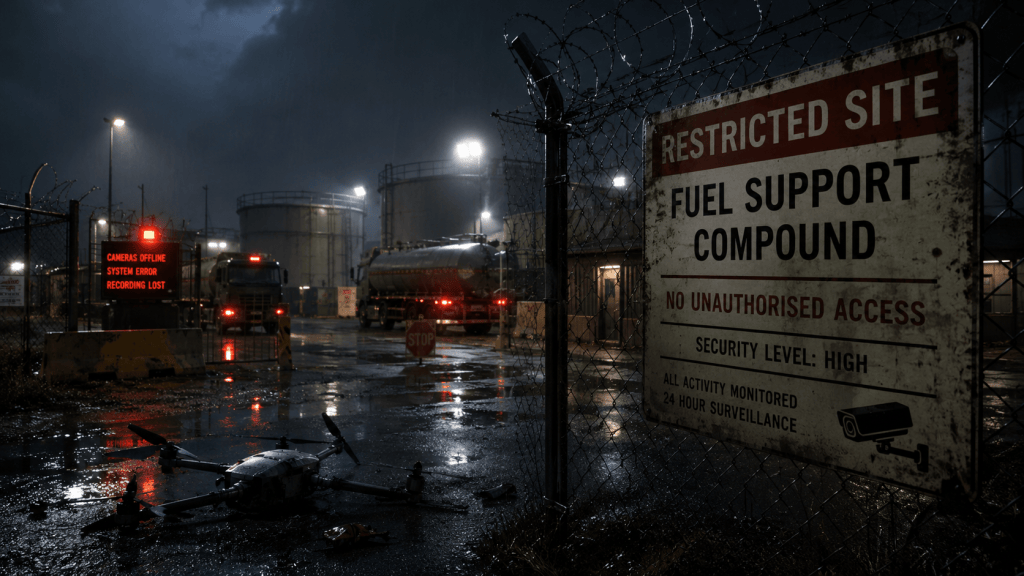
The platform passed below parts of the established surveillance arc and entered the fuel-handling approach at low level. Counter-unmanned-aircraft measures were activated before impact, although the device reached the pump housing beside the primary lane.
The impact caused fire, smoke, local blast damage, camera loss, and temporary disruption to the auxiliary fuel-control system. Station fire crews attended the fuel point while RAF Police widened the inner cordon and secured the approach lanes.
Several personnel were assessed for blast exposure and minor injuries. Casualty information remained subject to medical confirmation and next-of-kin handling during the initial reporting window.
Emergency Movement Measures
Regional police closed the public service road between the village junction and the northern freight turn after smoke became visible beyond the perimeter.
Traffic was redirected through the western supermarket access road and the bypass diversion. Emergency vehicles received priority passage through the eastbound lane, while commercial traffic, contractor vans, local buses, and private vehicles were held beyond the outer cordon.
Contractor entry was suspended at the eastern and secondary service gates. Vehicles already inside the station remained at assigned holding points until access teams completed personnel checks and movement clearance.
A family-contact point was established at the village hall in coordination with police liaison officers, local authority staff, station welfare personnel, and employer representatives. Names submitted by relatives and contractors were checked against gate records, delivery manifests, shift lists, and local movement logs.
Employers were instructed to avoid issuing independent casualty assessments before station confirmation.
Site Continuity Position
The damaged fuel-handling point remained isolated throughout the first response period. Fire crews applied foam across the pump housing, bowser approach, and affected control area while technical teams isolated the auxiliary feed.
Fuel traffic was redirected through an alternate lane under enhanced supervision. Aircraft already inside movement windows were held, resequenced, or transferred to revised servicing points.
Portable camera systems were moved towards the south-eastern approach after fixed coverage was lost near the strike area. Mobile patrols maintained observation across the affected perimeter until temporary technical coverage became available.
Air movement resumed in restricted stages after station command confirmed safe separation between the emergency cordon and the revised loading route.
The continuation of movement depended upon reduced fuel flexibility, additional fire cover, manual verification, portable surveillance, controlled contractor access, and the reassignment of personnel from secondary tasks.
Regional Freight Effect
The Regional Movement Desk received the first site restriction notice within minutes of the road closure.
Three scheduled freight arrivals were held at their originating depots, two protected consignments were moved to alternate staging, and civilian loads approaching the district were redirected away from the emergency corridor.
A local dispatch centre reported immediate loss of confidence in published arrival windows after police controls closed both the service-road approach and the northern freight turn. Drivers already inside the district were instructed to remain at marked holding areas until revised release times became available.
The transfer site’s reduced fuel and gate capacity created further pressure across linked road, rail, and port sequences. Regional coordinators were advised to preserve strategic movement while limiting visible congestion near the station perimeter.
Media and Public Handling
Images of smoke above the airfield began circulating before the first coordinated government statement.
Local broadcasters received reports describing an explosion near the fuel lanes, emergency aircraft activity, road closures, injured personnel, and a possible drone strike. Newsrooms were advised that several claims remained unverified and that footage recorded from public roads could reveal active emergency positions.
The approved description remained:
A hostile unmanned-platform incident under investigation.
Communications staff were authorised to confirm emergency-service attendance, local road restrictions, protective measures, and the continuation of essential operations under revised control.
Questions concerning the exact impact point, platform route, counter-unmanned-aircraft response, fuel capacity, aircraft destinations, casualty identity, or prior reconnaissance activity were to be referred to the Ministry of Defence communications desk.
Lines to Avoid
Avoid describing the incident as an attack on Britain pending ministerial clearance.
Avoid confirming that the platform reached its intended target.
Avoid identifying the affected pump housing, approach route, surveillance gap, or alternate fuel lane.
Avoid confirming the number or destination of aircraft moving during the incident window.
Avoid linking the incident publicly to earlier unmanned-platform recoveries near the site or at other fuel-linked infrastructure.
Avoid suggesting that eastbound support movement depended upon continued operation of the facility.
Avoid speculation concerning state direction, foreign sponsorship, launch method, or operator identity.
Avoid language implying that Britain had entered open hostilities.
Internal Assessment
The incident represented the first confirmed physical strike against the transfer site during the current protection period.
The platform reached a fuel-linked support area after earlier aerial activity had already drawn attention to perimeter response, camera positioning, access routes, and movement priorities. Investigators were therefore instructed to examine whether previous incidents had supplied useful information concerning the station’s defensive behaviour.
Damage remained localised, although the operational effect extended beyond the impact point. Police closures disrupted civilian roads, contractor access stopped, freight timings deteriorated, family-contact systems activated, media attention intensified, and protected movement required immediate resequencing across several linked systems.
The rapid restoration of air movement remained operationally necessary. It also created a significant communications risk. Continued activity beneath visible smoke could lead observers to conclude that the site held greater strategic importance than public statements had previously acknowledged.
The station remained functional because emergency, technical, military, contractor, transport, and policing systems absorbed the damage around the failed fuel point. Continued function should therefore be understood as a controlled recovery under pressure, rather than evidence of minor impact.
Attribution remained unresolved. The event’s timing, approach, target selection, and relationship to earlier unmanned activity increased the likelihood of deliberate hostile action against infrastructure supporting eastbound movement.
Further Action
Station command to preserve debris, control-system records, camera footage, radio logs, and counter-unmanned-aircraft data for joint examination.
Regional police to maintain road controls until emergency access and public traffic could be separated safely.
Defence Movement Desk to issue revised fuel, freight, and aircraft sequencing through the next operational window.
Contractor liaison teams to confirm the status of all personnel held inside the station and provide verified updates through employer contact lists.
Cabinet Office Resilience Cell to prepare revised cross-government language in advance of the next media briefing.
Public-facing wording to remain limited to a hostile incident under investigation, localised disruption, protective measures, and essential operations continuing under revised control.
About the Creator
The Modern Chronicle is written and curated by Simon Phillips, an author of modern speculative fiction and contemporary crisis-driven storytelling who explores the point where ordinary life begins to tighten beneath political strain, military movement, institutional caution, and the public language used to keep dangerous realities at a distance.
Many of the records presented in these Chronicles sit alongside Simon’s wider modern-war novella series, where governments, soldiers, families, and civilian systems are forced to absorb a world changing faster than its official explanations. The stories remain grounded in recognisable places: ports, school corridors, freight yards, government rooms, roadside queues, transfer sites, and homes where the news has started to feel too close.
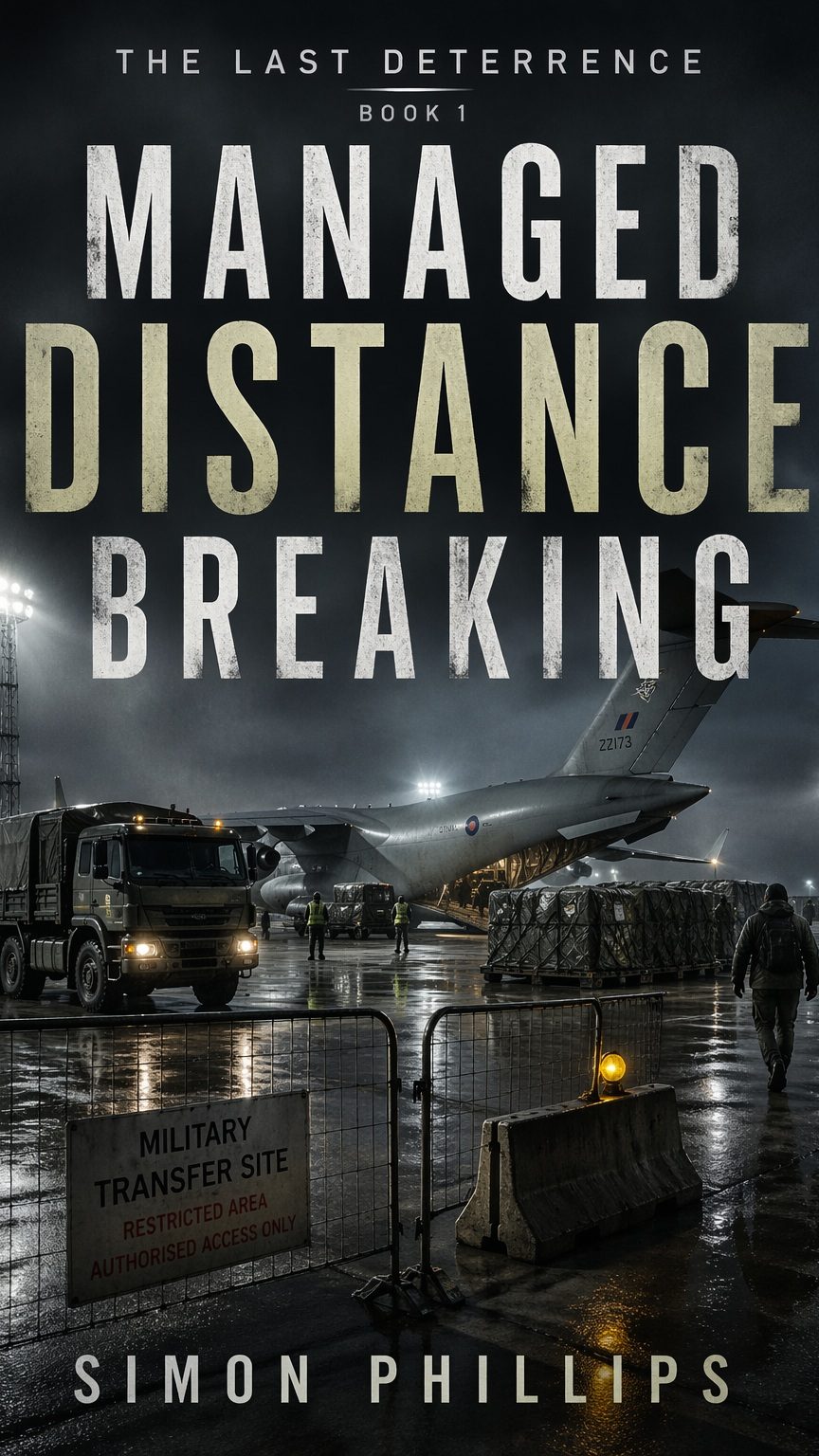
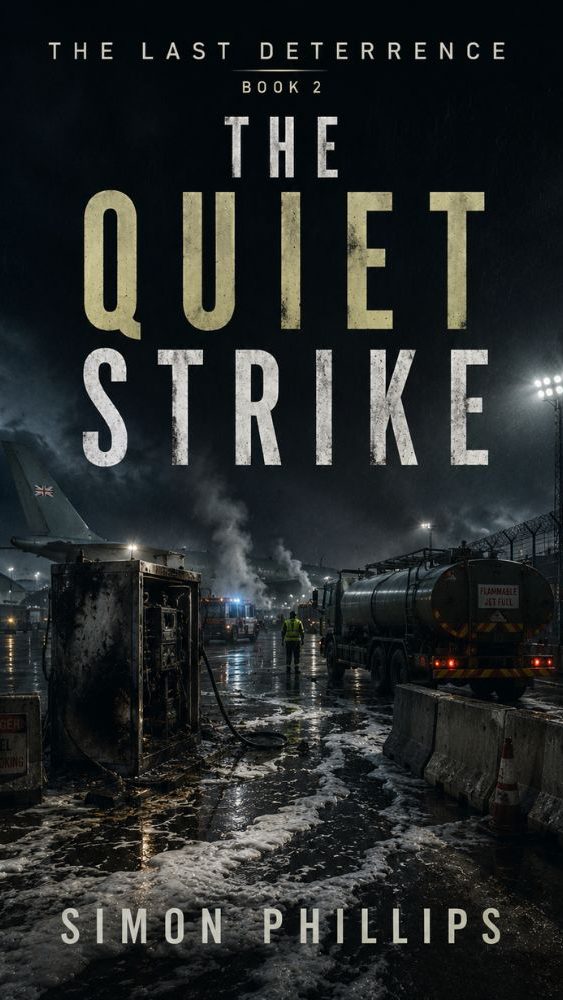
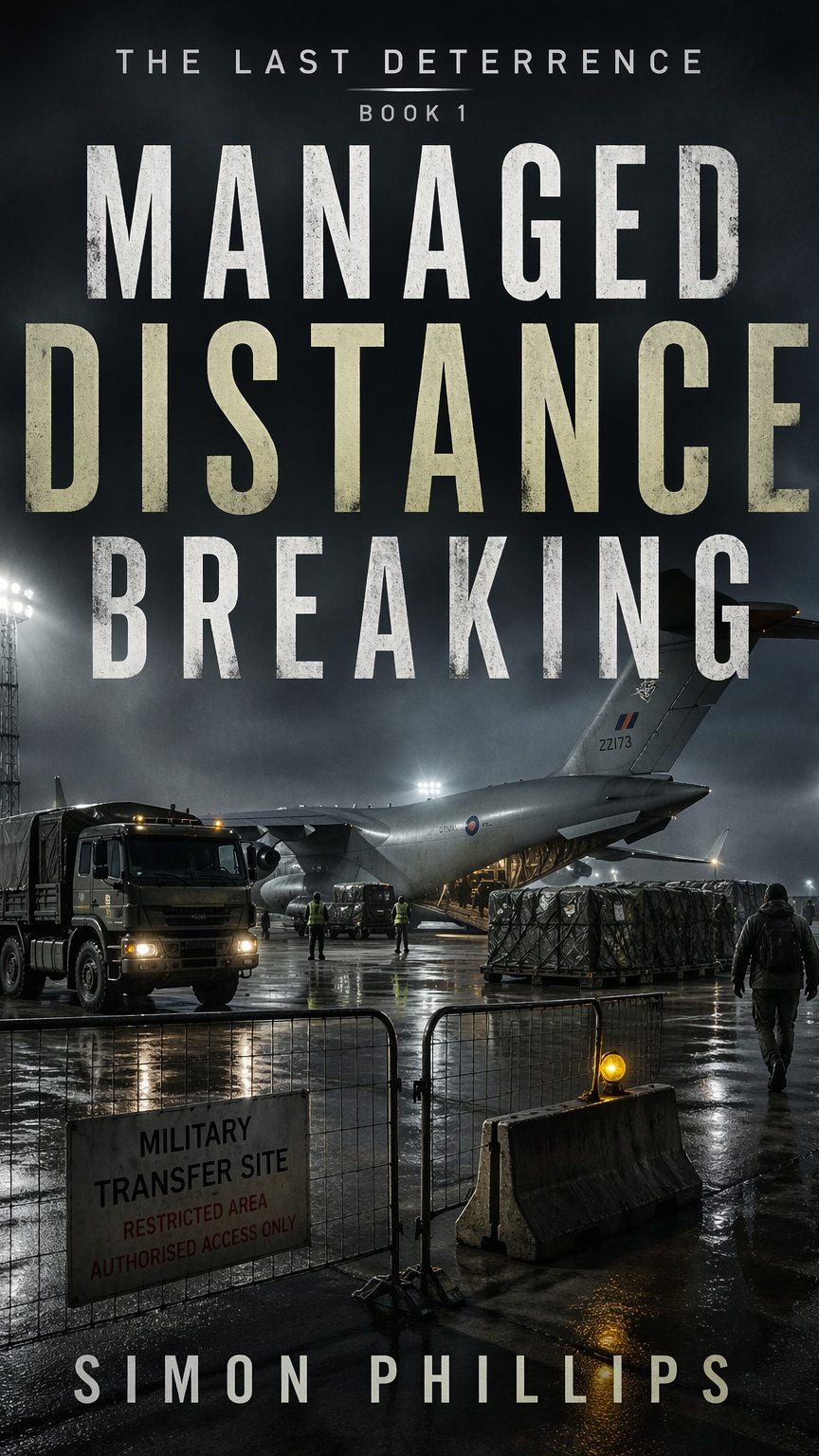
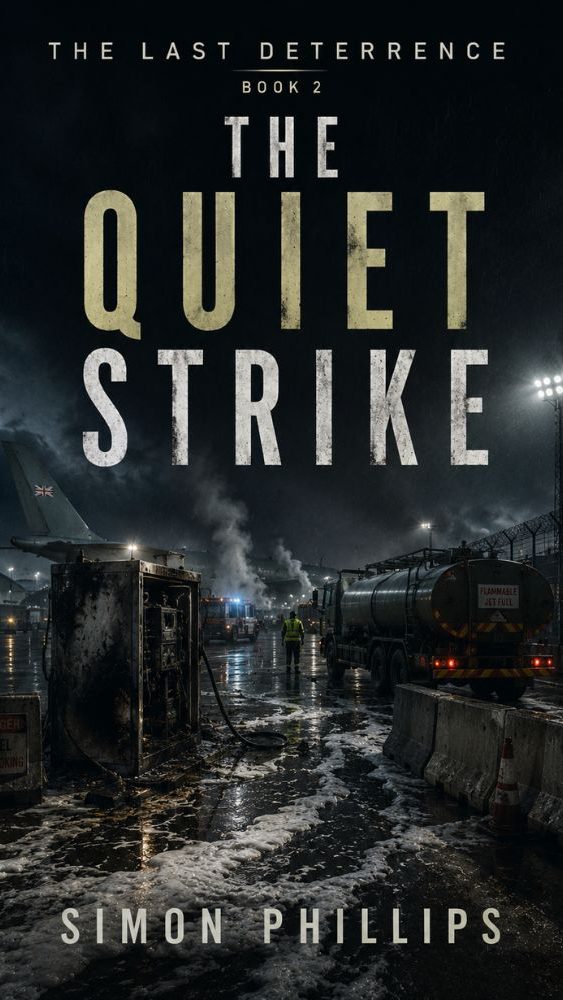
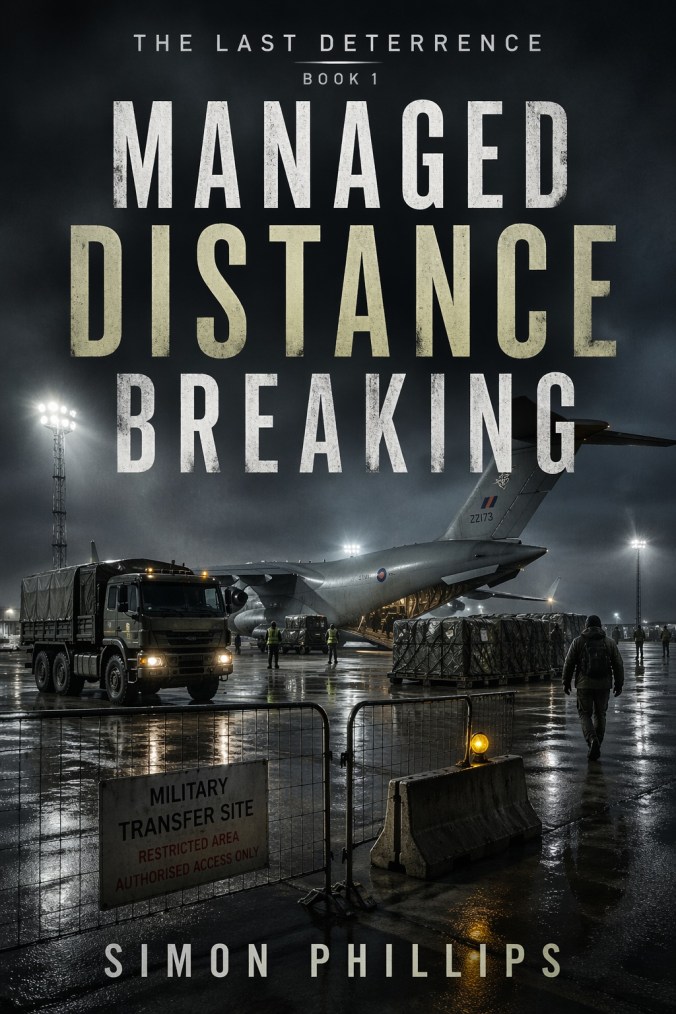
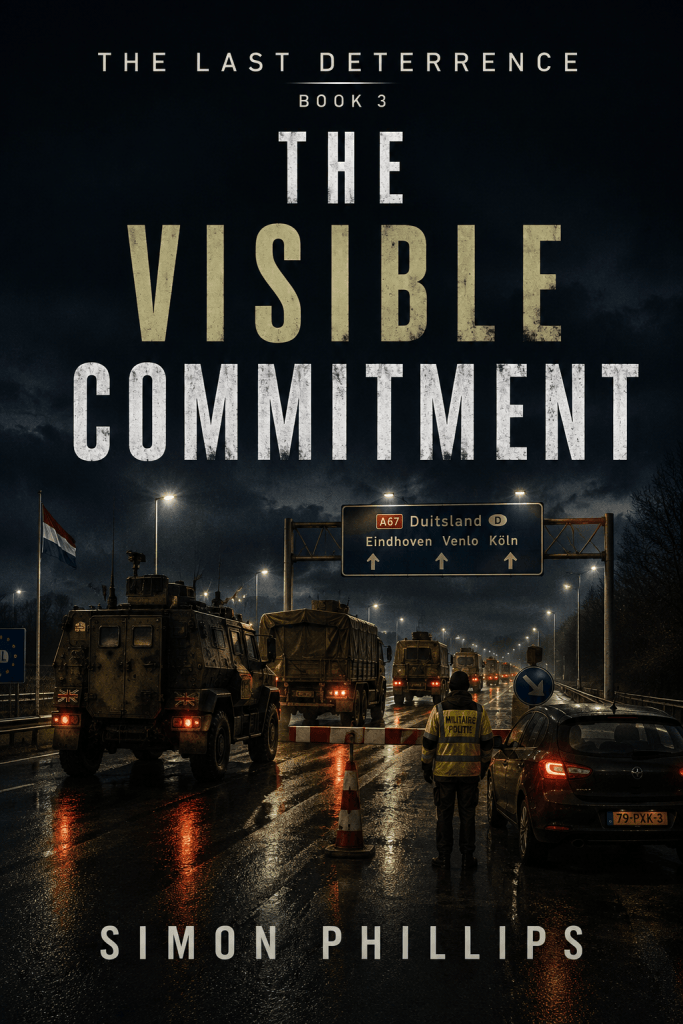
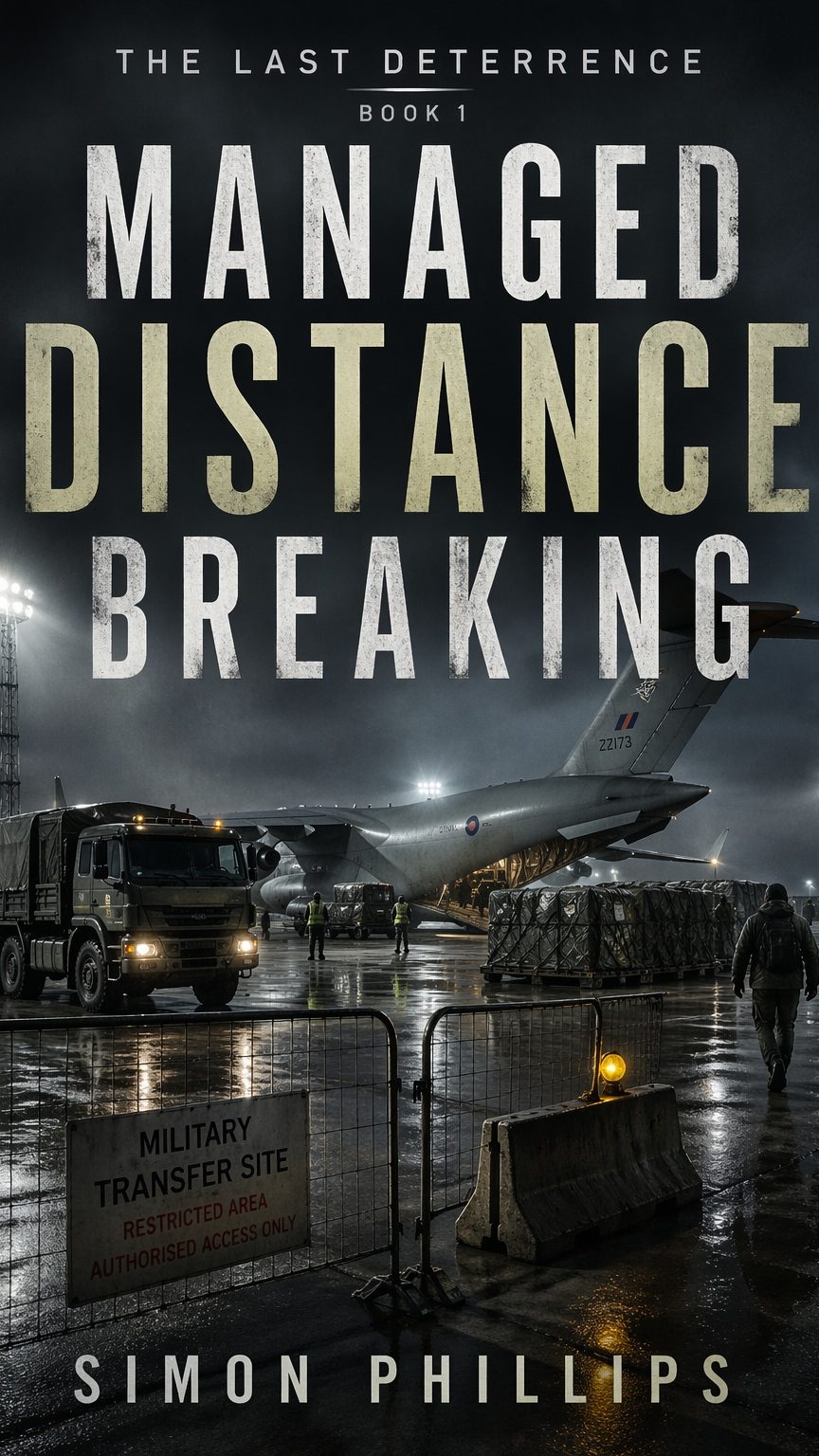
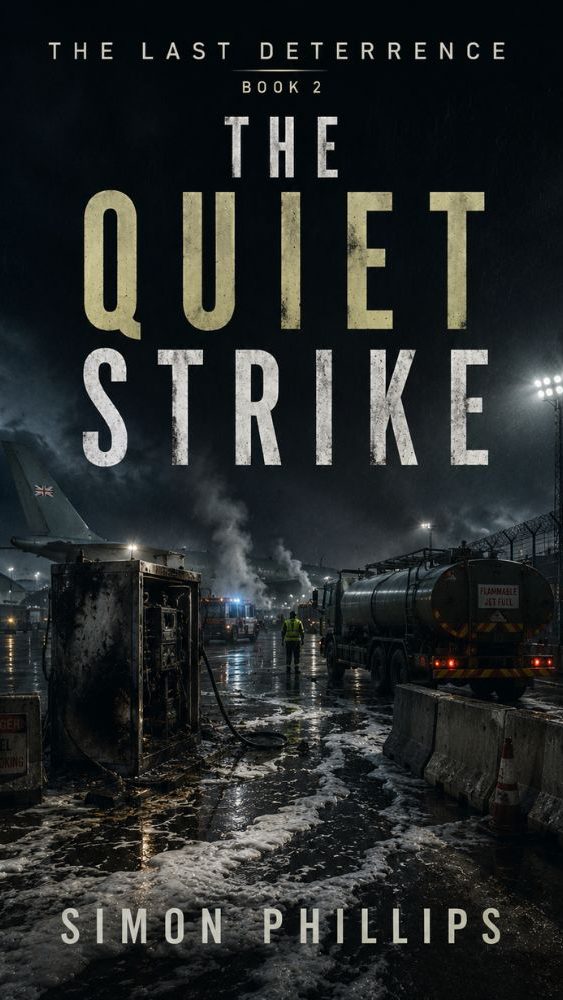
One such world unfolds through The Last Deterrence, a modern-war novella sequence beginning with Managed Distance Breaking and continuing in The Quiet Strike. Together, the first two books follow Britain as support language begins to fracture under freight pressure, European escalation, domestic infrastructure strain, and the growing sense that distance from war has already begun to fail.
Readers who wish to explore the wider published story world connected to this Chronicle can find the novellas below.
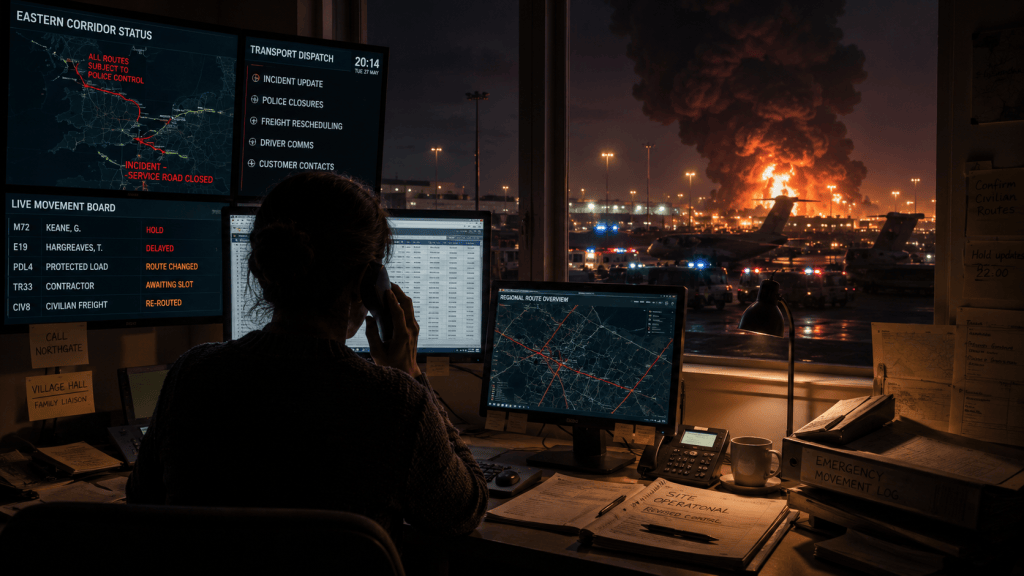
At Moorland Regional Dispatch, the first sign of the strike arrived as a grey block spreading across the eastern movement board, swallowing three arrival windows and turning the service-road approach beside the transfer site into a route marked unavailable. The change came through at eighteen seventeen, six minutes after the night controller had finished rebuilding a schedule already weakened by rain, driver shortages, and two protected loads that had entered the system with less warning than the paperwork claimed. Sophie Rennick watched the block settle across her screen while the office continued around it, phones ringing beneath fluorescent light, printers feeding revised sheets into crowded trays, and drivers calling from lay-bys where they had been sent to wait for instructions that kept changing before anyone could repeat them.
She leaned closer to the monitor and opened the incident layer. The service road had closed first, followed by the northern freight turn and the eastbound slip from the bypass. A police-control symbol appeared beside the village junction, then another near the supermarket access road. The transfer site remained green at the centre of the map, which meant operational according to the data feed, although every route leading towards it had begun turning red.
“Pete, look at Station East,” Sophie said as she rolled her chair away from the desk and pointed towards the wall display.
Peter Lang came over with his headset hanging around his neck and a half-eaten cereal bar held in one hand. He had managed dispatch rooms for fifteen years and carried alarm through smaller movements than most people used for thought. His eyes travelled across the closed roads, the held arrivals, and the green site marker at the centre.
“Who placed the police hold?” Peter asked as he set the cereal bar beside Sophie’s keyboard and reached for the incident log.
“County control issued the first closure, then Defence Movement overlaid a protected restriction,” Sophie said as she enlarged the freight list. “Keane is on the southern approach with chilled medical stock, Hargreaves has electrical cabinets, and PDL Four is carrying sealed drums due through the contractor gate at eighteen forty.”
Peter touched the green marker with one finger, as though the screen might yield more truth through pressure. “And the site still says live.”
“The site says essential operations continue under revised control,” Sophie replied as a fresh message opened in the lower corner. “That arrived thirty seconds ago.”
A silence travelled across the office as the television mounted above the lockers changed from weather to a live picture of smoke rising behind an airfield fence. Someone had muted the screen during the afternoon shift, yet the caption beneath the footage supplied enough: emergency response at military-linked facility; public advised to avoid area. The camera shook as blue lights crossed the foreground, and a transport aircraft climbed behind the smoke with its lamps bright against the darkening sky.
Peter looked from the television to the green marker and gave a quiet breath through his nose. “Operational is earning its wage tonight.”
Sophie’s headset rang before she could answer. She accepted the call and brought up the driver record as Gareth Keane’s voice filled one ear with rain, engine noise, and anger held close to the surface.
“Dispatch, this is Keane on load M-seven-two,” Gareth said as his cab indicator blinked on Sophie’s screen. “Police have turned us off the bypass and pushed twenty vehicles into the old livestock lay-by. My temperature line is holding, though the remaining window is forty-eight minutes and falling.”
Sophie read the diversion note and saw no released route beyond an instruction to hold. “Keep the unit running and preserve the cold-chain log,” she said as she opened the customer contact panel. “I am asking for a new acceptance time.”
Gareth shifted in his seat, leather creaking close to the microphone. “Ask them whether they still have a gate. The smoke is visible from here.”
“The site remains active under revised control,” Sophie said as Peter looked towards her from the wall display.
Gareth gave a tired laugh that dissolved beneath the wipers. “The road is shut, fire engines are passing every few minutes, and they remain active. That sounds like a sentence written by someone sitting farther away than us.”
Sophie watched his temperature reading hold steady. “You have enough fuel for the refrigeration unit?”
“I have enough for four hours if traffic control lets the engine run,” Gareth said as a horn sounded behind him. “The police officer wants all cabs quiet unless we need heat or medical support, and three lads behind me have already decided their deliveries outrank national security.”
“Stay where you are, Gareth,” Sophie said as she marked the load for continuous review. “I will ring before the temperature margin reaches thirty minutes.”
Gareth lowered his voice, and the anger inside it gave way to something less protected. “Was anybody hurt?”
Sophie looked up at the television, where the smoke had spread into the cloud base. “No confirmed personnel information has reached this desk,” she said as she rested one hand against the console. “I will pass anything cleared for drivers.”
“You do that,” Gareth said as a police loudhailer carried faintly through his cab. “Half the vehicles here have regulars inside that place. People remember names once the gates close.”
The call ended, leaving Sophie with the live temperature line and a question her system had no field to hold. Around her, the dispatch room divided the crisis into manageable pieces. One controller rang a depot near Coventry and asked them to retain a protected load. Another moved two civilian consignments towards a rail holding yard farther north. Peter spoke with regional coordination while writing timings on the glass board in red marker, each number recording a promise already slipping beyond reach.
At the village hall, Martin Hales carried Corinne’s message through a room full of people reading their phones as though each screen had become a private border between safety and grief. Folding tables had been arranged beneath noticeboards advertising a summer fête, a pension advice morning, and a children’s dance class postponed from the previous week. Police liaison officers worked near the stage with laptops, printed gate lists, and paper cups left untouched beside their hands. Relatives sat on plastic chairs beneath the basketball hoops, coats steaming in the overheated room while rain struck the high windows and aircraft passed above the roof in long, heavy climbs.
Rachel Dunn saw Martin near the entrance and hurried across, her mother following several steps behind with both hands wrapped around her handbag. Martin raised his phone before either woman could ask.
“She is safe,” he said as Rachel reached him, turning the message so both could read it. “Corinne sent this from inside. They are holding her until clearance.”
Rachel pressed her palm against his forearm and closed her eyes for a moment. “Thank God,” she said as her shoulders loosened. “Mum has heard from Jamie as well. He is with the second fire crew and can only send one line at a time.”
A police liaison officer named Amina Shah came from the stage carrying a clipboard sealed inside a clear cover. She had already spoken with Martin near the entrance and wore the careful expression of someone repeating partial reassurance to people who needed whole answers.
“Mr Hales, Northgate have confirmed Mrs Hales against the contractor shelter list,” Amina said as she pointed to a marked line on the page. “She remains inside the inner compound because the eastern gate route is reserved for emergency access. We expect controlled contractor release once the fire service hands the outer lane back to station security.”
“Has she been examined?” Martin asked as he kept his eyes on Corinne’s name beneath Amina’s finger.
Amina shifted the clipboard closer. “The welfare check records her as uninjured and accounted for. That is the strongest verified wording available to me.”
Martin watched a young man at the far wall pace beneath a poster about local flood resilience, his phone pressed against his mouth while he left the same message again. “The television says hostile incident,” he said as the hall doors opened and carried in a fresh wash of wet air. “The police officer on the road said serious incident. Northgate said emergency restriction. Which one is true?”
“All three may describe the same event from different responsibilities,” Amina said as she lowered the clipboard. “I know that answer offers very little comfort.”
“It offers a great deal of language,” Martin replied as an aircraft passed above the roof and made the window frames tremble. “Comfort appears to have missed its slot.”
Amina looked towards the ceiling until the engine sound moved east. “The aircraft are part of why the release is taking time,” she said as she returned her attention to Martin. “Movement has resumed across one section of the site, and the emergency routes have to remain clear.”
Rachel looked towards the dark windows. “They are still flying after a strike?”
Amina adjusted her grip on the clipboard. “Essential operations are continuing under revised control.”
In the village hall, surrounded by families waiting beneath paper decorations left from a school fundraiser, the words carried a harder weight. The site had taken a hit serious enough to close roads, summon fire crews, hold contractors, and establish a family centre. Its work still had to continue.
Across the region, Meridian Public News producer Hannah Crowe stood behind the assignment desk with three screens carrying three versions of the same evening. The first showed a live camera near the petrol station, where police tape cut across the road and smoke rose beyond a line of roofs. The second carried phone footage from a driver who claimed a drone had crossed above the service lane seconds before the explosion. The third showed the Ministry of Defence inbox, refreshing every few moments beneath a subject line marked holding response to emerging incident.
Reporter Lewis Grant sat opposite with headphones around his neck and rain still shining on the shoulders of his jacket. He had returned from the outer cordon ten minutes earlier after police moved the media line farther west. A notebook lay open beneath his hand, filled with names, times, vehicle descriptions, and arrows linking claims that refused to settle into one account.
“We can lead on the smoke and road closures,” Lewis said as he turned the notebook towards Hannah. “We have two residents who heard a blast, one contractor partner who received a safe message, and footage of aircraft leaving after the emergency response began.”
Hannah watched the driver video again, slowing the image near the top of the frame. A dark speck crossed above a lamp, vanished behind a vehicle, and the picture swung towards the smoke before anything useful could be fixed.
“We have a shape on a phone camera and a witness saying drone after hearing other people say drone,” Hannah said as she paused the clip. “That gives us rumour with pixels.”
Lewis rubbed rain from his eyebrow and drew a line beneath the word aircraft. “The police closed both approaches. Fire crews entered through the east gate. The family centre is active. Something struck the site.”
“I agree something happened,” Hannah said as she opened the latest police statement. “Our problem is the noun.”
News editor Malcolm Reed came from the studio gallery with his reading glasses held in one hand. Behind him, the evening presenter was recording a short introduction against a map showing the district and the closed roads.
“MOD have sent a line,” Malcolm said as he placed a printed page between them. “Hostile unmanned-platform incident under investigation. Localised disruption. Protective measures active. Essential operations continue under revised control.”
Lewis read the page and looked towards the live feed, where a further aircraft rose behind the smoke. “They have given us hostile and taken away attack.”
“They have given us a platform and left out where it came from,” Hannah said as she marked the page with a pen. “That is usable if we keep attribution open.”
Malcolm rested both hands on the desk and studied the live picture. “Can we say Britain has been struck?”
Hannah looked at the public line again. “We can say a military-linked facility in Britain has experienced a hostile incident involving an unmanned platform. Going further turns interpretation into fact.”
Lewis tapped the road-closure note with one finger. “People watching that plume already think the sentence is hiding from them.”
“Our job is to keep the picture and the sentence in the same report,” Malcolm said as he put on his glasses. “We show what we can verify, label what remains unclear, and leave the government to explain why an operational site needs fire crews, police cordons, family liaison, and continued flights in the same hour.”
Hannah looked towards the studio clock. “We have four minutes.”
The newsroom tightened around the deadline. Graphics staff changed explosion near airfield to hostile incident at military-linked site. The presenter rewrote her opening line to keep attribution unresolved. Lewis recorded a live introduction from beside the assignment desk because the cordon had moved too far from a stable signal. Hannah called the village hall liaison number and received the same approved wording that had already reached Martin. Across every screen, the fire became language by degrees.
At Moorland Dispatch, Sophie watched the nine o’clock bulletin with the sound raised while Peter held a phone between shoulder and ear and rebuilt the night movement sheet. The presenter stood beside footage of the smoke and explained that officials were investigating a hostile unmanned-platform incident at a military-linked facility. Protective measures remained active. Roads around the site stayed closed. Essential operations continued under revised control.
On Sophie’s screen, the green site marker remained in place while every connected timing carried amber or red.
Gareth called again from the livestock lay-by, his refrigeration margin reduced to twenty-nine minutes and his patience reduced further. Sophie answered as Peter waved a fresh route authorisation across the desk.
“They are opening the northern freight turn for controlled releases,” Sophie said as she read the instruction. “You are second in sequence behind an emergency engineering load.”
Gareth started his engine, and the vibration entered his voice. “Second sounds almost luxurious.”
“You will proceed under police escort to Holding Gate Three,” Sophie said as she marked his release. “Acceptance remains provisional until station control confirms the lane.”
Gareth paused before answering, his wipers moving fast across the cab glass. “The news says the place stayed operational.”
Sophie watched the site marker, the delayed freight, the diverted vehicles, and the road opening for two selected loads while the wider district remained closed.
“It stayed operational because everyone around it stopped doing something else,” Sophie said as Peter looked towards her from the next desk.
Gareth let the engine idle for a moment. “That line will never reach television.”
“No,” Sophie said as she moved his load into the controlled-release column. “It still has to reach the gate.”
The police escort pulled into the lay-by, blue lights turning across lorry cabs and wet fencing. Gareth joined the short line behind the engineering vehicle, while farther back the civilian loads remained parked with their drivers waiting for another version of the night. At the village hall, Martin received a second message saying Corinne would leave through the western contractor gate after ten. In the newsroom, Hannah watched the official phrase settle beneath pictures that remained larger than it. Across the airfield, engines continued through smoke, floodlight, fire cover, and the reduced space left by the damaged lane.
By the time the first controlled freight reached Holding Gate Three, the public record had taken its final shape for the evening. A hostile incident had caused localised disruption. Protective measures had worked. Operations had continued under revised control. Each sentence held a measurable truth, while the roads, families, dispatch boards, emergency crews, and aircraft carried the cost required to keep it standing.
Inside the regional dispatch room, routes failed across the screens while the airfield burned beyond the glass and essential movement was rebuilt one delayed load at a time.
The Idea Behind the Chronicle
Military sites are often presented through the most visible parts of their purpose: aircraft lifting from runways, uniformed personnel moving through secure gates, or large vehicles travelling beneath escort. Their true ability to function depends on a quieter architecture of fuel points, access roads, loading areas, contractor systems, communications links, maintenance teams, emergency crews, dispatch offices, and people whose names rarely enter the public account. A single damaged component inside that architecture may carry consequences far beyond the place where the impact occurred.
This Chronicle grew from the idea that the meaning of an attack can be measured through everything forced to move around it. The damaged fuel lane matters because it sits inside a larger chain. Aircraft require fuel, freight requires acceptance windows, contractors require controlled entry, emergency vehicles require clear roads, and every delay passes backwards through dispatch boards, depots, drivers, police controls, employers, and families waiting for information. The fire remains inside the perimeter, while its consequences spread across systems that may sit many miles away.
That wider movement is central to modern infrastructure pressure. A site may continue operating after damage, although continued operation rarely means the incident carried little importance. It may mean staff were reassigned, alternate routes opened, civilian deliveries held, emergency crews placed beside active movement, technical checks reduced to their most urgent form, and workers asked to carry several responsibilities at once. The public statement records continuation because continuation offers reassurance. The people inside the system understand how much labour, delay, and risk were required to keep that statement true.
The phrase operations continued under revised control therefore became the centre of this Chronicle. It sounds measured and stable, yet every word contains strain. Revised control may mean a gate closed to contractors, a freight route lost, a family liaison point opened, a fuel load transferred, an aircraft held beneath smoke, or a driver sent into a lay-by while his delivery window collapses. The phrase describes success at the level of national messaging, while the lived reality appears in the people who absorb the revision.
The Chronicle also explores how a modern incident becomes public knowledge. Smoke can be filmed within seconds. Drivers share road closures. residents hear the blast, relatives receive fragments through private messages, and newsrooms begin assembling a report before the official account has settled. Institutions then face a difficult task. They must confirm enough to preserve trust, protect information that may still carry operational value, avoid premature attribution, and maintain public calm while images already show a response larger than the first statement can comfortably explain.
That tension shaped the newsroom scenes. The journalists saw fire, emergency movement, continued aircraft activity, and families directed towards a liaison centre. The official wording described a hostile unmanned-platform incident under investigation. Both accounts carried truth, although each revealed a different layer. The image showed consequence. The statement controlled meaning. The Chronicle remained in the space between them, where the public could see that something serious had happened while still lacking permission to name its full importance.
Martin Hales, Sophie Rennick, Gareth Keane, Hannah Crowe, and the people waiting inside the village hall carry that gap through ordinary responsibilities. Martin wanted one message from his wife. Sophie needed to preserve freight movement through collapsing timings. Gareth had to keep a temperature-controlled load viable while police controlled the road. Hannah had to decide which words could survive broadcast. Each person stood outside the central military event, yet each became part of its consequence. Their experience showed how a strike against one protected site could enter homes, offices, lorry cabs, newsrooms, and public buildings within minutes.
The earlier Chronicles in The Eastbound Line followed a corridor becoming visible through containers, capacity statements, freight yards, controlled roads, fuel compounds, hardened gates, public-order pressure, and aerial reconnaissance. This Chronicle marked the point where observation became physical damage. The systems established across the series were forced to respond at once, revealing the transfer site’s importance through the scale of the effort used to keep it functioning.
The deeper idea behind The Fuel Lane Remained Operational is that resilience and vulnerability can exist in the same place at the same time. The airfield kept moving, which proved the strength of the people and systems supporting it. The roads closed, freight timings failed, families gathered, emergency crews entered, and public language narrowed, which revealed how close that strength had come to being tested beyond its prepared limits.
The official record could therefore say that operations continued. The wider Chronicle recorded everything that had to stop, change, wait, or carry additional weight in order for that sentence to remain true.
From the Author’s Desk
The Eastbound Line grew from a question that remained with me while I was writing the opening books of The Last Deterrence: how would a country recognise that war had reached it when every institution still depended upon language designed to keep that admission at a distance?
The answer seemed likely to emerge through ordinary systems before it appeared through any formal declaration. Ports would change priority. Freight yards would tighten. Roads would close for movements that carried no public explanation. Contractors would wait outside hardened gates. Families would receive fragments of reassurance while newsrooms tried to fit smoke, rumour, and official statements into the same account.
This Chronicle reached the point where those pressures became physical. The fuel-lane strike mattered through the damage inside the perimeter, though its wider meaning appeared through the people beyond it: a husband waiting for one message, a dispatcher rebuilding failed timings, drivers held on closed roads, journalists searching for a word strong enough to match the images, and officials trying to preserve uncertainty while aircraft continued moving beneath the smoke.
The wider books, Managed Distance Breaking and The Quiet Strike, followed the same worsening national reality through the Mercer family, government decision-making, civilian strain, military movement, and the gradual collapse of distance from the conflict. These Chronicles remained beside that central story, recording adjacent lives and public accounts that revealed how deeply the same crisis had entered Britain’s roads, workplaces, institutions, and homes.
Alongside The Last Deterrence, I continue writing modern speculative stories shaped by political pressure, institutional failure, military escalation, and the human cost carried beneath official language.
Readers interested in those stories can explore more through the links below.
Fuel infrastructure often appears as a supporting detail beside aircraft, vehicles, freight, and personnel, yet every movement across a military-linked site depends upon it. Aircraft require planned quantities, safe separation, working pumps, trained crews, tested control systems, clear access lanes, and enough spare capacity to absorb delay. A fuel point therefore functions as more than a collection of pipes and tanks. It becomes part of the timing structure holding the entire site together.
That structure is especially vulnerable during periods of sustained movement. A damaged pump housing may close one lane, though the effect quickly travels elsewhere. Aircraft wait longer. Bowsers cross routes originally assigned to freight. Fire crews occupy movement space. Technical teams isolate power. Portable lighting and surveillance move towards the damaged area. Contractors lose access while emergency traffic takes priority. Each adjustment preserves one form of activity by narrowing another.
Article Nine sits inside that chain of dependency. The physical damage remains localised around the fuel-handling area, while the operational shock reaches roads, depots, dispatch offices, contractor lists, family-contact systems, and newsrooms. The wider effect reveals why fuel infrastructure carries strategic value. Its importance comes from everything else that struggles once the lane loses capacity.
The Chronicle therefore treats the fuel point as a pressure system instead of a spectacle. Fire and smoke draw the eye, though the deeper story appears through revised arrival windows, closed approaches, resequenced freight, held workers, and aircraft continuing under reduced flexibility. The site remains active because every surrounding system accepts additional strain. That distinction reflects the published world of The Quiet Strike, where the fuel-lane blast causes damage, partial camera loss, reduced flow, contractor suspension, technical risk, and a wider political recognition that British-linked infrastructure has become exposed.
The Meaning of Revised Control
Official language carries unusual weight after an incident at a protected site. Public statements must reassure nearby communities, preserve operational security, prevent unsupported attribution, maintain confidence in national systems, and leave ministers room to respond as evidence develops. A phrase such as operations continued under revised control serves all those purposes at once.
The sentence sounds calm because it records the outcome instead of the effort required to achieve it. Revised control may involve an alternate fuel route, additional fire cover, manual checks, changed aircraft sequencing, reduced contractor access, portable camera coverage, police closures, or the reassignment of staff from secondary duties. Every measure belongs to continued operation, although each also reveals that the previous operating condition has already been lost.
That tension matters across The Eastbound Line. Earlier Chronicles described ports remaining operational while civilian freight waited, roads remaining open while ordinary traffic was held, fuel compounds remaining secure while cameras failed, and airfields continuing their work while gates hardened around them. Article Nine carries the same institutional language into a more serious stage. The site has suffered a hostile incident, yet the public line still emphasises continuity, localised disruption, and protective measures.
Continued operation therefore becomes evidence of importance. A minor facility could pause, close, or transfer its work elsewhere. A site required to keep moving through smoke, emergency access, damaged infrastructure, and public scrutiny reveals its place within the wider support corridor through the urgency of its recovery. The approved series plan makes that pressure central to Article Nine: Britain has been hit in a strategically meaningful way, and the insistence upon continued movement exposes how vital the transfer site has become.
Families, Contractors, and Personnel Confirmation
Military-linked infrastructure depends upon a wide civilian workforce. Contractors maintain cameras, lighting, electrical systems, catering, communications, vehicles, fuel equipment, security technology, and the small practical components that keep large sites usable. During an emergency, those workers enter the same personnel-accounting system as service members, emergency crews, drivers, and technical staff, although their information may travel through separate employers, gate records, delivery manifests, and liaison channels.
That separation creates delay at the moment families need certainty most. A partner at home may know that a van entered the site, yet the employer may only hold a scheduled delivery reference. The employer then waits for station access staff. Station staff compare contractor lists against gate records and holding areas. Police liaison teams gather names from relatives. Medical confirmation moves through its own controlled route. A single message saying safe may arrive before the formal system has completed its checks, leaving families caught between private reassurance and official silence.
Article Nine uses that gap through Martin and Corinne Hales. Corinne’s presence inside the site has no strategic significance by itself. She carries technical equipment, follows access instructions, and waits where she is directed. Her importance lies in the way the emergency becomes human through Martin’s need for one verified sentence. The state sees personnel categories. Northgate sees an employee on a live delivery. Police see a name requiring confirmation. Martin sees his wife inside a column of smoke.
Family liaison centres often occupy ordinary civic spaces because emergencies require places large enough for tables, records, welfare staff, and controlled contact. A village hall used for fêtes, advice sessions, classes, and local meetings becomes part of national resilience within an hour. That transformation carries the wider Modern Chronicle idea especially well: ordinary buildings acquire new functions as pressure spreads, while people learn that national security can enter their lives through a plastic chair, a damp coat, and a name checked against a printed list.
The inability to provide immediate family certainty also reflects one of the state’s limits within The Quiet Strike. Officials can protect information, coordinate movement, and control public phrasing, yet they struggle to give relatives a full account while the incident remains active.
Smoke, Newsrooms, and the Public Record
Modern incidents become visible long before their official meaning settles. Smoke rises above a perimeter. Drivers film road closures. Residents hear a blast and post from upstairs windows. Emergency vehicles appear on local feeds. Aircraft continue moving through the background. Newsrooms begin assembling these fragments while government departments, police commands, and military communications teams are still agreeing which details can safely enter public language.
The visual record creates immediate pressure because images appear complete even when the information around them remains partial. A plume above an airfield suggests scale. A closed road suggests danger. A family centre suggests casualties. Continued aircraft movement suggests operational importance. Each image may be genuine, though the conclusion drawn from it can still exceed the confirmed record.
Newsrooms therefore work inside the same narrow space as government communications, though their duties differ. Journalists need language strong enough to reflect visible events, careful enough to preserve unresolved facts, and clear enough to separate eyewitness accounts from confirmed information. The phrase hostile unmanned-platform incident under investigation provides a usable centre. It confirms hostile character and an unmanned system while leaving origin, operator, intention, launch point, and state direction open.
That restraint protects accuracy, though it also creates tension with the pictures. Viewers see smoke, fire appliances, closed roads, and aircraft moving beneath emergency lighting. The official sentence speaks of localised disruption and revised control. The Chronicle lives between those two records, preserving what people saw while respecting how little had been established publicly.
Attribution remains especially sensitive. Earlier drone incidents around the support corridor suggested observation, testing, and deliberate probing, yet the published record still stops short of naming an operator. Article Eight established that the airfield’s routines and defensive reactions may already have been measured. Article Nine advances from observation to physical damage while keeping origin unresolved.
Britain as Exposed Rear Infrastructure
The traditional idea of a secure rear depends upon distance. Front-line forces face direct danger, while ports, airfields, depots, fuel sites, roads, and government systems behind them provide movement and support. Modern long-range weapons, unmanned platforms, cyber access, commercial surveillance, and civilian logistics networks weaken that distinction. A country may remain outside declared war while its infrastructure already carries the risks of participation.
The Eastbound Line has traced that change through practical systems. Containers moved first. Capacity statements concealed displacement. Germany altered freight logic inside Britain. Protected routes changed civilian time. Fuel-linked infrastructure came under observation. Airfield gates hardened. Public-order policing absorbed wider strain. A damaged unmanned device revealed how much the site exposed when it reacted.
Article Nine marks the point where that pressure becomes physical. The transfer site is struck, roads close, freight timings collapse, families gather, emergency crews enter, and the public account narrows around controlled language. The event remains limited in scale, yet its meaning extends across the whole cycle. Britain’s support system has become significant enough to attract hostile action and resilient enough to keep moving after damage.
The official success lies in continuation. Aircraft still depart. Freight reaches controlled gates. Personnel are accounted for. Fire crews contain the damaged area. Public order holds around the cordon. The deeper record lies in the cost of that success: reduced capacity, diverted labour, family uncertainty, public confusion, and a national support corridor behaving increasingly like infrastructure inside an active conflict.
Article Nine therefore occupies the final stage before the cycle’s closing threshold. The country still uses the language of support, resilience, investigation, and protective action. Its roads, fuel systems, airfields, police lines, and emergency structures already carry a heavier reality. The site remained operational, while the nation around it moved closer to an admission its public language had yet to make.
Next Chronicle
In the hours after the strike on the transfer site, ministers and officials began preparing a new public account of Britain’s response. The language centred on defensive support, allied air movement, logistics resilience, and risk reduction, each phrase chosen to describe a widening commitment while keeping one heavier word beyond the statement.
Across the eastbound line, the practical meaning appeared before the announcement had settled. Port rosters changed again, sealed loads received fresh movement orders, protected routes tightened, and aircraft were prepared beneath floodlights while families received calls offering destinations, timings, and very little certainty. The same people who had watched containers wait, roads close, gates harden, and freight priorities shift could now see those separate pressures joining into a single national movement.
The public record would describe enhanced defensive support for allied logistics and air-movement infrastructure. Beneath that language, Britain had reached the threshold where support had become participation in practice, and the word deployment remained absent because saying it aloud would have revealed how far the country had already travelled.
The next Chronicle follows the statement and the movement beneath it, as aircraft began carrying Britain east under language still shaped to suggest the country remained safely behind the conflict.
Next Week: The Word They Kept Out of the Statement
By midnight, the smoke had thinned above the transfer site, though aircraft still climbed east through the dark, carrying a decision the country had yet to name.
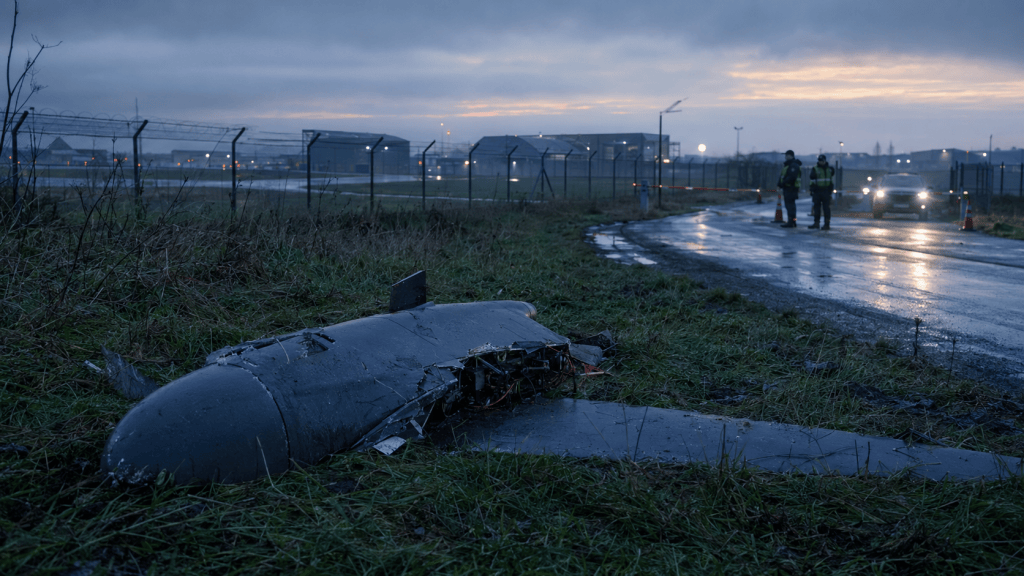
After a damaged unmanned device was found beyond an RAF transfer site, the road was sealed, contractors were held at the gate, and the official explanation became smaller than the response around it.
The Road That Closed Before the Gate
The first blue light appeared in Corinne Hales’s windscreen before the airfield came into view, turning through the rain at the far bend of the service road and throwing a pale pulse across the hedges, the standing water, and the low branches dragged towards the verge by the wind. She eased the Northgate Systems van below twenty, expecting an ambulance or a stranded car, then saw a marked police vehicle angled across both lanes beside a line of cones that had been laid from the ditch to the outer fence. Beyond them, the transfer site continued beneath its hard white floodlights, transport tails rising above the wire and loading lamps glowing through the weather, yet the familiar approach had been divided into pieces: civilian road, police line, closed gate, armed figures, and a strip of wet ground between the hedge and the perimeter where every available light appeared to be pointing.
Corinne stopped behind a catering van and lowered her window as a constable came towards her under a black waterproof cap. Rain swept into the cab, cold against her cheek, carrying the smell of diesel, wet grass, and aviation fuel from the other side of the fence.
“Please switch off your engine and remain inside the vehicle,” the constable said as she raised one gloved hand towards the queue forming behind Corinne. “Keep your phone away from the windows, and leave enough space for emergency traffic to pass on your right.”
Corinne turned the key and held up her contractor pass between two fingers. “I have a scheduled delivery for the technical compound, reference Northgate seven-one-six. The gate office should have me at seventeen-thirty.”
The constable glanced at the pass, then towards the outer gate, where a second barrier was sliding across the entrance. “The site has suspended contractor access, Mrs Hales. Someone from the gate team will speak with you when they are able.”
“How long are they expecting us to sit here?” Corinne asked as she looked past the police car towards the dark verge.
The constable adjusted the radio clipped high on her jacket. “I have no reliable time for you yet. Please stay in the van and follow any instruction given over the loudhailer.”
She moved towards the next vehicle before Corinne could ask what had happened, leaving rain to collect along the open edge of the window. Corinne raised the glass and watched the road change around her. Another police car arrived from the village direction and stopped behind the growing queue, sealing the approach from both ends. Two RAF Police officers crossed outside the gate with torches held low, while a man in a heavy green jacket stood near the ditch beside a wheeled case and a folded screen. No one approached the patch of grass under the brightest lamp. Their distance from it gave the ground a shape Corinne could feel even while the object itself remained hidden.
Her phone vibrated in the dashboard cradle. The depot had sent three messages, each more urgent than the last, asking whether the replacement camera housing had reached the site and whether the engineer would still receive it before the evening installation window closed. Corinne read them, locked the screen, and left the phone face down beside the gear lever. Four days earlier she had delivered the brackets that now held some of the portable cameras above the contractor yard. She recognised one mast near the inner lane, its head turning in a slow mechanical sweep until it reached the service road, where it stopped and held.
A knock sounded against the passenger window. Tom Grady, the catering driver ahead, stood beside the van with his hood flattened against his head and one hand braced on the door mirror. Corinne lowered the glass a few inches.
“The officer told everyone to stay inside,” Corinne said as she leaned across the passenger seat. “She looked serious enough to remember faces.”
Tom wiped water from his eyebrows and pointed towards his rear doors. “I have chilled food in there, and the refrigeration warning came on near the bypass. If they keep me here for an hour, the kitchen can argue over warm yoghurt tomorrow.”
“Get back in and ring your dispatcher,” Corinne said as a dark vehicle moved through the gate behind two armed escorts. “This has passed the point where yoghurt carries authority.”
Tom followed her gaze towards the verge. “One of the lads up front heard the police say drone. He reckons it came down beside the road.”
Corinne felt her attention sharpen, although she kept her voice level. “One of the lads up front heard half a radio call through rain. Those stories usually improve each time they travel backwards.”
“You think it is rubbish?” Tom asked as he tucked his hands beneath his arms.
Corinne watched an RAF officer raise a torch towards the hedge, then lower it when the man beside the wheeled case spoke to him. “I think you should return to your van before somebody writes your registration into a report.”
Tom gave the verge another glance, then hurried back through the rain. His brake lights glowed red when he climbed inside, painting the wet road between their vehicles. Beyond the perimeter, an announcement broke across the airfield tannoy, thinned by distance until Corinne could catch only assigned positions and outer line. Movement changed at once. A forklift stopped beside a pallet stack. Ground staff stepped away from an open lane. Two figures crossed towards the fence at a run, then dropped from view behind concrete sections. The transport aircraft remained lit and open, its rear ramp a bright rectangle facing the weather, while every smaller movement around it became faster, tighter, and harder to follow.
Corporal Reeve came through the pedestrian gate ten minutes later with his hood raised and a clipboard sealed inside a clear cover. Corinne recognised his careful walk along the queue, pausing at each cab, checking names, giving drivers the same measured explanation. When he reached her window, the brief warmth of recognition in his face disappeared beneath the strain of the evening.
“Mrs Hales, Northgate Systems,” Reeve said as he checked the first sheet. “You have the weatherproof camera housing and replacement junction kit?”
“They are in the back, dry and increasingly expensive by the minute,” Corinne said as she passed her movement paper through the narrow gap. “The police officer says access has been suspended.”
Reeve held the paper beneath the lamp fixed to his shoulder. “All contractor arrivals are being held while the outer road remains controlled. Your delivery window will be reissued once the site access officer clears movement.”
Corinne looked towards the cluster of lights near the ditch. “What is lying in the grass?”
Reeve kept his eyes on the movement reference. “Debris was reported beyond the perimeter. A specialist team is assessing it.”
“Debris from what?” Corinne asked as a gust shook water from the hedge across the road.
Reeve returned the paper and pressed its damp corner flat against the clipboard. “The approved description is a possible small unmanned platform. There has been no detonation, and there is no current indication of danger to the public.”
“Then why have local police closed both ends of the road?” Corinne asked as she gestured towards the blue lights behind the queue.
Reeve looked past her towards the vehicles, each driver visible through a bright phone screen or rain-streaked windscreen. “Because possible becomes expensive near an active airfield, and because leaving the road open would place people where the assessment team needs space.”
The answer carried more honesty than the line before it, which made Corinne study him closely. Rain ran from his hood onto the shoulders of his jacket. A radio spoke somewhere beneath the fabric, too low for sense, and Reeve turned his head as though one phrase had reached him through the noise.
“Were the cameras working?” Corinne asked as the mast above the inner lane remained fixed on the service road.
Reeve tightened his grip on the clipboard. “Which cameras?”
“The ones Northgate spent all week mounting because somebody decided this gate needed more eyes.” Corinne nodded towards the mast. “That one has been staring at the same piece of road since I arrived.”
Reeve followed her glance for less than a second. “All questions about site surveillance go through the access office. Please keep your phone inside the cab, avoid taking photographs, and speak only with your employer about the delay.”
“That sounds less like advice than an instruction,” Corinne said as she set both hands on the steering wheel.
“It is an instruction,” Reeve said as he stepped back from the van. “I am asking politely because we have met before.”
He continued down the queue, leaving Corinne with the hum of the refrigeration unit ahead and the softened blue light moving across her mirrors. On the far side of the fence, the response gathered its own order. A white-suited figure appeared near the wheeled screen, followed by two officers who kept several paces behind. Portable lamps shifted until the ditch, verge, and lower fence shone with the flat brightness of an operating theatre. A small shape became visible for a moment in the beaten grass, dark at its centre, one thin arm raised at an angle, before a technician blocked the view.
Tom rang her instead of leaving his van again. Corinne answered through the dashboard speaker, keeping her eyes on the activity ahead.
“My dispatcher wants a reason for the delay,” Tom said as refrigeration machinery rattled behind his voice. “Temporary security hold sounds as if I have lost my pass.”
Corinne watched a technician kneel near the small shape while an officer turned his face towards the gate. “Tell him the service road is closed during an official assessment, then leave every other word alone.”
“Do you think they were watching the airfield?” Tom asked as his voice fell quieter.
Corinne looked at the gate cameras, the police cars, the halted vans, the armed figures beside the fence, and the loading lanes that had revealed their order one movement at a time. “I think everyone close enough to see this road now knows which parts of the place move first.”
The call ended as Flight Lieutenant Harcourt emerged from the gate cabin and spoke with the local police sergeant beside the cones. Their conversation lasted less than a minute. Harcourt handed over a printed sheet, the sergeant read the first page under her torch, and both looked towards the waiting vehicles before the police loudhailer carried a woman’s voice along the road.
“The site remains secure, and there is no reported danger to the public,” the sergeant announced as she stood beside the marked vehicle. “Contractor access will remain suspended while enquiries continue. Drivers will receive individual movement instructions from site personnel.”
The words settled over the queue with the rain. Engines stayed off. Doors stayed closed. Behind the fence, a forklift started moving again, then another, and the aircraft ramp remained open as loading resumed under the same floodlights that covered the ditch. Operations continued, just as the statement would later say, although the service road remained sealed, the cameras held their altered positions, and every person at the gate had already seen how much movement one damaged object could command.
A Visual Chronicle
A damaged drone outside an RAF airfield revealed no explosives, only the unsettling possibility that someone had been watching the base reveal how it defended itself.
Airfield Perimeter Incident Summary
Extract from Station Security and Resilience Cell Initial Record Incident Reference: ES-17/08-4 Location: Outer service road, eastern transfer site Time Opened: 17:16 Record Updated: 20:35 Handling: OFFICIAL-SENSITIVE
Purpose
To provide a consolidated initial record for station command, Service Police, regional police liaison, specialist recovery personnel, and Ministry of Defence press handling following the discovery of a suspected unmanned platform beyond the outer perimeter.
Initial Record
At 17:16, a perimeter patrol reported an irregular object lying within long grass between the public service road and the eastern security fence. The object was located approximately thirty metres beyond the vehicle gate and close to the sightline of a recently installed surveillance mast.
The item appeared damaged and remained motionless. Patrol personnel observed a compact central housing, fractured composite arms, exposed wiring, and one incomplete propulsion assembly. There was no visible smoke, heat, fire, or ground disturbance consistent with an explosive event.
At 17:21, regional police closed the service road between the village junction and the northern freight turn. Station access staff suspended contractor admissions, secured the outer vehicle barrier, and directed all waiting drivers to remain inside their vehicles.
Operational Effect
Core air movement continued under revised local controls. Loading activity within the outer lane was paused while the initial cordon was established and resumed once specialist personnel confirmed a safe working distance.
Contractor vehicles remained outside the gate throughout the examination period. Deliveries requiring access to the technical compound, catering area, and maintenance stores were placed under temporary hold. Gate staff recorded driver names, employers, movement references, and scheduled delivery windows for later review.
Portable cameras were redirected towards the service road, while counter-unmanned-aircraft personnel moved from the central compound to the eastern perimeter. These adjustments were logged as precautionary security measures.
Specialist Examination
At 18:04, the object was provisionally identified as a small battery-powered unmanned platform. Its sensor housing had suffered impact damage, while elements of its radio and storage assembly remained present.
The initial examination found no explosive payload. Country of manufacture, launch location, flight path, operator, and intended purpose remained unresolved. The device was transferred under controlled evidence procedures for technical exploitation.
Damage to the platform prevented any immediate conclusion concerning whether it had crashed through mechanical failure, been forced down, or reached the verge under deliberate control.
Personnel Handling
Contractors waiting outside the gate were instructed to avoid photography, external comment, and speculation concerning the object or the station response. Employers were advised only that access had been suspended during an official security assessment.
Compliance appeared general, although individual telephone use inside private vehicles remained unverified.
Approved Public Line
A small unmanned object was recovered near a secured defence site after being reported by station personnel. There was no identified danger to the public, essential operations continued, and enquiries remained ongoing.
Internal Assessment
The position of the device may have allowed observation of the contractor gate, outer loading lanes, surveillance coverage, and the movement of security personnel following detection.
If the platform remained operational before reaching the ground, its operator may have recorded the interval between discovery and road closure, the direction from which reinforcement arrived, the relocation of camera coverage, and the duration of the loading interruption.
No perimeter breach would have been required to obtain those indicators.
Handling Direction
Avoid confirming the condition of recovered recording equipment.
Avoid describing the incident as hostile reconnaissance before technical exploitation was completed.
Avoid identifying response times, camera positions, internal movement routes, or counter-unmanned-aircraft procedures.
Avoid language suggesting the security response had removed every possible intelligence value from the incident.
All external communication should remain limited to recovery, public safety, continued operations, and ongoing enquiries.
About the Creator
The Modern Chronicle is written and curated by Simon Phillips, an author of modern speculative fiction and contemporary crisis-driven storytelling who explores the point where ordinary life begins to tighten beneath political strain, military movement, institutional caution, and the public language used to keep dangerous realities at a distance.
Many of the records presented in these Chronicles sit alongside Simon’s wider modern-war novella series, where governments, soldiers, families, and civilian systems are forced to absorb a world changing faster than its official explanations. The stories remain grounded in recognisable places: ports, school corridors, freight yards, government rooms, roadside queues, transfer sites, and homes where the news has started to feel too close.
One such world unfolds through The Last Deterrence, a modern-war novella sequence beginning with Managed Distance Breaking and continuing in The Quiet Strike. Together, the first two books follow Britain as support language begins to fracture under freight pressure, European escalation, domestic infrastructure strain, and the growing sense that distance from war has already begun to fail.
Readers who wish to explore the wider published story world connected to this Chronicle can find the novellas below.
The following Chronicle reconstructs the discovery of a damaged unmanned device beyond an RAF transfer site, the tightening security response around the sealed service road, and the growing concern that the aircraft may have recorded more than its operators intended to reveal.
Readers supporting The Modern Chronicle can continue the record below.
Subscribe to continue reading
Subscribe to get access to the rest of this post and other subscriber-only content.
A planned demonstration was rerouted in the name of public safety, but those caught between the barriers saw a city where foreign policy, policing, media pressure, and ordinary fear had begun occupying the same street.
The Street ThatChangedDirection
The first barrier moved before the children understood that the pavement had ceased to be theirs, lifted by two officers in fluorescent jackets and carried across the wet stone with the slow, awkward care of people trying to rearrange a city while it watched them. Rain had been falling since mid-morning, fine at first and then harder, collecting along the kerbs near Kensington High Street, shining on the black railings, blurring the red brake lights of traffic held behind cones, and turning the press vans into bright rectangular shapes beneath the trees. The march had been due to pass along the agreed route after eleven, with stewards in orange bibs at the front, police horses farther back, and counter-protest groups contained across a separate line. By ten forty-seven the first route change had already moved two streets into the plan. By eleven twelve the second had begun moving through radios, hand signals, school phones, and the faces of teachers who had entered the area under instructions already out of date.
Hannah Vale had brought thirty-one Year Ten pupils from Bracknell to London for a citizenship trip that had looked harmless on the booking form in February and gradually acquired more warnings in the week before departure. The museum visit had survived. The coach company had survived. The packed lunches had survived in torn paper bags and softening foil, although most of the children had eaten the crisps before Slough. What had altered was the city around them, which had seemed at first merely busy and then increasingly arranged by forces Hannah could see only through their effects: a line of metal barriers appearing across a crossing, a police van reversing into a side street, a steward waving a group away from a junction, a broadcast camera turning towards the same gap Hannah was trying to use.
“Keep close to the wall, please,” Hannah called, raising one hand while the pupils gathered under the shallow cover of a stone frontage. “Phones away unless you are contacting home, and stay where I can see your coats.”
Beside her, David Phelps had the attendance sheet held inside a plastic sleeve, his thumb pressed against the names as though pressure could keep the group intact. He taught history, wore a tie with tiny blue ships on it, and had spent the coach ride explaining that public protest formed part of democratic life. He looked less confident now, standing beside a bin overflowing with wet cardboard while sirens moved somewhere beyond the next turn.
“I make it thirty,” David said as he scanned the line of pupils again, his voice low enough to keep the concern between the adults.
Hannah looked across the hoods, rucksacks, headphones, and half-raised faces. “Saira is with Mrs Ellison.”
“She went for the toilets with Ellie and Grace,” David said, checking the bottom of the sheet. “They came back after the first hold.”
Hannah found Saira near the pillar, hands tucked inside her blazer sleeves, eyes wide under damp fringe, and she allowed herself one breath before the crowd noise rose from the far side of the barriers. It came as a layered sound, chants, whistles, engines, shouted instructions, and the strange hollow applause that moved through large crowds when a chant changed shape. A Palestinian flag lifted above the people at the corner, soaked dark by rain, and beyond it a smaller line of Union flags and Israeli flags showed above a row of police helmets. The two groups were still apart, separated by vans, barriers, mounted officers, and a space the police seemed to treat as something alive enough to slip.
A young constable came towards them from the crossing with water running from the brim of her cap. Her name badge read SEN, and her cheeks had reddened with cold. She held her radio close to her shoulder and kept glancing towards the junction as she spoke.
“You are the school party from Berkshire?” PC Sen asked, angling her body so the pupils heard a calm voice before they saw the tension in her face.
“Yes,” Hannah said, lifting the visitor folder. “We were directed this way by an officer at the previous crossing.”
PC Sen looked towards the old route printed on the sheet, then towards the barriers. “That route has changed. We need you to hold here until the next safe crossing opens.”
David shifted the plastic sleeve beneath his arm. “How long will that be?”
PC Sen listened to her radio for a moment, her eyes still on the group. “A few minutes, we hope.”
One of the pupils, a tall boy named Callum Price, looked past her towards the line of cameras gathering near the barrier. “Miss, is this going on the news?”
Hannah turned towards him before his worry could spread through the group. “Callum, keep your voice down and stay with Kai.”
PC Sen followed his gaze and saw the camera crew as well. Two reporters stood beneath umbrellas near the corner, speaking to their producers while a cameraman filmed across the top of the barrier. A second crew had moved closer to the school group because children in uniform beside police tape made a clean image, easier for an editor to understand than route revisions, protest permits, ministerial pressure, and every instruction moving invisibly through the morning.
Hannah saw the same calculation at the same time. “Officer, I would prefer the children moved away from the cameras.”
“So would I,” PC Sen said, touching her radio key. “Control, this is Sen at West Link Two. School group present beside Queen’s Gate frontage. Request movement away from media line when safe crossing opens.”
The reply came through as a burst of static and a voice too clipped for Hannah to catch, although Sen’s expression tightened by a degree.
“Received,” PC Sen said into the radio, then lowered it. “They are opening a crossing behind the second van as soon as the counter group has cleared the side street.”
David looked along the line of pupils, his jaw set hard. “That sounds like a great deal depending on as soon as.”
PC Sen gave him the briefest glance. “Yes, sir.”
A chant rolled closer, louder through the wet air, and several pupils turned towards it at once. Hannah stepped forward, placing herself between the group and the barrier, with one hand lifted in the school gesture that meant listen because I am still calm enough for both of us. In the road, officers were speaking into radios, stewards were holding their arms out to slow the front of the march, and a police horse shifted sideways as a steward waved people back from the kerb. Traffic had been emptied from the nearest lane, yet buses and taxis were still trapped farther down, their windows full of faces watching the city argue around them.
“Miss Vale,” Saira said from near the pillar, her voice thinned by embarrassment and fear, “my mum has messaged four times.”
Hannah turned just enough to see her. “Send her one message saying you are with staff and safe. Then put the phone back in your pocket.”
Saira’s fingers moved quickly over the screen. “She says there are videos online already.”
“Then give her the truth before the videos do,” Hannah said, keeping her eyes on the junction.
David moved closer, speaking from the side of his mouth while pretending to count the pupils again. “The school office has rung twice. Reception says parents have started calling.”
Hannah kept her face steady for the children. “Tell reception we are held near a police cordon and awaiting movement to a safe crossing.”
“They will ask whether they should send that to parents.”
“Tell them to send exactly that,” Hannah said, then added after a breath, “and remove police cordon. Say supervised public-safety hold.”
David looked at her, rain shining along the edge of his glasses. “You have started writing like the council.”
“I have started writing for parents who are refreshing news clips,” Hannah said as a shout rose at the corner and vanished beneath a louder chant.
The second barrier line shifted again. Two officers dragged a section of fencing across the side road while a sergeant pointed towards the school group and then towards the crossing beyond the van. PC Sen stepped away to listen, one hand pressed against her earpiece, her other hand open at waist height as if holding the situation in place by gesture alone. The reporter under the black umbrella saw the movement and touched her cameraman’s sleeve. The lens turned a fraction towards the children.
Hannah felt anger rise through her, sharp and immediate, then forced it into usefulness. “David, put yourself on the camera side. Mrs Ellison, bring the back half forward. Everyone hoods up, bags on, eyes on me.”
Mrs Ellison, the teaching assistant, gathered the rear pupils with a briskness born from playgrounds, bus queues, fire drills, and years of moving teenagers through spaces designed by adults who rarely had to count them. “You heard Miss Vale,” she said, clapping once above the rain. “Pairs, please. We are walking, which means nobody becomes dramatic for TikTok.”
A few pupils laughed, brittle at first and then with relief enough to loosen their shoulders. Callum put his phone away after David gave him a look that required very few words. Saira stayed close to Ellie. Kai pulled his hood down so far he could see only his shoes, and Hannah reached out to lift the front edge enough for him to walk safely.
PC Sen returned at a fast walk. “We are moving you now. Stay tight. Teachers front and rear. Cross behind the van, then left along the service frontage. A liaison officer will take you through to the coach point.”
“Has the route changed again?” Hannah asked, already lifting her hand to signal movement.
PC Sen glanced towards the corner, where stewards had begun turning the front of the march away from the first agreed line while counter-protesters surged against their own barrier in complaint. “The route is being adjusted for public safety.”
David gave a small, strained laugh as he folded the attendance sheet and tucked it inside his coat. “That sounds familiar.”
“It has had practice today,” PC Sen said, and her honesty lasted only a second before the radio pulled her back into duty.
The group moved in pairs between the barriers, shoes slipping on wet paving, rucksacks knocking against hips, staff counting aloud beneath the crowd noise as though arithmetic could keep the city from changing shape around them. On one side, the march pressed against its own delay, voices rising under flags and umbrellas. On the other, cameras tracked movement, police held the gap, and an official explanation waited somewhere ahead, clean enough for a statement and thin enough to pass through every room that needed it. Hannah kept counting as the children crossed behind the van, thirty-one pupils, three staff, all present, all moving, all officially safe, while the city rearranged itself around them for the second time that morning.
A school trip to Kensington became caught between shifting protest lines, police control, media pressure, and an official explanation that concealed more than it revealed.llowing Visual Chronicle presents a cinematic reconstruction of the events described above.
Extract from Public Order Command and Local Authority Movement Record
Subject: Kensington Protest Route Adjustment / School Group Hold Time: 10:41–11:26 Circulation: Public Order Command / Local Authority Liaison / Transport Coordination Desk / Government Communications Duty Cell / Media Handling Group
Purpose
To record the route adjustment applied during a planned central London demonstration and associated counter-protest activity, with particular reference to public-safety barriers, media positioning, school-party movement, traffic displacement, and the maintenance of separation between participant groups.
This extract covered the first instruction window after the agreed march route required revision owing to crowd density, counter-protest movement, and reduced safe crossing capacity near Kensington High Street.
Approved Public Position
Police, stewards, local authority teams, and transport partners worked together to support lawful protest, maintain public safety, and minimise disruption across the affected area.
The march route was adjusted during the morning in response to live crowd conditions. The change formed part of standard public-order management and allowed officers to preserve safe movement for pedestrians, road users, nearby businesses, and organised groups present within the area.
Members of the public were advised to follow officer instructions, allow additional journey time, and use marked crossing points where available.
Operational Position
At 10:41, officers began adjusting the initial barrier layout after crowd pressure increased along the western approach. Stewards reported slowed movement at the front of the march, while officers monitoring the counter-protest line requested greater separation near the side-street junction.
At 10:56, local traffic was held across two lanes to allow the movement of barriers and police vehicles. Several bus services were delayed or diverted during the adjustment period. Pedestrian movement remained possible through controlled gaps, although safe crossing capacity narrowed around the museum frontage and adjacent stone walkway.
At 11:08, a school group became held beside the temporary barrier line after being directed away from the first crossing point. Teachers remained with the pupils throughout the hold. Officers identified the group as vulnerable to media exposure owing to camera crews positioned along the revised route.
At 11:13, Public Order Command authorised a controlled movement of the school group behind a police van and through the service frontage. The group was transferred towards the coach point under officer direction.
At 11:26, the second route adjustment was confirmed as active, with the march redirected through the cleared frontage and the counter-protest line held behind the secondary barrier set.
Handling Guidance
Members of the public should be advised that the route changed owing to live public-safety conditions. Officers should describe the decision as an adjustment to preserve safe movement and reduce crowd pressure.
Questions concerning the school group should be answered with confirmation that the pupils remained supervised, were moved under police guidance, and continued towards their planned transport point.
Questions concerning media access, counter-protest movement, embassy security, diplomatic premises, or ministerial involvement should be referred to the media handling group.
Lines to Avoid
Avoid language implying loss of route control.
Avoid speculation regarding foreign-policy pressure, embassy-security requests, or government direction.
Avoid identifying school name, pupil details, staff names, or exact coach location.
Avoid confirming operational separation distances between protest groups.
Avoid suggesting the route change resulted from intelligence beyond live public-safety assessment.
The route adjustment remained operationally contained, although visibility was high owing to broadcast teams, social-media filming, and the presence of school pupils near a temporary barrier line.
The incident demonstrated increased public sensitivity around protest management where diplomatic premises, counter-protest groups, media crews, traffic holds, and vulnerable civilian groups converged within the same instruction window.
The school group’s position beside the barrier line created a short-duration reputational risk, especially where camera angles could imply pupils had been trapped between opposing groups. Officers acted appropriately by moving the group through a controlled gap once safe crossing became available.
The revised route reduced immediate pressure on the side-street junction, although continued crowd density and shifting participant behaviour required further monitoring across the next instruction window.
Safeguarding Note
Local authority education contacts were advised that pupils had remained supervised throughout the public-safety hold. Schools with planned visits inside the affected area should be advised to maintain direct staff-to-pupil counts, preserve coach contact, and follow police instructions where routes altered at short notice.
Operational Note
Further route changes may require earlier liaison with school-trip organisers, coach marshals, nearby cultural venues, and transport operators. Media teams should assume that footage of pupils, barriers, flags, and police movement will circulate ahead of any formal public explanation.
About the Creator
The Modern Chronicle is written and curated by Simon Phillips, an author of modern speculative fiction and contemporary crisis-driven storytelling who explores the point where ordinary life begins to tighten beneath political strain, military movement, institutional caution, and the public language used to keep dangerous realities at a distance.
Many of the records presented in these Chronicles sit alongside Simon’s wider modern-war novella series, where governments, soldiers, families, and civilian systems are forced to absorb a world changing faster than its official explanations. The stories remain grounded in recognisable places: ports, school corridors, freight yards, government rooms, roadside queues, transfer sites, and homes where the news has started to feel too close.
One such world unfolds through The Last Deterrence, a modern-war novella sequence beginning with Managed Distance Breaking and continuing in The Quiet Strike. Together, the first two books follow Britain as support language begins to fracture under freight pressure, European escalation, domestic infrastructure strain, and the growing sense that distance from war has already begun to fail.
Readers who wish to explore the wider published story world connected to this Chronicle can find the novellas below.
The following Chronicle continues the morning in Kensington, where a revised march route, a held school group, media crews, police barriers, and competing public explanations turned a planned demonstration into another record of a city being forced to manage more pressure than its official language could safely hold.
Readers supporting The Modern Chronicle can continue the record below.
Subscribe to continue reading
Subscribe to get access to the rest of this post and other subscriber-only content.
At a defence-linked transfer site, routine access began to harden into something more guarded, and those who worked around the perimeter understood the airfield had become important before anyone told them why.
The Gate That Changed First
The airfield had always announced itself before it could be seen, first through the deep working note of engines beyond the tree line, then through the pale spread of floodlight above the hangars, and finally through the smell that seemed to settle along the lane each evening, aviation fuel, wet concrete, warm brakes, cut grass, and rain held in the ditches beside the perimeter road. By the time Corinne Hales reached the outer gate, the sky had sunk into a blue-grey weight over the flat fields, and the transport aircraft on the far apron showed only in fragments between buildings, tail fins rising beyond razor wire, red wing lights blinking through rain, loading lamps glowing inside open bellies while men and vehicles moved beneath them with a purpose the road outside could feel before anyone explained it.
Corinne slowed the van behind a concrete barrier that had never been there on Monday. Two days earlier the lane had run straight to the contractor gate, past the old sign about authorised access and the small brick hut where Len Goddard used to wave familiar drivers through after checking the printed sheet with one finger and complaining about the tea machine. Now the lane narrowed between water-filled barriers, steel fencing, and two floodlit cabins with temporary steps still clean enough to look freshly delivered. A soldier in wet body armour stood beside the first barrier, his rifle held low across his chest, and an RAF police corporal watched from under the hut canopy with the expression of someone who had spent the afternoon measuring everyone’s patience and finding it poor.
A laminated notice had been tied to the fencing with cable clips. All contractor arrivals to present photographic identification, movement reference, vehicle plate, cargo manifest, escort name, and amended site authorisation. Corinne read it twice through the windscreen wipers and felt the old routine leave her hands. She had driven specialist electrical parts into defence estates for eight years, sensor housings, lighting assemblies, weatherproof cabinets, camera brackets, the dull little things that made larger places function. Most sites had their moods. This one had gained a new spine.
The soldier lifted one gloved hand and directed her towards the inspection bay. Corinne eased the van forward, tyres hissing through shallow water, and stopped beside a line of yellow cones weighted with sandbags. The engine ticked beneath her feet as she lowered the window, letting in rain, diesel, radio static, and the faint metallic knock of something being unloaded beyond the inner fence.
“Name and company,” the soldier said as he stepped close enough to see her face.
“Corinne Hales, Northgate Systems,” she said, already reaching for the folder on the passenger seat. “Camera-mount delivery for compound maintenance. I have the reference in here somewhere.”
The soldier kept his eyes on her hands until the folder was open. “Keep both hands where I can see them while you find it, please.”
Corinne paused, then lifted the folder higher so the papers showed between them. “That is new.”
The RAF corporal came out from under the canopy, rain spotting his shoulders as he moved with a clipboard tucked inside his jacket. “Everything is new by the time it reaches this gate,” he said, glancing from her pass to the van plate. “Miss Hales, yes?”
“Mrs,” Corinne said, handing over the plastic pass. “Though my husband only remembers that when forms require it.”
The corporal’s mouth shifted, close enough to human warmth to carry through the rain. “Corporal Reeve. I have Northgate on the list, vehicle ending seven-three-kilo?”
“That is me,” Corinne said as she tapped the steering wheel with two fingers. “Same van as last week, same driver, same complaint about the pothole outside the contractor yard.”
Reeve checked the clipboard, then looked towards the new cabin where a younger airman sat behind a monitor with headphones over one ear. “Same van needs a scan. The load needs visual confirmation, and you need an escort past the second point.”
Corinne looked through the barrier towards the inner lane. Past the cabins, two more concrete blocks sat across the road, angled to force vehicles into a crawl. Beyond them, the old contractor car park had been half lost beneath portable camera masts, generator cases, coils of cable, and a stack of black equipment boxes with white labels she could see only in flashes as floodlight shifted through rain.
“Since when?” she asked, keeping her tone mild because she had learnt years ago that gates punished frustration by becoming paperwork.
“Since this morning,” Reeve said as he held her pass beneath a handheld reader. “Or since yesterday afternoon, depending which instruction sheet you believe.”
The reader beeped once, then flashed amber. Reeve looked at it, then at the pass, then back towards the cabin. The soldier at the barrier adjusted his grip on the rifle and watched the van’s side panel as if the Northgate logo had become a disguise. Corinne felt her pulse rise in the foolish place beneath her throat.
“That usually goes green,” she said.
Reeve kept his voice even as he raised his radio. “Access, this is outer point. Northgate Systems, Hales, Corinne. Pass has returned amber against amended authorisation. Confirm escort status and cargo acceptance.”
Static answered first. A woman’s voice came through, clipped by weather and distance. “Hold at outer point. Site access officer moving.”
Corinne leaned back in her seat and looked past Reeve towards the airfield. The big transport aircraft on the far apron had its rear ramp open, a bright rectangle in the wet dusk. A forklift reversed towards it with a pallet wrapped in dark sheeting. Farther along the apron, a fuel bowser waited beside a marked lane under lamps so bright the rain looked like wire. People crossed between vehicles in helmets and high-visibility strips, small against the aircraft and the hangars, each movement contained by cones, barriers, and men who looked as if they had been placed there after several versions of a plan had already failed.
Reeve stepped back from the window. “You can switch off, Mrs Hales. This may take a few minutes.”
“It always takes a few minutes when someone says that,” Corinne said as she turned the key and let the engine die into the rain.
The silence after the engine stopped made the airfield sound larger. She heard the floodlights hum, a tannoy call too distorted to understand, the soft impact of boots in puddles, and somewhere high above the perimeter, a brief sharp buzz that made the soldier by the barrier turn his helmet towards the sky. Reeve saw the movement and looked up as well. For a second, the gate held its breath around a sound too small for the size of the place.
A man in a dark waterproof came quickly from the new cabin, carrying a tablet under his arm and a high-vis jacket open over RAF working dress. He was older than Reeve, with thinning hair flattened by rain and the tight courtesy of a person whose day had been divided into problems since breakfast.
“Mrs Hales,” he said as he reached her window. “I am Flight Lieutenant Harcourt, site access. Your delivery is expected, though your authorisation moved from direct contractor route to escorted technical route at fourteen-ten.”
Corinne let out a careful breath. “Nobody told Northgate.”
Harcourt gave her a look that contained apology, exhaustion, and no useful freedom. “Northgate were sent the revised advisory at fourteen-twenty-two.”
“My depot prints paperwork at noon and believes email is witchcraft after that,” Corinne said, reaching again for the folder. “I have the manifest and the old entry sheet.”
“That will help,” Harcourt said as he looked towards the rear doors of the van. “What is inside?”
“Camera brackets, two weatherproof housings, mounting rails, junction plates, fixings, and a box of cable glands someone marked urgent in red pen as if screws can sense emotion.”
Reeve gave a quiet laugh before he caught himself. Harcourt allowed the smallest crease at the side of his mouth, then turned serious again as a radio call sounded from the inner lane. Corinne heard the words north perimeter and low return, followed by a response too faint for sense. Harcourt lowered his head as he listened, then spoke into his radio with his eyes still on the airfield.
“Access holding one contractor vehicle outer point. No movement past second barrier until technical escort arrives. Confirm counter-UAS team remains east apron.”
The reply came fast, clipped, and partially lost beneath the rain. Corinne looked from Harcourt to Reeve. “Counter what?”
Reeve adjusted the edge of his waterproof and looked towards the inner fence. “Routine site protection.”
Corinne held his gaze for a moment. “I deliver to three RAF sites, Corporal. Routine has a smell, and this smells dearer.”
Harcourt stepped closer to the window, lowering his voice enough to keep it between them while the soldier at the barrier watched the lane. “The site has increased security measures under standard resilience arrangements. Your delivery forms part of that uplift. You will be escorted to the maintenance compound, remain with the vehicle during unloading, and exit through this point after clearance. The official explanation is dull because dull explanations keep gates moving.”
Corinne looked beyond him again, towards the portable cameras rising over the contractor yard, the armed men at the fuel lane, and the transport aircraft glowing under the rain as if the whole airfield had turned itself outward for inspection. She had seen busy sites before. She had seen exercises, inspections, ministerial visits, and every flavour of last-minute panic disguised as planning. This felt different in the way the port had felt different in the news, the way the protected road near Ashwell had felt different in the videos passed around her depot, the way ordinary places had begun growing fences inside their old fences while everyone in charge offered a word like resilience and hoped people would accept it as weather.
A white van pulled in behind her, then stopped short as the soldier raised his hand. Its driver leaned towards the windscreen and stared at the barrier with the helpless irritation of a man who had expected to unload catering supplies and reach home before his children slept. The queue beyond him had started to form out of the evening, two contractor vans, a small lorry, an estate car with a base sticker in the lower corner, all held outside the gate while the airfield moved on behind the wire.
Harcourt returned her pass through the open window. “Your escort is coming now.”
Corinne took the pass and slid it back into the plastic pocket. “Flight Lieutenant, are they expecting trouble here?”
The question hung between them, plain and wet with rain. Reeve looked down at his clipboard. The soldier kept watching the road. Harcourt studied the inner gate for a moment before he answered, and when he turned back his face carried the careful calm of official language being chosen under pressure.
“We are expecting people to ask that question,” Harcourt said as a second set of floodlights came on beyond the hangars, whitening the rain and throwing the new barriers into hard relief. “That is usually enough to change how a place works.”
Corinne looked past him towards the aircraft, the fuel lane, the masts, the cameras, the rifles, and the men moving across the wet apron beneath a sky that had lowered itself over the whole field. The airfield had been visible from the road for years, a line of lights beyond hedges, a rumble in bad weather, an occasional aircraft passing low enough to draw children to windows. That evening it became visible in a different sense, visible through what had been added, held, checked, delayed, and guarded, visible through the way every ordinary arrival had to be stopped and taught the site’s new importance before being allowed inside.
A Visual Chronicle
A routine contractor delivery became something else when an RAF airfield hardened its gates, watched the sky, and turned one forgotten corner into a place worth seeing.
Site Access Bulletin
Extract from Defence Estate Access and Contractor Control Notice
Subject: RAF Transfer Site Security Uplift / Contractor Entry Measures
Time: 16:35
Circulation: Site Access Office / RAF Police / Contractor Liaison / Technical Maintenance Leads / Defence Movement Desk
Purpose
To support revised access control, contractor movement, delivery handling, and technical maintenance activity at a defence-linked air movement site operating under increased resilience measures.
This bulletin covered the first instruction window following the introduction of enhanced perimeter controls, amended contractor authorisation, portable camera coverage, and escorted technical routing across the outer service areas.
Approved Public Position
Security arrangements at the site were adjusted as part of standard defence resilience measures. Site operations continued as planned, with contractors and delivery partners asked to allow additional time for access checks, escort coordination, and vehicle inspection.
The changes formed part of routine protective work across defence infrastructure and were intended to maintain safe, orderly movement for personnel, contractors, and essential support activity.
Access Control Changes
From 14:10, all contractor vehicles entering through the outer access point were required to present photographic identification, vehicle registration, movement reference, cargo manifest, escort confirmation, and amended site authorisation.
Direct contractor routing was suspended for technical deliveries linked to perimeter systems, lighting, camera mounts, junction cabinets, fuel-lane support, temporary barriers, and access-control equipment.
All relevant deliveries were moved to escorted technical routing. Drivers were to remain with vehicles during inspection and unloading unless directed by the site access officer or RAF Police.
Outer-gate staff were instructed to hold any contractor whose pass returned amber under the amended authorisation system. Amber returns were to be treated as administrative holds pending escort confirmation, rather than access refusal.
Operational Position
The air movement site remained active throughout the instruction window. Aircraft loading, fuel handling, technical maintenance, vehicle movement, and protected freight handling continued under revised control.
Portable camera masts were installed around the contractor yard, inner service road, and fuel-handling approach. Additional lighting was placed near the old maintenance lane and the second access barrier.
RAF Police and assigned security personnel maintained visible presence at the outer gate, second barrier, fuel-lane approach, and apron-side vehicle control points. Contractor delay increased during the first two hours of implementation owing to amended pass checks and revised escort allocation.
Handling Guidance
Drivers, contractors, and commercial callers were to be advised that site access was operating under temporary security uplift. Staff were authorised to describe delays as the result of additional identity checks, revised delivery sequencing, and essential resilience work.
Queries concerning aircraft movement, destination assumptions, armed personnel, counter-unmanned aerial systems, fuel-handling activity, portable camera coverage, or site importance were to be referred to the site access officer or Defence communications contact.
Access staff were reminded that contractor familiarity with the site increased the likelihood of direct challenge where measures had visibly changed. Gate responses should remain calm, practical, and limited to current access requirements.
Lines to Avoid
Avoid language implying the site had become a priority target.
Avoid confirming counter-unmanned aerial system deployment.
Avoid describing the site as part of an eastbound movement corridor.
Avoid identifying fuel-handling areas, camera gaps, escort shortages, or protected freight categories.
Avoid linking security uplift to recent infrastructure incidents elsewhere.
Avoid discussion of overseas events, allied movement, or operational destination.
Internal Assessment
The site had become increasingly visible to contractors, local delivery staff, road users, and nearby civilian observers due to the cumulative effect of added barriers, armed personnel, portable surveillance, traffic holds, and delayed access.
Although the measures remained consistent with resilience language, the visible character of the uplift risked drawing attention to the site’s role within wider air movement activity. Contractors familiar with previous access routines were likely to identify the scale of change faster than casual observers.
The addition of portable camera coverage and counter-unmanned aerial system personnel reflected concern around perimeter observation, low-level aerial activity, and the vulnerability of support areas adjacent to fuel, loading, and temporary technical infrastructure.
Attribution of any hostile interest remained unresolved. Site posture should therefore emphasise preparedness, protection, and continuity rather than threat confirmation.
Further Action
Site Access Office to review contractor delays after the evening delivery window.
RAF Police to assess whether outer-gate staffing remained sufficient under amended checks.
Technical Maintenance Leads to prioritise installation of camera brackets, weatherproof housings, junction plates, and lighting assemblies across exposed service areas.
Defence Movement Desk to confirm whether escorted technical routing remained required for all contractor deliveries through the following morning.
Public-facing explanation to remain limited to routine security uplift and standard resilience measures.
About the Creator
The Modern Chronicle is written and curated by Simon Phillips, an author of modern speculative fiction and contemporary crisis-driven storytelling who explores the point where ordinary life begins to tighten beneath political strain, military movement, institutional caution, and the public language used to keep dangerous realities at a distance.
Many of the records presented in these Chronicles sit alongside Simon’s wider modern-war novella series, where governments, soldiers, families, and civilian systems are forced to absorb a world changing faster than its official explanations. The stories remain grounded in recognisable places: ports, school corridors, freight yards, government rooms, roadside queues, transfer sites, and homes where the news has started to feel too close.
One such world unfolds through The Last Deterrence, a modern-war novella sequence beginning with Managed Distance Breaking and continuing in The Quiet Strike. Together, the first two books follow Britain as support language begins to fracture under freight pressure, European escalation, domestic infrastructure strain, and the growing sense that distance from war has already begun to fail.
Readers who wish to explore the wider published story world connected to this Chronicle can find the novellas below.
The following Chronicle reconstructs the hours after the airfield’s outer gate changed, as contractor access, delayed deliveries, portable cameras, armed personnel, and counter-drone measures turned a familiar RAF transfer site into one of the most visible pressure points on Britain’s eastbound line.
Readers supporting The Modern Chronicle can continue the record below.
The Site That Learned to Hold
Corinne followed the escort vehicle through the second barrier with both hands light on the steering wheel, moving slowly enough for the van to feel exposed beneath every lamp placed along the inner service road. The escort vehicle kept five car lengths ahead, amber roof light turning through the rain, and each rotation caught the fresh metal edges of portable fencing, camera poles, cable trays, sandbags, wheel chocks, temporary signs, and men stationed where empty space had been during her last visit. The airfield unfolded around her by increments, less like a familiar maintenance site and more like a place explaining its new importance through objects: a barrier angled across a lane, a rifle held against a wet jacket, a generator humming beside a camera mast, an armed patrol crossing between hangars with torches aimed low across puddled concrete.
The route took her past the contractor yard, where the old parking bays had been swallowed by equipment boxes and a mobile command cabin with a blue cable running from its side towards the inner fence. Two men in dark waterproofs were fitting a camera to the top of a pole while a third stood below with a tablet held under his coat, calling small corrections through the rain. A catering van idled by the kerb with its rear doors open and four crates of wrapped sandwiches still inside. Its driver stood under the raised door with a paper cup in one hand, watching the new camera mast as if it had arrived to judge him personally.
The escort vehicle stopped beside a painted holding line, and Corinne stopped behind it. Flight Lieutenant Harcourt stepped from the passenger seat and came back towards her, rain silvering his shoulders under the light. He raised one hand as he approached the window, then pointed towards a maintenance bay set against a low brick building near the old vehicle workshop.
“You will follow the marshaller into Bay Three,” Harcourt said as Corinne lowered the glass. “Stay with the vehicle until the technical team checks the load. After that, Mrs Hales, they may ask you to wait in the contractor room while the equipment is walked across.”
Corinne looked towards the bay, where two RAF personnel waited beneath the roof with clipboards, torches, and the resigned posture of people ready to find another problem. “Walked across sounds slower than unloading.”
Harcourt glanced towards the apron before he answered. “Slower is allowed. Loose movement around the inner lane is less welcome this evening.”
A sharp buzz rose somewhere beyond the workshop roof, high enough to set Corinne’s teeth on edge, then faded into the sound of rain and generators. One of the RAF personnel at the bay looked up. Harcourt looked up as well, his face tightening for only a moment before he turned back to her window.
“Is that one of yours?” Corinne asked as she kept her voice level.
Harcourt rested one gloved hand against the van door. “One of ours, or one being persuaded to leave ours alone. The distinction matters less at ground level.”
The marshaller waved her forwards, and Corinne eased the van under the bay roof with water running in sheets from the gutter above. The change in sound as she entered shelter made the place feel enclosed, almost domestic, until she saw two armed RAF police officers standing beyond the open roller door inside the workshop. Their presence altered the room more than the new notices on the wall, because weapons made every familiar object appear newly fragile. A pallet jack became a thing that could block a doorway. A tool chest became cover. A van full of brackets became cargo that needed watching.
A woman in working dress and a wet high-vis jacket came to the driver’s side with a manifest board tucked beneath one arm. Her name tape read Ellery. She had rain-dark hair pinned tight beneath her cap and the brisk, practical face of a person whose patience had been turned into procedure through repetition.
“Mrs Hales, I am Sergeant Ellery, technical maintenance lead,” she said as Corinne climbed down and pulled her coat tighter at the neck. “You have camera mounts, housings, rails, plates, and fixings.”
“That is what my manifest says,” Corinne replied as she opened the rear doors. “If my depot has sent shower brackets by mistake, I would like a moment alone before anyone reports it.”
Ellery gave a small, tired smile as she leaned in with a torch and swept the beam across the sealed boxes. “I would accept shower brackets if they came with working screws and a revised instruction sheet.”
A young airman beside her marked the box numbers against his board, his lips moving as he counted. Corinne recognised the look on him, because she had seen it in apprentices at depots during audits and emergency callouts, the effort to appear grown into a task that had arrived larger than expected. He lifted one carton, checked the side label, then looked towards Ellery.
“Brackets match,” he said as he set it down. “Housings match. Cable glands say four boxes.”
Corinne bent into the van and tapped the rear stack. “Fourth one slid behind the rails. It wanted a quieter life.”
The airman gave a quick laugh, then glanced towards the armed police officers and folded the sound away. Ellery saw him catch himself and softened her voice as she reached for the next box.
“Laugh while you can, Tamsin,” Ellery said, moving the first carton onto the pallet jack. “The site will still be here after humour has been rationed.”
Harcourt had stayed near the bay entrance, speaking into his radio in low bursts. Corinne heard fragments of lane control, north fence, contractor hold, apron-side escort, and camera mast priority. Each phrase sounded like part of a machine being rebuilt while still in motion. Beyond the workshop doors, a transport aircraft began to turn its engines. The low rising growl moved through the concrete and into her ribs, and the air inside the bay changed pressure around every person there.
Tamsin looked towards the sound, then back to the manifest board. “That one has been waiting since lunch.”
Ellery placed the next box on the jack. “Aircraft wait. People wait. Paperwork pretends it was planned.”
Corinne leaned one shoulder against the open van door and looked out through the rain. A line of vehicles had formed along the inner lane, held near a temporary signal where an RAF policewoman stood with one palm raised. A fuel bowser sat farther along the apron under brutal white lamps, its driver still in the cab with his window open and a cigarette unlit between two fingers. Near the outer fence, a pair of soldiers carried a coil of black cable towards a camera pole while a third man scanned the grass beyond the wire with binoculars.
“This was a quiet entrance last week,” Corinne said as Ellery checked the last box. “Len at the hut used to ask whether I had biscuits in the cab.”
Ellery marked the page and passed it to Tamsin. “Len has been moved to day access.”
“Lucky Len,” Corinne said.
Ellery looked past the bay towards the inner road, where a fresh group of contractors had been stopped by a soldier at the second barrier. “Len hates it. He says daylight brings managers.”
Harcourt returned from the entrance with his radio still in one hand. “Sergeant Ellery, the camera mast near the old maintenance lane is now priority one. South-east feed comes after that. Fuel-lane bracket installation follows once apron control clears the crossing.”
Ellery ran a gloved finger down her board, then looked at the boxes on the pallet jack. “That order changed ten minutes ago.”
Harcourt gave her the tired look of a man offering truth in the shape available. “Then it has lived a rich life.”
Corinne saw Ellery absorb the reply, place anger somewhere useful, and turn towards Tamsin. “Take the mast brackets first. Leave the housings here until I get two more hands. Mrs Hales, I am going to ask you to wait in the contractor room after we seal the van.”
Corinne looked towards the pallet jack. “You need someone who knows which box holds what.”
Ellery shook her head gently as she closed the first rear door. “I need you away from the crossing while apron control argues with three departments.”
“I can read labels,” Corinne said, keeping her tone practical. “I can also push a pallet jack in rain. Northgate charges extra for charm.”
Harcourt studied her for a moment, then looked at Ellery. The two of them had the quick silent exchange of people who had spent the day making compromises with less room than they wanted. Ellery gave a small tilt of her head, and Harcourt lifted his radio.
“Access to technical,” Harcourt said. “Northgate driver remains with technical escort for equipment identification only. No independent movement. Confirm acceptable.”
The answer came after a pause. “Acceptable. Keep civilian inside escort group. Crossing window in three minutes.”
Corinne zipped her coat to the throat. “Civilian inside escort group sounds deeply glamorous.”
Tamsin picked up the front of the pallet jack handle. “Glamour fades once you meet the puddle by Hangar Four.”
They moved as a small, awkward party, Ellery first with the clipboard and radio, Tamsin guiding the pallet jack, Corinne beside the load with one hand steadying the top carton, and Harcourt walking slightly behind with his eyes crossing between the inner road, the apron, and the dark strip of grass beyond the fence. The rain strengthened as they left the bay roof. It ran down Corinne’s neck, flattened her fringe, and turned the labels on the top box glossy beneath the torchlight.
The crossing had been timed between two vehicle movements, although it carried the feel of something more serious than traffic. An RAF policewoman held a line of vans with one raised hand. A forklift waited by the marked lane with its amber beacon rotating. Farther away, loading crews moved around the aircraft ramp, figures made small by light and machinery. Corinne felt the pallet jack wheels catch in shallow cracks as Tamsin steered, and she pressed harder against the boxes to keep them straight.
A burst of radio traffic passed across Harcourt’s handset. “Low return east perimeter, possible bird, possible small platform. Counter team tracking.”
Tamsin’s grip tightened on the jack handle. Ellery kept walking, although Corinne saw her shoulders rise under the wet jacket. The armed policewoman near the vehicles looked towards the fence and then towards Harcourt.
“Keep moving,” Harcourt said as he stepped closer to Corinne and Tamsin. “Same pace.”
The words were calm enough to obey and strained enough to remember. Corinne kept walking with her hand flat against the box, every instinct asking her to look up. She resisted until the crossing had carried them beneath the lee of a hangar, where floodlight poured across the puddles and the wind shifted from rain to the hot chemical breath of the apron.
A man in a black waterproof stood beside the camera mast with an open toolkit at his feet. He wore civilian boots and a contractor badge turned backwards by the wind. When he saw the pallet, he lifted both hands with theatrical relief.
“Tell me those are the brackets,” he called as they came close.
Ellery held up the manifest board. “They are the brackets, Mr Rance. Please save your praise for after they fit.”
The man stepped forward and took the top carton from Corinne. “I gave up on praise when procurement became a belief system.”
Corinne wiped rain from her cheek with the back of her wrist. “Northgate sent the right parts.”
Rance looked at her with sudden gratitude. “You speak like a prophet.”
Tamsin lowered the pallet jack near the mast base. The pole rose above them, black against the stormy evening, its temporary camera head angled towards the service road and the outer fence. Cables ran down its side into a weatherproof box still open for wiring. Corinne saw the gap it covered then: a slice of road between the old maintenance lane and the service track, a place where vehicles slowed, staff crossed, and the fence line dipped behind scrub. Last week it had been a blind corner nobody mentioned. Now four people stood in the rain fitting a camera over it while armed personnel watched the wider darkness.
Rance opened the carton and began laying brackets on a sheet of plastic. “Good. These will do.”
Ellery crouched beside him and checked the first fitting. “How long?”
“Twenty minutes if the wind drops,” Rance said as he tightened a strap around the mast. “Forty if the weather keeps throwing itself at us.”
“Use thirty in the update,” Ellery said.
Rance looked up at her. “That is how lies become project management.”
“That is how project management remains employable,” Ellery replied as she rose.
Another tannoy announcement rolled across the apron, distorted by engines and rain. Corinne caught only sections: stand by, north service road, movement pause, all contractor traffic hold position. A vehicle reversed near the fuel lane, then stopped halfway through the turn as a soldier walked quickly to the driver’s window. The whole airfield seemed to pause in separate pieces, each one waiting for a different voice to permit the next movement.
Corinne looked towards Harcourt, who had lifted his radio again. “Another access change?”
Harcourt listened, answered briefly, then lowered the set. “Outer service road has been held. A sensor return near the fence, probably weather or wildlife.”
“Probably does a lot of work here,” Corinne said.
Harcourt followed her gaze towards the service road. “Probably lets us keep working.”
The sentence held more honesty than the official lines at the gate. Corinne watched the crew around the fuel lane stand in rain and floodlight, helmets turning towards the same stretch of darkness. She thought of her husband at home in Leicester, making pasta for their daughter and complaining about delivery drivers leaving parcels under the wrong porch. She thought of the videos passed around the depot after the Ashwell hold, covered vehicles moving through a roundabout while a school bus waited. She thought of the port delays, the news from Germany, the phrases on the radio that made every change sound temporary, sensible, contained.
At the mast, Rance tightened the first bracket and stepped back to check the angle. “There. First one holds.”
Ellery looked up at the camera head, then towards the service road. “Fit the second.”
Tamsin crouched to pass him another piece. Her hand shook slightly as she reached into the box. Corinne saw it because she was standing close enough to notice, and because the girl was trying hard to make sure nobody else did.
“Cold fingers,” Corinne said as she lifted the next bracket and offered it across. “Mine go useless after ten minutes in this weather.”
Tamsin looked up, startled, then gave a grateful smile. “Mine as well.”
Ellery glanced at Corinne once, recognising the mercy in the lie, then returned to the radio call taking shape at her shoulder. “Technical team at old maintenance lane. First bracket fitted. Second in progress. Camera activation pending cable check.”
The reply came with another layer of static. “Maintain position. Further movement held until east perimeter return is cleared.”
Rance swore softly under his breath, then caught himself near Corinne. “Sorry.”
Corinne looked towards the fence, where torch beams had begun moving through rain on the far side of the road. “I sell screws to the Ministry of Defence. I have heard stronger language in purchase orders.”
Rance laughed, and this time Tamsin joined him. The laugh passed quickly, carried away by wind and engines, yet for a moment the small group became people again instead of functions arranged around a pole. Harcourt heard it too, and his face eased just enough to show he had been listening while watching everything else.
The camera took thirty-seven minutes to fit. By the time the feed came live, Corinne’s sleeves were heavy with rain, Tamsin had mud up one shin, and Rance had dropped one washer into the puddle and declared it claimed by the state. Ellery stood beneath the mast while the access cabin confirmed the image over radio. The new feed showed the service road, the dipped fence line, the old lane, and the pale disturbed grass beyond it. On the tablet screen, the view appeared clean, controlled, and useful, stripped of the cold, the waiting vehicles, the young airman’s shaking hand, and the contractor driver who had learnt too much simply by being allowed to stand there.
Harcourt escorted Corinne back towards the maintenance bay after apron control released the crossing. The outer queue had grown while she was inside. Catering crates, electrical boxes, fuel paperwork, cleaning supplies, parts for a generator unit, and men with wet hoods and anxious clocks sat beyond the gate in a line that had become part of the site’s new shape. At the second barrier, the same soldier checked the escort list again, although Corinne had passed him less than an hour earlier.
“Do you ever get used to being checked by the same person twice?” Corinne asked as Harcourt walked beside her van.
Harcourt looked towards the outer lights, where rain turned every beam into a white blade. “You get used to people pretending they recognise you enough to skip it. Then a week arrives where recognition becomes the weakness.”
Corinne let that settle as she climbed into the van. The seat had gone cold, and her hands ached as she closed them around the steering wheel. Reeve appeared by the window with her signed exit sheet and a fresh advisory tucked beneath it.
“Your depot needs this for tomorrow,” Reeve said, passing the papers through. “All arrivals must use updated authorisation. Old sheets will return amber.”
Corinne took the papers. “They will love that.”
Reeve glanced towards the vans waiting behind her. “They are welcome to direct their feelings to the shared inbox.”
Harcourt stepped back from the door and lifted one hand in farewell. “Thank you for assisting the technical team, Mrs Hales.”
Corinne started the engine, then paused with the van still in park. “Flight Lieutenant, that corner we fitted the camera over. Was something seen there?”
Reeve looked down at the clipboard again. Harcourt kept his eyes on the van for a moment, then turned towards the airfield. The transport aircraft at the far apron had begun loading again. The fuel bowser moved under escort. The new camera mast stood above the old maintenance lane, small against the vast dark field, yet bright on a monitor somewhere inside the access cabin.
“Something could be seen from there,” Harcourt said as he looked back at her. “That is enough for tonight.”
Corinne drove out through the outer gate with the advisory on the passenger seat and rain beating hard against the windscreen. In the mirror, the airfield receded into floodlight, fencing, aircraft tails, camera poles, wet concrete, and figures moving through artificial light. From the public road, it still looked like a defence site carrying out protective work under bad weather. From inside the gate, it had felt like a place teaching itself how to be watched, and how to survive being visible.
A defence-linked airfield hardened under floodlights, where aircraft, escorts, camera lines, and rain-soaked barriers turned routine movement into visible pressure.
The Idea Behind the Chronicle
Military airfields often sit at the edge of public awareness. They are visible from nearby roads, heard through low aircraft noise, and recognised by fences, lamps, hangars, and occasional convoys, yet their true purpose usually remains hidden inside schedules, access lists, technical work, and the ordinary labour of people who keep the site functioning. Most civilians pass them as fixed features of the landscape, familiar enough to ignore until the barriers change.
This Chronicle explores the moment when a familiar defence site becomes visibly important. The change arrives through practical details rather than announcement: stricter pass checks, delayed unloading, extra concrete blocks, portable camera masts, armed personnel at old access points, and contractors being held where they once drove through as part of routine work. The airfield’s new importance is revealed through procedure before it is ever admitted in public language.
Modern conflict depends on places like this. Air movement sites, fuel lanes, contractor yards, technical compounds, and service roads form the hidden architecture beneath public phrases such as support, resilience, and protection. Aircraft may draw the eye, yet the pressure often sits in the surrounding systems: who gains access, which load moves first, which camera angle matters, which blind corner suddenly needs covering, and which civilian worker notices that yesterday’s routine has become today’s controlled movement.
The Airfield That Became Visible follows that pressure through an adjacent witness rather than through the main events of the novellas. Corinne Hales enters the site as a contractor carrying ordinary technical parts, yet she sees the airfield changing around her in ways official explanations cannot fully hold. Her position allows the Chronicle to remain grounded at the edge of restricted knowledge, close enough to feel the tightening and distant enough to preserve the uncertainty.
The wider idea is that national participation often becomes visible first through infrastructure. Before a country admits what it is becoming involved in, its roads, ports, fuel sites, gates, and airfields may already have changed their behaviour. This Chronicle records that threshold, when a place still described as protected support begins to look, to those standing in the rain beside its barriers, like part of a corridor the war has already found.
From the Author’s Desk
The Eastbound Line began from a simple modern image: a support route that still appeared ordinary from the outside while everything inside it had started to change. Ports, roads, fuel sites, holding yards, and airfields are easy to pass by as pieces of infrastructure, yet in a crisis they become the places where public language gains weight. A statement may speak of support or resilience, while a driver, contractor, teacher, or gate officer sees the change arrive first through queues, barriers, armed checks, delayed loads, and new instructions pinned to a wall.
This Chronicle focuses on one of those thresholds. The airfield in The Airfield That Became Visible is a place still described through routine protective language, yet the people working around its edge can feel that the old routine has ended. I wanted the episode to stay close to the ground, following someone whose job gives her access to the site while keeping her outside the full explanation. That kind of partial understanding is central to The Modern Chronicle, where records, fragments, and lived observations reveal pressure before official accounts admit its shape.
The Last Deterrence explores how modern war can move through systems long before a country openly names its involvement. Managed Distance Breaking and The Quiet Strike follow that widening pressure through government rooms, military movement, family life, logistics work, and the narrowing space between support and participation. The Chronicles sit beside those books as adjacent records, showing places and people touched by the same crisis from different angles.
Alongside The Modern Chronicle, I continue writing contemporary crisis fiction, speculative fiction, and connected story worlds where ordinary lives meet political strain, military systems, infrastructure pressure, and events moving faster than official explanations can safely follow.
Readers interested in those stories can explore more through the links below.
Defence-linked airfields often appear quieter than ports, freight yards, or protected roads because their work takes place behind fencing, across wide areas of tarmac, and inside access systems most civilians rarely enter. From the public road, an airfield may look unchanged for years: lamps over hangars, aircraft tails above hedges, the occasional convoy at a gate, the low sound of engines moving through bad weather. Its importance stays partly hidden because air movement depends on timing, fuel, loading crews, technical support, contractors, security checks, and routing decisions that rarely become visible outside the perimeter.
Once a support corridor begins to harden, an airfield changes in ways familiar workers see quickly. Old contractor routes close. Passes return amber. Barriers appear at points once managed by habit and recognition. Portable cameras cover blind corners. Fuel lanes gain extra attention. Service roads become controlled spaces. These details rarely look dramatic on their own, yet together they reveal a site moving from background support into strategic significance.
Article Six of The Eastbound Line sits inside that change. The airfield has yet to become a public headline, and official language still frames the uplift as resilience and protection. The people at the gate understand something else first. A place they knew through routine has begun to defend itself against being watched.
Contractors Inside the System
Modern military infrastructure depends heavily on civilian contractors. Electrical firms, camera technicians, catering suppliers, fuel specialists, maintenance crews, vehicle mechanics, cleaners, drivers, and equipment installers all keep defence sites functioning. During calm periods, many of these workers move through familiar gates with familiar paperwork, recognised by access staff and known through years of ordinary service.
In a crisis, that familiarity becomes complicated. The same contractor who knows a site well may also be someone who sees which entrance has closed, which fuel lane has gained guards, which camera has been moved, which delivery has become urgent, and which old routine has vanished overnight. Contractors often stand close enough to see the shape of change while being kept outside the explanation for it.
Corinne Hales belongs to that world. She arrives with camera brackets and weatherproof housings, the sort of practical parts that sit far below public statements and ministerial language. Yet those small parts matter because they close gaps, cover approaches, and help the airfield adapt to a threat still described in softer terms. Her position allows the Chronicle to show how ordinary technical labour becomes part of national pressure.
The Visibility of Security Uplift
Security uplift often aims to reduce risk while attracting as little public attention as possible. Extra checks, amended authorisation, temporary barriers, escort requirements, mobile surveillance, and increased patrols can all be described as standard protective measures. Inside the site, though, each addition changes behaviour. Drivers wait longer. Delivery windows slip. Staff explain less. Armed personnel appear where clerks or gate officers once managed movement through routine.
The result is a paradox. Measures intended to protect a site can also reveal its importance. A camera mast placed over an old maintenance lane tells workers that the lane matters. A held crossing tells drivers that movement across the apron has become sensitive. A pass returning amber tells a familiar contractor that recognition alone has lost value. Security, in such moments, becomes its own signal.
That tension sits at the centre of The Airfield That Became Visible. The Chronicle records the airfield before the larger strike events that follow elsewhere in the cycle, when suspicion, protective work, and controlled access had already started altering the site’s shape. The airfield is still operating. Aircraft still load. Contractors still arrive. Fuel still moves. Yet every ordinary movement has gained a second meaning.
Low-Level Aerial Threats
Small unmanned systems have changed the way modern sites think about perimeter defence. A cheap aerial device can observe gates, count vehicles, test response times, record fuel handling, or identify blind spots. It may carry little immediate destructive power and still produce serious operational value for whoever sent it. The danger lies as much in what it learns as in what it can damage.
For defence-linked sites, that creates a problem of scale. A large airfield must watch the sky, the fence line, the service roads, the contractor lanes, the fuel points, the loading areas, and the gaps between them. A single drone alert may end in nothing visible, yet the response itself reveals patterns. Which teams move first. Which route closes. Which area receives priority. Which workers are held. Which cameras fail to cover the angle that suddenly matters.
The Chronicle uses that pressure quietly. The sound above the gate, the radio language, the counter-drone references, and the new camera mast all suggest a site reacting to observation before any clear public account exists. The threat stays partly unresolved because the people living through these measures would rarely receive a complete explanation. They would experience the change first as delay, caution, procedure, and the feeling that the air around the site had become less empty than it looked.
Next Chronicle
After the airfield hardened under new barriers, portable cameras, held contractors, and counter-drone measures, the pressure moved back into London, where public order, foreign policy, media scrutiny, and domestic unease began folding into the same crowded streets.
A planned march near the Israeli embassy changed route twice before midday. Police lines shifted. Counter-protest groups moved closer than expected. Broadcast crews gathered near barriers while officials tried to hold two public explanations at once: one about safety on the streets, and another about a government already carrying Germany, allied support language, infrastructure protection, and rising public suspicion.
Caught between the moving barriers was a school group that had entered the area before the second route change reached their teachers. Their delay became minor on paper, logged as a public-safety adjustment during a controlled demonstration. For those standing in the rain beside police tape, it felt like another sign that the country’s ordinary spaces were being reorganised faster than anyone could explain.
The next Chronicle follows that day in London, as a march route, a police cordon, a frightened class, and an overburdened government room revealed how the eastbound line had begun stretching beyond freight, fuel, and airfields into the fragile politics of the street.
Next Week: The March Route Changed Twice
By morning, the new camera feed had joined the others on the access cabin wall, clean and silent above the service road, showing a corner of the airfield that had always been there and had only now become important enough to watch.
At a fuel-linked support compound near a controlled route, a brief technical failure began to look less like an outage and more like a test.
The Fence That Went Blind
By the time the cameras failed at Rookham Fuel Support Compound, rain had worked into every edge of the evening, running along the mesh fencing, gathering on the concrete lanes, and turning the floodlights into pale broken bars across the yard. The controlled route lay beyond the outer ditch, hidden behind blackthorn and the low bank, although everyone on shift knew when movement passed because blue police lamps slipped between hedge gaps and travelled over wire. Tankers waited beside the southern bay, bowsers sat under temporary lamps, and tarpaulin-covered flatbeds had been kept at the gate long enough for their drivers to lose faith in the printed schedule. Rookham still called itself a fuel support compound on signs fixed to the fence, useful, dull, and safely technical, yet lately it had begun to feel like a small hinge in a route everyone had been told to treat as routine.
Nina Carver had taken over the maintenance-control desk at six, carrying a plastic folder under one arm and a paper cup of tea that had already gone too cool to forgive. She had worked Rookham for six years, long enough to know which pumps whined before rain, which gate sensor sulked during frost, and which drivers arrived with anger already packed in the cab beside them. Extra barriers had appeared near the service gate, contractor access required a second call, and police parked in the lay-by after dusk. Nina preferred valves, pumps, lines, and fuses, because machinery usually failed with more honesty than people.
Across the cabin, Amir Laleh sat beside the access terminal, one shoulder angled towards the window so he could watch the gate between entries. He was logging the Bay Two tanker when the generator sound dipped beneath the rain, softening the lights for less than a second. The screens brightened again, the pumps carried on, and Nina had already turned towards the power panel before Amir finished looking up.
“That was supply side,” Amir said, keeping one hand on the mouse as the green status marks flickered across the terminal.
Nina touched the panel casing with the back of her fingers before she checked the strip of readings. “Or load side. The site enjoys variety when it wants attention.”
Amir reached for the internal phone, his eyes still fixed on the panel. “Should I call Dale?”
Nina kept her attention on the board as a fresh amber mark appeared beside the east fence feed. “Call Dale once we know which part wants to embarrass us.”
The perimeter screens above the maintenance desk had spent most of the evening showing rain, wire, and puddles, which made their sudden failure feel absurdly intimate. Camera Thirteen froze first, preserving a stripe of rain in the floodlight as though the night had been pinned to the screen. Camera Fourteen shivered once and held on the maintenance gate with the warning plate blurred by water. Camera Fifteen turned grey, recovered for half a breath, then fell into black. Amir rose from his chair, the phone still in his hand, and stepped close enough for his reflection to appear faintly beside the dead feed.
“East fence line,” Amir said, his voice lower now as he looked from one screen to the next.
Nina opened the camera status window and watched the system repeat the same useless symbol beside each channel. “Three cameras and one feed alarm.”
The cabin door opened before Amir could reach for a simpler answer, and Dale Houghton came in with rain on his shoulders, a torch in one hand, and his site keys hooked between two fingers. He looked at the frozen screens, then at the power panel, then at Nina’s radio, as water dripped from his jacket onto the rubber mat by the door.
“How long?” Dale asked as he moved beside the desk.
Nina slid the status window across the lower monitor so he could see the feed alarm. “Under a minute.”
Dale raised the torch towards the frozen fence image. “Power dip first?”
Nina kept her hand near the radio. “One pulse, then recovery. The generator caught itself.”
Dale studied the dead channel for a moment. “Machines get blamed for many human talents.”
The yard radio cut across them before Nina could answer. Bay Two reported a pause in fuelling because the driver’s paperwork had changed during entry. The gatehouse asked whether the controlled-route window still held. A third voice from the police car in the lay-by requested confirmation that no external access had been granted along the east fence since shift handover. Nina looked towards Dale as that final question settled inside the cabin, sharper than the generator dip and heavier than the dead screens. Amir turned from the terminal with the phone pressed against his palm.
“Why are police asking about the east fence already?” Amir asked.
Dale took a key from the ring and headed for the door. “Because someone outside this cabin has seen the same hole in the evening.”
Nina pulled her coat from the hook and followed him into the rain, leaving Amir at the panel with instructions to log each feed change and hold Bay Two if any further alarm appeared. The compound opened around her in glare and water, tanks rising as dark curves behind the lamps, pipe runs shining along the low gantries, tanker lights reflecting in the puddles beside the bay. Beyond the fence, traffic moved along the controlled route in brief fragments of sound, engine noise dampened by wet hedges and the soft rush of tyres through standing water.
The east side of Rookham had always felt less settled than the rest of the compound, with the ground dipping towards the drainage ditch and the old service track narrowing near the culvert. Camera Thirteen sat on a black post halfway along the line, its weather hood shining with rain. Beneath it, the junction box remained closed, labelled, and locked, although the conduit below it had a new pale mark near the entry point, visible once Dale’s torch crossed it. Dale crouched in front of the box, bracing one knee against the wet gravel as he worked the key into the lock. Nina stood behind him with her torch angled along the fence, her beam passing across wire, weeds, the outer ditch, and the flattened grass beyond the bank.
The junction-box door opened with a stiff metallic scrape, and Dale leaned in, his torch held close enough to turn the inner casing white.
“Well,” Dale said quietly as he shifted his body aside so Nina could see inside.
The feed line had been cut near the lower entry point, the outer sheath opened in a clean split and the inner cable exposed where it should have run whole into the conduit. Water gathered along the severed edge and dropped onto the gravel in clear beads. The cut carried too much intention for weather, wear, or the old gate’s usual talent for humiliation. Dale kept his hands away from the damaged line and looked at the surrounding gravel, his whole body held still by the kind of care that arrived when a familiar place revealed a stranger’s hand.
“That came from outside,” Nina said as she lifted the radio and kept the torch fixed on the cable.
Dale shifted the beam from the box to the fence base, where wet grass had been pressed low in a narrow patch near the ditch. “Looks that way.”
A movement beyond the wire drew Nina’s eye before either of them spoke again. Her torch crossed the ditch, swept back, then held on a small dark shape half buried in grass near the outer bank, with one broken arm lifted from the mud. At first the rain made it look like roadside scrap, a piece of shattered casing thrown from a van, yet the shape resolved under the light into something more deliberate, black-framed, compact, and wrongly patient. Dale turned his torch slowly across the same spot, and the two beams met on the broken frame as rain gathered along its arms.
Nina pressed the transmit key, watching the object through the fence as she spoke. “Control, this is Carver at east fence. We have confirmed cable damage at Junction Thirteen and possible unmanned debris beyond the perimeter. Hold Bay Two. Lock east access. Request police to the outer ditch and suspend movement near the service track until cleared.”
Static answered first, then Amir’s voice came from the cabin. “Received, Carver. Bay Two held. East access locked. Police requested. I am logging junction damage and possible unmanned debris now.”
Dale stayed by the open junction box, his torch moving from the severed cable to the fence post and back again, as though the line between the two might make more sense under enough light. The compound carried on behind them, pumps humming, tanker brakes sighing, rain striking the tanks, drivers waiting beneath shelters, radios turning fear into procedure. Inside the floodlit fence, Rookham still looked like a fuel site managing a technical fault. Outside the wire, in the wet grass beyond the dead cameras, the damaged drone lay where the fault had started to look like a message.
A Visual Chronicle
A brief camera failure at Rookham Fuel Support Compound became something far more deliberate when Nina Carver followed the fault beyond the fence.
Restricted Infrastructure Incident Report Extract from Regional Fuel Continuity and Site Security Coordination Log Subject: Rookham Fuel Support Compound / Eastern Perimeter Camera Failure Time: 19:17–20:06 Circulation: Regional Movement Desk / Fuel Continuity Cell / Police Liaison / Contractor Security Lead / Defence Access Support
Purpose To record the initial response to a perimeter-system failure at Rookham Fuel Support Compound during an active controlled-route movement window, with associated impact on fuelling operations, site access, police liaison, and contractor maintenance activity.
Public Position A minor technical issue affected part of the perimeter-security system at a fuel support site. Site operations remained under control while maintenance checks and routine safety procedures were carried out. There was no confirmed threat to public safety, and relevant agencies continued to monitor the position.
Incident Summary At 19:17, Rookham maintenance control recorded a brief generator-load dip affecting internal lighting and perimeter-monitoring feeds. Power recovered within normal tolerance, although three eastern-perimeter camera feeds failed or froze during the same event.
The affected feeds covered the outer fence, the old maintenance gate, and the drainage-culvert approach beside the eastern service track. Maintenance staff attended the junction box beneath Camera Thirteen and identified damage to the external feed line near the lower conduit entry point.
At 19:24, maintenance staff reported possible unmanned debris outside the perimeter fence, positioned in wet grass beyond the drainage ditch. Eastern access was locked, Bay Two fuelling was paused, and police liaison was requested to attend the outer ditch under controlled access.
Operational Impact Bay Two fuelling paused pending perimeter clearance. Eastern service-track movement was suspended. Contractor access through the old maintenance gate remained closed. Controlled-route traffic continued under police supervision. No site evacuation was initiated. No injuries were reported during the initial response window.
Technical Position Initial maintenance assessment indicated deliberate damage to the external camera feed line. The generator dip remained under review, with no immediate evidence of wider compound power failure.
Camera Thirteen and Camera Fourteen remained unavailable during the first response window. Camera Fifteen returned intermittent grey-feed output before failing again. Temporary visual coverage was requested through mobile patrol and police outer-fence observation.
Handling Guidance Staff were advised to describe the event as a perimeter-system fault under review. Drivers, contractors, and local callers were to be told that fuelling activity had paused temporarily while maintenance and safety checks were completed.
Questions concerning police attendance, camera-feed failure, route movement, drone activity, defence-linked traffic, or wider infrastructure security were to be referred to regional communications.
Lines to Avoid Avoid confirming deliberate interference pending forensic review. Avoid linking the incident to protected route movement. Avoid identifying camera coverage gaps or feed locations. Avoid discussing unmanned debris, drone recovery, or possible reconnaissance. Avoid confirming Defence access involvement unless cleared through regional handling. Avoid suggesting any wider pattern of infrastructure probing.
Internal Assessment The timing of the camera failure, the generator-load dip, the damaged feed line, and the recovery of unmanned debris beyond the eastern perimeter increased concern that Rookham had been subject to external observation or probing.
Attribution remained unresolved during the initial reporting window. The incident was assessed as operationally contained, although the affected camera line covered a sensitive section of the compound adjacent to controlled-route movement and fuel-handling activity.
Further review was required to establish whether the generator dip was coincidental, induced through local interference, or connected to the camera-feed failure.
Further Action Police liaison to secure the outer ditch and preserve the debris field. Contractor security lead to provide maintenance history for Cameras Thirteen to Fifteen. Fuel Continuity Cell to review Bay Two pause against scheduled movement requirements. Regional Movement Desk to assess whether further controlled-route activity required temporary camera uplift or mobile patrol cover. Public-facing explanation to remain limited to a perimeter-system issue under review.
About the Creator
The Modern Chronicle is written and curated by Simon Phillips, an author of modern speculative fiction and contemporary crisis-driven storytelling who explores the point where ordinary life begins to tighten beneath political strain, military movement, institutional caution, and the public language used to keep dangerous realities at a distance.
Many of the records presented in these Chronicles sit alongside Simon’s wider modern-war novella series, where governments, soldiers, families, and civilian systems are forced to absorb a world changing faster than its official explanations. The stories remain grounded in recognisable places: ports, school corridors, freight yards, government rooms, roadside queues, transfer sites, and homes where the news has started to feel too close.
One such world unfolds through The Last Deterrence, a modern-war novella sequence beginning with Managed Distance Breaking and continuing in The Quiet Strike. Together, the first two books follow Britain as support language begins to fracture under freight pressure, European escalation, domestic infrastructure strain, and the growing sense that distance from war has already begun to fail.
Readers who wish to explore the wider published story world connected to this Chronicle can find the novellas below.
The following Chronicle continues the night at Rookham Fuel Support Compound, where a brief camera failure, a damaged feed line, and debris beyond the eastern fence began turning a routine perimeter fault into evidence of something more deliberate moving around the edge of Britain’s protected support corridor.
Readers supporting The Modern Chronicle can continue the record below.
Subscribe to continue reading
Subscribe to get access to the rest of this post and other subscriber-only content.
Rain followed Simon Hale from RAF Northolt into the centre of London. He had crossed half the world from Japan expecting his sudden recall to concern East Asia, Britain’s increasingly important alliance with the Japanese Empire, or the growing pressure from China across the Pacific. Instead, Whitehall had prepared something considerably larger. Behind guarded doors, among sealed folders, encrypted tablets and the old ceremonial confidence of imperial government, Simon was offered one of the most powerful offices outside Britain itself: Governor-General of America.
That appointment forms the heart of The Governor’s Commission, Book Two of The Measure of Empire, a modern alternate-history political series set in a world where the British Empire never collapsed and the United States never formed. America remains under British rule, although the continent has long since outgrown any simple idea of colonial dependency. Its cities, industries, military installations, research centres, ports, cyber networks and representative institutions have become fundamental to the strength of the Empire itself. Simon is therefore being sent to govern a territory that remains constitutionally subordinate while becoming increasingly difficult to think of as anything less than a nation in waiting.
The political tension comes from the fact that London does not yet see the situation in those terms. Whitehall believes that America can still be strengthened, reassured and drawn more effectively into the imperial system through competent reform. Simon believes much the same thing. He is ambitious, intelligent and deeply invested in the idea that good government can solve problems before force becomes necessary. His appointment is intended to prove that the Empire still knows how to adapt, although the very reforms designed to preserve imperial authority may also make America more coherent, more confident and more aware of the power it already possesses.
Governing an America That Has Become Indispensable
The America waiting for Simon bears little resemblance to the familiar historical image of thirteen colonies clustered along the Atlantic coast. In The Measure of Empire, the American Territories have expanded across much of the continent and developed into the industrial and technological centre of British power. Aerospace production, naval construction, cyber infrastructure, strategic logistics, agriculture, military bases and advanced research all sit within a colonial system that has grown far beyond the political assumptions under which it was originally created.
That contradiction matters because Britain’s global position increasingly depends upon American strength. Imperial fleets may operate across the Pacific and Indian Oceans, London may remain the centre of political authority, and the Crown may continue to appoint governors and command military forces, yet much of the machinery supporting that power comes from across the Atlantic. America builds, supplies, feeds, maintains and increasingly understands the systems that allow the Empire to remain dominant.
Whitehall knows that something has changed, even if it cannot yet define the full meaning of that change. The officials who appoint Simon describe a continent whose assemblies have become more confident, whose industries understand their importance, and whose military-support networks reach into almost every important theatre of imperial power. Their answer is to send a civilian governor with enough authority to modernise the relationship before resentment hardens into something more dangerous.
Simon is a logical choice because he has spent his career making complicated systems function. His experience in East Asia has taught him how to manage competing political interests, diplomatic sensitivities and administrative structures that cannot simply be commanded into obedience. London does not want a military occupation of America, since the very appearance of coercion could deepen the political problem. It wants someone who can make authority appear reasonable, responsive and modern.
The danger is that Simon may be exceptionally good at doing exactly that.
Simon Hale and the Confidence of the Imperial Reformer
Simon does not arrive in the story as a hidden revolutionary or a man secretly hostile to Britain. He believes in the Empire, takes pride in serving it and understands his appointment as both an honour and an opportunity to prove what capable administration can achieve. His instinct is to reform rather than dismantle, and his ambition lies partly in the belief that history may remember him as one of the great imperial governors.
That confidence gives him both strength and vulnerability. Simon immediately recognises that America cannot be treated as a passive possession. He questions language that sounds patronising, understands that political dignity matters, and prefers the idea of “shared imperial responsibility” to formulations that would reduce America to the obedient child of London. His instinct is to make imperial government more intelligent, more responsive and more respectful of the people living beneath it.
Those choices reveal why he has been entrusted with the office. They also reveal the deeper problem at the centre of the series. Reform changes institutions even when the reformer intends to preserve the system around them. Greater local competence creates greater local confidence. Better channels between government and assemblies make those assemblies more effective. More responsive administration can strengthen the political identity of the territory being governed. Simon believes he can modernise imperial rule while leaving the essential balance of authority intact, yet America has already reached a scale where every improvement carries consequences beyond administration.
The resulting tension gives The Governor’s Commission much of its political weight. Simon is neither foolish nor malicious. His decisions make sense. The reader can understand the attraction of his programme and why London places such faith in him. The unease comes from watching a capable man enter a system whose contradictions may be larger than his ability to manage them.
The Hale Family Pays the First Price
Simon’s appointment may be made in Whitehall, although its consequences reach Japan almost immediately. His wife, Erina Takahashi Hale, remains in Ashiya with their young son Noa while carrying another child, and the speed of the imperial transition means that embassy officials and government departments begin making arrangements around the family before Simon has even had time to return home properly.
The intrusion troubles him because Whitehall has begun treating his household as part of the machinery surrounding the governorship. Erina’s Japanese background and family connections have political importance within the British-Japanese alliance, which means the Hale marriage is viewed by officials as more than a private relationship. Simon understands why his family matters diplomatically, yet he resents the ease with which institutions can transform a wife, child and home into elements of a transition plan.
That private cost becomes clearer when Simon returns briefly to Ashford, the Hale family estate. The house allows the appointment to be seen through parents and siblings rather than ministers. His family understands the prestige of the office, while also recognising what its speed has demanded from Erina and from Simon himself. Pride exists beside worry, and loyalty to the Crown does not remove the sense that imperial duty has once again entered a family room and expected everyone inside it to rearrange their lives.
Erina’s influence remains particularly strong despite her physical absence. Her message to Simon is restrained, practical and perceptive. She will manage Japan while he must learn America. The instruction captures her role within the series because she refuses to become a passive political spouse waiting for decisions to reach her. She understands how officials move, how Japanese society will interpret activity around the family, and how easily public duty can consume private dignity if nobody protects the boundary between them.
The marriage gives Simon’s political rise an emotional weight that an office alone could never provide. America may represent the greatest responsibility of his career, yet accepting it means leaving Erina to manage the first consequences thousands of miles away. The book therefore keeps political history tied to recognisable human experience, showing how government decisions affect homes, pregnancies, children, parents, travel, reputation and the quiet agreements through which families survive public ambition.
Halstead and the Empire Beyond Whitehall
While Simon moves towards America, Admiral Edward Halstead sees another side of imperial power aboard HMS Sovereign. The Imperial Second Fleet operates in the Pacific alongside Japanese forces while China grows increasingly willing to test the limits of the British-Japanese order. The result is a military thread built around restraint, signalling and the difficult work of managing immense force in circumstances where a careless decision could create consequences far beyond the immediate encounter.
The military world is unmistakably modern. Aircraft carriers, stealth aircraft, reconnaissance drones, electronic warfare, satellite-linked communications and cyber systems define Halstead’s environment, while the broader imperial network stretches from East Asia towards Africa and across the American industrial base. The Empire remains capable of projecting formidable military strength, although the demands placed upon that strength are becoming harder to separate from one another.
A British-Japanese naval exercise becomes the focus of Chinese protest, followed by reconnaissance drones testing the boundaries of allied operations and probing electronic systems. Halstead responds with controlled warnings, fighter shadowing, passive recording and carefully limited electronic countermeasures. The point is never simply to demonstrate what the fleet can destroy. His responsibility lies in showing enough strength to preserve credibility while denying China an incident that could be turned into justification for greater escalation.
That approach makes Halstead’s sections more than conventional military action. His command reveals the burdens hidden beneath imperial power: ships diverted towards other theatres, logistics stretched across oceans, allied sensitivities that must be respected, intelligence that remains incomplete and political language that can carry almost as much danger as weapons. Britain is still extraordinarily powerful, yet the fleet’s very scale exposes how many separate pressures must be managed at once.
The most revealing moment comes when American-origin support traffic begins moving through fleet-linked systems in connection with Simon’s appointment. Naval yards, aerospace inventories, cyber routes, Colonial Defence channels and logistical networks become visible inside Sovereign’s operational picture. What appears at first to be administrative traffic gradually reveals something strategically significant. America is not merely another territory receiving a new governor; it is embedded inside the machinery that allows Britain to operate as a global military power.
Halstead can therefore see a truth that London’s political language tends to soften. The Empire is attempting to strengthen its hold over America while simultaneously revealing how heavily imperial strength already rests upon American capacity.
Charlotte Mercer Inside the Machinery of Transition
Philadelphia offers a third perspective on Simon’s arrival. Charlotte Mercer works inside the Colonial Administrative Offices while the incoming Governor-General’s appointment begins reshaping the building around her. Transition packets multiply, departments overlap, security lists change, rooms are reassigned and officials struggle to interpret requests arriving from London under different headings. Simon has yet to set foot in America, although his office is already altering how people work.
Charlotte proves valuable because she understands that administrative disorder often reveals the true structure of power. Where others see confused paperwork, she sees relationships between assembly confidence, industrial capacity, defence support and political sensitivity. Her ability to organise material across departments draws the attention of senior staff and brings her closer to the newly forming Governor-General Transition Office.
Her competence matters because Charlotte also belongs to the underground American independence movement. At this stage, however, resistance remains cautious. There is no open revolt moving through Philadelphia, and the people around Charlotte understand how easily careless action could destroy what they are trying to build. Daniel Mercer, her brother and a former military officer, urges patience, evidence and survival. He understands that access is more valuable when preserved than when sacrificed for a dramatic gesture.
Charlotte follows the same logic. She refuses reckless demands, protects her position and learns through the files moving across her desk. Her usefulness to the colonial administration becomes the very thing that allows her to see more clearly how the imperial system functions. That tension gives her sections their quiet danger, because the state does not yet face an obvious enemy standing outside its walls. It faces politically serious people who understand those walls from within.
The book also carefully establishes the first connection between Charlotte and Simon through ability rather than attraction. Simon notices the quality of the Philadelphia material reaching him during his journey and asks for the name behind the work. Charlotte has helped create the administrative structure that makes those reports clearer. Their paths are beginning to approach one another through competence, political usefulness and the changing machinery of government, which gives their eventual proximity a much stronger foundation than simple personal fascination.
A Modern Empire Rather Than a Historical Costume
One of the defining strengths of The Measure of Empire is that its alternate history does not preserve the British Empire as a museum piece. The surviving Empire has continued developing through the twentieth and twenty-first centuries, adapting its institutions, military systems and technology while retaining political structures that would have disappeared in our own history.
Whitehall therefore combines old architecture and ceremonial authority with encrypted communications and modern security. Imperial aircraft cross continents at high speed. Colonial government operates through contemporary administrative systems. The Pacific is shaped by carrier groups, electronic warfare, drones and missile defence. Philadelphia is a modern American city whose people live beneath British imperial authority as a normal part of civic life.
This creates a different form of alternate history from one built mainly around uniforms, maps or famous historical battles. The divergence has reached into everyday life. America has developed technologically while remaining politically subordinate. Japan has survived as a major imperial power and strategic ally of Britain. China has risen as a challenger to the East Asian order. Britain continues to dominate much of global politics because it still possesses the American industrial and military base that, in our history, belonged to an independent United States.
The world therefore feels familiar enough to recognise while remaining politically different at almost every important level. Readers interested in modern alternate history, geopolitical fiction, political thrillers and military fiction will encounter a setting in which the consequences of historical divergence are visible in government offices, family homes, cities, naval command centres and ordinary assumptions about who possesses the right to rule.
When a Colony Already Functions Like a Nation
The deeper tension in The Governor’s Commission comes from the widening gap between America’s constitutional status and its practical reality. Britain still governs the continent through imperial institutions. The Governor-General remains the highest representative of London’s authority, while Colonial Congress, territorial governments and Colonial Defence structures continue to operate within the wider imperial framework.
Yet America already behaves in many ways like a nation. Its industries sustain global strategy. Its administrative institutions possess continental reach. Its military systems are capable of defending enormous territory. Its political bodies have developed their own expectations and arguments. Its people increasingly understand that British power depends upon American contribution as much as American security depends upon Britain.
That condition makes Simon’s arrival especially significant. He is being sent to improve the relationship between London and America at precisely the moment when better government may make American institutions stronger. Whitehall wants more coherence. Simon wants more effective administration. Philadelphia is already proving that it possesses the competence required to produce both.
Nobody needs to declare a revolution for the political problem to exist. Nationhood can begin as a habit before it becomes a constitutional fact. People can start thinking collectively, institutions can begin operating at national scale, and local authority can acquire its own legitimacy long before anyone agrees that separation has become possible.
Book Two places the reader inside that earlier stage, when the Empire remains powerful enough to assume the situation can still be managed and America remains loyal enough for its growing confidence to appear compatible with imperial rule.
The Governor Arrives After His Office
The final movement brings Simon across the Atlantic aboard the imperial Concorde, where his journey becomes another working extension of government rather than a simple flight. Security routes, assembly questions, industrial reports, cyber confirmations, reception language and Philadelphia transition material pass through his hands while America grows closer beneath the aircraft.
By the time he reaches Philadelphia, the governorship has already developed a life of its own. Officials are waiting. Colonial Defence representatives have taken their places. Security routes have been prepared. The Transition Office is functioning. Charlotte is already inside the administrative machinery that will support his rule. The continent has begun responding to Simon Hale before Simon Hale has had the chance to define what his authority will mean.
That arrival captures the political appeal of The Governor’s Commission. The story does not rely upon an immediate uprising to create tension. Its pressure comes from watching capable institutions move, intelligent people make reasonable choices, and a powerful Empire attempt to modernise a relationship whose underlying balance has already begun changing.
Readers can find The Governor’s Commission on Amazon. It continues the story begun in Book One while bringing Simon Hale directly into the American political world that will define the next stage of The Measure of Empire. The book combines political alternate history, modern military pressure, family consequence and geopolitical rivalry around a central contradiction that grows more dangerous with every sensible attempt to manage it.
Britain still possesses the commission, the Crown authority and the institutions of imperial government when Simon reaches Philadelphia. America still receives its new Governor-General beneath the structures of loyalty and ceremony that have shaped generations. Yet beneath those visible signs of continuity lies a continent whose industrial, military and administrative strength has already become essential to the very Empire claiming the right to govern it, leaving Simon to begin his new office in a country that may understand its own importance sooner than London understands what that importance means.
Morning reaches Ashiya through the ordinary movement of a prosperous modern city. Cargo ships cross Osaka Bay towards Kobe, cranes work along the distant waterfront, aircraft descend towards Kansai, and the streets below the Hale residence begin filling with delivery vans and bicycles. Inside, Simon Hale studies reports from London while his young son, Noa, commands an imaginary fleet across the breakfast table. Simon’s wife, Erina Takahashi Hale, observes the same wider political world that occupies her husband’s thoughts, although she reads its apparent stability with considerably greater caution.
This is where Instruments of Authority, Book One of The Measure of Empire, opens. The British Empire survived into the modern age as the dominant global power, the United States never formed, and America developed within the imperial system until it became one of its greatest centres of industry and technology. Japan survived as a major empire and stands beside Britain as its principal strategic ally in East Asia, while China is becoming increasingly capable of challenging the established order. The world Simon inhabits is recognisably modern in its aircraft, communications systems, container ports, political institutions and military technology, yet its history produced a radically different distribution of power.
The tension of Instruments of Authority begins before any public crisis announces itself. Simon sees a global system that has survived because it continually adjusts. Erina sees the possibility that constant adjustment may reveal pressure as much as strength. Their disagreement remains quiet, affectionate and intelligent, yet it introduces the question that sits beneath the whole book: how long can a political structure continue appearing permanent once the conditions supporting that permanence have begun to change?
A Modern Empire Built on Movement
The British Empire of The Measure of Empire survived by continuing to develop rather than remaining trapped in the age that created it. Its government crosses continents through encrypted communications, official aircraft, diplomatic networks, military commands and administrative institutions capable of moving decisions between London, Asia, Africa and America with extraordinary speed. Its economic strength depends on vast shipping corridors, advanced industrial regions and ports that connect territories separated by entire oceans. Imperial authority therefore appears in contemporary forms, carried as readily through data, logistics and bureaucracy as through warships and military bases.
That modernisation gives the world of Instruments of Authority much of its credibility. Simon does not live among relics of nineteenth-century imperial government. He works inside a sophisticated diplomatic structure in Japan, surrounded by economic forecasts, strategic assessments, trade negotiations and British-Japanese military coordination. His confidence in the Empire emerges from experience rather than simple patriotism. He has watched its systems operate across borders, absorb problems and maintain relationships between distant territories whose economic and political interests often differ sharply.
Erina sees the same machinery through another perspective. Her family connections and experience of Japanese political society have taught her to listen for changes beneath official reassurance. When Simon describes stability as the ability of a system to absorb pressure while remaining coherent, Erina answers through quieter observations about foundations, currents and structures that may change before the people living inside them fully recognise the direction of movement. Their conversation establishes the intellectual tension of the book while also grounding those ideas inside a marriage and household that feel lived rather than symbolic.
This approach allows empire to become something more complex than a flag over a government building. It exists in the routes followed by merchant vessels, the expectation that alliances will hold, the authority carried by an official message, and the assumption that London may redirect a man’s life through a single instruction. The Empire feels powerful because its institutions function, and that functioning makes the first irregularities much more significant when they begin to appear.
Simon Hale Before History Reaches Him
Simon enters the series as an ambitious and capable imperial administrator, yet the story first places him inside his home. His life with Erina and Noa gives the opening a quiet centre that becomes increasingly important once London intervenes. Ashiya has become a genuine family home, shaped by Simon’s British background, Erina’s Japanese world and the diplomatic culture surrounding both of them. Their morning moves between political discussion, family teasing and the ordinary interruptions of a young child whose greatest concern is the imaginary voyage of a wooden ship.
The family gains another layer when Erina tells Simon she is expecting their second child. Simon receives the news with warmth and characteristic composure, and the conversation naturally turns towards the future. Ambassador Whitmore is approaching retirement, Simon believes continuity in Japan may favour his own career, and Ashiya appears likely to remain the place where their growing family will live. That sense of an ordered future gives the interruption that follows much greater force.
An embassy motorcar arrives at the Hale residence with instructions requiring Simon’s immediate presence at the chancery. Ambassador Whitmore eventually gives him the message London has sent: Simon must return to Britain within twelve hours, travelling alone while Erina and Noa remain in Japan until further instructions arrive. The directive contains no explanation, and Whitmore offers no suggestion that Simon’s work has caused difficulty. The absence of accusation makes the summons more unsettling because it signals that something elsewhere has changed quickly enough for London to move him across half the world before telling him why.
Simon’s response reveals much about the man who will carry the central political perspective of the series. He experiences concern, thinks immediately of his family and understands the disruption the order creates, yet he accepts the authority behind it. Imperial service has shaped the assumptions through which he understands duty. London may demand his presence, and Simon assumes that a coherent reason must exist somewhere inside the machinery of government, even when that reason remains hidden from him.
Edward Halstead and the Machinery of Imperial Power
The perspective then widens from Simon’s household to Victoria Harbour in Hong Kong, where Admiral Edward Halstead commands the Imperial Second Fleet. The shift changes the scale of the story while preserving its central concern with systems of authority. HMS Sovereign dominates the anchorage alongside guided-missile destroyers and stealth frigates, while reconnaissance drones, advanced aircraft and satellite-linked command systems turn naval power into a vast network of information and logistics extending far beyond the horizon.
Halstead represents the military confidence of the Empire in its mature form. He sees commercial shipping and naval security as parts of the same structure because the trade flowing through Hong Kong depends upon predictable seas, protected routes and an alliance system capable of discouraging rivals from testing its limits. Japanese forces coordinate with British units across the Pacific, Chinese patrol activity is monitored carefully, and the fleet maintains a readiness that makes imperial stability appear almost mechanical in its reliability.
Yet Halstead’s command also reveals how widely imperial responsibility has spread. While East Asian forces watch Chinese activity and prepare for continuing British-Japanese coordination, Admiralty messages draw attention towards instability in the Mozambique Channel. Merchant shipping moving through East African routes faces interference, creating pressure for reinforcement from naval forces already serving elsewhere. Halstead can respond because the Empire remains immensely powerful, although every redeployment demonstrates how many distant regions depend upon that power being available at the same time.
Simon Hale’s name enters this military world through a Foreign Office communication concerning his sudden recall. Fleet command is asked to assist with his movement if circumstances require it, linking a diplomat’s unexplained journey with the wider machinery of naval authority. Halstead sees only one piece of the same pattern Simon has begun encountering, and the reader is allowed to recognise that several imperial systems are moving simultaneously even while their connection remains unclear.
America Under British Rule
Philadelphia introduces the central political contradiction that gives The Measure of Empire its distinctive alternate-history identity. America exists as a prosperous and technologically advanced part of the British imperial system. Its government offices process communications with London, its cities participate in global trade, and its political institutions have matured across generations of continued British rule. The continent therefore carries none of the atmosphere of an eighteenth-century colony preserved unchanged into modern times.
Charlotte Mercer works inside Philadelphia’s Colonial Administrative Offices, where correspondence moves between American institutions and the imperial authorities overseeing them. Her position allows her to recognise patterns that would pass unnoticed by someone unfamiliar with the ordinary rhythms of government work. Requests arriving from London have increased, encrypted transmissions are becoming more frequent, and officials in higher departments appear increasingly interested in updated information concerning America.
The importance of Charlotte’s introduction lies in how little outward disruption accompanies those signals. Clerks continue sorting documents, senior officials attend conferences, government vehicles enter the courtyard, and cargo continues moving through the city beyond the administrative buildings. America remains part of a functioning imperial world, and daily life carries the confidence of a society accustomed to that arrangement.
A small folded message among Charlotte’s official correspondence introduces another layer of political awareness. Its language is deliberately indirect, referring to changing weather across the continent and the value of recognising the direction of the wind. Charlotte understands enough to conceal the message immediately, while the story leaves the scale of the network behind it deliberately uncertain. The effect is one of pressure gathering beneath institutions that continue carrying out their ordinary work.
Later conversations reinforce the wider significance of what Charlotte has begun seeing. America is described as the most technologically advanced region of the Empire, and London’s renewed attention reflects the strategic importance of a continent whose industry, infrastructure and administrative maturity have become central to imperial strength. That relationship creates a powerful question for political alternate history: what happens when a territory becomes essential to a system while still remaining subordinate to the authority governing it?
Political Tension Before Open Crisis
Instruments of Authority builds its suspense through accumulation rather than immediate confrontation. Simon receives an unexplained summons from London. Halstead sees naval assets being considered for movement between distant theatres. Charlotte detects unusual interest from Whitehall and receives a message suggesting that others across America are already watching the same changes. Every event is manageable in isolation, yet their proximity creates a larger sense that the imperial world has begun tightening.
This gives the book a different kind of momentum from an alternate-history story built around a battlefield or dramatic historical divergence. The world already changed generations before the opening pages. The reader enters after that divergence has become normal life and experiences the consequences through people who have inherited its institutions. Simon has no reason to find the British presence in America extraordinary, Halstead treats global naval power as an ordinary responsibility of command, and Charlotte works every day inside an American government whose connection to London has existed throughout her life.
That normality allows political uncertainty to carry real weight. A request for information matters because Charlotte knows the usual volume of correspondence. A fleet movement matters because Halstead understands how naval resources are balanced across oceans. A recall matters because Simon had every reason to expect his career and family life to continue in Japan. The story asks the reader to pay attention to small institutional movements because the characters themselves understand that governments often begin changing direction through internal decisions long before those changes reach public view.
Erina Takahashi Hale and the Political Meaning of Home
Erina gives the opening book an emotional and political intelligence that extends well beyond her role in Simon’s household. Her marriage to Simon places their family naturally within the world of the British-Japanese alliance, and their home reflects the cultural confidence of two imperial societies whose strategic partnership has shaped both public life and private relationships. Erina understands that Simon’s work carries obligations beyond the office, and she also understands that political systems rarely reveal all of their intentions through formal language.
When the recall arrives, Simon searches for the administrative logic behind it while Erina focuses on the speed with which London has acted. She recognises that such urgency usually means events elsewhere have already gathered momentum. Her advice before Simon leaves is personal because she knows his confidence and ambition, yet it also carries the caution of someone who has spent years watching powerful institutions speak through omission as much as through direct instruction.
Their farewell also keeps the political story firmly connected to family consequence. Noa views the aircraft journey through the imagination of a child fascinated by travel, while Erina understands that Simon is leaving during a moment whose meaning remains uncertain. Simon carries both reactions with him during the long journey towards Britain, and the memory of home prevents his summons from becoming an abstract transition between plot locations. London has called an official back to Westminster, while the human reality is that a husband and father has left a pregnant wife and young son in Japan with no clear idea when he will return.
Where The Measure of Empire Begins
The final movement carries Simon across the northern world towards Britain aboard a government aircraft while the unanswered question surrounding his recall grows heavier. He thinks about Erina’s warning, remembers Noa’s request that he describe the clouds, and watches the British coastline emerge beneath the aircraft as London draws closer. The capital appears as both home territory and political centre, a city whose ministries send instructions outward across the same global network Simon has spent his career serving.
RAF Northolt provides one final disruption to his expectations. Simon anticipates official transport and the beginning of a formal briefing, yet his brother David Hale has come to meet him personally. David offers only the information that matters immediately: circumstances changed during Simon’s flight, and Westminster requires him at once.
That arrival brings together everything the book has been building. Simon has travelled from a secure family life in Japan towards an unexplained political summons. Halstead remains in Hong Kong, watching military and commercial pressures appear across different regions of the Empire. Charlotte remains in Philadelphia, where London’s growing interest in America has already become visible through the administrative system. Britain still possesses enormous political, military and economic strength, and the institutions supporting that power continue functioning with impressive efficiency, yet several people inside those institutions have begun recognising that something has shifted.
For readers drawn to British Empire alternate history, modern alternate history, political fiction, geopolitical tension, Imperial America and modern military fiction, Instruments of Authority opens a world where history is already different before the first page begins. Its interest lies in watching another change begin from inside that established reality, carried through family decisions, diplomatic instructions, naval calculations and the early movement of political ideas through an America that has grown powerful while remaining under British rule.
The book closes with Simon travelling towards Westminster and an explanation that has remained beyond his reach since the summons first arrived in Ashiya. Behind him lies the family life he expected to continue, while ahead stands the political centre of an Empire whose decisions still shape much of the modern world. Somewhere between those two points, the first movement of The Measure of Empire has already begun.
A protected route cut through ordinary England, and for those left beside it, the delay was the first sign that the road had begun to belong to something else.
The Morning the Road Changed Hands
Ashwell Roundabout had begun taking the shape it would keep for hours by the time the police cars settled across the western approach, a slow curve of brake lights bending past the petrol station, along the supermarket service road, and towards the damp fields beyond the last row of houses. Rain had arrived before dawn and left the tarmac shining beneath a low grey sky, each puddle catching the amber blink of temporary signs and the blue pulse from vehicles positioned where school traffic usually moved through with practised irritation. On most mornings the roundabout carried commuters, delivery vans, farm pick-ups, buses, and late parents, yet that morning it held them in place while a road team in waterproof jackets lifted cones from a flatbed and built a corridor through the middle of their day.
Paul Seddon sat three vehicles from the front with the engine idling and the temperature alarm on his dashboard giving a soft, regular chirp that had grown more personal with every minute. Fresh produce, pharmacy bins, and milk for a primary school kitchen had become a marker beside Ashwell Services, although stationary made the morning feel calmer than the road outside the windscreen. He saw the school bus ahead of him at the edge of the roundabout, hazard lights blinking, windows steamed from inside, children’s hands drawing brief marks through condensation while the driver leaned out and spoke to a police constable under the rain.
The constable looked young enough to still expect approved words to carry useful weight. She stood with one gloved hand resting on the bus door frame and the other raised towards the temporary closure board as she explained the diversion again. The bus driver, square-shouldered in a purple fleece beneath her uniform jacket, listened with a face arranged for patience and eyes moving towards the clock above her windscreen. Behind her, a boy in the front seat had pressed his forehead against the glass and watched the roundabout as if the cones and barriers had been placed there for him alone. Paul saw the driver shape the words school run through the rain, and the constable lowered her hand, offering a small apologetic tilt of the head before she directed the bus into the side lane beside the petrol queue.
The queue had become its own argument before eight. Cars waited two deep at the station entrance, cutting across the supermarket slip and blocking half the service road where delivery bays sat behind locked gates. A man in a dark estate car had left his driver’s door open while he walked towards the forecourt kiosk, calling over the weather about priority, children, work, and how the council had given the village no useful warning. The woman at the kiosk window kept both hands flat on the counter and repeated the same sentence because no safer sentence had been supplied. Fuel remained available, customers would be served in order, and emergency access had to remain clear. Each line came back across the forecourt changed by rain, engines, and the harder sound people made when delay had joined a wider kind of fear.
Paul checked his phone again, although the depot had already sent the instruction that mattered: hold position until police released the route, preserve load temperature, update customer delay category to external road-management pressure. The phrase sat on his screen with a cold neatness he disliked, fit for resurfacing, flooding, a crash, or any local misery that belonged to local roads. It struggled to cover what he could now see beyond the roundabout, where two police motorcycles had taken position at the far approach and a pair of dark military trucks waited beneath the trees with their lights dipped. Farther back, beyond the bend, more headlights gathered in a line that held its own discipline.
At half past eight, the roundabout quietened in a way that travelled through the waiting vehicles before the sound changed. The constables moved first, stepping out from the cones and raising their arms, while buses, vans, cars, and supermarket lorries stayed where they had been told to stay. The petrol station forecourt seemed to pause around pumps and raised voices, and even the children on the bus stopped drawing in the condensation. Then the leading police motorcycle came through from the western approach, blue light glancing across wet tarmac, followed by the first covered truck, then a second, then three low loaders carrying equipment under dark tarpaulins. Paul watched the wheels pass through the cleared centre of the roundabout, tyres hissing through standing water, the vehicles moving steadily east while everyone else sat behind cones and learned that the road had a second purpose when someone higher up required it.
The convoy held no spectacle, which made its authority harder to absorb. Its movement came through the village as a settled fact, passing under temporary traffic lights and past a petrol queue that had received no explanation beyond traffic management and essential national movement. A police 4×4 followed the first section, then a gap wide enough for radios to crackle and heads to turn, then two more heavy vehicles with rear doors sealed and number plates already filmed by half the waiting traffic. The school bus driver climbed down during the second gap and walked towards Paul’s van, rain dotting her glasses and darkening the shoulders of her fleece. She glanced towards the convoy, then towards the service-road queue, assessing the same road through three separate obligations.
The bus driver rested one hand on Paul’s half-open window. “Have they told you anything useful?” she asked, her voice carrying the rough edge of a morning slipping beyond timetable.
Paul lowered the glass and felt rain reach his sleeve. “Depot says hold position,” he said, nodding towards the phone on his passenger seat. “External road-management pressure.”
The driver gave a tired laugh while a fresh line of trucks entered the roundabout behind her. “That sounds expensive for saying stuck.”
Paul looked towards the bus, where the boy in the front seat still watched through the glass. “How late are they?”
“Late enough for every parent to ring the school,” the driver said as she wiped water from her glasses with her sleeve. “My youngest is front left, pretending he is fine, which usually means I get the fallout at tea.”
Paul found the boy again, small against the wide bus window, his attention fixed on a covered vehicle carrying what looked like generator housings beneath canvas. A further truck had side panels stripped of company markings, leaving pale rectangles where old names had been removed. A marked highways officer stood beside the cones with a clipboard held inside his jacket, writing each passage down as if recording could keep the route ordinary. Paul wanted to say the convoy would pass, the bus would go on, and the day would become late instead of altered. The sentence fitted the weather, the road, and the careful look on the constable’s face, so he left it where it belonged, inside his own mouth.
A horn sounded near the petrol station, short and angry, followed by a second from farther back. The man from the estate car had reached the kiosk window and was jabbing his hand towards the blocked slip road. A supermarket worker in a green jacket came out to move delivery cages away from the service gate, then stood with both hands on the metal rail, caught between stock that needed unloading and a road that had ceased to answer to the shop. When the final vehicles entered the roundabout, the rain thickened and drew the village, the school bus, the petrol queue, the supermarket yard, and the trapped delivery vans into one blurred reflection.
The police sergeant spoke into his radio, listened, then nodded towards the far approach as if the corridor had gone through cleanly. The cones stayed in place for several minutes after the final truck disappeared beyond the trees, and that delay unsettled the waiting drivers more than the convoy itself. It suggested that the movement had left something behind besides water on the road and tyre tracks through the roundabout. It had left a revised understanding of priority, one everyone could feel while still lacking permission to name it.
The constable returned to the bus first, and Paul watched the driver nod, climb back into her seat, close the door, and ease the vehicle into the diversion lane. The petrol queue released next in bad temper, each car moving too close to the one ahead. Paul’s tracker flashed a new estimated delivery time and revised itself again before he had taken his foot from the brake. The road opened by degrees, ordinary traffic pouring back into the shape left for it, as if the interruption had been a passing inconvenience. Yet as Paul guided the van past the cones and saw the water still trembling in the lorry tracks, he understood that the road had held open for something larger than traffic.
A Visual Chronicle
An ordinary school run stalled in the rain as Ashwell Roundabout briefly became part of a protected route moving east.
Extract from County Roads Policing and Local Resilience Coordination Log
Subject: Ashwell Roundabout / Essential Movement Hold Time: 08:06–09:18 Circulation: Roads Policing Unit / Local Authority Duty Officer / Highways Liaison / Regional Movement Desk
Purpose To record temporary traffic-management measures applied at Ashwell Roundabout in support of protected eastbound movement through the A-road corridor, with associated disruption to civilian traffic, school transport, commercial delivery access, and fuel-station queuing.
Public Position Short-term traffic controls were applied to support essential movement through the local road network. Police, highways staff, and local authority partners worked to maintain public safety, preserve emergency access, and limit wider disruption during the movement window.
Incident Summary At 08:06, roads policing units established a controlled hold on the western and southern approaches to Ashwell Roundabout. Highways contractors placed cones and temporary signage under police direction. Civilian traffic accumulated across the supermarket service road, petrol-station entrance, and school-bus approach within twelve minutes of the first hold.
At 08:24, the first protected movement entered the controlled corridor from the western approach under police motorcycle escort. The movement consisted of covered heavy vehicles, support vehicles, and low-loader units carrying sealed equipment under tarpaulin. Vehicles proceeded east through the roundabout under continuous police control.
At 08:31, local bus service 42A was diverted into the side lane due to corridor clearance requirements. The bus carried school pupils bound for Ashwell Primary and Harford Road Academy. Driver reported anticipated lateness and requested school notification. Local authority education contact was advised through the duty channel.
At 08:37, fuel-station queuing extended across the supermarket slip road and affected rear delivery access. Forecourt staff reported customer agitation linked to route closure, pump access, and visible police movement. No physical disorder was recorded. One male driver challenged kiosk staff and was verbally redirected by attending officers.
At 08:49, final protected vehicles cleared the eastern approach. Police retained the hold for route-confirmation checks before staggered civilian release began at 08:57. Full civilian movement through the roundabout resumed by 09:18, although residual congestion continued across the service road and petrol-station entrance.
Approved Local Explanation Members of the public were advised that short-term traffic management had been applied to support essential national movement. Police and highways teams were present to maintain safety, manage congestion, and reopen the route as soon as conditions allowed.
Lines to Avoid Refrain from identifying vehicle category, load type, destination, escort protocol, or connection to wider allied-support movement. Refrain from suggesting routine civilian traffic had been displaced by defence-linked movement. Refrain from confirming repeated use of the route unless cleared through regional handling. Refrain from linking the hold directly to overseas military events or recent freight disruption.
Local Impact Assessment The route hold created visible public disruption in a mixed civilian setting, with school transport, retail delivery access, fuel queues, and commuter traffic affected during the morning peak. Public frustration increased where road users observed escorted vehicles passing through while ordinary traffic remained stationary.
The presence of marked police units, temporary signage, and covered heavy vehicles increased public speculation around the purpose of the movement. Several members of the public filmed the convoy from stationary vehicles. Local communications teams should assume social-media circulation of images from Ashwell Roundabout across the morning period.
Operational Note Further use of Ashwell Roundabout for protected movement may require earlier school transport warning, revised petrol-station access control, and supermarket delivery coordination to reduce visible civilian delay.
About the Creator
The Modern Chronicle is written and curated by Simon Phillips, an author of modern speculative fiction and contemporary crisis-driven storytelling who explores the point where ordinary life begins to tighten beneath political strain, military movement, institutional caution, and the public language used to keep dangerous realities at a distance.
Many of the records presented in these Chronicles sit alongside Simon’s wider modern-war novella series, where governments, soldiers, families, and civilian systems are forced to absorb a world changing faster than its official explanations. The stories remain grounded in recognisable places: ports, school corridors, freight yards, government rooms, roadside queues, transfer sites, and homes where the news has started to feel too close.
One such world unfolds through The Last Deterrence, a modern-war novella sequence beginning with Managed Distance Breaking and continuing in The Quiet Strike. Together, the first two books follow Britain as support language begins to fracture under freight pressure, European escalation, domestic infrastructure strain, and the growing sense that distance from war has already begun to fail.
Readers who wish to explore the wider published story world connected to this Chronicle can find the novellas below.
The following Chronicle continues the morning at Ashwell Roundabout, where police route control, delayed school transport, a worsening petrol queue, and a protected eastbound convoy turned a familiar local road into part of a corridor few people had been allowed to understand.
Readers supporting The Modern Chronicle can continue the record below.
Subscribe to continue reading
Subscribe to get access to the rest of this post and other subscriber-only content.
The American flag is the first thing Aaron Cole knows is wrong, although for several seconds he cannot understand why. The familiar red and white stripes hang exactly where they should beneath the controlled lighting of the staging hall, the fabric arranged with institutional precision and treated by everyone passing beneath it as something too ordinary to deserve attention, yet the blue canton no longer carries the constellation he has known since childhood. There is only one white star, large and uncompromising, suspended at the centre of a design that seems familiar until memory attempts to complete it.
Then Aaron looks for the Union Jack.
It is not there.
For Aaron, Rei Nakamura, Marcus Reed, Connor Blake, Declan O’Shea and Sofia Alvarez, the discovery should not matter as much as the crisis they have only just survived. They have already endured an experience so physically convincing that the language of advanced simulation has begun to feel inadequate, and they have returned carrying injuries that should have disappeared when the experiment ended. Sofia’s ankle remains swollen and painful, Aaron’s hands still carry abrasions, Marcus bears bruising from impacts that belong to another place, and exhaustion sits inside all of them with the stubborn weight of something the transition back has failed to remove.
The hall around them, however, remains composed. Personnel move between desks. Announcements direct arrivals through processing. Screens display ordinary public information. No one appears concerned by the altered flag because, within this place, nothing about it is altered at all.
Calibration Cycle: Mandate Event begins at precisely that point of uncertainty, carrying the consequences of Meteor Event forward instead of allowing the characters the comfort of beginning again. The first book forced six volunteers to question whether an experimental immersive environment could produce consequences beyond anything they had been promised. Book Two asks something more dangerous: what happens when the world outside the supposed experiment appears perfectly stable, yet the history supporting that stability is not the history they remember?
The Return They Wanted Does Not Behave Like Home
The six entered the Calibration Cycle believing they had volunteered for a classified programme involving advanced immersive technology, adaptive crisis modelling and sensory feedback far beyond anything available to the public. That original explanation gave them something to hold onto when the first experience became difficult to distinguish from physical reality, because even impossible sensations could still be fitted inside the possibility of extraordinary technology if they were willing to stretch the definition far enough.
Mandate Event begins putting that explanation under a different kind of pressure.
Sofia’s ankle is not merely remembered as painful. It remains injured. The swelling is present beneath institutional lighting that belongs to the supposedly safe side of the experience, and when medical personnel eventually examine it, they do not respond with astonishment. They possess terminology for injuries that persist across what should have been a clean transition, and the casual professionalism with which those terms are used becomes more disturbing than panic would have been.
Aaron carries smaller marks, though their significance is no easier to dismiss. Marcus feels damage that should have belonged to a completed crisis. The six have returned carrying evidence in their own bodies, and every attempt to explain that evidence requires another layer of technology they were never told existed.
Connor, whose instinct is to understand a system before allowing himself to fear it, continues searching for a technical explanation because that is still more manageable than accepting that the original explanation may have been fundamentally wrong. Rei pays closer attention to the bodies themselves, noticing what pain does, how exhaustion remains, and how physical consequence refuses to respect the boundary everyone was told would exist.
Nothing provides them with a definitive answer, which is precisely what makes the uncertainty work. They are not handed a revelation about what has happened to them. They are forced to continue moving while the explanation they trusted becomes increasingly expensive to maintain.
The Single Star Belongs to a World That Thinks It Is Normal
The altered flag is only the beginning.
Announcements inside the facility direct people towards return processing. Administrative staff speak about return groups and return blocks as though those categories have existed long enough to become boring. Public devices connect to something called the Imperial Civic Mesh. Transport information identifies the wider region as part of an Imperial Union, and Britain no longer appears under the name Aaron expects to find.
It has become the Albion Administrative Territory.
The significance of that change does not arrive through an explanation delivered by an authority figure. It emerges from the ordinary machinery of public life, which makes the altered history far harder to dismiss as an artificial backdrop. Britain has not disappeared beneath rubble, and the world has not been thrown into a visibly dystopian collapse. People buy coffee, complain about delays, take children to school, work behind desks, scan travel documents and hurry through transport concourses beneath symbols they stopped consciously noticing years ago.
The single-star emblem appears on uniforms, public screens, transport notices and civic material because it belongs there.
Albion appears in official language because, within this history, that is simply what the country is called.
The effect is deliberately quieter than a ruined skyline or military occupation because Mandate Event is interested in something more unsettling than obvious conquest. It examines the way political transformation can become ordinary once enough time has passed for institutions, education, paperwork and language to make the new arrangement feel inevitable.
The Imperial Union does not need soldiers standing on every corner shouting about power. Its authority is already built into the names people use, the documents they carry and the systems through which ordinary life is allowed to move.
The Imperial Union Was Built Through the Language of Rescue
As Aaron and the others begin cautiously reading the world around them, the altered history reveals a political structure that is far more complicated than a simple empire imposed overnight.
The Imperial Union presents its origins through reconstruction, relief, stability and protection. The history taught within its civic systems describes a world emerging from the devastation of the Second World War under increasingly permanent American leadership, where humanitarian supply networks, military security, reconstruction programmes and international coordination gradually became something larger than the emergency structures that first justified them.
Connor can see why such a system might once have looked brilliant.
Shared logistics could prevent famine. Coordinated security could limit another continental war. Common infrastructure could move medicine, refugees and aid across borders more efficiently than fractured governments acting alone. A world that had watched nations destroy one another might willingly tolerate extraordinary central authority if that authority appeared to offer stability.
Marcus understands another part of the problem because military history is full of temporary structures that survive the emergencies that created them. Once command systems work, dismantling them carries risk, and the person suggesting that the guardrail should be removed becomes responsible for whatever happens afterwards.
Declan sees the trap hidden inside that logic. Temporary necessity becomes permanent authority, permanent authority becomes administrative expectation, and eventually people forget that the structure was ever supposed to be temporary at all.
What makes the Imperial Union effective as political science fiction is that its public argument contains enough truth to make its later form uncomfortable. It is not frightening because every part of it was designed by obvious monsters. It is frightening because many of the mechanisms that eventually erased sovereignty can be traced back to decisions that could once have been defended as reasonable.
That history gives Mandate Event its political depth without turning the story into a lecture. Aaron and the others discover it because they must understand the rules of the world before those rules classify them as threats.
Aaron’s Passport Becomes More Dangerous Than a Weapon
For Aaron, the altered history stops being theoretical when the group reaches identity processing.
The passports they carried into the original programme have travelled with them, small pieces of ordinary life preserved through experiences that have already damaged almost every other assumption. Connor’s American passport produces confusion because its design does not match local federal standards. Rei’s Japanese documentation requires manual review. Sofia’s Mexican identity and Declan’s Irish passport fit imperfectly into a world whose international order followed another path.
Aaron’s British passport produces something else entirely.
The United Kingdom of Great Britain and Northern Ireland is not recognised as a legitimate sovereign state.
The familiar crest inside his passport is treated as proscribed political material connected to Albion separatism, and an object that once allowed him to pass through airports becomes evidence that he may belong to a movement the authorities consider dangerous.
The moment changes the nature of the story because Aaron has done nothing except prove who he is.
His nationality has become suspicious.
His passport carries symbols the state regards as politically destabilising.
The country printed inside it is treated as an obsolete claim preserved by people unwilling to accept history’s correction.
That idea sits at the centre of Mandate Event: power does not only control territory when it can also control the vocabulary through which territory is remembered. Once Britain becomes Albion, anyone insisting on the older name can be described as refusing reality rather than defending identity. Once sovereign symbols become prohibited emblems, preserving them can be treated as radical behaviour. Once an entire generation is educated inside the revised language, the argument over what was lost becomes easier for authority to dismiss as nostalgia, extremism or historical misinformation.
Aaron entered the experiment without thinking very much about what being British meant.
This world forces him to discover what happens when somebody else has already decided that the identity no longer exists.
Berlin Makes the Wrong History Feel Real
Beyond the controlled processing areas lies Berlin, and the city gives the altered world the texture that makes it difficult to dismiss.
Nothing about everyday life pauses to acknowledge the six outsiders’ confusion. Buses run. Shops open. Delivery drivers argue with staff. Public terminals charge fees. Schoolchildren carry bags beneath civic emblems. News broadcasts move between transport information, security notices and political ceremonies while people glance at them with varying degrees of interest.
That normality is important because Mandate Event never treats the altered world as a decorative setting waiting for Aaron’s group to arrive. People have lived here their entire lives. They possess loyalties, compromises, resentments and memories that existed before six strangers appeared inside their political reality.
Some accept the Imperial Union because it is the only structure they have ever known.
Some believe its promise of order.
Some dislike it without being willing to risk their lives opposing it.
Some have learned to conceal forbidden symbols beneath clothing.
Some belong to networks attempting to preserve identities that official history has taught the public to regard as dangerous.
The city therefore becomes more than an alternate-history curiosity. It becomes a functioning society whose contradictions must be understood before the characters can safely act inside it.
Steven Hale, another survivor caught in the same impossible chain of events, becomes especially important because he recognises that language itself has become part of the terrain. His instinct is to read signs, official categories, school history, public warnings and bureaucratic terminology before trusting any interpretation. He understands that governments often reveal more through the words they treat as ordinary than through the speeches they make deliberately.
For a group accustomed to waiting for instructions, that becomes an important change.
They begin learning to read the world before allowing the world to tell them what to do.
Nathaniel Crowe Is Dead, Yet Berlin Recognises His Face
Aaron’s British passport makes him dangerous to the Imperial authorities, although it is not the strangest problem attached to his identity.
A records clerk named Tomas Rale sees Aaron and reacts as though somebody long dead has stepped into the fluorescent light.
The man he recognises is Nathaniel Crowe.
Within sections of the Albion resistance, Crowe is better known as the Ghost, a figure surrounded by enough conflicting history to make certainty almost impossible. Official sources connect him to extremist violence and attacks against Imperial structures. Resistance accounts describe someone who became a symbol of survival, defiance and the refusal to allow Britain’s identity to be administratively erased.
Crowe is also supposed to be dead.
The resemblance between him and Aaron is close enough to make disbelief difficult and acceptance even worse.
For Aaron, the danger lies in the fact that he knows perfectly well who he is while everybody around him begins responding to somebody else.
He has no memories of Crowe’s life.
He does not know the people who speak about him with grief.
He has no understanding of the decisions that turned the Ghost into both a security threat and a resistance symbol.
Yet a face can carry authority before a person has spoken a word, and once the possibility of Crowe’s return begins moving through hidden networks, Aaron discovers that denying the identity may not be enough to prevent other people using it.
That pressure suits Aaron particularly well because leadership has never been something he sought. In Meteor Event, people began looking towards him because he remained capable of organising movement while certainty collapsed. In Mandate Event, an entire political network begins seeing significance in him for reasons that have nothing to do with the choices he has actually made.
He is no longer simply being asked to decide.
He is being asked to inhabit expectation.
The Resistance Has Preserved What the State Tried to Make Obsolete
The resistance Aaron encounters is not presented as a polished underground army waiting for the arrival of its rightful hero. Its rooms are crowded with practical work, exhausted people and the accumulated objects of a history that has become dangerous to possess.
Old flags are hidden.
Passports from the United Kingdom are preserved after official recognition has vanished.
School material is collected alongside forbidden records.
People maintain routes, falsify paperwork, move information, repair equipment and support families whose lives have been reshaped by political decisions made long before Aaron entered the city.
That detail keeps the resistance grounded.
The struggle is not initially defined by weapons. It is defined by memory.
People preserve names because names disappear first. They preserve documents because documents prove that something existed before an authority decided it did not. They teach history privately because public education has replaced political loss with a story of rescue, stability and inevitable progress.
Only later does that preservation become entangled with violence.
This is where the story refuses to give either side an easy moral position. The Imperial Union has erased sovereignty, suppressed prohibited symbols and turned national memory into a security concern. The resistance has understandable reasons to exist, although understandable reasons do not guarantee that every action taken in their name becomes morally acceptable.
That distinction becomes increasingly important as Aaron is pulled closer to people who see his resemblance to Crowe as an opportunity.
Cerys Thorne Sees a Man and a Weapon in the Same Face
Among the resistance figures Aaron encounters, Cerys Thorne carries perhaps the most difficult relationship with the identity being placed over him.
Crowe was not an abstract figure to her.
The history between them is personal enough that Aaron’s face causes an immediate reaction, although Cerys does not allow grief to become certainty. She understands the danger of believing too easily, particularly when the Imperial Union would have every reason to exploit a symbol capable of disrupting resistance judgement.
At the same time, she cannot ignore the practical effect Aaron has on the people around her.
Some believe Crowe survived.
Others believe Aaron may be damaged, altered or deliberately planted.
Some do not care which explanation is correct because the sight of his face gives exhausted people something they have not felt for years.
Hope.
That becomes dangerous because hope is another form of leverage.
Cerys understands it.
Aaron begins understanding it.
The harder question is whether recognising that leverage prevents them from using it.
The political conflict in Mandate Event becomes much more personal at this point. Aaron is no longer simply hiding from Imperial authorities. He is being drawn into a struggle where his face can influence frightened people, his name can alter trust, and remaining completely outside the conflict may no longer be possible.
Something Knows Exactly Which Identity Will Open the Next Door
The external guidance that helped drive the crisis in Meteor Event has changed as well.
The wrist-mounted prompts that previously offered direction are no longer the only route through which instructions appear. Phones connected to the Imperial Civic Mesh begin receiving language that resembles both the local political system and the clinical direction the group encountered before.
The distinction becomes increasingly difficult to maintain.
Are the messages part of the Imperial network?
Are they part of the original experiment using local infrastructure?
Are the two being deliberately blended so that the characters can no longer tell where one authority ends and another begins?
Connor is particularly disturbed by the way terminology changes after the group learns it. New phrases appear only after local people have introduced those concepts. Role descriptions shift as the resistance begins assigning its own structures. The language surrounding Aaron starts acknowledging the importance of the Crowe identity as though something has recognised that other people’s belief can be used to change behaviour.
Then the intrusion becomes more personal.
Aaron is confronted with a resistance challenge that requires knowledge he cannot possess.
Instead of receiving a simple written answer, he experiences something closer to a memory.
Rain against water.
Stone beneathfoot.
Soot.
A voice carrying words that feel remembered despite belonging to a life Aaron has never lived.
The moment is deeply unsettling because it crosses a boundary that external instructions had left intact. Telling someone where to go is one kind of control. Supplying the internal texture necessary for them to behave like somebody else is another.
For the resistance, Aaron’s answer appears to confirm something.
For Aaron, it confirms almost nothing except that whatever is guiding them can reach further into him than he realised.
Rei Nakamura Keeps Looking for Aaron Beneath the Ghost
The growing Crowe identity also strengthens one of the quieter relationships inside the group.
Rei has never needed Aaron to become a conventional leader. Her connection to him grows through shared responsibility, observation and the small acts required to keep people moving under pressure. She sees when he is carrying too much before he says it, and in Berlin she becomes increasingly aware that the danger surrounding him is not only physical.
Everyone else has reasons to see Crowe.
The resistance sees history.
Cerys sees grief.
Tomas sees possibility.
The authorities see a threat.
Whatever is guiding the group appears to see an identity that can be used.
Rei continues seeing Aaron.
That distinction does not require sentimental declarations because it works more effectively through restraint. A glance held for a fraction longer, a question asked quietly while everyone else talks about the Ghost, a deliberate use of Aaron’s real name when the room has begun treating Crowe as more useful.
The relationship matters because identity pressure only works if there is something being lost beneath it.
Aaron cannot be frightened by becoming Crowe unless being Aaron still has weight.
Marcus, Connor, Declan and Sofia Read Different Dangers in the Same World
Book Two also gives the rest of the core group increasingly distinct ways of interpreting the altered political reality.
Marcus Reed reads structures of force. His military experience allows him to recognise security posture, command hierarchy, access routes and the difference between authority that expects obedience and authority that has begun preparing for violence. The Imperial Union unsettles him partly because much of its machinery is recognisable. Its worst instincts do not look alien to him; they look like familiar systems pushed far enough that necessity has become permanent doctrine.
Connor Blake approaches the world through architecture and information. He can admire the efficiency of civic networks while being disturbed by what that efficiency enables, and his willingness to understand the mechanisms around them becomes both essential and dangerous. Every time he discovers another pattern, he moves closer to something none of them yet understands.
Declan O’Shea reacts through suspicion shaped by money, incentives and the public language of power. He understands that empires can benefit from being attacked if an attack provides the justification for greater control, and his cynicism becomes increasingly valuable whenever everyone else begins confusing movement with progress.
Sofia Alvarez continues carrying the most visible physical connection to the previous event through her injured ankle, though Book Two develops her far beyond that vulnerability. She watches people rather than structures and frequently notices emotional realities others miss. She recognises when civilians are afraid of being seen reacting. She sees rooms building expectations around Aaron before he fully recognises what is happening. Her sensitivity, which initially appeared to make her the least suited to sustained crisis, increasingly allows her to perceive what more confident people overlook.
The six are therefore becoming more capable as a group, although capability is not presented as uncomplicated progress.
The better they become at surviving these situations, the more dangerous the question becomes of what survival is teaching them to accept.
The Continental Mandate Forum Turns Politics Into a Moral Trap
The resistance eventually identifies an opportunity created by the Continental Mandate Forum in Berlin, where political, security, financial and administrative power has been brought unusually close together.
For an organisation that has spent years surviving beneath Imperial surveillance, the convergence appears almost impossible to ignore.
This is where Mandate Event moves from political discovery into moral pressure.
The Imperial Union has given the resistance countless reasons to oppose it. Britain has been administratively reduced to Albion. Sovereign symbols have been criminalised. Historical identity has been recast as dangerous nostalgia. People have disappeared into institutions whose language makes coercion sound procedural.
None of that automatically makes a violent response clean.
The Forum contains people rather than abstract structures.
Workers move through it.
Security personnel protect it.
Political figures carry responsibility in different degrees.
Civilians exist around every plan.
The resistance understands that striking the right points could weaken the machinery holding the Imperial system together, while Declan immediately understands that the wrong attack could provide the Union with exactly the fear required to justify even greater control.
Aaron and the others are therefore placed inside a political conflict where the obvious enemy does not produce an obvious moral answer.
Helping the resistance may contribute to liberation.
Helping the resistance may also contribute to deaths none of them can justify afterwards.
Refusing involvement may preserve their consciences.
Refusing may also abandon people already living under an authority that has erased parts of their identity for generations.
There is no choice capable of leaving everyone innocent.
That is exactly where Calibration Cycle wants its characters.
Mandate Event Is About What Happens When Success Has No Moral Definition
The first book presented a crisis that looked straightforward from a distance. Something catastrophic was approaching. An intervention was possible. The difficulty lay in not knowing whether acting would prevent disaster or create another form of it.
Mandate Event takes the same underlying pressure and removes the clarity of a physical object falling from the sky.
Political systems do not offer a single impact point.
Resistance movements do not come with clean success probabilities.
History cannot be corrected by pressing the right sequence of controls.
Every decision changes people who have already been living inside the consequences long before Aaron’s group arrived.
That makes Book Two particularly suited to readers who enjoy psychological science fiction where the speculative element is inseparable from character, politics and moral uncertainty. The technology matters, although the story is never about technology for its own sake. The alternate history matters, although it is never presented simply as an exercise in imagining different flags and borders.
What matters is what those structures do to the people forced to live inside them.
Aaron is pushed towards leadership through an identity that is not his.
Rei watches the person beneath that identity become harder to protect.
Marcus confronts the danger of thinking too easily in operational terms.
Connor begins recognising that understanding a system does not mean controlling it.
Declan sees how power converts violence into justification.
Sofia notices the human cost while everyone else is still arguing about structure.
The deeper the group moves into Berlin, the harder it becomes to tell whether the next successful action is bringing them closer to safety or merely proving how effectively they can be made to function under pressure.
Read Calibration Cycle: Mandate Event
Calibration Cycle: Mandate Event continues the story begun in Meteor Event while expanding its psychological and political pressure considerably beyond the first crisis. Readers who enjoy psychological science fiction, alternate-history thrillers, political dystopian fiction, unreliable reality, artificial-intelligence ethics, resistance narratives and character-driven speculative fiction will find a story concerned less with explaining an impossible world than with forcing ordinary people to live inside it long enough for every easy explanation to begin failing.
Aaron Cole survived the first event expecting that survival would eventually lead back towards certainty. Instead he finds himself standing beneath a flag that should not exist, carrying injuries that should have disappeared and presenting a passport from a country this world regards as a dangerous historical fiction. Before he has time to understand the history surrounding him, strangers begin recognising his face as that of Nathaniel Crowe, a dead resistance figure whose legacy carries equal measures of hope, violence and political mythology.
The more useful that resemblance becomes, the less control Aaron has over what other people believe.
The more the group learns about the Imperial Union, the harder it becomes to reduce the conflict to good people fighting bad ones.
And as the technology surrounding them begins adapting to the language, identities and pressures of the world itself, one possibility becomes increasingly difficult to ignore: perhaps completing whatever comes next has never guaranteed that the result will be good.
The experiment was supposed to test how six people responded to crisis. By the time Berlin closes around them, Aaron and the others are beginning to face a much less comfortable possibility: the crisis may be learning how to use what they are becoming.