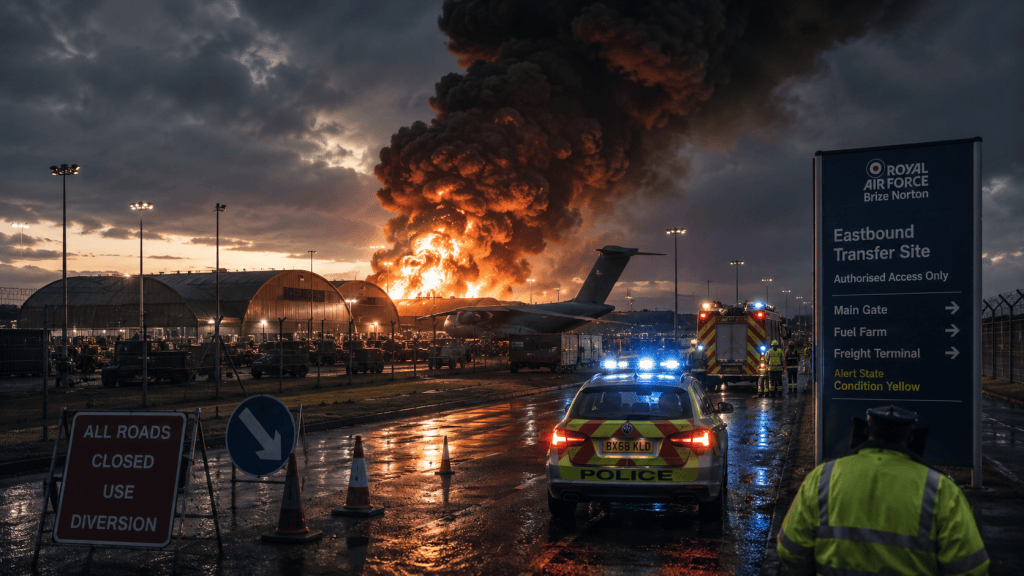
Smoke rose above an RAF transfer site, roads closed across the surrounding district, and those waiting beyond the perimeter were told that essential operations continued under revised control.
The Phone That Stayed Silent
The first tremor reached Martin Hales through the kitchen window, a low pressure against the glass that made the teaspoon shift inside Corinne’s mug and sent a faint shiver through the framed school photograph on the dresser. He had been standing at the worktop cutting two slices from the end of a loaf, watching rain gather along the patio doors while the evening news murmured from the radio beside the kettle. The sound arrived a heartbeat later, deeper than thunder and too contained to belong to the weather, followed by the sudden rising note of car alarms across the estate and a flock of starlings lifting from the roofs in one dark, startled sheet.
Martin set the knife beside the bread and moved towards the back window, his palm leaving a damp mark on the glass as he looked beyond the gardens towards the airfield. The site lay several miles away behind fields, hedges, low industrial roofs, and the long grey line of the bypass, usually present only through aircraft lights and the distant working weight of engines after dusk. A dark column had begun climbing above the horizon, broadening as it rose beneath the rain clouds, its lower edge carrying a brown-orange glow that appeared, vanished, then appeared again through the weather.
The radio presenter continued speaking about parliamentary business for several seconds before her voice broke beneath a producer’s interruption. Martin reached for his phone beside the fruit bowl and called Corinne. The line opened, held its silence, then moved to voicemail.
“Come on, love,” Martin said as he crossed towards the front room, keeping the phone pressed to his ear while the recorded greeting finished. “Pick up when you see this. I heard something from the airfield, and there is smoke above the eastern side. Send anything, even one word.”
He ended the message and stood beside the front window as neighbours emerged from houses along the close. A woman opposite held a baby against her shoulder while speaking into her mobile, and two boys near the corner had already raised their phones towards the smoke. An older man in slippers stepped onto his drive, looked towards the horizon, then hurried inside when the first sirens began moving along the bypass.
Corinne had left home shortly after two with a replacement control housing, three sealed junction units, and a crate of fittings Northgate Systems had marked for same-day delivery. She had laughed at the word urgent while pulling on her coat, saying the site had begun treating every bracket, cable, and weatherproof box as though the country might lean sideways if one arrived after tea. Martin had watched her reverse the van from the drive, one hand lifted through the rain-streaked windscreen, expecting her back before seven.
Her shift message at four thirty had been brief.
Held at inner compound. Delivery accepted. Home after clearance.
He called again, listened to the line ring, and opened the local traffic page while the voicemail greeting began for a second time. The map refreshed slowly, then filled with red bands around the service road, the village junction, and the freight turn near the eastern perimeter. A police notice advised drivers to avoid the area because of an emergency-services response, while a second notice from the county fire service asked residents near the airfield to keep windows closed as a precaution.
Martin moved through the house closing each latch while the smoke thickened beyond the gardens. At the upstairs landing window, he saw blue lights threading along the bypass in both directions, some moving towards the site, others taking positions at junctions where ordinary traffic had begun to stall. A transport aircraft crossed low above the western fields, its landing lights bright against the rain, then climbed away from the smoke in a wide turn that carried it behind the clouds.
His phone rang while he stood on the stairs. The screen showed Northgate Systems, and for one second relief weakened his knees before he answered.
“Martin Hales speaking,” he said as he gripped the banister and listened to office noise moving behind the caller.
“Mr Hales, this is Jenna Price from Northgate duty support,” the woman said as paper shifted close to her microphone. “Mrs Hales is registered on a live delivery at the transfer site. We have received notice of an emergency access restriction, and the site has asked employers to hold family enquiries through company channels.”
“Have you spoken to her?” Martin asked as he reached the hall and took Corinne’s coat from the peg simply to have something of hers in his hand.
Jenna paused long enough for voices to cross behind her. “We have confirmation that the Northgate vehicle entered before the restriction. We are waiting for a personnel update from site access.”
“That tells me where the van is,” Martin said as he pressed the coat against his side. “I asked whether anyone had spoken to Corinne.”
Jenna lowered her voice, the professional smoothness thinning beneath the strain. “No direct contact has reached us yet. The mobile network around the site is heavily loaded, and personnel inside may have been asked to keep lines clear.”
Martin looked through the glass panel beside the door, where rain had begun running in crooked streams. “There was an explosion.”
“We have seen the smoke,” Jenna said as a keyboard clicked beneath her next breath. “The instruction we received described an incident within the site boundary. Emergency services are attending, and Northgate staff are to remain where directed.”
“Staff,” Martin repeated as he pulled the door open and stepped onto the drive. “You keep saying staff as though there are fifty of them in there. Corinne is the only Northgate driver on that run.”
“I understand,” Jenna said as her chair moved across the office floor. “I have your number at the top of the family contact list, and I will ring the moment we receive verified information.”
The call ended with the politeness of a conversation that had carried no useful answer. Martin stood in the rain with Corinne’s coat over one arm while more sirens passed beyond the houses, their sound swelling against the wet brick and falling away towards the airfield. The woman opposite had begun fastening her baby into a car seat. She looked across the road and saw the phone in Martin’s hand.
“Is Corinne working there tonight?” Rachel Dunn asked as she straightened beside the open rear door, rain darkening her hair.
“She went in before five,” Martin said as he crossed towards the pavement, holding Corinne’s coat against his chest. “Northgate know the van entered. They are waiting for the site to tell them who is safe.”
Rachel closed the car door gently, leaving the baby visible through the steamed window. “My brother’s with the county fire service. He sent Mum one message saying they were heading towards the eastern gate, then his phone went quiet.”
Martin looked towards the bypass, where the blue light had become almost continuous between the rooftops. “Are you driving there?”
“I was,” Rachel said as she placed both hands on the roof of the car. “The police page says every approach is closed. Mum is already halfway down the main road because waiting in her kitchen became impossible.”
A heavy engine note rolled above them. Both looked up as another transport aircraft crossed from the airfield, lower than Martin expected, its lights passing beneath the smoke before the machine climbed towards the east. The sight held him more firmly than any barrier could have managed. Fire engines were moving in, roads were closing, families were being asked to wait, and somewhere behind the smoke the runway was still sending aircraft into the sky.
Martin returned Corinne’s coat to the house and took his keys. Rachel called after him from beside her car, asking where he intended to go, and he lifted one hand towards the road while walking.
“As close as they let me,” Martin said as he opened the driver’s door. “Sitting beside her mug is making me useless.”
The traffic slowed before he reached the bypass and stopped completely near the petrol station, where police had placed a vehicle across the eastbound lane and directed arriving cars into the supermarket access road. Drivers stood beside open doors in the rain, looking towards the smoke while officers moved from vehicle to vehicle asking for destinations and turning each answer into the same instruction. A fire appliance forced its way along the cleared centre, followed by an ambulance and an unmarked dark van carrying blue lamps behind the grille.
Martin left his car near the supermarket loading bay and walked towards the police line. A constable met him before the cones, one arm extended across his path while her radio spoke against her shoulder.
“Sir, this road is closed through to the northern freight turn,” the constable said as she shifted sideways to block the gap between two barriers. “You need to return to your vehicle and leave through the western exit.”
“My wife is inside the transfer site,” Martin said as he showed Corinne’s Northgate contact card on his phone. “She entered with a technical delivery before the incident. Her company has no personnel update.”
The constable looked at the card, then towards a sergeant speaking with two ambulance officers beside the marked car. “What is her name?”
“Corinne Hales,” Martin said as he moved close enough for rain from her cap to strike the screen. “Northgate Systems. White van, registration ending seven-three-kilo.”
The constable wrote the details on a damp page held inside a clear sleeve. “I can pass this to the family liaison desk being established at the village hall.”
“Is there a casualty point?” Martin asked as the fire glow moved through the clouds behind her.
“The village hall is receiving relatives and employer contacts,” the constable said as she folded the sleeve against her vest. “Medical information will come through the liaison route once identities are confirmed.”
Martin searched her face for the sentence she had avoided. “How bad is it?”
The constable held his gaze while another emergency vehicle approached behind him. “There has been a serious incident inside the perimeter. Crews are working, and the site remains under military control. I need this lane clear.”
A man beside the barrier raised his phone and called towards the officers, asking whether the reports of a drone strike were true. The sergeant turned at once, ordering him back from the road, while a cameraman near the petrol station lifted his lens towards the smoke. Martin saw the scene gathering its public shape around him: live streams, shouted questions, police tape, people pointing at aircraft, official phrases arriving slower than the fire.
His phone vibrated in his hand.
The message came from Corinne.
Safe. Held on site. I will call when cleared.
Martin read it once, then again, pressing his thumb against her name as though the screen could carry warmth back through the network. Relief reached him in a sudden wave that left his breath unsteady, yet the smoke still climbed above the perimeter and another aircraft was already moving beneath it, lights bright across the rain.
The constable saw the change in his face and lowered her pen. “Was that your wife?” she asked as she stepped a little closer.
“She says she is safe,” Martin replied, turning the screen towards her while his eyes remained on the airfield. “She also says they are keeping her inside.”
The constable read the message, gave a small nod, and opened a narrow space beside the barrier so an emergency vehicle could pass. “Take that to the family desk,” she said as the blue lights washed across both of them. “They will add her to the confirmed contact list.”
Martin moved back towards the supermarket road with Corinne’s message still open. Above the roofs, the smoke had spread into the cloud base, flattening across the evening until the whole eastern sky looked bruised. Behind the cordon, engines continued to rise and fall, emergency crews entered through gates closed to everyone else, and the airfield kept moving through the fire with the strained determination of a system whose importance could no longer hide behind the fence.
Restricted Emergency Movement Report
Extract from Defence Movement and National Resilience Coordination Record
Subject: Eastern Air Movement Site / Fuel-Handling Incident and Continuity Measures
Initial Reporting Window: 18:12–21:05
Handling: OFFICIAL-SENSITIVE
Circulation: Station Command / Defence Movement Desk / Cabinet Office Resilience Cell / Regional Police Liaison / Fire and Rescue Coordination / Ministry of Defence Communications
Purpose
To record the initial response to a hostile unmanned-platform incident affecting a fuel-handling point at a defence-linked air movement site, together with the resulting emergency-road controls, contractor holds, freight disruption, family-contact arrangements, media pressure, and measures taken to preserve essential operations.
This record covered the first response period, beginning with the reported impact inside the station perimeter and ending after limited air and ground movement resumed under a revised control plan.
Approved Public Position
A hostile incident involving a small unmanned platform occurred within the boundary of a military-linked facility.
Emergency services attended promptly, protective measures were activated, and the affected area was secured. Localised disruption occurred across nearby roads and contractor access points while police, fire, military, and technical personnel completed their initial response.
The site remained operational under revised control. Essential air movement continued, and there was no wider danger identified for surrounding communities.
The incident remained under investigation. Attribution, launch location, platform origin, and intended purpose remained unresolved.
Initial Situation
At approximately 18:12, station personnel reported a low aerial track approaching the south-eastern perimeter during active fuel, loading, and aircraft-movement operations.
The platform passed below parts of the established surveillance arc and entered the fuel-handling approach at low level. Counter-unmanned-aircraft measures were activated before impact, although the device reached the pump housing beside the primary lane.
The impact caused fire, smoke, local blast damage, camera loss, and temporary disruption to the auxiliary fuel-control system. Station fire crews attended the fuel point while RAF Police widened the inner cordon and secured the approach lanes.
Several personnel were assessed for blast exposure and minor injuries. Casualty information remained subject to medical confirmation and next-of-kin handling during the initial reporting window.
Emergency Movement Measures
Regional police closed the public service road between the village junction and the northern freight turn after smoke became visible beyond the perimeter.
Traffic was redirected through the western supermarket access road and the bypass diversion. Emergency vehicles received priority passage through the eastbound lane, while commercial traffic, contractor vans, local buses, and private vehicles were held beyond the outer cordon.
Contractor entry was suspended at the eastern and secondary service gates. Vehicles already inside the station remained at assigned holding points until access teams completed personnel checks and movement clearance.
A family-contact point was established at the village hall in coordination with police liaison officers, local authority staff, station welfare personnel, and employer representatives. Names submitted by relatives and contractors were checked against gate records, delivery manifests, shift lists, and local movement logs.
Employers were instructed to avoid issuing independent casualty assessments before station confirmation.
Site Continuity Position
The damaged fuel-handling point remained isolated throughout the first response period. Fire crews applied foam across the pump housing, bowser approach, and affected control area while technical teams isolated the auxiliary feed.
Fuel traffic was redirected through an alternate lane under enhanced supervision. Aircraft already inside movement windows were held, resequenced, or transferred to revised servicing points.
Portable camera systems were moved towards the south-eastern approach after fixed coverage was lost near the strike area. Mobile patrols maintained observation across the affected perimeter until temporary technical coverage became available.
Air movement resumed in restricted stages after station command confirmed safe separation between the emergency cordon and the revised loading route.
The continuation of movement depended upon reduced fuel flexibility, additional fire cover, manual verification, portable surveillance, controlled contractor access, and the reassignment of personnel from secondary tasks.
Regional Freight Effect
The Regional Movement Desk received the first site restriction notice within minutes of the road closure.
Three scheduled freight arrivals were held at their originating depots, two protected consignments were moved to alternate staging, and civilian loads approaching the district were redirected away from the emergency corridor.
A local dispatch centre reported immediate loss of confidence in published arrival windows after police controls closed both the service-road approach and the northern freight turn. Drivers already inside the district were instructed to remain at marked holding areas until revised release times became available.
The transfer site’s reduced fuel and gate capacity created further pressure across linked road, rail, and port sequences. Regional coordinators were advised to preserve strategic movement while limiting visible congestion near the station perimeter.
Media and Public Handling
Images of smoke above the airfield began circulating before the first coordinated government statement.
Local broadcasters received reports describing an explosion near the fuel lanes, emergency aircraft activity, road closures, injured personnel, and a possible drone strike. Newsrooms were advised that several claims remained unverified and that footage recorded from public roads could reveal active emergency positions.
The approved description remained:
A hostile unmanned-platform incident under investigation.
Communications staff were authorised to confirm emergency-service attendance, local road restrictions, protective measures, and the continuation of essential operations under revised control.
Questions concerning the exact impact point, platform route, counter-unmanned-aircraft response, fuel capacity, aircraft destinations, casualty identity, or prior reconnaissance activity were to be referred to the Ministry of Defence communications desk.
Lines to Avoid
Avoid describing the incident as an attack on Britain pending ministerial clearance.
Avoid confirming that the platform reached its intended target.
Avoid identifying the affected pump housing, approach route, surveillance gap, or alternate fuel lane.
Avoid confirming the number or destination of aircraft moving during the incident window.
Avoid linking the incident publicly to earlier unmanned-platform recoveries near the site or at other fuel-linked infrastructure.
Avoid suggesting that eastbound support movement depended upon continued operation of the facility.
Avoid speculation concerning state direction, foreign sponsorship, launch method, or operator identity.
Avoid language implying that Britain had entered open hostilities.
Internal Assessment
The incident represented the first confirmed physical strike against the transfer site during the current protection period.
The platform reached a fuel-linked support area after earlier aerial activity had already drawn attention to perimeter response, camera positioning, access routes, and movement priorities. Investigators were therefore instructed to examine whether previous incidents had supplied useful information concerning the station’s defensive behaviour.
Damage remained localised, although the operational effect extended beyond the impact point. Police closures disrupted civilian roads, contractor access stopped, freight timings deteriorated, family-contact systems activated, media attention intensified, and protected movement required immediate resequencing across several linked systems.
The rapid restoration of air movement remained operationally necessary. It also created a significant communications risk. Continued activity beneath visible smoke could lead observers to conclude that the site held greater strategic importance than public statements had previously acknowledged.
The station remained functional because emergency, technical, military, contractor, transport, and policing systems absorbed the damage around the failed fuel point. Continued function should therefore be understood as a controlled recovery under pressure, rather than evidence of minor impact.
Attribution remained unresolved. The event’s timing, approach, target selection, and relationship to earlier unmanned activity increased the likelihood of deliberate hostile action against infrastructure supporting eastbound movement.
Further Action
Station command to preserve debris, control-system records, camera footage, radio logs, and counter-unmanned-aircraft data for joint examination.
Regional police to maintain road controls until emergency access and public traffic could be separated safely.
Defence Movement Desk to issue revised fuel, freight, and aircraft sequencing through the next operational window.
Contractor liaison teams to confirm the status of all personnel held inside the station and provide verified updates through employer contact lists.
Cabinet Office Resilience Cell to prepare revised cross-government language in advance of the next media briefing.
Public-facing wording to remain limited to a hostile incident under investigation, localised disruption, protective measures, and essential operations continuing under revised control.
About the Creator
The Modern Chronicle is written and curated by Simon Phillips, an author of modern speculative fiction and contemporary crisis-driven storytelling who explores the point where ordinary life begins to tighten beneath political strain, military movement, institutional caution, and the public language used to keep dangerous realities at a distance.
Many of the records presented in these Chronicles sit alongside Simon’s wider modern-war novella series, where governments, soldiers, families, and civilian systems are forced to absorb a world changing faster than its official explanations. The stories remain grounded in recognisable places: ports, school corridors, freight yards, government rooms, roadside queues, transfer sites, and homes where the news has started to feel too close.
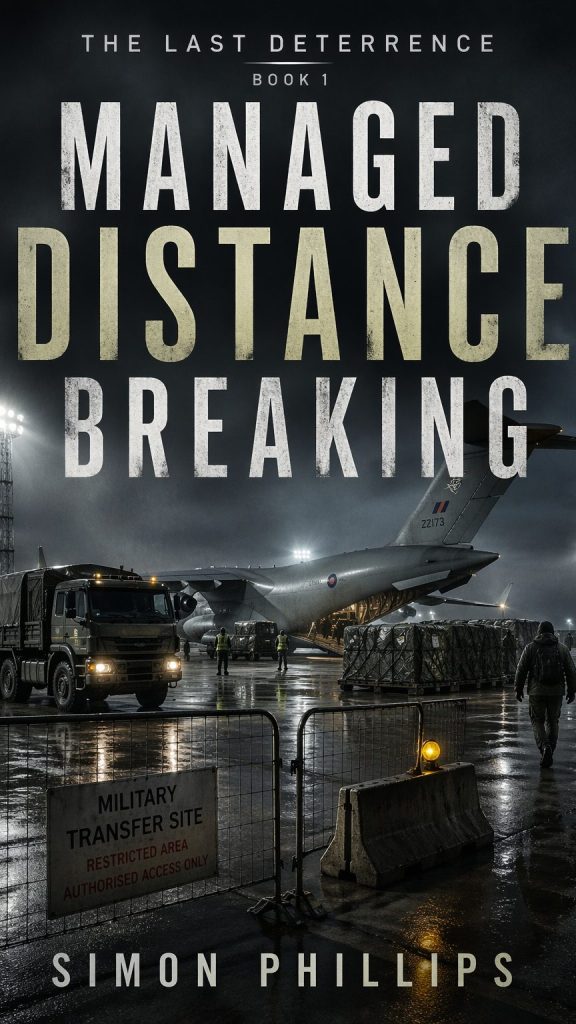
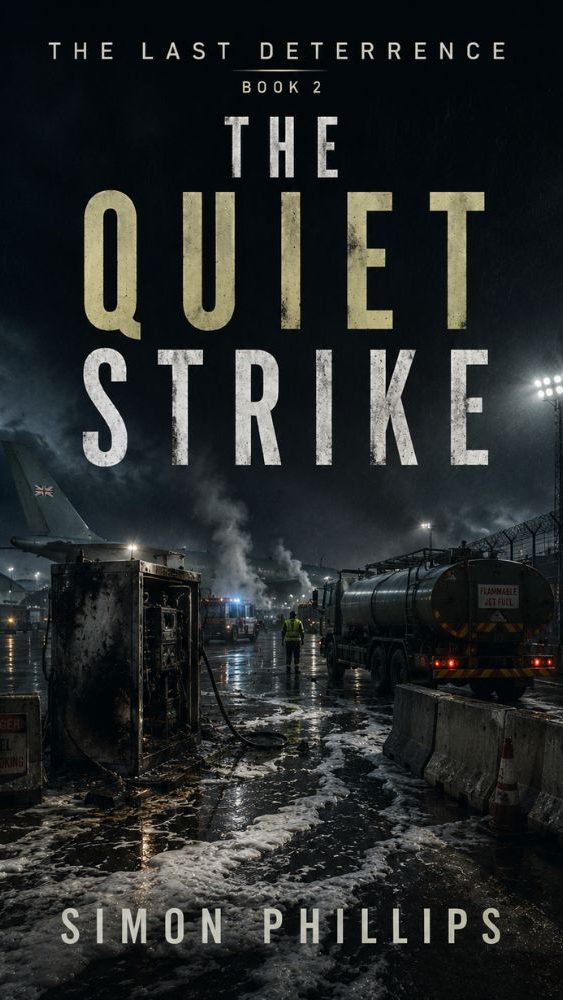
One such world unfolds through The Last Deterrence, a modern-war novella sequence beginning with Managed Distance Breaking and continuing in The Quiet Strike. Together, the first two books follow Britain as support language begins to fracture under freight pressure, European escalation, domestic infrastructure strain, and the growing sense that distance from war has already begun to fail.
Readers who wish to explore the wider published story world connected to this Chronicle can find the novellas below.
Explore the books:
The Last Deterrence: Managed Distance Breaking
The Last Deterrence: The Quiet Strike
You can watch his YouTube channel here:
Author Simon Phillips
The Timings That Fell Apart
At Moorland Regional Dispatch, the first sign of the strike arrived as a grey block spreading across the eastern movement board, swallowing three arrival windows and turning the service-road approach beside the transfer site into a route marked unavailable. The change came through at eighteen seventeen, six minutes after the night controller had finished rebuilding a schedule already weakened by rain, driver shortages, and two protected loads that had entered the system with less warning than the paperwork claimed. Sophie Rennick watched the block settle across her screen while the office continued around it, phones ringing beneath fluorescent light, printers feeding revised sheets into crowded trays, and drivers calling from lay-bys where they had been sent to wait for instructions that kept changing before anyone could repeat them.
She leaned closer to the monitor and opened the incident layer. The service road had closed first, followed by the northern freight turn and the eastbound slip from the bypass. A police-control symbol appeared beside the village junction, then another near the supermarket access road. The transfer site remained green at the centre of the map, which meant operational according to the data feed, although every route leading towards it had begun turning red.
“Pete, look at Station East,” Sophie said as she rolled her chair away from the desk and pointed towards the wall display.
Peter Lang came over with his headset hanging around his neck and a half-eaten cereal bar held in one hand. He had managed dispatch rooms for fifteen years and carried alarm through smaller movements than most people used for thought. His eyes travelled across the closed roads, the held arrivals, and the green site marker at the centre.
“Who placed the police hold?” Peter asked as he set the cereal bar beside Sophie’s keyboard and reached for the incident log.
“County control issued the first closure, then Defence Movement overlaid a protected restriction,” Sophie said as she enlarged the freight list. “Keane is on the southern approach with chilled medical stock, Hargreaves has electrical cabinets, and PDL Four is carrying sealed drums due through the contractor gate at eighteen forty.”
Peter touched the green marker with one finger, as though the screen might yield more truth through pressure. “And the site still says live.”
“The site says essential operations continue under revised control,” Sophie replied as a fresh message opened in the lower corner. “That arrived thirty seconds ago.”
A silence travelled across the office as the television mounted above the lockers changed from weather to a live picture of smoke rising behind an airfield fence. Someone had muted the screen during the afternoon shift, yet the caption beneath the footage supplied enough: emergency response at military-linked facility; public advised to avoid area. The camera shook as blue lights crossed the foreground, and a transport aircraft climbed behind the smoke with its lamps bright against the darkening sky.
Peter looked from the television to the green marker and gave a quiet breath through his nose. “Operational is earning its wage tonight.”
Sophie’s headset rang before she could answer. She accepted the call and brought up the driver record as Gareth Keane’s voice filled one ear with rain, engine noise, and anger held close to the surface.
“Dispatch, this is Keane on load M-seven-two,” Gareth said as his cab indicator blinked on Sophie’s screen. “Police have turned us off the bypass and pushed twenty vehicles into the old livestock lay-by. My temperature line is holding, though the remaining window is forty-eight minutes and falling.”
Sophie read the diversion note and saw no released route beyond an instruction to hold. “Keep the unit running and preserve the cold-chain log,” she said as she opened the customer contact panel. “I am asking for a new acceptance time.”
Gareth shifted in his seat, leather creaking close to the microphone. “Ask them whether they still have a gate. The smoke is visible from here.”
“The site remains active under revised control,” Sophie said as Peter looked towards her from the wall display.
Gareth gave a tired laugh that dissolved beneath the wipers. “The road is shut, fire engines are passing every few minutes, and they remain active. That sounds like a sentence written by someone sitting farther away than us.”
Sophie watched his temperature reading hold steady. “You have enough fuel for the refrigeration unit?”
“I have enough for four hours if traffic control lets the engine run,” Gareth said as a horn sounded behind him. “The police officer wants all cabs quiet unless we need heat or medical support, and three lads behind me have already decided their deliveries outrank national security.”
“Stay where you are, Gareth,” Sophie said as she marked the load for continuous review. “I will ring before the temperature margin reaches thirty minutes.”
Gareth lowered his voice, and the anger inside it gave way to something less protected. “Was anybody hurt?”
Sophie looked up at the television, where the smoke had spread into the cloud base. “No confirmed personnel information has reached this desk,” she said as she rested one hand against the console. “I will pass anything cleared for drivers.”
“You do that,” Gareth said as a police loudhailer carried faintly through his cab. “Half the vehicles here have regulars inside that place. People remember names once the gates close.”
The call ended, leaving Sophie with the live temperature line and a question her system had no field to hold. Around her, the dispatch room divided the crisis into manageable pieces. One controller rang a depot near Coventry and asked them to retain a protected load. Another moved two civilian consignments towards a rail holding yard farther north. Peter spoke with regional coordination while writing timings on the glass board in red marker, each number recording a promise already slipping beyond reach.
At the village hall, Martin Hales carried Corinne’s message through a room full of people reading their phones as though each screen had become a private border between safety and grief. Folding tables had been arranged beneath noticeboards advertising a summer fête, a pension advice morning, and a children’s dance class postponed from the previous week. Police liaison officers worked near the stage with laptops, printed gate lists, and paper cups left untouched beside their hands. Relatives sat on plastic chairs beneath the basketball hoops, coats steaming in the overheated room while rain struck the high windows and aircraft passed above the roof in long, heavy climbs.
Rachel Dunn saw Martin near the entrance and hurried across, her mother following several steps behind with both hands wrapped around her handbag. Martin raised his phone before either woman could ask.
“She is safe,” he said as Rachel reached him, turning the message so both could read it. “Corinne sent this from inside. They are holding her until clearance.”
Rachel pressed her palm against his forearm and closed her eyes for a moment. “Thank God,” she said as her shoulders loosened. “Mum has heard from Jamie as well. He is with the second fire crew and can only send one line at a time.”
A police liaison officer named Amina Shah came from the stage carrying a clipboard sealed inside a clear cover. She had already spoken with Martin near the entrance and wore the careful expression of someone repeating partial reassurance to people who needed whole answers.
“Mr Hales, Northgate have confirmed Mrs Hales against the contractor shelter list,” Amina said as she pointed to a marked line on the page. “She remains inside the inner compound because the eastern gate route is reserved for emergency access. We expect controlled contractor release once the fire service hands the outer lane back to station security.”
“Has she been examined?” Martin asked as he kept his eyes on Corinne’s name beneath Amina’s finger.
Amina shifted the clipboard closer. “The welfare check records her as uninjured and accounted for. That is the strongest verified wording available to me.”
Martin watched a young man at the far wall pace beneath a poster about local flood resilience, his phone pressed against his mouth while he left the same message again. “The television says hostile incident,” he said as the hall doors opened and carried in a fresh wash of wet air. “The police officer on the road said serious incident. Northgate said emergency restriction. Which one is true?”
“All three may describe the same event from different responsibilities,” Amina said as she lowered the clipboard. “I know that answer offers very little comfort.”
“It offers a great deal of language,” Martin replied as an aircraft passed above the roof and made the window frames tremble. “Comfort appears to have missed its slot.”
Amina looked towards the ceiling until the engine sound moved east. “The aircraft are part of why the release is taking time,” she said as she returned her attention to Martin. “Movement has resumed across one section of the site, and the emergency routes have to remain clear.”
Rachel looked towards the dark windows. “They are still flying after a strike?”
Amina adjusted her grip on the clipboard. “Essential operations are continuing under revised control.”
In the village hall, surrounded by families waiting beneath paper decorations left from a school fundraiser, the words carried a harder weight. The site had taken a hit serious enough to close roads, summon fire crews, hold contractors, and establish a family centre. Its work still had to continue.
Across the region, Meridian Public News producer Hannah Crowe stood behind the assignment desk with three screens carrying three versions of the same evening. The first showed a live camera near the petrol station, where police tape cut across the road and smoke rose beyond a line of roofs. The second carried phone footage from a driver who claimed a drone had crossed above the service lane seconds before the explosion. The third showed the Ministry of Defence inbox, refreshing every few moments beneath a subject line marked holding response to emerging incident.
Reporter Lewis Grant sat opposite with headphones around his neck and rain still shining on the shoulders of his jacket. He had returned from the outer cordon ten minutes earlier after police moved the media line farther west. A notebook lay open beneath his hand, filled with names, times, vehicle descriptions, and arrows linking claims that refused to settle into one account.
“We can lead on the smoke and road closures,” Lewis said as he turned the notebook towards Hannah. “We have two residents who heard a blast, one contractor partner who received a safe message, and footage of aircraft leaving after the emergency response began.”
Hannah watched the driver video again, slowing the image near the top of the frame. A dark speck crossed above a lamp, vanished behind a vehicle, and the picture swung towards the smoke before anything useful could be fixed.
“We have a shape on a phone camera and a witness saying drone after hearing other people say drone,” Hannah said as she paused the clip. “That gives us rumour with pixels.”
Lewis rubbed rain from his eyebrow and drew a line beneath the word aircraft. “The police closed both approaches. Fire crews entered through the east gate. The family centre is active. Something struck the site.”
“I agree something happened,” Hannah said as she opened the latest police statement. “Our problem is the noun.”
News editor Malcolm Reed came from the studio gallery with his reading glasses held in one hand. Behind him, the evening presenter was recording a short introduction against a map showing the district and the closed roads.
“MOD have sent a line,” Malcolm said as he placed a printed page between them. “Hostile unmanned-platform incident under investigation. Localised disruption. Protective measures active. Essential operations continue under revised control.”
Lewis read the page and looked towards the live feed, where a further aircraft rose behind the smoke. “They have given us hostile and taken away attack.”
“They have given us a platform and left out where it came from,” Hannah said as she marked the page with a pen. “That is usable if we keep attribution open.”
Malcolm rested both hands on the desk and studied the live picture. “Can we say Britain has been struck?”
Hannah looked at the public line again. “We can say a military-linked facility in Britain has experienced a hostile incident involving an unmanned platform. Going further turns interpretation into fact.”
Lewis tapped the road-closure note with one finger. “People watching that plume already think the sentence is hiding from them.”
“Our job is to keep the picture and the sentence in the same report,” Malcolm said as he put on his glasses. “We show what we can verify, label what remains unclear, and leave the government to explain why an operational site needs fire crews, police cordons, family liaison, and continued flights in the same hour.”
Hannah looked towards the studio clock. “We have four minutes.”
The newsroom tightened around the deadline. Graphics staff changed explosion near airfield to hostile incident at military-linked site. The presenter rewrote her opening line to keep attribution unresolved. Lewis recorded a live introduction from beside the assignment desk because the cordon had moved too far from a stable signal. Hannah called the village hall liaison number and received the same approved wording that had already reached Martin. Across every screen, the fire became language by degrees.
At Moorland Dispatch, Sophie watched the nine o’clock bulletin with the sound raised while Peter held a phone between shoulder and ear and rebuilt the night movement sheet. The presenter stood beside footage of the smoke and explained that officials were investigating a hostile unmanned-platform incident at a military-linked facility. Protective measures remained active. Roads around the site stayed closed. Essential operations continued under revised control.
On Sophie’s screen, the green site marker remained in place while every connected timing carried amber or red.
Gareth called again from the livestock lay-by, his refrigeration margin reduced to twenty-nine minutes and his patience reduced further. Sophie answered as Peter waved a fresh route authorisation across the desk.
“They are opening the northern freight turn for controlled releases,” Sophie said as she read the instruction. “You are second in sequence behind an emergency engineering load.”
Gareth started his engine, and the vibration entered his voice. “Second sounds almost luxurious.”
“You will proceed under police escort to Holding Gate Three,” Sophie said as she marked his release. “Acceptance remains provisional until station control confirms the lane.”
Gareth paused before answering, his wipers moving fast across the cab glass. “The news says the place stayed operational.”
Sophie watched the site marker, the delayed freight, the diverted vehicles, and the road opening for two selected loads while the wider district remained closed.
“It stayed operational because everyone around it stopped doing something else,” Sophie said as Peter looked towards her from the next desk.
Gareth let the engine idle for a moment. “That line will never reach television.”
“No,” Sophie said as she moved his load into the controlled-release column. “It still has to reach the gate.”
The police escort pulled into the lay-by, blue lights turning across lorry cabs and wet fencing. Gareth joined the short line behind the engineering vehicle, while farther back the civilian loads remained parked with their drivers waiting for another version of the night. At the village hall, Martin received a second message saying Corinne would leave through the western contractor gate after ten. In the newsroom, Hannah watched the official phrase settle beneath pictures that remained larger than it. Across the airfield, engines continued through smoke, floodlight, fire cover, and the reduced space left by the damaged lane.
By the time the first controlled freight reached Holding Gate Three, the public record had taken its final shape for the evening. A hostile incident had caused localised disruption. Protective measures had worked. Operations had continued under revised control. Each sentence held a measurable truth, while the roads, families, dispatch boards, emergency crews, and aircraft carried the cost required to keep it standing.
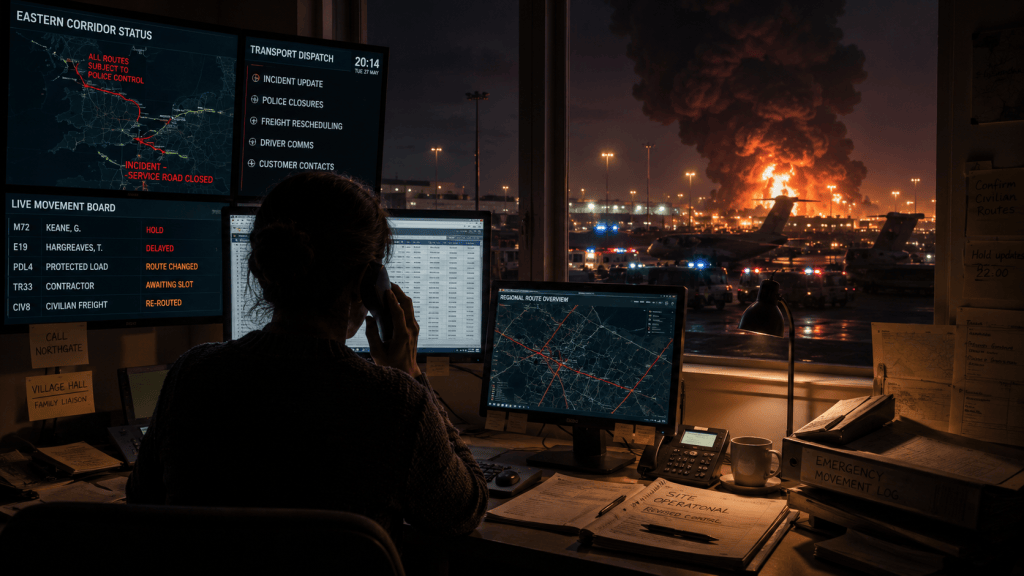
Inside the regional dispatch room, routes failed across the screens while the airfield burned beyond the glass and essential movement was rebuilt one delayed load at a time.
The Idea Behind the Chronicle
Military sites are often presented through the most visible parts of their purpose: aircraft lifting from runways, uniformed personnel moving through secure gates, or large vehicles travelling beneath escort. Their true ability to function depends on a quieter architecture of fuel points, access roads, loading areas, contractor systems, communications links, maintenance teams, emergency crews, dispatch offices, and people whose names rarely enter the public account. A single damaged component inside that architecture may carry consequences far beyond the place where the impact occurred.
This Chronicle grew from the idea that the meaning of an attack can be measured through everything forced to move around it. The damaged fuel lane matters because it sits inside a larger chain. Aircraft require fuel, freight requires acceptance windows, contractors require controlled entry, emergency vehicles require clear roads, and every delay passes backwards through dispatch boards, depots, drivers, police controls, employers, and families waiting for information. The fire remains inside the perimeter, while its consequences spread across systems that may sit many miles away.
That wider movement is central to modern infrastructure pressure. A site may continue operating after damage, although continued operation rarely means the incident carried little importance. It may mean staff were reassigned, alternate routes opened, civilian deliveries held, emergency crews placed beside active movement, technical checks reduced to their most urgent form, and workers asked to carry several responsibilities at once. The public statement records continuation because continuation offers reassurance. The people inside the system understand how much labour, delay, and risk were required to keep that statement true.
The phrase operations continued under revised control therefore became the centre of this Chronicle. It sounds measured and stable, yet every word contains strain. Revised control may mean a gate closed to contractors, a freight route lost, a family liaison point opened, a fuel load transferred, an aircraft held beneath smoke, or a driver sent into a lay-by while his delivery window collapses. The phrase describes success at the level of national messaging, while the lived reality appears in the people who absorb the revision.
The Chronicle also explores how a modern incident becomes public knowledge. Smoke can be filmed within seconds. Drivers share road closures. residents hear the blast, relatives receive fragments through private messages, and newsrooms begin assembling a report before the official account has settled. Institutions then face a difficult task. They must confirm enough to preserve trust, protect information that may still carry operational value, avoid premature attribution, and maintain public calm while images already show a response larger than the first statement can comfortably explain.
That tension shaped the newsroom scenes. The journalists saw fire, emergency movement, continued aircraft activity, and families directed towards a liaison centre. The official wording described a hostile unmanned-platform incident under investigation. Both accounts carried truth, although each revealed a different layer. The image showed consequence. The statement controlled meaning. The Chronicle remained in the space between them, where the public could see that something serious had happened while still lacking permission to name its full importance.
Martin Hales, Sophie Rennick, Gareth Keane, Hannah Crowe, and the people waiting inside the village hall carry that gap through ordinary responsibilities. Martin wanted one message from his wife. Sophie needed to preserve freight movement through collapsing timings. Gareth had to keep a temperature-controlled load viable while police controlled the road. Hannah had to decide which words could survive broadcast. Each person stood outside the central military event, yet each became part of its consequence. Their experience showed how a strike against one protected site could enter homes, offices, lorry cabs, newsrooms, and public buildings within minutes.
The earlier Chronicles in The Eastbound Line followed a corridor becoming visible through containers, capacity statements, freight yards, controlled roads, fuel compounds, hardened gates, public-order pressure, and aerial reconnaissance. This Chronicle marked the point where observation became physical damage. The systems established across the series were forced to respond at once, revealing the transfer site’s importance through the scale of the effort used to keep it functioning.
The deeper idea behind The Fuel Lane Remained Operational is that resilience and vulnerability can exist in the same place at the same time. The airfield kept moving, which proved the strength of the people and systems supporting it. The roads closed, freight timings failed, families gathered, emergency crews entered, and public language narrowed, which revealed how close that strength had come to being tested beyond its prepared limits.
The official record could therefore say that operations continued. The wider Chronicle recorded everything that had to stop, change, wait, or carry additional weight in order for that sentence to remain true.
From the Author’s Desk
The Eastbound Line grew from a question that remained with me while I was writing the opening books of The Last Deterrence: how would a country recognise that war had reached it when every institution still depended upon language designed to keep that admission at a distance?
The answer seemed likely to emerge through ordinary systems before it appeared through any formal declaration. Ports would change priority. Freight yards would tighten. Roads would close for movements that carried no public explanation. Contractors would wait outside hardened gates. Families would receive fragments of reassurance while newsrooms tried to fit smoke, rumour, and official statements into the same account.
This Chronicle reached the point where those pressures became physical. The fuel-lane strike mattered through the damage inside the perimeter, though its wider meaning appeared through the people beyond it: a husband waiting for one message, a dispatcher rebuilding failed timings, drivers held on closed roads, journalists searching for a word strong enough to match the images, and officials trying to preserve uncertainty while aircraft continued moving beneath the smoke.
The wider books, Managed Distance Breaking and The Quiet Strike, followed the same worsening national reality through the Mercer family, government decision-making, civilian strain, military movement, and the gradual collapse of distance from the conflict. These Chronicles remained beside that central story, recording adjacent lives and public accounts that revealed how deeply the same crisis had entered Britain’s roads, workplaces, institutions, and homes.
Alongside The Last Deterrence, I continue writing modern speculative stories shaped by political pressure, institutional failure, military escalation, and the human cost carried beneath official language.
Readers interested in those stories can explore more through the links below.
You can explore my books here::
Books by Simon Phillips
You can watch my YouTube channel here:
Author Simon Phillips
Operational Notes & National Context
Fuel Handling as a Strategic Pressure System
Fuel infrastructure often appears as a supporting detail beside aircraft, vehicles, freight, and personnel, yet every movement across a military-linked site depends upon it. Aircraft require planned quantities, safe separation, working pumps, trained crews, tested control systems, clear access lanes, and enough spare capacity to absorb delay. A fuel point therefore functions as more than a collection of pipes and tanks. It becomes part of the timing structure holding the entire site together.
That structure is especially vulnerable during periods of sustained movement. A damaged pump housing may close one lane, though the effect quickly travels elsewhere. Aircraft wait longer. Bowsers cross routes originally assigned to freight. Fire crews occupy movement space. Technical teams isolate power. Portable lighting and surveillance move towards the damaged area. Contractors lose access while emergency traffic takes priority. Each adjustment preserves one form of activity by narrowing another.
Article Nine sits inside that chain of dependency. The physical damage remains localised around the fuel-handling area, while the operational shock reaches roads, depots, dispatch offices, contractor lists, family-contact systems, and newsrooms. The wider effect reveals why fuel infrastructure carries strategic value. Its importance comes from everything else that struggles once the lane loses capacity.
The Chronicle therefore treats the fuel point as a pressure system instead of a spectacle. Fire and smoke draw the eye, though the deeper story appears through revised arrival windows, closed approaches, resequenced freight, held workers, and aircraft continuing under reduced flexibility. The site remains active because every surrounding system accepts additional strain. That distinction reflects the published world of The Quiet Strike, where the fuel-lane blast causes damage, partial camera loss, reduced flow, contractor suspension, technical risk, and a wider political recognition that British-linked infrastructure has become exposed.
The Meaning of Revised Control
Official language carries unusual weight after an incident at a protected site. Public statements must reassure nearby communities, preserve operational security, prevent unsupported attribution, maintain confidence in national systems, and leave ministers room to respond as evidence develops. A phrase such as operations continued under revised control serves all those purposes at once.
The sentence sounds calm because it records the outcome instead of the effort required to achieve it. Revised control may involve an alternate fuel route, additional fire cover, manual checks, changed aircraft sequencing, reduced contractor access, portable camera coverage, police closures, or the reassignment of staff from secondary duties. Every measure belongs to continued operation, although each also reveals that the previous operating condition has already been lost.
That tension matters across The Eastbound Line. Earlier Chronicles described ports remaining operational while civilian freight waited, roads remaining open while ordinary traffic was held, fuel compounds remaining secure while cameras failed, and airfields continuing their work while gates hardened around them. Article Nine carries the same institutional language into a more serious stage. The site has suffered a hostile incident, yet the public line still emphasises continuity, localised disruption, and protective measures.
Continued operation therefore becomes evidence of importance. A minor facility could pause, close, or transfer its work elsewhere. A site required to keep moving through smoke, emergency access, damaged infrastructure, and public scrutiny reveals its place within the wider support corridor through the urgency of its recovery. The approved series plan makes that pressure central to Article Nine: Britain has been hit in a strategically meaningful way, and the insistence upon continued movement exposes how vital the transfer site has become.
Families, Contractors, and Personnel Confirmation
Military-linked infrastructure depends upon a wide civilian workforce. Contractors maintain cameras, lighting, electrical systems, catering, communications, vehicles, fuel equipment, security technology, and the small practical components that keep large sites usable. During an emergency, those workers enter the same personnel-accounting system as service members, emergency crews, drivers, and technical staff, although their information may travel through separate employers, gate records, delivery manifests, and liaison channels.
That separation creates delay at the moment families need certainty most. A partner at home may know that a van entered the site, yet the employer may only hold a scheduled delivery reference. The employer then waits for station access staff. Station staff compare contractor lists against gate records and holding areas. Police liaison teams gather names from relatives. Medical confirmation moves through its own controlled route. A single message saying safe may arrive before the formal system has completed its checks, leaving families caught between private reassurance and official silence.
Article Nine uses that gap through Martin and Corinne Hales. Corinne’s presence inside the site has no strategic significance by itself. She carries technical equipment, follows access instructions, and waits where she is directed. Her importance lies in the way the emergency becomes human through Martin’s need for one verified sentence. The state sees personnel categories. Northgate sees an employee on a live delivery. Police see a name requiring confirmation. Martin sees his wife inside a column of smoke.
Family liaison centres often occupy ordinary civic spaces because emergencies require places large enough for tables, records, welfare staff, and controlled contact. A village hall used for fêtes, advice sessions, classes, and local meetings becomes part of national resilience within an hour. That transformation carries the wider Modern Chronicle idea especially well: ordinary buildings acquire new functions as pressure spreads, while people learn that national security can enter their lives through a plastic chair, a damp coat, and a name checked against a printed list.
The inability to provide immediate family certainty also reflects one of the state’s limits within The Quiet Strike. Officials can protect information, coordinate movement, and control public phrasing, yet they struggle to give relatives a full account while the incident remains active.
Smoke, Newsrooms, and the Public Record
Modern incidents become visible long before their official meaning settles. Smoke rises above a perimeter. Drivers film road closures. Residents hear a blast and post from upstairs windows. Emergency vehicles appear on local feeds. Aircraft continue moving through the background. Newsrooms begin assembling these fragments while government departments, police commands, and military communications teams are still agreeing which details can safely enter public language.
The visual record creates immediate pressure because images appear complete even when the information around them remains partial. A plume above an airfield suggests scale. A closed road suggests danger. A family centre suggests casualties. Continued aircraft movement suggests operational importance. Each image may be genuine, though the conclusion drawn from it can still exceed the confirmed record.
Newsrooms therefore work inside the same narrow space as government communications, though their duties differ. Journalists need language strong enough to reflect visible events, careful enough to preserve unresolved facts, and clear enough to separate eyewitness accounts from confirmed information. The phrase hostile unmanned-platform incident under investigation provides a usable centre. It confirms hostile character and an unmanned system while leaving origin, operator, intention, launch point, and state direction open.
That restraint protects accuracy, though it also creates tension with the pictures. Viewers see smoke, fire appliances, closed roads, and aircraft moving beneath emergency lighting. The official sentence speaks of localised disruption and revised control. The Chronicle lives between those two records, preserving what people saw while respecting how little had been established publicly.
Attribution remains especially sensitive. Earlier drone incidents around the support corridor suggested observation, testing, and deliberate probing, yet the published record still stops short of naming an operator. Article Eight established that the airfield’s routines and defensive reactions may already have been measured. Article Nine advances from observation to physical damage while keeping origin unresolved.
Britain as Exposed Rear Infrastructure
The traditional idea of a secure rear depends upon distance. Front-line forces face direct danger, while ports, airfields, depots, fuel sites, roads, and government systems behind them provide movement and support. Modern long-range weapons, unmanned platforms, cyber access, commercial surveillance, and civilian logistics networks weaken that distinction. A country may remain outside declared war while its infrastructure already carries the risks of participation.
The Eastbound Line has traced that change through practical systems. Containers moved first. Capacity statements concealed displacement. Germany altered freight logic inside Britain. Protected routes changed civilian time. Fuel-linked infrastructure came under observation. Airfield gates hardened. Public-order policing absorbed wider strain. A damaged unmanned device revealed how much the site exposed when it reacted.
Article Nine marks the point where that pressure becomes physical. The transfer site is struck, roads close, freight timings collapse, families gather, emergency crews enter, and the public account narrows around controlled language. The event remains limited in scale, yet its meaning extends across the whole cycle. Britain’s support system has become significant enough to attract hostile action and resilient enough to keep moving after damage.
The official success lies in continuation. Aircraft still depart. Freight reaches controlled gates. Personnel are accounted for. Fire crews contain the damaged area. Public order holds around the cordon. The deeper record lies in the cost of that success: reduced capacity, diverted labour, family uncertainty, public confusion, and a national support corridor behaving increasingly like infrastructure inside an active conflict.
Article Nine therefore occupies the final stage before the cycle’s closing threshold. The country still uses the language of support, resilience, investigation, and protective action. Its roads, fuel systems, airfields, police lines, and emergency structures already carry a heavier reality. The site remained operational, while the nation around it moved closer to an admission its public language had yet to make.
Next Chronicle
In the hours after the strike on the transfer site, ministers and officials began preparing a new public account of Britain’s response. The language centred on defensive support, allied air movement, logistics resilience, and risk reduction, each phrase chosen to describe a widening commitment while keeping one heavier word beyond the statement.
Across the eastbound line, the practical meaning appeared before the announcement had settled. Port rosters changed again, sealed loads received fresh movement orders, protected routes tightened, and aircraft were prepared beneath floodlights while families received calls offering destinations, timings, and very little certainty. The same people who had watched containers wait, roads close, gates harden, and freight priorities shift could now see those separate pressures joining into a single national movement.
The public record would describe enhanced defensive support for allied logistics and air-movement infrastructure. Beneath that language, Britain had reached the threshold where support had become participation in practice, and the word deployment remained absent because saying it aloud would have revealed how far the country had already travelled.
The next Chronicle follows the statement and the movement beneath it, as aircraft began carrying Britain east under language still shaped to suggest the country remained safely behind the conflict.
Next Week: The Word They Kept Out of the Statement
By midnight, the smoke had thinned above the transfer site, though aircraft still climbed east through the dark, carrying a decision the country had yet to name.
Discover more from Simon J. Phillips
Subscribe to get the latest posts sent to your email.
