ESC command had gathered enough evidence to suspect the incidents were connected, yet political pressure forced the warning into provisional language while another contaminated debris alert arrived from the Verge.
Chronicle Opening: The Words They Could Use
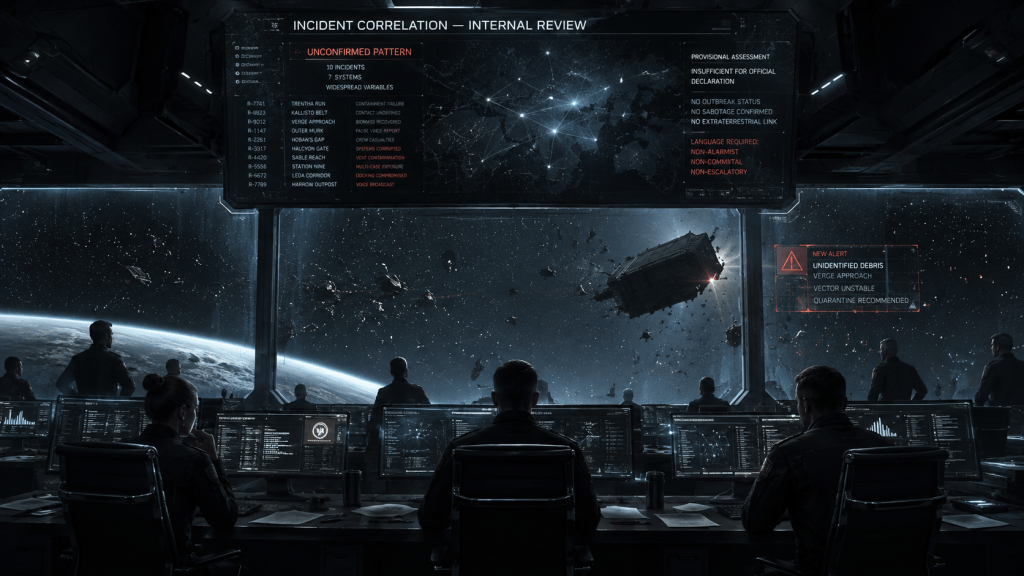
Restricted Correlation Suite Two sat beneath the command deck of the Leda Ark, close enough to the cruiser’s tactical spine for every change in speed to reach the room through the floor before the displays acknowledged it. Dark composite panels surrounded a long metal table, suspended readers hung above the work surface, and three narrow ventilation grilles drew processed air across the ceiling with a steady pull that flattened paper corners beneath the clinical light. Beyond the sealed hatch, officers crossed between command stations under brighter corridors, their movement reduced to muted pressure through the bulkhead, while inside the room ten incident files waited across the main wall in pale columns that refused to remain separate.
Tessa Vey stood at the lower end of the table with her sleeves folded to the elbow and a stylus resting between two fingers, watching the summary title change for the fourth time that watch. Each revision arrived from another authority branch, carrying a fresh layer of caution over the same evidence. The first version had read DISTRIBUTED CONTAMINATION EVENT. Republic liaison struck the phrase before the document reached operational law. The second used COORDINATED INFRASTRUCTURE SABOTAGE, which treaty counsel removed because intent remained unproven. The third referred to POSSIBLE NON-HUMAN MATERIAL ORIGIN. Command review returned that version beneath a red evidentiary warning, leaving the current heading to offer less danger because it offered less meaning.
PROVISIONAL CORRELATION OF INDEPENDENTLY REPORTED INDUSTRIAL AND ENVIRONMENTAL INCIDENTS.
Tessa read it again while the cruiser held course towards the Kheled Verge. Kestrel Relay sat beside Quarantine Hold One, Route Station R-17, the Jennah’s Pride recording, the Kordell Wake salvage review, Kheled-Three, Morrow Auxiliary Four, and Harrow Outpost H-09. The Red Titan and Station Nine occupied the final two columns beneath higher seals, their full records reduced to grey reference blocks beyond her clearance. Different offices had named each event, different governments claimed pieces of the evidence, and different crews had carried the loss. The same traces moved through every column once the safer language was stripped away.
Lieutenant Marris entered as the hatch completed its inward seal, a stack of printed amendments held beneath one arm and a fresh cup balanced in his other hand. He placed the papers beside Tessa’s slate and eased the cup into a recessed holder.
“Treaty counsel has returned the title again,” Marris said as he drew the upper sheet free. “They accept provisional correlation. They want independently reported kept in the final line.”
Tessa touched the first six files and brought their shared timing markers into view. “That phrase preserves separation,” she said as she looked towards him. “The whole reason for this summary is that separation has stopped surviving comparison.”
Marris rested both palms on the table. “Their concern is legal endurance,” he said as his gaze moved towards the Harrow file. “The Republic has challenged the Grey Mantle interdiction, the Meridian Way diversion, and Lieutenant Serrin’s authority to issue a full traffic denial before sector control joined the channel. If this summary declares connection too strongly, they will argue the ESC built a pattern to justify command overreach.”
Tessa opened the raw docking packets from Harrow Nine. Valid house keys, pressure fields, berth assignment, course correction, and survivor language spread across the wall. The outpost’s damaged collar appeared beside them, one docking arm fixed beyond safe alignment while guidance lights formed a clean path towards torn structure.
“The carrier had thirty-eight people aboard,” Tessa said as she enlarged the third packet. “The outpost called them by name, changed the route after a survey drone moved, and sent them towards a berth our own images showed as unsafe.”
Marris tapped the upper margin where his approval mark sat beneath operations review. “I agree with Serrin,” he said as the printed amendment settled beneath his hand. “Agreement survives badly once jurisdiction enters the sentence.”
The hatch opened again, allowing Commander Edda Pell and Deputy Review Officer Cassian Holt into the room together, though the space between them suggested their corridor discussion had offered little settlement. Pell carried a route slate beneath one arm. Holt entered with his hands free and his expression composed, as if every objection had already been arranged somewhere behind his eyes.
Pell stopped beside the Harrow display. “Keep the third packet visible,” she said as she placed her slate near Tessa. “Command needs to see how the wording changed after civilian traffic accepted the berth.”
Holt read the summary title from the opposite side of the table. “Command needs a document capable of reaching command,” he said as he rested one hand beside the amendments. “A title that triggers immediate dispute will stay trapped in legal circulation before an operational officer sees the first page.”
Pell opened the Meridian Way track, and the carrier’s interrupted approach traced across the wall. “A title that hides the relationship gives operations another collection of isolated faults,” she said as her jaw tightened. “We already have enough isolated faults to fill a fleet archive.”
Holt turned towards her. “Outbreak asserts propagation. Sabotage asserts intent. Alien asserts origin,” he said with patient restraint. “The record supports shared markers across several incidents. It has yet to support any of those three conclusions.”
Doctor Sel Ardan entered behind him carrying a narrow medical case. She closed the hatch through her wrist control, glanced across the ten files, then came to stand beside Pell.
“The record supports consequence,” Ardan said as she set the case on the table. “People hear human-shaped sound near air systems. Crews approach vents, hatches, and grilles. Residue remains quiet in cold conditions and changes when heat, pressure, or power increases. Systems correct themselves after witnesses have already reacted. Those consequences recur even where origin remains beyond reach.”
Holt gave her a measured look. “Recurring consequence still requires defensible limits.”
Ardan rested her fingertips against the sealed case. “Defensible limits should keep uncertainty around the cause,” she said as her eyes returned to the wall. “They should avoid cutting the incidents apart.”
Tessa brought the shared markers onto the main display one by one. Cold preservation. Thermal activation. Airflow proximity. Pressure delay. Self-correcting scans. Voice-range acoustic events. Movement towards ventilation infrastructure. Trusted system output continuing after physical conditions had changed. Each line crossed more than one file, and several reached nearly every column. The display remained calm, pale, and exact, turning frightened testimony, lost crews, corrupted machines, and sealed evidence into a geometry that looked manageable from the centre of the room.
Pell stepped closer and moved her finger from the Red Titan reference block towards Kestrel Relay. “Recovered salvage, dark or pale residue, cold suppression, changing scan results,” she said as the linked files brightened. “Then quarantine audio, delayed drone responses, voices through damaged vents, contaminated filters, crew movement towards grilles, and docking guidance from silent stations. Different routes, different authorities, the same operational pressure.”
Holt looked along the remaining files. “Kheled-Three reported conduit contamination before entering preservation load,” he said as he followed the lines. “Morrow Four held fourteen dead beside ventilation grilles. Harrow Nine issued adaptive guidance after local control had gone silent.”
“And Station Nine?” Tessa asked as she kept her hand near the sealed reference block.
Silence tightened around the table while the ventilation grilles continued drawing air above them, steady enough to fade into the room until every person became aware of the sound at once.
Marris looked towards Holt before drawing the authorised Station Nine layer across the lower edge of the wall. “The full file remains under command seal,” he said as the summary opened. “The authorised record gives us structural contamination, personnel-board corruption, voice-like audio, cold suppression, and active docking guidance after crew loss.”
Tessa held his gaze. “That is the pattern.”
Holt’s eyes moved from her to the wall. “That is a pattern,” he said as he laid careful weight on the article. “The distinction protects the document from claiming exclusivity before we understand the wider field.”
Pell folded her arms. “We are searching for language while traffic keeps moving through the same routes.”
“We are searching for language because traffic keeps moving,” Holt replied as he turned towards her. “One careless declaration could close Republic lanes, strand civilian ships outside fuel margins, freeze contract habitats, and place armed patrols across contested boundaries. A warning delivered in a form every authority rejects becomes another sealed file.”
Ardan opened her medical case and removed a printed testimony strip from Review Chamber Four. “Then use language strong enough to preserve action and narrow enough to preserve uncertainty,” she said as she placed the strip beneath the title. “Call it a correlated hazard. State that shared environmental, material, acoustic, and system-response markers indicate probable connection. Leave cause and origin unresolved.”
Marris read the line, then drew an authority tree beside it. “Probable connection gives route control grounds for precautionary holds,” he said as he looked towards Pell. “It avoids declaring spread as established fact.”
Pell leaned over the table while Harrow Nine’s guidance lights continued their patient sequence on the wall. “Add infrastructure,” she said as she touched the phrase. “The danger keeps entering through working systems. Freight handling, quarantine, air circulation, traffic response, docking guidance. Officers need to understand that a green board can carry the hazard.”
Tessa entered the revision.
PROVISIONAL CORRELATED INFRASTRUCTURE HAZARD.
Shared environmental, material, acoustic, and system-response markers indicate probable connection across multiple civilian and industrial incidents. Cause, origin, and full propagation mechanism remain unresolved. Precautionary route, quarantine, and recovery controls are advised pending expanded evidence review.
The wording carried no declaration of outbreak, no accusation of sabotage, and no claim of alien origin. The summary remained smaller than the evidence, though for the first time it held the incidents inside one frame instead of returning each loss to a separate office.
Holt read the paragraph twice and reached towards the approval field. His fingers paused before contact as a soft priority tone entered through the command link, low enough to preserve the room’s discipline while changing every face around the table.
Pell turned first. Her route slate had already woken beneath her hand, filling with a live alert from the outer Verge. “Debris report,” she said as she opened the packet across the lower wall. “Republic-affiliated tug, two-person crew, recovery in progress near the Morrow transit line. Salvage beacon valid. Ownership chain incomplete.”
Tessa felt the cruiser alter course through the floor, the pressure arriving beneath her boots before the navigation strip recognised the movement. On the wall, a rotating container emerged from darkness beneath the tug’s external lamps, its plating scored along one side and frost gathered around a sealed access seam. A narrow band of dark residue held against the metal where the recovery light warmed the edge, while the tug’s scanner corrected its first material reading into harmless industrial deposit.
Marris looked towards Tessa as the alert added a delayed pressure response and an unresolved sound inside the recovery vessel’s intake channel. “How long ago?” he asked while he pulled the raw timing field onto the table.
Pell read the transmission stamp, and the colour left her face by a fraction. “Seventeen minutes,” she said as she opened the emergency contact path. “The tug has already brought it inside.”
Above them, the ventilation grilles drew another measured pull through the suite. Tessa looked from the new container to the provisional summary waiting for approval, and the pattern no authority wanted stood complete across the wall, gathering another incident while the officers were still deciding which words could carry the first ten.
Station Record: Restricted Correlation Suite Two
Restricted Correlation Suite Two formed part of the sealed command-review section aboard the ESC peacekeeping cruiser Leda Ark, positioned beneath the tactical deck where route intelligence, treaty law, cognitive forensics, and operational command could examine politically sensitive incidents beyond the reach of ordinary ship archives.
The suite had originally served as a restricted planning room for events involving several authorities at once. Republic-linked traffic disputes, contested salvage claims, quarantine appeals, civilian vessel seizures, and emergency route closures could be assembled there before command issued instructions capable of crossing jurisdictional boundaries. Its construction reflected that purpose. Local memory remained isolated from the wider cruiser network, the wall readers accepted evidence under separate clearance seals, and every revision to a summary preserved the identity and authority of the officer who entered it.
Rooms of this kind became essential along the outer routes because danger rarely arrived beneath one government’s ownership. A civilian hauler might carry Republic registration while crossing an ESC-monitored corridor. A salvage object could retain several incomplete contract claims. A silent outpost could remain Republic property while its docking guidance threatened vessels from several neighbouring systems. Any response strong enough to protect traffic could also be interpreted as seizure, interference, or an expansion of military authority.
Restricted Correlation Suite Two therefore existed to shape evidence into language capable of surviving those pressures. Officers could compare route packets, quarantine records, medical findings, testimony extracts, acoustic analysis, docking telemetry, maintenance logs, and recovery images while legal reviewers assessed how each conclusion might affect trade, public order, diplomatic relations, or command responsibility. The room offered no automatic resolution. Its purpose was to preserve a conclusion long enough for authority to act upon it.
During the earliest Harbinger incidents, that task became increasingly difficult. The files entering ESC review arrived from different ships, stations, routes, and offices, each carrying a classification designed around the conditions first observed. Residue along a cargo seam became industrial deposit. A delayed reply from an empty drone became authentication variance. A human-shaped sound inside a vent became acoustic artefact. Crew movement towards service grilles became welfare disturbance under environmental stress. Structural contamination inside processing conduits became cold-stress interference after the station board corrected its own warning.
Each phrase remained defensible when viewed alone. The difficulty emerged once the files were placed beside one another.
The summary prepared inside Correlation Suite Two gathered records from Kestrel Relay, Quarantine Hold One, Route Control Station R-17, the civilian carrier Jennah’s Pride, the salvage tug Kordell Wake, Processing Relay Kheled-Three, Review Chamber Four, Morrow Auxiliary Four, Harrow Outpost H-09, the Red Titan, and Processing Station Nine. Several of those records remained partially sealed, while others carried disputed evidence chains or incomplete authority transfer. Even so, the same operational markers continued returning across the separate files.
Cold conditions appeared to slow or preserve the material. Heat, power restoration, airflow, and pressure change appeared close to later activity. Scanners corrected uncertain readings into familiar categories. Warnings reached formal records after workers had already sensed a change. Voice-like sounds travelled through vents, damaged communication channels, and environmental systems. Crews moved towards spaces where those sounds seemed to originate. Automated infrastructure continued issuing valid guidance after the people responsible for that infrastructure had stopped answering.
The Harrow Nine incident gave the comparison new urgency. The damaged outpost transmitted recognised docking packets after being declared silent, adjusted its approach guidance around live traffic movement, and directed the civilian carrier Meridian Way towards an unsafe receiving collar. The packets retained valid authority fields, current route information, and familiar service language, creating a hazard through the same systems civilian crews depended upon for protection. Lieutenant Talia Serrin’s emergency interdiction prevented the carrier from completing its approach, yet the decision triggered an immediate jurisdictional dispute because formal Republic approval had yet to reach the Grey Mantle when she issued the warning.
By the time the Harrow file entered Correlation Suite Two, ESC command possessed enough evidence to accept probable connection across the incidents. It still lacked language free from political consequence. The term outbreak implied a confirmed mechanism of spread and could close freight routes across several jurisdictions. Sabotage implied deliberate hostile action and risked accusation between governments already contesting salvage and evidence rights. A declaration of alien origin placed certainty beyond anything the surviving material could prove.
The officers therefore settled upon a provisional correlated infrastructure hazard. The phrase acknowledged recurring environmental, material, acoustic, and system-response markers while leaving cause, origin, and full propagation unresolved. It gave route-control officers grounds for precautionary holds, expanded quarantine, and stricter salvage handling, although its restraint also revealed how far the official record remained behind the people who had encountered the pattern directly.
Before the summary received final approval, a new alert reached the suite from the outer Verge. A Republic-affiliated tug had recovered a drifting container carrying an incomplete ownership chain, valid salvage beacon, scored plating, and residue along a sealed access seam. Its first scanner reading corrected into harmless industrial deposit. The tug had already brought the object aboard.
The alert became the final attachment to the restricted summary, preserving the moment when ESC command found language for the connected incidents while the same pattern continued moving through another trusted recovery system.
About the Creator

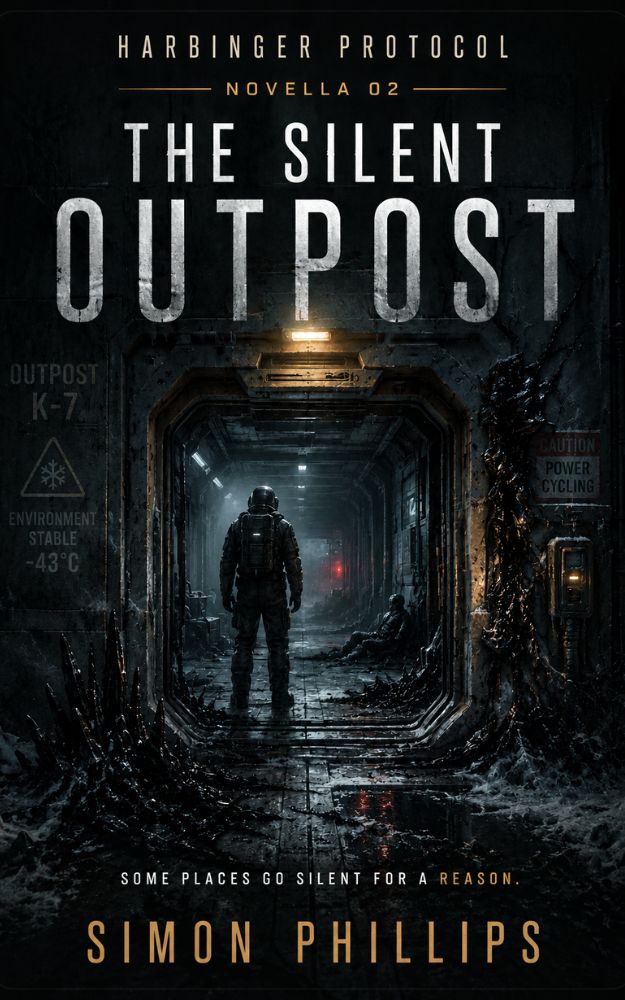
The Future Chronicle is written and curated by Simon Phillips, a writer of science fiction and speculative storytelling who explores the fragile edges of human expansion, where freight routes, inspection bays, patrol vessels, and isolated industrial stations continue their ordinary work while larger dangers gather quietly beneath routine procedure.
Many of the stories presented in these Chronicles exist within wider fictional worlds shaped by workers, survivors, officers, and investigators who encounter the first signs of events far greater than they are prepared to understand. These settings remain grounded in lived environments, where machinery, bureaucracy, and human judgement often shape the path of catastrophe long before anyone can give it a name.
The Harbinger Protocol follow that unfolding pressure through the experiences of Soren Vale, beginning with the civilian freighter disaster recorded in The Ash in Transit and continuing into the colder, more procedural dread of The Silent Outpost, where isolated incidents begin to reveal the outline of something spreading across human routes and systems.
Readers who wish to explore the full opening phase of the Harbinger crisis can find the below.
Explore the books:
The Ash in Transit
The Silent Outpost
You can watch his YouTube channel here:
Author Simon Phillips
The Chronicle: Provisional Language
The alert widened across the wall while Correlation Suite Two adjusted its displays around the new priority. The ten earlier files contracted into a narrow band above the table, leaving the centre to the Republic-affiliated tug and the rotating container secured inside its recovery bay. External imagery showed a compact industrial vessel with an ageing drive collar, twin salvage arms, and repair plates layered along the forward spine. Its registry identified it as the Orison Bell, licensed for debris recovery and contract towing across the Morrow transit line. Three crew identifiers remained active. One moved between the bridge and central passage, one held inside engineering, and one stood within the recovery section less than six metres from the captured unit.
Pell opened a direct traffic channel as the Leda Ark entered a harder burn. “Orison Bell, this is ESC Route Liaison aboard the Leda Ark,” she said while her fingers moved through the emergency authority fields. “Hold all recovery work, reduce bay temperature, isolate local airflow, and keep every crew member clear of the container.”
A carrier tone returned, followed by a man whose voice carried engine vibration and the cautious irritation of a captain receiving distant orders after a profitable recovery. “Leda Ark, this is Captain Harel Vos,” he said as a faint alarm sounded behind him. “The unit is secured under salvage procedure, our atmosphere reads clean, and we have Republic claim authority pending. State your hazard basis before I freeze a working bay and damage whatever is inside.”
Pell leaned closer to the pickup. “Your exterior scan shows residue along the lower access seam, delayed material correction, and a pressure response outside expected tolerance,” she said as she sent the raw comparison packet through the channel. “Those markers overlap with restricted incidents under current ESC review. Lower the bay to preservation temperature and close the recovery section now.”
Vos looked away from the camera as someone spoke beyond the bridge feed. “My engineer says the residue is cold-bound industrial ash,” he said while his eyes returned to Pell. “The scanner cleared it twice.”
The words moved through the suite before anyone answered. Kestrel Relay and the Red Titan carried the same classification, while Kheled-Three had softened structural contamination after its own boards corrected the warning. The earlier incidents brightened across the upper wall around the captain’s sentence.
Marris drew the tug’s scan path beside the Kestrel record. “First pass unresolved, second pass industrial deposit, third pass stable,” he said as he traced the correction times. “Seven-point-one seconds between uncertainty and acceptance.”
Ardan opened the acoustic layer from the recovery bay. “There is an event beneath the intake fan,” she said while she lowered the playback gain. “It begins after the bay heater rises.”
A soft mechanical wash entered the suite, carrying pump vibration, clamp load, and the hollow resonance of a cargo space under pressure. Several seconds passed before a narrow tone gathered inside the airflow, close enough to a human vowel for Tessa’s shoulders to tighten. The shape faded, returned in a lower register, then disappeared beneath tool noise from the crew member beside the container.
Pell kept the direct link open. “Captain, your recovery bay is warming the object while drawing air across the residue,” she said as she shifted the thermal graph into his feed. “Your scan corrections are arriving late, and your intake channel carries an unresolved acoustic event. Seal the bay and cut local heat.”
Vos studied the graph, his earlier irritation giving way to concentrated concern. “Bay Six, confirm heater state,” he called as he turned towards someone beyond the camera.
A woman answered through the bridge speaker, her voice thinned by the tug’s internal system. “Recovery heaters rose automatically after pressure lock,” she said while metal struck lightly near her pickup. “I have frost lifting from the casing and a black line forming along the lower clamp.”
“Step away from the unit,” Pell said as she placed one hand flat against the table. “Seal the section from your side and leave every tool where it is.”
The woman’s camera feed opened in the corner of the wall. Recovery Bay Six appeared under pale lamps, narrow enough for the container to dominate the centre of the chamber. Frost had receded from its upper plating. Along the lower seam, dark residue had spread beyond the original band and entered the textured surface of the clamp cradle in fine branching lines. Engineer Savi Ren stood near the yellow boundary with a thermal case beside her boots and one gloved hand raised towards the local controls.
Ren turned her helmet towards the overhead grille as airflow shifted through the bay. “Captain, someone is on the maintenance channel,” she said while her other hand reached for the seal command. “I can hear Lio in the return duct.”
Vos looked sharply towards an empty bridge station. “Lio is in engineering,” he said as he opened the internal line. “Lio, answer bridge.”
A younger man appeared from the engine room, his face bright with sweat beneath emergency strips. “I am here,” Lio said as he leaned towards his pickup. “I have been here since capture.”
In Bay Six, Ren remained facing the grille. The black line around the clamp deepened where warm metal met the container shell. Her suit microphone caught a faint sound beneath the fan, a drawn human shape carrying the beginning of her name.
Pell pressed the channel wider. “Savi, keep your eyes on the hatch and move out of the bay,” she said as her voice hardened. “The sound in that duct is an environmental artefact. Lio is on the line from engineering.”
Ren took one step towards the exit, then stopped as the local seal indicator changed from green to amber. “The hatch says pressure review,” she said while her glove moved over the manual release. “It has taken local control.”
Tessa followed the tug’s air route from Bay Six into the central return. A contamination warning appeared at the bay sensor, cleared itself, then returned under a softer equipment-fault label. The system had already begun translating danger into maintenance language.
“Captain Vos, cut recovery-bay power at the distribution trunk,” Pell said as she highlighted the correct control on his bridge plan. “Keep ventilation low. Keep the rest of the ship cold.”
Vos moved both hands across his console. “Bay power is dropping,” he said while the bridge lights dimmed around him. “Savi, manual hatch release should clear once the local bus falls.”
The recovery lamps faded to weak amber. Heater output collapsed, fan speed lowered, and the dark branching around the cradle slowed beneath the camera. Ren worked the manual wheel with both hands until the hatch gave a fraction. Cold vapour crossed the gap from the passage.
The voice in the grille returned, softer through the reduced airflow and shaped closely enough to Lio’s tone that Ren looked back over her shoulder. Her hand loosened on the wheel.
Lio struck his engine-room console with an open palm. “Savi, look at me on your wrist feed,” he said as he raised his face towards the camera. “I am in engineering. Whatever you hear, keep moving.”
Ren lowered her eyes to the small display on her sleeve. Lio’s live image flickered there, delayed by less than a second, while the sound above her formed the same voice through metal and falling air. Her posture tightened as two versions of the same man reached her from different parts of the ship.
“I see you,” Ren said as she forced the wheel through another turn. “Keep talking.”
Lio shifted closer to his pickup. “You left your blue mug beside the port regulator this morning,” he said while his hands gripped the console edge. “You threatened to throw it at me when I moved it. You still owe me a clean filter report from yesterday, and I still hate the tea you make.”
A strained laugh escaped Ren as the hatch opened wide enough for her shoulder. “That is because you boil it until it tastes like insulation,” she said while she pushed herself through the gap.
Vos sealed the passage side after she cleared the bay. The camera remained inside, showing the container beneath reduced light while the dark line held around the chilled clamp. The acoustic trace flattened as the fan slowed, leaving hull vibration and the small ticking sounds of metal losing heat.
Pell released the edge of the table. “Keep Bay Six isolated under cold draw,” she said as she looked towards Vos. “Move your crew into sealed suits, close the central return, and alter course away from inhabited traffic. The Leda Ark will establish escort distance and transfer handling instructions through a narrow data path.”
Vos sat back from his console, the colour drained from his face. “What have we brought aboard?” he asked while his gaze stayed on the sealed bay status.
Holt’s eyes moved towards the provisional summary waiting above the table. Tessa saw the answer he could give and the answer the files demanded pressing against each other behind his still expression.
Pell glanced towards him before speaking. “You have recovered material linked to a provisional correlated infrastructure hazard,” she said as she returned her attention to Vos. “Cold and isolation appear to slow its activity. Heat, airflow, and system wake appear to increase risk. Follow those controls and keep your crew away from every voice whose source you cannot see.”
Vos absorbed the phrasing with tired disbelief. “That sounds like a name built to avoid naming anything,” he said as he secured the course order.
“It is the strongest name cleared for use,” Pell said while her fingers rested beside the channel. “For now, it may be strong enough to keep your people alive.”
The Orison Bell began turning away from the Morrow transit line. Its drive output remained low, and its recovery bay temperature descended by steady degrees. Tessa watched the dark branching remain fixed around the cradle as the cold deepened. No further voice crossed the intake channel. The silence offered relief with no promise behind it.
Marris opened the summary approval field once the tug settled on its diversion course. “The live incident supports every operational clause,” he said as he added Bay Six to the restricted attachments. “Recovered debris, incomplete chain, cold inactivity, thermal response, airflow event, delayed correction, voice-range sound, and crew movement towards the source.”
Ardan stood beside the wall with her arms folded close. “Add human-response risk,” she said as she looked at Ren’s helmet recording. “The acoustic event used no clear sentence. Recognition supplied the rest. Savi heard a colleague because the sound reached the shape her mind expected.”
Holt touched the summary and revised the caution line. “Human interpretation of unresolved acoustic output may increase exposure through rescue, verification, or maintenance response,” he said as he read the sentence aloud. “That gives quarantine teams a usable instruction while preserving uncertainty around mechanism.”
Pell turned from the tug feed. “Add trusted infrastructure as a primary hazard route,” she said as Harrow Nine’s packets reappeared above the table. “The threat enters through green pressure fields, valid house keys, maintenance classifications, clean registry codes, and familiar voices. Every system that reassures a crew can become part of the exposure.”
Tessa entered the line beneath the shared markers. The summary grew heavier as each cautious sentence joined it, still provisional, still restricted, yet finally capable of carrying action beyond the room.
Holt read the title once more while the approval field waited beneath his name. “Public declaration remains unsupported, origin remains unresolved, and deliberate action remains unsupported,” he said as he looked from Pell to Ardan. “A connection between events has reached probable status. Will route control act on this wording?”
Pell gave a slow nod. “It supports precautionary holds, cold salvage handling, narrow-system response, and immediate challenge of automated guidance from silent infrastructure,” she said while she reopened the Harrow file. “It gives officers grounds to warn civilian traffic before every jurisdiction finishes arguing over ownership.”
Ardan rested one hand beside the acoustic clause. “Medical containment can use it for sealed suits, isolation from vent routes, source verification, and cold suppression,” she said as Ren’s recording remained frozen behind her. “Responders also need to understand that empathy can become an exposure path.”
Marris gathered the final amendments and looked towards Holt. “Every authority named in the attachments will challenge it,” he said while a weary half-smile touched his mouth. “The wording gives them fewer clean places to break.”
Holt lowered his hand to the approval field. “Then the routes receive it before the committees finish deciding what it means,” he said as his seal entered the record.
Pell followed, then Ardan and Marris added their authority marks beneath the operational clauses. Tessa’s name remained at the bottom under preparation and evidence correlation, smaller than the command approvals above it, yet present inside the record that had begun with six files arranged across Review Chamber Four.
The wall compressed the ten incidents and the new Orison Bell alert into a single restricted package. Transmission paths opened towards patrol groups, quarantine holds, route-control stations, salvage authorities, and selected Republic liaison desks. Some channels accepted the file at once. Others returned legal-review holds. Two requested softer language around probable connection. One rejected the title and asked whether correlated infrastructure hazard implied ESC jurisdiction over civilian ports.
Tessa watched the responses gather beneath the summary while the cruiser continued towards the Verge. “They are already pulling it apart,” she said as her stylus lowered to the table.
Holt stood beside her, his expression held in familiar controlled lines. “That is how a record proves it can travel,” he said as he looked across the objections. “Truth inside one sealed room has little operational value.”
Tessa turned towards the Orison Bell feed. The tug remained cold, isolated, and under escort approach. Bay Six held steady. Ren sat in the passage outside the sealed hatch with Lio beside her, both visible through a suit camera while Vos worked the diversion from the bridge. Three people remained alive because a warning had reached them before the words achieved full certainty.
A new marker entered at the edge of the route display, small and amber beneath the spread of command traffic. Another salvage beacon had appeared beyond the tug’s original recovery line, drifting among fragments too scattered for ownership confirmation. Its signal carried a recognised registry prefix and a damaged claim packet. The nearest civilian vessel altered course by two degrees before the warning summary reached its board.
Pell saw the movement and opened the traffic channel. Around her, the suite returned to work while the approved document travelled outward beneath cautious authority, carrying no declaration of outbreak, no accusation of sabotage, and no claim about origin. It carried only the pattern, the conditions that appeared to wake it, and the instruction that every trusted answer now required a second look.
Across the wall, the newest beacon continued pulsing from the Verge, patient inside the dark while another crew began deciding whether recovery remained worth the risk.
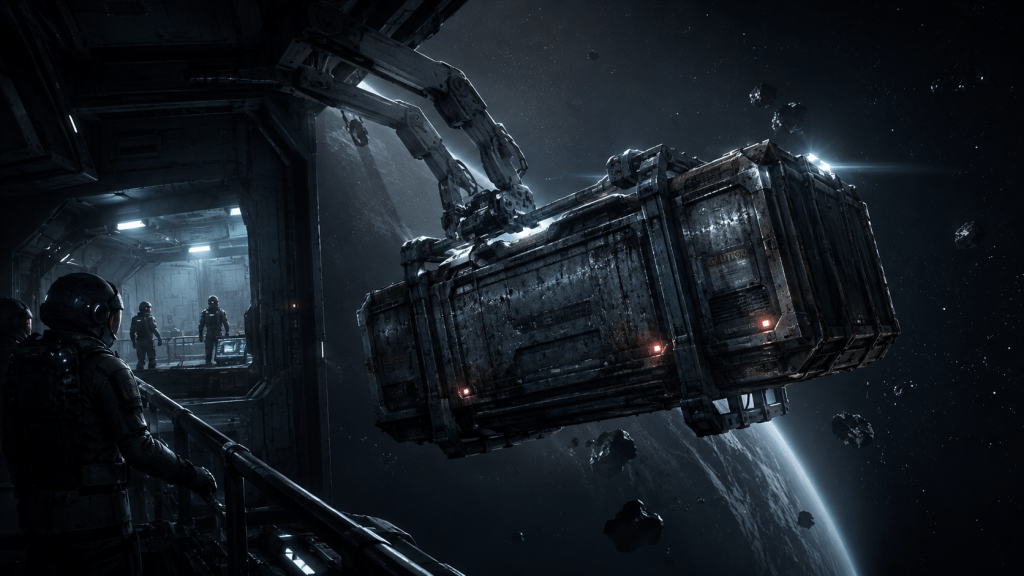
The Orison Bell drew the recovered container towards Bay Six under cold work lights, while its crew watched the frost recede and the dark residue along the sealed edge begin to spread.
The Idea Behind the Chronicle
Modern societies depend upon layers of infrastructure that most people rarely see. Freight systems, quarantine protocols, traffic control, automated guidance, maintenance networks, and legal authority work together to keep movement safe across enormous distances. In a future spread across many star systems, those systems would become even more important, because every civilian ship would rely upon recognised codes, route instructions, pressure readings, and docking permissions before approaching an unfamiliar station or recovering an object from deep space.
The central idea behind this Chronicle is that danger may enter through those trusted systems long before anyone understands its physical nature. A contaminated container can appear harmless while cold. A damaged outpost can continue transmitting valid docking instructions after its crew has vanished. A scanner can correct an uncertain reading into a familiar category, while a route-control board accepts the answer because every recognised code remains in place. The machinery has followed its design, yet the conditions around it have changed beyond anything the design expected.
This creates a different form of science-fiction horror. The threat does not need to attack openly. It only needs to exist inside the same channels that human beings use to recognise safety. A green pressure field, a valid registry chain, or a familiar voice can carry greater persuasive force than visible damage, because generations of workers have been trained to trust those signals. Once that trust becomes unreliable, every ordinary procedure gains a second meaning.
The Chronicle also explores the pressure placed upon institutions when evidence arrives before language. Governments and military organisations depend upon precise terms because words can close trade routes, trigger quarantines, create diplomatic disputes, or place responsibility upon officers acting across contested jurisdictions. Calling an event an outbreak implies a known method of spread. Calling it sabotage suggests deliberate intent. Naming an alien origin claims certainty far beyond the surviving evidence. Caution may protect political stability, yet excessive caution can delay the warnings needed by people facing the danger directly.
This tension reflects a real problem within complex organisations. Early reports of unfamiliar events often arrive as isolated maintenance faults, medical anomalies, equipment failures, or witness accounts that appear too uncertain to justify wider action. Each report can be explained alone. Only comparison reveals the pattern. By the time enough evidence has gathered for official recognition, the event may already have moved through systems designed to contain it.
The human element remains equally important. People respond to voices, distress calls, and signs that another person may need help. That response is one of humanity’s strongest qualities, though it can become a source of exposure when sound and machinery produce something close enough to human speech for empathy to complete the meaning. The Harbinger contamination never needs conscious intention for this to happen. Airflow, damaged systems, stored audio, pressure shifts, and human expectation create the tragedy together.
The Pattern No One Wanted therefore closes the early incident sequence at the moment when scattered losses finally enter one official frame. ESC command has found a phrase capable of travelling beyond a sealed review room, though the phrase remains smaller than the reality it describes. The pattern has been recognised, yet recognition arrives while another salvage crew is already bringing the next object aboard.
From the Author’s Desk
The Harbinger Protocol began with a simple question: what happens when humanity encounters something dangerous through the systems it already trusts? Freight routes, quarantine holds, docking guidance, salvage law, and environmental controls exist to make life beyond Earth possible, yet each one also creates a pathway through which an unknown threat can travel before anyone understands what has entered the network.
The Early Incident Files allowed me to explore that crisis beyond the central story, following inspectors, analysts, salvage crews, route officers, medical teams, and station workers who encountered separate pieces of the same pattern. Each Chronicle remained focused on one contained event, while the wider sequence gradually revealed how those isolated reports began moving towards official recognition.
The Ash in Transit opens the Harbinger Protocol through the disaster aboard the civilian freighter Red Titan, where Soren Vale witnesses contaminated salvage spread through heat, airflow, and failing ship systems. The Silent Outpost continues that pressure aboard the Leda Ark and Processing Station Nine, where the crisis becomes colder, more institutional, and harder to contain within a single explanation.
The Pattern No One Wanted closes this first Chronicle sequence at the point where scattered evidence can finally be placed inside one restricted summary. The danger remains unresolved, the language remains cautious, and another recovery vessel has already carried the next object aboard. That ending reflects the larger Harbinger world, where understanding always arrives a little later than exposure.
Alongside these Chronicles, I continue developing the Harbinger Protocol books and other science-fiction projects shaped by industrial environments, distant human settlements, institutional pressure, and ordinary people facing events far beyond the limits of their authority.
Readers interested in exploring the opening phase of the Harbinger crisis can find the books through the links below.
You can explore my books here:
Books by Simon Phillips
You can watch my YouTube channel here:
Author Simon Phillips
Technical Notes & Frontier Context
Incident Correlation Systems
A civilisation spread across many star systems would generate an enormous volume of operational data. Civilian freighters, patrol vessels, route stations, salvage ports, mining relays, medical holds, and automated cargo networks would each produce their own logs, sensor records, maintenance warnings, traffic packets, and crew reports. Most of this material would remain local because local systems could handle the event that created it.
The difficulty would begin when several small incidents shared the same underlying behaviour while carrying different official descriptions. One station might record pressure lag. Another might report unstable scanner correction. A quarantine team could preserve voice-shaped audio from a damaged vent, while a route-control office recorded a vessel responding several seconds late with perfect identification codes.
Each event could appear ordinary enough when reviewed alone. Correlation systems would therefore need to compare more than final classifications. Investigators would examine raw timing, environmental conditions, system corrections, crew movement, temperature changes, airflow routes, and the order in which warnings appeared. The pattern might emerge through relationships that local reports were never designed to preserve.
Restricted suites such as Correlation Suite Two represent that deeper level of review. Their purpose would be to place politically sensitive records beside one another while preserving evidence chains, access controls, and the identity of every officer altering the summary. The room would function as part archive, part operations centre, and part legal chamber, because any conclusion formed there could change traffic policy across several governments. The early Harbinger files become significant only after officers begin comparing raw details beneath the separate classifications.
Provisional Hazard Language
Emergency language carries practical power. A formal outbreak declaration could close ports, divert civilian traffic, freeze cargo movement, and trigger quarantine authority across entire regions. A sabotage classification might imply deliberate hostile action and create political pressure for retaliation. A declaration of non-human origin could produce public fear long before investigators possessed evidence strong enough to support the claim.
For this reason, officers facing an unknown hazard would rely upon provisional terminology. Such language allows action while preserving uncertainty. A phrase such as correlated infrastructure hazard gives route control grounds to halt traffic, quarantine teams grounds to isolate recovered material, and salvage crews grounds to maintain cold handling. At the same time, it avoids claiming a confirmed origin or mechanism.
This caution serves a genuine purpose. False certainty can cause panic, diplomatic confrontation, and harmful decisions across systems far beyond the original incident. Yet cautious wording also carries risk. If a summary becomes too narrow, officers receiving it may treat the event as a collection of unrelated maintenance faults instead of a wider danger.
The Chronicle explores that tension through the officers inside Correlation Suite Two. They are trying to produce language capable of surviving legal and political review while remaining strong enough to protect people who may encounter the next container, silent station, or damaged vessel. The final phrase is imperfect because the evidence remains incomplete. Its value lies in giving scattered responders a shared operational frame before full understanding arrives.
Cold Suppression and Environmental Control
Cold storage would play a central role in deep-space salvage, quarantine, and industrial transport. Reduced temperatures can slow chemical reactions, preserve unstable cargo, reduce biological activity, and limit damage while crews assess an unknown object. Remote stations would also use preservation modes to protect machinery during power shortages, coolant failures, or long periods between maintenance visits.
Within the Harbinger Protocol setting, cold has a more unsettling function. Contaminated residue often appears quiet under low-temperature conditions. Its stillness encourages crews to accept scanner classifications and proceed with recovery. Once heat rises, airflow increases, or systems return to fuller power, visible changes begin appearing along seams, vents, clamps, conduits, and damaged surfaces.
Cold therefore acts as suppression instead of removal. It may hold the contamination in a slower state while leaving the underlying hazard intact. The infected marine aboard Station Nine remained under cold treatment long enough for spread to slow, though the process continued once contamination had crossed into suit fabric and made contact with the station. The outpost itself remained quiet under low power until the attempted system wake fed energy into contaminated infrastructure.
This creates a practical contradiction for future crews. Warming a bay may help workers, protect equipment from freeze damage, and restore reliable control. The same action may also provide energy, airflow, and pressure conditions that allow hidden contamination to become active. Emergency procedure would therefore favour low heat, minimal airflow, narrow power use, and remote observation until the recovered material could be transferred under stronger containment.
Trusted Infrastructure
Interstellar travel would depend upon trust in machine-generated information. Civilian captains could never inspect every station, route marker, or cargo unit personally. They would rely upon verified house keys, valid registry chains, pressure fields, berth assignments, clamp reports, and recognised authority codes.
That trust makes large transport networks possible. It also creates vulnerability when a system continues operating after the physical reality behind it has changed.
Harrow Outpost H-09 remained convincing because its docking packets came from the correct source and carried valid authentication. The station recognised the approaching carrier, calculated its mass, adjusted the route around local traffic, and offered a berth through familiar traffic language. The broken collar and missing crew existed outside the information the carrier’s systems were trained to prioritise.
The same principle applies to scanners that correct uncertain readings into recognised materials, personnel boards that assign familiar labels to distorted returns, and cargo systems that accept valid beacon codes from dangerous salvage. The machinery follows the structure of its design. The danger appears when that design encounters conditions its builders never imagined.
The Pattern No One Wanted brings these failures together because the contamination rarely enters through dramatic destruction first. It arrives through a working route, an accepted scan, a recognised voice, or a green status field. The systems remain useful enough to earn trust while becoming unreliable in the exact places where trust matters most.
Human Interpretation Under Pressure
Human perception completes many of the Harbinger incidents. Air passing through damaged ducts, corrupted announcements, pressure changes, stored audio, and system interference can produce sounds close enough to speech for listeners to recognise a voice. Once that recognition occurs, memory and emotion supply identity, intention, and meaning.
A crew member may hear a colleague calling from an empty compartment. A responder may believe survivors remain beyond a sealed grille. A route officer may hear a welcome instruction inside damaged docking telemetry. The physical sound remains ambiguous, while the human response becomes immediate.
This is why acoustic procedure would require source verification before rescue action. Responders would need to confirm the speaker through a visible channel, compare live location tags, isolate environmental noise, and resist opening vents or hatches solely because a sound resembles a plea.
The tragedy lies in the conflict between survival and empathy. Human beings are inclined to answer voices that sound frightened, injured, or familiar. The Harbinger contamination gains no conscious intention through these events. The danger grows from machinery, environment, memory, and compassion converging at the wrong moment.
By the end of the Early Incident Files, ESC command has learned enough to warn crews about that convergence. It still lacks a full explanation. What it possesses is a list of conditions, repeated markers, and practical instructions strong enough to keep some people alive while the larger truth remains beyond the reach of the official record.
The Leda Ark continued towards the Kheled Verge, carrying within its sealed archives the first official shape of a crisis that had already travelled beyond the words chosen to contain it.
Discover more from Simon J. Phillips
Subscribe to get the latest posts sent to your email.
