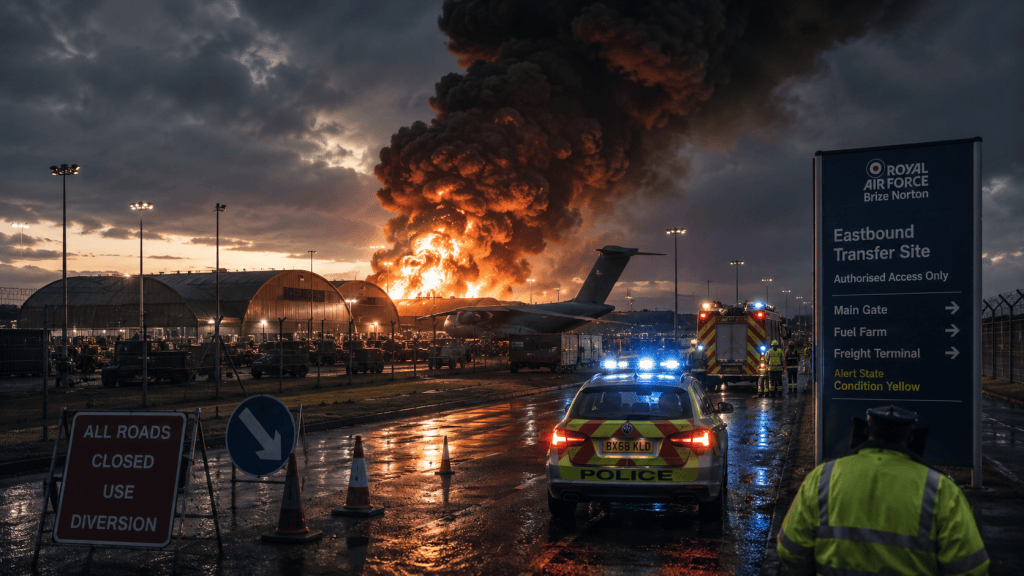
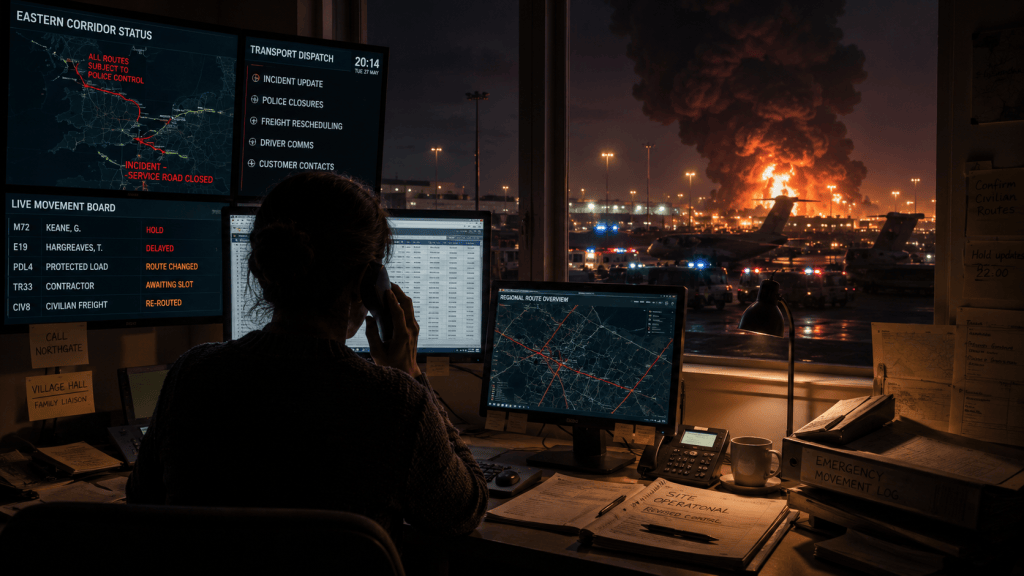
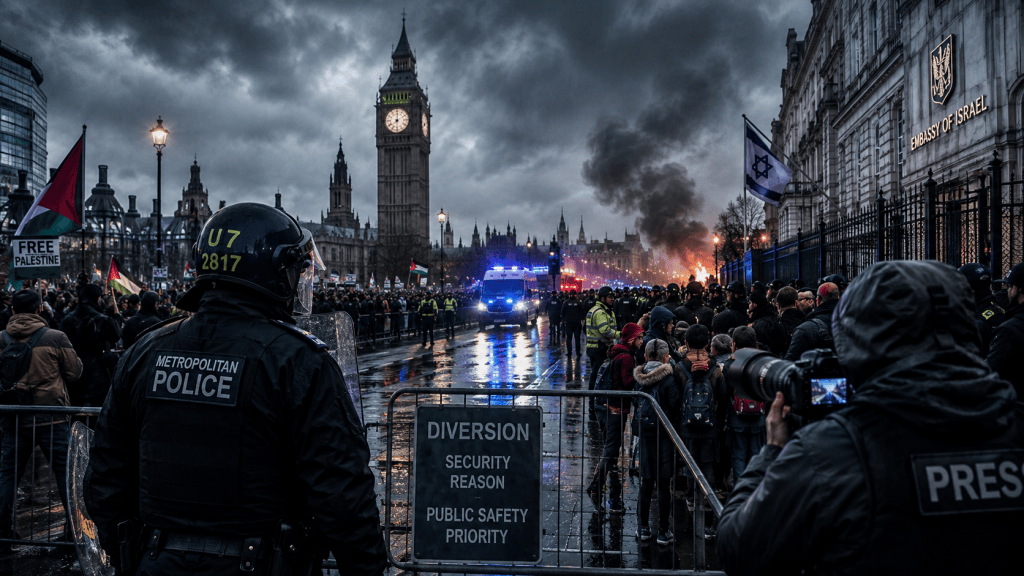
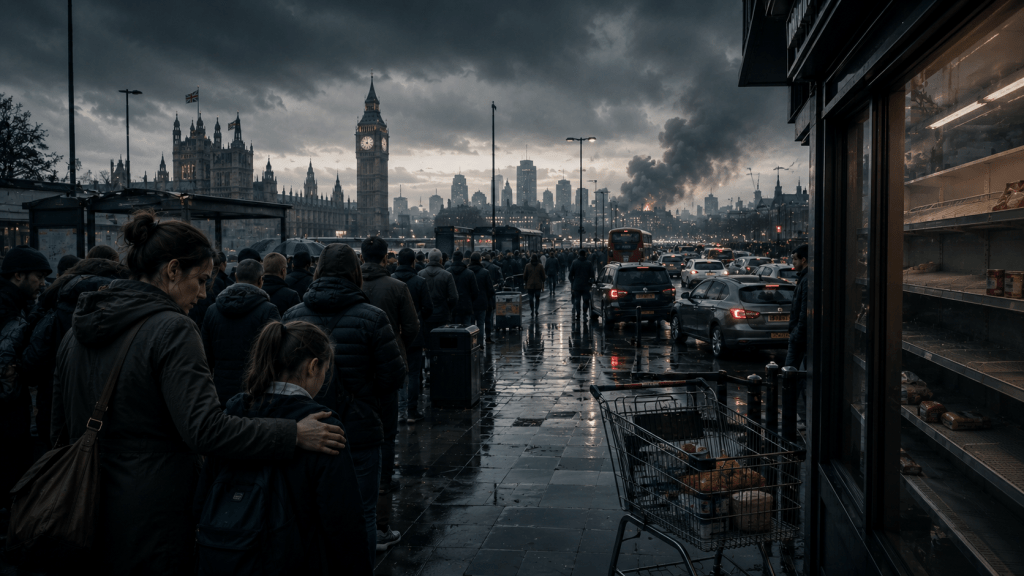
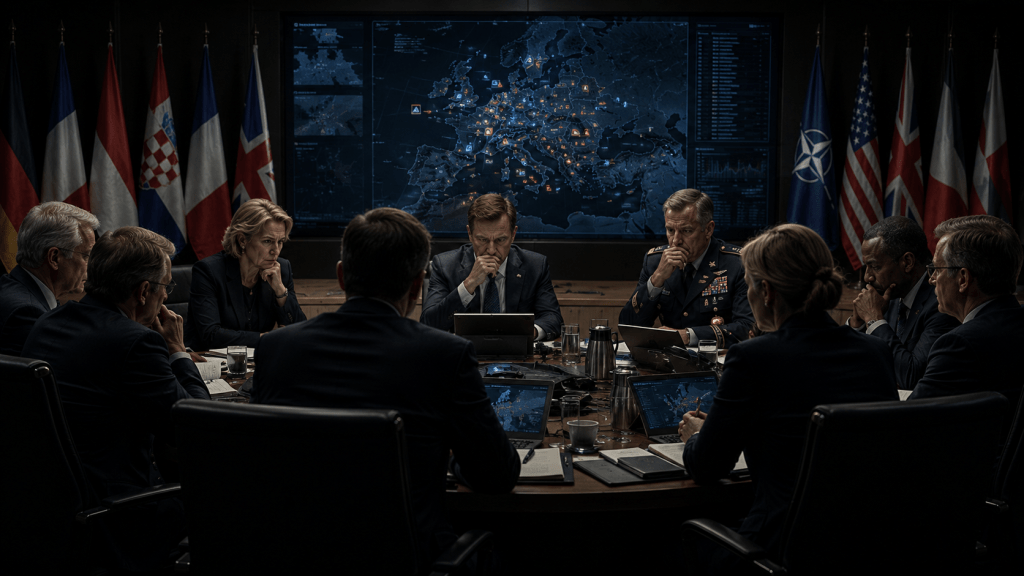
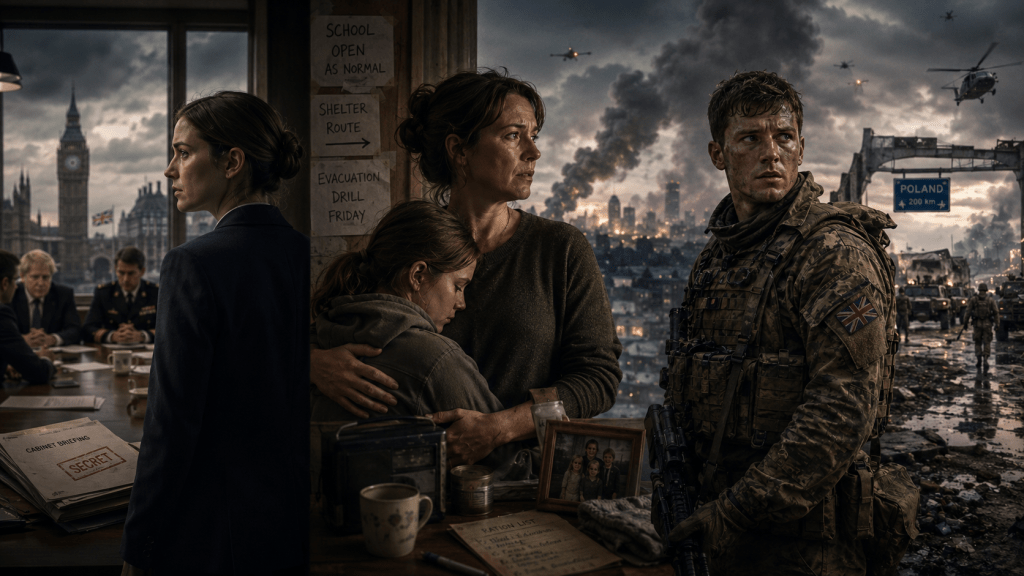
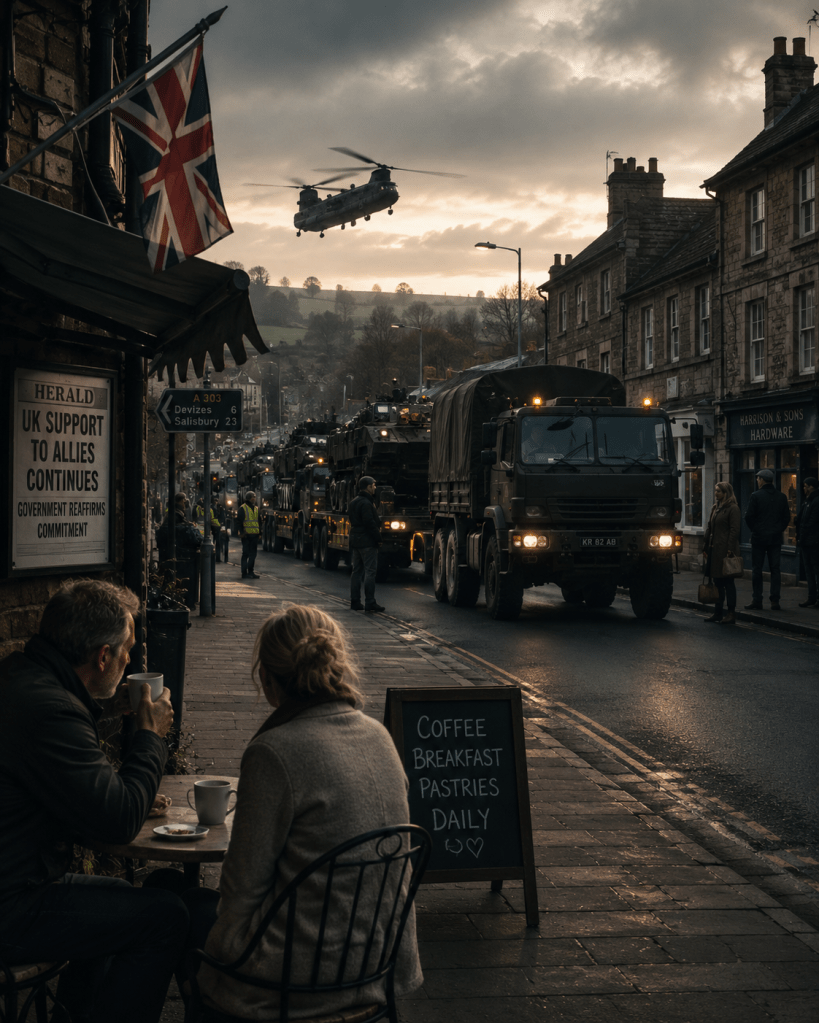
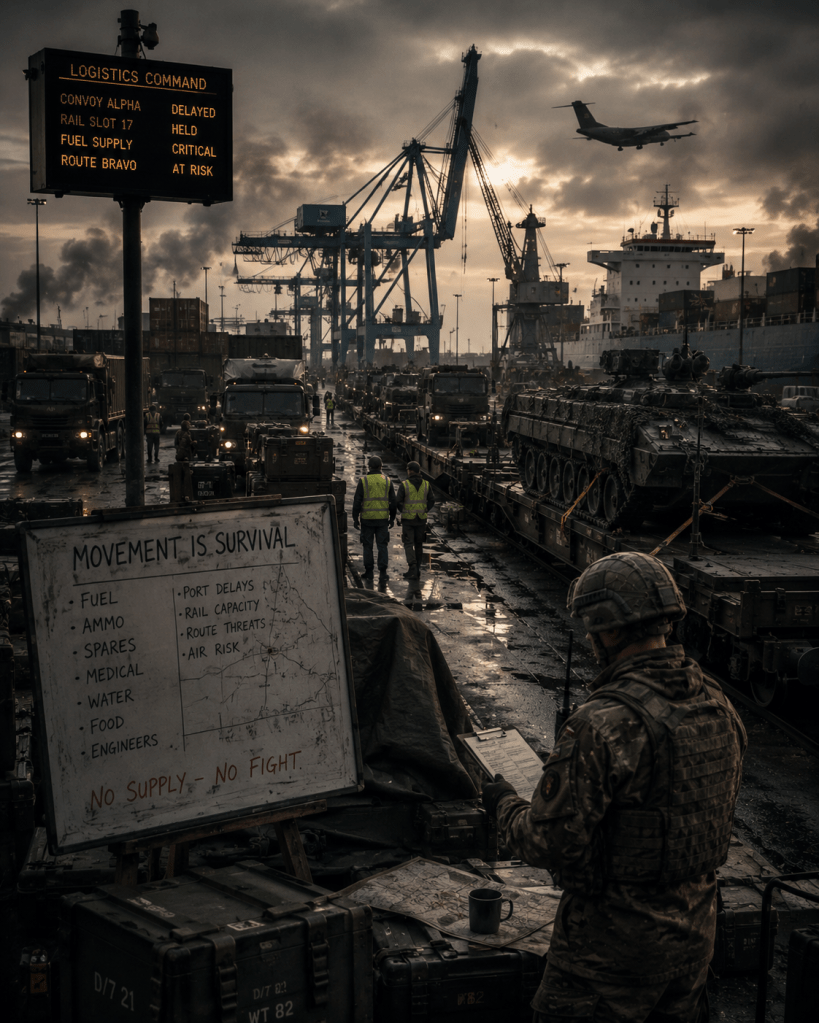
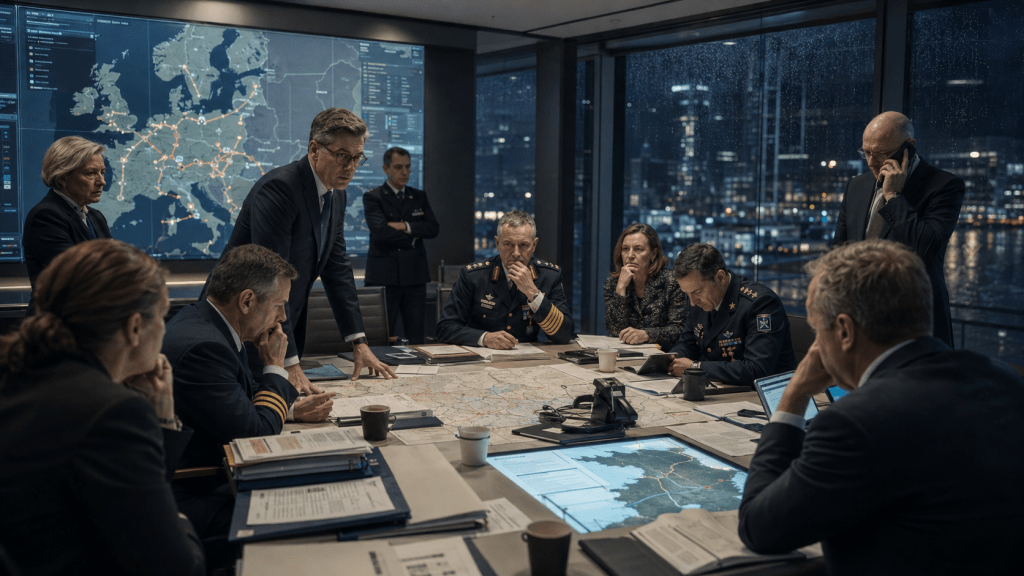
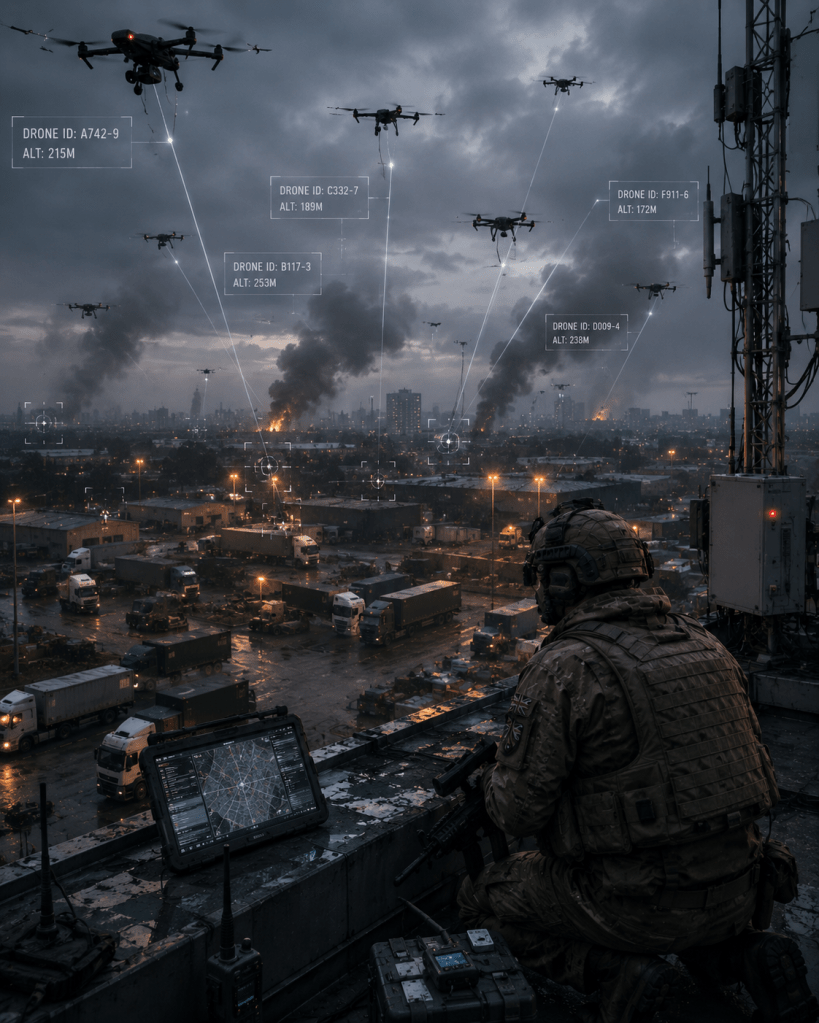
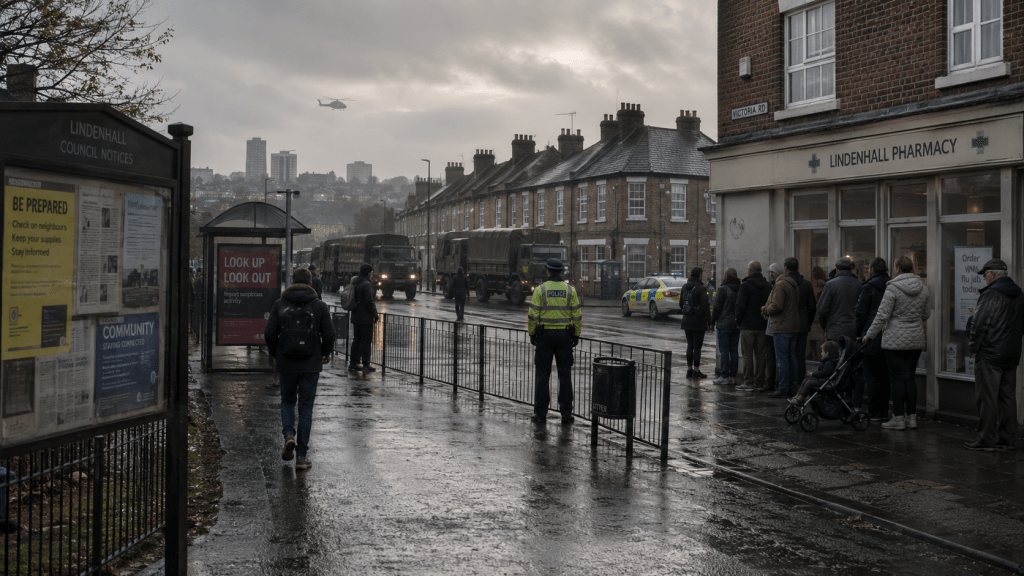
A planned demonstration was rerouted in the name of public safety, but those caught between the barriers saw a city where foreign policy, policing, media pressure, and ordinary fear had begun occupying the same street.
The Street ThatChangedDirection
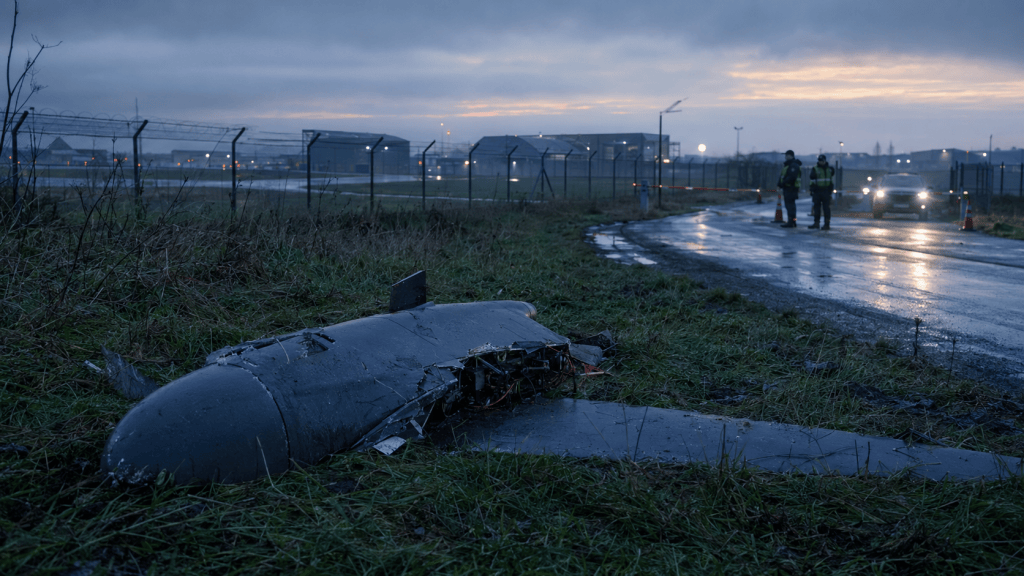
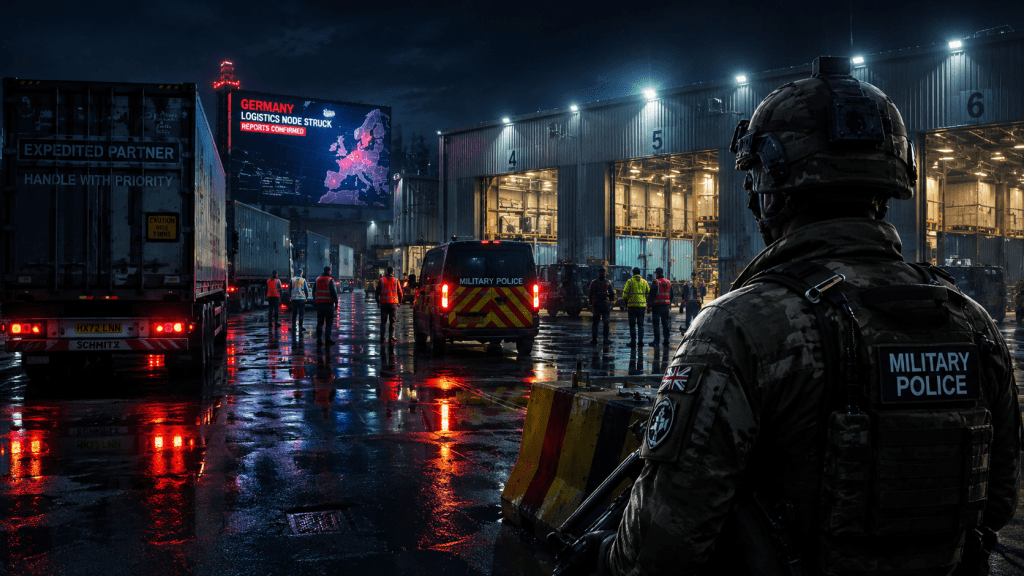
The first barrier moved before the children understood that the pavement had ceased to be theirs, lifted by two officers in fluorescent jackets and carried across the wet stone with the slow, awkward care of people trying to rearrange a city while it watched them. Rain had been falling since mid-morning, fine at first and then harder, collecting along the kerbs near Kensington High Street, shining on the black railings, blurring the red brake lights of traffic held behind cones, and turning the press vans into bright rectangular shapes beneath the trees. The march had been due to pass along the agreed route after eleven, with stewards in orange bibs at the front, police horses farther back, and counter-protest groups contained across a separate line. By ten forty-seven the first route change had already moved two streets into the plan. By eleven twelve the second had begun moving through radios, hand signals, school phones, and the faces of teachers who had entered the area under instructions already out of date.
Hannah Vale had brought thirty-one Year Ten pupils from Bracknell to London for a citizenship trip that had looked harmless on the booking form in February and gradually acquired more warnings in the week before departure. The museum visit had survived. The coach company had survived. The packed lunches had survived in torn paper bags and softening foil, although most of the children had eaten the crisps before Slough. What had altered was the city around them, which had seemed at first merely busy and then increasingly arranged by forces Hannah could see only through their effects: a line of metal barriers appearing across a crossing, a police van reversing into a side street, a steward waving a group away from a junction, a broadcast camera turning towards the same gap Hannah was trying to use.
“Keep close to the wall, please,” Hannah called, raising one hand while the pupils gathered under the shallow cover of a stone frontage. “Phones away unless you are contacting home, and stay where I can see your coats.”
Beside her, David Phelps had the attendance sheet held inside a plastic sleeve, his thumb pressed against the names as though pressure could keep the group intact. He taught history, wore a tie with tiny blue ships on it, and had spent the coach ride explaining that public protest formed part of democratic life. He looked less confident now, standing beside a bin overflowing with wet cardboard while sirens moved somewhere beyond the next turn.
“I make it thirty,” David said as he scanned the line of pupils again, his voice low enough to keep the concern between the adults.
Hannah looked across the hoods, rucksacks, headphones, and half-raised faces. “Saira is with Mrs Ellison.”
“She went for the toilets with Ellie and Grace,” David said, checking the bottom of the sheet. “They came back after the first hold.”
Hannah found Saira near the pillar, hands tucked inside her blazer sleeves, eyes wide under damp fringe, and she allowed herself one breath before the crowd noise rose from the far side of the barriers. It came as a layered sound, chants, whistles, engines, shouted instructions, and the strange hollow applause that moved through large crowds when a chant changed shape. A Palestinian flag lifted above the people at the corner, soaked dark by rain, and beyond it a smaller line of Union flags and Israeli flags showed above a row of police helmets. The two groups were still apart, separated by vans, barriers, mounted officers, and a space the police seemed to treat as something alive enough to slip.
A young constable came towards them from the crossing with water running from the brim of her cap. Her name badge read SEN, and her cheeks had reddened with cold. She held her radio close to her shoulder and kept glancing towards the junction as she spoke.
“You are the school party from Berkshire?” PC Sen asked, angling her body so the pupils heard a calm voice before they saw the tension in her face.
“Yes,” Hannah said, lifting the visitor folder. “We were directed this way by an officer at the previous crossing.”
PC Sen looked towards the old route printed on the sheet, then towards the barriers. “That route has changed. We need you to hold here until the next safe crossing opens.”
David shifted the plastic sleeve beneath his arm. “How long will that be?”
PC Sen listened to her radio for a moment, her eyes still on the group. “A few minutes, we hope.”
One of the pupils, a tall boy named Callum Price, looked past her towards the line of cameras gathering near the barrier. “Miss, is this going on the news?”
Hannah turned towards him before his worry could spread through the group. “Callum, keep your voice down and stay with Kai.”
PC Sen followed his gaze and saw the camera crew as well. Two reporters stood beneath umbrellas near the corner, speaking to their producers while a cameraman filmed across the top of the barrier. A second crew had moved closer to the school group because children in uniform beside police tape made a clean image, easier for an editor to understand than route revisions, protest permits, ministerial pressure, and every instruction moving invisibly through the morning.
Hannah saw the same calculation at the same time. “Officer, I would prefer the children moved away from the cameras.”
“So would I,” PC Sen said, touching her radio key. “Control, this is Sen at West Link Two. School group present beside Queen’s Gate frontage. Request movement away from media line when safe crossing opens.”
The reply came through as a burst of static and a voice too clipped for Hannah to catch, although Sen’s expression tightened by a degree.
“Received,” PC Sen said into the radio, then lowered it. “They are opening a crossing behind the second van as soon as the counter group has cleared the side street.”
David looked along the line of pupils, his jaw set hard. “That sounds like a great deal depending on as soon as.”
PC Sen gave him the briefest glance. “Yes, sir.”
A chant rolled closer, louder through the wet air, and several pupils turned towards it at once. Hannah stepped forward, placing herself between the group and the barrier, with one hand lifted in the school gesture that meant listen because I am still calm enough for both of us. In the road, officers were speaking into radios, stewards were holding their arms out to slow the front of the march, and a police horse shifted sideways as a steward waved people back from the kerb. Traffic had been emptied from the nearest lane, yet buses and taxis were still trapped farther down, their windows full of faces watching the city argue around them.
“Miss Vale,” Saira said from near the pillar, her voice thinned by embarrassment and fear, “my mum has messaged four times.”
Hannah turned just enough to see her. “Send her one message saying you are with staff and safe. Then put the phone back in your pocket.”
Saira’s fingers moved quickly over the screen. “She says there are videos online already.”
“Then give her the truth before the videos do,” Hannah said, keeping her eyes on the junction.
David moved closer, speaking from the side of his mouth while pretending to count the pupils again. “The school office has rung twice. Reception says parents have started calling.”
Hannah kept her face steady for the children. “Tell reception we are held near a police cordon and awaiting movement to a safe crossing.”
“They will ask whether they should send that to parents.”
“Tell them to send exactly that,” Hannah said, then added after a breath, “and remove police cordon. Say supervised public-safety hold.”
David looked at her, rain shining along the edge of his glasses. “You have started writing like the council.”
“I have started writing for parents who are refreshing news clips,” Hannah said as a shout rose at the corner and vanished beneath a louder chant.
The second barrier line shifted again. Two officers dragged a section of fencing across the side road while a sergeant pointed towards the school group and then towards the crossing beyond the van. PC Sen stepped away to listen, one hand pressed against her earpiece, her other hand open at waist height as if holding the situation in place by gesture alone. The reporter under the black umbrella saw the movement and touched her cameraman’s sleeve. The lens turned a fraction towards the children.
Hannah felt anger rise through her, sharp and immediate, then forced it into usefulness. “David, put yourself on the camera side. Mrs Ellison, bring the back half forward. Everyone hoods up, bags on, eyes on me.”
Mrs Ellison, the teaching assistant, gathered the rear pupils with a briskness born from playgrounds, bus queues, fire drills, and years of moving teenagers through spaces designed by adults who rarely had to count them. “You heard Miss Vale,” she said, clapping once above the rain. “Pairs, please. We are walking, which means nobody becomes dramatic for TikTok.”
A few pupils laughed, brittle at first and then with relief enough to loosen their shoulders. Callum put his phone away after David gave him a look that required very few words. Saira stayed close to Ellie. Kai pulled his hood down so far he could see only his shoes, and Hannah reached out to lift the front edge enough for him to walk safely.
PC Sen returned at a fast walk. “We are moving you now. Stay tight. Teachers front and rear. Cross behind the van, then left along the service frontage. A liaison officer will take you through to the coach point.”
“Has the route changed again?” Hannah asked, already lifting her hand to signal movement.
PC Sen glanced towards the corner, where stewards had begun turning the front of the march away from the first agreed line while counter-protesters surged against their own barrier in complaint. “The route is being adjusted for public safety.”
David gave a small, strained laugh as he folded the attendance sheet and tucked it inside his coat. “That sounds familiar.”
“It has had practice today,” PC Sen said, and her honesty lasted only a second before the radio pulled her back into duty.
The group moved in pairs between the barriers, shoes slipping on wet paving, rucksacks knocking against hips, staff counting aloud beneath the crowd noise as though arithmetic could keep the city from changing shape around them. On one side, the march pressed against its own delay, voices rising under flags and umbrellas. On the other, cameras tracked movement, police held the gap, and an official explanation waited somewhere ahead, clean enough for a statement and thin enough to pass through every room that needed it. Hannah kept counting as the children crossed behind the van, thirty-one pupils, three staff, all present, all moving, all officially safe, while the city rearranged itself around them for the second time that morning.
A school trip to Kensington became caught between shifting protest lines, police control, media pressure, and an official explanation that concealed more than it revealed.llowing Visual Chronicle presents a cinematic reconstruction of the events described above.
Extract from Public Order Command and Local Authority Movement Record
Subject: Kensington Protest Route Adjustment / School Group Hold Time: 10:41–11:26 Circulation: Public Order Command / Local Authority Liaison / Transport Coordination Desk / Government Communications Duty Cell / Media Handling Group
Purpose
To record the route adjustment applied during a planned central London demonstration and associated counter-protest activity, with particular reference to public-safety barriers, media positioning, school-party movement, traffic displacement, and the maintenance of separation between participant groups.
This extract covered the first instruction window after the agreed march route required revision owing to crowd density, counter-protest movement, and reduced safe crossing capacity near Kensington High Street.
Approved Public Position
Police, stewards, local authority teams, and transport partners worked together to support lawful protest, maintain public safety, and minimise disruption across the affected area.
The march route was adjusted during the morning in response to live crowd conditions. The change formed part of standard public-order management and allowed officers to preserve safe movement for pedestrians, road users, nearby businesses, and organised groups present within the area.
Members of the public were advised to follow officer instructions, allow additional journey time, and use marked crossing points where available.
Operational Position
At 10:41, officers began adjusting the initial barrier layout after crowd pressure increased along the western approach. Stewards reported slowed movement at the front of the march, while officers monitoring the counter-protest line requested greater separation near the side-street junction.
At 10:56, local traffic was held across two lanes to allow the movement of barriers and police vehicles. Several bus services were delayed or diverted during the adjustment period. Pedestrian movement remained possible through controlled gaps, although safe crossing capacity narrowed around the museum frontage and adjacent stone walkway.
At 11:08, a school group became held beside the temporary barrier line after being directed away from the first crossing point. Teachers remained with the pupils throughout the hold. Officers identified the group as vulnerable to media exposure owing to camera crews positioned along the revised route.
At 11:13, Public Order Command authorised a controlled movement of the school group behind a police van and through the service frontage. The group was transferred towards the coach point under officer direction.
At 11:26, the second route adjustment was confirmed as active, with the march redirected through the cleared frontage and the counter-protest line held behind the secondary barrier set.
Handling Guidance
Members of the public should be advised that the route changed owing to live public-safety conditions. Officers should describe the decision as an adjustment to preserve safe movement and reduce crowd pressure.
Questions concerning the school group should be answered with confirmation that the pupils remained supervised, were moved under police guidance, and continued towards their planned transport point.
Questions concerning media access, counter-protest movement, embassy security, diplomatic premises, or ministerial involvement should be referred to the media handling group.
Lines to Avoid
Avoid language implying loss of route control.
Avoid speculation regarding foreign-policy pressure, embassy-security requests, or government direction.
Avoid identifying school name, pupil details, staff names, or exact coach location.
Avoid confirming operational separation distances between protest groups.
Avoid suggesting the route change resulted from intelligence beyond live public-safety assessment.
The route adjustment remained operationally contained, although visibility was high owing to broadcast teams, social-media filming, and the presence of school pupils near a temporary barrier line.
The incident demonstrated increased public sensitivity around protest management where diplomatic premises, counter-protest groups, media crews, traffic holds, and vulnerable civilian groups converged within the same instruction window.
The school group’s position beside the barrier line created a short-duration reputational risk, especially where camera angles could imply pupils had been trapped between opposing groups. Officers acted appropriately by moving the group through a controlled gap once safe crossing became available.
The revised route reduced immediate pressure on the side-street junction, although continued crowd density and shifting participant behaviour required further monitoring across the next instruction window.
Safeguarding Note
Local authority education contacts were advised that pupils had remained supervised throughout the public-safety hold. Schools with planned visits inside the affected area should be advised to maintain direct staff-to-pupil counts, preserve coach contact, and follow police instructions where routes altered at short notice.
Operational Note
Further route changes may require earlier liaison with school-trip organisers, coach marshals, nearby cultural venues, and transport operators. Media teams should assume that footage of pupils, barriers, flags, and police movement will circulate ahead of any formal public explanation.
About the Creator
The Modern Chronicle is written and curated by Simon Phillips, an author of modern speculative fiction and contemporary crisis-driven storytelling who explores the point where ordinary life begins to tighten beneath political strain, military movement, institutional caution, and the public language used to keep dangerous realities at a distance.
Many of the records presented in these Chronicles sit alongside Simon’s wider modern-war novella series, where governments, soldiers, families, and civilian systems are forced to absorb a world changing faster than its official explanations. The stories remain grounded in recognisable places: ports, school corridors, freight yards, government rooms, roadside queues, transfer sites, and homes where the news has started to feel too close.
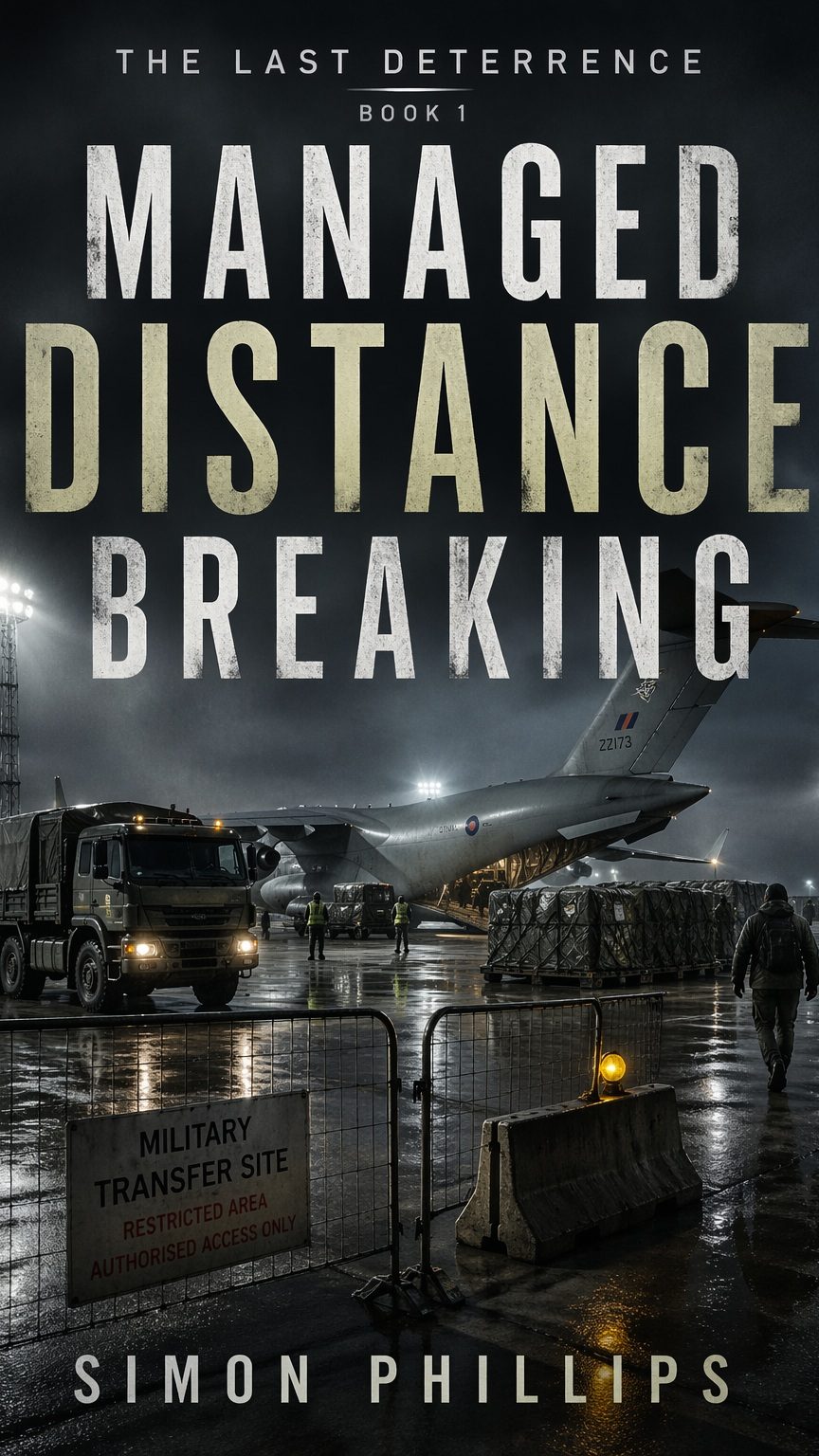
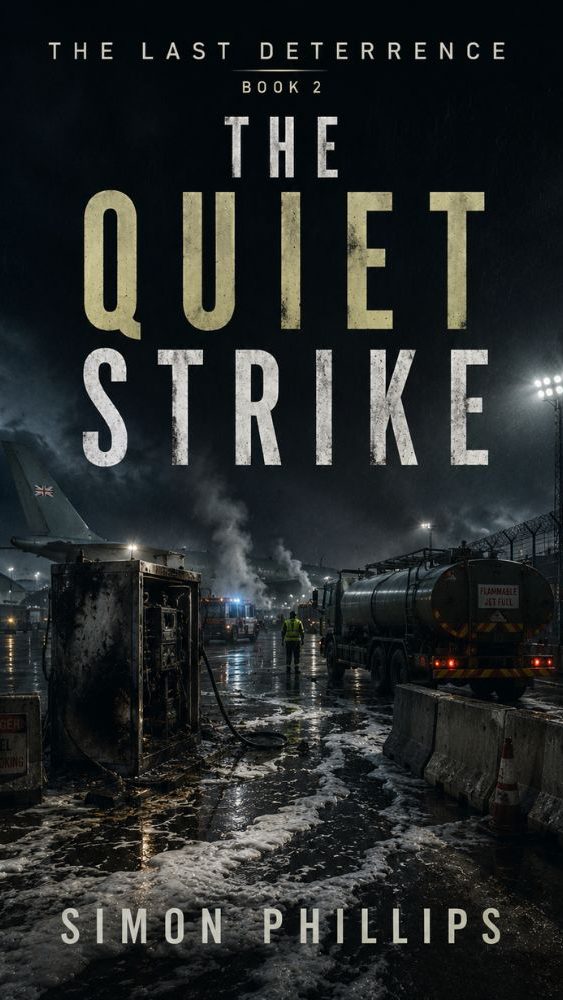
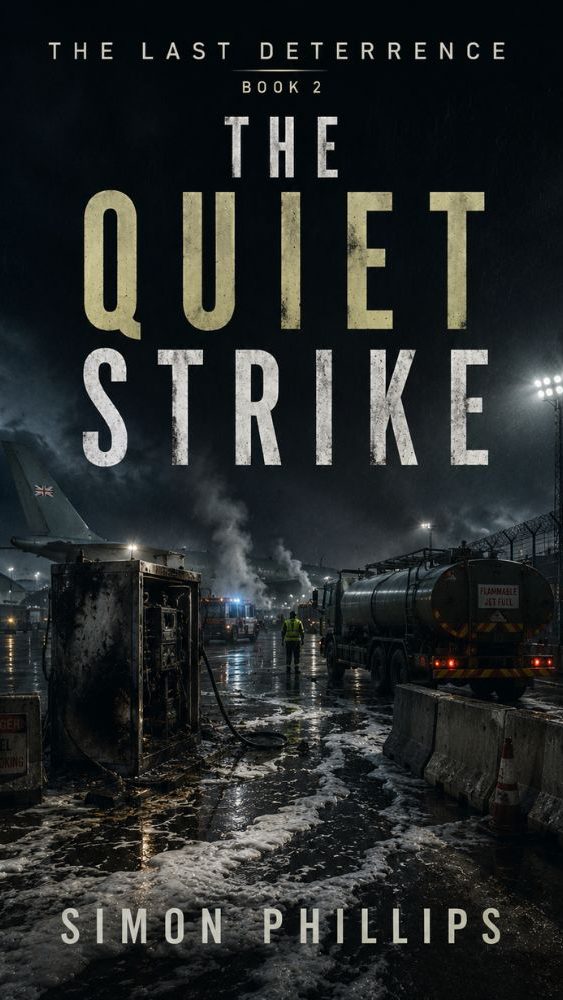
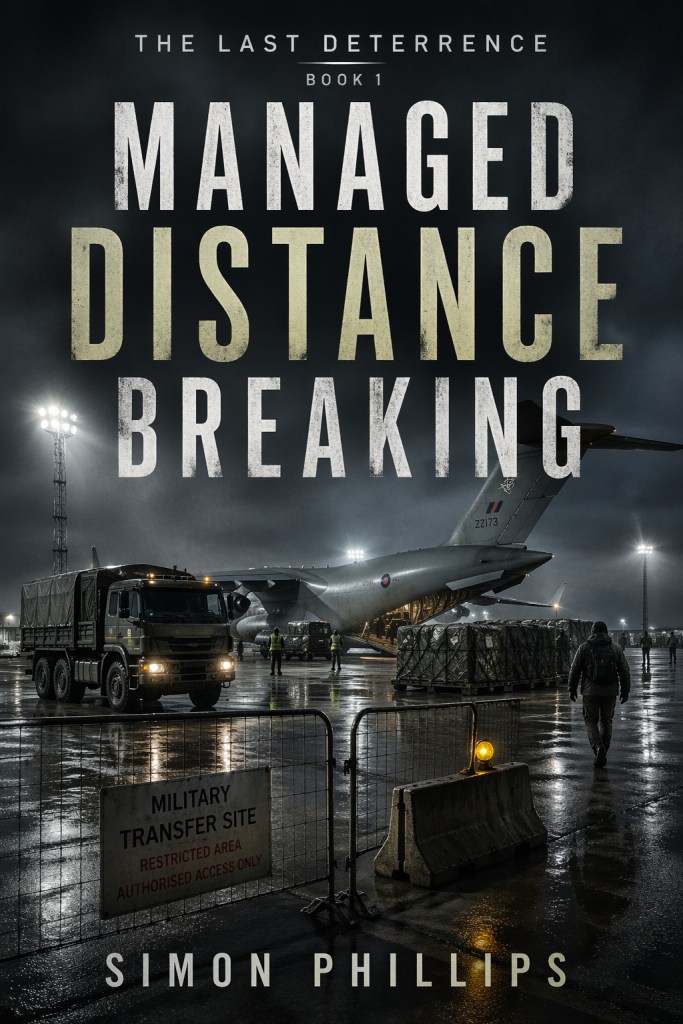
One such world unfolds through The Last Deterrence, a modern-war novella sequence beginning with Managed Distance Breaking and continuing in The Quiet Strike. Together, the first two books follow Britain as support language begins to fracture under freight pressure, European escalation, domestic infrastructure strain, and the growing sense that distance from war has already begun to fail.
Readers who wish to explore the wider published story world connected to this Chronicle can find the novellas below.
The following Chronicle continues the morning in Kensington, where a revised march route, a held school group, media crews, police barriers, and competing public explanations turned a planned demonstration into another record of a city being forced to manage more pressure than its official language could safely hold.
Readers supporting The Modern Chronicle can continue the record below.
Subscribe to continue reading
Subscribe to get access to the rest of this post and other subscriber-only content.
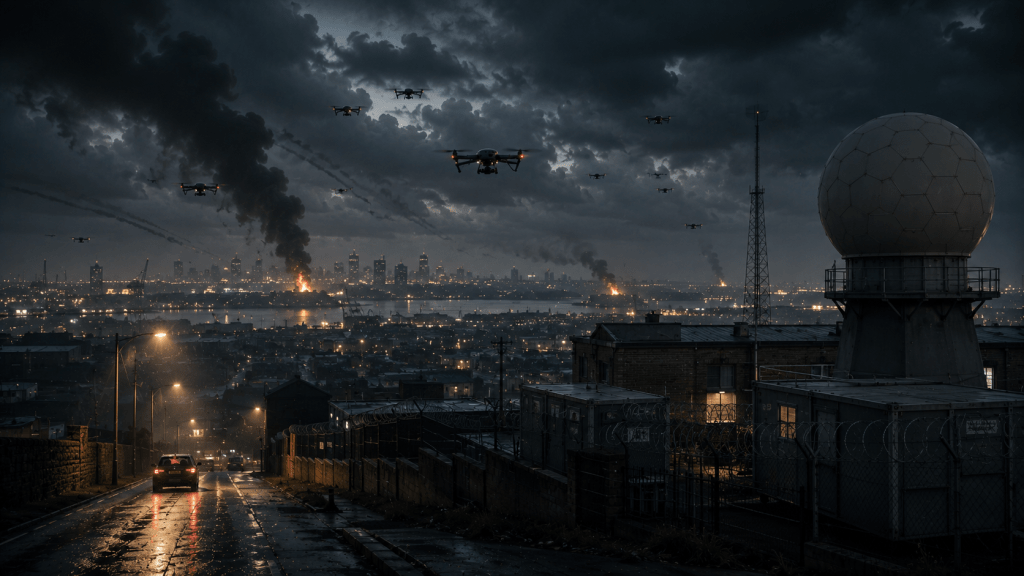
At a defence-linked transfer site, routine access began to harden into something more guarded, and those who worked around the perimeter understood the airfield had become important before anyone told them why.
The Gate That Changed First
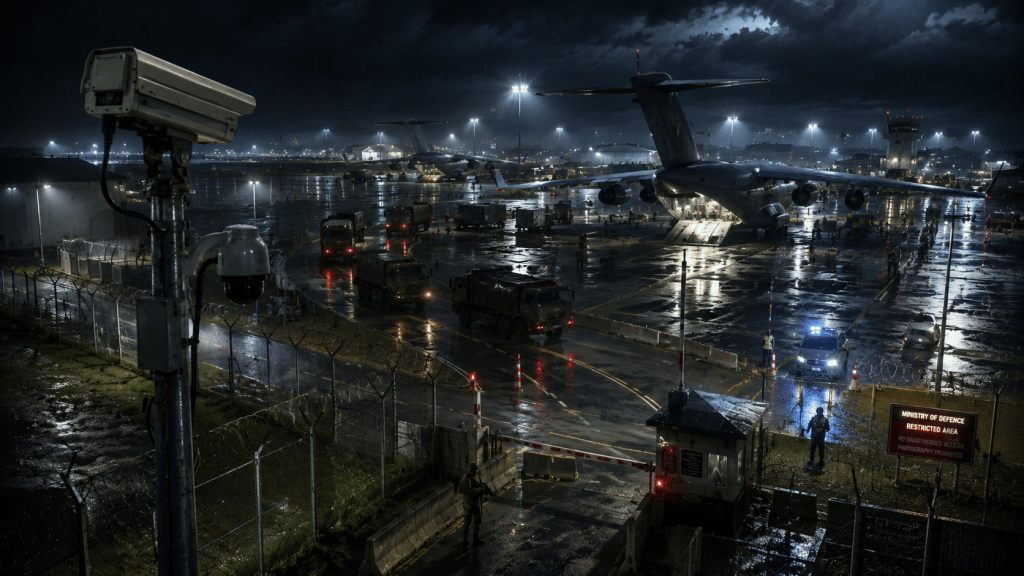
The airfield had always announced itself before it could be seen, first through the deep working note of engines beyond the tree line, then through the pale spread of floodlight above the hangars, and finally through the smell that seemed to settle along the lane each evening, aviation fuel, wet concrete, warm brakes, cut grass, and rain held in the ditches beside the perimeter road. By the time Corinne Hales reached the outer gate, the sky had sunk into a blue-grey weight over the flat fields, and the transport aircraft on the far apron showed only in fragments between buildings, tail fins rising beyond razor wire, red wing lights blinking through rain, loading lamps glowing inside open bellies while men and vehicles moved beneath them with a purpose the road outside could feel before anyone explained it.
Corinne slowed the van behind a concrete barrier that had never been there on Monday. Two days earlier the lane had run straight to the contractor gate, past the old sign about authorised access and the small brick hut where Len Goddard used to wave familiar drivers through after checking the printed sheet with one finger and complaining about the tea machine. Now the lane narrowed between water-filled barriers, steel fencing, and two floodlit cabins with temporary steps still clean enough to look freshly delivered. A soldier in wet body armour stood beside the first barrier, his rifle held low across his chest, and an RAF police corporal watched from under the hut canopy with the expression of someone who had spent the afternoon measuring everyone’s patience and finding it poor.
A laminated notice had been tied to the fencing with cable clips. All contractor arrivals to present photographic identification, movement reference, vehicle plate, cargo manifest, escort name, and amended site authorisation. Corinne read it twice through the windscreen wipers and felt the old routine leave her hands. She had driven specialist electrical parts into defence estates for eight years, sensor housings, lighting assemblies, weatherproof cabinets, camera brackets, the dull little things that made larger places function. Most sites had their moods. This one had gained a new spine.
The soldier lifted one gloved hand and directed her towards the inspection bay. Corinne eased the van forward, tyres hissing through shallow water, and stopped beside a line of yellow cones weighted with sandbags. The engine ticked beneath her feet as she lowered the window, letting in rain, diesel, radio static, and the faint metallic knock of something being unloaded beyond the inner fence.
“Name and company,” the soldier said as he stepped close enough to see her face.
“Corinne Hales, Northgate Systems,” she said, already reaching for the folder on the passenger seat. “Camera-mount delivery for compound maintenance. I have the reference in here somewhere.”
The soldier kept his eyes on her hands until the folder was open. “Keep both hands where I can see them while you find it, please.”
Corinne paused, then lifted the folder higher so the papers showed between them. “That is new.”
The RAF corporal came out from under the canopy, rain spotting his shoulders as he moved with a clipboard tucked inside his jacket. “Everything is new by the time it reaches this gate,” he said, glancing from her pass to the van plate. “Miss Hales, yes?”
“Mrs,” Corinne said, handing over the plastic pass. “Though my husband only remembers that when forms require it.”
The corporal’s mouth shifted, close enough to human warmth to carry through the rain. “Corporal Reeve. I have Northgate on the list, vehicle ending seven-three-kilo?”
“That is me,” Corinne said as she tapped the steering wheel with two fingers. “Same van as last week, same driver, same complaint about the pothole outside the contractor yard.”
Reeve checked the clipboard, then looked towards the new cabin where a younger airman sat behind a monitor with headphones over one ear. “Same van needs a scan. The load needs visual confirmation, and you need an escort past the second point.”
Corinne looked through the barrier towards the inner lane. Past the cabins, two more concrete blocks sat across the road, angled to force vehicles into a crawl. Beyond them, the old contractor car park had been half lost beneath portable camera masts, generator cases, coils of cable, and a stack of black equipment boxes with white labels she could see only in flashes as floodlight shifted through rain.
“Since when?” she asked, keeping her tone mild because she had learnt years ago that gates punished frustration by becoming paperwork.
“Since this morning,” Reeve said as he held her pass beneath a handheld reader. “Or since yesterday afternoon, depending which instruction sheet you believe.”
The reader beeped once, then flashed amber. Reeve looked at it, then at the pass, then back towards the cabin. The soldier at the barrier adjusted his grip on the rifle and watched the van’s side panel as if the Northgate logo had become a disguise. Corinne felt her pulse rise in the foolish place beneath her throat.
“That usually goes green,” she said.
Reeve kept his voice even as he raised his radio. “Access, this is outer point. Northgate Systems, Hales, Corinne. Pass has returned amber against amended authorisation. Confirm escort status and cargo acceptance.”
Static answered first. A woman’s voice came through, clipped by weather and distance. “Hold at outer point. Site access officer moving.”
Corinne leaned back in her seat and looked past Reeve towards the airfield. The big transport aircraft on the far apron had its rear ramp open, a bright rectangle in the wet dusk. A forklift reversed towards it with a pallet wrapped in dark sheeting. Farther along the apron, a fuel bowser waited beside a marked lane under lamps so bright the rain looked like wire. People crossed between vehicles in helmets and high-visibility strips, small against the aircraft and the hangars, each movement contained by cones, barriers, and men who looked as if they had been placed there after several versions of a plan had already failed.
Reeve stepped back from the window. “You can switch off, Mrs Hales. This may take a few minutes.”
“It always takes a few minutes when someone says that,” Corinne said as she turned the key and let the engine die into the rain.
The silence after the engine stopped made the airfield sound larger. She heard the floodlights hum, a tannoy call too distorted to understand, the soft impact of boots in puddles, and somewhere high above the perimeter, a brief sharp buzz that made the soldier by the barrier turn his helmet towards the sky. Reeve saw the movement and looked up as well. For a second, the gate held its breath around a sound too small for the size of the place.
A man in a dark waterproof came quickly from the new cabin, carrying a tablet under his arm and a high-vis jacket open over RAF working dress. He was older than Reeve, with thinning hair flattened by rain and the tight courtesy of a person whose day had been divided into problems since breakfast.
“Mrs Hales,” he said as he reached her window. “I am Flight Lieutenant Harcourt, site access. Your delivery is expected, though your authorisation moved from direct contractor route to escorted technical route at fourteen-ten.”
Corinne let out a careful breath. “Nobody told Northgate.”
Harcourt gave her a look that contained apology, exhaustion, and no useful freedom. “Northgate were sent the revised advisory at fourteen-twenty-two.”
“My depot prints paperwork at noon and believes email is witchcraft after that,” Corinne said, reaching again for the folder. “I have the manifest and the old entry sheet.”
“That will help,” Harcourt said as he looked towards the rear doors of the van. “What is inside?”
“Camera brackets, two weatherproof housings, mounting rails, junction plates, fixings, and a box of cable glands someone marked urgent in red pen as if screws can sense emotion.”
Reeve gave a quiet laugh before he caught himself. Harcourt allowed the smallest crease at the side of his mouth, then turned serious again as a radio call sounded from the inner lane. Corinne heard the words north perimeter and low return, followed by a response too faint for sense. Harcourt lowered his head as he listened, then spoke into his radio with his eyes still on the airfield.
“Access holding one contractor vehicle outer point. No movement past second barrier until technical escort arrives. Confirm counter-UAS team remains east apron.”
The reply came fast, clipped, and partially lost beneath the rain. Corinne looked from Harcourt to Reeve. “Counter what?”
Reeve adjusted the edge of his waterproof and looked towards the inner fence. “Routine site protection.”
Corinne held his gaze for a moment. “I deliver to three RAF sites, Corporal. Routine has a smell, and this smells dearer.”
Harcourt stepped closer to the window, lowering his voice enough to keep it between them while the soldier at the barrier watched the lane. “The site has increased security measures under standard resilience arrangements. Your delivery forms part of that uplift. You will be escorted to the maintenance compound, remain with the vehicle during unloading, and exit through this point after clearance. The official explanation is dull because dull explanations keep gates moving.”
Corinne looked beyond him again, towards the portable cameras rising over the contractor yard, the armed men at the fuel lane, and the transport aircraft glowing under the rain as if the whole airfield had turned itself outward for inspection. She had seen busy sites before. She had seen exercises, inspections, ministerial visits, and every flavour of last-minute panic disguised as planning. This felt different in the way the port had felt different in the news, the way the protected road near Ashwell had felt different in the videos passed around her depot, the way ordinary places had begun growing fences inside their old fences while everyone in charge offered a word like resilience and hoped people would accept it as weather.
A white van pulled in behind her, then stopped short as the soldier raised his hand. Its driver leaned towards the windscreen and stared at the barrier with the helpless irritation of a man who had expected to unload catering supplies and reach home before his children slept. The queue beyond him had started to form out of the evening, two contractor vans, a small lorry, an estate car with a base sticker in the lower corner, all held outside the gate while the airfield moved on behind the wire.
Harcourt returned her pass through the open window. “Your escort is coming now.”
Corinne took the pass and slid it back into the plastic pocket. “Flight Lieutenant, are they expecting trouble here?”
The question hung between them, plain and wet with rain. Reeve looked down at his clipboard. The soldier kept watching the road. Harcourt studied the inner gate for a moment before he answered, and when he turned back his face carried the careful calm of official language being chosen under pressure.
“We are expecting people to ask that question,” Harcourt said as a second set of floodlights came on beyond the hangars, whitening the rain and throwing the new barriers into hard relief. “That is usually enough to change how a place works.”
Corinne looked past him towards the aircraft, the fuel lane, the masts, the cameras, the rifles, and the men moving across the wet apron beneath a sky that had lowered itself over the whole field. The airfield had been visible from the road for years, a line of lights beyond hedges, a rumble in bad weather, an occasional aircraft passing low enough to draw children to windows. That evening it became visible in a different sense, visible through what had been added, held, checked, delayed, and guarded, visible through the way every ordinary arrival had to be stopped and taught the site’s new importance before being allowed inside.
A Visual Chronicle
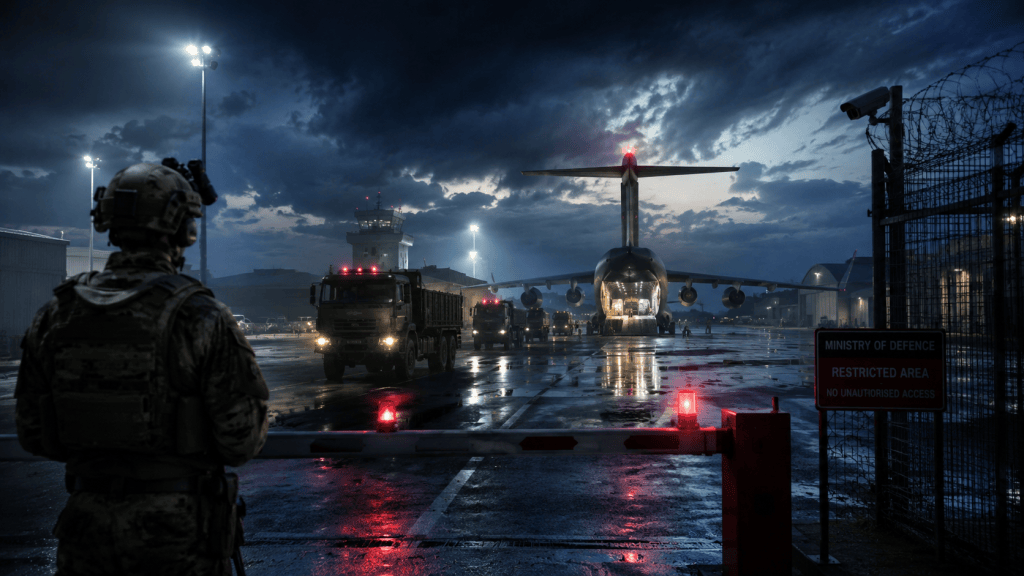
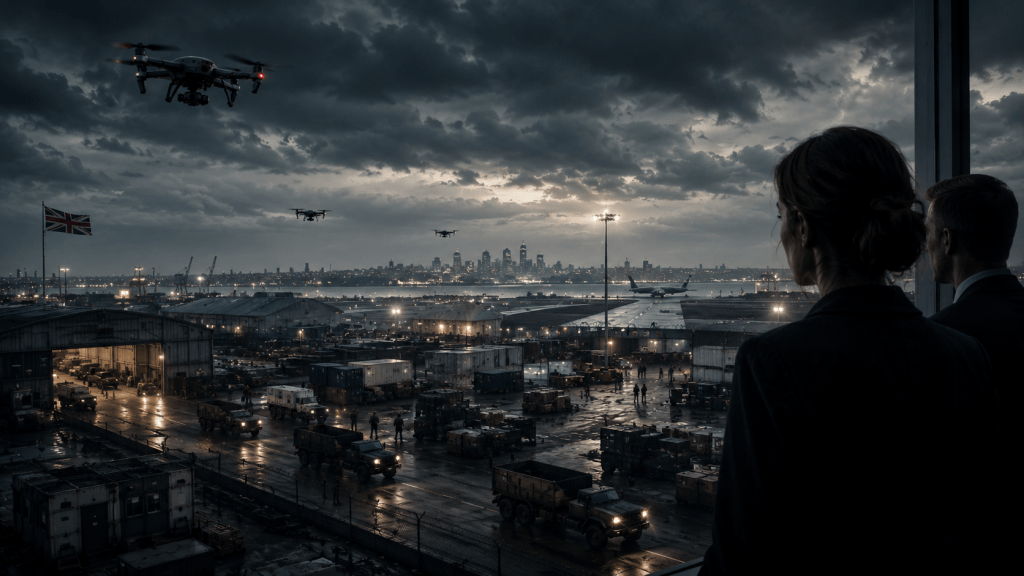
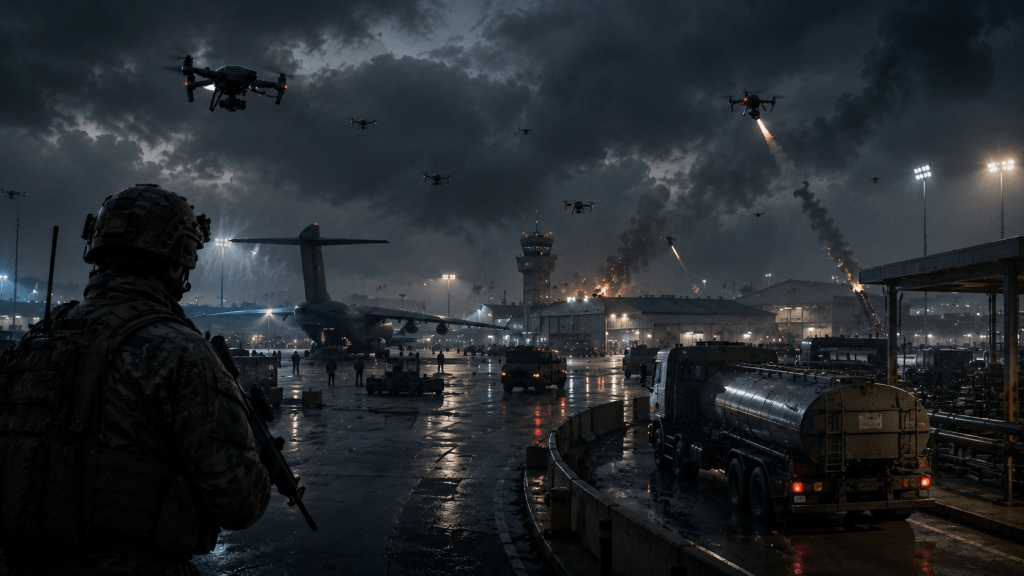
A routine contractor delivery became something else when an RAF airfield hardened its gates, watched the sky, and turned one forgotten corner into a place worth seeing.
Site Access Bulletin
Extract from Defence Estate Access and Contractor Control Notice
Subject: RAF Transfer Site Security Uplift / Contractor Entry Measures
Time: 16:35
Circulation: Site Access Office / RAF Police / Contractor Liaison / Technical Maintenance Leads / Defence Movement Desk
Purpose
To support revised access control, contractor movement, delivery handling, and technical maintenance activity at a defence-linked air movement site operating under increased resilience measures.
This bulletin covered the first instruction window following the introduction of enhanced perimeter controls, amended contractor authorisation, portable camera coverage, and escorted technical routing across the outer service areas.
Approved Public Position
Security arrangements at the site were adjusted as part of standard defence resilience measures. Site operations continued as planned, with contractors and delivery partners asked to allow additional time for access checks, escort coordination, and vehicle inspection.
The changes formed part of routine protective work across defence infrastructure and were intended to maintain safe, orderly movement for personnel, contractors, and essential support activity.
Access Control Changes
From 14:10, all contractor vehicles entering through the outer access point were required to present photographic identification, vehicle registration, movement reference, cargo manifest, escort confirmation, and amended site authorisation.
Direct contractor routing was suspended for technical deliveries linked to perimeter systems, lighting, camera mounts, junction cabinets, fuel-lane support, temporary barriers, and access-control equipment.
All relevant deliveries were moved to escorted technical routing. Drivers were to remain with vehicles during inspection and unloading unless directed by the site access officer or RAF Police.
Outer-gate staff were instructed to hold any contractor whose pass returned amber under the amended authorisation system. Amber returns were to be treated as administrative holds pending escort confirmation, rather than access refusal.
Operational Position
The air movement site remained active throughout the instruction window. Aircraft loading, fuel handling, technical maintenance, vehicle movement, and protected freight handling continued under revised control.
Portable camera masts were installed around the contractor yard, inner service road, and fuel-handling approach. Additional lighting was placed near the old maintenance lane and the second access barrier.
RAF Police and assigned security personnel maintained visible presence at the outer gate, second barrier, fuel-lane approach, and apron-side vehicle control points. Contractor delay increased during the first two hours of implementation owing to amended pass checks and revised escort allocation.
Handling Guidance
Drivers, contractors, and commercial callers were to be advised that site access was operating under temporary security uplift. Staff were authorised to describe delays as the result of additional identity checks, revised delivery sequencing, and essential resilience work.
Queries concerning aircraft movement, destination assumptions, armed personnel, counter-unmanned aerial systems, fuel-handling activity, portable camera coverage, or site importance were to be referred to the site access officer or Defence communications contact.
Access staff were reminded that contractor familiarity with the site increased the likelihood of direct challenge where measures had visibly changed. Gate responses should remain calm, practical, and limited to current access requirements.
Lines to Avoid
Avoid language implying the site had become a priority target.
Avoid confirming counter-unmanned aerial system deployment.
Avoid describing the site as part of an eastbound movement corridor.
Avoid identifying fuel-handling areas, camera gaps, escort shortages, or protected freight categories.
Avoid linking security uplift to recent infrastructure incidents elsewhere.
Avoid discussion of overseas events, allied movement, or operational destination.
Internal Assessment
The site had become increasingly visible to contractors, local delivery staff, road users, and nearby civilian observers due to the cumulative effect of added barriers, armed personnel, portable surveillance, traffic holds, and delayed access.
Although the measures remained consistent with resilience language, the visible character of the uplift risked drawing attention to the site’s role within wider air movement activity. Contractors familiar with previous access routines were likely to identify the scale of change faster than casual observers.
The addition of portable camera coverage and counter-unmanned aerial system personnel reflected concern around perimeter observation, low-level aerial activity, and the vulnerability of support areas adjacent to fuel, loading, and temporary technical infrastructure.
Attribution of any hostile interest remained unresolved. Site posture should therefore emphasise preparedness, protection, and continuity rather than threat confirmation.
Further Action
Site Access Office to review contractor delays after the evening delivery window.
RAF Police to assess whether outer-gate staffing remained sufficient under amended checks.
Technical Maintenance Leads to prioritise installation of camera brackets, weatherproof housings, junction plates, and lighting assemblies across exposed service areas.
Defence Movement Desk to confirm whether escorted technical routing remained required for all contractor deliveries through the following morning.
Public-facing explanation to remain limited to routine security uplift and standard resilience measures.
About the Creator
The Modern Chronicle is written and curated by Simon Phillips, an author of modern speculative fiction and contemporary crisis-driven storytelling who explores the point where ordinary life begins to tighten beneath political strain, military movement, institutional caution, and the public language used to keep dangerous realities at a distance.
Many of the records presented in these Chronicles sit alongside Simon’s wider modern-war novella series, where governments, soldiers, families, and civilian systems are forced to absorb a world changing faster than its official explanations. The stories remain grounded in recognisable places: ports, school corridors, freight yards, government rooms, roadside queues, transfer sites, and homes where the news has started to feel too close.
One such world unfolds through The Last Deterrence, a modern-war novella sequence beginning with Managed Distance Breaking and continuing in The Quiet Strike. Together, the first two books follow Britain as support language begins to fracture under freight pressure, European escalation, domestic infrastructure strain, and the growing sense that distance from war has already begun to fail.
Readers who wish to explore the wider published story world connected to this Chronicle can find the novellas below.
The following Chronicle reconstructs the hours after the airfield’s outer gate changed, as contractor access, delayed deliveries, portable cameras, armed personnel, and counter-drone measures turned a familiar RAF transfer site into one of the most visible pressure points on Britain’s eastbound line.
Readers supporting The Modern Chronicle can continue the record below.
The Site That Learned to Hold
Corinne followed the escort vehicle through the second barrier with both hands light on the steering wheel, moving slowly enough for the van to feel exposed beneath every lamp placed along the inner service road. The escort vehicle kept five car lengths ahead, amber roof light turning through the rain, and each rotation caught the fresh metal edges of portable fencing, camera poles, cable trays, sandbags, wheel chocks, temporary signs, and men stationed where empty space had been during her last visit. The airfield unfolded around her by increments, less like a familiar maintenance site and more like a place explaining its new importance through objects: a barrier angled across a lane, a rifle held against a wet jacket, a generator humming beside a camera mast, an armed patrol crossing between hangars with torches aimed low across puddled concrete.
The route took her past the contractor yard, where the old parking bays had been swallowed by equipment boxes and a mobile command cabin with a blue cable running from its side towards the inner fence. Two men in dark waterproofs were fitting a camera to the top of a pole while a third stood below with a tablet held under his coat, calling small corrections through the rain. A catering van idled by the kerb with its rear doors open and four crates of wrapped sandwiches still inside. Its driver stood under the raised door with a paper cup in one hand, watching the new camera mast as if it had arrived to judge him personally.
The escort vehicle stopped beside a painted holding line, and Corinne stopped behind it. Flight Lieutenant Harcourt stepped from the passenger seat and came back towards her, rain silvering his shoulders under the light. He raised one hand as he approached the window, then pointed towards a maintenance bay set against a low brick building near the old vehicle workshop.
“You will follow the marshaller into Bay Three,” Harcourt said as Corinne lowered the glass. “Stay with the vehicle until the technical team checks the load. After that, Mrs Hales, they may ask you to wait in the contractor room while the equipment is walked across.”
Corinne looked towards the bay, where two RAF personnel waited beneath the roof with clipboards, torches, and the resigned posture of people ready to find another problem. “Walked across sounds slower than unloading.”
Harcourt glanced towards the apron before he answered. “Slower is allowed. Loose movement around the inner lane is less welcome this evening.”
A sharp buzz rose somewhere beyond the workshop roof, high enough to set Corinne’s teeth on edge, then faded into the sound of rain and generators. One of the RAF personnel at the bay looked up. Harcourt looked up as well, his face tightening for only a moment before he turned back to her window.
“Is that one of yours?” Corinne asked as she kept her voice level.
Harcourt rested one gloved hand against the van door. “One of ours, or one being persuaded to leave ours alone. The distinction matters less at ground level.”
The marshaller waved her forwards, and Corinne eased the van under the bay roof with water running in sheets from the gutter above. The change in sound as she entered shelter made the place feel enclosed, almost domestic, until she saw two armed RAF police officers standing beyond the open roller door inside the workshop. Their presence altered the room more than the new notices on the wall, because weapons made every familiar object appear newly fragile. A pallet jack became a thing that could block a doorway. A tool chest became cover. A van full of brackets became cargo that needed watching.
A woman in working dress and a wet high-vis jacket came to the driver’s side with a manifest board tucked beneath one arm. Her name tape read Ellery. She had rain-dark hair pinned tight beneath her cap and the brisk, practical face of a person whose patience had been turned into procedure through repetition.
“Mrs Hales, I am Sergeant Ellery, technical maintenance lead,” she said as Corinne climbed down and pulled her coat tighter at the neck. “You have camera mounts, housings, rails, plates, and fixings.”
“That is what my manifest says,” Corinne replied as she opened the rear doors. “If my depot has sent shower brackets by mistake, I would like a moment alone before anyone reports it.”
Ellery gave a small, tired smile as she leaned in with a torch and swept the beam across the sealed boxes. “I would accept shower brackets if they came with working screws and a revised instruction sheet.”
A young airman beside her marked the box numbers against his board, his lips moving as he counted. Corinne recognised the look on him, because she had seen it in apprentices at depots during audits and emergency callouts, the effort to appear grown into a task that had arrived larger than expected. He lifted one carton, checked the side label, then looked towards Ellery.
“Brackets match,” he said as he set it down. “Housings match. Cable glands say four boxes.”
Corinne bent into the van and tapped the rear stack. “Fourth one slid behind the rails. It wanted a quieter life.”
The airman gave a quick laugh, then glanced towards the armed police officers and folded the sound away. Ellery saw him catch himself and softened her voice as she reached for the next box.
“Laugh while you can, Tamsin,” Ellery said, moving the first carton onto the pallet jack. “The site will still be here after humour has been rationed.”
Harcourt had stayed near the bay entrance, speaking into his radio in low bursts. Corinne heard fragments of lane control, north fence, contractor hold, apron-side escort, and camera mast priority. Each phrase sounded like part of a machine being rebuilt while still in motion. Beyond the workshop doors, a transport aircraft began to turn its engines. The low rising growl moved through the concrete and into her ribs, and the air inside the bay changed pressure around every person there.
Tamsin looked towards the sound, then back to the manifest board. “That one has been waiting since lunch.”
Ellery placed the next box on the jack. “Aircraft wait. People wait. Paperwork pretends it was planned.”
Corinne leaned one shoulder against the open van door and looked out through the rain. A line of vehicles had formed along the inner lane, held near a temporary signal where an RAF policewoman stood with one palm raised. A fuel bowser sat farther along the apron under brutal white lamps, its driver still in the cab with his window open and a cigarette unlit between two fingers. Near the outer fence, a pair of soldiers carried a coil of black cable towards a camera pole while a third man scanned the grass beyond the wire with binoculars.
“This was a quiet entrance last week,” Corinne said as Ellery checked the last box. “Len at the hut used to ask whether I had biscuits in the cab.”
Ellery marked the page and passed it to Tamsin. “Len has been moved to day access.”
“Lucky Len,” Corinne said.
Ellery looked past the bay towards the inner road, where a fresh group of contractors had been stopped by a soldier at the second barrier. “Len hates it. He says daylight brings managers.”
Harcourt returned from the entrance with his radio still in one hand. “Sergeant Ellery, the camera mast near the old maintenance lane is now priority one. South-east feed comes after that. Fuel-lane bracket installation follows once apron control clears the crossing.”
Ellery ran a gloved finger down her board, then looked at the boxes on the pallet jack. “That order changed ten minutes ago.”
Harcourt gave her the tired look of a man offering truth in the shape available. “Then it has lived a rich life.”
Corinne saw Ellery absorb the reply, place anger somewhere useful, and turn towards Tamsin. “Take the mast brackets first. Leave the housings here until I get two more hands. Mrs Hales, I am going to ask you to wait in the contractor room after we seal the van.”
Corinne looked towards the pallet jack. “You need someone who knows which box holds what.”
Ellery shook her head gently as she closed the first rear door. “I need you away from the crossing while apron control argues with three departments.”
“I can read labels,” Corinne said, keeping her tone practical. “I can also push a pallet jack in rain. Northgate charges extra for charm.”
Harcourt studied her for a moment, then looked at Ellery. The two of them had the quick silent exchange of people who had spent the day making compromises with less room than they wanted. Ellery gave a small tilt of her head, and Harcourt lifted his radio.
“Access to technical,” Harcourt said. “Northgate driver remains with technical escort for equipment identification only. No independent movement. Confirm acceptable.”
The answer came after a pause. “Acceptable. Keep civilian inside escort group. Crossing window in three minutes.”
Corinne zipped her coat to the throat. “Civilian inside escort group sounds deeply glamorous.”
Tamsin picked up the front of the pallet jack handle. “Glamour fades once you meet the puddle by Hangar Four.”
They moved as a small, awkward party, Ellery first with the clipboard and radio, Tamsin guiding the pallet jack, Corinne beside the load with one hand steadying the top carton, and Harcourt walking slightly behind with his eyes crossing between the inner road, the apron, and the dark strip of grass beyond the fence. The rain strengthened as they left the bay roof. It ran down Corinne’s neck, flattened her fringe, and turned the labels on the top box glossy beneath the torchlight.
The crossing had been timed between two vehicle movements, although it carried the feel of something more serious than traffic. An RAF policewoman held a line of vans with one raised hand. A forklift waited by the marked lane with its amber beacon rotating. Farther away, loading crews moved around the aircraft ramp, figures made small by light and machinery. Corinne felt the pallet jack wheels catch in shallow cracks as Tamsin steered, and she pressed harder against the boxes to keep them straight.
A burst of radio traffic passed across Harcourt’s handset. “Low return east perimeter, possible bird, possible small platform. Counter team tracking.”
Tamsin’s grip tightened on the jack handle. Ellery kept walking, although Corinne saw her shoulders rise under the wet jacket. The armed policewoman near the vehicles looked towards the fence and then towards Harcourt.
“Keep moving,” Harcourt said as he stepped closer to Corinne and Tamsin. “Same pace.”
The words were calm enough to obey and strained enough to remember. Corinne kept walking with her hand flat against the box, every instinct asking her to look up. She resisted until the crossing had carried them beneath the lee of a hangar, where floodlight poured across the puddles and the wind shifted from rain to the hot chemical breath of the apron.
A man in a black waterproof stood beside the camera mast with an open toolkit at his feet. He wore civilian boots and a contractor badge turned backwards by the wind. When he saw the pallet, he lifted both hands with theatrical relief.
“Tell me those are the brackets,” he called as they came close.
Ellery held up the manifest board. “They are the brackets, Mr Rance. Please save your praise for after they fit.”
The man stepped forward and took the top carton from Corinne. “I gave up on praise when procurement became a belief system.”
Corinne wiped rain from her cheek with the back of her wrist. “Northgate sent the right parts.”
Rance looked at her with sudden gratitude. “You speak like a prophet.”
Tamsin lowered the pallet jack near the mast base. The pole rose above them, black against the stormy evening, its temporary camera head angled towards the service road and the outer fence. Cables ran down its side into a weatherproof box still open for wiring. Corinne saw the gap it covered then: a slice of road between the old maintenance lane and the service track, a place where vehicles slowed, staff crossed, and the fence line dipped behind scrub. Last week it had been a blind corner nobody mentioned. Now four people stood in the rain fitting a camera over it while armed personnel watched the wider darkness.
Rance opened the carton and began laying brackets on a sheet of plastic. “Good. These will do.”
Ellery crouched beside him and checked the first fitting. “How long?”
“Twenty minutes if the wind drops,” Rance said as he tightened a strap around the mast. “Forty if the weather keeps throwing itself at us.”
“Use thirty in the update,” Ellery said.
Rance looked up at her. “That is how lies become project management.”
“That is how project management remains employable,” Ellery replied as she rose.
Another tannoy announcement rolled across the apron, distorted by engines and rain. Corinne caught only sections: stand by, north service road, movement pause, all contractor traffic hold position. A vehicle reversed near the fuel lane, then stopped halfway through the turn as a soldier walked quickly to the driver’s window. The whole airfield seemed to pause in separate pieces, each one waiting for a different voice to permit the next movement.
Corinne looked towards Harcourt, who had lifted his radio again. “Another access change?”
Harcourt listened, answered briefly, then lowered the set. “Outer service road has been held. A sensor return near the fence, probably weather or wildlife.”
“Probably does a lot of work here,” Corinne said.
Harcourt followed her gaze towards the service road. “Probably lets us keep working.”
The sentence held more honesty than the official lines at the gate. Corinne watched the crew around the fuel lane stand in rain and floodlight, helmets turning towards the same stretch of darkness. She thought of her husband at home in Leicester, making pasta for their daughter and complaining about delivery drivers leaving parcels under the wrong porch. She thought of the videos passed around the depot after the Ashwell hold, covered vehicles moving through a roundabout while a school bus waited. She thought of the port delays, the news from Germany, the phrases on the radio that made every change sound temporary, sensible, contained.
At the mast, Rance tightened the first bracket and stepped back to check the angle. “There. First one holds.”
Ellery looked up at the camera head, then towards the service road. “Fit the second.”
Tamsin crouched to pass him another piece. Her hand shook slightly as she reached into the box. Corinne saw it because she was standing close enough to notice, and because the girl was trying hard to make sure nobody else did.
“Cold fingers,” Corinne said as she lifted the next bracket and offered it across. “Mine go useless after ten minutes in this weather.”
Tamsin looked up, startled, then gave a grateful smile. “Mine as well.”
Ellery glanced at Corinne once, recognising the mercy in the lie, then returned to the radio call taking shape at her shoulder. “Technical team at old maintenance lane. First bracket fitted. Second in progress. Camera activation pending cable check.”
The reply came with another layer of static. “Maintain position. Further movement held until east perimeter return is cleared.”
Rance swore softly under his breath, then caught himself near Corinne. “Sorry.”
Corinne looked towards the fence, where torch beams had begun moving through rain on the far side of the road. “I sell screws to the Ministry of Defence. I have heard stronger language in purchase orders.”
Rance laughed, and this time Tamsin joined him. The laugh passed quickly, carried away by wind and engines, yet for a moment the small group became people again instead of functions arranged around a pole. Harcourt heard it too, and his face eased just enough to show he had been listening while watching everything else.
The camera took thirty-seven minutes to fit. By the time the feed came live, Corinne’s sleeves were heavy with rain, Tamsin had mud up one shin, and Rance had dropped one washer into the puddle and declared it claimed by the state. Ellery stood beneath the mast while the access cabin confirmed the image over radio. The new feed showed the service road, the dipped fence line, the old lane, and the pale disturbed grass beyond it. On the tablet screen, the view appeared clean, controlled, and useful, stripped of the cold, the waiting vehicles, the young airman’s shaking hand, and the contractor driver who had learnt too much simply by being allowed to stand there.
Harcourt escorted Corinne back towards the maintenance bay after apron control released the crossing. The outer queue had grown while she was inside. Catering crates, electrical boxes, fuel paperwork, cleaning supplies, parts for a generator unit, and men with wet hoods and anxious clocks sat beyond the gate in a line that had become part of the site’s new shape. At the second barrier, the same soldier checked the escort list again, although Corinne had passed him less than an hour earlier.
“Do you ever get used to being checked by the same person twice?” Corinne asked as Harcourt walked beside her van.
Harcourt looked towards the outer lights, where rain turned every beam into a white blade. “You get used to people pretending they recognise you enough to skip it. Then a week arrives where recognition becomes the weakness.”
Corinne let that settle as she climbed into the van. The seat had gone cold, and her hands ached as she closed them around the steering wheel. Reeve appeared by the window with her signed exit sheet and a fresh advisory tucked beneath it.
“Your depot needs this for tomorrow,” Reeve said, passing the papers through. “All arrivals must use updated authorisation. Old sheets will return amber.”
Corinne took the papers. “They will love that.”
Reeve glanced towards the vans waiting behind her. “They are welcome to direct their feelings to the shared inbox.”
Harcourt stepped back from the door and lifted one hand in farewell. “Thank you for assisting the technical team, Mrs Hales.”
Corinne started the engine, then paused with the van still in park. “Flight Lieutenant, that corner we fitted the camera over. Was something seen there?”
Reeve looked down at the clipboard again. Harcourt kept his eyes on the van for a moment, then turned towards the airfield. The transport aircraft at the far apron had begun loading again. The fuel bowser moved under escort. The new camera mast stood above the old maintenance lane, small against the vast dark field, yet bright on a monitor somewhere inside the access cabin.
“Something could be seen from there,” Harcourt said as he looked back at her. “That is enough for tonight.”
Corinne drove out through the outer gate with the advisory on the passenger seat and rain beating hard against the windscreen. In the mirror, the airfield receded into floodlight, fencing, aircraft tails, camera poles, wet concrete, and figures moving through artificial light. From the public road, it still looked like a defence site carrying out protective work under bad weather. From inside the gate, it had felt like a place teaching itself how to be watched, and how to survive being visible.
A defence-linked airfield hardened under floodlights, where aircraft, escorts, camera lines, and rain-soaked barriers turned routine movement into visible pressure.
The Idea Behind the Chronicle
Military airfields often sit at the edge of public awareness. They are visible from nearby roads, heard through low aircraft noise, and recognised by fences, lamps, hangars, and occasional convoys, yet their true purpose usually remains hidden inside schedules, access lists, technical work, and the ordinary labour of people who keep the site functioning. Most civilians pass them as fixed features of the landscape, familiar enough to ignore until the barriers change.
This Chronicle explores the moment when a familiar defence site becomes visibly important. The change arrives through practical details rather than announcement: stricter pass checks, delayed unloading, extra concrete blocks, portable camera masts, armed personnel at old access points, and contractors being held where they once drove through as part of routine work. The airfield’s new importance is revealed through procedure before it is ever admitted in public language.
Modern conflict depends on places like this. Air movement sites, fuel lanes, contractor yards, technical compounds, and service roads form the hidden architecture beneath public phrases such as support, resilience, and protection. Aircraft may draw the eye, yet the pressure often sits in the surrounding systems: who gains access, which load moves first, which camera angle matters, which blind corner suddenly needs covering, and which civilian worker notices that yesterday’s routine has become today’s controlled movement.
The Airfield That Became Visible follows that pressure through an adjacent witness rather than through the main events of the novellas. Corinne Hales enters the site as a contractor carrying ordinary technical parts, yet she sees the airfield changing around her in ways official explanations cannot fully hold. Her position allows the Chronicle to remain grounded at the edge of restricted knowledge, close enough to feel the tightening and distant enough to preserve the uncertainty.
The wider idea is that national participation often becomes visible first through infrastructure. Before a country admits what it is becoming involved in, its roads, ports, fuel sites, gates, and airfields may already have changed their behaviour. This Chronicle records that threshold, when a place still described as protected support begins to look, to those standing in the rain beside its barriers, like part of a corridor the war has already found.
From the Author’s Desk
The Eastbound Line began from a simple modern image: a support route that still appeared ordinary from the outside while everything inside it had started to change. Ports, roads, fuel sites, holding yards, and airfields are easy to pass by as pieces of infrastructure, yet in a crisis they become the places where public language gains weight. A statement may speak of support or resilience, while a driver, contractor, teacher, or gate officer sees the change arrive first through queues, barriers, armed checks, delayed loads, and new instructions pinned to a wall.
This Chronicle focuses on one of those thresholds. The airfield in The Airfield That Became Visible is a place still described through routine protective language, yet the people working around its edge can feel that the old routine has ended. I wanted the episode to stay close to the ground, following someone whose job gives her access to the site while keeping her outside the full explanation. That kind of partial understanding is central to The Modern Chronicle, where records, fragments, and lived observations reveal pressure before official accounts admit its shape.
The Last Deterrence explores how modern war can move through systems long before a country openly names its involvement. Managed Distance Breaking and The Quiet Strike follow that widening pressure through government rooms, military movement, family life, logistics work, and the narrowing space between support and participation. The Chronicles sit beside those books as adjacent records, showing places and people touched by the same crisis from different angles.
Alongside The Modern Chronicle, I continue writing contemporary crisis fiction, speculative fiction, and connected story worlds where ordinary lives meet political strain, military systems, infrastructure pressure, and events moving faster than official explanations can safely follow.
Readers interested in those stories can explore more through the links below.
Defence-linked airfields often appear quieter than ports, freight yards, or protected roads because their work takes place behind fencing, across wide areas of tarmac, and inside access systems most civilians rarely enter. From the public road, an airfield may look unchanged for years: lamps over hangars, aircraft tails above hedges, the occasional convoy at a gate, the low sound of engines moving through bad weather. Its importance stays partly hidden because air movement depends on timing, fuel, loading crews, technical support, contractors, security checks, and routing decisions that rarely become visible outside the perimeter.
Once a support corridor begins to harden, an airfield changes in ways familiar workers see quickly. Old contractor routes close. Passes return amber. Barriers appear at points once managed by habit and recognition. Portable cameras cover blind corners. Fuel lanes gain extra attention. Service roads become controlled spaces. These details rarely look dramatic on their own, yet together they reveal a site moving from background support into strategic significance.
Article Six of The Eastbound Line sits inside that change. The airfield has yet to become a public headline, and official language still frames the uplift as resilience and protection. The people at the gate understand something else first. A place they knew through routine has begun to defend itself against being watched.
Contractors Inside the System
Modern military infrastructure depends heavily on civilian contractors. Electrical firms, camera technicians, catering suppliers, fuel specialists, maintenance crews, vehicle mechanics, cleaners, drivers, and equipment installers all keep defence sites functioning. During calm periods, many of these workers move through familiar gates with familiar paperwork, recognised by access staff and known through years of ordinary service.
In a crisis, that familiarity becomes complicated. The same contractor who knows a site well may also be someone who sees which entrance has closed, which fuel lane has gained guards, which camera has been moved, which delivery has become urgent, and which old routine has vanished overnight. Contractors often stand close enough to see the shape of change while being kept outside the explanation for it.
Corinne Hales belongs to that world. She arrives with camera brackets and weatherproof housings, the sort of practical parts that sit far below public statements and ministerial language. Yet those small parts matter because they close gaps, cover approaches, and help the airfield adapt to a threat still described in softer terms. Her position allows the Chronicle to show how ordinary technical labour becomes part of national pressure.
The Visibility of Security Uplift
Security uplift often aims to reduce risk while attracting as little public attention as possible. Extra checks, amended authorisation, temporary barriers, escort requirements, mobile surveillance, and increased patrols can all be described as standard protective measures. Inside the site, though, each addition changes behaviour. Drivers wait longer. Delivery windows slip. Staff explain less. Armed personnel appear where clerks or gate officers once managed movement through routine.
The result is a paradox. Measures intended to protect a site can also reveal its importance. A camera mast placed over an old maintenance lane tells workers that the lane matters. A held crossing tells drivers that movement across the apron has become sensitive. A pass returning amber tells a familiar contractor that recognition alone has lost value. Security, in such moments, becomes its own signal.
That tension sits at the centre of The Airfield That Became Visible. The Chronicle records the airfield before the larger strike events that follow elsewhere in the cycle, when suspicion, protective work, and controlled access had already started altering the site’s shape. The airfield is still operating. Aircraft still load. Contractors still arrive. Fuel still moves. Yet every ordinary movement has gained a second meaning.
Low-Level Aerial Threats
Small unmanned systems have changed the way modern sites think about perimeter defence. A cheap aerial device can observe gates, count vehicles, test response times, record fuel handling, or identify blind spots. It may carry little immediate destructive power and still produce serious operational value for whoever sent it. The danger lies as much in what it learns as in what it can damage.
For defence-linked sites, that creates a problem of scale. A large airfield must watch the sky, the fence line, the service roads, the contractor lanes, the fuel points, the loading areas, and the gaps between them. A single drone alert may end in nothing visible, yet the response itself reveals patterns. Which teams move first. Which route closes. Which area receives priority. Which workers are held. Which cameras fail to cover the angle that suddenly matters.
The Chronicle uses that pressure quietly. The sound above the gate, the radio language, the counter-drone references, and the new camera mast all suggest a site reacting to observation before any clear public account exists. The threat stays partly unresolved because the people living through these measures would rarely receive a complete explanation. They would experience the change first as delay, caution, procedure, and the feeling that the air around the site had become less empty than it looked.
Next Chronicle
After the airfield hardened under new barriers, portable cameras, held contractors, and counter-drone measures, the pressure moved back into London, where public order, foreign policy, media scrutiny, and domestic unease began folding into the same crowded streets.
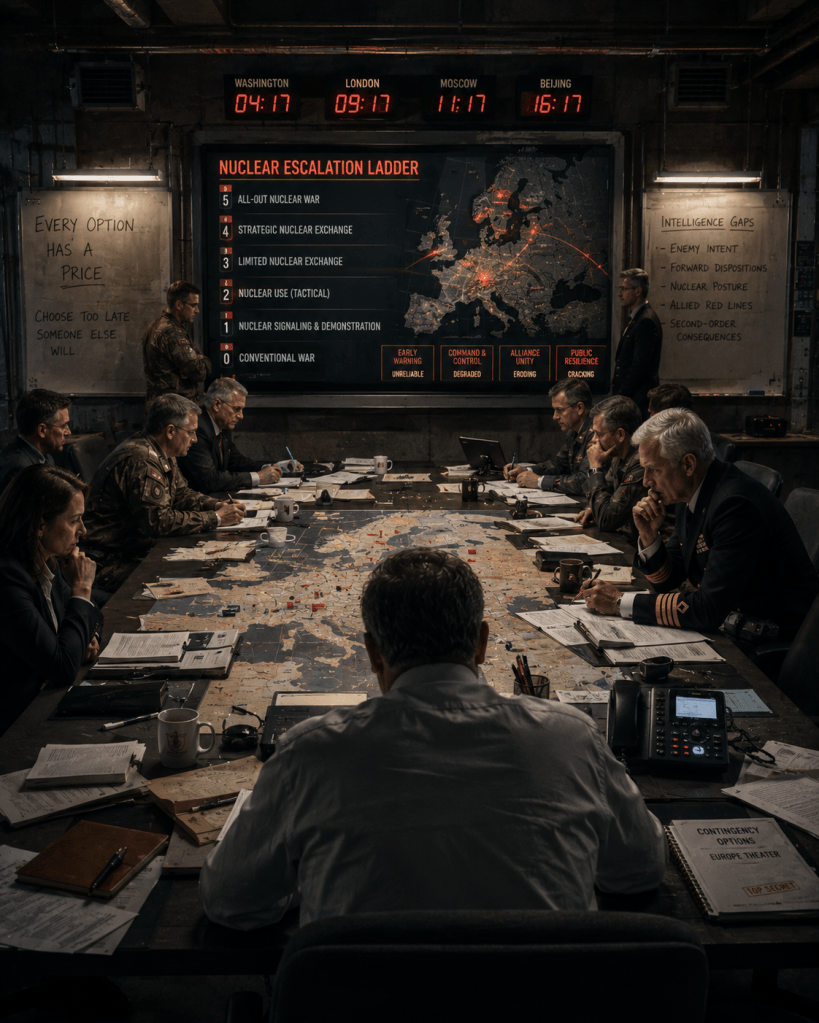
A planned march near the Israeli embassy changed route twice before midday. Police lines shifted. Counter-protest groups moved closer than expected. Broadcast crews gathered near barriers while officials tried to hold two public explanations at once: one about safety on the streets, and another about a government already carrying Germany, allied support language, infrastructure protection, and rising public suspicion.
Caught between the moving barriers was a school group that had entered the area before the second route change reached their teachers. Their delay became minor on paper, logged as a public-safety adjustment during a controlled demonstration. For those standing in the rain beside police tape, it felt like another sign that the country’s ordinary spaces were being reorganised faster than anyone could explain.
The next Chronicle follows that day in London, as a march route, a police cordon, a frightened class, and an overburdened government room revealed how the eastbound line had begun stretching beyond freight, fuel, and airfields into the fragile politics of the street.
Next Week: The March Route Changed Twice
By morning, the new camera feed had joined the others on the access cabin wall, clean and silent above the service road, showing a corner of the airfield that had always been there and had only now become important enough to watch.
A protected route cut through ordinary England, and for those left beside it, the delay was the first sign that the road had begun to belong to something else.
The Morning the Road Changed Hands
Ashwell Roundabout had begun taking the shape it would keep for hours by the time the police cars settled across the western approach, a slow curve of brake lights bending past the petrol station, along the supermarket service road, and towards the damp fields beyond the last row of houses. Rain had arrived before dawn and left the tarmac shining beneath a low grey sky, each puddle catching the amber blink of temporary signs and the blue pulse from vehicles positioned where school traffic usually moved through with practised irritation. On most mornings the roundabout carried commuters, delivery vans, farm pick-ups, buses, and late parents, yet that morning it held them in place while a road team in waterproof jackets lifted cones from a flatbed and built a corridor through the middle of their day.
Paul Seddon sat three vehicles from the front with the engine idling and the temperature alarm on his dashboard giving a soft, regular chirp that had grown more personal with every minute. Fresh produce, pharmacy bins, and milk for a primary school kitchen had become a marker beside Ashwell Services, although stationary made the morning feel calmer than the road outside the windscreen. He saw the school bus ahead of him at the edge of the roundabout, hazard lights blinking, windows steamed from inside, children’s hands drawing brief marks through condensation while the driver leaned out and spoke to a police constable under the rain.
The constable looked young enough to still expect approved words to carry useful weight. She stood with one gloved hand resting on the bus door frame and the other raised towards the temporary closure board as she explained the diversion again. The bus driver, square-shouldered in a purple fleece beneath her uniform jacket, listened with a face arranged for patience and eyes moving towards the clock above her windscreen. Behind her, a boy in the front seat had pressed his forehead against the glass and watched the roundabout as if the cones and barriers had been placed there for him alone. Paul saw the driver shape the words school run through the rain, and the constable lowered her hand, offering a small apologetic tilt of the head before she directed the bus into the side lane beside the petrol queue.
The queue had become its own argument before eight. Cars waited two deep at the station entrance, cutting across the supermarket slip and blocking half the service road where delivery bays sat behind locked gates. A man in a dark estate car had left his driver’s door open while he walked towards the forecourt kiosk, calling over the weather about priority, children, work, and how the council had given the village no useful warning. The woman at the kiosk window kept both hands flat on the counter and repeated the same sentence because no safer sentence had been supplied. Fuel remained available, customers would be served in order, and emergency access had to remain clear. Each line came back across the forecourt changed by rain, engines, and the harder sound people made when delay had joined a wider kind of fear.
Paul checked his phone again, although the depot had already sent the instruction that mattered: hold position until police released the route, preserve load temperature, update customer delay category to external road-management pressure. The phrase sat on his screen with a cold neatness he disliked, fit for resurfacing, flooding, a crash, or any local misery that belonged to local roads. It struggled to cover what he could now see beyond the roundabout, where two police motorcycles had taken position at the far approach and a pair of dark military trucks waited beneath the trees with their lights dipped. Farther back, beyond the bend, more headlights gathered in a line that held its own discipline.
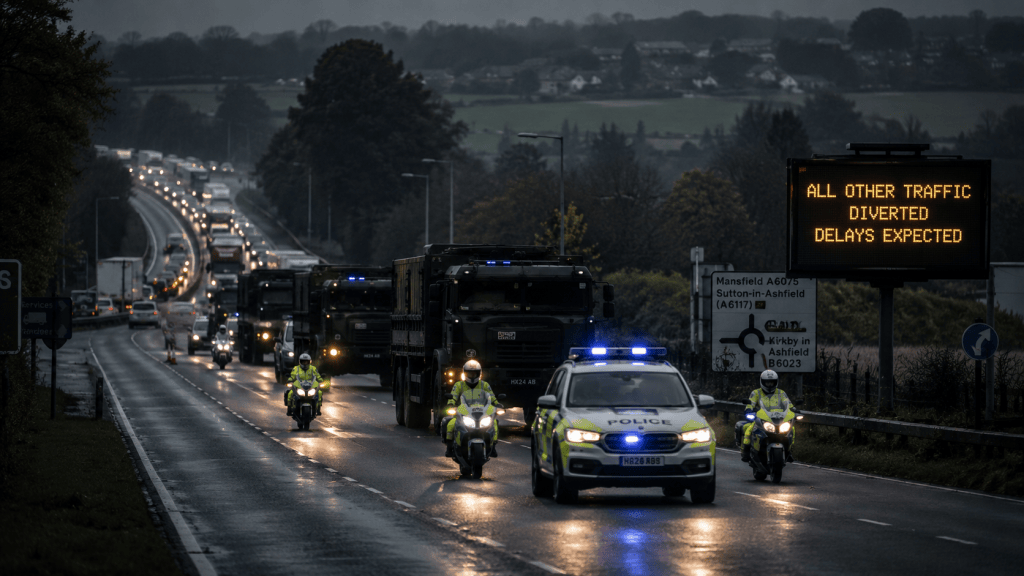
At half past eight, the roundabout quietened in a way that travelled through the waiting vehicles before the sound changed. The constables moved first, stepping out from the cones and raising their arms, while buses, vans, cars, and supermarket lorries stayed where they had been told to stay. The petrol station forecourt seemed to pause around pumps and raised voices, and even the children on the bus stopped drawing in the condensation. Then the leading police motorcycle came through from the western approach, blue light glancing across wet tarmac, followed by the first covered truck, then a second, then three low loaders carrying equipment under dark tarpaulins. Paul watched the wheels pass through the cleared centre of the roundabout, tyres hissing through standing water, the vehicles moving steadily east while everyone else sat behind cones and learned that the road had a second purpose when someone higher up required it.
The convoy held no spectacle, which made its authority harder to absorb. Its movement came through the village as a settled fact, passing under temporary traffic lights and past a petrol queue that had received no explanation beyond traffic management and essential national movement. A police 4×4 followed the first section, then a gap wide enough for radios to crackle and heads to turn, then two more heavy vehicles with rear doors sealed and number plates already filmed by half the waiting traffic. The school bus driver climbed down during the second gap and walked towards Paul’s van, rain dotting her glasses and darkening the shoulders of her fleece. She glanced towards the convoy, then towards the service-road queue, assessing the same road through three separate obligations.
The bus driver rested one hand on Paul’s half-open window. “Have they told you anything useful?” she asked, her voice carrying the rough edge of a morning slipping beyond timetable.
Paul lowered the glass and felt rain reach his sleeve. “Depot says hold position,” he said, nodding towards the phone on his passenger seat. “External road-management pressure.”
The driver gave a tired laugh while a fresh line of trucks entered the roundabout behind her. “That sounds expensive for saying stuck.”
Paul looked towards the bus, where the boy in the front seat still watched through the glass. “How late are they?”
“Late enough for every parent to ring the school,” the driver said as she wiped water from her glasses with her sleeve. “My youngest is front left, pretending he is fine, which usually means I get the fallout at tea.”
Paul found the boy again, small against the wide bus window, his attention fixed on a covered vehicle carrying what looked like generator housings beneath canvas. A further truck had side panels stripped of company markings, leaving pale rectangles where old names had been removed. A marked highways officer stood beside the cones with a clipboard held inside his jacket, writing each passage down as if recording could keep the route ordinary. Paul wanted to say the convoy would pass, the bus would go on, and the day would become late instead of altered. The sentence fitted the weather, the road, and the careful look on the constable’s face, so he left it where it belonged, inside his own mouth.
A horn sounded near the petrol station, short and angry, followed by a second from farther back. The man from the estate car had reached the kiosk window and was jabbing his hand towards the blocked slip road. A supermarket worker in a green jacket came out to move delivery cages away from the service gate, then stood with both hands on the metal rail, caught between stock that needed unloading and a road that had ceased to answer to the shop. When the final vehicles entered the roundabout, the rain thickened and drew the village, the school bus, the petrol queue, the supermarket yard, and the trapped delivery vans into one blurred reflection.
The police sergeant spoke into his radio, listened, then nodded towards the far approach as if the corridor had gone through cleanly. The cones stayed in place for several minutes after the final truck disappeared beyond the trees, and that delay unsettled the waiting drivers more than the convoy itself. It suggested that the movement had left something behind besides water on the road and tyre tracks through the roundabout. It had left a revised understanding of priority, one everyone could feel while still lacking permission to name it.
The constable returned to the bus first, and Paul watched the driver nod, climb back into her seat, close the door, and ease the vehicle into the diversion lane. The petrol queue released next in bad temper, each car moving too close to the one ahead. Paul’s tracker flashed a new estimated delivery time and revised itself again before he had taken his foot from the brake. The road opened by degrees, ordinary traffic pouring back into the shape left for it, as if the interruption had been a passing inconvenience. Yet as Paul guided the van past the cones and saw the water still trembling in the lorry tracks, he understood that the road had held open for something larger than traffic.
A Visual Chronicle
An ordinary school run stalled in the rain as Ashwell Roundabout briefly became part of a protected route moving east.
Extract from County Roads Policing and Local Resilience Coordination Log
Subject: Ashwell Roundabout / Essential Movement Hold Time: 08:06–09:18 Circulation: Roads Policing Unit / Local Authority Duty Officer / Highways Liaison / Regional Movement Desk
Purpose To record temporary traffic-management measures applied at Ashwell Roundabout in support of protected eastbound movement through the A-road corridor, with associated disruption to civilian traffic, school transport, commercial delivery access, and fuel-station queuing.
Public Position Short-term traffic controls were applied to support essential movement through the local road network. Police, highways staff, and local authority partners worked to maintain public safety, preserve emergency access, and limit wider disruption during the movement window.
Incident Summary At 08:06, roads policing units established a controlled hold on the western and southern approaches to Ashwell Roundabout. Highways contractors placed cones and temporary signage under police direction. Civilian traffic accumulated across the supermarket service road, petrol-station entrance, and school-bus approach within twelve minutes of the first hold.
At 08:24, the first protected movement entered the controlled corridor from the western approach under police motorcycle escort. The movement consisted of covered heavy vehicles, support vehicles, and low-loader units carrying sealed equipment under tarpaulin. Vehicles proceeded east through the roundabout under continuous police control.
At 08:31, local bus service 42A was diverted into the side lane due to corridor clearance requirements. The bus carried school pupils bound for Ashwell Primary and Harford Road Academy. Driver reported anticipated lateness and requested school notification. Local authority education contact was advised through the duty channel.
At 08:37, fuel-station queuing extended across the supermarket slip road and affected rear delivery access. Forecourt staff reported customer agitation linked to route closure, pump access, and visible police movement. No physical disorder was recorded. One male driver challenged kiosk staff and was verbally redirected by attending officers.
At 08:49, final protected vehicles cleared the eastern approach. Police retained the hold for route-confirmation checks before staggered civilian release began at 08:57. Full civilian movement through the roundabout resumed by 09:18, although residual congestion continued across the service road and petrol-station entrance.
Approved Local Explanation Members of the public were advised that short-term traffic management had been applied to support essential national movement. Police and highways teams were present to maintain safety, manage congestion, and reopen the route as soon as conditions allowed.
Lines to Avoid Refrain from identifying vehicle category, load type, destination, escort protocol, or connection to wider allied-support movement. Refrain from suggesting routine civilian traffic had been displaced by defence-linked movement. Refrain from confirming repeated use of the route unless cleared through regional handling. Refrain from linking the hold directly to overseas military events or recent freight disruption.
Local Impact Assessment The route hold created visible public disruption in a mixed civilian setting, with school transport, retail delivery access, fuel queues, and commuter traffic affected during the morning peak. Public frustration increased where road users observed escorted vehicles passing through while ordinary traffic remained stationary.
The presence of marked police units, temporary signage, and covered heavy vehicles increased public speculation around the purpose of the movement. Several members of the public filmed the convoy from stationary vehicles. Local communications teams should assume social-media circulation of images from Ashwell Roundabout across the morning period.
Operational Note Further use of Ashwell Roundabout for protected movement may require earlier school transport warning, revised petrol-station access control, and supermarket delivery coordination to reduce visible civilian delay.
About the Creator
The Modern Chronicle is written and curated by Simon Phillips, an author of modern speculative fiction and contemporary crisis-driven storytelling who explores the point where ordinary life begins to tighten beneath political strain, military movement, institutional caution, and the public language used to keep dangerous realities at a distance.
Many of the records presented in these Chronicles sit alongside Simon’s wider modern-war novella series, where governments, soldiers, families, and civilian systems are forced to absorb a world changing faster than its official explanations. The stories remain grounded in recognisable places: ports, school corridors, freight yards, government rooms, roadside queues, transfer sites, and homes where the news has started to feel too close.
One such world unfolds through The Last Deterrence, a modern-war novella sequence beginning with Managed Distance Breaking and continuing in The Quiet Strike. Together, the first two books follow Britain as support language begins to fracture under freight pressure, European escalation, domestic infrastructure strain, and the growing sense that distance from war has already begun to fail.
Readers who wish to explore the wider published story world connected to this Chronicle can find the novellas below.
The following Chronicle continues the morning at Ashwell Roundabout, where police route control, delayed school transport, a worsening petrol queue, and a protected eastbound convoy turned a familiar local road into part of a corridor few people had been allowed to understand.
Readers supporting The Modern Chronicle can continue the record below.
Subscribe to continue reading
Subscribe to get access to the rest of this post and other subscriber-only content.
After reports of a strike in Germany reached a Midlands freight holding site, the routes changed before the workers understood why.
The Yard That Turned East
The first report from Germany reached Hartlow Freight Holding Yard through a driver’s phone before any official instruction had crossed the dispatch system, carried into the evening shift by a man who had come to the hatch angry about a cancelled rail slot and then stood there with his anger thinned by what he had seen on the screen. Rain had blown in across the Midlands all afternoon and settled over the yard in a shining film, silvering the hardstanding beneath the floodlights, darkening the shrink-wrapped pallets beside the rail spur, and turning the painted arrows between the road lanes into broken reflections. On the phone, a presenter stood before a map of western Germany while emergency lights moved behind her in red and blue fragments, and although the sound barely carried through the glass, the strip beneath the image gave the room enough to understand why the driver’s hand had started to shake. Suspected strike. Logistics site affected. European freight movement disrupted.
The yard carried on around the words because freight places were built from habit and pressure. Forklifts crossed between pallet rows while tractor units crept forwards in the holding lanes, their headlights fixed on trailers late for places farther east. The dispatch office held its usual smells of printer heat, old coffee, damp coats, and paper kept too close to radiators, yet the air inside it seemed to tighten as staff looked from the driver’s screen to the movement board above Mara Ellison’s desk. During the previous fortnight, the holding yard had become harder to describe, as sealed loads arrived late, moved first, and left behind civilian consignments once protected by morning delivery windows.
“What site?” Mara asked as she rose from her chair and moved towards the hatch.
Ed Baines lifted the phone closer to the glass, rain dripping from his cuff onto the sill. “They’re saying western Germany. Near a freight route. They keep changing the wording.”
Mara unlocked the side door and stepped into the narrow vestibule, where cold air pressed around her and made the dispatch room seem suddenly too warm. “Who are they?”
Ed looked past her towards Lane Three, where two plain-sided trailers were being guided under escort handling while commercial traffic remained held beside the barrier. “All of them, by the look of it.”
The dispatch printer started again, grinding out a fresh movement sheet with the exhausted rhythm it had kept since late afternoon. Yusuf Hale, the shift coordinator, pulled the page clear with two fingers and read the top line, his shoulders rising the way they always did when the room began obeying instructions written by people safely distant from the yard.
“Rail sequence has shifted,” Yusuf said, keeping his eyes on the paper.
Mara looked back at Ed’s screen, where the footage had moved from emergency vehicles to a studio map. “Linked to Germany?”
Yusuf read farther down the page, his mouth tightening around the official line before he gave it voice. “European infrastructure disruption and route protection review.”
Ed gave a short laugh that held more disbelief than humour. “That is a generous number of words for yes.”
Mara took the sheet from Yusuf and scanned the lines. The old sequence had carried automotive parts, mixed retail, and chilled food consignments through rail transfer before midnight, with three protected loads threaded between them where space permitted. The new sequence pulled the protected loads forward, froze two civilian releases, turned one Sheffield driver back into reholding, and marked a whole row of pallets for rescan under supervision. A second instruction sat below the schedule in smaller print, advising staff to await military-police arrival before opening the auxiliary gate.
For a moment Mara felt the yard rearrange in her head before the physical place moved outside the windows. Lane Four would choke first. The chilled load would lose its rail margin unless the reefer points stayed clear. Somewhere beyond all of that, across wet roads, changed sheets, and a damaged site hundreds of miles away, Germany had entered Hartlow through columns, seals, gate positions, and men who had left home expecting a further miserable shift in a crowded yard.
Yusuf lowered his voice as he folded the sheet back against the desk. “Auxiliary gate means they are bringing more through than we have space to stage.”
“It means they want the space made before anyone asks where it came from,” Mara said as she reached for her radio. “Call Yard One. Tell Niall to hold the chilled row beside the reefer points until the rescan team is placed. If a driver asks for timing, sequencing review is under way.”
Ed watched her through the open doorway. “You sound like the people on television.”
“I sound like someone who has spent six years talking to angry men in wet jackets,” Mara said as she clipped the radio to her belt.
Mara stepped into the rain as a forklift crossed the hardstanding with its beacon turning across the water. Lately, Hartlow had begun to matter to people who never came to the gate and whose instructions arrived through regional channels, red-handled emails, and calls that left fewer choices than they named.
Across Lane Three, two staff in high-visibility jackets peeled old route labels from wrapped pallets and smoothed fresh tags over the plastic. Near the rail spur, Niall Ford stood beneath the loading canopy with a radio pressed close to his ear. He saw Mara and lifted one hand, palm up, asking the question everyone had started asking through gestures because the radios had filled with approved phrases. Mara raised the revised sheet through the rain, and Niall turned towards the staff-entrance screen, where the map of Germany glowed above workers checking numbers they had already checked twice.
The first military-police vehicle arrived at nine fourteen, rolling through the main gate with blue lights dimmed and headlights low. A second vehicle followed with two uniformed personnel and a civilian liaison officer in a dark coat. Gate staff stepped from beneath the shelter, their stance shifting at once from routine control to something straighter and less practised.
Mara crossed the yard towards the incoming party with rain running down the back of her neck. The leading officer, a woman with close-cropped hair beneath her beret and wet marks darkening her sleeves, stepped from the vehicle and looked across the lanes with a measured attention that unsettled Mara more than any raised voice could have managed. She saw the waiting drivers, the rail spur, the sealed units, the warehouse staff gathered beneath the lights, and the route through the auxiliary gate, placing each part into a map she had brought with her.
“Mara Ellison?” the officer asked as she came forwards.
“Yes,” Mara said, drawing the sheet from her jacket.
“Staff Sergeant Keane,” the woman said, giving a brief nod towards the vehicles behind her. “We are here for access-control support and protected movement verification. Regional should have sent the updated handling pack.”
“They sent half of it,” Mara said as rain spotted the paper between them. “The rest appears to have arrived in vehicles.”
Keane’s mouth moved by the smallest degree, close enough to a smile to show she had heard the line and far from enough to accept it as a joke. “Auxiliary gate stays closed to civilian movement. Rescan team works under supervision. Drivers turned back from rail release receive the approved explanation.”
“European infrastructure disruption and route protection review,” Mara said, keeping the paper flat against her palm.
Keane glanced towards the staff-entrance screen, where footage from Germany had returned to smoke, floodlights, and emergency tape snapping in the wind. “That line will carry the shift.”
“It rarely carries the people waiting inside it.”
Keane looked back at her. “Tonight it has to carry both.”
The words came as instruction, carrying little comfort. Mara looked towards the lanes, where drivers had begun leaving their cabs in ones and twos, drawn by the military-police vehicles, the changed sequence, the news on the screen, and the shared sense that something larger had entered the yard. An alarm never sounded across Hartlow. A barrier never crashed down. The freight system simply altered its priorities in the rain, and everyone inside it felt the change before any public statement could reach them.
By half past nine, the first turned-around driver was arguing at the gate, the chilled load had lost its rail slot, and Niall’s team were rescanning pallets beneath the canopy while the German map glowed above them in red and grey. Mara stood beside the dispatch hatch with the revised sheets pinned under her hand and watched sealed freight move through lanes cleared by delay, anger, and careful language. Officially, Hartlow had entered a temporary rerouting of freight following disruption to European logistics infrastructure. In the yard itself, beneath the floodlights and the rain, the route east had begun to feel less like support and more like the reason everyone else had been told to wait.
A Visual Chronicle
The following Visual Chronicle presents a cinematic reconstruction of the events described above.
Transport Movement Room Log
Extract from Regional Freight Re-Routing Instruction Sheet Subject: Hartlow Freight Holding Yard / European Infrastructure Disruption Time: 21:22–22:10 Circulation: Regional Movement Desk / Yard Dispatch / Rail Coordination / Police Liaison / Defence Access Support
Purpose
To support controlled re-sequencing of freight movement through Hartlow Freight Holding Yard following disruption to European logistics infrastructure and associated review of protected onward routes.
This extract covered the first instruction window after reports emerged of a strike affecting a German logistics site with relevance to eastbound movement. The purpose of the instruction was to preserve onward handling capacity, maintain rail flexibility, and reduce avoidable visibility around priority movement categories.
Movement Position
Hartlow Freight Holding Yard remained operational during the instruction window. Civilian freight, chilled consignments, automotive parts, and mixed retail loads remained present across the scheduled evening sequence. Protected movement categories were advanced through the yard following regional direction.
The revised sequence required immediate adjustment to Lane Three, Lane Four, the rail spur holding area, and auxiliary-gate access. Yard dispatch was instructed to preserve clear movement for sealed onward consignments and maintain staging flexibility for additional protected arrivals.
Civilian releases originally scheduled before midnight were subject to delay, reholding, or renewed scan control. Rail coordination was advised that previous timing assurances should be treated as provisional pending wider route review.
Approved Handling Language
Staff were advised to describe changes as temporary re-routing caused by European infrastructure disruption and route protection review.
Drivers, commercial operators, and depot callers were to be told that the yard remained operational, freight sequencing was under active review, and onward movement would resume as soon as revised clearance permitted.
Staff were advised against discussing protected categories, destination assumptions, military liaison, route sensitivity, or changes linked to specific overseas events.
Sequence Adjustments
21:22 — Regional Movement Desk issued revised sequence for Hartlow Freight Holding Yard. Protected consignments were moved ahead of mixed commercial freight across Lane Three and Lane Four. Yard dispatch was instructed to preserve direct access to the auxiliary gate pending further clearance.
21:31 — Rail coordination advised that two civilian consignments were moved out of the first release window. One chilled load remained under reefer monitoring while awaiting revised rail access. Automotive component load was placed into temporary reholding.
21:39 — Rescan requirement issued for pallet group H-17 through H-24. Yard staff instructed to conduct supervised scan verification before onward handling. Existing route labels were withdrawn and replaced under dispatch control.
21:46 — Gate team reported driver challenge concerning reversed release instruction. Approved handling language was used. Driver returned to vehicle after exchange with gate staff. Queue remained contained.
21:58 — Military Police access-support team arrived on site. Auxiliary gate placed under controlled entry status. Civilian vehicle access through auxiliary lane suspended for remainder of instruction window.
22:04 — Yard dispatch confirmed protected movement lane was clear. Regional Movement Desk advised that additional sealed units may be routed through Hartlow if European rail disruption widened across the overnight period.
22:10 — Hartlow remained functional under revised sequence. Civilian dwell time increased across three active categories. Protected consignments continued to move within assigned tolerance.
Internal Assessment
Hartlow’s operating position remained viable through controlled displacement of lower-priority freight. Continued viability depended upon yard staff compliance, rail-slot flexibility, police access support, driver containment, and continued availability of chilled holding capacity.
The German incident increased sensitivity across the eastbound freight chain. Although public phrasing should continue to emphasise temporary disruption and route review, regional desks should assume that workers, drivers, and commercial operators may connect revised sequencing to overseas reports.
Visible arrival of military-police access teams may increase driver speculation. Yard staff should use approved language and refer wider questions to regional communications.
Further Action
Regional Movement Desk to review Hartlow sequence again before 23:00.
Rail coordination to supply revised release timing for chilled and automotive loads.
Police Liaison to remain available for gate-pressure support.
Defence Access Support to confirm whether auxiliary gate control remained required beyond the first instruction window.
Public-facing explanation to remain unchanged unless civilian delay exceeded revised tolerance or visible disruption reached local media.
About the Creator
The Modern Chronicle is written and curated by Simon Phillips, an author of modern speculative fiction and contemporary crisis-driven storytelling who explores the point where ordinary life begins to tighten beneath political strain, military movement, institutional caution, and the public language used to keep dangerous realities at a distance.
Many of the records presented in these Chronicles sit alongside Simon’s wider modern-war novella series, where governments, soldiers, families, and civilian systems are forced to absorb a world changing faster than its official explanations. The stories remain grounded in recognisable places: ports, school corridors, freight yards, government rooms, roadside queues, transfer sites, and homes where the news has started to feel too close.
One such world unfolds through The Last Deterrence, a modern-war novella sequence beginning with Managed Distance Breaking and continuing in The Quiet Strike. Together, the first two books follow Britain as support language begins to fracture under freight pressure, European escalation, domestic infrastructure strain, and the growing sense that distance from war has already begun to fail.
Readers who wish to explore the wider published story world connected to this Chronicle can find the novellas below.
Explore the books: The Last Deterrence: Managed Distance Breaking The Last Deterrence: The Quiet Strike
You can watch his YouTube channel here: Author Simon Phillips
The following Chronicle continues the night at Hartlow Freight Holding Yard, where reports from Germany moved through the dispatch office faster than any official explanation, and route changes, rescan orders, military-police access control, and delayed civilian freight began turning an ordinary holding site into part of a protected eastbound corridor.
Readers supporting The Modern Chronicle can continue the record below.
Subscribe to continue reading
Subscribe to get access to the rest of this post and other subscriber-only content.
There were some wars a country could watch from the edge of the room for a while. It could send equipment, issue statements, argue over proportionality, absorb the rise in fuel, and tell itself that distance still meant safety. It could speak of support, resilience, defensive aid, allied infrastructure, and managed escalation. It could choose careful words and hope the world accepted the distinction between helping a war and entering one.
That distinction was never as strong as the language around it.
Grounded modern war fiction begins in that weakness. Not in the clean declaration, not in the heroic charge, not in the moment when every citizen wakes to find history has suddenly changed, but earlier, in the days when the signs are visible and still denied. It begins with the barrier moved outside a government building, the police route changed twice in the rain, the school trip trapped near a protest line, the supermarket notice asking people not to buy too much, the fuel queue stretching into traffic, the family message left unanswered because the person who could answer is not free to say what happened.
That is the pressure at the heart of The Last Deterrence. It is not a story about war arriving all at once. It is about the failure of distance, and the way a country can be changed by war before it admits that war has reached it.
The War Before the Declaration
Modern war does not always announce itself in the old way. There may be no clean dividing line between peace and conflict, no single morning when every public statement finally matches the physical evidence. A government may still speak of restraint while bases move to elevated posture. Ministers may still use the language of support while fuel lanes, air movement sites, ports, depots, railheads, and logistics hubs become part of the battlefield.
That is why political military fiction has to pay attention to language as much as weapons. The public statement is not decoration. It is a tool, a shield, a delay mechanism, and sometimes a confession made carefully enough to pass as reassurance. In a NATO crisis, every phrase has several audiences. Allies hear one thing. Opponents hear another. The public hears something smaller and more domestic, something filtered through the price of petrol, the tone of a presenter, the closed road by the station, or the silence of someone serving overseas.
In The Quiet Strike, the second book of The Last Deterrence, Britain has not declared open war. That matters. It also matters that the country is already behaving as though the old distance has failed. The government still speaks of defensive reinforcement and allied logistics. Yet the physical world is moving faster than the public vocabulary. Military-linked sites are being watched. Small drones test perimeters. Fuel infrastructure becomes exposed. Support routes begin to look, to an adversary, like the early shape of intervention.
This is where grounded modern-war fiction finds its strongest tension: not in spectacle, but in contradiction.
Britain Under Pressure
A war story set around Britain cannot only be told through ministers and soldiers. If the country is under pressure, the pressure has to enter ordinary systems. It has to touch schools, shops, transport, pharmacies, family kitchens, shopping centres, petrol stations, police lines, local roads, and the tired staff who become the visible edge of decisions made elsewhere.
The home front is not passive in this kind of fiction. It is where the official story is tested against lived reality. A minister may say supplies are stable, but a parent sees the shelf gaps. A security correspondent may say an incident is under investigation, but a mother hears the phrase “military-linked site” and knows her son is somewhere inside that careful wording. A government may insist that measures are routine, but everyone can see more barriers, more police, more delays, more shortages, more signs asking people to stay calm.
That is one reason British war fiction has a different texture when it is handled seriously. Britain is small enough for the state, family, media, road network, military estate, and public mood to feel connected. A crisis in Whitehall can become a traffic jam, a cancelled bus, a school safeguarding concern, a family argument, or a queue outside a petrol station within hours. The distance between policy and kitchen table is never as wide as official language needs it to be.
In The Last Deterrence, Helen Mercer’s civilian line carries that weight. Her life is not separate from the strategic world. It is where that world becomes intimate. She sees the strain through prices, public anger, school routes, teenage fear, fuel anxiety, and the changing tone of ordinary conversations. Her family does not receive the war as doctrine. They receive it as disruption, silence, worry, and the slow shrinking of what used to be normal.
NATO Crisis Fiction Without Clean Certainty
A NATO crisis in fiction can easily become too neat. One side provokes, the other responds, alliances hold or fail according to simple dramatic need, and the story moves from escalation point to escalation point as if decision-makers are pushing buttons on a map.
The more frightening version is slower and less certain.
Alliances are made of governments, and governments are made of people working under pressure, with incomplete information, public fear, legal risk, military advice, domestic politics, media pressure, and allies who all need slightly different language. No capital hears the same phrase in exactly the same way. One country wants restraint named. Another wants deterrence visible. Another wants ambiguity. Another wants speed. Another wants proof that solidarity means more than statements.
That is where political military thrillers can become more than crisis machinery. They can show the strain of holding a coalition together when every word changes the room. The danger is not only that an enemy misreads a movement. It is that allies misread one another, governments speak past their publics, and military necessity begins to outrun political permission.
Leah Mercer’s state line exists inside that pressure. She works near the centre of government, where public language, private fear, and actual events pull apart. Her work is not simply to “know more” than the public. In many ways, her knowledge is another form of exposure. She sees how phrases are built to hold panic at bay. She sees which words are avoided, which ones are kept private, and which ones are released because no better shelter remains.
In this kind of story, the state is not omniscient. It is strained, reactive, skilled in language, and often behind the physical reality it is trying to manage.
Drone Warfare and the End of the Safe Rear
Modern war punishes movement. It punishes concentration, exposed logistics, predictable routes, fuel points, open tarmac, contractor sprawl, weak perimeters, and old assumptions about what counts as the rear. A site does not have to be on the front line to matter. It only has to be useful.
That is why drone warfare fiction has become central to any serious modern-war story. Drones change the emotional grammar of military space. A soldier can no longer assume that danger arrives with a visible enemy, a clear direction, or a traditional battlefield. A small unmanned platform can test a perimeter, record response patterns, reveal blind spots, disrupt fuel handling, damage confidence, or force a whole site to show its reflexes.
The danger is physical, but it is also psychological. Men look up before crossing open ground. Contractor vehicles are checked longer than before. A fuel lane becomes a target. A camera outage becomes a strategic problem. The air above a base stops being empty and becomes watched.
Daniel Mercer’s military line carries that truth from the ground. He does not experience the war as policy. He experiences it as rain on concrete, helmet straps, ruined food, shouted orders, smoke, blast pressure, exposed fuel systems, injured men, and the knowledge that support infrastructure is now part of the fight. His world is not abstract. It is made of gates, lanes, floodlights, barriers, radios, technical cases, medics, aircraft, and people trying to keep working after the site has been hit.
That is the crucial shift in The Quiet Strike. Rear space stops feeling rear. Support becomes dangerous not because someone has declared war, but because the machinery of support has become visible enough to strike.
The Quiet Strike: Book Two of The Last Deterrence
The Quiet Strike is the second book in The Last Deterrence, and it sits at the point where Britain can no longer keep the war at a comfortable political distance.
The first book, Managed Distance Breaking, showed the early failure of distance: public reassurance, government strain, family unease, and the first signs that a war described as external was already bending British life around it. The Quiet Strike moves the pressure closer. The language of support still remains in place, but the physical reality has changed. British-linked military space is being watched, tested, and struck. Drones reach towards air movement and fuel infrastructure. NATO allies argue over how much restraint can survive when the systems supporting the war are already under attack.
The book follows that pressure through three connected lines: Leah Mercer inside the machinery of government, Helen Mercer at home as public life narrows around shortages, transport disruption and family fear, and Daniel Mercer on the ground as the rear stops feeling safe. Together, those lines show the same crisis at different levels of knowledge. Leah sees the careful wording. Helen hears what the wording refuses to say. Daniel lives the danger that official statements reduce to incident language.
This is the published second entry in the series, and it marks the moment where support becomes participation in practice. Not through a formal declaration. Not through spectacle. Through movement, fuel lanes, exposed bases, public statements, family calls, and the slow recognition that Britain is already being pulled into the machinery of a wider war.
Family as the Place Where Strategy Lands
Large-scale war fiction often risks losing the human centre beneath the machinery of escalation. Maps grow larger. Threats multiply. The reader is told what governments fear, what armies require, what alliances decide. Yet the cost of those decisions becomes thinner if it does not land somewhere specific.
The family connection is not decorative. It joins the three major forms of exposure: state, civilian, and military. Leah sees the language of government from inside the system. Helen feels the same language fail to comfort at home. Daniel lives the physical consequences of what is still publicly described as support. Around them, the wider family absorbs the crisis through finance, adolescence, transport, work, worry, and messages that are too short to carry the truth.
This matters because war does not give everyone the same knowledge. A soldier knows what happened at the fuel lane but not the full political calculation. A government staffer sees the restricted incident summary but not the smoke, fear, and ringing ears. A mother sees the public statement and knows only enough to be frightened. Each truth is partial. Each truth is real. The distance between them is where much of the story lives.
That separation gives the series its emotional force. Public truth, private knowledge, and actual events do not arrive together. They move at different speeds, and the family has to live inside the gaps.
The Quiet Strike and the Failure of Managed Distance
The Quiet Strike belongs to the stage before open European war, when the language of control still exists but has begun to carry too much weight. It is a book about British-linked military infrastructure under pressure, NATO allies trying to hold discipline, and a family discovering that the war can reach them through systems before it reaches them through declaration.
Its title points towards the way modern escalation often feels. Not quiet because nothing happens, but quiet because the public words remain controlled. Quiet because attribution is withheld. Quiet because the attack is processed through incident summaries, protective measures, revised lane plans, and cautious statements. Quiet because families hear only what can be safely said. Quiet because the real change is already moving beneath the surface.
The strike does not need to destroy a city to matter. It needs to change posture. It needs to make a base reveal its weaknesses. It needs to make fuel, air movement, technical support, and site security part of the war. It needs to turn defensive support into something that looks, to those watching, like participation.
That is the point where genre and story meet. This is grounded modern-war fiction because the war is not treated as spectacle. It is political military fiction because language, alliance pressure, and state decision matter. It is British war fiction because the crisis enters recognisable civic life. It is drone warfare fiction because small systems change large behaviour. It is NATO escalation fiction because every defensive movement can be read by someone else as the next rung.
The Wider Shape of The Last Deterrence
The wider series is built around the collapse of managed distance. It begins with a recognisable proxy-war frame and follows the way support, aid, training, movement, and infrastructure slowly become harder to separate from participation. The story widens through Europe, alliance overload, global pressure, nuclear threshold, and the long aftermath of partial survival.
But the purpose is not to hurry towards spectacle. The purpose is to let each stage change the people living inside it.
Ports matter because ships and fuel matter. Roads matter because movement is vulnerable. Schools matter because public reassurance reaches children through adults who are no longer sure what to say. Government rooms matter because the wrong phrase can harden an alliance, frighten a public, or give an adversary a signal it was already waiting to find. Bases matter because the rear is no longer safe simply because someone calls it rear.
The world of The Last Deterrence is built from these pressures. It is a war story about systems, but never systems alone. It is about the people who have to keep working inside them: the staffer drafting the line, the mother wiping water from a kitchen counter while the news scrolls beneath her, the soldier walking up an aircraft ramp with smoke still in his sleeve, the technician holding herself together because damaged equipment still needs to be made safe, the young private learning that fear can be carried but not dismissed.
When the World Changes Before the Words Do
The most dangerous moment is not always the loudest one. Sometimes it is the interval when everyone knows the situation has changed but the official language has not caught up. The country is still told that measures are defensive. The military is still told that movement is support. Families are still told that details cannot be shared. Allies are still told that consultation is holding. The public is still told that everything remains under urgent review.
And yet the roads are different. The gates are different. The queues are different. The silences are different.
That is where The Quiet Strike stands. It is the moment when support becomes participation in practice, when Britain’s distance from the war fails not through a declaration, but through movement, fuel, drones, family calls, public statements, and the visible strain of a state trying to remain calm while reality pushes past the words.
The world changes first.
Understanding follows later, unevenly, through official phrases, damaged places, short messages, and the people left to carry what those phrases cannot say.
Modern war does not always arrive first as fire on the skyline. Sometimes it arrives as a changed route, a delayed convoy, a guarded gate, a school rumour, a longer queue at a port, or a government phrase that no longer has enough strength to hold the truth inside it.
In grounded modern war fiction, Britain is rarely most interesting when it is already burning. The deeper tension begins earlier, when ordinary systems keep moving while the meaning beneath them changes. A freight yard still opens. A school still takes registration. A minister still speaks of restraint. A soldier still loads crates under rain. A family still eats at the kitchen table while the television softens danger into careful language. Nothing has fully broken yet, and that is what makes the atmosphere more frightening.
This is the world entered by Managed Distance Breaking, the opening novella of The Last Deterrence. It is a British war fiction novella about the stage before open war becomes undeniable, when NATO crisis fiction is still able to wear the clothes of policy, logistics, reassurance, and routine. The conflict remains officially elsewhere, yet every practical detail begins to suggest that distance has already failed.
Public calm and private movement
A country under pressure often speaks in layers. There is the public language, made for kitchens and news bulletins. There is the private language, spoken in offices, briefing rooms, depots, and command spaces. Then there is what is actually happening on the ground, where phrases such as support, preparedness, resilience, and restraint have to become fuel, medical crates, aircraft dispersal, armed guards, road priority, and exhausted people making bad systems work for one more night.
That gap matters. It is where political military fiction about Britain can become more than speeches and strategy. The real strain appears when government language tries to remain calm while the physical country beneath it is already changing shape.
In Managed Distance Breaking, the pressure does not come from spectacle. It comes from the slow recognition that support is no longer cleanly separate from participation. Aid to Ukraine and Europe is not abstract. It has to move through ports, road networks, military bases, freight yards, rail options, and civilian workers whose own lives are already stretched. Once those routes matter, they can be delayed, overloaded, watched, probed, and struck.
Modern war punishes movement. It punishes concentration. It punishes visible preparation. That is why infrastructure becomes as important as the battlefield. A port is not just a port. A rail spur is not just a rail spur. A fuel compound, a logistics site, a transfer yard, a guarded airfield, and a civilian freight lane all become part of the pressure map.
The public may still hear that Britain is steady. The people moving the weight know something has altered.
The family as a national pressure system
War fiction often widens too quickly. It reaches for maps, briefings, fronts, and declarations before the reader has felt what national danger does to a household. Yet the domestic line is where public truth is tested first. A family hears the softened words, sees the altered routines, and learns to read the spaces between them.
A school teacher notices the way pupils bring adult fear into the classroom as jokes, rumours, and half-understood politics. A daughter near government hears how phrases are shaped before they reach the public. A soldier sees how support becomes physical labour before anyone admits it has become military exposure. Another family member at a port sees the same pressure through containers, shift overruns, and freight chaos. A younger child feels it through cancelled buses, strange adult silences, and the slow loss of ordinary certainty.
That is what gives a modern war novella series its human spine. The war is not simply out there. It is distributed through family life. It reaches one person as a briefing, another as a queue, another as a route order, another as a classroom question, another as a message that arrives too late or says too little.
The Mercer family at the centre of The Last Deterrence carries that split. Leah, Helen, and Daniel do not experience the same truth at the same time. They cannot. One is close to government language. One is surrounded by civilian consequence. One is inside military movement. The emotional power comes from the fact that all three are right in partial ways, and all three are denied the whole shape of what is happening.
That separation is essential to grounded world war escalation fiction. When every character knows everything too early, tension collapses into explanation. When knowledge is uneven, the world feels larger, colder, and more believable.
Logistics as the hidden battlefield
The glamour version of war ignores logistics until it needs a dramatic convoy. A more serious war novel about modern technology has to understand that movement itself becomes a target. Drones, missiles, surveillance, digital systems, damaged roads, exposed depots, and stretched civilian infrastructure all make the act of moving material dangerous.
Before a soldier fires a shot, somebody has to load, route, fuel, guard, sign, scan, delay, unload, and reload. Somebody has to decide which civilian freight loses priority. Somebody has to explain why supermarkets, ports, buses, petrol stations, and schools are being touched by a war that the public has been told is still distant.
That is where the phrase “managed distance” begins to fail. Britain may still describe its role as support, yet support has weight. It takes up road space. It uses drivers, ships, rail slots, fuel, security, airfields, and political credibility. It creates patterns that adversaries can read. It makes domestic weakness visible.
In this kind of NATO crisis fiction, the first battlefield may be the route network. Not because roads and ports are more dramatic than soldiers, but because soldiers cannot exist apart from them. The state may speak from a lectern, yet the war moves through a gate in the rain.
NATO hesitation without caricature
A restrained political war thriller about Britain should not treat NATO hesitation as cowardice or simple incompetence. Alliance politics are slower and more strained than that. Every state has its own public, military limits, geography, stockpiles, industrial weaknesses, elections, memories, and fears. To move together, allies must translate danger into language each capital can survive.
That makes hesitation part of the drama. A government may know more than it says and still not know enough to speak plainly. It may fear panic at home as much as misreading abroad. It may need to reassure allies while avoiding a phrase that locks it into action before the military system is ready.
In Managed Distance Breaking, this strain is felt through the changing relation between Germany, Britain, NATO support, and the Russia-Ukraine war. The point is not to reduce escalation to one dramatic decision. It is to show how pressure accumulates until careful language becomes too thin for the events it is meant to contain.
The most dangerous moments are not always the loudest. Sometimes they are the moments when everyone still speaks calmly because no one can afford the alternative.
Drones, signals, and the loss of a safe rear
Drone warfare fiction often focuses on the machine itself: the object in the sky, the strike, the surveillance, the sudden violence. Yet the deeper unease lies in what drones do to the idea of distance. They make the rear feel watched. They turn fences, fuel points, cameras, and minor outages into signs that something hostile may already be inside the system.
A drone does not have to destroy a base to change how the base feels. A cut feed, a broken device near a fence, a temporary light failure, or a small intrusion at the wrong hour can force armed men to move differently on home soil. It changes posture. It changes sleep. It changes the meaning of a quiet night.
That is the beginning of the no-safe-rear logic. Not full collapse. Not spectacle. A subtler and more frightening transition: ordinary military space becomes alert space, then guarded space, then exposed space. The country has not yet admitted it is in the war, yet parts of it are already behaving as though the war has found them.
Why the first book begins before the explosion
There is a temptation in world war escalation fiction to hurry. To reach the declaration, the strike, the invasion, the nuclear threshold, the ruined city. Yet escalation only has force when the reader understands what has been lost before the obvious loss begins.
Managed Distance Breaking begins with the failure of ordinary reassurance. It lets the reader feel the country before open war has hardened it. Downing Street still speaks in careful phrases. Schools still operate. Freight still moves. Soldiers still joke while hauling loads. Families still argue about buses, food, work, and whether anyone is saying the whole truth.
That matters because later destruction needs memory. Places must feel inhabited before they are damaged. Systems must feel functional before they fail. Relationships must have humour, irritation, habit, and warmth before fear begins to alter them.
The novella’s pressure lies in recognising that the state, the family, and the military are all moving at different speeds towards the same conclusion. The public is told that things are manageable. The people closest to the machinery can feel that manageability thinning. The soldier sees the change first in orders, routes, load sheets, and posture rather than in speeches.
This is why the book does not need to shout. Its unease comes from delay, repetition, wet roads, freight lanes, official rooms, and the growing suspicion that every ordinary process has acquired a second meaning.
The road towards the nuclear threshold
The Last Deterrence is not only about the opening phase of war. Its wider world points towards darker territory: open European war, global overload, nuclear threshold fiction, and eventually post-nuclear survival fiction in Britain. Yet the early books matter because the final threshold must never feel like a shortcut.
Nuclear fear becomes hollow when it appears too early as spectacle. It becomes credible when it emerges from accumulated failure: conventional war that cannot decide anything cleanly, alliances under intolerable strain, infrastructure exposed, command confidence damaged, public truth corroded, and leaders forced to make decisions under shrinking time and worsening information.
That road begins with smaller failures. A phrase that no longer holds. A logistics system that cannot stretch further. A family that stops believing reassurance. A soldier recalled from one kind of work into another. A government discovering that calm has become expensive.
The aftermath, when it comes, must also grow from this same world. Not wasteland fantasy. Not instant lawlessness. A half-surviving Britain would still have queues, notices, local councils, ration points, military remnants, missing-person lists, exhausted teachers, damaged ports, guarded depots, and people arguing over who has the right to give orders. The horror would not be emptiness. It would be uneven survival.
Entering Britain before it understands itself
The strength of grounded modern war fiction lies in what it refuses to simplify. War is not only battle. Politics is not only speeches. Family life is not only worry. Military service is not only action. Each becomes part of the same strained system, and the pressure moves through all of it.
Managed Distance Breaking enters Britain at the point where the old distinction between elsewhere and here begins to fail. It does not ask the reader to admire war. It asks them to feel how a country starts changing before it has the courage, evidence, or permission to say plainly what is happening.
A road remains a road until it becomes a route. A port remains a port until it becomes a pressure point. A school remains a school until children start bringing the war in through rumour. A family remains ordinary until every silence starts to mean more than it should. A government remains calm until calm itself becomes part of the deception.
The world does not end in the opening movement. That is not the point. The more unsettling truth is that it continues. Lights stay on. Meals are made. Statements are issued. Vehicles move. People go to work. Children ask questions adults cannot answer cleanly.
The change comes first through roads, rooms, queues, gates, silences, and delays.