After a damaged unmanned device was found beyond an RAF transfer site, the road was sealed, contractors were held at the gate, and the official explanation became smaller than the response around it.
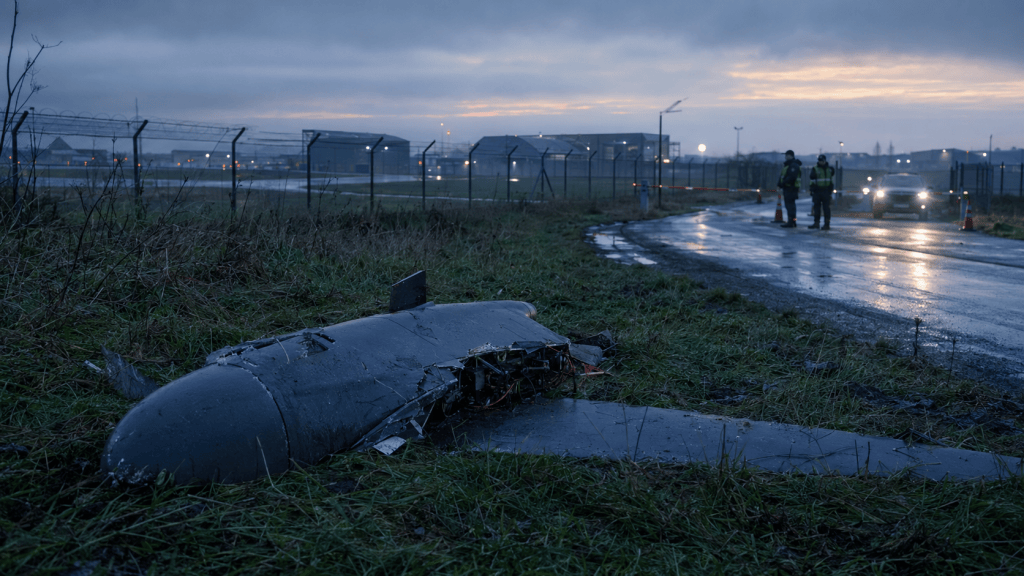
The Road That Closed Before the Gate
The first blue light appeared in Corinne Hales’s windscreen before the airfield came into view, turning through the rain at the far bend of the service road and throwing a pale pulse across the hedges, the standing water, and the low branches dragged towards the verge by the wind. She eased the Northgate Systems van below twenty, expecting an ambulance or a stranded car, then saw a marked police vehicle angled across both lanes beside a line of cones that had been laid from the ditch to the outer fence. Beyond them, the transfer site continued beneath its hard white floodlights, transport tails rising above the wire and loading lamps glowing through the weather, yet the familiar approach had been divided into pieces: civilian road, police line, closed gate, armed figures, and a strip of wet ground between the hedge and the perimeter where every available light appeared to be pointing.
Corinne stopped behind a catering van and lowered her window as a constable came towards her under a black waterproof cap. Rain swept into the cab, cold against her cheek, carrying the smell of diesel, wet grass, and aviation fuel from the other side of the fence.
“Please switch off your engine and remain inside the vehicle,” the constable said as she raised one gloved hand towards the queue forming behind Corinne. “Keep your phone away from the windows, and leave enough space for emergency traffic to pass on your right.”
Corinne turned the key and held up her contractor pass between two fingers. “I have a scheduled delivery for the technical compound, reference Northgate seven-one-six. The gate office should have me at seventeen-thirty.”
The constable glanced at the pass, then towards the outer gate, where a second barrier was sliding across the entrance. “The site has suspended contractor access, Mrs Hales. Someone from the gate team will speak with you when they are able.”
“How long are they expecting us to sit here?” Corinne asked as she looked past the police car towards the dark verge.
The constable adjusted the radio clipped high on her jacket. “I have no reliable time for you yet. Please stay in the van and follow any instruction given over the loudhailer.”
She moved towards the next vehicle before Corinne could ask what had happened, leaving rain to collect along the open edge of the window. Corinne raised the glass and watched the road change around her. Another police car arrived from the village direction and stopped behind the growing queue, sealing the approach from both ends. Two RAF Police officers crossed outside the gate with torches held low, while a man in a heavy green jacket stood near the ditch beside a wheeled case and a folded screen. No one approached the patch of grass under the brightest lamp. Their distance from it gave the ground a shape Corinne could feel even while the object itself remained hidden.
Her phone vibrated in the dashboard cradle. The depot had sent three messages, each more urgent than the last, asking whether the replacement camera housing had reached the site and whether the engineer would still receive it before the evening installation window closed. Corinne read them, locked the screen, and left the phone face down beside the gear lever. Four days earlier she had delivered the brackets that now held some of the portable cameras above the contractor yard. She recognised one mast near the inner lane, its head turning in a slow mechanical sweep until it reached the service road, where it stopped and held.
A knock sounded against the passenger window. Tom Grady, the catering driver ahead, stood beside the van with his hood flattened against his head and one hand braced on the door mirror. Corinne lowered the glass a few inches.
“The officer told everyone to stay inside,” Corinne said as she leaned across the passenger seat. “She looked serious enough to remember faces.”
Tom wiped water from his eyebrows and pointed towards his rear doors. “I have chilled food in there, and the refrigeration warning came on near the bypass. If they keep me here for an hour, the kitchen can argue over warm yoghurt tomorrow.”
“Get back in and ring your dispatcher,” Corinne said as a dark vehicle moved through the gate behind two armed escorts. “This has passed the point where yoghurt carries authority.”
Tom followed her gaze towards the verge. “One of the lads up front heard the police say drone. He reckons it came down beside the road.”
Corinne felt her attention sharpen, although she kept her voice level. “One of the lads up front heard half a radio call through rain. Those stories usually improve each time they travel backwards.”
“You think it is rubbish?” Tom asked as he tucked his hands beneath his arms.
Corinne watched an RAF officer raise a torch towards the hedge, then lower it when the man beside the wheeled case spoke to him. “I think you should return to your van before somebody writes your registration into a report.”
Tom gave the verge another glance, then hurried back through the rain. His brake lights glowed red when he climbed inside, painting the wet road between their vehicles. Beyond the perimeter, an announcement broke across the airfield tannoy, thinned by distance until Corinne could catch only assigned positions and outer line. Movement changed at once. A forklift stopped beside a pallet stack. Ground staff stepped away from an open lane. Two figures crossed towards the fence at a run, then dropped from view behind concrete sections. The transport aircraft remained lit and open, its rear ramp a bright rectangle facing the weather, while every smaller movement around it became faster, tighter, and harder to follow.
Corporal Reeve came through the pedestrian gate ten minutes later with his hood raised and a clipboard sealed inside a clear cover. Corinne recognised his careful walk along the queue, pausing at each cab, checking names, giving drivers the same measured explanation. When he reached her window, the brief warmth of recognition in his face disappeared beneath the strain of the evening.
“Mrs Hales, Northgate Systems,” Reeve said as he checked the first sheet. “You have the weatherproof camera housing and replacement junction kit?”
“They are in the back, dry and increasingly expensive by the minute,” Corinne said as she passed her movement paper through the narrow gap. “The police officer says access has been suspended.”
Reeve held the paper beneath the lamp fixed to his shoulder. “All contractor arrivals are being held while the outer road remains controlled. Your delivery window will be reissued once the site access officer clears movement.”
Corinne looked towards the cluster of lights near the ditch. “What is lying in the grass?”
Reeve kept his eyes on the movement reference. “Debris was reported beyond the perimeter. A specialist team is assessing it.”
“Debris from what?” Corinne asked as a gust shook water from the hedge across the road.
Reeve returned the paper and pressed its damp corner flat against the clipboard. “The approved description is a possible small unmanned platform. There has been no detonation, and there is no current indication of danger to the public.”
“Then why have local police closed both ends of the road?” Corinne asked as she gestured towards the blue lights behind the queue.
Reeve looked past her towards the vehicles, each driver visible through a bright phone screen or rain-streaked windscreen. “Because possible becomes expensive near an active airfield, and because leaving the road open would place people where the assessment team needs space.”
The answer carried more honesty than the line before it, which made Corinne study him closely. Rain ran from his hood onto the shoulders of his jacket. A radio spoke somewhere beneath the fabric, too low for sense, and Reeve turned his head as though one phrase had reached him through the noise.
“Were the cameras working?” Corinne asked as the mast above the inner lane remained fixed on the service road.
Reeve tightened his grip on the clipboard. “Which cameras?”
“The ones Northgate spent all week mounting because somebody decided this gate needed more eyes.” Corinne nodded towards the mast. “That one has been staring at the same piece of road since I arrived.”
Reeve followed her glance for less than a second. “All questions about site surveillance go through the access office. Please keep your phone inside the cab, avoid taking photographs, and speak only with your employer about the delay.”
“That sounds less like advice than an instruction,” Corinne said as she set both hands on the steering wheel.
“It is an instruction,” Reeve said as he stepped back from the van. “I am asking politely because we have met before.”
He continued down the queue, leaving Corinne with the hum of the refrigeration unit ahead and the softened blue light moving across her mirrors. On the far side of the fence, the response gathered its own order. A white-suited figure appeared near the wheeled screen, followed by two officers who kept several paces behind. Portable lamps shifted until the ditch, verge, and lower fence shone with the flat brightness of an operating theatre. A small shape became visible for a moment in the beaten grass, dark at its centre, one thin arm raised at an angle, before a technician blocked the view.
Tom rang her instead of leaving his van again. Corinne answered through the dashboard speaker, keeping her eyes on the activity ahead.
“My dispatcher wants a reason for the delay,” Tom said as refrigeration machinery rattled behind his voice. “Temporary security hold sounds as if I have lost my pass.”
Corinne watched a technician kneel near the small shape while an officer turned his face towards the gate. “Tell him the service road is closed during an official assessment, then leave every other word alone.”
“Do you think they were watching the airfield?” Tom asked as his voice fell quieter.
Corinne looked at the gate cameras, the police cars, the halted vans, the armed figures beside the fence, and the loading lanes that had revealed their order one movement at a time. “I think everyone close enough to see this road now knows which parts of the place move first.”
The call ended as Flight Lieutenant Harcourt emerged from the gate cabin and spoke with the local police sergeant beside the cones. Their conversation lasted less than a minute. Harcourt handed over a printed sheet, the sergeant read the first page under her torch, and both looked towards the waiting vehicles before the police loudhailer carried a woman’s voice along the road.
“The site remains secure, and there is no reported danger to the public,” the sergeant announced as she stood beside the marked vehicle. “Contractor access will remain suspended while enquiries continue. Drivers will receive individual movement instructions from site personnel.”
The words settled over the queue with the rain. Engines stayed off. Doors stayed closed. Behind the fence, a forklift started moving again, then another, and the aircraft ramp remained open as loading resumed under the same floodlights that covered the ditch. Operations continued, just as the statement would later say, although the service road remained sealed, the cameras held their altered positions, and every person at the gate had already seen how much movement one damaged object could command.
A Visual Chronicle
A damaged drone outside an RAF airfield revealed no explosives, only the unsettling possibility that someone had been watching the base reveal how it defended itself.
Airfield Perimeter Incident Summary
Extract from Station Security and Resilience Cell Initial Record
Incident Reference: ES-17/08-4
Location: Outer service road, eastern transfer site
Time Opened: 17:16
Record Updated: 20:35
Handling: OFFICIAL-SENSITIVE
Purpose
To provide a consolidated initial record for station command, Service Police, regional police liaison, specialist recovery personnel, and Ministry of Defence press handling following the discovery of a suspected unmanned platform beyond the outer perimeter.
Initial Record
At 17:16, a perimeter patrol reported an irregular object lying within long grass between the public service road and the eastern security fence. The object was located approximately thirty metres beyond the vehicle gate and close to the sightline of a recently installed surveillance mast.
The item appeared damaged and remained motionless. Patrol personnel observed a compact central housing, fractured composite arms, exposed wiring, and one incomplete propulsion assembly. There was no visible smoke, heat, fire, or ground disturbance consistent with an explosive event.
At 17:21, regional police closed the service road between the village junction and the northern freight turn. Station access staff suspended contractor admissions, secured the outer vehicle barrier, and directed all waiting drivers to remain inside their vehicles.
Operational Effect
Core air movement continued under revised local controls. Loading activity within the outer lane was paused while the initial cordon was established and resumed once specialist personnel confirmed a safe working distance.
Contractor vehicles remained outside the gate throughout the examination period. Deliveries requiring access to the technical compound, catering area, and maintenance stores were placed under temporary hold. Gate staff recorded driver names, employers, movement references, and scheduled delivery windows for later review.
Portable cameras were redirected towards the service road, while counter-unmanned-aircraft personnel moved from the central compound to the eastern perimeter. These adjustments were logged as precautionary security measures.
Specialist Examination
At 18:04, the object was provisionally identified as a small battery-powered unmanned platform. Its sensor housing had suffered impact damage, while elements of its radio and storage assembly remained present.
The initial examination found no explosive payload. Country of manufacture, launch location, flight path, operator, and intended purpose remained unresolved. The device was transferred under controlled evidence procedures for technical exploitation.
Damage to the platform prevented any immediate conclusion concerning whether it had crashed through mechanical failure, been forced down, or reached the verge under deliberate control.
Personnel Handling
Contractors waiting outside the gate were instructed to avoid photography, external comment, and speculation concerning the object or the station response. Employers were advised only that access had been suspended during an official security assessment.
Compliance appeared general, although individual telephone use inside private vehicles remained unverified.
Approved Public Line
A small unmanned object was recovered near a secured defence site after being reported by station personnel. There was no identified danger to the public, essential operations continued, and enquiries remained ongoing.
Internal Assessment
The position of the device may have allowed observation of the contractor gate, outer loading lanes, surveillance coverage, and the movement of security personnel following detection.
If the platform remained operational before reaching the ground, its operator may have recorded the interval between discovery and road closure, the direction from which reinforcement arrived, the relocation of camera coverage, and the duration of the loading interruption.
No perimeter breach would have been required to obtain those indicators.
Handling Direction
Avoid confirming the condition of recovered recording equipment.
Avoid describing the incident as hostile reconnaissance before technical exploitation was completed.
Avoid identifying response times, camera positions, internal movement routes, or counter-unmanned-aircraft procedures.
Avoid language suggesting the security response had removed every possible intelligence value from the incident.
All external communication should remain limited to recovery, public safety, continued operations, and ongoing enquiries.
About the Creator
The Modern Chronicle is written and curated by Simon Phillips, an author of modern speculative fiction and contemporary crisis-driven storytelling who explores the point where ordinary life begins to tighten beneath political strain, military movement, institutional caution, and the public language used to keep dangerous realities at a distance.
Many of the records presented in these Chronicles sit alongside Simon’s wider modern-war novella series, where governments, soldiers, families, and civilian systems are forced to absorb a world changing faster than its official explanations. The stories remain grounded in recognisable places: ports, school corridors, freight yards, government rooms, roadside queues, transfer sites, and homes where the news has started to feel too close.
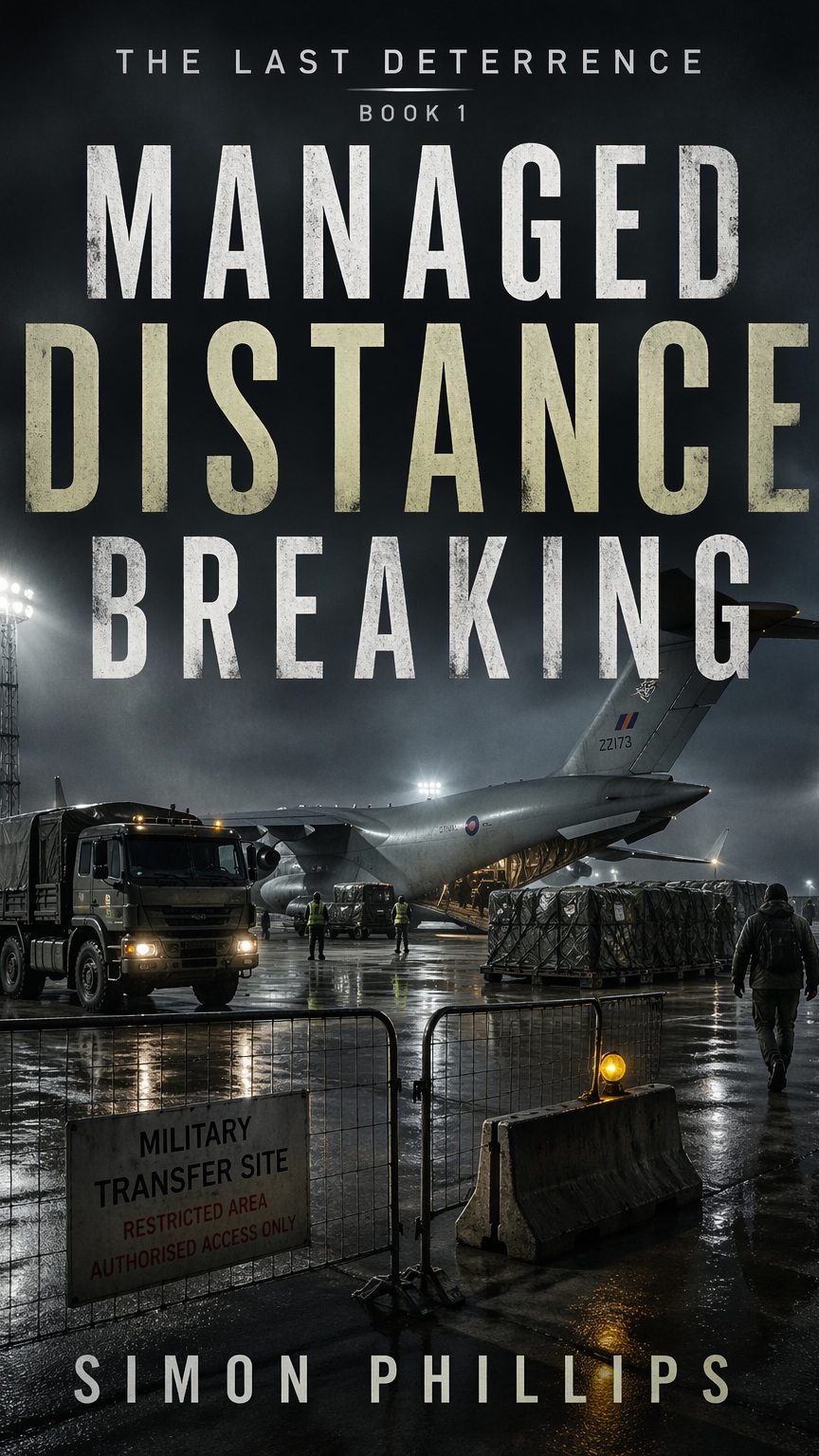
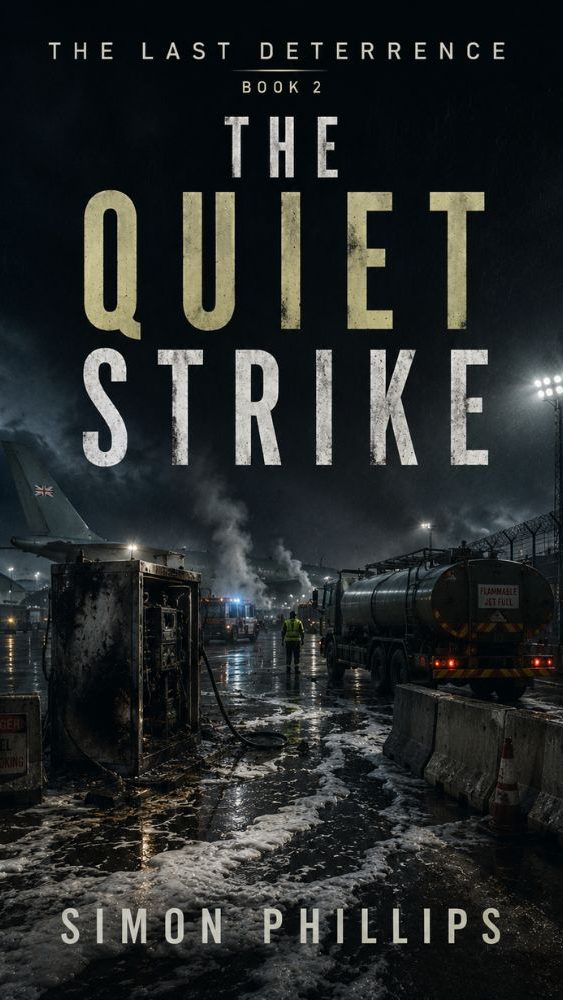
One such world unfolds through The Last Deterrence, a modern-war novella sequence beginning with Managed Distance Breaking and continuing in The Quiet Strike. Together, the first two books follow Britain as support language begins to fracture under freight pressure, European escalation, domestic infrastructure strain, and the growing sense that distance from war has already begun to fail.
Readers who wish to explore the wider published story world connected to this Chronicle can find the novellas below.
Explore the books:
The Last Deterrence: Managed Distance Breaking
The Last Deterrence: The Quiet Strike
You can watch his YouTube channel here:
Author Simon Phillips
Continuing the Chronicle
The following Chronicle reconstructs the discovery of a damaged unmanned device beyond an RAF transfer site, the tightening security response around the sealed service road, and the growing concern that the aircraft may have recorded more than its operators intended to reveal.
Readers supporting The Modern Chronicle can continue the record below.

Subscribe to continue reading
Subscribe to get access to the rest of this post and other subscriber-only content.
