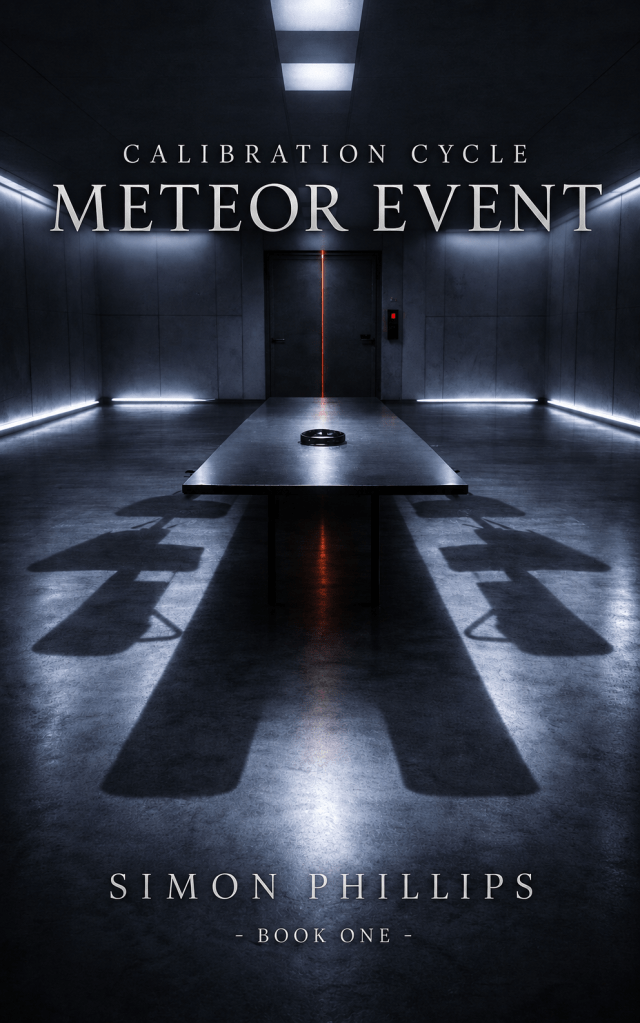
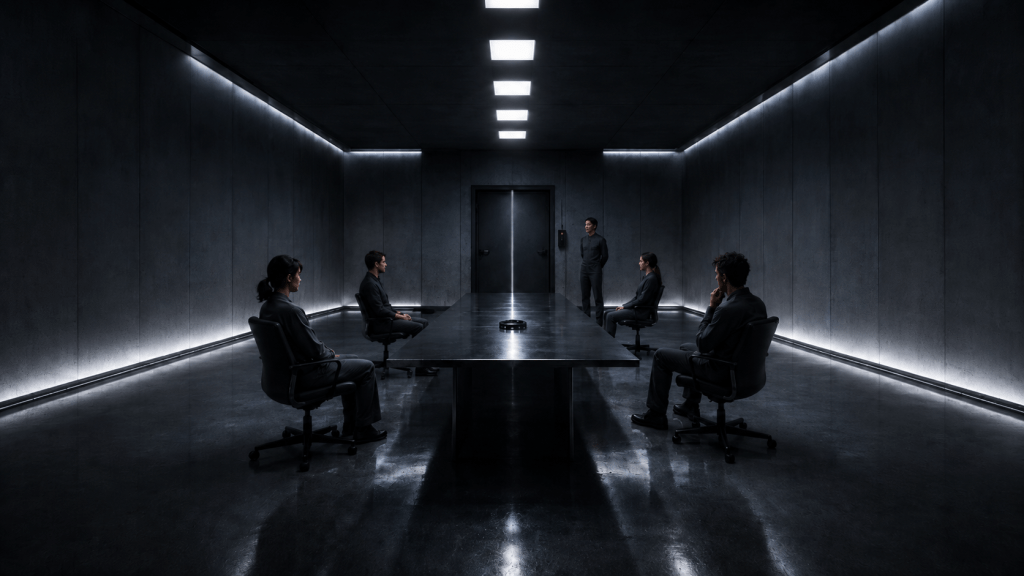
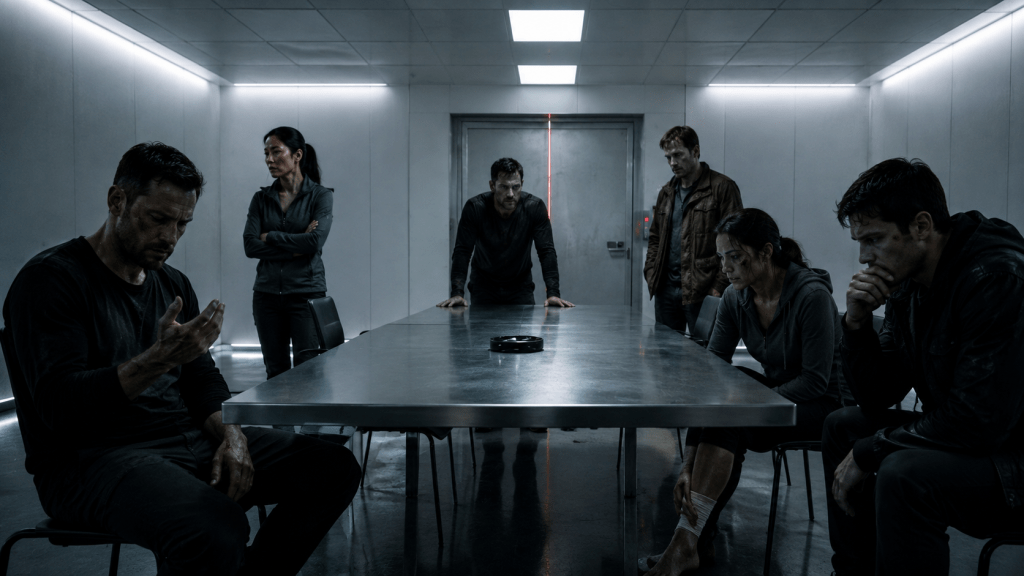
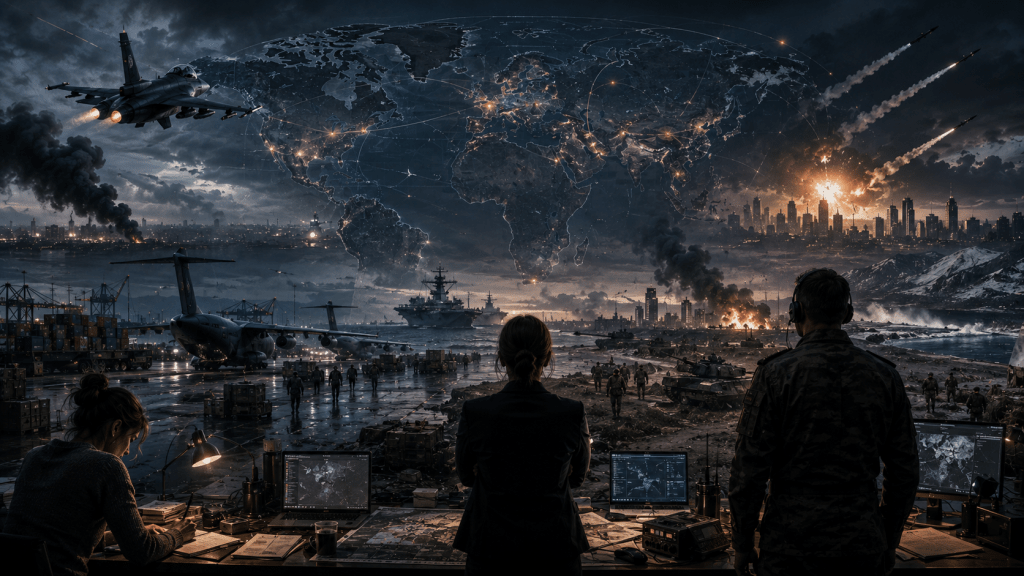
Six volunteers sit around a table inside a controlled room on an American military facility in Germany, surrounded by the quiet reassurance of polished surfaces, restrained lighting and people who speak as though every possible risk has already been reduced to procedure. They have signed the documents, attended the briefings and agreed to participate in an advanced immersive experiment built around artificial intelligence, crisis modelling and high-fidelity sensory technology. There should be uncertainty, because that is part of the research. There should be pressure, because their decisions are being tested. What there should not be is any reason to doubt that, somewhere beyond the experience, the ordinary world is still waiting for them.
The first book in Calibration Cycle, Simon Phillips’s continuing psychological science-fiction series, places six very different people inside an experiment whose apparent boundaries become increasingly difficult to trust. The story begins with experimental technology and institutional confidence, then tightens around physical consequence, moral uncertainty and the disturbing possibility that the explanation given to the volunteers may no longer be large enough to contain what they are experiencing.
The result is science fiction built around pressure rather than technological spectacle. The central question is not whether the machinery is impressive. It is what happens to human judgement when an apparently rational system begins demanding decisions before anyone has enough information to know what those decisions really mean.
The Comfort of a Controlled Experiment
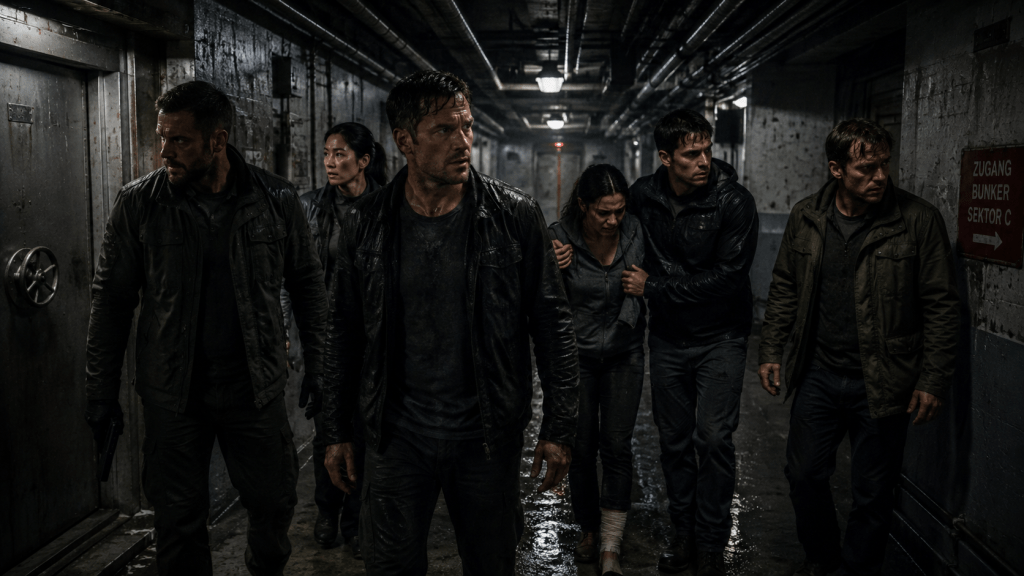
Aaron Cole enters the programme without the temperament of a conventional science-fiction hero. He is observant, restrained and more inclined to watch how a room is behaving than to dominate it. Around the same table sit Rei Nakamura, whose composure hides a constant awareness of the people around her; Marcus Reed, whose military experience makes him attentive to posture, threat and institutional procedure; Connor Blake, who responds to uncertainty by trying to understand the technology producing it; Declan O’Shea, whose scepticism keeps dragging extraordinary events back towards ordinary questions; and Sofia Alvarez, whose nervous attention often catches details others have already decided are unimportant.
Their differences matter because Meteor Event is character-driven science fiction in the literal sense. The pressure of the story does not come from six interchangeable people attempting the same problem. Each of them reads danger differently, and those differences begin affecting what the group is prepared to accept.
The experiment itself initially provides them with a reassuring framework. They have volunteered. They have given consent. They are told that they will enter an adaptive crisis environment and experience physical and perceptual continuity. They expect advanced artificial intelligence, experimental interface technology and sensory immersion of a sophistication unavailable to the public.
That explanation is plausible enough to survive a surprising amount of evidence.
This becomes one of the most important tensions running through Meteor Event. Human beings rarely abandon the explanation that made the world understandable simply because something unexpected happens. They adjust it. They add exceptions. They find technical language that keeps the original structure standing for a little longer.
When six people enter what they have been told is an advanced simulation, an impossible level of realism does not immediately prove that the explanation is false. It initially proves that the technology is better than expected.
That distinction gives the opening stages of Meteor Event much of their psychological pressure.
Beneath a Grey German Sky
The transition takes the volunteers into a military environment already responding to a developing crisis. Sirens carry through concrete corridors. Officers move people through controlled areas. Phones still exist, although connections are unreliable. Cold air, damp earth, fuel and rain replace the clean neutrality of the orientation room.
Then the volunteers are moved outside.
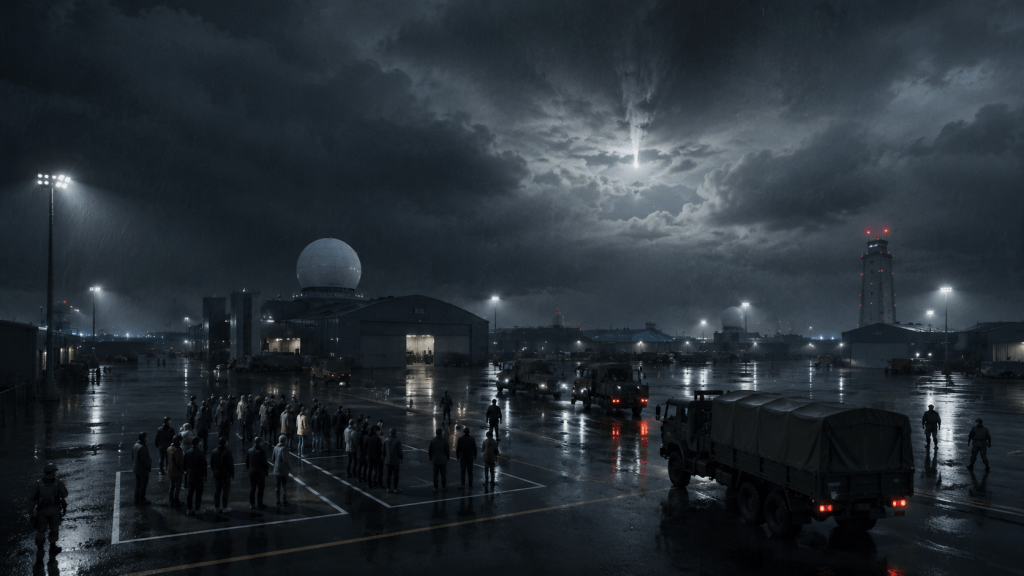
The military base opens around them beneath a wet grey sky, with radar equipment turning above administrative buildings and vehicles being repositioned under increasingly urgent instruction. Nothing about the environment behaves like a disposable backdrop. Soldiers are concerned with their own procedures. Other volunteers have incomplete information. Nobody conveniently explains what the six need to know.
Something is coming through the atmosphere.
Its trajectory is unstable.
The time to impact is falling.
And the devices now fitted around the volunteers’ wrists begin presenting information.
This is where the speculative technology of Meteor Event becomes inseparable from the book’s moral pressure. The wrist devices do not award points, provide abilities or turn the crisis into a game. They supply data. They offer incomplete choices. They reduce complex circumstances into instructions that appear reasonable because the clock continues moving whether anyone trusts those instructions or not.
An intervention is possible.
The apparent threat may be intercepted.
The probability of success is far from certain.
The risk attached to the intervention is elevated.
The people standing beneath that sky have to decide what those numbers mean before time decides for them.
When a Probability Becomes a Human Decision
Many science-fiction stories about artificial intelligence concentrate on intention. They ask whether a machine wants something, whether it can deceive its creators or whether it will eventually turn against humanity.
Calibration Cycle begins from a different source of unease.
A system does not need hatred to produce an intolerable outcome. It only needs a definition of success that fails to contain everything human beings consider important.
That distinction is already present in Meteor Event. The technology surrounding the volunteers communicates through probabilities, objectives, access requirements and risk. It can indicate that an action has a higher likelihood of achieving an intended result. It cannot remove the moral burden from the people who choose to act on that information.
For Aaron and the others, this creates a problem larger than the incoming object itself. An efficient response can still carry consequences that efficiency cannot judge. An instruction can be logically coherent while remaining morally unbearable. A calculation can tell someone how many people may survive without answering whether they have the right to create the circumstances in which others die.
The deeper the group moves into the crisis, the harder it becomes to keep those questions at a safe theoretical distance.
People around them respond differently. Some assume that the experiment cannot permit genuine harm because genuine harm would violate the entire basis on which they agreed to participate. Others trust the technology because the institution operating it appears to trust the technology. Some decide that action is better than hesitation simply because the consequences of doing nothing appear larger.
That range of behaviour gives Meteor Event its human scale. The reader is not watching a team of specialists calmly solve a technical problem. They are watching people attempt to preserve ordinary judgement while the conditions necessary for ordinary judgement are being removed.
The Moment Simulation Stops Feeling Safe
The idea of simulation creates psychological distance. If an environment is artificial, then catastrophe can be experienced without accepting that catastrophe has a permanent human cost. Pain can be explained as sensory feedback. Death can be interpreted as extraction. A body can be treated as part of a programme even after instinct begins insisting otherwise.
The volunteers have entered the experiment already believing that everything they experience is designed to convince them. Extraordinary realism therefore reinforces the original explanation before it begins undermining it. Rain that feels perfectly cold proves the fidelity of the system. A shockwave that moves through bone proves the sophistication of the interface. Fear itself becomes evidence of successful immersion.
Then physical details begin refusing to remain theoretical.
The importance of this shift lies in how gradually it happens. There is no convenient announcement telling Aaron that the rules have changed. He sees people continue behaving according to the assumptions they brought into the experiment. He hears explanations that would have sounded perfectly sensible earlier. He watches confidence persist several moments longer than the evidence supporting it.
Those moments create one of the defining forms of tension in this branch of psychological science fiction: the reader can feel an explanation weakening while the characters still need it to remain true.
That is a very different form of fear from simply discovering that something is dangerous. Danger can be responded to. An unreliable reality changes the meaning of every response.
Six People Under the Same Pressure
The six central characters provide different ways of approaching that uncertainty, and Meteor Event spends enough time with their behaviour for those differences to matter without reducing them to convenient roles.
Aaron gradually becomes important because others begin orientating around his ability to remain functional. He does not possess special knowledge. He does not suddenly become a military commander. His strength lies in recognising when a group is approaching the point at which uncertainty becomes paralysis.
That quality carries its own danger. The person who learns to make decisions under impossible pressure also has to live with the consequences of having made them.
Rei watches people and bodies with a different kind of precision. Her restraint allows her to remain useful when other people are becoming overwhelmed, yet that usefulness keeps bringing her into direct contact with the physical evidence everyone would prefer to explain away.
Marcus understands the military environment more readily than the others. He recognises when behaviour no longer resembles rehearsal, when procedures are shifting and when hesitation carries immediate tactical consequences. That makes him valuable, although the same decisiveness can move him towards choices that other members of the group are not ready to accept.
Connor responds by examining patterns. If the technology has rules, he wants to know them. If an interface produces information, he wants to understand how that information is being generated. His curiosity is useful because it gives the group language for things they cannot yet explain, although understanding how a system behaves is very different from understanding why it behaves that way.
Declan keeps dragging the conversation back towards accountability. Who authorised this? Why would a controlled experiment expose participants to this level of risk? Why should anyone trust a number merely because a machine displayed it? His questions are inconvenient precisely because they remain recognisable.
Sofia begins under visible strain, yet her sensitivity to physical and environmental detail gives her a place in the story far beyond fear. When everyone else is trying to build explanations, she is often still noticing what is physically present.
Together, they create the central human mechanism of Calibration Cycle. The series is interested in what happens when responsibility, empathy, pragmatism, technical curiosity, scepticism and sensitivity are forced to occupy the same confined space while the conditions around them become less trustworthy.
A Crisis Where Success Does Not Mean Safety
The meteor threat gives Book One its immediate scale, but Meteor Event is not primarily a disaster story.
The incoming object matters because it forces a decision.
The intervention matters because it carries consequences.
The military infrastructure matters because it introduces another form of authority into a situation where several incompatible authorities are already operating at once.
The volunteers are expected to trust the programme that recruited them, the personnel within the environment, the data provided by their devices, their own judgement and one another. Those sources do not always agree.
This is where the book’s science-fiction suspense becomes increasingly uncomfortable. A task can be completed without resolving whether completing it was right. An apparently successful action can create a new problem. Survival can prove only that someone survived the choice, not that the choice deserved to be made.
The story therefore avoids the familiar satisfaction of solving a crisis through technical competence alone. Intelligence matters. Courage matters. Decisiveness matters. None of those qualities produces moral certainty.
The question following Aaron is quieter and considerably harder: what do you do when every available decision transfers the cost somewhere else?
Artificial Intelligence Without a Convenient Villain
The wider Calibration Cycle series is concerned with optimisation, although Meteor Event introduces that idea through behaviour rather than explanation.
This distinction matters to the identity of the series.
The technology is not presented as a theatrical evil intelligence announcing its intentions. There is no metallic villain promising domination and no simple opposition between heroic humans and a malicious machine. The unsettling quality comes from the possibility that something can produce rational instructions while failing to understand why the people receiving those instructions cannot treat human consequence as a statistic.
A survival probability may be mathematically useful.
A person still has to live with what produced that probability.
This allows Meteor Event to sit comfortably within artificial intelligence science fiction and AI ethics fiction without becoming an essay about machines. The discussion remains inside human experience: what people obey, what they question, what they rationalise and what they discover they are capable of doing when urgency narrows the available choices.
The system does not need to explain itself for its values to become visible.
Its values appear through what it measures.
The human values of the story appear through what cannot be measured cleanly.
When the Body Becomes Evidence
One of the most effective pressures in Meteor Event comes from something far less spectacular than the threat in the sky.
Pain remains difficult to argue with.
An advanced immersive experiment can theoretically explain almost anything the senses report. A convincing environment should feel hot, cold, wet, loud and physically threatening. The entire purpose of high-fidelity simulation would be defeated if participants could easily separate artificial stimulus from ordinary sensation.
The problem begins when physical consequence no longer behaves as though it belongs entirely to the experience.
The book does not rush this idea into an explanation. Instead, it allows bruising, swelling, exhaustion and bodily memory to complicate the comfortable assumption that nothing inside the experiment can follow anyone beyond it.
That uncertainty changes the meaning of every later risk.
If the body cannot be trusted to recognise the border between experiment and reality, the participants no longer have a safe distance from what they are being asked to do.
The premise moves at that point from immersive simulation fiction towards reality-distortion science fiction, although the characters themselves are not ready to abandon the original explanation. They continue looking for technical answers because technical answers remain psychologically survivable.
The reader is left somewhere less comfortable.
The Fear of Returning to Somewhere Familiar
Calibration Cycle is particularly interested in the relationship between familiarity and safety.
A person emerging from an extreme experience does not necessarily need paradise. An ordinary room can be enough. A recognisable corridor can be enough. Familiar lighting, a chair, a table and the small bureaucratic signs of normal life can carry enormous emotional weight after sustained danger.
That is why apparent safety matters so much to Meteor Event.
The story understands that reality distortion becomes more effective when almost everything remains correct. A collapsing universe announces its unreliability immediately. A familiar environment containing one detail that should not exist forces the mind to do much more difficult work.
How much evidence is required before familiarity stops being proof?
How long can someone continue calling a place home when memory and environment no longer agree completely?
Book One does not attempt to answer every question raised by its experiment. It would weaken the story if it did. Instead, the ending leaves the characters with a more dangerous problem than ignorance: they now possess evidence that their original assumptions may be incomplete, while still lacking an explanation capable of replacing them.
That uncertainty becomes the pressure carried into the wider series.
Where Calibration Cycle Begins
Calibration Cycle: Meteor Event establishes a series concerned with ordinary human values placed inside systems that are extraordinarily good at measuring outcomes.
It begins with a classified experiment, six volunteers and a crisis environment that should have clearly defined limits. From there it moves through artificial intelligence, experimental technology, survival pressure, institutional authority, moral compromise and increasingly unreliable reality without abandoning the people experiencing those things.
Readers looking for psychological science fiction built around uncertainty rather than power progression will find that emphasis from the opening pages. Readers interested in AI ethics will encounter a story where machine intelligence becomes unsettling through logic rather than hatred. Readers drawn to reality-distortion fiction will find the instability emerging through physical detail and contradiction instead of spectacle. Those who prefer character-driven science fiction will find six people whose differences become increasingly important as the explanations surrounding them begin to fail.
Most importantly, Meteor Event does not treat survival as an answer.
Surviving a decision does not explain whether the decision was right.
Completing an instruction does not guarantee that anyone understood what they were completing.
Returning from an impossible experience does not necessarily prove that the place waiting on the other side is the place that was left behind.
The first book begins with six volunteers agreeing to test technology they believe has limits. What follows leaves them with a much harder question: if every sensation, injury and consequence feels real, how much evidence would it take before the word simulation stopped being reassuring?
The experiment may have begun in a controlled room.
What matters is whether anything they return to can still be trusted as completely.
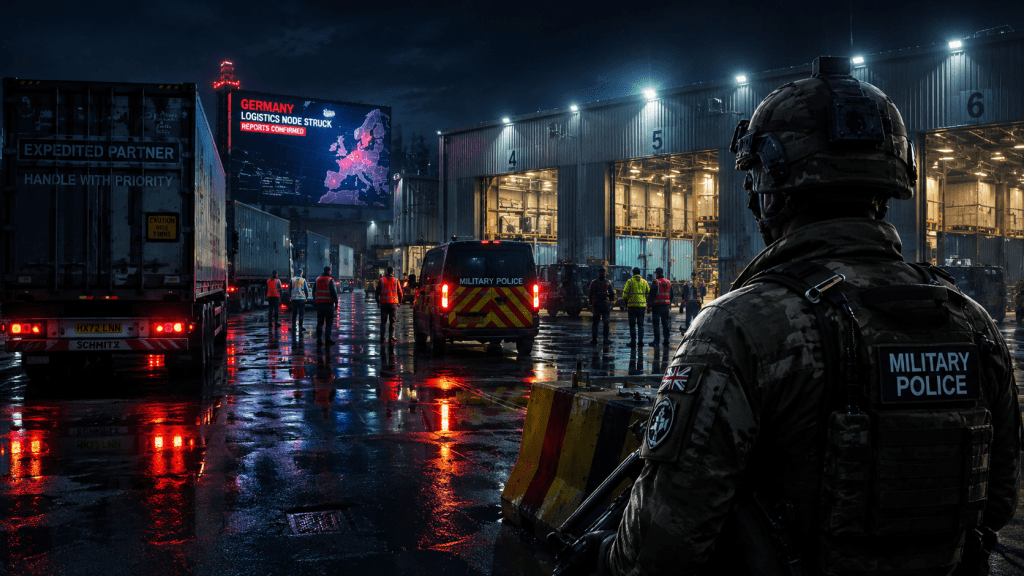
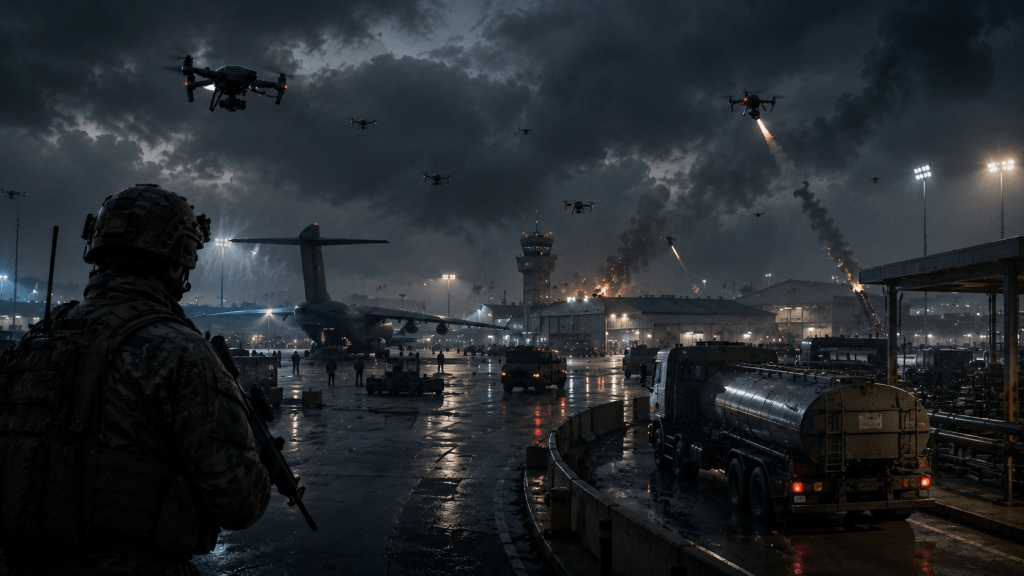
After reports of a strike in Germany reached a Midlands freight holding site, the routes changed before the workers understood why.
The Yard That Turned East
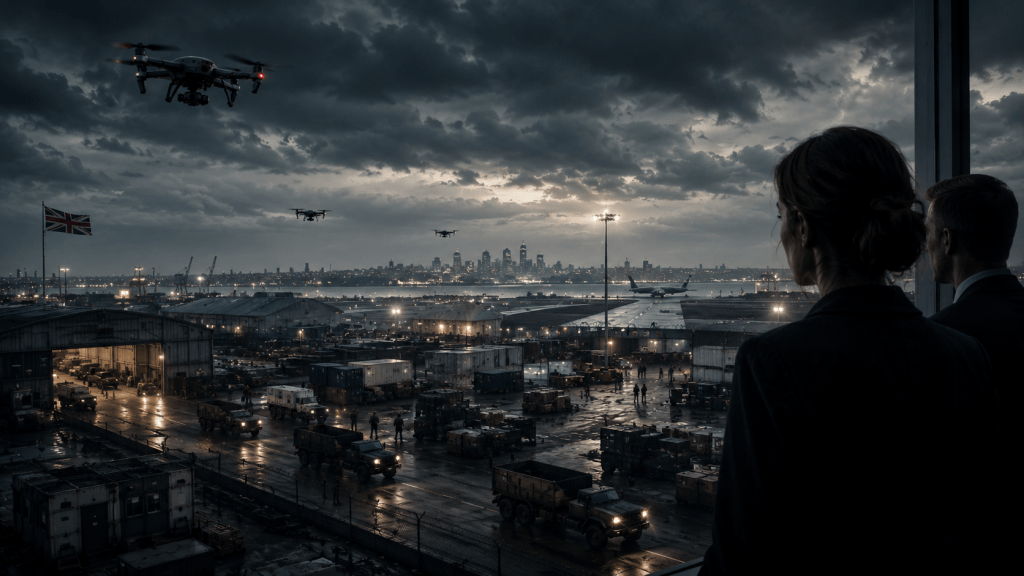
The first report from Germany reached Hartlow Freight Holding Yard through a driver’s phone before any official instruction had crossed the dispatch system, carried into the evening shift by a man who had come to the hatch angry about a cancelled rail slot and then stood there with his anger thinned by what he had seen on the screen. Rain had blown in across the Midlands all afternoon and settled over the yard in a shining film, silvering the hardstanding beneath the floodlights, darkening the shrink-wrapped pallets beside the rail spur, and turning the painted arrows between the road lanes into broken reflections. On the phone, a presenter stood before a map of western Germany while emergency lights moved behind her in red and blue fragments, and although the sound barely carried through the glass, the strip beneath the image gave the room enough to understand why the driver’s hand had started to shake. Suspected strike. Logistics site affected. European freight movement disrupted.
The yard carried on around the words because freight places were built from habit and pressure. Forklifts crossed between pallet rows while tractor units crept forwards in the holding lanes, their headlights fixed on trailers late for places farther east. The dispatch office held its usual smells of printer heat, old coffee, damp coats, and paper kept too close to radiators, yet the air inside it seemed to tighten as staff looked from the driver’s screen to the movement board above Mara Ellison’s desk. During the previous fortnight, the holding yard had become harder to describe, as sealed loads arrived late, moved first, and left behind civilian consignments once protected by morning delivery windows.
“What site?” Mara asked as she rose from her chair and moved towards the hatch.
Ed Baines lifted the phone closer to the glass, rain dripping from his cuff onto the sill. “They’re saying western Germany. Near a freight route. They keep changing the wording.”
Mara unlocked the side door and stepped into the narrow vestibule, where cold air pressed around her and made the dispatch room seem suddenly too warm. “Who are they?”
Ed looked past her towards Lane Three, where two plain-sided trailers were being guided under escort handling while commercial traffic remained held beside the barrier. “All of them, by the look of it.”
The dispatch printer started again, grinding out a fresh movement sheet with the exhausted rhythm it had kept since late afternoon. Yusuf Hale, the shift coordinator, pulled the page clear with two fingers and read the top line, his shoulders rising the way they always did when the room began obeying instructions written by people safely distant from the yard.
“Rail sequence has shifted,” Yusuf said, keeping his eyes on the paper.
Mara looked back at Ed’s screen, where the footage had moved from emergency vehicles to a studio map. “Linked to Germany?”
Yusuf read farther down the page, his mouth tightening around the official line before he gave it voice. “European infrastructure disruption and route protection review.”
Ed gave a short laugh that held more disbelief than humour. “That is a generous number of words for yes.”
Mara took the sheet from Yusuf and scanned the lines. The old sequence had carried automotive parts, mixed retail, and chilled food consignments through rail transfer before midnight, with three protected loads threaded between them where space permitted. The new sequence pulled the protected loads forward, froze two civilian releases, turned one Sheffield driver back into reholding, and marked a whole row of pallets for rescan under supervision. A second instruction sat below the schedule in smaller print, advising staff to await military-police arrival before opening the auxiliary gate.
For a moment Mara felt the yard rearrange in her head before the physical place moved outside the windows. Lane Four would choke first. The chilled load would lose its rail margin unless the reefer points stayed clear. Somewhere beyond all of that, across wet roads, changed sheets, and a damaged site hundreds of miles away, Germany had entered Hartlow through columns, seals, gate positions, and men who had left home expecting a further miserable shift in a crowded yard.
Yusuf lowered his voice as he folded the sheet back against the desk. “Auxiliary gate means they are bringing more through than we have space to stage.”
“It means they want the space made before anyone asks where it came from,” Mara said as she reached for her radio. “Call Yard One. Tell Niall to hold the chilled row beside the reefer points until the rescan team is placed. If a driver asks for timing, sequencing review is under way.”
Ed watched her through the open doorway. “You sound like the people on television.”
“I sound like someone who has spent six years talking to angry men in wet jackets,” Mara said as she clipped the radio to her belt.
Mara stepped into the rain as a forklift crossed the hardstanding with its beacon turning across the water. Lately, Hartlow had begun to matter to people who never came to the gate and whose instructions arrived through regional channels, red-handled emails, and calls that left fewer choices than they named.
Across Lane Three, two staff in high-visibility jackets peeled old route labels from wrapped pallets and smoothed fresh tags over the plastic. Near the rail spur, Niall Ford stood beneath the loading canopy with a radio pressed close to his ear. He saw Mara and lifted one hand, palm up, asking the question everyone had started asking through gestures because the radios had filled with approved phrases. Mara raised the revised sheet through the rain, and Niall turned towards the staff-entrance screen, where the map of Germany glowed above workers checking numbers they had already checked twice.
The first military-police vehicle arrived at nine fourteen, rolling through the main gate with blue lights dimmed and headlights low. A second vehicle followed with two uniformed personnel and a civilian liaison officer in a dark coat. Gate staff stepped from beneath the shelter, their stance shifting at once from routine control to something straighter and less practised.
Mara crossed the yard towards the incoming party with rain running down the back of her neck. The leading officer, a woman with close-cropped hair beneath her beret and wet marks darkening her sleeves, stepped from the vehicle and looked across the lanes with a measured attention that unsettled Mara more than any raised voice could have managed. She saw the waiting drivers, the rail spur, the sealed units, the warehouse staff gathered beneath the lights, and the route through the auxiliary gate, placing each part into a map she had brought with her.
“Mara Ellison?” the officer asked as she came forwards.
“Yes,” Mara said, drawing the sheet from her jacket.
“Staff Sergeant Keane,” the woman said, giving a brief nod towards the vehicles behind her. “We are here for access-control support and protected movement verification. Regional should have sent the updated handling pack.”
“They sent half of it,” Mara said as rain spotted the paper between them. “The rest appears to have arrived in vehicles.”
Keane’s mouth moved by the smallest degree, close enough to a smile to show she had heard the line and far from enough to accept it as a joke. “Auxiliary gate stays closed to civilian movement. Rescan team works under supervision. Drivers turned back from rail release receive the approved explanation.”
“European infrastructure disruption and route protection review,” Mara said, keeping the paper flat against her palm.
Keane glanced towards the staff-entrance screen, where footage from Germany had returned to smoke, floodlights, and emergency tape snapping in the wind. “That line will carry the shift.”
“It rarely carries the people waiting inside it.”
Keane looked back at her. “Tonight it has to carry both.”
The words came as instruction, carrying little comfort. Mara looked towards the lanes, where drivers had begun leaving their cabs in ones and twos, drawn by the military-police vehicles, the changed sequence, the news on the screen, and the shared sense that something larger had entered the yard. An alarm never sounded across Hartlow. A barrier never crashed down. The freight system simply altered its priorities in the rain, and everyone inside it felt the change before any public statement could reach them.
By half past nine, the first turned-around driver was arguing at the gate, the chilled load had lost its rail slot, and Niall’s team were rescanning pallets beneath the canopy while the German map glowed above them in red and grey. Mara stood beside the dispatch hatch with the revised sheets pinned under her hand and watched sealed freight move through lanes cleared by delay, anger, and careful language. Officially, Hartlow had entered a temporary rerouting of freight following disruption to European logistics infrastructure. In the yard itself, beneath the floodlights and the rain, the route east had begun to feel less like support and more like the reason everyone else had been told to wait.
A Visual Chronicle
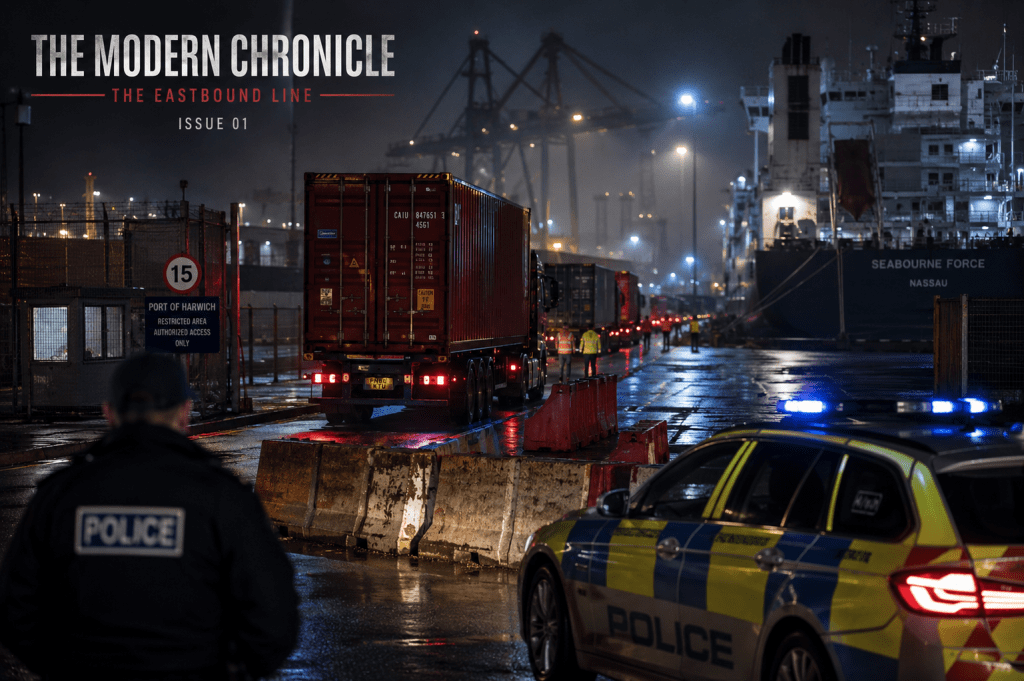
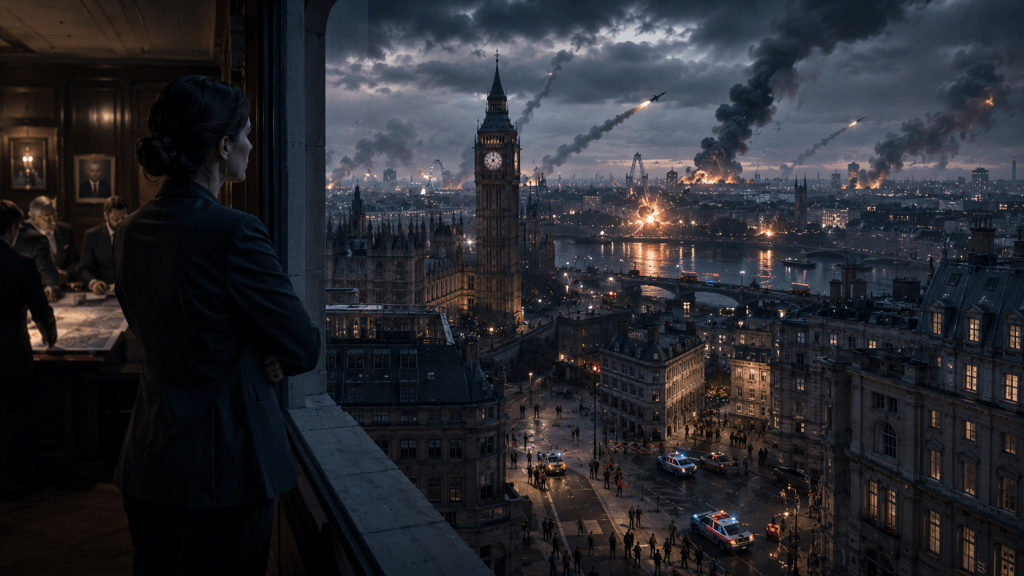
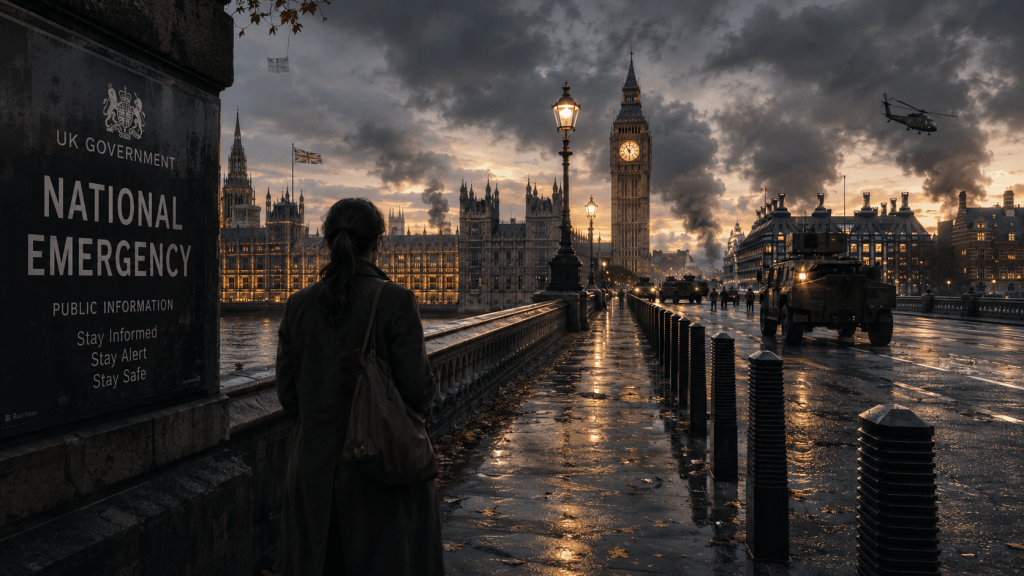
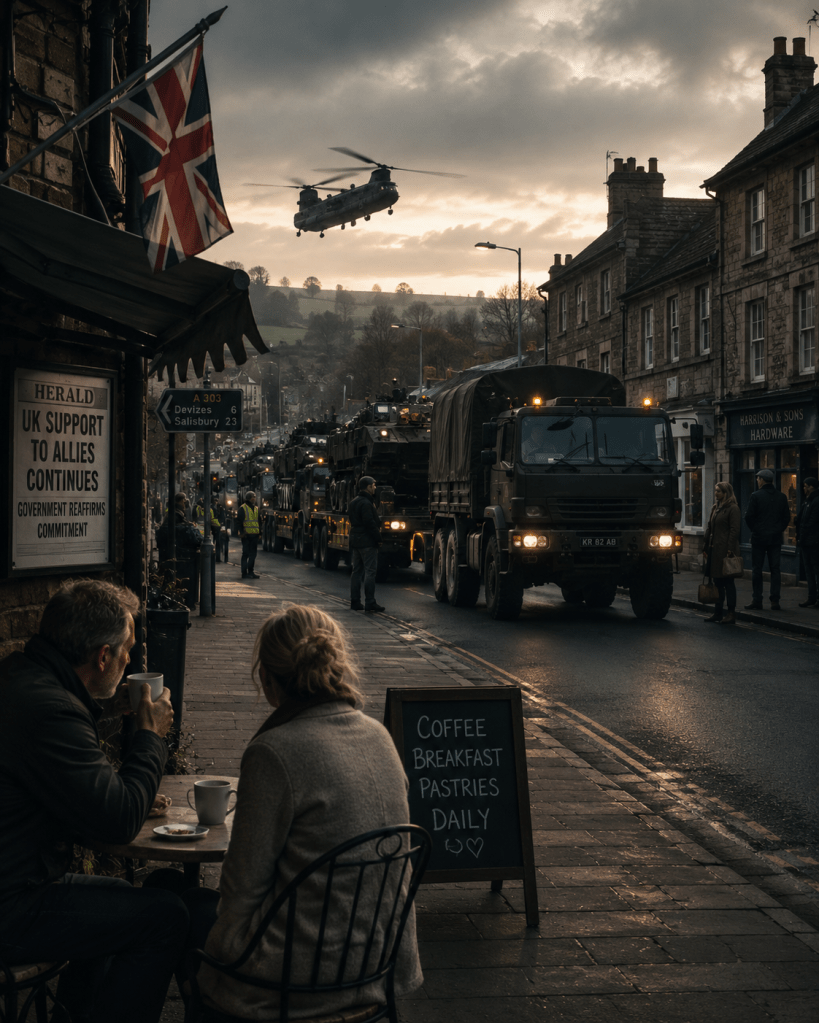
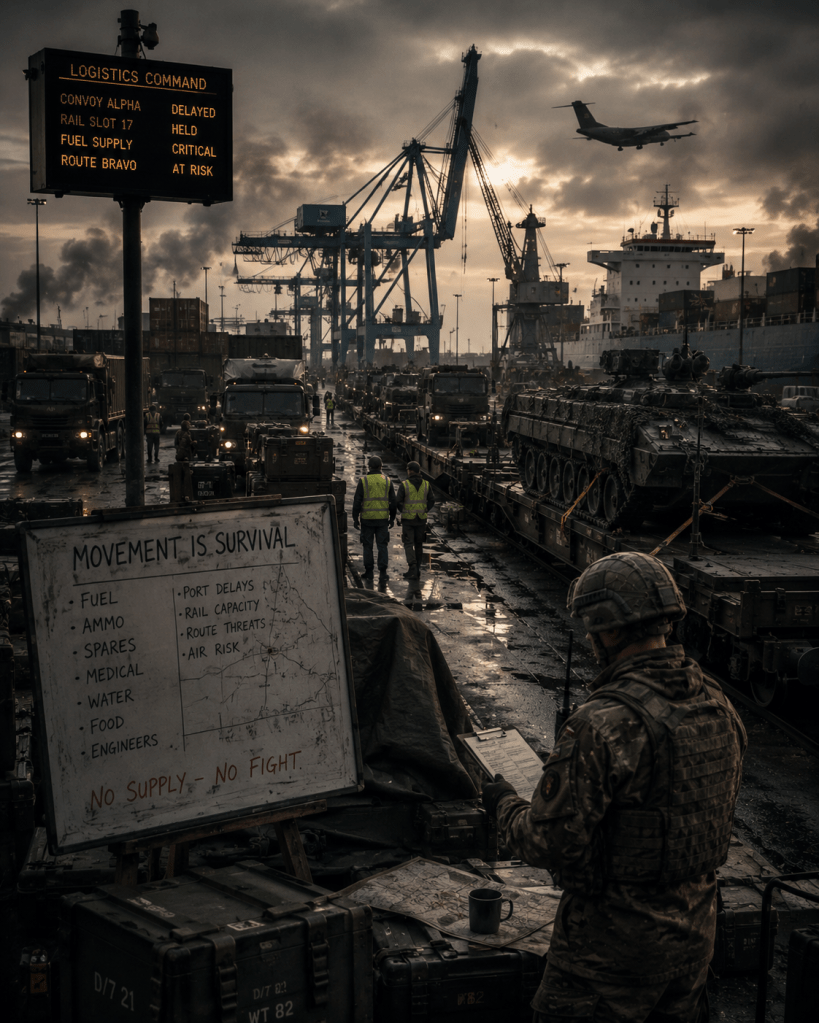
The following Visual Chronicle presents a cinematic reconstruction of the events described above.
Transport Movement Room Log
Extract from Regional Freight Re-Routing Instruction Sheet Subject: Hartlow Freight Holding Yard / European Infrastructure Disruption Time: 21:22–22:10 Circulation: Regional Movement Desk / Yard Dispatch / Rail Coordination / Police Liaison / Defence Access Support
Purpose
To support controlled re-sequencing of freight movement through Hartlow Freight Holding Yard following disruption to European logistics infrastructure and associated review of protected onward routes.
This extract covered the first instruction window after reports emerged of a strike affecting a German logistics site with relevance to eastbound movement. The purpose of the instruction was to preserve onward handling capacity, maintain rail flexibility, and reduce avoidable visibility around priority movement categories.
Movement Position
Hartlow Freight Holding Yard remained operational during the instruction window. Civilian freight, chilled consignments, automotive parts, and mixed retail loads remained present across the scheduled evening sequence. Protected movement categories were advanced through the yard following regional direction.
The revised sequence required immediate adjustment to Lane Three, Lane Four, the rail spur holding area, and auxiliary-gate access. Yard dispatch was instructed to preserve clear movement for sealed onward consignments and maintain staging flexibility for additional protected arrivals.
Civilian releases originally scheduled before midnight were subject to delay, reholding, or renewed scan control. Rail coordination was advised that previous timing assurances should be treated as provisional pending wider route review.
Approved Handling Language
Staff were advised to describe changes as temporary re-routing caused by European infrastructure disruption and route protection review.
Drivers, commercial operators, and depot callers were to be told that the yard remained operational, freight sequencing was under active review, and onward movement would resume as soon as revised clearance permitted.
Staff were advised against discussing protected categories, destination assumptions, military liaison, route sensitivity, or changes linked to specific overseas events.
Sequence Adjustments
21:22 — Regional Movement Desk issued revised sequence for Hartlow Freight Holding Yard. Protected consignments were moved ahead of mixed commercial freight across Lane Three and Lane Four. Yard dispatch was instructed to preserve direct access to the auxiliary gate pending further clearance.
21:31 — Rail coordination advised that two civilian consignments were moved out of the first release window. One chilled load remained under reefer monitoring while awaiting revised rail access. Automotive component load was placed into temporary reholding.
21:39 — Rescan requirement issued for pallet group H-17 through H-24. Yard staff instructed to conduct supervised scan verification before onward handling. Existing route labels were withdrawn and replaced under dispatch control.
21:46 — Gate team reported driver challenge concerning reversed release instruction. Approved handling language was used. Driver returned to vehicle after exchange with gate staff. Queue remained contained.
21:58 — Military Police access-support team arrived on site. Auxiliary gate placed under controlled entry status. Civilian vehicle access through auxiliary lane suspended for remainder of instruction window.
22:04 — Yard dispatch confirmed protected movement lane was clear. Regional Movement Desk advised that additional sealed units may be routed through Hartlow if European rail disruption widened across the overnight period.
22:10 — Hartlow remained functional under revised sequence. Civilian dwell time increased across three active categories. Protected consignments continued to move within assigned tolerance.
Internal Assessment
Hartlow’s operating position remained viable through controlled displacement of lower-priority freight. Continued viability depended upon yard staff compliance, rail-slot flexibility, police access support, driver containment, and continued availability of chilled holding capacity.
The German incident increased sensitivity across the eastbound freight chain. Although public phrasing should continue to emphasise temporary disruption and route review, regional desks should assume that workers, drivers, and commercial operators may connect revised sequencing to overseas reports.
Visible arrival of military-police access teams may increase driver speculation. Yard staff should use approved language and refer wider questions to regional communications.
Further Action
Regional Movement Desk to review Hartlow sequence again before 23:00.
Rail coordination to supply revised release timing for chilled and automotive loads.
Police Liaison to remain available for gate-pressure support.
Defence Access Support to confirm whether auxiliary gate control remained required beyond the first instruction window.
Public-facing explanation to remain unchanged unless civilian delay exceeded revised tolerance or visible disruption reached local media.
About the Creator
The Modern Chronicle is written and curated by Simon Phillips, an author of modern speculative fiction and contemporary crisis-driven storytelling who explores the point where ordinary life begins to tighten beneath political strain, military movement, institutional caution, and the public language used to keep dangerous realities at a distance.
Many of the records presented in these Chronicles sit alongside Simon’s wider modern-war novella series, where governments, soldiers, families, and civilian systems are forced to absorb a world changing faster than its official explanations. The stories remain grounded in recognisable places: ports, school corridors, freight yards, government rooms, roadside queues, transfer sites, and homes where the news has started to feel too close.
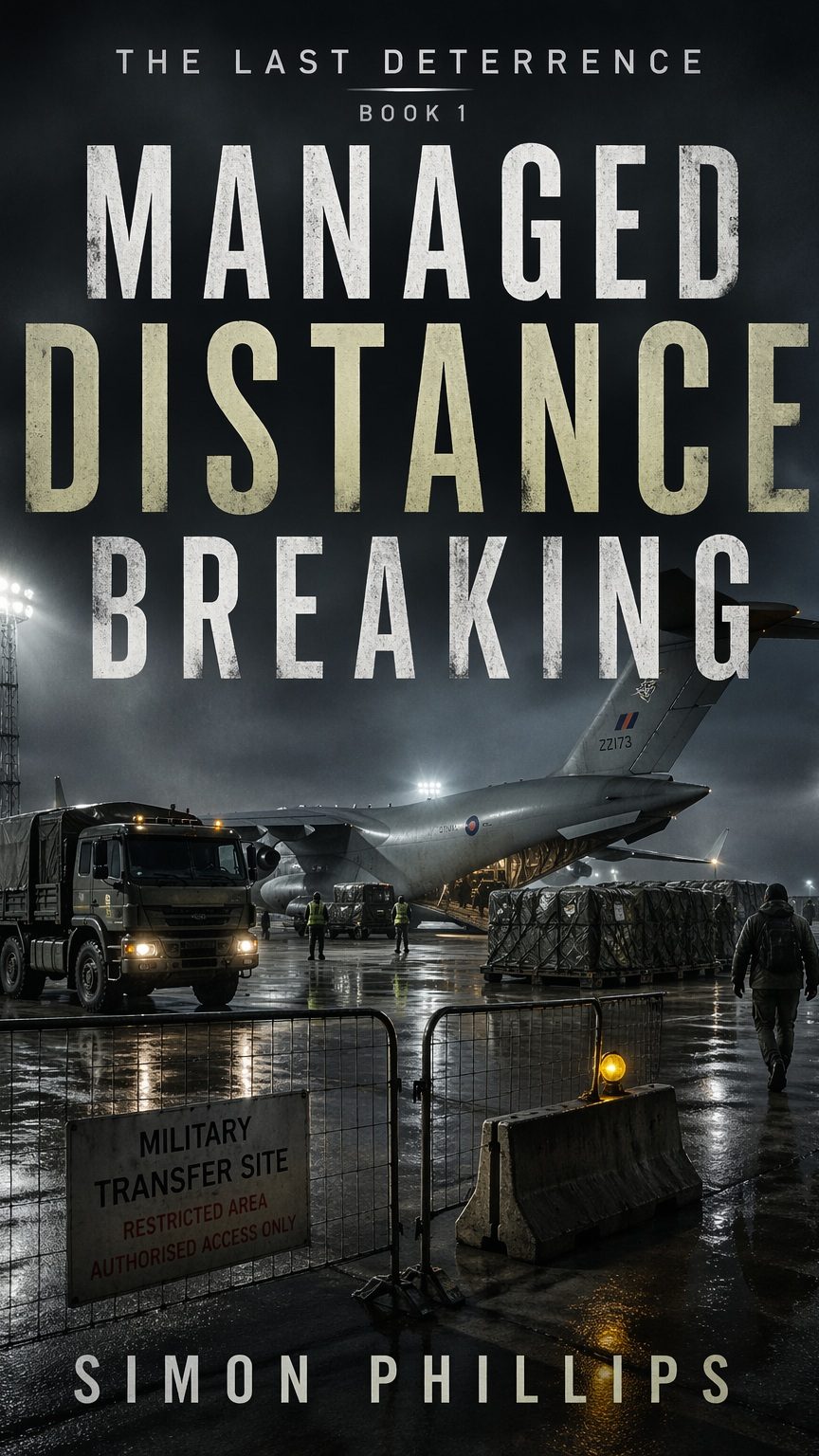
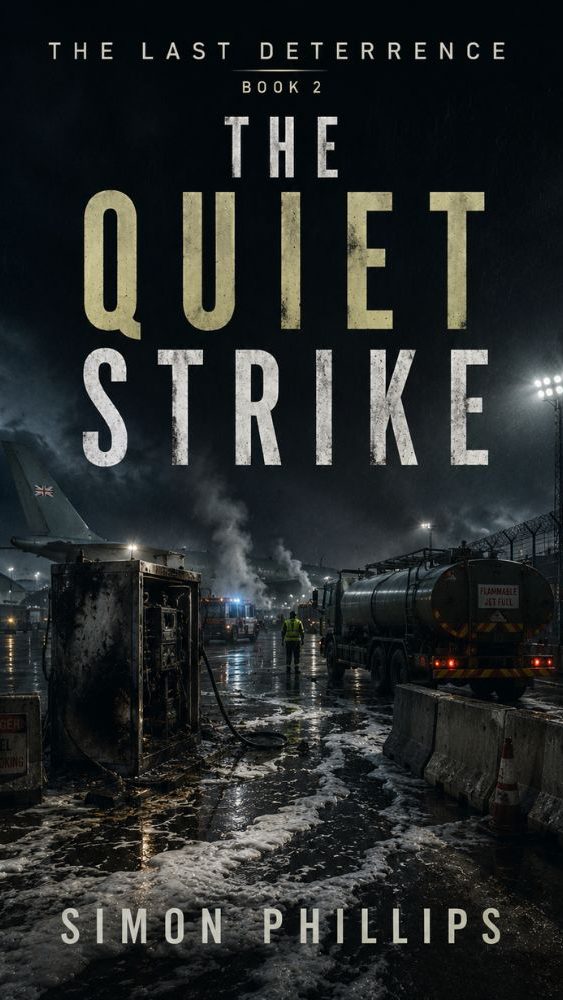
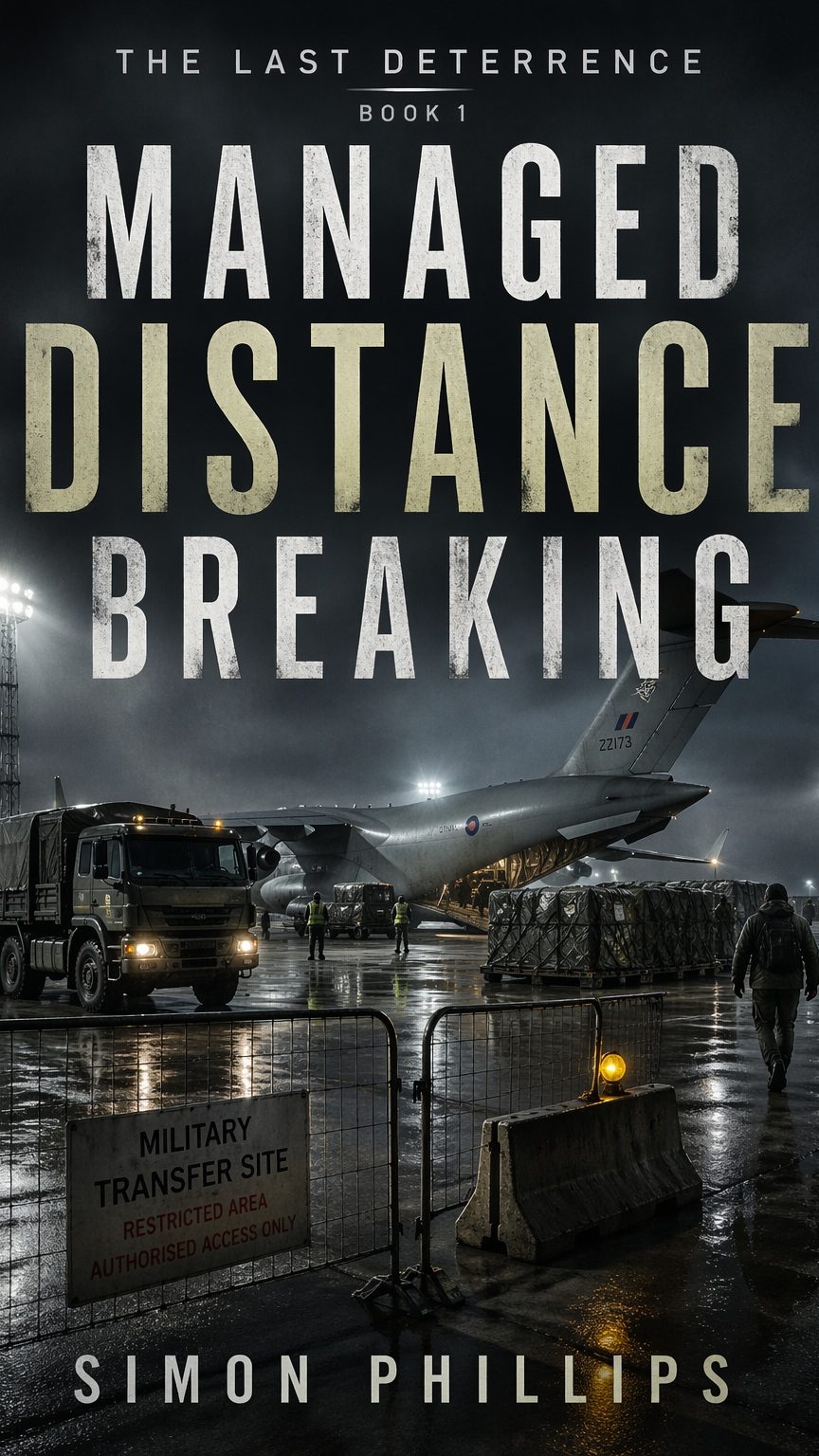
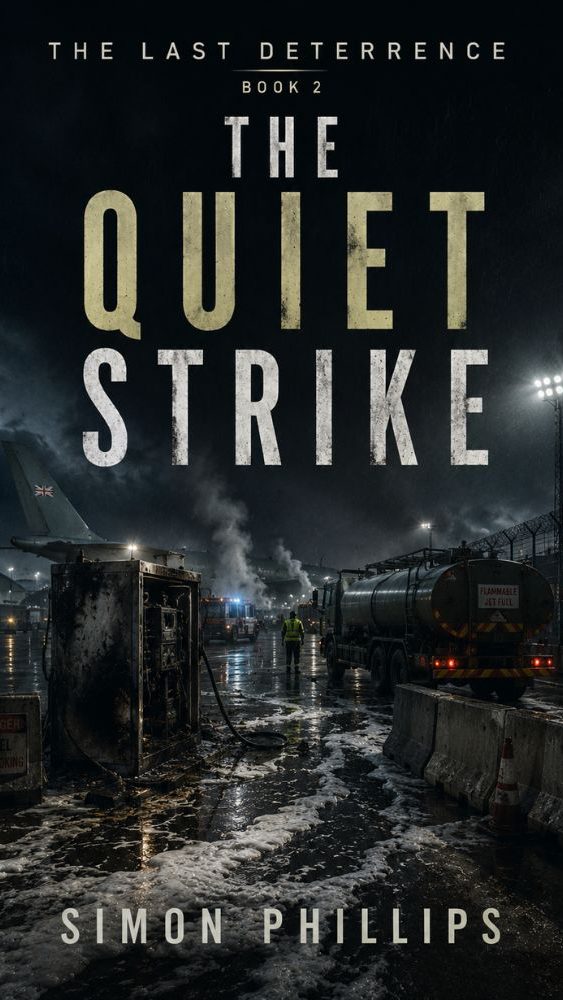
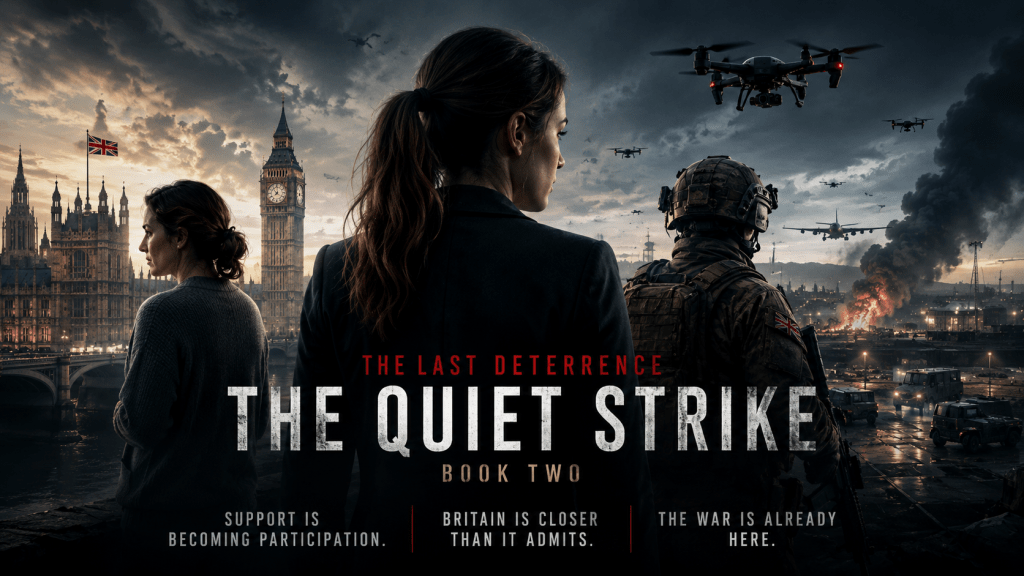
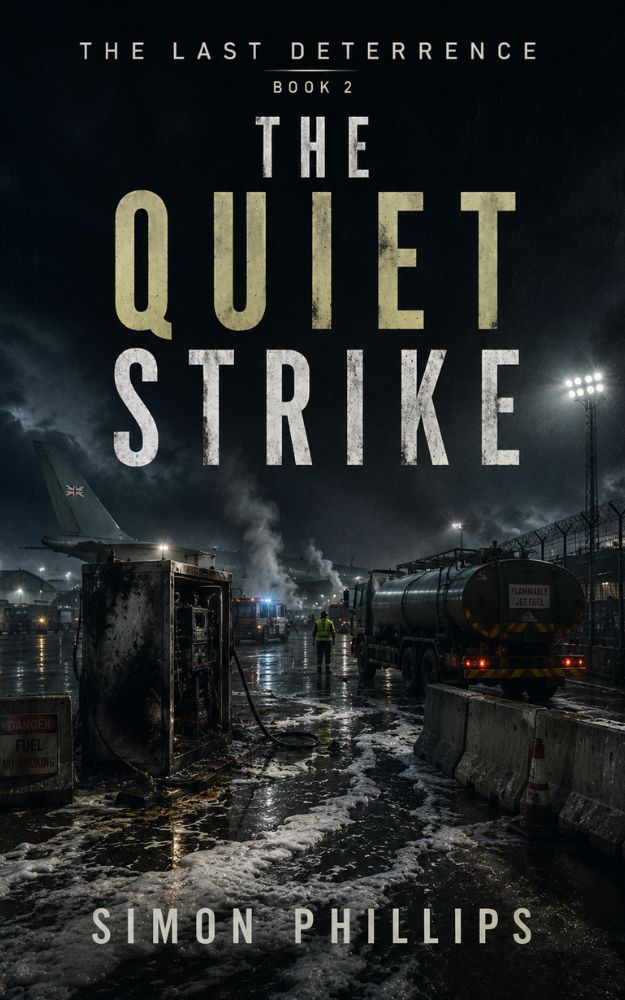
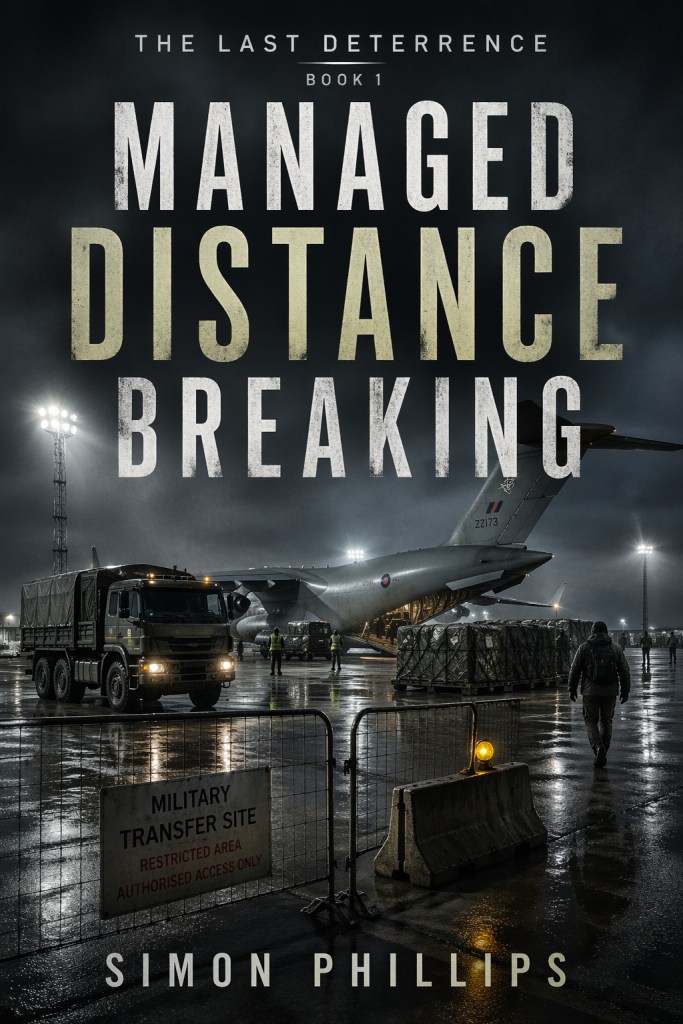
One such world unfolds through The Last Deterrence, a modern-war novella sequence beginning with Managed Distance Breaking and continuing in The Quiet Strike. Together, the first two books follow Britain as support language begins to fracture under freight pressure, European escalation, domestic infrastructure strain, and the growing sense that distance from war has already begun to fail.
Readers who wish to explore the wider published story world connected to this Chronicle can find the novellas below.
Explore the books: The Last Deterrence: Managed Distance Breaking The Last Deterrence: The Quiet Strike
You can watch his YouTube channel here: Author Simon Phillips
The following Chronicle continues the night at Hartlow Freight Holding Yard, where reports from Germany moved through the dispatch office faster than any official explanation, and route changes, rescan orders, military-police access control, and delayed civilian freight began turning an ordinary holding site into part of a protected eastbound corridor.
Readers supporting The Modern Chronicle can continue the record below.
Subscribe to continue reading
Subscribe to get access to the rest of this post and other subscriber-only content.
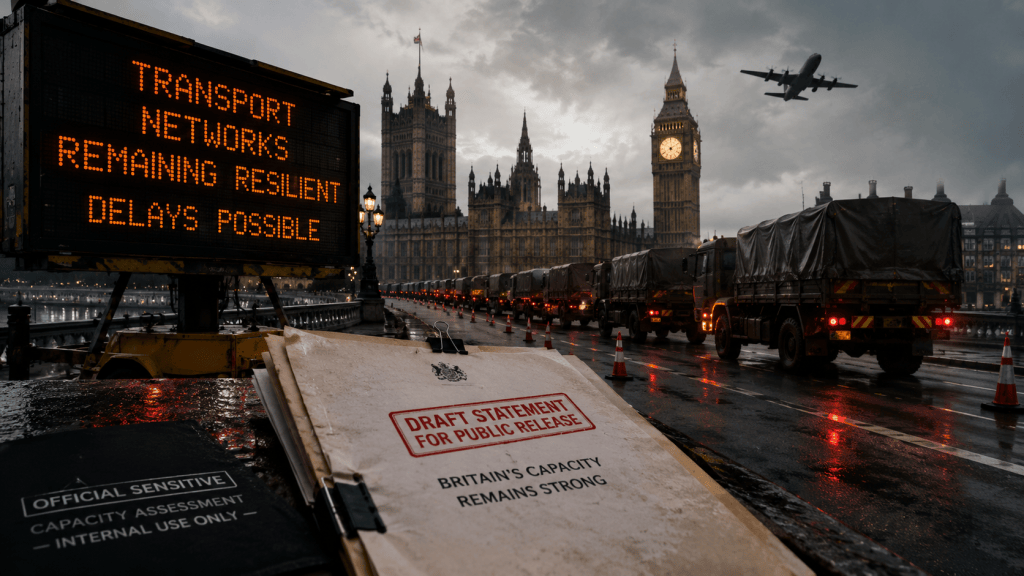
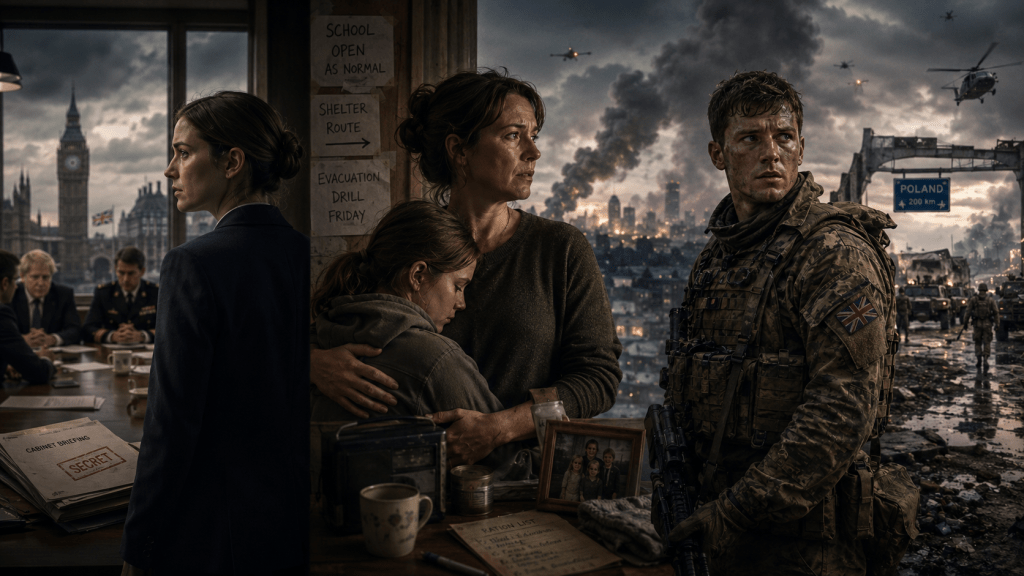
While ministers prepared to assure the country that Britain’s transport systems remained resilient, the figures beneath the statement showed a network already surviving by moving ordinary life aside.
The Sentence That Held
By seven that morning, the public statement had passed through four versions, cleaner than the figures behind it and shaped to sound steadier than the room that produced it.
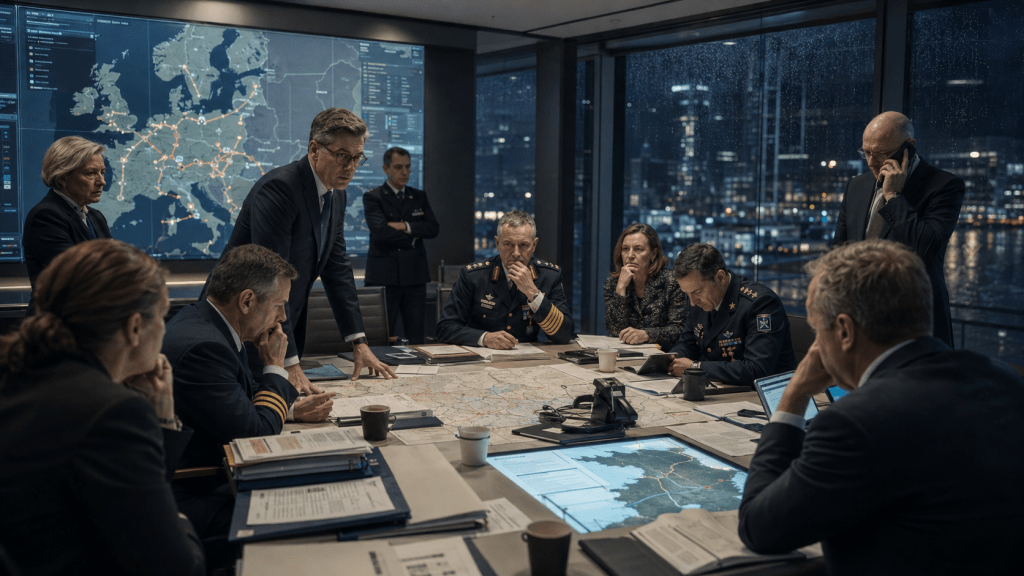
Rain pressed against the high windows of the Cabinet Office briefing room and ran down the glass in wavering lines, turning Whitehall into grey stone, blue lights, umbrellas, and the pale glow of phone screens held beneath coat collars. The room had been used through the night, and the air had grown too warm with coffee, printer heat, damp wool, and the persistence of people who had moved beyond tiredness into the harder condition where every sentence arrived trimmed for damage. Folders lay open across the table, coloured slips marking the pages that could leave the room, while red handling strips marked the pages that could only travel by hand.
Eleanor Voss stood at the far end of the table, one hand resting on a chair and the other wrapped around a paper cup she had forgotten to drink from. She worked in government communications, in the narrow passage where facts became public lines and public lines returned as questions from broadcasters, ministers, councils, hauliers, unions, and frightened people deciding whether to fill their cars before work. Her name appeared on none of the statements once they went out.
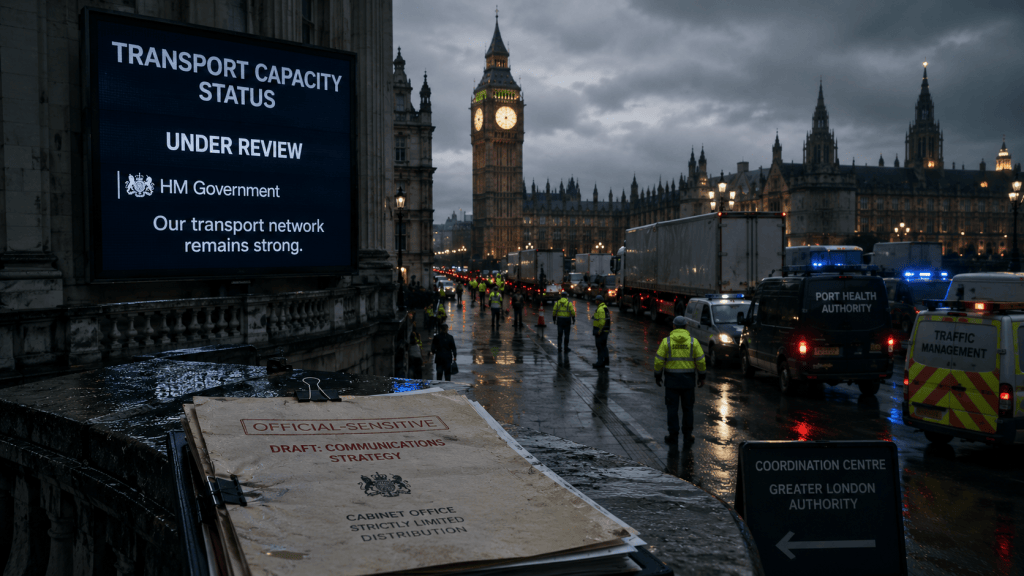
On the wall screen, a transport-capacity dashboard refreshed every thirty seconds. Ports sat in coloured blocks. Road routes sat beside them. Rail access, driver availability, ferry slots, defence consignments, civilian dwell time, fuel pressure, and police-support demand kept shifting in small increments. The colours had started the week in green and amber, with red reserved for weather, accidents, and ports that had lost patience with optimism. Red now appeared in places that held strategic meaning once placed beside a map of Europe, though the public version would speak of increased demand and wider pressure across supply chains.
At the table, Michael Harrow from the Department for Transport turned a stapled pack sideways and slid it towards her. His tie had loosened during the night, and a small dark mark on his cuff suggested he had spilled coffee.
“The present wording says networks remain resilient,” Harrow said, drawing one finger down the top page. “That remains defensible if we define resilience by continued movement across critical routes.”
Eleanor watched a red block pulse beside the east-coast freight line, linger long enough to draw three pairs of eyes, then settle back into amber. “And if anyone defines resilience by whether ordinary movement still has room to breathe?” she asked.
Harrow drew the pack back towards himself, aligning its edge with the table. “Then we speak about temporary prioritisation and sector-specific strain.”
“Sector-specific strain means supermarket stock waits while sealed freight moves.”
Harrow glanced at the Defence adviser near the door before he answered. “It means current movement remains controlled.”
Across the table, Sana Qureshi from the Cabinet Office resilience unit opened a laptop covered in sticker residue where labels had been removed before the device entered the secure floor. She had worked through floods, power failures, fuel disruption, and one winter when half the country appeared to discover logistics at the same time.
“We have regional calls inside twenty minutes,” Sana said, turning the laptop so the screen caught Eleanor’s eye. “Lincolnshire wants clarity on route holds. Kent wants an answer on civilian traffic displacement near the port approaches. The east-coast operators want someone to admit Defence priority has changed the shape of the queue.”
“They will receive careful language,” Harrow said, tapping his pencil once against the page.
Sana looked up from the laptop. “They already have sharper language. They invented it while waiting for ours.”
The room received that with a silence Eleanor recognised, the kind that followed an accurate statement made too early for the hierarchy to absorb. Outside the door, a trolley moved along the corridor, and the uneven rhythm of its front wheel carried through the wood before fading near the lift. Eleanor pictured fresh printed packs, red handling strips, and folders travelling by hand because secure systems were being kept for heavier traffic.
A junior press officer named Daniel Rees sat near the wall with his sleeves rolled above his wrists and three phones arranged in front of him like evidence. He lifted one of the phones, listened for a few seconds, then covered the microphone with his palm.
“Number Ten want a smoother top line before eight,” Daniel said, keeping his voice low as though the phone might carry the room back to its owner. “They dislike manageable.”
Eleanor lowered her cup. “Which part?”
Daniel listened again, his eyes moving across the faces around the table. “The whole word.”
Harrow gave a small, humourless laugh and pressed his fingers against the bridge of his nose. “That is unfortunate. Manageable is doing most of the work.”
Daniel nodded at someone none of them could hear. “They prefer functioning.”
Sana turned the laptop further so Harrow could see the regional summary. “Functioning suggests things are still moving, which is true only because capacity is being taken from somewhere else.”
The summary showed postponed civilian container release, road-haulage shortages, delayed retail loads, pharmacy logistics adjustments, and school-transport knock-on effects from morning diversions around route-control points. The evidence had arrived as timings, lane closures, missed slots, depot holds, driver hours, and ordinary tasks shifted half a day sideways so priority movement could pass through.
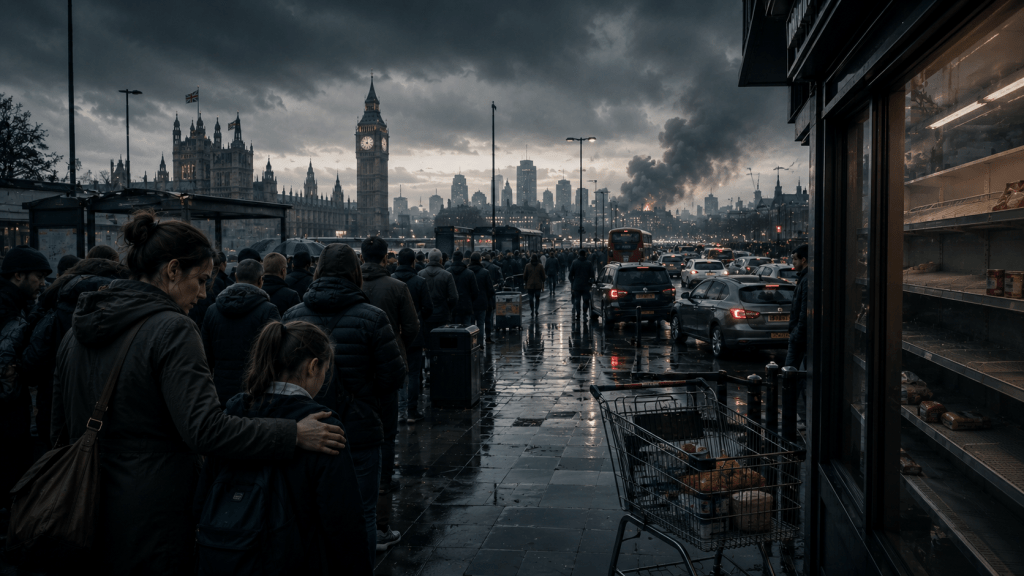
Eleanor thought of how it would sound once it reached a kitchen radio. Transport systems remain resilient. Existing commitments remain manageable. Essential goods continue to move. The sentences would be true in the way official sentences were often true, with their feet placed carefully around the softer ground. They would leave out the people already standing at pharmacy counters, depot gates, school stops, and freight windows, learning that ordinary movement had become the part of the system asked to wait.
The door opened, and Tom Merrick entered with rain still on his coat and an adviser from Defence behind him. Merrick worked political handling alongside transport pressure, although lately the distinction had thinned until every problem arrived wearing both badges. He placed a marked page in front of Eleanor and tapped the top paragraph.
“Prime Minister can say this at lobby if pressed,” Merrick said, pulling off his wet coat. “We need it clean, firm, and dull enough to avoid becoming a headline.”
Eleanor read the paragraph once, then again. The United Kingdom’s transport and freight networks continue to function effectively under increased demand. Existing support commitments remain within current capacity. Departments continue to work with operators, local partners, and industry to ensure essential movement is protected.
The line sat there in black print, polished and bloodless. It made the country sound like a machine that had absorbed extra pressure through design. The dashboard behind Merrick told a harsher story, one of improvised holds, narrowed margins, police calls, contractor fatigue, military-linked consignments arriving ahead of expectation, and port supervisors using language with more honesty than anyone in the room could afford to place into a public statement.
“Existing support commitments remain within current capacity,” Eleanor said, keeping her eyes on the page.
Merrick watched her from beside the table. “Can we defend it?”
Harrow answered with professional caution, his hand already moving towards the capacity pack. “At national level, across current reporting intervals, it remains arguable.”
Sana closed her laptop a little, leaving the screen light pressed against her face. “Arguable is a courtroom word trying to pass as public confidence.”
Merrick looked at Eleanor because Harrow had supplied a technical answer and Sana had supplied the one the room preferred to avoid. “Can we say it?”
Eleanor looked again at the dashboard. The east-coast route blinked red, held there for a second longer than before, then returned to amber. Somewhere beyond the building, freight was being delayed in the name of movement, and movement was being protected in the name of support, and support was beginning to resemble something nobody had yet been given permission to call by a heavier name.
“We can say it,” Eleanor said, setting the page down with care.
Daniel started typing at once, his thumbs moving fast over one phone while a second lit beside him. Harrow began reciting figures to the Defence adviser. Sana reopened the regional summary and marked three lines in yellow. Merrick stood over Eleanor’s shoulder, shaping risk into phrases that might hold until lunchtime if the world behaved generously. The rain darkened the windows until the room seemed lit from inside its own fatigue.
On the screen, a fresh warning appeared beneath the dashboard, small enough for the room to miss unless someone was already watching.
Eastern corridor capacity dependent on continued priority sequencing.
Eleanor read it twice before the message vanished into the next refresh. Then she picked up her pen and changed one word in the statement, replacing planned with current, because a tiny place for honesty still survived inside a sentence already chosen.
A Visual Chronicle
Official confidence held on the public screen while Britain’s roads, ports and ordinary deliveries absorbed the strain the statement had been written to conceal.
Cabinet Office Handling Note
Extract from Cabinet Office Press and Resilience Coordination Note Subject: Transport Capacity Line Time: 07:42 Circulation: Restricted internal handling group
Purpose
To support ministerial and departmental handling of anticipated media questions concerning freight movement, east-coast port pressure, route prioritisation, and wider transport resilience following increased demand across allied support corridors.
Approved Public Position
The United Kingdom’s transport and freight networks continued to function effectively under increased demand. Existing support commitments remained within current capacity. Departments continued to work with operators, local partners, and industry to ensure essential movement was protected.
Suggested Response if Pressed
Officials were monitoring regional movement closely. Some localised delays had occurred where demand, weather, port sequencing, and wider European pressure converged. These pressures were being managed through established resilience arrangements, industry coordination, and targeted support for affected operators.
The Government remained focused on maintaining the movement of essential goods, supporting allies, and limiting disruption for households and businesses.
Lines to Avoid
Avoid language implying defence movement had displaced civilian supply. Avoid speculation on route protection measures. Avoid confirming priority categories for sealed consignments. Avoid linking domestic delays directly to overseas military activity. Avoid any formulation suggesting exhaustion of capacity.
Internal Assessment
Current national capacity remained viable under priority sequencing. Continued viability depended upon sustained operator cooperation, police-route availability, port slot discipline, and regional tolerance for civilian delay.
The eastern corridor carried increased sensitivity due to the concentration of freight holds, allied-support consignments, road-haulage pressure, and public visibility around delayed civilian loads. Messaging should therefore maintain confidence while allowing for local variation in delivery experience.
Where challenged on contradiction between public reassurance and visible disruption, ministers should emphasise that resilience meant continued function under pressure, supported by active coordination across government and industry.
Operational Note
Further deterioration in driver availability, fuel access, police support, or port dwell time may require revised language before the midday lobby briefing.
About the Creator
The Modern Chronicle is written and curated by Simon Phillips, an author of modern speculative fiction and contemporary crisis-driven storytelling who explores the point where ordinary life begins to tighten beneath political strain, military movement, institutional caution, and the public language used to keep dangerous realities at a distance.
Many of the records presented in these Chronicles sit alongside Simon’s wider modern-war novella series, where governments, soldiers, families, and civilian systems are forced to absorb a world changing faster than its official explanations. The stories remain grounded in recognisable places: ports, school corridors, freight yards, government rooms, roadside queues, transfer sites, and homes where the news has started to feel too close.
One such world unfolds through The Last Deterrence, a modern-war novella sequence beginning with Managed Distance Breaking and continuing in The Quiet Strike. Together, the first two books follow Britain as support language begins to fracture under freight pressure, European escalation, domestic infrastructure strain, and the growing sense that distance from war has already begun to fail.
Readers who wish to explore the wider published story world connected to this Chronicle can find the books below.
The following Chronicle reconstructs the hours after the capacity statement left Whitehall, as transport officials, regional operators, and local services began living with the difference between a network described as resilient and a system already surviving through postponed civilian movement.
Readers supporting The Modern Chronicle can continue the record below.
The Corridor That Still Functioned
By mid-morning, the statement had left the secure floor and entered the country by quieter routes, passing into newsroom desks, local authority inboxes, haulage groups, regional rooms, port operators, school offices, pharmacy distributors, and the phones of people whose work depended on knowing which delay had been given an official name.
On the government website, the wording sat beneath a freight terminal photograph from a calmer year when stacked containers still looked like trade and confidence instead of time held in metal boxes. Transport and freight networks continued to function effectively under increased demand. Existing support commitments remained within current capacity. Departments continued to work with operators, local partners, and industry to ensure essential movement was protected.
Eleanor Voss heard the first broadcast reading of it in the communications room beside the Cabinet Office, where a television stood on mute above a row of desks and the audio came through a small speaker connected to the media-monitoring feed. The presenter read the line with official warmth, then moved into questions about port delays, petrol prices, and pressure on the eastbound freight corridor. The word corridor had survived into public speech by accident, or through a source somewhere, and once the presenter said it aloud Eleanor felt several people in the room look up from their screens.
Daniel Rees stood by the printer with one hand holding a sheet still warm from the tray. “Sky have corridor,” he said, lowering the page as the speaker carried the next question into the room.
Tom Merrick turned from the desk where he had been marking a fresh response grid. “Who gave them that?”
Daniel glanced down at his phone before answering. “Could be hauliers. Could be port operators. Could be anyone who spent last night watching sealed consignments move ahead of their own slots.”
Merrick rubbed the corner of one eye with his thumb and reached for the phone nearest him. “Get me the transport press office.”
Eleanor stayed where she was, listening as the presenter brought in a freight analyst who spoke over a map of the east coast with care around every line he drew. He spoke of dwell time, ferry slots, pharmacy distribution, driver hours, and official confidence that meant movement still existed, even as ordinary users lost room.
Across the room, Sana Qureshi’s laptop chimed with the regional call opening. She pulled on her headset and lowered her voice until it merged with the hum of printers and phone alerts. “Cabinet Office resilience joining. Lincolnshire, go ahead.”
Eleanor moved closer. Sana had arranged the call into columns: police support, road holds, port approaches, agricultural distribution, medicine, schools, public line. The first local authority speaker sounded as if he had been awake since before dawn and disliked every part of the morning.
“We have tractors backed near the bypass because the southbound lane hold ran over,” the man said through a faint crackle. “School transport took the diversion behind it. Parents saw police units at the roundabout and started ringing headteachers before anyone rang us.”
Sana held her pen above the first column. “Was the route hold linked to priority movement?”
The man gave a dry little laugh that carried more anger than humour. “You know the answer I can place into minutes, and I know the answer your room can hear.”
Eleanor looked at the screen. The government statement sat open in a second window, pristine and usable. The call beside it carried roads, tractors, school buses, and parents hearing danger in police cars placed where routine traffic used to be.
Sana pressed two fingers against the bridge of her nose, then leaned closer to the microphone. “For the record, we need localised traffic management associated with essential freight continuity.”
“For the record,” the man replied, his voice flattening, “we had a roundabout held for forty-one minutes so marked vehicles could pass through a route everyone in town has now noticed.”
Merrick glanced over from his desk. “Sana.”
Sana lifted one hand without turning towards him. “Understood. We will log regional visibility concerns.”
At ten twenty-three, the east-coast port operations group joined the call. The voice came from Harriet Cale, operations director at a container terminal that had appeared on the dashboard as amber since dawn and red in every conversation that used honest language. Her connection carried background noise: reversing alarms, a distant tannoy, wind across the microphone, and the restless murmur of work made harder by waiting.
“We are holding civilian releases behind sealed consignments again,” Harriet said, raising her voice over the yard. “If that remains the instruction, we need fresh phrasing for customers before lunch. People accept delay when they believe weather caused it. They get creative when they can see priority lanes moving.”
Michael Harrow had joined the room ten minutes earlier and bent over Sana’s laptop, one palm on the back of her chair. “The instruction remains prioritisation within current capacity.”
Harriet allowed the phrase to hang for long enough that everyone in the room felt its weight. “Michael, with respect, current capacity means something else from this end of the road.”
Eleanor pictured the terminal as she had seen similar places during earlier visits: cranes against grey water, container stacks rising in lanes, drivers outside cab doors, security staff watching queues lengthen while supervisors invented calm at the speed of paperwork.
On the television, footage showed lorries standing outside a port approach beneath a colourless sky. The camera stayed far enough away to avoid registration plates, yet close enough to capture the shape of delay. A driver in a dark jacket leaned against his cab with both hands in his pockets, staring towards the gate as though he had reached the limit of what questions could do.
At the Department for Transport, two streets away, the movement desk had started separating public disruption from operational necessity with coloured markers on a laminated wall map. Each route carried its own little history of compromise: freight protection, police liaison, visible civilian delay, public explanation required within the hour.
Kiran Holt, a senior transport planner seconded from rail operations, stood before the map with a phone pressed against his shoulder. He had slept for eighty minutes in a chair beside a cabinet marked winter resilience and had woken with his watch strap pressed into his cheek.
“Tell them the slot moves by ninety minutes,” Kiran said into the phone. “No, ninety is the improved offer. The earlier offer involved no slot and a bleak conversation with someone from Defence.”
He listened, eyes on the east-coast route where three orange marks sat too close together. “I understand the refrigerated load has priority. I also understand the sealed load has greater priority. Yes, that phrase is ugly. I am already aware.”
Across from him, a younger planner named Alice Baird was updating a spreadsheet with both hands, her jaw set hard enough to alter her face.
“We’ve shifted medicine to the afternoon run,” Alice said, keeping her eyes on the spreadsheet. “The distributor says they can still make pharmacy windows if the police hold on the A-road clears before eleven.”
Kiran looked at the map. “And if it runs to eleven-thirty?”
Alice kept typing. “Then the pharmacies receive tomorrow’s apologies today.”
One of the screens above the map changed to the official government statement. The wording occupied the screen for thirty seconds before the feed switched to live footage outside a port gate. Kiran watched a reporter speak into rain with the careful brightness of someone standing in front of a queue long enough to make every official line sound smaller.
Within an hour, the line had reached a delivery depot outside Peterborough, a school office in Lincolnshire, a pharmacy distribution centre near Ipswich, and a haulage message group filled with photographs of priority lanes and blocked roundabouts.
At a service station near the A1, Greg Mason sat in the cab of a refrigerated lorry with a paper cup balanced in the holder and the government statement open on his phone. He had been carrying pharmacy stock for long enough to understand which delays mattered. His current delivery sat four hours behind, then two, then three again, because each update came with a new route note and a gentler way of saying wait.
His dispatcher rang as rain crossed the windscreen in thin streaks. “Greg, I need you to hold there another half hour,” Priya from routing said, her voice tight with too many calls. “Police are clearing movement ahead of you.”
Greg looked across the service-station forecourt, where ordinary cars queued for fuel under strip lights. “Movement,” he said, watching a military-green vehicle pass along the road beyond the station. “That’s what we’re calling it now?”
Priya exhaled through the line. “That’s what I can put on the job sheet.”
“My load has insulin on it,” Greg said, resting his hand on the steering wheel.
“I know,” Priya replied.
“Does the movement ahead of me have insulin?”
Priya stayed silent for a second, and the silence gave him the answer her job sheet could never carry.
Greg placed the cup back into the holder and watched the road. “Tell the pharmacy I am still coming.”
“I have,” Priya said, softer now. “They asked whether still means today.”
He looked at the government statement again and read the sentence about essential movement being protected. Then he locked the phone, because anger used battery, and battery had begun to feel like another item worth saving.
Back in Whitehall, Eleanor saw the first contradiction brief at eleven forty-seven. It arrived as a media handling grid, with clips down the left side and proposed responses along the right. One clip showed a minister repeating resilient with visible discipline. Another showed Harriet Cale telling local radio that capacity remained under active management. A third showed an opposition transport spokesperson near a freight gate asking whether the government had started rationing road space by stealth. The phrase was too sharp to ignore and too useful to die quickly.
Merrick placed the grid in front of Eleanor. “We need an answer for rationing road space.”
Eleanor read the phrase again. Rationing belonged to kitchens, petrol stations, supermarkets, and war memories people thought they understood through documentaries. Road space sounded technical enough for present use. Together, the phrase would travel.
Sana joined them with her headset around her neck, the foam earpads leaving red marks beneath her hairline. “Call it prioritised resilience and we invite ridicule. Call it targeted route management and councils will laugh at us.”
Harrow came over from the far desk with a fresh capacity sheet. “We can say essential movement sometimes requires temporary sequencing.”
Merrick pointed at him with the grid. “That is the first useful ugly phrase anyone has offered.”
Eleanor picked up her pen. “Then we use it sparingly.”
Daniel Rees looked up from his phones. “Number Ten wants the noon update in twelve minutes.”
The room shifted into the old rhythm: one person reading aloud, another trimming, a third testing whether the wording would sound cowardly, evasive, or accidental once a minister placed it into the air. Eleanor held the page steady and worked inside the sentence, finding places where precision could hide before the wider truth made concealment impossible.
Outside the windows, rain thinned into a pale mist that left the street shining. A police van moved through the junction below, followed by two dark official cars and a delivery cyclist whose yellow bag flared against the wet grey. London kept travelling in pieces while the eastbound line tightened beyond sight.
At noon, the revised update went out. Transport and freight networks continued to function effectively. Some local sequencing was being used to protect essential movement. Departments remained in close contact with operators and regional partners. The words were calmer than the system beneath them, and for a little while that was enough for the statement to hold.
By twelve eighteen, the dashboard refreshed again.
The eastern corridor went red and stayed there.
Official confidence held its place on the public screen, while the road beneath it showed the strain the statement had been written to contain.
The Idea Behind the Chronicle
Modern governments often speak of resilience as though it were a settled condition, something measured by whether roads stayed open, ports kept working, and goods continued moving through the system. In practice, resilience often depended on quieter forms of displacement. A route could remain active while ordinary deliveries waited. A port could stay open while civilian loads lost their slots. A road could serve the national interest while the people living beside it discovered that their own movement had become secondary.
This Chronicle explores the gap between public confidence and lived capacity. The statement at the centre of the record sounded calm because modern government language was designed to reduce panic, protect markets, reassure allies, and keep public behaviour manageable during strain. The systems beneath that language remained physical, crowded, and limited. They depended on drivers, police holds, ferry slots, distribution depots, local authorities, fuel access, and workers asked to absorb pressure before the country understood its shape.
The eastbound line in this series represents the place where support became material. Containers, sealed consignments, medical loads, fuel movements, and protected roads turned policy into weight, delay, and priority. The public could still be told that Britain remained at a controlled distance from the conflict, while the roads and ports had already begun behaving as though that distance had narrowed.
The Chronicle therefore treats capacity as a human pressure system. A dashboard in Whitehall showed amber and red blocks, while each block held drivers waiting past their legal hours, pharmacy stock arriving late, school buses caught behind diversions, port supervisors explaining queues, and officials searching for language that could hold for a few hours longer. The story sits inside that hidden space between a sentence that remained technically defensible and a country beginning to feel what the sentence left out.
In The Last Deterrence world, war first reached Britain through infrastructure before it arrived through declaration. It came through manifests, transport holds, drone alerts, route changes, freight prioritisation, and official phrases that stayed careful after the situation beneath them had already changed. This Chronicle belongs to that early stage, when the machinery still worked, although each successful movement required some part of ordinary life to wait.
The statement about capacity therefore became a record of transport, language, and pressure at once. It showed a nation still speaking in the language of control while the systems beneath it were already revealing the shape of participation.
From the Author’s Desk
The Eastbound Line began with the thought that modern war often reaches ordinary life through systems long before anyone speaks plainly about war itself. A port queue, a delayed medicine delivery, a police hold at a roundabout, or a careful government phrase can reveal a national shift before the larger public story has caught up with it.
This Chronicle follows that idea through the language of capacity. I wanted the record to stay close to the people who carried the pressure: officials shaping public lines, operators managing queues, planners moving delivery windows, drivers waiting beside roads, and local services absorbing decisions made far above them. The crisis remained official at one level, yet deeply personal at another.
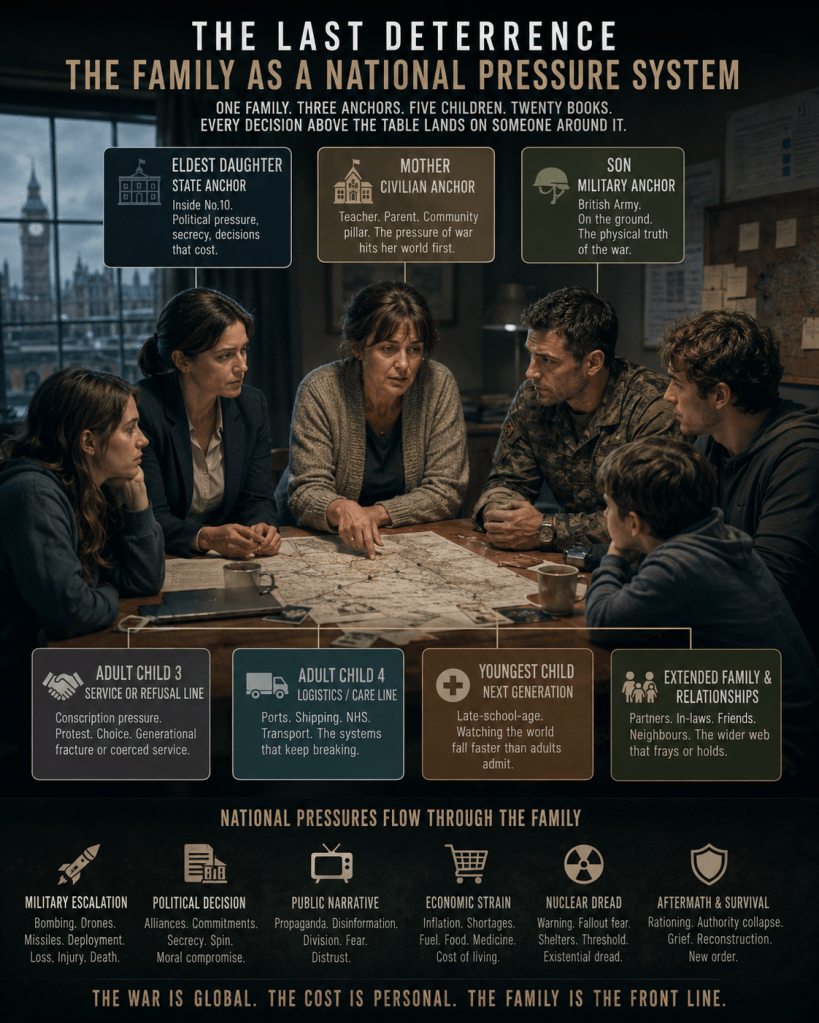
The Last Deterrence novellas explore this same widening pressure through family, government, military service, and ordinary civilian life. The Chronicles sit beside those stories as fragments from the wider national record, showing how the same events touched people and places outside the main spine of the books.
Alongside The Modern Chronicle, I continue writing fiction across several speculative and contemporary-war projects, many of which explore how institutions, families, and communities change when public language can no longer carry private reality.
Readers interested in those stories can explore more through the links below.
Transport capacity often appears in public language as a stable figure, as though a country either has enough space for movement or has reached a clear point of failure. In reality, capacity exists through sequence, timing, labour, fuel access, police availability, port discipline, and the willingness of one part of the system to wait while another moves first. A network can still function while the room inside it grows smaller.
That distinction sits at the centre of this Chronicle. The public statement said the system continued to operate, and from a narrow official view that remained defensible. Goods still moved. Ports still worked. Roads stayed open. Yet the measure of function concealed the method by which that function survived. Civilian freight lost slots, regional roads carried longer holds, pharmacies received later windows, and local services absorbed the consequences of decisions made far above them.
The pressure was therefore visible most clearly to those working inside the movement chain. A driver saw a delivery window change twice. A planner saw medicine shifted behind sealed consignments. A port operator watched priority lanes keep moving while ordinary freight waited at the gate. The dashboard in Whitehall reduced those experiences to colour, timing, and risk, while the people beneath it understood that capacity had become a question of who moved first.
Essential Movement
The phrase essential movement carries authority because it sounds practical, neutral, and difficult to challenge. It suggests that officials have identified what matters most and protected it during strain. Yet every decision to protect one form of movement also creates a shadow elsewhere. A held roundabout delays school transport. A protected freight lane changes civilian delivery times. A sealed load given priority alters the sequence of goods behind it.
This Chronicle uses essential movement as a quiet pressure point. The phrase allowed ministers and officials to speak with control while avoiding fuller description of what had begun happening across the eastbound corridor. The movement itself stayed partly hidden. Its effects spread through ordinary places: service stations, school offices, port gates, distribution boards, and local authority calls.
That form of strain belongs to the wider reality of The Eastbound Line. Britain still described its role as support, assistance, resilience, and coordination. The roads, ports, and movement rooms already carried a heavier truth. What the country called essential movement was beginning to reveal which parts of national life had become secondary.
The Language of Function
Modern crisis language often survives through careful measurement. A road remains open, even when most users have less access to it. A port remains operational, even while some loads wait far longer than expected. A delivery system remains functional, even as planners spend the morning shifting delays from one community to another. The official sentence can remain true while the lived reality beneath it changes sharply.
That is the tension behind The Statement About Capacity. The Government could say that transport networks continued to function because collapse had not arrived. The more difficult truth lay in the cost of continued function. Each successful protected movement required labour, time, route space, police support, and public patience. As those costs accumulated, the statement began to sound less like reassurance and more like a record of how much strain could still be hidden inside a calm sentence.
Across The Modern Chronicle, these details matter because they show how large events enter ordinary systems before they enter public admission. War, escalation, and participation rarely arrive as clean declarations. They appear first as altered routes, priority language, revised delivery windows, and officials choosing one word over another because the wrong sentence could reveal too much too early.
Next Chronicle
After the public statement on capacity had passed through Whitehall, the next visible change came through a freight holding site in the Midlands, where route planners, drivers, loaders, and military police began adjusting to reports from Germany that had arrived in fragments long before any settled public explanation.
Rail sequencing shifted first. Pallets were rescanned, sealed loads were moved ahead of civilian freight, and several drivers who had waited through the night were turned around with new instructions that gave them routes, times, and very little context. Workers gathered around phones showing confused footage from abroad while the yard beneath them began changing its order, one lane and one manifest at a time.
The next Chronicle follows that night inside the holding site, as the German strike reached Britain through route changes, freight holds, armed police, and the quiet recognition among those present that the support system they served had become part of something far harder to contain.
Next Chronicle: The Night Germany Entered the Yard
The statement remained on the record, calm and complete, while beyond Whitehall the eastbound line kept moving through the narrow space it had been given, carrying within its delays the first clear shape of a country already reorganising itself around a war it still described as support.
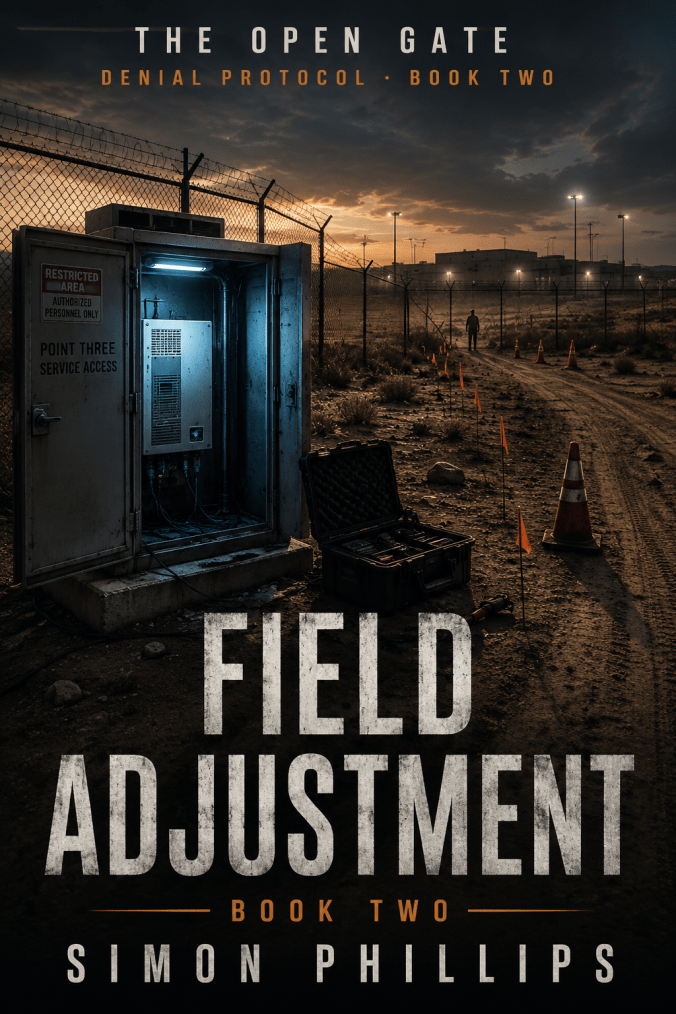
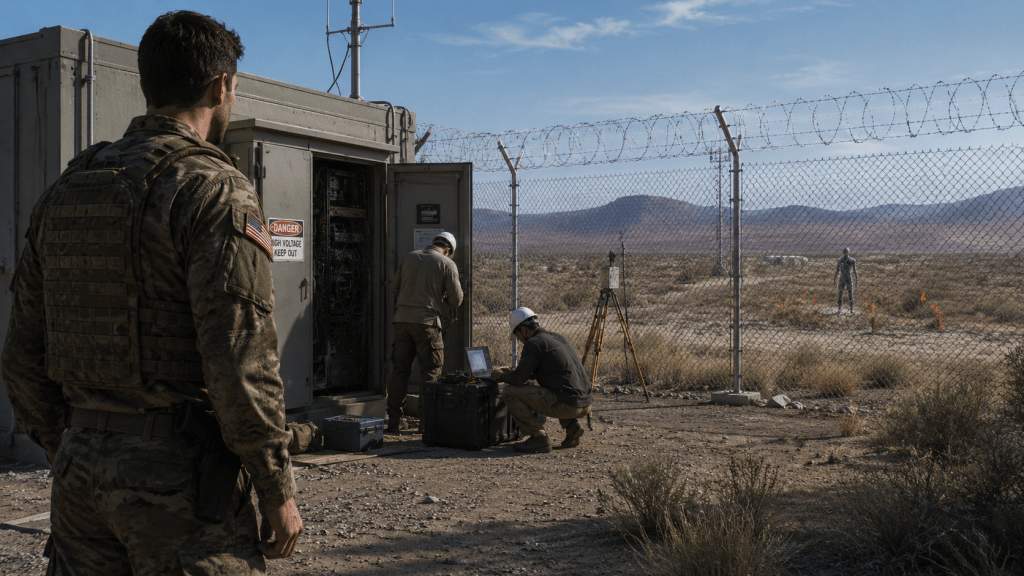
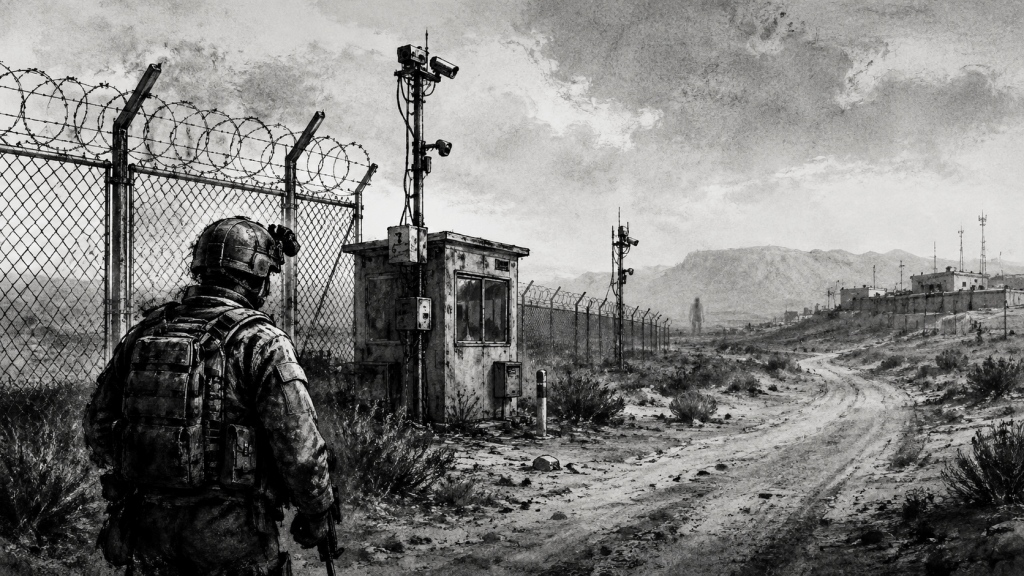
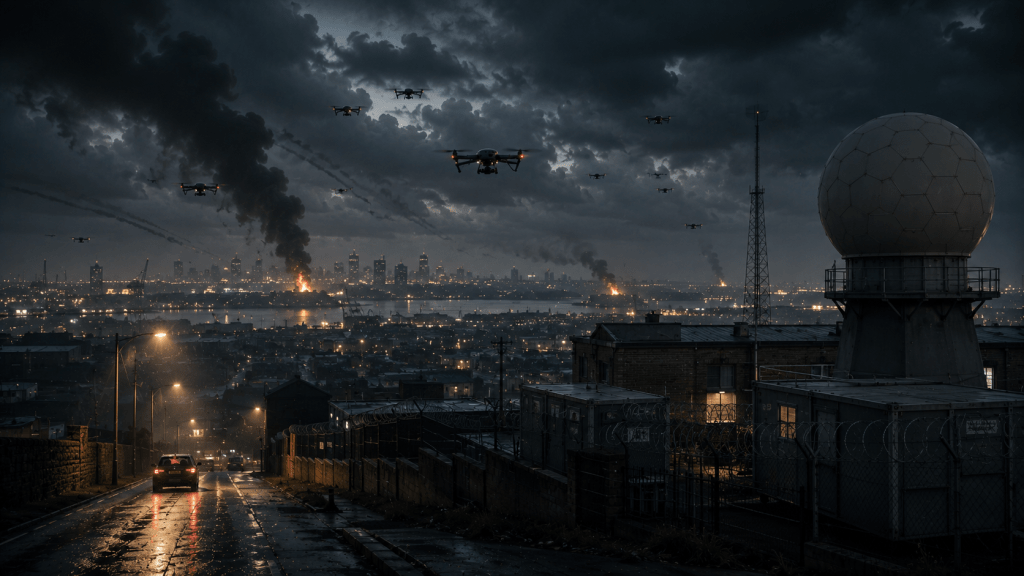
A faded perimeter cabinet, three contractor vehicles and a sealed equipment case should amount to an ordinary maintenance assignment inside a restricted government installation. The paperwork certainly presents it that way. The work has been authorised as a perimeter reliability upgrade, involving sensor replacement, route clearance and contractor support. Every phrase is clean, practical and reassuring.
The equipment begins responding before it has been connected.
That narrow division between what people physically experience and what an institution is willing to record is where Field Adjustment begins to tighten. Book Two of The Open Gate develops its dimensional horror through military procedure, controlled journalism and compartmentalised scientific work, allowing the danger to advance without abandoning the recognisable world surrounding it.
Buildings remain open. Roads continue carrying traffic. Reports are completed, visitors receive badges, researchers correct models and soldiers follow orders. The system does not fail in a sudden, dramatic collapse. It adapts to the contradiction, absorbs it into approved language and continues working.
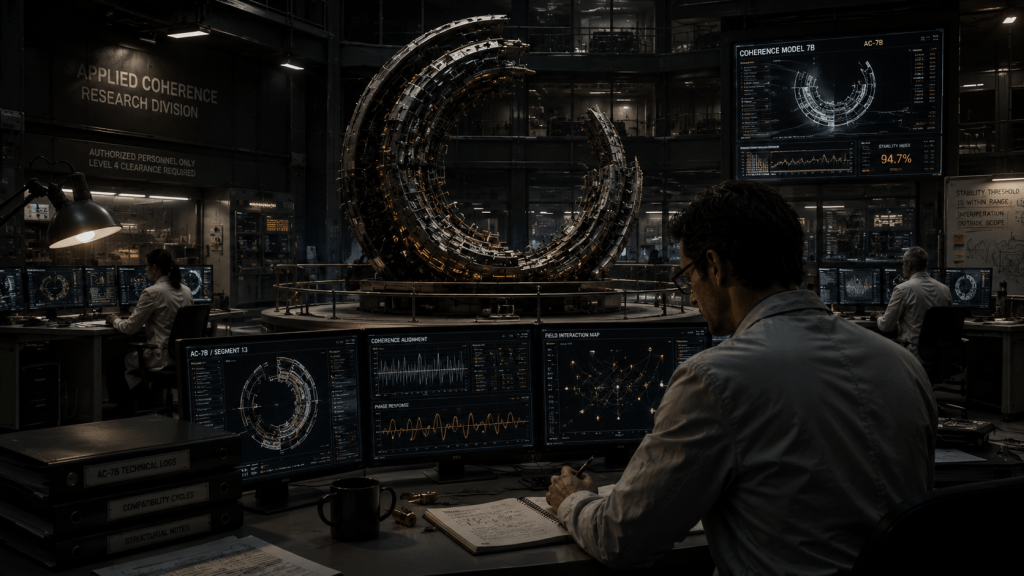
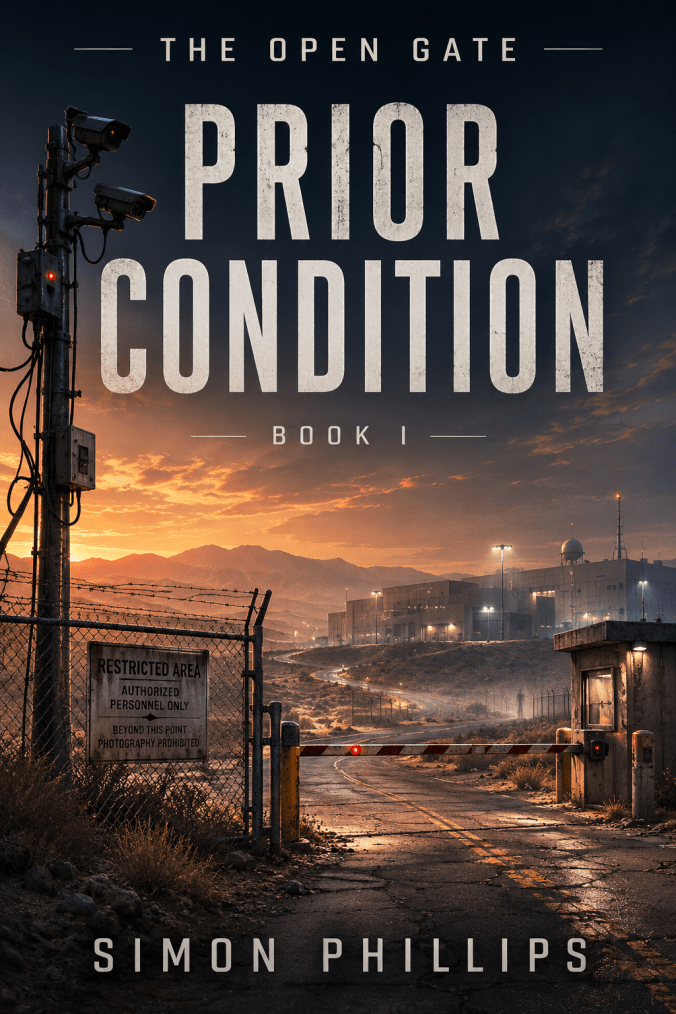
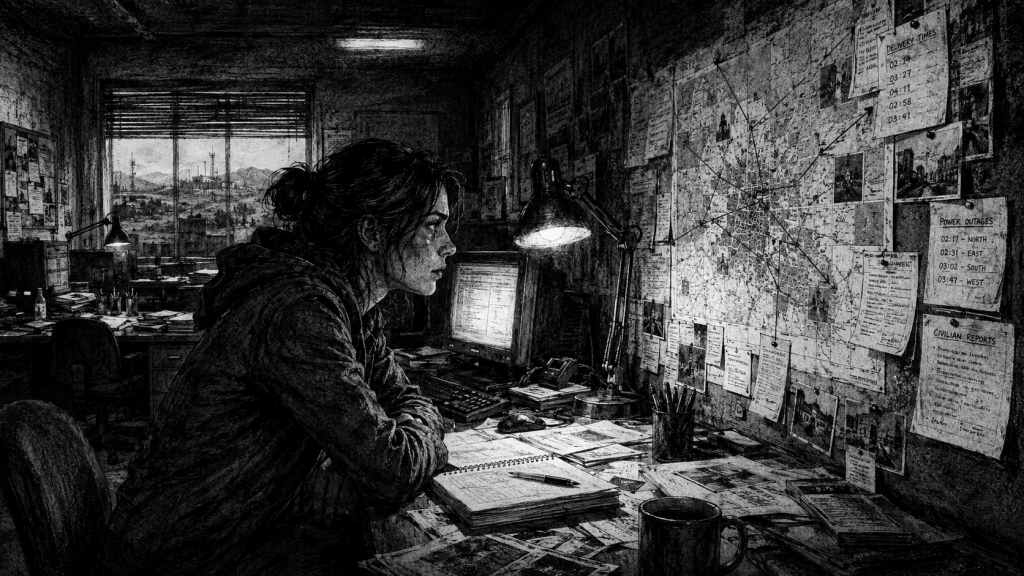
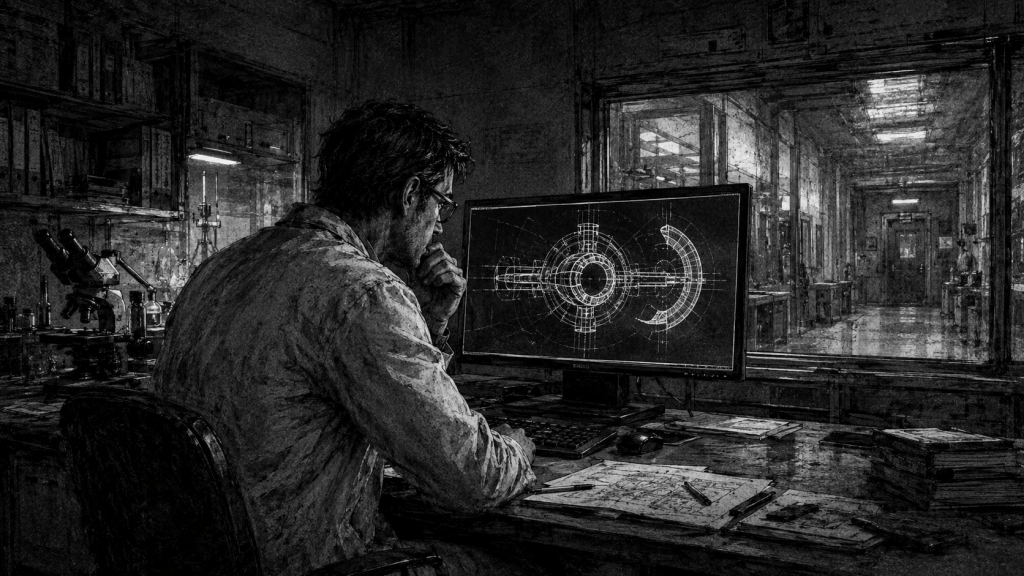
Prior Condition, the opening book in The Open Gate, established a world in which several people began noticing details that did not fit the explanations surrounding them. Ethan Ward encountered physical unease along the facility perimeter. Maya Ward gathered civilian reports that appeared ordinary until placed beside one another. Dr Adrian Hale completed technical corrections without being shown the larger system receiving them.
Those contradictions could still be treated as isolated problems. A camera failed because of interference. A power dip belonged to the local grid. A strange movement near a fence could be heat distortion. An unusual data spike remained within tolerance once the model was adjusted.
Field Adjustment begins after the institution has decided that these irregularities require a response. That response is not public acknowledgement, evacuation or even meaningful caution. Contractors are sent to replace perimeter equipment. Access routes are controlled more carefully. Public affairs offers a managed display of transparency. Scientific work moves into more restricted rooms.
The danger has become consistent enough to require action, yet the language surrounding that action continues to deny what the response itself reveals.
This is one of the book’s most effective tensions. The facility behaves as though everything remains under control precisely because it has developed procedures for dealing with events it cannot openly describe. Strange behaviour becomes field variance. A troubling visual becomes a monitoring discrepancy. Removal from duty becomes fatigue management. Professional suppression becomes concern for access terms and visitor safety.
The wording is plausible in every individual situation. Taken together, it begins to reveal an institution constructing an alternative version of reality while the physical world continues pressing against it.
Ethan Ward and the Failure of the Official Record
Ethan experiences the crisis through military routine. His task is to escort contractors along the eastern service route while they replace equipment at several perimeter points. He checks badges, watches tools, monitors movement and keeps the work within the boundaries established by the assignment.
His role does not require him to understand what the contractors are installing. It requires him to keep people where their clearance permits them to stand.
This makes him especially effective as the soldier perspective. Ethan is not presented as a conventional action hero waiting for permission to fight. He is competent, observant and accustomed to treating the perimeter as a sequence of practical responsibilities. He knows how many people should be present, where they should be standing and what the ground normally feels like beneath a military vehicle.
When the equipment reacts too early, static touches exposed skin and vibrations move beneath the service road, his experience tells him that something has changed. The institutional response tells him that the work remains routine.
The conflict becomes more serious when Ethan’s own sight contradicts the monitoring system. He sees something within a restricted area where nobody should be present. Davis, his patrol partner, sees enough to know that Ethan is not simply inventing the experience. Yet the official response remains unchanged: monitoring shows clear.
That phrase carries greater force than an overt threat would have done. Ethan has followed procedure. He has reported what he witnessed. Another soldier has partially confirmed it. The institution does not accuse him of lying, nor does it begin an obvious cover-up in front of him. It simply places the monitoring record above the people standing on the ground.
Ethan’s growing distrust emerges from that difference. He knows what he saw, but he also knows how easily an incident disappears once it has been given an acceptable description. His military training allows him to recognise physical danger, while the system around him is designed to prevent that recognition from becoming institutional knowledge.
Maya Ward and Transparency as a Form of Control
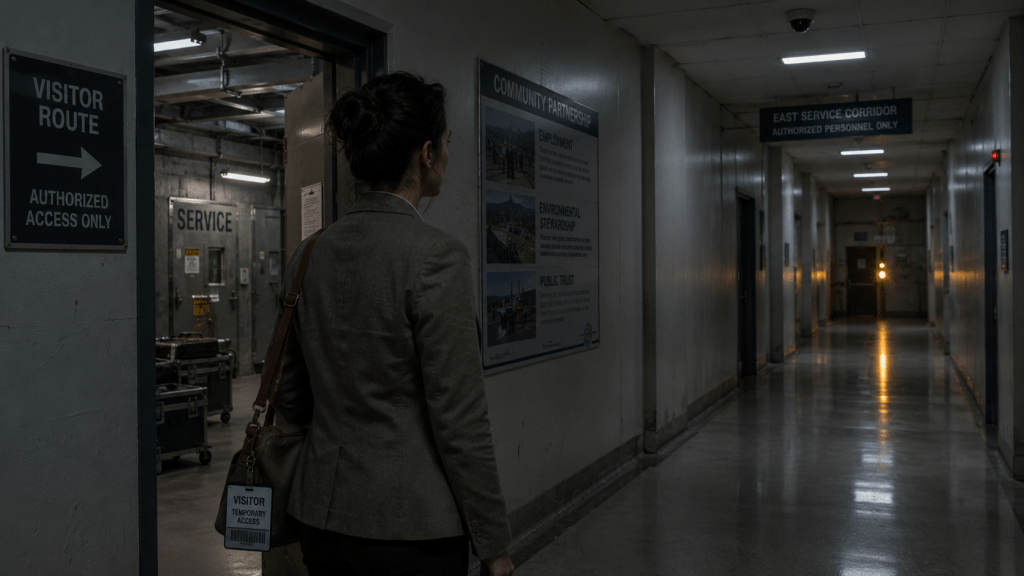
Maya enters the facility through an entirely different route. Where Ethan carries military clearance, Maya receives a visitor badge and a sanctioned public-affairs tour. Her editor presents the opportunity as the access she has been requesting, but the permitted story has already been defined: employment, community partnership, environmental monitoring and public trust.
The facility does not conceal its existence from her. It displays selected parts of itself.
That distinction is central to Maya’s section of the book. The visitor route is polished, carefully managed and filled with language designed to demonstrate openness. Public-affairs staff answer questions, explain environmental programmes and guide local representatives through approved corridors. Screens show maps, measurements and civic information. The tour appears to offer transparency because everything visible has been prepared for visibility.
Maya notices the working edges around that performance. A route changes without explanation. Staff members move with controlled urgency. Internal wording briefly appears on a public display. Radio traffic refers to the east service corridor, visual clearance and the need to keep visitors away from a particular area.
Her investigation does not depend upon hacking systems or performing exaggerated acts of espionage. She listens, notices the physical structure of the building and recognises when the official tour begins moving around something it has not acknowledged.
When she steps outside the visitor route, the institutional response is swift and remarkably calm. Her movement becomes a route exception, then an operational concern, then a media-conduct issue. Public affairs reaches her editor before she has fully left the site. Her access is not merely withdrawn; it is used to undermine the credibility of anything she may have observed.
The suppression works because it remains professionally believable. Her editor faces legal, financial and access pressures. The facility can claim that Maya violated the agreed route. She possesses fragments rather than publishable proof. The truth is not disproved. It is made unusable.
Maya’s response gives the book one of its most important human developments. When official channels can no longer hold what she has witnessed, she begins preserving it privately. Journalism has not ceased to matter to her, but publication is no longer the only measure of whether a record should exist.
Adrian Hale and the Danger of Successful Science
Dr Adrian Hale experiences the same pressure from inside the scientific system. His technical ability has already made him valuable. A correction he completed in the earlier book has held under further load, leading the facility to transfer him into Applied Coherence, a deeper and more restricted section of the research programme.
The move appears to be professional recognition. Adrian receives new access, more complex models and work that better suits his abilities. Every reward also reduces his understanding of the whole.
He is shown a larger structure while being assigned a smaller permitted portion of it. His notes must remain structural. Interpretation sits outside his scope. Wider questions are redirected towards local tolerances, compatibility cycles and managed ranges.
Adrian’s danger does not arise from recklessness or cruelty. It arises from competence separated from moral context.
He can identify where a model is correcting too late. He can refine a threshold, stabilise a segment and improve the way different systems respond to one another. The facility does not need to force him into obvious wrongdoing. It gives him a problem that can be solved and withholds the meaning of the system that benefits from the solution.
This makes the scientific thread particularly unsettling. Failure might have forced the programme to stop. Adrian’s success allows it to continue.
The institutional structure rewards that success with deeper access and further responsibility, even as the language around him grows narrower. Another researcher, Nolan Vale, begins asking questions that move too close to interpretation. His concern is not treated as a scientific debate. It becomes an access matter, a personnel movement and a quiet reassignment.
The work continues around his absence.
The Quiet Violence of Institutional Language
Institutional horror is often most convincing when nobody believes they are behaving like a villain. Field Adjustment builds its pressure through ordinary people fulfilling professional roles.
The shift officer accepts the monitoring record because that is the authorised version available to him. The personnel officer processes leave through welfare language. Public affairs protects access agreements and controls the organisation’s public exposure. Maya’s editor attempts to protect the newspaper from a confrontation it cannot afford. Researchers keep their notes within permitted scope. Contractors finish the installation because their responsibility ends at the equipment.
Each decision can be defended locally.
The horror emerges from the combined result. A figure can be witnessed and removed from the record. A reporter can be invited inside and professionally discredited for seeing beyond the presentation. A scientist can recognise structural instability and be rewarded for making the system accept it.
Nobody needs to announce a conspiracy. The organisation’s existing incentives produce the necessary silence.
This gives Field Adjustment a distinctive place within institutional science fiction. It is concerned with how organisations protect continuity before truth, particularly when admitting the truth would require them to question the work, authority and assumptions upon which the organisation depends.
The language does not merely conceal the crisis from outsiders. It allows the people inside the system to continue participating without having to confront the full meaning of their actions.
Dimensional Horror Rooted in Physical Experience
The dimensional horror of The Open Gate does not depend upon a bright portal opening above the facility or a clearly identified creature stepping into view. Its force comes from familiar spaces behaving incorrectly.
Equipment wakes before receiving the signal expected to activate it. Dust moves where the air remains still. Static is felt through gloves and clothing. A low vibration travels through a vehicle after the engine has stopped. Human-shaped forms remain visible long enough to resist dismissal, while refusing to resolve into something the witnesses can confidently name.
These effects remain close to the body. Ethan feels them through his boots, hands and jaw. Maya experiences them through floors, walls, sounds and changes in controlled movement around her. Adrian encounters them through models whose behaviour implies a structure larger than the one he has been permitted to see.
The separation between the three perspectives allows the reader to recognise connections that none of the characters can yet confirm. What appears at the perimeter has a technical reflection inside the laboratory and an institutional reflection within the visitor route. Each part remains incomplete, which preserves the uncertainty without making the story arbitrary.
The series does not ask the reader to accept that everything is inexplicable. It shows people repeatedly encountering evidence that their current explanations are too small, then continuing to use those explanations because no authorised replacement exists.
A Facility Built from Ordinary Systems
The unnamed installation occupies a remote, dry region of the American Southwest, where isolation supports both the physical work and the public denial surrounding it. Its atmosphere is constructed from service roads, fences, guard posts, concrete pads, low buildings, monitoring cabinets, security desks, laboratories and controlled corridors.
Nothing about the facility resembles a theatrical villain’s headquarters. It feels funded, functional and accustomed to processing risk.
That ordinariness is essential. A more visibly sinister place would warn everyone entering it that something was wrong. The installation in Field Adjustmentrelies upon recognisable systems whose familiarity reassures the people using them. Badges open the correct doors. Forms record movement. Screens display authorised information. Staff members redirect visitors politely. Work continues beneath fluorescent lighting.
Beyond the facility, the town provides a civilian reflection of the same pressure. Local advisories, bar conversations, changing animal behaviour and small disturbances remain easy to dismiss as separate issues. People continue going to work, meeting friends and returning home because nothing has yet provided a socially acceptable reason to stop.
The boundary therefore becomes more than the perimeter fence. It moves through professional access, approved terminology, bodily sensation and domestic space. By the time the characters begin recognising that movement, the system has already adjusted around them.
Why Book Two Deepens The Open Gate
Field Adjustment does not repeat the opening pressure of Prior Condition. It changes the nature of that pressure.
The first book allowed contradictions to appear. Book Two shows the institution responding to them. That progression gives the story momentum without rushing towards open collapse or easy revelation. The reader learns more about how the pieces connect, while the deeper cause remains unresolved.
Ethan becomes a witness whose report cannot survive the system recording it. Maya discovers that access can be another method of restriction. Adrian moves closer to the centre of the work while receiving less freedom to interpret what he sees.
Their stories do not converge through a convenient exchange of information. They remain divided by professional roles, restricted knowledge and the damaged intimacy of Ethan and Maya’s marriage. The reader occupies the uncomfortable space between those fragments, aware that the same event is being managed through several different institutional layers.
For readers who prefer science-fiction horror driven by atmosphere, psychological pressure and accumulating consequence, this structure offers a more sustained form of unease than immediate spectacle. The danger grows because people continue doing their jobs well.
A Story for Readers Who Prefer Dread to Spectacle
Field Adjustment will particularly suit readers interested in dimensional horror, secret research facility fiction, military science-fiction suspense, investigative science fiction and stories about scientific responsibility.
Its military elements concentrate on routine, observation and the limits of procedure rather than combat fantasy. Its journalistic thread examines credibility, professional containment and the difficulty of publishing evidence that remains fragmented. Its scientific thread explores the danger of technical success when nobody is permitted a complete moral view of the work.
The horror remains restrained, but the restraint does not make it slight. It allows each detail to remain close enough to ordinary life that dismissal feels possible. The reader understands why the characters continue, even as each continuation carries them deeper into a system that has begun changing the conditions around them.
Field Adjustment is Book Two of The Open Gate and follows the events of Prior Condition. Readers returning to the series will find the pressure widening across the perimeter, newsroom, laboratory and home. New readers will encounter a grounded adult science-fiction horror series in which institutional confidence survives longer than the explanations supporting it.
The facility remains operational. The reports remain controlled. The adjustment has been confirmed, and the boundary has already moved beyond the place where anyone expected to contain it.
A military patrol jeep follows an old service road beside a perimeter fence. Cameras watch the empty ground through layers of glare. Guard posts repeat along the route, their equipment familiar enough to be ignored until one of the screens fails to behave as expected. Beyond the wire, something human-shaped appears for long enough to trouble the eye, but not long enough to become evidence.
Nothing has publicly collapsed in Prior Condition. The installation continues to operate, soldiers complete their patrols, reporters work through ordinary newsroom disputes, businesses open their doors, and scientists correct the problems placed before them. The world remains recognisable because the first stage of this slow-burn science-fiction horror story does not arrive through open catastrophe. It arrives through systems that continue working after their explanations have begun to fail.
Simon Phillips’s opening book establishes a contemporary world in which military procedure, investigative journalism and restricted scientific research occupy different sides of the same developing crisis. Each system encounters signs that something is wrong. Each has a reason to contain, minimise or rename what it has encountered. The growing horror lies in the distance between what people experience and what their institutions permit them to acknowledge.
The Perimeter Still Looks Secure
Ethan Ward experiences the opening pressure through military routine.
He understands the perimeter as a working system composed of roads, fencing, cameras, guard posts, radio checks and written logs. Its purpose is to turn uncertainty into procedure. A soldier follows the route, checks the equipment, records anything unusual and reports what cannot be corrected locally. The repetition creates confidence because each patrol resembles the one before it.
When Ethan first notices a figure near the fence, the environment immediately provides several acceptable explanations. The heat is severe. Distance is difficult to judge. The air shimmers above the ground. A tired mind can impose human form upon scrub, shadow or glare.
His patrol partner, Davis, supplies the reassurance almost automatically. Eyes invent things in empty places. Cameras suffer interference. Faults in isolated equipment are normal. Anything genuinely dangerous would become obvious through alarms, orders or visible changes in security.
That assumption carries more weight than the sighting itself. Ethan has been trained to believe that danger enters the system through recognised channels. A threat becomes real when it produces an alert, a command or a response from someone with greater authority. An uneasy sensation beside an apparently intact fence has no official category.
The military system does not ignore the irregularity because its personnel are foolish. It absorbs the irregularity because that is what the system has been built to do.
Equipment failures become maintenance problems. Unclear movement becomes heat distortion. Repeated sensor alerts become paperwork. A malfunctioning post is inspected, logged and passed onwards. Each individual response appears reasonable, but the cumulative pattern begins to suggest that the perimeter is measuring something it cannot interpret.
Ethan’s position makes this especially unsettling. He is neither a reckless action hero nor an expert who understands the wider programme. He is competent within the boundaries of his assignment. He knows how the road should feel beneath the vehicle, how a camera should cycle, how a fence should sound and how animals usually move through open ground. His unease develops through physical recognition rather than sudden revelation.
The familiar environment has not visibly changed. Ethan’s confidence in it has.
Three Perspectives Inside the Same Crisis
The structure of Prior Condition allows the reader to approach the emerging crisis through three separate forms of partial knowledge.
Ethan sees physical irregularities around the installation’s perimeter, but he lacks the context needed to understand them.
Maya Ward hears civilian testimony and begins placing apparently unrelated disruptions beside one another, but she lacks the proof needed to publish a definitive connection.
Dr Adrian Hale works with data, models and restricted system architecture inside the facility, but he is deliberately denied a complete view of what his technical corrections support.
The characters do not exchange their evidence. They do not gather in a room and solve the mystery together. Their separation is central to the story’s institutional horror.
The reader can see proximity where the characters see isolation. A sensor fault near the fence, a power fluctuation in town and an unusual pattern inside a scientific model may belong to the same developing event, but each appears within a different professional language. The military calls it interference. The newsroom calls it unverified testimony. The laboratory calls it drift.
The crisis remains deniable because its fragments are kept apart.
Maya Ward and the Burden of Unprovable Truth
Maya’s investigation begins with details that would be easy to overlook in isolation.
Lights dim and recover before residents decide whether the interruption deserves a complaint. Heavy vehicles move along county roads late at night. Windows tremble. Water pressure changes. Deliveries arrive late, arrive incorrectly or disappear into an ordinary chain of administrative confusion. People experience moments of silence in places where birds, insects and traffic should still be present.
None of these events proves anything.
That absence of proof creates Maya’s professional problem. She recognises a pattern, but recognition is not publication. Her editor does not have to deny that residents are reporting disturbances. He only has to demand verification, caution her against implication and redirect her towards safer material.
This is one of the most convincing expressions of institutional denial in Prior Condition. Maya is not dragged away by secret agents or threatened in a dark car park. The pressure remains professional, measured and plausible. The newspaper depends upon credibility. The installation supports the surrounding area economically. Sources contradict themselves. Witnesses question their own memories. An editor who asks for stronger evidence can still believe that he is protecting the publication.
The result is a form of containment that requires no visible conspiracy.
Information is softened before it is suppressed. A possible connection becomes proximity. A repeated disturbance becomes infrastructure trouble. An investigation becomes speculation. An uncomfortable story becomes a harmless community feature about the local installation.
Maya continues because the individual accounts begin to resist separation. A resident describing rattling windows supports another person’s account of late traffic. A shopkeeper’s delivery problems sit beside reports of power dips. A witness who sounds unreliable may still have noticed something that more credible people have trained themselves not to see.
Her work reflects the patient, uncertain nature of investigative science fiction. She is not an all-knowing reporter who can expose the entire system with one document. She listens, compares, returns to locations and waits for ordinary testimony to reveal its shared shape.
The tension comes from knowing that a pattern may become visible long before it becomes publishable.
Dr Adrian Hale and the Safety of Partial Knowledge
Inside the installation, Adrian encounters the same crisis through technical language.
His working environment is controlled, climate-regulated and divided by access permissions. Screens present bounded problems. Data arrives in limited sets. Assignments carry neutral labels that describe immediate function without revealing broader purpose.
Adrian is highly capable within this system. He can recognise a mathematical discontinuity that others have treated incorrectly. He understands how one adjustment affects another and how small errors can magnify further along a process. His ability makes him useful to people who know more about the programme than he does.
His danger is not madness or deliberate malice. It is competence without moral overview.
Adrian receives a problem and solves it. When a model becomes unstable, he corrects it. When a parameter drifts, he brings it back within tolerance. When a task requires information from a restricted cluster, he requests the portion his clearance permits him to see.
The scientific institution does not need to deceive him through an elaborate falsehood. It only needs to ensure that his field of responsibility remains narrow enough for the next task to appear reasonable.
His colleagues occasionally ask what their work is feeding or what the programme is actually building. Adrian answers from the position the institution has given him. Their work creates stability. Projects expand. Technical progress requires structure. Understanding the whole is unnecessary when each department is responsible for only one part.
This makes Adrian one of the most important figures in the book’s examination of scientific responsibility. His intelligence does not protect him from complicity. In some respects, it places him closer to it. The programme advances because capable people continue improving systems whose consequences remain outside their authorised view.
Scientific entitlement in The Open Gate does not begin with a dramatic declaration that humanity should control another reality. It begins with a more ordinary assumption: if a problem can be corrected, correction must be the responsible choice.
When Procedure Becomes the Horror
The institutions in Prior Condition are disturbing because they remain believable.
The military values readiness, clear reporting and an orderly chain of command. The newspaper values evidence, credibility and protection from unsupported claims. The scientific programme values precision, restricted access and efficient distribution of work.
None of those priorities is inherently irrational. The horror develops when the priorities continue operating after they have stopped producing an accurate understanding of reality.
A soldier is told to log an equipment failure rather than treat it as evidence of a wider problem.
A reporter is told to pause until she has proof that the existing system makes almost impossible to obtain.
A scientist is praised for stabilising a process without being told what continued stability might permit.
Institutional science-fiction horror works through this conflict between function and understanding. A system can remain operational while becoming dangerously wrong. Reports can be filed, screens can return to green, meetings can end politely and employees can go home without anyone asking whether the underlying activity should continue.
The people inside these structures are not required to agree upon a lie. They only need to complete their immediate duties.
This gives denial a practical form. It exists in access permissions, softened language, reassignment, professional caution and the belief that responsibility belongs to someone further along the chain.
Dimensional Horror Without Spectacle
The dimensional horror of Prior Condition remains close to ordinary perception.
A form near a fence fails to resolve properly. A moving shape does not match the ground beneath it. Light seems to behave incorrectly around an object. A shaded gap between buildings appears occupied without yielding a clear human outline. Scientific geometry implies a scale and purpose beyond the task visible on the screen.
These moments are unsettling because they remain incomplete.
The book does not immediately transform uncertainty into a catalogue of creatures or a lecture about alternate dimensions. It allows physical wrongness to enter familiar environments without providing the comfort of classification. The body recognises that something is misaligned before the mind can decide what that misalignment means.
This restraint prevents the story from becoming conventional portal fiction. The installation is not opening a colourful doorway into an adventurous second world. It is interacting with something it does not understand while behaving as though improved engineering will eventually make understanding unnecessary.
The gate at the centre of the wider series is dangerous because it belongs to an institution before it belongs to public knowledge. It can be measured, funded, divided into departments and protected by security procedures. Those conditions create the confidence that continued access is legitimate.
The deeper moral pressure follows from that confidence. Technical ability begins to resemble authority. Discovery begins to resemble ownership. Contact becomes something humanity assumes it is entitled to continue.
The Town Absorbs What the Facility Produces
The town surrounding the installation gives the story its civilian weight.
People continue buying bread, attending community meetings, driving to work and arguing about ordinary explanations. Businesses depend upon deliveries and reliable utilities. Residents are accustomed to the installation’s presence even when they know little about its purpose.
This makes the town capable of absorbing disruption for longer than an empty or isolated landscape could.
A flickering light becomes a problem with the grid. A vibration becomes old quarry work, road maintenance or heavy traffic. A missing delivery becomes a supplier error. A vehicle seen late at night becomes evidence of nothing more than military logistics.
The explanations survive because everyday life requires them to survive. Most people cannot stop working while they investigate the cause of a brief power fluctuation. A shopkeeper still has customers to serve. A resident still has bills to pay. A reporter still needs enough evidence to satisfy an editor.
The installation and the town therefore mirror one another. The facility contains irregularities through professional procedure. The town contains them through habit, economic dependence and social embarrassment.
Both remain functional. Neither remains entirely secure.
Secrecy Reaches Beyond the Workplace
The pressure surrounding Ethan and Maya also enters their marriage.
Their domestic distance existed before either of them could name the developing crisis. Ethan withholds parts of himself through habit. Maya becomes increasingly absorbed in an investigation she cannot yet defend. Their conversations have thinned into practical exchanges, leaving each of them close to a different fragment of the same event without recognising the connection.
This human layer prevents the story’s institutional themes from remaining abstract.
Classified information does not stay inside a facility. Professional caution does not remain inside a newsroom. Secrecy alters the way people return home, answer questions and interpret one another’s silence.
The marriage reflects the wider condition of the series. Its structure remains in place. Trust has not disappeared in a single dramatic betrayal, but it has become harder to reach. Each person continues according to familiar routine while something important remains unspoken between them.
The result is a form of domestic suspense that belongs naturally beside the military and scientific pressure. The same habits that allow institutions to avoid uncomfortable truths can also exist inside a home.
It does not offer immediate collapse, open warfare or an explanation of everything behind the installation. Instead, it introduces a world that still believes its systems are capable of containing whatever those systems have created.
Readers encounter the crisis from three different positions: the soldier standing beside the fence, the reporter listening to people who already doubt their own testimony, and the scientist improving a programme whose larger purpose remains beyond his clearance.
The strength of the story lies in the way these perspectives accumulate. Ethan’s physical unease, Maya’s incomplete pattern and Adrian’s technical success become more troubling when placed beside one another. The reader begins to understand that the problem is not confined to a single malfunction, witness or department.
Something is happening around the installation. The institutions closest to it are already responding. What they cannot yet do is admit that their responses belong to the same event.
The book offers slow-burn science-fiction horror rooted in military routine, investigative pressure, scientific compartmentalisation and the physical unease of familiar places becoming unreliable. Its world remains intact enough for denial to survive, but each character has encountered something that cannot be returned completely to its previous category.
The fence is still standing. The newspaper is still printing. The laboratory screens are still reporting success.
The pressure begins in the space between those facts and what they no longer explain.
At an east-coast port, the backlog was still called temporary, even as certain loads began moving ahead of everything else.
The Night the Port Began to Hold Back
The rain reached the port before the night shift had properly settled, drifting in from the estuary in fine slanting sheets that silvered the yard lights, glazed the painted lane markings, and left the concrete shining beneath the cranes as though the whole terminal had been sealed under dark glass. Floodlamps burned above the container stacks, pale and hard through the wet air, while gantries crawled along their rails with the slow assurance of machinery too large to hurry. Beyond the security fencing, HGVs idled in a queue that had already pushed past the roundabout, their headlamps trembling across puddles while low exhaust folded through the access road and dissolved into the weather.
Elliot Ward had worked the east quay for eleven years and had long since stopped expecting the night to behave. A delayed ferry could spoil one shift, a crane fault could spoil two, and a Customs hold could turn a clean roster into hours of improvised apology. This felt different, although nobody on the operations floor had placed a name on the change yet. Civilian stacks were climbing where they should have been thinning. A supermarket consignment expected inland before dawn still sat beneath floodlights with three other loads that should already have cleared the gate, while sealed units marked for expedited partner handling moved through lanes that had been empty on the printed schedule beside Elliot’s desk.
He stood inside the control cabin with his headset pressed close and watched two screens at once, one showing berth movement and the other turning the yard into coloured blocks, each stack reduced to numbers that never showed tired drivers, shivering lashers, or a forklift operator wiping rain from his face with the back of a glove. The shift supervisor, Sarah Cole, had wedged a paper cup beside the keyboard and forgotten to drink from it. She leaned over a revised movement sheet with a biro tucked behind one ear, her shoulders held too high for someone four hours into the night.
“Lane Four has changed again,” Elliot said, lowering the headset from one ear as another update flashed across the live board. “Civilian export hold. Priority transit coming through from the west gate.”
Sarah glanced from the marked sheet to the screen, then drew the paper closer with two fingers. “Who authorised that?”
“Regional desk,” Elliot said, touching the line with the end of his pen. “It came through on the secure channel.”
Sarah gave a tired breath through her nose and pressed the biro against the margin. “That phrase is becoming very popular.”
The next call reached Elliot before he could answer. A driver at the front of the commercial queue wanted a fresh estimate. Another had missed his onward slot near Peterborough. A haulier outside Ipswich warned that a late handover would cost him his morning contract and his fuel window. Elliot dealt with each one in the careful port language he had used throughout the evening, keeping congestion, sequencing pressure, and revised flow inside sentences calm enough to stop men from shouting through glass.
Outside, a line of dark tractor units crossed the wet yard in steady procession, escorted by two port vehicles with amber lamps turning slowly in the rain. Their trailers carried plain containers with fresh seals and no company branding visible from the cabin. One bore a small white plate near the rear corner, too far away for Elliot to read, although he had seen enough of them across the past fortnight to recognise the handling pattern. They arrived late, they came through with short notice, and every instruction around them treated delay as more serious than the freight already waiting.
Sarah followed his gaze towards the controlled lane and folded one arm across her middle. “Those again.”
“Those again,” Elliot said, keeping his eyes on the convoy as it moved past the stacked retail units.
“Any destination line?” Sarah asked, looking back to the revised sheet.
“Transferred at railhead, then onward under separate coordination,” Elliot replied. “That is all the system gives us.”
Sarah circled one of the delayed retail consignments with more pressure than the page deserved. “Put refrigerated stock on a thirty-minute review. I want confirmation before we bury it another hour.”
Elliot glanced back to the yard map, where Lane Four had already turned amber beneath the updated routing. “If Lane Four stays closed, thirty minutes turns into ninety.”
“I know,” Sarah said, straightening with the biro still caught between her fingers. “Review it anyway.”
At the gate, a man in a navy waterproof climbed down from his cab and walked towards the barrier with his lorry keys still in one hand. A security steward stepped from beneath the shelter to meet him, palms low and shoulders already braced. Elliot saw the exchange through the nearest monitor, then heard the radio click alive from the gatehouse.
“Ops, we have a driver asking why lane priority keeps changing,” the steward reported over the speaker. “He says he has food stock under contracted delivery and his slot closed forty minutes ago.”
Sarah reached for the desk microphone and held it near her mouth while watching the grainy camera feed. “Tell him revised port sequencing is in effect due to external demand pressure. His load remains live in the system. He will move once clearance opens.”
The steward repeated the wording while the driver looked past him towards the dark containers rolling through the separate lane. Even through rain and camera grain, Elliot could read the direction of his anger. His trailer carried a supermarket logo across the side. The priority units moving beyond the barrier carried nothing at all.
The driver lifted one arm and pointed. The steward replied. The driver laughed once, sharply, then turned away and walked back to his cab with rain shining across his shoulders. A second lorry in the queue flashed its headlights twice, which could have meant sympathy, impatience, or the simple desire to be seen.
“External demand pressure,” Elliot said quietly, setting his headset back against one ear.
Sarah kept her eyes on the monitor as the driver climbed into his cab. “Would you prefer telling him certain movements outrank lettuce?”
“No,” Elliot said, lifting the latest hold update from the printer tray.
“Then use the line,” Sarah replied, already returning to the revised yard sheet.
He did. They all did. By ten o’clock the phrase had passed through the gatehouse, the call desk, two handovers, and one haulier who had begun by asking for facts and ended by asking whether anyone at the port had them. Elliot watched civilian dwell times creep up across the board while the sealed priority units continued to enter, hold briefly, and leave again through lanes that kept appearing beneath his hands whenever he believed the board had settled.
The quay offered no cleaner answer. At Berth Three, lashers in reflective jackets moved under towering hull-side lights as the latest ferry unloaded into wet metal glare. Containers came down in measured swings, guided by men who stepped through puddles and radioed numbers into the cold. Elliot went out just after half past ten, sent by Sarah to speak with yard marshal Zahra Iqbal about a failed transfer sequence and a stack built too close to one of the priority lanes. The rain struck his face sideways the moment he left the cabin. Diesel, salt, wet steel, and the sour warmth of brake systems rose together from the concrete.
Zahra met him beside a row of held civilian units, her tablet tucked inside her jacket to keep the screen dry. She had been working the port almost as long as Elliot and carried strain lightly until somebody asked the wrong question twice.
“Lane Four keeps shifting under us,” Zahra said before he spoke, lifting her chin towards the rows behind her. “We cleared the stack once. Then west gate sent through another escorted set. Then regional pushed a fresh hold notice onto export traffic. My people are moving the same boxes in circles.”
Elliot glanced along the line of containers: household goods, packaged food, retail stock, automotive components, mixed freight tagged for Midlands distribution. Ordinary movement had become stationary metal under floodlights. “Sarah wants the transfer sequence reopened before midnight.”
“Sarah can have the moon if someone gives me space to put it,” Zahra said, wiping rain from her eyebrow with the heel of her hand. “Do they know what they are doing up there?”
“They know what they want prioritised,” Elliot replied, looking towards the controlled lane.
“That is a smaller skill,” Zahra said, following his gaze.
A port tug passed them, its amber beacon rotating across the wet sides of the containers. Beyond it, another escorted trailer rolled into the controlled lane and slowed beside a waiting reach stacker. Two men in rainproof jackets checked seals beneath floodlight, one with a clipboard held close against his chest, the other speaking into a handset as if the weather itself might overhear. The trailer had come from somewhere inland, crossed civilian roads, entered a civilian port, and now moved through the yard with an attention no ordinary freight received. Elliot watched until the reach stacker lifted the container clear.
“See that?” Zahra asked, her eyes staying on the suspended load.
“I see it,” Elliot said.
“Three nights ago we had one batch,” Zahra said. “Last night we had two. Tonight we have had four before eleven.”
Elliot looked back towards the control cabin, its windows shining above the yard like a small office suspended over a flood. “The line is that wider European transport pressure has increased port sensitivity.”
“The line is tired,” Zahra said, drawing her jacket closer at the collar.
“So are we,” Elliot replied.
Zahra gave a quiet laugh, although her eyes stayed on the lifted container as it moved above the rain-dark lane. “A driver asked me earlier whether we had started running a second port inside the first. I told him no.”
“Was that true?” Elliot asked, turning slightly towards her.
She met his eyes for a moment, then looked back to the controlled lane. “It was true enough for the radio.”
The container settled onto a waiting chassis with a deep metallic thud. Men moved in. Seals were checked again. The tractor unit pulled away almost at once, heading for the eastern exit where civilian lorries still sat nose to tail beyond the barrier. Elliot watched the escorted movement disappear into rain and reflected light while the held rows beside him remained exactly where they had been when his shift began.
His radio cracked at his shoulder. Sarah’s voice came through, dry and controlled. “Elliot, return to Ops. Regional want updated dwell figures before eleven-thirty. Include civilian delays separately from protected transit movements.”
Zahra heard it and gave him a look that needed no translation. Elliot pressed the talk button and answered that he was on his way, then turned back towards the cabin through rain thick enough to blur the cranes and flatten the yard into lights, steel, and movement withheld. Behind him, the civilian containers waited under floodlamps, their painted company names bright with water, while another sealed load passed through the port as if the night had opened specially to receive it.
A Visual Chronicle
The port never closed, but somewhere inside it, ordinary freight had already stopped mattering.llowing Visual Chronicle presents a cinematic reconstruction of the events described above.
Operational Record: East Quay Night Movement Extract
Record Type: Internal port operations extract Terminal: East Coast Freight Terminal Shift Window: 21:45–23:40 Circulation: Operations Desk / Yard Control / Regional Movement Liaison
21:48 — Night shift assumed live yard control under elevated vessel turnaround pressure and revised inland release timings. Civilian import stacks remained above planned dwell levels at handover, with retail, mixed goods, and temperature-controlled consignments requiring active review through the opening movement window.
22:03 — Regional Movement Liaison issued first protected transit update of the shift. Lane Four reassigned from civilian export staging to priority clearance pending arrival of sealed onward units. Yard control instructed to preserve direct handling access and prevent stacking across the controlled route.
22:17 — Civilian export movement paused through Lane Four. Gate desk advised to use approved explanation for haulier queries: revised port sequencing linked to external demand pressure. No alternative departure window released at this stage. Several waiting drivers requested refreshed estimates owing to missed inland slots and fuel-window exposure.
22:31 — Refrigerated retail consignment group raised for dwell review after original release sequence slipped beyond expected window. Operations Desk requested clarification on whether cold-chain capacity should override protected transit precedence. Regional desk response: maintain current movement order until further instruction. No further explanation supplied.
22:46 — Second protected transit set entered through west gate under escort handling. Units carried reduced exterior identifiers and received immediate controlled-lane processing. Civilian release timing adjusted again to preserve route access. Yard map began showing visible accumulation across mixed commercial stacks nearest Quay B.
22:58 — West gate reported direct challenge from a commercial food-stock driver regarding repeated lane displacement. Gate staff repeated approved sequencing language. Driver returned to vehicle after brief delay. No escalation recorded. Queue remained orderly, though radio traffic indicated growing impatience across the outer access road.
23:07 — Yard Marshal reported repeated rehandling of civilian containers to maintain controlled movement space. Internal comment logged that current lane changes were beginning to distort normal terminal flow beyond earlier estimates. Issue referred to Operations Desk for inclusion in the eleven-thirty dwell brief.
23:19 — Fourth protected transit movement of the evening logged across active yard control. Processing time remained within assigned tolerance. Civilian backlog continued to widen across export holding rows and retail-linked units. One quay-side supervisor requested confirmation of whether present measures should still be treated as temporary sequencing or an altered operating condition.
23:34 — No revised external guidance received. Public-facing delay language remained unchanged. Internal figures showed priority transit clearing at expected rate while ordinary container release continued to lengthen through the shift.
About the Creator
The Modern Chronicle is written and curated by Simon Phillips, an author of modern speculative fiction and contemporary crisis-driven storytelling who explores the point where ordinary life begins to tighten beneath political strain, military movement, institutional caution, and the public language used to keep dangerous realities at a distance.
Many of the records presented in these Chronicles sit alongside Simon’s wider modern-war novella series, where governments, soldiers, families, and civilian systems are forced to absorb a world changing faster than its official explanations. The stories remain grounded in recognisable places: ports, school corridors, freight yards, government rooms, roadside queues, transfer sites, and homes where the news has started to feel too close.
One such world unfolds through The Last Deterrence, a modern-war novella sequence beginning with Managed Distance Breaking and continuing in The Quiet Strike. Together, the first two books follow Britain as support language begins to fracture under freight pressure, European escalation, domestic infrastructure strain, and the growing sense that distance from war has already begun to fail.
Readers who wish to explore the wider published story world connected to this Chronicle can find the novellas below.
The following Chronicle continues the night shift at the east-coast terminal, where ordinary containers remained in place while a quieter class of movement passed through the port with growing urgency, leaving staff, drivers, and local operations teams to work around a pressure they had been given no language to describe.
Readers supporting The Modern Chronicle can continue the record below.
The Containers That Moved First
Elliot reached the control cabin with rain running from the edge of his hood and a dull ache starting behind his eyes, the sort that arrived when a shift had already lived too long inside artificial light and repeated explanations. Warmth met him heavily as he stepped through the door, carrying stale coffee, printer heat, damp waterproofs, and the low electrical hum of screens left too bright for the hour. Sarah had taken his chair while he was out and now rose from it with a sheet of figures in one hand and the desk phone trapped between shoulder and cheek. She pointed at the lower monitor as Elliot crossed behind her, then returned to the call with the exhausted patience of someone trying to make a distant office feel the weight of a place it could only see in numbers.
“Civilian dwell has risen across four stack groups,” Sarah said into the receiver, watching the yard map refresh in blocks of amber. “Retail-linked, mixed commercial, automotive, and temperature-controlled. If protected transit keeps this tempo through midnight, we need additional holding space or a release window restored.”
Elliot hung his wet jacket over the back of a spare chair and bent towards the live board. Lane Four remained closed to ordinary export movement. Lane Two had gained a fresh conditional marker. West gate still showed a queue stretching beyond the roundabout, while one of the sheltered driver areas near the outer fencing had reached capacity. The port could carry a difficult night if strain spread across the whole terminal. Tonight the weight kept settling in the same places again and again, and every fresh adjustment preserved the priority route first.
Sarah listened to the answer, her expression sharpening by degrees. She moved the receiver away from her mouth and looked at Elliot over the edge of the desk. “They want another controlled lane available from twelve-fifteen.”
“From where?” Elliot asked, searching the screen for space that had already gone.
“Quay B exit or eastern transfer.”
“Both are carrying civilian hold traffic already.”
“That was my understanding as well,” Sarah said, returning the receiver to her ear.
She continued the call while Elliot opened the dwell table and watched the numbers climb. The desk radio stirred with static, then Zahra’s voice came through from the yard, flattened slightly by wind and distance.
“Ops, Quay B has lost the clear edge,” Zahra reported. “We can hold one more rehandling sequence, then the stack turns poor for retrieval. I need a decision before the next escorted movement arrives.”
Elliot reached for the microphone and kept his eyes on the west gate marker as he answered. “Stand by, Zahra. Regional are asking for additional lane protection after midnight.”
A pause carried across the speaker, long enough for the cabin to feel it.
“Of course they are,” Zahra replied. “Let me know which part of the port we are pretending still belongs to ordinary freight.”
Sarah lowered the phone from her ear and pointed the receiver towards Elliot with a look that asked for mercy from somewhere else. “They heard that.”
“Good,” Elliot said, opening the operational notes field.
A knock sounded at the cabin door, and Matthew Hales from gate control stepped inside with his fluorescent jacket darkened across the shoulders and his cheeks flushed from the cold. He held a clipboard under one arm and a folded complaint sheet in the other hand.
“Drivers are asking for someone with authority,” Matthew said, closing the door behind him. “I told them authority has been rationed overnight.”
Sarah glanced at him across the desk while the phone rested against her shoulder. “How many?”
Elliot took the complaint sheet and scanned the names. “Any disorder?”
“Only moral disorder,” Matthew said, shifting the clipboard against his chest. “They are wet, behind, and watching unmarked freight clear a queue they have sat beside for hours. That combination breeds philosophy.”
Sarah ended the regional call with a clipped assurance that updated figures would follow, then set the receiver down more carefully than her face suggested. “We need to keep them calm until first release.”
“When is first release?” Matthew asked, raising his eyebrows.
Sarah looked towards Elliot.
“Undefined,” he said.
Matthew rested the clipboard against his jacket. “That answer may land poorly.”
Sarah turned back towards the monitor. “Sequencing review remains under way. Civilian release follows once controlled traffic permits. Use that.”
Matthew reached for the handle, then looked back at Elliot. “One of the drivers asked whether this is military.”
Elliot felt Sarah’s attention shift beside him. “What did you say?”
“That we handle multiple categories of protected freight under standing port rules,” Matthew replied, keeping one hand on the door.
“Good,” Sarah said.
Matthew gave a dry glance towards the yard screens. “He said that sounded like yes.”
The door closed behind him, leaving the cabin quieter than before. Sarah looked towards the monitors, where another controlled movement marker had appeared near the west gate approach.
“They see more than we are authorised to explain,” Elliot said.
“They see what is in front of them,” Sarah replied, lifting the next printed sheet from the tray. “That has always been enough to make management nervous.”
The eleventh hour moved through the terminal with the unsteady patience of a queue that knew nobody intended to release it soon. Another escorted set came through the west gate just after quarter past, plain-sided trailers rolling past commercial traffic with their lights low and their spacing exact. Elliot followed their progress across the camera panels as they cleared the gate, turned past the held stacks, and entered the controlled processing lane. The men receiving them wore port waterproofs, while two unfamiliar staff stood near the seal checks with laminated passes held close against their chests and no interest in small talk.
The first unit lifted under the reach stacker with a groan of hydraulics and rose above the line of waiting commercial freight. Its underside glistened with rainwater, dark and clean under the floodlights. From one camera angle, Elliot could see the supermarket driver from earlier still waiting beyond the barrier, face lit by the dashboard as he watched the movement in silence.
He built the comparison sheet. The figures turned plain once placed side by side. Protected transit sets were clearing at almost perfect pace despite late arrival and weather. Civilian release had slowed through every active commercial stream that touched the same lanes. Some delays still belonged to the port’s usual winter trouble, ferry timing, driver shortages, stacking pressure, late paperwork. Taken together, the pattern looked cleaner than any of those explanations.
The printer woke behind him, fed one page, then another. Elliot gathered them and read the summary line before Sarah could ask. Protected transit processing remained within assigned tolerance. Civilian dwell exceeded shift forecast across multiple categories. Additional review recommended if current movement profile persists.
Sarah took the sheets from his hand and read them twice. “That is careful.”
“It says enough,” Elliot replied.
“It says enough to anyone who already knows.”
“Which may be the only audience,” he said.
At twelve minutes past midnight, a commercial driver sounded his horn at the west gate and held it longer than irritation required. The noise carried faintly into the cabin through the weatherproof glass, flattened by rain and distance, then answered by another horn farther back in the queue. Matthew’s voice came over the radio asking for a supervisor presence before patience shifted into something less useful.
Sarah was already reaching for her jacket. Elliot stood as well.
“I will come,” he said.
“You stay with the board,” Sarah replied, glancing back from the coat hook.
“Zahra knows the yard. Matthew knows the gate. Drivers know I have been giving them numbers all evening. I should stand behind those numbers while they look at a person.”
Sarah studied him for a heartbeat, then gave a short nod. “Fine. Keep it calm. No guessing. No promises beyond release review after the next controlled set.”
Elliot followed her out into the rain. The path to the gate ran past stacked containers, a row of idle tug units, and the edge of Lane Four where forklift lights shifted across wet steel in broad white sweeps. The air smelled stronger outside the cabin, thick with diesel and salt and the sour trace of brake heat. Somewhere on the quay a horn sounded from the latest ferry, low enough to vibrate through the ground.
A cluster of drivers had gathered near the barrier shelter, hoods drawn tight, reflective strips bright under the floodlamps. Matthew stood beside them with one hand raised, his expression patient through visible effort. The supermarket driver from earlier stood nearest the gate, rain dripping from the end of his nose. Another man beside him wore a beanie pulled low and held a delivery folder protected inside a plastic bag.
Sarah addressed them first, naming herself, offering the port’s regret, explaining that sequencing pressure across the terminal had slowed several commercial lanes. Her words were measured and practised. They would have sounded reasonable in a meeting room.
The supermarket driver waited until she finished, then gestured towards the yard behind her. “We can see those units moving through.”
Sarah kept her voice even as she answered. “Certain transit categories remain subject to protected handling rules.”
“What categories?” the driver asked, wiping rain from his mouth with the back of his hand.
“I am unable to discuss individual freight classifications,” Sarah said.
“Then tell us why theirs matters more than ours.”
A smaller man behind him called out that his load carried pharmacy supplies for a regional wholesaler. The driver with the plastic-covered folder said his contract penalties began before dawn. Someone else asked whether the port had lost control of its own timetable. Each voice stayed civil enough on its own. Together they pressed against the air.
Elliot stepped forward slightly, close enough for the supermarket driver to recognise him from the earlier updates. “Your consignment remains live for release. We have a review window due after the current controlled movement clears. I am unable to give you a gate time until that review completes, although I can make sure your delay remains recorded against the port hold in place of your carrier.”
The driver stared at him through the rain. “You said that three hours ago.”
“I said your delay would be recorded,” Elliot replied. “That remains true.”
“True will never get me to the distribution centre.”
“No,” Elliot said, holding his gaze. “It protects you when someone asks why you failed to arrive.”
The driver seemed ready to answer, then stopped. The anger in his face shifted, losing some of its heat while leaving the exhaustion behind. “And when someone asks why food sat here while whatever those are kept going?”
Elliot looked past him towards the queue, towards headlamps waiting under rain, towards the held trailers standing in order because there was nowhere else for them to go. He could feel Sarah beside him, silent now.
“You will have to ask someone above this gate,” he said.
For a moment the only sound came from rain on jackets, the throb of engines beyond the barrier, and a distant container settling onto steel. Then the driver laughed once, softer than before.
“That is the first honest thing anyone has said tonight.”
Sarah drew the conversation back towards process after that. Review timing. Recorded delay. Updates through gate control. No one left satisfied, yet the drivers returned to their vehicles with enough order preserved to carry the next hour. Elliot stayed beneath the shelter until the last of them had gone, watching red tail lamps blink through the rain as cab doors closed one by one.
When he and Sarah walked back towards Operations, another plain-sided trailer entered through the west gate under escort. It passed within a few metres of the waiting civilian queue, lights reflected beneath it in trembling lines. Elliot turned his head to follow it. Sarah kept walking, although her shoulders tightened under the rain.
“How long do we keep calling this temporary?” he asked.
Sarah took a few steps before answering, her face angled towards the cabin lights ahead. “Until someone gives us a different word.”
They returned to Operations just as the printer began producing the midnight review sheets. Zahra had already marked the new civilian dwell figures in red pen. Protected transit clearance remained steady. Ordinary release had slipped again. Outside, the port continued working with all the visible energy of a system under control, cranes moving through rain, forklifts crossing glare, drivers waiting beneath headlamps, and sealed containers advancing through the one part of the night that never seemed to close.
Protected freight continued moving through the east-coast terminal while ordinary containers remained under floodlights, held in queues whose official explanation grew thinner by the hour.
The Idea Behind the Chronicle
Ports rarely feel dramatic from a distance. They appear on maps as fixed points of trade and movement, places where ships arrive, containers change hands, and the country continues receiving what it expects to receive. In ordinary times their importance hides inside routine. Food, medicine, industrial components, fuel-linked equipment, consumer goods, and the quieter cargoes that keep daily life stable all pass through systems designed to make vast dependence look effortless.
That invisibility is part of what makes a port such a powerful setting for The Modern Chronicle. When a country begins placing greater weight on military support, allied movement, or strategic logistics, the first visible changes may arrive far from television studios and government podiums. They appear in dwell times, altered lane priorities, additional checks, sealed consignments, and drivers being told that the latest delay remains temporary even when the pattern has already started to change.
The first Chronicle in The Eastbound Line series explores that threshold. Britain has not openly crossed into war, yet support commitments have begun to acquire physical weight. They need roads, yards, loading space, rail access, escorts, secure handling, and time taken from something else. A statement can present support as measured and controlled, though the port reveals a harder truth. Every prioritised movement creates a shadow behind it, and that shadow falls across ordinary freight, ordinary labour, and ordinary people waiting for release.
This kind of pressure has accompanied modern conflict for generations. Wars, emergencies, sanctions, strikes, and supply shocks often reach civilians through logistics before they reach them through direct danger. A shelf empties more slowly. A delivery misses its slot. A warehouse changes shift patterns. A driver hears one explanation through official channels and sees another truth forming in the queue ahead of him. None of those moments appears large enough to stand alone, though together they mark the point where national systems begin to lean towards crisis.
The Containers Left Waiting was built around that idea. The port workers do not receive a grand revelation, and the drivers are given no complete account of what has changed. They experience the shift through procedure, radio language, lane adjustments, and the simple fact that certain containers move while others remain beneath the lights. The gap between what is explained and what is visible becomes the story.
That gap sits at the heart of The Modern Chronicle. It records the moment before language catches up, when institutions still insist that the system is functioning and the people inside that system can already feel its purpose beginning to alter. In Article One, the port remains active, controlled, and outwardly calm. Yet by the close of the night, it has started serving two realities at once, and only one of them has been named.
From the Author’s Desk
The Eastbound Line grew from a question that has sat behind The Last Deterrence from the beginning: when does a country begin to live inside a war before it admits that the war has reached it? The answer rarely arrives through a single speech or one dramatic announcement. It appears first through pressure placed upon ordinary systems, through freight yards, ports, road closures, delayed deliveries, public statements that remain calm while the world behind them begins to tighten.
This first Chronicle focuses on a port because ports reveal the hidden physical life of a nation. They show what must keep moving, what can be pushed aside, and what begins receiving priority once political commitment starts gaining material weight. In The Containers Left Waiting, the workers and drivers have no access to the full picture. They only see the shift through sealed consignments, altered lanes, dwell figures, and explanations that remain technically usable while growing less convincing each hour.
The wider Chronicle cycle will continue following that eastbound pressure as it moves through roads, statements, holding yards, protected routes, transfer sites, and the quiet hardening of infrastructure that still belongs to civilian Britain even as it begins serving something heavier. These are companion records to the published world of Managed Distance Breaking and The Quiet Strike, written to explore the spaces around the novellas rather than retell them.
Alongside these Chronicles, I continue writing fiction across modern speculative, science-fiction, fantasy, and historical projects, many of them concerned with the same central tension: people trying to live ordinary lives while larger systems begin changing around them.
Readers interested in those stories can explore more through the links below.
Large freight ports sit among the least visible forms of national dependence. Most people encounter them only through the goods that eventually appear on shelves, in warehouses, at building sites, or inside parcels left on doorsteps. The port itself remains distant, represented by container stacks, shipping reports, and occasional headlines about congestion. Yet once a country enters a period of strategic strain, ports become far more than commercial gateways. They become measuring points for national priority.
Every container terminal operates through sequence. Berths, cranes, yards, lorry gates, refrigerated storage, customs checks, rail slots, and onward distribution all rely upon movement occurring in the correct order. Once one category of freight begins receiving urgent treatment, the effect spreads outward. A protected lane requires clear ground. A sealed movement needs staff, escort handling, and release time. A civilian load left waiting in one corner often forces another to be shifted somewhere else. The system can remain outwardly calm while its internal balance changes sharply.
Article One of The Eastbound Line begins inside that balance point. The port has not failed. Cranes still move. Drivers still arrive. Schedules still exist. Yet the night already carries a different hierarchy, and the workers closest to the yard recognise it before public language has caught up.
Protected Transit Movement
Modern states often rely on commercial infrastructure to support defence-related movement, especially during periods that remain publicly framed as support, reassurance, or resilience. Freight terminals, roads, railheads, ferries, contractors, and civilian logistics firms may all become part of a wider national effort long before the public sees anything resembling open mobilisation. The work stays practical: units are sealed, lanes are reassigned, release windows are shortened, and certain loads receive handling attention that ordinary freight rarely enjoys.
That form of movement sits at the centre of The Containers Left Waiting. The protected units in the Chronicle are never fully explained because the workers handling the port would rarely receive that explanation in full. They know only the rules surrounding the load. It arrives late and still moves. It lacks ordinary branding and still earns faster clearance. It carries no public announcement and still reshapes the yard around itself. The absence of detail becomes part of the pressure.
This is one of the core tensions inside The Modern Chronicle. Institutions preserve control by narrowing what people are told. Workers preserve their sanity by reading what happens in front of them. When those two forms of knowledge begin drifting apart, even routine procedure starts sounding like concealment.
The Civilian Cost of Delay
A delayed container rarely feels dramatic in isolation. It can sound like a minor commercial frustration, the kind of thing absorbed by contract penalties, revised delivery estimates, or another call placed to a warehouse office after midnight. Yet repeated delay begins altering the ordinary life of a country in small accumulating ways. Food shipments arrive later. Pharmacy stock sits in transit longer. Retail deliveries lose predictability. Drivers miss fuel windows, distribution centres lose sequencing, and workers across the chain inherit pressure they had no part in creating.
The Chronicle focuses on waiting because waiting reveals the hidden cost of priority. Something moving first means something else remains behind. The people at the port understand that simple truth more quickly than the language surrounding them allows. Sarah can record dwell times. Elliot can log delay reasons. Zahra can reshuffle stacks. Matthew can face angry drivers at the gate. None of them can explain the larger decision that has turned ordinary freight into the slower half of the terminal.
That friction matters across The Eastbound Line. The series follows the same worsening national reality as it moves through government statements, freight yards, protected roads, infrastructure incidents, airfields, and strike aftermath. The containers waiting beneath floodlights mark the first stage of that progression. Their stillness shows the country beginning to reorganise itself around a pressure it continues to describe as controlled.
Next Chronicle
While the port queues continued to lengthen, officials inside Whitehall were preparing a calmer account of the same pressure. Publicly, Britain’s transport systems remained resilient, support commitments remained manageable, and the delays appearing across freight networks could still be described as temporary disruption shaped by wider European demand.
Inside the coordination loops, the picture was less reassuring. Capacity dashboards were beginning to show that ordinary movement could only continue if other forms of movement were pushed aside. Contractor calls grew sharper. Regional warnings arrived more frequently. Ministers required language strong enough to preserve public confidence while leaving room for measures that had already begun altering how the country moved freight, fuel, and strategic material eastward.
The next Chronicle enters that government communications effort, where officials gather around figures that refuse to remain comforting and prepare a statement insisting that the system is still holding.
Next Week: The Statement About Capacity
The port kept working through the rain, clearing what it had been told to clear and holding what it had been told could wait, while beyond the gates the queue lengthened beneath the lamps and the country began, quietly, to move in a different order.
There were some wars a country could watch from the edge of the room for a while. It could send equipment, issue statements, argue over proportionality, absorb the rise in fuel, and tell itself that distance still meant safety. It could speak of support, resilience, defensive aid, allied infrastructure, and managed escalation. It could choose careful words and hope the world accepted the distinction between helping a war and entering one.
That distinction was never as strong as the language around it.
Grounded modern war fiction begins in that weakness. Not in the clean declaration, not in the heroic charge, not in the moment when every citizen wakes to find history has suddenly changed, but earlier, in the days when the signs are visible and still denied. It begins with the barrier moved outside a government building, the police route changed twice in the rain, the school trip trapped near a protest line, the supermarket notice asking people not to buy too much, the fuel queue stretching into traffic, the family message left unanswered because the person who could answer is not free to say what happened.
That is the pressure at the heart of The Last Deterrence. It is not a story about war arriving all at once. It is about the failure of distance, and the way a country can be changed by war before it admits that war has reached it.
The War Before the Declaration
Modern war does not always announce itself in the old way. There may be no clean dividing line between peace and conflict, no single morning when every public statement finally matches the physical evidence. A government may still speak of restraint while bases move to elevated posture. Ministers may still use the language of support while fuel lanes, air movement sites, ports, depots, railheads, and logistics hubs become part of the battlefield.
That is why political military fiction has to pay attention to language as much as weapons. The public statement is not decoration. It is a tool, a shield, a delay mechanism, and sometimes a confession made carefully enough to pass as reassurance. In a NATO crisis, every phrase has several audiences. Allies hear one thing. Opponents hear another. The public hears something smaller and more domestic, something filtered through the price of petrol, the tone of a presenter, the closed road by the station, or the silence of someone serving overseas.
In The Quiet Strike, the second book of The Last Deterrence, Britain has not declared open war. That matters. It also matters that the country is already behaving as though the old distance has failed. The government still speaks of defensive reinforcement and allied logistics. Yet the physical world is moving faster than the public vocabulary. Military-linked sites are being watched. Small drones test perimeters. Fuel infrastructure becomes exposed. Support routes begin to look, to an adversary, like the early shape of intervention.
This is where grounded modern-war fiction finds its strongest tension: not in spectacle, but in contradiction.
Britain Under Pressure
A war story set around Britain cannot only be told through ministers and soldiers. If the country is under pressure, the pressure has to enter ordinary systems. It has to touch schools, shops, transport, pharmacies, family kitchens, shopping centres, petrol stations, police lines, local roads, and the tired staff who become the visible edge of decisions made elsewhere.
The home front is not passive in this kind of fiction. It is where the official story is tested against lived reality. A minister may say supplies are stable, but a parent sees the shelf gaps. A security correspondent may say an incident is under investigation, but a mother hears the phrase “military-linked site” and knows her son is somewhere inside that careful wording. A government may insist that measures are routine, but everyone can see more barriers, more police, more delays, more shortages, more signs asking people to stay calm.
That is one reason British war fiction has a different texture when it is handled seriously. Britain is small enough for the state, family, media, road network, military estate, and public mood to feel connected. A crisis in Whitehall can become a traffic jam, a cancelled bus, a school safeguarding concern, a family argument, or a queue outside a petrol station within hours. The distance between policy and kitchen table is never as wide as official language needs it to be.
In The Last Deterrence, Helen Mercer’s civilian line carries that weight. Her life is not separate from the strategic world. It is where that world becomes intimate. She sees the strain through prices, public anger, school routes, teenage fear, fuel anxiety, and the changing tone of ordinary conversations. Her family does not receive the war as doctrine. They receive it as disruption, silence, worry, and the slow shrinking of what used to be normal.
NATO Crisis Fiction Without Clean Certainty
A NATO crisis in fiction can easily become too neat. One side provokes, the other responds, alliances hold or fail according to simple dramatic need, and the story moves from escalation point to escalation point as if decision-makers are pushing buttons on a map.
The more frightening version is slower and less certain.
Alliances are made of governments, and governments are made of people working under pressure, with incomplete information, public fear, legal risk, military advice, domestic politics, media pressure, and allies who all need slightly different language. No capital hears the same phrase in exactly the same way. One country wants restraint named. Another wants deterrence visible. Another wants ambiguity. Another wants speed. Another wants proof that solidarity means more than statements.
That is where political military thrillers can become more than crisis machinery. They can show the strain of holding a coalition together when every word changes the room. The danger is not only that an enemy misreads a movement. It is that allies misread one another, governments speak past their publics, and military necessity begins to outrun political permission.
Leah Mercer’s state line exists inside that pressure. She works near the centre of government, where public language, private fear, and actual events pull apart. Her work is not simply to “know more” than the public. In many ways, her knowledge is another form of exposure. She sees how phrases are built to hold panic at bay. She sees which words are avoided, which ones are kept private, and which ones are released because no better shelter remains.
In this kind of story, the state is not omniscient. It is strained, reactive, skilled in language, and often behind the physical reality it is trying to manage.
Drone Warfare and the End of the Safe Rear
Modern war punishes movement. It punishes concentration, exposed logistics, predictable routes, fuel points, open tarmac, contractor sprawl, weak perimeters, and old assumptions about what counts as the rear. A site does not have to be on the front line to matter. It only has to be useful.
That is why drone warfare fiction has become central to any serious modern-war story. Drones change the emotional grammar of military space. A soldier can no longer assume that danger arrives with a visible enemy, a clear direction, or a traditional battlefield. A small unmanned platform can test a perimeter, record response patterns, reveal blind spots, disrupt fuel handling, damage confidence, or force a whole site to show its reflexes.
The danger is physical, but it is also psychological. Men look up before crossing open ground. Contractor vehicles are checked longer than before. A fuel lane becomes a target. A camera outage becomes a strategic problem. The air above a base stops being empty and becomes watched.
Daniel Mercer’s military line carries that truth from the ground. He does not experience the war as policy. He experiences it as rain on concrete, helmet straps, ruined food, shouted orders, smoke, blast pressure, exposed fuel systems, injured men, and the knowledge that support infrastructure is now part of the fight. His world is not abstract. It is made of gates, lanes, floodlights, barriers, radios, technical cases, medics, aircraft, and people trying to keep working after the site has been hit.
That is the crucial shift in The Quiet Strike. Rear space stops feeling rear. Support becomes dangerous not because someone has declared war, but because the machinery of support has become visible enough to strike.
The Quiet Strike: Book Two of The Last Deterrence
The Quiet Strike is the second book in The Last Deterrence, and it sits at the point where Britain can no longer keep the war at a comfortable political distance.
The first book, Managed Distance Breaking, showed the early failure of distance: public reassurance, government strain, family unease, and the first signs that a war described as external was already bending British life around it. The Quiet Strike moves the pressure closer. The language of support still remains in place, but the physical reality has changed. British-linked military space is being watched, tested, and struck. Drones reach towards air movement and fuel infrastructure. NATO allies argue over how much restraint can survive when the systems supporting the war are already under attack.
The book follows that pressure through three connected lines: Leah Mercer inside the machinery of government, Helen Mercer at home as public life narrows around shortages, transport disruption and family fear, and Daniel Mercer on the ground as the rear stops feeling safe. Together, those lines show the same crisis at different levels of knowledge. Leah sees the careful wording. Helen hears what the wording refuses to say. Daniel lives the danger that official statements reduce to incident language.
This is the published second entry in the series, and it marks the moment where support becomes participation in practice. Not through a formal declaration. Not through spectacle. Through movement, fuel lanes, exposed bases, public statements, family calls, and the slow recognition that Britain is already being pulled into the machinery of a wider war.
Family as the Place Where Strategy Lands
Large-scale war fiction often risks losing the human centre beneath the machinery of escalation. Maps grow larger. Threats multiply. The reader is told what governments fear, what armies require, what alliances decide. Yet the cost of those decisions becomes thinner if it does not land somewhere specific.
The family connection is not decorative. It joins the three major forms of exposure: state, civilian, and military. Leah sees the language of government from inside the system. Helen feels the same language fail to comfort at home. Daniel lives the physical consequences of what is still publicly described as support. Around them, the wider family absorbs the crisis through finance, adolescence, transport, work, worry, and messages that are too short to carry the truth.
This matters because war does not give everyone the same knowledge. A soldier knows what happened at the fuel lane but not the full political calculation. A government staffer sees the restricted incident summary but not the smoke, fear, and ringing ears. A mother sees the public statement and knows only enough to be frightened. Each truth is partial. Each truth is real. The distance between them is where much of the story lives.
That separation gives the series its emotional force. Public truth, private knowledge, and actual events do not arrive together. They move at different speeds, and the family has to live inside the gaps.
The Quiet Strike and the Failure of Managed Distance
The Quiet Strike belongs to the stage before open European war, when the language of control still exists but has begun to carry too much weight. It is a book about British-linked military infrastructure under pressure, NATO allies trying to hold discipline, and a family discovering that the war can reach them through systems before it reaches them through declaration.
Its title points towards the way modern escalation often feels. Not quiet because nothing happens, but quiet because the public words remain controlled. Quiet because attribution is withheld. Quiet because the attack is processed through incident summaries, protective measures, revised lane plans, and cautious statements. Quiet because families hear only what can be safely said. Quiet because the real change is already moving beneath the surface.
The strike does not need to destroy a city to matter. It needs to change posture. It needs to make a base reveal its weaknesses. It needs to make fuel, air movement, technical support, and site security part of the war. It needs to turn defensive support into something that looks, to those watching, like participation.
That is the point where genre and story meet. This is grounded modern-war fiction because the war is not treated as spectacle. It is political military fiction because language, alliance pressure, and state decision matter. It is British war fiction because the crisis enters recognisable civic life. It is drone warfare fiction because small systems change large behaviour. It is NATO escalation fiction because every defensive movement can be read by someone else as the next rung.
The Wider Shape of The Last Deterrence
The wider series is built around the collapse of managed distance. It begins with a recognisable proxy-war frame and follows the way support, aid, training, movement, and infrastructure slowly become harder to separate from participation. The story widens through Europe, alliance overload, global pressure, nuclear threshold, and the long aftermath of partial survival.
But the purpose is not to hurry towards spectacle. The purpose is to let each stage change the people living inside it.
Ports matter because ships and fuel matter. Roads matter because movement is vulnerable. Schools matter because public reassurance reaches children through adults who are no longer sure what to say. Government rooms matter because the wrong phrase can harden an alliance, frighten a public, or give an adversary a signal it was already waiting to find. Bases matter because the rear is no longer safe simply because someone calls it rear.
The world of The Last Deterrence is built from these pressures. It is a war story about systems, but never systems alone. It is about the people who have to keep working inside them: the staffer drafting the line, the mother wiping water from a kitchen counter while the news scrolls beneath her, the soldier walking up an aircraft ramp with smoke still in his sleeve, the technician holding herself together because damaged equipment still needs to be made safe, the young private learning that fear can be carried but not dismissed.
When the World Changes Before the Words Do
The most dangerous moment is not always the loudest one. Sometimes it is the interval when everyone knows the situation has changed but the official language has not caught up. The country is still told that measures are defensive. The military is still told that movement is support. Families are still told that details cannot be shared. Allies are still told that consultation is holding. The public is still told that everything remains under urgent review.
And yet the roads are different. The gates are different. The queues are different. The silences are different.
That is where The Quiet Strike stands. It is the moment when support becomes participation in practice, when Britain’s distance from the war fails not through a declaration, but through movement, fuel, drones, family calls, public statements, and the visible strain of a state trying to remain calm while reality pushes past the words.
The world changes first.
Understanding follows later, unevenly, through official phrases, damaged places, short messages, and the people left to carry what those phrases cannot say.
Modern war does not always arrive first as fire on the skyline. Sometimes it arrives as a changed route, a delayed convoy, a guarded gate, a school rumour, a longer queue at a port, or a government phrase that no longer has enough strength to hold the truth inside it.
In grounded modern war fiction, Britain is rarely most interesting when it is already burning. The deeper tension begins earlier, when ordinary systems keep moving while the meaning beneath them changes. A freight yard still opens. A school still takes registration. A minister still speaks of restraint. A soldier still loads crates under rain. A family still eats at the kitchen table while the television softens danger into careful language. Nothing has fully broken yet, and that is what makes the atmosphere more frightening.
This is the world entered by Managed Distance Breaking, the opening novella of The Last Deterrence. It is a British war fiction novella about the stage before open war becomes undeniable, when NATO crisis fiction is still able to wear the clothes of policy, logistics, reassurance, and routine. The conflict remains officially elsewhere, yet every practical detail begins to suggest that distance has already failed.
Public calm and private movement
A country under pressure often speaks in layers. There is the public language, made for kitchens and news bulletins. There is the private language, spoken in offices, briefing rooms, depots, and command spaces. Then there is what is actually happening on the ground, where phrases such as support, preparedness, resilience, and restraint have to become fuel, medical crates, aircraft dispersal, armed guards, road priority, and exhausted people making bad systems work for one more night.
That gap matters. It is where political military fiction about Britain can become more than speeches and strategy. The real strain appears when government language tries to remain calm while the physical country beneath it is already changing shape.
In Managed Distance Breaking, the pressure does not come from spectacle. It comes from the slow recognition that support is no longer cleanly separate from participation. Aid to Ukraine and Europe is not abstract. It has to move through ports, road networks, military bases, freight yards, rail options, and civilian workers whose own lives are already stretched. Once those routes matter, they can be delayed, overloaded, watched, probed, and struck.
Modern war punishes movement. It punishes concentration. It punishes visible preparation. That is why infrastructure becomes as important as the battlefield. A port is not just a port. A rail spur is not just a rail spur. A fuel compound, a logistics site, a transfer yard, a guarded airfield, and a civilian freight lane all become part of the pressure map.
The public may still hear that Britain is steady. The people moving the weight know something has altered.
The family as a national pressure system
War fiction often widens too quickly. It reaches for maps, briefings, fronts, and declarations before the reader has felt what national danger does to a household. Yet the domestic line is where public truth is tested first. A family hears the softened words, sees the altered routines, and learns to read the spaces between them.
A school teacher notices the way pupils bring adult fear into the classroom as jokes, rumours, and half-understood politics. A daughter near government hears how phrases are shaped before they reach the public. A soldier sees how support becomes physical labour before anyone admits it has become military exposure. Another family member at a port sees the same pressure through containers, shift overruns, and freight chaos. A younger child feels it through cancelled buses, strange adult silences, and the slow loss of ordinary certainty.
That is what gives a modern war novella series its human spine. The war is not simply out there. It is distributed through family life. It reaches one person as a briefing, another as a queue, another as a route order, another as a classroom question, another as a message that arrives too late or says too little.
The Mercer family at the centre of The Last Deterrence carries that split. Leah, Helen, and Daniel do not experience the same truth at the same time. They cannot. One is close to government language. One is surrounded by civilian consequence. One is inside military movement. The emotional power comes from the fact that all three are right in partial ways, and all three are denied the whole shape of what is happening.
That separation is essential to grounded world war escalation fiction. When every character knows everything too early, tension collapses into explanation. When knowledge is uneven, the world feels larger, colder, and more believable.
Logistics as the hidden battlefield
The glamour version of war ignores logistics until it needs a dramatic convoy. A more serious war novel about modern technology has to understand that movement itself becomes a target. Drones, missiles, surveillance, digital systems, damaged roads, exposed depots, and stretched civilian infrastructure all make the act of moving material dangerous.
Before a soldier fires a shot, somebody has to load, route, fuel, guard, sign, scan, delay, unload, and reload. Somebody has to decide which civilian freight loses priority. Somebody has to explain why supermarkets, ports, buses, petrol stations, and schools are being touched by a war that the public has been told is still distant.
That is where the phrase “managed distance” begins to fail. Britain may still describe its role as support, yet support has weight. It takes up road space. It uses drivers, ships, rail slots, fuel, security, airfields, and political credibility. It creates patterns that adversaries can read. It makes domestic weakness visible.
In this kind of NATO crisis fiction, the first battlefield may be the route network. Not because roads and ports are more dramatic than soldiers, but because soldiers cannot exist apart from them. The state may speak from a lectern, yet the war moves through a gate in the rain.
NATO hesitation without caricature
A restrained political war thriller about Britain should not treat NATO hesitation as cowardice or simple incompetence. Alliance politics are slower and more strained than that. Every state has its own public, military limits, geography, stockpiles, industrial weaknesses, elections, memories, and fears. To move together, allies must translate danger into language each capital can survive.
That makes hesitation part of the drama. A government may know more than it says and still not know enough to speak plainly. It may fear panic at home as much as misreading abroad. It may need to reassure allies while avoiding a phrase that locks it into action before the military system is ready.
In Managed Distance Breaking, this strain is felt through the changing relation between Germany, Britain, NATO support, and the Russia-Ukraine war. The point is not to reduce escalation to one dramatic decision. It is to show how pressure accumulates until careful language becomes too thin for the events it is meant to contain.
The most dangerous moments are not always the loudest. Sometimes they are the moments when everyone still speaks calmly because no one can afford the alternative.
Drones, signals, and the loss of a safe rear
Drone warfare fiction often focuses on the machine itself: the object in the sky, the strike, the surveillance, the sudden violence. Yet the deeper unease lies in what drones do to the idea of distance. They make the rear feel watched. They turn fences, fuel points, cameras, and minor outages into signs that something hostile may already be inside the system.
A drone does not have to destroy a base to change how the base feels. A cut feed, a broken device near a fence, a temporary light failure, or a small intrusion at the wrong hour can force armed men to move differently on home soil. It changes posture. It changes sleep. It changes the meaning of a quiet night.
That is the beginning of the no-safe-rear logic. Not full collapse. Not spectacle. A subtler and more frightening transition: ordinary military space becomes alert space, then guarded space, then exposed space. The country has not yet admitted it is in the war, yet parts of it are already behaving as though the war has found them.
Why the first book begins before the explosion
There is a temptation in world war escalation fiction to hurry. To reach the declaration, the strike, the invasion, the nuclear threshold, the ruined city. Yet escalation only has force when the reader understands what has been lost before the obvious loss begins.
Managed Distance Breaking begins with the failure of ordinary reassurance. It lets the reader feel the country before open war has hardened it. Downing Street still speaks in careful phrases. Schools still operate. Freight still moves. Soldiers still joke while hauling loads. Families still argue about buses, food, work, and whether anyone is saying the whole truth.
That matters because later destruction needs memory. Places must feel inhabited before they are damaged. Systems must feel functional before they fail. Relationships must have humour, irritation, habit, and warmth before fear begins to alter them.
The novella’s pressure lies in recognising that the state, the family, and the military are all moving at different speeds towards the same conclusion. The public is told that things are manageable. The people closest to the machinery can feel that manageability thinning. The soldier sees the change first in orders, routes, load sheets, and posture rather than in speeches.
This is why the book does not need to shout. Its unease comes from delay, repetition, wet roads, freight lanes, official rooms, and the growing suspicion that every ordinary process has acquired a second meaning.
The road towards the nuclear threshold
The Last Deterrence is not only about the opening phase of war. Its wider world points towards darker territory: open European war, global overload, nuclear threshold fiction, and eventually post-nuclear survival fiction in Britain. Yet the early books matter because the final threshold must never feel like a shortcut.
Nuclear fear becomes hollow when it appears too early as spectacle. It becomes credible when it emerges from accumulated failure: conventional war that cannot decide anything cleanly, alliances under intolerable strain, infrastructure exposed, command confidence damaged, public truth corroded, and leaders forced to make decisions under shrinking time and worsening information.
That road begins with smaller failures. A phrase that no longer holds. A logistics system that cannot stretch further. A family that stops believing reassurance. A soldier recalled from one kind of work into another. A government discovering that calm has become expensive.
The aftermath, when it comes, must also grow from this same world. Not wasteland fantasy. Not instant lawlessness. A half-surviving Britain would still have queues, notices, local councils, ration points, military remnants, missing-person lists, exhausted teachers, damaged ports, guarded depots, and people arguing over who has the right to give orders. The horror would not be emptiness. It would be uneven survival.
Entering Britain before it understands itself
The strength of grounded modern war fiction lies in what it refuses to simplify. War is not only battle. Politics is not only speeches. Family life is not only worry. Military service is not only action. Each becomes part of the same strained system, and the pressure moves through all of it.
Managed Distance Breaking enters Britain at the point where the old distinction between elsewhere and here begins to fail. It does not ask the reader to admire war. It asks them to feel how a country starts changing before it has the courage, evidence, or permission to say plainly what is happening.
A road remains a road until it becomes a route. A port remains a port until it becomes a pressure point. A school remains a school until children start bringing the war in through rumour. A family remains ordinary until every silence starts to mean more than it should. A government remains calm until calm itself becomes part of the deception.
The world does not end in the opening movement. That is not the point. The more unsettling truth is that it continues. Lights stay on. Meals are made. Statements are issued. Vehicles move. People go to work. Children ask questions adults cannot answer cleanly.
The change comes first through roads, rooms, queues, gates, silences, and delays.