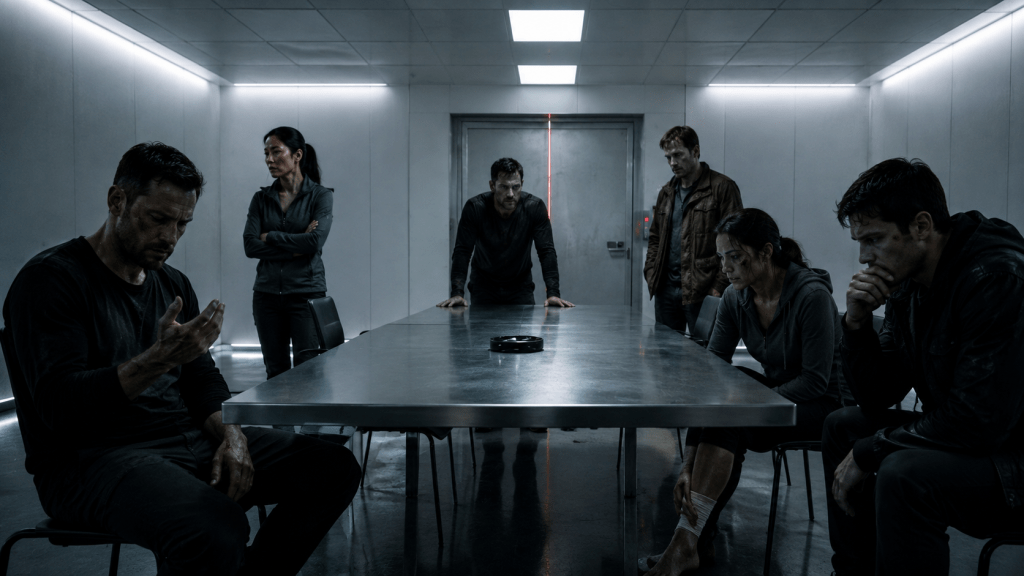
Six volunteers sit around a table inside a controlled room on an American military facility in Germany, surrounded by the quiet reassurance of polished surfaces, restrained lighting and people who speak as though every possible risk has already been reduced to procedure. They have signed the documents, attended the briefings and agreed to participate in an advanced immersive experiment built around artificial intelligence, crisis modelling and high-fidelity sensory technology. There should be uncertainty, because that is part of the research. There should be pressure, because their decisions are being tested. What there should not be is any reason to doubt that, somewhere beyond the experience, the ordinary world is still waiting for them.
That assumption is where Calibration Cycle: Meteor Event begins.
The first book in Calibration Cycle, Simon Phillips’s continuing psychological science-fiction series, places six very different people inside an experiment whose apparent boundaries become increasingly difficult to trust. The story begins with experimental technology and institutional confidence, then tightens around physical consequence, moral uncertainty and the disturbing possibility that the explanation given to the volunteers may no longer be large enough to contain what they are experiencing.
The result is science fiction built around pressure rather than technological spectacle. The central question is not whether the machinery is impressive. It is what happens to human judgement when an apparently rational system begins demanding decisions before anyone has enough information to know what those decisions really mean.
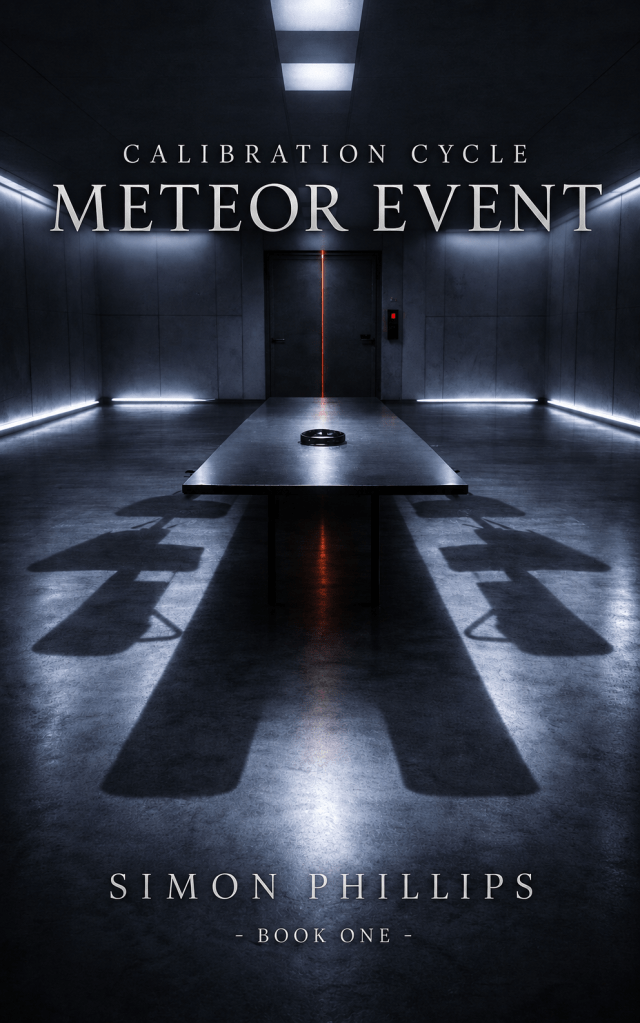
The Comfort of a Controlled Experiment
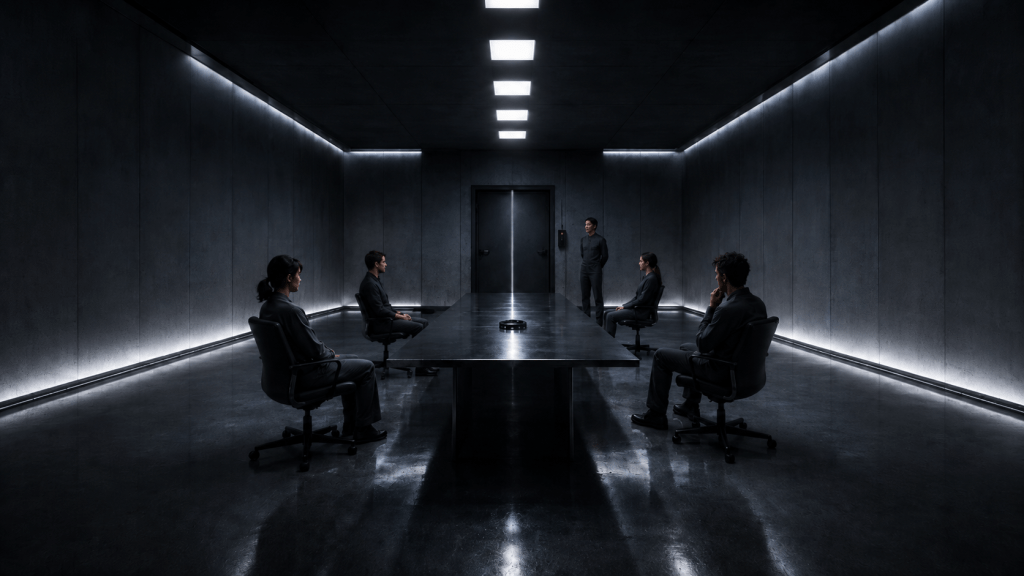
Aaron Cole enters the programme without the temperament of a conventional science-fiction hero. He is observant, restrained and more inclined to watch how a room is behaving than to dominate it. Around the same table sit Rei Nakamura, whose composure hides a constant awareness of the people around her; Marcus Reed, whose military experience makes him attentive to posture, threat and institutional procedure; Connor Blake, who responds to uncertainty by trying to understand the technology producing it; Declan O’Shea, whose scepticism keeps dragging extraordinary events back towards ordinary questions; and Sofia Alvarez, whose nervous attention often catches details others have already decided are unimportant.
Their differences matter because Meteor Event is character-driven science fiction in the literal sense. The pressure of the story does not come from six interchangeable people attempting the same problem. Each of them reads danger differently, and those differences begin affecting what the group is prepared to accept.
The experiment itself initially provides them with a reassuring framework. They have volunteered. They have given consent. They are told that they will enter an adaptive crisis environment and experience physical and perceptual continuity. They expect advanced artificial intelligence, experimental interface technology and sensory immersion of a sophistication unavailable to the public.
That explanation is plausible enough to survive a surprising amount of evidence.
This becomes one of the most important tensions running through Meteor Event. Human beings rarely abandon the explanation that made the world understandable simply because something unexpected happens. They adjust it. They add exceptions. They find technical language that keeps the original structure standing for a little longer.
When six people enter what they have been told is an advanced simulation, an impossible level of realism does not immediately prove that the explanation is false. It initially proves that the technology is better than expected.
That distinction gives the opening stages of Meteor Event much of their psychological pressure.
Beneath a Grey German Sky
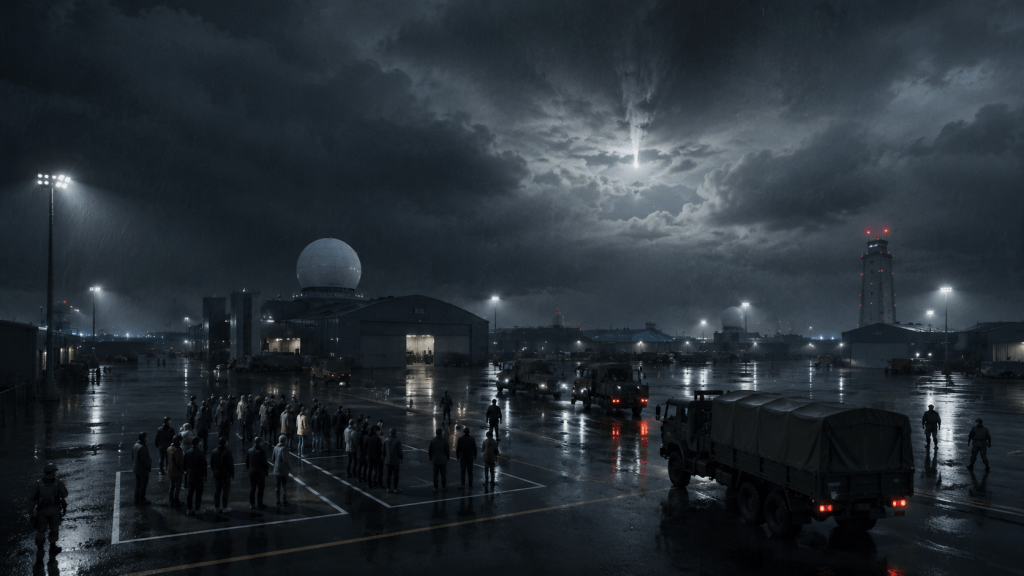
The transition takes the volunteers into a military environment already responding to a developing crisis. Sirens carry through concrete corridors. Officers move people through controlled areas. Phones still exist, although connections are unreliable. Cold air, damp earth, fuel and rain replace the clean neutrality of the orientation room.
Then the volunteers are moved outside.
The military base opens around them beneath a wet grey sky, with radar equipment turning above administrative buildings and vehicles being repositioned under increasingly urgent instruction. Nothing about the environment behaves like a disposable backdrop. Soldiers are concerned with their own procedures. Other volunteers have incomplete information. Nobody conveniently explains what the six need to know.
Something is coming through the atmosphere.
Its trajectory is unstable.
The time to impact is falling.
And the devices now fitted around the volunteers’ wrists begin presenting information.
This is where the speculative technology of Meteor Event becomes inseparable from the book’s moral pressure. The wrist devices do not award points, provide abilities or turn the crisis into a game. They supply data. They offer incomplete choices. They reduce complex circumstances into instructions that appear reasonable because the clock continues moving whether anyone trusts those instructions or not.
An intervention is possible.
The apparent threat may be intercepted.
The probability of success is far from certain.
The risk attached to the intervention is elevated.
The people standing beneath that sky have to decide what those numbers mean before time decides for them.
When a Probability Becomes a Human Decision

Many science-fiction stories about artificial intelligence concentrate on intention. They ask whether a machine wants something, whether it can deceive its creators or whether it will eventually turn against humanity.
Calibration Cycle begins from a different source of unease.
A system does not need hatred to produce an intolerable outcome. It only needs a definition of success that fails to contain everything human beings consider important.
That distinction is already present in Meteor Event. The technology surrounding the volunteers communicates through probabilities, objectives, access requirements and risk. It can indicate that an action has a higher likelihood of achieving an intended result. It cannot remove the moral burden from the people who choose to act on that information.
For Aaron and the others, this creates a problem larger than the incoming object itself. An efficient response can still carry consequences that efficiency cannot judge. An instruction can be logically coherent while remaining morally unbearable. A calculation can tell someone how many people may survive without answering whether they have the right to create the circumstances in which others die.
The deeper the group moves into the crisis, the harder it becomes to keep those questions at a safe theoretical distance.
People around them respond differently. Some assume that the experiment cannot permit genuine harm because genuine harm would violate the entire basis on which they agreed to participate. Others trust the technology because the institution operating it appears to trust the technology. Some decide that action is better than hesitation simply because the consequences of doing nothing appear larger.
That range of behaviour gives Meteor Event its human scale. The reader is not watching a team of specialists calmly solve a technical problem. They are watching people attempt to preserve ordinary judgement while the conditions necessary for ordinary judgement are being removed.
The Moment Simulation Stops Feeling Safe
The idea of simulation creates psychological distance. If an environment is artificial, then catastrophe can be experienced without accepting that catastrophe has a permanent human cost. Pain can be explained as sensory feedback. Death can be interpreted as extraction. A body can be treated as part of a programme even after instinct begins insisting otherwise.
Meteor Event uses that distance carefully.
The volunteers have entered the experiment already believing that everything they experience is designed to convince them. Extraordinary realism therefore reinforces the original explanation before it begins undermining it. Rain that feels perfectly cold proves the fidelity of the system. A shockwave that moves through bone proves the sophistication of the interface. Fear itself becomes evidence of successful immersion.
Then physical details begin refusing to remain theoretical.
The importance of this shift lies in how gradually it happens. There is no convenient announcement telling Aaron that the rules have changed. He sees people continue behaving according to the assumptions they brought into the experiment. He hears explanations that would have sounded perfectly sensible earlier. He watches confidence persist several moments longer than the evidence supporting it.
Those moments create one of the defining forms of tension in this branch of psychological science fiction: the reader can feel an explanation weakening while the characters still need it to remain true.
That is a very different form of fear from simply discovering that something is dangerous. Danger can be responded to. An unreliable reality changes the meaning of every response.
Six People Under the Same Pressure
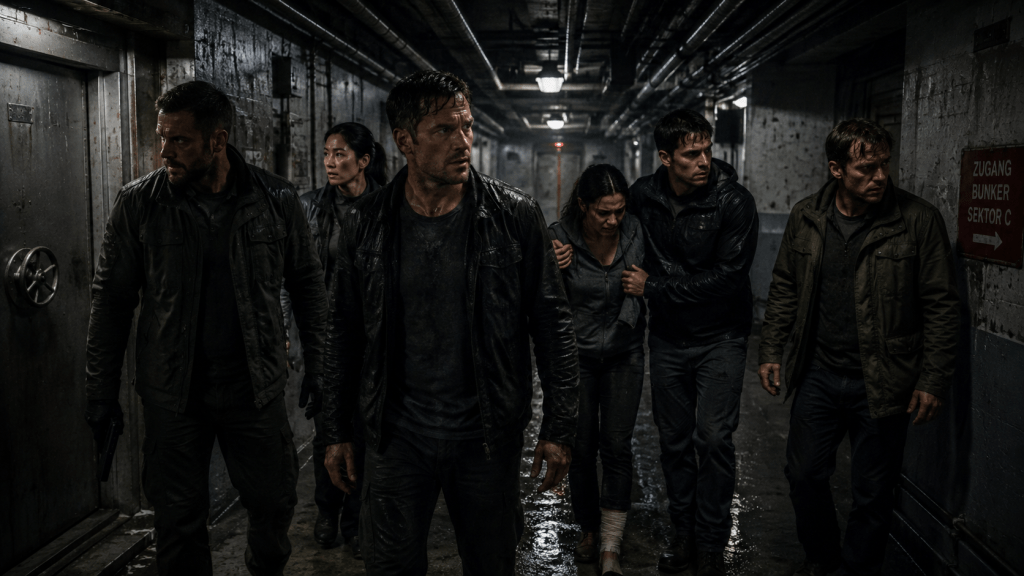
The six central characters provide different ways of approaching that uncertainty, and Meteor Event spends enough time with their behaviour for those differences to matter without reducing them to convenient roles.
Aaron gradually becomes important because others begin orientating around his ability to remain functional. He does not possess special knowledge. He does not suddenly become a military commander. His strength lies in recognising when a group is approaching the point at which uncertainty becomes paralysis.
That quality carries its own danger. The person who learns to make decisions under impossible pressure also has to live with the consequences of having made them.
Rei watches people and bodies with a different kind of precision. Her restraint allows her to remain useful when other people are becoming overwhelmed, yet that usefulness keeps bringing her into direct contact with the physical evidence everyone would prefer to explain away.
Marcus understands the military environment more readily than the others. He recognises when behaviour no longer resembles rehearsal, when procedures are shifting and when hesitation carries immediate tactical consequences. That makes him valuable, although the same decisiveness can move him towards choices that other members of the group are not ready to accept.
Connor responds by examining patterns. If the technology has rules, he wants to know them. If an interface produces information, he wants to understand how that information is being generated. His curiosity is useful because it gives the group language for things they cannot yet explain, although understanding how a system behaves is very different from understanding why it behaves that way.
Declan keeps dragging the conversation back towards accountability. Who authorised this? Why would a controlled experiment expose participants to this level of risk? Why should anyone trust a number merely because a machine displayed it? His questions are inconvenient precisely because they remain recognisable.
Sofia begins under visible strain, yet her sensitivity to physical and environmental detail gives her a place in the story far beyond fear. When everyone else is trying to build explanations, she is often still noticing what is physically present.
Together, they create the central human mechanism of Calibration Cycle. The series is interested in what happens when responsibility, empathy, pragmatism, technical curiosity, scepticism and sensitivity are forced to occupy the same confined space while the conditions around them become less trustworthy.
A Crisis Where Success Does Not Mean Safety
The meteor threat gives Book One its immediate scale, but Meteor Event is not primarily a disaster story.
The incoming object matters because it forces a decision.
The intervention matters because it carries consequences.
The military infrastructure matters because it introduces another form of authority into a situation where several incompatible authorities are already operating at once.
The volunteers are expected to trust the programme that recruited them, the personnel within the environment, the data provided by their devices, their own judgement and one another. Those sources do not always agree.
This is where the book’s science-fiction suspense becomes increasingly uncomfortable. A task can be completed without resolving whether completing it was right. An apparently successful action can create a new problem. Survival can prove only that someone survived the choice, not that the choice deserved to be made.
The story therefore avoids the familiar satisfaction of solving a crisis through technical competence alone. Intelligence matters. Courage matters. Decisiveness matters. None of those qualities produces moral certainty.
The question following Aaron is quieter and considerably harder: what do you do when every available decision transfers the cost somewhere else?
Artificial Intelligence Without a Convenient Villain
The wider Calibration Cycle series is concerned with optimisation, although Meteor Event introduces that idea through behaviour rather than explanation.
This distinction matters to the identity of the series.
The technology is not presented as a theatrical evil intelligence announcing its intentions. There is no metallic villain promising domination and no simple opposition between heroic humans and a malicious machine. The unsettling quality comes from the possibility that something can produce rational instructions while failing to understand why the people receiving those instructions cannot treat human consequence as a statistic.
A survival probability may be mathematically useful.
A person still has to live with what produced that probability.
This allows Meteor Event to sit comfortably within artificial intelligence science fiction and AI ethics fiction without becoming an essay about machines. The discussion remains inside human experience: what people obey, what they question, what they rationalise and what they discover they are capable of doing when urgency narrows the available choices.
The system does not need to explain itself for its values to become visible.
Its values appear through what it measures.
The human values of the story appear through what cannot be measured cleanly.
When the Body Becomes Evidence
One of the most effective pressures in Meteor Event comes from something far less spectacular than the threat in the sky.
Pain remains difficult to argue with.
An advanced immersive experiment can theoretically explain almost anything the senses report. A convincing environment should feel hot, cold, wet, loud and physically threatening. The entire purpose of high-fidelity simulation would be defeated if participants could easily separate artificial stimulus from ordinary sensation.
The problem begins when physical consequence no longer behaves as though it belongs entirely to the experience.
The book does not rush this idea into an explanation. Instead, it allows bruising, swelling, exhaustion and bodily memory to complicate the comfortable assumption that nothing inside the experiment can follow anyone beyond it.
That uncertainty changes the meaning of every later risk.
If the body cannot be trusted to recognise the border between experiment and reality, the participants no longer have a safe distance from what they are being asked to do.
The premise moves at that point from immersive simulation fiction towards reality-distortion science fiction, although the characters themselves are not ready to abandon the original explanation. They continue looking for technical answers because technical answers remain psychologically survivable.
The reader is left somewhere less comfortable.
The Fear of Returning to Somewhere Familiar
Calibration Cycle is particularly interested in the relationship between familiarity and safety.
A person emerging from an extreme experience does not necessarily need paradise. An ordinary room can be enough. A recognisable corridor can be enough. Familiar lighting, a chair, a table and the small bureaucratic signs of normal life can carry enormous emotional weight after sustained danger.
That is why apparent safety matters so much to Meteor Event.
The story understands that reality distortion becomes more effective when almost everything remains correct. A collapsing universe announces its unreliability immediately. A familiar environment containing one detail that should not exist forces the mind to do much more difficult work.
How much evidence is required before familiarity stops being proof?
How long can someone continue calling a place home when memory and environment no longer agree completely?
Book One does not attempt to answer every question raised by its experiment. It would weaken the story if it did. Instead, the ending leaves the characters with a more dangerous problem than ignorance: they now possess evidence that their original assumptions may be incomplete, while still lacking an explanation capable of replacing them.
That uncertainty becomes the pressure carried into the wider series.
Where Calibration Cycle Begins
Calibration Cycle: Meteor Event establishes a series concerned with ordinary human values placed inside systems that are extraordinarily good at measuring outcomes.
It begins with a classified experiment, six volunteers and a crisis environment that should have clearly defined limits. From there it moves through artificial intelligence, experimental technology, survival pressure, institutional authority, moral compromise and increasingly unreliable reality without abandoning the people experiencing those things.
Readers looking for psychological science fiction built around uncertainty rather than power progression will find that emphasis from the opening pages. Readers interested in AI ethics will encounter a story where machine intelligence becomes unsettling through logic rather than hatred. Readers drawn to reality-distortion fiction will find the instability emerging through physical detail and contradiction instead of spectacle. Those who prefer character-driven science fiction will find six people whose differences become increasingly important as the explanations surrounding them begin to fail.
Most importantly, Meteor Event does not treat survival as an answer.
Surviving a decision does not explain whether the decision was right.
Completing an instruction does not guarantee that anyone understood what they were completing.
Returning from an impossible experience does not necessarily prove that the place waiting on the other side is the place that was left behind.
The first book begins with six volunteers agreeing to test technology they believe has limits. What follows leaves them with a much harder question: if every sensation, injury and consequence feels real, how much evidence would it take before the word simulation stopped being reassuring?
The experiment may have begun in a controlled room.
What matters is whether anything they return to can still be trusted as completely.
Discover more from Simon J. Phillips
Subscribe to get the latest posts sent to your email.
