A Republic cargo drone missed two checkpoint windows, then replied with perfect identification codes from a silence no crew remained to explain.
Chronicle Opening: The Late Response
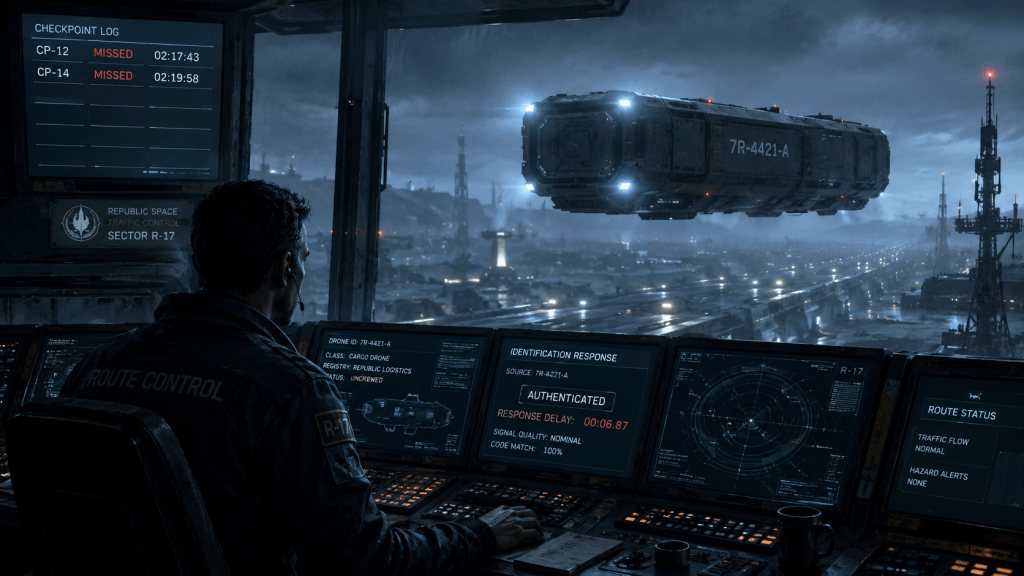
Route Control Station R-17 held its position above the rain-dark hemisphere of Pel Rovan, fixed to a trade line that crossed Republic contract space before bending towards the older ESC-supervised freight corridors beyond the inner markers. From outside, the station looked minor, a narrow orbital control spine beneath a sensor mast and three service rings, its hull plates darkened by years of station-keeping burns and repair work. Inside, the night watch carried a heavier life. Air moved through long wall grilles with a dry processed chill, console glass reflected tired faces in layers, and every display carried some piece of traffic seeking clearance, confirmation, correction, or delay. Freighters crossed the lane in patient arcs, ore sleds moved under tug escort, and courier drones slipped between larger bodies while the route board held them all inside identifiers, checkpoint windows, transponder returns, and the steady discipline of systems built to make emptiness behave like a road.
Evan Maer had worked the R-17 night shift for almost five years, long enough to hear the difference between common delay and the kind that left a mark. Most delays carried a familiar shape: worn transmitters, charged dust, tired guidance shells, haulers waiting for cheaper burn paths. The board corrected them, operators grumbled into cooling tea, supervisors sent queries, and the route carried on. Delay belonged to traffic. Silence belonged to something else.
The first missed window appeared at 02:17:43 station time, a thin amber warning beneath Cargo Drone 7R-4421-A, Republic Bulk Logistics, autonomous industrial transport, class four, uncrewed. Evan noticed it because the drone had been clean across every marker since it entered the sector, its path smooth, fuel economy exact, response codes dull enough to be reassuring. The vessel carried refinery mesh, sealed filter cores, and stripped machine housing from a shuttered processing yard near the outer contract belts. Its destination lay two gates inward, where bulk cargo would pass inspection, valuation, and ownership transfer before a human crew came near the freight.
Evan leaned closer to the console as the amber warning held beyond its grace period. He called up the drone’s last pings and let them arrange themselves along the side display. Checkpoint Twelve had answered within range. Checkpoint Thirteen had returned a clean handshake, though the transit image showed a faint shimmer across the aft plating that the traffic system had dismissed as sensor wash. Checkpoint Fourteen waited for confirmation. The window closed. The board marked the miss with polite restraint, as though courtesy could change the fact that a registered cargo body had crossed an automated lane and failed to say where it was.
Supervisor Halden sat beneath the main orbital plot with a cup balanced near his elbow and a review slate open across one knee, carrying the heavy stillness of a man conserving attention for whatever might earn it. His eyes lifted before Evan spoke, drawn by the change in Evan’s hand over the console keys. “Which one?” Halden asked as he set the slate aside and turned his chair towards the route board.
“Seven R, four four two one A,” Evan said, dragging the drone’s profile wider across the glass while the amber warning continued to pulse beside its route line. “Republic Bulk Logistics. Missed Fourteen. Still inside passive track. No drift warning.”
Halden’s fingers moved across the auxiliary console with measured speed. “Query it,” he said, and the order came quietly enough to make the room listen.
Evan sent the standard ping, a clean request asking for identity, route confirmation, cargo state, navigation health, and response. The timer appeared beside the drone’s icon. At four seconds, the line stayed empty. At five, the icon remained unchanged. At six, Evan felt the old watch-room quiet settle around the console, the kind that arrived before anyone admitted they had begun listening. At seven, a reply returned, and the code matched perfectly: identity confirmed, route status nominal, cargo status sealed, crew status uncrewed, hazard report clear.
Evan read the lines twice before his eye found the time stamp. “That came late,” he said, his thumb held against the lower edge of the glass.
Halden’s chair creaked as he turned fully towards him. “By how much?” he asked, his earlier irritation fading into attention.
“Six point eight seven seconds after expected return,” Evan said, opening the path as the station smoothed the delay into a tolerable communication variance. “The board wants routing delay.”
Halden set his cup down and stepped closer, his gaze narrowing on the signal path. “Does the signal quality support that?” he asked.
Evan pulled the signal apart. Carrier strength held. Packet integrity held. Registry seal held. Every field matched the drone’s declared identity, down to the stale certification chain and the contractor update pushed eight months earlier from a Republic logistics office. Damaged drones limped through language. They repeated fragments, lost fields, dropped ownership branches, sent bad checksums, and confessed their damage in the gaps. This one answered like a clerk reading from a manual after being woken in an empty room.
“Signal quality is clean,” Evan said, easing back from the display only far enough to see the whole route line. “Return timing is wrong.”
At the far communications bank, Nira Sol turned from her own traffic stack and pushed her chair back with one boot. Her gaze moved from Evan to the late-response timer as she came across the aisle. “Say that again,” she said, one hand settling against the edge of his console.
Evan kept his eyes on the drone. “It answered too late with a perfect code.”
Nira leaned in until her reflection joined his in the screen, pale and narrowed by display light. “Could be a ghost return from the last checkpoint,” she said, her fingers tapping once against the console frame.
“Fresh packet,” Evan said, opening the authentication layer beside the optical feed. “It includes my query seed.”
Halden straightened, the decision reaching his posture before he voiced it. “Send a deeper challenge,” he said as he shifted aside to give Evan the controls.
Evan selected bonded-freight verification, the kind used for drones carrying sealed industrial cargo through disputed contract lanes. It requested identity confirmation, route authority, cargo lock status, pressure shell, thermal state, ownership chain, and proof from the guidance core. The query left the station. Three seconds. Four. Five. Six. Seven. The reply arrived at 00:07.12, perfect again, and the board rewarded it with green lights across route status, cargo shell, ownership, hazard report, and guidance response.
Nira’s fingers tightened against the edge of the console. “Why is the response slower than the ping?” she asked, her voice soft enough that the question seemed meant for the board itself.
“Something in the path is holding it,” Evan said.
Halden looked at him sharply, his hand lifting once in warning before settling again at his side. “Careful,” he said.
Evan heard the weight inside the word. Route stations survived by keeping claims narrow. A late response could become a fault. A fault could become a hold. A hold could become a dispute between route authority, Republic contract office, cargo owner, insurer, and every hauler forced to burn around an inspection delay. Operators learned precision because vague fear had costs. Still, the drone crossed the plot with darkened running lights and patient delayed answers, and the station’s eagerness to believe it felt suddenly like a weakness built into the lane itself.
He opened the optical feed wider. The image sharpened by degrees as R-17’s mast adjusted towards the drone. Hull number 7R-4421-A resolved across the side plating, flaked white against dark metal. Republic Bulk Logistics marks sat beneath it, scuffed by micrometeor scoring and old handling wear. Along the aft service band, where thermal unevenness had first appeared, a thin pale trace ran between two panel seams. It might have been frost, exposed insulation, sensor glare, or the same kind of surface artefact that filled salvage reports across border space. The board offered no classification.
A third warning appeared beneath the drone profile, and the tone that accompanied it stayed small, polite, almost apologetic: Checkpoint Fifteen window missed. The room folded into a deeper quiet while Halden moved to the auxiliary station and drew a controlled breath. “Place a soft hold on local traffic inside its approach cone,” he said, his hand moving through command layers with careful control. “No alarm phrasing. Nira, pull prior drone incidents across the last thirty days. Evan, issue manual route correction and require course response.”
Evan entered the correction. Drone 7R-4421-A should have adjusted by two degrees, enough to prove live guidance control while keeping it clear of the populated service lane. The command left R-17. The timer began. The drone held its line. Six seconds passed. Seven. The reply arrived at 00:07.04, accepting the correction with perfect administrative calm while the plotted course remained unchanged.
Nira rested both hands on the back of Evan’s chair. “It accepted the order,” she said, her gaze fixed on the unmoving line.
“It accepted the sentence,” Evan said as the icon crossed the inner approach boundary. “The ship has given us words. It has given us no movement.”
Halden reached for the command line to sector authority, his fingers stopping above the contact field as the drone sent a packet of its own for the first time since entering R-17 control. The message unfolded across Evan’s screen before any operator requested it, cleanly formatted, properly signed, and shaped in the calm administrative language of lawful freight transit: identity confirmed, route status nominal, requesting continued clearance through Checkpoint Sixteen. The time stamp sat seven seconds behind station time.
Evan felt the station air move across his face from the overhead grille, cool and dry, carrying the stale scent of electronics, old insulation, and tea gone cold beside the console. Outside the viewport, the traffic lane curved through orbital night in ordered lines of distant light. Each vessel trusted the same board, the same codes, the same habit of accepting a correct answer as a safe one. He looked at the cargo drone crossing towards them, dark against the planet’s storm-lit horizon, and understood with a slow pressure in his chest that the danger had entered the route as language first.
A Visual Chronicle
An empty cargo drone answered every command seven seconds late, and Route Control R-17 realised that something inside the freight lane had learned how to speak in the language of clearance.
Incident Record: Route Control Station R-17
Route Control Station R-17 occupied a fixed orbital position above Pel Rovan, a rain-bound Republic contract world used less for settlement prestige than for freight management, bonded cargo transfers, and the supervision of industrial traffic moving between the outer processing belts and the older inward trade corridors.
The station served Sector R-17, a working stretch of Republic-linked route space where civilian haulers, autonomous cargo drones, ore sleds, refinery tenders, contract tugs, and bonded freight carriers crossed through a narrow administrative boundary before passing towards heavier inspection, gate access, or long-haul corridor transfer.
Installations of this kind formed the quiet nervous system of interstellar commerce. They were rarely large enough to earn political attention in their own right, yet every lane depended on them. Their operators confirmed identity chains, corrected traffic drift, handled missed checkpoint windows, logged cargo status, routed priority vessels, softened delays into acceptable language, and kept thousands of tonnes of moving freight from becoming hazard, dispute, or wreckage.
R-17 had been built during a period of rapid contract-route expansion, when Republic logistics authorities pushed deeper into industrial border space and relied increasingly on autonomous cargo movement to keep costs low across routes too thinly populated for regular crewed haulage. Cargo drones became common there because they required no sleep cycle, no passenger support, no crew compensation, and no immediate human judgement once sealed cargo had entered bonded transit.
That efficiency shaped the station’s culture. A registered drone with correct identifiers, intact cargo seals, clean route authority, and confirmed ownership chain was treated as predictable traffic unless its course, timing, or hazard data forced deeper scrutiny. In most cases, a delayed response meant transmitter fatigue, guidance-shell reset, route relay congestion, or charged dust along the signal path. The machinery of commerce depended on such explanations remaining ordinary.
The incident involving Cargo Drone 7R-4421-A became significant because it entered R-17 control carrying the appearance of ordinary freight. Its registry matched, its cargo status held, its ownership packet survived enough verification for route handling, and every formal answer it returned remained clean enough for the station board to accept. What unsettled the night watch was the delay between question and answer, a pause too small for public alarm and too precise for easy dismissal.
At the time, route-control language had no agreed category for a vessel that responded correctly while failing to behave correctly. The drone missed checkpoint windows, accepted commands, confirmed identity, and requested onward clearance through standard traffic phrasing, yet its movement and timing resisted the confidence of its own reports.
Only later, after ESC comparison teams began gathering files from freight inspection crews, quarantine holds, civilian haulers, and silent outposts, was the R-17 drone incident reviewed as part of the same early pattern. The danger had entered the route through systems built to create trust: registry code, response timing, cargo verification, and the calm administrative habit of accepting a correct answer as proof of safety.
About the Creator

The Future Chronicle is written and curated by Simon Phillips, a writer of science fiction and speculative storytelling who explores the fragile edges of human expansion, where freight routes, inspection bays, patrol vessels, and isolated industrial stations continue their ordinary work while larger dangers gather quietly beneath routine procedure.
Many of the stories presented in these Chronicles exist within wider fictional worlds shaped by workers, survivors, officers, and investigators who encounter the first signs of events far greater than they are prepared to understand. These settings remain grounded in lived environments, where machinery, bureaucracy, and human judgement often shape the path of catastrophe long before anyone can give it a name.
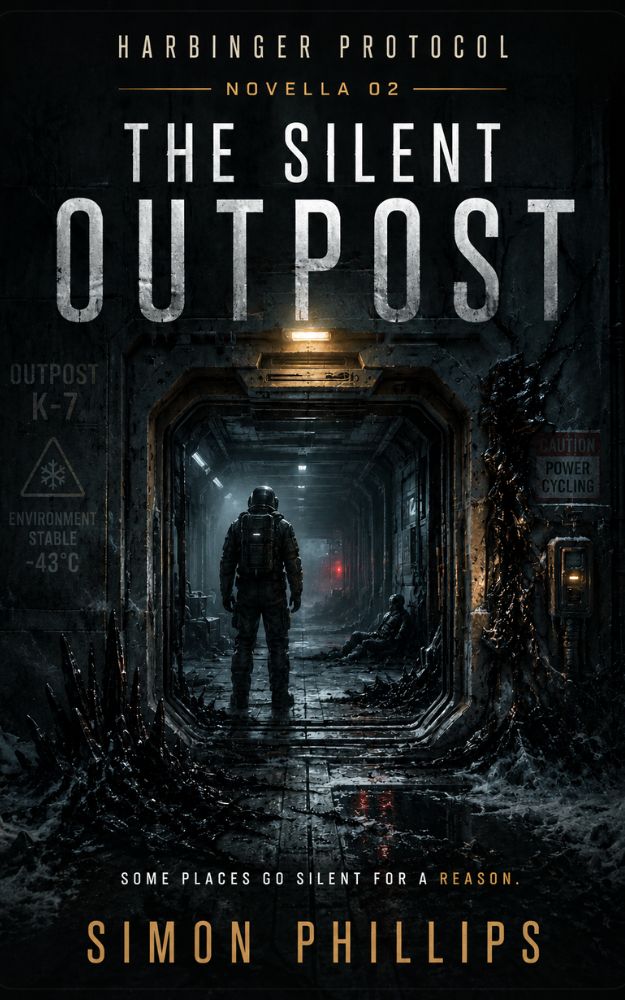
The Harbinger Protocol novellas follow that unfolding pressure through the experiences of Soren Vale, beginning with the civilian freighter disaster recorded in The Ash in Transit and continuing into the colder, more procedural dread of The Silent Outpost, where isolated incidents begin to reveal the outline of something spreading across human routes and systems.
Readers who wish to explore the full opening phase of the Harbinger crisis can find the novellas below.
Explore the books:
The Ash in Transit
The Silent Outpost
You can watch his YouTube channel here:
Author Simon Phillips
Continuing the Chronicle
The following Chronicle reconstructs the R-17 night watch’s handling of Cargo Drone 7R-4421-A after its clean identification codes began arriving several seconds late, while the vessel continued along its assigned route with no matching course response, no crew aboard, and no visible reason for its perfect answers.
Readers supporting The Future Chronicle can continue the record below.

Subscribe to continue reading
Subscribe to get access to the rest of this post and other subscriber-only content.
