An ESC analyst studied a damaged audio fragment from a contaminated ship and heard a voice where procedure insisted there could only be corrupted airflow.
Chronicle Opening: The Recording in Chamber Nine
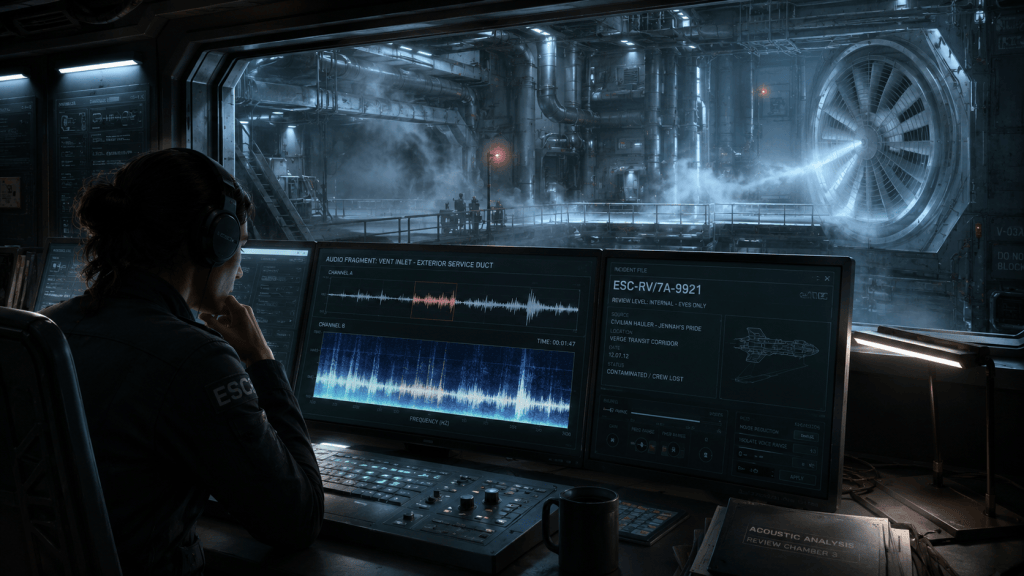
Review Chamber Nine held its cold in the wall panels long after the upper decks moved into their sleep cycle. It sat three levels below the main intelligence spine of the ESC cruiser Adderfall, sealed behind two pressure doors and a corridor lined with acoustic baffles thick enough to swallow the sound of boots before those sounds reached the bulkheads. The room had once been a navigation review suite, made for traffic reconstruction, distress-call sorting, and signal comparison from damaged civilian craft, although later work had changed it into something more private. Extra insulation covered the older seams. Audio pickups hung from black jointed arms above the central table. Three analysis boards curved around the main workstation in dull blue light, carrying spectral maps, pressure traces, ship schematics, and damaged recordings recovered from vessels whose final reports had reached command in fragments.
Analyst Liora Venn sat beneath the listening array with one hand beside the playback controls and the other wrapped around a cup gone cold against her palm. Her review slate showed the file name in clean institutional text. ESC-RV/9A-441. Civilian carrier Jennah’s Pride. Verge transit corridor. Crew status lost. Contamination status unresolved. Audio source recovered from forward environmental stack. The file had arrived from Evidence Intake with three notes attached by officers who had tried to keep the fragment inside a safer frame. Damaged ventilation record. Probable pressure flutter. Emergency channel bleed. Liora had read each line before opening the raw track, and each phrase carried the same careful pressure, the same quiet attempt to turn fear into something a desk could approve.
She drew the Jennah’s Pride schematic across the left board and let the carrier unfold in pale lines. The ship had been a mid-range civilian hauler, narrow through the crew spine, broad through the cargo belly, old enough to carry exposed heat trunks behind patched maintenance covers and cheap enough for its owners to argue over every delayed repair. The forward environmental stack sat above the lower crew passage, feeding filtered air through sleep cells, galley, med recess, and service ducts leading into cargo control. The recovery drone had found ribbed residue along two vent grilles, black particulate inside a filter tray, and pale scoring across an inner access cover where metal had cooled around shapes the original design had never required. Liora enlarged the stack and traced the airflow path with two fingers. If air had crossed a damaged grille at the right pressure, if the emergency channel had held a cached distress syllable, if the ship’s own announcements had torn apart during power loss, a sound could gather shape. She wrote that on her slate, then lowered the playback threshold and allowed Chamber Nine to listen.
Static came first, low and irregular, carried inside fan wash and broken signal return. The visual band rose in white clusters across the central display while Liora watched the peaks before letting the sound move deeper into her attention. Hull vibration sat underneath it, a slow structural shiver from a vessel losing thermal balance. A relay click repeated in the upper range. Air moved through the stack in pulses, too uneven for a healthy loop and too regular for random failure. Then a tone surfaced beneath the wash, thin as breath crossing a cracked pipe, and the room changed around it. Liora stopped the track with one careful touch. She stared at the frozen waveform while the cold panels, listening arms, display boards, and sealed doors seemed to gather more closely around her. The sound had lasted less than a second, close enough to a voice for the body to react before reason could claim it. She marked the frame, rewound nine seconds, and played it again with the voice-isolation layer disengaged.
The second pass carried more weight because she knew where the sound waited. Static crossed the chamber. Fan wash followed, broad and dry. The relay clicked. The airflow pulse came from the damaged stack, then the thin tone rose again, shaping itself with enough human timing to make her body react before thought could build a wall around it. Liora kept her hand still beside the controls and opened a filter to strip low-frequency hull vibration. A second filter reduced relay chatter. A third mapped airflow against the forward stack, feeding the pressure model across the right board in slow blue lines. Most of the fragment behaved the way training said it should behave. Broken flow crossed the grille, struck the access lip, and returned through the stack with a warped harmonic that could form a vowel under poor conditions. The final third sat slightly apart from the airflow model, a narrow lift in the middle band that held across twelve frames with the patience of speech.
The door opened behind her with a soft pressure shift that moved through the room before the hinge sound arrived. Lieutenant Arel Doss stepped inside carrying a sealed evidence case under one arm and a field jacket fastened over his duty shirt. He paused once he saw the active boards, then his eyes moved from the Jennah’s Pride schematic to the frozen waveform across the central display.
“You started early,” Doss said as he crossed to the side table and set the case down.
Liora kept her eyes on the spectral line. “The file arrived marked routine acoustic review.”
Doss glanced at the dark cup beside her wrist. “Routine files usually wait for morning.”
Liora lifted the cup, found it cold, and set it down again. “This one kept the room awake.”
Doss came to stand beside her chair, his face drawn by fatigue and the hard light of the boards. “Play it from the mark.”
Liora sent the fragment through the chamber speakers. Static moved across the room with the dry scrape of damaged distance. Fan wash followed, then the relay click, then the airflow tone rising from the stack, stretched thin through metal, filter mesh, and pressure failure until it shaped itself into two syllables that no program on the board would name. Doss lowered his head by a fraction. Liora stopped the track before the following distortion buried the sound, and for several seconds they stayed beneath the listening arms while the display held the waveform in frozen light.
Doss moved first, drawing one hand across the back of his neck as he looked at the schematic. “That sounded like a woman.”
Liora pointed to the airflow model. “It came from the forward environmental stack during pressure collapse.”
Doss leaned closer to the display, his voice lower as he answered. “Those are separate statements, Liora.”
She drew the spectral layer wider and forced herself to follow the clean lines of the model. “It sounded like airflow travelling through damaged vent structure.”
Doss looked at her profile in the blue light. “You heard her as well.”
Liora pushed back from the workstation and stood, needing the small change in height more than distance from the sound. “Jennah’s Pride had already lost pressure across forward crew sections before the recording,” she said, taking the stylus from the slate and marking the relevant time block. “Thermal map showed no living return inside the stack or lower passage. Rescue authority closed before the drone entered.”
Doss folded his arms and kept his eyes on the waveform. “Then why did she sound trapped inside it?”
Liora lowered her hand and opened the pressure overlay again. “Because damaged ships carry people after people are gone,” she said. “Announcements, emergency loops, suit traffic, last words, cabin audio, airflow through broken spaces. The system keeps pieces.”
Doss looked towards the sealed evidence case he had brought in. “That answer will satisfy Evidence Intake.”
Liora followed his gaze. “It will satisfy them if the track behaves.”
The line from Evidence Intake chimed across her board. Liora accepted it through text only. Supplementary file available. Drone visual, forward environmental stack, Jennah’s Pride. A grainy still filled the right display, showing an access grille under emergency light, its surface rimed with frost and thin pale residue gathered along every rib. The centre of the grille had bent outward from inside the duct, enough for a technician to see pressure had travelled the wrong way through the stack. Doss stepped closer, his earlier argument fading as the visual settled between them. Liora enlarged the bent grille, then laid the waveform beneath it. The thin tone aligned with the pressure reversal. The explanation strengthened. Relief passed through her too quickly, too eagerly, and for that reason it felt unsafe.
“There,” Liora said, touching the pressure mark with the stylus. “Air forced through a damaged grille during collapse. That gives us the vocal edge.”
Doss kept his gaze on the still. “And the timing?”
Liora looked back at the waveform, where twelve frames held their small human shape. The cruiser hummed around Chamber Nine while the room waited for language strong enough to contain the sound.
“The timing remains under review,” she said, saving the mark before she played it once more.
A Visual Chronicle
Inside Review Chamber Nine, a damaged recording recovered from the dead carrier Jennah’s Pride is stripped down to airflow and static until the machinery seems to form a single human word: “Please.”
Incident Record: Review Chamber Nine
Review Chamber Nine formed part of the restricted intelligence and evidence-analysis section aboard the ESC cruiser Adderfall, a midline patrol vessel assigned to incident comparison work across the Verge transit corridors during the earliest phase of the contamination crisis.
The chamber had originally served as a navigation review suite, where damaged route packets, traffic disputes, late transponder replies, and civilian distress bursts could be reconstructed after accidents along the outer freight lanes. Its first purpose had been practical and narrow, built around the careful rebuilding of events from signal fragments, pressure logs, ship schematics, and traffic authority records.
As unexplained incidents increased across civilian haulers, salvage craft, cargo drones, and isolated industrial stations, the chamber’s role gradually changed. Additional acoustic insulation was installed behind the wall panels, evidence feeds were restricted to cleared analysts, and the listening array above the central workstation was upgraded to process degraded audio recovered from contaminated vessels and post-disposal drone sweeps.
Rooms of this type became important because many early Harbinger-related files reached ESC review through damaged sound before they reached command through reliable evidence. Ships lost environmental balance, distress channels fractured, emergency buffers repeated broken phrases, and ventilation systems carried pressure noise that trained officers struggled to dismiss once it began to resemble human speech.
Review Chamber Nine was therefore used for the difficult work of separating mechanical failure from possible survivor audio, a task that carried both procedural and moral pressure. A sound could be logged as airflow distortion, comm bleed, pressure flutter, emergency loop corruption, or acoustic artefact, yet each label carried consequences for rescue authority, evidence handling, quarantine procedure, and the official language later attached to the incident.
The recording recovered from the civilian carrier Jennah’s Pride entered Chamber Nine under this uncertain status. It had been taken from the forward environmental stack after the ship was declared lost, and the fragment appeared to contain a short human-sounding vocal shape inside a field of static, fan wash, relay chatter, and pressure collapse. At the time of review, no confirmed survivor remained aboard the vessel, and the recovered visual evidence showed damage around the vent structure that supported a mechanical explanation.
Later comparison work would place the Jennah’s Pride fragment among a wider body of early contamination records involving false voice-like events, delayed system responses, airflow anomalies, and human interpretation under extreme stress. In the official summary, the sound was classified as an acoustic artefact pending further review.
Yet within the chamber logs, analysts preserved the original waveform, the pressure model, and the damaged vent image together, leaving behind a record of the moment when procedure found a name for the sound while uncertainty remained inside the file.
About the Creator

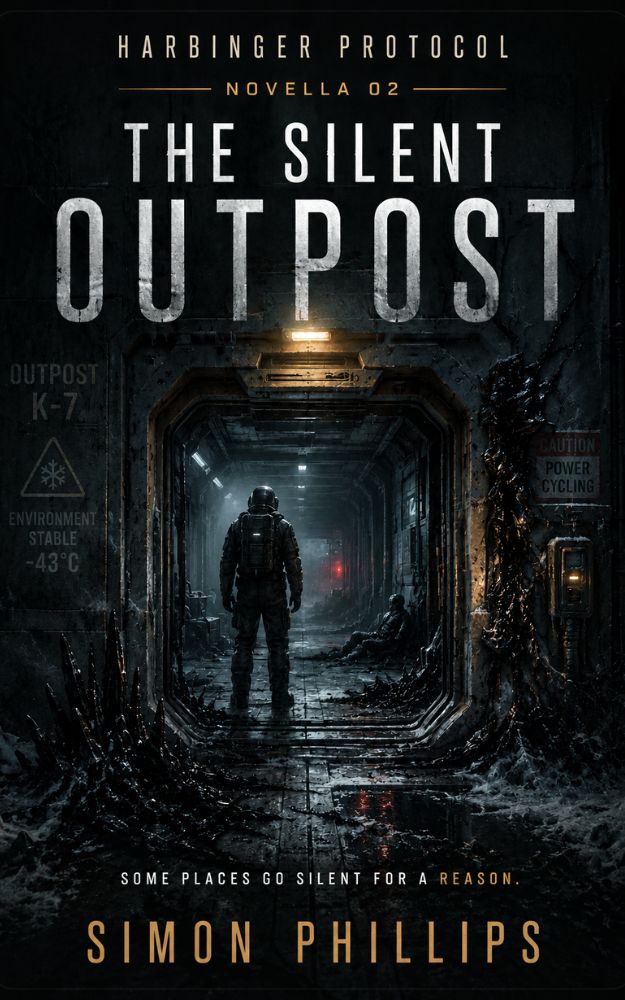
The Future Chronicle is written and curated by Simon Phillips, a writer of science fiction and speculative storytelling who explores the fragile edges of human expansion, where freight routes, inspection bays, patrol vessels, and isolated industrial stations continue their ordinary work while larger dangers gather quietly beneath routine procedure.
Many of the stories presented in these Chronicles exist within wider fictional worlds shaped by workers, survivors, officers, and investigators who encounter the first signs of events far greater than they are prepared to understand. These settings remain grounded in lived environments, where machinery, bureaucracy, and human judgement often shape the path of catastrophe long before anyone can give it a name.
The Harbinger Protocol novellas follow that unfolding pressure through the experiences of Soren Vale, beginning with the civilian freighter disaster recorded in The Ash in Transit and continuing into the colder, more procedural dread of The Silent Outpost, where isolated incidents begin to reveal the outline of something spreading across human routes and systems.
Readers who wish to explore the full opening phase of the Harbinger crisis can find the novellas below.
Explore the books:
The Ash in Transit
The Silent Outpost
You can watch his YouTube channel here:
Author Simon Phillips
Continuing the Chronicle
The following Chronicle reconstructs the review of the Jennah’s Pride audio fragment inside Review Chamber Nine, where an ESC analyst attempted to reduce a human-sounding voice to airflow, pressure collapse, and damaged ship systems while the recording continued to resist every clean explanation.
Readers supporting The Future Chronicle can continue the record below.

Subscribe to continue reading
Subscribe to get access to the rest of this post and other subscriber-only content.
