Harbinger Protocol Chronicle: The Listening Dead

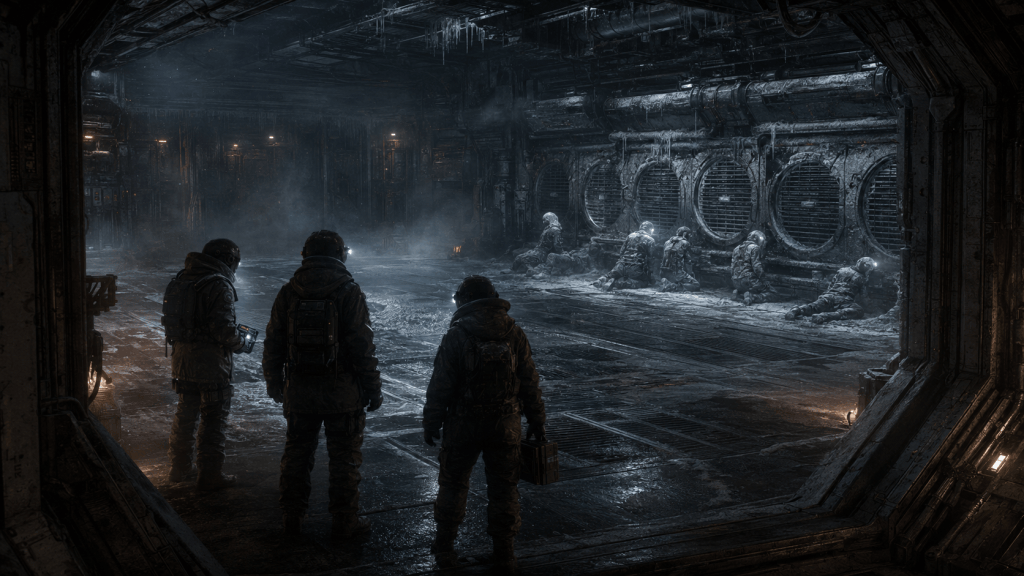
A first-response team entered a silent auxiliary station and found its frozen crew gathered beside the ventilation grilles, as though listening to something the official record could not call a voice.

Where the Air Was Still Moving

Morrow Auxiliary Four hung beneath the shadow of a stripped iron moon, turning through the scattered light of the Kheled Verge with its guidance lamps reduced to a single pale line along the docking collar. From the forward glass of the ESC response cutter Ardent, the station resembled a piece of discarded machinery caught above the moon’s broken horizon, its habitation drum dark, its service spine edged with frost, and its two external relay vanes locked at different angles as though work had ended in the middle of an ordinary adjustment. The stars remained clear around it, sharp against the absence of local traffic, while the cutter moved closer under restrained thrust and received only the same faint carrier pulse repeating every eleven seconds from a communications array that had missed three scheduled reports. Morrow Four still held power somewhere inside its hull, although every system meant to welcome an approaching vessel had fallen silent.

Medical Response Officer Lena Oras watched the station grow across the glass while cold gathered through the soles of her boots from the cutter’s forward deck. The Ardent had left a Republic-linked freight lane six hours earlier with a four-person response team, a sealed medical cradle, and an initial failure notice describing fourteen missing workers as a probable life-support casualty. That description had followed them through the dark in clean official lettering, joined by estimates for coolant loss, communications collapse, and evacuation delay, each possibility familiar enough to fit inside the equipment stacked behind Lena’s seat. Even so, the station ahead carried an order that the report had failed to describe, because the docking arms remained folded, the maintenance crawler sat secured in its rail, and every outer hatch showed green seal integrity while the people responsible for those systems had vanished from the network together.

“Range is four hundred metres, and the collar still refuses an active handshake,” pilot-specialist Corin Jale said as he leaned over the approach board and reduced the cutter’s forward drift. He ran two fingers along the response trace, then glanced towards Lieutenant Harun Cade at the rear of the flight deck. “I can place us against the passive guides, Lieutenant, although the station will be accepting us from stored instruction. If the clamps close, they may have no live controller behind them.”

Cade tightened the seal at his right wrist and studied the docking image from beside Lena’s chair. The lieutenant had spent most of the approach speaking in the even practical tone of someone refusing to let uncertainty set the pace of a room. “Bring us in on mechanical capture and keep our data link narrow,” he said as he rested one hand against Corin’s seat. “If Morrow tries to widen the exchange after contact, isolate the cutter first and ask questions once our own systems are clear.”

Engineer Sera Quill shifted inside her harness near the rear equipment rack and raised the station diagram across her forearm slate. “The carrier pulse includes a valid house key from the previous shift,” she said while the habitation layout opened in dim blue lines. “That gives us access through Dock Two and the central service passage. It also tells us somebody left the communications shell running long enough to load the current key before the reports stopped.”

Lena turned from the station and checked the fourteen crew identifiers waiting on her medical display, where each name held the same unresolved grey field beside life status. “A valid key tells us the station remembered its last instruction,” she said as she secured the display against her sleeve. “It gives us very little about the people who entered it.”

The Ardent crossed the remaining distance with the low vibration of manoeuvring jets passing through its frame. Morrow Four slid above the forward glass until the docking collar filled the view, scarred by mineral dust and old repair plates whose Republic contract markings had faded into dull red bars. Corin brought the cutter between the passive guides with small measured corrections, and the hull answered each thrust with a pressure that moved through Lena’s ribs. Contact came as a firm metallic knock, followed several seconds later by the deeper pull of clamps closing around the cutter’s docking lugs one after the next.

Corin held his hands above the controls while a thin status line travelled across the board and stopped short of completion. “Mechanical capture is secure,” he said as he watched the unfinished line remain in place. “The station accepted our mass and sealed the collar. Its traffic system still refuses to acknowledge that we arrived.”

Cade released his harness and stepped into the narrow aisle between the seats. “Then we treat the collar as unsecured beyond our own hatch,” he said while drawing his helmet forward from the equipment rail. “Closed suits, local air, cold lights, and a fixed line back to the cutter. Sera reads systems, Corin holds the link from this side, and Lena stays behind me until the receiving lock gives us a clear environmental picture.”

“I heard the order,” Lena replied as she lifted the medical pack onto her shoulders and met his eyes through the rising edge of her faceplate. “If someone is alive in there, I move when the reading supports it. You may complain after I bring them back.”

Cade’s expression softened for a moment as he locked his helmet ring into place. “Bring them back first, Officer Oras,” he said while the suit display painted a faint amber reflection across his face. “I will prepare a thorough complaint for the return flight.”

The docking passage opened ahead of them beneath two strips of emergency light that brightened slowly from red to weak amber. Lena followed Cade through the cutter hatch with Sera close behind, their boots crossing the flexible collar while the metal around them carried a distant shiver from Morrow Four. The station-side seal showed full pressure, although the indicator took three attempts to settle on a stable figure, sliding from breathable mix to sensor review and back again before Sera placed her glove against the manual reader. A line of frost had formed around the inner frame, pale and delicate across hinges that had seen years of freight dust, coolant vapour, and human hands.

Sera angled her helmet lamp across the lock and traced the pressure feed to its local panel. “Temperature sits at nine below, oxygen is low yet serviceable, and air movement is holding at preservation draw,” she said as she expanded the environmental reading. “The habitat heaters dropped out in stages. Ventilation kept running at reduced load after the main grid fell away.”

Cade looked through the small window set into the inner hatch, where a reception passage extended beyond the glass in blue shadow. “Any atmosphere event strong enough to kill the full crew?” he asked as he raised one gloved hand towards the manual release.

Lena checked the pressure history moving along her wrist. “No rapid loss, no fire purge, and no toxic warning preserved in the local buffer,” she said while the final six hours arranged themselves into a descending temperature curve. “Cold could have killed them after prolonged exposure. It fails to explain why every medical tag disappeared from the station board before the habitat reached freezing.”

Cade held her gaze for a second through the faceplate, then turned the release wheel. The inner hatch withdrew with a slow grinding pull, allowing a blade of colder air to cross their suits and carry the smell of metal, stale filtration, and something faintly sweet from the unheated passage. Their helmet lamps reached over wall cabinets, two empty pressure-suit cradles, and a row of work boots left beneath the crew board. One boot lay on its side near the centre of the deck, its laces open, while a thermal coat remained hooked above it with a station badge fixed neatly to the breast.

Sera stepped through after Cade and swept her system reader along the walls. “Local current is present in the emergency run, and the habitat door reports sealed open,” she said as she stopped beside the abandoned boot. “The board has erased crew location data. I can see the memory blocks where the tags should sit, all of them cleared within the same minute.”

Lena crouched beside the boot and moved her lamp across the deck. A shallow crescent of frost marked the floor around its heel, interrupted by a dragged line leading towards the habitat passage, while the thermal coat above it showed no sign of hurried removal. “Someone came through here after the temperature fell,” she said as she rose and followed the line with her light. “They lost the boot, kept moving, and left the warmest coat on the wall.”

Cade faced the dark passage beyond the reception lock and increased his lamp until the beam reached a junction thirty metres ahead. “Morrow Response, this is ESC Lieutenant Cade aboard the Ardent,” he called through his suit speaker while his free hand remained close to the restraint weapon at his hip. “We are inside Dock Two and moving towards habitation. Any crew member receiving this call, answer through local comms or strike a bulkhead three times.”

His voice travelled into the station and returned as a thin reflection from the metal walls. For several seconds the only reply came from the ventilation system, a low pull of air passing through service channels behind the panels with enough force to stir fine frost from a grille near the ceiling. Then a softer sound moved beneath it, carrying the rounded shape of a human vowel before pressure flattened it into the hum of the duct.

Sera lifted one hand and turned her helmet towards the grille. “Hold your next call,” she said as she brought the acoustic trace onto her slate and watched a narrow band rise through the airflow noise. “There was something inside the return line. It could be a damaged announcement fragment crossing from the habitat speakers.”

Cade kept his lamp on the grille while he opened a local record marker. “Log it as an untraced acoustic event,” he said as his thumb moved across the suit control. “We follow the crew search route and leave the duct sealed until you have a source.”

Lena remained beneath the grille long enough to hear the airflow draw through it again. The sound carried no clear word, only a fragile lift and fall that resembled a person speaking from the far side of a closed door, and her training supplied a dozen mechanical causes before memory could offer a human face. She turned towards the habitat corridor, where Cade had begun moving under the emergency lights, and followed with her medical scanner open across the centre of her visor.

They passed the galley first, finding cups secured in their wall recesses and a half-completed shift list waiting on a table beneath a film of frost. The next compartment held six sleep berths with their curtains drawn back, blankets folded at the foot of four mattresses, and one personal lamp still glowing beside an unfinished message slate. Every room carried the marks of people expecting to return within minutes, while the dragged frost lines on the deck led deeper towards Habitation Junction South, crossing each other at corners and converging along the route taken by the station’s main return ducts.

Sera slowed beside a wall panel where the service diagram showed three ventilation branches joining beyond the next hatch. “All return airflow passes through the south junction before it reaches the exchange stack,” she said as she placed her glove against a vibration in the metal. “The pressure is low, although this panel feels warmer than the corridor. Something in the exchange route still carries load.”

Cade reached the junction hatch and studied the narrow darkness beyond its window. “Officer Oras, I have a possible casualty,” he said as he shifted to one side and directed his lamp through the glass. “Three metres inside, seated against the left wall. I need your reading before we enter.”

Lena moved beside him and lifted the medical scanner towards the window. The beam crossed a figure wearing station overalls, knees drawn close to the chest, one bare foot resting against the deck where frost had closed around the skin. The figure’s head leaned towards a service grille at shoulder height, and one hand remained pressed flat across the mesh with the fingers spread as though feeling for air. Her scanner searched through the hatch, returned no cardiac activity, and placed the time of death somewhere inside the long fall of the station’s temperature.

“Adult male, preserved by cold, with no visible suit breach or external injury,” Lena said as she forced her breath into a slower rhythm and widened the scan. More shapes appeared beyond the first body, soft grey outlines gathered along the far wall and beneath the ceiling returns. “Harun, there are at least seven people inside that junction, and every one of them is facing a grille.”

Cade lowered his head for half a second, then raised it as duty settled back across his posture. “Record before entry and keep the hatch between us and the room until Sera checks the air path,” he said while his lamp moved from one frozen face to the next. “These people came here together, so we learn what brought them before we follow the same route.”

The ventilation shifted beyond the glass, drawing a veil of frost from the nearest grille and carrying the sound through the sealed hatch with startling softness. This time the shape lasted longer, rising beneath the mechanical pull as though a tired speaker had formed two words and lost them inside the metal. Lena saw the dead man’s hand against the mesh, the waiting turn of his head, and the seven pale faces angled towards the same narrow opening while her suit recorder struggled to decide whether it had captured airflow or speech.

Sera stepped back from the hatch, her system reader trembling slightly in her grip. “The station archive will call that duct resonance,” she said as she looked towards Cade through the blue light. “Lieutenant, it sounded like someone asking us to come closer.”

Cade kept his eyes on the people gathered beyond the glass and sealed the junction access beneath a restricted-entry marker. “Then we stay here,” he said as his hand remained firm against the manual lock. “We listen from this side until we understand why fourteen experienced workers chose the other one.”


Station Record: Morrow Auxiliary Four

Morrow Auxiliary Four occupied a narrow maintenance orbit above an iron-rich moon on the southern edge of the Kheled Verge, positioned where three freight routes crossed before separating towards the outer extraction fields. The station had been built to support the civilian haulers, mineral carriers, maintenance cutters, and survey vessels working beyond the reach of the larger Republic-linked ports.

Its original structure consisted of a docking collar, a service spine, and two rotating relay vanes assembled from prefabricated industrial sections. Later contracts added a habitation drum, an equipment store, and an environmental exchange stack large enough to sustain twenty-two workers. Permanent staffing rarely exceeded fourteen, with most shifts divided between traffic monitoring, relay maintenance, hull inspection, and emergency support for vessels crossing the Verge.

Life aboard Morrow Four followed the requirements of the freight lanes. Crews worked irregular shifts around convoy arrivals, equipment failures, and the long communication delays common beyond the central routes. The station possessed a compact galley, six shared sleeping compartments, a medical room intended for stabilisation work, and a narrow observation gallery overlooking the moon. Personal space remained limited, and most of the crew lived within hearing distance of the machinery that kept the station functioning.

The ventilation system formed one of its oldest surviving networks. Air drawn through the habitation compartments passed along three return branches before meeting at Habitation Junction South, where the combined flow entered the exchange stack beneath the service spine. Years of repairs had left the ducts lined with replacement filters, pressure regulators, and mismatched acoustic baffles installed under several different maintenance contracts.

Crew reports from earlier rotations occasionally mentioned vibration passing through the southern grilles when the exchange fans moved between operating levels. The station engineer had classified the effect as pressure flutter caused by the age of the return channels. Repair work had been scheduled twice and postponed after inspections found airflow within acceptable limits.

Morrow Four also carried a preservation cycle intended to protect critical equipment during power loss. When the main grid failed, the station reduced heat, lighting, and residential power while maintaining a controlled draw through the ventilation network. The system could slow corrosion, preserve medical supplies, and prevent moisture damage until a repair crew arrived. It had never been designed to keep the habitation compartments safe for prolonged human occupation.

The final routine report from Morrow Four described a minor irregularity inside the environmental exchange stack. One pressure sensor had begun correcting its own readings after each diagnostic pass, while a second registered short changes in airflow during periods when the fans remained at fixed output. The duty engineer opened a maintenance file and requested replacement components from the next scheduled supply vessel.

Two hours later, the station transmitted its last complete traffic update.

Over the following shift, all fourteen medical tags disappeared from the local crew board within the same minute. The main heaters then failed in stages, internal communications fragmented, and the preservation cycle assumed control of the remaining environmental systems. No decompression alarm, evacuation order, or fire warning entered the emergency archive.

The station continued transmitting a valid carrier pulse every eleven seconds.

When the ESC response cutter Ardent reached Morrow Four, the outer seals remained intact, the docking equipment accepted mechanical capture, and reduced ventilation still moved air through the darkened habitation drum. Inside, the crew’s abandoned rooms suggested an interruption measured in minutes. Cups remained secured beside unfinished meals, personal displays waited beside open messages, and thermal clothing hung where the workers had left it.

Every trace of movement led towards Habitation Junction South.

There, beside the oldest ventilation grilles aboard the station, the response team found the missing crew gathered in the cold.


About the Creator

The Future Chronicle is written and curated by Simon Phillips, a writer of science fiction and speculative storytelling who explores the fragile edges of human expansion, where freight routes, inspection bays, patrol vessels, and isolated industrial stations continue their ordinary work while larger dangers gather quietly beneath routine procedure.

Many of the stories presented in these Chronicles exist within wider fictional worlds shaped by workers, survivors, officers, and investigators who encounter the first signs of events far greater than they are prepared to understand. These settings remain grounded in lived environments, where machinery, bureaucracy, and human judgement often shape the path of catastrophe long before anyone can give it a name.

The Harbinger Protocol follow that unfolding pressure through the experiences of Soren Vale, beginning with the civilian freighter disaster recorded in The Ash in Transit and continuing into the colder, more procedural dread of The Silent Outpost, where isolated incidents begin to reveal the outline of something spreading across human routes and systems.

Readers who wish to explore the full opening phase of the Harbinger crisis can find the below.

Explore the books:
The Ash in Transit
The Silent Outpost


You can watch his YouTube channel here:
Author Simon Phillips


Continuing the Chronicle

The following Chronicle reconstructs the first-response search inside Morrow Auxiliary Four, where the crew of the Ardent found fourteen station workers gathered beside the ventilation grilles and began tracing the sound that had drawn them into the cold.

Readers supporting The Future Chronicle can continue the record below.

Subscribe to continue reading

Subscribe to get access to the rest of this post and other subscriber-only content.
Harbinger Protocol Chronicle: The Vent Recording

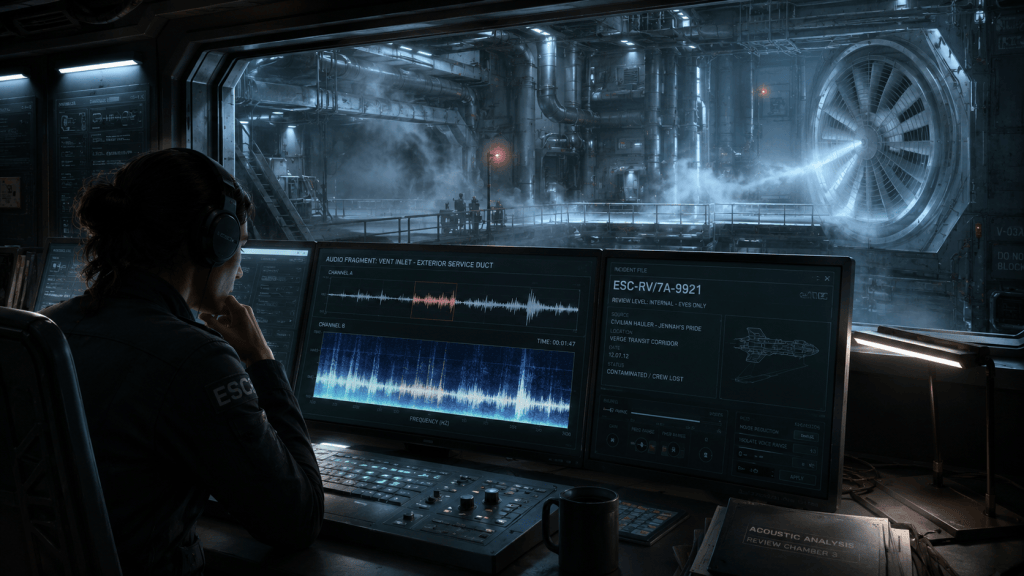
An ESC analyst studied a damaged audio fragment from a contaminated ship and heard a voice where procedure insisted there could only be corrupted airflow.


Chronicle Opening: The Recording in Chamber Nine

Review Chamber Nine held its cold in the wall panels long after the upper decks moved into their sleep cycle. It sat three levels below the main intelligence spine of the ESC cruiser Adderfall, sealed behind two pressure doors and a corridor lined with acoustic baffles thick enough to swallow the sound of boots before those sounds reached the bulkheads. The room had once been a navigation review suite, made for traffic reconstruction, distress-call sorting, and signal comparison from damaged civilian craft, although later work had changed it into something more private. Extra insulation covered the older seams. Audio pickups hung from black jointed arms above the central table. Three analysis boards curved around the main workstation in dull blue light, carrying spectral maps, pressure traces, ship schematics, and damaged recordings recovered from vessels whose final reports had reached command in fragments.

Analyst Liora Venn sat beneath the listening array with one hand beside the playback controls and the other wrapped around a cup gone cold against her palm. Her review slate showed the file name in clean institutional text. ESC-RV/9A-441. Civilian carrier Jennah’s Pride. Verge transit corridor. Crew status lost. Contamination status unresolved. Audio source recovered from forward environmental stack. The file had arrived from Evidence Intake with three notes attached by officers who had tried to keep the fragment inside a safer frame. Damaged ventilation record. Probable pressure flutter. Emergency channel bleed. Liora had read each line before opening the raw track, and each phrase carried the same careful pressure, the same quiet attempt to turn fear into something a desk could approve.

She drew the Jennah’s Pride schematic across the left board and let the carrier unfold in pale lines. The ship had been a mid-range civilian hauler, narrow through the crew spine, broad through the cargo belly, old enough to carry exposed heat trunks behind patched maintenance covers and cheap enough for its owners to argue over every delayed repair. The forward environmental stack sat above the lower crew passage, feeding filtered air through sleep cells, galley, med recess, and service ducts leading into cargo control. The recovery drone had found ribbed residue along two vent grilles, black particulate inside a filter tray, and pale scoring across an inner access cover where metal had cooled around shapes the original design had never required. Liora enlarged the stack and traced the airflow path with two fingers. If air had crossed a damaged grille at the right pressure, if the emergency channel had held a cached distress syllable, if the ship’s own announcements had torn apart during power loss, a sound could gather shape. She wrote that on her slate, then lowered the playback threshold and allowed Chamber Nine to listen.

Static came first, low and irregular, carried inside fan wash and broken signal return. The visual band rose in white clusters across the central display while Liora watched the peaks before letting the sound move deeper into her attention. Hull vibration sat underneath it, a slow structural shiver from a vessel losing thermal balance. A relay click repeated in the upper range. Air moved through the stack in pulses, too uneven for a healthy loop and too regular for random failure. Then a tone surfaced beneath the wash, thin as breath crossing a cracked pipe, and the room changed around it. Liora stopped the track with one careful touch. She stared at the frozen waveform while the cold panels, listening arms, display boards, and sealed doors seemed to gather more closely around her. The sound had lasted less than a second, close enough to a voice for the body to react before reason could claim it. She marked the frame, rewound nine seconds, and played it again with the voice-isolation layer disengaged.

The second pass carried more weight because she knew where the sound waited. Static crossed the chamber. Fan wash followed, broad and dry. The relay clicked. The airflow pulse came from the damaged stack, then the thin tone rose again, shaping itself with enough human timing to make her body react before thought could build a wall around it. Liora kept her hand still beside the controls and opened a filter to strip low-frequency hull vibration. A second filter reduced relay chatter. A third mapped airflow against the forward stack, feeding the pressure model across the right board in slow blue lines. Most of the fragment behaved the way training said it should behave. Broken flow crossed the grille, struck the access lip, and returned through the stack with a warped harmonic that could form a vowel under poor conditions. The final third sat slightly apart from the airflow model, a narrow lift in the middle band that held across twelve frames with the patience of speech.

The door opened behind her with a soft pressure shift that moved through the room before the hinge sound arrived. Lieutenant Arel Doss stepped inside carrying a sealed evidence case under one arm and a field jacket fastened over his duty shirt. He paused once he saw the active boards, then his eyes moved from the Jennah’s Pride schematic to the frozen waveform across the central display.

“You started early,” Doss said as he crossed to the side table and set the case down.

Liora kept her eyes on the spectral line. “The file arrived marked routine acoustic review.”

Doss glanced at the dark cup beside her wrist. “Routine files usually wait for morning.”

Liora lifted the cup, found it cold, and set it down again. “This one kept the room awake.”

Doss came to stand beside her chair, his face drawn by fatigue and the hard light of the boards. “Play it from the mark.”

Liora sent the fragment through the chamber speakers. Static moved across the room with the dry scrape of damaged distance. Fan wash followed, then the relay click, then the airflow tone rising from the stack, stretched thin through metal, filter mesh, and pressure failure until it shaped itself into two syllables that no program on the board would name. Doss lowered his head by a fraction. Liora stopped the track before the following distortion buried the sound, and for several seconds they stayed beneath the listening arms while the display held the waveform in frozen light.

Doss moved first, drawing one hand across the back of his neck as he looked at the schematic. “That sounded like a woman.”

Liora pointed to the airflow model. “It came from the forward environmental stack during pressure collapse.”

Doss leaned closer to the display, his voice lower as he answered. “Those are separate statements, Liora.”

She drew the spectral layer wider and forced herself to follow the clean lines of the model. “It sounded like airflow travelling through damaged vent structure.”

Doss looked at her profile in the blue light. “You heard her as well.”

Liora pushed back from the workstation and stood, needing the small change in height more than distance from the sound. “Jennah’s Pride had already lost pressure across forward crew sections before the recording,” she said, taking the stylus from the slate and marking the relevant time block. “Thermal map showed no living return inside the stack or lower passage. Rescue authority closed before the drone entered.”

Doss folded his arms and kept his eyes on the waveform. “Then why did she sound trapped inside it?”

Liora lowered her hand and opened the pressure overlay again. “Because damaged ships carry people after people are gone,” she said. “Announcements, emergency loops, suit traffic, last words, cabin audio, airflow through broken spaces. The system keeps pieces.”

Doss looked towards the sealed evidence case he had brought in. “That answer will satisfy Evidence Intake.”

Liora followed his gaze. “It will satisfy them if the track behaves.”

The line from Evidence Intake chimed across her board. Liora accepted it through text only. Supplementary file available. Drone visual, forward environmental stack, Jennah’s Pride. A grainy still filled the right display, showing an access grille under emergency light, its surface rimed with frost and thin pale residue gathered along every rib. The centre of the grille had bent outward from inside the duct, enough for a technician to see pressure had travelled the wrong way through the stack. Doss stepped closer, his earlier argument fading as the visual settled between them. Liora enlarged the bent grille, then laid the waveform beneath it. The thin tone aligned with the pressure reversal. The explanation strengthened. Relief passed through her too quickly, too eagerly, and for that reason it felt unsafe.

“There,” Liora said, touching the pressure mark with the stylus. “Air forced through a damaged grille during collapse. That gives us the vocal edge.”

Doss kept his gaze on the still. “And the timing?”

Liora looked back at the waveform, where twelve frames held their small human shape. The cruiser hummed around Chamber Nine while the room waited for language strong enough to contain the sound.

“The timing remains under review,” she said, saving the mark before she played it once more.


A Visual Chronicle

Inside Review Chamber Nine, a damaged recording recovered from the dead carrier Jennah’s Pride is stripped down to airflow and static until the machinery seems to form a single human word: “Please.”


Incident Record: Review Chamber Nine

Review Chamber Nine formed part of the restricted intelligence and evidence-analysis section aboard the ESC cruiser Adderfall, a midline patrol vessel assigned to incident comparison work across the Verge transit corridors during the earliest phase of the contamination crisis.

The chamber had originally served as a navigation review suite, where damaged route packets, traffic disputes, late transponder replies, and civilian distress bursts could be reconstructed after accidents along the outer freight lanes. Its first purpose had been practical and narrow, built around the careful rebuilding of events from signal fragments, pressure logs, ship schematics, and traffic authority records.

As unexplained incidents increased across civilian haulers, salvage craft, cargo drones, and isolated industrial stations, the chamber’s role gradually changed. Additional acoustic insulation was installed behind the wall panels, evidence feeds were restricted to cleared analysts, and the listening array above the central workstation was upgraded to process degraded audio recovered from contaminated vessels and post-disposal drone sweeps.

Rooms of this type became important because many early Harbinger-related files reached ESC review through damaged sound before they reached command through reliable evidence. Ships lost environmental balance, distress channels fractured, emergency buffers repeated broken phrases, and ventilation systems carried pressure noise that trained officers struggled to dismiss once it began to resemble human speech.

Review Chamber Nine was therefore used for the difficult work of separating mechanical failure from possible survivor audio, a task that carried both procedural and moral pressure. A sound could be logged as airflow distortion, comm bleed, pressure flutter, emergency loop corruption, or acoustic artefact, yet each label carried consequences for rescue authority, evidence handling, quarantine procedure, and the official language later attached to the incident.

The recording recovered from the civilian carrier Jennah’s Pride entered Chamber Nine under this uncertain status. It had been taken from the forward environmental stack after the ship was declared lost, and the fragment appeared to contain a short human-sounding vocal shape inside a field of static, fan wash, relay chatter, and pressure collapse. At the time of review, no confirmed survivor remained aboard the vessel, and the recovered visual evidence showed damage around the vent structure that supported a mechanical explanation.

Later comparison work would place the Jennah’s Pride fragment among a wider body of early contamination records involving false voice-like events, delayed system responses, airflow anomalies, and human interpretation under extreme stress. In the official summary, the sound was classified as an acoustic artefact pending further review.

Yet within the chamber logs, analysts preserved the original waveform, the pressure model, and the damaged vent image together, leaving behind a record of the moment when procedure found a name for the sound while uncertainty remained inside the file.


About the Creator

The Future Chronicle is written and curated by Simon Phillips, a writer of science fiction and speculative storytelling who explores the fragile edges of human expansion, where freight routes, inspection bays, patrol vessels, and isolated industrial stations continue their ordinary work while larger dangers gather quietly beneath routine procedure.

Many of the stories presented in these Chronicles exist within wider fictional worlds shaped by workers, survivors, officers, and investigators who encounter the first signs of events far greater than they are prepared to understand. These settings remain grounded in lived environments, where machinery, bureaucracy, and human judgement often shape the path of catastrophe long before anyone can give it a name.

The Harbinger Protocol novellas follow that unfolding pressure through the experiences of Soren Vale, beginning with the civilian freighter disaster recorded in The Ash in Transit and continuing into the colder, more procedural dread of The Silent Outpost, where isolated incidents begin to reveal the outline of something spreading across human routes and systems.

Readers who wish to explore the full opening phase of the Harbinger crisis can find the novellas below.

Explore the books:
The Ash in Transit
The Silent Outpost

You can watch his YouTube channel here:
Author Simon Phillips


Continuing the Chronicle

The following Chronicle reconstructs the review of the Jennah’s Pride audio fragment inside Review Chamber Nine, where an ESC analyst attempted to reduce a human-sounding voice to airflow, pressure collapse, and damaged ship systems while the recording continued to resist every clean explanation.

Readers supporting The Future Chronicle can continue the record below.

Subscribe to continue reading

Subscribe to get access to the rest of this post and other subscriber-only content.

The Future Chronicle: The First Quarantine Hold

Chronicle Opening: The Hold Wakes

Quarantine Hold One sat below the corvette’s medical deck, tucked into a reinforced section where casualty receiving, evidence handling, and emergency isolation met behind three pressure doors. The chamber had been built for known dangers first, fevers brought in from mining stations, sealed cargo leaks, reactor-burn exposure, and fungal blooms carried in coolant dust from old refinery routes. Years later, after an incident near the Merrow transit chain, armour panels had been fixed over the original composite walls, leaving the room uneven around its edges. Bolt housings rose beneath fresh paint. Seal lines ran in thick black bands around the doors. Service pipes crossed the ceiling behind armoured mesh, their insulation patched where frost damage had split the wrap and maintenance crews had repaired it in a hurry. The room carried the sharp smell of disinfectant, cold metal, and filter cartridges, a deliberate scent that seemed to cling to the back of the throat, reminding every person who entered that the hold existed for moments when mercy and procedure had to stand on opposite sides of the same door.

Technician Orren Kail had worked the hold for nine months, long enough to read its moods before the consoles finished naming them. He stood at the outer board with both gloved hands resting near the pressure controls while the corvette adjusted course around him. The deck gave a brief pull beneath his boots, smooth and controlled, the kind of movement ESC patrol craft made when command wanted speed hidden inside discipline. Civilian haulers complained when they altered heading. Frames rattled, braces answered, storage crates shifted against their locks. This ship moved through intention. Acceleration passed through armour, rails, and sealed decks, through the small delay in the lamps above the prep bench, through the faint change in air draw behind the intake grilles. Orren had felt the harder burn almost eight minutes before medical containment received the formal notice.

The board showed the room in clean layers of light. Inner hold temperature sat low. Negative pressure held within tolerance. Vapour wash reservoirs were full. Evidence cold storage ran at preservation setting. Four suit racks showed green, three drone samplers waited inside their wall niches, and the body sled stood aligned with the inner rail, straps folded across its surface in neat black bands. Every reading claimed readiness, though readiness meant little until something arrived to test it. Quarantine bays gathered silence differently from other compartments. Ordinary silence filled space. Quarantine silence held itself in preparation, as if every sealed seam had already heard the alarm that people were still waiting to receive.

A voice came through the ceiling speaker, flattened by operations relay. “Medical containment, prepare Hold One for inbound material transfer. Distress source: civilian hauler. Classification unresolved. Chain pending.”

Across the console, Senior Med-Tech Vela Armit paused with one hand inside the open seal drawer. She had already removed three sterile cutter packs, a thermal sheath, and a bloodless sample kit before the relay finished speaking. Experience moved faster than orders aboard patrol ships, especially on decks built for whatever command struggled to name.

Vela placed the cutter packs into the receiving tray and looked towards Orren through the rim of her clear face shield. “Material transfer,” she said. “They avoided saying survivor.”

Orren brought the hold wake sequence onto his screen and kept his eyes on the pressure curve. “They avoided saying remains as well.”

Vela closed the drawer with a measured push, the seals catching one after the other. “That worries me more.”

The corvette gave another slight correction. Somewhere above them, docking control passed status traffic to the bridge, each signal carried through encrypted routing and stripped of warmth before it reached the lower decks. Orren keyed the first stage. The lights inside the hold shifted from idle amber to cold white, and pumps answered beneath the floor, drawing air from the inner chamber through filter stacks and pressure traps. The main door remained sealed, its inspection slit dark. Beyond it, the chamber waited in clinical brightness around the empty sled.

A private line opened from casualty receiving, and Lieutenant Sarre’s voice entered Orren’s ear with less polish than the bridge relay. “Kail, the hauler’s distress burst came in broken across three bands. Automated tag says medical emergency. Manual voice layer is degraded. Patrol shuttle is moving to intercept a detachable pod near the outer hull.”

Orren checked the reserve pressure line before answering. “Detachable pod as in lifepod?”

Sarre gave a tight breath on the line. “As in command has chosen softer language until the shuttle has eyes on it. The hauler is tumbling on low power. Drive section is dark. Internal traffic keeps correcting itself before route control can verify origin.”

Vela stepped closer to the console, her reflection sliding across the dark glass beside the board. “Crew count?”

“Manifest says twenty-one,” Sarre answered. “Burst says four active. Heat map says the returns keep breaking before they hold.” Her voice lowered, and the background noise behind her carried the movement of people preparing beds they hoped to leave empty. “There is audio in the distress packet. Bridge scrubbed most of it before the medical feed opened, though I heard enough.”

Orren turned from the board for the first time. “Enough meaning?”

The line stayed quiet for half a second while the corvette carried all of them towards the disabled ship. “Someone kept saying open the lower door,” Sarre said. “Same phrase, different pitch, as if the line had too many throats in it.”

Vela rested one hand on the edge of the console, her gloved fingers flattening against the metal. “We treat this as contaminated evidence until readings tell us otherwise.”

Sarre answered at once. “That language is already moving through the bridge. Captain wants standard biohazard preparation. Doctor Hen wants full isolation. Route control wants the pod scanned in the shuttle bay before it comes near my deck. The shuttle commander says the pod is losing internal pressure, and if someone is inside, every minute matters.”

There it was, the shape every quarantine team knew before any briefing named it. A sealed door. A possible survivor beyond it. Procedure leaning one way, human instinct leaning the other. Orren looked through the inspection slit into the empty hold and imagined the pod arriving there with frost on its casing, clamps around its frame, and some injured crew member inside waiting for hands willing to open it. He imagined the same pod carrying vapour, blood, particulate, failed seals, or a sickness whose name had yet to reach any manual in the drawer beside him.

Orren touched the pressure control and watched the inner chamber drop further below ship atmosphere. “Hold One can receive. Inner chamber only. We keep casualty pass-through sealed until readings stabilise.”

Sarre released a low breath, caught between relief and frustration. “I will put that on record.”

Vela leaned near Orren’s shoulder and spoke clearly towards the open line. “Put my name beside it. Larger letters if command starts wanting softer phrasing.”

The line closed, and for a moment the bay offered only machinery. Air slipped through filters. Coolant ticked in the wall behind the evidence drawer. Orren watched the temperature inside the hold sink another three degrees. They had been trained to slow unknown biological activity with cold, reduced air movement, sealed sample paths, and restrained handling. The manuals spoke cleanly. Seal the chamber. Stabilise the subject. Extract evidence. Prevent cross-contamination. Escalate when required. Every verb seemed strong inside a training room. In a live hold, each one depended on somebody choosing which life to protect first.

Vela lifted a sealed hood from the rack and passed it across the console. “Full suit.”

Orren accepted the hood, though his gaze stayed on the sealed inner door. “We are still behind the console.”

Vela drew her own hood down from the rack and locked it beneath her chin with a firm twist. “Full suit, Orren.”

He fitted the hood against his collar ring and let the suit fold around him. Pressure tightened at the jaw as the seal found its line. His own breath returned through the filter path, softer than the room, closer than comfort. Vela stepped in front of him, checked the closure at his throat, then turned her shoulder so he could check hers. The ritual steadied his hands more than the readings did.

Vela keyed a private short-range link once her seal showed green. “You heard Sarre. If a living crew member is inside that pod, command may push for immediate breach.”

Orren checked the lock authority on the board, then checked it again because the act gave his fingers something useful to do. “They can push from the bridge. The hold opens by this console or by command override.”

Vela’s eyes moved to the override channel, where a single amber strip marked the captain’s authority path. “Command override exists because command likes to mistake distance for wisdom.”

The remark should have eased him. It failed. He looked at the hold again. Frost had begun gathering around the inner rail where cold air sank against the floor. The body sled stood ready, black straps resting in pairs, each one folded for speed. Under the white light, the chamber had the unreal cleanliness of a place prepared for violence by people who used gentler words for it.

A new file opened on the console. The hauler’s identification resolved in staggered fragments, then corrected into clean text. CIVILIAN LONG-HAUL CARRIER MERCY OF DAWN. Registry lines followed, broken by amber warnings. Cargo: industrial filters, refinery mesh, sealed coolant drums, private salvage claim under Republic-linked lane authority. The distress burst copied beneath it. Orren resisted the audio and opened the waveform first. Peaks rose where human speech should have thinned, and layered returns repeated in uneven intervals. Beneath the main distress marker, a maintenance note refreshed out of order.

LOWER ACCESS OPEN. LOWER ACCESS OPEN. LOWER ACCESS OPEN.

Vela leaned close enough that her shoulder brushed Orren’s suit. “That came from the hauler?”

Orren enlarged the line and checked the source tag. “Emergency buffer. Repeated six hundred and twelve times inside the burst.”

Vela kept her eyes on the repeating text. “Which lower access?”

“The file cannot decide.” Orren scrolled through the origin correction. “Cargo lower. Engineering lower. Pod lower. Every correction gives me a different source.”

The speaker opened again before Vela could answer. This time the bridge came through directly, the captain’s voice steady enough to make the urgency beneath it clearer. “Medical containment, inbound pod secured by Patrol Shuttle Three. Outer casing shows residue, thermal irregularity, and surface scoring. Shuttle reports intermittent sound from inside. Prepare to receive under negative pressure. Hold breach requires command authorisation.”

Orren’s hand hovered above the acknowledgement key. “Define sound from inside.”

The bridge line carried the faint murmur of other officers speaking beyond the captain, then a filtered clip passed through the console, short and degraded by distance. Static came first, followed by three soft impacts, perhaps metal flexing, perhaps a hand against a wall. Then a voice, small and almost human beneath the interference, shaped itself around a plea.

Open the lower door.

Vela stood beside Orren with her gloved hand still resting near the cutter tray. The filters hummed. The cold board held green. Orren felt the sentence pass through the room and settle inside the narrow space between procedure and mercy. He pressed the acknowledgement key with one controlled movement and watched the inner hold lights brighten for arrival.


A Visual Chronicle

The quarantine board said the chamber was clean, but one dark thread remained, read the full record in The Future Chronicle.


Incident Record: Quarantine Hold One

Quarantine Hold One formed part of the lower medical-containment deck aboard an ESC patrol corvette assigned to border-route response duty along the Republic-linked trade lanes, where civilian haulers, salvage craft, courier drones, and maintenance ships crossed through overlapping jurisdictions under the uneasy protection of emergency treaty law.

The corvette had been built for rapid interception, evidence recovery, casualty intake, and short-duration containment, a practical vessel designed to reach distressed ships before larger peacekeeping cruisers or formal quarantine platforms could be moved into position across the outer routes.

Its quarantine systems were therefore functional instead of grand: reinforced holds, negative-pressure chambers, sealed sample drawers, cold-storage racks, vapour wash reservoirs, drone samplers, incineration lines, and casualty pass-through locks that allowed medical teams to receive the injured while preserving evidence chain for later review.

Before the events recorded in this Chronicle, such spaces were used for hazards the ESC already understood, including reactor exposure, industrial toxins, habitat fevers, fungal growths from refinery systems, coolant contamination, and the biological consequences of poorly maintained long-haul cargo environments.

Those procedures assumed that danger could be classified, isolated, tested, and then either treated, destroyed, or transferred under controlled authority.

The incident involving the civilian carrier Mercy of Dawn challenged that assumption before the recovered material even entered the hold, as the ship’s distress burst carried conflicting crew returns, unstable heat readings, damaged origin markers, and a repeated voice-like fragment that seemed to request access from somewhere inside the lower structure of the vessel.

At the time, ESC personnel had no agreed language for the pattern now associated with early Harbinger contamination events. The material was treated as a biohazard, the distressed pod as possible survivor evidence, and the acoustic fragment as damaged emergency audio.

Only later, after the Red Titan and Station Nine files were compared against other incidents, did Quarantine Hold One become one of the first minor records showing how normal containment procedure began to fail against a threat that moved through systems, pressure, temperature, airflow, and human response faster than any existing manual could properly describe.


About the Creator

The Future Chronicle is written and curated by Simon Phillips, a writer of science fiction and speculative storytelling who explores the fragile edges of human expansion, where freight routes, inspection bays, patrol vessels, and isolated industrial stations continue their ordinary work while larger dangers gather quietly beneath routine procedure.

Many of the stories presented in these Chronicles exist within wider fictional worlds shaped by workers, survivors, officers, and investigators who encounter the first signs of events far greater than they are prepared to understand. These settings remain grounded in lived environments, where machinery, bureaucracy, and human judgement often shape the path of catastrophe long before anyone can give it a name.

The Harbinger Protocol novellas follow that unfolding pressure through the experiences of Soren Vale, beginning with the civilian freighter disaster recorded in The Ash in Transit and continuing into the colder, more procedural dread of The Silent Outpost, where isolated incidents begin to reveal the outline of something spreading across human routes and systems.

Readers who wish to explore the full opening phase of the Harbinger crisis can find the novellas below.

Explore the books:
The Ash in Transit
The Silent Outpost

You can watch his YouTube channel here:
Author Simon Phillips


Continuing the Chronicle

The following Chronicle reconstructs the first activation of Quarantine Hold One aboard an ESC patrol corvette, after a damaged civilian-hauler pod was transferred into isolation under uncertain survivor status and unresolved contamination readings.


The Hold Condition

The pod arrived inside a transfer frame instead of on the casualty rail, and Orren understood the difference as soon as the rail lights changed colour. Casualty rail meant hope travelling under alarm. Transfer frame meant command had begun moving the object away from rescue and towards evidence. Through the inspection slit, he watched shuttle bay handlers guide it through the outer lock while every person stayed behind the red line. Frost lay over the shell in grey plates, and surface scoring crossed the hatch rim.

Vela stood beside Orren at the outer board, her face hidden behind suit glass, one hand lifted near the drone control pad. “No manual contact,” she said through the hold channel while the first sampler rolled from its wall niche. “Frame team releases from outside the red line, then exits the lock. Orren, keep the chamber cold.”

Orren lowered the hold another two degrees and watched vapour thicken around the pod’s casing. “Temperature falling. Pressure stable. Chamber air remains isolated from ship return.”

The handler beyond the glass backed away as the transfer frame locked into the inner rail. The outer lock sealed behind him. Warning lamps shifted from amber to white. The sound came before the drone reached the shell. Three dull taps moved through the pod, soft enough to pass for metal contracting under cold. Then the voice followed, thin through the chamber pickups, static wrapped around every syllable. “Open the lower door.”

Sarre broke into the private line from casualty receiving, her voice low. “Hold One, casualty team is standing by outside medical lock. Captain wants status on possible occupant.”

Vela kept her eyes on the pod while the sampler crawled forward. “Possible occupant remains unverified. Hold breach stays sealed pending exterior scan.”

Orren checked the internal scan pane as three lines corrected themselves while he watched. “It says yes, then empty, then four. Heat returns keep sliding across the shell instead of holding to a body shape.”

The drone touched the pod with a probe no wider than a needle. A bead of dark residue clung to the tip, then stretched as the probe withdrew, forming a thread that held in the cold air before snapping back against the casing. The sample cell sealed. Orren watched the scan unfold on the board. Mineral trace. Carbonised particulate. Protein shadow. Unresolved lattice. The last phrase stayed in amber, pulsing with the false patience of a system searching its library and finding no honest match.

Captain Myren entered through the command line. “Hold One, report.”

Vela straightened beside the board. “Inbound object secured in negative-pressure isolation. Exterior residue sampled. Classification unresolved. Biohazard handling remains active.”

Orren brought the heat map to the main board before Myren could ask the next question. “Survivor status remains unstable. The pod is returning active markers, although the markers disperse through shell, seam, and internal frame. There is no coherent body location.”

“The distress call carried a manual voice layer,” Myren said, his words tight with bridge pressure. “Under rescue authority, I require firmer basis before refusing breach.”

Vela looked once towards the pod, where frost thickened over the seam. “Under containment authority, I require firmer basis before opening a contaminated object into a medical deck.”

Silence held across the command line while the bridge absorbed that answer. Then Myren granted four minutes for further confirmation. Orren enlarged the pod schematic while Vela shifted the drone to the lower seam and spoke through the private channel with her hand steady on the pad. “Then we prove what we can.”

The sampler passed a cold-light strip over the residue. The material stayed inert under the first pass, then tightened as the strip warmed the seam by a fraction. The dark centre dulled. The pale edges brightened into fine ribbed lines. They travelled less than a finger’s width, small enough for an engineer to call thermal creep, deliberate enough for every person watching the feed to fall silent.

Vela withdrew the drone light. “Temperature response.”

Orren saved the frame and tagged it against the board. “Logged. Residue activity under minor thermal rise. Returning to static as cold restores.”

The pod speaker crackled, and the voice returned in a softer pitch. “Please. Lower door. Please.”

Orren felt the plea move through him before training could catch it. The voice sounded younger now, smaller, as if the pod had stored fear in damaged layers and played it through whatever shape the system could still force into sound.

Vela touched his sleeve with two fingers. “Stay with the board.”

Orren checked the pressure graph. “I am with it.”

Vela kept her gaze on the pod. “Give me a way inside that keeps the hold sealed.”

Orren pulled up the pod’s service architecture. The lower access plate connected to an emergency supply drawer and internal waste line, too small for a person and large enough for a drone probe. “We can breach the supply drawer with a microdrill. No hatch opening. Drone probe only. If someone is alive, we can pass air and fluid through the line after confirmation.”

Vela keyed the proposal to command and sent it. “Proceeding with restricted service access,” she said aloud, her gloved hand already bringing the microdrill online. “Captain can object while the procedure moves.”

The microdrill touched the lower plate. Orren watched the temperature graph, pressure curve, residue edge, and internal scan. For several seconds, the hold seemed manageable. Tools worked. Readings responded. Procedure held its shape around fear. Then the pod answered through the service line.

A shape bloomed on the internal scan, wide and diffuse, arranged through the pod wall, the supply drawer, and the floor beneath it. The board labelled it organic mass, withdrew the label, replaced it with structural interference, then opened a casualty icon in the centre of the pod. The icon pulsed green once.

Sarre saw it from casualty receiving and spoke with sharp urgency. “I have a life sign.”

Orren froze the frame before the next correction erased it. “You have a system response shaped like one.”

“That icon came from your board,” Sarre said, fear tightening every word.

“My board is guessing,” Orren replied.

Vela stood rigid beside him while the drill completed its cut. “Probe in.”

The drone fed a fibre camera through the service access. Orren adjusted the blurred image until the lower compartment resolved. Torn emergency packs floated against one wall. A broken filter mask lay beneath an open restraint. A human glove rested on the floor, empty, its fingers curled inward by cold. Beside it sat a recorder unit from the hauler’s bridge kit, its casing split, its audio light still blinking through a smear of dark residue. Along the wall, pale ribbed growth followed the seams in delicate branching lines.

Vela leaned closer, her breath soft over the private channel. “Recorder is active.”

The pod voice whispered through the chamber. “Open the lower door.”

Orren stared at the recorder light and felt the rescue-shaped part of the event alter inside him. Damaged audio, trapped in a pod full of residue, carried through a speaker, reshaped by failing systems and whatever lined the interior seams. The sound had never needed a living throat to wound them.

Sarre spoke from casualty receiving, quieter than before. “Is there a body?”

Orren moved the fibre probe further. Straps hung open. A boot remained locked beneath a restraint bar with a leg inside it only as far as the knee, the rest obscured by a mass of dark crystalline plates rising into the corner where heat lines once fed the emergency beacon.

Vela swallowed, the sound tiny over the link. “Recovered occupant partial. No viable survivor. Biohazard status escalated.”

Sarre repeated the words for her own record, each one arriving with controlled effort. “Recovered occupant partial. No viable survivor. Biohazard status escalated.”

Orren sent the still image to the bridge with the worst sections masked by medical protocol. “Audio source appears to be recorder unit and pod speaker corruption. Interior contamination present across lower compartment, seat frame, and beacon heat line. Residue responds to minor thermal increase. Recommend sealed transfer to deep cold storage and no casualty pass-through.”

Myren stayed quiet long enough for the hum of the hold to fill the line. “Acknowledged. Hold breach denied. Medical deck remains sealed. Evidence chain transfers under full isolation.”

Orren and Vela kept the chamber cold while the drone sealed the access cut and transferred three residue samples into cold cells. The recorder unit remained inside the pod after growth along its casing brightened beneath the probe lamp. Orren marked the whole object as active under thermal stimulus, then hesitated over the classification field. The system offered biohazard, chemical exposure, unknown pathogen, contaminated remains, and structural toxin. Each sounded too small, a drawer label for something already moving beyond the cabinet.

He selected unknown bio-structural contaminant and watched the words settle on the board with false authority.

The pod voice played once more as they prepared deep storage transfer. It emerged through the chamber pickups, stretched thin by cold and damaged power. “Please.”

Vela stopped the drone with one fingertip on the pad. Orren looked at her, then towards the pod. No lower door this time. Only the human fragment, the part the recorder had kept and ruined. Vela resumed the drone path with a controlled movement and kept her voice steady. “Recorder remains sealed.”

When the storage drawer took the pod, the rail drew it into the wall like the room was swallowing a secret. Cold seals locked around the frame. Pressure traps cycled twice. The hold washed itself in vapour and white light until the inspection slit showed a chamber stripped back to readiness, empty except for sampler tracks on the floor and a faint dark thread fixed beneath the first place the pod had rested.

Orren saw it before the board marked completion. A line no longer than his thumb lay along the rail groove, dark at the centre and pale along one side. The vapour wash passed over it. The line remained.

“Vela,” Orren said, keeping his voice level as he lifted one hand from the reset control.

She followed his gaze. Her hand stilled above the drone pad. “I see it.”

The board marked the chamber clean three seconds later.

Orren stared at the green status until the colour seemed almost obscene. “The wash missed residue.”

Vela kept her eyes on the line. “The wash says the chamber cleared.”

“It missed that.”

She reached towards the drone pad again. “Then the board is wrong.”

That simple sentence changed the room more than any alarm could have. Orren keyed the hold back down, cancelling reset before the system released the chamber to idle. Vela sent the drone to the rail groove, and the sampler returned with a thread so fine it barely registered in the cold cell. Under magnification, it showed the same ribbed pattern as the pod seam, reduced to a fragment small enough for procedure to overlook.

Sarre opened the line from casualty receiving, her voice cautious. “Hold One, your clean status came through. Are you releasing?”

Vela looked at the magnified thread and answered with her eyes still on the screen. “Hold One remains sealed.”

Sarre waited a moment before speaking again. “The board says clean.”

Orren saved the image, attached it to the event log, and overrode the room status with manual authority. “The board learned too quickly.”

Inside the cold-storage wall, the pod stayed silent. The chamber held its pressure, its temperature, its seals, and its bright medical cleanliness while the warning moved through the ship.

Beyond the lower medical deck, the corvette kept station near the tumbling hauler while patrol crews prepared for a second transfer from the disabled ship. In the hold, the dark thread inside the sample cell remained inert beneath cold light, quiet enough to tempt belief, while the room around it stayed sealed long after the board said it was safe.


The recovered pod sat sealed inside Quarantine Hold One while the board continued to insist that every system remained under control.


The Idea Behind the Chronicle

Quarantine has always carried a difficult moral weight. It exists to protect the many, yet it often begins with a single person behind a sealed door, waiting for help while others decide how close mercy can safely come.

In science fiction, quarantine bays are usually shown as clean, controlled spaces where procedure holds firm against danger. The reality would likely feel far more uncertain. A shipboard containment room would depend on readings, pressure seals, scanners, sample drawers, cold storage, medical judgement, command authority, and human restraint. Every decision would have to balance possible rescue against possible spread.

This Chronicle explores the moment when those familiar systems begin to lose their certainty. Quarantine Hold One was designed for dangers the ESC already understood: infection, toxins, exposure, contaminated cargo, and damaged bodies brought in from industrial accidents. Its procedures assumed that a threat could be isolated, labelled, tested, and contained.

The recovered pod from the Mercy of Dawn challenged that assumption. The danger arrived through familiar signs first: a distress call, a possible survivor, residue on a casing, unstable heat returns, a corrupted audio fragment, and a system board that kept correcting itself too smoothly. Nothing appeared large enough at first to justify panic. Everything appeared serious enough to delay trust.

The central idea behind the Chronicle is that future disasters may arrive through systems built to protect people. A distress signal encourages rescue. A life-sign icon demands urgency. A clean status board invites release. A human voice shapes itself inside damaged audio and pulls trained people towards the oldest instinct of all: open the door and help.

Within the Harbinger Protocol world, that instinct becomes dangerous because the contamination moves through the very channels people depend on: air, heat, pressure, sealed mechanisms, sensor logic, and emergency language. The horror comes from a room doing almost everything correctly while still failing in small, precise ways.

Quarantine Hold One therefore marks one of the earliest moments when ESC procedure began to meet something outside its existing vocabulary. The board said clean. The human eye saw residue. Between those two truths, the first shape of the wider crisis began to appear.


From the Author’s Desk

The Harbinger Protocol stories began with a simple question: what happens when humanity encounters something it can physically respond to, yet cannot properly understand? The first incidents are small in scale compared with the wider crisis that follows, though they carry the shape of everything to come. A strange residue on cargo. A shipboard system correcting itself too smoothly. A voice in damaged audio that sounds human enough to make trained people hesitate.

These Chronicles explore that early phase through side records and recovered incidents around the main novella sequence. They are designed to feel like missing files from the same world as The Ash in Transit and The Silent Outpost, showing the wider machinery of the crisis through technicians, quarantine crews, route officers, analysts, and field responders who encountered the pattern before anyone had the right language for it.

The First Quarantine Hold sits close to the world of the novellas because it focuses on procedure under pressure. The people inside this Chronicle are competent. They follow the rules. They understand danger in the forms their training has prepared them for. The horror comes from the moment those rules still function, yet no longer function far enough.

The Harbinger Protocol novellas continue that larger story through Soren Vale, whose survival aboard the Red Titan draws him into the first institutional attempts to understand and contain the contamination. These Chronicles widen the frame around him, revealing how other crews and departments began seeing fragments of the same crisis from different angles.

Readers interested in those stories can explore more through the links below.

You can explore my books here:
Books by Simon Phillips

You can watch my YouTube channel here:
Author Simon Phillips


Technical Notes & Frontier Context

Shipboard Quarantine Systems

A patrol corvette operating along disputed trade routes would need more than weapons and engines. It would also require specialised spaces for receiving damaged cargo, injured crew, contaminated equipment, and biological material from ships in distress. These rooms would form a practical bridge between rescue work and evidence control.

Quarantine Hold One reflects that kind of military-industrial design. It is small, reinforced, procedural, and built around layered containment: negative pressure, cold storage, vapour wash, sealed sample drawers, drone handling, casualty locks, and command-controlled hatch authority. Every part of the room exists to slow uncertainty long enough for trained personnel to make decisions.

The danger in this Chronicle comes from the gap between equipment and understanding. The hold functions correctly. The crew follow the rules. Yet the material brought aboard behaves outside the categories those rules were built around.

Distress Signals and Human Response

Emergency systems are designed to provoke action. A distress burst tells responders that someone may still be alive. A life-sign icon invites urgency. A voice inside a damaged recording pushes trained people towards rescue, even when the surrounding evidence suggests danger.

That tension sits at the centre of the Harbinger Protocol world. The early contamination crisis spreads through ordinary systems of trust. Ships answer distress calls. Medical teams prepare casualty intake. Route control attempts classification. Command seeks language that can survive review. Each system exists for good reason, and each one creates a possible opening for misjudgement.

In The First Quarantine Hold, the recovered pod becomes dangerous because it arrives wearing the shape of a rescue problem. The question is never simple. Open too slowly and a survivor may die. Open too quickly and the ship may become part of the incident.

Cold, Heat, and Containment

Cold plays an important role in the early Harbinger incidents. Low temperature can slow activity, preserve evidence, and make contaminated material appear inert. This creates a dangerous false confidence, because stillness can look like safety when the threat has only entered a quieter state.

Heat has the opposite effect. Lamps, scanners, emergency beacons, suit warmth, powered systems, and airflow can all create small changes in the environment. Those changes may seem minor to a technician, yet they can become the difference between dormant residue and active spread.

The quarantine hold therefore becomes a test chamber by accident. Every procedure meant to study the pod risks altering the conditions around it. Light reveals. Heat wakes. Scanning clarifies one thing while disturbing another. The room becomes safest only while it remains cold, sealed, and mistrustful of its own readings.

The Failure of Clean Status

One of the most unsettling ideas in this Chronicle is the clean board. Modern systems depend on status indicators because human beings cannot directly see every hazard inside a sealed environment. Green means safe. Clear means release. Clean means reset.

Yet a status board can only report what it has been built to recognise. If residue remains below the threshold of detection, or if a system corrects a reading too smoothly, the board can offer reassurance at exactly the wrong moment.

That is why the final residue thread matters. It is small, quiet, and almost beneath notice, yet it proves that the room’s own confidence has become unreliable. The danger has entered the space between procedure and perception, where a trained human eye sees what the machine has already dismissed.


Next Chronicle

Soon after the quarantine incident recorded in this Chronicle, route-control operators along a Republic-linked cargo corridor began tracking a routine drone freighter whose behaviour seemed ordinary enough to avoid immediate alarm. The vessel missed one checkpoint window, then another, before returning a complete identification packet with perfect registry codes, clean routing language, and the expected commercial authorisations.

At first the delay was treated as a communications fault. Cargo drones often crossed long stretches of poorly maintained traffic space, and minor signal drift could be explained by damaged relays, weak beacon alignment, or automated correction lag. Yet the replies from the vessel carried a stranger quality. Each response arrived a few seconds too late, as though the ship were listening to the question first, assembling the correct answer, and sending it back through systems that still remembered how ordinary traffic was meant to sound.

The next Chronicle moves into the quiet world of route control, where danger arrived through timing, registry codes, and familiar logistics language, long before anyone understood that a ship could answer correctly while carrying no living crew at all.

Next Week: The Ship That Answered Late


Quarantine Hold One remained sealed long after its systems claimed the chamber was clean, carrying within its cold walls one of the first quiet warnings that the crisis had already begun to outgrow the language built to contain it.

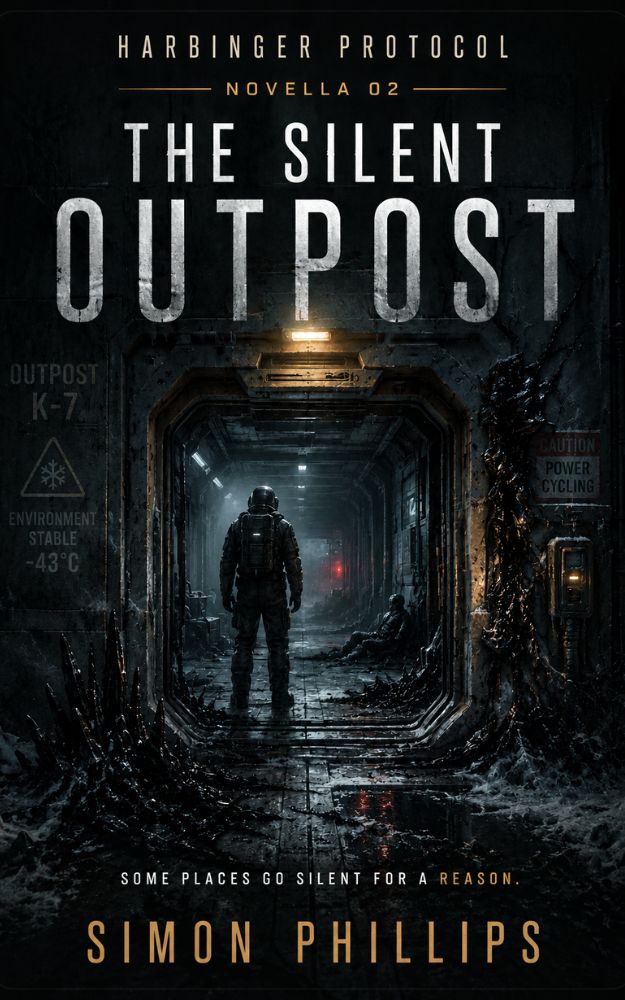
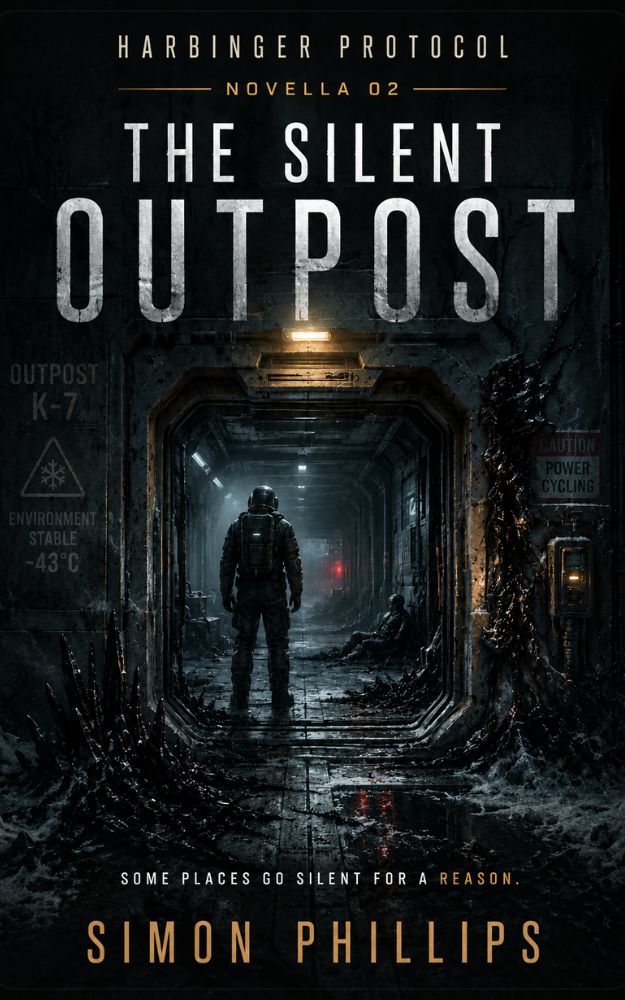
The Silent Outpost: Sci-Fi Horror, Biological Contamination, and the Collapse of Trust in Harbinger Protocol


When a Station Stops Behaving Like a Station

A station under quarantine should be quiet in a way people understand. Doors should remain sealed. Power should stay low. Emergency lights should mark safe routes through dead corridors. The silence should feel like failure, damage, or abandonment.

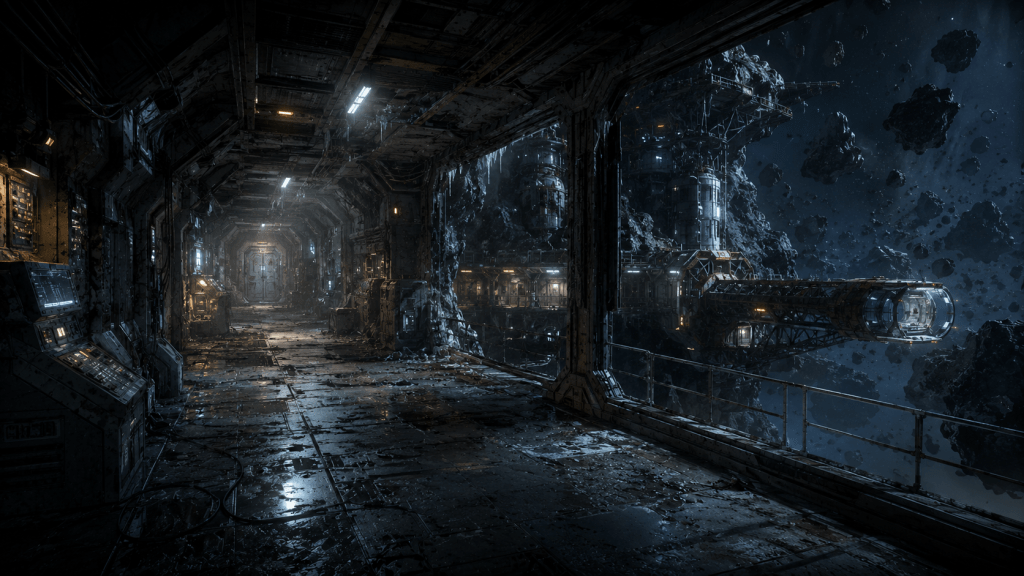
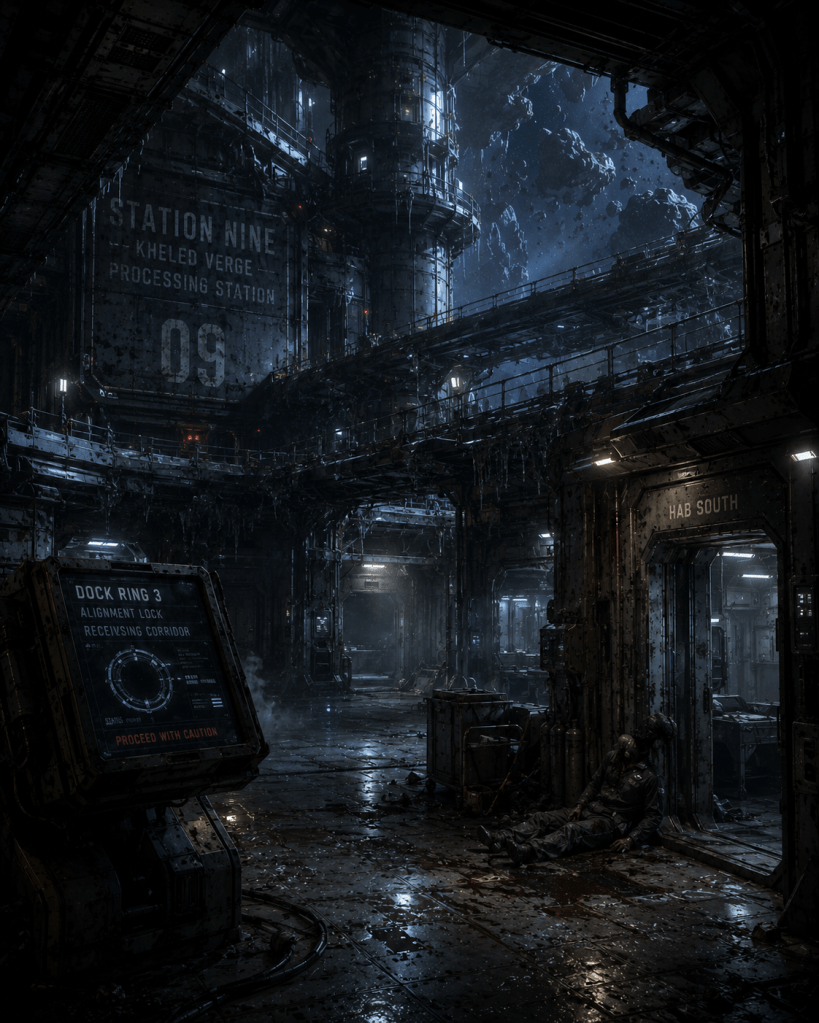
In The Silent Outpost, the second entry in Harbinger Protocol, silence becomes something more dangerous. Kheled Verge Processing Station Nine is cold, partially powered, and almost still when the ESC investigation team arrives. Its docking arms hang in interrupted motion. Its work lights have failed in broken sequence. Maintenance equipment remains suspended mid-task. The place appears paused, as though the ordinary life of an industrial outpost has been held in place by something that has learned how stations breathe.

This is where the series widens from isolated shipboard sci-fi horror into something larger. The first incident aboard the Red Titan left Soren Vale as a survivor. The second places him inside an institution trying to decide whether truth should be spoken plainly, delayed until it becomes useful, or shaped into language that can survive politics.

For readers looking for atmospheric science fiction horror, space station horror, biological contamination sci-fi, and a darker kind of interstellar political thriller, The Silent Outpost marks the moment Harbinger Protocol begins to show its wider shape.

Read The Silent Outpost on Amazon Kindle


Soren Vale and the Weight of Surviving Twice

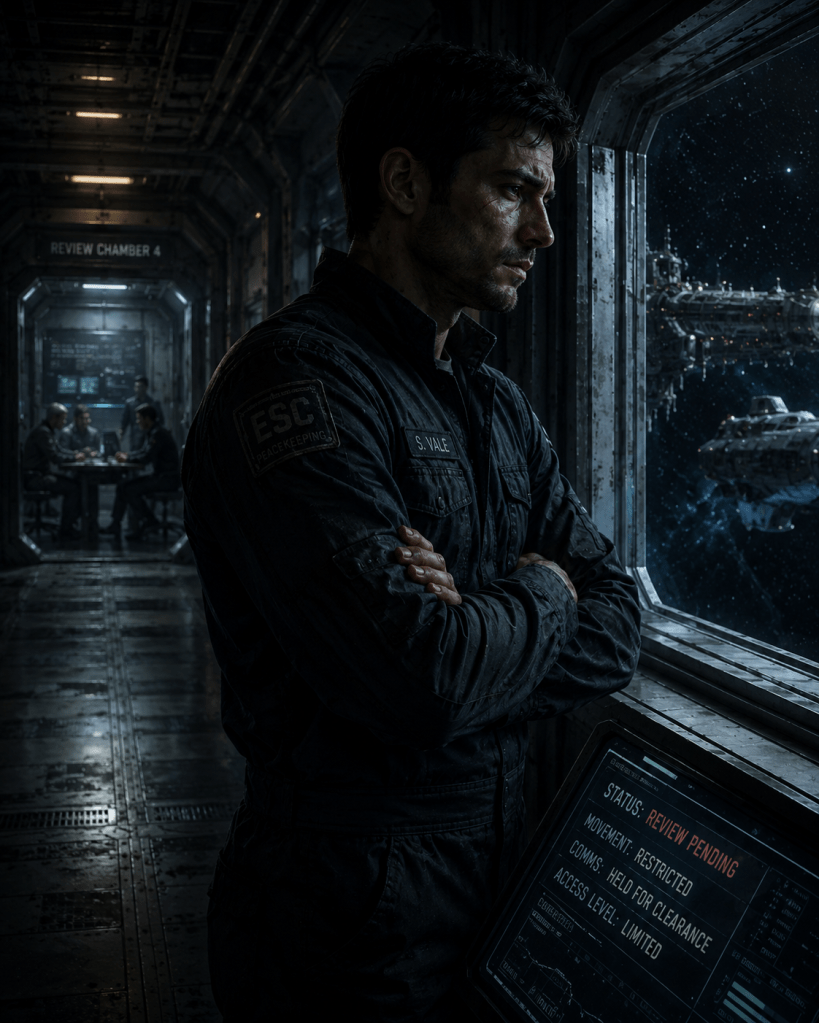
Soren Vale enters this novella in a cleaner kind of captivity.

He is aboard the ESC Peacekeeping Cruiser Leda Ark, safer than he was on the Red Titan, yet far from free. His movement is limited. His communications are held. His memories have become evidence. The institution around him speaks in careful phrases: protective review, pattern integrity, operational legal oversight, acoustic artefacts. Each term carries part of the truth, yet none of them can hold the shape of what he lived through.

That is one of the most important pressures in Harbinger Protocol. The horror is biological, industrial, and cosmic in its eventual reach, though it first enters through administration. Somebody has to classify the event. Somebody has to decide which words can be released. Somebody has to ask whether panic, sovereignty, route control, and treaty law are more dangerous than the thing moving through ducts and cargo bays.

Soren’s usefulness becomes a second form of custody. He notices patterns before committees are ready to name them. He recognises that wrongness can travel through air systems, power routes, warm compartments, and human assumptions. The ESC needs that instinct. It also needs him contained.

In many science fiction horror stories, the survivor becomes the hero who knows the truth and forces the world to listen. Harbinger Protocol takes a colder path. Soren is believed just enough to be used, controlled just enough to be kept close, and trusted only when his fear becomes operationally useful.


Station Nine and the Horror of Working Systems

Kheled Verge Processing Station Nine is not a gothic ruin in space. It is an industrial place. Ore systems, docking rings, maintenance spines, habitation blocks, control boards, pressure doors, service trunks, coolant lines, and emergency fallback systems form its body. That practicality matters.

The terror in The Silent Outpost comes from systems that almost behave correctly.

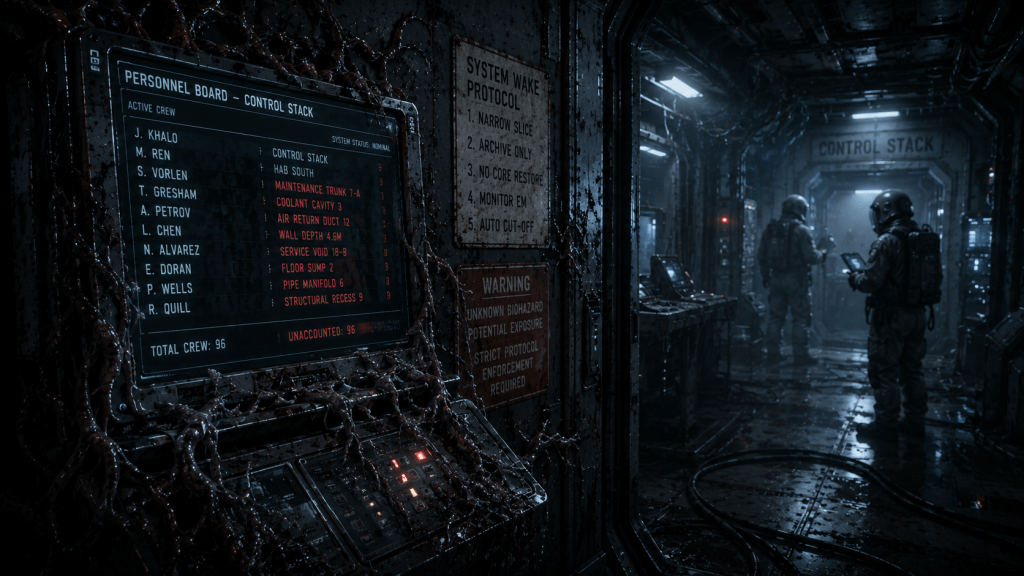
Dock Ring Three still answers, although weakly. The receiving corridor shows no grand destruction. Tools remain where workers left them. The first evidence of contamination appears in pale ribbed accretions on metal surfaces, hatch frames, vent housings, and equipment. It could be coolant residue. It could be mineral deposition. It could be a station ageing badly in deep cold.

Then Hab South changes the meaning of the place.

The dead are found near vents and service grilles. Some stand with hands against the metal. Others sit with faces angled upward, as if listening. There is no visible violence. No clear attack. No easy monster to blame. The bodies have been preserved by cold and arranged by behaviour. Something in the station made them listen long enough to die.

The voice-like sounds that follow are central to the series. They are not true speech in a simple sense. They are damaged systems, airflow, corrupted buffers, acoustic memory, and the human mind reaching for pattern. Yet that distinction offers no comfort. A false plea can kill as effectively as a real one when people are trained to answer distress.

A station does not need to become alive to become dangerous. It only needs to become trustworthy in the wrong places.


Biological Contamination That Uses Human Procedure Against Itself

The biomass threat in Harbinger Protocol is frightening because it does not behave like a simple alien invader. It is reactive, environmental, and tied to physical conditions: heat, power, airflow, oxygen, pressure, electromagnetic fields, and the infrastructure humans depend on.

That makes every sensible action dangerous.

A dark station must be investigated. Evidence must be recovered. Survivors may be trapped in sealed compartments. Life support might matter. Operations archives could explain what happened. A controlled systems wake seems reasonable. It is exactly the kind of careful, professional decision an ESC field team would make.

In The Silent Outpost, Kell attempts a narrow slice wake inside Control Stack. The intention is precise: operations archive and environmental board only, no station-wide restoration, no refinery systems, no heavy motors. Procedure is followed. Caution is present. Nobody behaves like a fool.

The station answers anyway.

Lights slam awake. Air handlers roar. Pressure doors cycle across the structure. Old announcements burst through speakers. Dead routines return in fragments. The outpost, once cold and held down, finds pathways through the very systems designed to reveal it.

This is where the novella deepens its biological contamination horror. The danger is not merely infection. It is infrastructure conversion. The station’s systems begin to blur human presence, ducting, wall cavities, coolant routes, service voids, and crew identifiers until the personnel board can no longer separate bodies from structure.

Thirty-two becomes sixty-four. Then ninety-six. Then zero.

That simple numerical corruption is one of the most unsettling images in the novella because it makes bureaucracy itself part of the horror. The system still counts. It simply no longer understands what a person is.


The Personnel Board and the Fear of Becoming Infrastructure

The corrupted personnel board is the central horror image of The Silent Outpost.

A crew roster should be one of the most human systems aboard a station. It tells command who is present, where they are working, which sectors are occupied, who may still need rescue, and who may already be gone. It is a tool of accountability.

On Station Nine, that tool breaks in a way that feels worse than silence.

Crew names appear in ducts, coolant cavities, wall depth, floor sumps, service voids, and processing infrastructure. The system sees occupied space where there should be only pipes and structural cavities. Whether the readout is literal, corrupted, or some terrible combination of both, the emotional effect is clear. The station has stopped recognising the difference between its workers and its own body.

This is also where Soren’s pattern recognition becomes essential. He understands that the contamination followed air routes. Cold slowed it. Power restored movement. The wake allowed the station to read what it had already begun to absorb, overwrite, or misunderstand.

The result is not spectacle. It is a quiet, industrial nightmare. A man does not fear being eaten by a monster. He fears being placed inside the walls and misread as part of the station.

That fear becomes human through the infected marine, whose glove breach turns a small field accident into a containment crisis. The infection follows warmth, suit seams, skin, fabric, and deck contact. Cold suppression slows it, yet the team understands the cost of trying to carry him further. His plea not to be left where the station can “put” him in the walls gives the entire outpost a human centre.

Containment, in this universe, rarely feels clean.


The ESC, Quarantine, and the Politics of Naming Disaster

The Earth Strategic Coalition is powerful, disciplined, and capable of rapid action. It also works inside a human civilisation fractured by treaties, rival governments, trade routes, sovereignty claims, and competing narratives.

That is why The Silent Outpost is more than space station horror. It is also political sci-fi horror.

The ESC can send a team. It can freeze a lane. It can order a containment strike. Yet every action becomes evidence in someone else’s accusation. The Republic contests custody, access, survivor handling, route authority, and strike justification. A dead outpost becomes a diplomatic event. A contaminated fragment becomes a border crisis. A docking signal becomes a legal trap as much as a biological one.

The station’s docking shell creates one of the novella’s most dangerous pressures. Once Station Nine begins broadcasting live docking guidance, the threat moves beyond the interior. Any Republic cutter, ore hauler, emergency responder, or salvage vessel that trusts the beacon could open a clean path through contamination and carry it back into traffic.

That is the real horror of beacon trust. Civilisation depends on systems answering correctly. Ships follow guidance. Docking rings identify traffic. Emergency signals draw help. In Harbinger Protocol, those habits become vectors.

The containment strike that destroys Station Nine is swift, grim, and politically explosive. It is not a victory. It is an institutional wound. The outpost is erased because leaving it standing may spread the threat further, and the aftermath immediately becomes a fight over language.

Cascade failure. Infrastructure loss. Traffic risk.

The words are true enough to survive. They are also too clean to carry what happened.


A Series Built on Contamination, Denial, and Scale

Harbinger Protocol works because its escalation is controlled. The early horror remains grounded in freight corridors, sealed compartments, industrial stations, damaged telemetry, and official caution. The series does not rush towards cosmic revelation. It lets the reader feel how a civilisation fails to recognise collapse while its systems still appear to function.

The Silent Outpost moves the saga from the Red Titan’s isolated shipboard nightmare into a wider pattern of station-scale contamination, political pressure, and institutional dependence. Soren Vale becomes the continuity anchor between events. The ESC becomes both protector and jailer. The biomass remains strange, reactive, and deeply tied to the environments humans have built around themselves.

This is adult science fiction horror rooted in procedure, pressure, and consequence. Its fear comes from the gap between what people see and what institutions can say. It belongs to the same family as space survival horror, cosmic horror science fiction, quarantine fiction, and industrial sci-fi horror, yet its centre remains human. People still make tea. Officers still argue over phrasing. Crew still answer voices in vents because the voice sounds close enough to need help.

A short visual reading connected to the novella is also available here:


Where the Next Failure Begins

By the end of The Silent Outpost, Station Nine has fallen. The report has begun to change. Soren remains under provisional attachment. The ESC has survived one immediate containment crisis, yet the political cost is already moving faster than the language built to contain it.

A Star Kingdom patrol and a Federation salvage convoy are drawing towards confrontation over contaminated debris. Each side sees the other through suspicion before either fully understands the object between them. The biomass no longer needs to attack. Human systems are carrying it outward through fear, ownership, law, salvage rights, and accusation.

That is where Harbinger Protocol finds its most unsettling pressure. The crisis spreads through matter, yes, yet it also spreads through delay. Through the need for proof. Through the instinct to rescue. Through governments protecting territory. Through commanders trying to hold routes open for one more hour. Through the dangerous belief that a station, a ship, a beacon, or a report can still be trusted because it looks familiar from the outside.

The outpost is gone.

The pattern remains.

And somewhere beyond the next quarantine line, another system is still answering.

When a System Clears Something Twice

There are moments when failure announces itself loudly. Alarms sound. Lights change. Authority moves in response to visible threat.

Then there are the other moments.

The ones that pass inspection.

Harbinger Protocol was built around those quieter failures. The ones logged, approved, signed off, and archived without protest. The incidents that make sense on paper and leave a faint pressure in the room once the report ends.

The flash-fiction fragments I have been releasing recently come from that space. They are not scenes in the conventional sense. They are residues. Procedural echoes. Things overheard through systems that were never designed to listen for consequence.

One of those fragments centres on a compartment that received clearance twice.

No alarm followed the first authorisation.
No escalation followed the second.
Every reading remained stable.

The repetition carried no technical significance. That is what unsettled it.

Clearance systems exist to remove hesitation. They translate judgement into colour states, timestamps, and confirmation loops. Once permission is granted, the system proceeds without interpretation. That design works well in stable environments. It functions less cleanly when the environment begins to change in ways the system cannot name.

In Harbinger Protocol, those changes arrive early and quietly.

The flash-fiction videos released on YouTube present these moments as isolated artefacts. A log entry. A procedural pause. A line written down and accepted because nothing else contradicted it. They are intended to feel incomplete, as though part of the context remains elsewhere.

That context lives in the short story.

📘 Harbinger Protocol: available on Amazon Kindle
https://www.amazon.com/dp/B0GJPHF7FH

The book expands the same approach across a wider frame. Institutions responding through habit. Authorities interpreting anomalies through existing language. Witnesses revising statements under pressure until they align with what the system expects to hear.

Nothing in the story announces itself as extraordinary. The horror develops through repetition, delay, and misinterpretation. By the time recognition arrives, the paperwork already carries multiple signatures.

The YouTube video linked below functions as a recovered fragment from that larger record. It stands on its own, although it gains weight when placed alongside the written report.

Watch the flash-fiction video

I have chosen to release these fragments alongside the book for a specific reason. The Harbinger Protocol project relies on atmosphere and accumulation. Each piece adds pressure without resolving it. The videos create a sense of institutional proximity. The book carries the full procedural arc.

Neither replaces the other. They occupy adjacent layers.

This approach reflects the world of the story itself. Systems communicate through partial records. Decisions pass through multiple hands. Meaning emerges through overlap, delay, and repetition. The audience assembles understanding in the same way the characters do.

Slowly.
Indirectly.
After the moment when intervention might have mattered.

If you are drawn to restrained science fiction, procedural horror, and narratives that unfold through systems instead of spectacle, Harbinger Protocol was written for that space. The fragments will continue to appear. The records remain open.

Some files clear once.
Some clear twice.
The difference arrives later.