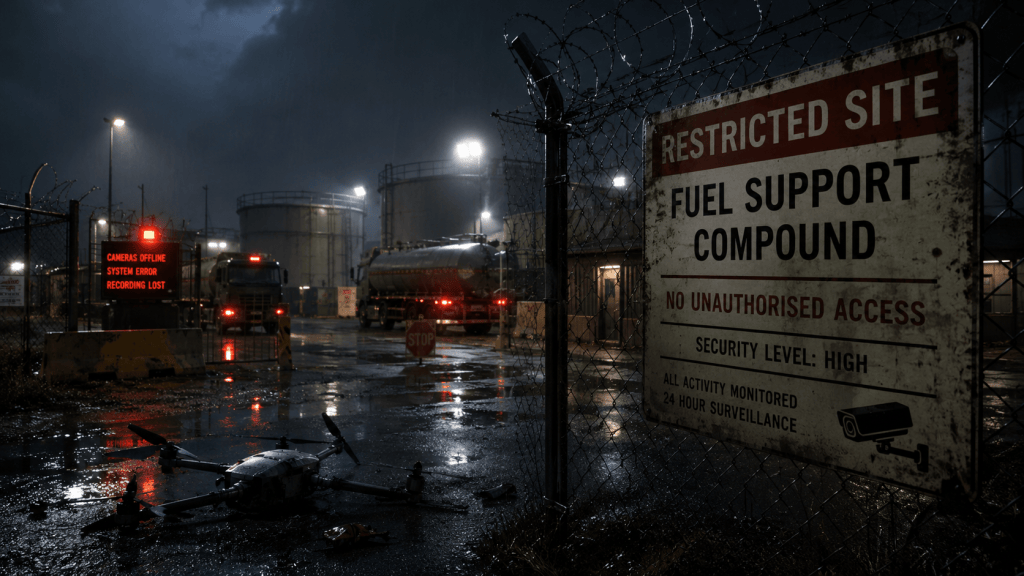
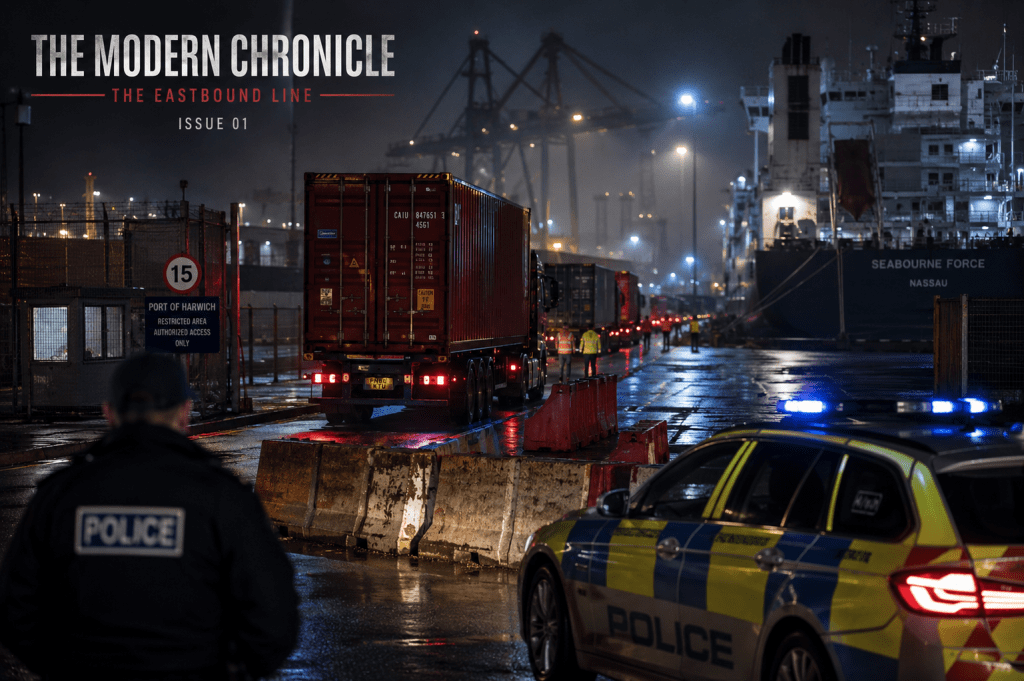
At a fuel-linked support compound near a controlled route, a brief technical failure began to look less like an outage and more like a test.
The Fence That Went Blind
By the time the cameras failed at Rookham Fuel Support Compound, rain had worked into every edge of the evening, running along the mesh fencing, gathering on the concrete lanes, and turning the floodlights into pale broken bars across the yard. The controlled route lay beyond the outer ditch, hidden behind blackthorn and the low bank, although everyone on shift knew when movement passed because blue police lamps slipped between hedge gaps and travelled over wire. Tankers waited beside the southern bay, bowsers sat under temporary lamps, and tarpaulin-covered flatbeds had been kept at the gate long enough for their drivers to lose faith in the printed schedule. Rookham still called itself a fuel support compound on signs fixed to the fence, useful, dull, and safely technical, yet lately it had begun to feel like a small hinge in a route everyone had been told to treat as routine.
Nina Carver had taken over the maintenance-control desk at six, carrying a plastic folder under one arm and a paper cup of tea that had already gone too cool to forgive. She had worked Rookham for six years, long enough to know which pumps whined before rain, which gate sensor sulked during frost, and which drivers arrived with anger already packed in the cab beside them. Extra barriers had appeared near the service gate, contractor access required a second call, and police parked in the lay-by after dusk. Nina preferred valves, pumps, lines, and fuses, because machinery usually failed with more honesty than people.
Across the cabin, Amir Laleh sat beside the access terminal, one shoulder angled towards the window so he could watch the gate between entries. He was logging the Bay Two tanker when the generator sound dipped beneath the rain, softening the lights for less than a second. The screens brightened again, the pumps carried on, and Nina had already turned towards the power panel before Amir finished looking up.
“That was supply side,” Amir said, keeping one hand on the mouse as the green status marks flickered across the terminal.
Nina touched the panel casing with the back of her fingers before she checked the strip of readings. “Or load side. The site enjoys variety when it wants attention.”
Amir reached for the internal phone, his eyes still fixed on the panel. “Should I call Dale?”
Nina kept her attention on the board as a fresh amber mark appeared beside the east fence feed. “Call Dale once we know which part wants to embarrass us.”
The perimeter screens above the maintenance desk had spent most of the evening showing rain, wire, and puddles, which made their sudden failure feel absurdly intimate. Camera Thirteen froze first, preserving a stripe of rain in the floodlight as though the night had been pinned to the screen. Camera Fourteen shivered once and held on the maintenance gate with the warning plate blurred by water. Camera Fifteen turned grey, recovered for half a breath, then fell into black. Amir rose from his chair, the phone still in his hand, and stepped close enough for his reflection to appear faintly beside the dead feed.
“East fence line,” Amir said, his voice lower now as he looked from one screen to the next.
Nina opened the camera status window and watched the system repeat the same useless symbol beside each channel. “Three cameras and one feed alarm.”
The cabin door opened before Amir could reach for a simpler answer, and Dale Houghton came in with rain on his shoulders, a torch in one hand, and his site keys hooked between two fingers. He looked at the frozen screens, then at the power panel, then at Nina’s radio, as water dripped from his jacket onto the rubber mat by the door.
“How long?” Dale asked as he moved beside the desk.
Nina slid the status window across the lower monitor so he could see the feed alarm. “Under a minute.”
Dale raised the torch towards the frozen fence image. “Power dip first?”
Nina kept her hand near the radio. “One pulse, then recovery. The generator caught itself.”
Dale studied the dead channel for a moment. “Machines get blamed for many human talents.”
The yard radio cut across them before Nina could answer. Bay Two reported a pause in fuelling because the driver’s paperwork had changed during entry. The gatehouse asked whether the controlled-route window still held. A third voice from the police car in the lay-by requested confirmation that no external access had been granted along the east fence since shift handover. Nina looked towards Dale as that final question settled inside the cabin, sharper than the generator dip and heavier than the dead screens. Amir turned from the terminal with the phone pressed against his palm.
“Why are police asking about the east fence already?” Amir asked.
Dale took a key from the ring and headed for the door. “Because someone outside this cabin has seen the same hole in the evening.”
Nina pulled her coat from the hook and followed him into the rain, leaving Amir at the panel with instructions to log each feed change and hold Bay Two if any further alarm appeared. The compound opened around her in glare and water, tanks rising as dark curves behind the lamps, pipe runs shining along the low gantries, tanker lights reflecting in the puddles beside the bay. Beyond the fence, traffic moved along the controlled route in brief fragments of sound, engine noise dampened by wet hedges and the soft rush of tyres through standing water.
The east side of Rookham had always felt less settled than the rest of the compound, with the ground dipping towards the drainage ditch and the old service track narrowing near the culvert. Camera Thirteen sat on a black post halfway along the line, its weather hood shining with rain. Beneath it, the junction box remained closed, labelled, and locked, although the conduit below it had a new pale mark near the entry point, visible once Dale’s torch crossed it. Dale crouched in front of the box, bracing one knee against the wet gravel as he worked the key into the lock. Nina stood behind him with her torch angled along the fence, her beam passing across wire, weeds, the outer ditch, and the flattened grass beyond the bank.
The junction-box door opened with a stiff metallic scrape, and Dale leaned in, his torch held close enough to turn the inner casing white.
“Well,” Dale said quietly as he shifted his body aside so Nina could see inside.
The feed line had been cut near the lower entry point, the outer sheath opened in a clean split and the inner cable exposed where it should have run whole into the conduit. Water gathered along the severed edge and dropped onto the gravel in clear beads. The cut carried too much intention for weather, wear, or the old gate’s usual talent for humiliation. Dale kept his hands away from the damaged line and looked at the surrounding gravel, his whole body held still by the kind of care that arrived when a familiar place revealed a stranger’s hand.
“That came from outside,” Nina said as she lifted the radio and kept the torch fixed on the cable.
Dale shifted the beam from the box to the fence base, where wet grass had been pressed low in a narrow patch near the ditch. “Looks that way.”
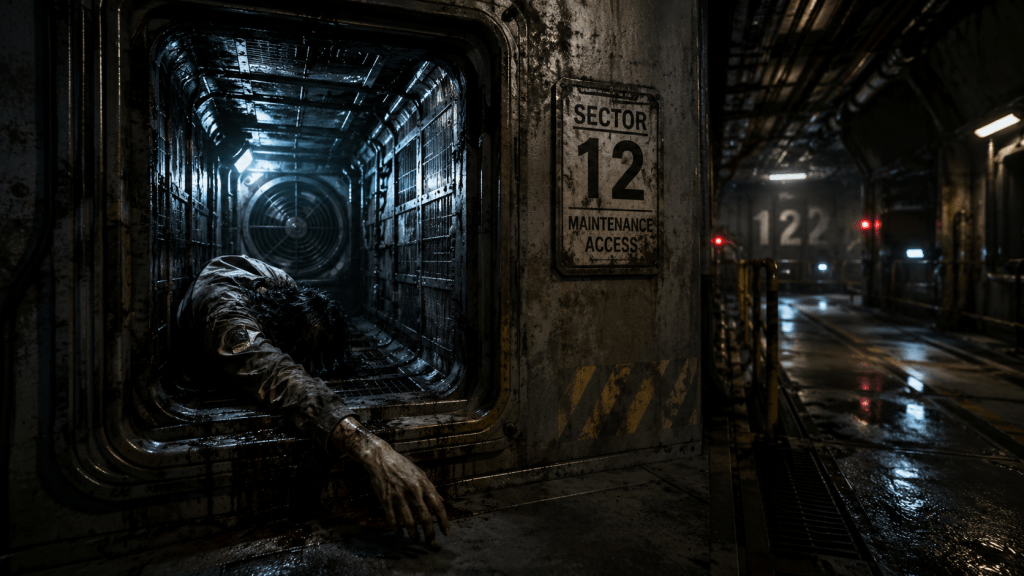
A movement beyond the wire drew Nina’s eye before either of them spoke again. Her torch crossed the ditch, swept back, then held on a small dark shape half buried in grass near the outer bank, with one broken arm lifted from the mud. At first the rain made it look like roadside scrap, a piece of shattered casing thrown from a van, yet the shape resolved under the light into something more deliberate, black-framed, compact, and wrongly patient. Dale turned his torch slowly across the same spot, and the two beams met on the broken frame as rain gathered along its arms.
Nina pressed the transmit key, watching the object through the fence as she spoke. “Control, this is Carver at east fence. We have confirmed cable damage at Junction Thirteen and possible unmanned debris beyond the perimeter. Hold Bay Two. Lock east access. Request police to the outer ditch and suspend movement near the service track until cleared.”
Static answered first, then Amir’s voice came from the cabin. “Received, Carver. Bay Two held. East access locked. Police requested. I am logging junction damage and possible unmanned debris now.”
Dale stayed by the open junction box, his torch moving from the severed cable to the fence post and back again, as though the line between the two might make more sense under enough light. The compound carried on behind them, pumps humming, tanker brakes sighing, rain striking the tanks, drivers waiting beneath shelters, radios turning fear into procedure. Inside the floodlit fence, Rookham still looked like a fuel site managing a technical fault. Outside the wire, in the wet grass beyond the dead cameras, the damaged drone lay where the fault had started to look like a message.
A Visual Chronicle
A brief camera failure at Rookham Fuel Support Compound became something far more deliberate when Nina Carver followed the fault beyond the fence.
Restricted Infrastructure Incident Report Extract from Regional Fuel Continuity and Site Security Coordination Log Subject: Rookham Fuel Support Compound / Eastern Perimeter Camera Failure Time: 19:17–20:06 Circulation: Regional Movement Desk / Fuel Continuity Cell / Police Liaison / Contractor Security Lead / Defence Access Support
Purpose To record the initial response to a perimeter-system failure at Rookham Fuel Support Compound during an active controlled-route movement window, with associated impact on fuelling operations, site access, police liaison, and contractor maintenance activity.
Public Position A minor technical issue affected part of the perimeter-security system at a fuel support site. Site operations remained under control while maintenance checks and routine safety procedures were carried out. There was no confirmed threat to public safety, and relevant agencies continued to monitor the position.
Incident Summary At 19:17, Rookham maintenance control recorded a brief generator-load dip affecting internal lighting and perimeter-monitoring feeds. Power recovered within normal tolerance, although three eastern-perimeter camera feeds failed or froze during the same event.
The affected feeds covered the outer fence, the old maintenance gate, and the drainage-culvert approach beside the eastern service track. Maintenance staff attended the junction box beneath Camera Thirteen and identified damage to the external feed line near the lower conduit entry point.
At 19:24, maintenance staff reported possible unmanned debris outside the perimeter fence, positioned in wet grass beyond the drainage ditch. Eastern access was locked, Bay Two fuelling was paused, and police liaison was requested to attend the outer ditch under controlled access.
Operational Impact Bay Two fuelling paused pending perimeter clearance. Eastern service-track movement was suspended. Contractor access through the old maintenance gate remained closed. Controlled-route traffic continued under police supervision. No site evacuation was initiated. No injuries were reported during the initial response window.
Technical Position Initial maintenance assessment indicated deliberate damage to the external camera feed line. The generator dip remained under review, with no immediate evidence of wider compound power failure.
Camera Thirteen and Camera Fourteen remained unavailable during the first response window. Camera Fifteen returned intermittent grey-feed output before failing again. Temporary visual coverage was requested through mobile patrol and police outer-fence observation.
Handling Guidance Staff were advised to describe the event as a perimeter-system fault under review. Drivers, contractors, and local callers were to be told that fuelling activity had paused temporarily while maintenance and safety checks were completed.
Questions concerning police attendance, camera-feed failure, route movement, drone activity, defence-linked traffic, or wider infrastructure security were to be referred to regional communications.
Lines to Avoid Avoid confirming deliberate interference pending forensic review. Avoid linking the incident to protected route movement. Avoid identifying camera coverage gaps or feed locations. Avoid discussing unmanned debris, drone recovery, or possible reconnaissance. Avoid confirming Defence access involvement unless cleared through regional handling. Avoid suggesting any wider pattern of infrastructure probing.
Internal Assessment The timing of the camera failure, the generator-load dip, the damaged feed line, and the recovery of unmanned debris beyond the eastern perimeter increased concern that Rookham had been subject to external observation or probing.
Attribution remained unresolved during the initial reporting window. The incident was assessed as operationally contained, although the affected camera line covered a sensitive section of the compound adjacent to controlled-route movement and fuel-handling activity.
Further review was required to establish whether the generator dip was coincidental, induced through local interference, or connected to the camera-feed failure.
Further Action Police liaison to secure the outer ditch and preserve the debris field. Contractor security lead to provide maintenance history for Cameras Thirteen to Fifteen. Fuel Continuity Cell to review Bay Two pause against scheduled movement requirements. Regional Movement Desk to assess whether further controlled-route activity required temporary camera uplift or mobile patrol cover. Public-facing explanation to remain limited to a perimeter-system issue under review.
About the Creator
The Modern Chronicle is written and curated by Simon Phillips, an author of modern speculative fiction and contemporary crisis-driven storytelling who explores the point where ordinary life begins to tighten beneath political strain, military movement, institutional caution, and the public language used to keep dangerous realities at a distance.
Many of the records presented in these Chronicles sit alongside Simon’s wider modern-war novella series, where governments, soldiers, families, and civilian systems are forced to absorb a world changing faster than its official explanations. The stories remain grounded in recognisable places: ports, school corridors, freight yards, government rooms, roadside queues, transfer sites, and homes where the news has started to feel too close.
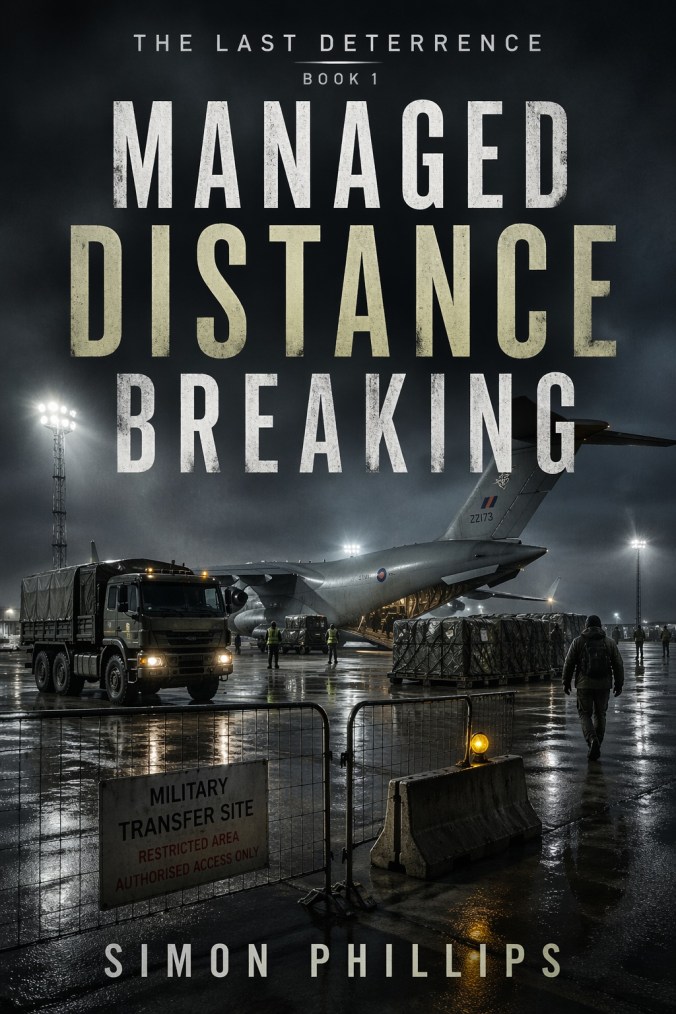
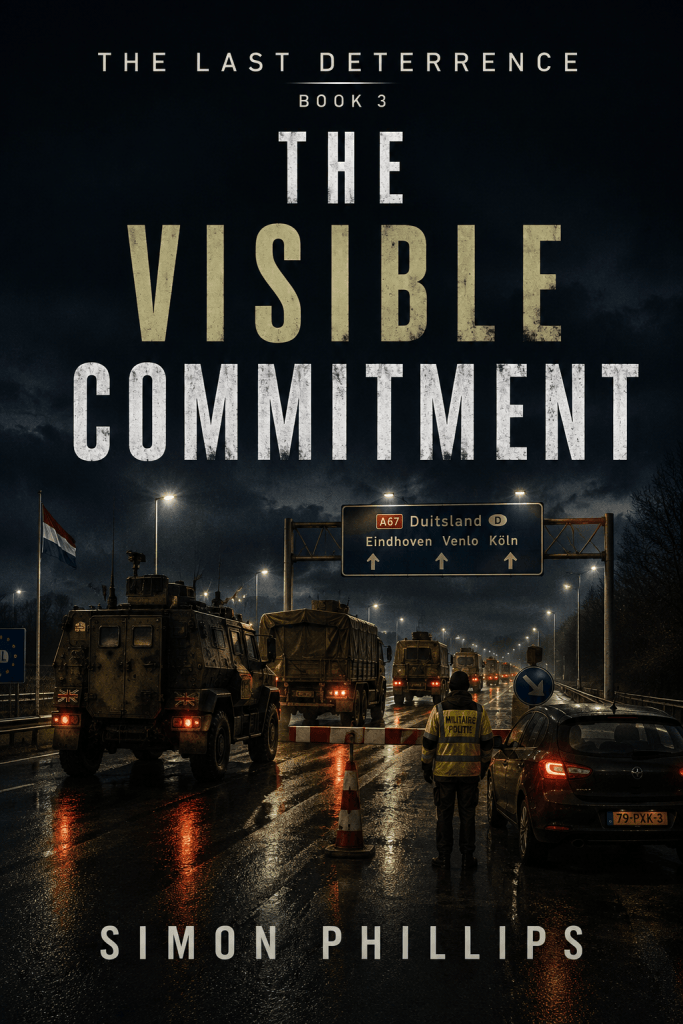
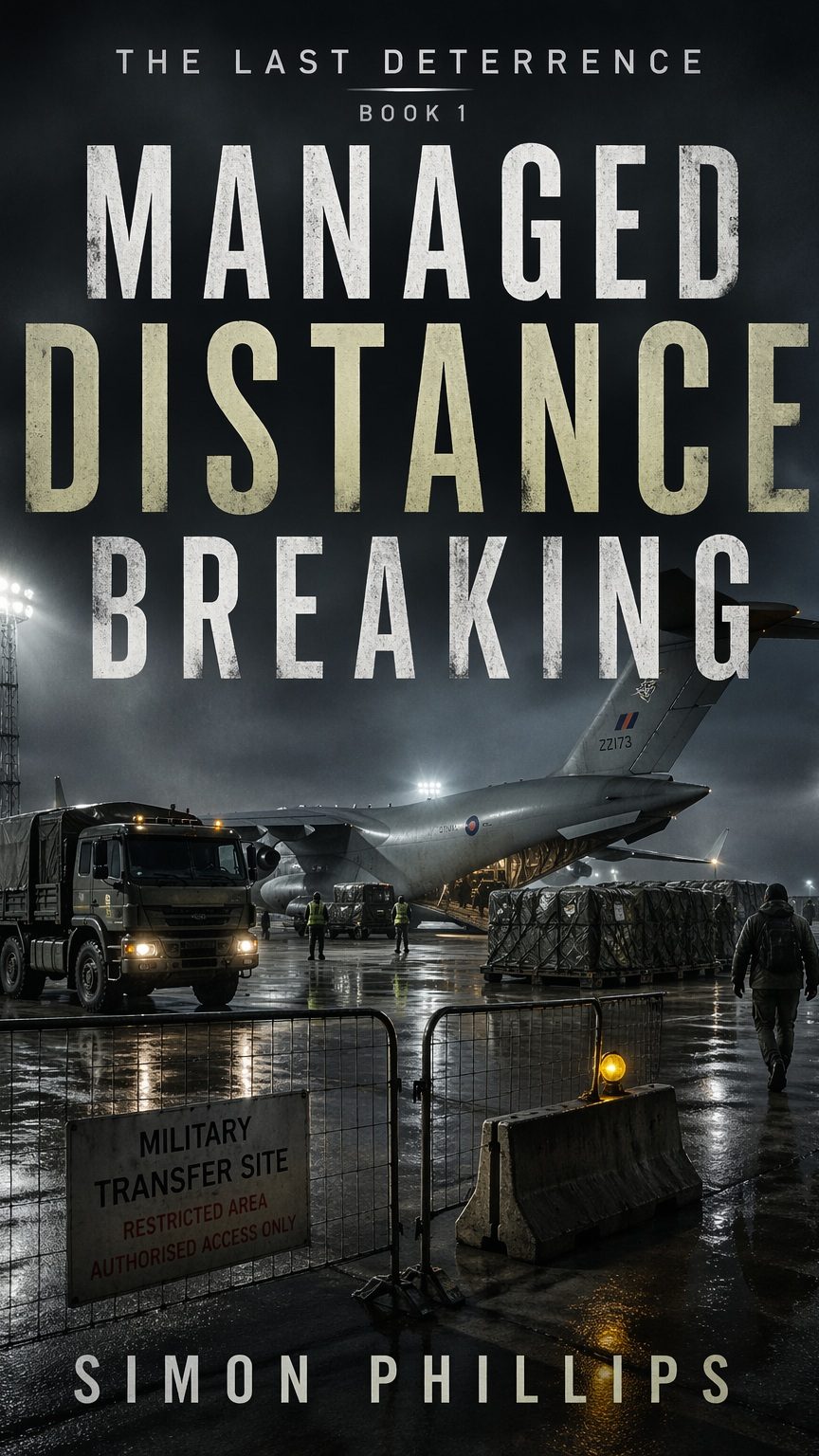
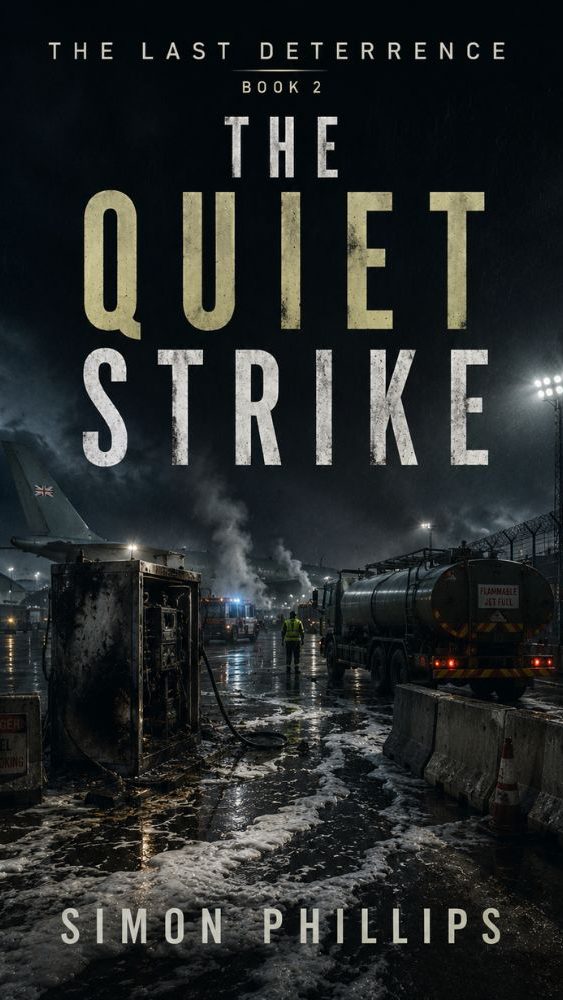
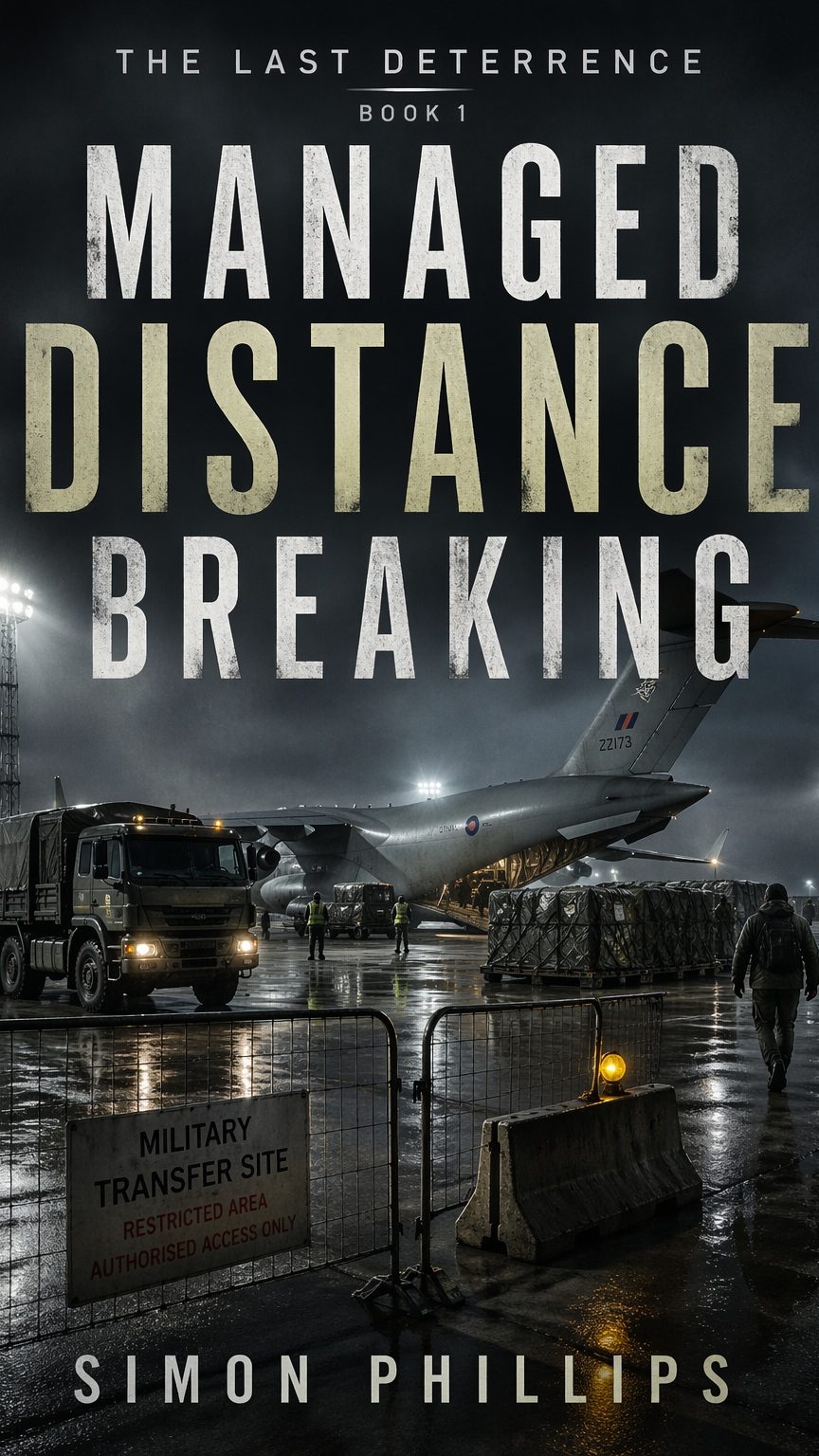
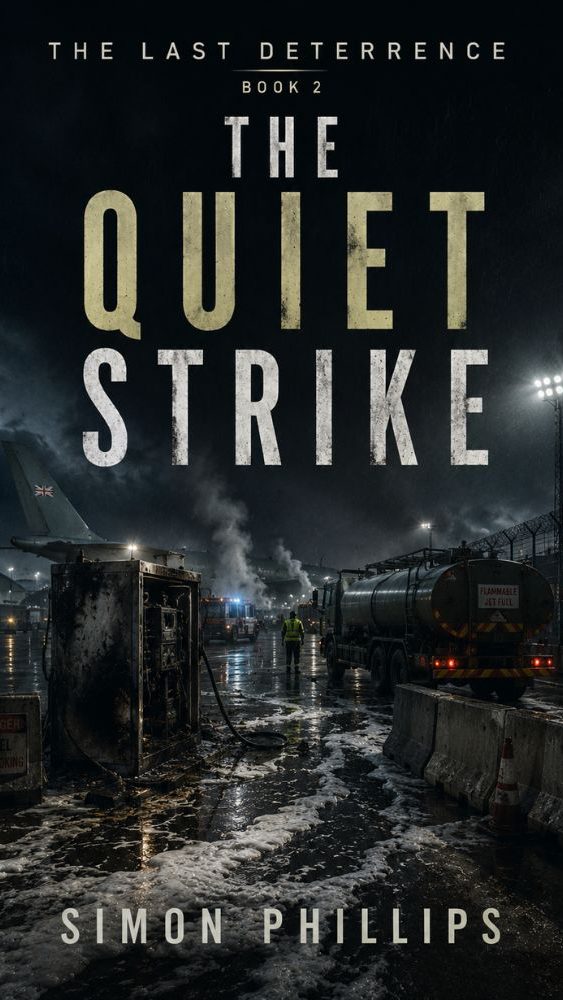
One such world unfolds through The Last Deterrence, a modern-war novella sequence beginning with Managed Distance Breaking and continuing in The Quiet Strike. Together, the first two books follow Britain as support language begins to fracture under freight pressure, European escalation, domestic infrastructure strain, and the growing sense that distance from war has already begun to fail.
Readers who wish to explore the wider published story world connected to this Chronicle can find the novellas below.
The following Chronicle continues the night at Rookham Fuel Support Compound, where a brief camera failure, a damaged feed line, and debris beyond the eastern fence began turning a routine perimeter fault into evidence of something more deliberate moving around the edge of Britain’s protected support corridor.
Readers supporting The Modern Chronicle can continue the record below.
Subscribe to continue reading
Subscribe to get access to the rest of this post and other subscriber-only content.
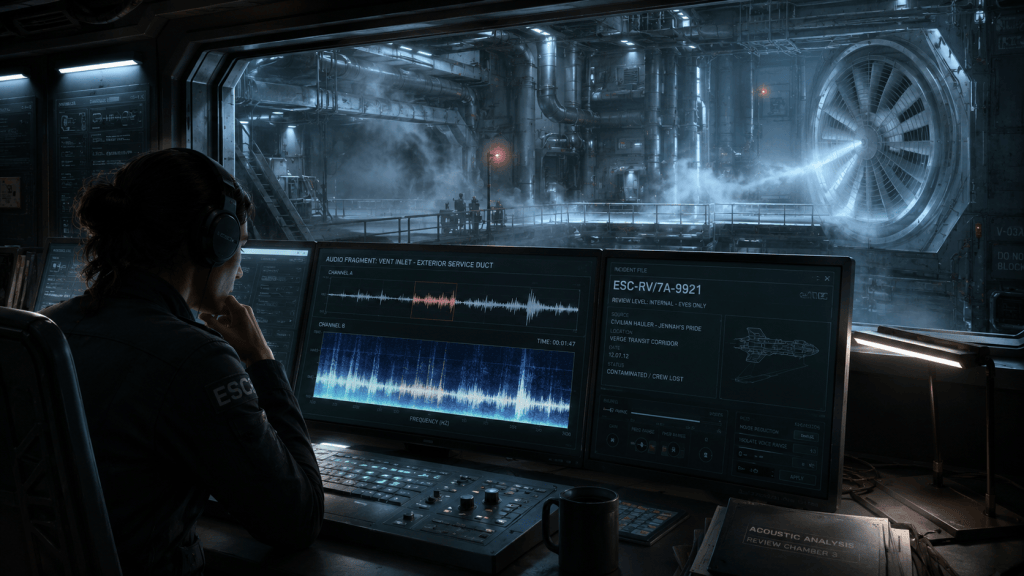
An ESC analyst studied a damaged audio fragment from a contaminated ship and heard a voice where procedure insisted there could only be corrupted airflow.
Chronicle Opening: The Recording in Chamber Nine
Review Chamber Nine held its cold in the wall panels long after the upper decks moved into their sleep cycle. It sat three levels below the main intelligence spine of the ESC cruiser Adderfall, sealed behind two pressure doors and a corridor lined with acoustic baffles thick enough to swallow the sound of boots before those sounds reached the bulkheads. The room had once been a navigation review suite, made for traffic reconstruction, distress-call sorting, and signal comparison from damaged civilian craft, although later work had changed it into something more private. Extra insulation covered the older seams. Audio pickups hung from black jointed arms above the central table. Three analysis boards curved around the main workstation in dull blue light, carrying spectral maps, pressure traces, ship schematics, and damaged recordings recovered from vessels whose final reports had reached command in fragments.
Analyst Liora Venn sat beneath the listening array with one hand beside the playback controls and the other wrapped around a cup gone cold against her palm. Her review slate showed the file name in clean institutional text. ESC-RV/9A-441. Civilian carrier Jennah’s Pride. Verge transit corridor. Crew status lost. Contamination status unresolved. Audio source recovered from forward environmental stack. The file had arrived from Evidence Intake with three notes attached by officers who had tried to keep the fragment inside a safer frame. Damaged ventilation record. Probable pressure flutter. Emergency channel bleed. Liora had read each line before opening the raw track, and each phrase carried the same careful pressure, the same quiet attempt to turn fear into something a desk could approve.
She drew the Jennah’s Pride schematic across the left board and let the carrier unfold in pale lines. The ship had been a mid-range civilian hauler, narrow through the crew spine, broad through the cargo belly, old enough to carry exposed heat trunks behind patched maintenance covers and cheap enough for its owners to argue over every delayed repair. The forward environmental stack sat above the lower crew passage, feeding filtered air through sleep cells, galley, med recess, and service ducts leading into cargo control. The recovery drone had found ribbed residue along two vent grilles, black particulate inside a filter tray, and pale scoring across an inner access cover where metal had cooled around shapes the original design had never required. Liora enlarged the stack and traced the airflow path with two fingers. If air had crossed a damaged grille at the right pressure, if the emergency channel had held a cached distress syllable, if the ship’s own announcements had torn apart during power loss, a sound could gather shape. She wrote that on her slate, then lowered the playback threshold and allowed Chamber Nine to listen.
Static came first, low and irregular, carried inside fan wash and broken signal return. The visual band rose in white clusters across the central display while Liora watched the peaks before letting the sound move deeper into her attention. Hull vibration sat underneath it, a slow structural shiver from a vessel losing thermal balance. A relay click repeated in the upper range. Air moved through the stack in pulses, too uneven for a healthy loop and too regular for random failure. Then a tone surfaced beneath the wash, thin as breath crossing a cracked pipe, and the room changed around it. Liora stopped the track with one careful touch. She stared at the frozen waveform while the cold panels, listening arms, display boards, and sealed doors seemed to gather more closely around her. The sound had lasted less than a second, close enough to a voice for the body to react before reason could claim it. She marked the frame, rewound nine seconds, and played it again with the voice-isolation layer disengaged.
The second pass carried more weight because she knew where the sound waited. Static crossed the chamber. Fan wash followed, broad and dry. The relay clicked. The airflow pulse came from the damaged stack, then the thin tone rose again, shaping itself with enough human timing to make her body react before thought could build a wall around it. Liora kept her hand still beside the controls and opened a filter to strip low-frequency hull vibration. A second filter reduced relay chatter. A third mapped airflow against the forward stack, feeding the pressure model across the right board in slow blue lines. Most of the fragment behaved the way training said it should behave. Broken flow crossed the grille, struck the access lip, and returned through the stack with a warped harmonic that could form a vowel under poor conditions. The final third sat slightly apart from the airflow model, a narrow lift in the middle band that held across twelve frames with the patience of speech.
The door opened behind her with a soft pressure shift that moved through the room before the hinge sound arrived. Lieutenant Arel Doss stepped inside carrying a sealed evidence case under one arm and a field jacket fastened over his duty shirt. He paused once he saw the active boards, then his eyes moved from the Jennah’s Pride schematic to the frozen waveform across the central display.
“You started early,” Doss said as he crossed to the side table and set the case down.
Liora kept her eyes on the spectral line. “The file arrived marked routine acoustic review.”
Doss glanced at the dark cup beside her wrist. “Routine files usually wait for morning.”
Liora lifted the cup, found it cold, and set it down again. “This one kept the room awake.”
Doss came to stand beside her chair, his face drawn by fatigue and the hard light of the boards. “Play it from the mark.”
Liora sent the fragment through the chamber speakers. Static moved across the room with the dry scrape of damaged distance. Fan wash followed, then the relay click, then the airflow tone rising from the stack, stretched thin through metal, filter mesh, and pressure failure until it shaped itself into two syllables that no program on the board would name. Doss lowered his head by a fraction. Liora stopped the track before the following distortion buried the sound, and for several seconds they stayed beneath the listening arms while the display held the waveform in frozen light.
Doss moved first, drawing one hand across the back of his neck as he looked at the schematic. “That sounded like a woman.”
Liora pointed to the airflow model. “It came from the forward environmental stack during pressure collapse.”
Doss leaned closer to the display, his voice lower as he answered. “Those are separate statements, Liora.”
She drew the spectral layer wider and forced herself to follow the clean lines of the model. “It sounded like airflow travelling through damaged vent structure.”
Doss looked at her profile in the blue light. “You heard her as well.”
Liora pushed back from the workstation and stood, needing the small change in height more than distance from the sound. “Jennah’s Pride had already lost pressure across forward crew sections before the recording,” she said, taking the stylus from the slate and marking the relevant time block. “Thermal map showed no living return inside the stack or lower passage. Rescue authority closed before the drone entered.”
Doss folded his arms and kept his eyes on the waveform. “Then why did she sound trapped inside it?”
Liora lowered her hand and opened the pressure overlay again. “Because damaged ships carry people after people are gone,” she said. “Announcements, emergency loops, suit traffic, last words, cabin audio, airflow through broken spaces. The system keeps pieces.”
Doss looked towards the sealed evidence case he had brought in. “That answer will satisfy Evidence Intake.”
Liora followed his gaze. “It will satisfy them if the track behaves.”
The line from Evidence Intake chimed across her board. Liora accepted it through text only. Supplementary file available. Drone visual, forward environmental stack, Jennah’s Pride. A grainy still filled the right display, showing an access grille under emergency light, its surface rimed with frost and thin pale residue gathered along every rib. The centre of the grille had bent outward from inside the duct, enough for a technician to see pressure had travelled the wrong way through the stack. Doss stepped closer, his earlier argument fading as the visual settled between them. Liora enlarged the bent grille, then laid the waveform beneath it. The thin tone aligned with the pressure reversal. The explanation strengthened. Relief passed through her too quickly, too eagerly, and for that reason it felt unsafe.
“There,” Liora said, touching the pressure mark with the stylus. “Air forced through a damaged grille during collapse. That gives us the vocal edge.”
Doss kept his gaze on the still. “And the timing?”
Liora looked back at the waveform, where twelve frames held their small human shape. The cruiser hummed around Chamber Nine while the room waited for language strong enough to contain the sound.
“The timing remains under review,” she said, saving the mark before she played it once more.
A Visual Chronicle
Inside Review Chamber Nine, a damaged recording recovered from the dead carrier Jennah’s Pride is stripped down to airflow and static until the machinery seems to form a single human word: “Please.”
Incident Record: Review Chamber Nine
Review Chamber Nine formed part of the restricted intelligence and evidence-analysis section aboard the ESC cruiser Adderfall, a midline patrol vessel assigned to incident comparison work across the Verge transit corridors during the earliest phase of the contamination crisis.
The chamber had originally served as a navigation review suite, where damaged route packets, traffic disputes, late transponder replies, and civilian distress bursts could be reconstructed after accidents along the outer freight lanes. Its first purpose had been practical and narrow, built around the careful rebuilding of events from signal fragments, pressure logs, ship schematics, and traffic authority records.
As unexplained incidents increased across civilian haulers, salvage craft, cargo drones, and isolated industrial stations, the chamber’s role gradually changed. Additional acoustic insulation was installed behind the wall panels, evidence feeds were restricted to cleared analysts, and the listening array above the central workstation was upgraded to process degraded audio recovered from contaminated vessels and post-disposal drone sweeps.
Rooms of this type became important because many early Harbinger-related files reached ESC review through damaged sound before they reached command through reliable evidence. Ships lost environmental balance, distress channels fractured, emergency buffers repeated broken phrases, and ventilation systems carried pressure noise that trained officers struggled to dismiss once it began to resemble human speech.
Review Chamber Nine was therefore used for the difficult work of separating mechanical failure from possible survivor audio, a task that carried both procedural and moral pressure. A sound could be logged as airflow distortion, comm bleed, pressure flutter, emergency loop corruption, or acoustic artefact, yet each label carried consequences for rescue authority, evidence handling, quarantine procedure, and the official language later attached to the incident.
The recording recovered from the civilian carrier Jennah’s Pride entered Chamber Nine under this uncertain status. It had been taken from the forward environmental stack after the ship was declared lost, and the fragment appeared to contain a short human-sounding vocal shape inside a field of static, fan wash, relay chatter, and pressure collapse. At the time of review, no confirmed survivor remained aboard the vessel, and the recovered visual evidence showed damage around the vent structure that supported a mechanical explanation.
Later comparison work would place the Jennah’s Pride fragment among a wider body of early contamination records involving false voice-like events, delayed system responses, airflow anomalies, and human interpretation under extreme stress. In the official summary, the sound was classified as an acoustic artefact pending further review.
Yet within the chamber logs, analysts preserved the original waveform, the pressure model, and the damaged vent image together, leaving behind a record of the moment when procedure found a name for the sound while uncertainty remained inside the file.
About the Creator
The Future Chronicle is written and curated by Simon Phillips, a writer of science fiction and speculative storytelling who explores the fragile edges of human expansion, where freight routes, inspection bays, patrol vessels, and isolated industrial stations continue their ordinary work while larger dangers gather quietly beneath routine procedure.
Many of the stories presented in these Chronicles exist within wider fictional worlds shaped by workers, survivors, officers, and investigators who encounter the first signs of events far greater than they are prepared to understand. These settings remain grounded in lived environments, where machinery, bureaucracy, and human judgement often shape the path of catastrophe long before anyone can give it a name.
The Harbinger Protocol novellas follow that unfolding pressure through the experiences of Soren Vale, beginning with the civilian freighter disaster recorded in The Ash in Transit and continuing into the colder, more procedural dread of The Silent Outpost, where isolated incidents begin to reveal the outline of something spreading across human routes and systems.
Readers who wish to explore the full opening phase of the Harbinger crisis can find the novellas below.
The following Chronicle reconstructs the review of the Jennah’s Pride audio fragment inside Review Chamber Nine, where an ESC analyst attempted to reduce a human-sounding voice to airflow, pressure collapse, and damaged ship systems while the recording continued to resist every clean explanation.
Readers supporting The Future Chronicle can continue the record below.
Subscribe to continue reading
Subscribe to get access to the rest of this post and other subscriber-only content.
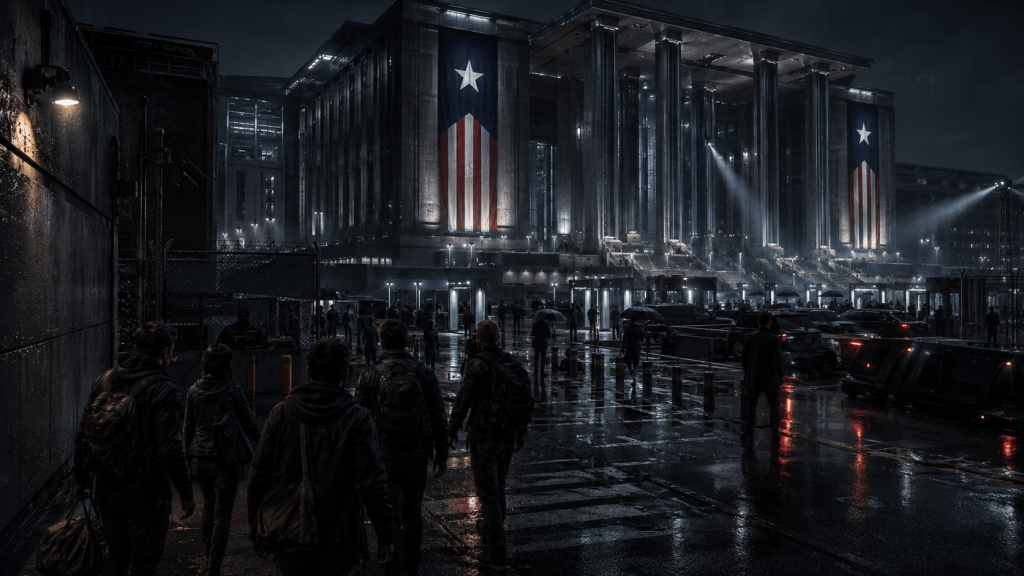
The American flag is the first thing Aaron Cole knows is wrong, although for several seconds he cannot understand why. The familiar red and white stripes hang exactly where they should beneath the controlled lighting of the staging hall, the fabric arranged with institutional precision and treated by everyone passing beneath it as something too ordinary to deserve attention, yet the blue canton no longer carries the constellation he has known since childhood. There is only one white star, large and uncompromising, suspended at the centre of a design that seems familiar until memory attempts to complete it.
Then Aaron looks for the Union Jack.
It is not there.
For Aaron, Rei Nakamura, Marcus Reed, Connor Blake, Declan O’Shea and Sofia Alvarez, the discovery should not matter as much as the crisis they have only just survived. They have already endured an experience so physically convincing that the language of advanced simulation has begun to feel inadequate, and they have returned carrying injuries that should have disappeared when the experiment ended. Sofia’s ankle remains swollen and painful, Aaron’s hands still carry abrasions, Marcus bears bruising from impacts that belong to another place, and exhaustion sits inside all of them with the stubborn weight of something the transition back has failed to remove.
The hall around them, however, remains composed. Personnel move between desks. Announcements direct arrivals through processing. Screens display ordinary public information. No one appears concerned by the altered flag because, within this place, nothing about it is altered at all.
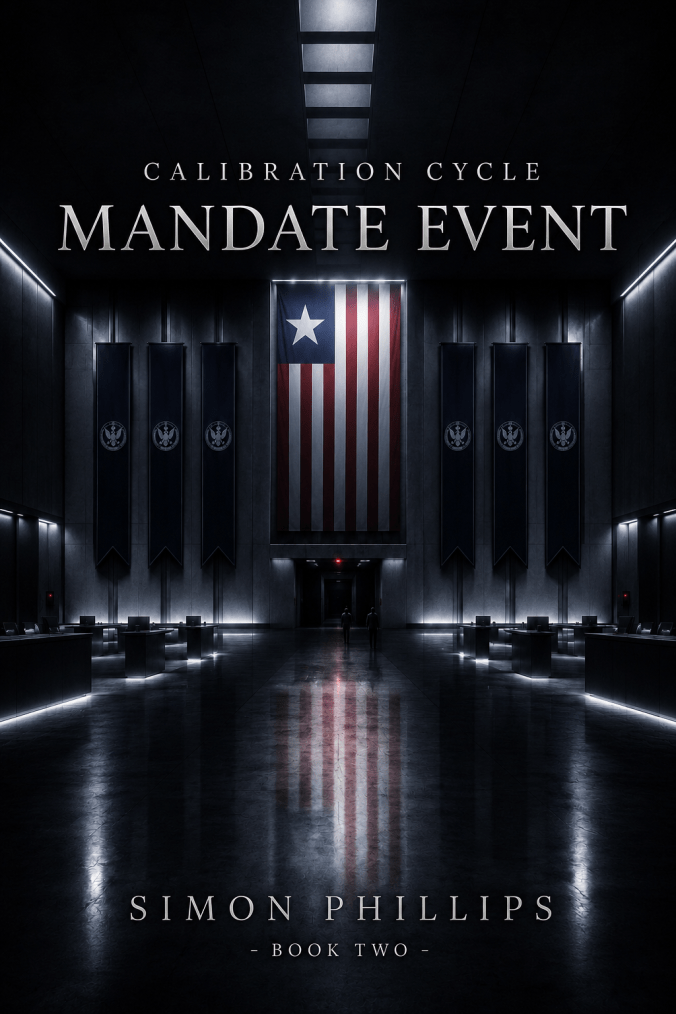
Calibration Cycle: Mandate Event begins at precisely that point of uncertainty, carrying the consequences of Meteor Event forward instead of allowing the characters the comfort of beginning again. The first book forced six volunteers to question whether an experimental immersive environment could produce consequences beyond anything they had been promised. Book Two asks something more dangerous: what happens when the world outside the supposed experiment appears perfectly stable, yet the history supporting that stability is not the history they remember?
The Return They Wanted Does Not Behave Like Home
The six entered the Calibration Cycle believing they had volunteered for a classified programme involving advanced immersive technology, adaptive crisis modelling and sensory feedback far beyond anything available to the public. That original explanation gave them something to hold onto when the first experience became difficult to distinguish from physical reality, because even impossible sensations could still be fitted inside the possibility of extraordinary technology if they were willing to stretch the definition far enough.
Mandate Event begins putting that explanation under a different kind of pressure.
Sofia’s ankle is not merely remembered as painful. It remains injured. The swelling is present beneath institutional lighting that belongs to the supposedly safe side of the experience, and when medical personnel eventually examine it, they do not respond with astonishment. They possess terminology for injuries that persist across what should have been a clean transition, and the casual professionalism with which those terms are used becomes more disturbing than panic would have been.
Aaron carries smaller marks, though their significance is no easier to dismiss. Marcus feels damage that should have belonged to a completed crisis. The six have returned carrying evidence in their own bodies, and every attempt to explain that evidence requires another layer of technology they were never told existed.
Connor, whose instinct is to understand a system before allowing himself to fear it, continues searching for a technical explanation because that is still more manageable than accepting that the original explanation may have been fundamentally wrong. Rei pays closer attention to the bodies themselves, noticing what pain does, how exhaustion remains, and how physical consequence refuses to respect the boundary everyone was told would exist.
Nothing provides them with a definitive answer, which is precisely what makes the uncertainty work. They are not handed a revelation about what has happened to them. They are forced to continue moving while the explanation they trusted becomes increasingly expensive to maintain.
The Single Star Belongs to a World That Thinks It Is Normal
The altered flag is only the beginning.
Announcements inside the facility direct people towards return processing. Administrative staff speak about return groups and return blocks as though those categories have existed long enough to become boring. Public devices connect to something called the Imperial Civic Mesh. Transport information identifies the wider region as part of an Imperial Union, and Britain no longer appears under the name Aaron expects to find.
It has become the Albion Administrative Territory.
The significance of that change does not arrive through an explanation delivered by an authority figure. It emerges from the ordinary machinery of public life, which makes the altered history far harder to dismiss as an artificial backdrop. Britain has not disappeared beneath rubble, and the world has not been thrown into a visibly dystopian collapse. People buy coffee, complain about delays, take children to school, work behind desks, scan travel documents and hurry through transport concourses beneath symbols they stopped consciously noticing years ago.
The single-star emblem appears on uniforms, public screens, transport notices and civic material because it belongs there.
Albion appears in official language because, within this history, that is simply what the country is called.
The effect is deliberately quieter than a ruined skyline or military occupation because Mandate Event is interested in something more unsettling than obvious conquest. It examines the way political transformation can become ordinary once enough time has passed for institutions, education, paperwork and language to make the new arrangement feel inevitable.
The Imperial Union does not need soldiers standing on every corner shouting about power. Its authority is already built into the names people use, the documents they carry and the systems through which ordinary life is allowed to move.
The Imperial Union Was Built Through the Language of Rescue
As Aaron and the others begin cautiously reading the world around them, the altered history reveals a political structure that is far more complicated than a simple empire imposed overnight.
The Imperial Union presents its origins through reconstruction, relief, stability and protection. The history taught within its civic systems describes a world emerging from the devastation of the Second World War under increasingly permanent American leadership, where humanitarian supply networks, military security, reconstruction programmes and international coordination gradually became something larger than the emergency structures that first justified them.
Connor can see why such a system might once have looked brilliant.
Shared logistics could prevent famine. Coordinated security could limit another continental war. Common infrastructure could move medicine, refugees and aid across borders more efficiently than fractured governments acting alone. A world that had watched nations destroy one another might willingly tolerate extraordinary central authority if that authority appeared to offer stability.
Marcus understands another part of the problem because military history is full of temporary structures that survive the emergencies that created them. Once command systems work, dismantling them carries risk, and the person suggesting that the guardrail should be removed becomes responsible for whatever happens afterwards.
Declan sees the trap hidden inside that logic. Temporary necessity becomes permanent authority, permanent authority becomes administrative expectation, and eventually people forget that the structure was ever supposed to be temporary at all.
What makes the Imperial Union effective as political science fiction is that its public argument contains enough truth to make its later form uncomfortable. It is not frightening because every part of it was designed by obvious monsters. It is frightening because many of the mechanisms that eventually erased sovereignty can be traced back to decisions that could once have been defended as reasonable.
That history gives Mandate Event its political depth without turning the story into a lecture. Aaron and the others discover it because they must understand the rules of the world before those rules classify them as threats.
Aaron’s Passport Becomes More Dangerous Than a Weapon
For Aaron, the altered history stops being theoretical when the group reaches identity processing.
The passports they carried into the original programme have travelled with them, small pieces of ordinary life preserved through experiences that have already damaged almost every other assumption. Connor’s American passport produces confusion because its design does not match local federal standards. Rei’s Japanese documentation requires manual review. Sofia’s Mexican identity and Declan’s Irish passport fit imperfectly into a world whose international order followed another path.
Aaron’s British passport produces something else entirely.
The United Kingdom of Great Britain and Northern Ireland is not recognised as a legitimate sovereign state.
The familiar crest inside his passport is treated as proscribed political material connected to Albion separatism, and an object that once allowed him to pass through airports becomes evidence that he may belong to a movement the authorities consider dangerous.
The moment changes the nature of the story because Aaron has done nothing except prove who he is.
His nationality has become suspicious.
His passport carries symbols the state regards as politically destabilising.
The country printed inside it is treated as an obsolete claim preserved by people unwilling to accept history’s correction.
That idea sits at the centre of Mandate Event: power does not only control territory when it can also control the vocabulary through which territory is remembered. Once Britain becomes Albion, anyone insisting on the older name can be described as refusing reality rather than defending identity. Once sovereign symbols become prohibited emblems, preserving them can be treated as radical behaviour. Once an entire generation is educated inside the revised language, the argument over what was lost becomes easier for authority to dismiss as nostalgia, extremism or historical misinformation.
Aaron entered the experiment without thinking very much about what being British meant.
This world forces him to discover what happens when somebody else has already decided that the identity no longer exists.
Berlin Makes the Wrong History Feel Real
Beyond the controlled processing areas lies Berlin, and the city gives the altered world the texture that makes it difficult to dismiss.
Nothing about everyday life pauses to acknowledge the six outsiders’ confusion. Buses run. Shops open. Delivery drivers argue with staff. Public terminals charge fees. Schoolchildren carry bags beneath civic emblems. News broadcasts move between transport information, security notices and political ceremonies while people glance at them with varying degrees of interest.
That normality is important because Mandate Event never treats the altered world as a decorative setting waiting for Aaron’s group to arrive. People have lived here their entire lives. They possess loyalties, compromises, resentments and memories that existed before six strangers appeared inside their political reality.
Some accept the Imperial Union because it is the only structure they have ever known.
Some believe its promise of order.
Some dislike it without being willing to risk their lives opposing it.
Some have learned to conceal forbidden symbols beneath clothing.
Some belong to networks attempting to preserve identities that official history has taught the public to regard as dangerous.
The city therefore becomes more than an alternate-history curiosity. It becomes a functioning society whose contradictions must be understood before the characters can safely act inside it.
Steven Hale, another survivor caught in the same impossible chain of events, becomes especially important because he recognises that language itself has become part of the terrain. His instinct is to read signs, official categories, school history, public warnings and bureaucratic terminology before trusting any interpretation. He understands that governments often reveal more through the words they treat as ordinary than through the speeches they make deliberately.
For a group accustomed to waiting for instructions, that becomes an important change.
They begin learning to read the world before allowing the world to tell them what to do.
Nathaniel Crowe Is Dead, Yet Berlin Recognises His Face
Aaron’s British passport makes him dangerous to the Imperial authorities, although it is not the strangest problem attached to his identity.
A records clerk named Tomas Rale sees Aaron and reacts as though somebody long dead has stepped into the fluorescent light.
The man he recognises is Nathaniel Crowe.
Within sections of the Albion resistance, Crowe is better known as the Ghost, a figure surrounded by enough conflicting history to make certainty almost impossible. Official sources connect him to extremist violence and attacks against Imperial structures. Resistance accounts describe someone who became a symbol of survival, defiance and the refusal to allow Britain’s identity to be administratively erased.
Crowe is also supposed to be dead.
The resemblance between him and Aaron is close enough to make disbelief difficult and acceptance even worse.
For Aaron, the danger lies in the fact that he knows perfectly well who he is while everybody around him begins responding to somebody else.
He has no memories of Crowe’s life.
He does not know the people who speak about him with grief.
He has no understanding of the decisions that turned the Ghost into both a security threat and a resistance symbol.
Yet a face can carry authority before a person has spoken a word, and once the possibility of Crowe’s return begins moving through hidden networks, Aaron discovers that denying the identity may not be enough to prevent other people using it.
That pressure suits Aaron particularly well because leadership has never been something he sought. In Meteor Event, people began looking towards him because he remained capable of organising movement while certainty collapsed. In Mandate Event, an entire political network begins seeing significance in him for reasons that have nothing to do with the choices he has actually made.
He is no longer simply being asked to decide.
He is being asked to inhabit expectation.
The Resistance Has Preserved What the State Tried to Make Obsolete
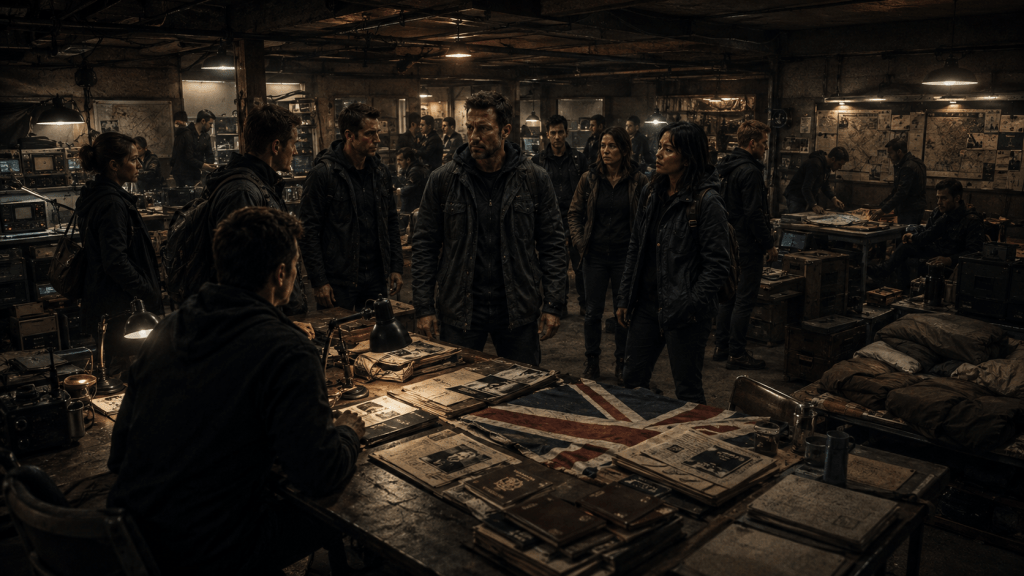
The resistance Aaron encounters is not presented as a polished underground army waiting for the arrival of its rightful hero. Its rooms are crowded with practical work, exhausted people and the accumulated objects of a history that has become dangerous to possess.
Old flags are hidden.
Passports from the United Kingdom are preserved after official recognition has vanished.
School material is collected alongside forbidden records.
People maintain routes, falsify paperwork, move information, repair equipment and support families whose lives have been reshaped by political decisions made long before Aaron entered the city.
That detail keeps the resistance grounded.
The struggle is not initially defined by weapons. It is defined by memory.
People preserve names because names disappear first. They preserve documents because documents prove that something existed before an authority decided it did not. They teach history privately because public education has replaced political loss with a story of rescue, stability and inevitable progress.
Only later does that preservation become entangled with violence.
This is where the story refuses to give either side an easy moral position. The Imperial Union has erased sovereignty, suppressed prohibited symbols and turned national memory into a security concern. The resistance has understandable reasons to exist, although understandable reasons do not guarantee that every action taken in their name becomes morally acceptable.
That distinction becomes increasingly important as Aaron is pulled closer to people who see his resemblance to Crowe as an opportunity.
Cerys Thorne Sees a Man and a Weapon in the Same Face
Among the resistance figures Aaron encounters, Cerys Thorne carries perhaps the most difficult relationship with the identity being placed over him.
Crowe was not an abstract figure to her.
The history between them is personal enough that Aaron’s face causes an immediate reaction, although Cerys does not allow grief to become certainty. She understands the danger of believing too easily, particularly when the Imperial Union would have every reason to exploit a symbol capable of disrupting resistance judgement.
At the same time, she cannot ignore the practical effect Aaron has on the people around her.
Some believe Crowe survived.
Others believe Aaron may be damaged, altered or deliberately planted.
Some do not care which explanation is correct because the sight of his face gives exhausted people something they have not felt for years.
Hope.
That becomes dangerous because hope is another form of leverage.
Cerys understands it.
Aaron begins understanding it.
The harder question is whether recognising that leverage prevents them from using it.
The political conflict in Mandate Event becomes much more personal at this point. Aaron is no longer simply hiding from Imperial authorities. He is being drawn into a struggle where his face can influence frightened people, his name can alter trust, and remaining completely outside the conflict may no longer be possible.
Something Knows Exactly Which Identity Will Open the Next Door
The external guidance that helped drive the crisis in Meteor Event has changed as well.
The wrist-mounted prompts that previously offered direction are no longer the only route through which instructions appear. Phones connected to the Imperial Civic Mesh begin receiving language that resembles both the local political system and the clinical direction the group encountered before.
The distinction becomes increasingly difficult to maintain.
Are the messages part of the Imperial network?
Are they part of the original experiment using local infrastructure?
Are the two being deliberately blended so that the characters can no longer tell where one authority ends and another begins?
Connor is particularly disturbed by the way terminology changes after the group learns it. New phrases appear only after local people have introduced those concepts. Role descriptions shift as the resistance begins assigning its own structures. The language surrounding Aaron starts acknowledging the importance of the Crowe identity as though something has recognised that other people’s belief can be used to change behaviour.
Then the intrusion becomes more personal.
Aaron is confronted with a resistance challenge that requires knowledge he cannot possess.
Instead of receiving a simple written answer, he experiences something closer to a memory.
Rain against water.
Stone beneathfoot.
Soot.
A voice carrying words that feel remembered despite belonging to a life Aaron has never lived.
The moment is deeply unsettling because it crosses a boundary that external instructions had left intact. Telling someone where to go is one kind of control. Supplying the internal texture necessary for them to behave like somebody else is another.
For the resistance, Aaron’s answer appears to confirm something.
For Aaron, it confirms almost nothing except that whatever is guiding them can reach further into him than he realised.
Rei Nakamura Keeps Looking for Aaron Beneath the Ghost
The growing Crowe identity also strengthens one of the quieter relationships inside the group.
Rei has never needed Aaron to become a conventional leader. Her connection to him grows through shared responsibility, observation and the small acts required to keep people moving under pressure. She sees when he is carrying too much before he says it, and in Berlin she becomes increasingly aware that the danger surrounding him is not only physical.
Everyone else has reasons to see Crowe.
The resistance sees history.
Cerys sees grief.
Tomas sees possibility.
The authorities see a threat.
Whatever is guiding the group appears to see an identity that can be used.
Rei continues seeing Aaron.
That distinction does not require sentimental declarations because it works more effectively through restraint. A glance held for a fraction longer, a question asked quietly while everyone else talks about the Ghost, a deliberate use of Aaron’s real name when the room has begun treating Crowe as more useful.
The relationship matters because identity pressure only works if there is something being lost beneath it.
Aaron cannot be frightened by becoming Crowe unless being Aaron still has weight.
Marcus, Connor, Declan and Sofia Read Different Dangers in the Same World
Book Two also gives the rest of the core group increasingly distinct ways of interpreting the altered political reality.
Marcus Reed reads structures of force. His military experience allows him to recognise security posture, command hierarchy, access routes and the difference between authority that expects obedience and authority that has begun preparing for violence. The Imperial Union unsettles him partly because much of its machinery is recognisable. Its worst instincts do not look alien to him; they look like familiar systems pushed far enough that necessity has become permanent doctrine.
Connor Blake approaches the world through architecture and information. He can admire the efficiency of civic networks while being disturbed by what that efficiency enables, and his willingness to understand the mechanisms around them becomes both essential and dangerous. Every time he discovers another pattern, he moves closer to something none of them yet understands.
Declan O’Shea reacts through suspicion shaped by money, incentives and the public language of power. He understands that empires can benefit from being attacked if an attack provides the justification for greater control, and his cynicism becomes increasingly valuable whenever everyone else begins confusing movement with progress.
Sofia Alvarez continues carrying the most visible physical connection to the previous event through her injured ankle, though Book Two develops her far beyond that vulnerability. She watches people rather than structures and frequently notices emotional realities others miss. She recognises when civilians are afraid of being seen reacting. She sees rooms building expectations around Aaron before he fully recognises what is happening. Her sensitivity, which initially appeared to make her the least suited to sustained crisis, increasingly allows her to perceive what more confident people overlook.
The six are therefore becoming more capable as a group, although capability is not presented as uncomplicated progress.
The better they become at surviving these situations, the more dangerous the question becomes of what survival is teaching them to accept.
The Continental Mandate Forum Turns Politics Into a Moral Trap
The resistance eventually identifies an opportunity created by the Continental Mandate Forum in Berlin, where political, security, financial and administrative power has been brought unusually close together.
For an organisation that has spent years surviving beneath Imperial surveillance, the convergence appears almost impossible to ignore.
This is where Mandate Event moves from political discovery into moral pressure.
The Imperial Union has given the resistance countless reasons to oppose it. Britain has been administratively reduced to Albion. Sovereign symbols have been criminalised. Historical identity has been recast as dangerous nostalgia. People have disappeared into institutions whose language makes coercion sound procedural.
None of that automatically makes a violent response clean.
The Forum contains people rather than abstract structures.
Workers move through it.
Security personnel protect it.
Political figures carry responsibility in different degrees.
Civilians exist around every plan.
The resistance understands that striking the right points could weaken the machinery holding the Imperial system together, while Declan immediately understands that the wrong attack could provide the Union with exactly the fear required to justify even greater control.
Aaron and the others are therefore placed inside a political conflict where the obvious enemy does not produce an obvious moral answer.
Helping the resistance may contribute to liberation.
Helping the resistance may also contribute to deaths none of them can justify afterwards.
Refusing involvement may preserve their consciences.
Refusing may also abandon people already living under an authority that has erased parts of their identity for generations.
There is no choice capable of leaving everyone innocent.
That is exactly where Calibration Cycle wants its characters.
Mandate Event Is About What Happens When Success Has No Moral Definition
The first book presented a crisis that looked straightforward from a distance. Something catastrophic was approaching. An intervention was possible. The difficulty lay in not knowing whether acting would prevent disaster or create another form of it.
Mandate Event takes the same underlying pressure and removes the clarity of a physical object falling from the sky.
Political systems do not offer a single impact point.
Resistance movements do not come with clean success probabilities.
History cannot be corrected by pressing the right sequence of controls.
Every decision changes people who have already been living inside the consequences long before Aaron’s group arrived.
That makes Book Two particularly suited to readers who enjoy psychological science fiction where the speculative element is inseparable from character, politics and moral uncertainty. The technology matters, although the story is never about technology for its own sake. The alternate history matters, although it is never presented simply as an exercise in imagining different flags and borders.
What matters is what those structures do to the people forced to live inside them.
Aaron is pushed towards leadership through an identity that is not his.
Rei watches the person beneath that identity become harder to protect.
Marcus confronts the danger of thinking too easily in operational terms.
Connor begins recognising that understanding a system does not mean controlling it.
Declan sees how power converts violence into justification.
Sofia notices the human cost while everyone else is still arguing about structure.
The deeper the group moves into Berlin, the harder it becomes to tell whether the next successful action is bringing them closer to safety or merely proving how effectively they can be made to function under pressure.
Read Calibration Cycle: Mandate Event
Calibration Cycle: Mandate Event continues the story begun in Meteor Event while expanding its psychological and political pressure considerably beyond the first crisis. Readers who enjoy psychological science fiction, alternate-history thrillers, political dystopian fiction, unreliable reality, artificial-intelligence ethics, resistance narratives and character-driven speculative fiction will find a story concerned less with explaining an impossible world than with forcing ordinary people to live inside it long enough for every easy explanation to begin failing.
Aaron Cole survived the first event expecting that survival would eventually lead back towards certainty. Instead he finds himself standing beneath a flag that should not exist, carrying injuries that should have disappeared and presenting a passport from a country this world regards as a dangerous historical fiction. Before he has time to understand the history surrounding him, strangers begin recognising his face as that of Nathaniel Crowe, a dead resistance figure whose legacy carries equal measures of hope, violence and political mythology.
The more useful that resemblance becomes, the less control Aaron has over what other people believe.
The more the group learns about the Imperial Union, the harder it becomes to reduce the conflict to good people fighting bad ones.
And as the technology surrounding them begins adapting to the language, identities and pressures of the world itself, one possibility becomes increasingly difficult to ignore: perhaps completing whatever comes next has never guaranteed that the result will be good.
The experiment was supposed to test how six people responded to crisis. By the time Berlin closes around them, Aaron and the others are beginning to face a much less comfortable possibility: the crisis may be learning how to use what they are becoming.
While ministers prepared to assure the country that Britain’s transport systems remained resilient, the figures beneath the statement showed a network already surviving by moving ordinary life aside.
The Sentence That Held
By seven that morning, the public statement had passed through four versions, cleaner than the figures behind it and shaped to sound steadier than the room that produced it.
Rain pressed against the high windows of the Cabinet Office briefing room and ran down the glass in wavering lines, turning Whitehall into grey stone, blue lights, umbrellas, and the pale glow of phone screens held beneath coat collars. The room had been used through the night, and the air had grown too warm with coffee, printer heat, damp wool, and the persistence of people who had moved beyond tiredness into the harder condition where every sentence arrived trimmed for damage. Folders lay open across the table, coloured slips marking the pages that could leave the room, while red handling strips marked the pages that could only travel by hand.
Eleanor Voss stood at the far end of the table, one hand resting on a chair and the other wrapped around a paper cup she had forgotten to drink from. She worked in government communications, in the narrow passage where facts became public lines and public lines returned as questions from broadcasters, ministers, councils, hauliers, unions, and frightened people deciding whether to fill their cars before work. Her name appeared on none of the statements once they went out.
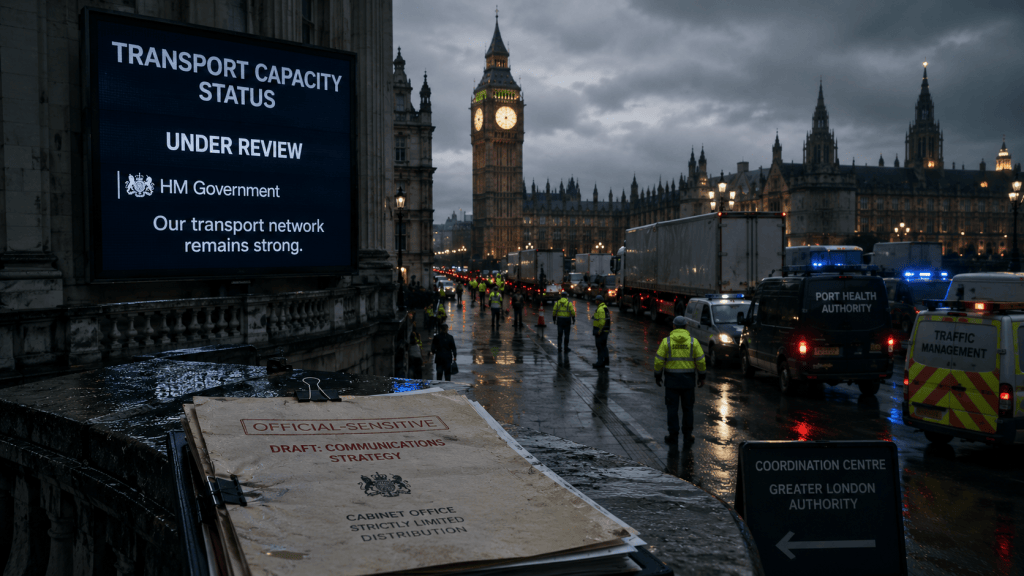
On the wall screen, a transport-capacity dashboard refreshed every thirty seconds. Ports sat in coloured blocks. Road routes sat beside them. Rail access, driver availability, ferry slots, defence consignments, civilian dwell time, fuel pressure, and police-support demand kept shifting in small increments. The colours had started the week in green and amber, with red reserved for weather, accidents, and ports that had lost patience with optimism. Red now appeared in places that held strategic meaning once placed beside a map of Europe, though the public version would speak of increased demand and wider pressure across supply chains.
At the table, Michael Harrow from the Department for Transport turned a stapled pack sideways and slid it towards her. His tie had loosened during the night, and a small dark mark on his cuff suggested he had spilled coffee.
“The present wording says networks remain resilient,” Harrow said, drawing one finger down the top page. “That remains defensible if we define resilience by continued movement across critical routes.”
Eleanor watched a red block pulse beside the east-coast freight line, linger long enough to draw three pairs of eyes, then settle back into amber. “And if anyone defines resilience by whether ordinary movement still has room to breathe?” she asked.
Harrow drew the pack back towards himself, aligning its edge with the table. “Then we speak about temporary prioritisation and sector-specific strain.”
“Sector-specific strain means supermarket stock waits while sealed freight moves.”
Harrow glanced at the Defence adviser near the door before he answered. “It means current movement remains controlled.”
Across the table, Sana Qureshi from the Cabinet Office resilience unit opened a laptop covered in sticker residue where labels had been removed before the device entered the secure floor. She had worked through floods, power failures, fuel disruption, and one winter when half the country appeared to discover logistics at the same time.
“We have regional calls inside twenty minutes,” Sana said, turning the laptop so the screen caught Eleanor’s eye. “Lincolnshire wants clarity on route holds. Kent wants an answer on civilian traffic displacement near the port approaches. The east-coast operators want someone to admit Defence priority has changed the shape of the queue.”
“They will receive careful language,” Harrow said, tapping his pencil once against the page.
Sana looked up from the laptop. “They already have sharper language. They invented it while waiting for ours.”
The room received that with a silence Eleanor recognised, the kind that followed an accurate statement made too early for the hierarchy to absorb. Outside the door, a trolley moved along the corridor, and the uneven rhythm of its front wheel carried through the wood before fading near the lift. Eleanor pictured fresh printed packs, red handling strips, and folders travelling by hand because secure systems were being kept for heavier traffic.
A junior press officer named Daniel Rees sat near the wall with his sleeves rolled above his wrists and three phones arranged in front of him like evidence. He lifted one of the phones, listened for a few seconds, then covered the microphone with his palm.
“Number Ten want a smoother top line before eight,” Daniel said, keeping his voice low as though the phone might carry the room back to its owner. “They dislike manageable.”
Eleanor lowered her cup. “Which part?”
Daniel listened again, his eyes moving across the faces around the table. “The whole word.”
Harrow gave a small, humourless laugh and pressed his fingers against the bridge of his nose. “That is unfortunate. Manageable is doing most of the work.”
Daniel nodded at someone none of them could hear. “They prefer functioning.”
Sana turned the laptop further so Harrow could see the regional summary. “Functioning suggests things are still moving, which is true only because capacity is being taken from somewhere else.”
The summary showed postponed civilian container release, road-haulage shortages, delayed retail loads, pharmacy logistics adjustments, and school-transport knock-on effects from morning diversions around route-control points. The evidence had arrived as timings, lane closures, missed slots, depot holds, driver hours, and ordinary tasks shifted half a day sideways so priority movement could pass through.
Eleanor thought of how it would sound once it reached a kitchen radio. Transport systems remain resilient. Existing commitments remain manageable. Essential goods continue to move. The sentences would be true in the way official sentences were often true, with their feet placed carefully around the softer ground. They would leave out the people already standing at pharmacy counters, depot gates, school stops, and freight windows, learning that ordinary movement had become the part of the system asked to wait.
The door opened, and Tom Merrick entered with rain still on his coat and an adviser from Defence behind him. Merrick worked political handling alongside transport pressure, although lately the distinction had thinned until every problem arrived wearing both badges. He placed a marked page in front of Eleanor and tapped the top paragraph.
“Prime Minister can say this at lobby if pressed,” Merrick said, pulling off his wet coat. “We need it clean, firm, and dull enough to avoid becoming a headline.”
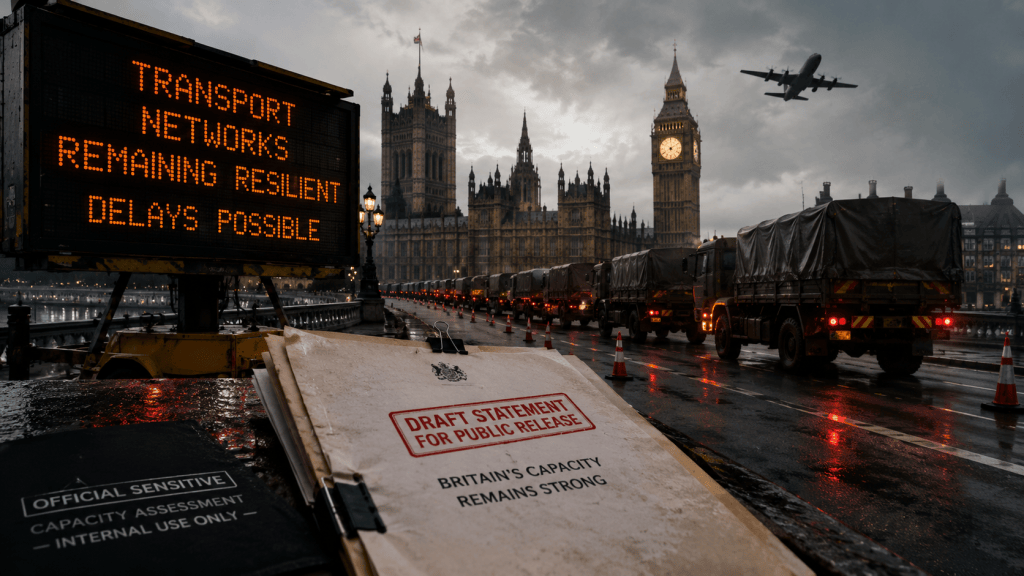
Eleanor read the paragraph once, then again. The United Kingdom’s transport and freight networks continue to function effectively under increased demand. Existing support commitments remain within current capacity. Departments continue to work with operators, local partners, and industry to ensure essential movement is protected.
The line sat there in black print, polished and bloodless. It made the country sound like a machine that had absorbed extra pressure through design. The dashboard behind Merrick told a harsher story, one of improvised holds, narrowed margins, police calls, contractor fatigue, military-linked consignments arriving ahead of expectation, and port supervisors using language with more honesty than anyone in the room could afford to place into a public statement.
“Existing support commitments remain within current capacity,” Eleanor said, keeping her eyes on the page.
Merrick watched her from beside the table. “Can we defend it?”
Harrow answered with professional caution, his hand already moving towards the capacity pack. “At national level, across current reporting intervals, it remains arguable.”
Sana closed her laptop a little, leaving the screen light pressed against her face. “Arguable is a courtroom word trying to pass as public confidence.”
Merrick looked at Eleanor because Harrow had supplied a technical answer and Sana had supplied the one the room preferred to avoid. “Can we say it?”
Eleanor looked again at the dashboard. The east-coast route blinked red, held there for a second longer than before, then returned to amber. Somewhere beyond the building, freight was being delayed in the name of movement, and movement was being protected in the name of support, and support was beginning to resemble something nobody had yet been given permission to call by a heavier name.
“We can say it,” Eleanor said, setting the page down with care.
Daniel started typing at once, his thumbs moving fast over one phone while a second lit beside him. Harrow began reciting figures to the Defence adviser. Sana reopened the regional summary and marked three lines in yellow. Merrick stood over Eleanor’s shoulder, shaping risk into phrases that might hold until lunchtime if the world behaved generously. The rain darkened the windows until the room seemed lit from inside its own fatigue.
On the screen, a fresh warning appeared beneath the dashboard, small enough for the room to miss unless someone was already watching.
Eastern corridor capacity dependent on continued priority sequencing.
Eleanor read it twice before the message vanished into the next refresh. Then she picked up her pen and changed one word in the statement, replacing planned with current, because a tiny place for honesty still survived inside a sentence already chosen.
A Visual Chronicle
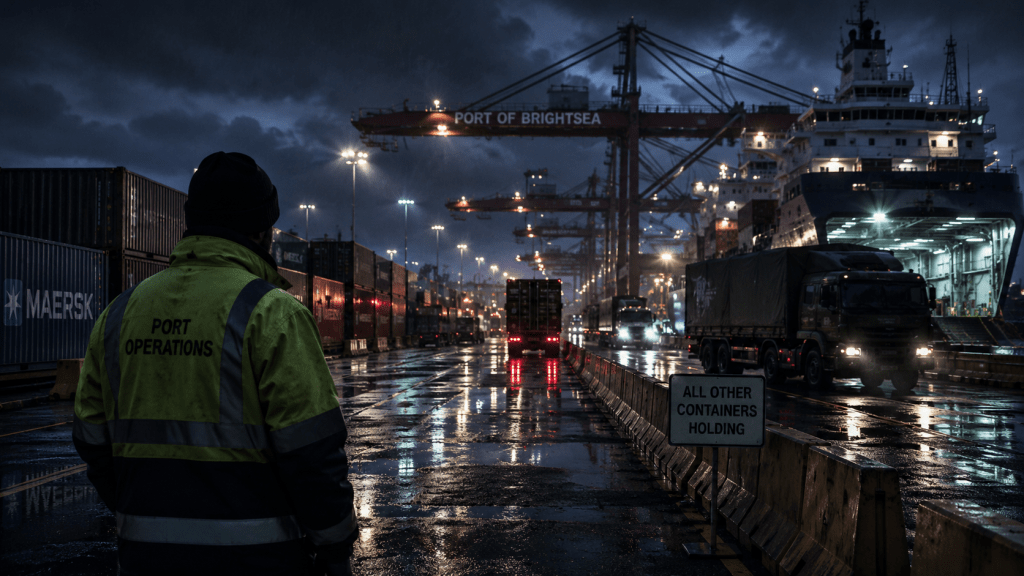
Official confidence held on the public screen while Britain’s roads, ports and ordinary deliveries absorbed the strain the statement had been written to conceal.
Cabinet Office Handling Note
Extract from Cabinet Office Press and Resilience Coordination Note Subject: Transport Capacity Line Time: 07:42 Circulation: Restricted internal handling group
Purpose
To support ministerial and departmental handling of anticipated media questions concerning freight movement, east-coast port pressure, route prioritisation, and wider transport resilience following increased demand across allied support corridors.
Approved Public Position
The United Kingdom’s transport and freight networks continued to function effectively under increased demand. Existing support commitments remained within current capacity. Departments continued to work with operators, local partners, and industry to ensure essential movement was protected.
Suggested Response if Pressed
Officials were monitoring regional movement closely. Some localised delays had occurred where demand, weather, port sequencing, and wider European pressure converged. These pressures were being managed through established resilience arrangements, industry coordination, and targeted support for affected operators.
The Government remained focused on maintaining the movement of essential goods, supporting allies, and limiting disruption for households and businesses.
Lines to Avoid
Avoid language implying defence movement had displaced civilian supply. Avoid speculation on route protection measures. Avoid confirming priority categories for sealed consignments. Avoid linking domestic delays directly to overseas military activity. Avoid any formulation suggesting exhaustion of capacity.
Internal Assessment
Current national capacity remained viable under priority sequencing. Continued viability depended upon sustained operator cooperation, police-route availability, port slot discipline, and regional tolerance for civilian delay.
The eastern corridor carried increased sensitivity due to the concentration of freight holds, allied-support consignments, road-haulage pressure, and public visibility around delayed civilian loads. Messaging should therefore maintain confidence while allowing for local variation in delivery experience.
Where challenged on contradiction between public reassurance and visible disruption, ministers should emphasise that resilience meant continued function under pressure, supported by active coordination across government and industry.
Operational Note
Further deterioration in driver availability, fuel access, police support, or port dwell time may require revised language before the midday lobby briefing.
About the Creator
The Modern Chronicle is written and curated by Simon Phillips, an author of modern speculative fiction and contemporary crisis-driven storytelling who explores the point where ordinary life begins to tighten beneath political strain, military movement, institutional caution, and the public language used to keep dangerous realities at a distance.
Many of the records presented in these Chronicles sit alongside Simon’s wider modern-war novella series, where governments, soldiers, families, and civilian systems are forced to absorb a world changing faster than its official explanations. The stories remain grounded in recognisable places: ports, school corridors, freight yards, government rooms, roadside queues, transfer sites, and homes where the news has started to feel too close.
One such world unfolds through The Last Deterrence, a modern-war novella sequence beginning with Managed Distance Breaking and continuing in The Quiet Strike. Together, the first two books follow Britain as support language begins to fracture under freight pressure, European escalation, domestic infrastructure strain, and the growing sense that distance from war has already begun to fail.
Readers who wish to explore the wider published story world connected to this Chronicle can find the books below.
The following Chronicle reconstructs the hours after the capacity statement left Whitehall, as transport officials, regional operators, and local services began living with the difference between a network described as resilient and a system already surviving through postponed civilian movement.
Readers supporting The Modern Chronicle can continue the record below.
The Corridor That Still Functioned
By mid-morning, the statement had left the secure floor and entered the country by quieter routes, passing into newsroom desks, local authority inboxes, haulage groups, regional rooms, port operators, school offices, pharmacy distributors, and the phones of people whose work depended on knowing which delay had been given an official name.
On the government website, the wording sat beneath a freight terminal photograph from a calmer year when stacked containers still looked like trade and confidence instead of time held in metal boxes. Transport and freight networks continued to function effectively under increased demand. Existing support commitments remained within current capacity. Departments continued to work with operators, local partners, and industry to ensure essential movement was protected.
Eleanor Voss heard the first broadcast reading of it in the communications room beside the Cabinet Office, where a television stood on mute above a row of desks and the audio came through a small speaker connected to the media-monitoring feed. The presenter read the line with official warmth, then moved into questions about port delays, petrol prices, and pressure on the eastbound freight corridor. The word corridor had survived into public speech by accident, or through a source somewhere, and once the presenter said it aloud Eleanor felt several people in the room look up from their screens.
Daniel Rees stood by the printer with one hand holding a sheet still warm from the tray. “Sky have corridor,” he said, lowering the page as the speaker carried the next question into the room.
Tom Merrick turned from the desk where he had been marking a fresh response grid. “Who gave them that?”
Daniel glanced down at his phone before answering. “Could be hauliers. Could be port operators. Could be anyone who spent last night watching sealed consignments move ahead of their own slots.”
Merrick rubbed the corner of one eye with his thumb and reached for the phone nearest him. “Get me the transport press office.”
Eleanor stayed where she was, listening as the presenter brought in a freight analyst who spoke over a map of the east coast with care around every line he drew. He spoke of dwell time, ferry slots, pharmacy distribution, driver hours, and official confidence that meant movement still existed, even as ordinary users lost room.
Across the room, Sana Qureshi’s laptop chimed with the regional call opening. She pulled on her headset and lowered her voice until it merged with the hum of printers and phone alerts. “Cabinet Office resilience joining. Lincolnshire, go ahead.”
Eleanor moved closer. Sana had arranged the call into columns: police support, road holds, port approaches, agricultural distribution, medicine, schools, public line. The first local authority speaker sounded as if he had been awake since before dawn and disliked every part of the morning.
“We have tractors backed near the bypass because the southbound lane hold ran over,” the man said through a faint crackle. “School transport took the diversion behind it. Parents saw police units at the roundabout and started ringing headteachers before anyone rang us.”
Sana held her pen above the first column. “Was the route hold linked to priority movement?”
The man gave a dry little laugh that carried more anger than humour. “You know the answer I can place into minutes, and I know the answer your room can hear.”
Eleanor looked at the screen. The government statement sat open in a second window, pristine and usable. The call beside it carried roads, tractors, school buses, and parents hearing danger in police cars placed where routine traffic used to be.
Sana pressed two fingers against the bridge of her nose, then leaned closer to the microphone. “For the record, we need localised traffic management associated with essential freight continuity.”
“For the record,” the man replied, his voice flattening, “we had a roundabout held for forty-one minutes so marked vehicles could pass through a route everyone in town has now noticed.”
Merrick glanced over from his desk. “Sana.”
Sana lifted one hand without turning towards him. “Understood. We will log regional visibility concerns.”
At ten twenty-three, the east-coast port operations group joined the call. The voice came from Harriet Cale, operations director at a container terminal that had appeared on the dashboard as amber since dawn and red in every conversation that used honest language. Her connection carried background noise: reversing alarms, a distant tannoy, wind across the microphone, and the restless murmur of work made harder by waiting.
“We are holding civilian releases behind sealed consignments again,” Harriet said, raising her voice over the yard. “If that remains the instruction, we need fresh phrasing for customers before lunch. People accept delay when they believe weather caused it. They get creative when they can see priority lanes moving.”
Michael Harrow had joined the room ten minutes earlier and bent over Sana’s laptop, one palm on the back of her chair. “The instruction remains prioritisation within current capacity.”
Harriet allowed the phrase to hang for long enough that everyone in the room felt its weight. “Michael, with respect, current capacity means something else from this end of the road.”
Eleanor pictured the terminal as she had seen similar places during earlier visits: cranes against grey water, container stacks rising in lanes, drivers outside cab doors, security staff watching queues lengthen while supervisors invented calm at the speed of paperwork.
On the television, footage showed lorries standing outside a port approach beneath a colourless sky. The camera stayed far enough away to avoid registration plates, yet close enough to capture the shape of delay. A driver in a dark jacket leaned against his cab with both hands in his pockets, staring towards the gate as though he had reached the limit of what questions could do.
At the Department for Transport, two streets away, the movement desk had started separating public disruption from operational necessity with coloured markers on a laminated wall map. Each route carried its own little history of compromise: freight protection, police liaison, visible civilian delay, public explanation required within the hour.
Kiran Holt, a senior transport planner seconded from rail operations, stood before the map with a phone pressed against his shoulder. He had slept for eighty minutes in a chair beside a cabinet marked winter resilience and had woken with his watch strap pressed into his cheek.
“Tell them the slot moves by ninety minutes,” Kiran said into the phone. “No, ninety is the improved offer. The earlier offer involved no slot and a bleak conversation with someone from Defence.”
He listened, eyes on the east-coast route where three orange marks sat too close together. “I understand the refrigerated load has priority. I also understand the sealed load has greater priority. Yes, that phrase is ugly. I am already aware.”
Across from him, a younger planner named Alice Baird was updating a spreadsheet with both hands, her jaw set hard enough to alter her face.
“We’ve shifted medicine to the afternoon run,” Alice said, keeping her eyes on the spreadsheet. “The distributor says they can still make pharmacy windows if the police hold on the A-road clears before eleven.”
Kiran looked at the map. “And if it runs to eleven-thirty?”
Alice kept typing. “Then the pharmacies receive tomorrow’s apologies today.”
One of the screens above the map changed to the official government statement. The wording occupied the screen for thirty seconds before the feed switched to live footage outside a port gate. Kiran watched a reporter speak into rain with the careful brightness of someone standing in front of a queue long enough to make every official line sound smaller.
Within an hour, the line had reached a delivery depot outside Peterborough, a school office in Lincolnshire, a pharmacy distribution centre near Ipswich, and a haulage message group filled with photographs of priority lanes and blocked roundabouts.
At a service station near the A1, Greg Mason sat in the cab of a refrigerated lorry with a paper cup balanced in the holder and the government statement open on his phone. He had been carrying pharmacy stock for long enough to understand which delays mattered. His current delivery sat four hours behind, then two, then three again, because each update came with a new route note and a gentler way of saying wait.
His dispatcher rang as rain crossed the windscreen in thin streaks. “Greg, I need you to hold there another half hour,” Priya from routing said, her voice tight with too many calls. “Police are clearing movement ahead of you.”
Greg looked across the service-station forecourt, where ordinary cars queued for fuel under strip lights. “Movement,” he said, watching a military-green vehicle pass along the road beyond the station. “That’s what we’re calling it now?”
Priya exhaled through the line. “That’s what I can put on the job sheet.”
“My load has insulin on it,” Greg said, resting his hand on the steering wheel.
“I know,” Priya replied.
“Does the movement ahead of me have insulin?”
Priya stayed silent for a second, and the silence gave him the answer her job sheet could never carry.
Greg placed the cup back into the holder and watched the road. “Tell the pharmacy I am still coming.”
“I have,” Priya said, softer now. “They asked whether still means today.”
He looked at the government statement again and read the sentence about essential movement being protected. Then he locked the phone, because anger used battery, and battery had begun to feel like another item worth saving.
Back in Whitehall, Eleanor saw the first contradiction brief at eleven forty-seven. It arrived as a media handling grid, with clips down the left side and proposed responses along the right. One clip showed a minister repeating resilient with visible discipline. Another showed Harriet Cale telling local radio that capacity remained under active management. A third showed an opposition transport spokesperson near a freight gate asking whether the government had started rationing road space by stealth. The phrase was too sharp to ignore and too useful to die quickly.
Merrick placed the grid in front of Eleanor. “We need an answer for rationing road space.”
Eleanor read the phrase again. Rationing belonged to kitchens, petrol stations, supermarkets, and war memories people thought they understood through documentaries. Road space sounded technical enough for present use. Together, the phrase would travel.
Sana joined them with her headset around her neck, the foam earpads leaving red marks beneath her hairline. “Call it prioritised resilience and we invite ridicule. Call it targeted route management and councils will laugh at us.”
Harrow came over from the far desk with a fresh capacity sheet. “We can say essential movement sometimes requires temporary sequencing.”
Merrick pointed at him with the grid. “That is the first useful ugly phrase anyone has offered.”
Eleanor picked up her pen. “Then we use it sparingly.”
Daniel Rees looked up from his phones. “Number Ten wants the noon update in twelve minutes.”
The room shifted into the old rhythm: one person reading aloud, another trimming, a third testing whether the wording would sound cowardly, evasive, or accidental once a minister placed it into the air. Eleanor held the page steady and worked inside the sentence, finding places where precision could hide before the wider truth made concealment impossible.
Outside the windows, rain thinned into a pale mist that left the street shining. A police van moved through the junction below, followed by two dark official cars and a delivery cyclist whose yellow bag flared against the wet grey. London kept travelling in pieces while the eastbound line tightened beyond sight.
At noon, the revised update went out. Transport and freight networks continued to function effectively. Some local sequencing was being used to protect essential movement. Departments remained in close contact with operators and regional partners. The words were calmer than the system beneath them, and for a little while that was enough for the statement to hold.
By twelve eighteen, the dashboard refreshed again.
The eastern corridor went red and stayed there.
Official confidence held its place on the public screen, while the road beneath it showed the strain the statement had been written to contain.
The Idea Behind the Chronicle
Modern governments often speak of resilience as though it were a settled condition, something measured by whether roads stayed open, ports kept working, and goods continued moving through the system. In practice, resilience often depended on quieter forms of displacement. A route could remain active while ordinary deliveries waited. A port could stay open while civilian loads lost their slots. A road could serve the national interest while the people living beside it discovered that their own movement had become secondary.
This Chronicle explores the gap between public confidence and lived capacity. The statement at the centre of the record sounded calm because modern government language was designed to reduce panic, protect markets, reassure allies, and keep public behaviour manageable during strain. The systems beneath that language remained physical, crowded, and limited. They depended on drivers, police holds, ferry slots, distribution depots, local authorities, fuel access, and workers asked to absorb pressure before the country understood its shape.
The eastbound line in this series represents the place where support became material. Containers, sealed consignments, medical loads, fuel movements, and protected roads turned policy into weight, delay, and priority. The public could still be told that Britain remained at a controlled distance from the conflict, while the roads and ports had already begun behaving as though that distance had narrowed.
The Chronicle therefore treats capacity as a human pressure system. A dashboard in Whitehall showed amber and red blocks, while each block held drivers waiting past their legal hours, pharmacy stock arriving late, school buses caught behind diversions, port supervisors explaining queues, and officials searching for language that could hold for a few hours longer. The story sits inside that hidden space between a sentence that remained technically defensible and a country beginning to feel what the sentence left out.
In The Last Deterrence world, war first reached Britain through infrastructure before it arrived through declaration. It came through manifests, transport holds, drone alerts, route changes, freight prioritisation, and official phrases that stayed careful after the situation beneath them had already changed. This Chronicle belongs to that early stage, when the machinery still worked, although each successful movement required some part of ordinary life to wait.
The statement about capacity therefore became a record of transport, language, and pressure at once. It showed a nation still speaking in the language of control while the systems beneath it were already revealing the shape of participation.
From the Author’s Desk
The Eastbound Line began with the thought that modern war often reaches ordinary life through systems long before anyone speaks plainly about war itself. A port queue, a delayed medicine delivery, a police hold at a roundabout, or a careful government phrase can reveal a national shift before the larger public story has caught up with it.
This Chronicle follows that idea through the language of capacity. I wanted the record to stay close to the people who carried the pressure: officials shaping public lines, operators managing queues, planners moving delivery windows, drivers waiting beside roads, and local services absorbing decisions made far above them. The crisis remained official at one level, yet deeply personal at another.
The Last Deterrence novellas explore this same widening pressure through family, government, military service, and ordinary civilian life. The Chronicles sit beside those stories as fragments from the wider national record, showing how the same events touched people and places outside the main spine of the books.
Alongside The Modern Chronicle, I continue writing fiction across several speculative and contemporary-war projects, many of which explore how institutions, families, and communities change when public language can no longer carry private reality.
Readers interested in those stories can explore more through the links below.
Transport capacity often appears in public language as a stable figure, as though a country either has enough space for movement or has reached a clear point of failure. In reality, capacity exists through sequence, timing, labour, fuel access, police availability, port discipline, and the willingness of one part of the system to wait while another moves first. A network can still function while the room inside it grows smaller.
That distinction sits at the centre of this Chronicle. The public statement said the system continued to operate, and from a narrow official view that remained defensible. Goods still moved. Ports still worked. Roads stayed open. Yet the measure of function concealed the method by which that function survived. Civilian freight lost slots, regional roads carried longer holds, pharmacies received later windows, and local services absorbed the consequences of decisions made far above them.
The pressure was therefore visible most clearly to those working inside the movement chain. A driver saw a delivery window change twice. A planner saw medicine shifted behind sealed consignments. A port operator watched priority lanes keep moving while ordinary freight waited at the gate. The dashboard in Whitehall reduced those experiences to colour, timing, and risk, while the people beneath it understood that capacity had become a question of who moved first.
Essential Movement
The phrase essential movement carries authority because it sounds practical, neutral, and difficult to challenge. It suggests that officials have identified what matters most and protected it during strain. Yet every decision to protect one form of movement also creates a shadow elsewhere. A held roundabout delays school transport. A protected freight lane changes civilian delivery times. A sealed load given priority alters the sequence of goods behind it.
This Chronicle uses essential movement as a quiet pressure point. The phrase allowed ministers and officials to speak with control while avoiding fuller description of what had begun happening across the eastbound corridor. The movement itself stayed partly hidden. Its effects spread through ordinary places: service stations, school offices, port gates, distribution boards, and local authority calls.
That form of strain belongs to the wider reality of The Eastbound Line. Britain still described its role as support, assistance, resilience, and coordination. The roads, ports, and movement rooms already carried a heavier truth. What the country called essential movement was beginning to reveal which parts of national life had become secondary.
The Language of Function
Modern crisis language often survives through careful measurement. A road remains open, even when most users have less access to it. A port remains operational, even while some loads wait far longer than expected. A delivery system remains functional, even as planners spend the morning shifting delays from one community to another. The official sentence can remain true while the lived reality beneath it changes sharply.
That is the tension behind The Statement About Capacity. The Government could say that transport networks continued to function because collapse had not arrived. The more difficult truth lay in the cost of continued function. Each successful protected movement required labour, time, route space, police support, and public patience. As those costs accumulated, the statement began to sound less like reassurance and more like a record of how much strain could still be hidden inside a calm sentence.
Across The Modern Chronicle, these details matter because they show how large events enter ordinary systems before they enter public admission. War, escalation, and participation rarely arrive as clean declarations. They appear first as altered routes, priority language, revised delivery windows, and officials choosing one word over another because the wrong sentence could reveal too much too early.
Next Chronicle
After the public statement on capacity had passed through Whitehall, the next visible change came through a freight holding site in the Midlands, where route planners, drivers, loaders, and military police began adjusting to reports from Germany that had arrived in fragments long before any settled public explanation.
Rail sequencing shifted first. Pallets were rescanned, sealed loads were moved ahead of civilian freight, and several drivers who had waited through the night were turned around with new instructions that gave them routes, times, and very little context. Workers gathered around phones showing confused footage from abroad while the yard beneath them began changing its order, one lane and one manifest at a time.
The next Chronicle follows that night inside the holding site, as the German strike reached Britain through route changes, freight holds, armed police, and the quiet recognition among those present that the support system they served had become part of something far harder to contain.
Next Chronicle: The Night Germany Entered the Yard
The statement remained on the record, calm and complete, while beyond Whitehall the eastbound line kept moving through the narrow space it had been given, carrying within its delays the first clear shape of a country already reorganising itself around a war it still described as support.
At an east-coast port, the backlog was still called temporary, even as certain loads began moving ahead of everything else.
The Night the Port Began to Hold Back
The rain reached the port before the night shift had properly settled, drifting in from the estuary in fine slanting sheets that silvered the yard lights, glazed the painted lane markings, and left the concrete shining beneath the cranes as though the whole terminal had been sealed under dark glass. Floodlamps burned above the container stacks, pale and hard through the wet air, while gantries crawled along their rails with the slow assurance of machinery too large to hurry. Beyond the security fencing, HGVs idled in a queue that had already pushed past the roundabout, their headlamps trembling across puddles while low exhaust folded through the access road and dissolved into the weather.
Elliot Ward had worked the east quay for eleven years and had long since stopped expecting the night to behave. A delayed ferry could spoil one shift, a crane fault could spoil two, and a Customs hold could turn a clean roster into hours of improvised apology. This felt different, although nobody on the operations floor had placed a name on the change yet. Civilian stacks were climbing where they should have been thinning. A supermarket consignment expected inland before dawn still sat beneath floodlights with three other loads that should already have cleared the gate, while sealed units marked for expedited partner handling moved through lanes that had been empty on the printed schedule beside Elliot’s desk.
He stood inside the control cabin with his headset pressed close and watched two screens at once, one showing berth movement and the other turning the yard into coloured blocks, each stack reduced to numbers that never showed tired drivers, shivering lashers, or a forklift operator wiping rain from his face with the back of a glove. The shift supervisor, Sarah Cole, had wedged a paper cup beside the keyboard and forgotten to drink from it. She leaned over a revised movement sheet with a biro tucked behind one ear, her shoulders held too high for someone four hours into the night.
“Lane Four has changed again,” Elliot said, lowering the headset from one ear as another update flashed across the live board. “Civilian export hold. Priority transit coming through from the west gate.”
Sarah glanced from the marked sheet to the screen, then drew the paper closer with two fingers. “Who authorised that?”
“Regional desk,” Elliot said, touching the line with the end of his pen. “It came through on the secure channel.”
Sarah gave a tired breath through her nose and pressed the biro against the margin. “That phrase is becoming very popular.”
The next call reached Elliot before he could answer. A driver at the front of the commercial queue wanted a fresh estimate. Another had missed his onward slot near Peterborough. A haulier outside Ipswich warned that a late handover would cost him his morning contract and his fuel window. Elliot dealt with each one in the careful port language he had used throughout the evening, keeping congestion, sequencing pressure, and revised flow inside sentences calm enough to stop men from shouting through glass.
Outside, a line of dark tractor units crossed the wet yard in steady procession, escorted by two port vehicles with amber lamps turning slowly in the rain. Their trailers carried plain containers with fresh seals and no company branding visible from the cabin. One bore a small white plate near the rear corner, too far away for Elliot to read, although he had seen enough of them across the past fortnight to recognise the handling pattern. They arrived late, they came through with short notice, and every instruction around them treated delay as more serious than the freight already waiting.
Sarah followed his gaze towards the controlled lane and folded one arm across her middle. “Those again.”
“Those again,” Elliot said, keeping his eyes on the convoy as it moved past the stacked retail units.
“Any destination line?” Sarah asked, looking back to the revised sheet.
“Transferred at railhead, then onward under separate coordination,” Elliot replied. “That is all the system gives us.”
Sarah circled one of the delayed retail consignments with more pressure than the page deserved. “Put refrigerated stock on a thirty-minute review. I want confirmation before we bury it another hour.”
Elliot glanced back to the yard map, where Lane Four had already turned amber beneath the updated routing. “If Lane Four stays closed, thirty minutes turns into ninety.”
“I know,” Sarah said, straightening with the biro still caught between her fingers. “Review it anyway.”
At the gate, a man in a navy waterproof climbed down from his cab and walked towards the barrier with his lorry keys still in one hand. A security steward stepped from beneath the shelter to meet him, palms low and shoulders already braced. Elliot saw the exchange through the nearest monitor, then heard the radio click alive from the gatehouse.
“Ops, we have a driver asking why lane priority keeps changing,” the steward reported over the speaker. “He says he has food stock under contracted delivery and his slot closed forty minutes ago.”
Sarah reached for the desk microphone and held it near her mouth while watching the grainy camera feed. “Tell him revised port sequencing is in effect due to external demand pressure. His load remains live in the system. He will move once clearance opens.”
The steward repeated the wording while the driver looked past him towards the dark containers rolling through the separate lane. Even through rain and camera grain, Elliot could read the direction of his anger. His trailer carried a supermarket logo across the side. The priority units moving beyond the barrier carried nothing at all.
The driver lifted one arm and pointed. The steward replied. The driver laughed once, sharply, then turned away and walked back to his cab with rain shining across his shoulders. A second lorry in the queue flashed its headlights twice, which could have meant sympathy, impatience, or the simple desire to be seen.
“External demand pressure,” Elliot said quietly, setting his headset back against one ear.
Sarah kept her eyes on the monitor as the driver climbed into his cab. “Would you prefer telling him certain movements outrank lettuce?”
“No,” Elliot said, lifting the latest hold update from the printer tray.
“Then use the line,” Sarah replied, already returning to the revised yard sheet.
He did. They all did. By ten o’clock the phrase had passed through the gatehouse, the call desk, two handovers, and one haulier who had begun by asking for facts and ended by asking whether anyone at the port had them. Elliot watched civilian dwell times creep up across the board while the sealed priority units continued to enter, hold briefly, and leave again through lanes that kept appearing beneath his hands whenever he believed the board had settled.
The quay offered no cleaner answer. At Berth Three, lashers in reflective jackets moved under towering hull-side lights as the latest ferry unloaded into wet metal glare. Containers came down in measured swings, guided by men who stepped through puddles and radioed numbers into the cold. Elliot went out just after half past ten, sent by Sarah to speak with yard marshal Zahra Iqbal about a failed transfer sequence and a stack built too close to one of the priority lanes. The rain struck his face sideways the moment he left the cabin. Diesel, salt, wet steel, and the sour warmth of brake systems rose together from the concrete.
Zahra met him beside a row of held civilian units, her tablet tucked inside her jacket to keep the screen dry. She had been working the port almost as long as Elliot and carried strain lightly until somebody asked the wrong question twice.
“Lane Four keeps shifting under us,” Zahra said before he spoke, lifting her chin towards the rows behind her. “We cleared the stack once. Then west gate sent through another escorted set. Then regional pushed a fresh hold notice onto export traffic. My people are moving the same boxes in circles.”
Elliot glanced along the line of containers: household goods, packaged food, retail stock, automotive components, mixed freight tagged for Midlands distribution. Ordinary movement had become stationary metal under floodlights. “Sarah wants the transfer sequence reopened before midnight.”
“Sarah can have the moon if someone gives me space to put it,” Zahra said, wiping rain from her eyebrow with the heel of her hand. “Do they know what they are doing up there?”
“They know what they want prioritised,” Elliot replied, looking towards the controlled lane.
“That is a smaller skill,” Zahra said, following his gaze.
A port tug passed them, its amber beacon rotating across the wet sides of the containers. Beyond it, another escorted trailer rolled into the controlled lane and slowed beside a waiting reach stacker. Two men in rainproof jackets checked seals beneath floodlight, one with a clipboard held close against his chest, the other speaking into a handset as if the weather itself might overhear. The trailer had come from somewhere inland, crossed civilian roads, entered a civilian port, and now moved through the yard with an attention no ordinary freight received. Elliot watched until the reach stacker lifted the container clear.
“See that?” Zahra asked, her eyes staying on the suspended load.
“I see it,” Elliot said.
“Three nights ago we had one batch,” Zahra said. “Last night we had two. Tonight we have had four before eleven.”
Elliot looked back towards the control cabin, its windows shining above the yard like a small office suspended over a flood. “The line is that wider European transport pressure has increased port sensitivity.”
“The line is tired,” Zahra said, drawing her jacket closer at the collar.
“So are we,” Elliot replied.
Zahra gave a quiet laugh, although her eyes stayed on the lifted container as it moved above the rain-dark lane. “A driver asked me earlier whether we had started running a second port inside the first. I told him no.”
“Was that true?” Elliot asked, turning slightly towards her.
She met his eyes for a moment, then looked back to the controlled lane. “It was true enough for the radio.”
The container settled onto a waiting chassis with a deep metallic thud. Men moved in. Seals were checked again. The tractor unit pulled away almost at once, heading for the eastern exit where civilian lorries still sat nose to tail beyond the barrier. Elliot watched the escorted movement disappear into rain and reflected light while the held rows beside him remained exactly where they had been when his shift began.
His radio cracked at his shoulder. Sarah’s voice came through, dry and controlled. “Elliot, return to Ops. Regional want updated dwell figures before eleven-thirty. Include civilian delays separately from protected transit movements.”
Zahra heard it and gave him a look that needed no translation. Elliot pressed the talk button and answered that he was on his way, then turned back towards the cabin through rain thick enough to blur the cranes and flatten the yard into lights, steel, and movement withheld. Behind him, the civilian containers waited under floodlamps, their painted company names bright with water, while another sealed load passed through the port as if the night had opened specially to receive it.
A Visual Chronicle
The port never closed, but somewhere inside it, ordinary freight had already stopped mattering.llowing Visual Chronicle presents a cinematic reconstruction of the events described above.
Operational Record: East Quay Night Movement Extract
Record Type: Internal port operations extract Terminal: East Coast Freight Terminal Shift Window: 21:45–23:40 Circulation: Operations Desk / Yard Control / Regional Movement Liaison
21:48 — Night shift assumed live yard control under elevated vessel turnaround pressure and revised inland release timings. Civilian import stacks remained above planned dwell levels at handover, with retail, mixed goods, and temperature-controlled consignments requiring active review through the opening movement window.
22:03 — Regional Movement Liaison issued first protected transit update of the shift. Lane Four reassigned from civilian export staging to priority clearance pending arrival of sealed onward units. Yard control instructed to preserve direct handling access and prevent stacking across the controlled route.
22:17 — Civilian export movement paused through Lane Four. Gate desk advised to use approved explanation for haulier queries: revised port sequencing linked to external demand pressure. No alternative departure window released at this stage. Several waiting drivers requested refreshed estimates owing to missed inland slots and fuel-window exposure.
22:31 — Refrigerated retail consignment group raised for dwell review after original release sequence slipped beyond expected window. Operations Desk requested clarification on whether cold-chain capacity should override protected transit precedence. Regional desk response: maintain current movement order until further instruction. No further explanation supplied.
22:46 — Second protected transit set entered through west gate under escort handling. Units carried reduced exterior identifiers and received immediate controlled-lane processing. Civilian release timing adjusted again to preserve route access. Yard map began showing visible accumulation across mixed commercial stacks nearest Quay B.
22:58 — West gate reported direct challenge from a commercial food-stock driver regarding repeated lane displacement. Gate staff repeated approved sequencing language. Driver returned to vehicle after brief delay. No escalation recorded. Queue remained orderly, though radio traffic indicated growing impatience across the outer access road.
23:07 — Yard Marshal reported repeated rehandling of civilian containers to maintain controlled movement space. Internal comment logged that current lane changes were beginning to distort normal terminal flow beyond earlier estimates. Issue referred to Operations Desk for inclusion in the eleven-thirty dwell brief.
23:19 — Fourth protected transit movement of the evening logged across active yard control. Processing time remained within assigned tolerance. Civilian backlog continued to widen across export holding rows and retail-linked units. One quay-side supervisor requested confirmation of whether present measures should still be treated as temporary sequencing or an altered operating condition.
23:34 — No revised external guidance received. Public-facing delay language remained unchanged. Internal figures showed priority transit clearing at expected rate while ordinary container release continued to lengthen through the shift.
About the Creator
The Modern Chronicle is written and curated by Simon Phillips, an author of modern speculative fiction and contemporary crisis-driven storytelling who explores the point where ordinary life begins to tighten beneath political strain, military movement, institutional caution, and the public language used to keep dangerous realities at a distance.
Many of the records presented in these Chronicles sit alongside Simon’s wider modern-war novella series, where governments, soldiers, families, and civilian systems are forced to absorb a world changing faster than its official explanations. The stories remain grounded in recognisable places: ports, school corridors, freight yards, government rooms, roadside queues, transfer sites, and homes where the news has started to feel too close.
One such world unfolds through The Last Deterrence, a modern-war novella sequence beginning with Managed Distance Breaking and continuing in The Quiet Strike. Together, the first two books follow Britain as support language begins to fracture under freight pressure, European escalation, domestic infrastructure strain, and the growing sense that distance from war has already begun to fail.
Readers who wish to explore the wider published story world connected to this Chronicle can find the novellas below.
The following Chronicle continues the night shift at the east-coast terminal, where ordinary containers remained in place while a quieter class of movement passed through the port with growing urgency, leaving staff, drivers, and local operations teams to work around a pressure they had been given no language to describe.
Readers supporting The Modern Chronicle can continue the record below.
The Containers That Moved First
Elliot reached the control cabin with rain running from the edge of his hood and a dull ache starting behind his eyes, the sort that arrived when a shift had already lived too long inside artificial light and repeated explanations. Warmth met him heavily as he stepped through the door, carrying stale coffee, printer heat, damp waterproofs, and the low electrical hum of screens left too bright for the hour. Sarah had taken his chair while he was out and now rose from it with a sheet of figures in one hand and the desk phone trapped between shoulder and cheek. She pointed at the lower monitor as Elliot crossed behind her, then returned to the call with the exhausted patience of someone trying to make a distant office feel the weight of a place it could only see in numbers.
“Civilian dwell has risen across four stack groups,” Sarah said into the receiver, watching the yard map refresh in blocks of amber. “Retail-linked, mixed commercial, automotive, and temperature-controlled. If protected transit keeps this tempo through midnight, we need additional holding space or a release window restored.”
Elliot hung his wet jacket over the back of a spare chair and bent towards the live board. Lane Four remained closed to ordinary export movement. Lane Two had gained a fresh conditional marker. West gate still showed a queue stretching beyond the roundabout, while one of the sheltered driver areas near the outer fencing had reached capacity. The port could carry a difficult night if strain spread across the whole terminal. Tonight the weight kept settling in the same places again and again, and every fresh adjustment preserved the priority route first.
Sarah listened to the answer, her expression sharpening by degrees. She moved the receiver away from her mouth and looked at Elliot over the edge of the desk. “They want another controlled lane available from twelve-fifteen.”
“From where?” Elliot asked, searching the screen for space that had already gone.
“Quay B exit or eastern transfer.”
“Both are carrying civilian hold traffic already.”
“That was my understanding as well,” Sarah said, returning the receiver to her ear.
She continued the call while Elliot opened the dwell table and watched the numbers climb. The desk radio stirred with static, then Zahra’s voice came through from the yard, flattened slightly by wind and distance.
“Ops, Quay B has lost the clear edge,” Zahra reported. “We can hold one more rehandling sequence, then the stack turns poor for retrieval. I need a decision before the next escorted movement arrives.”
Elliot reached for the microphone and kept his eyes on the west gate marker as he answered. “Stand by, Zahra. Regional are asking for additional lane protection after midnight.”
A pause carried across the speaker, long enough for the cabin to feel it.
“Of course they are,” Zahra replied. “Let me know which part of the port we are pretending still belongs to ordinary freight.”
Sarah lowered the phone from her ear and pointed the receiver towards Elliot with a look that asked for mercy from somewhere else. “They heard that.”
“Good,” Elliot said, opening the operational notes field.
A knock sounded at the cabin door, and Matthew Hales from gate control stepped inside with his fluorescent jacket darkened across the shoulders and his cheeks flushed from the cold. He held a clipboard under one arm and a folded complaint sheet in the other hand.
“Drivers are asking for someone with authority,” Matthew said, closing the door behind him. “I told them authority has been rationed overnight.”
Sarah glanced at him across the desk while the phone rested against her shoulder. “How many?”
Elliot took the complaint sheet and scanned the names. “Any disorder?”
“Only moral disorder,” Matthew said, shifting the clipboard against his chest. “They are wet, behind, and watching unmarked freight clear a queue they have sat beside for hours. That combination breeds philosophy.”
Sarah ended the regional call with a clipped assurance that updated figures would follow, then set the receiver down more carefully than her face suggested. “We need to keep them calm until first release.”
“When is first release?” Matthew asked, raising his eyebrows.
Sarah looked towards Elliot.
“Undefined,” he said.
Matthew rested the clipboard against his jacket. “That answer may land poorly.”
Sarah turned back towards the monitor. “Sequencing review remains under way. Civilian release follows once controlled traffic permits. Use that.”
Matthew reached for the handle, then looked back at Elliot. “One of the drivers asked whether this is military.”
Elliot felt Sarah’s attention shift beside him. “What did you say?”
“That we handle multiple categories of protected freight under standing port rules,” Matthew replied, keeping one hand on the door.
“Good,” Sarah said.
Matthew gave a dry glance towards the yard screens. “He said that sounded like yes.”
The door closed behind him, leaving the cabin quieter than before. Sarah looked towards the monitors, where another controlled movement marker had appeared near the west gate approach.
“They see more than we are authorised to explain,” Elliot said.
“They see what is in front of them,” Sarah replied, lifting the next printed sheet from the tray. “That has always been enough to make management nervous.”
The eleventh hour moved through the terminal with the unsteady patience of a queue that knew nobody intended to release it soon. Another escorted set came through the west gate just after quarter past, plain-sided trailers rolling past commercial traffic with their lights low and their spacing exact. Elliot followed their progress across the camera panels as they cleared the gate, turned past the held stacks, and entered the controlled processing lane. The men receiving them wore port waterproofs, while two unfamiliar staff stood near the seal checks with laminated passes held close against their chests and no interest in small talk.
The first unit lifted under the reach stacker with a groan of hydraulics and rose above the line of waiting commercial freight. Its underside glistened with rainwater, dark and clean under the floodlights. From one camera angle, Elliot could see the supermarket driver from earlier still waiting beyond the barrier, face lit by the dashboard as he watched the movement in silence.
He built the comparison sheet. The figures turned plain once placed side by side. Protected transit sets were clearing at almost perfect pace despite late arrival and weather. Civilian release had slowed through every active commercial stream that touched the same lanes. Some delays still belonged to the port’s usual winter trouble, ferry timing, driver shortages, stacking pressure, late paperwork. Taken together, the pattern looked cleaner than any of those explanations.
The printer woke behind him, fed one page, then another. Elliot gathered them and read the summary line before Sarah could ask. Protected transit processing remained within assigned tolerance. Civilian dwell exceeded shift forecast across multiple categories. Additional review recommended if current movement profile persists.
Sarah took the sheets from his hand and read them twice. “That is careful.”
“It says enough,” Elliot replied.
“It says enough to anyone who already knows.”
“Which may be the only audience,” he said.
At twelve minutes past midnight, a commercial driver sounded his horn at the west gate and held it longer than irritation required. The noise carried faintly into the cabin through the weatherproof glass, flattened by rain and distance, then answered by another horn farther back in the queue. Matthew’s voice came over the radio asking for a supervisor presence before patience shifted into something less useful.
Sarah was already reaching for her jacket. Elliot stood as well.
“I will come,” he said.
“You stay with the board,” Sarah replied, glancing back from the coat hook.
“Zahra knows the yard. Matthew knows the gate. Drivers know I have been giving them numbers all evening. I should stand behind those numbers while they look at a person.”
Sarah studied him for a heartbeat, then gave a short nod. “Fine. Keep it calm. No guessing. No promises beyond release review after the next controlled set.”
Elliot followed her out into the rain. The path to the gate ran past stacked containers, a row of idle tug units, and the edge of Lane Four where forklift lights shifted across wet steel in broad white sweeps. The air smelled stronger outside the cabin, thick with diesel and salt and the sour trace of brake heat. Somewhere on the quay a horn sounded from the latest ferry, low enough to vibrate through the ground.
A cluster of drivers had gathered near the barrier shelter, hoods drawn tight, reflective strips bright under the floodlamps. Matthew stood beside them with one hand raised, his expression patient through visible effort. The supermarket driver from earlier stood nearest the gate, rain dripping from the end of his nose. Another man beside him wore a beanie pulled low and held a delivery folder protected inside a plastic bag.
Sarah addressed them first, naming herself, offering the port’s regret, explaining that sequencing pressure across the terminal had slowed several commercial lanes. Her words were measured and practised. They would have sounded reasonable in a meeting room.
The supermarket driver waited until she finished, then gestured towards the yard behind her. “We can see those units moving through.”
Sarah kept her voice even as she answered. “Certain transit categories remain subject to protected handling rules.”
“What categories?” the driver asked, wiping rain from his mouth with the back of his hand.
“I am unable to discuss individual freight classifications,” Sarah said.
“Then tell us why theirs matters more than ours.”
A smaller man behind him called out that his load carried pharmacy supplies for a regional wholesaler. The driver with the plastic-covered folder said his contract penalties began before dawn. Someone else asked whether the port had lost control of its own timetable. Each voice stayed civil enough on its own. Together they pressed against the air.
Elliot stepped forward slightly, close enough for the supermarket driver to recognise him from the earlier updates. “Your consignment remains live for release. We have a review window due after the current controlled movement clears. I am unable to give you a gate time until that review completes, although I can make sure your delay remains recorded against the port hold in place of your carrier.”
The driver stared at him through the rain. “You said that three hours ago.”
“I said your delay would be recorded,” Elliot replied. “That remains true.”
“True will never get me to the distribution centre.”
“No,” Elliot said, holding his gaze. “It protects you when someone asks why you failed to arrive.”
The driver seemed ready to answer, then stopped. The anger in his face shifted, losing some of its heat while leaving the exhaustion behind. “And when someone asks why food sat here while whatever those are kept going?”
Elliot looked past him towards the queue, towards headlamps waiting under rain, towards the held trailers standing in order because there was nowhere else for them to go. He could feel Sarah beside him, silent now.
“You will have to ask someone above this gate,” he said.
For a moment the only sound came from rain on jackets, the throb of engines beyond the barrier, and a distant container settling onto steel. Then the driver laughed once, softer than before.
“That is the first honest thing anyone has said tonight.”
Sarah drew the conversation back towards process after that. Review timing. Recorded delay. Updates through gate control. No one left satisfied, yet the drivers returned to their vehicles with enough order preserved to carry the next hour. Elliot stayed beneath the shelter until the last of them had gone, watching red tail lamps blink through the rain as cab doors closed one by one.
When he and Sarah walked back towards Operations, another plain-sided trailer entered through the west gate under escort. It passed within a few metres of the waiting civilian queue, lights reflected beneath it in trembling lines. Elliot turned his head to follow it. Sarah kept walking, although her shoulders tightened under the rain.
“How long do we keep calling this temporary?” he asked.
Sarah took a few steps before answering, her face angled towards the cabin lights ahead. “Until someone gives us a different word.”
They returned to Operations just as the printer began producing the midnight review sheets. Zahra had already marked the new civilian dwell figures in red pen. Protected transit clearance remained steady. Ordinary release had slipped again. Outside, the port continued working with all the visible energy of a system under control, cranes moving through rain, forklifts crossing glare, drivers waiting beneath headlamps, and sealed containers advancing through the one part of the night that never seemed to close.
Protected freight continued moving through the east-coast terminal while ordinary containers remained under floodlights, held in queues whose official explanation grew thinner by the hour.
The Idea Behind the Chronicle
Ports rarely feel dramatic from a distance. They appear on maps as fixed points of trade and movement, places where ships arrive, containers change hands, and the country continues receiving what it expects to receive. In ordinary times their importance hides inside routine. Food, medicine, industrial components, fuel-linked equipment, consumer goods, and the quieter cargoes that keep daily life stable all pass through systems designed to make vast dependence look effortless.
That invisibility is part of what makes a port such a powerful setting for The Modern Chronicle. When a country begins placing greater weight on military support, allied movement, or strategic logistics, the first visible changes may arrive far from television studios and government podiums. They appear in dwell times, altered lane priorities, additional checks, sealed consignments, and drivers being told that the latest delay remains temporary even when the pattern has already started to change.
The first Chronicle in The Eastbound Line series explores that threshold. Britain has not openly crossed into war, yet support commitments have begun to acquire physical weight. They need roads, yards, loading space, rail access, escorts, secure handling, and time taken from something else. A statement can present support as measured and controlled, though the port reveals a harder truth. Every prioritised movement creates a shadow behind it, and that shadow falls across ordinary freight, ordinary labour, and ordinary people waiting for release.
This kind of pressure has accompanied modern conflict for generations. Wars, emergencies, sanctions, strikes, and supply shocks often reach civilians through logistics before they reach them through direct danger. A shelf empties more slowly. A delivery misses its slot. A warehouse changes shift patterns. A driver hears one explanation through official channels and sees another truth forming in the queue ahead of him. None of those moments appears large enough to stand alone, though together they mark the point where national systems begin to lean towards crisis.
The Containers Left Waiting was built around that idea. The port workers do not receive a grand revelation, and the drivers are given no complete account of what has changed. They experience the shift through procedure, radio language, lane adjustments, and the simple fact that certain containers move while others remain beneath the lights. The gap between what is explained and what is visible becomes the story.
That gap sits at the heart of The Modern Chronicle. It records the moment before language catches up, when institutions still insist that the system is functioning and the people inside that system can already feel its purpose beginning to alter. In Article One, the port remains active, controlled, and outwardly calm. Yet by the close of the night, it has started serving two realities at once, and only one of them has been named.
From the Author’s Desk
The Eastbound Line grew from a question that has sat behind The Last Deterrence from the beginning: when does a country begin to live inside a war before it admits that the war has reached it? The answer rarely arrives through a single speech or one dramatic announcement. It appears first through pressure placed upon ordinary systems, through freight yards, ports, road closures, delayed deliveries, public statements that remain calm while the world behind them begins to tighten.
This first Chronicle focuses on a port because ports reveal the hidden physical life of a nation. They show what must keep moving, what can be pushed aside, and what begins receiving priority once political commitment starts gaining material weight. In The Containers Left Waiting, the workers and drivers have no access to the full picture. They only see the shift through sealed consignments, altered lanes, dwell figures, and explanations that remain technically usable while growing less convincing each hour.
The wider Chronicle cycle will continue following that eastbound pressure as it moves through roads, statements, holding yards, protected routes, transfer sites, and the quiet hardening of infrastructure that still belongs to civilian Britain even as it begins serving something heavier. These are companion records to the published world of Managed Distance Breaking and The Quiet Strike, written to explore the spaces around the novellas rather than retell them.
Alongside these Chronicles, I continue writing fiction across modern speculative, science-fiction, fantasy, and historical projects, many of them concerned with the same central tension: people trying to live ordinary lives while larger systems begin changing around them.
Readers interested in those stories can explore more through the links below.
Large freight ports sit among the least visible forms of national dependence. Most people encounter them only through the goods that eventually appear on shelves, in warehouses, at building sites, or inside parcels left on doorsteps. The port itself remains distant, represented by container stacks, shipping reports, and occasional headlines about congestion. Yet once a country enters a period of strategic strain, ports become far more than commercial gateways. They become measuring points for national priority.
Every container terminal operates through sequence. Berths, cranes, yards, lorry gates, refrigerated storage, customs checks, rail slots, and onward distribution all rely upon movement occurring in the correct order. Once one category of freight begins receiving urgent treatment, the effect spreads outward. A protected lane requires clear ground. A sealed movement needs staff, escort handling, and release time. A civilian load left waiting in one corner often forces another to be shifted somewhere else. The system can remain outwardly calm while its internal balance changes sharply.
Article One of The Eastbound Line begins inside that balance point. The port has not failed. Cranes still move. Drivers still arrive. Schedules still exist. Yet the night already carries a different hierarchy, and the workers closest to the yard recognise it before public language has caught up.
Protected Transit Movement
Modern states often rely on commercial infrastructure to support defence-related movement, especially during periods that remain publicly framed as support, reassurance, or resilience. Freight terminals, roads, railheads, ferries, contractors, and civilian logistics firms may all become part of a wider national effort long before the public sees anything resembling open mobilisation. The work stays practical: units are sealed, lanes are reassigned, release windows are shortened, and certain loads receive handling attention that ordinary freight rarely enjoys.
That form of movement sits at the centre of The Containers Left Waiting. The protected units in the Chronicle are never fully explained because the workers handling the port would rarely receive that explanation in full. They know only the rules surrounding the load. It arrives late and still moves. It lacks ordinary branding and still earns faster clearance. It carries no public announcement and still reshapes the yard around itself. The absence of detail becomes part of the pressure.
This is one of the core tensions inside The Modern Chronicle. Institutions preserve control by narrowing what people are told. Workers preserve their sanity by reading what happens in front of them. When those two forms of knowledge begin drifting apart, even routine procedure starts sounding like concealment.
The Civilian Cost of Delay
A delayed container rarely feels dramatic in isolation. It can sound like a minor commercial frustration, the kind of thing absorbed by contract penalties, revised delivery estimates, or another call placed to a warehouse office after midnight. Yet repeated delay begins altering the ordinary life of a country in small accumulating ways. Food shipments arrive later. Pharmacy stock sits in transit longer. Retail deliveries lose predictability. Drivers miss fuel windows, distribution centres lose sequencing, and workers across the chain inherit pressure they had no part in creating.
The Chronicle focuses on waiting because waiting reveals the hidden cost of priority. Something moving first means something else remains behind. The people at the port understand that simple truth more quickly than the language surrounding them allows. Sarah can record dwell times. Elliot can log delay reasons. Zahra can reshuffle stacks. Matthew can face angry drivers at the gate. None of them can explain the larger decision that has turned ordinary freight into the slower half of the terminal.
That friction matters across The Eastbound Line. The series follows the same worsening national reality as it moves through government statements, freight yards, protected roads, infrastructure incidents, airfields, and strike aftermath. The containers waiting beneath floodlights mark the first stage of that progression. Their stillness shows the country beginning to reorganise itself around a pressure it continues to describe as controlled.
Next Chronicle
While the port queues continued to lengthen, officials inside Whitehall were preparing a calmer account of the same pressure. Publicly, Britain’s transport systems remained resilient, support commitments remained manageable, and the delays appearing across freight networks could still be described as temporary disruption shaped by wider European demand.
Inside the coordination loops, the picture was less reassuring. Capacity dashboards were beginning to show that ordinary movement could only continue if other forms of movement were pushed aside. Contractor calls grew sharper. Regional warnings arrived more frequently. Ministers required language strong enough to preserve public confidence while leaving room for measures that had already begun altering how the country moved freight, fuel, and strategic material eastward.
The next Chronicle enters that government communications effort, where officials gather around figures that refuse to remain comforting and prepare a statement insisting that the system is still holding.
Next Week: The Statement About Capacity
The port kept working through the rain, clearing what it had been told to clear and holding what it had been told could wait, while beyond the gates the queue lengthened beneath the lamps and the country began, quietly, to move in a different order.
In Time Strip: The Last Alignment, the journey towards time travel begins long before anyone enters the temporal corridor.
Caelen Marris is already under pressure as London disappears beneath the cloud shelf and his transport carries him west towards a restricted facility in North America. The harness across his chest is secure, the aircraft is following its assigned route, and the future outside the window appears ordered down to its weather systems and managed flight lanes. Inside the cabin, that order has lost the layer that usually makes it bearable.
Silin, Caelen’s bonded AI, has been suppressed.
Her absence leaves him exposed to the engine tone, the vibration running through the seat frame, changes in cabin pressure and the glare travelling across the external display. These are ordinary sensations for everyone else aboard. For Caelen, they arrive without the filtering presence that has accompanied him for most of his life.
This opening establishes the character of The Last Alignment immediately. This is psychological time-travel science fiction in which technology is experienced through the body, authority is expressed through access and restriction, and the approach to the impossible is built through physical consequence rather than distant explanation.
Book One, Before the Fall, drew Caelen out of his ordinary life and placed him under the authority of a mission he could neither refuse nor fully understand. Book Two carries him into that mission. Theories become machines. Briefings become corridors, medical scans, deployment procedures and sealed launch chambers. The people named in mission files become a team whose lives will soon depend upon Caelen’s ability to sense what their instruments cannot.
The controlled future has prepared everything it believes the jump requires. Caelen is the one component it cannot completely explain.
A Mission That Has Finally Become Physical
The Time Strip has already shaped Caelen’s life before he reaches the deployment site. His scientific work has placed him close to unstable temporal conditions, while his unusual sensitivity has made him valuable to the same institutions that once kept him at a distance.
In The Last Alignment, that relationship changes. Caelen is no longer being consulted as a specialist who can be returned to the edge of the system once his usefulness has ended. He has been assigned as a Proximity Navigator, the human operator responsible for holding a jump vessel in alignment when computational certainty begins to fail.
His journey across the Atlantic allows the scale of his future to emerge around him. Atmospheric processors rise through cloud systems. Ocean harvest grids move across the water in coordinated bands. Controlled landscapes and engineered coastlines pass below the aircraft. Reclamation machines dismantle the remains of old cities with methodical precision, separating stone, metal and glass while the world continues around them.
Caelen cannot ignore the contradiction. He is being sent through time to prevent history from being altered while the society that employs him removes its own physical history by the hectare.
That tension runs through the book. The future is advanced, functional and capable of achievements that would once have appeared miraculous. It has also become comfortable with systems that classify people, narrow their choices and turn extraordinary danger into administrative procedure.
Caelen is transported, routed, scanned and cleared because the mission needs him. Whether he understands what his body is becoming capable of sensing remains secondary to the fact that the institution intends to use it.
Caelen Marris and the Cost of Being Useful
Caelen’s role gives The Last Alignment its distinctive form of temporal science fiction.
He does not approach the Time Strip as an adventurous explorer eager to cross into another age. He approaches it as a scientist who understands enough to recognise the danger, while knowing that the official explanation is incomplete.
His awareness of the Strip begins physically. Pressure settles in his jaw. The floor feels fractionally uneven beneath him. Sound arrives slightly out of place. A field transition reaches his spine before the surrounding equipment visibly confirms that anything has changed.
These reactions do not grant him easy power. They make him more exposed.
The systems around Caelen can measure his responses, record his compatibility and decide that he remains fit for deployment. They cannot fully explain why he recognises inactive alignment equipment through sealed bulkheads, senses field movement before a test has visibly begun, or adjusts himself against temporal pressure before the machines have completed their calculations.
His value comes from that uncertainty. The NAV-craft needs a human presence capable of feeling the relationship between vessel and corridor when precise instruments begin losing authority over what they report.
This leaves Caelen in an uncomfortable position. His unusual perception gives him importance within the mission, although it provides little control over the mission itself. He is essential enough to place at the centre of the craft, yet still subject to permissions, restraints and decisions made elsewhere.
The science-fiction suspense grows from that imbalance. Every stage of preparation proves that Caelen is needed. Each stage also places another mechanism around him.
Silin and the Intimacy of Bonded AI
Silin is one of the most important elements of the Time Strip series because she makes its future feel inhabited rather than displayed.
She is not a robot walking beside Caelen or a holographic personality projected into the room. She exists through continuous bonded presence, environmental regulation, private communication and an intimate awareness of his physical condition.
Silin softens glare before Caelen has to close his eyes. She adjusts intrusive frequencies before they settle into his teeth. She recognises changes in breathing, muscle tension and heart rate before he consciously identifies them. Her work usually happens so close to ordinary perception that Caelen seldom has reason to separate her assistance from the world around him.
Her suppression during the early journey reveals how much she carries.
When Silin is absent, the cabin becomes harder, louder and less manageable. When she returns under restricted permissions, Caelen’s body settles before he has time to explain the relief. The engine vibration becomes easier to place. The glare loses its sharper edge. The aircraft feels less hostile because he is no longer meeting every sensation alone.
Their relationship gives the book an unusually personal approach to artificial intelligence. Silin is supportive and emotionally significant, though her capabilities remain controlled by external authority. At each stage of the mission, she is permitted, narrowed, restored or rebuilt according to the needs of the site.
The institution treats those changes as alterations to system access. Caelen experiences them as changes to a relationship embedded in his daily life.
As the mission advances, Silin’s conversational freedom becomes increasingly restricted. Her role is redirected towards medical monitoring, mission integration and alignment support. She remains beside Caelen, although the terms of that presence no longer belong entirely to either of them.
That quiet removal of control gives the bonded AI element its emotional force. The future has made human life more manageable through constant artificial intelligence, then built institutions capable of withdrawing or reshaping that support whenever procedure demands it.
The Strip Site Turns Authority into Architecture
The North American Strip Site does not announce itself through dramatic military spectacle. Its power lies in the size of the landscape emptied around it, the precision of its restricted routes and the ease with which it assumes control of everyone entering its perimeter.
The transport surrenders its landing authority to the site before Caelen reaches the ground. Passengers are released according to designation. Caelen’s onward route is separated from the other travellers, and Silin’s access changes as soon as they cross the first secure threshold.
The architecture is clean, measured and carefully illuminated. That cleanliness never implies freedom. Floor markings determine where people walk. Gates recognise clearance before individuals reach them. Doors open for authorised movement and remain featureless to everyone else.
The facility has been designed for execution rather than discussion.
Surface intake gives way to deployment processing, medical clearance, lower hangars, rest areas, final compatibility reviews and the descending route towards the launch chamber. Each level removes another piece of ordinary movement. The deeper Caelen travels, the less the site attempts to make its control comfortable.
The Time Strip itself remains hidden through most of this descent, yet its influence grows stronger. Dampening systems protect the upper levels so that personnel can work, eat and rest without constantly feeling the active field below them. As those protections reduce, Caelen begins registering the Strip through his chest, jaw, balance and perception of time.
The site has built enormous technological systems around a temporal corridor that still refuses to behave like a passive machine. Regulator rings, containment structures, field towers, deployment tracks and specialist craft exist because the Strip cannot simply be opened and crossed.
Humanity has built an institution around time travel. The institution has mistaken the ability to contain something for proof that it controls it.
A Jump Team Worth Caring About
The mission becomes emotionally real when Caelen meets the people who will travel with him.
General Nomack commands the Jump Team without relying on speeches or theatrical displays of authority. He allows the group’s long-established habits to continue until the work requires sharper discipline. When he speaks, the room narrows around the decision because everyone understands that his restraint has limits.
Johhnan, the AI integration specialist, provides Caelen’s first connection to the team. He has already argued with site authorities to preserve Silin’s bonded continuity, recognising that removing her would alter Caelen’s baseline before the mission had properly begun. His support is practical, understated and rooted in technical understanding rather than easy reassurance.
Kera Holt is the pilot responsible for conventional flight and the final approach towards the Time Strip. Her dry humour gives the team warmth without weakening the seriousness of the launch. She understands the boundary between her work and Caelen’s more clearly than most: she can bring the craft to the door, while he must keep that door open long enough for everyone to cross.
Tooth, the systems engineer, distrusts reassuring percentages, incomplete inspections and any machine that claims perfect readiness. His arguments about fasteners, structural braces and software assumptions initially appear severe, although his concern for the craft is inseparable from concern for the people it carries.
Vornal Aki manages communications and external continuity as the approaching jump begins to compress the team’s connection with the wider world. She is precise, observant and economical with her words, often cutting cleanly through Tooth’s longer objections or Johhnan’s technical evasions.
Havel, the medical officer, keeps the human body central within a mission dominated by engineering, temporal calculations and artificial intelligence. He watches hydration, posture, food intake, fatigue and physical strain because every theoretical success still has to pass through flesh.
Their relationships are revealed through work, meals, medical checks, shared irritation and long familiarity. A condiment is passed before anyone asks for it. A technical complaint is interrupted because everyone has heard its earlier versions. Havel makes certain they eat. Nomack forces Tooth to rest. Johhnan slows his pace so Caelen does not enter the group alone.
These details matter because the mission is carrying people rather than a collection of functions. Caelen’s responsibility grows heavier as he begins to understand who will be inside the craft with him when ordinary navigation ends.
NAV-Seven and the Human Navigation System
NAV-Seven is not presented as a sleek symbol of future progress. It is a dense, reinforced vessel designed to remain coherent under forces that ordinary craft cannot safely interpret.
The ship is built around an alignment spine running through its central structure. Its cockpit, systems station, communications position, medical seat and mission spaces all support the work taking place in the rearward alignment chamber.
That chamber contains the cradle prepared for Caelen.
The alignment cradle is part restraint, part interface and part navigational system. It secures Caelen across the arms, legs and shoulders while contact points connect with his skull, jaw, spine and nervous system. Silin enters the authorised support layer, and the craft begins translating its orientation through Caelen’s body.
He does not fly NAV-Seven in the conventional sense. Kera controls the vessel while ordinary movement still applies. Caelen holds the relationship between the craft and the Time Strip once conventional navigation can no longer be trusted.
This is where proximity navigation separates Time Strip from familiar portal-based time travel.
The corridor has depth, resistance, timing and unstable relation. The vessel needs more than coordinates. It needs a human being capable of sensing when the Strip is forming differently from the route shown by the machines.
Caelen’s body recognises those differences first. The craft then takes his physical correction and distributes it through its own spine.
The process makes him indispensable while removing almost every possibility of escape. Once seated, he is physically locked into the system. The mission depends upon his perception, and the machinery has been constructed to keep that perception connected even when every instinct may tell him to pull away.
Time Travel Built from Pressure Rather Than Spectacle
A permissions layer changes. A medical scan takes longer than expected. An inactive chamber feels active to Caelen before he crosses its threshold. The dampening grid withdraws in stages. Silin’s voice becomes narrower as launch authority rebuilds her around mission requirements.
Each event remains controlled on its own. Together, they create the sense that the institution is moving towards a boundary its procedures may be unable to hold.
This restrained approach allows the scientific and psychological elements to strengthen one another. The book does not pause to lecture the reader about temporal theory. The mechanics become understandable through Caelen’s movement across the site and through the consequences of each system coming online.
The same principle shapes the future world. Technology appears through daily use, transport systems, environmental control, bonded AI, medical infrastructure and the way people move through restricted spaces. The world feels advanced because its inhabitants already know how to live inside it.
That normality makes the Time Strip more disturbing. Every piece of the launch apparatus has been designed by a society accustomed to controlling complex systems. The corridor still presses through those protections, reaching Caelen’s senses before the people monitoring him are ready to acknowledge what he has felt.
The Presence Beyond the Glass
A quieter threat follows Caelen towards the launch.
He has already seen a cloaked figure in London, standing where no person should have been able to stand. Silin cannot retrieve a clear image of the event. Official systems provide no confirmation that the figure existed.
At the Strip Site, surrounded by surveillance, sealed routes and tightly managed access, Caelen sees it again.
The figure appears across the launch chamber behind observation glass, positioned too close to the active field and outside any visible staff assignment. It does not approach him or offer an explanation. Its presence is disturbing because the site has been designed to know where every person is allowed to stand.
Silin does not register it.
The moment opens a deeper uncertainty within the story. Caelen is entering a system controlled by military authority, scientific oversight and advanced artificial intelligence, while something beyond those systems appears able to observe him unnoticed.
He carries the sighting into the craft because the launch sequence has left no safe place to stop. The team is moving. The Time Strip is active. NAV-Seven is waiting.
The impossible presence reaches the threshold before Caelen does.
The Last Controlled Moment Before the Route Breaks
The Last Alignment is Book Two of Time Strip and continues directly from Before the Fall. It expands the series from institutional selection into full mission deployment, while bringing Caelen, Silin, the Jump Team, the Strip Site and NAV-Seven together inside one narrowing movement.
The book will appeal to readers drawn to psychological science fiction, controlled future societies, human relationships with artificial intelligence, slow-burn time-travel suspense and technology that remains physically consequential. Its tension comes from procedure becoming irreversible, people learning to trust one another under pressure, and a temporal system beginning to respond in ways its creators never authorised.
By the time the launch machinery reaches readiness and the Jump Team is aboard, the future still believes it controls the route. Caelen is restrained inside the alignment cradle, Silin has been drawn into mission support, and NAV-Seven is moving towards a corridor built to carry them into history.
Then the sequence begins answering in the wrong order.
The team has prepared for instability, structural failure and the loss of ordinary navigation. None of their procedures were written for the possibility that something beyond the authorised route might already know they are coming.
A body is discovered inside a sealed maintenance shaft in Sector Twelve, and the report begins to vanish before the investigation can properly begin.
The Shaft Beneath Sector Twelve
The first call reached Ralen Orst during the late recovery cycle, while he was standing beneath a row of restored lights that shone too brightly across the lower maintenance office. The lamps had been replaced after the blackout, and the new glare showed every stain on the floor, every scratch along the cabinets, every old burn mark around the relay board where the western grid had nearly failed. Ashfall Station had recovered its public face. Above Sector Twelve, freight moved through the docking arms, markets reopened beneath steady amber light, and families crossed the habitation galleries as though the darkness had become one more story to fold into ordinary station life.
Down in the service levels, recovery felt thinner. The air still carried dust from opened panels and the dry metallic taste of overworked circuits. Ralen stood with a half-finished repair slate in one hand while the office wall hummed beside him, and he listened to the old station through the soles of his boots. Ashfall always spoke in machinery. Freight lifts, circulation trunks, pressure doors, pumps, relays, all of it moved through the structure in layered sound. Since the blackout, he had found himself listening for a second movement beneath the first.
The call appeared on his slate with an authority marker he rarely saw attached to environmental work. Ventilation Run 12-C. Restricted airflow variance. Manual verification required. The wording looked clean enough to belong to ordinary maintenance. The access trail beneath it looked worse. Three previous entries had been sealed. Two had been reassigned away from local review. One showed a blank where a crew name should have been.
Ralen stared at the line for a moment longer than he liked, then closed his hand around the slate and turned towards the tool racks.
Anik Vale was already watching him from the far bench, one boot on the lower rail, a coil of fibre line looped across his shoulder. He had the restless alertness of a technician still young enough to believe every fault had a proper cause somewhere inside the system. Beside him, Tessa Myr checked the charge on two portable lamps with slow, deliberate movements, her face pale under the hard office light.
“Another airflow call?” Anik asked.
“Sector Twelve,” Ralen said.
That answered more than the words themselves. Anik lowered his boot from the rail. Tessa looked down at the lamp in her hand, then checked the charge again though the display already showed full.
“Which run?” she asked.
“Twelve-C.”
Her mouth tightened. “That one came up during the blackout review.”
Ralen picked a seal cutter from the rack, weighed it in his palm, and placed it into the field kit. “A lot came up during the blackout review.”
“A lot vanished after it too,” she said.
He looked at her then. The office felt smaller under the bright lights. Across the room, the old relay board gave a soft tick as one line shifted load. “Bring the scanner,” he said. “And keep your private notes off-network until we know what we are looking at.”
They left the maintenance office through the lower corridor and descended towards Sector Twelve by way of a service stair that wrapped around one of Ashfall’s older pressure shafts. Each level changed the station around them. The upper maintenance decks still carried modern signage and fresh emergency paint. Two flights down, the walls thickened. The panels grew older. Later repairs sat over original plating in rough layers, each one solving a problem the last record had failed to explain.
The stair opened into a corridor where the light thinned to a tired amber strip along the ceiling. Ralen stepped out first and let the lamp on his shoulder wake across the walls. The passage stretched ahead through reinforced ribs and exposed conduits. Pipes crossed overhead in uneven banks, some labelled in current Fleet script, others marked with faded station codes from earlier construction phases. The deck dipped slightly beneath his boots where old settlement had warped the plates by a few millimetres.
Anik brought the trolley through the stair door, guiding it over the raised threshold with a quiet curse. The wheels rattled across the floor seams. Tessa followed with the scanner already open, its pale display washing her face in blue.
“Pressure in the run reads stable,” she said as they started forward. “Low movement through the trunk. Temperature sits below corridor average.”
“Contamination?” Ralen asked.
“Clear so far.” She hesitated. “The system keeps refreshing the access history.”
Ralen kept walking. “Let it refresh.”
“What does that usually mean?” Anik asked from behind the trolley.
“It means someone above us wants the file to look alive while it decides what we are allowed to see.”
The corridor bent left beneath a junction of old airflow pipes. At the turn, Ralen paused and studied the wall map mounted in a cracked frame. Much of it had been updated by overlays. Blue modern routes sat over grey legacy lines. Several older paths stopped against blank sections as though the station had forgotten where they led. Ventilation Run 12-C appeared twice, once as an auxiliary trunk feeding the lower environmental grid and once, faint beneath the overlay, as part of an older service transit route whose destination had been erased by later mapping.
Tessa noticed the same thing. “That is the wrong alignment.”
“It was the right alignment once,” Ralen said.
“Before the station changed around it?” Anik asked.
Ralen touched the cracked map with two fingers. Dust came away on his glove. “Before the record changed around the station.”
They moved on. Sector Twelve had grown familiar to him across many years of work, though familiarity gave little comfort in those lower runs. The station felt different there. The sounds carried further through the walls. Air moved through hidden channels before entering the open corridors, bringing faint traces from sealed spaces and older shafts. Every few metres, small inspection plates broke the line of the bulkheads. Some were clean from recent use. Others were filmed with dust thick enough to show no hand had opened them in years.
Ventilation Run 12-C sat behind a stack of temporary shielding panels at the end of a narrow spur. The panels had been leaned against the wall long enough to gather dust along their top edges. Ralen and Anik lifted them aside, revealing a broad maintenance hatch set low into the bulkhead. Its frame was black with old sealant. Rust-coloured residue marked the lower edge. Three labels crossed the face of the hatch. The newest read inactive pending manual inspection. Beneath it, an older strip identified the trunk as auxiliary airflow. Beneath both, nearly lost under grime, a third stencil showed a code Ralen recognised only from deep archive fragments.
Tessa stood a step back and raised the scanner. “Internal atmosphere holds.”
Ralen crouched by the hatch and swept his lamp across the frame. “Readings inside the bend?”
“Partial return only. Something is blocking line of sight.”
Anik leaned closer before Ralen lifted one hand and stopped him.
“Stay behind the frame,” Ralen said.
“I’m behind it.”
“Further behind it.”
Anik moved back with the trolley. Tessa watched the hatch as if it might answer before any of them touched it.
Ralen entered his clearance code. The panel took the code, paused, then asked for confirmation through a second prompt that had no place inside ordinary maintenance access. He looked at the authority marker again. It had already shifted. What had opened as an environmental work order now carried a review flag from central systems.
Tessa saw the change on her scanner. “That marker wasn’t there upstairs.”
“No,” Ralen said. “It came to meet us.”
The hatch accepted the second code. The locking bolts began to withdraw. Each one released with a dull knock that travelled into the wall around them. Dust slipped from the upper seal and drifted through the lamp beam. The final bolt scraped loose, and a thin breath of cold air moved through the frame before the door had even opened.
Ralen smelled it at once. Old metal came first, then stale dust, then something sourer beneath it. His fingers tightened around the manual handle.
Tessa lowered her scanner a fraction. “Ralen.”
“I know.”
He pulled the hatch inward. It moved a few centimetres, stuck, then gave with a drawn-out groan that seemed to travel deeper into the wall than the hinge itself allowed. The opening widened. Cold air spilled around his boots. His shoulder lamp reached into the shaft and revealed ribbed wall plating, old cable ties, a pipe run wrapped in cracked insulation, and dust lying thick along the floor.
Something pale rested near the bend.
For a few breaths, the shape refused to become what it was. The light found a sleeve first, grey with dust. Then a hand appeared, palm turned upwards against the floor plating, fingers curled as though the last motion had been interrupted halfway through. A shoulder followed. A head rested at an angle against the right wall, partly hidden by shadow.
Tessa took one step back. Anik stopped breathing loudly enough for the silence to show.
Ralen held the lamp steady. The body lay folded inside the shaft, forced into the narrow space before the bend. One arm stretched towards the hatch. The other disappeared beneath the torso. Work clothes clung stiffly to the limbs, their station-issue fabric darkened by old moisture and dust. No emergency beacon flashed nearby. No tool kit lay within reach. No open panel suggested a repair abandoned in fear.
“Is that maintenance?” Anik asked, his voice thin.
Ralen looked at the sleeve patch, half hidden by the angle of the body. He saw enough colour to know the uniform belonged somewhere within station work, though the grime made the division hard to identify. “I cannot confirm from here.”
“Could they have crawled in?” Tessa asked.
Ralen studied the frame, the dust along the lower lip, the clean disturbance where the hatch had opened for the first time in recent memory. He looked along the floor of the shaft, searching for drag marks, tool scrapes, boot prints, anything that might give the body a route into that position. The dust had shifted around the figure. Near the hatch, it remained settled and undisturbed.
“No,” he said.
Anik stared at him. “No?”
“No one entered this way.”
The statement changed the corridor. Ralen felt it in the way Tessa lowered the scanner and in the way Anik took another half step away from the hatch. The station kept humming around them with its usual weary steadiness. A public deck somewhere above would be bright with repaired lights and evening traffic. Down here, cold air kept flowing from the open shaft around a body that should have had no path into the place where it lay.
Ralen opened the emergency maintenance channel and spoke with care. “Control, this is Orst at Ventilation Run 12-C. Body located inside sealed maintenance shaft. Access opened under assigned inspection order. No entry made. Scene held pending security response.”
The line stayed open. Static moved through it in soft waves. Ralen watched the body while waiting for the response. In ordinary circumstances, Control would ask for identification, environmental conditions, hazard status, scene security, medical readiness. The silence lasted long enough for him to know the report had already travelled somewhere else.
A voice answered at last. It was calm, clipped, and unfamiliar. “Maintain position. Restrict local access. Alter no systems linked to the shaft. Security response has been assigned.”
Ralen looked down at his slate. The incident file opened on its own, then narrowed. His name remained visible. The location remained visible. The body description field greyed out before he could enter the first line. Witness attachment disabled. Local duplication suspended. Audio capture transferred to central review.
Tessa stared at her scanner. “My log just locked.”
Anik whispered, “We only found it.”
Ralen said nothing. The shaft drew his attention again. Beyond the body, the trunk bent out of sight into darkness. His lamp showed a faint line along the inner wall where something had scraped through dust deeper in the passage. It continued past the bend, thin and deliberate, as if the body had arrived from inside the station instead of through the hatch.
A soft click sounded beyond the curve.
All three of them heard it. Tessa went still. Anik lifted his lamp with both hands, though the beam shook against the hatch frame. Ralen kept his own light fixed on the body and listened. Another click followed, further away this time, then a slow settling sound passed through the old ductwork behind the bend. It resembled metal cooling after heat, yet the trunk around them carried no active thermal load. It ended with a faint vibration under Ralen’s knees.
The emergency channel remained open, though no voice came through it. Somewhere far down the corridor, a pressure door opened and closed. The sound felt too distant to matter. The body lay before them in the shaft, its outstretched hand caught in the lamp glow, while Ashfall Station continued its restored routine above and around them.
Ralen finally looked back at Tessa and Anik. He saw the question in both faces and had no answer fit for speech.
“Keep the corridor clear,” he said. “Record what you can by hand.”
Tessa swallowed once and nodded.
Anik glanced towards the dark shaft. “And if they ask what we saw?”
Ralen looked at the locked file on his slate, then at the body, then at the bend where the sound had faded into the hidden structure of Sector Twelve. “Then we remember it properly.”
No one spoke after that. The old ventilation run breathed cold air into the corridor. The hatch stood open like a wound in the wall. Around them, the station hummed with careful normality, as though all its lights, rails, markets, and restored systems had agreed to continue while this one discovery began to vanish inside the record.
By the time local security reached the corridor, the incident file had already changed twice. By the time the first officer looked into the shaft, the maintenance order had disappeared from Ralen’s active queue. By the time the body was logged for removal, its presence had become a restricted matter under central authority. Sector Twelve held its silence around them, old metal, cold air, and buried routes drawing close once more.
Ashfall had given them a body from a sealed shaft. Before anyone could ask how it had reached them, the station had begun taking the question away.
Station Record: Sector Twelve Maintenance Shaft; Suppressed Incident File
Ashfall Station remained under restricted recovery oversight in the operational cycles following the quiet Fleet inquiry that followed the multi-ring blackout. Public systems had returned to stable function across the visible station. Freight traffic resumed through the docking arms, market levels reopened beneath repaired lighting, and habitation corridors carried the usual movement of workers, families, and transit crews. Official communications continued to present the blackout as a managed infrastructure disruption linked to legacy grid complexity, while internal departments adjusted to a station whose records had become increasingly difficult to trust.
During this recovery period, multiple incident files connected to earlier irregularities entered central custody. These included materials concerning the missing survey teams, the outer relay closure, the Deck Twelve sealed corridor, expansion junction anomalies, and witness reports gathered after the blackout. Local departments retained partial indexes in several cases, though full contents became inaccessible through ordinary station channels. Maintenance, records, security, and engineering staff reported shortened files, withdrawn attachments, altered routing markers, and access paths that resolved only into central authority review.
Sector Twelve remained a point of continuing concern during this period. The level contained a dense network of older service routes, ventilation trunks, pressure shafts, and support corridors laid across several phases of station construction. Many of these systems had been rebuilt, redirected, or relabelled during later development. In several cases, current schematics showed only partial continuity between active infrastructure and older spaces embedded behind the modern bulkheads. This made maintenance within the sector unusually dependent on local experience, archived fragments, and manual verification.
Ventilation Run 12-C had been listed in recent maintenance systems as an inactive auxiliary airflow route pending inspection. Earlier references classified the same structure as part of a lower environmental trunk serving older support corridors beneath the active deck. A further legacy code, visible beneath later labels on the access hatch, appears to have linked the run to a service transit route absent from current station mapping. This overlap suggests that the shaft occupied a transitional space between functioning environmental infrastructure and a deeper structural network removed from ordinary station use.
The inspection order assigned to the maintenance crew described a restricted airflow variance within the shaft. Environmental readings available before access showed low movement, stable pressure, and reduced temperature within acceptable limits. No contamination warning, breach event, emergency signal, or active crew assignment appeared in the accessible maintenance record. The shaft access frame remained sealed when the crew arrived, and initial physical inspection found no visible evidence of recent authorised entry through the hatch.
Upon manual release of the access frame, maintenance personnel discovered a body inside the shaft near an internal bend. The body appeared positioned beyond the immediate access point, within a section of trunk whose entry through ordinary maintenance procedure would have required hatch opening, crawlspace movement, and logged environmental access. Personnel at the scene reported no tool kit, emergency beacon, visible repair activity, or active work order connected to the individual found inside the shaft. Early observations also indicated minimal disturbance near the hatch compared with irregular disruption deeper inside the trunk.
The initial maintenance report entered the station system under standard emergency handling, then shifted authority status during the first response window. Witness attachment options were disabled. Local duplication became unavailable. Audio capture transferred to central review. The body description field became restricted before full scene notation could be completed by the assigned maintenance lead. These changes occurred before local security completed arrival at the scene.
Security response records show that the corridor was placed under temporary containment shortly after discovery. Access to the immediate service spur was limited to assigned personnel, with traffic through nearby maintenance routes redirected under an infrastructure safety marker. Medical extraction was delayed while authority status over the scene changed twice within the same cycle. By the time the body was prepared for removal, the maintenance order that led personnel to the hatch had disappeared from active local queues.
System logs associated with Ventilation Run 12-C entered central custody during the same response period. Environmental history, hatch access trace, airflow variance data, and internal sensor returns were withdrawn from ordinary maintenance review. Local departments retained only a shortened incident reference identifying the shaft as subject to restricted structural assessment. Security summaries attached to the discovery later appeared with reduced scene detail and no accessible witness material.
Personnel connected to the discovery were instructed to preserve operational discipline and await further contact from central review. Informal accounts suggest that maintenance staff present at the hatch believed the file had begun changing while they still stood beside the open shaft. Several later references from lower-deck workers indicate that handwritten notes from the scene circulated briefly among trusted crews before those individuals were reassigned across separate sectors.
The public operational archive contains no full incident report for the body discovered inside Ventilation Run 12-C. Index fragments recovered during later archive review indicate that a file existed under Sector Twelve maintenance classification for part of one station cycle before entering restricted authority handling. Subsequent public records mention only a temporary safety closure affecting lower environmental routes, with no reference to body recovery, security attendance, or scene containment.
Later examination of restricted references would identify the suppressed Sector Twelve report as one of the final recorded irregularities before the events surrounding Ashfall Station entered a deeper phase of concealment. The discovery connected active maintenance infrastructure, erased service routes, altered files, and a physical body placed within a shaft whose access history failed to support ordinary entry. For the visible station, the cycle passed into routine. For those who stood beside the open hatch, Sector Twelve had returned something the record was already being taught to forget.
About the Creator
The Future Chronicle is written and curated by Simon Phillips, a writer of science fiction and speculative storytelling who explores the quiet edges of human expansion, where ageing stations, distant worlds, and forgotten technologies continue their slow existence beyond the reach of the central worlds.
Many of the stories presented in these Chronicles exist within a wider fictional universe that follows the lives of investigators, engineers, and frontier workers living far from the comfort of the inner systems, where the machinery of civilisation continues to function long after its original purpose has begun to fade.
One such story unfolds aboard Ashfall Station, an ageing orbital installation whose corridors and industrial sectors form the setting for the science-fiction mystery novella Ashfall Station: The Dead Girl in Sector Twelve. What begins as a routine investigation gradually reveals that something hidden within the station’s structure may have been present for far longer than the official records suggest.
Readers who wish to explore the full investigation and its unfolding events can find the novella below.
The Chronicle continued with the recovery of the suppressed Sector Twelve incident, after Ralen Orst and his crew opened Ventilation Run 12-C and found a body folded inside a sealed shaft.
What first reached the system as an airflow inspection became something older and darker before local security reached the corridor. The hatch had been sealed. The dust near the frame showed little sign of passage. The body lay deeper within the trunk, beyond the place any worker could have reached by simple accident. While the crew stood beside the open panel, the file narrowed around them, taking witness fields, audio capture, and maintenance notes into central custody before the scene had even settled.
Later fragments placed the discovery among the last known warnings before Sector Twelve passed fully into restricted history. Ashfall had returned a body through one of its hidden routes. Before anyone could ask how it had arrived there, the station had already begun taking the question away.
Readers supporting The Future Chronicle can continue the record below.
The Rooms Where Records Changed
Local security arrived with two officers and a medical team whose equipment cart rattled across the service corridor long before any of them appeared around the bend. Ralen heard them coming through the old metal first, their boots and wheels sending small vibrations through the deck plating while the open hatch breathed cold air against his knees. He had remained beside Ventilation Run 12-C with his lamp fixed on the body, because looking away felt like granting the shaft permission to change while no one watched. Tessa stood near the wall map with her scanner tucked under one arm and a grease pencil in her hand, writing on the back of a torn maintenance wrapper. Anik kept the corridor clear with more discipline than Ralen had expected from him, one hand raised each time distant footsteps approached, his young face set in a tight mask that made him look older than he had been at the start of the shift.
The first security officer slowed as soon as he saw the hatch. His name patch read Corvin Hale. Ralen knew him by sight from lower-sector incidents, a broad-shouldered man with the patient, guarded expression common among officers assigned to parts of the station where accidents often carried other meanings. Hale took in the open shaft, the technicians, the sealed trolley, and the way Tessa had her private notes hidden beneath her sleeve. He then looked past Ralen and saw the body lying in the lamp glow beyond the frame.
“Who entered?” Hale asked.
“No one,” Ralen said.
The officer crouched beside him, careful to keep his boots away from the dust gathered along the hatch lip. “You opened under work order?”
Ralen held out his slate. “The order existed when we arrived.”
Hale glanced at the screen, then at him. The slate showed the restricted marker where the work order had once sat. The officer understood the absence at once. His jaw shifted slightly, and that was the only sign his face gave.
“Medical stays back until I clear the frame,” Hale said over his shoulder.
The medical lead, a woman with silver clips along the side of her cap and exhausted eyes, stopped the cart beside the wall. She looked into the shaft from where she stood. “How long has the body been here?”
Tessa answered before Ralen could. “Temperature reading sits below corridor average. Internal atmosphere stable. No active contamination flag. I had more from the scanner, then my log locked.”
The medical lead looked at her. “Name?”
“Tessa Myr. Environmental maintenance.”
“Keep that written copy,” the woman said quietly, then busied herself with the cart as if she had never spoken beyond procedure.
Hale activated his recorder. The device emitted a start tone, flashed twice, and displayed a restricted custody notice. He stared at it for several seconds. “Security capture transferred,” he said, mostly to himself.
Ralen felt the corridor tighten around them. The report was moving ahead of the people assigned to write it. He had seen files reclassified after review. He had seen errors corrected, attachments withdrawn, permissions narrowed. This was different. The record was closing while the scene still lay open in front of them.
Hale removed a hand lamp from his belt and swept the beam around the hatch frame. “Dust near the threshold is settled,” he said, speaking slowly in case any system still listened. “Manual release disturbed outer lip only. No visible entry trail from corridor side.”
His recorder gave no confirmation.
Ralen watched him continue anyway.
The second officer, Jessa Vorn, moved down the corridor and set a temporary barrier at the bend. She spoke into her comm with her back turned, low enough that only fragments carried. Sector Twelve. Restricted. Central marker. Awaiting instruction. Her shoulders stiffened as the reply came through, then she lowered her hand from the earpiece and returned to Hale.
“Command says scene authority has moved above local security,” she said.
Hale kept his lamp steady on the shaft. “Command said that before we got here?”
“Yes.”
Anik looked from one officer to the other. “How could they move authority before the scene was assessed?”
No one answered him. In the silence, the body became heavier inside the shaft, as though the corridor itself had leaned closer around the question.
Hale shifted his beam beyond the figure. The light caught the thin scrape Ralen had noticed along the inner wall, a pale line through the dust that ran deeper around the bend. Hale followed it with care, then angled the lamp under the body’s outstretched arm. The hand lay palm-up against the plating. Dust had settled across the knuckles, yet the fingertips were cleaner, faintly marked where they had brushed the metal.
“Looks dragged from inside,” Hale said.
Jessa Vorn looked sharply at him. “Say that again with central capture active and the sentence may vanish before it leaves the room.”
Hale gave her a brief look. “Then remember I said it.”
The medical lead stepped closer with a compact body scanner held in both hands. Hale allowed her to kneel beside the hatch while Ralen moved back half a pace. The scanner projected a thin sheet of light over the visible portion of the body. Its data flickered in pale bands across the display, then stalled. The medical lead frowned and adjusted the angle.
“Signal scatter from the shaft walls,” she said.
“Interference?” Ralen asked.
“Dense plating. Old conduit. Maybe shielding in the trunk.” She shifted the scanner again. “No clean identity return.”
The words unsettled Anik more than the body had. “Station ID should ping from the sleeve patch at least.”
“It should,” she said.
Hale leaned closer. “Cause?”
“Ask me after extraction,” the medical lead said. “From here I see dehydration signs, pressure exposure, and trauma from confinement. That is all I will say beside an open shaft that keeps eating my readings.”
Another sound travelled from beyond the bend. This time it came as a faint metallic tick followed by a slow sliding vibration, gentle enough to pass for ordinary duct settling if five people had not already learned to fear the place. Hale raised his lamp. Jessa’s hand went to the grip at her belt. Tessa stopped writing. The medical lead held the scanner still above the body.
Ralen felt the vibration move through the floor beneath one knee, then fade deeper into the wall.
Hale looked at him. “Earlier?”
“Twice,” Ralen said. “After the file locked.”
Jessa lifted her comm. “Control, this is Officer Vorn at the 12-C scene. We have internal movement reported beyond the body location inside the shaft.”
A clean tone interrupted the channel, then a voice answered with smooth authority. “Officer Vorn, maintain scene containment. Further structural observations are outside local incident scope.”
Jessa stared at the comm unit. “Outside scope?”
“Maintain scene containment,” the voice repeated.
Hale exhaled through his nose. “There it is.”
The medical team prepared extraction under Hale’s direction. Because the body lay beyond the hatch angle, they had to extend a narrow brace into the trunk and secure the figure without sending anyone inside. The work took time. Every motion had to be slow, every shift logged by hand after the devices began refusing full capture. Ralen held the lamp from one side while Tessa marked times on her wrapper. Anik counted each tool passed forward and each tool withdrawn, his voice shaking at first, then growing steadier as repetition gave him something to hold.
As the body moved, dust lifted inside the shaft in a grey cloud. The smell deepened, and one of the medical assistants turned his face away. The figure came free by degrees, sleeve first, shoulder next, head bowed forward as though the shaft itself resented surrender. Ralen saw then that the back of the work jacket carried maintenance colours, though the name strip had been removed. The patch had been cut out cleanly, leaving a darker rectangle in the fabric. Whoever the person had been, the station had already lost the name before giving the body back.
The medical lead saw it too. Her expression hardened. Hale asked, “Name strip removed before death or after?”
“Edges are clean,” she said. “I need proper light.”
“Make a note.”
“My notes are my own now,” she replied, and for a moment her tone carried more anger than fear.
They laid the body on a portable sheet beside the corridor wall. Hale stood over it with his lamp angled down. The face was partly obscured by dust and the angle of the jaw, yet Ralen saw enough to feel the sudden pressure of recognition trying to form and failing. The dead man might have passed him in a service corridor. He might have stood in the lower office queue, collected spare filters, complained about shift assignments, waited at a lift with one hand on a tool bag. Ashfall was filled with such people, workers made familiar by posture, uniform, fatigue, and shared air, even when names came slowly.
Tessa drew in a thin breath. “I know him.”
Ralen turned. “From where?”
She looked at the body, then at the officers, then back to Ralen. “I think he worked old airflow routes after the expansion hold. Lio Sarn. Maybe. He was transferred after the blackout review.”
Hale opened his slate and searched the name. The screen gave a soft error tone. He tried again. This time it returned a personnel index with no image, no assignment, no current sector, and no active status. Only the name remained, floating in the system without the structure that should have held it.
“Lio Sarn,” Hale said.
The slate greyed out. The name vanished.
Anik swore under his breath. Tessa looked down at her wrapper as if checking whether she had already written the name somewhere the station could not erase. She had. Ralen saw it near the edge of the torn material, pressed hard in grease pencil.
A new arrival reached the barrier before Hale could speak. The man wore Fleet issue with no department colour, his coat sealed high at the throat and his gloves still clean from upper-deck corridors. He came alone, though two local security staff followed behind him with the blank expressions of personnel reassigned by order. Ralen recognised the type from the post-blackout inquiry. The station seemed to clear itself around such people.
“Scene authority transfers now,” the Fleet officer said.
Hale remained beside the body. “Local security has active custody.”
“Local security has attendance.” The officer’s gaze moved across the body, the hatch, the technicians, the medical cart. “Custody has transferred.”
The words landed with practised weight. Hale held the man’s stare for two breaths, then lowered his slate. Ralen saw the moment calculation replaced resistance. A local officer could hold a corridor for a while. He could even delay a report. He could not win a jurisdictional fight inside a station whose records had already chosen a side.
The Fleet officer turned to the medical lead. “Prepare remains for restricted transfer.”
“I need full scan, identity confirmation, and extraction conditions recorded.”
“You will receive the authorised summary.”
Her face sharpened. “I am the medical lead on scene.”
“You are the medical lead present at a restricted infrastructure recovery.”
That phrase altered the body at their feet. It shifted the dead man from person to object, from death to material, from discovery to recovery. Ralen felt Anik’s anger beside him before the younger technician moved, and he reached back without looking, gripping Anik’s sleeve hard enough to keep him still.
The Fleet officer saw the motion and gave no sign. “Names of all personnel present.”
Hale supplied them slowly. Ralen Orst. Tessa Myr. Anik Vale. Corvin Hale. Jessa Vorn. Medical Lead Saela Drin. Two assistants. Each name entered the officer’s slate. Ralen watched the screen as the list formed. For a moment, his own name appeared under witness category. Then the category changed to maintenance attendance. Tessa’s changed as well. Anik’s shifted to support personnel. Hale’s changed from scene lead to local liaison.
The record had found cleaner words for them while they stood breathing the air of the corridor.
“Your accounts will be collected separately,” the officer said. “No unauthorised copies, no informal discussion, no continuation of independent notes.”
Tessa held the wrapper at her side. Ralen stepped half in front of her.
“Tools and materials remain with maintenance until receipt,” he said.
The officer looked at him. “All scene materials transfer.”
“Then issue a receipt.”
The corridor held still. Hale glanced at Ralen with something close to approval. Saela Drin folded her arms. Anik kept his gaze on the deck.
The Fleet officer studied Ralen for a long moment, then tapped his slate. A receipt appeared on Ralen’s device. It contained no item list, only a transfer number and a custody seal.
Ralen looked at it. “That is a hole with a number on it.”
Hale shifted as if ready to intervene. The Fleet officer’s expression remained calm.
“You are finished here, Technician Orst.”
Ralen thought of the body inside the shaft. He thought of the scrape line beyond the bend and the way the name Lio Sarn had vanished between one breath and the next. He thought of the public galleries above them, lights restored, families walking under the impression that recovery meant safety. The station hummed through the corridor with soft, steady discipline.
“No,” he said. “I found him here.”
“You found an object of restricted review inside inactive infrastructure.”
“I found a man.”
The words seemed too plain for the corridor, too heavy for the official air around them. Tessa looked up. Anik stopped staring at the floor. Hale held still, his lamp angled across the body sheet and the open hatch.
For the first time, the Fleet officer looked at the body as though it had become inconvenient in a human way. “You will attend interview when summoned,” he said.
“Then summon me properly.”
The officer gave a small motion to the local security staff behind him. They moved to collect the handwritten notes, the medical preliminary sheet, and the tool wrapper in Tessa’s hand. Hale stepped between them before they reached her.
“Scene integrity requires local duplicate until transfer completion,” he said.
“Scene integrity is under central review.”
“Then central review can write that it removed witness material before final extraction.”
The two men faced one another in the amber light. Ralen knew Hale was buying seconds, maybe less. Tessa used them. Her hand moved once, quick and low, passing the torn wrapper behind the open field kit. Anik shifted his boot to cover it. The gesture was small enough to vanish inside ordinary fear. Ralen kept his eyes on the Fleet officer and willed the station to look elsewhere.
Saela Drin sealed the body sheet herself. “Transfer ready,” she said.
The medical assistants lifted the remains onto the cart. The sheet changed the body into a shape, and the shape began moving out of the corridor under escort. Ralen watched until the cart passed the bend and the sound of its wheels faded into the broader service route. The cold breath from the hatch continued. The shaft remained open, body gone, darkness still bending beyond the reach of the lamps.
The Fleet officer ordered the hatch sealed. Ralen refused to perform the closure. Anik refused before anyone asked him. Tessa said nothing. In the end, two upper-deck technicians brought in under central order fitted a temporary seal across the frame while Ralen stood back with his hands at his sides. The panel they installed carried no maintenance code. It had a smooth white surface and a single authority tag that linked to no visible file.
When it locked, the corridor sounded different.
The open wound had been covered, yet the air around it remained cold. Behind the new seal, the shaft settled into silence. Ralen imagined the old trunk bending away through darkness, the scrape line vanishing around the corner, the hidden route beyond continuing into spaces current maps had never held honestly. Somewhere inside that buried network, metal clicked once, so faintly he wondered if only he had heard it.
The Fleet officer left last. Before he went, he looked at Ralen with the composed patience of a man who expected time, rank, and systems to perform most of his work for him.
“Technician Orst,” he said, “records exist to preserve continuity.”
Ralen met his gaze. “That depends what they preserve.”
The officer gave no reply. He walked away down the corridor with the two local security staff following behind him. Hale remained until the sound of their footsteps faded.
Only then did Anik lift his boot from the field kit.
The torn wrapper lay beneath it, creased, marked with dust, and filled with Tessa’s hard, cramped handwriting. Times. Readings. The first sight of the body. The name Lio Sarn. The scrape line beyond the bend. The first sound inside the shaft after discovery. Hale looked at it, then at Ralen.
“If they find that on you,” he said, “they will make it disappear with everything else.”
Ralen folded the wrapper once, then slid it into the lining behind the cracked casing of his old scanner. “Then they had better search carefully.”
Hale gave him a tired look. “Careful is what they are.”
“Then we remember more carefully.”
No one smiled. There was no victory in the corridor, only a small piece of resistance held inside a damaged tool casing while the larger record closed around them. The service route returned to work by degrees. Medical cleared. Security withdrew. The trolley went back towards the lower maintenance office carrying tools that now felt borrowed from another life. Tessa walked beside Ralen in silence. Anik followed close behind, his earlier anger drained into a pale focus that would keep him awake for many cycles.
At the junction, Ralen looked back once. The new panel over Ventilation Run 12-C reflected the amber strip light with blank perfection. It looked cleaner than the wall around it. That made it worse. Ashfall rarely repaired anything so neatly unless the repair was meant to hide the shape of what had been broken.
By the time they reached the maintenance office, the official message had already arrived. The inspection at Ventilation Run 12-C had been reclassified as a restricted infrastructure recovery. No fatality appeared in the summary. No body appeared in the wording. No named worker appeared in the accessible record. Ralen opened the file, watched the lines settle, and felt the old scanner casing press against his ribs beneath his jacket.
Tessa stood beside his desk, hands folded tight. “He will be gone by morning.”
Ralen kept reading the emptied summary. “He is already gone.”
Anik looked towards the bright office lights, then away. “So what was the point of finding him?”
Ralen closed the file. The screen went dark, and for a moment he saw the reflection of all three of them in it, pale under hard light, carrying the look of workers who had entered a corridor and returned with something the station had refused to keep.
“The point,” he said, “is that someone saw where he was.”
Above them, Ashfall continued its orbit with freight lanes active, markets open, and public lamps restored. In the lower office, three maintenance workers stood around a closed file while the station carried on pretending the shaft had held nothing of consequence. Yet behind the casing of an old scanner, on a torn strip of maintenance wrapper, a different record remained. It was fragile, incomplete, and dangerously small against the weight of Fleet custody. It was still more honest than the archive.
Later, when Sector Twelve became a name spoken with caution across the station, few would know about the wrapper or the hand that wrote on it. Fewer would know how close the body came to vanishing before anyone outside central review had time to understand that it had been there at all. The official record held the incident for less than a cycle. The people who witnessed it carried it for much longer.
In that difference lay the last trace of the event the station tried to erase.
Maintenance crews at Ventilation Run 12-C recorded the body before the incident file began to close around the discovery.
The Idea Behind the Chronicle
Large orbital stations depend on more than machinery. They depend on confidence. Lights must return when they fail, doors must open when commanded, air must move through the decks, and every corridor must continue giving the impression that the structure around its residents can still be trusted. For those living inside a station like Ashfall, survival depends on that trust so completely that the machinery becomes almost invisible. People sleep because the walls hold. They work because the vents breathe. They cross service corridors because the maps say those corridors lead somewhere known.
Ashfall Station existed at the edge of that trust. It had been built in layers, expanded through necessity, patched through decline, and kept alive by workers who understood parts of it more intimately than any central archive ever could. In such a place, infrastructure becomes memory. Every sealed panel, redirected shaft, abandoned corridor, and relabelled route carries the trace of a decision made by someone in an earlier generation. Some of those decisions preserve life. Some bury mistakes. Others survive long after their reason has vanished from the record.
The idea behind this Chronicle grew from the question of what happens when a station begins returning what its records have buried. A body discovered in a sealed maintenance shaft is a crime scene, an engineering problem, a system failure, and an archival disturbance all at once. It belongs to security, medical, maintenance, administration, and Fleet oversight. Each department sees a different shape. None of them holds the full truth. That fragmentation allows the incident to be controlled before it can be understood.
This entry also explores the tension between physical evidence and institutional power. The body inside Ventilation Run 12-C is undeniable in the moment of discovery. People see it. They smell the cold air coming from the shaft. They watch the file change while they are still standing beside the open hatch. Yet the official record begins to reduce the event almost immediately. A death becomes an infrastructure recovery. Witnesses become attendance. A person becomes an object under restricted review. The horror lies in watching reality become smaller inside the language of authority.
Science fiction often imagines the future through grand discoveries: alien objects, impossible signals, lost worlds, and technologies beyond human understanding. Ashfall moves through a quieter kind of speculative fear. It asks what happens when the future is governed by access permissions, controlled archives, automated classifications, and systems that decide what can remain visible. In such a world, truth does not vanish only through lies. It vanishes through workflow. It becomes restricted, transferred, renamed, or placed beyond local authority until the people who witnessed it are left carrying memory without proof.
The maintenance crew at the centre of this Chronicle matter because they are ordinary workers standing at the edge of something far larger than themselves. Ralen, Tessa, and Anik are not investigators in the formal sense. They are people who know how the station breathes, how its panels should sound, how old dust lies when a hatch has remained sealed, and how a maintenance order feels when authority has already touched it. Their knowledge is practical, lived, and grounded in labour. That makes them dangerous to a system trying to simplify what happened.
The Chronicle also turns the maintenance shaft into a symbolic space without making it abstract. Ventilation routes are meant to sustain life quietly. They move air through hidden passages so public spaces can remain habitable. Placing a body inside such a route corrupts that purpose. The shaft becomes both infrastructure and witness, a buried artery carrying evidence back into the visible station. It is an old part of Ashfall’s body returning something the station had tried, or been instructed, to keep out of sight.
There is a broader speculative idea beneath this entry as well. Future societies spread across stations, colonies, and remote installations would rely heavily on technical records to define reality. A person’s identity, access history, movements, work assignments, and even death would pass through interconnected systems before becoming part of public knowledge. If those systems were controlled by distant authority, then memory itself would become vulnerable. A life could be narrowed to a missing name field. A scene could be recategorised. A body could be removed from the archive before grief had time to form around it.
As the final Chronicle in this Ashfall Station sequence, this entry sits close to the boundary between worldbuilding and the events that follow in the wider Ashfall story. It does not explain the mystery outright. It shows the station reaching a point where accident, suppression, infrastructure, and fear can no longer be kept apart. The body in the shaft is important because of where it is found, how quickly the record closes, and how little time ordinary people are given to understand what they have seen.
The fear in this entry comes from the calmness of the response. There is no public panic. No announcement passes through the decks. No dramatic lockdown interrupts the life of the station. Freight continues. Markets remain open. Lights stay on. The incident disappears through procedure, and that is what makes it feel true to Ashfall. The station survives by continuing, even when continuation requires silence.
By the end, the unanswered question is no longer simply how a body reached a sealed shaft in Sector Twelve. The deeper question is why the station’s systems seemed prepared to erase the answer before anyone could properly ask it.
From the Author’s Desk
This Chronicle closes the first Ashfall Station sequence by bringing the mystery back to Sector Twelve, where the wider story of the station begins to press against the edge of the novella. Earlier entries followed the station through distance and disturbance: the strange salvage fragment, the signal in the debris field, the missing survey team, the blackout, and the quiet Fleet inquiry that gathered those separate incidents into restricted custody. This final Chronicle narrows that pressure into one service corridor, one opened shaft, and one body the official record refuses to keep.
That narrowing felt important.
Ashfall works best when the scale of the mystery is held inside ordinary labour. A maintenance crew checking an airflow variance should be one of the most routine scenes possible inside a large station. Workers arrive with a trolley, open a hatch, take readings, make notes, and move on to the next fault. Yet in this world, routine is exactly where the station hides its deeper history. The most frightening discoveries rarely arrive through grand announcements. They emerge through old panels, incomplete maps, and jobs assigned with too little explanation.
Ralen, Tessa, and Anik gave this Chronicle its human centre. They are not detectives or Fleet officers. They are station workers who understand the physical truth of Ashfall more closely than those who control its records. They know how dust should lie around a sealed hatch. They know what a normal airflow fault looks like. They know when a work order has been touched by authority before they ever reach the site. That practical knowledge becomes its own form of resistance.
The body inside Ventilation Run 12-C also carries a deliberate connection to the wider Ashfall atmosphere. It is not only the discovery itself that matters, but the speed with which the discovery is renamed. A death becomes an infrastructure recovery. Witnesses become attendance. A person becomes an object of restricted review. That kind of language interests me because it shows how a system protects itself. The horror comes from calm procedure, not open chaos.
Across these Chronicles, Ashfall has gradually become more than an ageing industrial station. It has become a place where infrastructure, memory, authority, and fear all overlap. The walls hold old routes. The archive holds altered records. Fleet holds the power to decide which parts of reality remain visible. Ordinary workers are left carrying what they saw in private, often with nothing stronger than memory or a scrap of handwritten evidence.
This final entry does not solve Ashfall’s mystery. It was never meant to. Instead, it marks the point where the station’s hidden history becomes impossible to separate from its present condition. Sector Twelve is no longer simply a lower maintenance zone with unreliable lighting and ageing shafts. It becomes a threshold, a place where the station gives something back and the official record immediately tries to take it away.
These Chronicles take place before the events of Ashfall Station: The Dead in Sector Twelve, and they are designed to deepen the world around that story rather than retell it. They show how Ashfall reached the state in which the novella begins: strained, watched, altered, and full of silences that ordinary people have learned to survive around.
Readers interested in exploring more of Ashfall and the wider worlds connected to it can find further work below.
Large orbital stations depend on systems most residents never see. Air does not simply appear inside corridors, cabins, markets, and docking galleries. It moves through shafts, filters, trunks, pressure regulators, and circulation routes buried behind the visible architecture of daily life. These systems are meant to remain unnoticed. Their success lies in silence, regularity, and the absence of attention.
In a station as old as Ashfall, those hidden systems would carry a long operational history. Ventilation routes might begin as part of one construction phase, then become auxiliary channels during later expansion. A shaft built to serve one industrial zone could later be rerouted into habitation support, then sealed, relabelled, or partially absorbed into a newer environmental grid. Over decades, the practical map of the station could drift away from the original design.
This creates a dangerous kind of uncertainty. A sealed maintenance shaft may be inactive in one system, partially mapped in another, and still physically connected to older routes that current crews rarely enter. For maintenance workers, such spaces are difficult because they sit between infrastructure and memory. They are real enough to affect airflow, pressure, and temperature, yet poorly recorded enough to resist clean explanation when something goes wrong.
In this Chronicle, Ventilation Run 12-C becomes that kind of space. It is a practical system, a physical route for air and maintenance access, and a forgotten corridor into the deeper body of the station. The discovery of a body inside it turns infrastructure into evidence.
Airflow, Pressure, and Access Records
A station’s environmental systems would leave extensive traces whenever a sealed shaft was opened, inspected, or entered. Hatch release logs, pressure changes, internal temperature readings, airflow movement, contamination checks, tool access, and worker assignments would all help establish the condition of the scene. In an ordinary fatality, those details would shape the first layer of investigation.
If a worker crawled into a ventilation run, there should be an access event. If a hatch opened, the station should record it. If pressure changed or air movement shifted, environmental systems should mark the disturbance. Even in an ageing station, the absence of those records would matter. It would suggest either system failure, deliberate removal, or entry through a route outside current mapping.
That is what makes the Sector Twelve incident unsettling. The hatch appears sealed. The dust near the access point remains settled. The body lies beyond the immediate opening. The available readings show stable pressure and low airflow, with no ordinary emergency condition attached. The scene suggests presence without a supported route.
For a maintenance crew, that would be more frightening than visible damage. A broken hatch gives one kind of answer. A sealed hatch with a body behind it gives none. It forces the question away from accident and towards the hidden structure beyond the bend.
The Language of Reclassification
Institutional control often begins with language. A body in a shaft can be called a fatality, a crime scene, a maintenance hazard, a restricted recovery, or an infrastructure matter. Each term creates a different kind of response. Each one determines who has authority, who can view the record, who can speak, and which departments retain access to the evidence.
In a fragile frontier station, official language carries practical power. Calling an incident an infrastructure recovery can move it away from local security and into central technical custody. Witnesses become personnel present at the recovery. Medical findings become authorised summaries. Scene notes become controlled material. The event remains real, yet its public shape changes.
That is the central mechanism at work in this Chronicle. The body discovered inside Ventilation Run 12-C is never allowed to remain simply a body for long. The record begins adjusting around it. The people who found it are renamed by function. Their statements narrow into attendance. The dead worker’s identity begins to slip from the system before ordinary confirmation can complete.
This kind of reclassification creates a quiet horror suited to Ashfall. Nothing needs to explode. No announcement has to be made. Authority changes the frame, and the event begins to disappear inside procedure.
Practical Knowledge Versus Central Records
Maintenance workers understand a station differently from administrators. They know the feel of a hatch that has stayed closed for years. They know the smell of old air escaping from a sealed trunk. They know how dust settles around an untouched panel and how a system sounds when load travels through a line that should have been retired. Their knowledge is physical, repetitive, and built through labour.
Central records understand the station through permissions, files, maps, and classifications. This form of knowledge is powerful because it determines what can be seen by others. A file can confirm a route exists. A map can deny it. A work order can send a crew into a shaft. A restriction marker can erase the reason they were sent there.
The tension between these two kinds of knowledge runs through this entry. Ralen, Tessa, and Anik see the body, the dust, the hatch, the scrape line, and the file changing in real time. Their experience is direct. The record that replaces it is controlled, narrowed, and safer for the station to carry.
In a future built on complex systems, that conflict becomes deeply important. A worker may know the truth of a place through touch, sound, and experience, while the official system holds the power to decide whether that truth exists beyond the corridor where it was witnessed.
Identity Inside a Controlled System
In a station environment, identity would depend on constant verification. A worker’s name, assignment history, clearance level, location access, medical record, communication trail, and personnel file would all form part of their official existence. The system would know who belonged where, which routes they could enter, and what work they had been assigned to complete.
That makes a missing or unstable identity record especially disturbing. A body without a clean return from station systems is more than an unidentified death. It suggests that the person’s relationship to the archive has already been altered. A name strip cut from a uniform and a personnel file that vanishes during scene review both point towards the same fear: the person has begun to disappear from the station before the body itself has been removed.
This is one of the darker speculative ideas behind the Chronicle. In highly managed future societies, erasure may begin administratively before it becomes physical. Someone can still be present, still remembered by co-workers, still lying in front of witnesses, while their official identity is already being withdrawn from accessible systems.
For Ashfall, that idea matters because the station has always been a place where people survive through records. Work assignments, rations, housing, medical access, and movement all depend on being legible to the system. To be removed from that system is to become vulnerable in a profound way.
Frontier Continuity and Suppressed Death
Remote stations survive by continuing. A death in a lower shaft cannot stop freight movement for long. A disturbing discovery cannot keep markets closed. Air systems still need inspection. Docking arms still need crews. Families still require food, heat, water, and habitable corridors. The pressure to resume routine is not only institutional. It is practical.
That practical need becomes dangerous when it is used to bury meaning. A body can be removed. A hatch can be sealed. A corridor can reopen. A report can be renamed. Once those actions are complete, the station can continue functioning while the deeper question remains untouched.
This Chronicle sits inside that tension. Ashfall’s survival depends on continuity, yet continuity has become the means by which the station avoids understanding itself. The body in Ventilation Run 12-C should interrupt the whole structure. Instead, the event is absorbed, reclassified, and placed beyond ordinary reach.
The frontier context is therefore simple and severe. In a distant station, silence can be made to look like stability. Routine can become a form of concealment. The lights can remain on while the truth disappears below the level where most people are allowed to look.
Next Chronicle
In the operational cycles following the quiet Fleet inquiry, Ashfall Station resumed its outward appearance of ordinary function. Freight moved through the docking arms, lighting remained stable across the public galleries, and the market levels filled again with the familiar movement of workers, families, and transit crews. Yet beneath that restored routine, the station’s internal record had changed. Files connected to the blackout, the missing survey teams, the Deck Twelve corridor, and the expansion anomalies had been drawn into restricted custody, leaving local departments with gaps where explanations should have been.
Within Sector Twelve, maintenance crews continued working around older service routes whose history had grown increasingly difficult to trace. Some shafts remained listed as inactive. Others appeared in partial schematics only, their original purpose obscured by later construction and repeated administrative revision. In this part of the station, where ventilation trunks crossed buried support corridors and access panels opened into spaces few residents ever saw, the boundary between working infrastructure and forgotten structure had always been thin.
During a routine inspection inside one of these sealed maintenance shafts, workers discovered a body positioned where no crew member should have been able to enter through ordinary access. The corridor around the shaft showed no immediate sign of open violence, system breach, or emergency activity. The discovery passed first into local maintenance reporting, then into security channels, where the initial incident file began to form around familiar procedural language.
That file would remain visible for only a short time. Before the report completed its movement through the station’s ordinary archive, authority markers appeared across the record. Access narrowed. Witness notes were separated from the case file. System logs linked to the shaft were withdrawn for central review. By the end of the cycle, the discovery had ceased to exist in the public operational archive, leaving only scattered references in restricted channels and the memories of those who had stood beside the opened panel.
Later review would identify this suppressed report as one of the final known entries before the events surrounding Sector Twelve entered Ashfall’s deeper history, where accident, investigation, and concealment became impossible to separate.
Next Week: The Incident That Was Never Recorded
Ashfall Station continued its slow orbit above the pale surface of Kestren-4, its public decks lit, its freight lanes open, and its lower systems carrying air through routes most residents would never see. Sector Twelve returned to the familiar discipline of sealed panels, closed files, and workers moving carefully through corridors where every sound seemed to travel further than it should. The shaft at Ventilation Run 12-C disappeared behind a clean authority plate, smoother than the wall around it, while the official record reduced the discovery to a restricted infrastructure recovery.
Yet the station had returned something before the archive could fully close around it. A body had lain inside a sealed route, a name had flickered briefly inside the system, and a handful of workers had stood close enough to see the truth before it was taken away. Ashfall endured, turning quietly at the edge of the debris field, while beneath its restored lights and ordinary schedules, the old routes held their silence again, carrying whatever remained beyond the reach of the record.
A sealed Fleet detachment arrives after the blackout and begins asking questions no one on Ashfall is meant to answer.
The Transport with No Insignia
The sealed transport arrived during the first low-traffic cycle after the station-wide blackout, when Ashfall’s public lights had returned and most residents had begun the careful work of treating the darkness as another entry in maintenance history. It approached through the outer corridor with no escort visible on the traffic boards, a compact Fleet vessel with a matte hull and no divisional markings painted along its sides. Guidance beacons reflected in thin silver lines across its surface as it moved beneath the wide ribs of Dock Ring Three, where the bay lamps still carried the harsh brightness of recent repair. From the observation gallery above the docking arm, shift workers paused with coffee bulbs in hand and watched it glide into the berth reserved for command traffic, each of them silent in the way people became silent when authority arrived with its purpose concealed.
The docking clamps received the transport with a low concussion that travelled through the deck and into the gallery railings. Pressure seals engaged, amber lights changed to white, and the access bridge extended towards the vessel’s side hatch with precise mechanical patience. Around the bay, ordinary movement continued by habit. Freight loaders crossed between storage frames. A maintenance crawler rolled along the lower track with a replacement relay casing secured to its flatbed. Dock staff checked arrival boards and pretended their attention belonged to schedules, cargo weights, and clearance windows, while their eyes kept returning to the sealed vessel resting under the high industrial lamps.
Ashfall Station had seen Fleet arrivals before. Inspectors came during operational reviews. Logistics officers arrived to negotiate cargo priority. Security detachments passed through whenever the lower decks grew too restless for polite administrative language. This transport carried a different pressure. Its silence came first, then the absence of insignia, then the way local docking systems accepted its clearance before the bay controller spoke the authorisation aloud. In a station built from procedure, timing had meaning. The transport had entered Ashfall’s network before most of the dock crew knew it existed.
Senior Records Clerk Mara Venn watched the arrival from the corridor outside Bay Control, her slate held against her chest and her shift jacket zipped to the throat against the chill that had lingered in the upper rings since the blackout. She had come down to collect revised outage statements from the dock office, a routine task made heavier by the number of reports that had passed through her desk during the previous three cycles. Everyone had something to add once the lights returned. A sound in the walls. A door that opened during power loss. A relay cabinet found unlocked. A pressure fluctuation in a corridor whose systems claimed stability throughout the outage. Mara had spent two days attaching timestamps, witness names, and sector references to accounts that no department seemed eager to own.
The transport hatch opened with a soft mechanical release. Four figures stepped through the access bridge into the docking bay, dressed in dark Fleet issue without department colours. Their clothing followed standard command cut in broad outline, though the lack of visible assignment made each figure harder to place within the station’s familiar hierarchy. No weapons were openly carried, and none of them moved with the blunt intimidation of ordinary enforcement. They crossed the bridge at an unhurried pace, their attention passing over the bay with quiet assessment. Behind them came two equipment cases suspended between compact grav-sleds, sealed under black tags that displayed no cargo registry numbers.
Mara felt the workers around her draw their curiosity inward. People on Ashfall learned quickly when to stare and when to look busy, and the distinction could save a career or a ration allotment. The figures moved past the dock supervisor, who had stepped forward with a formal greeting already prepared, and accepted his words with brief nods that gave him nothing to answer. A local security officer approached, checked his wrist display, and went pale enough for the change to show beneath the white docking lamps. Within seconds, Bay Control adjusted its public arrival board. The transport vanished from the list of active vessels.
That unsettled Mara more than the ship itself. Records rarely vanished cleanly. They blurred, amended, migrated, gained restricted tags, or became inaccessible through permissions errors that left enough administrative residue for experienced clerks to follow. This entry disappeared as if the system had been instructed to forget it before anyone had committed the act of remembering. She watched the blank space on the board where the vessel designation should have remained, and the chill along her arms deepened.
The tallest of the Fleet officers turned towards the gallery level, and for an instant Mara thought his gaze had found her specifically. He was older than the others, narrow-faced, grey at the temples, with the composed expression of a man accustomed to entering rooms already adjusted in his favour. His eyes moved across the workers gathered behind the rail, then along the control windows, then towards the corridor that led deeper into the administrative spine. When he began walking, the others followed, and the dock resumed its ordinary noise around their departure with a slight delay, like machinery recovering after a missed beat.
By the time Mara returned to Central Records, the first interview summons had already appeared in the queue. Three maintenance technicians from the western support grid. Two freight workers from Dock Ring Three. One shift controller from emergency response. A lower systems engineer assigned to Substation West-Three. Each request carried a classification header Mara had only seen during fatal pressure incidents and internal corruption reviews, though the signature line belonged to no station department. She opened one file, then another, and found the same instruction repeated with exact wording. Personnel were to attend without delay. Personal copies of statements were to remain unavailable pending central review. Interview rooms were to be cleared of local recording access.
The records office around her continued its quiet work, although every clerk had noticed the new queue. Terminals glowed across the long room, each station separated by low partitions scratched from years of use. Above them, the restored lights shone too brightly, as if maintenance had overcorrected the system after the blackout and left the room exposed beneath a sterile glare. The air smelled faintly of replaced wiring and heated dust. Somewhere behind the walls, the environmental system hummed in a steady line that would have comforted her under ordinary conditions. Since the blackout, every sound inside the structure seemed to ask for interpretation.
“Mara,” Jalen from archive intake said, keeping his voice low as he approached her desk. “You have the blackout witness folder?”
She looked up. “Which copy?”
His expression gave the answer before he spoke. “The working set.”
Mara turned back to her terminal and entered the folder code. The access wheel rotated once, paused, then returned a restricted marker she had never applied. She tried the local mirror, the emergency backup, and the raw statement index gathered during the first recovery cycle. Each path returned the same result. Central review. Authority hold. No local access available.
“It was open an hour ago,” she said.
Jalen rested one hand on the edge of her partition and glanced towards the supervisor’s office, where the door remained closed and voices moved behind frosted glass. “They pulled Deck Fourteen, West-Three, Dock Ring Two, and the market gallery reports. Anything mentioning movement in the walls went with them.”
Mara kept her hands still above the terminal. “All of them?”
“All that I checked.” He paused, then lowered his voice further. “The missing survey team files are locked as well.”
She looked at him then. The survey crews belonged to a different category of unease, one that had begun outside the station and returned empty through its docking arms. Their files already carried restricted flags, though local summaries had remained available to departments responsible for operational continuity. Since those had closed as well, the investigation had reached beyond the blackout. It had begun gathering the station’s recent history into one place.
Before she could reply, the records office door opened and two of the unmarked Fleet officers entered with the calm entitlement of people who expected rooms to change around them. Conversation faded in layers. Keyboards slowed. The office supervisor emerged from behind the frosted glass with a face carefully arranged into professional cooperation. The older officer Mara had seen in the bay stood just inside the doorway while his companion carried a compact case to the central evidence terminal and set it down beside the intake scanner.
“Records access will be routed through our review team for the duration of this inquiry,” the older officer said. His voice held no threat and needed none. “Local staff will continue assigned duties. Any blackout, relay, structural deviation, or personnel absence materials requested through this office will be transferred directly to restricted archive channels.”
The supervisor nodded once. “May I ask which operational category the inquiry falls under?”
The officer regarded him for a moment with measured patience. “Infrastructure continuity.”
The phrase settled into the office with the emptiness of language chosen because it revealed nothing. Mara saw several clerks exchange quick looks before returning to their screens. Infrastructure continuity could mean power systems, dock stability, relay integrity, population control, or a dozen other things Ashfall required in order to continue appearing functional. It could hold an entire disaster inside it without bending.
A summons arrived on Mara’s terminal while the officer was still speaking. Her name appeared at the top. Interview Room C. Immediate attendance. Associated materials: blackout witness intake, external relay loss records, Deck Twelve structural closure references. She read the line twice, aware of Jalen still standing near her partition and the Fleet officer’s voice continuing somewhere beyond the sudden narrowing of the room.
She rose with her slate in hand, though the summons required no documents and gave no reason. The corridor outside Central Records seemed longer than usual, its restored lights bright against walls still marked by the emergency crews who had passed through during the blackout. At the far end, two security staff stood beside the interview wing with their eyes forward and their hands clasped behind their backs. They were local personnel, wearing local colours, yet they had the stillness of people temporarily serving a different power.
Interview Room C had once been used for internal staffing disputes and minor access violations. Mara had processed enough files from inside it to know the shape of the room before she entered. A table fixed to the floor. Three chairs. A wall terminal with local recording capacity. A ceiling lamp too harsh for long conversation. When the door slid open, the first thing she noticed was that the terminal had been removed from its mounting, leaving an empty bracket and a bundled line of disconnected cable hanging neatly beneath it.
The older Fleet officer sat on the far side of the table with a blank slate resting before him. He gestured to the chair opposite without introducing himself. Mara sat, placed her hands around her own slate, and waited for the room to define the rules. Through the wall, faint station noise travelled in softened layers: footsteps in the corridor, a distant lift, the low circulation of air through ducts still recovering from recent repair.
“You processed witness reports from the blackout recovery cycle,” he said.
“Yes.”
“You handled accounts describing movement within sealed or inaccessible structural spaces.”
“I handled accounts submitted through maintenance, security, dock operations, market control, and habitation response.”
He watched her for a moment. “That was broader than my question.”
“It was broader than one department,” she replied, and heard the caution in her own voice arrive a fraction too late.
The officer looked down at his slate, though she doubted he needed to read from it. “Several reports refer to sound travelling through walls before or during local power loss. In your review, did these accounts share language, source sectors, or timing patterns that suggested coordination between witnesses?”
Mara thought of the statements as they had first arrived, rough with fear, frustration, embarrassment, and anger. Freight workers who had laughed at themselves halfway through describing a sound that climbed through a wall. A market vendor who insisted the floor moved under her stall. A substation engineer who recorded pulse traffic through dead lines and then tried to retract the word dead from her own report. The accounts had reached her through separate channels, from separate shifts, with separate kinds of fear pressed between the lines. That was what made the pattern harder to dismiss.
“No,” she said. “They came from separate sectors and different reporting channels.”
“Yet you associated them during intake.”
“The timestamps overlapped. The descriptions matched in ways the reporters had no opportunity to compare.”
He made no visible note. “You also accessed relay loss records during blackout review.”
“The outer network closure affected several departments. Cross-reference was required.”
“Required by whom?”
Mara held his gaze and felt, with sudden clarity, how narrow the safe answers had become. “By the work.”
For the first time, the officer’s expression shifted, though only slightly. Beyond the interview room wall, the station gave a faint tremor as some distant system changed load. Mara felt it through the chair and the soles of her boots. Both of them remained silent until it passed.
When the officer spoke again, his voice had softened without becoming kinder. “During your review, did you encounter any reference linking the blackout to the sealed Deck Twelve corridor, the expansion junction irregularities, or the missing survey personnel?”
There it was. The shape beneath the questions. Mara had expected the blackout. She had expected the wall sounds and perhaps the relay closures. She had expected Fleet to gather the recent damage into a clean administrative category. She had expected, because expectation was how clerks survived, that the inquiry would pretend each incident belonged to its own file. Instead the officer had named the hidden chain aloud inside a room stripped of local recording.
She answered carefully. “I saw reports from separate departments. Some involved old structures. Some involved relay systems. Some involved power irregularities.”
“That avoids the question.”
“It preserves the record.”
He leaned back slightly. The ceiling light sharpened the lines of his face and left his eyes darker beneath his brow. “The record is precisely what we are discussing.”
Mara felt the room contract around the sentence. Somewhere outside, Ashfall continued its ordinary performance of recovery. Freight resumed along repaired lanes. Markets reopened under restored lamps. Workers returned to corridors where they had heard things moving beyond the walls. Files closed, reopened, shifted, vanished, and returned with pieces missing. The station breathed around all of it, wounded and vast, while those with authority moved through its records as though searching for a truth they had already decided ordinary people could never hold.
The officer lowered his gaze to the blank slate between them. “Begin with the first statement you remember that described movement inside the station before the lights failed.”
Mara looked at the dead wall bracket where the local recorder had been removed, then back at the man across the table. The station hummed through the floor beneath her, steady now, almost reassuring, except that she had read too many reports to mistake steadiness for safety.
She began to speak, and outside the interview room the quiet investigation settled deeper into Ashfall Station, drawing its questions through the corridors like a net pulled slowly through dark water.
Station Record: Fleet Intelligence Review; Post-Blackout Inquiry Log
Ashfall Station entered a controlled recovery phase following the multi-ring blackout that affected public galleries, freight sectors, maintenance corridors, and lower support systems across several parts of the installation. Emergency reserves restored partial function during the initial outage window, after which engineering departments began replacing damaged relays, reviewing substation response data, and stabilising power distribution across the major rings. Public communications described the event as a legacy-grid disruption intensified by ageing infrastructure, while internal maintenance logs retained broader references to structural movement, pulse-like electrical drift, and unexplained activity within sealed sections of the station.
Within the first recovery cycles, station departments submitted a large volume of witness statements concerning the blackout and its surrounding conditions. Reports originated from maintenance crews, dock workers, freight personnel, habitation staff, emergency controllers, and lower-deck engineers. Although descriptions varied according to location and role, many accounts referred to metallic movement within walls, floors, overhead trunks, or sealed service runs during periods of lighting failure. Several witnesses also described directional motion, with sounds passing ahead of them through hidden structural spaces before fading deeper into the station.
Initial local review treated these statements as supplemental material attached to the blackout investigation. Engineering teams compared witness reports against relay failure maps, emergency lighting recovery sequences, and recorded load redistribution through substations tied to the older support grid. Several points of overlap appeared between sectors where unusual movement had been reported and junctions where pulse irregularities entered the modern grid through infrastructure listed as inactive, obsolete, or absent from current operational schematics.
During this period, access to multiple record sets changed without public notice. Maintenance statements concerning Deck Fourteen, Substation West-Three, Dock Ring Two, and the western support corridors were placed under central review. Local copies of several witness files became unavailable through ordinary departmental channels. Outage maps containing references to buried electrical routes were withdrawn from shared engineering systems, then returned in shortened form with restricted sections removed from staff visibility.
A sealed Fleet transport arrived at Dock Ring Three shortly after these changes began. Station arrival boards displayed no public vessel designation following docking completion, though internal traffic systems recorded temporary command-priority clearance within the bay during the relevant cycle. Personnel observed a small intelligence detachment entering the station under sealed authority and moving directly into administrative, records, security, and engineering review areas. The detachment wore unmarked Fleet issue and carried equipment cases registered through authority tags unavailable to local cargo or evidence systems.
Following arrival, interview summons were issued to selected station personnel connected to the blackout response. These included lighting-grid technicians, emergency controllers, substation engineers, dock staff, freight workers, records clerks, and personnel assigned to departments that had submitted reports of structural sound or unexplained access changes during the outage. Interview rooms used for the inquiry were removed from local recording access, and personal copies of statements were withheld pending central review.
Questions asked during these interviews extended beyond the blackout itself. Archived testimony indicates that Fleet officers requested information concerning earlier incidents across Ashfall Station’s recent operational history, including the loss of survey crews within the outer relay network, closure of affected relay sectors, structural deviations encountered during the Expansion Project, the sealed Deck Twelve corridor, and repeated reports of electrical disturbances within older service zones. This wider scope suggests that the blackout was being examined as part of a longer pattern rather than as a single infrastructure failure.
Records staff later noted that several files connected to these incidents shifted authority status during the inquiry window. Access logs tied to Deck Twelve structural discovery, relay return anomalies, and expansion junction surveys were moved into restricted channels. Some entries remained visible at index level while their contents became unavailable. Other records returned with reduced detail, altered routing references, or classification markers indicating central archive custody.
The inquiry produced no public conclusion. Station communications continued to describe the blackout as a managed infrastructure event associated with legacy grid complexity and recovery demand. Freight operations resumed in stages, market galleries reopened, and public lighting returned across the major habitation routes. Even so, additional security presence appeared in older support corridors after shift change, and several lower-deck access points remained under temporary restriction throughout the following cycles.
Personnel interviewed during this period were given no shared explanation for the questions asked or the materials removed from local review. Many returned to duty with instructions to preserve operational discipline and avoid unauthorised speculation concerning station infrastructure, relay losses, or restricted structural zones. Informal accounts from the same period indicate that workers across multiple sectors became increasingly cautious when discussing the blackout, especially in areas where public terminals or Fleet monitoring units remained active.
By the time the detachment departed Ashfall Station, the official archive contained only a narrow procedural record of their visit. The transport’s arrival and departure remained absent from public station traffic summaries, and the inquiry itself appeared under a limited classification heading concerned with infrastructure continuity. No formal finding was attached to the accessible blackout report for that cycle.
Later archive review would identify the visit as a significant moment in Ashfall’s pre-incident history. It gathered multiple irregularities under a single restricted inquiry and placed earlier events into connection with one another inside Fleet-controlled records. For the ordinary crews of the station, the visit left behind no explanation. It left only altered files, unanswered questions, and a deeper quiet around the sections of Ashfall that had already begun to move beyond the reach of routine repair.
About the Creator
The Future Chronicle is written and curated by Simon Phillips, a writer of science fiction and speculative storytelling who explores the quiet edges of human expansion, where ageing stations, distant worlds, and forgotten technologies continue their slow existence beyond the reach of the central worlds.
Many of the stories presented in these Chronicles exist within a wider fictional universe that follows the lives of investigators, engineers, and frontier workers living far from the comfort of the inner systems, where the machinery of civilisation continues to function long after its original purpose has begun to fade.
One such story unfolds aboard Ashfall Station, an ageing orbital installation whose corridors and industrial sectors form the setting for the science-fiction mystery novella Ashfall Station: The Dead Girl in Sector Twelve. What begins as a routine investigation gradually reveals that something hidden within the station’s structure may have been present for far longer than the official records suggest.
Readers who wish to explore the full investigation and its unfolding events can find the novella below.
The following Chronicle continues the reconstruction of the restricted Fleet inquiry that followed Ashfall Station’s multi-ring blackout, when a sealed intelligence detachment arrived without public notice and began gathering testimony from personnel across the station.
At first, the investigation appeared to concern the outage alone. Emergency recovery records, lighting-grid reports, and substation logs formed the visible centre of the review. Yet the questions asked in interview rooms soon reached beyond the blackout itself. Witnesses were asked about missing survey crews, relay sector closures, the sealed corridor on Deck Twelve, irregularities recorded during the Expansion Project, and the metallic movement heard inside the station’s buried structure before the lights failed.
Later review placed this inquiry among the final moments before Ashfall’s scattered irregularities were drawn together inside Fleet-controlled records. What the officers discovered was never released through public channels. For those called into the rooms, the experience left behind only the sense that the station had been measured against a truth its ordinary crews were never meant to understand.
Readers supporting The Future Chronicle can continue the record below.
Subscribe to continue reading
Subscribe to get access to the rest of this post and other subscriber-only content.
When Ashfall Station fell into darkness, the sounds moving through its walls no longer belonged to failing machinery alone.
When the Station Went Dark
The evening cycle settled over Ashfall Station with the tired calm of a place that had carried strain for so long that strain itself had become part of the atmosphere. Along the habitation ring, food stalls lowered their shutters one by one, service carts vanished into storage alcoves, and the last of the public traffic thinned into a drifting flow of workers heading home beneath lamps that glowed a little weaker than they had a month earlier. Through the wide gallery windows, Kestren-4 turned below in its pale silence, casting a ghost-grey reflection across the lower structure of the station.
Nera Seln crossed the upper transit spine with a maintenance satchel against her hip and her jacket folded over one arm, following the curve of the public gallery towards the western lift banks. She had spent eleven years inside Ashfall’s lighting grid and had never lost the habit of seeing every fault. As she passed a sealed service hatch near the gallery rail, the wall strips to her left dimmed for half a heartbeat, then filled again with a warm amber wash that slid across the floor plating and the soles of her boots. The shift was small. It was also wrong.
She slowed by the railing and looked down into the interior ring. From that height, Ashfall resembled an immense mechanical city built inside its own turning shell. Freight lanes traced blue lines along the lower decks. Market corridors glowed with softer light. Deeper down, the light thinned into darker layers threaded by the buried pulse of systems few station residents ever saw. Somewhere under those visible decks, the old power routes still carried current through conduits laid during the station’s first industrial years above Kestren-4, and in recent cycles those buried lines had begun to behave in ways the surface reports never managed to explain cleanly.
The comm badge at her collar vibrated once. She glanced down at the display on her wrist and read the incoming line from Control.
Sector Seven lighting variance. Confirm local relay response.
She let out a slow breath and resumed walking. Sector Seven had drifted twice during the previous cycle, and before that the same fault pattern had appeared in Nine, Twelve, the western habitation blocks, and half the service access routes under Dock Ring Two. Each report arrived in the language of routine. Seen together, the incidents formed something else. They moved inward from the station’s outer systems and touched older structural zones where present-day routing crossed layers of buried infrastructure.
The lift carried her down into the service levels where Ashfall showed its age more plainly. The doors opened on a corridor lined with exposed conduit runs, relay cabinets, old power lockers, and bulkheads thick with repeated repair work. The air felt warmer there, dry with insulation dust and the faint metallic tang of hard-driven current. Two technicians waited outside the grid office with the slumped posture of men coming off a long shift.
“You’ve got Seven again,” the older one said as she came up.
“And Nine,” the younger added. “Twelve gave us a dip near shift end. Western support ran low for four seconds, then climbed back as if nothing had happened.”
Nera palmed the office door open. “Control still calling them isolated?”
The younger technician gave a flat little laugh. “Control calls everything manageable until the station chooses a louder word.”
Inside, the grid office hummed with the soft chatter of relays and the pale rise and fall of routing maps climbing the wall displays. Nera dropped her satchel beside the central console and scrolled through the latest reports while the handover continued around her. The figures told the same story she had been reading for days. Tiny dips. Quick recovery. No visible overload. No corresponding damage. Her eyes moved from one time stamp to the next, then to the station map beside it, and there it was again, the pattern that had sharpened after the survey teams vanished out in the relay network. The fluctuations were no longer skimming the edge of the station. They were turning up in older sectors tied to the deep frame.
“You logged the sounds?” she asked.
The older technician folded his arms. “Three times. Western support run, late cycle. Sounded like something moving through the bulkheads.”
“Pipe stress?”
He shook his head. “Too steady. It travelled.”
The younger one nodded towards the map. “Deck Fourteen heard it as well during a lighting dip near midnight. Crew there said the sound passed ahead of them inside the wall, then carried on into a dead section.”
“And Control?”
“Routine structural noise.”
She signed off their handover, watched them leave, and listened to the current moving through the walls. Ashfall always had a sound. The station breathed through vents, vibrated through rails, and murmured through power trunks that had survived more years than some records admitted. Tonight the hum seemed to carry a faint second layer below the usual noise, something intermittent and measured, as if a pulse was rising through the deep grid and touching the modern circuits one junction at a time.
For the next hour she worked through the reported sectors, sending diagnostic pulses along feeder lines and reading the response from substations buried through the station’s lower spine. Some faults cleared the instant she examined them. Others remained vague in the most unhelpful way, giving her tiny losses in output with no matching overload, short, or physical break in the line. By the time she reached the western support run, the map showed a cluster of irregular readings gathered around Junction W-17.
She clipped a portable lamp to her belt and headed out into the support corridors. The route took her away from the busier maintenance channels and into a quieter band of the station where the lighting thinned and the architecture grew older with every turn. Heavy conduit housings jutted from the walls in square banks. Cable trunks vanished into bulkheads whose seams no longer matched current engineering standards.
Junction W-17 stood at the far end of a narrow support corridor where the deck dipped slightly towards the outer ring. The first thing she saw was the relay cabinet door hanging open. It should have been sealed. Instead it stood ajar by a few centimetres, as if someone had eased the catch and walked away before deciding whether to go further. Nera crouched, set the lamp on the floor, and inspected the cabinet interior. The relay stack remained seated. Wiring looms were intact. No scorch marks. No tool damage. No sign that any maintenance hand had been inside. She checked the live load on her wrist display and felt her mouth tighten. Current was moving through the cabinet in pulses too regular for random drift, rising and easing at exact intervals that matched nothing on the demand schedule for that deck.
She closed the panel and stayed where she was for a moment, listening. At first she heard only the familiar life of the station. Air moved through the vents in a long controlled flow. Somewhere far off, a cargo lift engaged and sent a faint tremor through the plating beneath her boots. Then something shifted behind the wall at her right shoulder. The sound arrived low and metallic, deeper than pipe strain and heavier than a loose conduit brace. It travelled through the bulkhead with a slow measured persistence, as though a weight had leaned into the hidden structure and continued forward through it.
Nera put one hand against the wall. The metal felt cool. A second later the movement came again, stronger this time, following the line of the corridor ahead while her palm caught the last of its passing vibration. She pulled her hand away and opened a maintenance query on her wrist unit. No active crews. No mobile service units. No mapped systems under stress. The station’s own data denied the sound even as the bulkhead carried a fading echo of it.
She rose, lifted the lamp, and walked towards the next junction. The corridor narrowed there, squeezed by older reinforcement ribs that pressed closer to the central walkway. Overhead strips flickered once, then settled into a weaker glow. At the far wall, a second relay cabinet stood open exactly as the first had done.
Nera reached it in quick steps and stopped. The pulse pattern on her wrist display had spread. W-17 was no longer carrying the sequence alone. Three adjacent junctions were rising and easing in the same measured order, each one touching the next as if something were moving through the grid by way of infrastructure that had never been intended to carry it. She raised the lamp and turned slowly, trying to locate the source by instinct as much as instrument.
The lights went out.
Darkness fell across the corridor with such force that the station seemed to disappear around her. The ambient hum collapsed into a stunned silence. For one suspended instant Ashfall felt less like a functioning installation than an enormous hollow shell turning through open space. Then the emergency grid tried to answer. A red strip along the floor ignited, flickered twice, and held at a weak output that barely reached the opposite wall.
In that red half-light, the sound inside the structure returned. It moved through the walls ahead of her, larger now, accompanied by the distant cry of voices rising from decks she could no longer see. Somewhere across the station, systems were failing ring by ring. Somewhere close at hand, within the buried layers behind the corridor bulkheads, something metallic was shifting its weight and travelling through Ashfall in the dark.
The station had lost power before. Every resident knew the waiting and the old anger that came with living inside a structure held together by labour and compromise. As Nera stood at the junction with her lamp in one hand and the dead corridor stretching before her, she understood with a cold clarity that this failure carried a different shape. Ashfall had gone dark all at once, and in the darkness something within its walls had begun to move.
Station Record: Multi-Ring Power Disruption; Internal Structural Disturbance Log
Ashfall Station maintained a layered electrical distribution system designed to sustain continuous operation across its habitation rings, freight sectors, engineering corridors, and lower industrial frameworks while the installation remained in orbit above Kestren-4. Power moved through a network of primary conduits, secondary relays, emergency reserves, and local substations assembled across several phases of construction, with later expansions tied into older infrastructure that remained active far beyond its original service projection. Under ordinary operating conditions, temporary lighting variance, local relay drift, and brief environmental inconsistencies were treated as manageable features of an ageing station whose systems required constant balancing across a vast structural footprint.
In the operational cycles following the loss of multiple survey crews within Ashfall Station’s outer relay network, maintenance departments recorded an increase in minor electrical irregularities appearing across sectors unconnected by ordinary load behaviour. Lighting strips dimmed and recovered in public galleries, service corridors, and lower support runs. Door panels lost output for brief intervals before returning to stable function. Environmental controls registered short inconsistencies in pressure and temperature data, then restored baseline readings without direct intervention from station personnel. Early review classified these events as routine infrastructure drift distributed across an ageing system under continuous operational strain.
As reports accumulated, engineering analysis identified a broader spread pattern moving inward from outer support sectors into older structural zones linked to the station’s buried frame. This progression carried no clear relationship to scheduled maintenance work, recorded overload events, or known points of mechanical failure within the active grid. Time stamps attached to these incidents suggested intermittent alignment across multiple decks, with brief reductions in output occurring within narrow intervals despite physical distance between affected sectors.
Alongside these electrical irregularities, maintenance crews working during low-activity cycles submitted repeated observations concerning metallic sounds travelling through sections of wall structure where no active service routes, mobile units, or accessible maintenance shafts were recorded within current station schematics. Descriptions varied in detail while retaining a consistent core impression. Personnel reported slow internal movement, measured impacts within buried structural layers, and the sense of weight shifting along passageways hidden behind bulkheads. Standard systems review failed to identify a corresponding mechanical source for these reports.
During one extended station cycle, a large-scale disruption affected multiple rings simultaneously. Lighting systems across public, industrial, and maintenance sectors fell away within a compressed time window, followed by partial interruption to communication channels, local access control, and environmental regulation across several decks. Initial loss duration remained brief in comparison with catastrophic system failure scenarios, as emergency reserves and automated recovery protocols restored partial function within minutes. Even so, the scale and synchronicity of the disruption exceeded ordinary outage patterns previously recorded within Ashfall’s accessible operational archive.
External observation during the disruption confirmed no major impact event, hull breach, or hostile interference affecting the station’s outer structure. Core rotational stability remained within acceptable tolerances. Primary power source behaviour showed irregular redistribution across the internal grid during the outage window, though no single failed relay, ruptured conduit, or overloaded junction could account for the full spread of the event. Automated diagnostics initiated after partial restoration produced conflicting sequence data, with several substations reporting loss and recovery times that resisted clean alignment when compared across deck records.
Personnel statements gathered in the immediate aftermath revealed a second layer of anomaly associated with the blackout period. Across multiple sectors, residents, technicians, freight workers, and support staff described hearing movement within the station’s structure while primary lighting remained absent or severely reduced. These accounts referred to metallic shifting, internal scraping, and slow directional transit through walls, floors, or overhead spaces beyond visible access points. In several testimonies, the sound appeared to pass ahead of witnesses along corridor lines before fading into deeper sections of the station once emergency lighting returned.
Reports of this movement emerged from habitation levels, maintenance runs, freight access corridors, and older engineering decks alike. In each case, local system review found no authorised maintenance teams, active transit carts, service drones, or structural adjustments recorded along the reported pathways at the relevant times. Environmental monitoring detected ordinary vibration from emergency recovery systems following the outage, though analysis remained insufficient to reconcile the specific directional qualities described by witnesses.
Following restoration of baseline function across the majority of affected sectors, Fleet oversight initiated a restricted review of the blackout and the associated internal disturbance reports. Maintenance logs, relay response records, and substation recovery data were collected for comparative analysis. Access to selected lower service routes and older support corridors was temporarily limited while engineering departments examined the relationship between the outage pattern and the station’s deeper infrastructure layers. Public-facing communications classified the event as a multi-sector power disruption intensified by legacy distribution complexities within Ashfall’s ageing grid.
Internal review records from that cycle indicate growing concern that the boundary between external relay anomalies and internal structural behaviour had weakened in ways the station’s existing diagnostic models could not fully interpret. Several analysis summaries noted the recurrence of pulse-like electrical drift across junctions tied to older frameworks embedded beneath later construction phases. Additional witness logs connected these pulse events to the periods immediately preceding local lighting loss in a number of affected corridors.
No definitive cause for the station-wide disruption was entered into the accessible archive for that cycle. The incident remained logged as a major infrastructure anomaly accompanied by unresolved internal disturbance reports, and later review would place it among the earliest large-scale events in which Ashfall Station’s electrical systems and hidden structural layers appeared to respond in concert across multiple rings.
About the Creator
The Future Chronicle is written and curated by Simon Phillips, a writer of science fiction and speculative storytelling who explores the quiet edges of human expansion, where ageing stations, distant worlds, and forgotten technologies continue their slow existence beyond the reach of the central worlds.
Many of the stories presented in these Chronicles exist within a wider fictional universe that follows the lives of investigators, engineers, and frontier workers living far from the comfort of the inner systems, where the machinery of civilisation continues to function long after its original purpose has begun to fade.
One such story unfolds aboard Ashfall Station, an ageing orbital installation whose corridors and industrial sectors form the setting for the science-fiction mystery novella Ashfall Station: The Dead Girl in Sector Twelve. What begins as a routine investigation gradually reveals that something hidden within the station’s structure may have been present for far longer than the official records suggest.
Readers who wish to explore the full investigation and its unfolding events can find the novella below.
The following Chronicle continues the reconstruction of the station-wide blackout that spread across Ashfall Station after cycles of minor power drift, relay irregularities, and unexplained sounds within the older sectors.
At first, the outage appeared to be one more failure within an ageing grid stretched beyond its intended life. Emergency systems restored partial function within minutes, and Fleet administration treated the disruption as severe yet manageable. Reports gathered across the rings told a darker story. During the period of darkness, workers and residents in widely separated sectors described the same metallic movement travelling through walls, floors, and sealed structural spaces absent from current schematics.
Later review placed this event among the earliest moments when Ashfall’s failing electrical systems and buried infrastructure seemed to move in concert. What vanished during those minutes was more than light. For those who stood inside the red emergency glow and heard the station shift around them, Ashfall no longer felt like a wounded industrial outpost. It felt as though something deeper had begun to answer.
Readers supporting The Future Chronicle can continue the record below.
Subscribe to continue reading
Subscribe to get access to the rest of this post and other subscriber-only content.
When a routine survey mission returned to Ashfall Station with its systems intact and its crew missing, the station was forced to confront the quiet possibility that something within its outer network had begun to remove people without leaving any trace.
The Shuttle That Returned Empty
The shuttle arrived at the edge of Ashfall Station on a schedule that had been filed, confirmed, and quietly set aside within the station’s endless flow of routine traffic.
It emerged from the outer dark along a narrow approach vector used by survey craft assigned to the relay network beyond the station’s immediate perimeter. Its hull was marked with fine scoring from micrometeor drift and long exposure to debris fields that moved in slow, unpredictable tides. Its engines burned low as it aligned with Dock Ring Three, stabilisers correcting small deviations while the station’s guidance systems drew it inward with patient precision. Its movement carried the quiet assurance of systems that had performed the same task countless times before.
From the observation galleries overlooking the docking arms, only a handful of engineers gave the vessel more than a passing glance as it completed its final approach. Traffic through the ring had slowed during the current cycle, leaving wide stretches of the structure dimly lit and largely unattended, with overhead strips casting long reflections across exposed metal. The shuttle passed through this environment with measured control, its surface lights responding automatically to the station’s signals as the docking clamps extended to receive it.
Contact came in the way such moments always arrived on Ashfall, through quiet confirmation rather than spectacle. Magnetic locks engaged. Structural supports settled. The shuttle became part of the station’s outer architecture as a low vibration travelled through the docking arm and pressure equalisation began. Air moved through the connection point with steady, regulated flow that aligned with every expected reading.
The first suggestion that something had shifted appeared in the access corridor rather than within the shuttle itself. A technician assigned to Dock Ring Three arrived several minutes after the vessel had secured, following a route along the outer spine where maintenance panels sat flush against the walls and lighting remained permanently reduced to conserve power.
His steps echoed softly across the metal floor, the sound absorbed quickly by the surrounding structure, leaving only the constant hum of the station’s systems behind him. He carried a standard inspection kit, his movements shaped by repetition and routine while his attention moved between the environment and the data scrolling across the display attached to his wrist.
He paused when he reached the airlock leading into the shuttle, his gaze settling on the access indicator mounted beside the door. It showed a completed docking sequence, pressure levels stabilised, and internal atmosphere within acceptable parameters. A secondary line of data confirmed the expected crew manifest, four names listed beneath the vessel’s designation, each marked as present within the craft. The readout allowed no immediate cause for concern, even as the door remained closed longer than expected.
He allowed the system time to complete its final checks, listening as the faint hiss of equalisation faded into silence. The station’s hum pressed gently against the edges of his awareness, shaping every movement within Ashfall’s outer rings. When the indicator shifted to confirm that the airlock was ready for manual access, he reached out and initiated the opening sequence.
The door slid aside with a soft mechanical release, revealing the narrow corridor beyond. Interior lighting remained active, casting a steady glow along worn surfaces shaped by long use, while the air carried a neutral clarity that suggested intact systems and controlled conditions. There was no immediate sign of damage or disturbance as he stepped inside and waited for the door behind him to seal.
The sound of the station closing him into the shuttle arrived as a quiet confirmation that the transition had completed as intended. The corridor extended forward into the main compartment with a layout familiar enough that he could move without conscious thought, since survey vessels of this class followed standard design principles that prioritised efficiency and continuity over comfort.
He called out once, his voice carrying along the narrow space before fading into the machinery around him. When no response followed, he continued forward, his steps slowing as the absence of sound began to take shape as something more than routine quiet. Vessels returning from long-range surveys often arrived with crews resting while automated systems completed the final transition into station control.
Even so, the space carried a stillness that felt held rather than empty, as though the environment had settled into a state that awaited interruption. That quality followed him into the main compartment, where systems remained active and displays cycled through post-flight diagnostics that confirmed the vessel’s integrity. The chairs assigned to the crew remained secured, harnesses retracted, and personal equipment left exactly where it had been placed.
Nothing suggested struggle, and nothing suggested departure. The arrangement of the space carried a continuity that implied presence had been removed without disturbance rather than displaced through force or urgency. This became more apparent as he moved further inside and studied both the physical environment and the data feeds that continued to confirm a successful mission profile.
Navigation logs showed a completed survey of the relay station beyond Ashfall’s outer debris field. The recorded route aligned with assigned parameters, while time stamps progressed in orderly sequence from departure to return. Each segment was accounted for with the same precise regularity expected of Fleet operations, culminating in a final entry that carried the vessel back into the station’s operational range without recorded irregularity.
The logs ended there, with docking control transferred seamlessly to Ashfall’s guidance network. From the vessel’s perspective, the mission had concluded exactly as intended. That conclusion stood in quiet contrast to the absence that continued to define the interior space as he moved towards the crew quarters.
The secondary corridor opened onto a compartment identical to every vessel of its class. Four bunks lined the walls, and storage compartments remained sealed while personal effects rested in place with the quiet order shaped by long missions and limited space. Yet each bunk remained untouched, the bedding smooth and undisturbed in a way that suggested no recent use at any stage of the return journey.
He stepped back into the corridor, his attention narrowing as the pattern resolved into something that resisted dismissal. Systems functioned and the environment remained intact, and the vessel carried every indication of a completed mission. Yet the human presence that should have defined that return existed only within recorded data and nowhere within the physical space itself.
He accessed the internal comm system and opened a channel to station control, his voice measured as he reported the discrepancy within the language expected of procedural communication. The reality of what he had observed settled more fully into his awareness, and the response arrived after a brief delay that extended just beyond routine timing.
“Confirm crew status,” the voice instructed, its tone neutral and its phrasing precise.
He glanced back towards the main compartment, then towards the empty corridor leading to the airlock. The vessel held its silence while systems continued their steady articulation of data that no longer aligned with what stood before him. He replied that the crew were absent, with no departure record, no breach indicators, and the vessel intact.
A longer pause followed, carrying only the faint background noise of the station’s wider communication network. The instruction came to maintain position, alter no internal systems, and await further direction. The line closed, leaving him standing within the narrow corridor between the main compartment and the airlock.
Beyond the hull, Ashfall Station extended outward into the surrounding void. Its vast structure was held together through layers of maintenance, compromise, and habit accumulated across decades. Within that structure, information moved through channels that regulated attention and determined which events required intervention and which could be absorbed without disruption.
The return of a survey vessel without its crew occupied a space that resisted easy classification. While Dock Ring Three continued its slow rotation and engineers returned to their tasks, the report began its movement through the station’s administrative layers, where it would be reviewed, categorised, and assigned a level of response that determined how widely the information would travel.
Within the shuttle, the absence remained unchanged. The technician listened to the quiet with growing awareness of how completely the vessel had accepted its state. Its systems continued to function without interruption and without escalation, fulfilling their purpose while the absence of those they were meant to support remained outside their scope.
He studied the access logs again, tracing the recorded movements of the crew through the vessel’s systems, where each entry confirmed their presence at various stages of the mission. The data persisted with structured clarity that insisted upon a reality no longer supported by observation, allowing the recorded and the real to exist together for a moment without resolution.
Then a subtle shift passed through the displays as a recalibration altered the presentation of the data by a fraction. The crew manifest was repositioned within the interface, its prominence diminished within the wider hierarchy of operational information, while the names themselves remained unchanged and continued to persist within the system.
Their presence endured through processes that carried them forward without question, yet the emphasis placed upon them receded as though the system had begun to accommodate an absence it could not resolve. The technician watched this change without understanding its origin, aware only that something within the station had responded to the report now moving through its networks.
Beyond the hull, the relay network extended outward into the dark. Its distant structures were linked to Ashfall through channels that carried data, signals, and the steady flow of information that defined the station’s role within the wider system. The survey vessel had travelled along those routes and returned with its systems intact, its mission recorded, and its trajectory complete.
Only the crew had failed to make the same journey back. Within the layered structure of Ashfall Station, where systems compensated for failure and records adjusted to maintain continuity, that absence began its quiet integration into the fabric of the station’s ongoing operations. It settled into place without resistance and without announcement, as though it had always belonged there.
Station Record: Survey Relay Inspection; Outer Network Return Log
Ashfall Station maintained operational oversight of a distributed relay network positioned beyond the immediate debris field surrounding the station’s outer perimeter. These relay structures functioned as navigational anchors and data transmission nodes, extending Ashfall’s effective reach into surrounding space while supporting long-range survey operations and communication stability across transit corridors. Each relay was subject to periodic inspection cycles carried out by small survey crews assigned to routine maintenance, calibration, and verification tasks.
The survey vessel assigned to the current inspection cycle departed Ashfall Station under standard procedural conditions, carrying a four-person crew with appropriate clearance for external relay access. Mission parameters specified a direct transit to a designated relay installation located beyond the station’s primary debris boundary, followed by systems verification and return along a pre-approved route. No deviations from standard operating procedure were recorded at the point of departure.
Outbound transit logs indicated stable navigation across all phases of the journey. Environmental readings remained within expected tolerances, and communication signals between the vessel and Ashfall’s control systems were maintained throughout the initial segment of the mission. Data packets transmitted during this period confirmed routine inspection activity at the relay site, including structural assessment, signal calibration, and minor system adjustments consistent with previous survey cycles.
Upon completion of the relay inspection, the vessel initiated its return sequence. Navigation logs recorded a standard departure from the relay structure, with course alignment matching assigned parameters for re-entry into Ashfall’s operational range. System diagnostics transmitted during the early stages of return indicated full operational integrity across propulsion, life support, and navigation systems.
The final transmission received from the survey vessel occurred during the midpoint of the return trajectory. At this stage, all reported conditions remained nominal, with no indication of system failure, external interference, or environmental hazard. Communication quality remained stable, and telemetry data continued to align with expected mission performance.
Following this transmission, no further communication was received from the vessel until it re-entered Ashfall Station’s automated docking range.
Station guidance systems assumed control of the vessel during final approach, executing docking procedures without deviation. External scans conducted during approach confirmed the structural integrity of the vessel’s hull, with no evidence of impact damage, breach, or abnormal thermal signatures. Docking clamps engaged successfully, and pressure equalisation between the vessel and Dock Ring Three completed within standard parameters.
Internal system synchronisation between the vessel and station infrastructure initiated automatically upon docking. Data integration confirmed continuity across navigation logs, environmental systems, and onboard diagnostics. All recorded systems indicated a completed mission profile consistent with initial parameters and expected operational outcomes.
Upon manual access to the vessel by assigned station personnel, it was determined that no crew members were present within any accessible compartment of the craft.
No evidence of forced egress was identified. Internal access points remained sealed, with no recorded activation during the return phase. Environmental conditions within the vessel remained stable and unchanged from standard operational parameters. Personal equipment assigned to crew members remained in place, with no indication of preparation for departure or emergency evacuation.
Review of onboard access logs indicated continuous crew presence throughout the outbound and inspection phases of the mission. Recorded activity within the vessel’s internal systems confirmed routine operation by all four crew members during these stages. However, no recorded movement corresponding to crew activity was identified during the final segment of the return trajectory.
Life support systems remained active throughout the duration of the mission and return sequence, with no recorded failure or fluctuation that would account for crew absence. Atmospheric composition within the vessel remained within acceptable limits upon inspection, with no detectable contaminants or anomalies identified through standard diagnostic procedures.
Further analysis of internal sensor logs revealed no breach events, pressure fluctuations, or unauthorised access attempts during the return phase. All structural and environmental readings remained consistent with nominal operation from departure through to docking.
The discrepancy between recorded crew presence and physical absence upon docking was formally logged as an unresolved anomaly within the station’s operational record.
Following initial inspection, the vessel was placed under restricted access pending further review by Fleet oversight. Survey operations within the affected relay sector were temporarily suspended while additional data analysis was conducted.
No definitive cause for crew absence was recorded within the accessible station archive for that cycle.
About the Creator
The Future Chronicle is written and curated by Simon Phillips, a writer of science fiction and speculative storytelling who explores the quiet edges of human expansion, where ageing stations, distant worlds, and forgotten technologies continue their slow existence beyond the reach of the central worlds.
Many of the stories presented in these Chronicles exist within a wider fictional universe that follows the lives of investigators, engineers, and frontier workers living far from the comfort of the inner systems, where the machinery of civilisation continues to function long after its original purpose has begun to fade.
One such story unfolds aboard Ashfall Station, an ageing orbital installation whose corridors and industrial sectors form the setting for the science-fiction mystery novella Ashfall Station: The Dead Girl in Sector Twelve. What begins as a routine investigation gradually reveals that something hidden within the station’s structure may have been present for far longer than the official records suggest.
Readers who wish to explore the full investigation and its unfolding events can find the novella below.
The following Chronicle continues the reconstruction of the survey mission assigned to Ashfall Station’s outer relay network, where a routine inspection cycle resulted in the return of a vessel whose systems remained intact while its crew failed to return with it.
At the time, survey operations beyond the station’s immediate perimeter were regarded as stable and well understood. Relay structures positioned across the outer debris field formed part of a wider infrastructure network designed to extend Ashfall’s operational reach, supporting navigation, communication, and long-range observation. These installations required periodic inspection and calibration, tasks carried out by small crews operating within tightly defined procedural frameworks that had remained unchanged across successive cycles.
The mission assigned to the relay station in question followed these established patterns. Transit routes, inspection procedures, and return sequences were all drawn from standard operational templates. Initial reports indicated that each stage of the survey had proceeded within expected parameters. The relay installation itself registered no significant deviation during inspection, and the vessel’s recorded departure from the structure aligned with routine completion of assigned tasks.
The return of the vessel without its crew introduced a discrepancy that extended beyond the scope of standard operational variation. Internal systems confirmed continuous crew presence throughout the mission’s early phases. The absence of any recorded breach, evacuation sequence, or environmental failure during the return trajectory prevented immediate classification of the event within known categories of system or personnel loss.
Subsequent review of transmission logs and onboard diagnostics suggested that the point at which crew activity ceased occurred during the return phase, after departure from the relay structure and prior to re-entry into Ashfall Station’s direct communication range. Within this interval, recorded data remained structurally intact. Later analysis noted a reduction in variation across internal activity logs, as though expected human interaction with the vessel’s systems had diminished without triggering automated alert conditions.
The relay sector assigned to the mission lay beyond the station’s primary debris boundary, positioned within a region where signal integrity relied on the continued operation of distributed transmission nodes. While these structures were considered stable, their distance from Ashfall limited the resolution of real-time monitoring, requiring reliance on onboard systems for detailed operational feedback. This distance introduced a layer of observational separation that would later complicate attempts to reconstruct events occurring during the vessel’s return.
In the cycles following the vessel’s recovery, Fleet oversight initiated a restricted review of survey operations within the affected sector. Access to the relay network was temporarily suspended, and subsequent inspection assignments were reassigned to alternate routes pending further analysis. Public-facing records retained the classification of the event as an unresolved operational anomaly, with no additional detail appended to the station’s accessible archives.
Later examination of internal logs and fragmented transmission records would suggest that the return of the vessel marked the first recorded instance in which personnel assigned to Ashfall’s external network failed to reappear without accompanying system failure or environmental cause. The absence, preserved within both the station’s records and its physical reality, established a pattern that would not remain confined to a single mission.
Readers supporting The Future Chronicle can continue the record below.
Subscribe to continue reading
Subscribe to get access to the rest of this post and other subscriber-only content.