When a routine survey mission returned to Ashfall Station with its systems intact and its crew missing, the station was forced to confront the quiet possibility that something within its outer network had begun to remove people without leaving any trace.
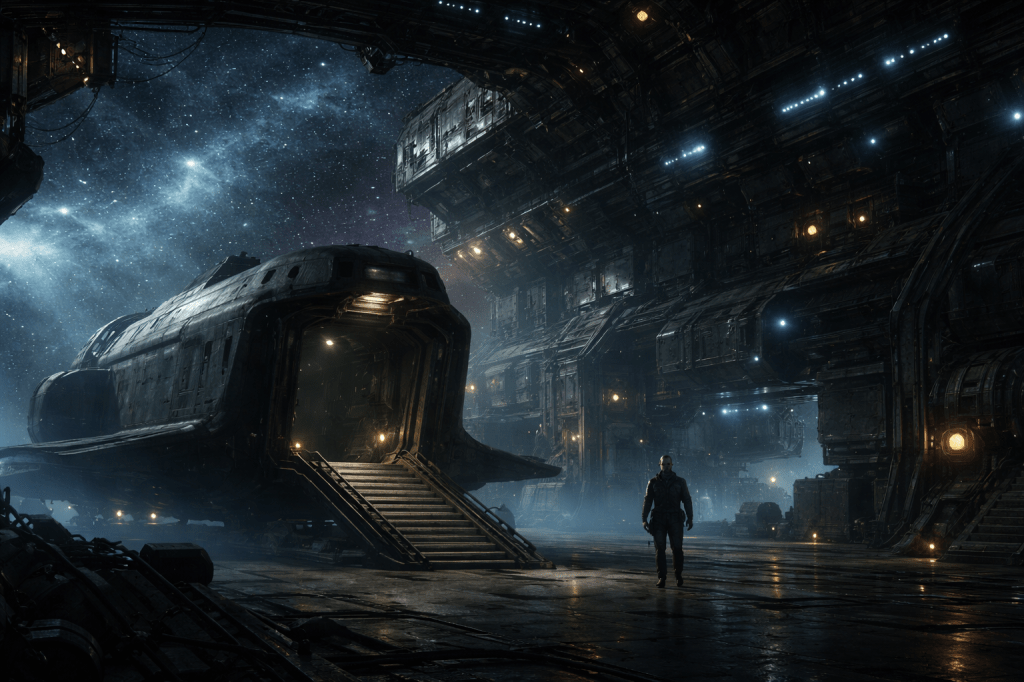
The Shuttle That Returned Empty
The shuttle arrived at the edge of Ashfall Station on a schedule that had been filed, confirmed, and quietly set aside within the station’s endless flow of routine traffic.
It emerged from the outer dark along a narrow approach vector used by survey craft assigned to the relay network beyond the station’s immediate perimeter. Its hull was marked with fine scoring from micrometeor drift and long exposure to debris fields that moved in slow, unpredictable tides. Its engines burned low as it aligned with Dock Ring Three, stabilisers correcting small deviations while the station’s guidance systems drew it inward with patient precision. Its movement carried the quiet assurance of systems that had performed the same task countless times before.
From the observation galleries overlooking the docking arms, only a handful of engineers gave the vessel more than a passing glance as it completed its final approach. Traffic through the ring had slowed during the current cycle, leaving wide stretches of the structure dimly lit and largely unattended, with overhead strips casting long reflections across exposed metal. The shuttle passed through this environment with measured control, its surface lights responding automatically to the station’s signals as the docking clamps extended to receive it.
Contact came in the way such moments always arrived on Ashfall, through quiet confirmation rather than spectacle. Magnetic locks engaged. Structural supports settled. The shuttle became part of the station’s outer architecture as a low vibration travelled through the docking arm and pressure equalisation began. Air moved through the connection point with steady, regulated flow that aligned with every expected reading.
The first suggestion that something had shifted appeared in the access corridor rather than within the shuttle itself. A technician assigned to Dock Ring Three arrived several minutes after the vessel had secured, following a route along the outer spine where maintenance panels sat flush against the walls and lighting remained permanently reduced to conserve power.
His steps echoed softly across the metal floor, the sound absorbed quickly by the surrounding structure, leaving only the constant hum of the station’s systems behind him. He carried a standard inspection kit, his movements shaped by repetition and routine while his attention moved between the environment and the data scrolling across the display attached to his wrist.
He paused when he reached the airlock leading into the shuttle, his gaze settling on the access indicator mounted beside the door. It showed a completed docking sequence, pressure levels stabilised, and internal atmosphere within acceptable parameters. A secondary line of data confirmed the expected crew manifest, four names listed beneath the vessel’s designation, each marked as present within the craft. The readout allowed no immediate cause for concern, even as the door remained closed longer than expected.
He allowed the system time to complete its final checks, listening as the faint hiss of equalisation faded into silence. The station’s hum pressed gently against the edges of his awareness, shaping every movement within Ashfall’s outer rings. When the indicator shifted to confirm that the airlock was ready for manual access, he reached out and initiated the opening sequence.
The door slid aside with a soft mechanical release, revealing the narrow corridor beyond. Interior lighting remained active, casting a steady glow along worn surfaces shaped by long use, while the air carried a neutral clarity that suggested intact systems and controlled conditions. There was no immediate sign of damage or disturbance as he stepped inside and waited for the door behind him to seal.
The sound of the station closing him into the shuttle arrived as a quiet confirmation that the transition had completed as intended. The corridor extended forward into the main compartment with a layout familiar enough that he could move without conscious thought, since survey vessels of this class followed standard design principles that prioritised efficiency and continuity over comfort.
He called out once, his voice carrying along the narrow space before fading into the machinery around him. When no response followed, he continued forward, his steps slowing as the absence of sound began to take shape as something more than routine quiet. Vessels returning from long-range surveys often arrived with crews resting while automated systems completed the final transition into station control.
Even so, the space carried a stillness that felt held rather than empty, as though the environment had settled into a state that awaited interruption. That quality followed him into the main compartment, where systems remained active and displays cycled through post-flight diagnostics that confirmed the vessel’s integrity. The chairs assigned to the crew remained secured, harnesses retracted, and personal equipment left exactly where it had been placed.
Nothing suggested struggle, and nothing suggested departure. The arrangement of the space carried a continuity that implied presence had been removed without disturbance rather than displaced through force or urgency. This became more apparent as he moved further inside and studied both the physical environment and the data feeds that continued to confirm a successful mission profile.
Navigation logs showed a completed survey of the relay station beyond Ashfall’s outer debris field. The recorded route aligned with assigned parameters, while time stamps progressed in orderly sequence from departure to return. Each segment was accounted for with the same precise regularity expected of Fleet operations, culminating in a final entry that carried the vessel back into the station’s operational range without recorded irregularity.
The logs ended there, with docking control transferred seamlessly to Ashfall’s guidance network. From the vessel’s perspective, the mission had concluded exactly as intended. That conclusion stood in quiet contrast to the absence that continued to define the interior space as he moved towards the crew quarters.
The secondary corridor opened onto a compartment identical to every vessel of its class. Four bunks lined the walls, and storage compartments remained sealed while personal effects rested in place with the quiet order shaped by long missions and limited space. Yet each bunk remained untouched, the bedding smooth and undisturbed in a way that suggested no recent use at any stage of the return journey.
He stepped back into the corridor, his attention narrowing as the pattern resolved into something that resisted dismissal. Systems functioned and the environment remained intact, and the vessel carried every indication of a completed mission. Yet the human presence that should have defined that return existed only within recorded data and nowhere within the physical space itself.
He accessed the internal comm system and opened a channel to station control, his voice measured as he reported the discrepancy within the language expected of procedural communication. The reality of what he had observed settled more fully into his awareness, and the response arrived after a brief delay that extended just beyond routine timing.
“Confirm crew status,” the voice instructed, its tone neutral and its phrasing precise.
He glanced back towards the main compartment, then towards the empty corridor leading to the airlock. The vessel held its silence while systems continued their steady articulation of data that no longer aligned with what stood before him. He replied that the crew were absent, with no departure record, no breach indicators, and the vessel intact.
A longer pause followed, carrying only the faint background noise of the station’s wider communication network. The instruction came to maintain position, alter no internal systems, and await further direction. The line closed, leaving him standing within the narrow corridor between the main compartment and the airlock.
Beyond the hull, Ashfall Station extended outward into the surrounding void. Its vast structure was held together through layers of maintenance, compromise, and habit accumulated across decades. Within that structure, information moved through channels that regulated attention and determined which events required intervention and which could be absorbed without disruption.
The return of a survey vessel without its crew occupied a space that resisted easy classification. While Dock Ring Three continued its slow rotation and engineers returned to their tasks, the report began its movement through the station’s administrative layers, where it would be reviewed, categorised, and assigned a level of response that determined how widely the information would travel.
Within the shuttle, the absence remained unchanged. The technician listened to the quiet with growing awareness of how completely the vessel had accepted its state. Its systems continued to function without interruption and without escalation, fulfilling their purpose while the absence of those they were meant to support remained outside their scope.
He studied the access logs again, tracing the recorded movements of the crew through the vessel’s systems, where each entry confirmed their presence at various stages of the mission. The data persisted with structured clarity that insisted upon a reality no longer supported by observation, allowing the recorded and the real to exist together for a moment without resolution.
Then a subtle shift passed through the displays as a recalibration altered the presentation of the data by a fraction. The crew manifest was repositioned within the interface, its prominence diminished within the wider hierarchy of operational information, while the names themselves remained unchanged and continued to persist within the system.
Their presence endured through processes that carried them forward without question, yet the emphasis placed upon them receded as though the system had begun to accommodate an absence it could not resolve. The technician watched this change without understanding its origin, aware only that something within the station had responded to the report now moving through its networks.
Beyond the hull, the relay network extended outward into the dark. Its distant structures were linked to Ashfall through channels that carried data, signals, and the steady flow of information that defined the station’s role within the wider system. The survey vessel had travelled along those routes and returned with its systems intact, its mission recorded, and its trajectory complete.
Only the crew had failed to make the same journey back. Within the layered structure of Ashfall Station, where systems compensated for failure and records adjusted to maintain continuity, that absence began its quiet integration into the fabric of the station’s ongoing operations. It settled into place without resistance and without announcement, as though it had always belonged there.
Station Record: Survey Relay Inspection; Outer Network Return Log
Ashfall Station maintained operational oversight of a distributed relay network positioned beyond the immediate debris field surrounding the station’s outer perimeter. These relay structures functioned as navigational anchors and data transmission nodes, extending Ashfall’s effective reach into surrounding space while supporting long-range survey operations and communication stability across transit corridors. Each relay was subject to periodic inspection cycles carried out by small survey crews assigned to routine maintenance, calibration, and verification tasks.
The survey vessel assigned to the current inspection cycle departed Ashfall Station under standard procedural conditions, carrying a four-person crew with appropriate clearance for external relay access. Mission parameters specified a direct transit to a designated relay installation located beyond the station’s primary debris boundary, followed by systems verification and return along a pre-approved route. No deviations from standard operating procedure were recorded at the point of departure.
Outbound transit logs indicated stable navigation across all phases of the journey. Environmental readings remained within expected tolerances, and communication signals between the vessel and Ashfall’s control systems were maintained throughout the initial segment of the mission. Data packets transmitted during this period confirmed routine inspection activity at the relay site, including structural assessment, signal calibration, and minor system adjustments consistent with previous survey cycles.
Upon completion of the relay inspection, the vessel initiated its return sequence. Navigation logs recorded a standard departure from the relay structure, with course alignment matching assigned parameters for re-entry into Ashfall’s operational range. System diagnostics transmitted during the early stages of return indicated full operational integrity across propulsion, life support, and navigation systems.
The final transmission received from the survey vessel occurred during the midpoint of the return trajectory. At this stage, all reported conditions remained nominal, with no indication of system failure, external interference, or environmental hazard. Communication quality remained stable, and telemetry data continued to align with expected mission performance.
Following this transmission, no further communication was received from the vessel until it re-entered Ashfall Station’s automated docking range.
Station guidance systems assumed control of the vessel during final approach, executing docking procedures without deviation. External scans conducted during approach confirmed the structural integrity of the vessel’s hull, with no evidence of impact damage, breach, or abnormal thermal signatures. Docking clamps engaged successfully, and pressure equalisation between the vessel and Dock Ring Three completed within standard parameters.
Internal system synchronisation between the vessel and station infrastructure initiated automatically upon docking. Data integration confirmed continuity across navigation logs, environmental systems, and onboard diagnostics. All recorded systems indicated a completed mission profile consistent with initial parameters and expected operational outcomes.
Upon manual access to the vessel by assigned station personnel, it was determined that no crew members were present within any accessible compartment of the craft.
No evidence of forced egress was identified. Internal access points remained sealed, with no recorded activation during the return phase. Environmental conditions within the vessel remained stable and unchanged from standard operational parameters. Personal equipment assigned to crew members remained in place, with no indication of preparation for departure or emergency evacuation.
Review of onboard access logs indicated continuous crew presence throughout the outbound and inspection phases of the mission. Recorded activity within the vessel’s internal systems confirmed routine operation by all four crew members during these stages. However, no recorded movement corresponding to crew activity was identified during the final segment of the return trajectory.
Life support systems remained active throughout the duration of the mission and return sequence, with no recorded failure or fluctuation that would account for crew absence. Atmospheric composition within the vessel remained within acceptable limits upon inspection, with no detectable contaminants or anomalies identified through standard diagnostic procedures.
Further analysis of internal sensor logs revealed no breach events, pressure fluctuations, or unauthorised access attempts during the return phase. All structural and environmental readings remained consistent with nominal operation from departure through to docking.
The discrepancy between recorded crew presence and physical absence upon docking was formally logged as an unresolved anomaly within the station’s operational record.
Following initial inspection, the vessel was placed under restricted access pending further review by Fleet oversight. Survey operations within the affected relay sector were temporarily suspended while additional data analysis was conducted.
No definitive cause for crew absence was recorded within the accessible station archive for that cycle.
About the Creator
The Future Chronicle is written and curated by Simon Phillips, a writer of science fiction and speculative storytelling who explores the quiet edges of human expansion, where ageing stations, distant worlds, and forgotten technologies continue their slow existence beyond the reach of the central worlds.
Many of the stories presented in these Chronicles exist within a wider fictional universe that follows the lives of investigators, engineers, and frontier workers living far from the comfort of the inner systems, where the machinery of civilisation continues to function long after its original purpose has begun to fade.
One such story unfolds aboard Ashfall Station, an ageing orbital installation whose corridors and industrial sectors form the setting for the science-fiction mystery novella Ashfall Station: The Dead Girl in Sector Twelve. What begins as a routine investigation gradually reveals that something hidden within the station’s structure may have been present for far longer than the official records suggest.
Readers who wish to explore the full investigation and its unfolding events can find the novella below.
Explore the book:
Ashfall Station: The Dead Girl in Sector Twelve
You can watch his YouTube channel here:
Author Simon Phillips

Continuing the Chronicle
The following Chronicle continues the reconstruction of the survey mission assigned to Ashfall Station’s outer relay network, where a routine inspection cycle resulted in the return of a vessel whose systems remained intact while its crew failed to return with it.
At the time, survey operations beyond the station’s immediate perimeter were regarded as stable and well understood. Relay structures positioned across the outer debris field formed part of a wider infrastructure network designed to extend Ashfall’s operational reach, supporting navigation, communication, and long-range observation. These installations required periodic inspection and calibration, tasks carried out by small crews operating within tightly defined procedural frameworks that had remained unchanged across successive cycles.
The mission assigned to the relay station in question followed these established patterns. Transit routes, inspection procedures, and return sequences were all drawn from standard operational templates. Initial reports indicated that each stage of the survey had proceeded within expected parameters. The relay installation itself registered no significant deviation during inspection, and the vessel’s recorded departure from the structure aligned with routine completion of assigned tasks.
The return of the vessel without its crew introduced a discrepancy that extended beyond the scope of standard operational variation. Internal systems confirmed continuous crew presence throughout the mission’s early phases. The absence of any recorded breach, evacuation sequence, or environmental failure during the return trajectory prevented immediate classification of the event within known categories of system or personnel loss.
Subsequent review of transmission logs and onboard diagnostics suggested that the point at which crew activity ceased occurred during the return phase, after departure from the relay structure and prior to re-entry into Ashfall Station’s direct communication range. Within this interval, recorded data remained structurally intact. Later analysis noted a reduction in variation across internal activity logs, as though expected human interaction with the vessel’s systems had diminished without triggering automated alert conditions.
The relay sector assigned to the mission lay beyond the station’s primary debris boundary, positioned within a region where signal integrity relied on the continued operation of distributed transmission nodes. While these structures were considered stable, their distance from Ashfall limited the resolution of real-time monitoring, requiring reliance on onboard systems for detailed operational feedback. This distance introduced a layer of observational separation that would later complicate attempts to reconstruct events occurring during the vessel’s return.
In the cycles following the vessel’s recovery, Fleet oversight initiated a restricted review of survey operations within the affected sector. Access to the relay network was temporarily suspended, and subsequent inspection assignments were reassigned to alternate routes pending further analysis. Public-facing records retained the classification of the event as an unresolved operational anomaly, with no additional detail appended to the station’s accessible archives.
Later examination of internal logs and fragmented transmission records would suggest that the return of the vessel marked the first recorded instance in which personnel assigned to Ashfall’s external network failed to reappear without accompanying system failure or environmental cause. The absence, preserved within both the station’s records and its physical reality, established a pattern that would not remain confined to a single mission.
Readers supporting The Future Chronicle can continue the record below.

Subscribe to continue reading
Subscribe to get access to the rest of this post and other subscriber-only content.
