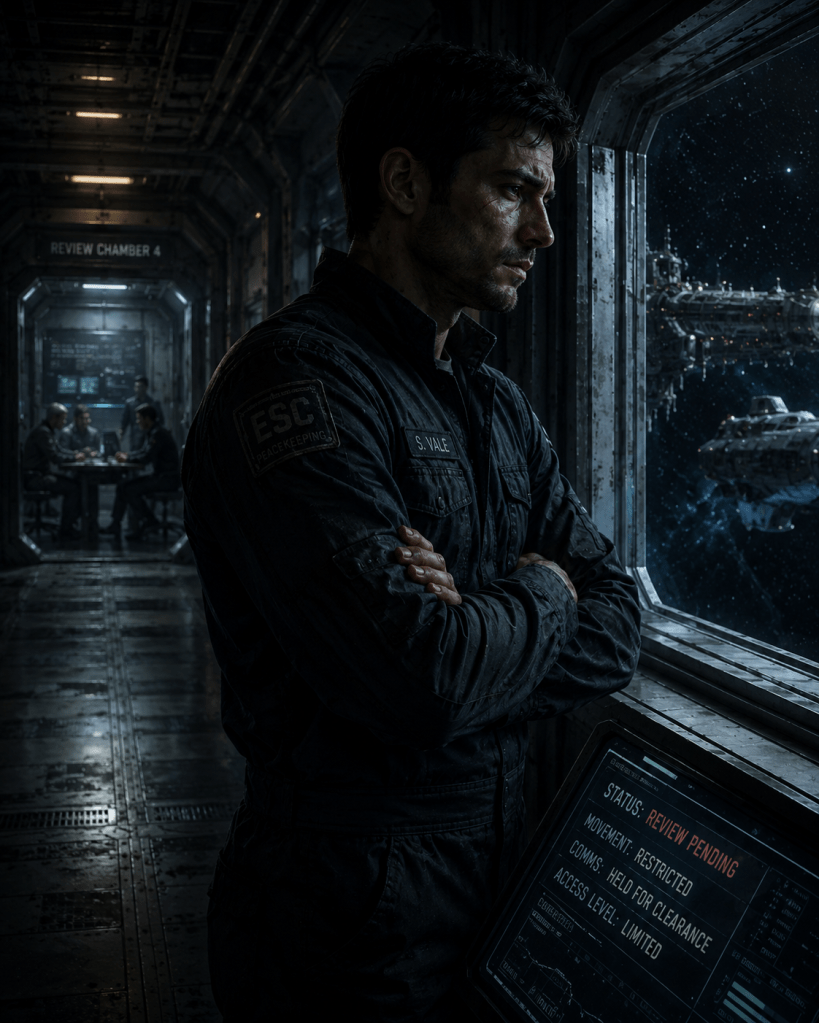
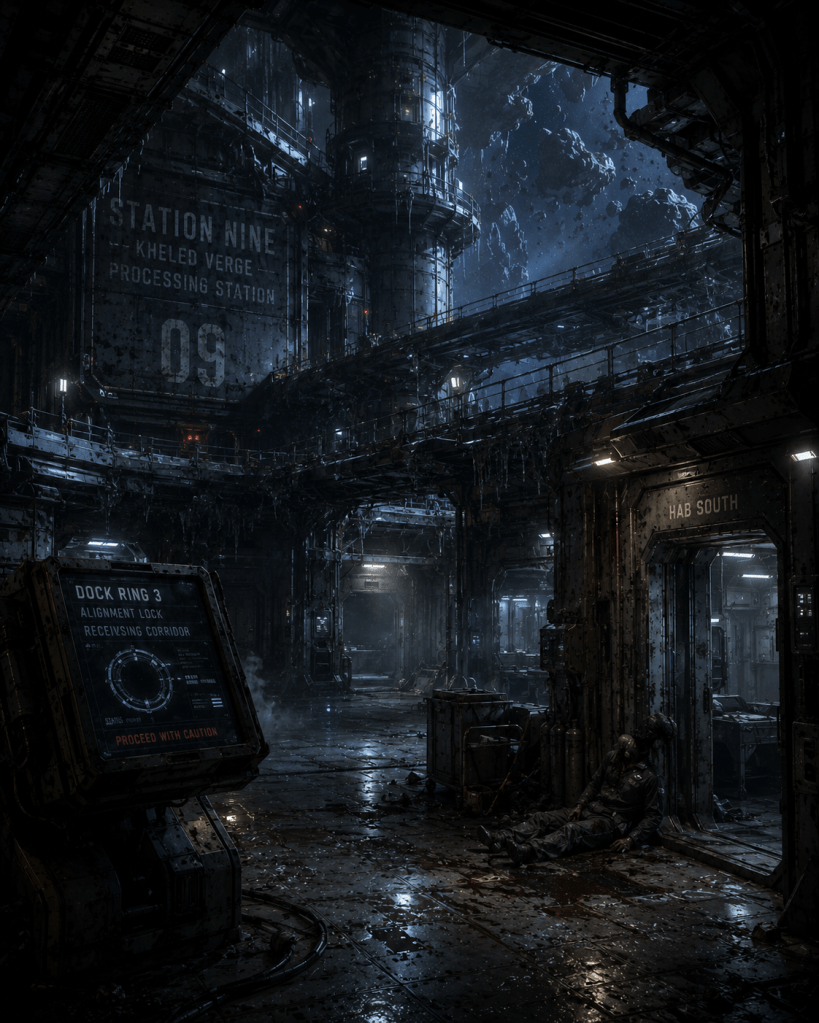
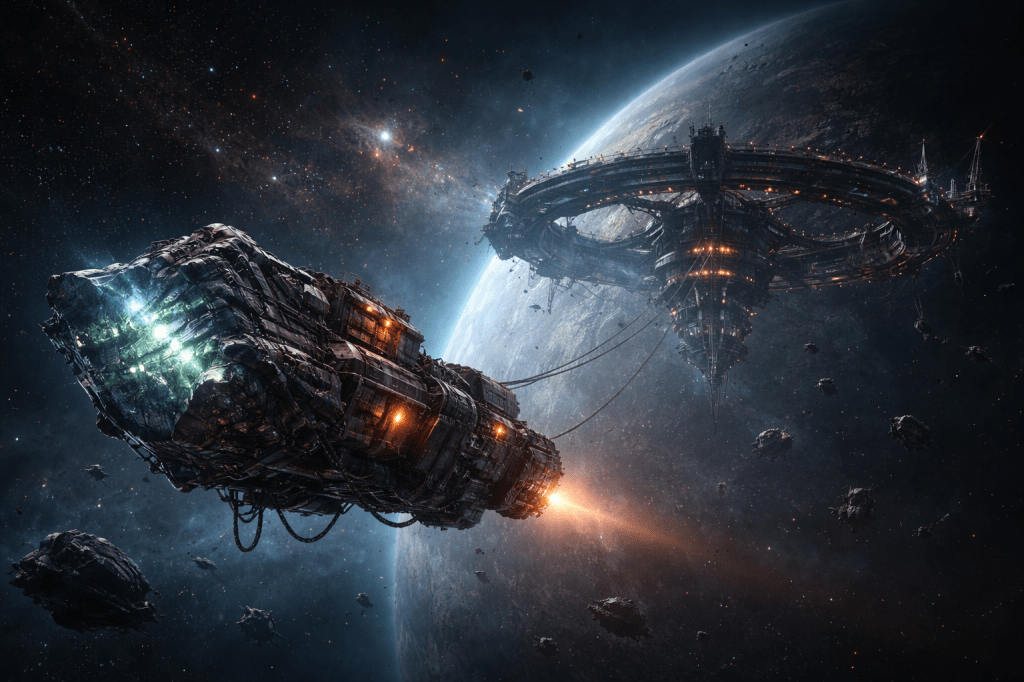
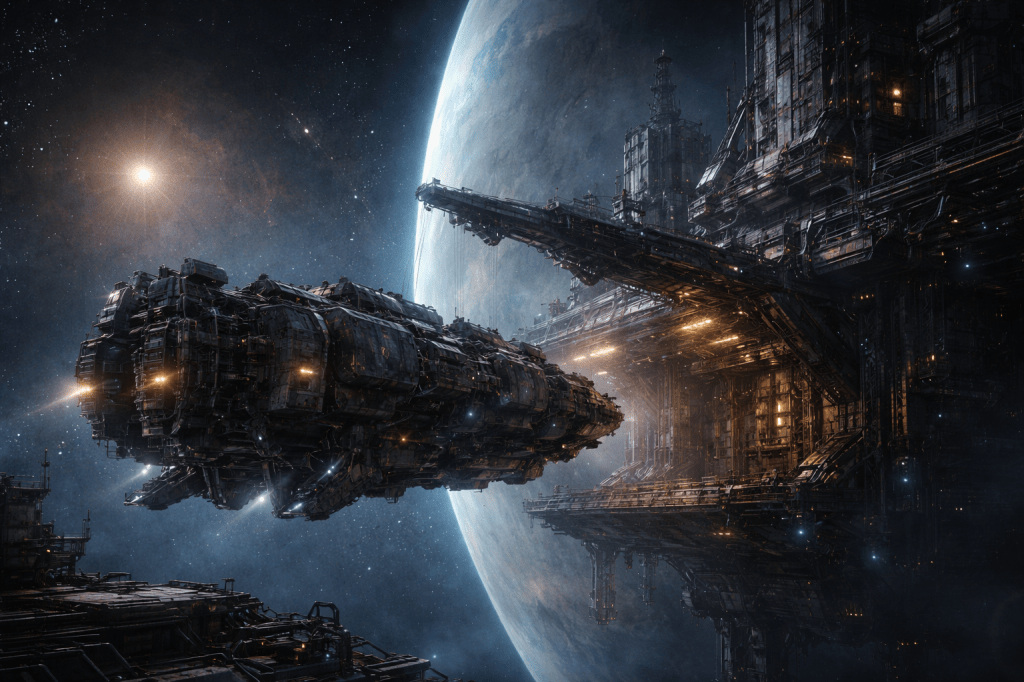
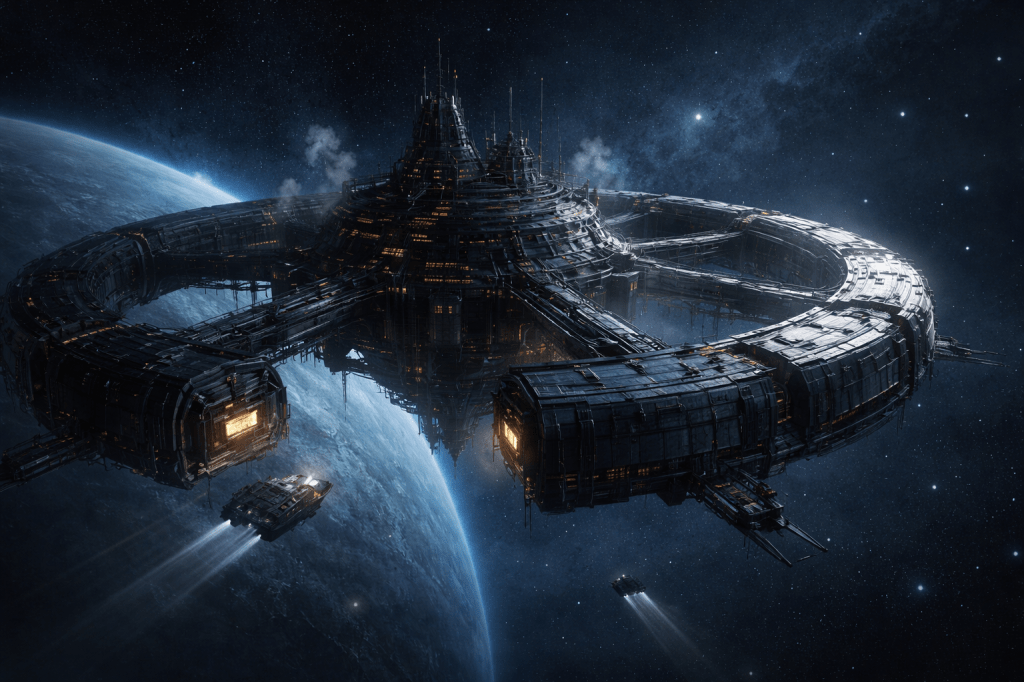
When new construction connected with Ashfall Station’s forgotten sectors, engineers discovered that the station had not been built as a single structure, but layered over something far older.
The First Frame of Expansion
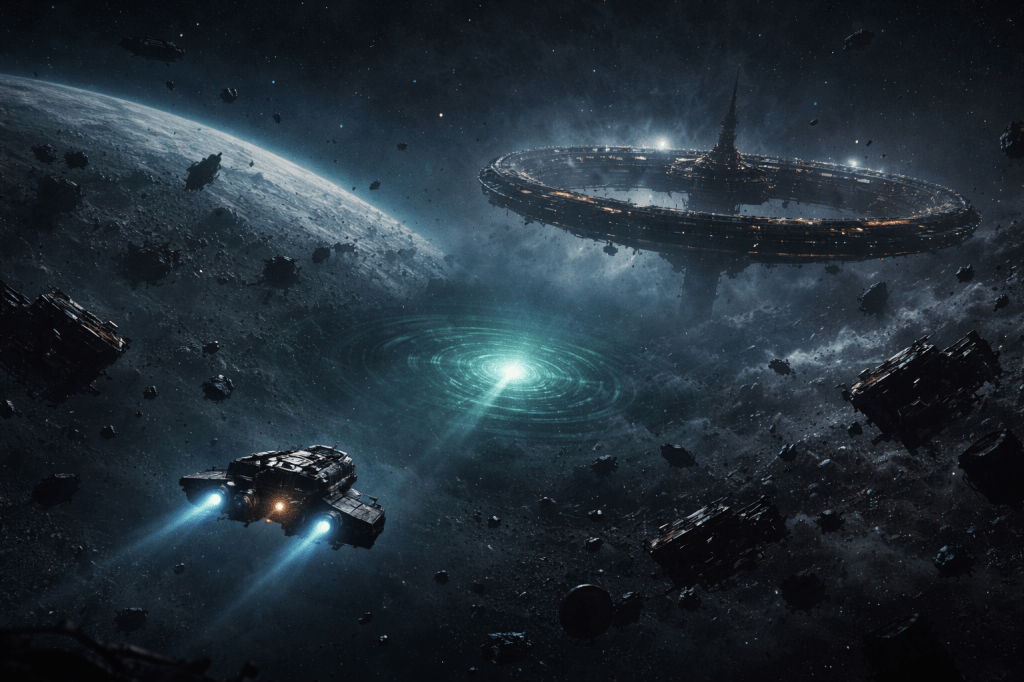
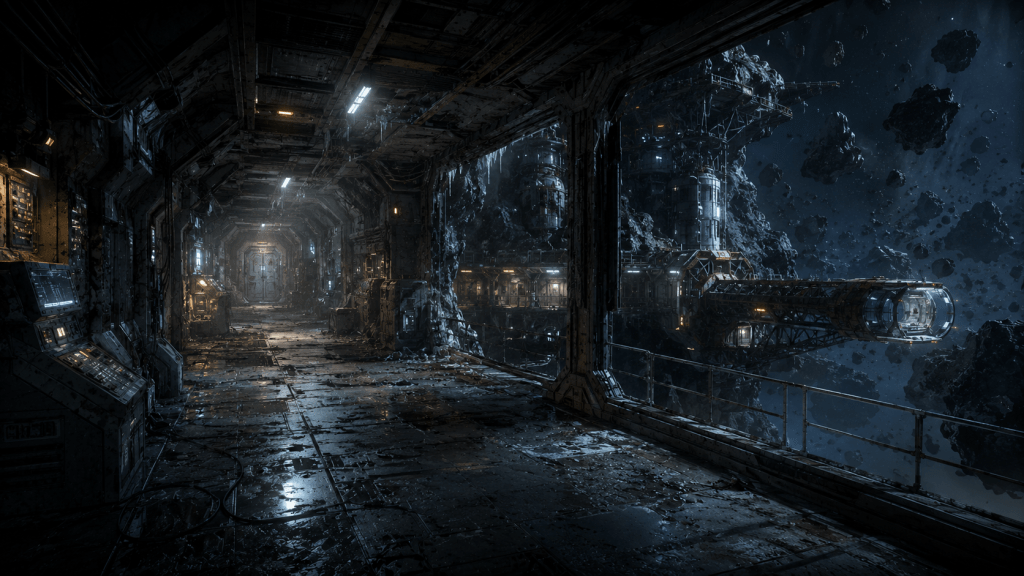
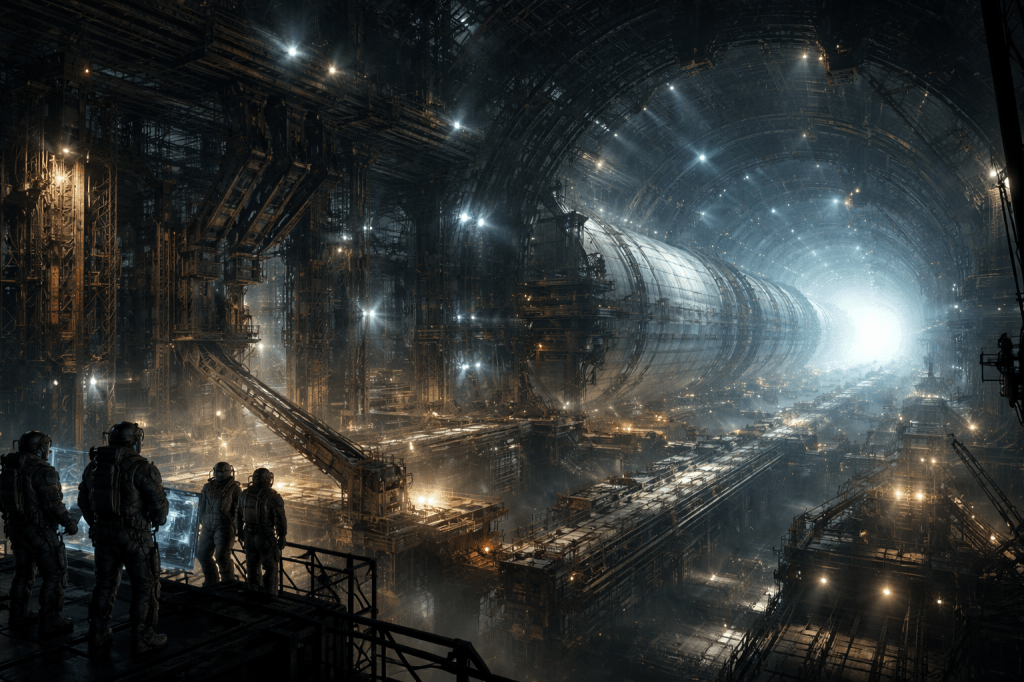
The first structural frame arrived in silence, carried along Ashfall’s outer ring by a convoy of slow-moving construction tugs whose engines burned with a steady blue light against the darkness. From a distance, the framework appeared almost delicate, a skeletal lattice of reinforced trusses extending across open space, its geometry holding a precision the station itself had long since surrendered.
Inside the observation deck, Senior Structural Engineer Halren Voss stood with his hands resting against the glass and watched the frame draw closer with a focus that had sharpened over the course of the last cycle. The expansion had been approved months earlier and passed through Fleet infrastructure review with unusual efficiency, its purpose stated in clear terms that required little interpretation. Ashfall would expand its cargo capacity, reinforce its ageing structural spine, and extend its operational lifespan deeper into the Kestren system, all of which made sense on paper, even as the timing carried a quiet insistence that felt closer to instruction than maintenance.
The tugs aligned with the outer docking struts in careful sequence, each movement controlled through a series of micro-adjustments that compensated for Ashfall’s uneven rotational drift. Voss followed the alignment metrics scrolling across his comm display while noting the minor corrections required to stabilise the frame against the station’s existing mass, aware that even here, at the edge of expansion, Ashfall resisted precision, its structure carrying subtle deviations that no amount of recalibration ever fully resolved.
“Alignment within tolerance,” a voice reported behind him, the words settling into the background hum of the deck as part of a routine that had already begun to feel rehearsed.
Voss inclined his head without turning, his attention still fixed on the approaching frame as he spoke. “Log the variance. I want the full correction profile before integration begins.” The technician acknowledged before stepping away, leaving him alone with the slow, deliberate arrival of something new that seemed almost out of place against the station’s accumulated imperfections.
For a moment, the contrast unsettled him in a way he could not immediately define. The frame remained exact in its construction, its lines following specification without drift, each segment fabricated to tolerances Ashfall’s older sections could no longer match. Against it, the station revealed its age more clearly than any maintenance report ever had, layers of repair and reinforcement visible even at this distance, each applied at a slightly different angle and each solving a problem that had already replaced an earlier one.
The thought formed gradually as he watched, settling into place with quiet weight as he recognised that Ashfall had never been built as a single structure, but instead had grown over time, accumulating its form through necessity rather than design. Once that understanding surfaced, it refused to leave, colouring the way he now saw every junction, every seam, every correction layered over the last.
He turned away from the observation deck once the first frame locked into position, the heavy clang of magnetic couplings echoing faintly through the hull as the structure connected with the station’s outer ring. The sound travelled further than expected, carrying through the corridors with a depth that suggested the impact had been received by more than the immediate junction, as though something within the station had answered in return.
Construction always carried sound, yet this felt different in a way that lingered beyond the moment. Although Voss dismissed the impression, he found that it remained with him as he moved towards the access lift. His next task already formed in sequence, as integration required verification, and verification required proximity, drawing him down towards the mid-ring’s older support corridors where decades of incremental modification had taken place without comprehensive review.
The lift descended through layers of the station that grew progressively less refined, the lighting shifting from steady white to the familiar flicker of ageing strips that hummed with uneven power draw. Voss watched the deck indicators count down while noting the subtle changes in air pressure and temperature that marked each transition between sectors, each layer carrying its own atmosphere shaped by use, repair, and neglect.
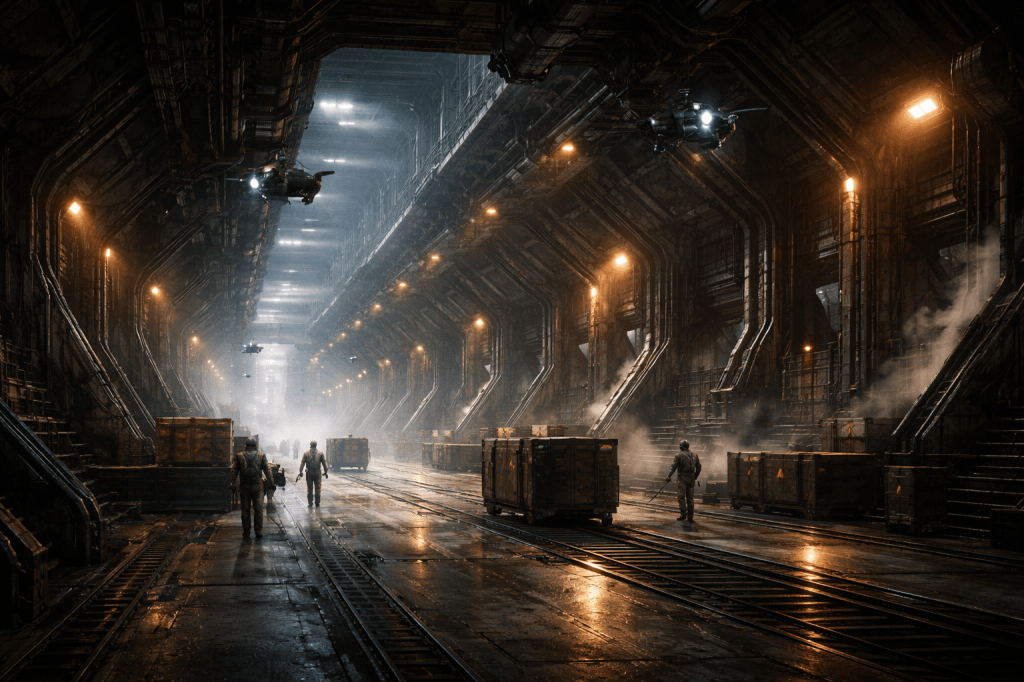
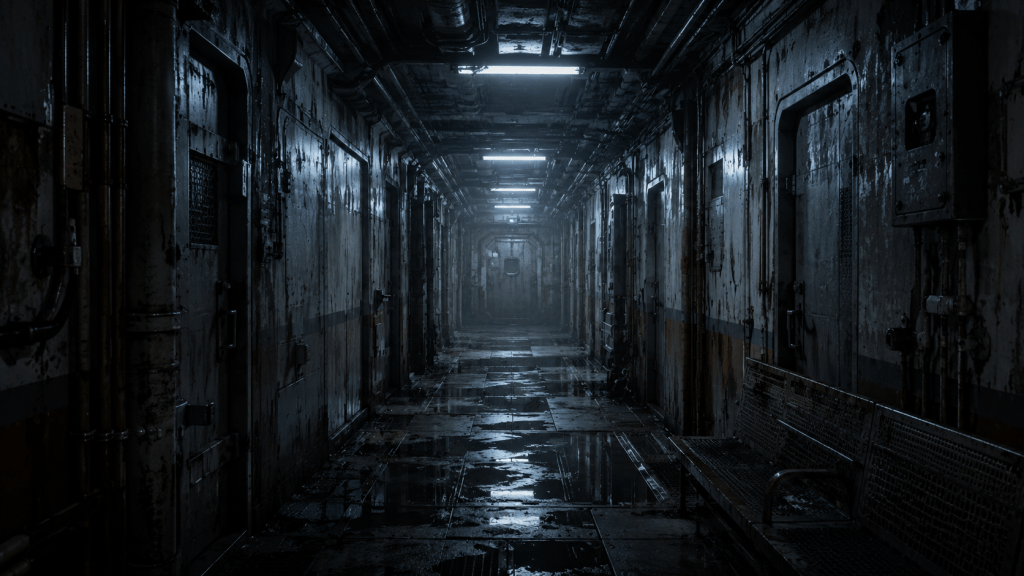
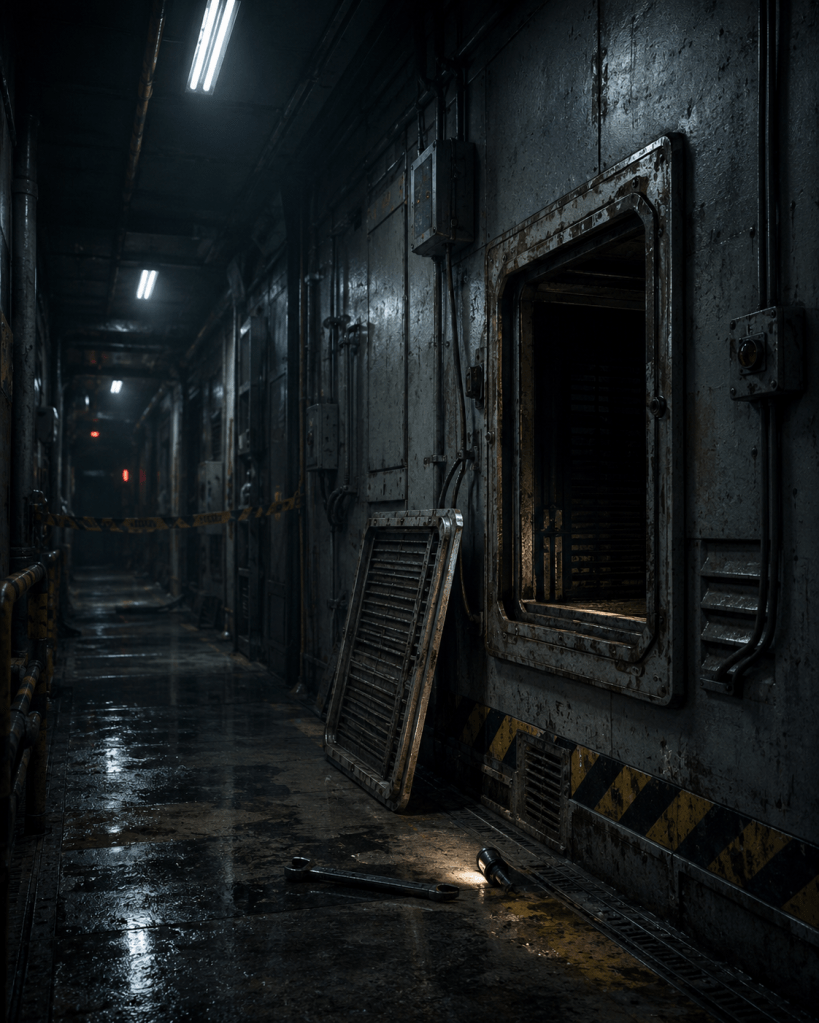
When the doors opened, the corridor beyond carried the quiet weight of long use. Reinforcement ribs lined the walls at irregular intervals, their surfaces marked by overlapping weld seams that told the story of previous adjustments, while cable conduits ran exposed along the ceiling, their routing altered and rerouted so many times that no single path remained original, giving the space a sense of accumulated decisions rather than planned design.
He stepped out into the corridor and paused, allowing his eyes to settle into the lower light as a small team of engineers waited near the junction hatch, their tools arranged in careful order along the bulkhead. They straightened as he approached, their expressions attentive and restrained, as though the space itself encouraged caution and discouraged unnecessary movement.
“Status,” Voss said, his voice carrying just enough authority to settle the room without disrupting its quiet.
“Preliminary scan complete,” the lead technician replied. “Structural integrity within acceptable limits, though internal mapping diverges from archived schematics.” The phrasing carried a hesitation that suggested the words had been chosen with care.
Voss considered that for a moment, his gaze drifting towards the sealed hatch that marked the boundary between active infrastructure and the older layers beneath. “Define diverges,” he said, and the technician hesitated again before bringing up a projection on his handheld display.
“The original construction maps show a continuous support corridor beyond this point,” he explained. “Yet current scans indicate interruptions. Voids where material should exist.” The explanation settled uneasily in the confined space.
“Damage,” Voss said, the word offered as a possibility rather than a conclusion.
“Possibly,” the technician replied, “though the edges appear too regular for collapse,” and the distinction lingered between them with quiet weight.
Voss stepped closer to the hatch and ran his hand along the seam where the newer locking mechanism met the older structure, the metal cool beneath his fingers and smooth where it had been recently reinforced. Beneath that, he sensed the older material, a subtle difference in density that suggested a different fabrication process entirely, one that belonged to an earlier stage of the station’s development.
“When was this section last accessed?” he asked, keeping his tone even as he traced the seam.
“Records indicate closure during the second expansion phase,” the technician said. “Approximately forty years ago,” and the span of time settled into the corridor as something more than a number.
Forty years was long enough for a space to fall out of memory while still remaining part of the structure, long enough for records to lose context even when they remained intact. Voss felt that weight as he withdrew his hand and gave the instruction to open the hatch.
The team moved with practised efficiency, tools engaging with the locking mechanism as power was redirected to disengage the seal. The process took longer than expected, as the system resisted in small ways that required manual override at several stages, and when the final lock released, the hatch shifted inward with a low, reluctant sound that echoed into the space beyond.
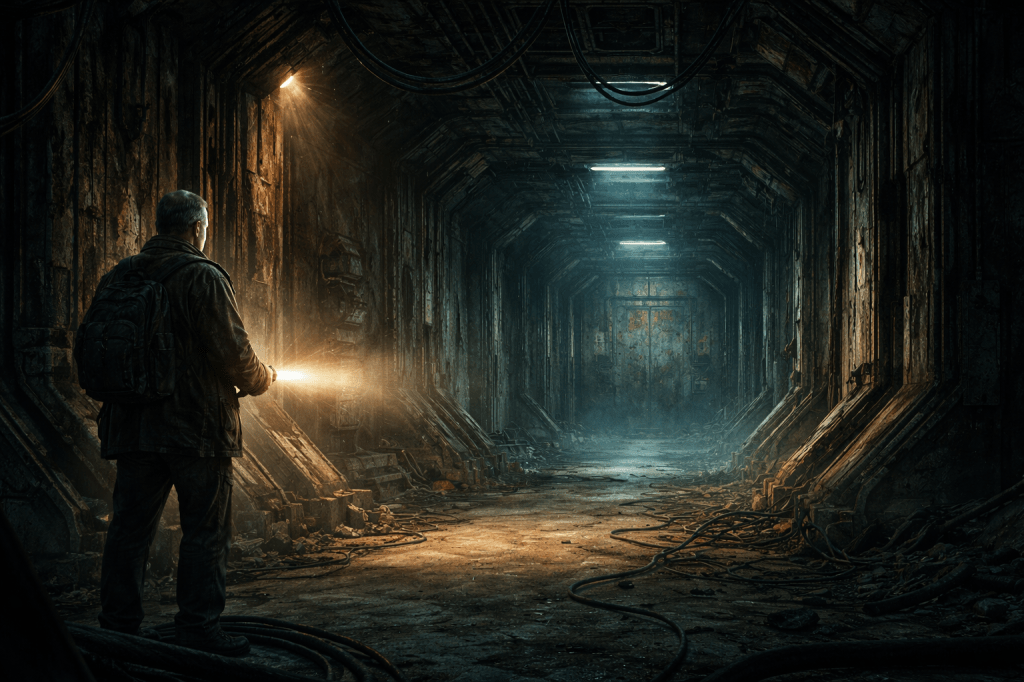
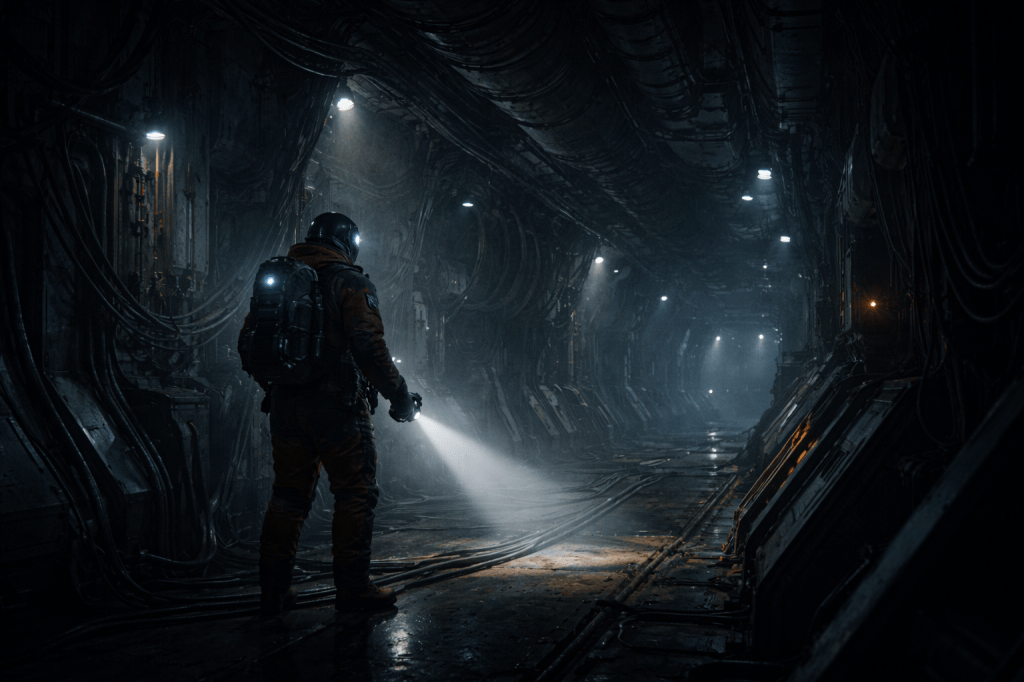
The corridor on the other side lay in darkness. Voss activated his light before stepping through, the beam cutting across a passage that extended further than the archived schematics had suggested. The walls bore the same reinforcement pattern as the active corridor, yet with weld seams that appeared older and less precise, their edges softened by time and exposure.
He advanced slowly, his attention fixed on the details that emerged within the light, and as he moved further into the corridor, the differences began to resolve into something more deliberate than simple variation. The floor plating shifted in alignment so that its edges met at angles that no longer corresponded to the station’s standard grid.
One of the engineers spoke quietly behind him, drawing attention to the same detail, yet Voss remained focused as he crouched and ran his light along the seam between two plates, the join holding firm and the structure remaining sound even as the orientation suggested an alternate reference point that the station’s current systems no longer recognised.
“Bring up the grid overlay,” he said, and when the technician complied, the discrepancy became immediately clear as the projected grid failed to align with the plating beneath their feet, revealing that the corridor followed a different structure altogether.
Voss rose slowly, the earlier thought returning with greater weight as he turned and scanned the corridor’s length, the beam of his light revealing further inconsistencies as junction points appeared where none should exist, and conduits entered the walls at angles that bypassed standard routing protocols before disappearing into spaces the maps no longer acknowledged.
The technician spoke again, his voice lower now, suggesting that these sections had been modified after initial construction. Voss answered quietly that the changes might have come before, and the possibility settled into the space with a silence that carried more meaning than any confirmation could have provided.
Behind them, the open hatch framed the brighter corridor of the active station, its light spilling into the darkness without fully dispersing it, and the boundary felt sharper now, marking more than a division between old and new as the integration plans began to shift in implication.
The technician began outlining the structural requirements for anchoring along this axis, explaining how the deviations would alter load distribution beyond projected tolerance. Voss listened before instructing him to hold, stepping further into the corridor as the pattern continued to unfold, each segment reinforcing the sense that the station’s deeper layers followed a logic no longer present in its current design.
The maps had recorded something else, or they had been altered, and the uncertainty carried its own weight as Voss reached the first junction and paused, his light tracing the outline of a sealed access panel set into the wall, its surface unmarked and smooth, reflecting the beam back at him in muted tones that revealed nothing of what lay beyond.
He placed his hand against it and remained still as a faint vibration passed through the metal, subtle enough to be dismissed as background activity, yet steady enough to hold his attention, the rhythm repeating with a precision that felt measured rather than incidental.
Voss kept his hand in place for a moment longer before withdrawing it, aware of the team watching him from the corridor behind, and when he spoke again, his voice carried the weight of a decision that extended beyond immediate procedure as he called for a full survey of the section, making it clear that integration would not proceed until they understood what they were connecting to.
The technician nodded, relief visible in the motion as though the instruction aligned with an unease he had been unwilling to voice, and Voss turned back towards the open hatch where the light from the active corridor spilled across the threshold, pausing for a moment between the older structure behind him and the newer station ahead.
The expansion had been designed to strengthen Ashfall, yet what it revealed suggested that the station’s foundation carried more than its current systems could account for, and whatever lay within those deeper layers had remained undisturbed until something new attempted to connect to it again.
The light flickered once as he stepped back through the hatch, the corridor beyond settling into its familiar hum while the darkness behind remained unchanged, holding its shape without resistance as though the brief intrusion had made no difference at all, and although Voss did not look back, he carried the pattern with him, its quiet repetition remaining long after the corridor returned to routine.
The expansion had only just begun, and Ashfall had already begun to answer.
Station Record: Expansion Junction Survey; Mid-Ring Structural Integration
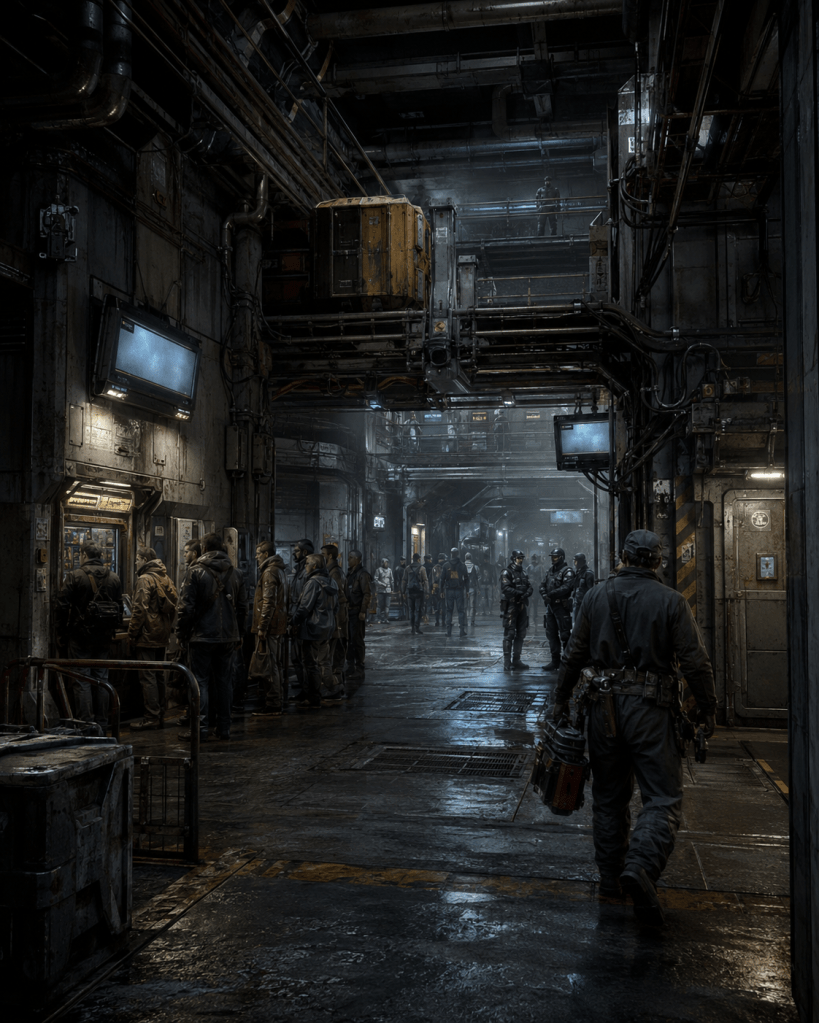
Ashfall Station maintained extensive structural archives documenting the layered growth of the installation across successive decades of expansion above the mining world of Kestren-4. From its earliest function as an industrial transfer platform, the station evolved through repeated phases of reinforcement and outward development. Each stage embedded earlier infrastructure within newer construction. Over time, this created a dense internal framework in which modern systems frequently intersected with structural elements originating from the station’s initial industrial period.
The mid-ring support corridors selected for the Expansion Project belonged to one of these transitional layers. These sections formed part of the station’s secondary structural network, designed to distribute load between the outer docking assemblies and the central habitation rings. While still active in a limited capacity, many of these corridors had undergone decades of incremental modification, resulting in a structural profile that differed in detail from the original construction schematics.
Fleet-approved expansion plans required several new structural frameworks to be anchored along these mid-ring junction points. The objective was to extend Ashfall’s cargo handling capacity while reinforcing stress-bearing segments of the station’s ageing superstructure. Integration of the new frameworks depended on accurate alignment with the existing load distribution grid, necessitating detailed engineering surveys of each proposed connection site prior to structural attachment.
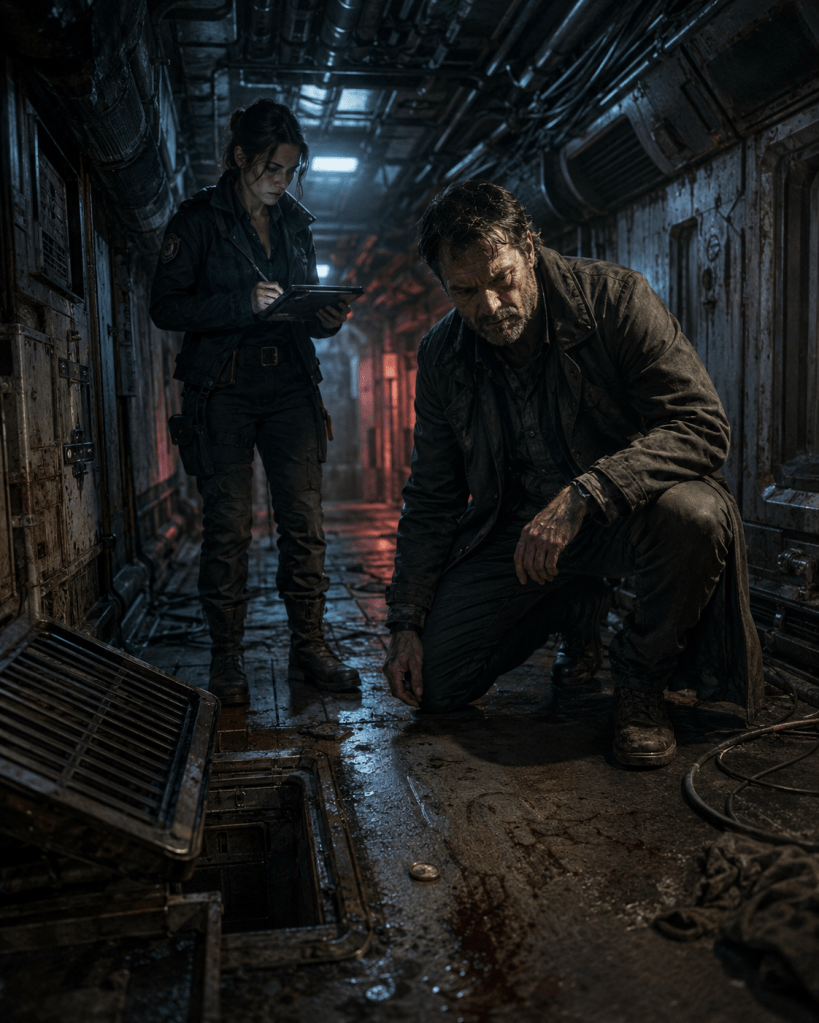
During one such survey cycle, engineering teams assigned to a designated junction corridor reported inconsistencies between archived schematics and real-time structural scans. Initial mapping indicated that the corridor extended beyond its documented termination point, with internal geometry diverging from the station’s standard grid alignment. Sections of plating and subframe support appeared to follow an alternate structural orientation, suggesting modification outside recorded parameters.
Further inspection revealed that portions of the underlying framework could not be reconciled with any phase of construction listed within the station’s accessible engineering archives. The deviations presented as continuous structural elements rather than isolated damage or degradation, indicating that the corridor had either been reconfigured during an undocumented phase of development or preserved from an earlier configuration that had not been carried forward into modern records.
At a primary junction node within the surveyed section, engineers identified a sealed access panel embedded within the wall structure. The panel bore no identification markings and did not correspond to any registered access point within the station’s current infrastructure database. Surface analysis indicated that the panel had remained in place for an extended period, with no evidence of recent interaction or maintenance.
Manual contact with the panel during inspection produced reports of low-level vibrational activity within the surrounding structure. These readings were initially attributed to standard background operation within adjacent systems, though their regularity prompted further notation within the survey log. The source of the vibration could not be isolated through standard diagnostic procedures available to the engineering team at that time.
Following these findings, the engineering department submitted a request to delay structural integration at the affected junction point, pending further analysis. The presence of undocumented structural elements, combined with the discovery of a sealed access panel lacking registry reference, introduced variables that could not be accounted for within the original expansion parameters.
Archived records indicate that the request for extended survey and verification was transmitted through standard channels to Fleet infrastructure authorities shortly after the initial findings were logged. Integration procedures at the identified junction were subsequently placed under temporary suspension while awaiting further instruction.
No additional clarification regarding the structural discrepancies was appended to the public engineering archive for that cycle.
About the Creator
The Future Chronicle is written and curated by Simon Phillips, a writer of science fiction and speculative storytelling who explores the quiet edges of human expansion, where ageing stations, distant worlds, and forgotten technologies continue their slow existence beyond the reach of the central worlds.
Many of the stories presented in these Chronicles exist within a wider fictional universe that follows the lives of investigators, engineers, and frontier workers living far from the comfort of the inner systems, where the machinery of civilisation continues to function long after its original purpose has begun to fade.
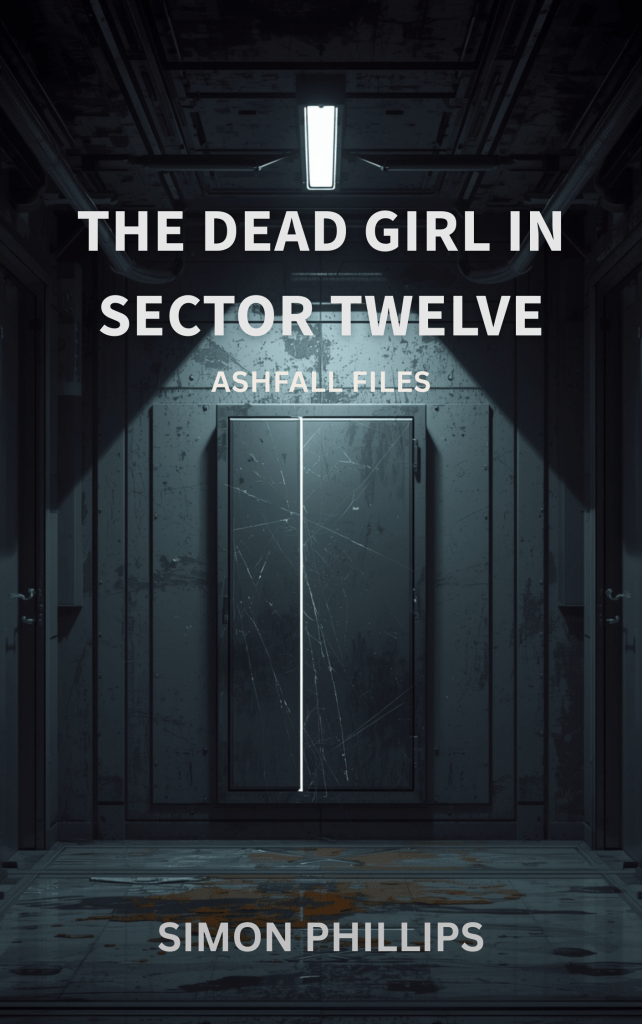
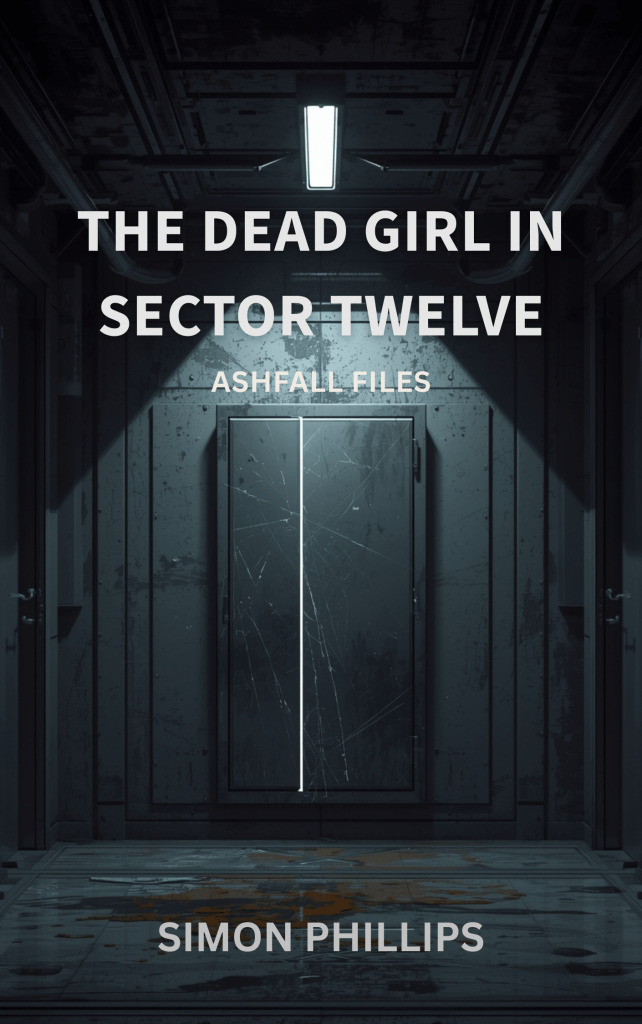
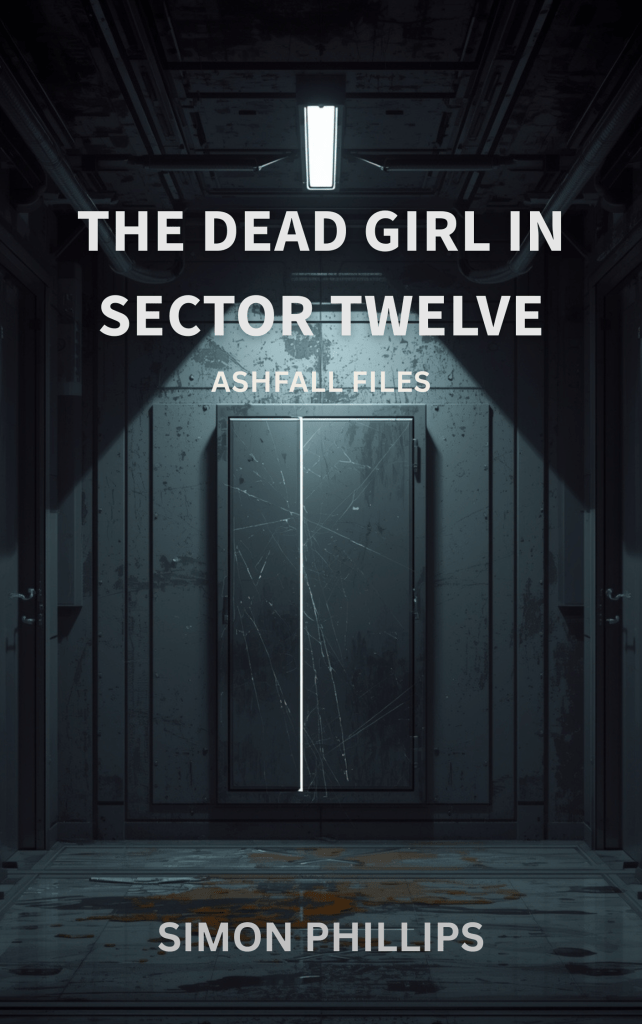
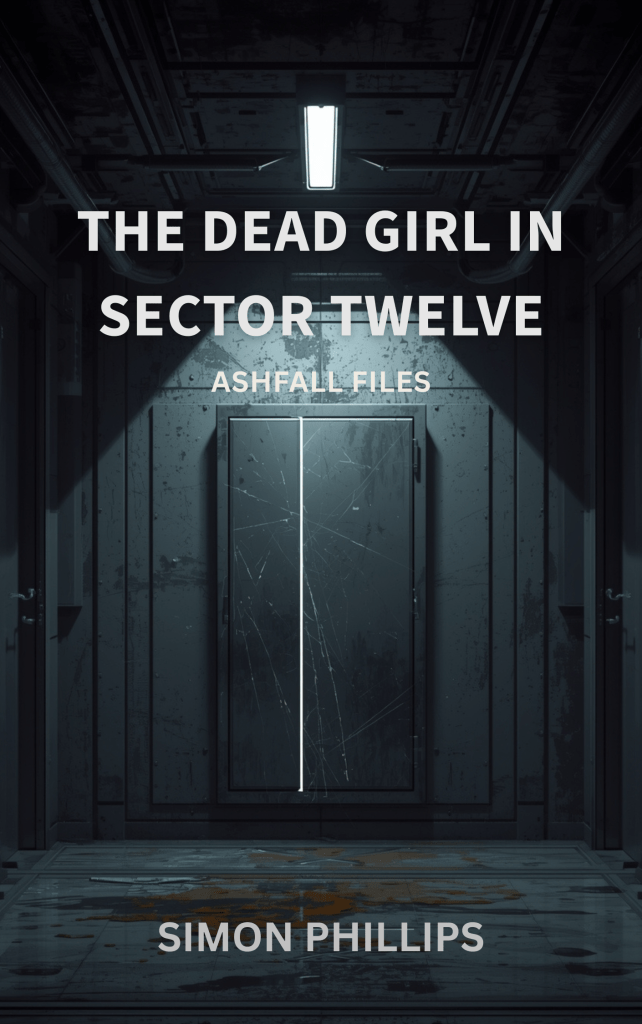
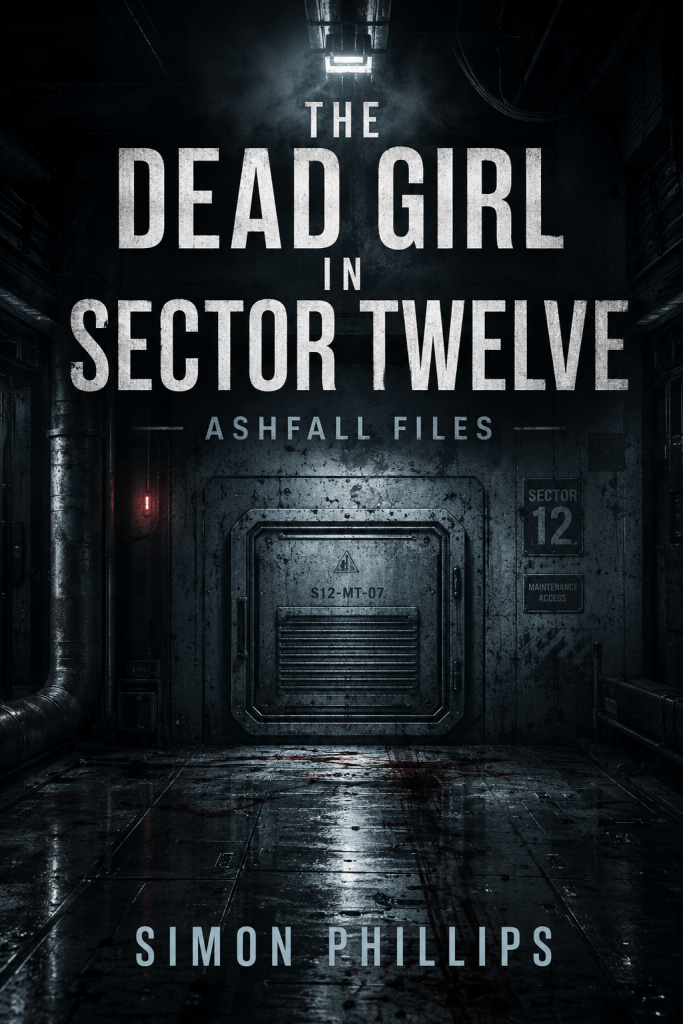
One such story unfolds aboard Ashfall Station, an ageing orbital installation whose corridors and industrial sectors form the setting for the science-fiction mystery novella Ashfall Station: The Dead Girl in Sector Twelve. What begins as a routine investigation gradually reveals that something hidden within the station’s structure may have been present for far longer than the official records suggest.
Readers who wish to explore the full investigation and its unfolding events can find the novella below.
Explore the book:
Ashfall Station: The Dead Girl in Sector Twelve
You can watch his YouTube channel here:
Author Simon Phillips
Continuing the Chronicle
The following Chronicle continues the reconstruction of the early expansion works carried out across Ashfall Station’s mid-ring support corridors, where engineering teams first began integrating new structural frameworks with sections of the station that had remained unchanged for decades.
At the time, the Expansion Project was recorded as a necessary reinforcement effort, intended to stabilise ageing infrastructure while extending the station’s cargo capacity across the Kestren system. Such work required frequent interaction with older structural layers, and it was not uncommon for engineering crews to encounter deviations between archived schematics and the station’s physical form. These irregularities were typically attributed to incremental modifications carried out during earlier phases of construction.
The survey conducted at the designated junction point revealed a more persistent inconsistency. Structural elements within the corridor followed an alignment that diverged from the station’s established grid, while underlying framework segments could not be traced to any documented phase of development within the accessible engineering archives. The discovery of a sealed access panel embedded within this section, absent from all modern records, suggested that portions of Ashfall’s deeper infrastructure had been altered, preserved, or removed from official documentation entirely.
Later examination of archived survey logs indicated that the findings recorded during this phase of the Expansion Project marked the first instance in which engineering teams encountered structural continuity that extended beyond the station’s recognised construction history.
Readers supporting The Future Chronicle can continue the record below.

Subscribe to continue reading
Subscribe to get access to the rest of this post and other subscriber-only content.