Frontier pilots approaching Ashfall Station begin reporting a repeating signal drifting through the outer debris field, even though station navigation confirms that no transmitter exists anywhere within the surrounding orbital space.
The Signal in the Debris Field
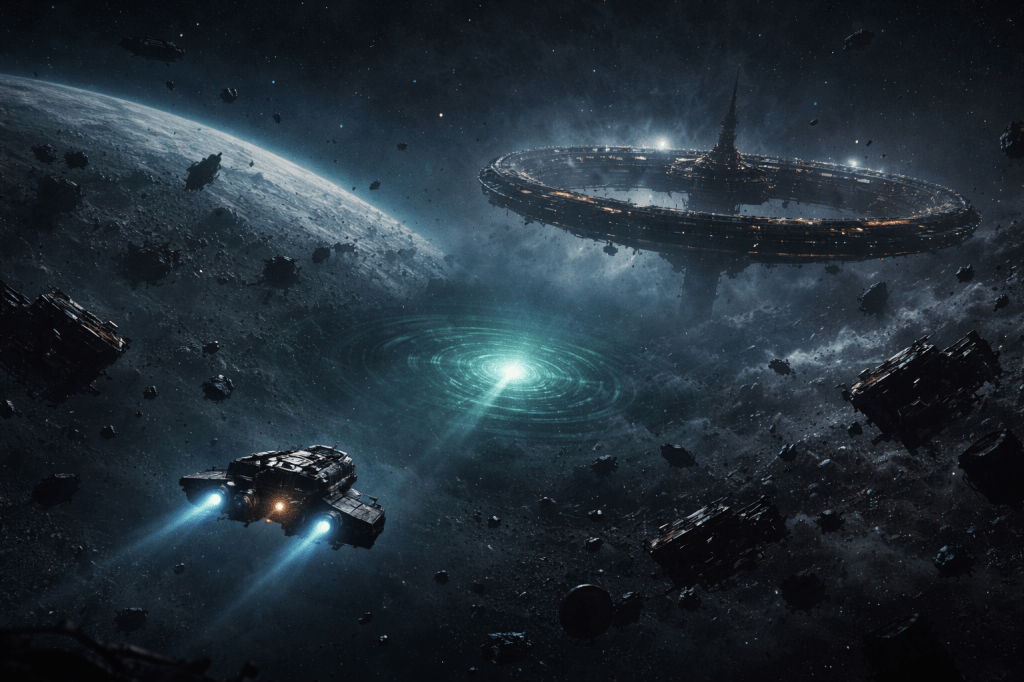
Approach to Ashfall Station rarely carried the drama imagined by those who had never travelled the outer routes of frontier space. For most pilots, the journey ended in a slow glide through the scattered remains of earlier industry, where fragments of forgotten machinery drifted in loose orbit around the silent mining world of Kestren-4. Cargo captains spoke of the region with a mixture of routine familiarity and quiet caution, since the debris field surrounding the station contained the accumulated remains of decades of industrial work. Broken survey satellites, abandoned ore containers, fragments of collapsed relay towers, and the rusting skeletons of transport frames all moved slowly through the dark, forming a shifting boundary that every incoming vessel learned to navigate with patient attention.
The pilot of the freighter Meridian Wake encountered the signal during the final stage of such an approach. Her vessel travelled along the outer navigation corridor that curved gradually toward Ashfall’s docking arms, engines reduced to manoeuvring thrust while the ship’s scanners tracked the larger fragments drifting ahead of the bow. Through the forward observation canopy, the distant ring of the station hung against the black horizon of space, its vast structure illuminated by the soft glow of maintenance lights tracing the circumference of the industrial habitat. Beneath the station, the surface of Kestren-4 rotated slowly through darkness, a barren world whose exhausted mines had once filled Ashfall’s cargo holds with ore during the early years of expansion across the system.
Traffic along the approach route remained quiet during that cycle. Two small salvage craft held position near the outer marker buoys while a long-range ore hauler departed the station’s southern docking spine and accelerated toward the deeper trade lanes beyond the system. Routine communications flowed across the Meridian Wake’s console as navigation systems exchanged positioning data with the station’s control tower. The pilot guided the freighter along the authorised corridor with the calm precision expected of anyone who had spent years crossing the frontier routes, where industrial stations served as the only islands of human presence within vast distances of unoccupied space.
It was during the final scan sweep of the debris field that the first trace of the signal appeared. The anomaly entered the ship’s communication display as a brief distortion across the receiver spectrum, a thin band of transmission energy repeating at regular intervals somewhere beyond the edge of the navigational corridor. At first, the pattern resembled the scattered noise sometimes produced by damaged communication beacons drifting within the debris field, remnants of earlier construction projects whose transmitters continued broadcasting fragments of long obsolete data into empty space. The Meridian Wake’s automated systems attempted to classify the signal within the standard catalogue of known transmissions across the Kestren system, yet the repeating pattern matched none of the frequencies registered within the station’s navigation archives.
The pilot adjusted the receiver gain and watched the signal repeat again across the console display. A narrow pulse travelled through the communication channel, fading into silence before returning several seconds later with the same precise rhythm. Each repetition carried identical amplitude and duration, suggesting a source operating with mechanical consistency somewhere within the drifting field of debris surrounding Ashfall Station. The ship’s long-range scanners turned slowly toward the region indicated by the signal’s directional trace while the navigation computer calculated the relative motion of nearby objects moving through the corridor.
Across the forward canopy, the darkness of the debris field appeared unchanged. Fragments of machinery drifted slowly through the weak gravity of Kestren-4 while Ashfall’s immense ring structure rotated in distant silence above the planet’s dim horizon. Yet the signal continued to repeat across the Meridian Wake’s receiver with quiet persistence, a steady pulse arriving from a point somewhere within the scattered wreckage ahead of the ship.
The pilot opened a routine communication channel with Ashfall Station’s navigation office while transmitting the signal data along with the vessel’s current position within the approach corridor.
“Ashfall Navigation, this is Meridian Wake approaching corridor three,” the pilot said into the bridge transmitter while the freighter continued its measured glide through the drifting debris. “Receiving a repeating transmission within the debris field ahead of the marker buoys. Forwarding signal trace to your console now.”
Several seconds passed before the reply arrived across the communication channel, the calm voice of a navigation officer emerging from the distant control rooms of the station.
“Meridian Wake, Ashfall Navigation receiving your transmission,” the officer answered with the quiet routine of someone accustomed to minor irregularities along the frontier routes. “Stand by while we check beacon registry and external sensor records.”
Reports of unidentified transmissions occasionally appeared within frontier systems where ageing infrastructure lingered long after its original function had faded from memory. In most cases, navigation technicians traced the source to damaged equipment or abandoned satellites still broadcasting faint automated signals through the surrounding vacuum. The pilot expected a similar explanation to emerge once the station’s monitoring systems examined the data arriving from the freighter.
Several minutes passed while the Meridian Wake continued its gradual approach toward the station. The signal repeated twice more during that interval, its narrow pulse crossing the receiver display with unwavering regularity. Ashfall’s navigation officer eventually returned the transmission with confirmation that no registered beacon operated anywhere within the debris field along the ship’s projected path. Automated sensor arrays surrounding the station scanned the indicated coordinates and detected no active transmitter within their range of observation.
For a brief moment, the bridge of the Meridian Wake fell quiet as the pilot studied the communication console where the signal continued to appear with patient rhythm. The freighter drifted between two large fragments of collapsed docking scaffolding while the navigation computer adjusted course to maintain safe distance from the surrounding debris. Beyond the canopy, the lights of Ashfall Station grew slowly brighter as the vessel closed the final kilometres of open space separating it from the docking ring.
The signal returned again, identical in form to each earlier transmission, emerging from the silent debris field where no transmitter had ever been recorded within the station’s operational charts. The navigation officer requested that the pilot maintain the recorded frequency within the receiver while the station’s monitoring systems continued searching the surrounding region for any object capable of generating the repeating pulse.
Across the dark expanse between the drifting fragments of machinery, the invisible source of that signal continued its steady broadcast toward the approaching freighter. It repeated with the same calm precision that would soon draw the attention of every pilot navigating the outer routes toward Ashfall Station.
Station Record: Frontier Navigation Monitoring
Ashfall Station maintained a permanent navigation monitoring system designed to regulate vessel movement through the debris field that surrounded the installation’s outer orbital corridor. The station’s position above the mining world of Kestren-4 placed it within a region crowded by the remains of earlier industrial expansion, where abandoned infrastructure and drifting machinery formed a loose halo of debris extending several thousand kilometres beyond the station’s docking rings. For vessels approaching from the outer trade routes, safe arrival required careful coordination with Ashfall’s navigation office, whose systems tracked both incoming traffic and the gradual movement of the debris field itself.
The debris surrounding the station consisted largely of industrial remnants dating from the early decades of the Kestren mining operations. When the system’s ore extraction projects expanded rapidly, construction crews deployed large numbers of relay platforms, cargo transfer frames, survey satellites, and automated mining equipment throughout the orbital zone above the planet. Many of these structures eventually fell into disuse as production declined across the system. Over time, the abandoned equipment fragmented into drifting clusters of metal framework that continued to orbit within the gravitational influence of Kestren-4.
To manage this environment, Ashfall Station established a network of navigational corridors marked by automated beacon buoys positioned along the safest approach routes toward the docking arms. Incoming vessels aligned their approach vectors with these corridors while the station’s control tower monitored traffic through a combination of radar systems, optical tracking arrays, and long-range communication receivers capable of detecting transmissions across the surrounding orbital space.
Although these monitoring systems provided extensive coverage across the region, Ashfall’s navigation personnel frequently encountered irregular signals produced by ageing infrastructure still drifting within the debris field. Damaged communication relays and obsolete survey satellites occasionally continued broadcasting fragments of automated transmissions long after their original control networks had ceased functioning. Most such signals were catalogued within the station’s archival records and rarely attracted attention beyond routine maintenance reports.
Archived navigation logs indicate that the freighter Meridian Wake reported a repeating transmission while travelling through the outer approach corridor during a routine arrival cycle. Initial analysis of the signal failed to match any registered beacon frequency operating within the station’s navigation registry. Sensor arrays surrounding Ashfall Station conducted a wide scan of the coordinates supplied by the vessel and confirmed that no active transmitter appeared within the detection range of the station’s monitoring equipment.
At the time the report was filed, the signal was classified as an unidentified transmission anomaly originating somewhere within the debris field beyond the approach corridor. Ashfall Station continued its standard docking operations throughout the cycle while navigation personnel opened a routine investigation into the source of the signal detected during the freighter’s approach.
About the Creator

The Future Chronicle is written and curated by Simon Phillips, a writer of science fiction and speculative storytelling who explores the quiet edges of human expansion, where ageing stations, distant worlds, and forgotten technologies continue their slow existence beyond the reach of the central worlds.
Many of the stories presented in these Chronicles exist within a wider fictional universe that follows the lives of investigators, engineers, and frontier workers living far from the comfort of the inner systems, where the machinery of civilisation continues to function long after its original purpose has begun to fade.
One such story unfolds aboard Ashfall Station, an ageing orbital installation whose corridors and industrial sectors form the setting for the science-fiction mystery novella Ashfall Station: The Dead Girl in Sector Twelve. What begins as a routine investigation gradually reveals that something hidden within the station’s structure may have been present for far longer than the official records suggest.
Readers who wish to explore the full investigation and its unfolding events can find the novella below.
Explore the book:
Ashfall Station: The Dead Girl in Sector Twelve
You can watch his YouTube channel here:
Author Simon Phillips
Continuing the Chronicle
The following Chronicle reconstructs the approach of the freighter Meridian Wake during the arrival cycle when pilots travelling through the outer debris field first reported a repeating signal drifting somewhere beyond Ashfall Station’s navigation corridors.
At the time the transmission appeared to be little more than an unidentified anomaly detected by a single vessel during routine approach procedures. Navigation officers reviewing the report recorded no registered transmitter within the surrounding debris field, and the station’s sensor arrays detected no active beacon operating within the region identified by the freighter’s communication logs.
Later examination of archived navigation records suggests that this brief encounter may represent one of the earliest documented observations of the signal that would gradually become known among pilots travelling the outer routes toward Ashfall Station.
Readers supporting The Future Chronicle can continue the record below.

Subscribe to continue reading
Subscribe to get access to the rest of this post and other subscriber-only content.
