The Future Chronicle: The Expansion Project

When new construction connected with Ashfall Station’s forgotten sectors, engineers discovered that the station had not been built as a single structure, but layered over something far older.
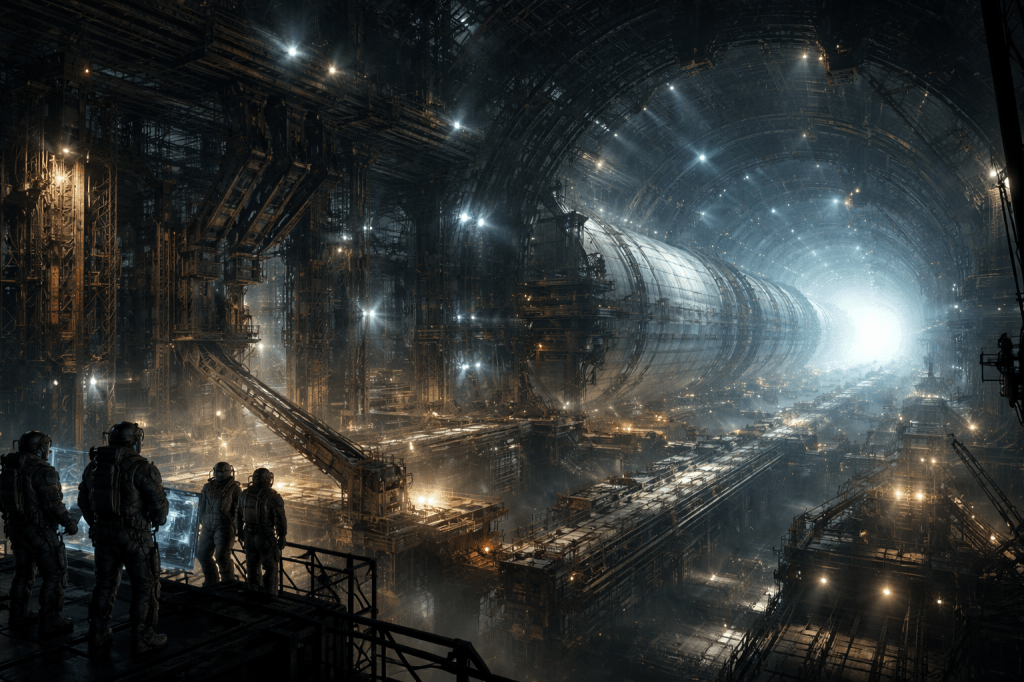

The First Frame of Expansion

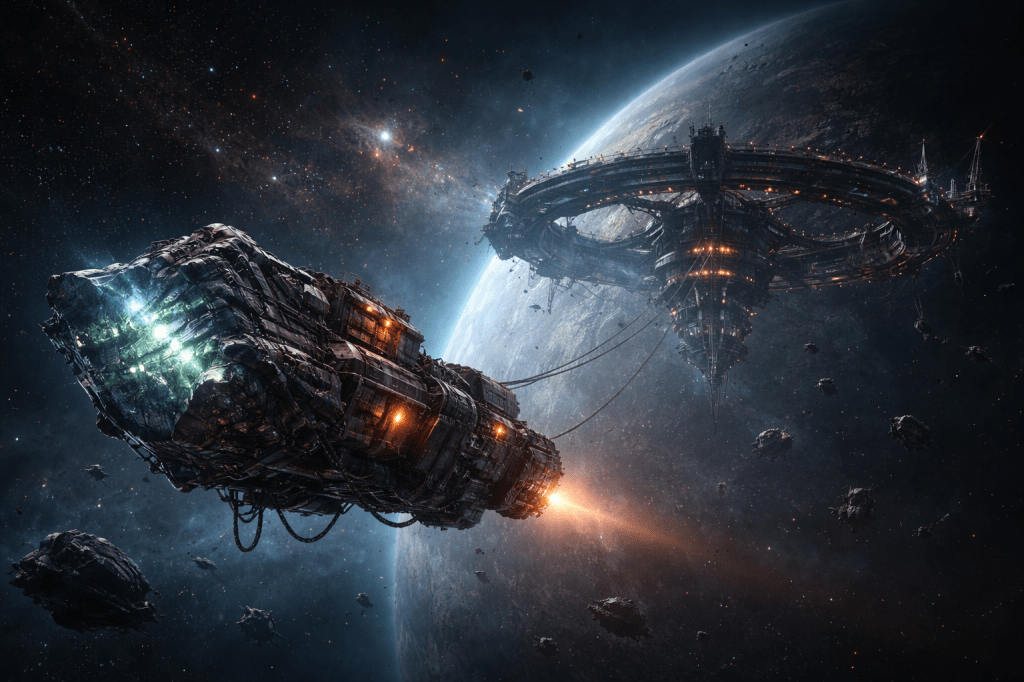
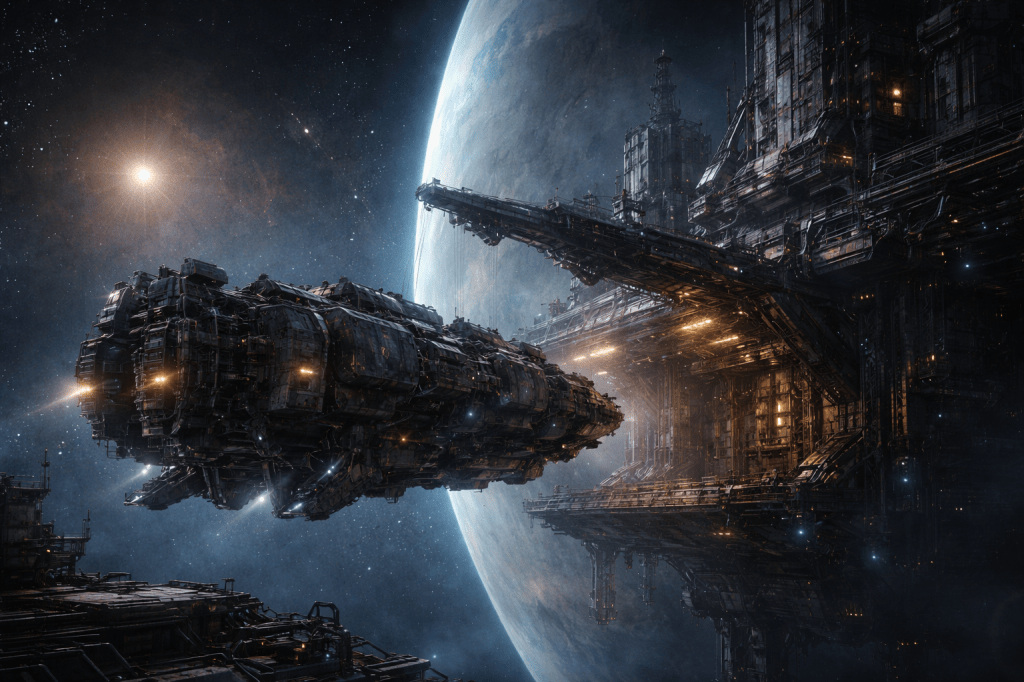
The first structural frame arrived in silence, carried along Ashfall’s outer ring by a convoy of slow-moving construction tugs whose engines burned with a steady blue light against the darkness. From a distance, the framework appeared almost delicate, a skeletal lattice of reinforced trusses extending across open space, its geometry holding a precision the station itself had long since surrendered.

Inside the observation deck, Senior Structural Engineer Halren Voss stood with his hands resting against the glass and watched the frame draw closer with a focus that had sharpened over the course of the last cycle. The expansion had been approved months earlier and passed through Fleet infrastructure review with unusual efficiency, its purpose stated in clear terms that required little interpretation. Ashfall would expand its cargo capacity, reinforce its ageing structural spine, and extend its operational lifespan deeper into the Kestren system, all of which made sense on paper, even as the timing carried a quiet insistence that felt closer to instruction than maintenance.

The tugs aligned with the outer docking struts in careful sequence, each movement controlled through a series of micro-adjustments that compensated for Ashfall’s uneven rotational drift. Voss followed the alignment metrics scrolling across his comm display while noting the minor corrections required to stabilise the frame against the station’s existing mass, aware that even here, at the edge of expansion, Ashfall resisted precision, its structure carrying subtle deviations that no amount of recalibration ever fully resolved.

“Alignment within tolerance,” a voice reported behind him, the words settling into the background hum of the deck as part of a routine that had already begun to feel rehearsed.

Voss inclined his head without turning, his attention still fixed on the approaching frame as he spoke. “Log the variance. I want the full correction profile before integration begins.” The technician acknowledged before stepping away, leaving him alone with the slow, deliberate arrival of something new that seemed almost out of place against the station’s accumulated imperfections.

For a moment, the contrast unsettled him in a way he could not immediately define. The frame remained exact in its construction, its lines following specification without drift, each segment fabricated to tolerances Ashfall’s older sections could no longer match. Against it, the station revealed its age more clearly than any maintenance report ever had, layers of repair and reinforcement visible even at this distance, each applied at a slightly different angle and each solving a problem that had already replaced an earlier one.

The thought formed gradually as he watched, settling into place with quiet weight as he recognised that Ashfall had never been built as a single structure, but instead had grown over time, accumulating its form through necessity rather than design. Once that understanding surfaced, it refused to leave, colouring the way he now saw every junction, every seam, every correction layered over the last.

He turned away from the observation deck once the first frame locked into position, the heavy clang of magnetic couplings echoing faintly through the hull as the structure connected with the station’s outer ring. The sound travelled further than expected, carrying through the corridors with a depth that suggested the impact had been received by more than the immediate junction, as though something within the station had answered in return.

Construction always carried sound, yet this felt different in a way that lingered beyond the moment. Although Voss dismissed the impression, he found that it remained with him as he moved towards the access lift. His next task already formed in sequence, as integration required verification, and verification required proximity, drawing him down towards the mid-ring’s older support corridors where decades of incremental modification had taken place without comprehensive review.

The lift descended through layers of the station that grew progressively less refined, the lighting shifting from steady white to the familiar flicker of ageing strips that hummed with uneven power draw. Voss watched the deck indicators count down while noting the subtle changes in air pressure and temperature that marked each transition between sectors, each layer carrying its own atmosphere shaped by use, repair, and neglect.

When the doors opened, the corridor beyond carried the quiet weight of long use. Reinforcement ribs lined the walls at irregular intervals, their surfaces marked by overlapping weld seams that told the story of previous adjustments, while cable conduits ran exposed along the ceiling, their routing altered and rerouted so many times that no single path remained original, giving the space a sense of accumulated decisions rather than planned design.

He stepped out into the corridor and paused, allowing his eyes to settle into the lower light as a small team of engineers waited near the junction hatch, their tools arranged in careful order along the bulkhead. They straightened as he approached, their expressions attentive and restrained, as though the space itself encouraged caution and discouraged unnecessary movement.

“Status,” Voss said, his voice carrying just enough authority to settle the room without disrupting its quiet.

“Preliminary scan complete,” the lead technician replied. “Structural integrity within acceptable limits, though internal mapping diverges from archived schematics.” The phrasing carried a hesitation that suggested the words had been chosen with care.

Voss considered that for a moment, his gaze drifting towards the sealed hatch that marked the boundary between active infrastructure and the older layers beneath. “Define diverges,” he said, and the technician hesitated again before bringing up a projection on his handheld display.

“The original construction maps show a continuous support corridor beyond this point,” he explained. “Yet current scans indicate interruptions. Voids where material should exist.” The explanation settled uneasily in the confined space.

“Damage,” Voss said, the word offered as a possibility rather than a conclusion.

“Possibly,” the technician replied, “though the edges appear too regular for collapse,” and the distinction lingered between them with quiet weight.

Voss stepped closer to the hatch and ran his hand along the seam where the newer locking mechanism met the older structure, the metal cool beneath his fingers and smooth where it had been recently reinforced. Beneath that, he sensed the older material, a subtle difference in density that suggested a different fabrication process entirely, one that belonged to an earlier stage of the station’s development.

“When was this section last accessed?” he asked, keeping his tone even as he traced the seam.

“Records indicate closure during the second expansion phase,” the technician said. “Approximately forty years ago,” and the span of time settled into the corridor as something more than a number.

Forty years was long enough for a space to fall out of memory while still remaining part of the structure, long enough for records to lose context even when they remained intact. Voss felt that weight as he withdrew his hand and gave the instruction to open the hatch.

The team moved with practised efficiency, tools engaging with the locking mechanism as power was redirected to disengage the seal. The process took longer than expected, as the system resisted in small ways that required manual override at several stages, and when the final lock released, the hatch shifted inward with a low, reluctant sound that echoed into the space beyond.

The corridor on the other side lay in darkness. Voss activated his light before stepping through, the beam cutting across a passage that extended further than the archived schematics had suggested. The walls bore the same reinforcement pattern as the active corridor, yet with weld seams that appeared older and less precise, their edges softened by time and exposure.

He advanced slowly, his attention fixed on the details that emerged within the light, and as he moved further into the corridor, the differences began to resolve into something more deliberate than simple variation. The floor plating shifted in alignment so that its edges met at angles that no longer corresponded to the station’s standard grid.

One of the engineers spoke quietly behind him, drawing attention to the same detail, yet Voss remained focused as he crouched and ran his light along the seam between two plates, the join holding firm and the structure remaining sound even as the orientation suggested an alternate reference point that the station’s current systems no longer recognised.

“Bring up the grid overlay,” he said, and when the technician complied, the discrepancy became immediately clear as the projected grid failed to align with the plating beneath their feet, revealing that the corridor followed a different structure altogether.

Voss rose slowly, the earlier thought returning with greater weight as he turned and scanned the corridor’s length, the beam of his light revealing further inconsistencies as junction points appeared where none should exist, and conduits entered the walls at angles that bypassed standard routing protocols before disappearing into spaces the maps no longer acknowledged.

The technician spoke again, his voice lower now, suggesting that these sections had been modified after initial construction. Voss answered quietly that the changes might have come before, and the possibility settled into the space with a silence that carried more meaning than any confirmation could have provided.

Behind them, the open hatch framed the brighter corridor of the active station, its light spilling into the darkness without fully dispersing it, and the boundary felt sharper now, marking more than a division between old and new as the integration plans began to shift in implication.

The technician began outlining the structural requirements for anchoring along this axis, explaining how the deviations would alter load distribution beyond projected tolerance. Voss listened before instructing him to hold, stepping further into the corridor as the pattern continued to unfold, each segment reinforcing the sense that the station’s deeper layers followed a logic no longer present in its current design.

The maps had recorded something else, or they had been altered, and the uncertainty carried its own weight as Voss reached the first junction and paused, his light tracing the outline of a sealed access panel set into the wall, its surface unmarked and smooth, reflecting the beam back at him in muted tones that revealed nothing of what lay beyond.

He placed his hand against it and remained still as a faint vibration passed through the metal, subtle enough to be dismissed as background activity, yet steady enough to hold his attention, the rhythm repeating with a precision that felt measured rather than incidental.

Voss kept his hand in place for a moment longer before withdrawing it, aware of the team watching him from the corridor behind, and when he spoke again, his voice carried the weight of a decision that extended beyond immediate procedure as he called for a full survey of the section, making it clear that integration would not proceed until they understood what they were connecting to.

The technician nodded, relief visible in the motion as though the instruction aligned with an unease he had been unwilling to voice, and Voss turned back towards the open hatch where the light from the active corridor spilled across the threshold, pausing for a moment between the older structure behind him and the newer station ahead.

The expansion had been designed to strengthen Ashfall, yet what it revealed suggested that the station’s foundation carried more than its current systems could account for, and whatever lay within those deeper layers had remained undisturbed until something new attempted to connect to it again.

The light flickered once as he stepped back through the hatch, the corridor beyond settling into its familiar hum while the darkness behind remained unchanged, holding its shape without resistance as though the brief intrusion had made no difference at all, and although Voss did not look back, he carried the pattern with him, its quiet repetition remaining long after the corridor returned to routine.

The expansion had only just begun, and Ashfall had already begun to answer.


Station Record: Expansion Junction Survey; Mid-Ring Structural Integration

Ashfall Station maintained extensive structural archives documenting the layered growth of the installation across successive decades of expansion above the mining world of Kestren-4. From its earliest function as an industrial transfer platform, the station evolved through repeated phases of reinforcement and outward development. Each stage embedded earlier infrastructure within newer construction. Over time, this created a dense internal framework in which modern systems frequently intersected with structural elements originating from the station’s initial industrial period.

The mid-ring support corridors selected for the Expansion Project belonged to one of these transitional layers. These sections formed part of the station’s secondary structural network, designed to distribute load between the outer docking assemblies and the central habitation rings. While still active in a limited capacity, many of these corridors had undergone decades of incremental modification, resulting in a structural profile that differed in detail from the original construction schematics.

Fleet-approved expansion plans required several new structural frameworks to be anchored along these mid-ring junction points. The objective was to extend Ashfall’s cargo handling capacity while reinforcing stress-bearing segments of the station’s ageing superstructure. Integration of the new frameworks depended on accurate alignment with the existing load distribution grid, necessitating detailed engineering surveys of each proposed connection site prior to structural attachment.

During one such survey cycle, engineering teams assigned to a designated junction corridor reported inconsistencies between archived schematics and real-time structural scans. Initial mapping indicated that the corridor extended beyond its documented termination point, with internal geometry diverging from the station’s standard grid alignment. Sections of plating and subframe support appeared to follow an alternate structural orientation, suggesting modification outside recorded parameters.

Further inspection revealed that portions of the underlying framework could not be reconciled with any phase of construction listed within the station’s accessible engineering archives. The deviations presented as continuous structural elements rather than isolated damage or degradation, indicating that the corridor had either been reconfigured during an undocumented phase of development or preserved from an earlier configuration that had not been carried forward into modern records.

At a primary junction node within the surveyed section, engineers identified a sealed access panel embedded within the wall structure. The panel bore no identification markings and did not correspond to any registered access point within the station’s current infrastructure database. Surface analysis indicated that the panel had remained in place for an extended period, with no evidence of recent interaction or maintenance.

Manual contact with the panel during inspection produced reports of low-level vibrational activity within the surrounding structure. These readings were initially attributed to standard background operation within adjacent systems, though their regularity prompted further notation within the survey log. The source of the vibration could not be isolated through standard diagnostic procedures available to the engineering team at that time.

Following these findings, the engineering department submitted a request to delay structural integration at the affected junction point, pending further analysis. The presence of undocumented structural elements, combined with the discovery of a sealed access panel lacking registry reference, introduced variables that could not be accounted for within the original expansion parameters.

Archived records indicate that the request for extended survey and verification was transmitted through standard channels to Fleet infrastructure authorities shortly after the initial findings were logged. Integration procedures at the identified junction were subsequently placed under temporary suspension while awaiting further instruction.

No additional clarification regarding the structural discrepancies was appended to the public engineering archive for that cycle.


About the Creator

The Future Chronicle is written and curated by Simon Phillips, a writer of science fiction and speculative storytelling who explores the quiet edges of human expansion, where ageing stations, distant worlds, and forgotten technologies continue their slow existence beyond the reach of the central worlds.

Many of the stories presented in these Chronicles exist within a wider fictional universe that follows the lives of investigators, engineers, and frontier workers living far from the comfort of the inner systems, where the machinery of civilisation continues to function long after its original purpose has begun to fade.

One such story unfolds aboard Ashfall Station, an ageing orbital installation whose corridors and industrial sectors form the setting for the science-fiction mystery novella Ashfall Station: The Dead Girl in Sector Twelve. What begins as a routine investigation gradually reveals that something hidden within the station’s structure may have been present for far longer than the official records suggest.

Readers who wish to explore the full investigation and its unfolding events can find the novella below.

Explore the book:
Ashfall Station: The Dead Girl in Sector Twelve

You can watch his YouTube channel here:
Author Simon Phillips

Continuing the Chronicle

The following Chronicle continues the reconstruction of the early expansion works carried out across Ashfall Station’s mid-ring support corridors, where engineering teams first began integrating new structural frameworks with sections of the station that had remained unchanged for decades.

At the time, the Expansion Project was recorded as a necessary reinforcement effort, intended to stabilise ageing infrastructure while extending the station’s cargo capacity across the Kestren system. Such work required frequent interaction with older structural layers, and it was not uncommon for engineering crews to encounter deviations between archived schematics and the station’s physical form. These irregularities were typically attributed to incremental modifications carried out during earlier phases of construction.

The survey conducted at the designated junction point revealed a more persistent inconsistency. Structural elements within the corridor followed an alignment that diverged from the station’s established grid, while underlying framework segments could not be traced to any documented phase of development within the accessible engineering archives. The discovery of a sealed access panel embedded within this section, absent from all modern records, suggested that portions of Ashfall’s deeper infrastructure had been altered, preserved, or removed from official documentation entirely.

Later examination of archived survey logs indicated that the findings recorded during this phase of the Expansion Project marked the first instance in which engineering teams encountered structural continuity that extended beyond the station’s recognised construction history.

Readers supporting The Future Chronicle can continue the record below.

Subscribe to continue reading

Subscribe to get access to the rest of this post and other subscriber-only content.
The Future Chronicle: The Signal in the Debris Field

Frontier pilots approaching Ashfall Station begin reporting a repeating signal drifting through the outer debris field, even though station navigation confirms that no transmitter exists anywhere within the surrounding orbital space.


The Signal in the Debris Field

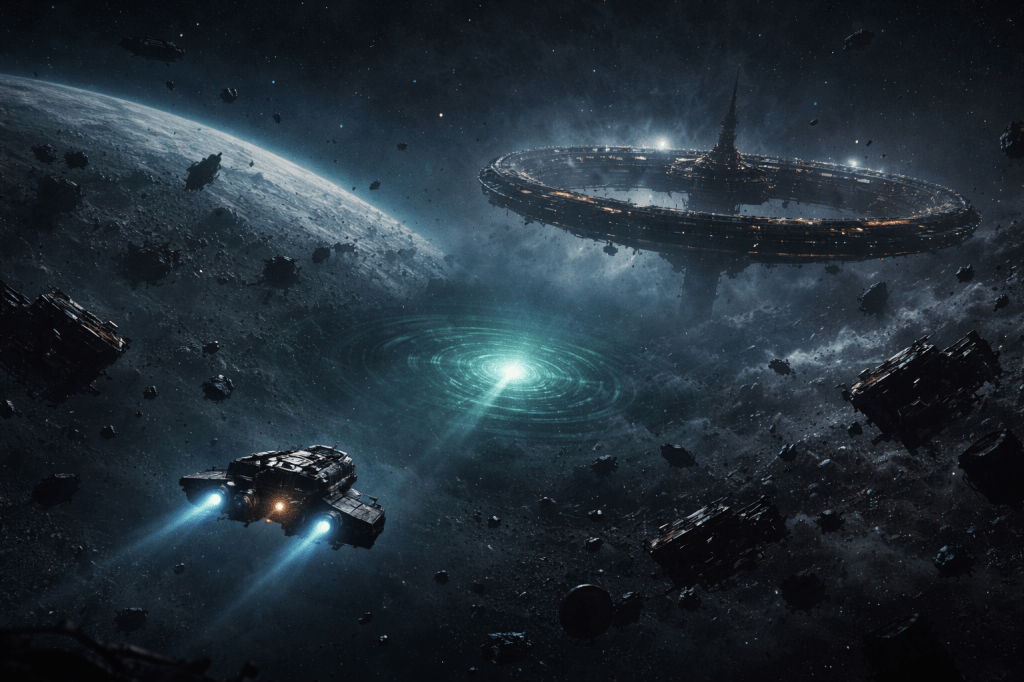
Approach to Ashfall Station rarely carried the drama imagined by those who had never travelled the outer routes of frontier space. For most pilots, the journey ended in a slow glide through the scattered remains of earlier industry, where fragments of forgotten machinery drifted in loose orbit around the silent mining world of Kestren-4. Cargo captains spoke of the region with a mixture of routine familiarity and quiet caution, since the debris field surrounding the station contained the accumulated remains of decades of industrial work. Broken survey satellites, abandoned ore containers, fragments of collapsed relay towers, and the rusting skeletons of transport frames all moved slowly through the dark, forming a shifting boundary that every incoming vessel learned to navigate with patient attention.

The pilot of the freighter Meridian Wake encountered the signal during the final stage of such an approach. Her vessel travelled along the outer navigation corridor that curved gradually toward Ashfall’s docking arms, engines reduced to manoeuvring thrust while the ship’s scanners tracked the larger fragments drifting ahead of the bow. Through the forward observation canopy, the distant ring of the station hung against the black horizon of space, its vast structure illuminated by the soft glow of maintenance lights tracing the circumference of the industrial habitat. Beneath the station, the surface of Kestren-4 rotated slowly through darkness, a barren world whose exhausted mines had once filled Ashfall’s cargo holds with ore during the early years of expansion across the system.

Traffic along the approach route remained quiet during that cycle. Two small salvage craft held position near the outer marker buoys while a long-range ore hauler departed the station’s southern docking spine and accelerated toward the deeper trade lanes beyond the system. Routine communications flowed across the Meridian Wake’s console as navigation systems exchanged positioning data with the station’s control tower. The pilot guided the freighter along the authorised corridor with the calm precision expected of anyone who had spent years crossing the frontier routes, where industrial stations served as the only islands of human presence within vast distances of unoccupied space.

It was during the final scan sweep of the debris field that the first trace of the signal appeared. The anomaly entered the ship’s communication display as a brief distortion across the receiver spectrum, a thin band of transmission energy repeating at regular intervals somewhere beyond the edge of the navigational corridor. At first, the pattern resembled the scattered noise sometimes produced by damaged communication beacons drifting within the debris field, remnants of earlier construction projects whose transmitters continued broadcasting fragments of long obsolete data into empty space. The Meridian Wake’s automated systems attempted to classify the signal within the standard catalogue of known transmissions across the Kestren system, yet the repeating pattern matched none of the frequencies registered within the station’s navigation archives.

The pilot adjusted the receiver gain and watched the signal repeat again across the console display. A narrow pulse travelled through the communication channel, fading into silence before returning several seconds later with the same precise rhythm. Each repetition carried identical amplitude and duration, suggesting a source operating with mechanical consistency somewhere within the drifting field of debris surrounding Ashfall Station. The ship’s long-range scanners turned slowly toward the region indicated by the signal’s directional trace while the navigation computer calculated the relative motion of nearby objects moving through the corridor.

Across the forward canopy, the darkness of the debris field appeared unchanged. Fragments of machinery drifted slowly through the weak gravity of Kestren-4 while Ashfall’s immense ring structure rotated in distant silence above the planet’s dim horizon. Yet the signal continued to repeat across the Meridian Wake’s receiver with quiet persistence, a steady pulse arriving from a point somewhere within the scattered wreckage ahead of the ship.

The pilot opened a routine communication channel with Ashfall Station’s navigation office while transmitting the signal data along with the vessel’s current position within the approach corridor.

“Ashfall Navigation, this is Meridian Wake approaching corridor three,” the pilot said into the bridge transmitter while the freighter continued its measured glide through the drifting debris. “Receiving a repeating transmission within the debris field ahead of the marker buoys. Forwarding signal trace to your console now.”

Several seconds passed before the reply arrived across the communication channel, the calm voice of a navigation officer emerging from the distant control rooms of the station.

“Meridian Wake, Ashfall Navigation receiving your transmission,” the officer answered with the quiet routine of someone accustomed to minor irregularities along the frontier routes. “Stand by while we check beacon registry and external sensor records.”

Reports of unidentified transmissions occasionally appeared within frontier systems where ageing infrastructure lingered long after its original function had faded from memory. In most cases, navigation technicians traced the source to damaged equipment or abandoned satellites still broadcasting faint automated signals through the surrounding vacuum. The pilot expected a similar explanation to emerge once the station’s monitoring systems examined the data arriving from the freighter.

Several minutes passed while the Meridian Wake continued its gradual approach toward the station. The signal repeated twice more during that interval, its narrow pulse crossing the receiver display with unwavering regularity. Ashfall’s navigation officer eventually returned the transmission with confirmation that no registered beacon operated anywhere within the debris field along the ship’s projected path. Automated sensor arrays surrounding the station scanned the indicated coordinates and detected no active transmitter within their range of observation.

For a brief moment, the bridge of the Meridian Wake fell quiet as the pilot studied the communication console where the signal continued to appear with patient rhythm. The freighter drifted between two large fragments of collapsed docking scaffolding while the navigation computer adjusted course to maintain safe distance from the surrounding debris. Beyond the canopy, the lights of Ashfall Station grew slowly brighter as the vessel closed the final kilometres of open space separating it from the docking ring.

The signal returned again, identical in form to each earlier transmission, emerging from the silent debris field where no transmitter had ever been recorded within the station’s operational charts. The navigation officer requested that the pilot maintain the recorded frequency within the receiver while the station’s monitoring systems continued searching the surrounding region for any object capable of generating the repeating pulse.

Across the dark expanse between the drifting fragments of machinery, the invisible source of that signal continued its steady broadcast toward the approaching freighter. It repeated with the same calm precision that would soon draw the attention of every pilot navigating the outer routes toward Ashfall Station.


Station Record: Frontier Navigation Monitoring

Ashfall Station maintained a permanent navigation monitoring system designed to regulate vessel movement through the debris field that surrounded the installation’s outer orbital corridor. The station’s position above the mining world of Kestren-4 placed it within a region crowded by the remains of earlier industrial expansion, where abandoned infrastructure and drifting machinery formed a loose halo of debris extending several thousand kilometres beyond the station’s docking rings. For vessels approaching from the outer trade routes, safe arrival required careful coordination with Ashfall’s navigation office, whose systems tracked both incoming traffic and the gradual movement of the debris field itself.

The debris surrounding the station consisted largely of industrial remnants dating from the early decades of the Kestren mining operations. When the system’s ore extraction projects expanded rapidly, construction crews deployed large numbers of relay platforms, cargo transfer frames, survey satellites, and automated mining equipment throughout the orbital zone above the planet. Many of these structures eventually fell into disuse as production declined across the system. Over time, the abandoned equipment fragmented into drifting clusters of metal framework that continued to orbit within the gravitational influence of Kestren-4.

To manage this environment, Ashfall Station established a network of navigational corridors marked by automated beacon buoys positioned along the safest approach routes toward the docking arms. Incoming vessels aligned their approach vectors with these corridors while the station’s control tower monitored traffic through a combination of radar systems, optical tracking arrays, and long-range communication receivers capable of detecting transmissions across the surrounding orbital space.

Although these monitoring systems provided extensive coverage across the region, Ashfall’s navigation personnel frequently encountered irregular signals produced by ageing infrastructure still drifting within the debris field. Damaged communication relays and obsolete survey satellites occasionally continued broadcasting fragments of automated transmissions long after their original control networks had ceased functioning. Most such signals were catalogued within the station’s archival records and rarely attracted attention beyond routine maintenance reports.

Archived navigation logs indicate that the freighter Meridian Wake reported a repeating transmission while travelling through the outer approach corridor during a routine arrival cycle. Initial analysis of the signal failed to match any registered beacon frequency operating within the station’s navigation registry. Sensor arrays surrounding Ashfall Station conducted a wide scan of the coordinates supplied by the vessel and confirmed that no active transmitter appeared within the detection range of the station’s monitoring equipment.

At the time the report was filed, the signal was classified as an unidentified transmission anomaly originating somewhere within the debris field beyond the approach corridor. Ashfall Station continued its standard docking operations throughout the cycle while navigation personnel opened a routine investigation into the source of the signal detected during the freighter’s approach.


About the Creator

The Future Chronicle is written and curated by Simon Phillips, a writer of science fiction and speculative storytelling who explores the quiet edges of human expansion, where ageing stations, distant worlds, and forgotten technologies continue their slow existence beyond the reach of the central worlds.

Many of the stories presented in these Chronicles exist within a wider fictional universe that follows the lives of investigators, engineers, and frontier workers living far from the comfort of the inner systems, where the machinery of civilisation continues to function long after its original purpose has begun to fade.

One such story unfolds aboard Ashfall Station, an ageing orbital installation whose corridors and industrial sectors form the setting for the science-fiction mystery novella Ashfall Station: The Dead Girl in Sector Twelve. What begins as a routine investigation gradually reveals that something hidden within the station’s structure may have been present for far longer than the official records suggest.

Readers who wish to explore the full investigation and its unfolding events can find the novella below.

Explore the book:
Ashfall Station: The Dead Girl in Sector Twelve

You can watch his YouTube channel here:
Author Simon Phillips


Continuing the Chronicle

The following Chronicle reconstructs the approach of the freighter Meridian Wake during the arrival cycle when pilots travelling through the outer debris field first reported a repeating signal drifting somewhere beyond Ashfall Station’s navigation corridors.

At the time the transmission appeared to be little more than an unidentified anomaly detected by a single vessel during routine approach procedures. Navigation officers reviewing the report recorded no registered transmitter within the surrounding debris field, and the station’s sensor arrays detected no active beacon operating within the region identified by the freighter’s communication logs.

Later examination of archived navigation records suggests that this brief encounter may represent one of the earliest documented observations of the signal that would gradually become known among pilots travelling the outer routes toward Ashfall Station.

Readers supporting The Future Chronicle can continue the record below.

Subscribe to continue reading

Subscribe to get access to the rest of this post and other subscriber-only content.
Ashfall Station Chronicle: The Salvage Run

A salvage vessel returning from the silent debris field delivers a fragment that does not appear in any Fleet registry.


The Salvage Run Beyond the Debris Perimeter

The salvage vessel Kestrel Drift emerged slowly from the outer debris field, with engines glowing a faint amber against the darkness. Its heavy hull moved with the deliberate patience of a ship that had travelled far beyond the mapped traffic lanes surrounding Kestren-4. Far ahead, the vast ring of Ashfall Station turned in silent orbit above the pale curve of the exhausted mining world. Its long industrial spines caught thin starlight while docking lights burned like distant embers along the station’s outer arms. Around the vessel, fragments of abandoned machinery and forgotten satellites drifted through the wide expanse of the system’s outer graveyard. These were remnants of earlier decades when cargo fleets and refinery platforms filled this region with activity that had long since faded into quiet isolation. The deeper edges of the debris field stretched outward into a quieter region of orbit, where salvage crews occasionally ventured in search of forgotten structures whose value lay hidden beneath years of drifting metal and silence.

Captain Elia Marr stood beside the forward observation console while the ship’s navigation system guided their slow return trajectory toward the station’s approach corridor. Her attention remained fixed upon the massive structure secured within the vessel’s external tow frame. The object followed the salvage ship through space with unsettling stillness, its surface reflecting faint bands of light across plates of metal whose design resembled no vessel recorded within the station registry. Salvage crews recovered thousands of fragments across the debris perimeter each year, pieces of forgotten cargo carriers or broken relay towers scattered across the long history of frontier industry. This fragment carried a different presence entirely. It was an immense cylinder of dark alloy whose structure appeared older than the wreckage surrounding it, its edges carved with patterns that drifted across the surface like weathered markings left behind by an unknown engineering language.

The discovery had occurred several hours earlier during a routine sweep along the fading edge of the debris perimeter, where the density of wreckage fell away into the darker reaches of the system’s outer orbit. The Kestrel Drift had traced its scanning pattern through a cloud of drifting relay antennae and shattered docking pylons when the object appeared upon the ship’s long-range sensors. Its dense mass stood out among the scattered fragments of abandoned industry. At first Marr assumed the reading belonged to the broken core of a transport module whose hull plating had collapsed long ago. When the ship closed the distance, the fragment revealed itself as something far stranger. It was an intact structure rotating slowly through open space, as though it had arrived from somewhere far beyond the ordinary boundaries of the debris field.

Inside the cockpit, the ship’s systems hummed steadily while Kestrel Drift advanced toward Ashfall Station, with its unusual cargo trailing silently behind. Marr allowed her gaze to follow the faint glow emanating from narrow seams running along the fragment’s exterior. Those lights pulsed at irregular intervals, subtle shifts of colour moving through the object’s surface in a pattern that resisted simple explanation. Salvage crews possessed equipment capable of identifying most known alloys circulating through the frontier systems. Yet every scan performed during the recovery process returned incomplete results, as if the fragment belonged to a category of construction that station registries had never recorded.

“Captain,” the navigation officer said quietly from the secondary console while the sensor displays flickered across his station. “Dock control is requesting cargo classification for the tow frame. They want confirmation before opening Docking Arm Twelve.”

Marr continued watching the fragment drift behind the ship, its dark surface turning slowly through the thin light of distant stars while Ashfall Station grew larger across the forward viewport.

“Transmit standard salvage clearance,” she replied after a moment of consideration. “Independent recovery operation. Unknown industrial fragment recovered beyond the debris perimeter.”

The navigation officer hesitated while entering the classification codes into the communication console. “That description leaves plenty of room for interpretation.”

“Ashfall specialises in interpretation,” Marr said calmly. “Let the station decide what it believes that thing might be.”

Ashfall Station continued its slow rotation ahead while the salvage vessel threaded its course toward Docking Arm Twelve, the station’s long industrial corridor reserved for freight traffic and independent recovery crews returning from the distant wreckage zones. The immense structure filled the viewport with growing detail as the ship advanced through the traffic corridor. It revealed layers of docking arms, maintenance gantries, and habitation sectors that had accumulated across decades of frontier construction. Amber guidance lights flickered along the docking arm while cargo tugs drifted between the outer platforms, guiding freight containers toward interior transit lifts. Life inside the station carried on with the steady rhythm of a place that had endured long enough to become part of the frontier itself.

Docking control acknowledged the vessel’s approach with routine clearance codes, unaware that the salvage ship carried something far older than the frontier installations scattered across the system. Within a few hours, the fragment would pass quietly through the station’s cargo registry and vanish behind sealed research doors deep within Ashfall’s inner decks. It would leave only the faintest trace within the official records of a salvage run that had recovered an object whose origins lay far beyond the station’s forgotten debris fields.


Station Record: Docking Arm Twelve

Station cargo archives record that the independent salvage vessel Kestrel Drift entered the Ashfall traffic corridor during the early maintenance cycle of Sector Rotation 4481. It approached through the outer freight lane used by vessels returning from the distant debris fields surrounding the Kestren system. Docking guidance systems directed the ship toward Docking Arm Twelve, a freight corridor commonly assigned to recovery crews operating beyond the mapped salvage perimeter.

The vessel reported the retrieval of a large unidentified fragment recovered from deep orbit several hundred kilometres beyond the outer debris boundary. Salvage operations within that region occasionally return damaged infrastructure from abandoned industrial platforms or fragments of transport vessels lost during earlier decades of frontier expansion. Initial cargo declarations submitted by the crew of Kestrel Drift classified the object simply as an industrial structure of unknown origin.

Dock control authorised standard recovery clearance and assigned the vessel a temporary cargo transfer window within the station’s external freight platforms. Maintenance records indicate that the fragment remained secured within the vessel’s tow frame during docking. Its transfer required the use of a heavy cargo crane normally reserved for refinery modules and structural salvage recovered from the deeper sectors of the debris field.

Internal station documentation confirms that the object was moved into Ashfall’s cargo network shortly after the vessel completed its docking sequence. Transport logs show the fragment passing through several internal freight elevators before arriving in a sealed research hold located deep within the station’s interior industrial sectors.

Public cargo registry entries referencing the object remained visible within the station’s open records for only a short period. Access to the documentation was then restricted under research authority protocols. Subsequent references to the recovered fragment appear only within internal archive systems accessible to a limited number of station departments.

Within the wider operational records of Ashfall Station, the salvage run conducted by Kestrel Drift appears at first glance to have been routine. Yet later archive reviews would identify this docking record as the earliest documented reference to an object whose arrival quietly altered the future of the station itself.


About the Creator

The Future Chronicle is written and curated by Simon Phillips, a writer of science fiction and speculative storytelling who explores the quiet edges of human expansion, where ageing stations, distant worlds, and forgotten technologies continue their slow existence beyond the reach of the central worlds.

Many of the stories presented in these Chronicles exist within a wider fictional universe that follows the lives of investigators, engineers, and frontier workers living far from the comfort of the inner systems, where the machinery of civilisation continues to function long after its original purpose has begun to fade.

One such story unfolds aboard Ashfall Station, an ageing orbital installation whose corridors and industrial sectors form the setting for the science-fiction mystery novella Ashfall Station: The Dead Girl in Sector Twelve. What begins as a routine investigation gradually reveals that something hidden within the station’s structure may have been present for far longer than the official records suggest.

Readers who wish to explore the full investigation and its unfolding events can find the novella below.

Explore the book:
Ashfall Station: The Dead Girl in Sector Twelve

You can watch his YouTube channel here:
Author Simon Phillips


Continuing the Chronicle

The following Chronicle reconstructs the arrival of the salvage vessel Kestrel Drift at Ashfall Station and the quiet transfer of the unidentified fragment recovered from deep orbit beyond the system’s outer debris field.

Station records describe the event as routine salvage processing. Later archival reviews suggest that the object brought aboard the station that day would become the earliest trace of changes whose significance remained unrecognised for many years.

Readers supporting The Future Chronicle can continue the record below.


The Transfer into the Inner Holds

Docking Arm Twelve extended from the outer industrial ring of Ashfall Station like a long skeletal bridge reaching into the quiet of orbit. Its massive framework was illuminated by rows of amber maintenance lights that cast slow reflections across the drifting freight platforms surrounding the arm’s entrance. Cargo tugs moved through the corridor with the unhurried rhythm of a place accustomed to the steady labour of frontier industry, guiding containers toward loading gantries while station workers in magnetised suits drifted between hull surfaces and scaffold rails that had accumulated across decades of repairs and expansion. Within this immense structure, the arrival of an independent salvage vessel rarely drew more than passing interest. Ashfall’s outer docks received a constant flow of battered transports, survey craft, and recovery ships returning from the wide fields of abandoned machinery that circled the system beyond the mining world below.

The salvage vessel Kestrel Drift entered the docking corridor under guidance thrusters that glowed softly against the dark metal of the arm’s interior walls. Its tow frame carried the recovered fragment with slow and deliberate motion while the station’s automated traffic beacons adjusted the vessel’s path toward the heavy freight platform positioned halfway along the arm. From the observation gallery above the docking grid, a small group of station engineers watched the approach through thick viewing panels whose surfaces bore the faint scratches of earlier decades, when Ashfall still received traffic from the central trade lanes. Among them stood Cargo Supervisor Dalen Rhyse, whose responsibility for coordinating heavy salvage transfers had accustomed him to the strange assortment of objects occasionally dragged in from the deeper reaches of the debris field.

Even from the gallery, the fragment attached to the salvage ship appeared unusual. Salvage debris recovered from the system’s outer perimeter often carried the battered shapes of broken transports or collapsed refinery structures whose origins could be traced through registry numbers etched into their hull plating. The object following the Kestrel Drift revealed no such markings. Its surface displayed broad plates of dark alloy whose faint seams emitted a dull internal glow. The light shifted across the metal with a quiet persistence that unsettled several of the engineers observing the approach.

“That piece came from the outer perimeter?” one of the younger technicians asked while leaning toward the viewing glass.

Rhyse studied the fragment with the patient attention of someone accustomed to measuring unfamiliar salvage against the long catalogue of industrial wreckage that had passed through the station during his years of service.

“According to the docking request,” he replied, his voice carrying the steady calm of routine authority. “Recovered beyond the debris boundary during a deep sweep.”

The technician continued watching the fragment rotate behind the salvage vessel as its strange surface reflected the station lights drifting across Docking Arm Twelve.

“That alloy carries a strange sheen,” he said quietly.

Rhyse allowed a faint smile to cross his expression while the salvage ship completed its slow alignment with the freight platform below.

“Everything looks strange when it drifts in from the graveyard long enough,” he answered. “Give the registry office a few hours and someone will decide which forgotten construction yard left it behind.”

Below the gallery, the heavy clamps of the freight platform locked around the salvage ship’s hull while docking cranes unfolded from their storage housings along the arm’s structural beams. The cranes moved with deliberate strength, extending long articulated arms toward the fragment secured within the vessel’s tow frame while the cargo crew guided the machinery through precise adjustments transmitted from the platform’s control station. Ashfall’s salvage infrastructure had grown formidable across the decades, designed to recover entire refinery segments from the drifting wreckage fields that surrounded the system. Even so, the recovered fragment demanded careful handling. Its dense mass forced the crane operators to adjust the lifting sequence through several cautious increments before the object finally rose free of the salvage ship’s frame.

For a brief moment, the fragment hung suspended within the wide chamber of Docking Arm Twelve. Its strange alloy surface reflected the amber lights that stretched along the arm’s immense corridor. Several workers below paused in their tasks to watch the slow movement of the cargo as the cranes guided it toward the freight platform’s interior rail system.

“Registry classification pending,” one of the control operators announced through the platform intercom while scanning the incomplete data arriving from the salvage crew’s recovery logs. “Temporary designation assigned under unidentified industrial structure.”

The words echoed across the control station with the calm authority of routine cargo processing. No one within the docking arm suspected that the object drifting slowly through the rail corridor carried origins far removed from the abandoned machinery of the debris fields.

The fragment settled onto the transport carriage with a low vibration that travelled through the platform’s framework while the crane arms withdrew into their resting positions. Once secured, the carriage engaged the internal freight rails that connected Docking Arm Twelve with the deeper cargo elevators buried within Ashfall’s industrial sectors. The movement began with a slow metallic shudder as the transport system drew the fragment away from the docking grid and into the long tunnel leading toward the station’s interior.

Rhyse remained beside the observation gallery window while the carriage disappeared into the dim freight corridor beyond the platform.

“Research hold transfer request,” the control operator said after reviewing the cargo routing instructions arriving through the station network. “Authorisation received from the inner systems office.”

One of the engineers raised an eyebrow while glancing toward Rhyse.

“Research division moves quickly,” he remarked.

Rhyse folded his arms across the railing while watching the fading lights of the freight carriage retreat deeper into the station.

“Anything without a clear registry attracts their curiosity,” he replied. “Give them a few days and the piece will return to storage with a catalogue number attached.”

Beyond the walls of Docking Arm Twelve, the transport carriage travelled steadily through the vast mechanical arteries that connected Ashfall’s outer docks with the station’s inner industrial decks. Freight tunnels stretched through layers of steel corridors and maintenance shafts where automated lifts guided cargo between sectors that had grown labyrinthine through years of incremental construction. Few workers travelled these interior routes unless assigned to maintenance duties. The passageways remained silent except for the distant hum of power conduits and the rhythmic movement of the freight system carrying materials across the station’s immense structure.

Within one such tunnel, the carriage bearing the recovered fragment slowed as it approached a sealed bulkhead whose heavy doors protected a research hold rarely accessed by the ordinary cargo network. Security lights along the corridor flickered to life while the carriage halted before the bulkhead’s sensor array. Moments later, the doors parted with a deep mechanical resonance that echoed across the empty passage.

Inside the chamber, the lighting remained dim. It revealed rows of reinforced containment frames designed to secure experimental machinery awaiting analysis by Ashfall’s internal research staff. The carriage advanced through the open bulkhead until the fragment reached the centre of the hold, where automated clamps secured the object within a circular support ring built to stabilise unusually heavy cargo.

As the freight system disengaged and withdrew toward the corridor outside, the bulkhead doors closed once more with the slow finality of a sealed archive chamber returning to silence.

Within the quiet of the research hold, the fragment rested beneath the faint glow of overhead inspection lamps whose pale light revealed subtle patterns etched across the alloy plates forming its surface. The seams running through the object continued their quiet pulsation. Faint shifts of colour moved through the metal like distant signals travelling across the skin of a machine whose purpose remained unrecorded within Ashfall’s official systems.

Elsewhere across the station, the arrival of the salvage ship passed into the long stream of routine events that filled the operational records of frontier installations. Cargo transfers continued across the docks, refinery shipments departed for distant trade routes, and the workers of Ashfall Station carried on with their ordinary lives beneath the rotating structure that circled the silent world of Kestren-4.

Deep within the sealed research chamber, the fragment remained alone within its containment frame. It waited quietly within the station’s vast interior while the earliest movements of a much larger story began to unfold beyond the reach of the records that first attempted to describe its arrival.


The salvage vessel Kestrel Drift approaches Docking Arm Twelve at Ashfall Station, carrying a fragment recovered from deep orbit beyond the system’s outer debris field.


The Idea Behind the Chronicle

Many of the earliest events that shape larger stories begin in moments that appear routine to those who witness them. Frontier stations such as Ashfall receive a constant flow of vessels returning from survey missions, mining expeditions, and salvage runs carried out in the distant debris fields surrounding exhausted industrial worlds. Most of these arrivals pass through the station’s docks with little attention beyond the ordinary procedures of cargo registration and freight transfer.

Salvage crews play a particularly important role within these frontier economies. Operating far beyond the established navigation corridors, their ships recover abandoned machinery, broken transports, and fragments of industrial infrastructure drifting through the quiet regions of orbit where earlier generations of expansion once left their mark. The work is dangerous and frequently uneventful, since the majority of recovered structures prove to be little more than forgotten wreckage left behind by earlier waves of settlement.

The idea behind this Chronicle explores what might happen when one such routine recovery operation returns with something that does not belong to the familiar catalogue of frontier industry. Within the vast mechanical systems of a station like Ashfall, an unusual object can pass quietly through the normal procedures of docking, registration, and research analysis without anyone immediately recognising its true significance.

In historical records, moments like these often appear ordinary when viewed in isolation. Only years later do investigators recognise that the arrival of a single cargo shipment or the discovery of an unidentified fragment marked the beginning of events whose consequences would slowly reshape the future of the station itself.

This Chronicle revisits one such moment in Ashfall’s past, when a salvage vessel returned from deep orbit carrying an object that would soon disappear into the station’s sealed research holds.


From the Author’s Desk

The Chronicle you have just read returns to one of the quieter moments in Ashfall Station’s early history, when a routine salvage operation carried something unusual back from the distant debris fields surrounding the Kestren system. Events like this rarely attract attention when they first occur. A cargo transfer is completed, the object is catalogued, and the station continues its work. Only later do historians begin to notice that certain small records mark the beginning of much larger stories.

Ashfall Station began as a simple image that lingered in my imagination for several years: the idea of an immense industrial structure drifting at the far edge of human space long after the frontier that created it had moved on. Science fiction often grows most naturally from such quiet beginnings, where a single place or moment suggests a much larger history waiting somewhere beyond the visible story.

The Chronicles presented here explore the earlier life of that station, revealing fragments of its past through the people who lived and worked within its corridors. Each episode focuses on a single event or encounter, gradually uncovering how Ashfall evolved from an ordinary frontier installation into a place carrying deeper layers of history hidden within its structure.

The novella Ashfall Station: The Dead Girl in Sector Twelve takes place much later in that timeline, when the station has already accumulated decades of expansion, modification, and quiet mystery. Writing the Chronicle series offers the opportunity to step backwards into that earlier period and observe the smaller moments that shaped the station long before the events of that investigation began.

Alongside these Chronicles I continue writing fiction across several science fiction and speculative projects, many of which explore frontier environments where technology, distance, and human persistence intersect in unexpected ways.

Readers interested in those stories can explore more through the links below.

You can explore my books here::
Books by Simon Phillips

You can watch my YouTube channel here:
Author Simon Phillips


Technical Notes & Frontier Context

Deep Orbit Salvage

Salvage work in frontier systems often extends far beyond the formal navigation corridors used by freight vessels and survey ships. Over time the outer regions of industrial star systems accumulate large fields of abandoned machinery, ranging from broken relay platforms and transport hulls to fragments of mining infrastructure left behind during earlier phases of expansion.

These regions become natural targets for independent recovery crews willing to operate at considerable distance from established ports. Equipped with long-range scanners and heavy tow frames, salvage vessels travel through the quieter edges of orbital space searching for structures whose remaining materials retain economic value. Many discoveries prove mundane, consisting of collapsed hull sections or obsolete machinery drifting through vacuum after decades of neglect.

Occasionally, however, salvage crews encounter objects whose origins remain unclear even after initial scans. In such cases the safest course of action is to transport the structure intact to the nearest frontier station, where specialised equipment and research staff can examine the material under controlled conditions.


Cargo Transfer Systems

Large orbital installations require extensive freight-handling infrastructure capable of moving cargo between external docking arms and the deeper sectors of the station. Heavy salvage items recovered from deep orbit frequently exceed the mass limits of standard loading systems, requiring reinforced cranes, magnetic clamps, and rail-mounted transport platforms designed to guide unusually large structures through the station’s internal freight corridors.

These transport networks function as the industrial arteries of the installation, linking the exposed docking arms with cargo elevators, storage vaults, and research facilities hidden within the station’s interior layers. Much of this machinery operates far from the public habitation districts, occupying maintenance tunnels and structural compartments whose existence remains invisible to most residents.

For stations that serve as salvage hubs, such systems become particularly important. Entire modules of abandoned spacecraft or refinery equipment may pass through these internal corridors on their way to storage or dismantling facilities.


Research Containment

When unidentified technology arrives at a frontier station, the object is normally transferred to a controlled research environment before any attempt is made to dismantle or catalogue its components. These research holds are typically located deep within the station’s interior where structural reinforcement and environmental isolation reduce the risk of accidental damage to surrounding systems.

Containment frameworks inside these chambers allow technicians to stabilise large objects while scanning equipment analyses structural composition and internal energy signatures. The majority of unidentified fragments eventually prove to be rare alloys or unfamiliar industrial designs originating from distant manufacturing centres.

Even so, the precaution of isolating such discoveries reflects a practical understanding common among frontier engineers: objects recovered from deep orbit sometimes carry histories that extend far beyond the debris fields where they are found.


Salvage Stations as Frontier Archives

Over long periods of operation, salvage ports such as Ashfall accumulate a vast and often incomplete archive of technological history. Each recovered fragment represents a small surviving trace of earlier exploration, industrial experimentation, or abandoned infrastructure scattered throughout human space.

Most of these objects eventually disappear into recycling facilities where their materials are reused for new construction. Yet some pieces remain stored within research holds or forgotten storage sectors, preserved simply because no one ever finished the process of analysing them.

In this way a frontier station gradually becomes a layered record of the expansion that created it, carrying within its structure the silent remains of many different eras of human activity.


Next Chronicle

Several hours after the salvage vessel Kestrel Drift completed its docking sequence, the fragment recovered from deep orbit briefly appeared within Ashfall Station’s cargo registry system under a temporary industrial classification.

The entry remained visible for only a short period before access to the record was quietly restricted, leaving behind a small gap in the station’s otherwise meticulous administrative archives.

The next Chronicle returns to that moment inside Ashfall’s cargo offices, where routine registration procedures would produce one of the earliest documented traces of the object whose arrival had already begun to alter the station’s future.

Next Week: The Cargo Registry


Ashfall Station continued its slow orbit above the silent world of Kestren-4, while deep within its inner research holds an unidentified fragment from the distant debris fields rested quietly inside a structure whose long history had only just begun to record its arrival.

Ashfall Station Chronicle: The Station That Should Not Exist

A Fleet inspection mission arrives expecting to close a dying industrial outpost. Instead, the station receives quiet orders for expansion


Chronicle Opening: The Arrival at Ashfall

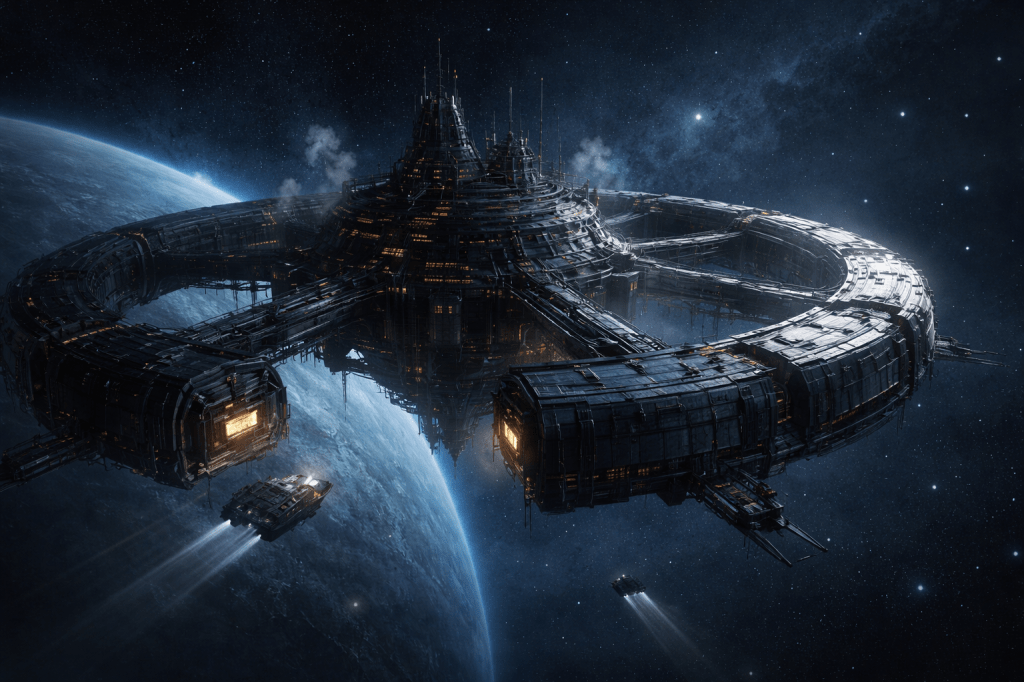
The inspection shuttle drifted through the outer traffic corridor with the slow patience of an ageing machine that had travelled far beyond the routes it once served. Ashfall Station filled the viewport ahead, an immense ring of darkened metal turning in quiet orbit above the pale curve of the planet below. From a distance the structure possessed the appearance of a relic left behind after a long war, its surfaces scarred by decades of repairs, extensions, and forgotten construction. Amber maintenance lights burned along the docking arms like distant lanterns hanging in a storm.

Inspector Halverin remained seated beside the forward console while the shuttle’s guidance system threaded its approach vector through a cloud of drifting cargo tugs and maintenance craft. Each vessel moved with the weary rhythm of workers who had spent their lives in the shadow of machinery, their engines leaving thin trails of ion light that faded into the deep blue of the surrounding stars. Ashfall grew larger with every passing second until the station occupied the entire frame of the viewport, its ring sections broken by thick industrial spines that connected to a central tower rising through the station’s heart.

Halverin studied the structure in silence while the shuttle rotated to align with Docking Arm Twelve. Fleet files described Ashfall as an ageing extraction hub at the far edge of controlled territory, a place built during an earlier phase of expansion when ore routes from the outer belt carried real promise. Those routes had faded many years earlier, leaving the station suspended between usefulness and abandonment. The inspection order carried a simple purpose: to evaluate the installation and prepare the paperwork required for closure.

Through the shuttle glass Halverin observed long rows of habitation windows scattered across the station ring. Many remained dark. Others glowed with dim interior light that hinted at quiet lives unfolding behind metal walls. Somewhere inside those corridors engineers maintained life support systems older than most Fleet vessels, while cargo crews moved freight between bays that had witnessed decades of traffic. Ashfall continued to function through habit as much as necessity.

The pilot cleared his throat while guiding the shuttle toward the docking corridor.

“Dock control confirms our arrival,” he said. “They sound relieved to see a Fleet inspection team.”

Halverin allowed his gaze to follow the slow movement of a cargo hauler sliding away from the docking arm ahead. The vessel’s hull carried a patchwork of weld seams and fresh plating where older sections had been replaced. Every surface told the same story of endurance and improvisation. A station like this survived through constant repair.

“Relief usually appears when rumours begin,” Halverin replied quietly.

The pilot glanced toward him. “Rumours, sir?”

Halverin opened the inspection tablet resting across his lap and scrolled through the preliminary maintenance reports transmitted by the station administration. Power fluctuations across several outer sectors. Unscheduled system resets inside the older structural corridors. Salvage traffic arriving from beyond the debris perimeter. Each entry carried the tone of routine paperwork, though the pattern beneath the reports suggested a station working harder than its ageing systems allowed.

Beyond the viewport Docking Arm Twelve opened like a vast mechanical tunnel. Rows of guidance lights stretched into the interior bay while maintenance drones drifted along the outer hull inspecting the arm’s pressure seals. Ashfall Station continued its slow rotation above the silent planet below, an immense structure that had survived long enough to become part of the frontier itself.

Fleet command expected a recommendation for decommissioning, a quiet administrative ending for a station that had already outlived the era that built it.

Halverin held the tablet screen in his hands while the shuttle glided toward the docking cradle. The files suggested a different future unfolding across the station’s decks, one that would require expansion orders instead of closure.

By every measure recorded in the inspection files, Ashfall Station had reached the end of its intended life, a frontier installation whose purpose had faded as trade routes shifted and distant mining operations closed.

Yet the deeper layers of Fleet correspondence suggested another direction unfolding beyond the official briefing, a quiet decision somewhere within command. This ageing station drifting at the edge of human expansion would expand instead of vanish.

The arrival of Fleet Inspector Halverin marked the beginning of a series of quiet events that would gradually change the fate of Ashfall Station.


Station Record: Ashfall Station

Ashfall Station occupies a slow orbital path above the frontier world of Kestren-4, a mining planet whose richest deposits were exhausted many decades earlier, leaving behind a landscape of silent refineries and abandoned extraction pits that once supplied entire industrial regions across the expanding territories of human space.

The station itself began life as a resource transfer hub during the fourth wave of outer-system expansion, an era when cargo vessels arrived daily from the belt refineries and the surrounding mining fields, unloading vast shipments of processed ore that were then routed inward toward the manufacturing worlds closer to the core systems, where factories and orbital shipyards transformed that material into the infrastructure of a rapidly growing civilisation.

As the richest mining zones declined and transport routes shifted toward newer territories, many installations built during that period were gradually dismantled or abandoned, their structural rings stripped for salvage or their corridors left drifting in quiet orbit around worlds that had already been forgotten by the trade fleets.

Ashfall, however, remained in operation through a mixture of persistence, adaptation, and the quiet administrative decisions that often shaped the frontier more strongly than official policy ever admitted.

Fleet administration eventually classified the station as a declining industrial outpost whose continued operation served a limited set of purposes, most notably the coordination of salvage vessels working the debris fields beyond the system and the support of long-range transport traffic that occasionally passed through this region of space while travelling between distant territories.

Inspection orders issued shortly before the events recorded in this Chronicle suggested that Ashfall Station had reached the final stage of its operational life and that Fleet command intended to evaluate the installation for decommissioning once the remaining contracts tied to the station had concluded.

Yet within a matter of weeks, the direction of those orders began to change, as if information circulating through the deeper layers of Fleet command had altered the station’s fate long before the reason for that decision ever appeared in the official record.


About the Creator

The Future Chronicle is written and curated by Simon Phillips, a writer of science fiction and speculative storytelling who explores the quiet edges of human expansion, where ageing stations, distant worlds, and forgotten technologies continue their slow existence beyond the reach of the central worlds.

Many of the stories presented in these Chronicles exist within a wider fictional universe that follows the lives of investigators, engineers, and frontier workers living far from the comfort of the inner systems, where the machinery of civilisation continues to function long after its original purpose has begun to fade.

One such story unfolds aboard Ashfall Station, an ageing orbital installation whose corridors and industrial sectors form the setting for the science-fiction mystery novella Ashfall Station: The Dead Girl in Sector Twelve, where a routine investigation gradually reveals that something hidden within the station’s structure may have been present for far longer than the official records suggest.

Readers who wish to explore the full investigation and its unfolding events can find the novella below.

Explore the book:
Ashfall Station: The Dead Girl in Sector Twelve

You can watch his YouTube channel here:
Author Simon Phillips


The First Walk Through Ashfall

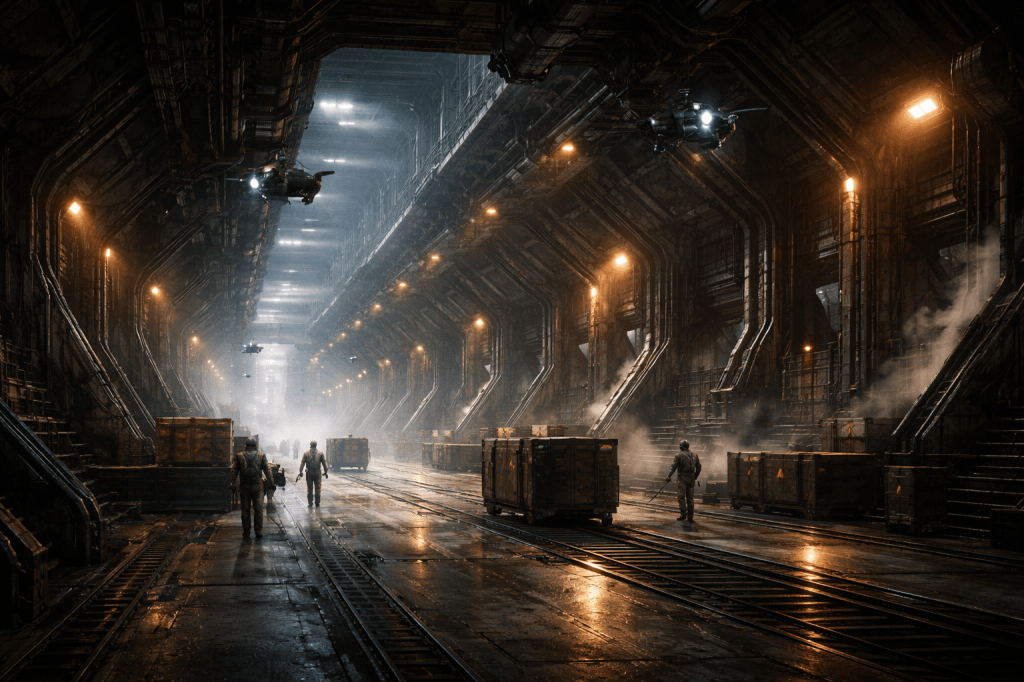
Inspector Halverin followed the station administrator along the docking corridor while the sounds of the bay settled into a steady industrial rhythm that seemed to pulse through every plate of metal beneath his boots. The corridor stretched forward beneath rows of amber maintenance lamps whose light reflected across the worn alloy floor in long warm bands. Along the distant walls, cargo machinery moved with patient deliberation while crews guided freight containers toward the interior lifts that carried materials deeper into the rotating ring of the station.

Ashfall possessed the atmosphere of a place whose working life had continued for so many years that every surface carried the quiet marks of labour. Rail tracks cut shallow grooves through the deck plating where freight trolleys had rolled for decades, and handrails bore the polished sheen left by countless gloved hands guiding themselves through artificial gravity shifts during docking operations. Above them, the massive skeletal framework of Docking Arm Twelve rose into the dimness like the interior of an enormous machine that had grown layer upon layer through successive expansions.

“Your arrival stirred a certain level of curiosity among the station crews,” the administrator said while guiding Halverin toward a security arch positioned at the end of the corridor. “Fleet inspections arrive rarely this far beyond the core trade lanes.”

Halverin glanced across the open docking chamber where two cargo haulers drifted slowly into their assigned berths while docking clamps moved outward to receive them.

“Curiosity usually accompanies uncertainty,” he replied. “Inspection orders tend to appear when Fleet administration begins reconsidering the value of a frontier installation.”

The administrator allowed a thoughtful expression to pass across her face while the security arch scanned Halverin’s identification tablet and cleared them into the interior access corridor.

“Ashfall has endured several such reconsiderations across its history,” she said. “Each time the station adapted to whatever circumstances followed.”

Beyond the checkpoint, the corridor widened into a long transit gallery whose walls were lined with structural ribs and exposed service conduits that carried power and atmosphere throughout the station. Freight lifts descended through circular shafts positioned at intervals along the passage, each platform transporting containers toward sectors hidden deeper within the ring. Overhead, the slow rotation of the station created a subtle sensation of movement, as if the entire structure breathed with mechanical patience.

Halverin studied the gallery while they walked, noting the layered architecture that revealed decades of construction phases. Some sections of the corridor carried the clean geometric lines typical of modern Fleet engineering, while older segments retained heavier structural plating from earlier eras when stations were built to endure harsher industrial demands. The result created a complex patchwork of engineering philosophies that had merged together through years of expansion.

“Fleet records describe Ashfall as a declining transfer hub,” Halverin said while examining a series of maintenance panels mounted along the wall. “Traffic levels appear healthier than the reports suggested.”

“Salvage operations increased across the outer debris field,” the administrator explained. “When older transport routes collapsed, many vessels and relay structures remained scattered across that region of space. Independent crews began recovering those materials several years ago, and Ashfall gradually became their primary staging port.”

The explanation carried the tone of an administrative summary that had been repeated many times. Halverin sensed an additional layer of thought behind the words, something unspoken that hovered beneath the careful clarity of the station official’s voice. Frontier installations often survived through precisely such quiet adjustments, yet the inspection reports resting inside Halverin’s tablet suggested deeper structural changes occurring within the station.

They passed beneath another bank of lighting where maintenance drones hovered close to the corridor ceiling while scanning the integrity of the power conduits embedded in the wall. Each machine moved with delicate mechanical grace, extending slender sensor arms that traced the seams between metal plates. The drones worked with such silent efficiency that their presence almost blended into the surrounding machinery.

“Your crew maintains a considerable amount of infrastructure,” Halverin observed. “The station appears larger than the official registry diagrams indicate.”

The administrator slowed slightly as they approached a junction where three corridors met beneath a circular observation window overlooking the inner ring of Ashfall Station. Through the glass, Halverin saw the immense curve of the rotating habitation decks stretching across the interior structure like the inside wall of a vast mechanical horizon. Cargo traffic moved along illuminated transit lanes while distant maintenance vehicles travelled between docking sectors that appeared as small points of light scattered along the ring.

“Ashfall grew in stages,” the administrator said while gesturing toward the interior view. “Each phase connected new construction to older frameworks. Salvage materials often supplemented the official supply chains during those expansions.”

Halverin listened while studying the station’s interior landscape. Layers of habitation modules, cargo corridors, and structural trusses formed a dense industrial ecosystem whose complexity extended far beyond the simple diagrams included in the Fleet archives. The station resembled a living organism assembled from decades of improvisation.

“Expansion during a period of declining traffic suggests unusual priorities,” Halverin said thoughtfully.

“Frontier economies evolve through necessity,” the administrator replied while guiding him toward a lift platform descending into the lower administrative decks. “Ashfall discovered ways to remain useful.”

The lift platform engaged with a low mechanical vibration and began its descent through the circular shaft that opened beneath the gallery floor. As the platform lowered into the interior levels of the station, Halverin watched the layered structure pass slowly around them, each deck revealing new corridors filled with workers moving between maintenance stations, habitation modules, and equipment lockers arranged along the walls.

Artificial gravity strengthened slightly as they travelled deeper into the rotating ring. The change produced a subtle shift in the balance of Halverin’s stance while the platform continued downward through the immense framework of the station.

Across the descending levels, he noticed several sealed corridors branching away from the primary decks. Their entrances carried reinforced bulkheads whose surfaces bore the faded markings of earlier construction authorities. Some appeared old enough to predate the most recent expansions recorded within Fleet engineering logs.

“Several sectors remain isolated,” Halverin observed while pointing toward one of the sealed passages sliding past the lift cage.

“Structural preservation zones,” the administrator said calmly. “Older engineering frameworks occasionally require separation from modern systems while reinforcement projects proceed.”

Halverin considered the answer while the lift continued its steady descent. Frontier stations possessed many hidden compartments where obsolete equipment waited for eventual removal. Yet the inspection reports inside his tablet contained references to unexplained power fluctuations originating from precisely such sealed areas.

The lift platform reached the administrative deck and slowed as the surrounding corridor came into view. Unlike the industrial spaces above, this level carried the quieter atmosphere of operational management. Offices lined the passage while communication terminals flickered with the pale light of long-range transmissions travelling between Ashfall and distant Fleet relays.

The administrator stepped from the lift and guided Halverin toward a wide observation corridor overlooking the station’s central command tower. From this vantage point, the immense rotating ring of Ashfall Station curved upward into the distance while the planet below cast a soft blue reflection across the lower structural beams.

Halverin paused beside the observation rail and studied the vast interior landscape spreading across the station. Freight moved through the illuminated corridors. Maintenance drones traced their patient circuits along the structural ribs. Human lives unfolded quietly inside thousands of compartments distributed across the rotating ring.

Ashfall continued its slow orbit above the silent world below while the machinery of the station carried on with the steady rhythm of a place that had grown accustomed to survival.

Yet somewhere within that immense industrial labyrinth, the inspection files suggested the presence of changes that had begun long before Fleet command issued the order that brought Halverin to this distant frontier installation.


Docking Arm Twelve formed one of the oldest sections of Ashfall Station, a corridor of machinery and freight traffic where decades of expansion had layered new construction upon the station’s original industrial framework.


The Idea Behind the Chronicle

Large orbital stations like Ashfall appear frequently in science fiction, yet their origins come from very real ideas that engineers and planners have considered for decades. As humanity expands further into space, the distances between settled worlds grow wider, and the infrastructure required to support trade, travel, and exploration becomes increasingly complex. Vast stations positioned along transport routes would function as the ports and industrial centres of those distant frontiers.

Early visions of space colonisation imagined elegant rotating habitats filled with gardens and cities suspended in orbit, though the practical reality of expansion would likely unfold in a far more industrial manner. Freight depots, salvage ports, fuel processing hubs, and maintenance platforms would appear long before comfortable civilian settlements, and many of those installations would begin life as harsh working environments where engineers and cargo crews kept machinery running under difficult conditions.

Ashfall Station belongs to this imagined era of expansion. It represents the kind of installation built quickly to serve a specific economic purpose, then left to adapt when the frontier moved elsewhere. Across human history many places have followed a similar path. Mining towns, remote harbours, and railway settlements have often survived long after the industries that created them began to fade, reshaping themselves into something new through the quiet persistence of the people who remained behind.

The Chronicle of Ashfall explores that idea of survival and adaptation. A station designed for one purpose gradually becomes something more complex as new trades appear, old systems are modified, and sections of the structure accumulate decades of layered construction. Over time the installation begins to feel less like a machine and more like a living environment shaped by the countless lives that have passed through its corridors.

In such places the boundary between past and present becomes blurred. Old infrastructure remains hidden behind modern upgrades, forgotten corridors continue to exist beyond sealed bulkheads, and the history of the station lingers within the machinery that keeps it alive.

Ashfall Station therefore serves as both setting and character within the Chronicle, an immense frontier installation whose long history has left traces that the official records may never fully explain.


From the Author’s Desk

Ashfall Station began as a simple image that lingered in my imagination for several years: the idea of an immense industrial structure drifting at the far edge of human space long after the frontier that created it had moved on. Science fiction often grows most naturally from such quiet beginnings, where a single place or moment suggests a much larger history waiting somewhere beyond the visible story.

The Chronicles presented here explore the earlier life of that station, revealing small fragments of its past through the people who lived and worked within its corridors. Each episode focuses on a single event or encounter, gradually uncovering how Ashfall evolved from an ordinary frontier installation into a place carrying deeper layers of history hidden within its structure.

The novella Ashfall Station: The Dead Girl in Sector Twelve takes place much later in that timeline, when the station has already accumulated decades of expansion, modification, and quiet mystery. Writing the Chronicle series offers the opportunity to step backwards into that earlier period and observe the smaller moments that shaped the station long before the events of the investigation began.

Alongside these Chronicles I continue writing fiction across several science fiction and speculative projects, many of which explore frontier environments where technology, distance, and human persistence intersect in unexpected ways.

Readers interested in those stories can explore more through the links below.

You can explore my books here::
Books by Simon Phillips

You can watch my YouTube channel here:
Author Simon Phillips


Technical Notes & Frontier Context

Frontier Infrastructure

Industrial stations such as Ashfall represent one of the most practical solutions to the challenge of distance in space exploration. Vast orbital platforms positioned along transport routes would form the logistical backbone of any expanding civilisation, providing docking capacity for freight vessels, repair facilities for long-range ships, and storage infrastructure for resources moving between distant systems.

During the earliest phases of expansion such stations would likely resemble harsh industrial environments rather than comfortable settlements. Engineers, cargo crews, and salvage operators would occupy modular habitats attached to immense structural frameworks designed primarily for durability and efficiency. Over time these installations might grow far beyond their original plans as new sectors were added to support changing economic activity.

Ashfall Station reflects this gradual evolution. A structure originally designed for ore transfer slowly becomes a hybrid of freight port, salvage hub, and frontier settlement as different industries pass through the system.

Salvage Economies

Salvage operations often emerge in regions where earlier waves of exploration have left abandoned infrastructure behind. Derelict cargo ships, obsolete relay stations, and fragments of industrial platforms may remain drifting through orbital space for decades or even centuries. Independent crews recover valuable materials from these forgotten structures and return them to frontier ports, where metal and components can be reused.

A station positioned near a large debris field would therefore become a natural gathering point for salvage crews and transport contractors. Over time such activity could replace the station’s original purpose entirely, allowing an installation once built for mining traffic to survive long after the surrounding resource economy has faded.

Layered Structures

One intriguing feature of long-lived orbital stations would be the accumulation of multiple engineering eras within a single structure. New modules could be attached to older frameworks, outdated systems might remain sealed behind bulkheads, and corridors originally designed for industrial machinery might later become part of habitation districts or storage sectors.

This layered architecture creates environments where the past remains physically embedded within the present. Forgotten corridors and abandoned compartments can persist inside the station’s interior, hidden behind structural reinforcements that few workers ever have reason to access.

Ashfall Station carries the weight of this accumulated history, a frontier installation whose present appearance reflects decades of adaptation, expansion, and quiet improvisation by the people who have kept its machinery running.


Next Chronicle

Several months before the inspection recorded in this Chronicle, a salvage vessel arrived at Ashfall Station after operating far beyond the normal navigation perimeter of the system. The ship returned with a fragment of unidentified structure recovered from deep orbit within the outer debris field, an object whose origin could not immediately be traced to any registered vessel or industrial installation.

Station logs record that the fragment was transferred quietly into a sealed research hold shortly after the salvage crew docked, and within a few hours the object disappeared from the public cargo registry entirely. Few workers on Ashfall understood what had been recovered from the silent region of space beyond the station, though rumours began to circulate through the docking sectors that the salvage crew had discovered something far older than the drifting wreckage normally collected from the debris field.

The next Chronicle returns to that earlier moment, when the salvage ship first approached the station carrying its unusual cargo and the events began that would slowly alter the future of Ashfall Station.

Next Week: The Salvage Run


Ashfall Station continued its slow orbit above the silent world of Kestren-4, carrying within its vast structure the quiet beginnings of events that few among its workers yet realised had already begun.