Where Broken Systems Still Breathe
Zone Thirteen stood at the edge of human order, though order had become a generous word for what remained there. The roads held their shape through habit more than repair. Pylons leaned into the wind with stripped frames and tired wires. Habitation shells endured by patchwork, scavenged metal, old clamps, and the quiet discipline of those who had learned to survive among systems already past their intended life.
For a mythic sci-fantasy novella, this kind of place matters. Power rarely begins inside palaces or temples. It begins where nobody expects consequence to gather. It begins in forgotten ground, beneath broken infrastructure, among salvage routes and old machines that still carry a faint memory of function. In Zone Thirteen, the opening movement of The Chronicles of Aeloria, the world does not announce itself through prophecy. It presses against the skin first.
Aeloria’s world is built from edges. The edge of roads. The edge of notice. The edge of value. The edge of systems that still respond in fragments. His life among salvage, tokens, failed conduits, and old relay units places him inside a fractured worlds fantasy series before the wider realms are ever named. The science fantasy pressure is already present in the environment itself, where broken technology carries something older than machinery and where dormant crystal behaviour waits beneath practical survival.
Zone Thirteen is not simply a damaged settlement. It is a pressure space. Every surface suggests previous use, previous collapse, previous hands stripping away whatever could still be sold or made useful. The people living there have inherited failure without receiving explanation. They cross unstable ground because the ground still allows them to cross. They use systems because enough of those systems continue to answer. They survive without believing survival has larger meaning.
That is why the shard matters before it is understood.
Power Before Understanding
In many fantasy stories, power arrives as revelation. In Zone Thirteen, power arrives as misalignment. The hum changes. The ground delays its response. Pylons flare when no working line should carry current. A storm gathers around an object whose shape and behaviour exceed every category available to the boy who finds it.
This is where the novella’s strongest discovery language sits. Aeloria does not step into mastery. He is pulled into pressure. The shard responds to him through heat, weight, resistance, and bodily consequence, making power feel like an event before it becomes a destiny. It is a magical crystal world fantasy without the comfort of clean enchantment. The crystal does not explain itself. It enters the body’s awareness through pulse and strain.
That restraint gives the world its force. Ancient systems remain present, yet their purpose has thinned into fragments. Relay units, pylons, conduits, machines, and scanning beams all belong to a technological order, while the shard and surge belong to an inheritance older than human control. The result is fantasy with ancient technology shaped through use, decay, and response. Nothing feels decorative. Nothing exists only to signal wonder. Every object carries function, failure, or threat.
The Zone teaches Aeloria how to read surfaces. He knows which paths draw attention, which structures still offer cover, which salvage holds value, and which movements might leave traces. That training becomes crucial once the world itself begins acting like a system that can notice him. He has spent his life avoiding attention in a place where attention costs. Once the shard wakes, hiding becomes more difficult because the environment responds before people do.
This is one of the deeper tensions inside atmospheric sci-fantasy fiction. A broken system can remain survivable for years, even generations, until something returns meaning to it. Zone Thirteen has survived through neglect because neglect is predictable. The surge changes that. It reminds the Zone of older pathways, older connections, and older power. What once failed quietly begins answering in fragments, and each answer draws the attention of forces trained to contain rather than understand.
The figures who arrive after the surge carry a different kind of fear. They are clean where the Zone is worn. Their machines move with coordinated precision through a place that usually belongs to improvisation and adaptation. They speak in controlled signals: contact, containment, grid. Their presence turns Aeloria’s home into an operational field, reducing lived ground into a map of detection and response.
That shift matters because The Awakening of Power is a series about misreading. Institutions see signal before person. Systems see anomaly before fear. Power is classified before it is understood. Aeloria becomes dangerous to others the moment the world reacts to him, even though he remains the one least able to explain what has happened.
Entering Zone Thirteen
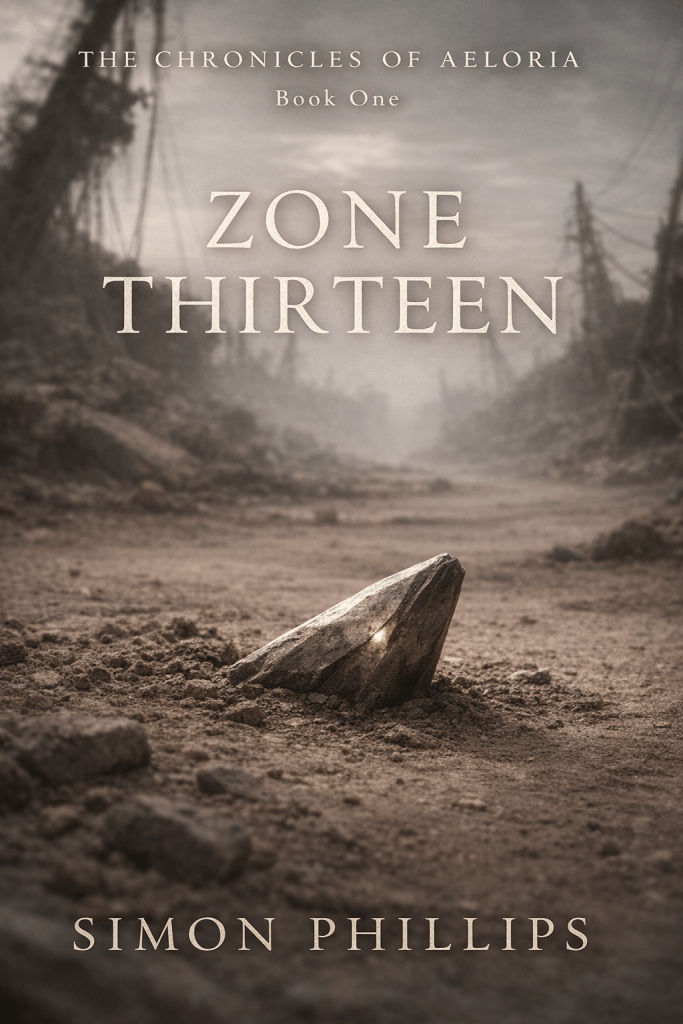
Zone Thirteen is Book 1 of The Chronicles of Aeloria, and it functions as the first contained movement in a slow-burn fantasy novella series shaped around pressure, displacement, and awakening. Its focus remains intimate. It holds close to one boy, one settlement, one guardian figure, one shard, and one rupture that changes the scale of everything.
The novella’s surface is survival. Aeloria moves through salvage routes, trades recovered parts, returns to the shack he shares with Larn, and measures value through tokens, repairs, and risk. Beneath that practical rhythm, the world begins to reveal its deeper instability. The ground shifts by fractions before larger distortions arrive. Systems respond in brief fragments before the surge takes hold. The storm grows from environmental pressure into something that feels almost structural, as though reality itself has begun to move out of alignment.
The experience of entering Zone Thirteen is the experience of entering a world already strained past comfort. It does not rush to explain its history. Instead, it lets the reader feel the shape of life inside its failure. Salvage is labour, habit, economy, and concealment. Larn’s shack is shelter, base, repair space, and emotional centre. The shard is discovery, wound, inheritance, and signal. The rupture is departure, threat, and threshold at once.
The KDP ebook link can sit quietly as the reader’s next step rather than as a loud interruption: The Chronicles of Aeloria: Zone Thirteen
What makes this opening work as a science fantasy novella series entry is its refusal to treat awakening as triumph. Aeloria gains no clean victory from the shard. He loses stability. He loses the safety of being overlooked. He sees Larn threatened. He feels the world answer him without consent. By the end, the Zone itself tears open, and the familiar ground beneath him gives way to motion, light, and the unknown.
The result is a beginning that feels complete in emotional pressure while leaving the larger mythic system unresolved. The novella closes the life Aeloria knew. It opens the passage into everything his world had buried.
The First Pressure of the Fractured Realms
Beyond Zone Thirteen, the larger movement of The Awakening of Power rests on fractured realms, ancient crystal systems, separated races, weakened pathways, and a forgotten inheritance that each civilisation understands only in part. The first novella keeps that larger architecture mostly beneath the surface, which strengthens its mystery. The reader senses scale through reaction rather than explanation.
The shard’s behaviour suggests inheritance before history names it. The surge shows that dormant systems can awaken through contact with the right presence. The glider introduces the possibility of non-human craft without turning the scene into exposition. The machines and external operators reveal that human authority has already developed methods for detection and containment, perhaps long before Aeloria ever became visible to them.
This layered approach allows the series to grow without feeling sudden. Zone Thirteen becomes the first pressure chamber of the wider fractured worlds fantasy series. It shows the human edge of a broken order: poor infrastructure, procedural enforcement, salvage economies, survival routes, and old systems degraded into partial function. Later realms may bring temples, pathways, crystal harmonics, elven vessels, ancient ruins, and political fear, yet their foundation is already present in the way Zone Thirteen behaves.
The fractured realms are living systems rather than simple locations. They remember through infrastructure. They answer through instability. They preserve old connections in damaged forms. When Aeloria touches the shard, he does more than activate an object. He forces the hidden relationship between body, crystal, environment, and old design into motion again.
That is where the mythic weight begins. Power in this world is neither prize nor weapon in its first expression. It is pressure. It changes footing. It changes sound. It changes how machines move and how people speak. It turns a scavenger into a signal and a home into a containment zone.
The cost of that awakening lies in the way no one present can fully interpret it. The Zone cannot explain itself. The operators act through procedure. Larn understands enough to recognise danger, yet even his protection cannot hold against the scale of what has begun. Aeloria feels the truth physically, long before he can name it. That gives the series its strongest continuity thread: understanding always arrives late.
What the World Remembers
Zone Thirteen remains behind, though it does not vanish. Places like that never vanish cleanly. They remain in the body through habit, caution, and the memory of ground tested before each step. They remain in the way a person watches doorways, listens to hums, weighs silence, and understands that attention can become a form of danger.
Aeloria leaves the Zone through rupture, yet the Zone has already shaped the way he will move through every realm that follows. He has learned broken systems before he learns ancient ones. He has learned survival before inheritance. He has learned that value is always judged by those holding power, and that being useful can become another kind of trap.
The world beyond the rupture waits with its own temples, pathways, ruins, and crystal pressures. Other races will carry their own partial truths. Other systems will claim older authority. The fractured realms may speak of balance, restoration, fear, and unity, yet the first lesson remains grounded in dust, salvage, and failing pylons.
A forgotten place answered first.
A shard woke inside a boy who had spent his life avoiding notice.
The world shifted before anyone understood why.
Discover more from Simon J. Phillips
Subscribe to get the latest posts sent to your email.
