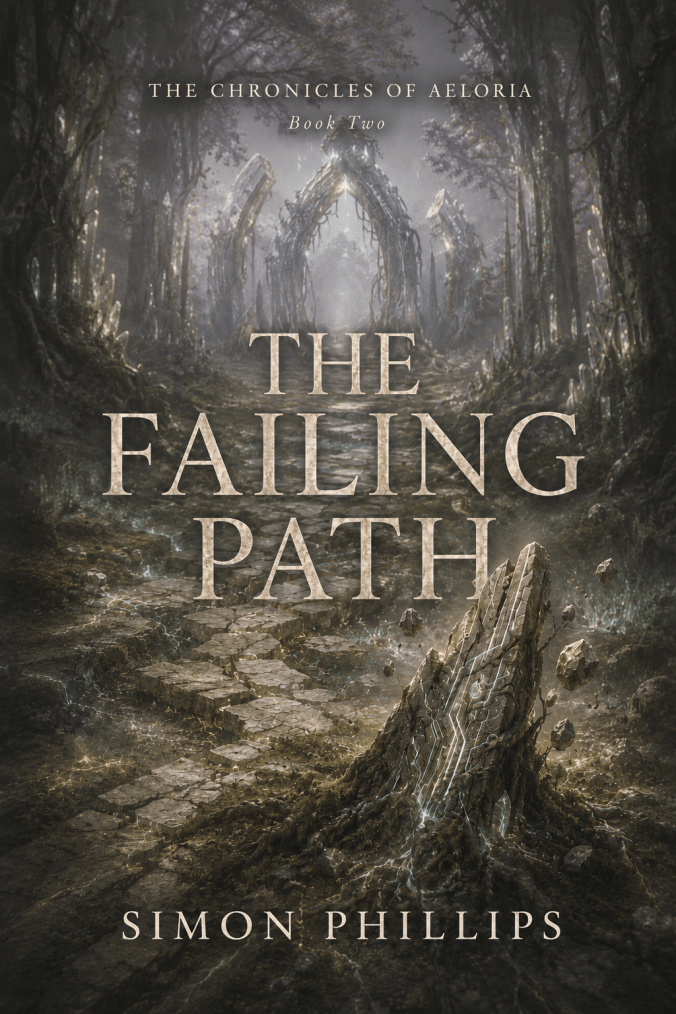
A path through a fractured world can resemble a road only until the ground beneath it begins behaving according to rules the traveller has never learned. In The Failing Path, Book Two of The Chronicles of Aeloria, Aeloria wakes far beyond Zone Thirteen in a place where moss restores itself after being disturbed, stones drift above the soil, water reacts to the shard at his wrist, and ancient structures respond to his movement before he has any understanding of what they were built to do.
The environment is beautiful in ways his former home never allowed, though beauty offers little reassurance when every part of the landscape seems tied to systems older than the people still moving through them. The fractured realms are separated by more than distance, with surviving routes running through unstable spaces where crystal, architecture, living growth and forgotten infrastructure continue functioning together even after much of their original purpose has been lost.
Travel between such worlds becomes an act of exposure. Every crossing places a traveller inside a structure whose rules may be understood only partially, and every surviving pathway carries the possibility that something built long ago still remembers how to respond.
A World Where Travel Has Physical Consequences
Fantasy often treats roads as the quiet space between significant locations, giving characters room to move from one place of consequence to another. Within The Awakening of Power, the road itself can become one of those places, because the old pathways between realms retain enough function to shape movement, alter the environment and place pressure directly upon anyone trying to cross them.
The bridge-realm Aeloria enters after leaving Zone Thirteen remains active despite its deterioration. Causeways lie beneath living growth, marker points still react to trained handling, damaged nodes continue regulating routes, and transfer stones retain enough of their purpose to carry travellers beyond the fragment when the surrounding systems can be held together for long enough.
Every surviving element also carries evidence of failure. The ground can settle late beneath Aeloria’s weight, dust hangs where gravity should pull it down, roots shift position after he passes, and passages that appear usable can begin closing as the fragment changes around those moving through it. Heat, cold and pressure can alter across short distances, leaving the body to register instability before the mind has any language for what is happening.
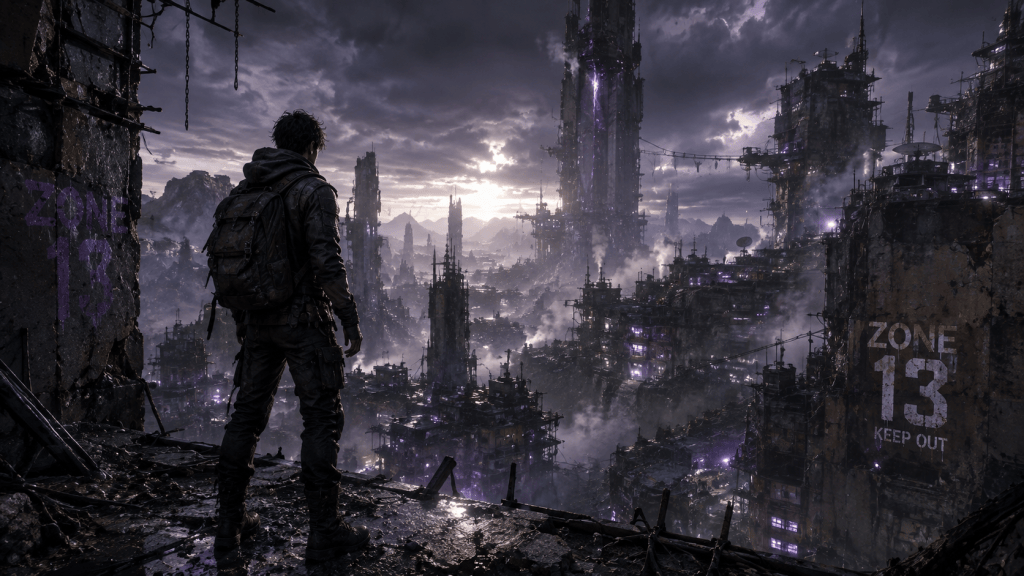
Aeloria approaches those conditions with instincts formed in Zone Thirteen, where a scavenger survives by testing uncertain surfaces, watching before entering open ground, judging whether damaged machinery is worth approaching, and distrusting anything that seems too easy. Those habits remain useful, though the fragment forces him to confront something his old environment never prepared him for, because broken infrastructure in the human world rarely appeared to notice who was walking across it.
The Bridge-Realm Is a Living Place, Even While It Fails
The fragment between worlds never behaves like an empty corridor separating two more important locations. It contains its own ecology, its own damaged structures and its own long relationship between living growth and ancient construction, creating a landscape that feels inhabited by history even where no settlement remains.
Crystal-veined trees rise through old architecture until it becomes difficult to judge where the built environment ends and the forest begins. Water passes through worked channels while roots and moss reclaim the stone around them, and small creatures move through conditions shaped by altered gravity and unusual atmospheric behaviour that would appear impossible within Aeloria’s familiar human world.
The effect is important because the fractured worlds are built upon inheritance rather than clean archaeological remains. Structures continue performing fragments of their original functions, landscapes grow around them, and later cultures maintain systems that have become necessary to survival even where their deepest logic remains uncertain.
The bridge-realm therefore holds more than one history at once. One belongs to whoever first shaped the pathways, while another belongs to the people who learned how to cross, maintain and survive those pathways after their original certainty had already begun to disappear.
That second history becomes visible through the elven field team Aeloria encounters beside the failing node. They carry markers, slivers and specialised crystal equipment, and their movements reveal a working culture built around unstable routes rather than a civilisation approaching them as mysterious ruins for the first time.
Their knowledge is practical and highly developed, yet it remains knowledge shaped by use. The fragment can still surprise them, which prevents elven familiarity with crystal systems from becoming the same thing as complete understanding.
Elven Technology Begins with Resonance
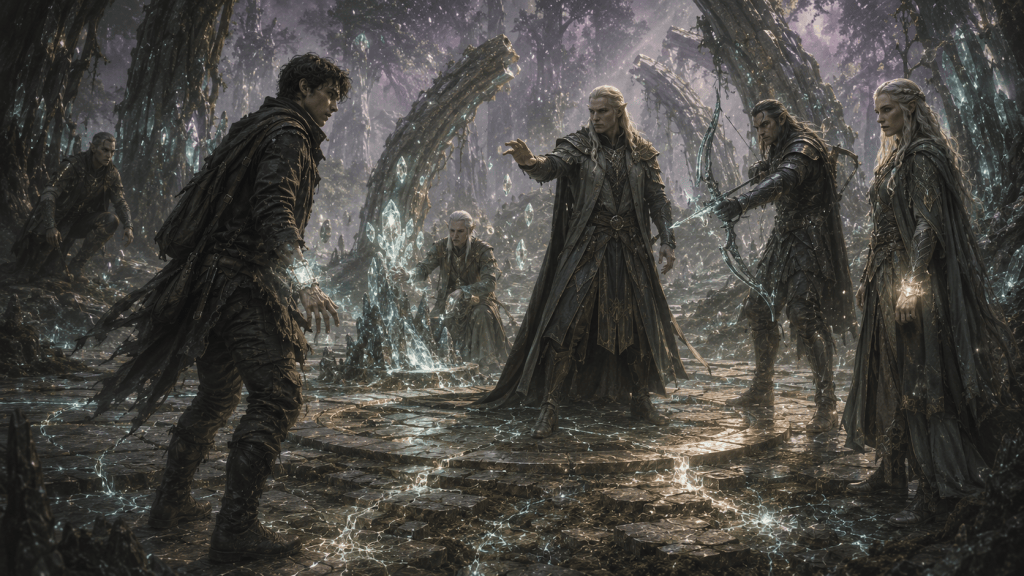
Aeloria’s first sustained encounter with elven culture arrives through work rather than ceremony. Thalorien’s team is already attempting to stabilise a failing node when he reaches them, which means his first view of another civilisation is shaped by technicians, route-readers, guards and field equipment rather than temples, rulers or formal introductions.
Ilyr works with crystal slivers and damaged sockets while Caerun reads route behaviour through markers placed along unstable ground. Vaelen watches the surrounding terrain and manages immediate physical danger, while Serenis carries a white shard whose controlled response differs sharply from the unpredictable pressure surrounding Aeloria.
Their tools belong naturally to the same environment as the roots, crystal growth and living structures surrounding them. Nothing feels bolted onto the landscape as a separate layer of machinery, because elven technology has developed through resonance, cultivation and integration with the materials that already shape their civilisation.
That difference becomes one of the clearest expressions of the series’ science-fantasy identity. Human engineering tends towards machinery, applied systems and technical control, while elven systems rely more heavily upon resonance and cultivated crystal structures that can behave almost like extensions of the surrounding environment.
Aeloria recognises that the elves are doing technical work even when the methods feel impossible to him. Ilyr understands the failing node well enough to intervene when its behaviour worsens, yet even his knowledge reaches a limit once Aeloria’s presence causes the system to respond in a way he never expected.
Different cultures therefore carry different kinds of competence without any single people possessing the full truth. That balance allows the fractured realms to remain genuinely divided by experience rather than merely separated by appearance.
When Old Systems Recognise Someone They Should Ignore
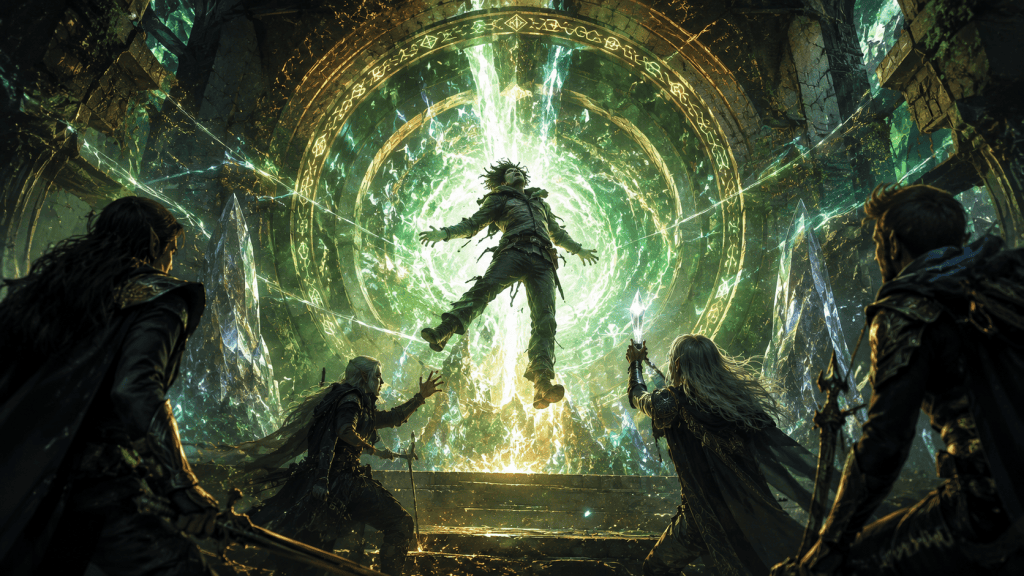
The most unsettling aspect of the fragment lies in the way old systems respond to Aeloria before anyone around him has decided what his presence means. The causeway lights beneath his steps, the node reaches towards him, Ilyr’s slivers begin turning in his direction, and a stabilising root responds when Aeloria catches himself against it during the node’s failure.
Later, the transfer stones begin treating him as though his position matters more than the arrangement chosen by the trained elven team. The route attempts to take him as its centre even though he has deliberately been placed away from that position, creating a danger that Serenis and the others can reduce only through coordinated action.
Aeloria never commands these events. His importance within the system appears before his ability to influence that importance deliberately, which keeps recognition separate from mastery and makes every reaction more threatening than empowering.
That distinction is central to the wider world of The Awakening of Power. Crystal interaction carries physical consequence first, placing strain upon the body and exposing the user to forces that may respond far beyond expectation before knowledge or control have developed.
For Aeloria, this means heat through the wrist, pressure through his body, loss of balance and the growing fear that structures around him recognise something he cannot identify. His problem is therefore larger than simply possessing unusual power, because every response makes other people more interested in understanding why the old systems react to him at all.
Rescue and Containment Begin to Look Similar
Once Thalorien’s team becomes responsible for Aeloria’s survival, first contact develops into something more uncomfortable than simple hostility or immediate friendship. The elves repeatedly keep him alive, yet they also watch him closely, restrict his movement and treat his presence as a potential danger to systems already under strain.
Vaelen catches him when unstable ground gives way and physically moves him clear when the path threatens to close. From Vaelen’s perspective, that behaviour is practical protection, while from Aeloria’s perspective the same hand can feel uncomfortably close to restraint after everything that happened in Zone Thirteen.
Thalorien explains enough for Aeloria to survive each immediate danger, while still placing him under direction because allowing an unknown human to move freely through a damaged crystal pathway could endanger everyone nearby. The resulting tension never requires either side to behave irrationally, because the conflict comes from the fact that their reasonable actions mean very different things depending upon who is experiencing them.
Even kindness carries that uncertainty. During a brief field halt, Caerun gives Aeloria concentrated elven travel food after recognising how depleted he has become, and Aeloria eats too quickly because hunger has already pushed caution aside. Serenis quietly contributes drink through Caerun while maintaining the silence she has kept throughout their journey.
The scene reveals cultural difference through the body rather than through explanation. Elven field food is designed for sustained travel through difficult terrain, their containers and supplies belong to the same cultivated technological culture as their path equipment, and Aeloria’s reaction exposes how far he has been reduced by displacement before he ever enters an elven city.
He accepts their help because survival requires it, though accepting assistance never becomes the same thing as trusting the people providing it. That distinction carries the emotional pressure of the entire crossing.
Isolation Changes the Way Cultures Read One Another
The fractured realms have remained divided long enough for cultural difference to become more than custom. Language, technology, risk, naming and even ordinary movement through dangerous spaces have developed according to separate histories, leaving first contact vulnerable to misunderstanding before anyone acts with deliberate hostility.
Aeloria gives his name because Thalorien asks for it, then learns afterwards that names carry particular weight within active path-space. The elves use a protective name-warding gesture as part of their established practice, while Aeloria has no reason to recognise the custom until he has already crossed its boundary.
From his perspective, rules keep appearing after they have already cost him something. From the elves’ perspective, they are trying to manage an unknown human whose arrival has disrupted systems that their own trained specialists approach with caution.
The tension grows from incomplete knowledge on both sides. Aeloria comes from a place where being noticed by organised authority can mean being taken, while the elves encounter someone who has appeared inside unstable route-space after old systems begin responding to him in unusual ways.
That kind of separation creates the deeper political pressure of a fractured world. Every realm develops its own explanation for danger, and those explanations become harder to challenge when generations have lived with little direct contact beyond unstable pathways and inherited warnings.
The Full Elven Realm Changes the Scale of Everything
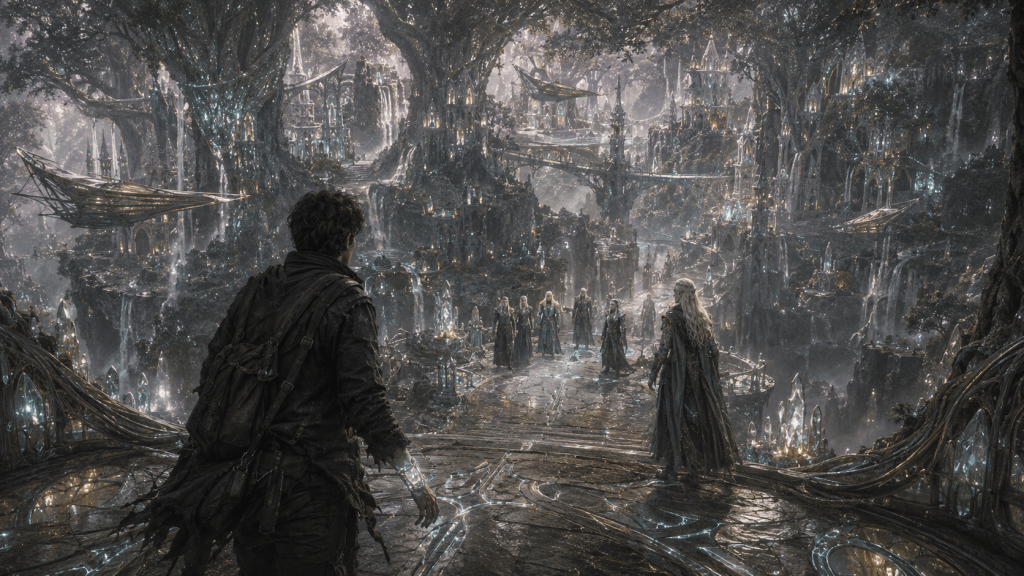
The arrival in the full elven realm brings one of the strongest visual and cultural contrasts in The Failing Path. Zone Thirteen survived through repair, salvage and adaptation, while the elven civilisation Aeloria enters rises through living crystal, enormous trees, layered bridges, controlled water systems and field-balanced craft moving through open air.
For Aeloria, the contrast reaches beyond beauty. Structures hold their weight, water flows where it has been guided, pathways remain maintained, and light runs through living architecture as part of ordinary function rather than as the unpredictable residue of a failing human system.
The experience reveals what stability looks like from someone raised in a place where almost everything had already been repaired too many times. It also demonstrates why material prosperity and personal safety should never be treated as the same thing.
The path-stones continue glowing after Aeloria arrives, ordinary elves begin watching, and six elders come to meet the field team. Serenis then reveals that she has understood Aeloria’s English throughout the crossing, changing the meaning of every earlier silence between them and leaving him aware that he has been observed far more closely than he realised.
The full elven realm therefore expands the scale of the story while narrowing Aeloria’s personal freedom. He has left the collapsing fragment behind, yet arrival places him before institutions capable of giving his presence a meaning he has never chosen for himself.
A Science-Fantasy World Built on Inheritance
The fractured realms of The Awakening of Power exist where technology, resonance, archaeology and myth can no longer be separated into simple categories. Crystals shape tools, architecture, transport and pathway systems, while structures left by older civilisations continue carrying functions that later cultures can use more easily than they can fully explain.
Human civilisation develops through technological adaptation and applied engineering, whereas the elves have built a closer relationship with crystal resonance and cultivated systems. Neither approach makes one culture inherently wiser, because each represents knowledge grown inside the limits of a separated world.
That partial understanding gives the series much of its atmosphere. Ancient structures matter because current lives still depend upon them, crystal systems matter because different peoples have built cultures around different forms of access, and pathways matter because their deterioration threatens the fragile connections that still exist between otherwise isolated realms.
The Failing Path places Aeloria directly inside that pressure for the first time. He enters the fragment carrying the survival instincts of Zone Thirteen and expecting damaged ground to behave according to the familiar logic of damaged machinery, only to discover that some old systems remain active enough to recognise movement, resonance and presence in ways no scavenger training could have prepared him to understand.
By the time he reaches the elven realm, the most unsettling truth is no longer simply that the path is failing. It is that parts of the ancient structure beneath the fractured worlds still appear capable of remembering what they were built to do, even when the people living among them have inherited only fragments of that knowledge.