When the Road Between Worlds Begins to Fail: Crystal Pathways and Fractured Realms in The Failing Path

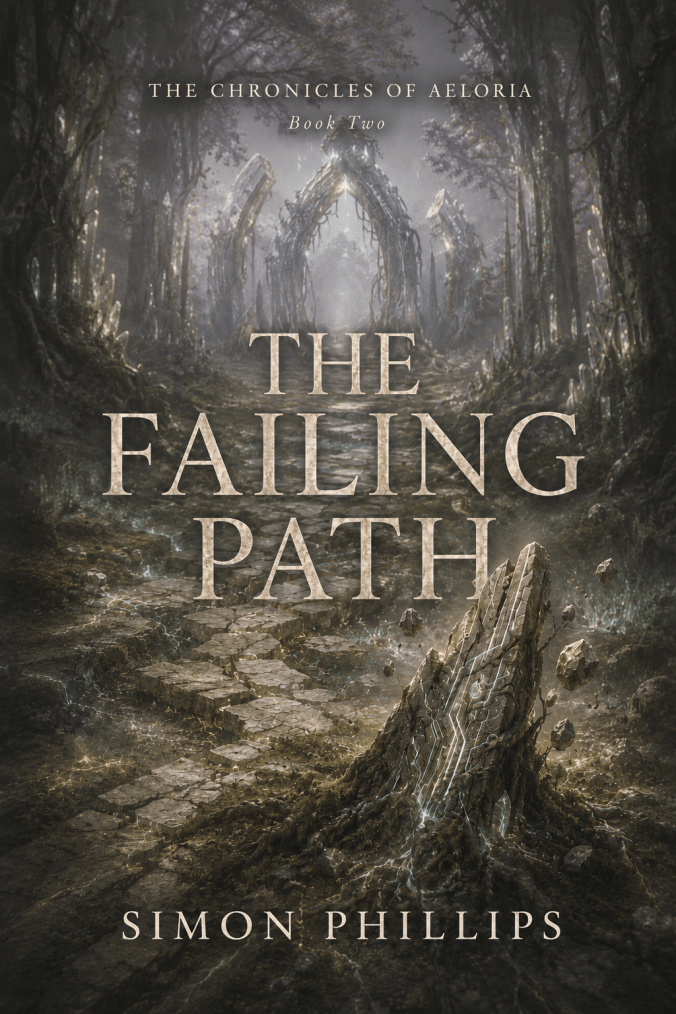
A path through a fractured world can resemble a road only until the ground beneath it begins behaving according to rules the traveller has never learned. In The Failing Path, Book Two of The Chronicles of Aeloria, Aeloria wakes far beyond Zone Thirteen in a place where moss restores itself after being disturbed, stones drift above the soil, water reacts to the shard at his wrist, and ancient structures respond to his movement before he has any understanding of what they were built to do.

The environment is beautiful in ways his former home never allowed, though beauty offers little reassurance when every part of the landscape seems tied to systems older than the people still moving through them. The fractured realms are separated by more than distance, with surviving routes running through unstable spaces where crystal, architecture, living growth and forgotten infrastructure continue functioning together even after much of their original purpose has been lost.

Travel between such worlds becomes an act of exposure. Every crossing places a traveller inside a structure whose rules may be understood only partially, and every surviving pathway carries the possibility that something built long ago still remembers how to respond.

A World Where Travel Has Physical Consequences
Fantasy often treats roads as the quiet space between significant locations, giving characters room to move from one place of consequence to another. Within The Awakening of Power, the road itself can become one of those places, because the old pathways between realms retain enough function to shape movement, alter the environment and place pressure directly upon anyone trying to cross them.

The bridge-realm Aeloria enters after leaving Zone Thirteen remains active despite its deterioration. Causeways lie beneath living growth, marker points still react to trained handling, damaged nodes continue regulating routes, and transfer stones retain enough of their purpose to carry travellers beyond the fragment when the surrounding systems can be held together for long enough.

Every surviving element also carries evidence of failure. The ground can settle late beneath Aeloria’s weight, dust hangs where gravity should pull it down, roots shift position after he passes, and passages that appear usable can begin closing as the fragment changes around those moving through it. Heat, cold and pressure can alter across short distances, leaving the body to register instability before the mind has any language for what is happening.

Aeloria approaches those conditions with instincts formed in Zone Thirteen, where a scavenger survives by testing uncertain surfaces, watching before entering open ground, judging whether damaged machinery is worth approaching, and distrusting anything that seems too easy. Those habits remain useful, though the fragment forces him to confront something his old environment never prepared him for, because broken infrastructure in the human world rarely appeared to notice who was walking across it.


The Bridge-Realm Is a Living Place, Even While It Fails

The fragment between worlds never behaves like an empty corridor separating two more important locations. It contains its own ecology, its own damaged structures and its own long relationship between living growth and ancient construction, creating a landscape that feels inhabited by history even where no settlement remains.

Crystal-veined trees rise through old architecture until it becomes difficult to judge where the built environment ends and the forest begins. Water passes through worked channels while roots and moss reclaim the stone around them, and small creatures move through conditions shaped by altered gravity and unusual atmospheric behaviour that would appear impossible within Aeloria’s familiar human world.

The effect is important because the fractured worlds are built upon inheritance rather than clean archaeological remains. Structures continue performing fragments of their original functions, landscapes grow around them, and later cultures maintain systems that have become necessary to survival even where their deepest logic remains uncertain.

The bridge-realm therefore holds more than one history at once. One belongs to whoever first shaped the pathways, while another belongs to the people who learned how to cross, maintain and survive those pathways after their original certainty had already begun to disappear.

That second history becomes visible through the elven field team Aeloria encounters beside the failing node. They carry markers, slivers and specialised crystal equipment, and their movements reveal a working culture built around unstable routes rather than a civilisation approaching them as mysterious ruins for the first time.

Their knowledge is practical and highly developed, yet it remains knowledge shaped by use. The fragment can still surprise them, which prevents elven familiarity with crystal systems from becoming the same thing as complete understanding.


Elven Technology Begins with Resonance
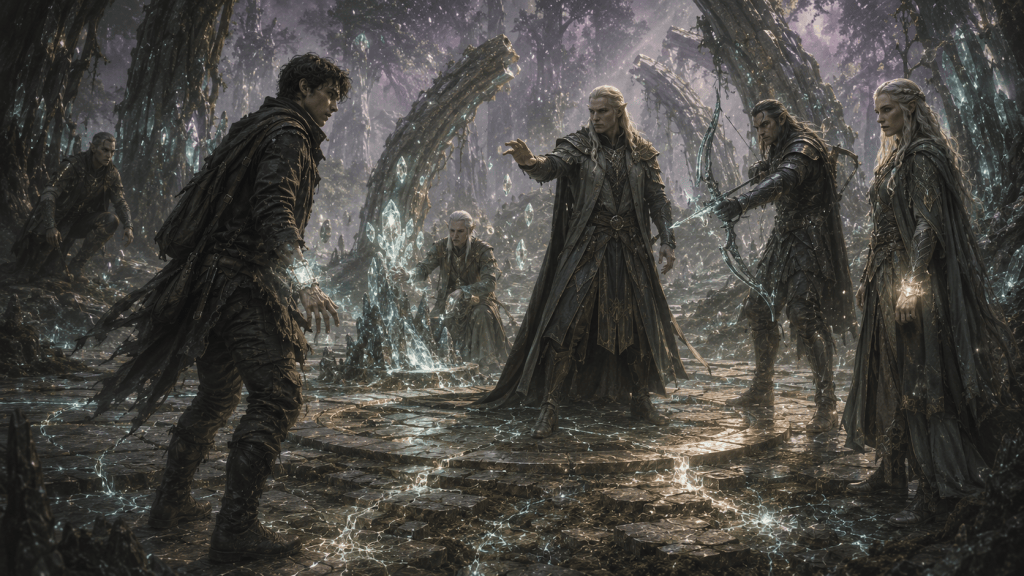
Aeloria’s first sustained encounter with elven culture arrives through work rather than ceremony. Thalorien’s team is already attempting to stabilise a failing node when he reaches them, which means his first view of another civilisation is shaped by technicians, route-readers, guards and field equipment rather than temples, rulers or formal introductions.

Ilyr works with crystal slivers and damaged sockets while Caerun reads route behaviour through markers placed along unstable ground. Vaelen watches the surrounding terrain and manages immediate physical danger, while Serenis carries a white shard whose controlled response differs sharply from the unpredictable pressure surrounding Aeloria.

Their tools belong naturally to the same environment as the roots, crystal growth and living structures surrounding them. Nothing feels bolted onto the landscape as a separate layer of machinery, because elven technology has developed through resonance, cultivation and integration with the materials that already shape their civilisation.

That difference becomes one of the clearest expressions of the series’ science-fantasy identity. Human engineering tends towards machinery, applied systems and technical control, while elven systems rely more heavily upon resonance and cultivated crystal structures that can behave almost like extensions of the surrounding environment.

Aeloria recognises that the elves are doing technical work even when the methods feel impossible to him. Ilyr understands the failing node well enough to intervene when its behaviour worsens, yet even his knowledge reaches a limit once Aeloria’s presence causes the system to respond in a way he never expected.

Different cultures therefore carry different kinds of competence without any single people possessing the full truth. That balance allows the fractured realms to remain genuinely divided by experience rather than merely separated by appearance.


When Old Systems Recognise Someone They Should Ignore
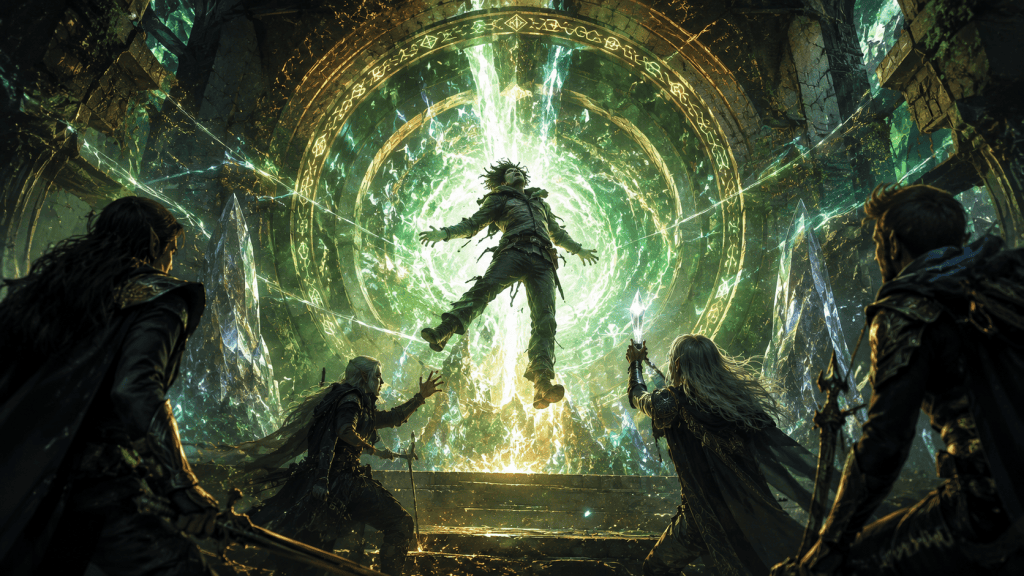
The most unsettling aspect of the fragment lies in the way old systems respond to Aeloria before anyone around him has decided what his presence means. The causeway lights beneath his steps, the node reaches towards him, Ilyr’s slivers begin turning in his direction, and a stabilising root responds when Aeloria catches himself against it during the node’s failure.

Later, the transfer stones begin treating him as though his position matters more than the arrangement chosen by the trained elven team. The route attempts to take him as its centre even though he has deliberately been placed away from that position, creating a danger that Serenis and the others can reduce only through coordinated action.

Aeloria never commands these events. His importance within the system appears before his ability to influence that importance deliberately, which keeps recognition separate from mastery and makes every reaction more threatening than empowering.

That distinction is central to the wider world of The Awakening of Power. Crystal interaction carries physical consequence first, placing strain upon the body and exposing the user to forces that may respond far beyond expectation before knowledge or control have developed.

For Aeloria, this means heat through the wrist, pressure through his body, loss of balance and the growing fear that structures around him recognise something he cannot identify. His problem is therefore larger than simply possessing unusual power, because every response makes other people more interested in understanding why the old systems react to him at all.


Rescue and Containment Begin to Look Similar

Once Thalorien’s team becomes responsible for Aeloria’s survival, first contact develops into something more uncomfortable than simple hostility or immediate friendship. The elves repeatedly keep him alive, yet they also watch him closely, restrict his movement and treat his presence as a potential danger to systems already under strain.

Vaelen catches him when unstable ground gives way and physically moves him clear when the path threatens to close. From Vaelen’s perspective, that behaviour is practical protection, while from Aeloria’s perspective the same hand can feel uncomfortably close to restraint after everything that happened in Zone Thirteen.

Thalorien explains enough for Aeloria to survive each immediate danger, while still placing him under direction because allowing an unknown human to move freely through a damaged crystal pathway could endanger everyone nearby. The resulting tension never requires either side to behave irrationally, because the conflict comes from the fact that their reasonable actions mean very different things depending upon who is experiencing them.

Even kindness carries that uncertainty. During a brief field halt, Caerun gives Aeloria concentrated elven travel food after recognising how depleted he has become, and Aeloria eats too quickly because hunger has already pushed caution aside. Serenis quietly contributes drink through Caerun while maintaining the silence she has kept throughout their journey.

The scene reveals cultural difference through the body rather than through explanation. Elven field food is designed for sustained travel through difficult terrain, their containers and supplies belong to the same cultivated technological culture as their path equipment, and Aeloria’s reaction exposes how far he has been reduced by displacement before he ever enters an elven city.

He accepts their help because survival requires it, though accepting assistance never becomes the same thing as trusting the people providing it. That distinction carries the emotional pressure of the entire crossing.


Isolation Changes the Way Cultures Read One Another

The fractured realms have remained divided long enough for cultural difference to become more than custom. Language, technology, risk, naming and even ordinary movement through dangerous spaces have developed according to separate histories, leaving first contact vulnerable to misunderstanding before anyone acts with deliberate hostility.

Aeloria gives his name because Thalorien asks for it, then learns afterwards that names carry particular weight within active path-space. The elves use a protective name-warding gesture as part of their established practice, while Aeloria has no reason to recognise the custom until he has already crossed its boundary.

From his perspective, rules keep appearing after they have already cost him something. From the elves’ perspective, they are trying to manage an unknown human whose arrival has disrupted systems that their own trained specialists approach with caution.

The tension grows from incomplete knowledge on both sides. Aeloria comes from a place where being noticed by organised authority can mean being taken, while the elves encounter someone who has appeared inside unstable route-space after old systems begin responding to him in unusual ways.

That kind of separation creates the deeper political pressure of a fractured world. Every realm develops its own explanation for danger, and those explanations become harder to challenge when generations have lived with little direct contact beyond unstable pathways and inherited warnings.


The Full Elven Realm Changes the Scale of Everything
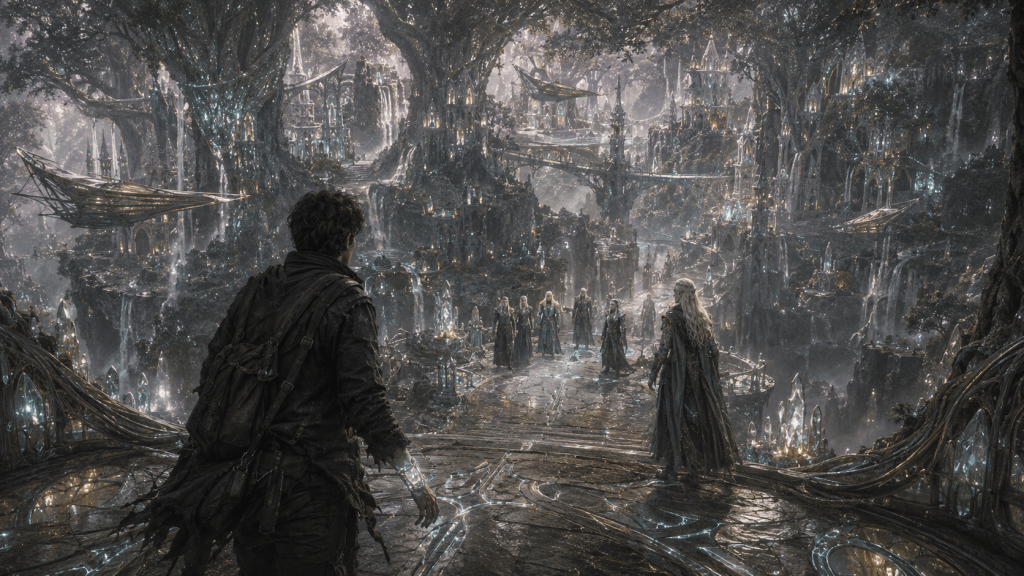
The arrival in the full elven realm brings one of the strongest visual and cultural contrasts in The Failing Path. Zone Thirteen survived through repair, salvage and adaptation, while the elven civilisation Aeloria enters rises through living crystal, enormous trees, layered bridges, controlled water systems and field-balanced craft moving through open air.

For Aeloria, the contrast reaches beyond beauty. Structures hold their weight, water flows where it has been guided, pathways remain maintained, and light runs through living architecture as part of ordinary function rather than as the unpredictable residue of a failing human system.

The experience reveals what stability looks like from someone raised in a place where almost everything had already been repaired too many times. It also demonstrates why material prosperity and personal safety should never be treated as the same thing.

The path-stones continue glowing after Aeloria arrives, ordinary elves begin watching, and six elders come to meet the field team. Serenis then reveals that she has understood Aeloria’s English throughout the crossing, changing the meaning of every earlier silence between them and leaving him aware that he has been observed far more closely than he realised.

The full elven realm therefore expands the scale of the story while narrowing Aeloria’s personal freedom. He has left the collapsing fragment behind, yet arrival places him before institutions capable of giving his presence a meaning he has never chosen for himself.


A Science-Fantasy World Built on Inheritance

The fractured realms of The Awakening of Power exist where technology, resonance, archaeology and myth can no longer be separated into simple categories. Crystals shape tools, architecture, transport and pathway systems, while structures left by older civilisations continue carrying functions that later cultures can use more easily than they can fully explain.

Human civilisation develops through technological adaptation and applied engineering, whereas the elves have built a closer relationship with crystal resonance and cultivated systems. Neither approach makes one culture inherently wiser, because each represents knowledge grown inside the limits of a separated world.

That partial understanding gives the series much of its atmosphere. Ancient structures matter because current lives still depend upon them, crystal systems matter because different peoples have built cultures around different forms of access, and pathways matter because their deterioration threatens the fragile connections that still exist between otherwise isolated realms.

The Failing Path places Aeloria directly inside that pressure for the first time. He enters the fragment carrying the survival instincts of Zone Thirteen and expecting damaged ground to behave according to the familiar logic of damaged machinery, only to discover that some old systems remain active enough to recognise movement, resonance and presence in ways no scavenger training could have prepared him to understand.

By the time he reaches the elven realm, the most unsettling truth is no longer simply that the path is failing. It is that parts of the ancient structure beneath the fractured worlds still appear capable of remembering what they were built to do, even when the people living among them have inherited only fragments of that knowledge.
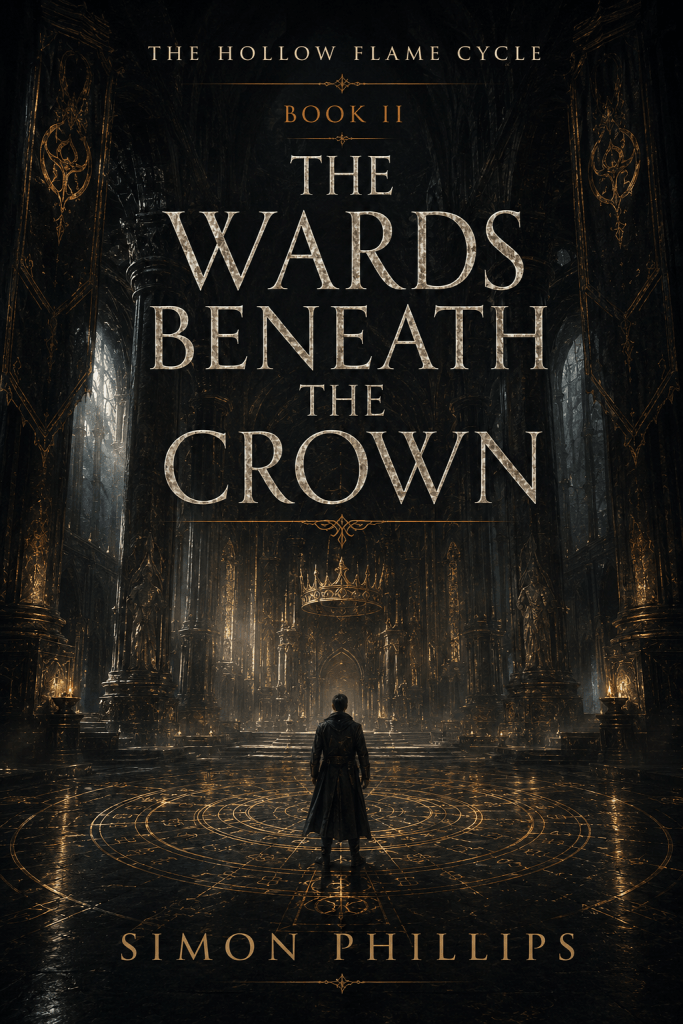
The Wards Beneath the Crown: Slow-Burn Epic Fantasy of Living Wards, Royal Power and a Realm That Refuses Its Stranger

Silas Thorn has already crossed through an ancient book and awakened inside the secured foundations of a royal palace. By the following morning, the impossible has acquired a locked door, a permanent guard, an official record, and a carefully chosen vocabulary designed to make captivity sound like protection.

The Wards Beneath the Crown, Book Two of The Hollow Flame Cycle, continues directly from The Unclassified. The first book carried a London manuscript conservator through an unidentified volume and into the heart of a hidden magical realm. Book Two follows the consequences as the Crown attempts to contain what it cannot explain, the Guild begins measuring disturbances it may already recognise, and the palace itself responds to Silas with increasing intensity.

This is slow-burn epic fantasy shaped through royal intrigue, living magical architecture, institutional conflict, ancient records, guarded relationships, and a displaced man who still wants only to know whether his father remains alive beyond the Veil.

The danger arrives quietly. Lamps brighten around handwritten questions. Ink acquires impossible depth. Buried routes remember that they once existed. A beautiful royal estate is prepared before its future resident has been asked whether he wishes to enter it.

Silas has been promised protection, yet every attempt to find his way home gives the realm another reason to fear him.


A Beautiful Chamber Becomes a Civilised Prison

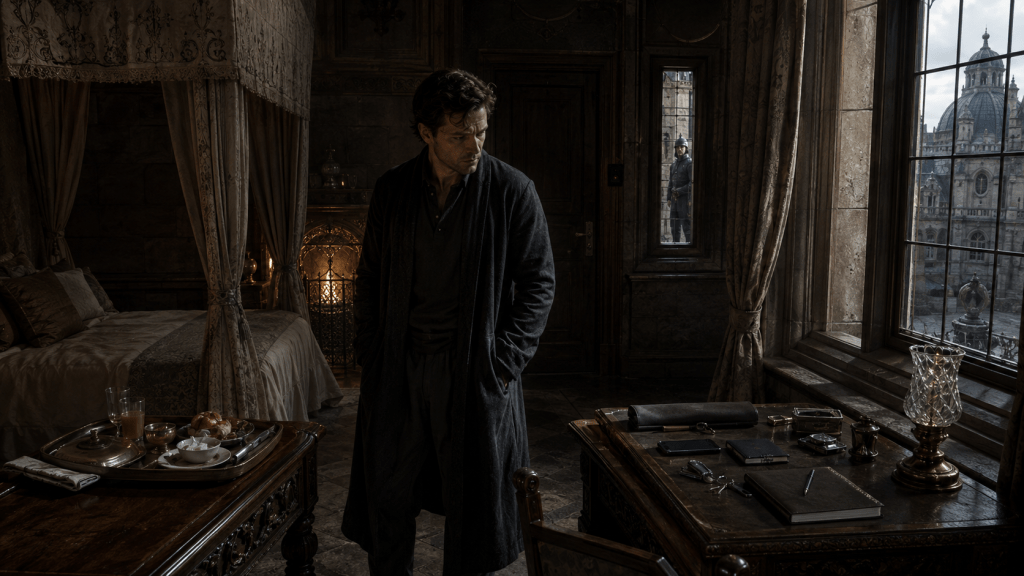
Silas awakens in the eastern guest wing of the royal palace after a night of fractured sleep and unfamiliar sounds.

The chamber contains everything a generous official might present as evidence of humane treatment. Clean linen covers a broad bed. Controlled warmth rests behind a curved hearth screen. Fresh water, prepared food, new clothing, and attentive service await him. Tall windows offer a view across palace courtyards where servants, clerks, guards, and household pages continue their ordinary work.

The door remains locked.

A guard waits outside. Silas’s possessions have been catalogued. The knife placed beside his breakfast has been deliberately dulled, and movement beyond the chamber requires permission, escort, and an approved route.

His professional understanding of conservation makes the contradiction especially sharp. Silas has spent years preserving rare books, protecting fragile objects from careless handling, unstable environments, and further damage. He understands that something may be kept safe while losing every meaningful form of freedom.

The Crown calls him a protected resident. Silas sees a beautiful enclosure whose comfort changes none of its essential purpose.

That tension gives The Wards Beneath the Crown its emotional foundation. The Crown’s concern is genuine. The guards are disciplined. The servant assigned to him, Maren, offers practical kindness and restrained humour. Halren Voss, the Crown liaison responsible for his residence, listens carefully and refuses easy consolation.

Even so, Silas cannot leave.

The story asks a difficult question from its opening pages: when protection cannot be refused, how far does it remain separate from imprisonment?


Silas Thorn Wants Answers More Than Power

Silas remains an unusually human centre for a story filled with royal wards, magical instruments, ancient foundations, and political authority.

He has no wish to become a mage, fulfil a prophecy, conquer a hidden realm, or claim a heroic place within it. His questions remain painfully ordinary:

Is London still there?

Is his father alive?

Does time continue at the same pace beyond the Veil?

What happened to the book?

Can anyone send him home?

Voss answers the final question with the honesty Silas has been dreading. No one can simply return him.

That truth reaches more deeply than the guarded chamber or the royal decree. Until someone states it plainly, Silas can still imagine the crossing as a misplaced road, an accidental doorway waiting to be found again. Once Voss speaks, return becomes an uncertainty that every institution around him may study, delay, or eventually declare impossible.

Silas responds through the skills and habits that shaped his former life. He observes language. He notices how records are phrased. He asks that his own account be preserved in his own handwriting because he understands how testimony becomes cleaner, safer, and less human as it travels through official hands.

He knows that naming determines how an object is handled.

He soon discovers that the same principle applies to people.


London Finds an Echo in Lundenvar

During a supervised orientation, Silas is shown maps of Valebrin, its capital Elyrion, and the wider shape of the realm into which he has fallen.

The hidden magical world is neither a medieval imitation nor a decorative kingdom designed around castles and spellcraft alone. It possesses roads, administrative borders, civic transport, communication systems, illuminated cities, royal offices, military structures, archives, and technologies shaped through magical development.

The map offers Silas his first chance to place himself somewhere measurable.

Instead, it makes the distance from home stranger.

Near the western edge of Valebrin lies Lundenvar, an old threshold city occupying an uneasy correspondence with London. It is no direct equivalent, yet its position carries enough similarity to disturb him. Rain-dark streets, Underground platforms, buses, libraries, his father’s house, and the conservation studio return through association while an unfamiliar place-name sits where his mind expects home.

The connection suggests that Earth and the hidden realm may preserve echoes of one another through geography, history, or the Veil itself.

Silas receives no comfort from the discovery. London has become more than a distant city. It is now a place that may possess a distorted reflection inside another world.

The distance between them can no longer be understood in miles.


The Written Word Refuses to Remain Ordinary

Silas is given paper and ink so that his questions can enter the Crown record.

He writes his name, the last place he remembers, and the matters no official answer has resolved. He asks about his father, the vanished book, the passage of time, the Veil, and the authority deciding what knowledge he may receive.

As he writes, the chamber lamps brighten.

The change is initially slight enough to invite doubt. Silas watches the crystal lights steady themselves and wonders whether fear has made him unreliable. Then the word Veil begins holding the light differently from every other word upon the page.

Its ink acquires the same inward depth he remembers from the ancient book in London.

When Silas calls for help, Guard Arven enters first, followed by Voss, Sera Valn, and Warden Cael Orven. Their response reveals how thoroughly magic has been integrated into this civilisation. Instruments are brought. The desk perimeter is measured. Chamber wards are examined. Technical language gathers around the page with unnerving speed.

Silas possesses no recognised casting discipline, visible training marks, declared magical focus, or knowledge of glyph construction. By the realm’s accepted understanding, his handwriting should have no power to alter a chamber ward.

Yet the page produces a second register.

The lamps respond. Passage-related words deepen. Ordinary questions about home become magical evidence.

Silas’s fear changes at that moment. He is no longer frightened solely because he cannot return to London. He is frightened because every attempt to ask for London becomes another reason for Crown and Guild to measure him.


The Crown and Guild Contest the Meaning of a Page

The altered page passes immediately into a political struggle.

The Guild of Mages possesses the expertise required to investigate unusual ward behaviour, crossing phenomena, glyph structures, and the ancient divisions between realms. The Crown possesses physical custody of Silas and responsibility for everything occurring within the palace.

Both institutions have legitimate grounds for involvement.

Neither fully trusts the other.

Lirael Vaerenthis permits the Guild to examine the page under Crown supervision. She refuses its removal to a private Guild chamber, blocks unsupervised copying, requires Crown witnesses, and ensures that the official record remains under royal custody.

The resulting audit is one of the book’s strongest expressions of political fantasy. No armies gather, no throne room erupts into open conflict, and no theatrical spell is cast across the chamber. Power moves through seals, witness rights, terminology, instrument placement, access restrictions, withheld interpretations, and the authority to decide which account becomes official.

High Mage Elarion approaches the event with intelligence and restraint. He refuses to classify Silas prematurely and recognises that the disturbance extends beyond ink. The response appears to move across written language, spoken words, remembered place, ward-lines, and Silas’s presence.

When Silas speaks the word London, the instruments respond.

When he speaks Veil, the reaction strengthens.

A pattern connected to older foundation behaviour briefly appears upon a Guild tablet, and one representative attempts to cover it before Lirael requires its inclusion in the Crown record.

The room discovers enough to become afraid and too little to become certain.


Lirael Vaerenthis Protects the Man Inside the Record

Lirael’s role throughout Book Two is politically demanding because every possible decision contains harm.

She cannot release Silas while the palace responds unpredictably around him. She cannot surrender him to the Guild merely because its mages possess greater technical knowledge. She cannot ignore the risk to servants, guards, clerks, petitioners, and families living within the palace.

She also refuses to allow official language to erase him.

When draft reports begin referring to Silas as a subject, anomaly, or ward-active presence, Lirael orders the language corrected. Within Crown records, he remains Master Thorn.

That choice carries more than courtesy. Lirael understands that technical wording can quietly change responsibility. Once Silas becomes an anomaly, officials may find it easier to isolate him, test him, relocate him, or claim jurisdiction over him. A name keeps his humanity inside the machinery processing his existence.

Her protection still has a coercive edge. She controls access, testimony, movement, and eventual relocation. Silas experiences her as one of the people deciding his life while asking him to trust the care within their restrictions.

Lirael offers him honesty in place of false reassurance. She protects his status as a person while acknowledging that his choices remain limited.

Her danger lies far from cruelty. It lies in the necessary authority she controls and the possibility that sensible governance can still wound the person it intends to preserve.


Seréne Searches the Language History Tried to Erase

Princess Seréne Vaerenthis approaches the disturbance from another direction.

While Crown and Guild examine instruments, Seréne enters the lower record arcade and searches older foundation texts. She studies marginal copies, disputed glossaries, early descriptions of reception, and words that later doctrine has simplified into cleaner administrative categories.

The oldest records describe warded stone in strikingly different terms.

Later scholars write of admission, rejection, intrusion, and instability. Earlier texts speak of presences being met, failing to settle, remaining unplaced, or creating an argument in stone.

Those differences matter.

Modern authority treats wards as systems that obey recognised command. The older language suggests something more responsive, uncertain, and alive. Seréne discovers references to one arrival producing two answers, an unseen answer requiring protection, and a mark that resembles Silas’s memory of the ancient book.

Her investigation shifts the central mystery. The problem may extend beyond what Silas is doing to the palace. The deeper question may concern how the palace, the Veil, or the realm itself is attempting to understand him.

Seréne recognises another danger as well. Crown and Guild are studying the second page, the one Silas wrote inside the guest chamber. Only Silas saw the first page, the ancient page in London whose dark markings opened beneath his hands.

Before official interpretation buries that original account, Seréne decides to hear it from him directly.


Old Books Create the First Ground of Trust

Seréne’s private conversation with Silas provides the book’s most intimate counterweight to institutional pressure.

Silas initially distrusts her. She is another royal daughter, another person connected to the authority holding him, and another visitor whose access has been granted through rank.

Their conversation changes when Seréne asks about the ancient book, his conservation work, and the distinction between repairing an object and preserving what survives.

Silas explains that conservation avoids forcing modern certainty into damaged history. A conservator stabilises evidence, respects alteration, and allows an object to retain the marks of what it has endured.

Seréne understands the principle because her own archival work has shown her how official histories become smoother as difficult meanings are copied away.

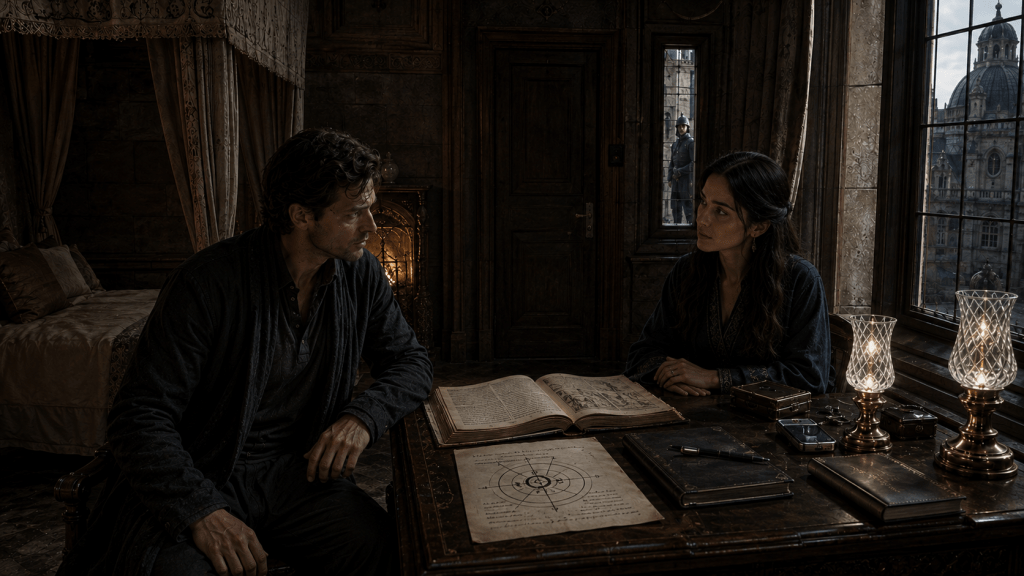
Their connection grows through shared intellectual ground rather than immediate romantic declaration. They speak about manuscripts, erased corrections, restricted texts, his father, his phone, the vanished book, and the danger of allowing institutions to replace a person’s first account with a cleaner summary.

Seréne treats Silas as someone who arrived with a profession, a family, memories, and a complete life beyond the palace.

That recognition matters enough for Silas to ask her to remain when Lirael enters.

Later, when he learns that he must be moved from the palace, he asks for Seréne to travel in his carriage because she has spoken to him as though his previous life still counts.

The request marks an important change. Silas still possesses little freedom, yet he has begun asserting whom he trusts within its limits.


The Palace Remembers a Buried Road

The disturbance refuses to remain inside the audit room.

As Silas returns towards his chamber, lamps dim in sequence along the gallery. Floor markers divide into conflicting routes. A sealed service passage beneath the visible corridor registers as available even though it has remained closed since an earlier reign.

The palace is no longer reacting only to a page or spoken word.

Its architecture has begun remembering.

This escalation transforms the palace from setting into participant. Its ancient wards, buried routes, foundation layers, and accumulated authority respond to Silas as though attempting to place him inside systems whose original instructions have been partly forgotten.

Elarion warns that each event has reached farther than the one before it. The disturbance began with page and lamp, moved into voice and measuring instruments, then spread into corridors and sealed structures.

He offers the Crown a deeply unsettling interpretation: the realm appears unable to decide whether to receive Silas, reject him, or answer through him.

The palace has become too old, too layered, and too closely bound to royal authority to hold him safely.

The Crown must move him.


Alderwick House Offers Space Inside Another Boundary

Alderwick House lies east of Elyrion, beyond the densest palace foundations and beneath a newer outer ward.

The Crown presents the estate as a safer residence with larger rooms, gardens, library access, fresh air, and distance from the reactive systems beneath the palace. Silas hears the truth beneath the amenities immediately.

It is another enclosure.

When he asks whether he can refuse, Lirael answers with painful clarity. He can object. His objection can enter the record. He cannot remain in the palace.

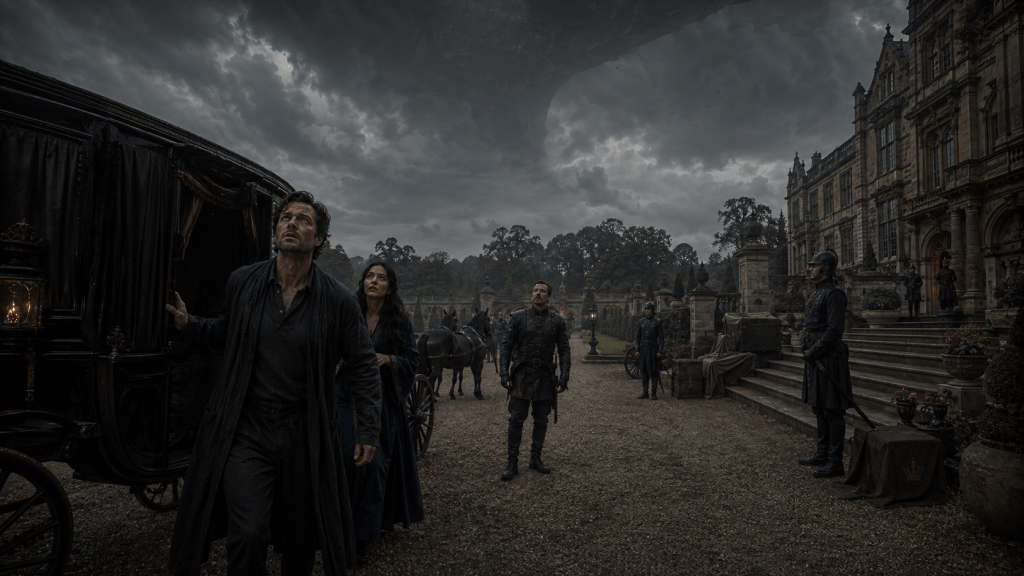
The early-morning carriage journey finally carries Silas beyond Crown corridors and gives him partial glimpses of the hidden realm’s roads, bridges, vehicles, settlements, and magical infrastructure. Curtains restrict his view, guards manage the route, and unexplained shadows pass high above the road.

Inside the carriage, Silas and Seréne compare their worlds through ordinary details. He describes buses, cars, trains, moving stairs, and mobile phones. She answers with guided platforms, line-stone routes, magical vehicles, and systems shaped through an entirely different history.

Their exchange reveals the scale of the world more effectively than an explanation could accomplish. Silas begins recognising that he has entered a functioning civilisation whose people find Earth as strange as he finds them.

When the carriage crosses Alderwick’s outer ward, Seréne and Arven pass through cleanly.

Silas does not.

The estate waits beyond the boundary, beautiful and guarded, with Crown officers, ward-stones, restricted shutters, and Guild-marked equipment already prepared. Then Silas steps from the carriage, looks beyond the roofline, and sees something above the ridge that changes the scale of everything he thought he understood.

The book closes before the sight is fully named.


Slow-Burn Fantasy Where Institutions Become the Source of Tension

The Wards Beneath the Crown will appeal especially to readers who enjoy political fantasy, hidden magical realms, portal fantasy, ancient manuscripts, royal intrigue, living architecture, institutional mysteries, gradual worldbuilding, and character-driven stories where consequences matter more than effortless spectacle.

The book’s tension grows through rooms, language, lamps, pages, maps, ward-lines, archives, sealed evidence, and guarded roads. Its characters behave intelligently, even when their competing responsibilities place them in conflict.

The Crown genuinely wishes to prevent harm.

The Guild genuinely needs to understand the disturbance.

Lirael genuinely protects Silas while restricting him.

Seréne genuinely seeks truth while approaching areas her sister has placed under control.

Silas genuinely wants home, even as the hidden realm begins answering him in ways that suggest his arrival carries meaning beyond accident.

No institution becomes foolish merely so the story can move. The danger emerges because intelligent people possess incomplete knowledge and enough authority to act upon it.

That combination makes every careful decision consequential.


Continue The Hollow Flame Cycle with The Wards Beneath the Crown

Book Two carries the crossing beyond its first shock and into the systems attempting to contain its consequences.

Silas Thorn remains far from home, watched by the Crown, examined by the Guild, and surrounded by warded structures that appear increasingly uncertain about his presence. Lirael must protect a kingdom and a man whose needs no longer align cleanly. Seréne has begun uncovering older language that may explain why the realm’s foundations answer differently from modern doctrine.

The palace has released Silas because it can no longer hold him safely.

Alderwick House has received him imperfectly.

Something impossible is waiting in the sky.

Readers who have completed The Unclassified can continue Silas Thorn’s journey in The Wards Beneath the Crown, Book Two of The Hollow Flame Cycle.

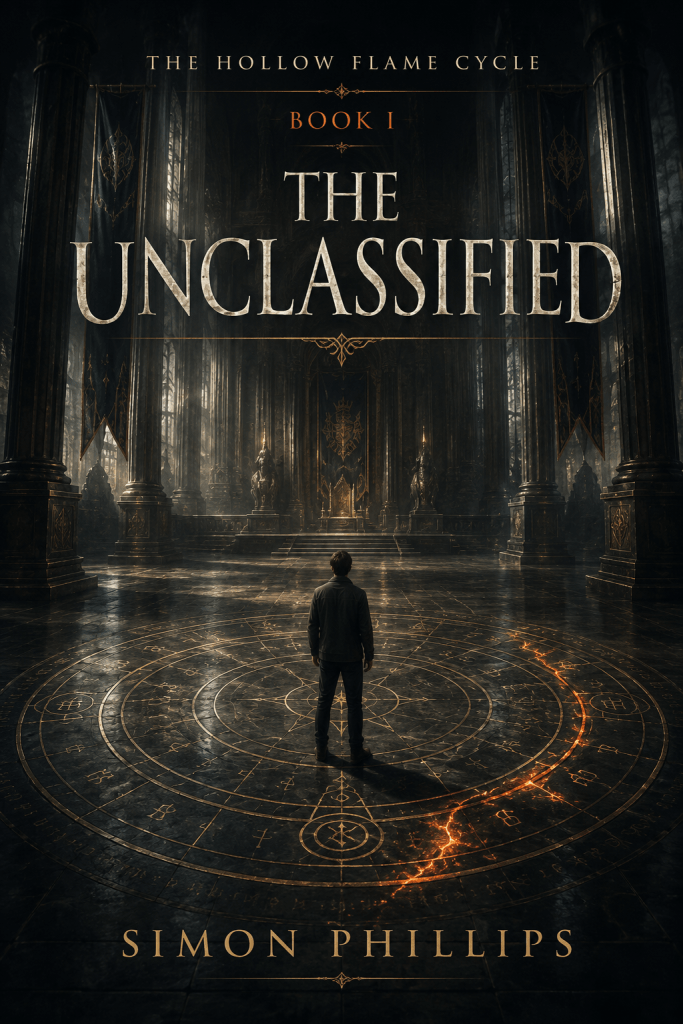
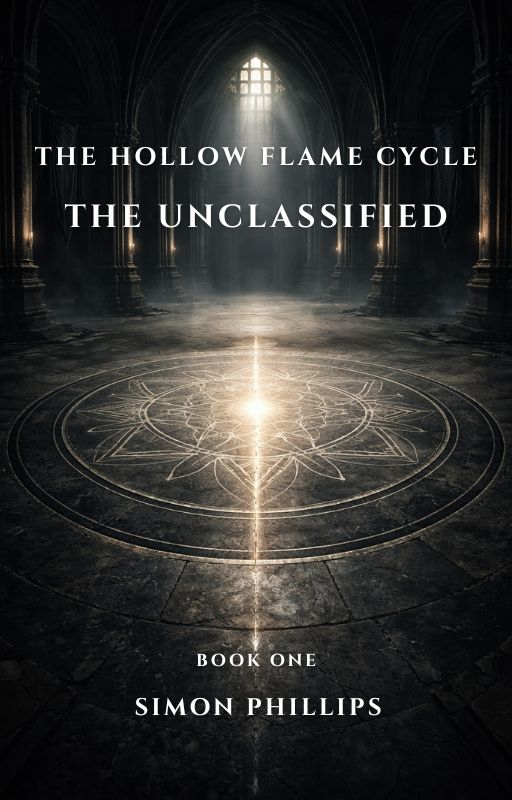
The Unclassified: Slow-Burn Epic Fantasy Where an Ancient Book Opens into a Hidden Magical Realm

An old book rests beneath the controlled light of a London conservation studio, surrounded by brushes, weights, linen thread, magnifying lenses, and the accumulated certainty of professional knowledge. Its leather carries no title. Its script belongs to no language its reader recognises. Darker marks sit between the lines, holding the lamplight longer than ordinary ink should ever manage.

Silas Thorn understands damaged books. He understands altered bindings, hidden repairs, brittle fibres, fading ink, and the patient labour required to preserve something that has survived the carelessness of previous generations. What he does not understand is why the book feels warm beneath his hand, why its markings appear to draw light inward, or why the page begins to open into a depth that cannot exist within paper.

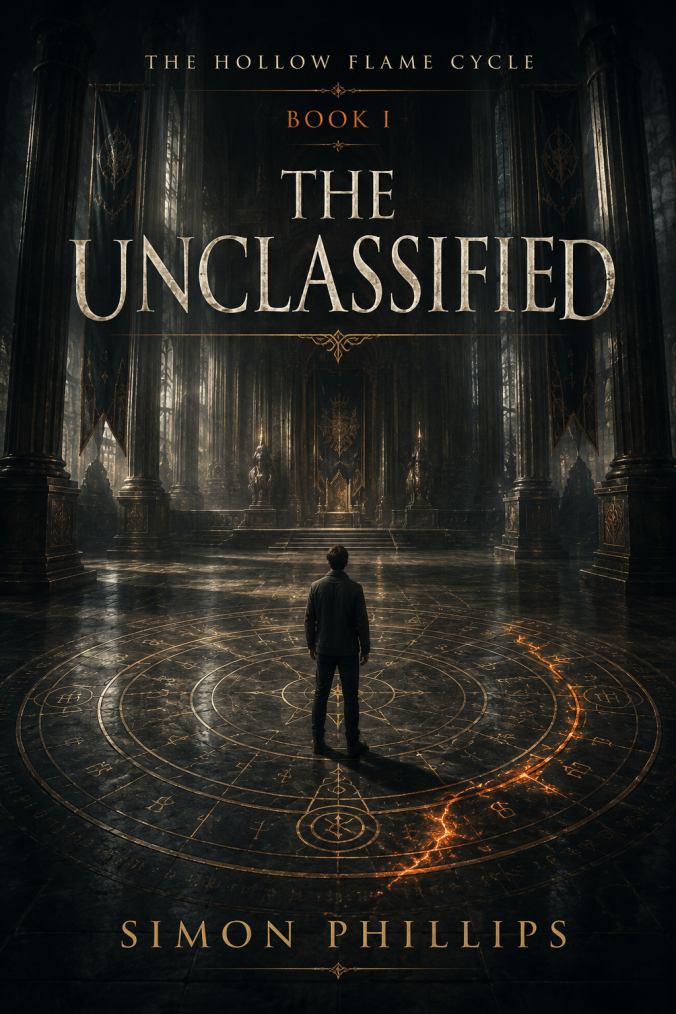
The Unclassified, Book One of The Hollow Flame Cycle, begins as an atmospheric fantasy about old books and buried history before widening into a slow-burn epic fantasy of hidden realms, royal authority, magical institutions, and a man whose arrival threatens every accepted explanation surrounding him.

The crossing does not welcome Silas into an adventure. It removes him from everything he knows and places him inside a civilisation that already believes his presence must mean something.


A Book That Refuses the Rules of Preservation

Silas approaches the unidentified volume as a manuscript conservator, rather than as someone searching for magic. That distinction shapes the entire story.

He does not open the book because he longs to escape modern life, discover secret powers, or fulfil an old prophecy. His father finds it among family possessions connected to Silas’s grandmother, wrapped and hidden behind an old trunk. Silas takes it back to his studio because careful examination is his profession. The response is completely reasonable within the life he understands.

That ordinary foundation gives the impossible greater weight.

The book’s transformation develops through physical details that Silas would naturally notice. Its construction seems unusually intact. The script carries discipline despite resisting identification. Darker marks hold light differently from the surrounding ink. Heat rises through the page and into the tools placed near it. The air above the surface shifts. Straight lines begin to bend.

Every stage moves Silas further from professional curiosity towards the recognition that the object is answering him.

The resulting tension belongs partly to supernatural fantasy, partly to hidden-world fantasy, and partly to the intimate unease of an intelligent person watching reliable knowledge fail beneath his hands. Silas has spent his working life bringing damaged history back into stable form. He now faces an artefact that seems to have been waiting for him to touch it.

The book does not merely contain a doorway. Its behaviour suggests intention, recognition, or some buried connection that Silas cannot yet name.


Silas Thorn Carries the Logic of London into the Impossible

Silas is an unusual centre for an epic fantasy story because his first strength is attention.

He is neither a trained fighter nor an ambitious seeker of power. He is a British manuscript conservator whose habits have been shaped by restraint, evidence, and respect for material history. He notices how an object has been handled. He recognises when thread belongs to a later repair. He understands that damage often carries several generations of human decisions within it.

Those skills continue to matter after the crossing.

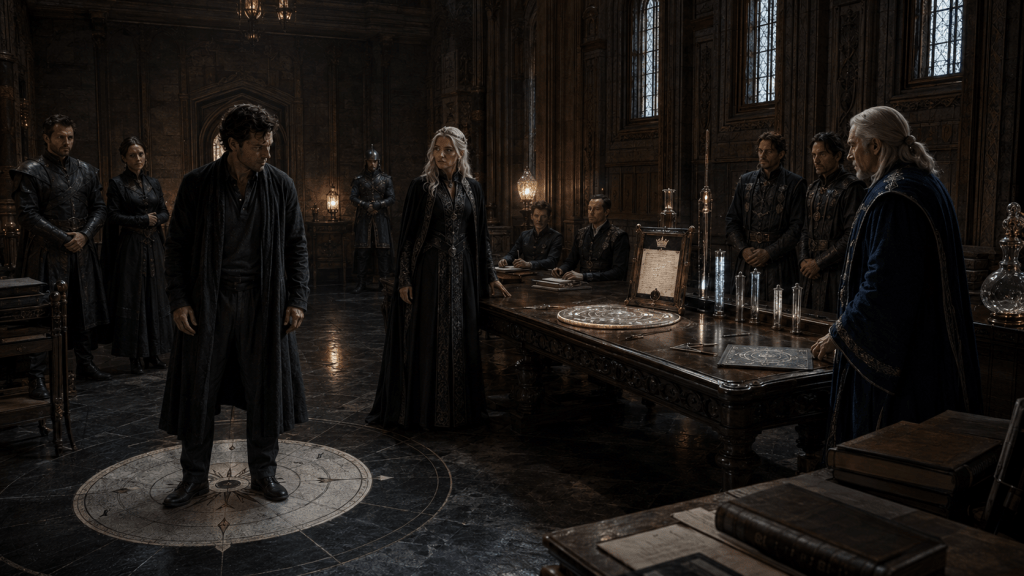
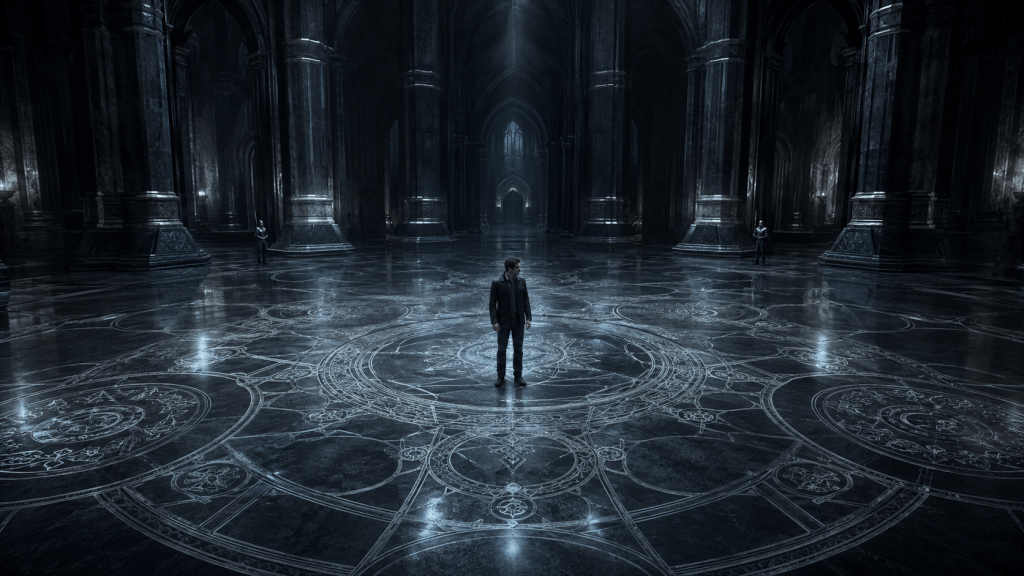
When Silas is drawn through the altered page and falls onto the polished stone of an enormous foundation chamber, he does not suddenly adopt the language or confidence of a fantasy hero. He searches for a door. He looks for the vanished book. He studies the architecture surrounding him and tries to find something that will return the world to measurable proportions.

The book has disappeared. London is beyond reach. Beneath him lies an intricate inlay of unknown sigils, set within the secured foundations of a royal palace.

Silas’s displacement remains personal even as it becomes political. He has a father who expects him to return. He has a profession, a familiar city, and an ordinary life that continues somewhere beyond the crossing. The story allows that loss to remain present. His first desire is not to master the hidden realm. He wants to understand what happened and find a path home.

That human response makes him a stronger emotional anchor. Readers enter the magical civilisation through someone who observes before claiming knowledge and admits uncertainty instead of disguising it. He cannot explain the book, the crossing, or the foundation chamber. He can only describe what he saw and insist upon the limits of what he knows.

The realm, however, has little patience for an answer that leaves so much unresolved.


The Palace Foundations Receive What the Crown Never Summoned

Silas does not appear at an abandoned ruin, an unguarded border, or a forgotten doorway. He arrives inside the protected heart of royal authority.

The palace foundations are layered with ward-lines and structural sigils that should answer only to recognised invocation. Their purpose is political as well as magical. They protect Crown space, carry the weight of inherited authority, and form part of a system whose reliability has endured across generations.

Then the east quadrant records a brief deviation.

The ward-lines move away from their expected pattern before returning to stability. No physical breach is found. None of the outer seals show disturbance. No authorised ritual has been conducted. When the palace guards enter the foundation chamber, they find an unknown man standing at the centre of the inlay.

The foundations have received Silas even though the Crown never summoned him.

That detail changes the crossing from a private supernatural event into a crisis of authority. Silas may be frightened and confused, yet his confusion cannot remove the political meaning of where he has appeared. If the palace wards admitted him, either the protections have failed or they recognised something their current keepers do not understand.

Both possibilities are dangerous.

This is where The Unclassified separates itself from fantasy stories that treat arrival in another world primarily as an invitation. Silas’s crossing creates procedure, investigation, jurisdiction, and fear. The hidden realm is a functioning civilisation with laws, offices, guards, archives, councils, and competing forms of magical authority. An impossible person appearing inside its protected centre cannot remain a private curiosity.

His existence has become a matter of state before he has learned the name of the kingdom holding him.


Lirael Vaerenthis Turns Fear into Law and Procedure

Princess Lirael Vaerenthis encounters the disturbance first through a report.

Her morning begins with questions of administration, disputed authority, altered ward-stones, and the Guild’s habit of acting before consulting the Crown. She is politically trained, disciplined, and acutely aware that small procedural changes can conceal larger claims of power.

When the foundation ward-lines fluctuate, Lirael does not respond through panic or superstition. She orders a quiet inspection. She requests a physical survey independent of the magical sentinel array. She insists that even the absence of visible evidence must be recorded.

Her response reveals one of the book’s most compelling ideas: competent institutions can behave rationally and still remain dangerously incomplete.

Lirael does many things correctly. She keeps the disturbance controlled. She prevents rumours from moving ahead of evidence. When Silas is found, she orders that no harm should come to him. She provides food, water, guarded accommodation, and formal inquiry instead of allowing frightened officials to decide his fate in a corridor.

Yet every careful response places Silas more firmly inside Crown authority.

Protection and restriction arrive together. He is treated humanely, while his freedom depends upon people who cannot classify him. Lirael recognises that fear could lead to dangerous decisions, but she also knows that compassion cannot erase the security implications of his arrival.

Their first conversation carries that conflict. Silas speaks as a displaced man who wants to return home. Lirael listens as a royal official responsible for a palace whose foundations have behaved impossibly. He insists that he invoked nothing. She knows the inlay should never answer by accident.

Neither is unreasonable. Their difficulty lies in the fact that both may be telling the truth.


Seréne Vaerenthis Listens for Meaning Beneath the Stone

Where Lirael approaches the crossing through law and structure, Princess Seréne Vaerenthis approaches it through older texts and meanings that formal authority has allowed to recede.

Before she sees Silas, Seréne is studying first-generation accounts of the palace foundations. Those records describe thresholds as structures that do more than keep danger outside. They suggest the foundations were designed to sense what pressed against them and that the stones listen as well as seal.

The difference is subtle, yet it changes the meaning of Silas’s arrival.

If the foundations are only barriers, his appearance represents a failure or breach. If they possess some older responsive function, they may have admitted him deliberately.

Seréne carries this possibility into the royal hearing. She watches Silas differently from the councillors who search for deception and differently from Lirael, whose duty requires an immediate policy response. Seréne notices the effort beneath his stillness, the scholar’s bearing within his unfamiliar clothing, and the way he studies the hall as someone seeking stable ground.

Her response remains restrained. She does not declare him innocent, prophetic, or trustworthy. When asked for judgement, she says that she would hear more because the questions raised by his arrival cannot be exhausted within the first hour.

That decision establishes her place within the central character braid. Lirael gives the crisis structure. Seréne preserves the possibility that the structure itself may be based upon an incomplete understanding of the past.

Silas stands between them, unaware that their differing responses may shape far more than the terms of his confinement.


London Becomes the Impossible World Inside the Royal Hall

One of the most distinctive movements in The Unclassified occurs when Silas is questioned before the sovereign and assembled court.

From Silas’s perspective, the palace is impossible. Its sigils, ward-lines, magical foundations, ritual authority, and vast architecture belong to stories. From the court’s perspective, London is equally difficult to comprehend.

Silas describes elected officials, Parliament, written law, archives, universities, steel bridges, electrical power, and streets illuminated without flame. He explains a society where authority can be challenged through debate and where scientific systems provide functions the court associates with magic.

The exchange turns familiar modern life into a form of speculative worldbuilding.

Electricity sounds implausible to people who understand illumination through magical craft. Government without succession binding seems structurally insecure. A world that dismisses magic as fiction becomes difficult to reconcile with the man who has crossed from it through a book.

Silas cannot prove London exists. The court cannot dismiss him because its own foundations received him.

The scene allows both worlds to remain strange. Modern Britain is not treated as the unquestionably superior civilisation, while the magical realm is never reduced to an archaic kingdom awaiting modern instruction. Each possesses systems, traditions, assumptions, and forms of knowledge that the other finds difficult to accept.

Silas has crossed between worlds, yet the more significant divide may lie between the explanations each civilisation has learned to trust.


Crown and Guild Gather Around an Unclassifiable Man

The Crown can decide where Silas sleeps, who guards him, and which questions he must answer. It cannot explain why he arrived.

That limitation brings the Guild into the palace.

The Guild exists beside royal authority rather than beneath it. Its knowledge of sigils, ward-lines, and magical structures gives it a necessary role, although its independence also makes every intervention politically sensitive. Lirael already suspects the Guild of treating technical expertise as permission to act within Crown territory. Silas’s arrival gives both institutions a legitimate claim to involvement.

The sovereign therefore chooses controlled residence and supervised inquiry. Silas will be protected, watched, and questioned while Crown and Guild attempt to understand the crossing.

Then High Mage Elarion enters the hall.

His arrival carries no extravagant display. The court shifts because everyone recognises what his presence represents. The Crown possesses Silas physically, while the Guild may possess the knowledge required to interpret him. Neither institution can proceed comfortably without the other.

Silas remains at the centre while older powers arrange themselves around him.

This political tension gives the story a scale larger than its immediate events. No battle is required to demonstrate the instability beginning within the realm. The disturbance exists in jurisdiction, withheld knowledge, altered foundations, and the quiet recognition that established authorities may no longer understand the systems they govern.


The Hidden Realm Feels Like a Civilisation Rather Than an Escape

The magical realm of The Echo of Fire and Shadow is introduced through institutions and ordinary activity rather than spectacle alone.

The palace contains clerks, petitioners, ledgers, archivists, servants, maps, formal hearings, restricted libraries, administrative chambers, and layers of working authority. People dispute grazing rights and river levies while ancient ward-lines rest beneath their feet. Political life continues around magic because magic has already become part of civilisation.

That approach gives the hidden realm credibility.

Silas has not entered a decorative medieval landscape waiting for an outsider to transform it. He has entered another form of organised society, one whose magical systems have shaped government, architecture, security, communication, and inherited law. Its people possess knowledge he lacks, while remaining blind to possibilities their own history may have concealed.

The palace itself becomes part of the story’s pressure. Its foundations hold older meanings. Its corridors control movement. Its great hall converts uncertainty into judgement. Its libraries preserve versions of history that official doctrine has narrowed over time.

Nothing has visibly collapsed by the end of Book One. The palace still stands. The ward-lines remain intact. The sovereign has issued a measured decree. The Guild has been called.

Yet the civilisation has been forced to acknowledge a man who should never have reached its centre.


Three Perspectives Surround a Single Unanswered Crossing

The story moves through Silas, Lirael, and Seréne because no single perspective can contain what has happened.

Silas gives the crossing its human cost. He remembers London, his father, the conservation studio, and the ordinary certainty of a world where pages remain pages.

Lirael reveals the political consequences. She understands that an unexplained person inside royal wards may create fear, rumour, and institutional conflict long before anyone discovers the truth.

Seréne senses the historical depth beneath the event. She recognises that the foundations may carry meanings that modern authority has preserved imperfectly.

Together, their viewpoints create a character-driven epic fantasy in which mystery develops through interpretation. The central question is larger than identifying who opened the passage. The deeper pressure comes from the different meanings attached to Silas before anyone has truly learned who he is.

To himself, he is a conservator who fell through a book.

To the Crown, he is an uninvited presence inside protected space.

To the Guild, he may be evidence of a magical event outside recognised boundaries.

To Seréne, he may be connected to something the foundations remembered even after the realm forgot.

Each interpretation brings consequences, and none yet provides an answer.


Epic Fantasy Built from Restraint, Memory and Political Consequence

The Unclassified will appeal especially to readers who enjoy atmospheric epic fantasy, hidden magical realms, ancient books, royal politics, magical institutions, slow-burn character development, and mysteries that widen through consequence instead of immediate explanation.

Its tension comes from competence meeting the impossible. Silas behaves intelligently. Lirael responds responsibly. The sovereign maintains order. Seréne refuses premature certainty. The Guild arrives when its expertise becomes necessary.

The danger persists because sensible decisions cannot resolve a truth that lies outside the systems making them.

This gives the opening of The Hollow Flame Cycle its particular identity. Magic is never presented as a convenient route to effortless power. Authority is neither foolish nor all-knowing. History is preserved, although preservation cannot guarantee that its meaning has survived intact.

At the centre remains Silas Thorn, a quiet man from London whose professional life has taught him that old damage must be handled carefully. He has now entered a realm shaped by an ancient history that may recognise him before he can recognise anything within it.


Begin The Hollow Flame Cycle with The Unclassified

Book One closes its immediate movement with Silas contained, protected, watched, and surrounded by questions. The Crown has acted. The Guild has entered the palace. Lirael has imposed structure. Seréne has begun looking beneath the official explanation.

The crossing remains unresolved.

Readers can begin The Echo of Fire and Shadow through The Unclassified: A Story from The Hollow Flame Cycle on Amazon Kindle.

The story begins with an old book beneath a conservator’s hands, yet its true disturbance reaches far beyond the page. A hidden realm has received someone it never summoned, and the institutions built to control magical uncertainty must now decide whether Silas Thorn represents a breach, a warning, or the return of something their own history no longer knows how to name.

Zone Thirteen and the Pressure of a Fractured Sci-Fantasy World

Where Broken Systems Still Breathe

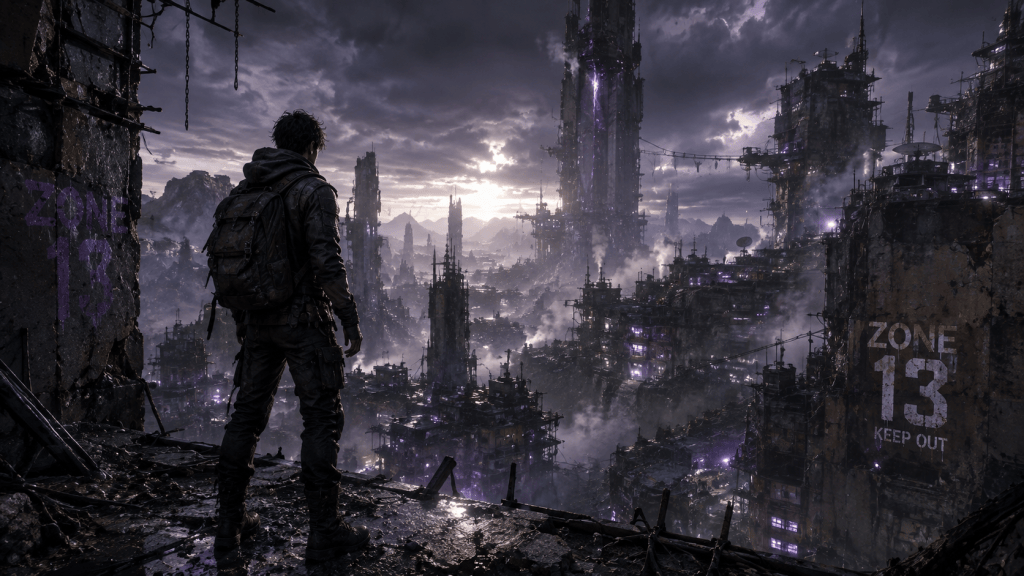
Zone Thirteen stood at the edge of human order, though order had become a generous word for what remained there. The roads held their shape through habit more than repair. Pylons leaned into the wind with stripped frames and tired wires. Habitation shells endured by patchwork, scavenged metal, old clamps, and the quiet discipline of those who had learned to survive among systems already past their intended life.

For a mythic sci-fantasy novella, this kind of place matters. Power rarely begins inside palaces or temples. It begins where nobody expects consequence to gather. It begins in forgotten ground, beneath broken infrastructure, among salvage routes and old machines that still carry a faint memory of function. In Zone Thirteen, the opening movement of The Chronicles of Aeloria, the world does not announce itself through prophecy. It presses against the skin first.

Aeloria’s world is built from edges. The edge of roads. The edge of notice. The edge of value. The edge of systems that still respond in fragments. His life among salvage, tokens, failed conduits, and old relay units places him inside a fractured worlds fantasy series before the wider realms are ever named. The science fantasy pressure is already present in the environment itself, where broken technology carries something older than machinery and where dormant crystal behaviour waits beneath practical survival.

Zone Thirteen is not simply a damaged settlement. It is a pressure space. Every surface suggests previous use, previous collapse, previous hands stripping away whatever could still be sold or made useful. The people living there have inherited failure without receiving explanation. They cross unstable ground because the ground still allows them to cross. They use systems because enough of those systems continue to answer. They survive without believing survival has larger meaning.

That is why the shard matters before it is understood.


Power Before Understanding

In many fantasy stories, power arrives as revelation. In Zone Thirteen, power arrives as misalignment. The hum changes. The ground delays its response. Pylons flare when no working line should carry current. A storm gathers around an object whose shape and behaviour exceed every category available to the boy who finds it.

This is where the novella’s strongest discovery language sits. Aeloria does not step into mastery. He is pulled into pressure. The shard responds to him through heat, weight, resistance, and bodily consequence, making power feel like an event before it becomes a destiny. It is a magical crystal world fantasy without the comfort of clean enchantment. The crystal does not explain itself. It enters the body’s awareness through pulse and strain.

That restraint gives the world its force. Ancient systems remain present, yet their purpose has thinned into fragments. Relay units, pylons, conduits, machines, and scanning beams all belong to a technological order, while the shard and surge belong to an inheritance older than human control. The result is fantasy with ancient technology shaped through use, decay, and response. Nothing feels decorative. Nothing exists only to signal wonder. Every object carries function, failure, or threat.

The Zone teaches Aeloria how to read surfaces. He knows which paths draw attention, which structures still offer cover, which salvage holds value, and which movements might leave traces. That training becomes crucial once the world itself begins acting like a system that can notice him. He has spent his life avoiding attention in a place where attention costs. Once the shard wakes, hiding becomes more difficult because the environment responds before people do.

This is one of the deeper tensions inside atmospheric sci-fantasy fiction. A broken system can remain survivable for years, even generations, until something returns meaning to it. Zone Thirteen has survived through neglect because neglect is predictable. The surge changes that. It reminds the Zone of older pathways, older connections, and older power. What once failed quietly begins answering in fragments, and each answer draws the attention of forces trained to contain rather than understand.

The figures who arrive after the surge carry a different kind of fear. They are clean where the Zone is worn. Their machines move with coordinated precision through a place that usually belongs to improvisation and adaptation. They speak in controlled signals: contact, containment, grid. Their presence turns Aeloria’s home into an operational field, reducing lived ground into a map of detection and response.

That shift matters because The Awakening of Power is a series about misreading. Institutions see signal before person. Systems see anomaly before fear. Power is classified before it is understood. Aeloria becomes dangerous to others the moment the world reacts to him, even though he remains the one least able to explain what has happened.


Entering Zone Thirteen

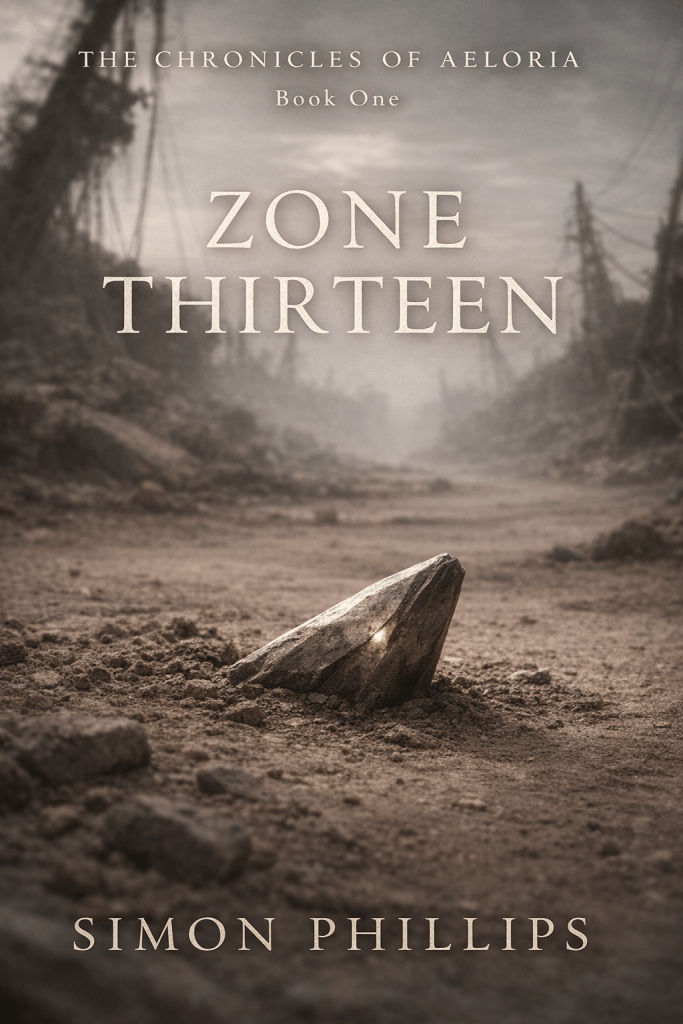
Zone Thirteen is Book 1 of The Chronicles of Aeloria, and it functions as the first contained movement in a slow-burn fantasy novella series shaped around pressure, displacement, and awakening. Its focus remains intimate. It holds close to one boy, one settlement, one guardian figure, one shard, and one rupture that changes the scale of everything.

The novella’s surface is survival. Aeloria moves through salvage routes, trades recovered parts, returns to the shack he shares with Larn, and measures value through tokens, repairs, and risk. Beneath that practical rhythm, the world begins to reveal its deeper instability. The ground shifts by fractions before larger distortions arrive. Systems respond in brief fragments before the surge takes hold. The storm grows from environmental pressure into something that feels almost structural, as though reality itself has begun to move out of alignment.

The experience of entering Zone Thirteen is the experience of entering a world already strained past comfort. It does not rush to explain its history. Instead, it lets the reader feel the shape of life inside its failure. Salvage is labour, habit, economy, and concealment. Larn’s shack is shelter, base, repair space, and emotional centre. The shard is discovery, wound, inheritance, and signal. The rupture is departure, threat, and threshold at once.

The KDP ebook link can sit quietly as the reader’s next step rather than as a loud interruption: The Chronicles of Aeloria: Zone Thirteen

What makes this opening work as a science fantasy novella series entry is its refusal to treat awakening as triumph. Aeloria gains no clean victory from the shard. He loses stability. He loses the safety of being overlooked. He sees Larn threatened. He feels the world answer him without consent. By the end, the Zone itself tears open, and the familiar ground beneath him gives way to motion, light, and the unknown.

The result is a beginning that feels complete in emotional pressure while leaving the larger mythic system unresolved. The novella closes the life Aeloria knew. It opens the passage into everything his world had buried.


The First Pressure of the Fractured Realms

Beyond Zone Thirteen, the larger movement of The Awakening of Power rests on fractured realms, ancient crystal systems, separated races, weakened pathways, and a forgotten inheritance that each civilisation understands only in part. The first novella keeps that larger architecture mostly beneath the surface, which strengthens its mystery. The reader senses scale through reaction rather than explanation.

The shard’s behaviour suggests inheritance before history names it. The surge shows that dormant systems can awaken through contact with the right presence. The glider introduces the possibility of non-human craft without turning the scene into exposition. The machines and external operators reveal that human authority has already developed methods for detection and containment, perhaps long before Aeloria ever became visible to them.

This layered approach allows the series to grow without feeling sudden. Zone Thirteen becomes the first pressure chamber of the wider fractured worlds fantasy series. It shows the human edge of a broken order: poor infrastructure, procedural enforcement, salvage economies, survival routes, and old systems degraded into partial function. Later realms may bring temples, pathways, crystal harmonics, elven vessels, ancient ruins, and political fear, yet their foundation is already present in the way Zone Thirteen behaves.

The fractured realms are living systems rather than simple locations. They remember through infrastructure. They answer through instability. They preserve old connections in damaged forms. When Aeloria touches the shard, he does more than activate an object. He forces the hidden relationship between body, crystal, environment, and old design into motion again.

That is where the mythic weight begins. Power in this world is neither prize nor weapon in its first expression. It is pressure. It changes footing. It changes sound. It changes how machines move and how people speak. It turns a scavenger into a signal and a home into a containment zone.

The cost of that awakening lies in the way no one present can fully interpret it. The Zone cannot explain itself. The operators act through procedure. Larn understands enough to recognise danger, yet even his protection cannot hold against the scale of what has begun. Aeloria feels the truth physically, long before he can name it. That gives the series its strongest continuity thread: understanding always arrives late.


What the World Remembers

Zone Thirteen remains behind, though it does not vanish. Places like that never vanish cleanly. They remain in the body through habit, caution, and the memory of ground tested before each step. They remain in the way a person watches doorways, listens to hums, weighs silence, and understands that attention can become a form of danger.

Aeloria leaves the Zone through rupture, yet the Zone has already shaped the way he will move through every realm that follows. He has learned broken systems before he learns ancient ones. He has learned survival before inheritance. He has learned that value is always judged by those holding power, and that being useful can become another kind of trap.

The world beyond the rupture waits with its own temples, pathways, ruins, and crystal pressures. Other races will carry their own partial truths. Other systems will claim older authority. The fractured realms may speak of balance, restoration, fear, and unity, yet the first lesson remains grounded in dust, salvage, and failing pylons.

A forgotten place answered first.

A shard woke inside a boy who had spent his life avoiding notice.

The world shifted before anyone understood why.

When the Page Opens and the World Follows

The moment where certainty fractures is rarely loud, though it alters everything that stands upon it

There are stories that begin with spectacle, with fire or proclamation, with the unmistakable signal that something has already broken beyond repair. This is not one of those stories. This is a story that begins with a page.

A man stands beneath morning light in a conservation studio, surrounded by the quiet labour of preservation, where history is handled gently, corrected carefully, and returned to stability through patience rather than force. The world outside continues as it always has, measured and dependable, its rhythms so deeply understood that they no longer require attention. Within that space, knowledge feels contained, ordered, and complete.

Then the page shifts.

It does not announce itself. It does not tear or burn. It folds inward.

And the world follows.


A Book That Does Not Behave Like a Book

Some objects are not preserved by time. They are waiting within it.

At the centre of The Unclassified, the first entry in The Hollow Flame Cycle, lies an object that resists classification at the most fundamental level. It resembles a book in form, though resemblance is the only certainty it offers. Its script refuses recognition, its structure resists familiarity, and its presence unsettles the very idea of passive material.

Silas Thorn approaches it as he would any artefact: with care, with discipline, and with the quiet confidence of someone who has spent his life restoring the past to coherence. His work is grounded in physical reality, in fibres, ink, binding, and time. Every action is deliberate, reversible, and measured against centuries of accumulated knowledge.

The book does not respond to that framework.

It holds warmth where none should exist. It bends light in ways that resist explanation. It answers touch with something that cannot be reduced to material behaviour.

What unfolds in that moment is not destruction, nor is it revelation in any familiar sense. It is intrusion.

The known world does not break. It gives way.


The Crossing That Leaves No Mark

Not all thresholds are visible. Some exist only in the moment they are crossed.

When Silas falls through the page, the act is not framed as travel. There is no preparation, no ritual, no understanding. The transition occurs in the space between expectation and perception, where reality has not yet had time to correct itself.

He lands not in chaos, though that might have been easier to comprehend.

He arrives in order.

The chamber that receives him is vast, structured, and deliberate. Its architecture carries the weight of centuries, its design shaped by authority rather than accident. Nothing appears broken. Nothing appears disturbed. The world into which he emerges does not recognise itself as interrupted.

This is the first tension the novella establishes with precision: the crossing is not treated as an anomaly by the space itself.

It is treated as an event that must be answered.


Authority Before Understanding

Institutions do not wait for clarity. They respond.

One of the defining tensions within The Unclassified lies in the way power reacts to uncertainty. The Crown, embodied through Princess Lirael and the sovereign, does not hesitate. The event is assessed, contained, and integrated into existing frameworks of control with remarkable efficiency.

There is no panic.

There is no denial.

There is only response.

Silas is not treated as an intruder in the traditional sense, nor is he embraced as a miracle. He is categorised as a problem requiring management. His presence is stabilised through containment, his movement restricted, his existence placed within the boundaries of governance.

This reaction reveals something fundamental about the world itself.

It does not collapse under pressure.

It absorbs it.


The Quiet Fracture Beneath Control

The most dangerous shift is the one that leaves everything looking unchanged.

While the structures of authority hold firm, the novella introduces a quieter, more unsettling movement beneath them. Through Princess Seréne, a different kind of awareness begins to emerge, one less concerned with immediate control and more attuned to what the event represents.

The foundations have opened.

They have closed again.

No mark remains.

This absence of damage becomes the central disturbance.

If the system can admit something without rupture, then the boundaries that define it are not as absolute as they were believed to be. The palace, the Crown, the Guild, and the very idea of structured reality all rest upon assumptions that have not yet been tested in this way.

Seréne does not rush to resolve this contradiction.

She recognises it.

And in doing so, she becomes the first to truly stand within the question the novella poses.


A World That Does Not Recognise Itself

When two systems meet, neither remains untouched.

The introduction of Silas’s world, described in fragments through his attempts to explain it, creates a second layer of tension. His reality is defined by written law, mechanical systems, and a complete absence of what this new world considers foundational.

There is no magic.

There are no sigils.

There is no binding of authority into stone.

And yet he stands within a place where all of those things are not only real, but necessary.

The contrast does not resolve into superiority or dismissal. Instead, it reveals the limits of both systems. Each world contains structures that appear complete within their own context. Each becomes unstable when viewed through the lens of the other.

The crossing does not simply move a man from one place to another.

It introduces incompatibility.


Where the First Movement Ends

The hall settles. The question remains.

By the close of the novella, nothing outwardly catastrophic has occurred. The palace still stands. Authority remains intact. The man has been contained. The Guild has been summoned. The system continues to function.

And yet something irreversible has begun.

The foundations have responded to something they were never meant to receive.

A man from a world without magic stands at the centre of a system built upon it.

The Crown has acted without understanding.

The Guild has arrived without conclusion.

The question has entered the world.

It has not left.


Step Into the Hall

If you want to experience the full unfolding of this first disturbance, you can read The Unclassified here:

This is the opening movement of The Hollow Flame Cycle, where the story does not begin with collapse, but with the moment just before it becomes possible.

The page has opened.

The world has followed.

And nothing, though it appears unchanged, will remain as it was.