During the quiet maintenance cycles of Ashfall Station’s graveyard shift, a lone technician working the outer hull corridors begins to hear movement within the station’s structure where no one should be.
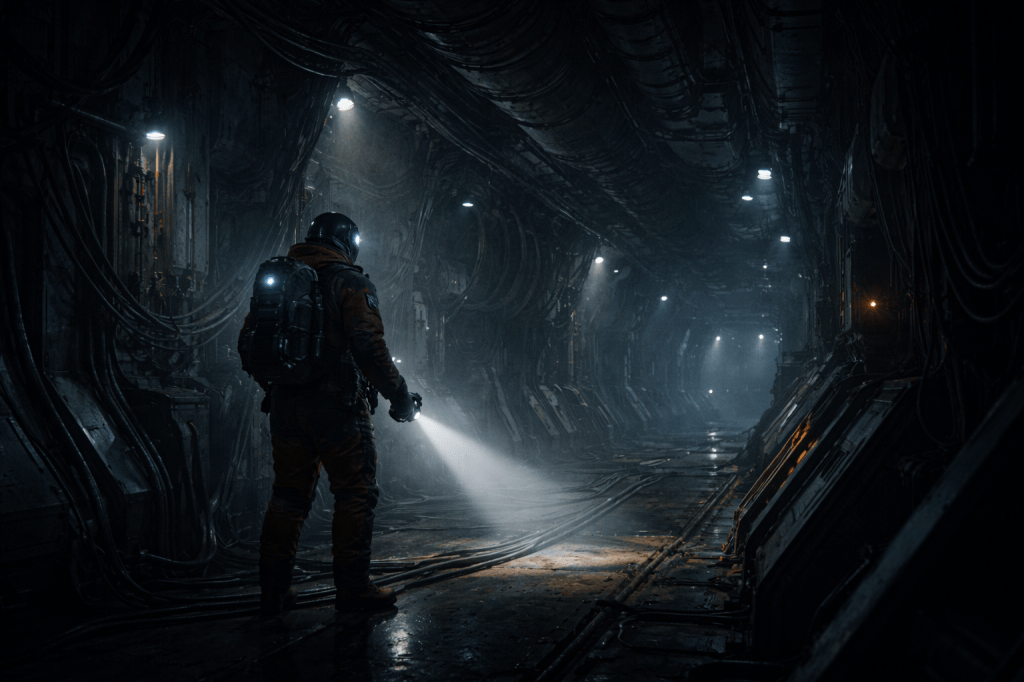
Inspection Record: Outer Hull Maintenance Corridor
The long night shift began during the quietest portion of Ashfall Station’s rotation, when the outer docking arms carried only the slow drift of a few cargo vessels awaiting clearance and the habitation sectors dimmed their lights in preparation for the artificial midnight cycle. Across most of the station, the machinery of daily operation continued with its patient rhythm. Freight carriers glided through distant cargo tunnels and refinery systems circulated power through the industrial ring that formed the backbone of the installation. Along the older maintenance corridors threaded through Ashfall’s outer hull, the atmosphere changed in subtle ways during these hours. The noise of human activity faded into the background, and the structure revealed the deeper sounds of its own existence: the low breathing of air circulation systems and the faint vibration of energy conduits running through steel arteries that had operated for decades above the silent mining world of Kestren-4.
Technician Marek Ilyan moved along one such corridor with the steady pace of someone accustomed to the solitude of these late rotations. His inspection lamp cast a narrow cone of light along the curved service passage while cables and cooling pipes followed the arc of the bulkhead overhead. The tunnel formed part of Ashfall’s older structural ring, a region assembled during the station’s earliest expansion when cargo traffic from the central trade lanes filled every dock with constant movement and industry. Time had layered the passage with generations of modification. Additional sensor housings stood bolted beside original control panels. Newer conduits ran alongside thick pipes whose metal carried the faded markings of earlier engineering teams, and occasional reinforcement plates revealed where stress fractures from past decades had once required careful repair by crews who worked these same corridors long before Ilyan first arrived on the station.
He paused beside a junction console where diagnostic indicators glowed with a steady amber light while his scanner transmitted a quiet stream of readings across the small display attached to his wrist unit. External hull pressure remained stable, and thermal distribution across the outer plating held comfortably within the parameters expected for this stage of the orbital cycle. The readings confirmed what the corridor itself already suggested. Ashfall Station continued its slow and dependable labour above the abandoned mining world below, carrying freight between distant systems and supporting the salvage operations that had grown gradually around the debris fields scattered through the outer reaches of the Kestren system.
Beyond the reinforced wall beside him lay the outer skin of Ashfall Station, and beyond that alloy plating stretched the open vacuum of orbit where the exhausted surface of Kestren-4 turned slowly beneath the station’s shadow. Earlier in the shift, Ilyan had passed two small observation ports cut through the structure where technicians could briefly look outward across the black horizon of space while performing inspection duties. Those windows revealed the faint movement of stars against the station’s gradual rotation, a quiet reminder that the immense industrial structure surrounding him remained only a thin barrier between human machinery and the vast silence beyond the hull.
He resumed his walk through the corridor while the beam of his lamp travelled across the layered construction of the bulkhead. Somewhere deep within the station, a cargo lift engaged its motors and the vibration travelled faintly through the structural framework beneath his boots. Sounds like that belonged to the familiar background of Ashfall’s life, small reminders that the vast installation remained active even during the quietest hours of the night cycle when most of the station’s workforce slept within the habitation rings.
The inspection route curved gradually towards a maintenance platform overlooking one of the older reinforcement beams that strengthened this section of the hull. Ilyan slowed his pace as the platform came into view, already reaching towards the railing where he intended to pause and begin the next sequence of structural diagnostics that formed part of the routine checks assigned to graveyard maintenance rotations.
As he stepped onto the platform, a faint vibration travelled through the metal beneath his boots. At first, the sound resembled the ordinary shift of thermal expansion passing through the station’s outer plates, the kind of subtle movement that maintenance crews heard frequently during their rounds as Ashfall’s immense framework adjusted to the slow temperature changes that accompanied orbital motion. The hull occasionally answered those shifts with quiet metallic murmurs that echoed through the surrounding corridors, and most technicians learned to ignore such sounds after enough months working the long night inspections.
Ilyan rested his scanner against the railing while the corridor returned to its familiar stillness. The conduits overhead continued their low electrical hum, and the diagnostic display on his wrist unit streamed its steady line of readings without interruption. For several moments, the corridor seemed unchanged from countless other shifts spent walking the quiet edges of the station.
Then the vibration returned, deeper this time and travelling slowly along the bulkhead beside him, as though something heavy moved across the far side of the alloy plating that separated the service corridor from open space. Ilyan turned slightly and placed his hand against the curved metal wall while the beam of his inspection lamp settled across the surface of the hull. Through the metal he felt the faint movement again, a dragging resonance that passed through the structure with deliberate weight before fading into the distant machinery of the station.
He remained standing beside the maintenance platform while Ashfall Station continued its silent orbit above the dark world below. The corridor returned once more to its quiet routine, and the familiar sounds of the station filled the passage. Yet the memory of that movement lingered beneath his hand against the hull. It was a slow travelling vibration that suggested something had crossed the outer surface of the station, where the maintenance logs recorded no scheduled drones, no passing vessels, and no external work crews operating anywhere near the reinforcement beams during the long night shift.
Station Record: Maintenance Inspection Protocols
Ashfall Station maintained a continuous inspection programme designed to monitor the condition of its outer hull and structural framework while the installation remained in orbit above the mining world of Kestren-4. The immense structure of the station consisted of several interconnected rings and industrial sectors assembled gradually during the early decades of frontier expansion, when ore extraction across the system required a large transfer platform capable of receiving freight vessels travelling between distant colonial routes. Over time, the station evolved beyond its original purpose. It expanded into a hybrid installation that supported freight traffic, salvage operations, engineering work, and long-term habitation for the technicians and crews who maintained its systems.
The outer maintenance corridors formed part of the earliest structural ring constructed during Ashfall’s initial development. Although successive generations of engineers reinforced the station with additional plating, upgraded sensor arrays, and expanded diagnostic infrastructure, many sections of the underlying framework remained original to the station’s first industrial phase. Maintenance crews assigned to these corridors followed inspection routes that traced the outer curvature of the hull, stopping at reinforcement beams and structural nodes where pressure readings, thermal fluctuations, and micro-fracture monitoring systems could be examined in detail.
Night shift rotations often assigned a single technician to these inspection loops. During these hours, the majority of Ashfall’s workforce remained within the habitation sectors while cargo traffic through the docking arms slowed to a minimal level. The quiet conditions allowed technicians to detect subtle changes in vibration patterns or structural resonance that might otherwise remain hidden beneath the noise of daytime operations. Maintenance personnel frequently relied upon experience as much as instrumentation, developing familiarity with the natural sounds of the station’s machinery as power conduits, cargo lifts, and environmental systems produced their constant background hum.
Archived station logs confirm that Technician Marek Ilyan began his inspection route along the outer corridor of Structural Ring Three during the late portion of the artificial night cycle. Environmental systems reported stable atmospheric pressure throughout the sector, while thermal monitoring arrays indicated normal distribution across the surrounding hull plating. No engineering crews were scheduled to perform external work in this region of the station, and the station’s traffic control systems recorded no vessels manoeuvring near the reinforcement beams along this portion of the hull.
At the time these inspections commenced, Ashfall Station continued its slow and stable orbit above Kestren-4, while all available monitoring systems indicated that the installation remained in normal operational condition.
About the Creator
The Future Chronicle is written and curated by Simon Phillips, a writer of science fiction and speculative storytelling who explores the quiet edges of human expansion, where ageing stations, distant worlds, and forgotten technologies continue their slow existence beyond the reach of the central worlds.
Many of the stories presented in these Chronicles exist within a wider fictional universe that follows the lives of investigators, engineers, and frontier workers living far from the comfort of the inner systems, where the machinery of civilisation continues to function long after its original purpose has begun to fade.
One such story unfolds aboard Ashfall Station, an ageing orbital installation whose corridors and industrial sectors form the setting for the science-fiction mystery novella Ashfall Station: The Dead Girl in Sector Twelve. What begins as a routine investigation gradually reveals that something hidden within the station’s structure may have been present for far longer than the official records suggest.
Readers who wish to explore the full investigation and its unfolding events can find the novella below.
Explore the book:
Ashfall Station: The Dead Girl in Sector Twelve
You can watch his YouTube channel here:
Author Simon Phillips
Continuing the Chronicle
The following Chronicle reconstructs the maintenance inspection conducted during the long night shift when Technician Marek Ilyan first reported unexplained movement within the outer hull corridors of Ashfall Station.
At the time the disturbance appeared to be a minor structural anomaly within one of the station’s older reinforcement rings. Later archival reviews suggest that the sounds recorded during that shift may represent one of the earliest documented encounters with the presence that would gradually reveal itself within the deeper infrastructure of the station.
Readers supporting The Future Chronicle can continue the record below.

Subscribe to continue reading
Subscribe to get access to the rest of this post and other subscriber-only content.
