The Future Chronicle: The Night the Lights Failed

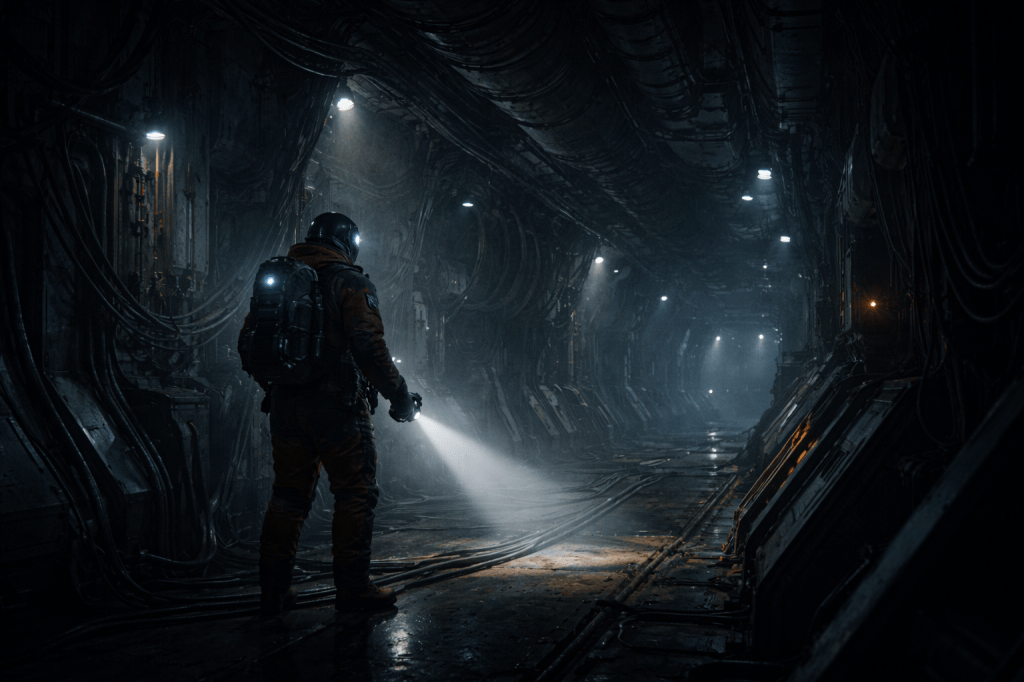
When Ashfall Station fell into darkness, the sounds moving through its walls no longer belonged to failing machinery alone.

When the Station Went Dark

The evening cycle settled over Ashfall Station with the tired calm of a place that had carried strain for so long that strain itself had become part of the atmosphere. Along the habitation ring, food stalls lowered their shutters one by one, service carts vanished into storage alcoves, and the last of the public traffic thinned into a drifting flow of workers heading home beneath lamps that glowed a little weaker than they had a month earlier. Through the wide gallery windows, Kestren-4 turned below in its pale silence, casting a ghost-grey reflection across the lower structure of the station.

Nera Seln crossed the upper transit spine with a maintenance satchel against her hip and her jacket folded over one arm, following the curve of the public gallery towards the western lift banks. She had spent eleven years inside Ashfall’s lighting grid and had never lost the habit of seeing every fault. As she passed a sealed service hatch near the gallery rail, the wall strips to her left dimmed for half a heartbeat, then filled again with a warm amber wash that slid across the floor plating and the soles of her boots. The shift was small. It was also wrong.

She slowed by the railing and looked down into the interior ring. From that height, Ashfall resembled an immense mechanical city built inside its own turning shell. Freight lanes traced blue lines along the lower decks. Market corridors glowed with softer light. Deeper down, the light thinned into darker layers threaded by the buried pulse of systems few station residents ever saw. Somewhere under those visible decks, the old power routes still carried current through conduits laid during the station’s first industrial years above Kestren-4, and in recent cycles those buried lines had begun to behave in ways the surface reports never managed to explain cleanly.

The comm badge at her collar vibrated once. She glanced down at the display on her wrist and read the incoming line from Control.

Sector Seven lighting variance. Confirm local relay response.

She let out a slow breath and resumed walking. Sector Seven had drifted twice during the previous cycle, and before that the same fault pattern had appeared in Nine, Twelve, the western habitation blocks, and half the service access routes under Dock Ring Two. Each report arrived in the language of routine. Seen together, the incidents formed something else. They moved inward from the station’s outer systems and touched older structural zones where present-day routing crossed layers of buried infrastructure.

The lift carried her down into the service levels where Ashfall showed its age more plainly. The doors opened on a corridor lined with exposed conduit runs, relay cabinets, old power lockers, and bulkheads thick with repeated repair work. The air felt warmer there, dry with insulation dust and the faint metallic tang of hard-driven current. Two technicians waited outside the grid office with the slumped posture of men coming off a long shift.

“You’ve got Seven again,” the older one said as she came up.

“And Nine,” the younger added. “Twelve gave us a dip near shift end. Western support ran low for four seconds, then climbed back as if nothing had happened.”

Nera palmed the office door open. “Control still calling them isolated?”

The younger technician gave a flat little laugh. “Control calls everything manageable until the station chooses a louder word.”

Inside, the grid office hummed with the soft chatter of relays and the pale rise and fall of routing maps climbing the wall displays. Nera dropped her satchel beside the central console and scrolled through the latest reports while the handover continued around her. The figures told the same story she had been reading for days. Tiny dips. Quick recovery. No visible overload. No corresponding damage. Her eyes moved from one time stamp to the next, then to the station map beside it, and there it was again, the pattern that had sharpened after the survey teams vanished out in the relay network. The fluctuations were no longer skimming the edge of the station. They were turning up in older sectors tied to the deep frame.

“You logged the sounds?” she asked.

The older technician folded his arms. “Three times. Western support run, late cycle. Sounded like something moving through the bulkheads.”

“Pipe stress?”

He shook his head. “Too steady. It travelled.”

The younger one nodded towards the map. “Deck Fourteen heard it as well during a lighting dip near midnight. Crew there said the sound passed ahead of them inside the wall, then carried on into a dead section.”

“And Control?”

“Routine structural noise.”

She signed off their handover, watched them leave, and listened to the current moving through the walls. Ashfall always had a sound. The station breathed through vents, vibrated through rails, and murmured through power trunks that had survived more years than some records admitted. Tonight the hum seemed to carry a faint second layer below the usual noise, something intermittent and measured, as if a pulse was rising through the deep grid and touching the modern circuits one junction at a time.

For the next hour she worked through the reported sectors, sending diagnostic pulses along feeder lines and reading the response from substations buried through the station’s lower spine. Some faults cleared the instant she examined them. Others remained vague in the most unhelpful way, giving her tiny losses in output with no matching overload, short, or physical break in the line. By the time she reached the western support run, the map showed a cluster of irregular readings gathered around Junction W-17.

She clipped a portable lamp to her belt and headed out into the support corridors. The route took her away from the busier maintenance channels and into a quieter band of the station where the lighting thinned and the architecture grew older with every turn. Heavy conduit housings jutted from the walls in square banks. Cable trunks vanished into bulkheads whose seams no longer matched current engineering standards.

Junction W-17 stood at the far end of a narrow support corridor where the deck dipped slightly towards the outer ring. The first thing she saw was the relay cabinet door hanging open. It should have been sealed. Instead it stood ajar by a few centimetres, as if someone had eased the catch and walked away before deciding whether to go further. Nera crouched, set the lamp on the floor, and inspected the cabinet interior. The relay stack remained seated. Wiring looms were intact. No scorch marks. No tool damage. No sign that any maintenance hand had been inside. She checked the live load on her wrist display and felt her mouth tighten. Current was moving through the cabinet in pulses too regular for random drift, rising and easing at exact intervals that matched nothing on the demand schedule for that deck.

She closed the panel and stayed where she was for a moment, listening. At first she heard only the familiar life of the station. Air moved through the vents in a long controlled flow. Somewhere far off, a cargo lift engaged and sent a faint tremor through the plating beneath her boots. Then something shifted behind the wall at her right shoulder. The sound arrived low and metallic, deeper than pipe strain and heavier than a loose conduit brace. It travelled through the bulkhead with a slow measured persistence, as though a weight had leaned into the hidden structure and continued forward through it.

Nera put one hand against the wall. The metal felt cool. A second later the movement came again, stronger this time, following the line of the corridor ahead while her palm caught the last of its passing vibration. She pulled her hand away and opened a maintenance query on her wrist unit. No active crews. No mobile service units. No mapped systems under stress. The station’s own data denied the sound even as the bulkhead carried a fading echo of it.

She rose, lifted the lamp, and walked towards the next junction. The corridor narrowed there, squeezed by older reinforcement ribs that pressed closer to the central walkway. Overhead strips flickered once, then settled into a weaker glow. At the far wall, a second relay cabinet stood open exactly as the first had done.

Nera reached it in quick steps and stopped. The pulse pattern on her wrist display had spread. W-17 was no longer carrying the sequence alone. Three adjacent junctions were rising and easing in the same measured order, each one touching the next as if something were moving through the grid by way of infrastructure that had never been intended to carry it. She raised the lamp and turned slowly, trying to locate the source by instinct as much as instrument.

The lights went out.

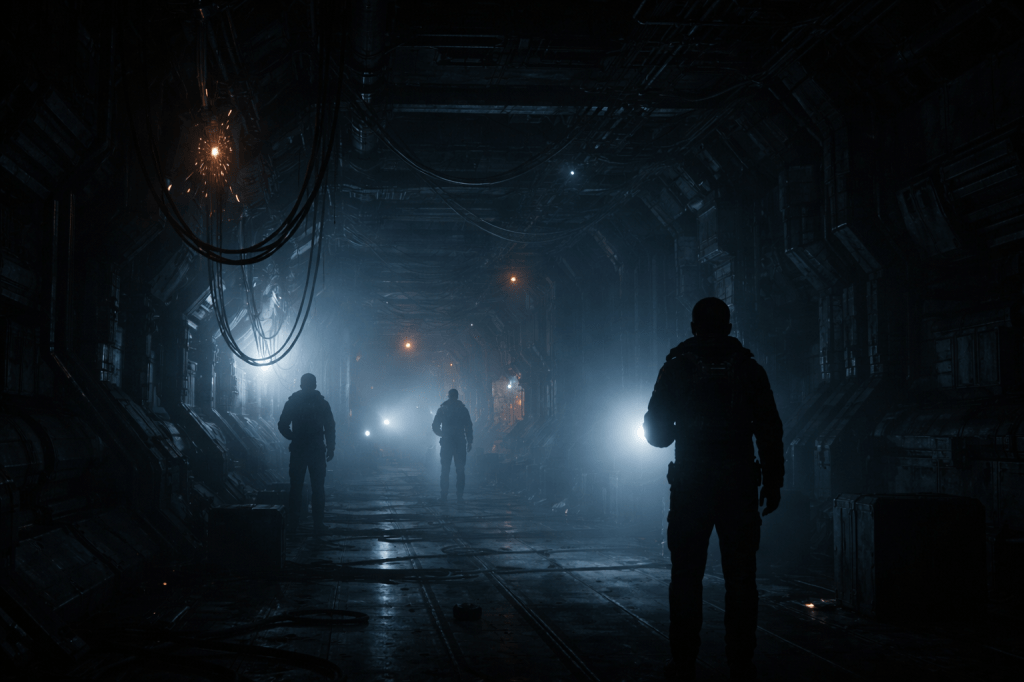
Darkness fell across the corridor with such force that the station seemed to disappear around her. The ambient hum collapsed into a stunned silence. For one suspended instant Ashfall felt less like a functioning installation than an enormous hollow shell turning through open space. Then the emergency grid tried to answer. A red strip along the floor ignited, flickered twice, and held at a weak output that barely reached the opposite wall.

In that red half-light, the sound inside the structure returned. It moved through the walls ahead of her, larger now, accompanied by the distant cry of voices rising from decks she could no longer see. Somewhere across the station, systems were failing ring by ring. Somewhere close at hand, within the buried layers behind the corridor bulkheads, something metallic was shifting its weight and travelling through Ashfall in the dark.

The station had lost power before. Every resident knew the waiting and the old anger that came with living inside a structure held together by labour and compromise. As Nera stood at the junction with her lamp in one hand and the dead corridor stretching before her, she understood with a cold clarity that this failure carried a different shape. Ashfall had gone dark all at once, and in the darkness something within its walls had begun to move.


Station Record: Multi-Ring Power Disruption; Internal Structural Disturbance Log

Ashfall Station maintained a layered electrical distribution system designed to sustain continuous operation across its habitation rings, freight sectors, engineering corridors, and lower industrial frameworks while the installation remained in orbit above Kestren-4. Power moved through a network of primary conduits, secondary relays, emergency reserves, and local substations assembled across several phases of construction, with later expansions tied into older infrastructure that remained active far beyond its original service projection. Under ordinary operating conditions, temporary lighting variance, local relay drift, and brief environmental inconsistencies were treated as manageable features of an ageing station whose systems required constant balancing across a vast structural footprint.

In the operational cycles following the loss of multiple survey crews within Ashfall Station’s outer relay network, maintenance departments recorded an increase in minor electrical irregularities appearing across sectors unconnected by ordinary load behaviour. Lighting strips dimmed and recovered in public galleries, service corridors, and lower support runs. Door panels lost output for brief intervals before returning to stable function. Environmental controls registered short inconsistencies in pressure and temperature data, then restored baseline readings without direct intervention from station personnel. Early review classified these events as routine infrastructure drift distributed across an ageing system under continuous operational strain.

As reports accumulated, engineering analysis identified a broader spread pattern moving inward from outer support sectors into older structural zones linked to the station’s buried frame. This progression carried no clear relationship to scheduled maintenance work, recorded overload events, or known points of mechanical failure within the active grid. Time stamps attached to these incidents suggested intermittent alignment across multiple decks, with brief reductions in output occurring within narrow intervals despite physical distance between affected sectors.

Alongside these electrical irregularities, maintenance crews working during low-activity cycles submitted repeated observations concerning metallic sounds travelling through sections of wall structure where no active service routes, mobile units, or accessible maintenance shafts were recorded within current station schematics. Descriptions varied in detail while retaining a consistent core impression. Personnel reported slow internal movement, measured impacts within buried structural layers, and the sense of weight shifting along passageways hidden behind bulkheads. Standard systems review failed to identify a corresponding mechanical source for these reports.

During one extended station cycle, a large-scale disruption affected multiple rings simultaneously. Lighting systems across public, industrial, and maintenance sectors fell away within a compressed time window, followed by partial interruption to communication channels, local access control, and environmental regulation across several decks. Initial loss duration remained brief in comparison with catastrophic system failure scenarios, as emergency reserves and automated recovery protocols restored partial function within minutes. Even so, the scale and synchronicity of the disruption exceeded ordinary outage patterns previously recorded within Ashfall’s accessible operational archive.

External observation during the disruption confirmed no major impact event, hull breach, or hostile interference affecting the station’s outer structure. Core rotational stability remained within acceptable tolerances. Primary power source behaviour showed irregular redistribution across the internal grid during the outage window, though no single failed relay, ruptured conduit, or overloaded junction could account for the full spread of the event. Automated diagnostics initiated after partial restoration produced conflicting sequence data, with several substations reporting loss and recovery times that resisted clean alignment when compared across deck records.

Personnel statements gathered in the immediate aftermath revealed a second layer of anomaly associated with the blackout period. Across multiple sectors, residents, technicians, freight workers, and support staff described hearing movement within the station’s structure while primary lighting remained absent or severely reduced. These accounts referred to metallic shifting, internal scraping, and slow directional transit through walls, floors, or overhead spaces beyond visible access points. In several testimonies, the sound appeared to pass ahead of witnesses along corridor lines before fading into deeper sections of the station once emergency lighting returned.

Reports of this movement emerged from habitation levels, maintenance runs, freight access corridors, and older engineering decks alike. In each case, local system review found no authorised maintenance teams, active transit carts, service drones, or structural adjustments recorded along the reported pathways at the relevant times. Environmental monitoring detected ordinary vibration from emergency recovery systems following the outage, though analysis remained insufficient to reconcile the specific directional qualities described by witnesses.

Following restoration of baseline function across the majority of affected sectors, Fleet oversight initiated a restricted review of the blackout and the associated internal disturbance reports. Maintenance logs, relay response records, and substation recovery data were collected for comparative analysis. Access to selected lower service routes and older support corridors was temporarily limited while engineering departments examined the relationship between the outage pattern and the station’s deeper infrastructure layers. Public-facing communications classified the event as a multi-sector power disruption intensified by legacy distribution complexities within Ashfall’s ageing grid.

Internal review records from that cycle indicate growing concern that the boundary between external relay anomalies and internal structural behaviour had weakened in ways the station’s existing diagnostic models could not fully interpret. Several analysis summaries noted the recurrence of pulse-like electrical drift across junctions tied to older frameworks embedded beneath later construction phases. Additional witness logs connected these pulse events to the periods immediately preceding local lighting loss in a number of affected corridors.

No definitive cause for the station-wide disruption was entered into the accessible archive for that cycle. The incident remained logged as a major infrastructure anomaly accompanied by unresolved internal disturbance reports, and later review would place it among the earliest large-scale events in which Ashfall Station’s electrical systems and hidden structural layers appeared to respond in concert across multiple rings.


About the Creator

The Future Chronicle is written and curated by Simon Phillips, a writer of science fiction and speculative storytelling who explores the quiet edges of human expansion, where ageing stations, distant worlds, and forgotten technologies continue their slow existence beyond the reach of the central worlds.

Many of the stories presented in these Chronicles exist within a wider fictional universe that follows the lives of investigators, engineers, and frontier workers living far from the comfort of the inner systems, where the machinery of civilisation continues to function long after its original purpose has begun to fade.

One such story unfolds aboard Ashfall Station, an ageing orbital installation whose corridors and industrial sectors form the setting for the science-fiction mystery novella Ashfall Station: The Dead Girl in Sector Twelve. What begins as a routine investigation gradually reveals that something hidden within the station’s structure may have been present for far longer than the official records suggest.

Readers who wish to explore the full investigation and its unfolding events can find the novella below.

Explore the book:
Ashfall Station: The Dead Girl in Sector Twelve

You can watch his YouTube channel here:
Author Simon Phillips

Continuing the Chronicle

The following Chronicle continues the reconstruction of the station-wide blackout that spread across Ashfall Station after cycles of minor power drift, relay irregularities, and unexplained sounds within the older sectors.

At first, the outage appeared to be one more failure within an ageing grid stretched beyond its intended life. Emergency systems restored partial function within minutes, and Fleet administration treated the disruption as severe yet manageable. Reports gathered across the rings told a darker story. During the period of darkness, workers and residents in widely separated sectors described the same metallic movement travelling through walls, floors, and sealed structural spaces absent from current schematics.

Later review placed this event among the earliest moments when Ashfall’s failing electrical systems and buried infrastructure seemed to move in concert. What vanished during those minutes was more than light. For those who stood inside the red emergency glow and heard the station shift around them, Ashfall no longer felt like a wounded industrial outpost. It felt as though something deeper had begun to answer.

Readers supporting The Future Chronicle can continue the record below.

Subscribe to continue reading

Subscribe to get access to the rest of this post and other subscriber-only content.
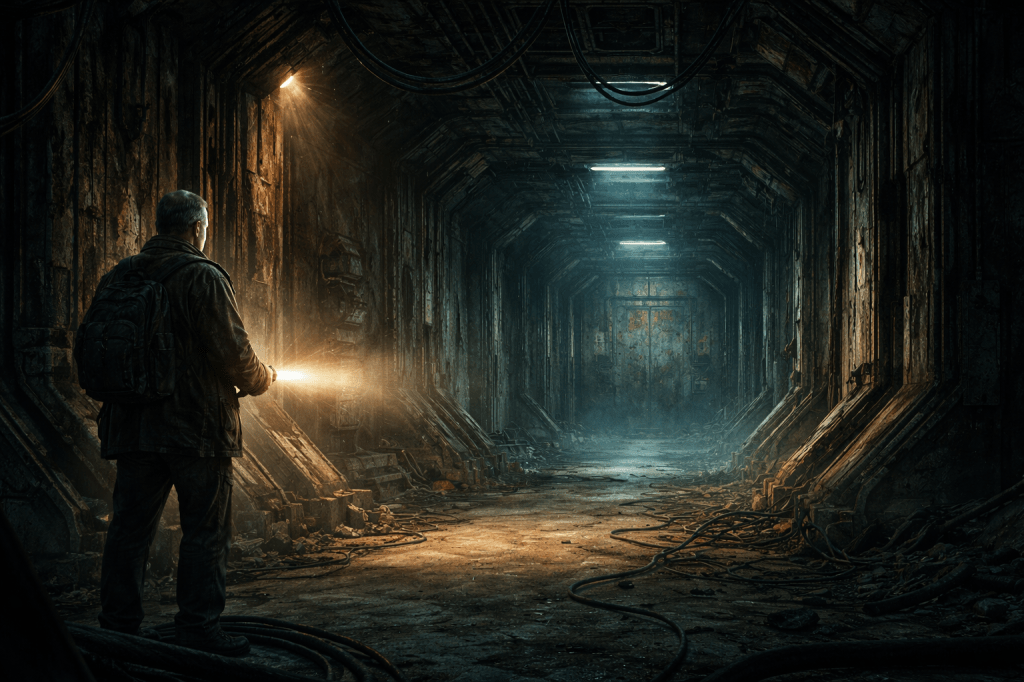
The Future Chronicle: The Sealed Corridor

An abandoned structural level beneath Ashfall Station reveals a corridor sealed since the station’s earliest construction, drawing the attention of a retiring station detective before Fleet orders the investigation to cease.


Deck Twelve: Ashfall Station

The engineering request reached Detective Adrian Mercer during the quiet middle stretch of the station cycle, when the administrative decks of Ashfall settled into the slow rhythm that followed freight departures. Offices remained lit, terminals remained active, yet movement across the corridors softened into the patient routines of clerks and inspectors completing the final tasks of their shifts. Mercer sat alone within the records office beneath Central Security, surrounded by the layered archives of incidents that had travelled through the station across several decades. Each report carried the calm language of procedure and closure. It held the quiet assurance that whatever disturbance had once drawn attention eventually found its place inside the long memory of Ashfall Station.

Through the narrow reinforced windows behind his desk, the interior ring of the station turned in its endless orbit above the pale, clouded surface of Kestren-4. Cargo lights drifted across the distant docking arms where freight vessels prepared for departure, their engine glow reflecting faintly across the structural ribs of the outer ring. The sight carried a familiarity that came from long service rather than affection. Ashfall never attempted elegance. The station endured through scale, through industry, through the steady labour of crews who kept its immense systems working across decades of frontier commerce.

Mercer closed the final file on his terminal and allowed the quiet hum of the station to settle around him. That sound travelled everywhere through Ashfall. It lived beneath conversation, beneath the clatter of cargo lifts, beneath the distant roar of docking clamps engaging with incoming ships. Power conduits vibrated within the walls. Freight rails shifted their loads across the lower decks. Atmospheric processors breathed steadily through shafts that crossed the station from end to end. A man who served long enough inside the structure eventually learned to hear its mood through those vibrations alone. Older officers spoke of it with a seriousness that once amused Mercer during his early years in security. Time changed the way such remarks sounded.

The message waiting on his terminal carried engineering clearance tags from Deck Twelve, a location whose name appeared so rarely in modern station reports that it held the faint quality of something remembered from another era. Mercer opened the note and read the short description several times before leaning back in his chair.

Structural access discovered during inspection survey. Legacy corridor revealed behind sealed plating. Security presence requested before further entry.

Deck Twelve belonged to the earliest period of Ashfall’s construction, when the station functioned primarily as an orbital transfer hub for the ore shipments rising constantly from the mines of Kestren-4. During those years, the station existed as a harsher place, a skeleton of structural rings and industrial corridors designed for endurance rather than comfort. Later expansions buried much of that original framework beneath new habitation sectors and modern freight systems. Entire levels faded from daily use as trade patterns shifted across the frontier. Some compartments became storage vaults. Some were dismantled to strengthen newer construction. Others survived only as references inside the ageing schematics that engineers consulted whenever expansion projects reached deeper into the station’s buried architecture.

Even so, the phrase legacy corridor carried weight. Abandoned spaces existed throughout Ashfall. Deliberately sealed ones remained rare.

Mercer gathered his coat from the back of his chair and left the office behind, moving through the quiet corridors of Central Security towards the transit lifts that descended into the lower structure of the station. The lift doors opened with the soft mechanical patience common to Ashfall’s older systems. Inside, muted amber light reflected from the brushed metal walls while deck numbers began their steady descent through the station’s interior framework.

The upper levels passed first, familiar sectors filled with administration offices, habitation corridors, and the ordered calm of Fleet oversight. Soon, the lift continued into deeper regions where the architecture changed. Plating grew thicker. Corridor lighting carried a colder tone. Structural doors reflected the heavy engineering logic of an earlier generation of station builders who valued resilience above refinement. Mercer rested one hand against the rail as the lift travelled downward, feeling the subtle vibration of the machinery through the metal beneath his palm.

When the doors finally opened onto Deck Twelve, the air carried the dry scent of dust and insulation compounds that gathered slowly inside long-maintained engineering spaces. The arrival corridor extended ahead through reinforced bulkheads lined with power conduits and dormant freight rails. Overhead pipes carried atmosphere and coolant through the deeper infrastructure of Ashfall’s industrial body. Human presence felt thinner here than in the busy decks above. Maintenance crews passed through the level when expansion work required it, yet daily life unfolded elsewhere.

Two engineers waited near the far bulkhead beside a portable floodlamp that cast strong white light across the corridor. The older of the pair stood with the relaxed endurance of someone accustomed to long hours within structural maintenance zones. Silver threaded through the dark hair above his temples, and his coveralls carried the pale dust of recently disturbed plating. Beside him, a younger technician held a scanning slate close against her chest while studying the exposed section of wall with careful attention.

Senior Structural Engineer Tavin Istran inclined his head in greeting as Mercer approached.

“Detective Mercer. I appreciate you coming down.”

Mercer acknowledged him with a quiet nod while allowing his gaze to follow the direction of the floodlamp. An entire panel of corridor plating had been removed to reveal an older access frame buried behind later reinforcement layers. The metal carried a darker tone than the surrounding bulkhead, and the riveted edges reflected construction methods that belonged to Ashfall’s earliest structural phase. At the centre of the frame stood a pressure door whose surface had vanished beneath decades of dust and insulation residue. Someone, long ago, had concealed the doorway behind the new wall rather than leaving it visible within the corridor.

“What exactly came through your survey scans?” Mercer asked.

Istran directed the beam of a handheld lamp across the exposed structure. “Expansion planning for the western support run,” he said. “Engineering required a density survey before we anchored new conduit lines through this section. Current schematics indicated a solid bulkhead. Our scanner showed a hollow space behind the plating. Initial assumptions suggested abandoned cable housing. Once we cut through the reinforcement, we uncovered this.”

The younger technician stepped forward and activated the projection on her slate. A rotating structural image hovered above the screen, outlining a narrow corridor stretching deeper into the station’s buried frame.

“The cavity continues for approximately sixty metres,” she explained. “Straight alignment through the subframe. Internal pressure readings remain low yet stable. Structural integrity appears intact.”

Mercer studied the projection before returning his attention to the sealed doorway. The structure carried a deliberate quality that unsettled him in a quiet way he struggled to explain. Decommissioned corridors existed throughout the station, sealed through convenience during later renovations. This doorway suggested a different decision entirely. The plating around it formed careful layers that erased the original entrance from every visible surface.

“Authority to open?” Mercer asked.

Istran folded his arms while considering the question. “Engineering procedure allows inspection of undocumented spaces that interfere with active construction work. That remained sufficient until the door appeared. Once we realised the corridor had been intentionally sealed, security presence became necessary before any attempt at entry.”

Mercer moved closer to the exposed frame. Dust shifted under his boots as the floodlamp illuminated faded stencilling across the pressure door. Time had worn most of the lettering into obscurity, though one line still remained visible beneath the grime.

DECK 12 SERVICE TRANSIT: EASTERN ACCESS

The words belonged to another age of the station, when workers travelled constantly through corridors like this one during the first decades of Ashfall’s operation. Ore shipments rose continuously from Kestren-4 in those years, and the station’s industrial skeleton thrived on movement. The sealed doorway standing before him hinted at a later moment when someone decided that passage through this corridor carried a risk greater than leaving it buried within the structure.

“Deck Twelve appears in modern registry as structural support,” Mercer said slowly. “Transit corridors should remain mapped.”

The technician glanced at the slate again. “Three generations of station schematics contain no reference to this passage.”

Mercer rested his hand against the cold metal frame beside the door. The station continued its immense labour around them while freight systems shifted through distant decks and atmospheric regulators breathed steadily through unseen conduits. Ashfall had endured for decades through expansion, repair, and quiet compromise. Within that long history, the buried doorway before him suggested a moment when concealment seemed preferable to explanation.

He looked back towards the engineers standing in the bright spill of the floodlamp.

“Release the outer seal,” he said quietly.


Station Record: Deck Twelve Access Survey

Ashfall Station maintained extensive structural archives documenting the layered construction of the installation across several decades of expansion above the mining world of Kestren-4. From its earliest years as an industrial ore transfer platform, the station grew through successive phases of reinforcement and redevelopment as freight activity within the system increased. Each stage of construction left behind segments of earlier infrastructure embedded within the station’s expanding framework, forming a complex internal structure where modern engineering systems frequently intersected with components dating back to the original industrial period.

Deck Twelve belonged to this earliest phase of Ashfall’s development. During the first decades of orbital mining operations, the level formed part of the station’s internal transit network, providing access routes for engineering crews responsible for maintaining the cargo transfer systems that linked the station’s outer docking arms with the ore elevators rising from the surface of Kestren-4. These corridors allowed personnel and equipment to move through the station’s internal framework without interfering with the heavy freight traffic that dominated the primary cargo decks.

As Ashfall Station expanded into a larger logistical hub serving multiple trade routes, many of the original transit corridors were gradually replaced by newer structural pathways better suited to the installation’s evolving layout. Entire sections of the station’s early industrial framework became redundant as modern freight systems bypassed the older infrastructure. Engineering departments frequently sealed obsolete passages behind reinforcement plating during later construction work in order to maintain structural integrity across the station’s expanding hull.

Maintenance records indicate that structural surveys conducted during later expansion projects occasionally revealed compartments whose original purpose had faded from modern engineering documentation. In most cases, these spaces consisted of abandoned cable runs, obsolete machinery housings, or storage cavities left behind during earlier construction phases. Such discoveries were typically catalogued within the station’s structural archive and secured to prevent interference with contemporary engineering operations.

During a routine inspection connected to an expansion survey on Deck Twelve, engineering crews uncovered an access frame concealed behind reinforcement plating installed during a later phase of structural redevelopment. Removal of the outer plating revealed a sealed pressure door belonging to a transit corridor absent from modern station schematics. Preliminary scans suggested that the passage extended several dozen metres through the station’s internal subframe while retaining limited atmospheric pressure.

Initial assessment by the engineering team indicated that the corridor had been deliberately sealed during an earlier construction phase rather than simply abandoned. Multiple layers of reinforcement plating had been installed across the original access point, effectively removing the passage from the visible structure of the surrounding corridor. The doorway itself remained intact beneath these layers, preserving evidence of a transit route that once formed part of the station’s earliest engineering network.

At the time the discovery was recorded, the engineering department requested a security review before attempting to open the sealed corridor. The presence of a deliberate structural closure, combined with the absence of the passage from modern schematics, prompted a preliminary investigation into the circumstances under which the transit corridor had been removed from the station’s operational layout.

Archived engineering logs from that cycle indicate that the request for investigation was transmitted to Fleet administration shortly after the discovery was reported within the station’s internal maintenance network.

Further access to the corridor was temporarily suspended pending instructions from Fleet command.


About the Creator

The Future Chronicle is written and curated by Simon Phillips, a writer of science fiction and speculative storytelling who explores the quiet edges of human expansion, where ageing stations, distant worlds, and forgotten technologies continue their slow existence beyond the reach of the central worlds.

Many of the stories presented in these Chronicles exist within a wider fictional universe that follows the lives of investigators, engineers, and frontier workers living far from the comfort of the inner systems, where the machinery of civilisation continues to function long after its original purpose has begun to fade.

One such story unfolds aboard Ashfall Station, an ageing orbital installation whose corridors and industrial sectors form the setting for the science-fiction mystery novella Ashfall Station: The Dead Girl in Sector Twelve. What begins as a routine investigation gradually reveals that something hidden within the station’s structure may have been present for far longer than the official records suggest.

Readers who wish to explore the full investigation and its unfolding events can find the novella below.

Explore the book:
Ashfall Station: The Dead Girl in Sector Twelve

You can watch his YouTube channel here:
Author Simon Phillips


Continuing the Chronicle

The following Chronicle continues the reconstruction of the engineering survey on Deck Twelve, when maintenance crews first uncovered the sealed pressure door hidden within Ashfall Station’s earliest structural framework.

At the time, the discovery appeared to be a minor irregularity encountered during routine expansion planning. Engineering departments working across older sections of the station frequently encountered abandoned compartments left behind by earlier construction phases, and such spaces were usually catalogued within the station’s structural archive before being secured or absorbed into new engineering layouts.

The doorway revealed beneath the reinforcement plating on Deck Twelve suggested a more deliberate closure. Preliminary scans indicated that the corridor extended through the station’s internal subframe while remaining absent from all modern schematics used by Ashfall’s engineering systems. The presence of multiple reinforcement layers surrounding the original access frame indicated that the passage had been intentionally sealed and removed from the visible architecture of the station many decades earlier.

Later examination of archived engineering records suggests that the discovery on Deck Twelve represented the first documented moment when Ashfall’s contemporary maintenance crews encountered evidence of structural alterations whose origins no longer appeared within the station’s official construction history.

Readers supporting The Future Chronicle can continue the record below.

Subscribe to continue reading

Subscribe to get access to the rest of this post and other subscriber-only content.
Ashfall Station Chronicle: The Long Night Shift

During the quiet maintenance cycles of Ashfall Station’s graveyard shift, a lone technician working the outer hull corridors begins to hear movement within the station’s structure where no one should be.


Inspection Record: Outer Hull Maintenance Corridor

The long night shift began during the quietest portion of Ashfall Station’s rotation, when the outer docking arms carried only the slow drift of a few cargo vessels awaiting clearance and the habitation sectors dimmed their lights in preparation for the artificial midnight cycle. Across most of the station, the machinery of daily operation continued with its patient rhythm. Freight carriers glided through distant cargo tunnels and refinery systems circulated power through the industrial ring that formed the backbone of the installation. Along the older maintenance corridors threaded through Ashfall’s outer hull, the atmosphere changed in subtle ways during these hours. The noise of human activity faded into the background, and the structure revealed the deeper sounds of its own existence: the low breathing of air circulation systems and the faint vibration of energy conduits running through steel arteries that had operated for decades above the silent mining world of Kestren-4.

Technician Marek Ilyan moved along one such corridor with the steady pace of someone accustomed to the solitude of these late rotations. His inspection lamp cast a narrow cone of light along the curved service passage while cables and cooling pipes followed the arc of the bulkhead overhead. The tunnel formed part of Ashfall’s older structural ring, a region assembled during the station’s earliest expansion when cargo traffic from the central trade lanes filled every dock with constant movement and industry. Time had layered the passage with generations of modification. Additional sensor housings stood bolted beside original control panels. Newer conduits ran alongside thick pipes whose metal carried the faded markings of earlier engineering teams, and occasional reinforcement plates revealed where stress fractures from past decades had once required careful repair by crews who worked these same corridors long before Ilyan first arrived on the station.

He paused beside a junction console where diagnostic indicators glowed with a steady amber light while his scanner transmitted a quiet stream of readings across the small display attached to his wrist unit. External hull pressure remained stable, and thermal distribution across the outer plating held comfortably within the parameters expected for this stage of the orbital cycle. The readings confirmed what the corridor itself already suggested. Ashfall Station continued its slow and dependable labour above the abandoned mining world below, carrying freight between distant systems and supporting the salvage operations that had grown gradually around the debris fields scattered through the outer reaches of the Kestren system.

Beyond the reinforced wall beside him lay the outer skin of Ashfall Station, and beyond that alloy plating stretched the open vacuum of orbit where the exhausted surface of Kestren-4 turned slowly beneath the station’s shadow. Earlier in the shift, Ilyan had passed two small observation ports cut through the structure where technicians could briefly look outward across the black horizon of space while performing inspection duties. Those windows revealed the faint movement of stars against the station’s gradual rotation, a quiet reminder that the immense industrial structure surrounding him remained only a thin barrier between human machinery and the vast silence beyond the hull.

He resumed his walk through the corridor while the beam of his lamp travelled across the layered construction of the bulkhead. Somewhere deep within the station, a cargo lift engaged its motors and the vibration travelled faintly through the structural framework beneath his boots. Sounds like that belonged to the familiar background of Ashfall’s life, small reminders that the vast installation remained active even during the quietest hours of the night cycle when most of the station’s workforce slept within the habitation rings.

The inspection route curved gradually towards a maintenance platform overlooking one of the older reinforcement beams that strengthened this section of the hull. Ilyan slowed his pace as the platform came into view, already reaching towards the railing where he intended to pause and begin the next sequence of structural diagnostics that formed part of the routine checks assigned to graveyard maintenance rotations.

As he stepped onto the platform, a faint vibration travelled through the metal beneath his boots. At first, the sound resembled the ordinary shift of thermal expansion passing through the station’s outer plates, the kind of subtle movement that maintenance crews heard frequently during their rounds as Ashfall’s immense framework adjusted to the slow temperature changes that accompanied orbital motion. The hull occasionally answered those shifts with quiet metallic murmurs that echoed through the surrounding corridors, and most technicians learned to ignore such sounds after enough months working the long night inspections.

Ilyan rested his scanner against the railing while the corridor returned to its familiar stillness. The conduits overhead continued their low electrical hum, and the diagnostic display on his wrist unit streamed its steady line of readings without interruption. For several moments, the corridor seemed unchanged from countless other shifts spent walking the quiet edges of the station.

Then the vibration returned, deeper this time and travelling slowly along the bulkhead beside him, as though something heavy moved across the far side of the alloy plating that separated the service corridor from open space. Ilyan turned slightly and placed his hand against the curved metal wall while the beam of his inspection lamp settled across the surface of the hull. Through the metal he felt the faint movement again, a dragging resonance that passed through the structure with deliberate weight before fading into the distant machinery of the station.

He remained standing beside the maintenance platform while Ashfall Station continued its silent orbit above the dark world below. The corridor returned once more to its quiet routine, and the familiar sounds of the station filled the passage. Yet the memory of that movement lingered beneath his hand against the hull. It was a slow travelling vibration that suggested something had crossed the outer surface of the station, where the maintenance logs recorded no scheduled drones, no passing vessels, and no external work crews operating anywhere near the reinforcement beams during the long night shift.


Station Record: Maintenance Inspection Protocols

Ashfall Station maintained a continuous inspection programme designed to monitor the condition of its outer hull and structural framework while the installation remained in orbit above the mining world of Kestren-4. The immense structure of the station consisted of several interconnected rings and industrial sectors assembled gradually during the early decades of frontier expansion, when ore extraction across the system required a large transfer platform capable of receiving freight vessels travelling between distant colonial routes. Over time, the station evolved beyond its original purpose. It expanded into a hybrid installation that supported freight traffic, salvage operations, engineering work, and long-term habitation for the technicians and crews who maintained its systems.

The outer maintenance corridors formed part of the earliest structural ring constructed during Ashfall’s initial development. Although successive generations of engineers reinforced the station with additional plating, upgraded sensor arrays, and expanded diagnostic infrastructure, many sections of the underlying framework remained original to the station’s first industrial phase. Maintenance crews assigned to these corridors followed inspection routes that traced the outer curvature of the hull, stopping at reinforcement beams and structural nodes where pressure readings, thermal fluctuations, and micro-fracture monitoring systems could be examined in detail.

Night shift rotations often assigned a single technician to these inspection loops. During these hours, the majority of Ashfall’s workforce remained within the habitation sectors while cargo traffic through the docking arms slowed to a minimal level. The quiet conditions allowed technicians to detect subtle changes in vibration patterns or structural resonance that might otherwise remain hidden beneath the noise of daytime operations. Maintenance personnel frequently relied upon experience as much as instrumentation, developing familiarity with the natural sounds of the station’s machinery as power conduits, cargo lifts, and environmental systems produced their constant background hum.

Archived station logs confirm that Technician Marek Ilyan began his inspection route along the outer corridor of Structural Ring Three during the late portion of the artificial night cycle. Environmental systems reported stable atmospheric pressure throughout the sector, while thermal monitoring arrays indicated normal distribution across the surrounding hull plating. No engineering crews were scheduled to perform external work in this region of the station, and the station’s traffic control systems recorded no vessels manoeuvring near the reinforcement beams along this portion of the hull.

At the time these inspections commenced, Ashfall Station continued its slow and stable orbit above Kestren-4, while all available monitoring systems indicated that the installation remained in normal operational condition.


About the Creator

The Future Chronicle is written and curated by Simon Phillips, a writer of science fiction and speculative storytelling who explores the quiet edges of human expansion, where ageing stations, distant worlds, and forgotten technologies continue their slow existence beyond the reach of the central worlds.

Many of the stories presented in these Chronicles exist within a wider fictional universe that follows the lives of investigators, engineers, and frontier workers living far from the comfort of the inner systems, where the machinery of civilisation continues to function long after its original purpose has begun to fade.

One such story unfolds aboard Ashfall Station, an ageing orbital installation whose corridors and industrial sectors form the setting for the science-fiction mystery novella Ashfall Station: The Dead Girl in Sector Twelve. What begins as a routine investigation gradually reveals that something hidden within the station’s structure may have been present for far longer than the official records suggest.

Readers who wish to explore the full investigation and its unfolding events can find the novella below.

Explore the book:
Ashfall Station: The Dead Girl in Sector Twelve

You can watch his YouTube channel here:
Author Simon Phillips


Continuing the Chronicle

The following Chronicle reconstructs the maintenance inspection conducted during the long night shift when Technician Marek Ilyan first reported unexplained movement within the outer hull corridors of Ashfall Station.

At the time the disturbance appeared to be a minor structural anomaly within one of the station’s older reinforcement rings. Later archival reviews suggest that the sounds recorded during that shift may represent one of the earliest documented encounters with the presence that would gradually reveal itself within the deeper infrastructure of the station.

Readers supporting The Future Chronicle can continue the record below.

Subscribe to continue reading

Subscribe to get access to the rest of this post and other subscriber-only content.