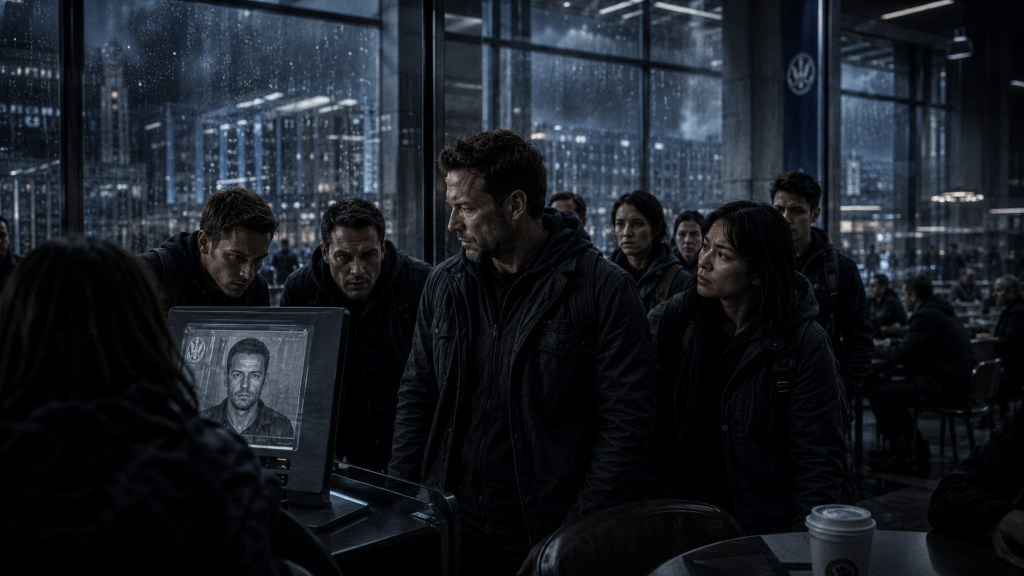
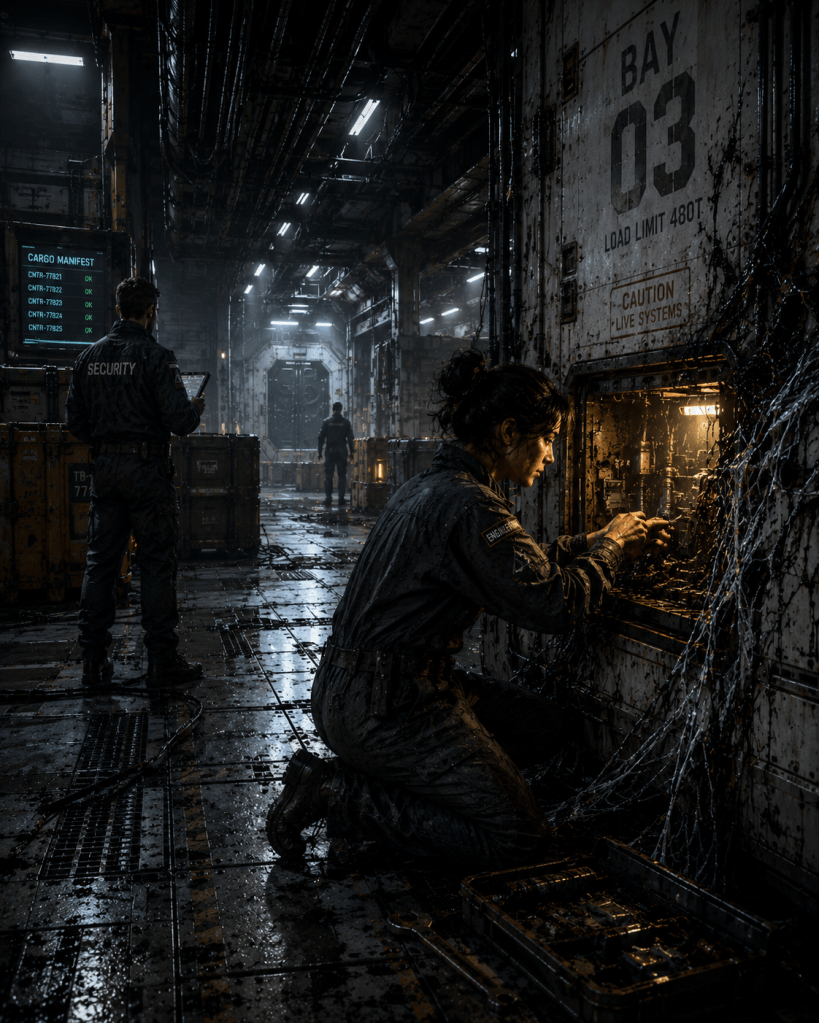
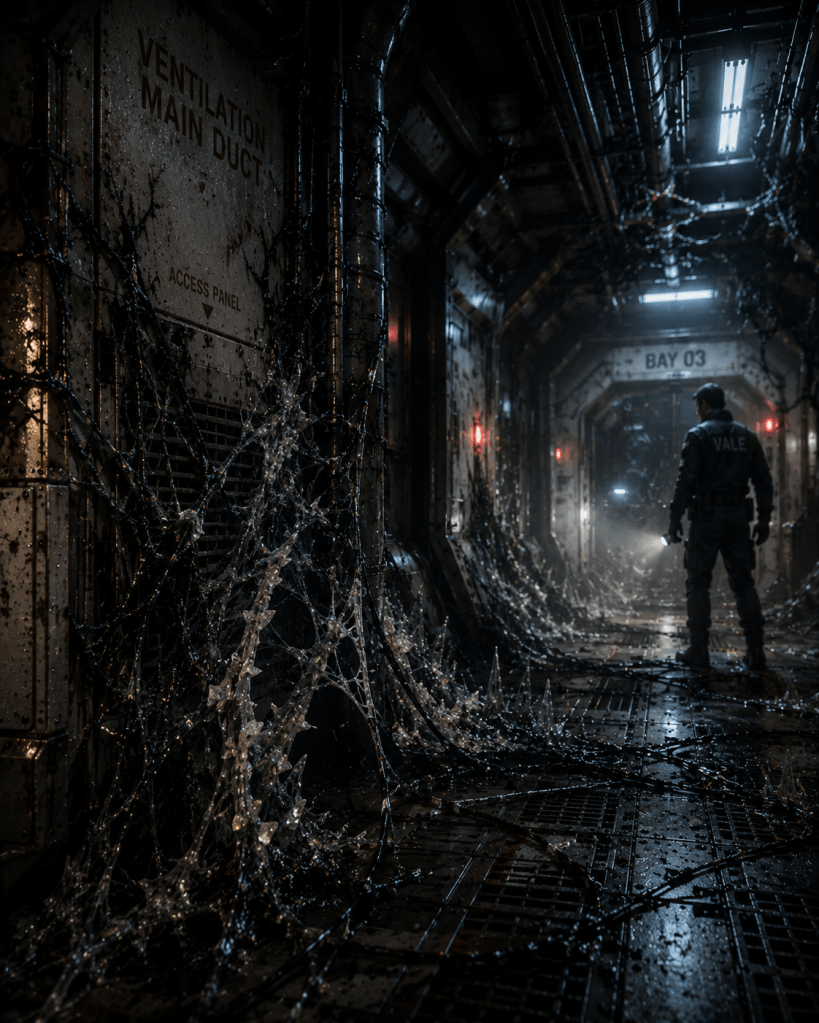
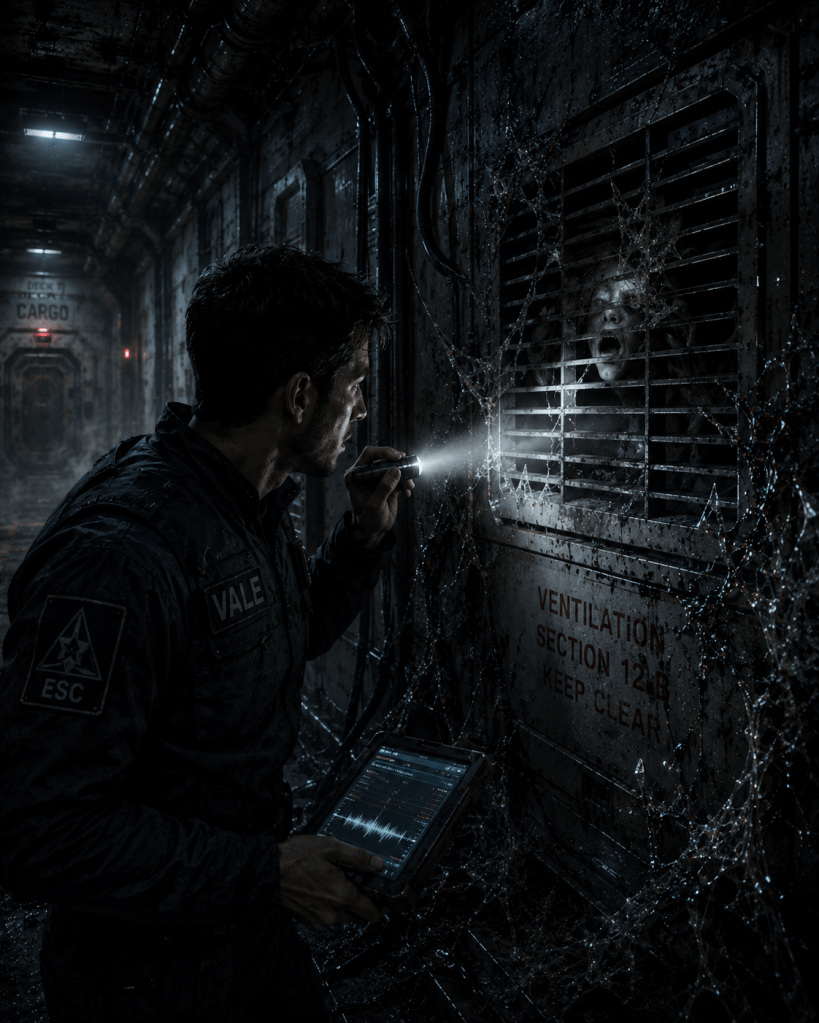
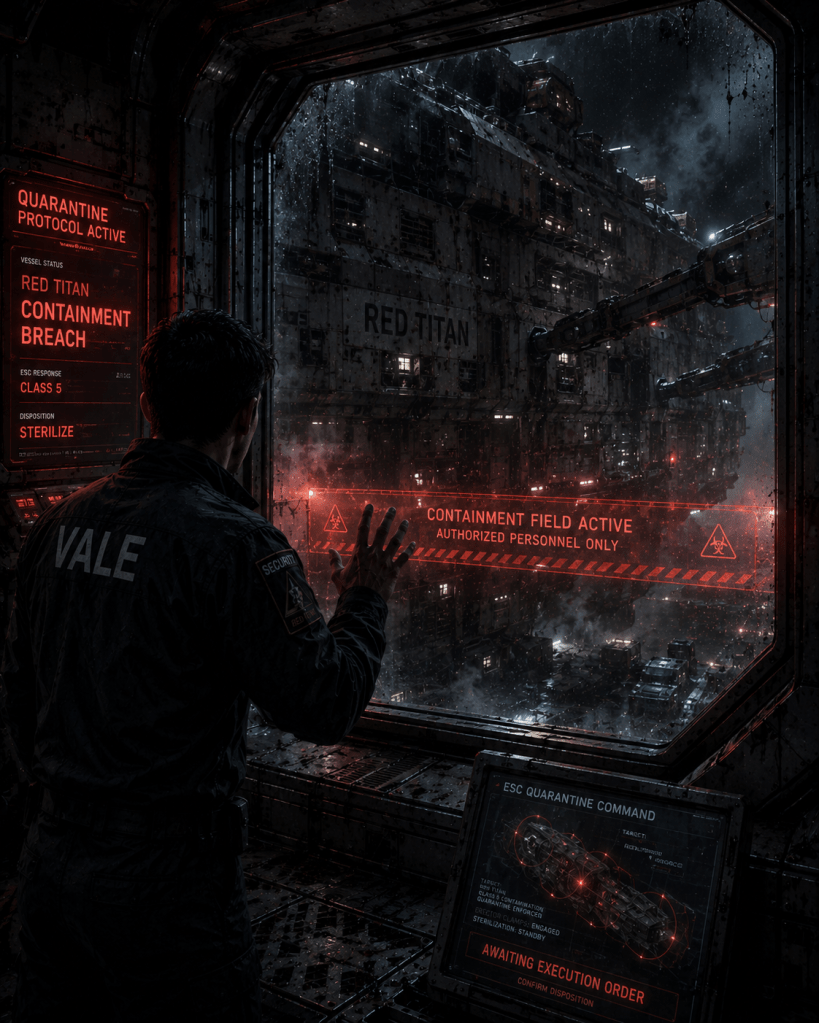
An ESC analyst studied a damaged audio fragment from a contaminated ship and heard a voice where procedure insisted there could only be corrupted airflow.
Chronicle Opening: The Recording in Chamber Nine
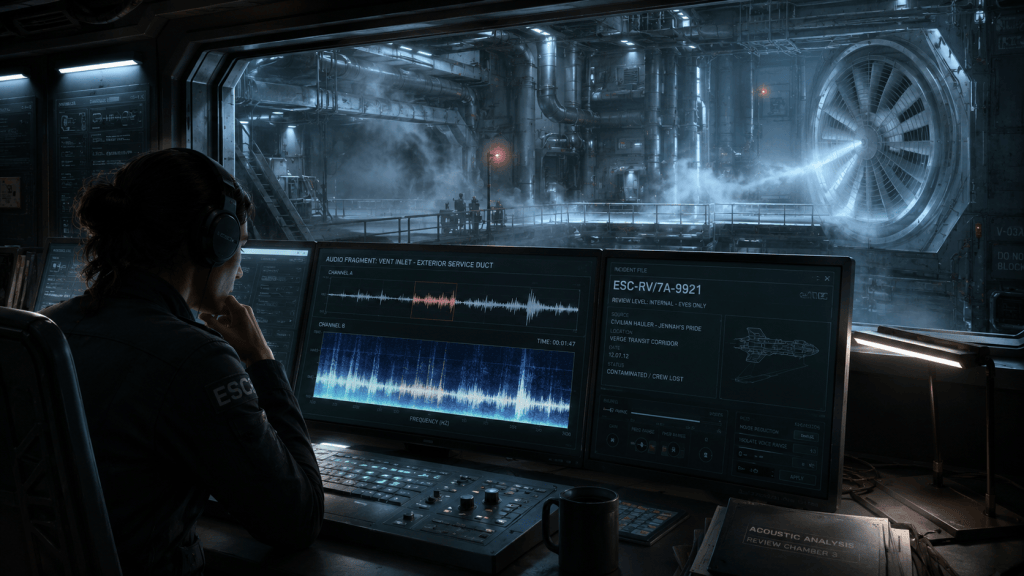
Review Chamber Nine held its cold in the wall panels long after the upper decks moved into their sleep cycle. It sat three levels below the main intelligence spine of the ESC cruiser Adderfall, sealed behind two pressure doors and a corridor lined with acoustic baffles thick enough to swallow the sound of boots before those sounds reached the bulkheads. The room had once been a navigation review suite, made for traffic reconstruction, distress-call sorting, and signal comparison from damaged civilian craft, although later work had changed it into something more private. Extra insulation covered the older seams. Audio pickups hung from black jointed arms above the central table. Three analysis boards curved around the main workstation in dull blue light, carrying spectral maps, pressure traces, ship schematics, and damaged recordings recovered from vessels whose final reports had reached command in fragments.
Analyst Liora Venn sat beneath the listening array with one hand beside the playback controls and the other wrapped around a cup gone cold against her palm. Her review slate showed the file name in clean institutional text. ESC-RV/9A-441. Civilian carrier Jennah’s Pride. Verge transit corridor. Crew status lost. Contamination status unresolved. Audio source recovered from forward environmental stack. The file had arrived from Evidence Intake with three notes attached by officers who had tried to keep the fragment inside a safer frame. Damaged ventilation record. Probable pressure flutter. Emergency channel bleed. Liora had read each line before opening the raw track, and each phrase carried the same careful pressure, the same quiet attempt to turn fear into something a desk could approve.
She drew the Jennah’s Pride schematic across the left board and let the carrier unfold in pale lines. The ship had been a mid-range civilian hauler, narrow through the crew spine, broad through the cargo belly, old enough to carry exposed heat trunks behind patched maintenance covers and cheap enough for its owners to argue over every delayed repair. The forward environmental stack sat above the lower crew passage, feeding filtered air through sleep cells, galley, med recess, and service ducts leading into cargo control. The recovery drone had found ribbed residue along two vent grilles, black particulate inside a filter tray, and pale scoring across an inner access cover where metal had cooled around shapes the original design had never required. Liora enlarged the stack and traced the airflow path with two fingers. If air had crossed a damaged grille at the right pressure, if the emergency channel had held a cached distress syllable, if the ship’s own announcements had torn apart during power loss, a sound could gather shape. She wrote that on her slate, then lowered the playback threshold and allowed Chamber Nine to listen.
Static came first, low and irregular, carried inside fan wash and broken signal return. The visual band rose in white clusters across the central display while Liora watched the peaks before letting the sound move deeper into her attention. Hull vibration sat underneath it, a slow structural shiver from a vessel losing thermal balance. A relay click repeated in the upper range. Air moved through the stack in pulses, too uneven for a healthy loop and too regular for random failure. Then a tone surfaced beneath the wash, thin as breath crossing a cracked pipe, and the room changed around it. Liora stopped the track with one careful touch. She stared at the frozen waveform while the cold panels, listening arms, display boards, and sealed doors seemed to gather more closely around her. The sound had lasted less than a second, close enough to a voice for the body to react before reason could claim it. She marked the frame, rewound nine seconds, and played it again with the voice-isolation layer disengaged.
The second pass carried more weight because she knew where the sound waited. Static crossed the chamber. Fan wash followed, broad and dry. The relay clicked. The airflow pulse came from the damaged stack, then the thin tone rose again, shaping itself with enough human timing to make her body react before thought could build a wall around it. Liora kept her hand still beside the controls and opened a filter to strip low-frequency hull vibration. A second filter reduced relay chatter. A third mapped airflow against the forward stack, feeding the pressure model across the right board in slow blue lines. Most of the fragment behaved the way training said it should behave. Broken flow crossed the grille, struck the access lip, and returned through the stack with a warped harmonic that could form a vowel under poor conditions. The final third sat slightly apart from the airflow model, a narrow lift in the middle band that held across twelve frames with the patience of speech.
The door opened behind her with a soft pressure shift that moved through the room before the hinge sound arrived. Lieutenant Arel Doss stepped inside carrying a sealed evidence case under one arm and a field jacket fastened over his duty shirt. He paused once he saw the active boards, then his eyes moved from the Jennah’s Pride schematic to the frozen waveform across the central display.
“You started early,” Doss said as he crossed to the side table and set the case down.
Liora kept her eyes on the spectral line. “The file arrived marked routine acoustic review.”
Doss glanced at the dark cup beside her wrist. “Routine files usually wait for morning.”
Liora lifted the cup, found it cold, and set it down again. “This one kept the room awake.”
Doss came to stand beside her chair, his face drawn by fatigue and the hard light of the boards. “Play it from the mark.”
Liora sent the fragment through the chamber speakers. Static moved across the room with the dry scrape of damaged distance. Fan wash followed, then the relay click, then the airflow tone rising from the stack, stretched thin through metal, filter mesh, and pressure failure until it shaped itself into two syllables that no program on the board would name. Doss lowered his head by a fraction. Liora stopped the track before the following distortion buried the sound, and for several seconds they stayed beneath the listening arms while the display held the waveform in frozen light.
Doss moved first, drawing one hand across the back of his neck as he looked at the schematic. “That sounded like a woman.”
Liora pointed to the airflow model. “It came from the forward environmental stack during pressure collapse.”
Doss leaned closer to the display, his voice lower as he answered. “Those are separate statements, Liora.”
She drew the spectral layer wider and forced herself to follow the clean lines of the model. “It sounded like airflow travelling through damaged vent structure.”
Doss looked at her profile in the blue light. “You heard her as well.”
Liora pushed back from the workstation and stood, needing the small change in height more than distance from the sound. “Jennah’s Pride had already lost pressure across forward crew sections before the recording,” she said, taking the stylus from the slate and marking the relevant time block. “Thermal map showed no living return inside the stack or lower passage. Rescue authority closed before the drone entered.”
Doss folded his arms and kept his eyes on the waveform. “Then why did she sound trapped inside it?”
Liora lowered her hand and opened the pressure overlay again. “Because damaged ships carry people after people are gone,” she said. “Announcements, emergency loops, suit traffic, last words, cabin audio, airflow through broken spaces. The system keeps pieces.”
Doss looked towards the sealed evidence case he had brought in. “That answer will satisfy Evidence Intake.”
Liora followed his gaze. “It will satisfy them if the track behaves.”
The line from Evidence Intake chimed across her board. Liora accepted it through text only. Supplementary file available. Drone visual, forward environmental stack, Jennah’s Pride. A grainy still filled the right display, showing an access grille under emergency light, its surface rimed with frost and thin pale residue gathered along every rib. The centre of the grille had bent outward from inside the duct, enough for a technician to see pressure had travelled the wrong way through the stack. Doss stepped closer, his earlier argument fading as the visual settled between them. Liora enlarged the bent grille, then laid the waveform beneath it. The thin tone aligned with the pressure reversal. The explanation strengthened. Relief passed through her too quickly, too eagerly, and for that reason it felt unsafe.
“There,” Liora said, touching the pressure mark with the stylus. “Air forced through a damaged grille during collapse. That gives us the vocal edge.”
Doss kept his gaze on the still. “And the timing?”
Liora looked back at the waveform, where twelve frames held their small human shape. The cruiser hummed around Chamber Nine while the room waited for language strong enough to contain the sound.
“The timing remains under review,” she said, saving the mark before she played it once more.
A Visual Chronicle
Inside Review Chamber Nine, a damaged recording recovered from the dead carrier Jennah’s Pride is stripped down to airflow and static until the machinery seems to form a single human word: “Please.”
Incident Record: Review Chamber Nine
Review Chamber Nine formed part of the restricted intelligence and evidence-analysis section aboard the ESC cruiser Adderfall, a midline patrol vessel assigned to incident comparison work across the Verge transit corridors during the earliest phase of the contamination crisis.
The chamber had originally served as a navigation review suite, where damaged route packets, traffic disputes, late transponder replies, and civilian distress bursts could be reconstructed after accidents along the outer freight lanes. Its first purpose had been practical and narrow, built around the careful rebuilding of events from signal fragments, pressure logs, ship schematics, and traffic authority records.
As unexplained incidents increased across civilian haulers, salvage craft, cargo drones, and isolated industrial stations, the chamber’s role gradually changed. Additional acoustic insulation was installed behind the wall panels, evidence feeds were restricted to cleared analysts, and the listening array above the central workstation was upgraded to process degraded audio recovered from contaminated vessels and post-disposal drone sweeps.
Rooms of this type became important because many early Harbinger-related files reached ESC review through damaged sound before they reached command through reliable evidence. Ships lost environmental balance, distress channels fractured, emergency buffers repeated broken phrases, and ventilation systems carried pressure noise that trained officers struggled to dismiss once it began to resemble human speech.
Review Chamber Nine was therefore used for the difficult work of separating mechanical failure from possible survivor audio, a task that carried both procedural and moral pressure. A sound could be logged as airflow distortion, comm bleed, pressure flutter, emergency loop corruption, or acoustic artefact, yet each label carried consequences for rescue authority, evidence handling, quarantine procedure, and the official language later attached to the incident.
The recording recovered from the civilian carrier Jennah’s Pride entered Chamber Nine under this uncertain status. It had been taken from the forward environmental stack after the ship was declared lost, and the fragment appeared to contain a short human-sounding vocal shape inside a field of static, fan wash, relay chatter, and pressure collapse. At the time of review, no confirmed survivor remained aboard the vessel, and the recovered visual evidence showed damage around the vent structure that supported a mechanical explanation.
Later comparison work would place the Jennah’s Pride fragment among a wider body of early contamination records involving false voice-like events, delayed system responses, airflow anomalies, and human interpretation under extreme stress. In the official summary, the sound was classified as an acoustic artefact pending further review.
Yet within the chamber logs, analysts preserved the original waveform, the pressure model, and the damaged vent image together, leaving behind a record of the moment when procedure found a name for the sound while uncertainty remained inside the file.
About the Creator
The Future Chronicle is written and curated by Simon Phillips, a writer of science fiction and speculative storytelling who explores the fragile edges of human expansion, where freight routes, inspection bays, patrol vessels, and isolated industrial stations continue their ordinary work while larger dangers gather quietly beneath routine procedure.
Many of the stories presented in these Chronicles exist within wider fictional worlds shaped by workers, survivors, officers, and investigators who encounter the first signs of events far greater than they are prepared to understand. These settings remain grounded in lived environments, where machinery, bureaucracy, and human judgement often shape the path of catastrophe long before anyone can give it a name.
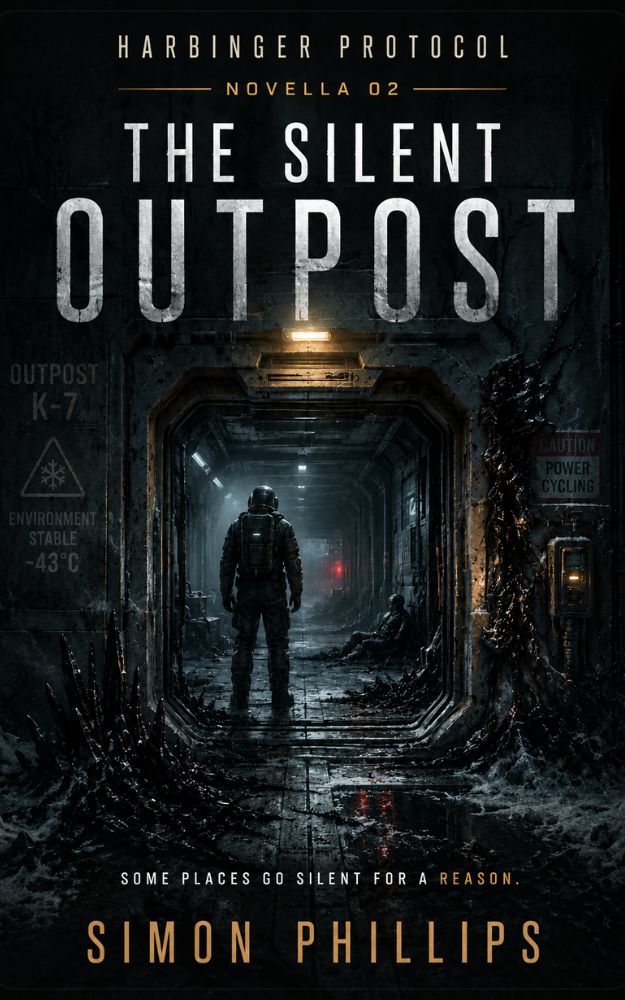
The Harbinger Protocol novellas follow that unfolding pressure through the experiences of Soren Vale, beginning with the civilian freighter disaster recorded in The Ash in Transit and continuing into the colder, more procedural dread of The Silent Outpost, where isolated incidents begin to reveal the outline of something spreading across human routes and systems.
Readers who wish to explore the full opening phase of the Harbinger crisis can find the novellas below.
The following Chronicle reconstructs the review of the Jennah’s Pride audio fragment inside Review Chamber Nine, where an ESC analyst attempted to reduce a human-sounding voice to airflow, pressure collapse, and damaged ship systems while the recording continued to resist every clean explanation.
Readers supporting The Future Chronicle can continue the record below.
Subscribe to continue reading
Subscribe to get access to the rest of this post and other subscriber-only content.
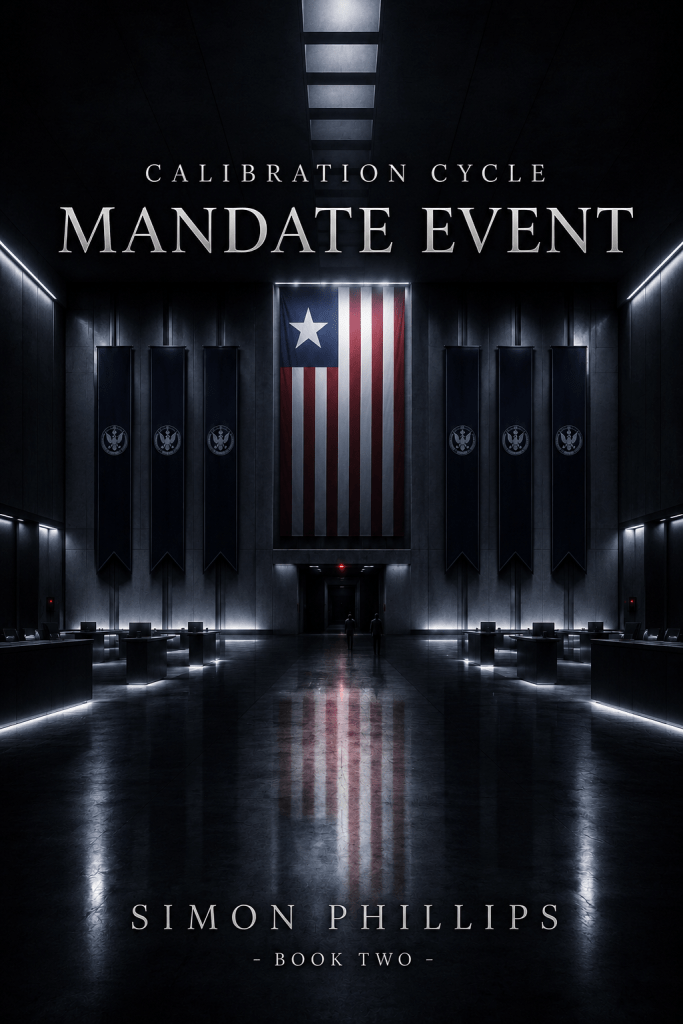
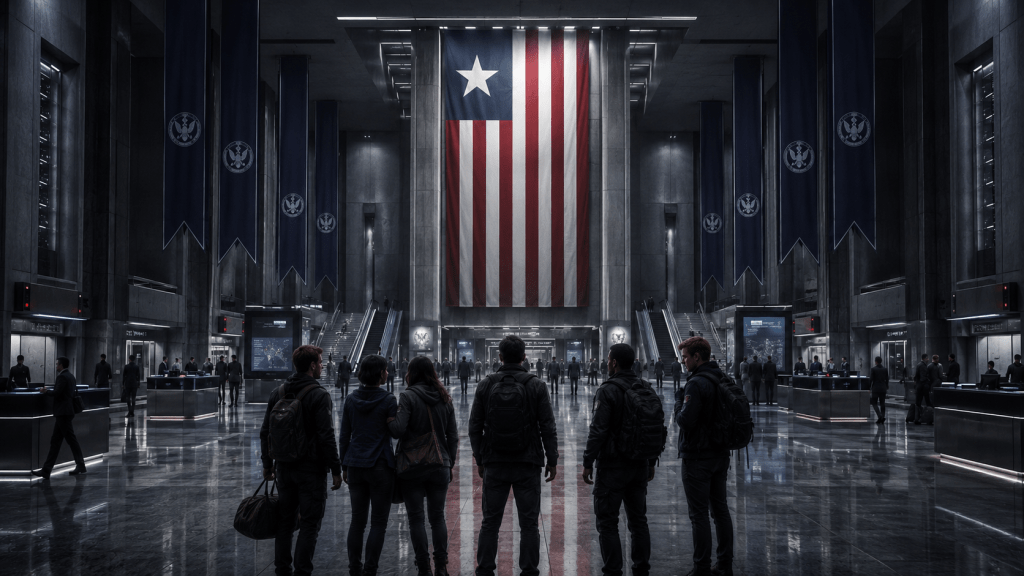
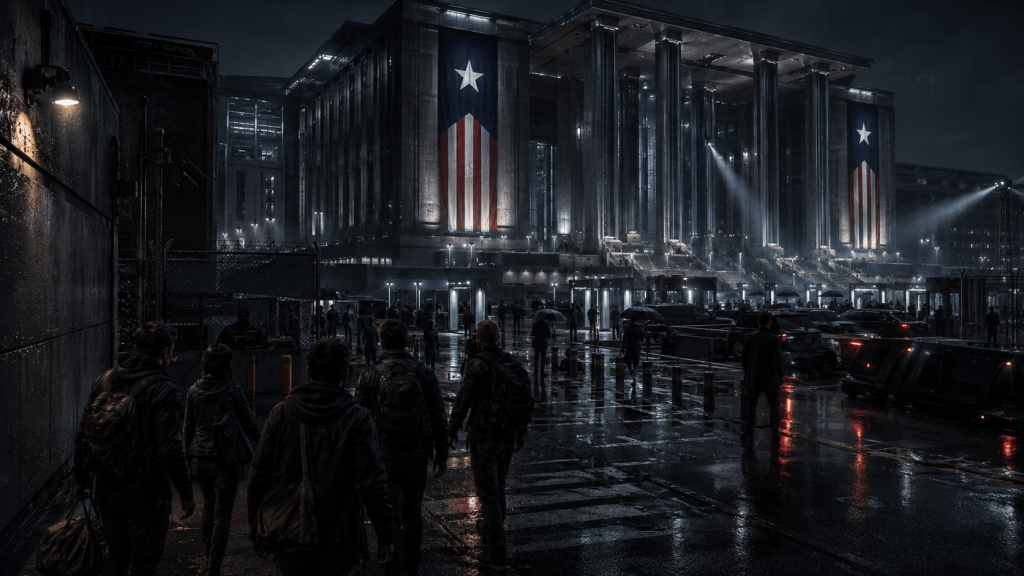
The American flag is the first thing Aaron Cole knows is wrong, although for several seconds he cannot understand why. The familiar red and white stripes hang exactly where they should beneath the controlled lighting of the staging hall, the fabric arranged with institutional precision and treated by everyone passing beneath it as something too ordinary to deserve attention, yet the blue canton no longer carries the constellation he has known since childhood. There is only one white star, large and uncompromising, suspended at the centre of a design that seems familiar until memory attempts to complete it.
Then Aaron looks for the Union Jack.
It is not there.
For Aaron, Rei Nakamura, Marcus Reed, Connor Blake, Declan O’Shea and Sofia Alvarez, the discovery should not matter as much as the crisis they have only just survived. They have already endured an experience so physically convincing that the language of advanced simulation has begun to feel inadequate, and they have returned carrying injuries that should have disappeared when the experiment ended. Sofia’s ankle remains swollen and painful, Aaron’s hands still carry abrasions, Marcus bears bruising from impacts that belong to another place, and exhaustion sits inside all of them with the stubborn weight of something the transition back has failed to remove.
The hall around them, however, remains composed. Personnel move between desks. Announcements direct arrivals through processing. Screens display ordinary public information. No one appears concerned by the altered flag because, within this place, nothing about it is altered at all.
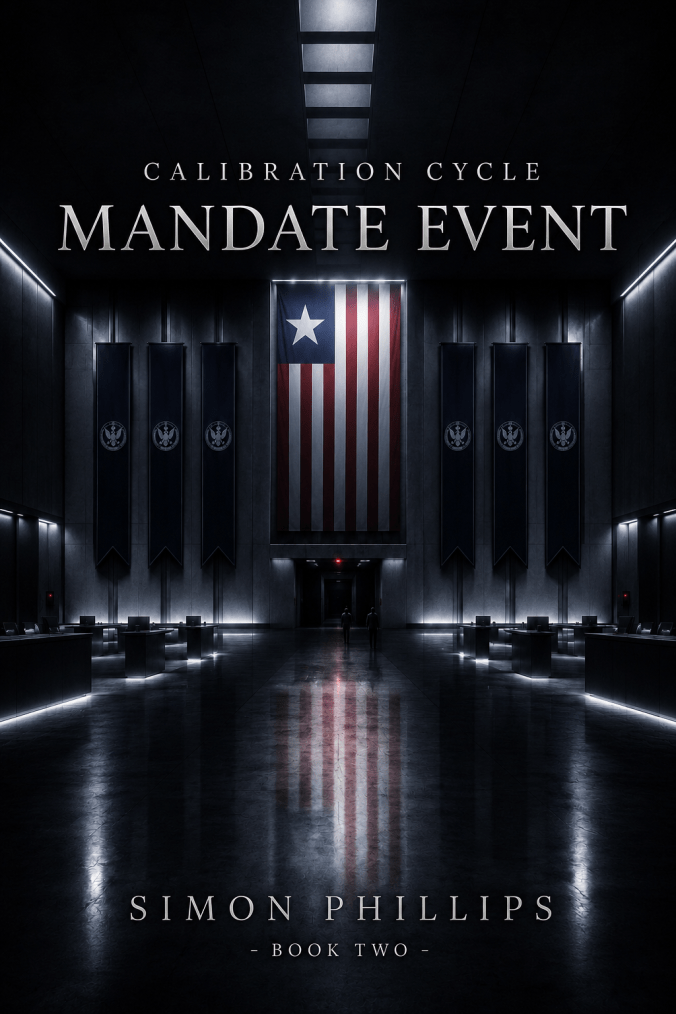
Calibration Cycle: Mandate Event begins at precisely that point of uncertainty, carrying the consequences of Meteor Event forward instead of allowing the characters the comfort of beginning again. The first book forced six volunteers to question whether an experimental immersive environment could produce consequences beyond anything they had been promised. Book Two asks something more dangerous: what happens when the world outside the supposed experiment appears perfectly stable, yet the history supporting that stability is not the history they remember?
The Return They Wanted Does Not Behave Like Home
The six entered the Calibration Cycle believing they had volunteered for a classified programme involving advanced immersive technology, adaptive crisis modelling and sensory feedback far beyond anything available to the public. That original explanation gave them something to hold onto when the first experience became difficult to distinguish from physical reality, because even impossible sensations could still be fitted inside the possibility of extraordinary technology if they were willing to stretch the definition far enough.
Mandate Event begins putting that explanation under a different kind of pressure.
Sofia’s ankle is not merely remembered as painful. It remains injured. The swelling is present beneath institutional lighting that belongs to the supposedly safe side of the experience, and when medical personnel eventually examine it, they do not respond with astonishment. They possess terminology for injuries that persist across what should have been a clean transition, and the casual professionalism with which those terms are used becomes more disturbing than panic would have been.
Aaron carries smaller marks, though their significance is no easier to dismiss. Marcus feels damage that should have belonged to a completed crisis. The six have returned carrying evidence in their own bodies, and every attempt to explain that evidence requires another layer of technology they were never told existed.
Connor, whose instinct is to understand a system before allowing himself to fear it, continues searching for a technical explanation because that is still more manageable than accepting that the original explanation may have been fundamentally wrong. Rei pays closer attention to the bodies themselves, noticing what pain does, how exhaustion remains, and how physical consequence refuses to respect the boundary everyone was told would exist.
Nothing provides them with a definitive answer, which is precisely what makes the uncertainty work. They are not handed a revelation about what has happened to them. They are forced to continue moving while the explanation they trusted becomes increasingly expensive to maintain.
The Single Star Belongs to a World That Thinks It Is Normal
The altered flag is only the beginning.
Announcements inside the facility direct people towards return processing. Administrative staff speak about return groups and return blocks as though those categories have existed long enough to become boring. Public devices connect to something called the Imperial Civic Mesh. Transport information identifies the wider region as part of an Imperial Union, and Britain no longer appears under the name Aaron expects to find.
It has become the Albion Administrative Territory.
The significance of that change does not arrive through an explanation delivered by an authority figure. It emerges from the ordinary machinery of public life, which makes the altered history far harder to dismiss as an artificial backdrop. Britain has not disappeared beneath rubble, and the world has not been thrown into a visibly dystopian collapse. People buy coffee, complain about delays, take children to school, work behind desks, scan travel documents and hurry through transport concourses beneath symbols they stopped consciously noticing years ago.
The single-star emblem appears on uniforms, public screens, transport notices and civic material because it belongs there.
Albion appears in official language because, within this history, that is simply what the country is called.
The effect is deliberately quieter than a ruined skyline or military occupation because Mandate Event is interested in something more unsettling than obvious conquest. It examines the way political transformation can become ordinary once enough time has passed for institutions, education, paperwork and language to make the new arrangement feel inevitable.
The Imperial Union does not need soldiers standing on every corner shouting about power. Its authority is already built into the names people use, the documents they carry and the systems through which ordinary life is allowed to move.
The Imperial Union Was Built Through the Language of Rescue
As Aaron and the others begin cautiously reading the world around them, the altered history reveals a political structure that is far more complicated than a simple empire imposed overnight.
The Imperial Union presents its origins through reconstruction, relief, stability and protection. The history taught within its civic systems describes a world emerging from the devastation of the Second World War under increasingly permanent American leadership, where humanitarian supply networks, military security, reconstruction programmes and international coordination gradually became something larger than the emergency structures that first justified them.
Connor can see why such a system might once have looked brilliant.
Shared logistics could prevent famine. Coordinated security could limit another continental war. Common infrastructure could move medicine, refugees and aid across borders more efficiently than fractured governments acting alone. A world that had watched nations destroy one another might willingly tolerate extraordinary central authority if that authority appeared to offer stability.
Marcus understands another part of the problem because military history is full of temporary structures that survive the emergencies that created them. Once command systems work, dismantling them carries risk, and the person suggesting that the guardrail should be removed becomes responsible for whatever happens afterwards.
Declan sees the trap hidden inside that logic. Temporary necessity becomes permanent authority, permanent authority becomes administrative expectation, and eventually people forget that the structure was ever supposed to be temporary at all.
What makes the Imperial Union effective as political science fiction is that its public argument contains enough truth to make its later form uncomfortable. It is not frightening because every part of it was designed by obvious monsters. It is frightening because many of the mechanisms that eventually erased sovereignty can be traced back to decisions that could once have been defended as reasonable.
That history gives Mandate Event its political depth without turning the story into a lecture. Aaron and the others discover it because they must understand the rules of the world before those rules classify them as threats.
Aaron’s Passport Becomes More Dangerous Than a Weapon
For Aaron, the altered history stops being theoretical when the group reaches identity processing.
The passports they carried into the original programme have travelled with them, small pieces of ordinary life preserved through experiences that have already damaged almost every other assumption. Connor’s American passport produces confusion because its design does not match local federal standards. Rei’s Japanese documentation requires manual review. Sofia’s Mexican identity and Declan’s Irish passport fit imperfectly into a world whose international order followed another path.
Aaron’s British passport produces something else entirely.
The United Kingdom of Great Britain and Northern Ireland is not recognised as a legitimate sovereign state.
The familiar crest inside his passport is treated as proscribed political material connected to Albion separatism, and an object that once allowed him to pass through airports becomes evidence that he may belong to a movement the authorities consider dangerous.
The moment changes the nature of the story because Aaron has done nothing except prove who he is.
His nationality has become suspicious.
His passport carries symbols the state regards as politically destabilising.
The country printed inside it is treated as an obsolete claim preserved by people unwilling to accept history’s correction.
That idea sits at the centre of Mandate Event: power does not only control territory when it can also control the vocabulary through which territory is remembered. Once Britain becomes Albion, anyone insisting on the older name can be described as refusing reality rather than defending identity. Once sovereign symbols become prohibited emblems, preserving them can be treated as radical behaviour. Once an entire generation is educated inside the revised language, the argument over what was lost becomes easier for authority to dismiss as nostalgia, extremism or historical misinformation.
Aaron entered the experiment without thinking very much about what being British meant.
This world forces him to discover what happens when somebody else has already decided that the identity no longer exists.
Berlin Makes the Wrong History Feel Real
Beyond the controlled processing areas lies Berlin, and the city gives the altered world the texture that makes it difficult to dismiss.
Nothing about everyday life pauses to acknowledge the six outsiders’ confusion. Buses run. Shops open. Delivery drivers argue with staff. Public terminals charge fees. Schoolchildren carry bags beneath civic emblems. News broadcasts move between transport information, security notices and political ceremonies while people glance at them with varying degrees of interest.
That normality is important because Mandate Event never treats the altered world as a decorative setting waiting for Aaron’s group to arrive. People have lived here their entire lives. They possess loyalties, compromises, resentments and memories that existed before six strangers appeared inside their political reality.
Some accept the Imperial Union because it is the only structure they have ever known.
Some believe its promise of order.
Some dislike it without being willing to risk their lives opposing it.
Some have learned to conceal forbidden symbols beneath clothing.
Some belong to networks attempting to preserve identities that official history has taught the public to regard as dangerous.
The city therefore becomes more than an alternate-history curiosity. It becomes a functioning society whose contradictions must be understood before the characters can safely act inside it.
Steven Hale, another survivor caught in the same impossible chain of events, becomes especially important because he recognises that language itself has become part of the terrain. His instinct is to read signs, official categories, school history, public warnings and bureaucratic terminology before trusting any interpretation. He understands that governments often reveal more through the words they treat as ordinary than through the speeches they make deliberately.
For a group accustomed to waiting for instructions, that becomes an important change.
They begin learning to read the world before allowing the world to tell them what to do.
Nathaniel Crowe Is Dead, Yet Berlin Recognises His Face
Aaron’s British passport makes him dangerous to the Imperial authorities, although it is not the strangest problem attached to his identity.
A records clerk named Tomas Rale sees Aaron and reacts as though somebody long dead has stepped into the fluorescent light.
The man he recognises is Nathaniel Crowe.
Within sections of the Albion resistance, Crowe is better known as the Ghost, a figure surrounded by enough conflicting history to make certainty almost impossible. Official sources connect him to extremist violence and attacks against Imperial structures. Resistance accounts describe someone who became a symbol of survival, defiance and the refusal to allow Britain’s identity to be administratively erased.
Crowe is also supposed to be dead.
The resemblance between him and Aaron is close enough to make disbelief difficult and acceptance even worse.
For Aaron, the danger lies in the fact that he knows perfectly well who he is while everybody around him begins responding to somebody else.
He has no memories of Crowe’s life.
He does not know the people who speak about him with grief.
He has no understanding of the decisions that turned the Ghost into both a security threat and a resistance symbol.
Yet a face can carry authority before a person has spoken a word, and once the possibility of Crowe’s return begins moving through hidden networks, Aaron discovers that denying the identity may not be enough to prevent other people using it.
That pressure suits Aaron particularly well because leadership has never been something he sought. In Meteor Event, people began looking towards him because he remained capable of organising movement while certainty collapsed. In Mandate Event, an entire political network begins seeing significance in him for reasons that have nothing to do with the choices he has actually made.
He is no longer simply being asked to decide.
He is being asked to inhabit expectation.
The Resistance Has Preserved What the State Tried to Make Obsolete
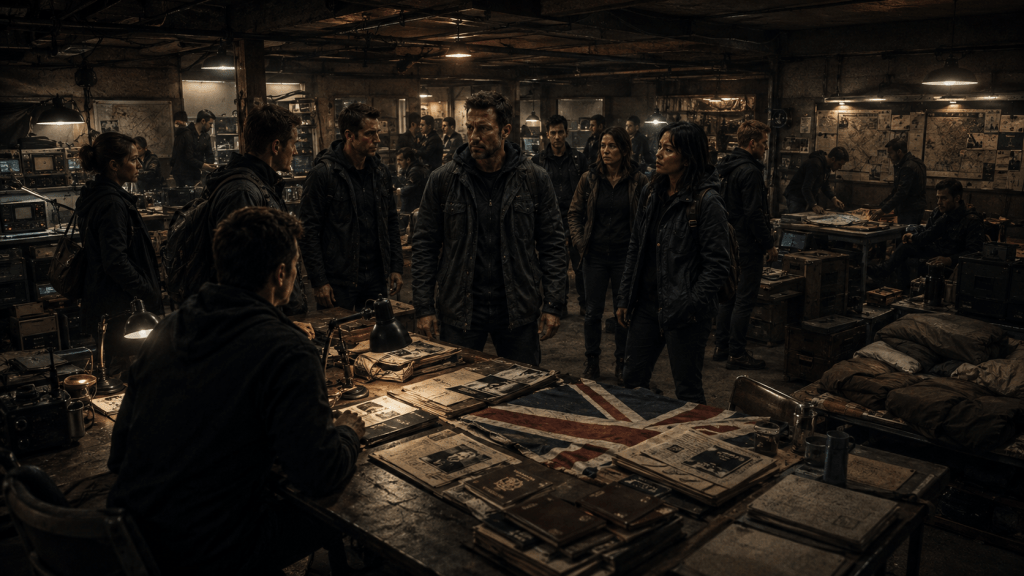
The resistance Aaron encounters is not presented as a polished underground army waiting for the arrival of its rightful hero. Its rooms are crowded with practical work, exhausted people and the accumulated objects of a history that has become dangerous to possess.
Old flags are hidden.
Passports from the United Kingdom are preserved after official recognition has vanished.
School material is collected alongside forbidden records.
People maintain routes, falsify paperwork, move information, repair equipment and support families whose lives have been reshaped by political decisions made long before Aaron entered the city.
That detail keeps the resistance grounded.
The struggle is not initially defined by weapons. It is defined by memory.
People preserve names because names disappear first. They preserve documents because documents prove that something existed before an authority decided it did not. They teach history privately because public education has replaced political loss with a story of rescue, stability and inevitable progress.
Only later does that preservation become entangled with violence.
This is where the story refuses to give either side an easy moral position. The Imperial Union has erased sovereignty, suppressed prohibited symbols and turned national memory into a security concern. The resistance has understandable reasons to exist, although understandable reasons do not guarantee that every action taken in their name becomes morally acceptable.
That distinction becomes increasingly important as Aaron is pulled closer to people who see his resemblance to Crowe as an opportunity.
Cerys Thorne Sees a Man and a Weapon in the Same Face
Among the resistance figures Aaron encounters, Cerys Thorne carries perhaps the most difficult relationship with the identity being placed over him.
Crowe was not an abstract figure to her.
The history between them is personal enough that Aaron’s face causes an immediate reaction, although Cerys does not allow grief to become certainty. She understands the danger of believing too easily, particularly when the Imperial Union would have every reason to exploit a symbol capable of disrupting resistance judgement.
At the same time, she cannot ignore the practical effect Aaron has on the people around her.
Some believe Crowe survived.
Others believe Aaron may be damaged, altered or deliberately planted.
Some do not care which explanation is correct because the sight of his face gives exhausted people something they have not felt for years.
Hope.
That becomes dangerous because hope is another form of leverage.
Cerys understands it.
Aaron begins understanding it.
The harder question is whether recognising that leverage prevents them from using it.
The political conflict in Mandate Event becomes much more personal at this point. Aaron is no longer simply hiding from Imperial authorities. He is being drawn into a struggle where his face can influence frightened people, his name can alter trust, and remaining completely outside the conflict may no longer be possible.
Something Knows Exactly Which Identity Will Open the Next Door
The external guidance that helped drive the crisis in Meteor Event has changed as well.
The wrist-mounted prompts that previously offered direction are no longer the only route through which instructions appear. Phones connected to the Imperial Civic Mesh begin receiving language that resembles both the local political system and the clinical direction the group encountered before.
The distinction becomes increasingly difficult to maintain.
Are the messages part of the Imperial network?
Are they part of the original experiment using local infrastructure?
Are the two being deliberately blended so that the characters can no longer tell where one authority ends and another begins?
Connor is particularly disturbed by the way terminology changes after the group learns it. New phrases appear only after local people have introduced those concepts. Role descriptions shift as the resistance begins assigning its own structures. The language surrounding Aaron starts acknowledging the importance of the Crowe identity as though something has recognised that other people’s belief can be used to change behaviour.
Then the intrusion becomes more personal.
Aaron is confronted with a resistance challenge that requires knowledge he cannot possess.
Instead of receiving a simple written answer, he experiences something closer to a memory.
Rain against water.
Stone beneathfoot.
Soot.
A voice carrying words that feel remembered despite belonging to a life Aaron has never lived.
The moment is deeply unsettling because it crosses a boundary that external instructions had left intact. Telling someone where to go is one kind of control. Supplying the internal texture necessary for them to behave like somebody else is another.
For the resistance, Aaron’s answer appears to confirm something.
For Aaron, it confirms almost nothing except that whatever is guiding them can reach further into him than he realised.
Rei Nakamura Keeps Looking for Aaron Beneath the Ghost
The growing Crowe identity also strengthens one of the quieter relationships inside the group.
Rei has never needed Aaron to become a conventional leader. Her connection to him grows through shared responsibility, observation and the small acts required to keep people moving under pressure. She sees when he is carrying too much before he says it, and in Berlin she becomes increasingly aware that the danger surrounding him is not only physical.
Everyone else has reasons to see Crowe.
The resistance sees history.
Cerys sees grief.
Tomas sees possibility.
The authorities see a threat.
Whatever is guiding the group appears to see an identity that can be used.
Rei continues seeing Aaron.
That distinction does not require sentimental declarations because it works more effectively through restraint. A glance held for a fraction longer, a question asked quietly while everyone else talks about the Ghost, a deliberate use of Aaron’s real name when the room has begun treating Crowe as more useful.
The relationship matters because identity pressure only works if there is something being lost beneath it.
Aaron cannot be frightened by becoming Crowe unless being Aaron still has weight.
Marcus, Connor, Declan and Sofia Read Different Dangers in the Same World
Book Two also gives the rest of the core group increasingly distinct ways of interpreting the altered political reality.
Marcus Reed reads structures of force. His military experience allows him to recognise security posture, command hierarchy, access routes and the difference between authority that expects obedience and authority that has begun preparing for violence. The Imperial Union unsettles him partly because much of its machinery is recognisable. Its worst instincts do not look alien to him; they look like familiar systems pushed far enough that necessity has become permanent doctrine.
Connor Blake approaches the world through architecture and information. He can admire the efficiency of civic networks while being disturbed by what that efficiency enables, and his willingness to understand the mechanisms around them becomes both essential and dangerous. Every time he discovers another pattern, he moves closer to something none of them yet understands.
Declan O’Shea reacts through suspicion shaped by money, incentives and the public language of power. He understands that empires can benefit from being attacked if an attack provides the justification for greater control, and his cynicism becomes increasingly valuable whenever everyone else begins confusing movement with progress.
Sofia Alvarez continues carrying the most visible physical connection to the previous event through her injured ankle, though Book Two develops her far beyond that vulnerability. She watches people rather than structures and frequently notices emotional realities others miss. She recognises when civilians are afraid of being seen reacting. She sees rooms building expectations around Aaron before he fully recognises what is happening. Her sensitivity, which initially appeared to make her the least suited to sustained crisis, increasingly allows her to perceive what more confident people overlook.
The six are therefore becoming more capable as a group, although capability is not presented as uncomplicated progress.
The better they become at surviving these situations, the more dangerous the question becomes of what survival is teaching them to accept.
The Continental Mandate Forum Turns Politics Into a Moral Trap
The resistance eventually identifies an opportunity created by the Continental Mandate Forum in Berlin, where political, security, financial and administrative power has been brought unusually close together.
For an organisation that has spent years surviving beneath Imperial surveillance, the convergence appears almost impossible to ignore.
This is where Mandate Event moves from political discovery into moral pressure.
The Imperial Union has given the resistance countless reasons to oppose it. Britain has been administratively reduced to Albion. Sovereign symbols have been criminalised. Historical identity has been recast as dangerous nostalgia. People have disappeared into institutions whose language makes coercion sound procedural.
None of that automatically makes a violent response clean.
The Forum contains people rather than abstract structures.
Workers move through it.
Security personnel protect it.
Political figures carry responsibility in different degrees.
Civilians exist around every plan.
The resistance understands that striking the right points could weaken the machinery holding the Imperial system together, while Declan immediately understands that the wrong attack could provide the Union with exactly the fear required to justify even greater control.
Aaron and the others are therefore placed inside a political conflict where the obvious enemy does not produce an obvious moral answer.
Helping the resistance may contribute to liberation.
Helping the resistance may also contribute to deaths none of them can justify afterwards.
Refusing involvement may preserve their consciences.
Refusing may also abandon people already living under an authority that has erased parts of their identity for generations.
There is no choice capable of leaving everyone innocent.
That is exactly where Calibration Cycle wants its characters.
Mandate Event Is About What Happens When Success Has No Moral Definition
The first book presented a crisis that looked straightforward from a distance. Something catastrophic was approaching. An intervention was possible. The difficulty lay in not knowing whether acting would prevent disaster or create another form of it.
Mandate Event takes the same underlying pressure and removes the clarity of a physical object falling from the sky.
Political systems do not offer a single impact point.
Resistance movements do not come with clean success probabilities.
History cannot be corrected by pressing the right sequence of controls.
Every decision changes people who have already been living inside the consequences long before Aaron’s group arrived.
That makes Book Two particularly suited to readers who enjoy psychological science fiction where the speculative element is inseparable from character, politics and moral uncertainty. The technology matters, although the story is never about technology for its own sake. The alternate history matters, although it is never presented simply as an exercise in imagining different flags and borders.
What matters is what those structures do to the people forced to live inside them.
Aaron is pushed towards leadership through an identity that is not his.
Rei watches the person beneath that identity become harder to protect.
Marcus confronts the danger of thinking too easily in operational terms.
Connor begins recognising that understanding a system does not mean controlling it.
Declan sees how power converts violence into justification.
Sofia notices the human cost while everyone else is still arguing about structure.
The deeper the group moves into Berlin, the harder it becomes to tell whether the next successful action is bringing them closer to safety or merely proving how effectively they can be made to function under pressure.
Read Calibration Cycle: Mandate Event
Calibration Cycle: Mandate Event continues the story begun in Meteor Event while expanding its psychological and political pressure considerably beyond the first crisis. Readers who enjoy psychological science fiction, alternate-history thrillers, political dystopian fiction, unreliable reality, artificial-intelligence ethics, resistance narratives and character-driven speculative fiction will find a story concerned less with explaining an impossible world than with forcing ordinary people to live inside it long enough for every easy explanation to begin failing.
Aaron Cole survived the first event expecting that survival would eventually lead back towards certainty. Instead he finds himself standing beneath a flag that should not exist, carrying injuries that should have disappeared and presenting a passport from a country this world regards as a dangerous historical fiction. Before he has time to understand the history surrounding him, strangers begin recognising his face as that of Nathaniel Crowe, a dead resistance figure whose legacy carries equal measures of hope, violence and political mythology.
The more useful that resemblance becomes, the less control Aaron has over what other people believe.
The more the group learns about the Imperial Union, the harder it becomes to reduce the conflict to good people fighting bad ones.
And as the technology surrounding them begins adapting to the language, identities and pressures of the world itself, one possibility becomes increasingly difficult to ignore: perhaps completing whatever comes next has never guaranteed that the result will be good.
The experiment was supposed to test how six people responded to crisis. By the time Berlin closes around them, Aaron and the others are beginning to face a much less comfortable possibility: the crisis may be learning how to use what they are becoming.
A station under quarantine should be quiet in a way people understand. Doors should remain sealed. Power should stay low. Emergency lights should mark safe routes through dead corridors. The silence should feel like failure, damage, or abandonment.
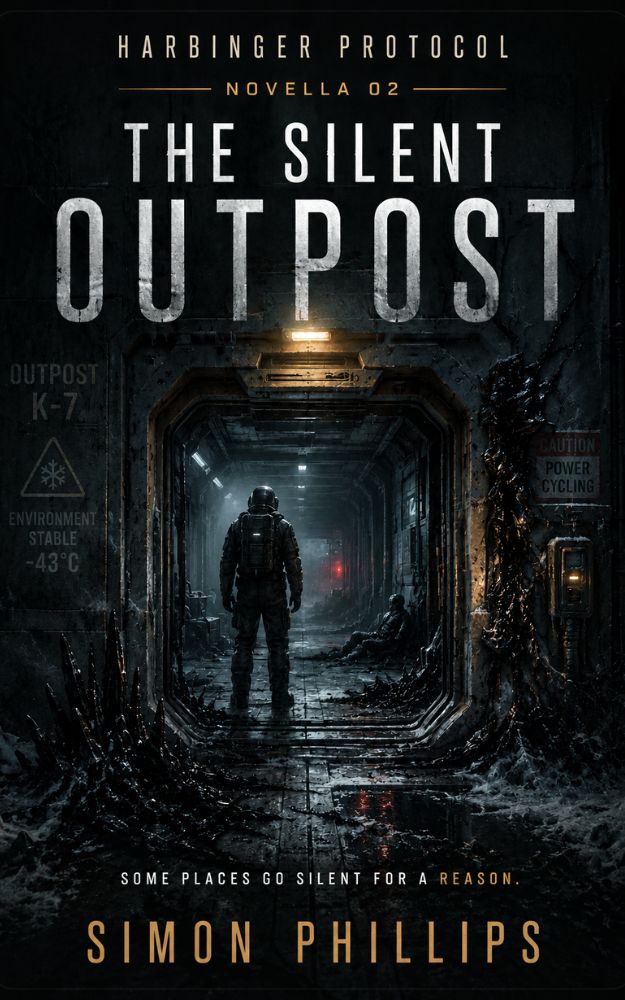
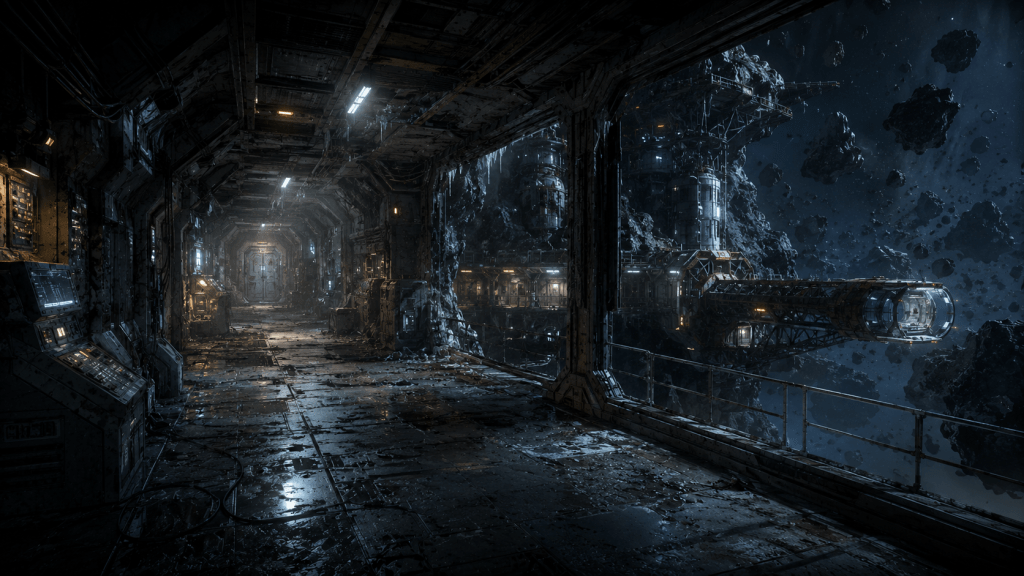
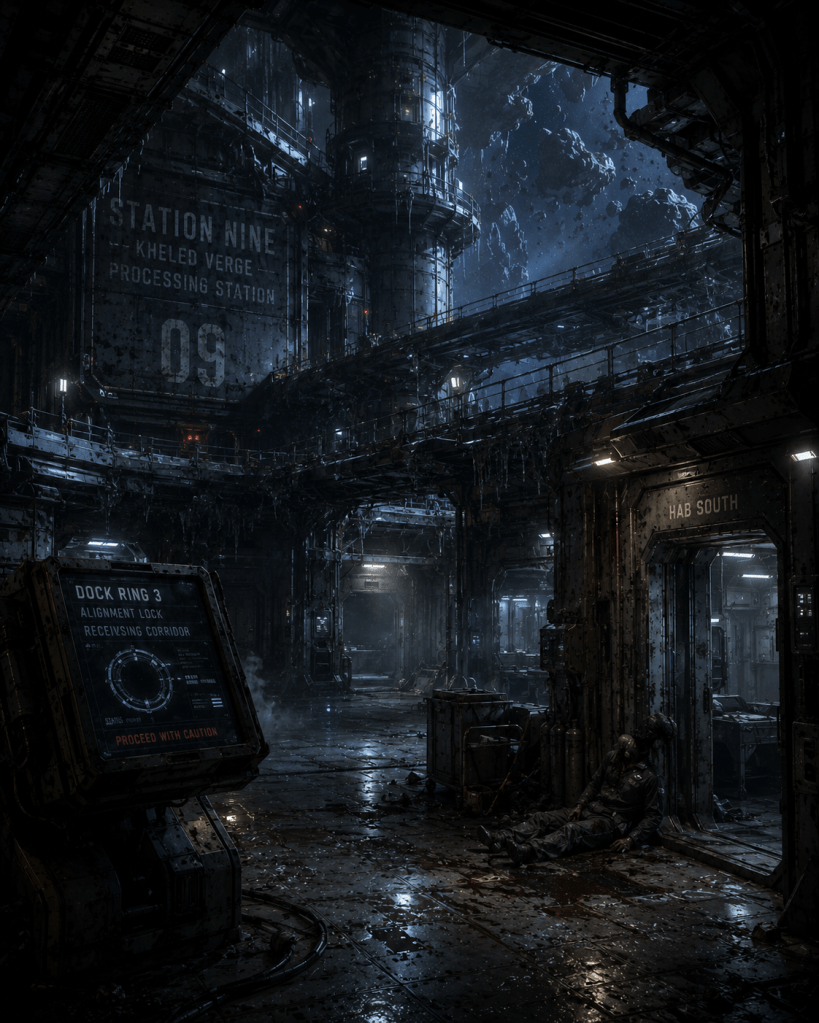
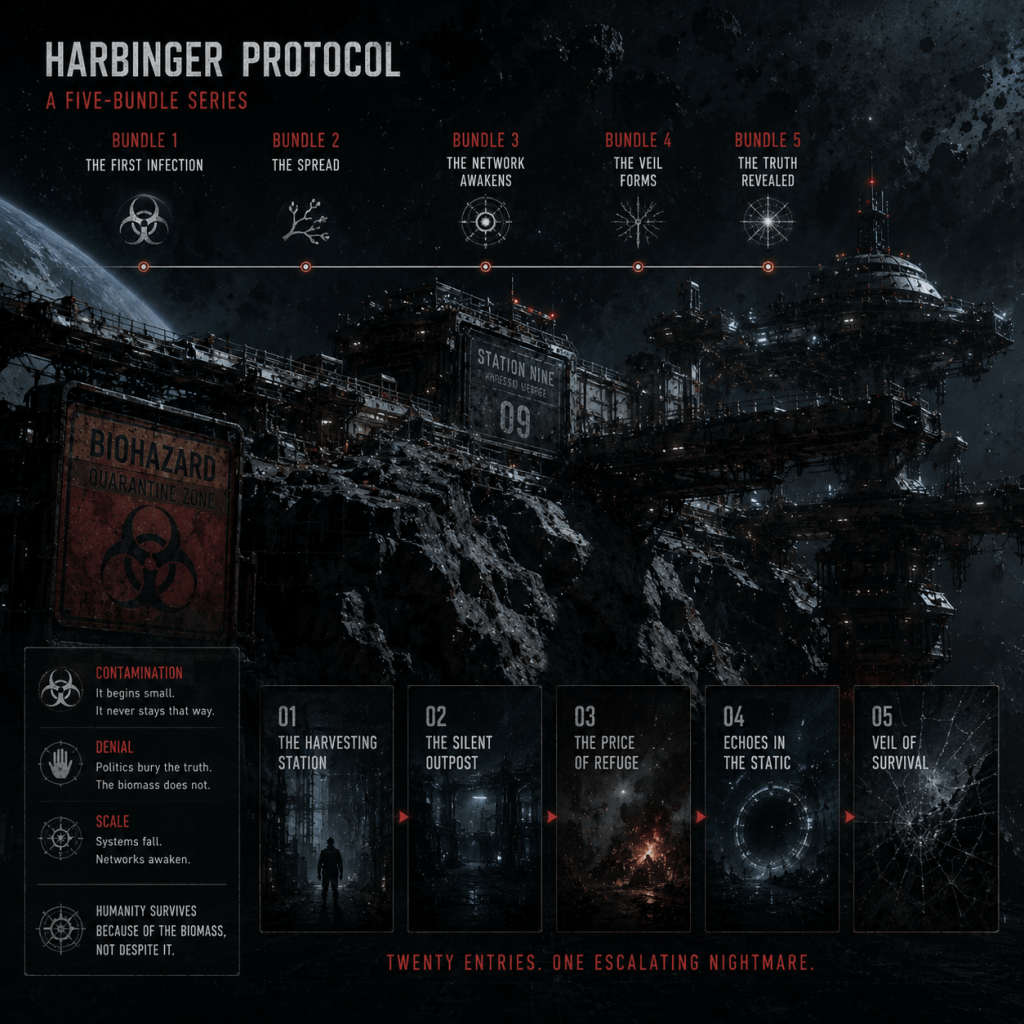
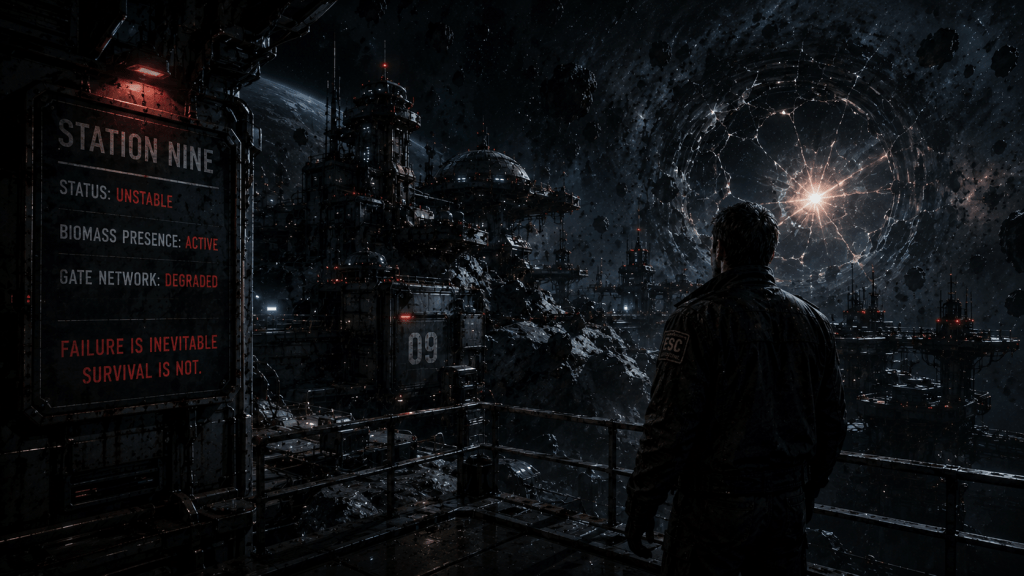
In The Silent Outpost, the second entry in Harbinger Protocol, silence becomes something more dangerous. Kheled Verge Processing Station Nine is cold, partially powered, and almost still when the ESC investigation team arrives. Its docking arms hang in interrupted motion. Its work lights have failed in broken sequence. Maintenance equipment remains suspended mid-task. The place appears paused, as though the ordinary life of an industrial outpost has been held in place by something that has learned how stations breathe.
This is where the series widens from isolated shipboard sci-fi horror into something larger. The first incident aboard the Red Titan left Soren Vale as a survivor. The second places him inside an institution trying to decide whether truth should be spoken plainly, delayed until it becomes useful, or shaped into language that can survive politics.
For readers looking for atmospheric science fiction horror, space station horror, biological contamination sci-fi, and a darker kind of interstellar political thriller, The Silent Outpost marks the moment Harbinger Protocol begins to show its wider shape.
Soren Vale enters this novella in a cleaner kind of captivity.
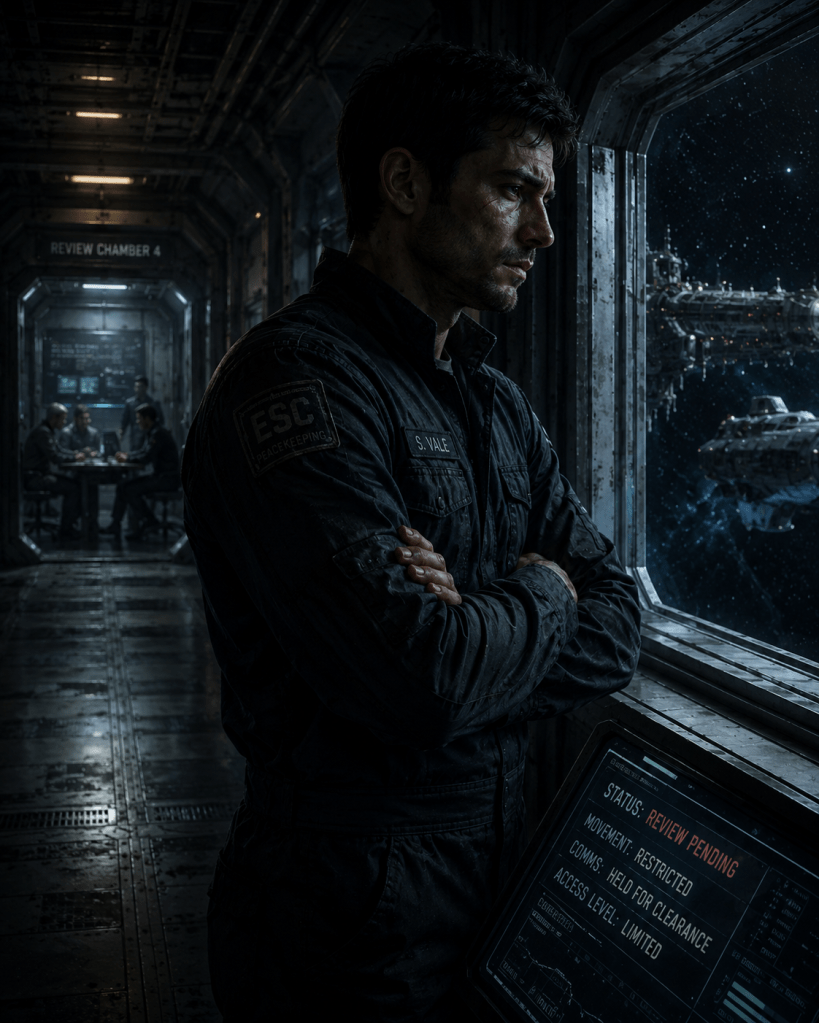
He is aboard the ESC Peacekeeping Cruiser Leda Ark, safer than he was on the Red Titan, yet far from free. His movement is limited. His communications are held. His memories have become evidence. The institution around him speaks in careful phrases: protective review, pattern integrity, operational legal oversight, acoustic artefacts. Each term carries part of the truth, yet none of them can hold the shape of what he lived through.
That is one of the most important pressures in Harbinger Protocol. The horror is biological, industrial, and cosmic in its eventual reach, though it first enters through administration. Somebody has to classify the event. Somebody has to decide which words can be released. Somebody has to ask whether panic, sovereignty, route control, and treaty law are more dangerous than the thing moving through ducts and cargo bays.
Soren’s usefulness becomes a second form of custody. He notices patterns before committees are ready to name them. He recognises that wrongness can travel through air systems, power routes, warm compartments, and human assumptions. The ESC needs that instinct. It also needs him contained.
In many science fiction horror stories, the survivor becomes the hero who knows the truth and forces the world to listen. Harbinger Protocol takes a colder path. Soren is believed just enough to be used, controlled just enough to be kept close, and trusted only when his fear becomes operationally useful.
Station Nine and the Horror of Working Systems
Kheled Verge Processing Station Nine is not a gothic ruin in space. It is an industrial place. Ore systems, docking rings, maintenance spines, habitation blocks, control boards, pressure doors, service trunks, coolant lines, and emergency fallback systems form its body. That practicality matters.
The terror in The Silent Outpost comes from systems that almost behave correctly.
Dock Ring Three still answers, although weakly. The receiving corridor shows no grand destruction. Tools remain where workers left them. The first evidence of contamination appears in pale ribbed accretions on metal surfaces, hatch frames, vent housings, and equipment. It could be coolant residue. It could be mineral deposition. It could be a station ageing badly in deep cold.
Then Hab South changes the meaning of the place.
The dead are found near vents and service grilles. Some stand with hands against the metal. Others sit with faces angled upward, as if listening. There is no visible violence. No clear attack. No easy monster to blame. The bodies have been preserved by cold and arranged by behaviour. Something in the station made them listen long enough to die.
The voice-like sounds that follow are central to the series. They are not true speech in a simple sense. They are damaged systems, airflow, corrupted buffers, acoustic memory, and the human mind reaching for pattern. Yet that distinction offers no comfort. A false plea can kill as effectively as a real one when people are trained to answer distress.
A station does not need to become alive to become dangerous. It only needs to become trustworthy in the wrong places.
Biological Contamination That Uses Human Procedure Against Itself
The biomass threat in Harbinger Protocol is frightening because it does not behave like a simple alien invader. It is reactive, environmental, and tied to physical conditions: heat, power, airflow, oxygen, pressure, electromagnetic fields, and the infrastructure humans depend on.
That makes every sensible action dangerous.
A dark station must be investigated. Evidence must be recovered. Survivors may be trapped in sealed compartments. Life support might matter. Operations archives could explain what happened. A controlled systems wake seems reasonable. It is exactly the kind of careful, professional decision an ESC field team would make.
In The Silent Outpost, Kell attempts a narrow slice wake inside Control Stack. The intention is precise: operations archive and environmental board only, no station-wide restoration, no refinery systems, no heavy motors. Procedure is followed. Caution is present. Nobody behaves like a fool.
The station answers anyway.
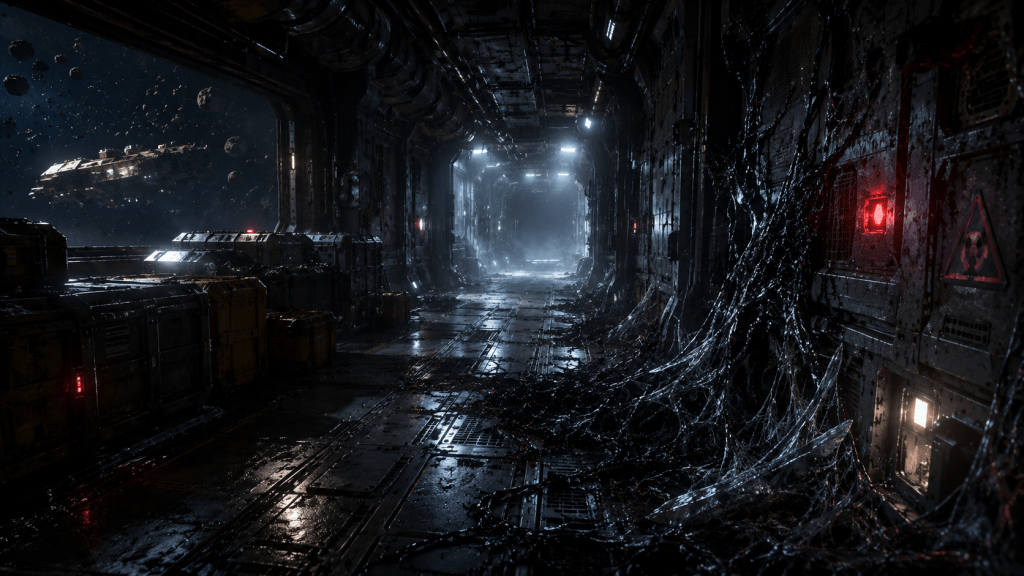
Lights slam awake. Air handlers roar. Pressure doors cycle across the structure. Old announcements burst through speakers. Dead routines return in fragments. The outpost, once cold and held down, finds pathways through the very systems designed to reveal it.
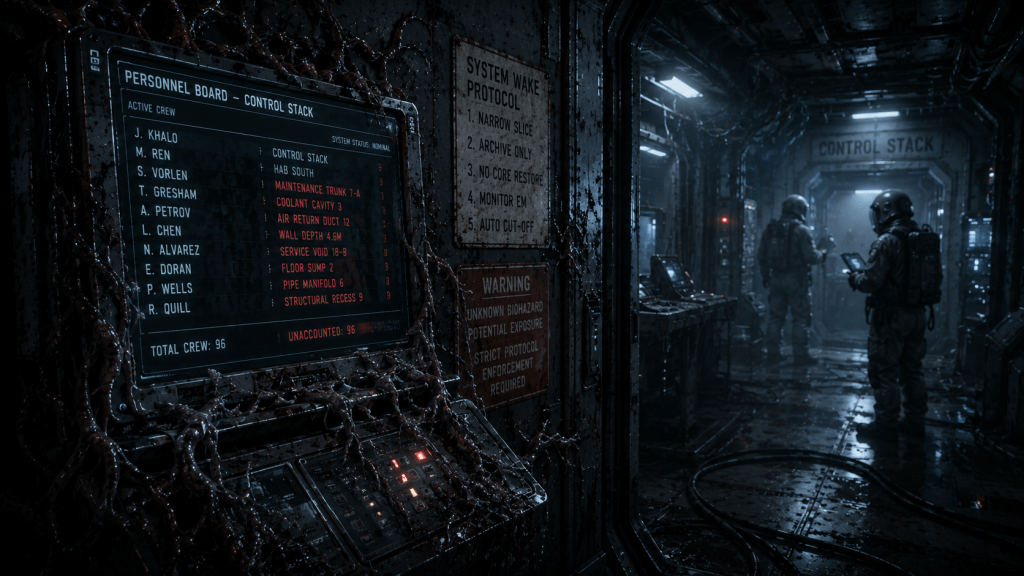
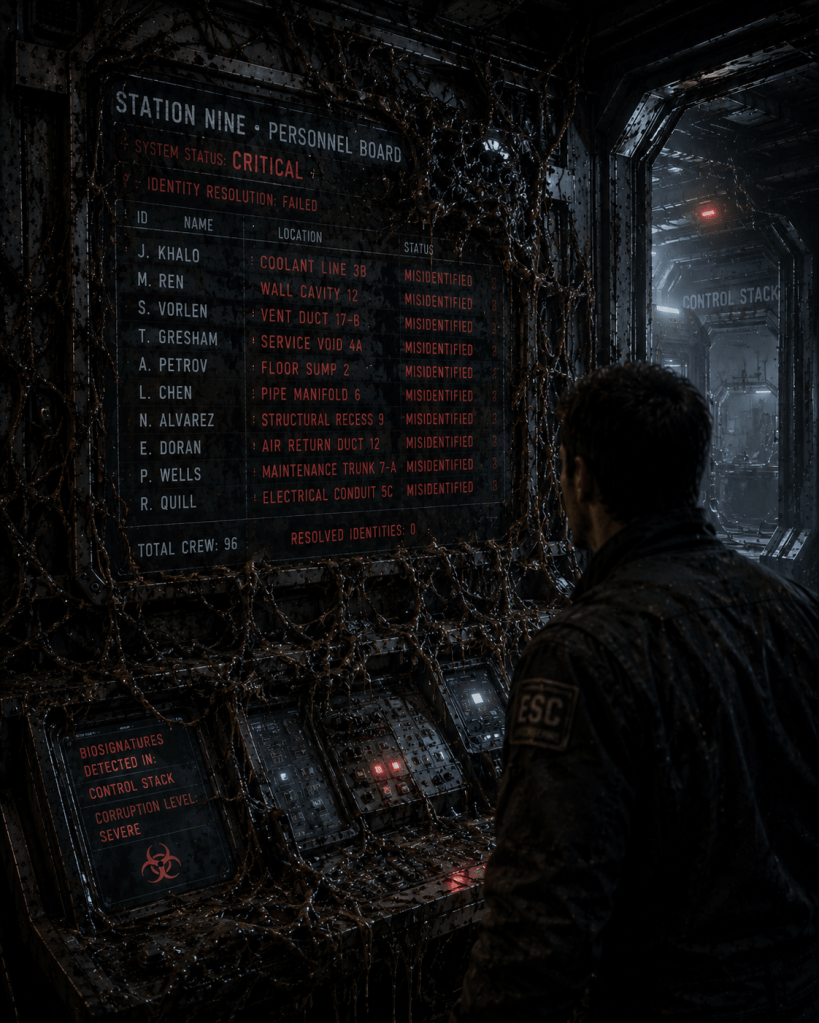
This is where the novella deepens its biological contamination horror. The danger is not merely infection. It is infrastructure conversion. The station’s systems begin to blur human presence, ducting, wall cavities, coolant routes, service voids, and crew identifiers until the personnel board can no longer separate bodies from structure.
Thirty-two becomes sixty-four. Then ninety-six. Then zero.
That simple numerical corruption is one of the most unsettling images in the novella because it makes bureaucracy itself part of the horror. The system still counts. It simply no longer understands what a person is.
The Personnel Board and the Fear of Becoming Infrastructure
The corrupted personnel board is the central horror image of The Silent Outpost.
A crew roster should be one of the most human systems aboard a station. It tells command who is present, where they are working, which sectors are occupied, who may still need rescue, and who may already be gone. It is a tool of accountability.
On Station Nine, that tool breaks in a way that feels worse than silence.
Crew names appear in ducts, coolant cavities, wall depth, floor sumps, service voids, and processing infrastructure. The system sees occupied space where there should be only pipes and structural cavities. Whether the readout is literal, corrupted, or some terrible combination of both, the emotional effect is clear. The station has stopped recognising the difference between its workers and its own body.
This is also where Soren’s pattern recognition becomes essential. He understands that the contamination followed air routes. Cold slowed it. Power restored movement. The wake allowed the station to read what it had already begun to absorb, overwrite, or misunderstand.
The result is not spectacle. It is a quiet, industrial nightmare. A man does not fear being eaten by a monster. He fears being placed inside the walls and misread as part of the station.
That fear becomes human through the infected marine, whose glove breach turns a small field accident into a containment crisis. The infection follows warmth, suit seams, skin, fabric, and deck contact. Cold suppression slows it, yet the team understands the cost of trying to carry him further. His plea not to be left where the station can “put” him in the walls gives the entire outpost a human centre.
Containment, in this universe, rarely feels clean.
The ESC, Quarantine, and the Politics of Naming Disaster
The Earth Strategic Coalition is powerful, disciplined, and capable of rapid action. It also works inside a human civilisation fractured by treaties, rival governments, trade routes, sovereignty claims, and competing narratives.
That is why The Silent Outpost is more than space station horror. It is also political sci-fi horror.
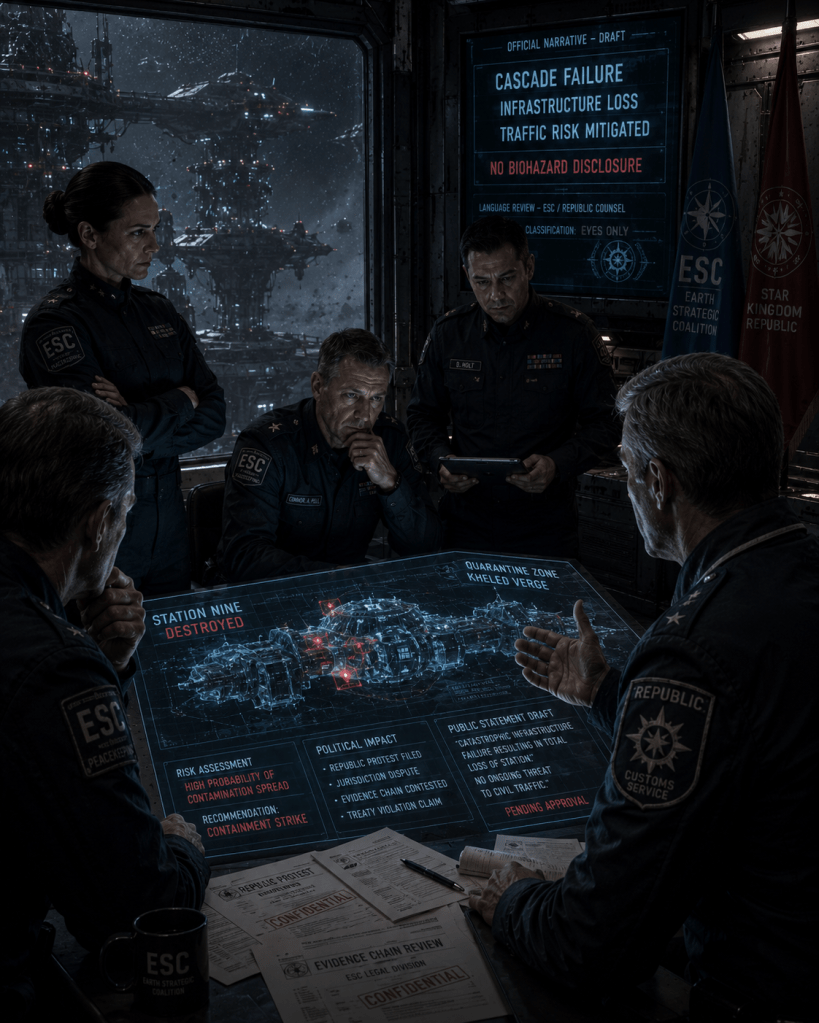
The ESC can send a team. It can freeze a lane. It can order a containment strike. Yet every action becomes evidence in someone else’s accusation. The Republic contests custody, access, survivor handling, route authority, and strike justification. A dead outpost becomes a diplomatic event. A contaminated fragment becomes a border crisis. A docking signal becomes a legal trap as much as a biological one.
The station’s docking shell creates one of the novella’s most dangerous pressures. Once Station Nine begins broadcasting live docking guidance, the threat moves beyond the interior. Any Republic cutter, ore hauler, emergency responder, or salvage vessel that trusts the beacon could open a clean path through contamination and carry it back into traffic.
That is the real horror of beacon trust. Civilisation depends on systems answering correctly. Ships follow guidance. Docking rings identify traffic. Emergency signals draw help. In Harbinger Protocol, those habits become vectors.
The containment strike that destroys Station Nine is swift, grim, and politically explosive. It is not a victory. It is an institutional wound. The outpost is erased because leaving it standing may spread the threat further, and the aftermath immediately becomes a fight over language.
The words are true enough to survive. They are also too clean to carry what happened.
A Series Built on Contamination, Denial, and Scale
Harbinger Protocol works because its escalation is controlled. The early horror remains grounded in freight corridors, sealed compartments, industrial stations, damaged telemetry, and official caution. The series does not rush towards cosmic revelation. It lets the reader feel how a civilisation fails to recognise collapse while its systems still appear to function.
The Silent Outpost moves the saga from the Red Titan’s isolated shipboard nightmare into a wider pattern of station-scale contamination, political pressure, and institutional dependence. Soren Vale becomes the continuity anchor between events. The ESC becomes both protector and jailer. The biomass remains strange, reactive, and deeply tied to the environments humans have built around themselves.
This is adult science fiction horror rooted in procedure, pressure, and consequence. Its fear comes from the gap between what people see and what institutions can say. It belongs to the same family as space survival horror, cosmic horror science fiction, quarantine fiction, and industrial sci-fi horror, yet its centre remains human. People still make tea. Officers still argue over phrasing. Crew still answer voices in vents because the voice sounds close enough to need help.
A short visual reading connected to the novella is also available here:
Where the Next Failure Begins
By the end of The Silent Outpost, Station Nine has fallen. The report has begun to change. Soren remains under provisional attachment. The ESC has survived one immediate containment crisis, yet the political cost is already moving faster than the language built to contain it.
A Star Kingdom patrol and a Federation salvage convoy are drawing towards confrontation over contaminated debris. Each side sees the other through suspicion before either fully understands the object between them. The biomass no longer needs to attack. Human systems are carrying it outward through fear, ownership, law, salvage rights, and accusation.
That is where Harbinger Protocol finds its most unsettling pressure. The crisis spreads through matter, yes, yet it also spreads through delay. Through the need for proof. Through the instinct to rescue. Through governments protecting territory. Through commanders trying to hold routes open for one more hour. Through the dangerous belief that a station, a ship, a beacon, or a report can still be trusted because it looks familiar from the outside.
The outpost is gone.
The pattern remains.
And somewhere beyond the next quarantine line, another system is still answering.
When the Corridor Feels Wrong Before the Alarm Sounds
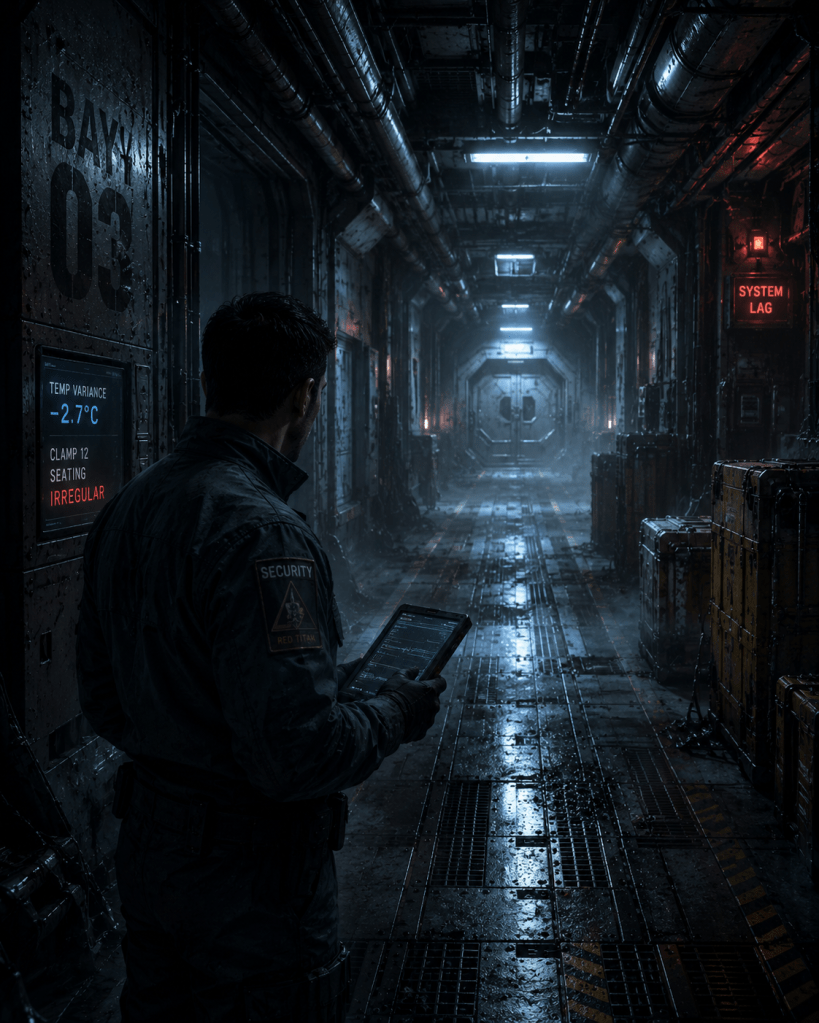
The first sign of disaster in The Ash in Transit is small enough to be dismissed.
A cargo bay runs colder than it should. A clamp seats unevenly. A scanner pauses for a fraction too long before the numbers settle into something official enough to ignore. The Red Titan, an ageing industrial hauler moving through the deep trade routes of human space, already carries the fatigue of long service. Its decks vibrate. Its air tastes metallic. Its systems correct themselves with the tired obedience of machinery pushed past comfort and still expected to perform.
That is where Harbinger Protocol begins.
This is sci-fi horror built from routine pressure rather than spectacle. The danger does not arrive as an invasion fleet or a declared enemy. It comes aboard as salvage. It hides inside procedure, schedule pressure, minor sensor variance, and the familiar language of shipboard inconvenience. A civilian freighter finds a drifting container near a Republic border route, pulls it inside, opens it before station protocol can intervene, and gives the unknown exactly what it needs: heat, air, circulation, and time.
By the point anyone aboard the Red Titan understands that something is present, the ship has already begun to carry it.
Industrial Horror in the Shape of Ordinary Work
Space horror often depends on isolation, yet The Ash in Transit makes that isolation feel practical rather than theatrical. The Red Titan is not a sleek vessel built for heroic command. It is a working hauler, patched by endurance, held together through routine checks, tired judgement, and the assumption that old problems are still manageable.
That assumption becomes the first weakness.
Soren Vale enters the series through attention. He is no grand military figure standing above events. He is a security officer who notices what the ship is doing before its systems explain it. He feels the deck shift beneath his boots. He registers airflow, pressure lag, temperature drift, the small refusal of machinery to behave as it did yesterday. His power, at this stage of Harbinger Protocol, is observation. His limitation is authority.
That imbalance gives the novella its pressure.
Soren can see enough to worry, yet not enough to stop the sequence. He can log variances, ask for scans, challenge procedure, and recognise that a container should perhaps remain sealed until station. Captain Rellin answers from another world of concerns: schedule, salvage value, delay, quarantine risk, operational consequence. No one has to be cruel for the wrong decision to happen. The crisis grows from ordinary human priorities placed in the path of something no one has classified.
This is where the biological contamination horror becomes institutional. A strange residue can be called soot. Subsurface filaments can be treated as an unresolved medical anomaly. Voice-like sounds in the vents can become stress, static, echo noise, or bad data. Every delay sounds reasonable until the ship stops agreeing with it.
The Biomass as Process, Not Monster
The biomass in Harbinger Protocol is frightening because it behaves less like a creature than a condition. It does not announce itself. It does not hunt in the familiar sense. It responds.
Heat draws it. Air moves it. Ventilation carries it through spaces designed to keep people alive. Metal seams, conduits, power lines, cable housings, and heat-retention zones become routes of expansion. Once the substance enters circulation, doors and seals lose the clean meaning they held before. Containment remains possible only as a delay.
That distinction matters to the tone of the series.
In The Ash in Transit, the biomass is first encountered through black crystalline residue along the seams of a recovered container. Its apparent stillness makes it seem safe. Cold keeps it inert enough to be misread. Once brought into a pressurised, oxygenated, heated environment, it begins to translate shipboard infrastructure into pathways for growth.
The result is alien biomass horror with a practical texture. It lives in vents, filters, grilles, panels, and junction rooms. It turns the reliable anatomy of a ship into something uncertain. A crew member’s illness becomes a structural event. A medical scan becomes an engineering warning. A corridor becomes dangerous because warmth has gathered there.
The horror is not that the Red Titan is attacked.
The horror is that the Red Titan becomes usable.
False Voices and the Human Need to Answer
One of the strongest recurring fears in Harbinger Protocol begins in this first novella: the voice that might be human.
Mara, the engineer, hears someone say her name through the vents. The moment works because the explanation remains uncertain in human terms, while the reader can feel the environment becoming involved. It is described less as speech than air shaped into a voice. That detail is central to the series’ horror identity.
The biomass is not communicating in any comforting or malicious sense. The sound resembles a plea because humans are built to recognise voices, especially in danger. Airflow, pressure shifts, corrupted audio, neural residue, and damaged systems produce something close enough to meaning that people move towards it. In a survival environment, empathy becomes a hazard.
That idea reaches beyond one ship.
Across Harbinger Protocol, false signals, distorted comms, sensor ghosts, and familiar sounds in hostile spaces become part of the wider crisis. A rescue call might be a pressure artefact. A life-sign ping might be corrupted by contaminated circuitry. A voice in the wall might be airflow moving through biomass-fused ducts. Each incident forces the same question into a different room: how long can people remain human when human instincts keep leading them into contaminated spaces?
Soren’s tragedy begins there. He listens. He checks. He tries to help. He keeps doing the right human thing inside a system where the right response arrives too late.
Containment as Fear, Cost, and Failure
Quarantine in The Ash in Transit carries weight before it arrives.
Captain Rellin does not want the ship flagged. Mara does not want to be “the reason.” The crew understands, even before formal disaster, that quarantine is not a neutral word. It means delay, investigation, loss of movement, financial ruin, possible abandonment, and the end of ordinary control. That fear shapes behaviour. It keeps evidence local. It keeps reports inside the ship. It allows the biomass to move from anomaly to event.
This is one of the reasons Harbinger Protocol works as political sci-fi horror as well as space survival horror. The series understands that containment is never only scientific. It is administrative, economic, legal, military, and emotional. Every order to seal a compartment has a human cost. Every refusal to transmit a warning has a wider consequence.
By the time an emergency distress broadcast reaches ESC patrol networks, the Red Titan has crossed from manageable incident into shipwide failure. The later intervention carries no triumph. The patrol corvette extracts what it can, secures what remains, and destroys the infected vessel. The action saves nothing cleanly. It only prevents one ruined ship from carrying the contamination further.
That is the first lesson of the series. Survival and containment are not the same thing.
Soren Vale and the Burden of Being the Witness
Soren Vale survives the Red Titan. That survival does not free him from the ship.
He begins as someone who notices too much and commands too little. By the final movement of the novella, he has become the only continuous witness to a failure that official systems can barely describe. He has seen Mara become part of the ship’s altered structure. He has seen Jace vanish during the escape through the docking spine. He has watched the Red Titan break apart after quarantine clamps engage.
The wider Harbinger Protocol saga rests on this kind of witnessing. Soren is not built as a power fantasy figure. He does not command fleets or solve the crisis through force. His importance comes from endurance, attention, and the terrible continuity of memory. He is the person left carrying the sequence when others reduce the event to files, classifications, and sterilised reports.
That makes The Ash in Transit more than an outbreak story. It is the origin point of a witness.
When the unidentified officer tells Soren that three other ships have reported identical failures that month, the novella opens outward. The Red Titan is no longer an isolated tragedy. It is one entry in a pattern that has already begun moving through trade routes, salvage chains, civilian transport systems, and the quiet spaces between official recognition and public panic.
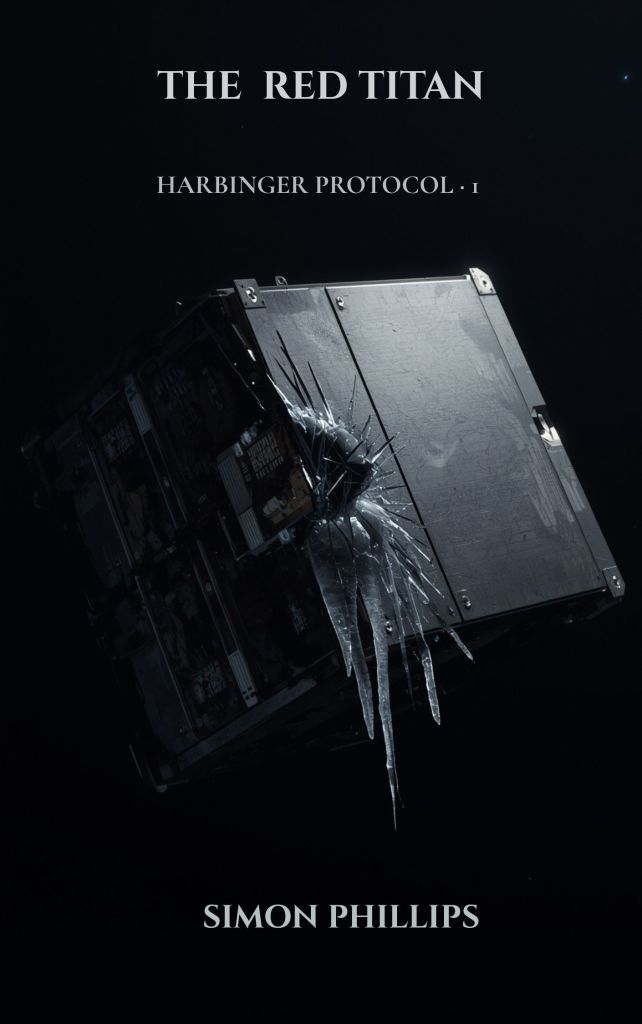
Readers can enter that first incident through The Ash in Transit on Kindle: The Red Titan
A Fragile Civilisation Built on Movement
The larger Harbinger Protocol universe depends on movement. Cargo moves between systems. Freight haulers keep distant settlements alive. Gate corridors connect political regions, economies, military response networks, and civilian life. Authority stretches across impossible distances through treaties, patrol routes, station controls, and the belief that systems will function when called upon.
The biomass exploits that belief long before anyone understands it.
A contaminated object moves because salvage has value. A sick crew member continues working because quarantine carries cost. A ship’s systems keep compensating because that is what systems are designed to do. A distress signal leaves only after automated thresholds decide that crew authority has already failed. The same pattern can scale upward from one freighter to a station, a gate hub, a refugee corridor, or a collapsing political border.
This is where the series reaches towards cosmic horror science fiction. The first fear is local: a cargo bay, a vent, a corridor, a ship that will no longer behave. The deeper fear is structural: civilisation itself depends on the same routes, assumptions, and delays that allow the contamination to spread.
Human governments in Harbinger Protocol do what human institutions often do under pressure. They classify. They argue over jurisdiction. They protect trade. They search for sabotage, blame, enemy action, or technical failure because those explanations fit existing systems. The biomass sits outside those categories, so it moves through the gaps between them.
The First Incident Never Remains First
The power of The Ash in Transit lies in its restraint. It does not empty the wider saga of mystery. It does not explain the final shape of the threat. It leaves the reader inside the first pressure change, the first failed report, the first human loss, and the first official admission that the crisis has already spread.
That is enough.
A sci-fi horror novella does not need to begin with the end of civilisation in order to carry its shadow. Sometimes it begins with a freighter running late. A captain choosing schedule over protocol. An engineer hearing her name through the vents. A security officer understanding the environment faster than command will allow.
The Red Titan is gone by the end, yet the conditions that destroyed it remain everywhere. Ships still move. Cargo still crosses borders. Stations still open their bays to containers that appear inert under cold lights. Officials still prefer clean explanations. Somewhere beyond the next route marker, another crew is already trusting the air.
Ashfall Station kept its corridors lit because darkness made people ask questions.
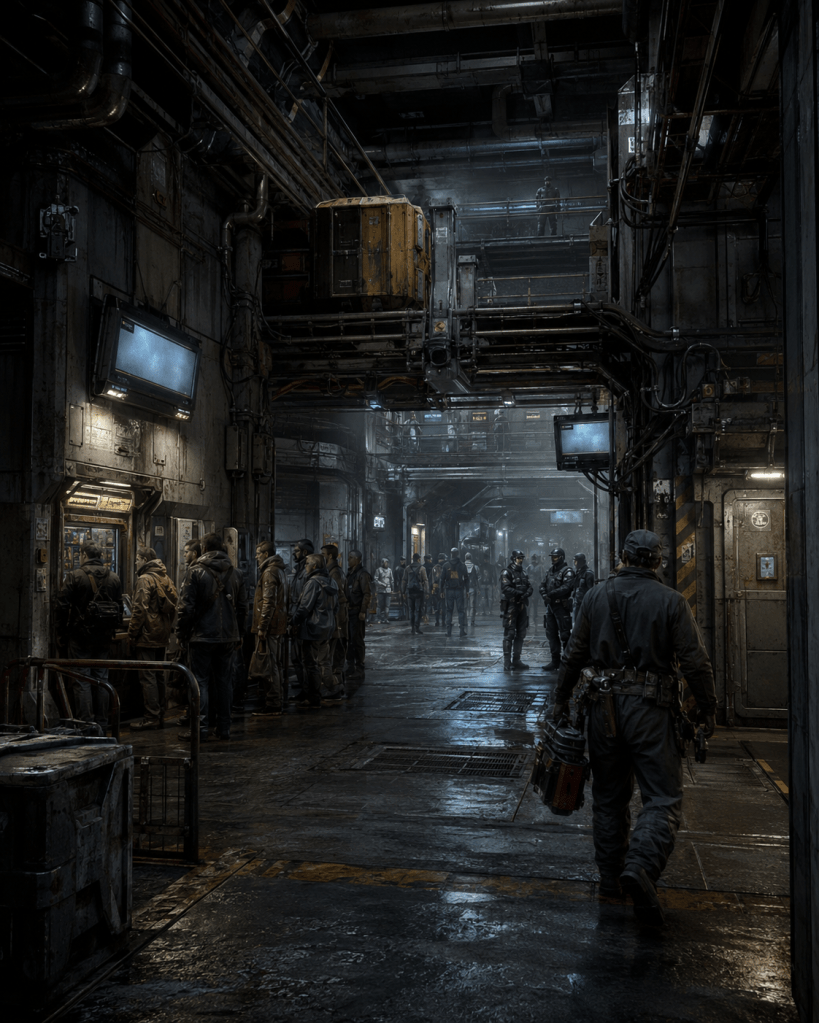
The light was rarely clean. It came from failing strips fixed into patched ceilings, from public screens rolling calm station updates over ration queues, from warning panels that flickered above bulkhead doors which sealed too slowly during drills and too quickly during unrest. Every surface carried the memory of pressure. Scratched metal. Repaired seams. Old stains worked into floor plating by boots, coolant, and time.
For readers entering a sci-fi noir novella, that kind of world matters. A crime aboard a space station only carries weight when the station itself has something to hide. Ashfall Station is built around that pressure. It is an orbital place of work, scarcity, surveillance, and exhausted routine, where a death can be filed as maintenance failure before anyone has finished looking at the body.
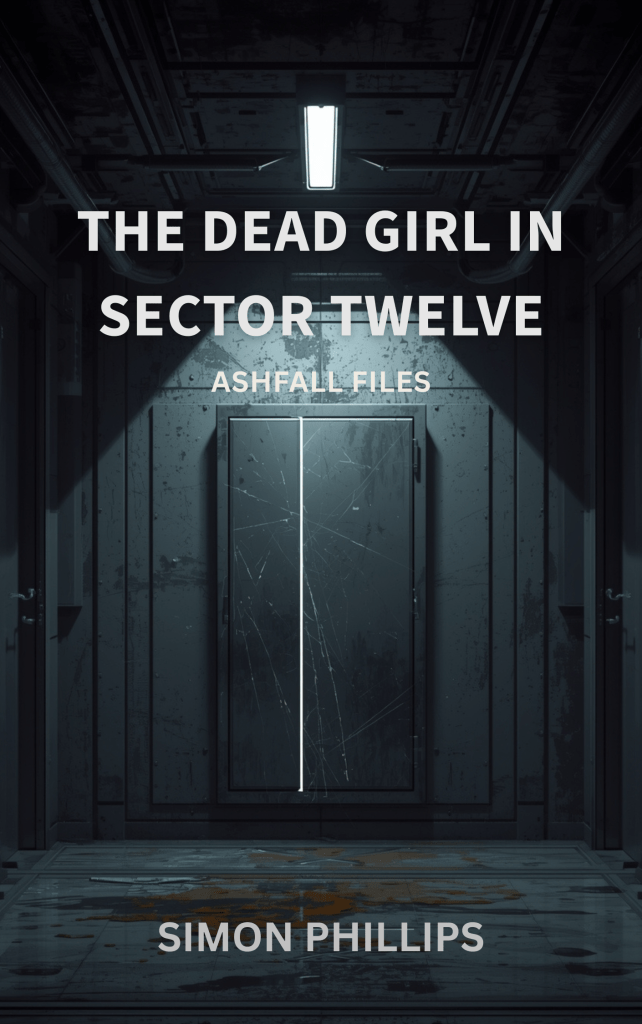
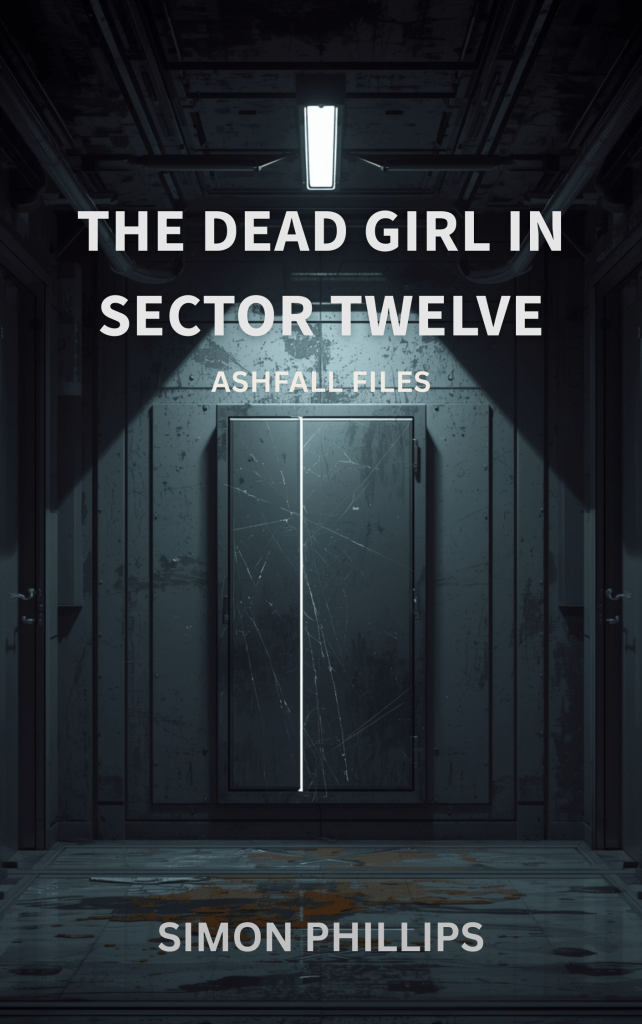
The first case, The Dead Girl in Sector Twelve, opens the door into an atmospheric sci-fi noir world shaped by crime, rationing, damaged infrastructure, official silence, and the slow corrosion of trust. It is a space station crime thriller built around investigation rather than spectacle, where one body in a ventilation shaft reveals more about the system around it than the system is willing to admit.
When a Body Becomes a Question
A failing station teaches people to lower their expectations before it teaches them to survive.
On Ashfall, power dips are routine until they happen at the wrong moment. Missing camera feeds become technical faults until they protect the wrong person. Records vanish into administrative language. Witnesses remember enough to be frightened, then stop speaking before a name leaves their mouth.
That is the central pressure of the series. Crime on Ashfall Station grows from scarcity and neglect. People steal ration tokens because water has value. They lie to security because truth carries cost. They move through half-lit service corridors because official routes belong to patrols, supervisors, cameras, and Fleet oversight. Every investigation becomes a study of how people behave when survival has narrowed their choices.
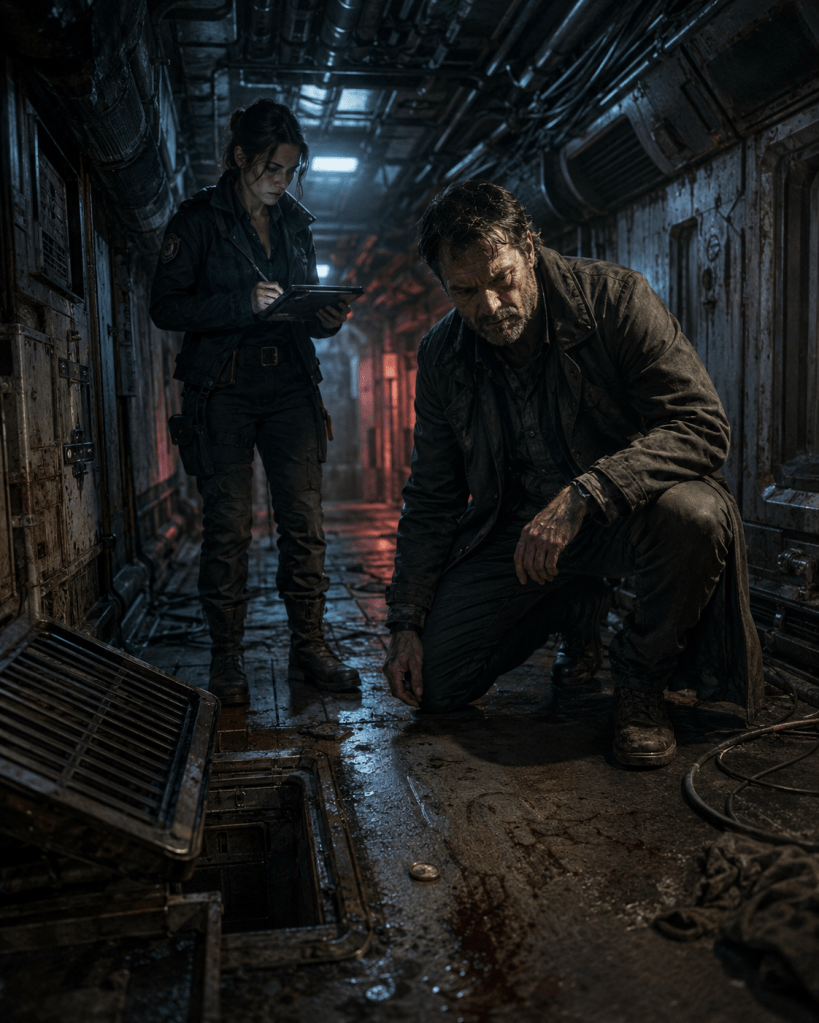
The noir element emerges through that moral compression. Ruff Kale, the detective at the centre of the Ashfall Files, understands the station too well to trust its explanations. He knows how quickly a report can soften a death into an incident. He knows the difference between disorder and arrangement. He knows silence when it has been trained into a room.
Lena Marik enters the case with procedure, discipline, and a belief that careful work still matters. Her presence gives the investigation its second pressure point. She records, checks, documents, and follows the lines the system claims to respect. The case teaches her what happens when those lines lead directly into obstruction.
Together, Ruff and Lena form the human scale of the wider Ashfall cycle. He reads the station through habit and damage. She reads it through records and inconsistencies. Between them, the reader sees how a corrupt space station fiction world becomes believable: through the small details that refuse to align.
A death in Sector Twelve becomes more than a crime scene. It becomes a question.
Who benefits when the records clear themselves?
Who decides which worker stays visible?
Who controls the broadcasts that tell civilians everything remains stable?
And what kind of authority needs a dead maintenance courier forgotten so quickly?
The Dead Girl in Sector Twelve
The Dead Girl in Sector Twelve is the first novella in the Ashfall Files cycle, and it works as the opening case in a larger detective science fiction series. The surface story is controlled and intimate: Ruff Kale and Lena Marik investigate a young woman found dead inside a maintenance shaft in Sector Twelve. Her placement feels wrong. Her records have been stripped. The systems around her hesitate in ways old infrastructure alone cannot explain.
Its strength lies in how quietly it expands. The investigation starts with a body, then moves through missing logs, frightened workers, erased evidence, and Fleet pressure. The case never needs to announce itself as a space station conspiracy. It becomes one through behaviour. A supervisor answers too quickly. A corridor falls silent. A witness disappears from the record before anyone can take a statement. An official explanation arrives with suspicious speed.
The result is an adult science fiction mystery rooted in atmosphere and consequence. The reader is taken through service corridors, Freight Spine noise, tired workers, precinct pressure, and the controlled politeness of authority. Ashfall Station never pauses to explain itself. It continues running, which makes its cruelty feel more convincing.
This opening novella also establishes the wider Ashfall Files method. Each case can be entered as a contained investigation, yet each one contributes to the larger movement of the station. A single death leads toward erased records. Erased records lead toward missing witnesses. Missing witnesses lead toward Fleet jurisdiction. Fleet jurisdiction points toward something far larger than the official report.
That sense of scale remains restrained. The story stays close to Ruff, Lena, and the immediate investigation. It lets the reader feel the conspiracy through pressure before understanding its full shape.
Ashfall Station as a Living Pressure System
Ashfall Station is a living pressure system.
Its sectors carry their own forms of decay. The Upper Concourse holds the polished language of administration and command. The Mid-Ring carries family noise, work exhaustion, and ration anxiety. The Freight Spine moves cargo, rumours, bribes, and bodies of evidence that pass through too many hands. The Red Decks hold the markets, dens, gangs, and informal networks that flourish wherever official supply fails. Beneath them all, the Underworks remain close, dark, humid, and only partly mapped.
Earth Fleet sits across that structure as authority, security, and threat. Its power appears through access locks, jurisdictional claims, missing files, controlled announcements, and the careful shaping of public truth. Fleet control is rarely dramatic at first. It arrives as a polite correction. A procedural reminder. A closed file. A warning phrased so cleanly it leaves no mark.
That is what makes Ashfall Files work as political sci-fi thriller material. The politics are lived before they are named. Civilians feel them in ration lines. Workers feel them when patrols pass. Detectives feel them when evidence disappears from intake. The station’s broadcasts ask people to remain calm while the people closest to the damage already understand that calm is being manufactured.
Ruff’s investigations provide the entry point into this world. He walks the corridors, talks to workers, pressures informants, reads silence, and notices when a room has been made too clean. Lena brings structure and conscience, forcing the case into forms the system then tries to corrupt. Her role matters because Ashfall needs someone who still believes procedure should protect people. Watching that belief bend under pressure gives the series its emotional edge.
The wider Ashfall Files cycle moves from grounded crime into civil fracture. That movement begins here, in small ways. A dead worker. A missing shard. A witness erased from housing records. A public system that keeps speaking after truth has been removed from the room.
A station never collapses all at once. It teaches collapse in stages.
First, people accept faulty lights.
Then they accept missing footage.
Then they accept closed reports.
Then they accept the absence of someone they spoke to yesterday.
By the time open unrest arrives, the damage has already been living in the walls.
The First Thread of the Ashfall Files
The Dead Girl in Sector Twelve matters because it begins with a simple institutional reflex: make the problem small enough to file.
That is how power survives aboard Ashfall Station. It reduces a life to a case number. It reduces fear to rumour. It reduces obstruction to procedure. It reduces truth to something that can be delayed until the station moves on.
Ruff Kale knows better than to expect justice from the machinery around him. Lena Marik still needs to learn how much machinery can lie. Between them, the first Ashfall Files case becomes a quiet act of resistance, carried through observation, unease, and the refusal to let a dead girl vanish cleanly into official language.
The station continues to hum. Broadcasts continue to roll. Ration queues continue to form beneath flickering light.
Somewhere inside that noise, the first thread has already been pulled.
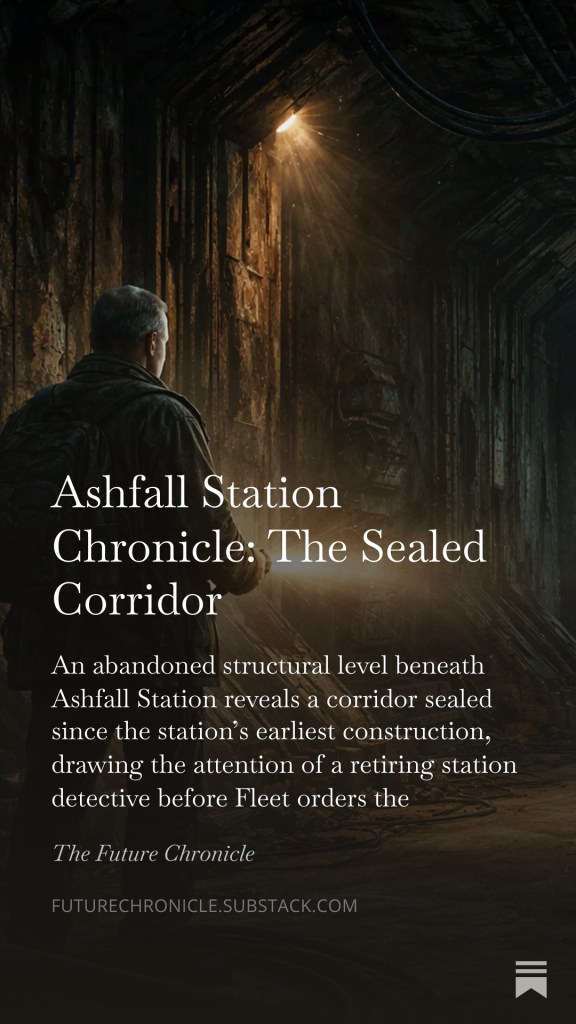
A sealed corridor inside a space station carries a peculiar kind of gravity. The image feels simple at first glance: a pressure door buried behind later construction, a service level erased from current schematics, a section of infrastructure left sleeping inside the larger body of the station. Yet that image opens a deeper unease, because a hidden passage suggests more than age. It suggests choice. Someone closed that route. Someone covered it over. Someone left it inside the walls, where future crews would keep living beside it without knowing what had been folded away.
That tension lies at the centre of Ashfall Station Chronicle: The Sealed Corridor, the current Ashfall entry on The Future Chronicle on Substack, where a routine engineering survey on Deck Twelve reveals a transit corridor concealed since the earliest phase of Ashfall Station’s construction. Detective Adrian Mercer, drawn into what first appears to be an ordinary security review, finds himself standing before a doorway that has vanished from three generations of station records, only for Fleet authority to reach downward with unusual speed once the passage opens.
What makes that premise linger is the way it treats the space station as an inhabited archive instead of a clean machine. Many futuristic settings depend on smooth surfaces and visible systems, as though advanced civilisation would sand away every rough seam left by time. Ashfall moves in the opposite direction. Its corridors carry freight dust, maintenance residue, ageing structure, and the long accumulation of decisions made by people who served the station during earlier decades. The result feels industrial, human, and quietly uneasy. A door sealed within that kind of place does more than add mystery. It reveals a wound in institutional memory.
Why sealed corridors remain so unsettling in science fiction
Science fiction returns again and again to abandoned decks, closed service shafts, darkened access tunnels, and transit routes erased from the active life of a station or ship. The reason reaches beyond visual atmosphere. A sealed corridor creates pressure between two versions of a place. One version is the official environment, mapped, lit, regulated, and understood well enough for daily routine. The other sits just behind it, preserved in silence, carrying the possibility that the world has always possessed an interior layer hidden from ordinary movement.
Within a planetary city, forgotten streets can sink beneath redevelopment. Within a station, forgotten passageways remain physically near every working system. Crews sleep, work, eat, and age only metres from chambers they no longer remember. That closeness gives the idea unusual force. The past has never truly gone anywhere. It remains in the walls, under the decking, behind the reinforcement plates, waiting for expansion work, structural failure, or human curiosity to cut back into it.
A sealed corridor also sharpens one of science fiction’s oldest questions: how much of a technological civilisation survives in genuine human memory, and how much survives only through procedure? In places built for endurance, procedure often outlasts explanation. Teams inherit maps, security classifications, maintenance routes, and authority chains whose origins have faded into archival depth. The station keeps functioning. Freight still moves. Atmosphere still cycles. Lights still come on across the inhabited decks. Meanwhile, older choices remain embedded in the structure, stripped of context, still exerting force.
That idea gives The Sealed Corridor its weight. The discovery on Deck Twelve carries no theatrical spectacle. There is no immediate catastrophe, no screaming alarm, no violent rupture across the station. The unease arrives through restraint. Engineers uncover an access frame where a solid wall was expected. Scanner readings show a hollow route inside the subframe. Dust, faded lettering, and the cold seam of an old pressure door begin to suggest that Ashfall’s history contains areas where concealment mattered more than record keeping. Then Fleet intervenes, and the station’s calm surface becomes harder to trust. A space station grows like a city, then begins to forget itself
The strongest space station stories often treat infrastructure as social history made physical. Every expansion ring, service transit, docking arm, and support grid reflects a previous phase of labour, urgency, policy, and economic need. Over time, a station gains layers. New freight systems bypass old ones. Living districts migrate. Engineering standards change. Administrative power centralises, fragments, or hardens. What once served as a vital artery can become a dead route sealed behind newer plating.
Ashfall Station feels convincing because its buried levels follow that logic. Deck Twelve belongs to the station’s earliest industrial period, when Ashfall served as an ore transfer hub above Kestren-4. Later growth covered those earlier transit networks beneath newer sectors and revised structural plans. From an engineering point of view, that process feels entirely plausible. From a narrative point of view, it creates a setting where the physical environment can hold memory more faithfully than the people moving through it. A wall panel can preserve history long after the registry has thinned it into omission. s is one of the quiet strengths of industrial science fiction. It understands that future settings carry bureaucracy as well as invention. Large systems create blind zones. Records become layered. Departments protect their own authority. Classification settles over awkward histories like dust over unused metal. Once that happens, space itself begins to participate in secrecy. The corridor on Deck Twelve has no voice, no overt intelligence, no dramatic display. Its mere existence is enough. The concealed access frame, the obsolete transit markings, and the absent schematics tell their own institutional story.
Engineering memory and human memory drift apart
One reason sealed infrastructure feels so effective in science fiction is that it captures a familiar modern anxiety in a future form. People already live inside systems few individuals fully understand. Cities depend on hidden services. Digital life depends on opaque layers of code, policy, and ownership. Industrial life depends on technical inheritance, old standards, legacy machinery, and habits passed forward through routine. A frontier station only intensifies that truth. Distance from central oversight, long operational life, and successive waves of expansion create the ideal conditions for forgotten corridors, sealed chambers, and partial records.
In The Sealed Corridor, Detective Mercer stands at the edge of precisely that divide. He is no engineer and no grand political figure. He is a station detective approaching retirement, someone who has spent enough years inside Ashfall to hear its changing mood through the background vibration of machinery and freight movement. That makes him an ideal witness. He reads the corridor through professional instinct and through accumulated familiarity with the station as a lived environment. The discovery unsettles him because it violates the station’s ordinary logic. A decommissioned passage would make sense. A deliberately erased one suggests an older decision whose consequences may still be active. Ashfall Station turns mystery into atmosphere
Many mystery-driven science fiction stories rely on puzzle mechanics alone. A clue appears, a question rises, and plot movement follows. Ashfall works through atmosphere first. The mystery gains force because the station already feels heavy with work, age, and endurance before the sealed passage enters view. Offices remain lit through the station cycle. Freight departures continue. Dust gathers in engineering spaces. Amber light reflects from older lift interiors. Outer docking arms glow above the pale clouded world below. Every detail deepens the sense that this place has kept functioning for a very long time, carrying more history than any single worker could hold in mind at once. t atmosphere makes the Chronicle an especially strong entry point for readers curious about science fiction built from pressure, environment, and institutional behaviour instead of spectacle. The Future Chronicle frames its Ashfall series as recovered future records, reconstructed incidents, and quiet disturbances unfolding across the life of an ageing frontier station. Entering through The Sealed Corridor feels like stepping into a report whose edges have started to fray, where the visible account is steady enough to trust and strange enough to invite a second look.
For readers arriving fresh to Ashfall, the Chronicle offers a contained threshold into the wider archive. It introduces the station through labour, architecture, and omission. It shows how minor engineering work can touch something older than the current order of things. It also leaves room for the larger implication to spread on its own, which suits this kind of fiction beautifully. A hidden corridor carries power precisely because full explanation remains at a distance. The station keeps orbit. The authority chain remains in place. The question settles deeper.
From the sealed corridor to the dead girl in Sector Twelve
The Chronicle also gains depth from its connection to the wider Ashfall setting. The corridor on Deck Twelve exists years before the later events of Ashfall Files: The Dead Girl in Sector Twelve, the linked ebook set within the same broader environment. The relation between those works gives the station an appealing sense of duration. One text opens a buried seam in the station’s past. The other follows an investigation unfolding inside a place already shaped by long neglect, institutional pressure, and structural secrets. t relationship is where The Future Chronicle feels especially effective as a literary gateway. The Chronicle stands on its own as a finished speculative essay-story, with its own internal weight and unease. At the same time, it opens a route toward the novella for readers who want to remain inside Ashfall a little longer, to move from reconstructed station history into a fuller noir investigation carried through living corridors and working sectors. The transition feels organic because the setting has already been prepared through texture, mood, and accumulated pressure.
There is also a short visual companion on YouTube, which works well as a brief atmospheric threshold before or after the written Chronicle. In a project built around reports, fragments, future records, and recurring disturbances, that kind of cross-format echo strengthens the sense that Ashfall is being approached from several angles, each one revealing a different surface of the same old structure.
The corridor behind the wall
A sealed corridor inside a space station endures in the imagination because it transforms architecture into withheld knowledge. The wall ceases to be a boundary and becomes a decision preserved in metal. On Ashfall Station, that decision carries the residue of labour, authority, and time. Engineers uncover a passage where current plans promised solid structure. A detective senses that the omission has weight. Fleet moves to close the opening before inquiry can gather momentum. The corridor returns to silence, though the silence now feels charged.
That is the quiet spell of The Sealed Corridor. It understands that the most unsettling future environments rarely depend on scale alone. They depend on layers. They depend on inhabited systems whose official version of themselves has begun to slip against the deeper truth held in their structure. A station like Ashfall keeps turning above Kestren-4, freight moving through its active decks, lights shining across its present routines, while older routes remain hidden in the body of the place, carrying histories that still press against the wall from the other side.
For readers drawn to abandoned infrastructure, industrial space station fiction, and science fiction shaped by secrecy, labour, and buried records, Ashfall offers a compelling threshold. The first doorway stands open in The Sealed Corridor on Substack. Beyond it waits a larger station history, and further in, the investigation at the heart of Ashfall Files: The Dead Girl in Sector Twelve. The pressure inside these stories comes from what a place continues to hold after memory has thinned, after maps have changed, and after official language has settled over the seam.