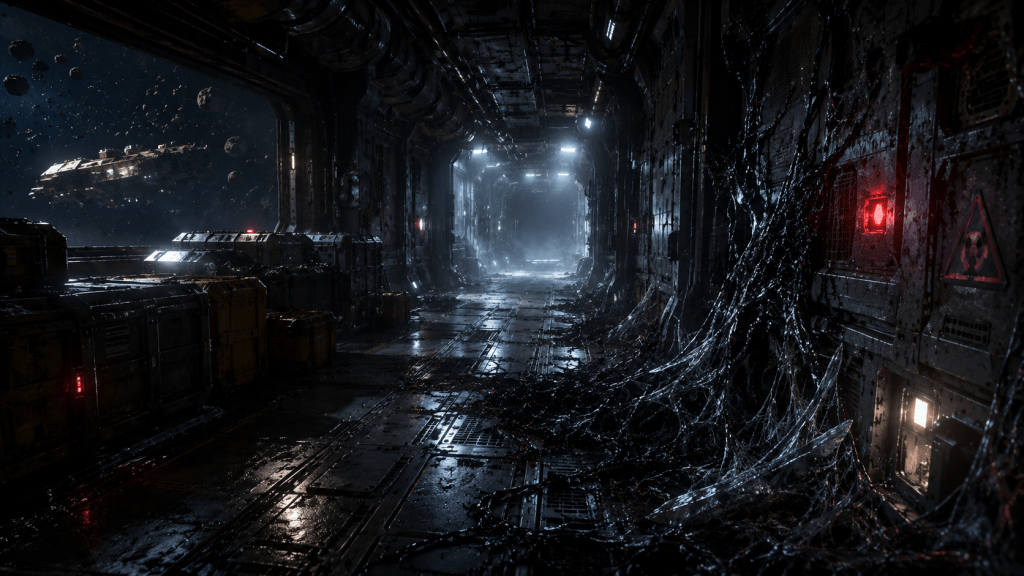
When the Corridor Feels Wrong Before the Alarm Sounds
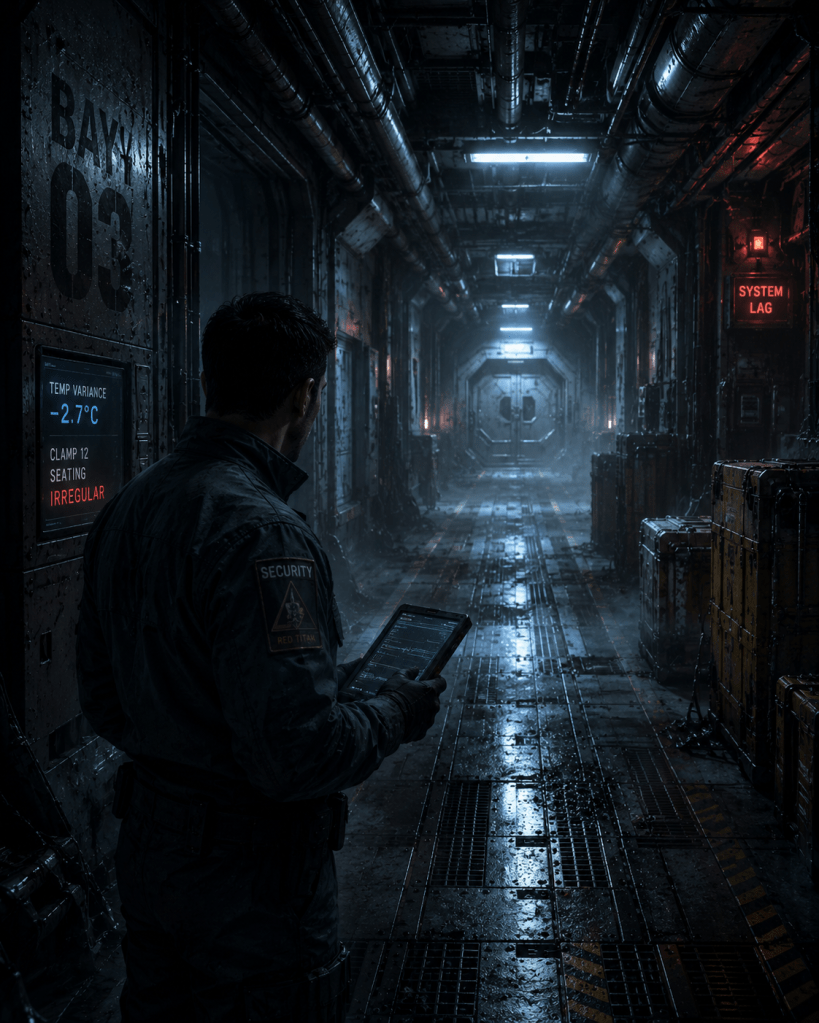
The first sign of disaster in The Ash in Transit is small enough to be dismissed.
A cargo bay runs colder than it should. A clamp seats unevenly. A scanner pauses for a fraction too long before the numbers settle into something official enough to ignore. The Red Titan, an ageing industrial hauler moving through the deep trade routes of human space, already carries the fatigue of long service. Its decks vibrate. Its air tastes metallic. Its systems correct themselves with the tired obedience of machinery pushed past comfort and still expected to perform.
That is where Harbinger Protocol begins.
This is sci-fi horror built from routine pressure rather than spectacle. The danger does not arrive as an invasion fleet or a declared enemy. It comes aboard as salvage. It hides inside procedure, schedule pressure, minor sensor variance, and the familiar language of shipboard inconvenience. A civilian freighter finds a drifting container near a Republic border route, pulls it inside, opens it before station protocol can intervene, and gives the unknown exactly what it needs: heat, air, circulation, and time.
By the point anyone aboard the Red Titan understands that something is present, the ship has already begun to carry it.
Industrial Horror in the Shape of Ordinary Work
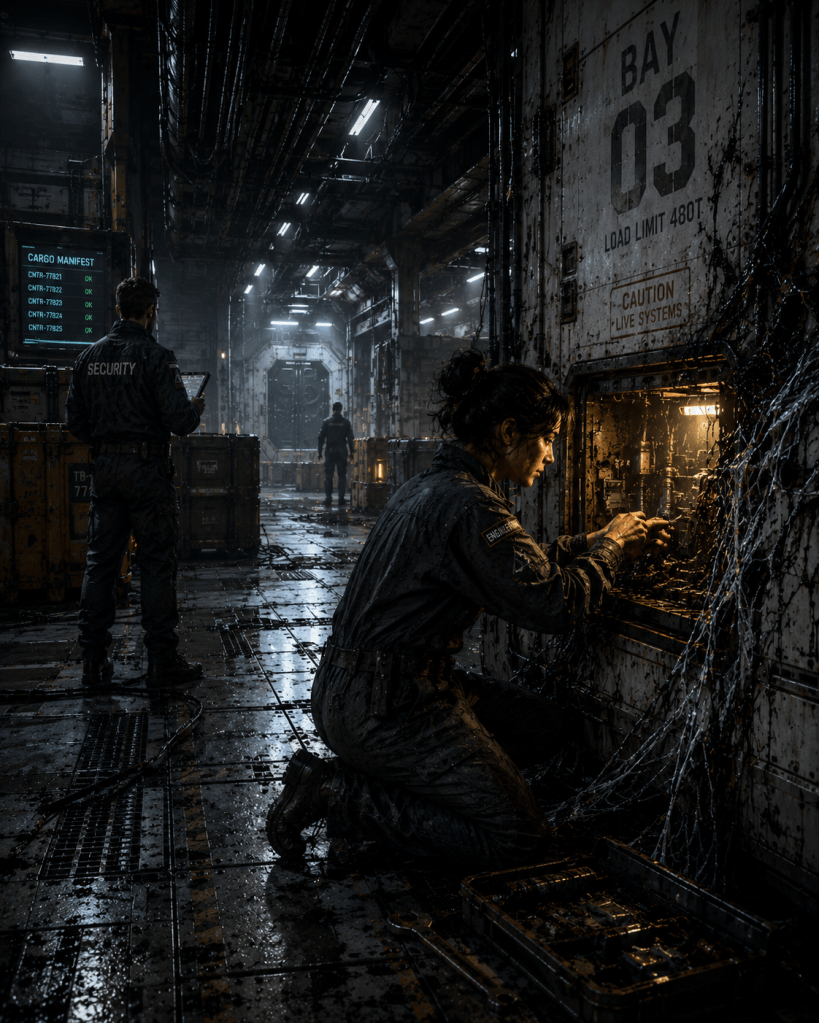
Space horror often depends on isolation, yet The Ash in Transit makes that isolation feel practical rather than theatrical. The Red Titan is not a sleek vessel built for heroic command. It is a working hauler, patched by endurance, held together through routine checks, tired judgement, and the assumption that old problems are still manageable.
That assumption becomes the first weakness.
Soren Vale enters the series through attention. He is no grand military figure standing above events. He is a security officer who notices what the ship is doing before its systems explain it. He feels the deck shift beneath his boots. He registers airflow, pressure lag, temperature drift, the small refusal of machinery to behave as it did yesterday. His power, at this stage of Harbinger Protocol, is observation. His limitation is authority.
That imbalance gives the novella its pressure.
Soren can see enough to worry, yet not enough to stop the sequence. He can log variances, ask for scans, challenge procedure, and recognise that a container should perhaps remain sealed until station. Captain Rellin answers from another world of concerns: schedule, salvage value, delay, quarantine risk, operational consequence. No one has to be cruel for the wrong decision to happen. The crisis grows from ordinary human priorities placed in the path of something no one has classified.
This is where the biological contamination horror becomes institutional. A strange residue can be called soot. Subsurface filaments can be treated as an unresolved medical anomaly. Voice-like sounds in the vents can become stress, static, echo noise, or bad data. Every delay sounds reasonable until the ship stops agreeing with it.
The Biomass as Process, Not Monster
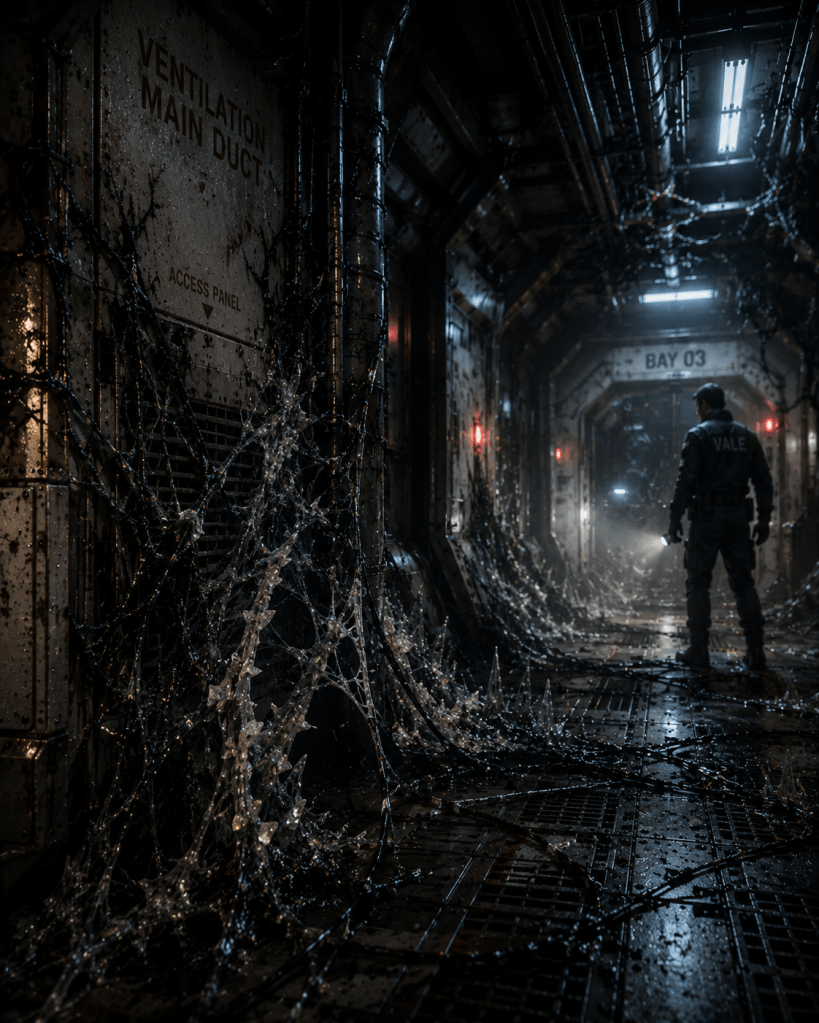
The biomass in Harbinger Protocol is frightening because it behaves less like a creature than a condition. It does not announce itself. It does not hunt in the familiar sense. It responds.
Heat draws it. Air moves it. Ventilation carries it through spaces designed to keep people alive. Metal seams, conduits, power lines, cable housings, and heat-retention zones become routes of expansion. Once the substance enters circulation, doors and seals lose the clean meaning they held before. Containment remains possible only as a delay.
That distinction matters to the tone of the series.
In The Ash in Transit, the biomass is first encountered through black crystalline residue along the seams of a recovered container. Its apparent stillness makes it seem safe. Cold keeps it inert enough to be misread. Once brought into a pressurised, oxygenated, heated environment, it begins to translate shipboard infrastructure into pathways for growth.
The result is alien biomass horror with a practical texture. It lives in vents, filters, grilles, panels, and junction rooms. It turns the reliable anatomy of a ship into something uncertain. A crew member’s illness becomes a structural event. A medical scan becomes an engineering warning. A corridor becomes dangerous because warmth has gathered there.
The horror is not that the Red Titan is attacked.
The horror is that the Red Titan becomes usable.
False Voices and the Human Need to Answer
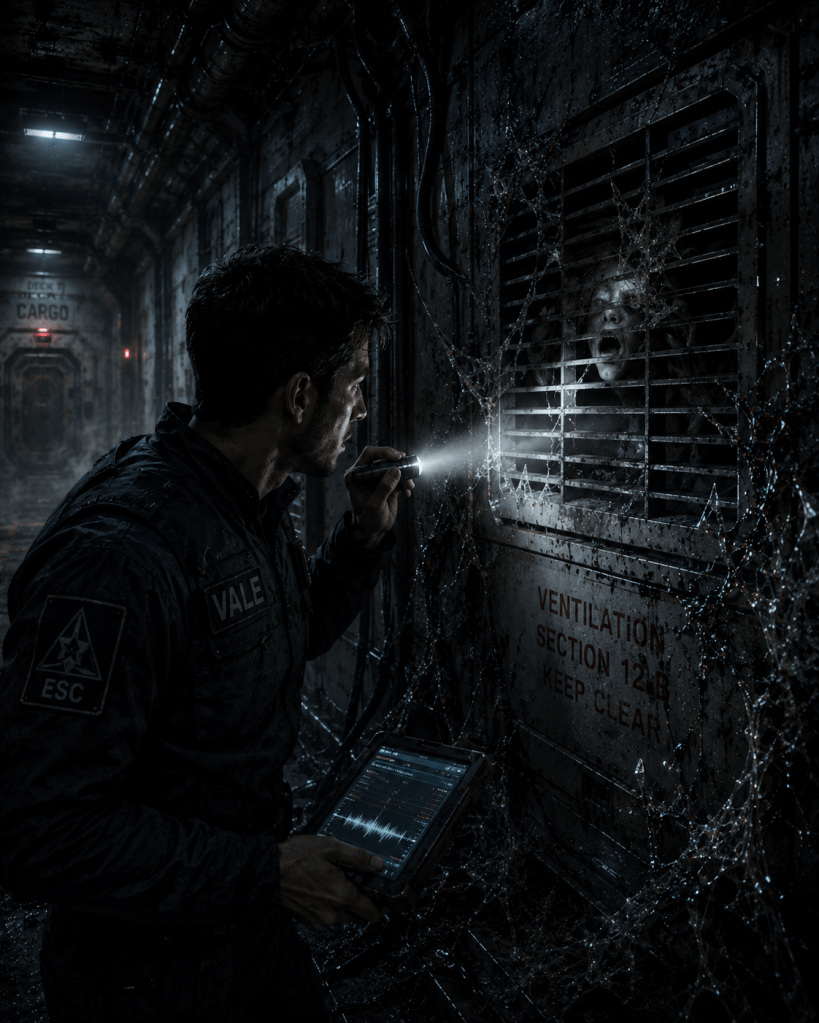
One of the strongest recurring fears in Harbinger Protocol begins in this first novella: the voice that might be human.
Mara, the engineer, hears someone say her name through the vents. The moment works because the explanation remains uncertain in human terms, while the reader can feel the environment becoming involved. It is described less as speech than air shaped into a voice. That detail is central to the series’ horror identity.
The biomass is not communicating in any comforting or malicious sense. The sound resembles a plea because humans are built to recognise voices, especially in danger. Airflow, pressure shifts, corrupted audio, neural residue, and damaged systems produce something close enough to meaning that people move towards it. In a survival environment, empathy becomes a hazard.
That idea reaches beyond one ship.
Across Harbinger Protocol, false signals, distorted comms, sensor ghosts, and familiar sounds in hostile spaces become part of the wider crisis. A rescue call might be a pressure artefact. A life-sign ping might be corrupted by contaminated circuitry. A voice in the wall might be airflow moving through biomass-fused ducts. Each incident forces the same question into a different room: how long can people remain human when human instincts keep leading them into contaminated spaces?
Soren’s tragedy begins there. He listens. He checks. He tries to help. He keeps doing the right human thing inside a system where the right response arrives too late.
Containment as Fear, Cost, and Failure
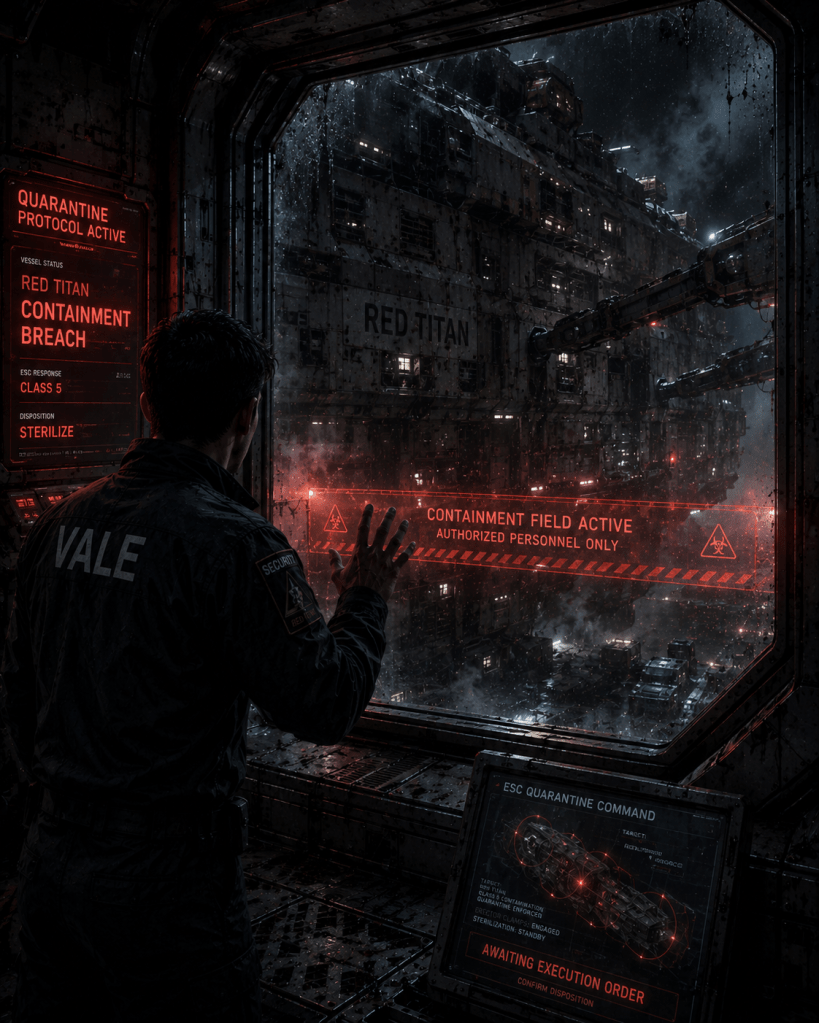
Quarantine in The Ash in Transit carries weight before it arrives.
Captain Rellin does not want the ship flagged. Mara does not want to be “the reason.” The crew understands, even before formal disaster, that quarantine is not a neutral word. It means delay, investigation, loss of movement, financial ruin, possible abandonment, and the end of ordinary control. That fear shapes behaviour. It keeps evidence local. It keeps reports inside the ship. It allows the biomass to move from anomaly to event.
This is one of the reasons Harbinger Protocol works as political sci-fi horror as well as space survival horror. The series understands that containment is never only scientific. It is administrative, economic, legal, military, and emotional. Every order to seal a compartment has a human cost. Every refusal to transmit a warning has a wider consequence.
By the time an emergency distress broadcast reaches ESC patrol networks, the Red Titan has crossed from manageable incident into shipwide failure. The later intervention carries no triumph. The patrol corvette extracts what it can, secures what remains, and destroys the infected vessel. The action saves nothing cleanly. It only prevents one ruined ship from carrying the contamination further.
That is the first lesson of the series. Survival and containment are not the same thing.
Soren Vale and the Burden of Being the Witness
Soren Vale survives the Red Titan. That survival does not free him from the ship.
He begins as someone who notices too much and commands too little. By the final movement of the novella, he has become the only continuous witness to a failure that official systems can barely describe. He has seen Mara become part of the ship’s altered structure. He has seen Jace vanish during the escape through the docking spine. He has watched the Red Titan break apart after quarantine clamps engage.
The wider Harbinger Protocol saga rests on this kind of witnessing. Soren is not built as a power fantasy figure. He does not command fleets or solve the crisis through force. His importance comes from endurance, attention, and the terrible continuity of memory. He is the person left carrying the sequence when others reduce the event to files, classifications, and sterilised reports.
That makes The Ash in Transit more than an outbreak story. It is the origin point of a witness.
When the unidentified officer tells Soren that three other ships have reported identical failures that month, the novella opens outward. The Red Titan is no longer an isolated tragedy. It is one entry in a pattern that has already begun moving through trade routes, salvage chains, civilian transport systems, and the quiet spaces between official recognition and public panic.
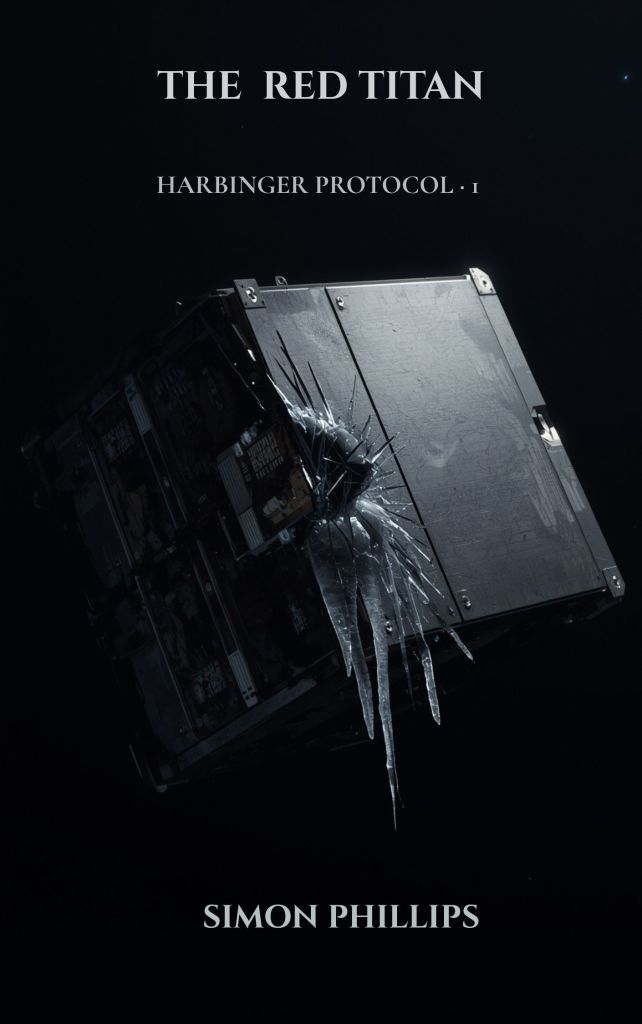
Readers can enter that first incident through The Ash in Transit on Kindle: The Red Titan
A Fragile Civilisation Built on Movement
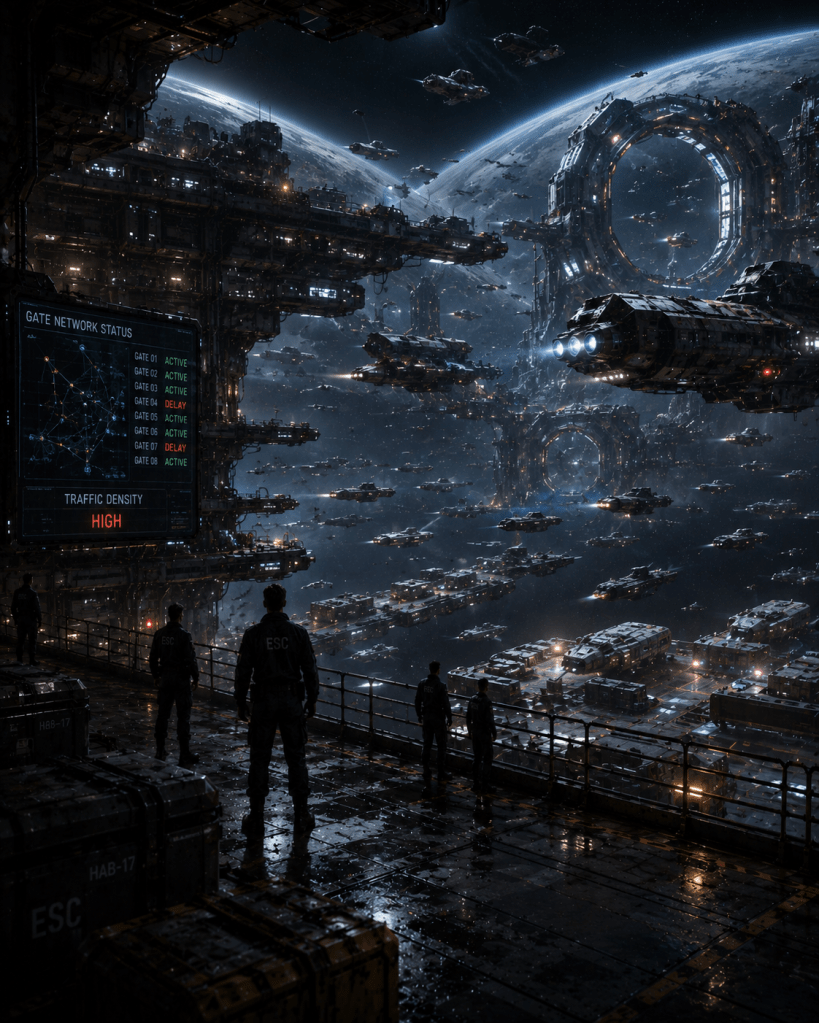
The larger Harbinger Protocol universe depends on movement. Cargo moves between systems. Freight haulers keep distant settlements alive. Gate corridors connect political regions, economies, military response networks, and civilian life. Authority stretches across impossible distances through treaties, patrol routes, station controls, and the belief that systems will function when called upon.
The biomass exploits that belief long before anyone understands it.
A contaminated object moves because salvage has value. A sick crew member continues working because quarantine carries cost. A ship’s systems keep compensating because that is what systems are designed to do. A distress signal leaves only after automated thresholds decide that crew authority has already failed. The same pattern can scale upward from one freighter to a station, a gate hub, a refugee corridor, or a collapsing political border.
This is where the series reaches towards cosmic horror science fiction. The first fear is local: a cargo bay, a vent, a corridor, a ship that will no longer behave. The deeper fear is structural: civilisation itself depends on the same routes, assumptions, and delays that allow the contamination to spread.
Human governments in Harbinger Protocol do what human institutions often do under pressure. They classify. They argue over jurisdiction. They protect trade. They search for sabotage, blame, enemy action, or technical failure because those explanations fit existing systems. The biomass sits outside those categories, so it moves through the gaps between them.
The First Incident Never Remains First
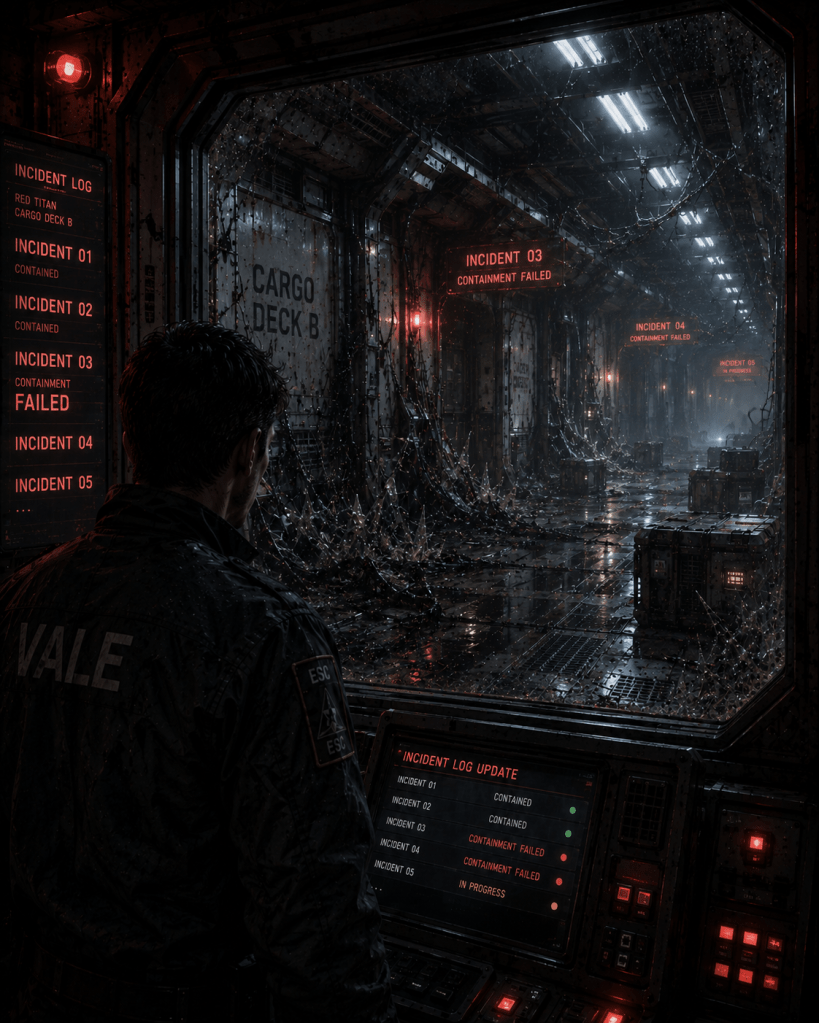
The power of The Ash in Transit lies in its restraint. It does not empty the wider saga of mystery. It does not explain the final shape of the threat. It leaves the reader inside the first pressure change, the first failed report, the first human loss, and the first official admission that the crisis has already spread.
That is enough.
A sci-fi horror novella does not need to begin with the end of civilisation in order to carry its shadow. Sometimes it begins with a freighter running late. A captain choosing schedule over protocol. An engineer hearing her name through the vents. A security officer understanding the environment faster than command will allow.
The Red Titan is gone by the end, yet the conditions that destroyed it remain everywhere. Ships still move. Cargo still crosses borders. Stations still open their bays to containers that appear inert under cold lights. Officials still prefer clean explanations. Somewhere beyond the next route marker, another crew is already trusting the air.
The crisis has entered the system.
No one has named it properly yet.
Discover more from Simon J. Phillips
Subscribe to get the latest posts sent to your email.
