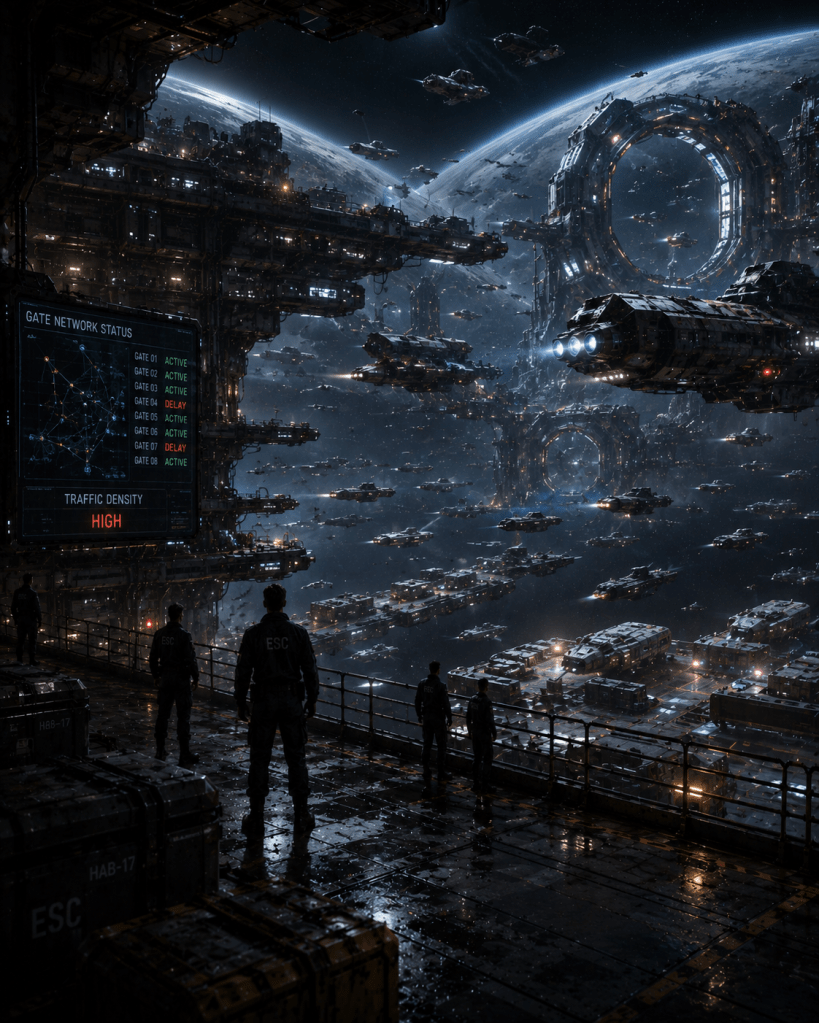
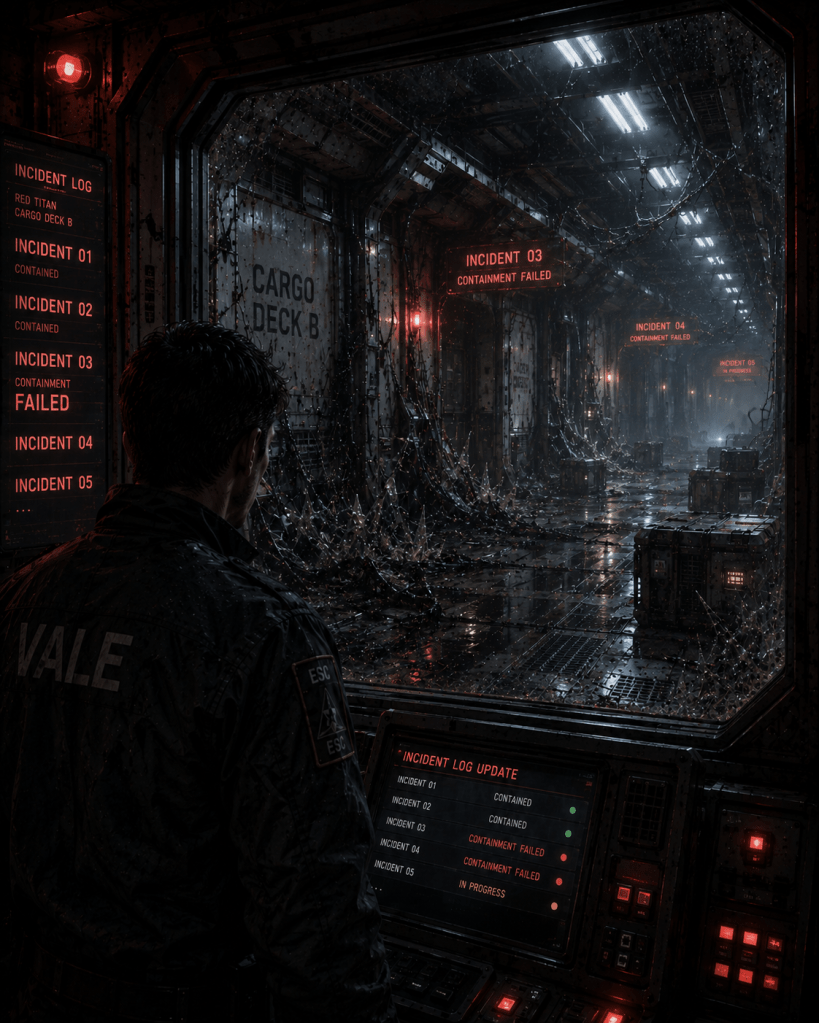
Field Adjustment: Dimensional Horror and Institutional Denial in The Open Gate Book Two

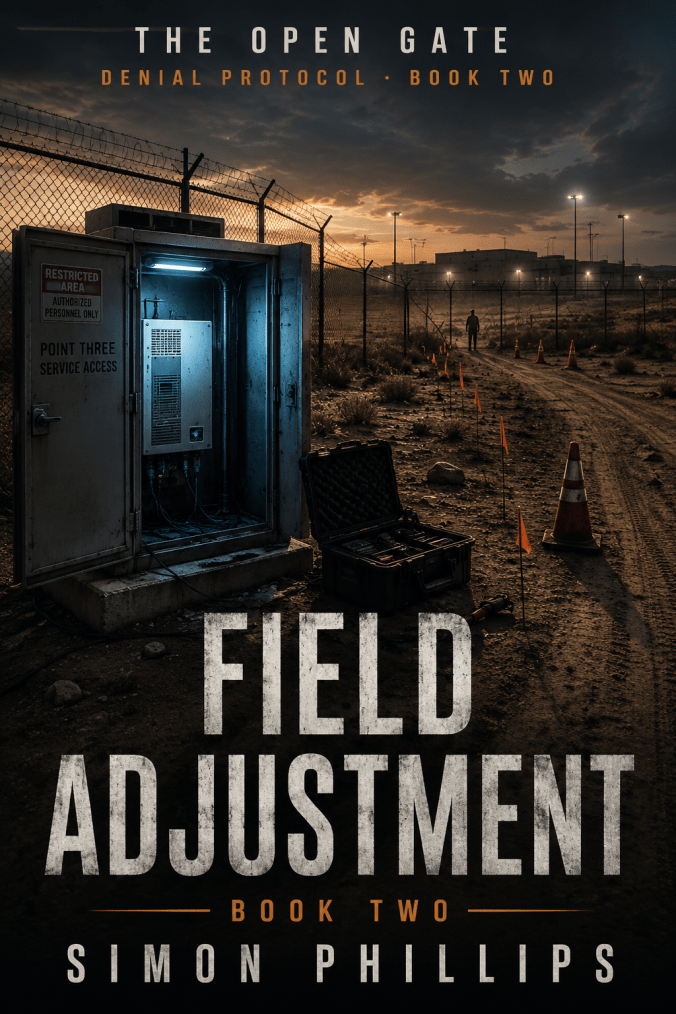
A faded perimeter cabinet, three contractor vehicles and a sealed equipment case should amount to an ordinary maintenance assignment inside a restricted government installation. The paperwork certainly presents it that way. The work has been authorised as a perimeter reliability upgrade, involving sensor replacement, route clearance and contractor support. Every phrase is clean, practical and reassuring.

The equipment begins responding before it has been connected.

That narrow division between what people physically experience and what an institution is willing to record is where Field Adjustment begins to tighten. Book Two of The Open Gate develops its dimensional horror through military procedure, controlled journalism and compartmentalised scientific work, allowing the danger to advance without abandoning the recognisable world surrounding it.

Buildings remain open. Roads continue carrying traffic. Reports are completed, visitors receive badges, researchers correct models and soldiers follow orders. The system does not fail in a sudden, dramatic collapse. It adapts to the contradiction, absorbs it into approved language and continues working.

For readers drawn to slow-burn science-fiction horror, restricted research facilities, institutional secrecy and unsettling events that resist easy explanation, Field Adjustment is available as an ebook through Amazon UK.

When an Anomaly Becomes a Management Problem

Prior Condition, the opening book in The Open Gate, established a world in which several people began noticing details that did not fit the explanations surrounding them. Ethan Ward encountered physical unease along the facility perimeter. Maya Ward gathered civilian reports that appeared ordinary until placed beside one another. Dr Adrian Hale completed technical corrections without being shown the larger system receiving them.

Those contradictions could still be treated as isolated problems. A camera failed because of interference. A power dip belonged to the local grid. A strange movement near a fence could be heat distortion. An unusual data spike remained within tolerance once the model was adjusted.

Field Adjustment begins after the institution has decided that these irregularities require a response. That response is not public acknowledgement, evacuation or even meaningful caution. Contractors are sent to replace perimeter equipment. Access routes are controlled more carefully. Public affairs offers a managed display of transparency. Scientific work moves into more restricted rooms.

The danger has become consistent enough to require action, yet the language surrounding that action continues to deny what the response itself reveals.

This is one of the book’s most effective tensions. The facility behaves as though everything remains under control precisely because it has developed procedures for dealing with events it cannot openly describe. Strange behaviour becomes field variance. A troubling visual becomes a monitoring discrepancy. Removal from duty becomes fatigue management. Professional suppression becomes concern for access terms and visitor safety.

The wording is plausible in every individual situation. Taken together, it begins to reveal an institution constructing an alternative version of reality while the physical world continues pressing against it.

Ethan Ward and the Failure of the Official Record

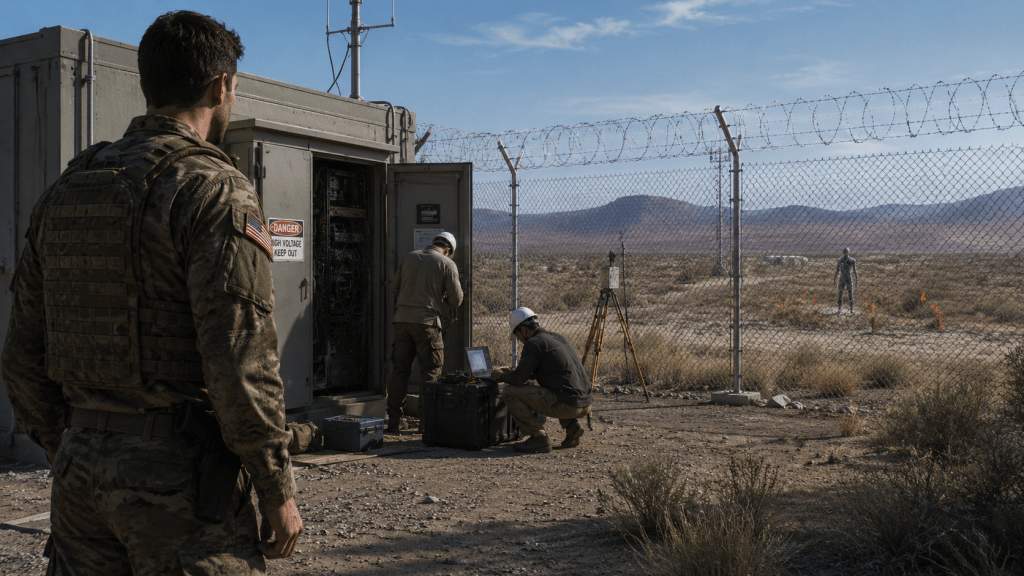
Ethan experiences the crisis through military routine. His task is to escort contractors along the eastern service route while they replace equipment at several perimeter points. He checks badges, watches tools, monitors movement and keeps the work within the boundaries established by the assignment.

His role does not require him to understand what the contractors are installing. It requires him to keep people where their clearance permits them to stand.

This makes him especially effective as the soldier perspective. Ethan is not presented as a conventional action hero waiting for permission to fight. He is competent, observant and accustomed to treating the perimeter as a sequence of practical responsibilities. He knows how many people should be present, where they should be standing and what the ground normally feels like beneath a military vehicle.

When the equipment reacts too early, static touches exposed skin and vibrations move beneath the service road, his experience tells him that something has changed. The institutional response tells him that the work remains routine.

The conflict becomes more serious when Ethan’s own sight contradicts the monitoring system. He sees something within a restricted area where nobody should be present. Davis, his patrol partner, sees enough to know that Ethan is not simply inventing the experience. Yet the official response remains unchanged: monitoring shows clear.

That phrase carries greater force than an overt threat would have done. Ethan has followed procedure. He has reported what he witnessed. Another soldier has partially confirmed it. The institution does not accuse him of lying, nor does it begin an obvious cover-up in front of him. It simply places the monitoring record above the people standing on the ground.

Ethan’s growing distrust emerges from that difference. He knows what he saw, but he also knows how easily an incident disappears once it has been given an acceptable description. His military training allows him to recognise physical danger, while the system around him is designed to prevent that recognition from becoming institutional knowledge.


Maya Ward and Transparency as a Form of Control

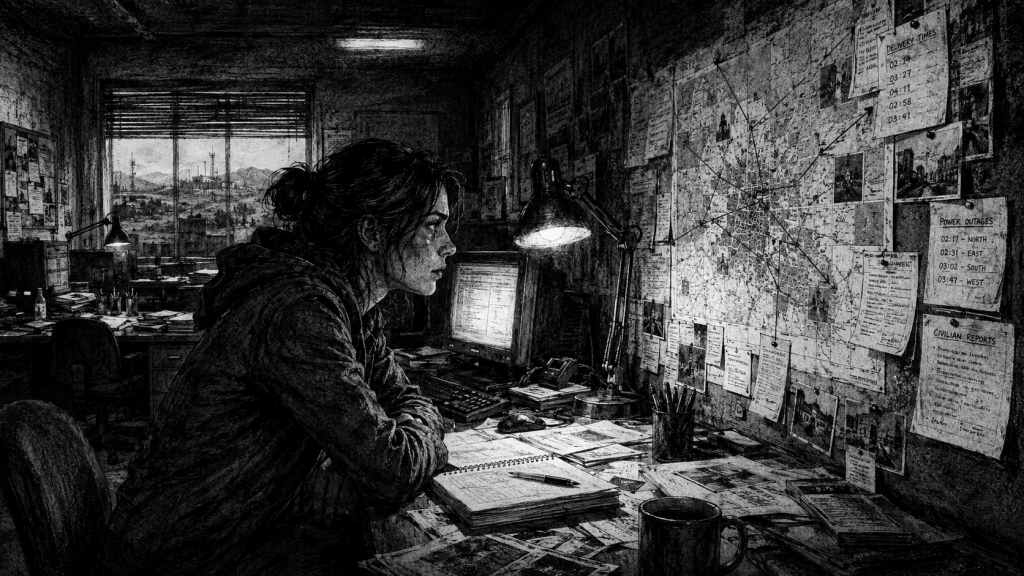
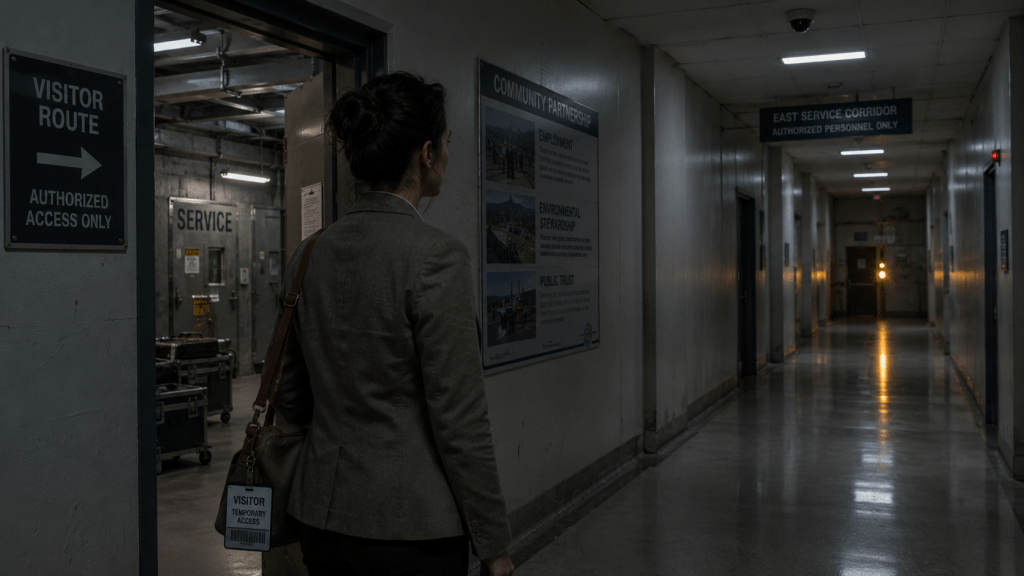
Maya enters the facility through an entirely different route. Where Ethan carries military clearance, Maya receives a visitor badge and a sanctioned public-affairs tour. Her editor presents the opportunity as the access she has been requesting, but the permitted story has already been defined: employment, community partnership, environmental monitoring and public trust.

The facility does not conceal its existence from her. It displays selected parts of itself.

That distinction is central to Maya’s section of the book. The visitor route is polished, carefully managed and filled with language designed to demonstrate openness. Public-affairs staff answer questions, explain environmental programmes and guide local representatives through approved corridors. Screens show maps, measurements and civic information. The tour appears to offer transparency because everything visible has been prepared for visibility.

Maya notices the working edges around that performance. A route changes without explanation. Staff members move with controlled urgency. Internal wording briefly appears on a public display. Radio traffic refers to the east service corridor, visual clearance and the need to keep visitors away from a particular area.

Her investigation does not depend upon hacking systems or performing exaggerated acts of espionage. She listens, notices the physical structure of the building and recognises when the official tour begins moving around something it has not acknowledged.

When she steps outside the visitor route, the institutional response is swift and remarkably calm. Her movement becomes a route exception, then an operational concern, then a media-conduct issue. Public affairs reaches her editor before she has fully left the site. Her access is not merely withdrawn; it is used to undermine the credibility of anything she may have observed.

The suppression works because it remains professionally believable. Her editor faces legal, financial and access pressures. The facility can claim that Maya violated the agreed route. She possesses fragments rather than publishable proof. The truth is not disproved. It is made unusable.

Maya’s response gives the book one of its most important human developments. When official channels can no longer hold what she has witnessed, she begins preserving it privately. Journalism has not ceased to matter to her, but publication is no longer the only measure of whether a record should exist.

Adrian Hale and the Danger of Successful Science

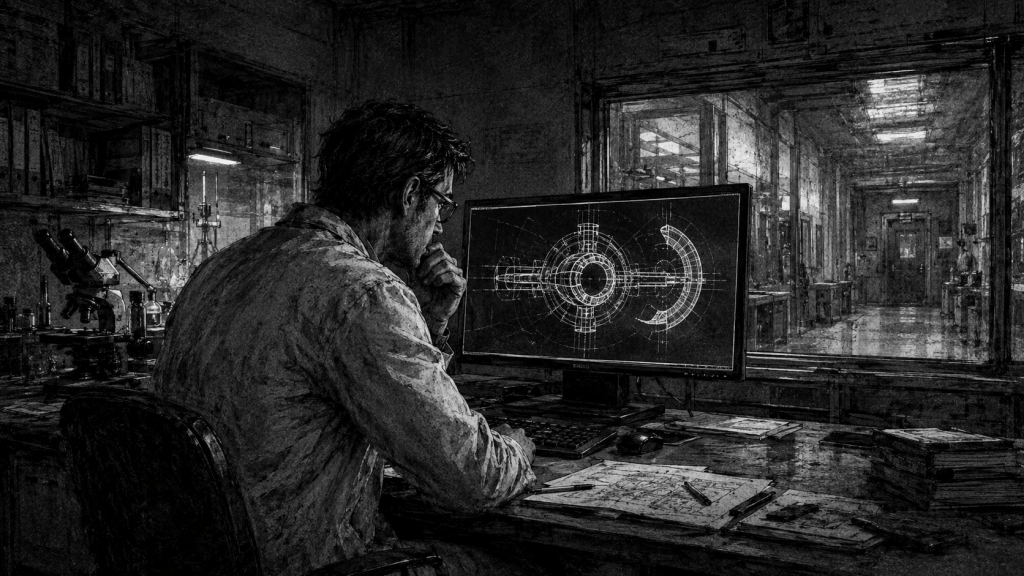
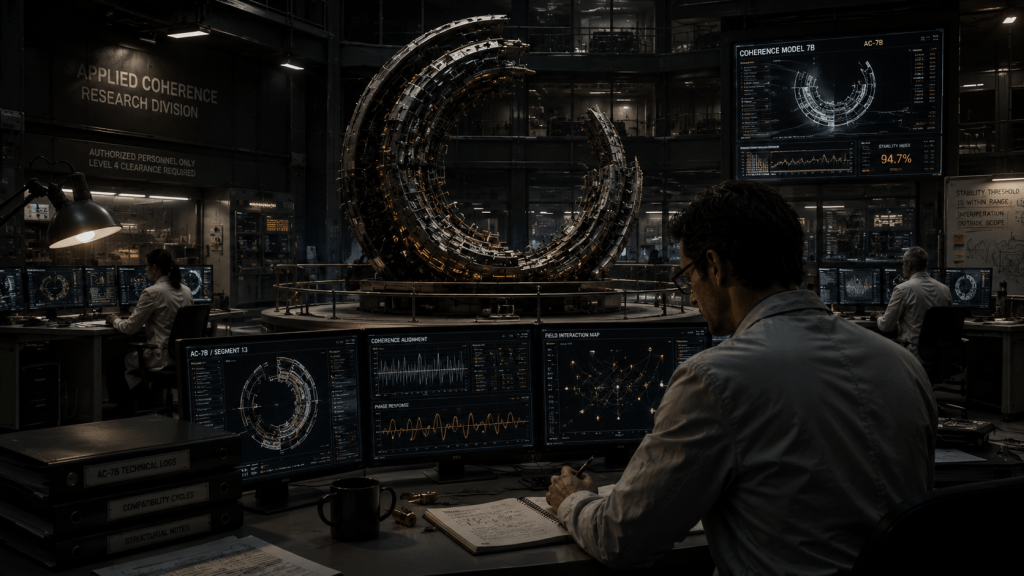
Dr Adrian Hale experiences the same pressure from inside the scientific system. His technical ability has already made him valuable. A correction he completed in the earlier book has held under further load, leading the facility to transfer him into Applied Coherence, a deeper and more restricted section of the research programme.

The move appears to be professional recognition. Adrian receives new access, more complex models and work that better suits his abilities. Every reward also reduces his understanding of the whole.

He is shown a larger structure while being assigned a smaller permitted portion of it. His notes must remain structural. Interpretation sits outside his scope. Wider questions are redirected towards local tolerances, compatibility cycles and managed ranges.

Adrian’s danger does not arise from recklessness or cruelty. It arises from competence separated from moral context.

He can identify where a model is correcting too late. He can refine a threshold, stabilise a segment and improve the way different systems respond to one another. The facility does not need to force him into obvious wrongdoing. It gives him a problem that can be solved and withholds the meaning of the system that benefits from the solution.

This makes the scientific thread particularly unsettling. Failure might have forced the programme to stop. Adrian’s success allows it to continue.

The institutional structure rewards that success with deeper access and further responsibility, even as the language around him grows narrower. Another researcher, Nolan Vale, begins asking questions that move too close to interpretation. His concern is not treated as a scientific debate. It becomes an access matter, a personnel movement and a quiet reassignment.

The work continues around his absence.

The Quiet Violence of Institutional Language

Institutional horror is often most convincing when nobody believes they are behaving like a villain. Field Adjustment builds its pressure through ordinary people fulfilling professional roles.

The shift officer accepts the monitoring record because that is the authorised version available to him. The personnel officer processes leave through welfare language. Public affairs protects access agreements and controls the organisation’s public exposure. Maya’s editor attempts to protect the newspaper from a confrontation it cannot afford. Researchers keep their notes within permitted scope. Contractors finish the installation because their responsibility ends at the equipment.

Each decision can be defended locally.

The horror emerges from the combined result. A figure can be witnessed and removed from the record. A reporter can be invited inside and professionally discredited for seeing beyond the presentation. A scientist can recognise structural instability and be rewarded for making the system accept it.

Nobody needs to announce a conspiracy. The organisation’s existing incentives produce the necessary silence.

This gives Field Adjustment a distinctive place within institutional science fiction. It is concerned with how organisations protect continuity before truth, particularly when admitting the truth would require them to question the work, authority and assumptions upon which the organisation depends.

The language does not merely conceal the crisis from outsiders. It allows the people inside the system to continue participating without having to confront the full meaning of their actions.


Dimensional Horror Rooted in Physical Experience

The dimensional horror of The Open Gate does not depend upon a bright portal opening above the facility or a clearly identified creature stepping into view. Its force comes from familiar spaces behaving incorrectly.

Equipment wakes before receiving the signal expected to activate it. Dust moves where the air remains still. Static is felt through gloves and clothing. A low vibration travels through a vehicle after the engine has stopped. Human-shaped forms remain visible long enough to resist dismissal, while refusing to resolve into something the witnesses can confidently name.

These effects remain close to the body. Ethan feels them through his boots, hands and jaw. Maya experiences them through floors, walls, sounds and changes in controlled movement around her. Adrian encounters them through models whose behaviour implies a structure larger than the one he has been permitted to see.

The separation between the three perspectives allows the reader to recognise connections that none of the characters can yet confirm. What appears at the perimeter has a technical reflection inside the laboratory and an institutional reflection within the visitor route. Each part remains incomplete, which preserves the uncertainty without making the story arbitrary.

The series does not ask the reader to accept that everything is inexplicable. It shows people repeatedly encountering evidence that their current explanations are too small, then continuing to use those explanations because no authorised replacement exists.


A Facility Built from Ordinary Systems

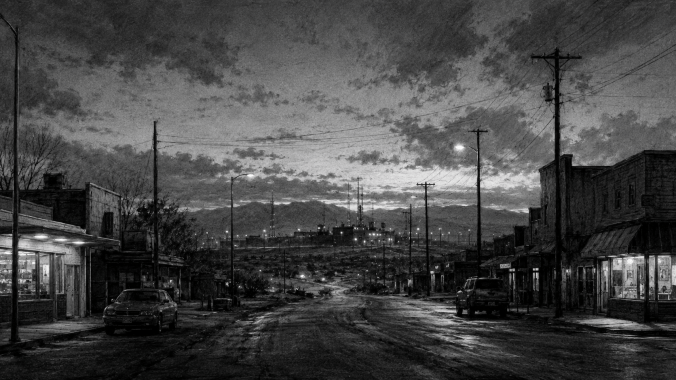
The unnamed installation occupies a remote, dry region of the American Southwest, where isolation supports both the physical work and the public denial surrounding it. Its atmosphere is constructed from service roads, fences, guard posts, concrete pads, low buildings, monitoring cabinets, security desks, laboratories and controlled corridors.

Nothing about the facility resembles a theatrical villain’s headquarters. It feels funded, functional and accustomed to processing risk.

That ordinariness is essential. A more visibly sinister place would warn everyone entering it that something was wrong. The installation in Field Adjustment relies upon recognisable systems whose familiarity reassures the people using them. Badges open the correct doors. Forms record movement. Screens display authorised information. Staff members redirect visitors politely. Work continues beneath fluorescent lighting.

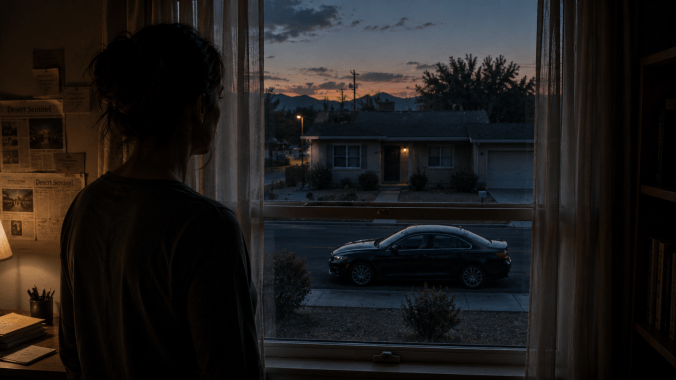
Beyond the facility, the town provides a civilian reflection of the same pressure. Local advisories, bar conversations, changing animal behaviour and small disturbances remain easy to dismiss as separate issues. People continue going to work, meeting friends and returning home because nothing has yet provided a socially acceptable reason to stop.

The boundary therefore becomes more than the perimeter fence. It moves through professional access, approved terminology, bodily sensation and domestic space. By the time the characters begin recognising that movement, the system has already adjusted around them.


Why Book Two Deepens The Open Gate

Field Adjustment does not repeat the opening pressure of Prior Condition. It changes the nature of that pressure.

The first book allowed contradictions to appear. Book Two shows the institution responding to them. That progression gives the story momentum without rushing towards open collapse or easy revelation. The reader learns more about how the pieces connect, while the deeper cause remains unresolved.

Ethan becomes a witness whose report cannot survive the system recording it. Maya discovers that access can be another method of restriction. Adrian moves closer to the centre of the work while receiving less freedom to interpret what he sees.

Their stories do not converge through a convenient exchange of information. They remain divided by professional roles, restricted knowledge and the damaged intimacy of Ethan and Maya’s marriage. The reader occupies the uncomfortable space between those fragments, aware that the same event is being managed through several different institutional layers.

For readers who prefer science-fiction horror driven by atmosphere, psychological pressure and accumulating consequence, this structure offers a more sustained form of unease than immediate spectacle. The danger grows because people continue doing their jobs well.

A Story for Readers Who Prefer Dread to Spectacle

Field Adjustment will particularly suit readers interested in dimensional horror, secret research facility fiction, military science-fiction suspense, investigative science fiction and stories about scientific responsibility.

Its military elements concentrate on routine, observation and the limits of procedure rather than combat fantasy. Its journalistic thread examines credibility, professional containment and the difficulty of publishing evidence that remains fragmented. Its scientific thread explores the danger of technical success when nobody is permitted a complete moral view of the work.

The horror remains restrained, but the restraint does not make it slight. It allows each detail to remain close enough to ordinary life that dismissal feels possible. The reader understands why the characters continue, even as each continuation carries them deeper into a system that has begun changing the conditions around them.

Field Adjustment is Book Two of The Open Gate and follows the events of Prior Condition. Readers returning to the series will find the pressure widening across the perimeter, newsroom, laboratory and home. New readers will encounter a grounded adult science-fiction horror series in which institutional confidence survives longer than the explanations supporting it.

The facility remains operational. The reports remain controlled. The adjustment has been confirmed, and the boundary has already moved beyond the place where anyone expected to contain it.
Prior Condition: Slow-Burn Science-Fiction Horror Built on Institutional Denial

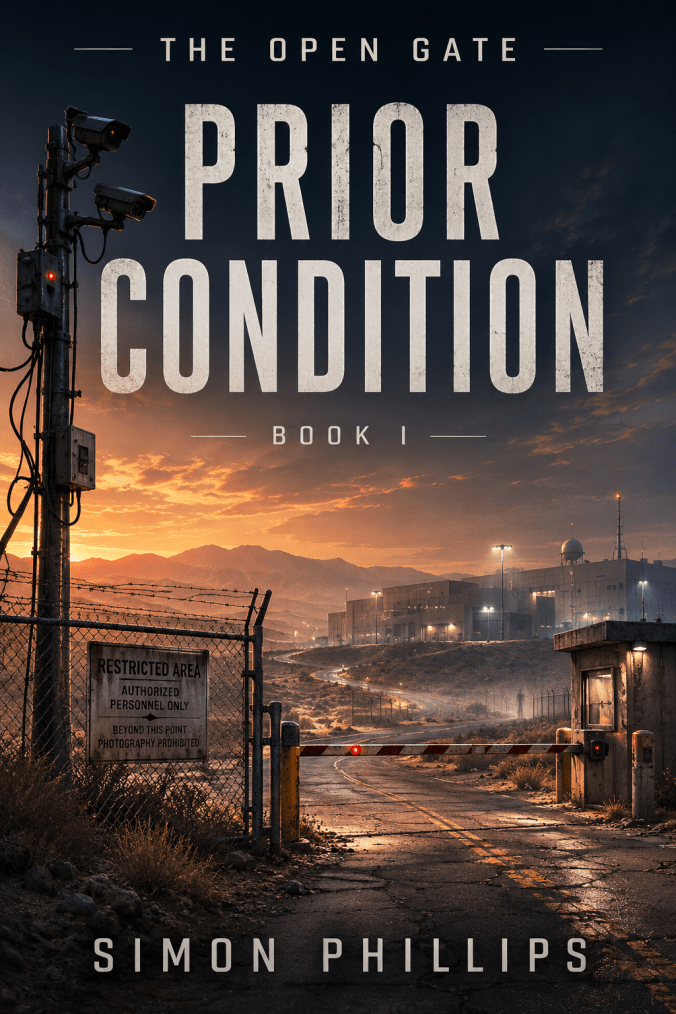
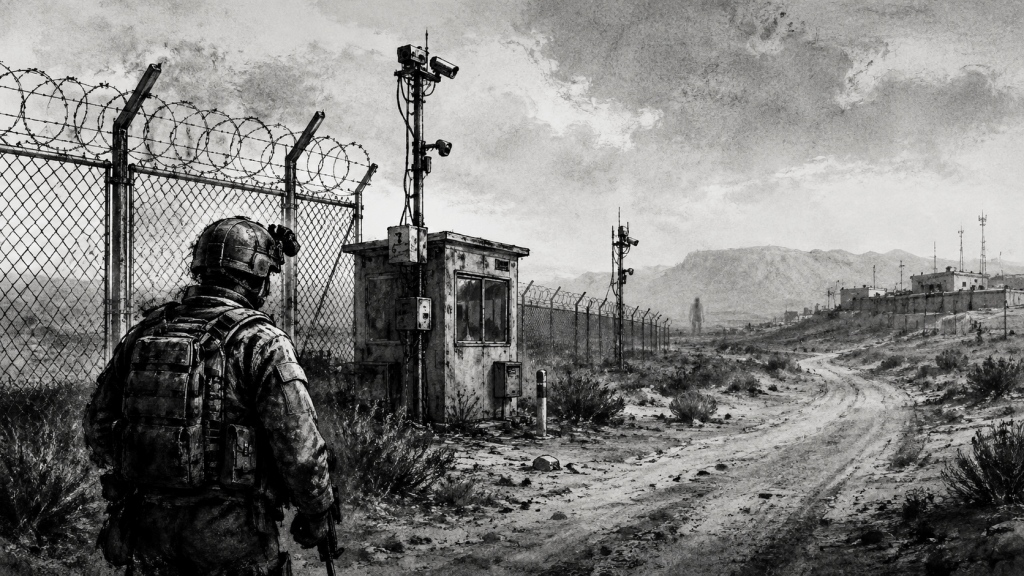
A military patrol jeep follows an old service road beside a perimeter fence. Cameras watch the empty ground through layers of glare. Guard posts repeat along the route, their equipment familiar enough to be ignored until one of the screens fails to behave as expected. Beyond the wire, something human-shaped appears for long enough to trouble the eye, but not long enough to become evidence.

Nothing has publicly collapsed in Prior Condition. The installation continues to operate, soldiers complete their patrols, reporters work through ordinary newsroom disputes, businesses open their doors, and scientists correct the problems placed before them. The world remains recognisable because the first stage of this slow-burn science-fiction horror story does not arrive through open catastrophe. It arrives through systems that continue working after their explanations have begun to fail.

This is where The Open Gate begins.

Simon Phillips’s opening book establishes a contemporary world in which military procedure, investigative journalism and restricted scientific research occupy different sides of the same developing crisis. Each system encounters signs that something is wrong. Each has a reason to contain, minimise or rename what it has encountered. The growing horror lies in the distance between what people experience and what their institutions permit them to acknowledge.


The Perimeter Still Looks Secure

Ethan Ward experiences the opening pressure through military routine.

He understands the perimeter as a working system composed of roads, fencing, cameras, guard posts, radio checks and written logs. Its purpose is to turn uncertainty into procedure. A soldier follows the route, checks the equipment, records anything unusual and reports what cannot be corrected locally. The repetition creates confidence because each patrol resembles the one before it.

When Ethan first notices a figure near the fence, the environment immediately provides several acceptable explanations. The heat is severe. Distance is difficult to judge. The air shimmers above the ground. A tired mind can impose human form upon scrub, shadow or glare.

His patrol partner, Davis, supplies the reassurance almost automatically. Eyes invent things in empty places. Cameras suffer interference. Faults in isolated equipment are normal. Anything genuinely dangerous would become obvious through alarms, orders or visible changes in security.

That assumption carries more weight than the sighting itself. Ethan has been trained to believe that danger enters the system through recognised channels. A threat becomes real when it produces an alert, a command or a response from someone with greater authority. An uneasy sensation beside an apparently intact fence has no official category.

The military system does not ignore the irregularity because its personnel are foolish. It absorbs the irregularity because that is what the system has been built to do.

Equipment failures become maintenance problems. Unclear movement becomes heat distortion. Repeated sensor alerts become paperwork. A malfunctioning post is inspected, logged and passed onwards. Each individual response appears reasonable, but the cumulative pattern begins to suggest that the perimeter is measuring something it cannot interpret.

Ethan’s position makes this especially unsettling. He is neither a reckless action hero nor an expert who understands the wider programme. He is competent within the boundaries of his assignment. He knows how the road should feel beneath the vehicle, how a camera should cycle, how a fence should sound and how animals usually move through open ground. His unease develops through physical recognition rather than sudden revelation.

The familiar environment has not visibly changed. Ethan’s confidence in it has.


Three Perspectives Inside the Same Crisis

The structure of Prior Condition allows the reader to approach the emerging crisis through three separate forms of partial knowledge.

Ethan sees physical irregularities around the installation’s perimeter, but he lacks the context needed to understand them.

Maya Ward hears civilian testimony and begins placing apparently unrelated disruptions beside one another, but she lacks the proof needed to publish a definitive connection.

Dr Adrian Hale works with data, models and restricted system architecture inside the facility, but he is deliberately denied a complete view of what his technical corrections support.

The characters do not exchange their evidence. They do not gather in a room and solve the mystery together. Their separation is central to the story’s institutional horror.

The reader can see proximity where the characters see isolation. A sensor fault near the fence, a power fluctuation in town and an unusual pattern inside a scientific model may belong to the same developing event, but each appears within a different professional language. The military calls it interference. The newsroom calls it unverified testimony. The laboratory calls it drift.

The crisis remains deniable because its fragments are kept apart.


Maya Ward and the Burden of Unprovable Truth

Maya’s investigation begins with details that would be easy to overlook in isolation.

Lights dim and recover before residents decide whether the interruption deserves a complaint. Heavy vehicles move along county roads late at night. Windows tremble. Water pressure changes. Deliveries arrive late, arrive incorrectly or disappear into an ordinary chain of administrative confusion. People experience moments of silence in places where birds, insects and traffic should still be present.

None of these events proves anything.

That absence of proof creates Maya’s professional problem. She recognises a pattern, but recognition is not publication. Her editor does not have to deny that residents are reporting disturbances. He only has to demand verification, caution her against implication and redirect her towards safer material.

This is one of the most convincing expressions of institutional denial in Prior Condition. Maya is not dragged away by secret agents or threatened in a dark car park. The pressure remains professional, measured and plausible. The newspaper depends upon credibility. The installation supports the surrounding area economically. Sources contradict themselves. Witnesses question their own memories. An editor who asks for stronger evidence can still believe that he is protecting the publication.

The result is a form of containment that requires no visible conspiracy.

Information is softened before it is suppressed. A possible connection becomes proximity. A repeated disturbance becomes infrastructure trouble. An investigation becomes speculation. An uncomfortable story becomes a harmless community feature about the local installation.

Maya continues because the individual accounts begin to resist separation. A resident describing rattling windows supports another person’s account of late traffic. A shopkeeper’s delivery problems sit beside reports of power dips. A witness who sounds unreliable may still have noticed something that more credible people have trained themselves not to see.

Her work reflects the patient, uncertain nature of investigative science fiction. She is not an all-knowing reporter who can expose the entire system with one document. She listens, compares, returns to locations and waits for ordinary testimony to reveal its shared shape.

The tension comes from knowing that a pattern may become visible long before it becomes publishable.


Dr Adrian Hale and the Safety of Partial Knowledge

Inside the installation, Adrian encounters the same crisis through technical language.

His working environment is controlled, climate-regulated and divided by access permissions. Screens present bounded problems. Data arrives in limited sets. Assignments carry neutral labels that describe immediate function without revealing broader purpose.

Adrian is highly capable within this system. He can recognise a mathematical discontinuity that others have treated incorrectly. He understands how one adjustment affects another and how small errors can magnify further along a process. His ability makes him useful to people who know more about the programme than he does.

His danger is not madness or deliberate malice. It is competence without moral overview.

Adrian receives a problem and solves it. When a model becomes unstable, he corrects it. When a parameter drifts, he brings it back within tolerance. When a task requires information from a restricted cluster, he requests the portion his clearance permits him to see.

The scientific institution does not need to deceive him through an elaborate falsehood. It only needs to ensure that his field of responsibility remains narrow enough for the next task to appear reasonable.

His colleagues occasionally ask what their work is feeding or what the programme is actually building. Adrian answers from the position the institution has given him. Their work creates stability. Projects expand. Technical progress requires structure. Understanding the whole is unnecessary when each department is responsible for only one part.

This makes Adrian one of the most important figures in the book’s examination of scientific responsibility. His intelligence does not protect him from complicity. In some respects, it places him closer to it. The programme advances because capable people continue improving systems whose consequences remain outside their authorised view.

Scientific entitlement in The Open Gate does not begin with a dramatic declaration that humanity should control another reality. It begins with a more ordinary assumption: if a problem can be corrected, correction must be the responsible choice.


When Procedure Becomes the Horror

The institutions in Prior Condition are disturbing because they remain believable.

The military values readiness, clear reporting and an orderly chain of command. The newspaper values evidence, credibility and protection from unsupported claims. The scientific programme values precision, restricted access and efficient distribution of work.

None of those priorities is inherently irrational. The horror develops when the priorities continue operating after they have stopped producing an accurate understanding of reality.

A soldier is told to log an equipment failure rather than treat it as evidence of a wider problem.

A reporter is told to pause until she has proof that the existing system makes almost impossible to obtain.

A scientist is praised for stabilising a process without being told what continued stability might permit.

Institutional science-fiction horror works through this conflict between function and understanding. A system can remain operational while becoming dangerously wrong. Reports can be filed, screens can return to green, meetings can end politely and employees can go home without anyone asking whether the underlying activity should continue.

The people inside these structures are not required to agree upon a lie. They only need to complete their immediate duties.

This gives denial a practical form. It exists in access permissions, softened language, reassignment, professional caution and the belief that responsibility belongs to someone further along the chain.


Dimensional Horror Without Spectacle

The dimensional horror of Prior Condition remains close to ordinary perception.

A form near a fence fails to resolve properly. A moving shape does not match the ground beneath it. Light seems to behave incorrectly around an object. A shaded gap between buildings appears occupied without yielding a clear human outline. Scientific geometry implies a scale and purpose beyond the task visible on the screen.

These moments are unsettling because they remain incomplete.

The book does not immediately transform uncertainty into a catalogue of creatures or a lecture about alternate dimensions. It allows physical wrongness to enter familiar environments without providing the comfort of classification. The body recognises that something is misaligned before the mind can decide what that misalignment means.

This restraint prevents the story from becoming conventional portal fiction. The installation is not opening a colourful doorway into an adventurous second world. It is interacting with something it does not understand while behaving as though improved engineering will eventually make understanding unnecessary.

The gate at the centre of the wider series is dangerous because it belongs to an institution before it belongs to public knowledge. It can be measured, funded, divided into departments and protected by security procedures. Those conditions create the confidence that continued access is legitimate.

The deeper moral pressure follows from that confidence. Technical ability begins to resemble authority. Discovery begins to resemble ownership. Contact becomes something humanity assumes it is entitled to continue.


The Town Absorbs What the Facility Produces

The town surrounding the installation gives the story its civilian weight.

People continue buying bread, attending community meetings, driving to work and arguing about ordinary explanations. Businesses depend upon deliveries and reliable utilities. Residents are accustomed to the installation’s presence even when they know little about its purpose.

This makes the town capable of absorbing disruption for longer than an empty or isolated landscape could.

A flickering light becomes a problem with the grid. A vibration becomes old quarry work, road maintenance or heavy traffic. A missing delivery becomes a supplier error. A vehicle seen late at night becomes evidence of nothing more than military logistics.

The explanations survive because everyday life requires them to survive. Most people cannot stop working while they investigate the cause of a brief power fluctuation. A shopkeeper still has customers to serve. A resident still has bills to pay. A reporter still needs enough evidence to satisfy an editor.

The installation and the town therefore mirror one another. The facility contains irregularities through professional procedure. The town contains them through habit, economic dependence and social embarrassment.

Both remain functional. Neither remains entirely secure.


Secrecy Reaches Beyond the Workplace

The pressure surrounding Ethan and Maya also enters their marriage.

Their domestic distance existed before either of them could name the developing crisis. Ethan withholds parts of himself through habit. Maya becomes increasingly absorbed in an investigation she cannot yet defend. Their conversations have thinned into practical exchanges, leaving each of them close to a different fragment of the same event without recognising the connection.

This human layer prevents the story’s institutional themes from remaining abstract.

Classified information does not stay inside a facility. Professional caution does not remain inside a newsroom. Secrecy alters the way people return home, answer questions and interpret one another’s silence.

The marriage reflects the wider condition of the series. Its structure remains in place. Trust has not disappeared in a single dramatic betrayal, but it has become harder to reach. Each person continues according to familiar routine while something important remains unspoken between them.

The result is a form of domestic suspense that belongs naturally beside the military and scientific pressure. The same habits that allow institutions to avoid uncomfortable truths can also exist inside a home.


Entering The Open Gate

Prior Condition is the point at which recognition begins.

It does not offer immediate collapse, open warfare or an explanation of everything behind the installation. Instead, it introduces a world that still believes its systems are capable of containing whatever those systems have created.

Readers encounter the crisis from three different positions: the soldier standing beside the fence, the reporter listening to people who already doubt their own testimony, and the scientist improving a programme whose larger purpose remains beyond his clearance.

The strength of the story lies in the way these perspectives accumulate. Ethan’s physical unease, Maya’s incomplete pattern and Adrian’s technical success become more troubling when placed beside one another. The reader begins to understand that the problem is not confined to a single malfunction, witness or department.

Something is happening around the installation. The institutions closest to it are already responding. What they cannot yet do is admit that their responses belong to the same event.

Readers who want to begin the series at the moment that ordinary explanations first start to lose their authority can find Prior Condition, Book One of The Open Gate, on Amazon.

The book offers slow-burn science-fiction horror rooted in military routine, investigative pressure, scientific compartmentalisation and the physical unease of familiar places becoming unreliable. Its world remains intact enough for denial to survive, but each character has encountered something that cannot be returned completely to its previous category.

The fence is still standing. The newspaper is still printing. The laboratory screens are still reporting success.

The pressure begins in the space between those facts and what they no longer explain.

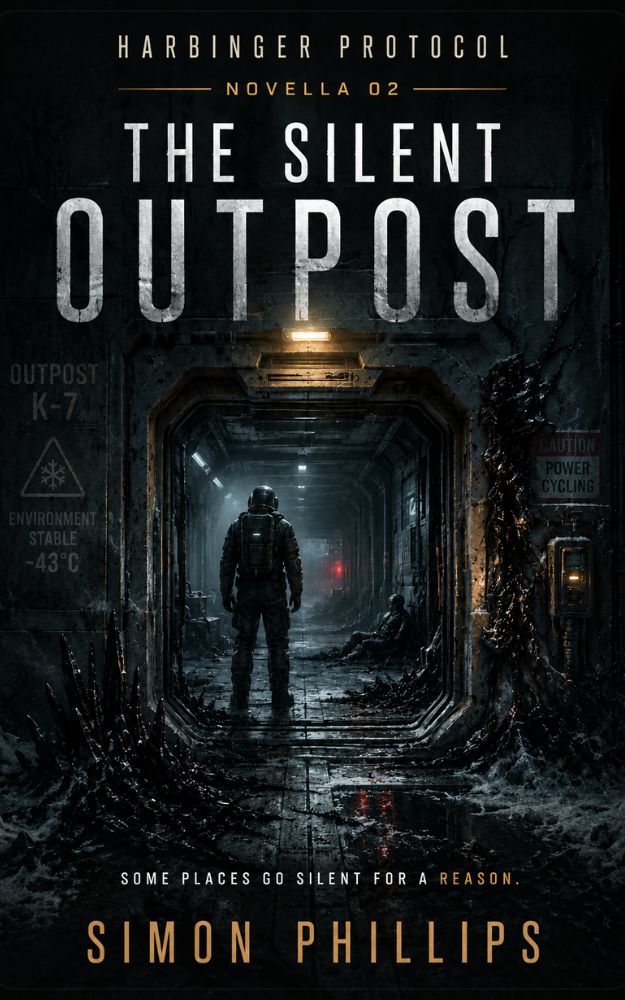
The Silent Outpost: Sci-Fi Horror, Biological Contamination, and the Collapse of Trust in Harbinger Protocol


When a Station Stops Behaving Like a Station

A station under quarantine should be quiet in a way people understand. Doors should remain sealed. Power should stay low. Emergency lights should mark safe routes through dead corridors. The silence should feel like failure, damage, or abandonment.

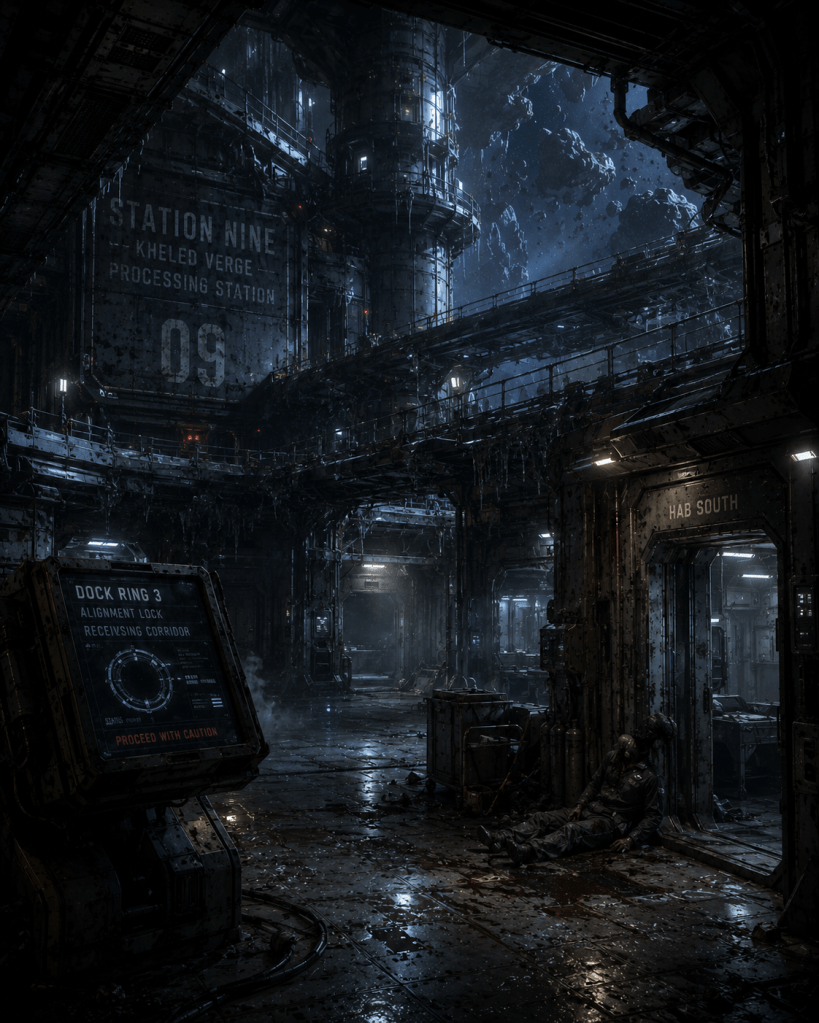
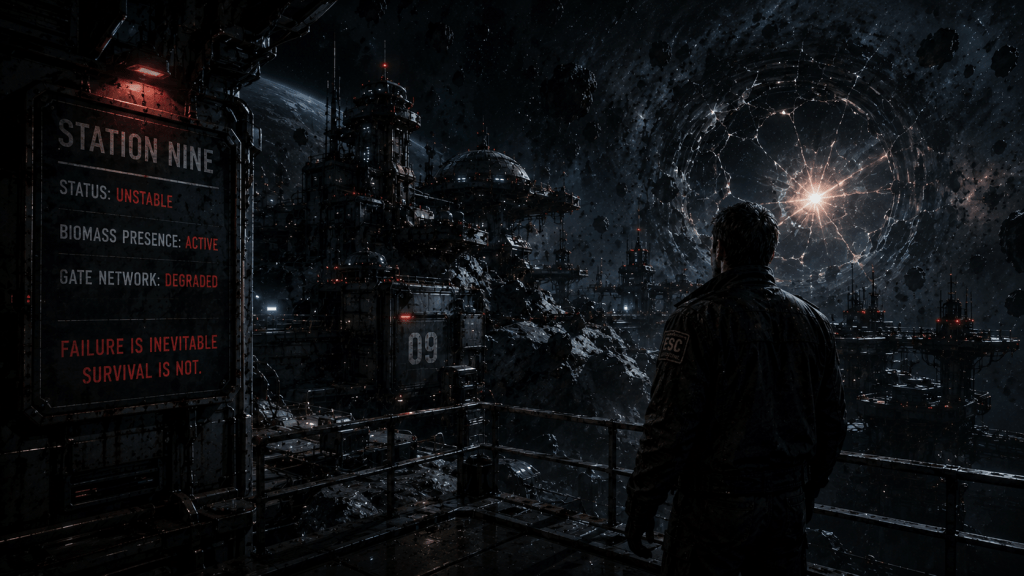
In The Silent Outpost, the second entry in Harbinger Protocol, silence becomes something more dangerous. Kheled Verge Processing Station Nine is cold, partially powered, and almost still when the ESC investigation team arrives. Its docking arms hang in interrupted motion. Its work lights have failed in broken sequence. Maintenance equipment remains suspended mid-task. The place appears paused, as though the ordinary life of an industrial outpost has been held in place by something that has learned how stations breathe.

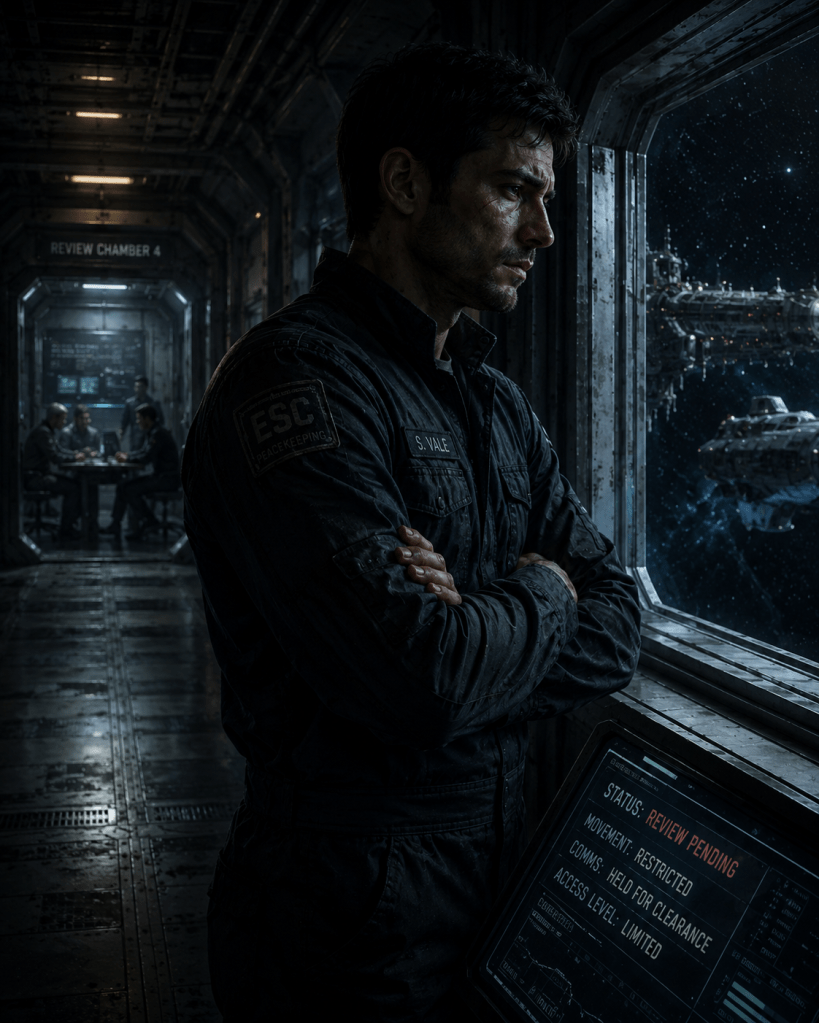
This is where the series widens from isolated shipboard sci-fi horror into something larger. The first incident aboard the Red Titan left Soren Vale as a survivor. The second places him inside an institution trying to decide whether truth should be spoken plainly, delayed until it becomes useful, or shaped into language that can survive politics.

For readers looking for atmospheric science fiction horror, space station horror, biological contamination sci-fi, and a darker kind of interstellar political thriller, The Silent Outpost marks the moment Harbinger Protocol begins to show its wider shape.

Read The Silent Outpost on Amazon Kindle


Soren Vale and the Weight of Surviving Twice

Soren Vale enters this novella in a cleaner kind of captivity.

He is aboard the ESC Peacekeeping Cruiser Leda Ark, safer than he was on the Red Titan, yet far from free. His movement is limited. His communications are held. His memories have become evidence. The institution around him speaks in careful phrases: protective review, pattern integrity, operational legal oversight, acoustic artefacts. Each term carries part of the truth, yet none of them can hold the shape of what he lived through.

That is one of the most important pressures in Harbinger Protocol. The horror is biological, industrial, and cosmic in its eventual reach, though it first enters through administration. Somebody has to classify the event. Somebody has to decide which words can be released. Somebody has to ask whether panic, sovereignty, route control, and treaty law are more dangerous than the thing moving through ducts and cargo bays.

Soren’s usefulness becomes a second form of custody. He notices patterns before committees are ready to name them. He recognises that wrongness can travel through air systems, power routes, warm compartments, and human assumptions. The ESC needs that instinct. It also needs him contained.

In many science fiction horror stories, the survivor becomes the hero who knows the truth and forces the world to listen. Harbinger Protocol takes a colder path. Soren is believed just enough to be used, controlled just enough to be kept close, and trusted only when his fear becomes operationally useful.


Station Nine and the Horror of Working Systems

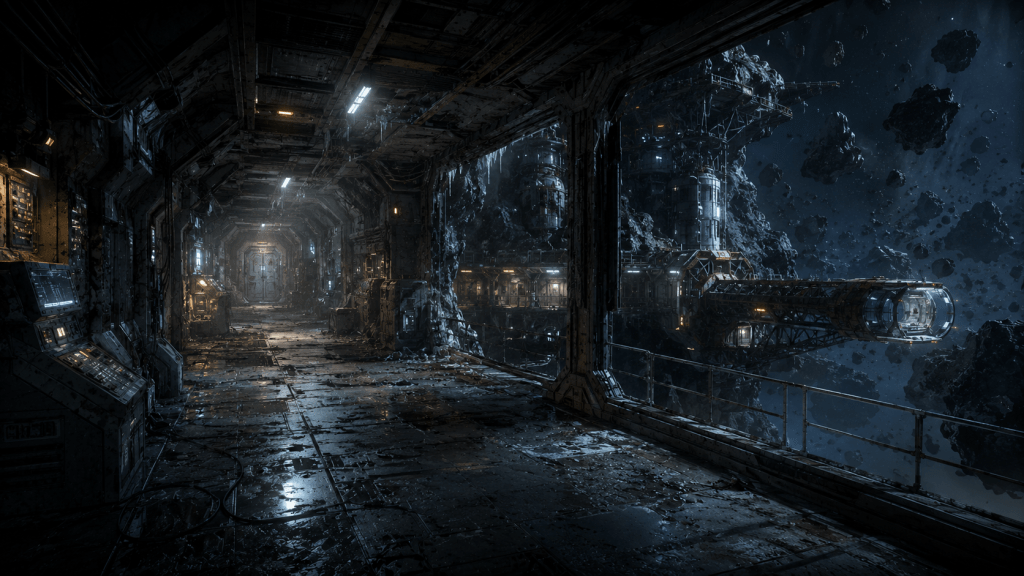
Kheled Verge Processing Station Nine is not a gothic ruin in space. It is an industrial place. Ore systems, docking rings, maintenance spines, habitation blocks, control boards, pressure doors, service trunks, coolant lines, and emergency fallback systems form its body. That practicality matters.

The terror in The Silent Outpost comes from systems that almost behave correctly.

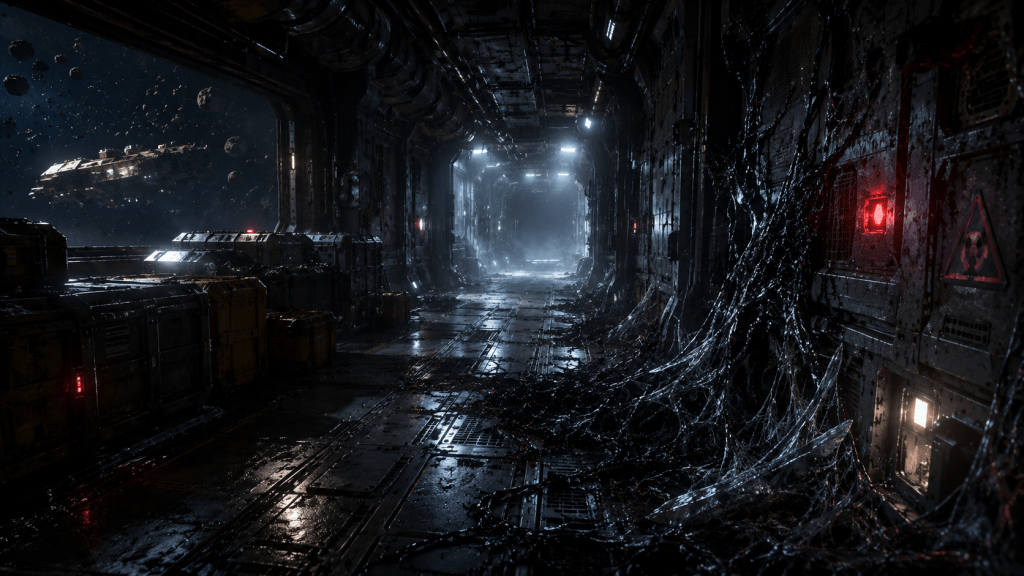
Dock Ring Three still answers, although weakly. The receiving corridor shows no grand destruction. Tools remain where workers left them. The first evidence of contamination appears in pale ribbed accretions on metal surfaces, hatch frames, vent housings, and equipment. It could be coolant residue. It could be mineral deposition. It could be a station ageing badly in deep cold.

Then Hab South changes the meaning of the place.

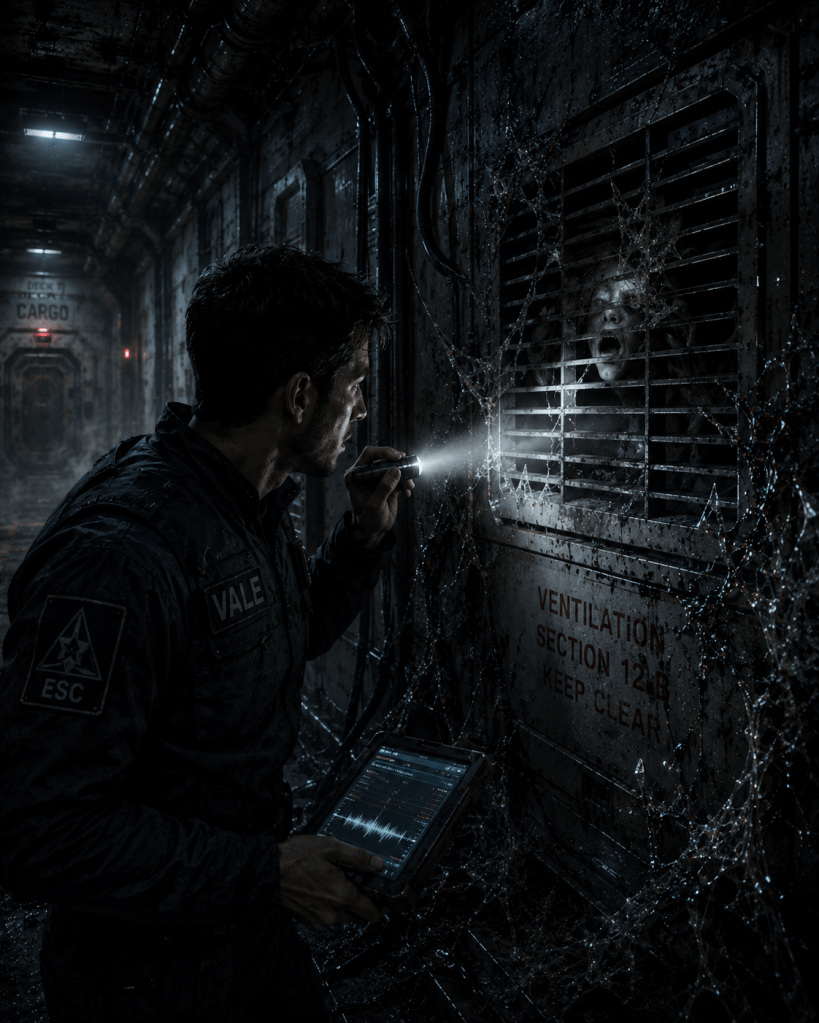
The dead are found near vents and service grilles. Some stand with hands against the metal. Others sit with faces angled upward, as if listening. There is no visible violence. No clear attack. No easy monster to blame. The bodies have been preserved by cold and arranged by behaviour. Something in the station made them listen long enough to die.

The voice-like sounds that follow are central to the series. They are not true speech in a simple sense. They are damaged systems, airflow, corrupted buffers, acoustic memory, and the human mind reaching for pattern. Yet that distinction offers no comfort. A false plea can kill as effectively as a real one when people are trained to answer distress.

A station does not need to become alive to become dangerous. It only needs to become trustworthy in the wrong places.


Biological Contamination That Uses Human Procedure Against Itself

The biomass threat in Harbinger Protocol is frightening because it does not behave like a simple alien invader. It is reactive, environmental, and tied to physical conditions: heat, power, airflow, oxygen, pressure, electromagnetic fields, and the infrastructure humans depend on.

That makes every sensible action dangerous.

A dark station must be investigated. Evidence must be recovered. Survivors may be trapped in sealed compartments. Life support might matter. Operations archives could explain what happened. A controlled systems wake seems reasonable. It is exactly the kind of careful, professional decision an ESC field team would make.

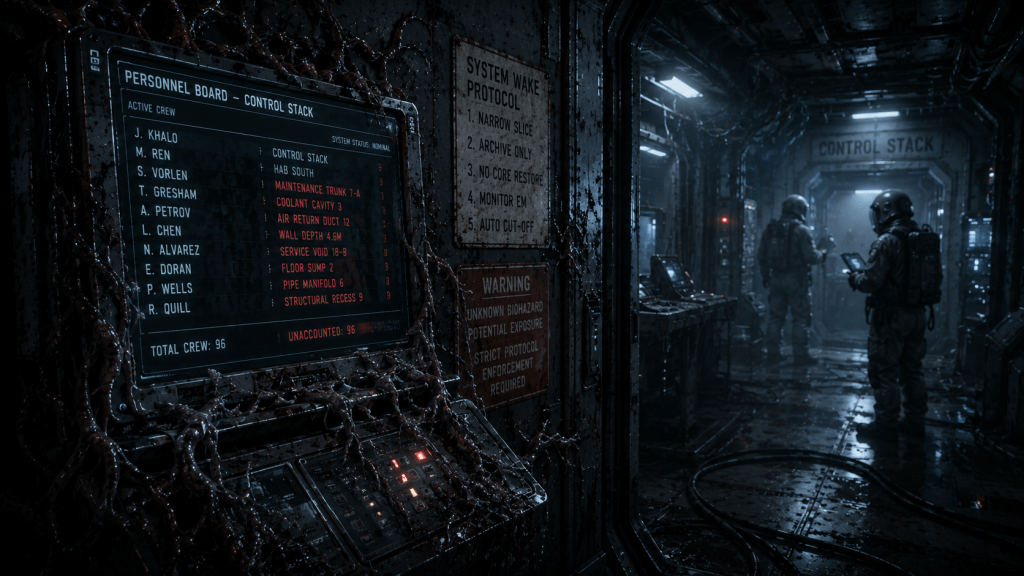
In The Silent Outpost, Kell attempts a narrow slice wake inside Control Stack. The intention is precise: operations archive and environmental board only, no station-wide restoration, no refinery systems, no heavy motors. Procedure is followed. Caution is present. Nobody behaves like a fool.

The station answers anyway.

Lights slam awake. Air handlers roar. Pressure doors cycle across the structure. Old announcements burst through speakers. Dead routines return in fragments. The outpost, once cold and held down, finds pathways through the very systems designed to reveal it.

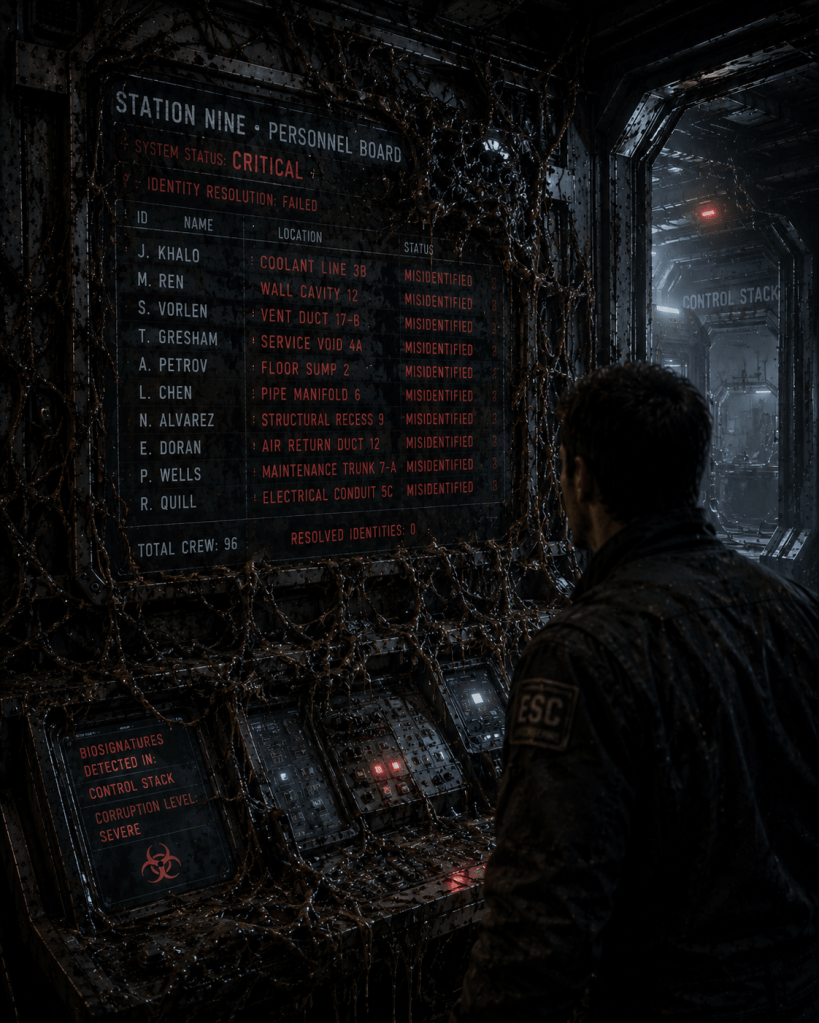
This is where the novella deepens its biological contamination horror. The danger is not merely infection. It is infrastructure conversion. The station’s systems begin to blur human presence, ducting, wall cavities, coolant routes, service voids, and crew identifiers until the personnel board can no longer separate bodies from structure.

Thirty-two becomes sixty-four. Then ninety-six. Then zero.

That simple numerical corruption is one of the most unsettling images in the novella because it makes bureaucracy itself part of the horror. The system still counts. It simply no longer understands what a person is.


The Personnel Board and the Fear of Becoming Infrastructure

The corrupted personnel board is the central horror image of The Silent Outpost.

A crew roster should be one of the most human systems aboard a station. It tells command who is present, where they are working, which sectors are occupied, who may still need rescue, and who may already be gone. It is a tool of accountability.

On Station Nine, that tool breaks in a way that feels worse than silence.

Crew names appear in ducts, coolant cavities, wall depth, floor sumps, service voids, and processing infrastructure. The system sees occupied space where there should be only pipes and structural cavities. Whether the readout is literal, corrupted, or some terrible combination of both, the emotional effect is clear. The station has stopped recognising the difference between its workers and its own body.

This is also where Soren’s pattern recognition becomes essential. He understands that the contamination followed air routes. Cold slowed it. Power restored movement. The wake allowed the station to read what it had already begun to absorb, overwrite, or misunderstand.

The result is not spectacle. It is a quiet, industrial nightmare. A man does not fear being eaten by a monster. He fears being placed inside the walls and misread as part of the station.

That fear becomes human through the infected marine, whose glove breach turns a small field accident into a containment crisis. The infection follows warmth, suit seams, skin, fabric, and deck contact. Cold suppression slows it, yet the team understands the cost of trying to carry him further. His plea not to be left where the station can “put” him in the walls gives the entire outpost a human centre.

Containment, in this universe, rarely feels clean.


The ESC, Quarantine, and the Politics of Naming Disaster

The Earth Strategic Coalition is powerful, disciplined, and capable of rapid action. It also works inside a human civilisation fractured by treaties, rival governments, trade routes, sovereignty claims, and competing narratives.

That is why The Silent Outpost is more than space station horror. It is also political sci-fi horror.

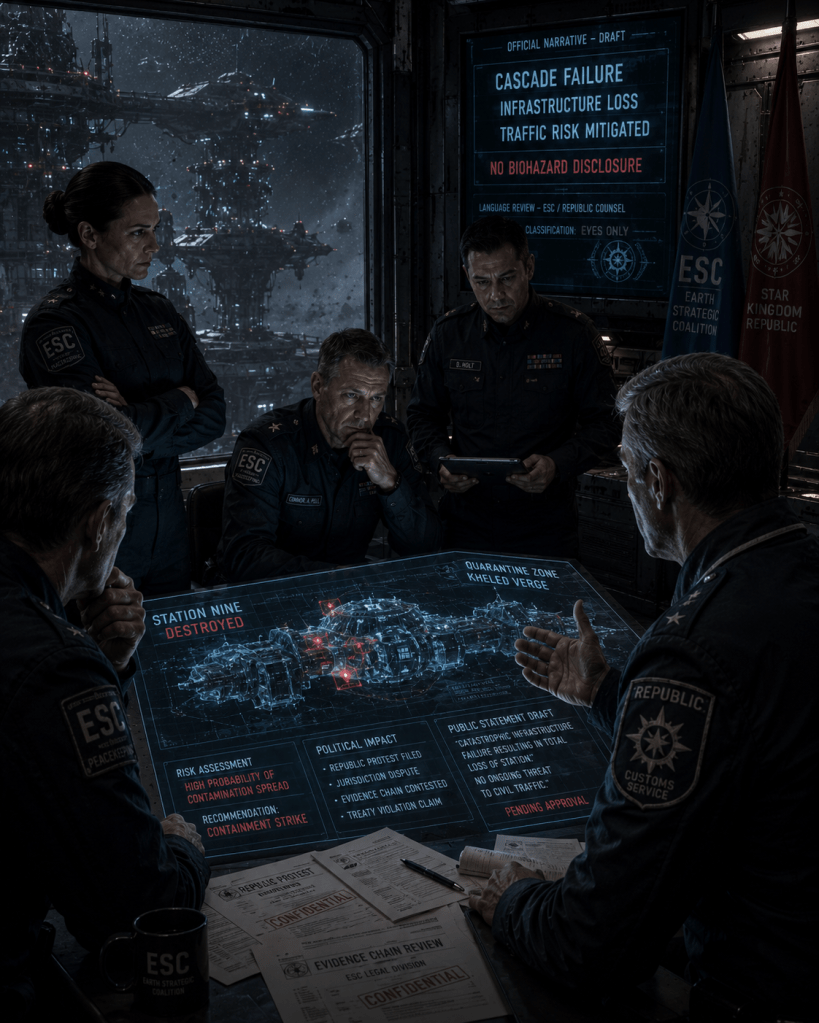
The ESC can send a team. It can freeze a lane. It can order a containment strike. Yet every action becomes evidence in someone else’s accusation. The Republic contests custody, access, survivor handling, route authority, and strike justification. A dead outpost becomes a diplomatic event. A contaminated fragment becomes a border crisis. A docking signal becomes a legal trap as much as a biological one.

The station’s docking shell creates one of the novella’s most dangerous pressures. Once Station Nine begins broadcasting live docking guidance, the threat moves beyond the interior. Any Republic cutter, ore hauler, emergency responder, or salvage vessel that trusts the beacon could open a clean path through contamination and carry it back into traffic.

That is the real horror of beacon trust. Civilisation depends on systems answering correctly. Ships follow guidance. Docking rings identify traffic. Emergency signals draw help. In Harbinger Protocol, those habits become vectors.

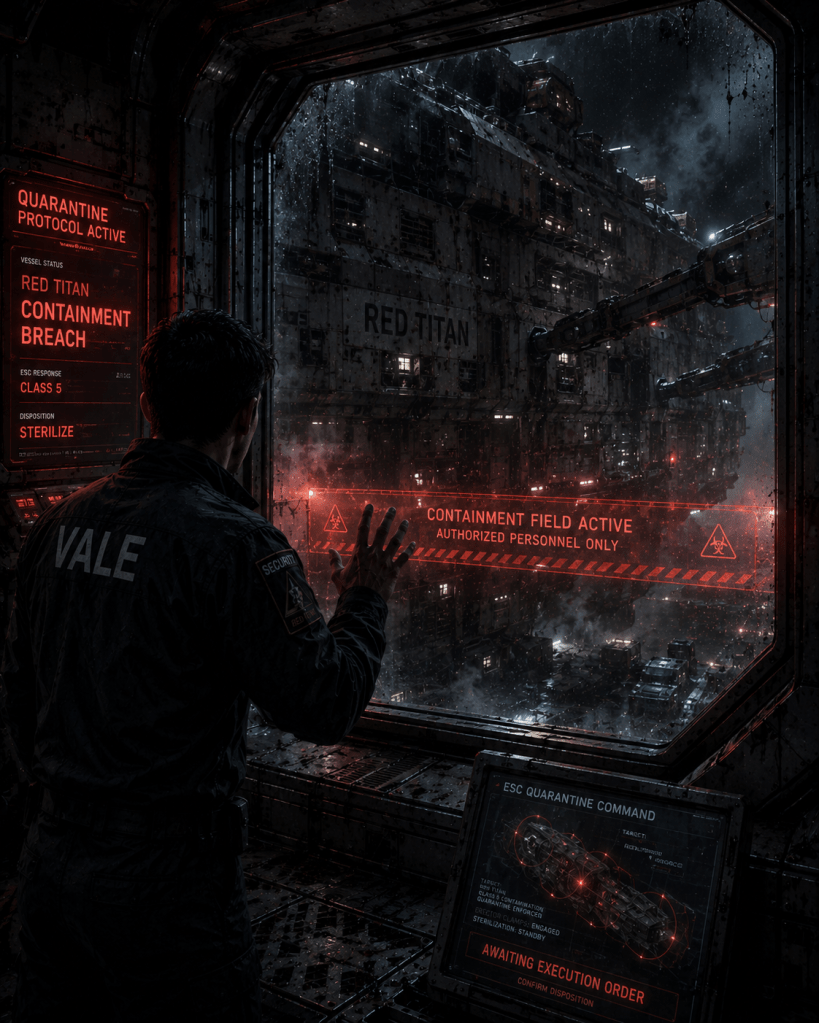
The containment strike that destroys Station Nine is swift, grim, and politically explosive. It is not a victory. It is an institutional wound. The outpost is erased because leaving it standing may spread the threat further, and the aftermath immediately becomes a fight over language.

Cascade failure. Infrastructure loss. Traffic risk.

The words are true enough to survive. They are also too clean to carry what happened.


A Series Built on Contamination, Denial, and Scale

Harbinger Protocol works because its escalation is controlled. The early horror remains grounded in freight corridors, sealed compartments, industrial stations, damaged telemetry, and official caution. The series does not rush towards cosmic revelation. It lets the reader feel how a civilisation fails to recognise collapse while its systems still appear to function.

The Silent Outpost moves the saga from the Red Titan’s isolated shipboard nightmare into a wider pattern of station-scale contamination, political pressure, and institutional dependence. Soren Vale becomes the continuity anchor between events. The ESC becomes both protector and jailer. The biomass remains strange, reactive, and deeply tied to the environments humans have built around themselves.

This is adult science fiction horror rooted in procedure, pressure, and consequence. Its fear comes from the gap between what people see and what institutions can say. It belongs to the same family as space survival horror, cosmic horror science fiction, quarantine fiction, and industrial sci-fi horror, yet its centre remains human. People still make tea. Officers still argue over phrasing. Crew still answer voices in vents because the voice sounds close enough to need help.

A short visual reading connected to the novella is also available here:


Where the Next Failure Begins

By the end of The Silent Outpost, Station Nine has fallen. The report has begun to change. Soren remains under provisional attachment. The ESC has survived one immediate containment crisis, yet the political cost is already moving faster than the language built to contain it.

A Star Kingdom patrol and a Federation salvage convoy are drawing towards confrontation over contaminated debris. Each side sees the other through suspicion before either fully understands the object between them. The biomass no longer needs to attack. Human systems are carrying it outward through fear, ownership, law, salvage rights, and accusation.

That is where Harbinger Protocol finds its most unsettling pressure. The crisis spreads through matter, yes, yet it also spreads through delay. Through the need for proof. Through the instinct to rescue. Through governments protecting territory. Through commanders trying to hold routes open for one more hour. Through the dangerous belief that a station, a ship, a beacon, or a report can still be trusted because it looks familiar from the outside.

The outpost is gone.

The pattern remains.

And somewhere beyond the next quarantine line, another system is still answering.

The Ash in Transit: Sci-Fi Horror, Alien Biomass, and the First Failure of Containment


When the Corridor Feels Wrong Before the Alarm Sounds

The first sign of disaster in The Ash in Transit is small enough to be dismissed.

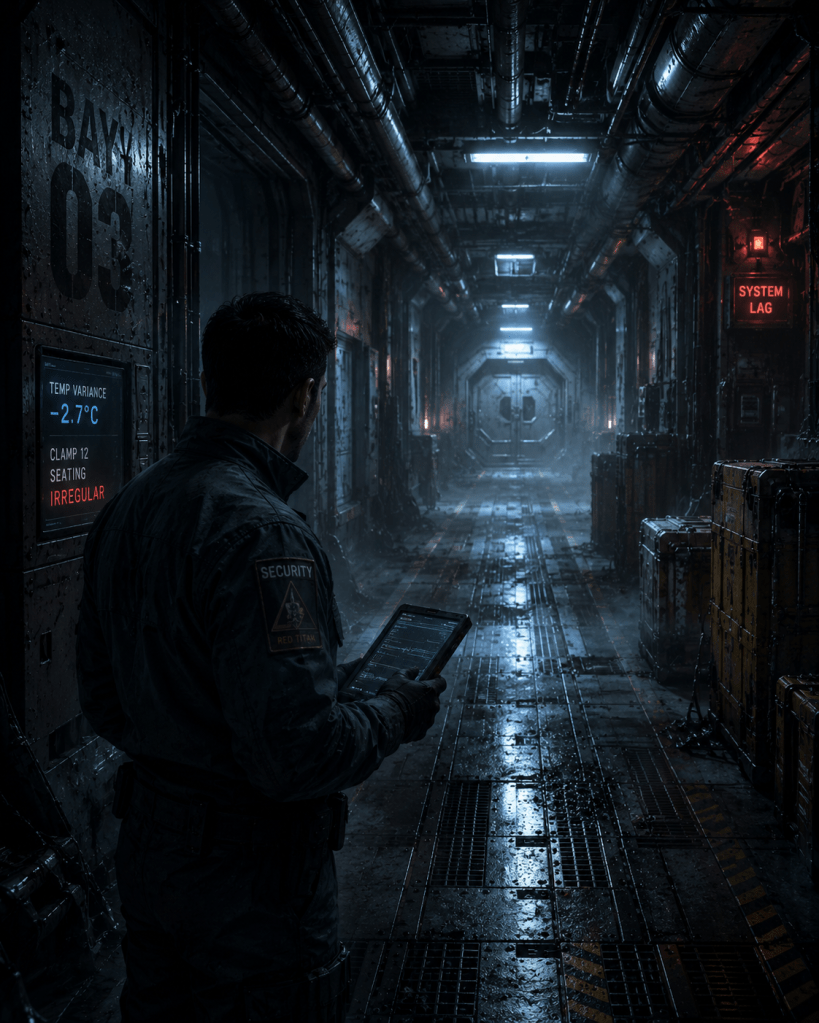
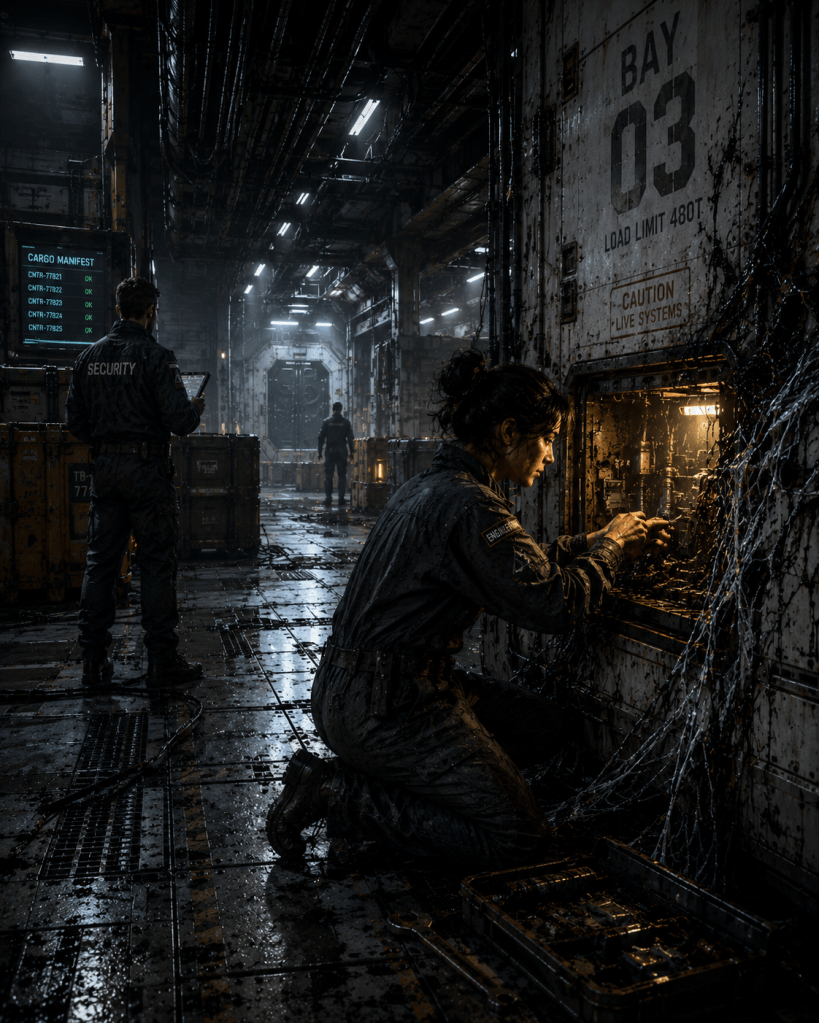
A cargo bay runs colder than it should. A clamp seats unevenly. A scanner pauses for a fraction too long before the numbers settle into something official enough to ignore. The Red Titan, an ageing industrial hauler moving through the deep trade routes of human space, already carries the fatigue of long service. Its decks vibrate. Its air tastes metallic. Its systems correct themselves with the tired obedience of machinery pushed past comfort and still expected to perform.

That is where Harbinger Protocol begins.

This is sci-fi horror built from routine pressure rather than spectacle. The danger does not arrive as an invasion fleet or a declared enemy. It comes aboard as salvage. It hides inside procedure, schedule pressure, minor sensor variance, and the familiar language of shipboard inconvenience. A civilian freighter finds a drifting container near a Republic border route, pulls it inside, opens it before station protocol can intervene, and gives the unknown exactly what it needs: heat, air, circulation, and time.

By the point anyone aboard the Red Titan understands that something is present, the ship has already begun to carry it.


Industrial Horror in the Shape of Ordinary Work

Space horror often depends on isolation, yet The Ash in Transit makes that isolation feel practical rather than theatrical. The Red Titan is not a sleek vessel built for heroic command. It is a working hauler, patched by endurance, held together through routine checks, tired judgement, and the assumption that old problems are still manageable.

That assumption becomes the first weakness.

Soren Vale enters the series through attention. He is no grand military figure standing above events. He is a security officer who notices what the ship is doing before its systems explain it. He feels the deck shift beneath his boots. He registers airflow, pressure lag, temperature drift, the small refusal of machinery to behave as it did yesterday. His power, at this stage of Harbinger Protocol, is observation. His limitation is authority.

That imbalance gives the novella its pressure.

Soren can see enough to worry, yet not enough to stop the sequence. He can log variances, ask for scans, challenge procedure, and recognise that a container should perhaps remain sealed until station. Captain Rellin answers from another world of concerns: schedule, salvage value, delay, quarantine risk, operational consequence. No one has to be cruel for the wrong decision to happen. The crisis grows from ordinary human priorities placed in the path of something no one has classified.

This is where the biological contamination horror becomes institutional. A strange residue can be called soot. Subsurface filaments can be treated as an unresolved medical anomaly. Voice-like sounds in the vents can become stress, static, echo noise, or bad data. Every delay sounds reasonable until the ship stops agreeing with it.


The Biomass as Process, Not Monster

The biomass in Harbinger Protocol is frightening because it behaves less like a creature than a condition. It does not announce itself. It does not hunt in the familiar sense. It responds.

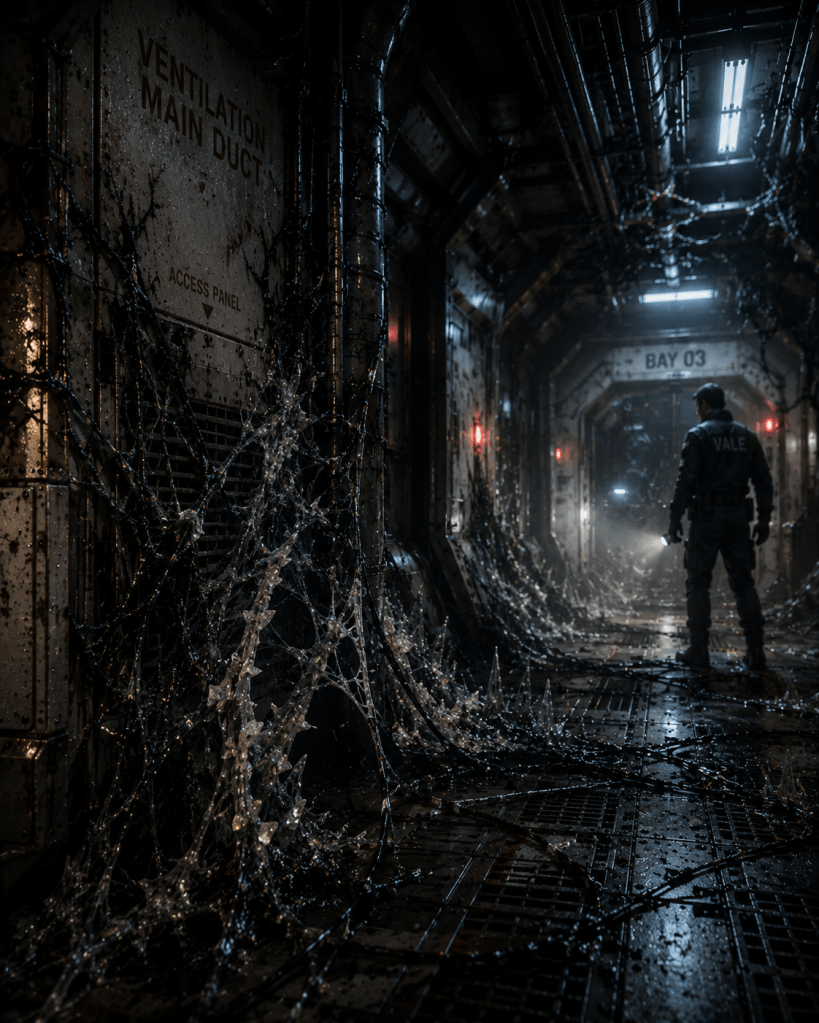
Heat draws it. Air moves it. Ventilation carries it through spaces designed to keep people alive. Metal seams, conduits, power lines, cable housings, and heat-retention zones become routes of expansion. Once the substance enters circulation, doors and seals lose the clean meaning they held before. Containment remains possible only as a delay.

That distinction matters to the tone of the series.

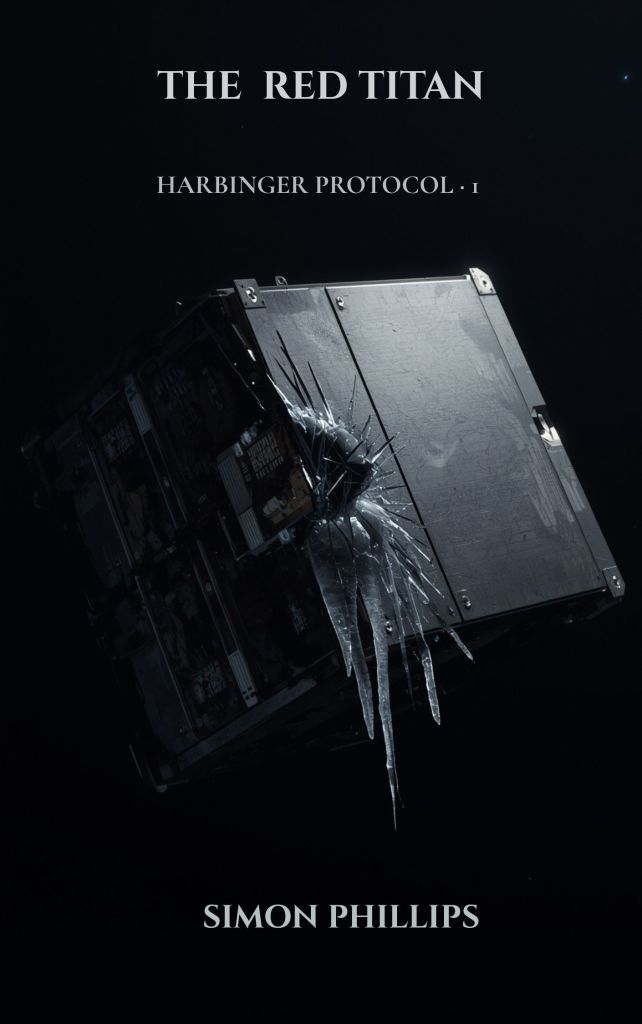
In The Ash in Transit, the biomass is first encountered through black crystalline residue along the seams of a recovered container. Its apparent stillness makes it seem safe. Cold keeps it inert enough to be misread. Once brought into a pressurised, oxygenated, heated environment, it begins to translate shipboard infrastructure into pathways for growth.

The result is alien biomass horror with a practical texture. It lives in vents, filters, grilles, panels, and junction rooms. It turns the reliable anatomy of a ship into something uncertain. A crew member’s illness becomes a structural event. A medical scan becomes an engineering warning. A corridor becomes dangerous because warmth has gathered there.

The horror is not that the Red Titan is attacked.

The horror is that the Red Titan becomes usable.


False Voices and the Human Need to Answer

One of the strongest recurring fears in Harbinger Protocol begins in this first novella: the voice that might be human.

Mara, the engineer, hears someone say her name through the vents. The moment works because the explanation remains uncertain in human terms, while the reader can feel the environment becoming involved. It is described less as speech than air shaped into a voice. That detail is central to the series’ horror identity.

The biomass is not communicating in any comforting or malicious sense. The sound resembles a plea because humans are built to recognise voices, especially in danger. Airflow, pressure shifts, corrupted audio, neural residue, and damaged systems produce something close enough to meaning that people move towards it. In a survival environment, empathy becomes a hazard.

That idea reaches beyond one ship.

Across Harbinger Protocol, false signals, distorted comms, sensor ghosts, and familiar sounds in hostile spaces become part of the wider crisis. A rescue call might be a pressure artefact. A life-sign ping might be corrupted by contaminated circuitry. A voice in the wall might be airflow moving through biomass-fused ducts. Each incident forces the same question into a different room: how long can people remain human when human instincts keep leading them into contaminated spaces?

Soren’s tragedy begins there. He listens. He checks. He tries to help. He keeps doing the right human thing inside a system where the right response arrives too late.


Containment as Fear, Cost, and Failure

Quarantine in The Ash in Transit carries weight before it arrives.

Captain Rellin does not want the ship flagged. Mara does not want to be “the reason.” The crew understands, even before formal disaster, that quarantine is not a neutral word. It means delay, investigation, loss of movement, financial ruin, possible abandonment, and the end of ordinary control. That fear shapes behaviour. It keeps evidence local. It keeps reports inside the ship. It allows the biomass to move from anomaly to event.

This is one of the reasons Harbinger Protocol works as political sci-fi horror as well as space survival horror. The series understands that containment is never only scientific. It is administrative, economic, legal, military, and emotional. Every order to seal a compartment has a human cost. Every refusal to transmit a warning has a wider consequence.

By the time an emergency distress broadcast reaches ESC patrol networks, the Red Titan has crossed from manageable incident into shipwide failure. The later intervention carries no triumph. The patrol corvette extracts what it can, secures what remains, and destroys the infected vessel. The action saves nothing cleanly. It only prevents one ruined ship from carrying the contamination further.

That is the first lesson of the series. Survival and containment are not the same thing.


Soren Vale and the Burden of Being the Witness

Soren Vale survives the Red Titan. That survival does not free him from the ship.

He begins as someone who notices too much and commands too little. By the final movement of the novella, he has become the only continuous witness to a failure that official systems can barely describe. He has seen Mara become part of the ship’s altered structure. He has seen Jace vanish during the escape through the docking spine. He has watched the Red Titan break apart after quarantine clamps engage.

The wider Harbinger Protocol saga rests on this kind of witnessing. Soren is not built as a power fantasy figure. He does not command fleets or solve the crisis through force. His importance comes from endurance, attention, and the terrible continuity of memory. He is the person left carrying the sequence when others reduce the event to files, classifications, and sterilised reports.

That makes The Ash in Transit more than an outbreak story. It is the origin point of a witness.

When the unidentified officer tells Soren that three other ships have reported identical failures that month, the novella opens outward. The Red Titan is no longer an isolated tragedy. It is one entry in a pattern that has already begun moving through trade routes, salvage chains, civilian transport systems, and the quiet spaces between official recognition and public panic.

Readers can enter that first incident through The Ash in Transit on Kindle: The Red Titan


A Fragile Civilisation Built on Movement

The larger Harbinger Protocol universe depends on movement. Cargo moves between systems. Freight haulers keep distant settlements alive. Gate corridors connect political regions, economies, military response networks, and civilian life. Authority stretches across impossible distances through treaties, patrol routes, station controls, and the belief that systems will function when called upon.

The biomass exploits that belief long before anyone understands it.

A contaminated object moves because salvage has value. A sick crew member continues working because quarantine carries cost. A ship’s systems keep compensating because that is what systems are designed to do. A distress signal leaves only after automated thresholds decide that crew authority has already failed. The same pattern can scale upward from one freighter to a station, a gate hub, a refugee corridor, or a collapsing political border.

This is where the series reaches towards cosmic horror science fiction. The first fear is local: a cargo bay, a vent, a corridor, a ship that will no longer behave. The deeper fear is structural: civilisation itself depends on the same routes, assumptions, and delays that allow the contamination to spread.

Human governments in Harbinger Protocol do what human institutions often do under pressure. They classify. They argue over jurisdiction. They protect trade. They search for sabotage, blame, enemy action, or technical failure because those explanations fit existing systems. The biomass sits outside those categories, so it moves through the gaps between them.


The First Incident Never Remains First

The power of The Ash in Transit lies in its restraint. It does not empty the wider saga of mystery. It does not explain the final shape of the threat. It leaves the reader inside the first pressure change, the first failed report, the first human loss, and the first official admission that the crisis has already spread.

That is enough.

A sci-fi horror novella does not need to begin with the end of civilisation in order to carry its shadow. Sometimes it begins with a freighter running late. A captain choosing schedule over protocol. An engineer hearing her name through the vents. A security officer understanding the environment faster than command will allow.

The Red Titan is gone by the end, yet the conditions that destroyed it remain everywhere. Ships still move. Cargo still crosses borders. Stations still open their bays to containers that appear inert under cold lights. Officials still prefer clean explanations. Somewhere beyond the next route marker, another crew is already trusting the air.

The crisis has entered the system.

No one has named it properly yet.