How King Edmund’s death became the wound and witness of a fallen kingdom.
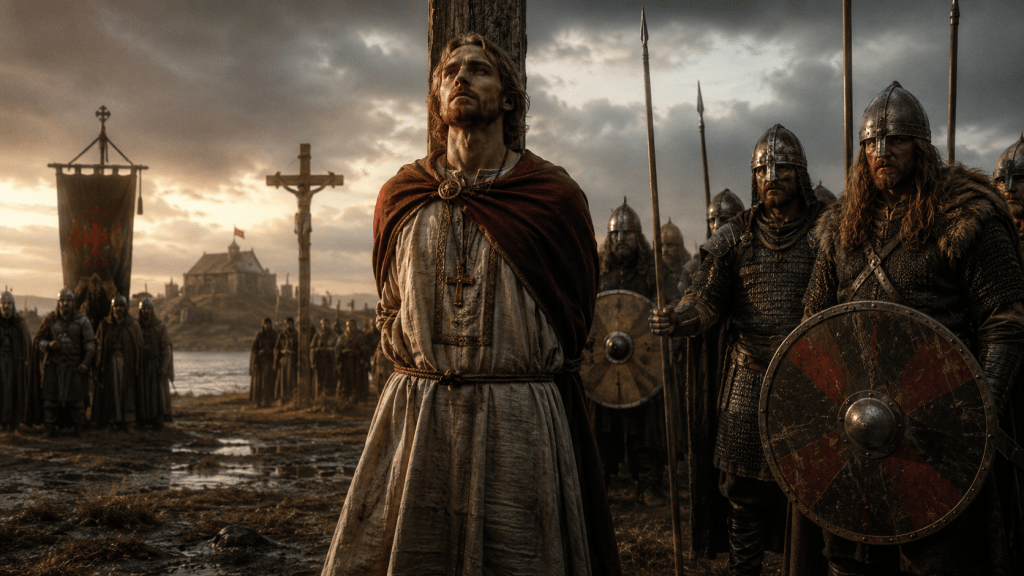
Where rumour reached the marshes before the army
The eastern sky had begun to pale over a low country of river bends, reed beds, grazing fields, and winter mist, where the chill gathered softly across the open land before the first hearth smoke rose above the settlements. East Anglia had always lived with water close at hand, with the sea beyond the flat horizon and the rivers carrying life inland through fields, churches, royal estates, and small communities shaped by tide, trade, and prayer. Ships could arrive kindly in such a place, bringing merchants, pilgrims, messages, and goods from distant shores, yet the same waters could also bear men whose purpose had hardened long before their keels touched land.
Across the kingdom, rumours moved faster than certainty. Northumbria had already been broken by the armies from over the sea, and York had fallen into hands that understood how to turn a raid into possession. Mercia, once the great weight of Anglo-Saxon power, had begun to bend beneath pressures gathering beyond its control. Travellers carried these stories in lowered voices beside hearths, in church porches, at river crossings, and along muddy roads where packhorses slipped beneath their loads. What had first come as raiding now moved like occupation, and each tale carried the same uneasy truth: the Viking armies had learned how England could be entered, crossed, and held.
East Anglia stood in their path with its wealth spread through fields, minsters, market routes, and riverways. It lacked the broad strength of Mercia and the hardening frontier spirit that would later shape Wessex under Alfred, yet it held grain enough to feed warriors, horses enough to serve a campaign, and land open enough to become a base for further war. A smaller kingdom could still matter greatly when larger forces needed shelter, supplies, and obedience. That knowledge gave the eastern land its value, and value, in such years, drew violence as surely as carrion drew ravens.
At the centre of the kingdom’s remembered sorrow stood Edmund, king of East Anglia, whose name would pass from the uncertain politics of the ninth century into the deeper realm of sacred memory. Later generations would picture him as a martyr, a ruler faced by heathen power and remembered through death with a force greater than any victory he could have claimed in life. The details would be shaped by chronicles, devotion, and legend, yet beneath them lay a harsher historical truth: East Anglia faced an army whose arrival could strip a kingdom of its ruler, its security, and its future within a single season of fear.
Perhaps the first warning came as smoke along a distant track. Perhaps it came through a rider, mud-spattered and exhausted, bringing news that armed strangers had crossed land once thought safely removed from the old centres of power. However the message reached Edmund’s court, it belonged to the same age of unravelling that had already consumed kingdoms to the north and shaken those to the west. A decision would soon be forced upon him, shaped by faith, kingship, survival, and the terrible limits of resistance.
The story of East Anglia’s fall began in that narrowing space between rumour and arrival, where a kingdom could still hear its church bells, gather its people, and imagine endurance, while beyond the mist the road carried an army towards it.
A Visual Chronicle
As the Great Heathen Army moved through the winter mist, East Anglia waited beneath the rule of a king whose defeat would become one of the most enduring memories of Anglo-Saxon England.
Timeline of Events
855 AD – Edmund is traditionally remembered as becoming king of East Anglia, entering a reign later preserved through devotion, coins, and the memory of his death.
865 AD – The Great Heathen Army enters England and winters in East Anglia, where the local people make peace and provide horses to the invaders.
866 AD – The Viking army leaves East Anglia and moves north to capture York, turning Northumbria’s division into conquest.
869 AD – The army returns to East Anglia, overruns the kingdom, and Edmund is killed during the Viking campaign.
c. 870s–900s AD – Edmund’s memory begins to grow beyond defeat, with later tradition shaping him as a martyr and sacred symbol of East Anglian endurance.
About the Creator
This Chronicle is written by Simon Phillips, author of several historical and speculative fiction works exploring forgotten worlds, myth, and the turning points of history.
You can explore his books here:
Books by Simon Phillips
You can watch his YouTube channel here:
Author Simon Phillips
Continuing the Chronicle
The account that follows moves deeper into East Anglia’s final season of independence, where Edmund’s kingship met the force of an army that had already learned how to break kingdoms, gather horses, and turn wintering ground into conquest. What began as pressure upon the eastern roads would become the fall of a realm, and from that defeat Edmund’s memory would rise as one of the strongest symbols of Anglo-Saxon endurance.
Readers supporting The Forgotten Chronicle may continue into the full record below.

Subscribe to continue reading
Subscribe to get access to the rest of this post and other subscriber-only content.
