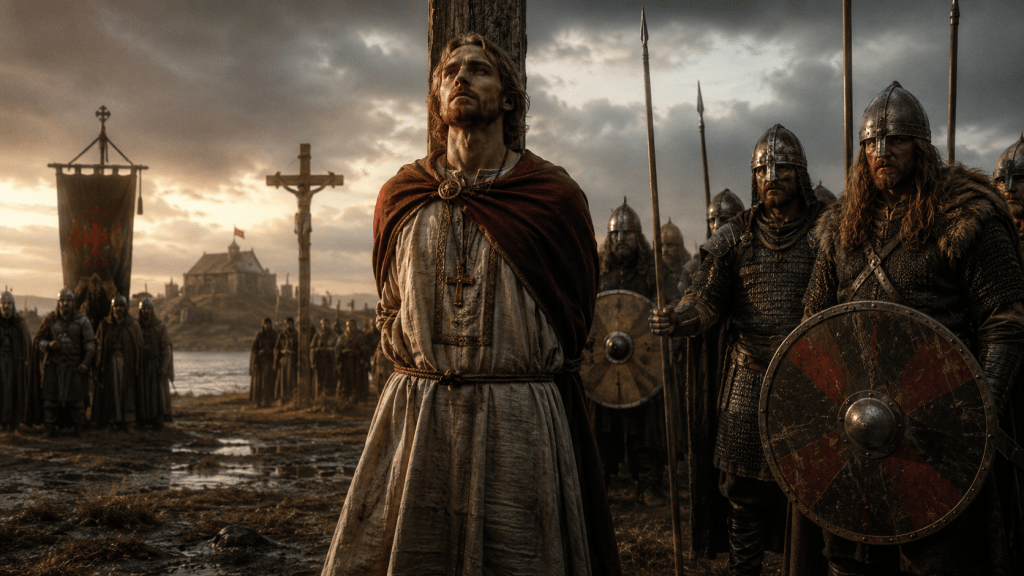
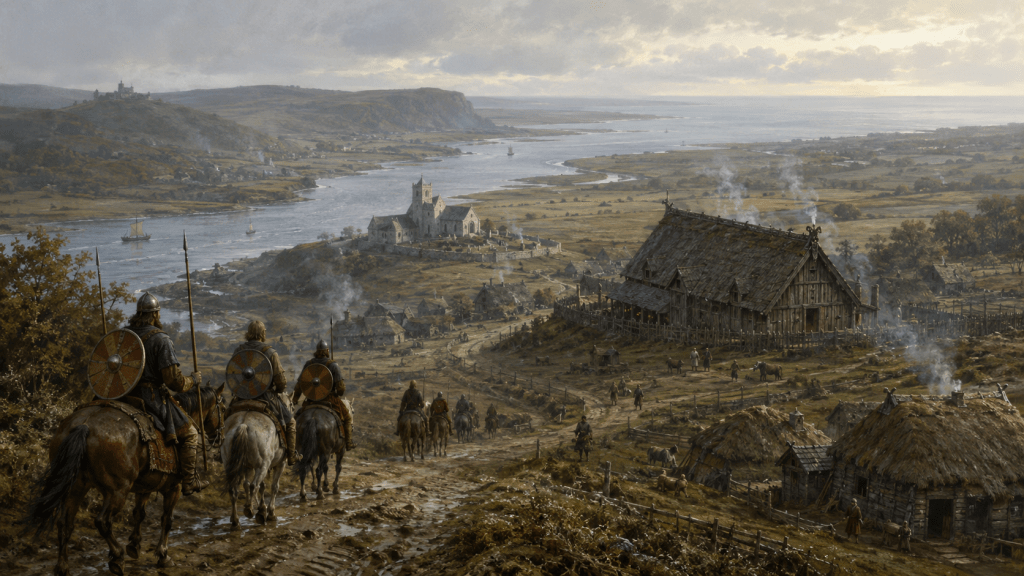
How King Edmund’s death became the wound and witness of a fallen kingdom.
Where rumour reached the marshes before the army
The eastern sky had begun to pale over a low country of river bends, reed beds, grazing fields, and winter mist, where the chill gathered softly across the open land before the first hearth smoke rose above the settlements. East Anglia had always lived with water close at hand, with the sea beyond the flat horizon and the rivers carrying life inland through fields, churches, royal estates, and small communities shaped by tide, trade, and prayer. Ships could arrive kindly in such a place, bringing merchants, pilgrims, messages, and goods from distant shores, yet the same waters could also bear men whose purpose had hardened long before their keels touched land.
Across the kingdom, rumours moved faster than certainty. Northumbria had already been broken by the armies from over the sea, and York had fallen into hands that understood how to turn a raid into possession. Mercia, once the great weight of Anglo-Saxon power, had begun to bend beneath pressures gathering beyond its control. Travellers carried these stories in lowered voices beside hearths, in church porches, at river crossings, and along muddy roads where packhorses slipped beneath their loads. What had first come as raiding now moved like occupation, and each tale carried the same uneasy truth: the Viking armies had learned how England could be entered, crossed, and held.
East Anglia stood in their path with its wealth spread through fields, minsters, market routes, and riverways. It lacked the broad strength of Mercia and the hardening frontier spirit that would later shape Wessex under Alfred, yet it held grain enough to feed warriors, horses enough to serve a campaign, and land open enough to become a base for further war. A smaller kingdom could still matter greatly when larger forces needed shelter, supplies, and obedience. That knowledge gave the eastern land its value, and value, in such years, drew violence as surely as carrion drew ravens.
At the centre of the kingdom’s remembered sorrow stood Edmund, king of East Anglia, whose name would pass from the uncertain politics of the ninth century into the deeper realm of sacred memory. Later generations would picture him as a martyr, a ruler faced by heathen power and remembered through death with a force greater than any victory he could have claimed in life. The details would be shaped by chronicles, devotion, and legend, yet beneath them lay a harsher historical truth: East Anglia faced an army whose arrival could strip a kingdom of its ruler, its security, and its future within a single season of fear.
Perhaps the first warning came as smoke along a distant track. Perhaps it came through a rider, mud-spattered and exhausted, bringing news that armed strangers had crossed land once thought safely removed from the old centres of power. However the message reached Edmund’s court, it belonged to the same age of unravelling that had already consumed kingdoms to the north and shaken those to the west. A decision would soon be forced upon him, shaped by faith, kingship, survival, and the terrible limits of resistance.
The story of East Anglia’s fall began in that narrowing space between rumour and arrival, where a kingdom could still hear its church bells, gather its people, and imagine endurance, while beyond the mist the road carried an army towards it.
A Visual Chronicle
As the Great Heathen Army moved through the winter mist, East Anglia waited beneath the rule of a king whose defeat would become one of the most enduring memories of Anglo-Saxon England.
Timeline of Events
855 AD – Edmund is traditionally remembered as becoming king of East Anglia, entering a reign later preserved through devotion, coins, and the memory of his death.
865 AD – The Great Heathen Army enters England and winters in East Anglia, where the local people make peace and provide horses to the invaders.
866 AD – The Viking army leaves East Anglia and moves north to capture York, turning Northumbria’s division into conquest.
869 AD – The army returns to East Anglia, overruns the kingdom, and Edmund is killed during the Viking campaign.
c. 870s–900s AD – Edmund’s memory begins to grow beyond defeat, with later tradition shaping him as a martyr and sacred symbol of East Anglian endurance.
About the Creator
This Chronicle is written by Simon Phillips, author of several historical and speculative fiction works exploring forgotten worlds, myth, and the turning points of history.
The account that follows moves deeper into East Anglia’s final season of independence, where Edmund’s kingship met the force of an army that had already learned how to break kingdoms, gather horses, and turn wintering ground into conquest. What began as pressure upon the eastern roads would become the fall of a realm, and from that defeat Edmund’s memory would rise as one of the strongest symbols of Anglo-Saxon endurance.
Readers supporting The Forgotten Chronicle may continue into the full record below.
Subscribe to continue reading
Subscribe to get access to the rest of this post and other subscriber-only content.
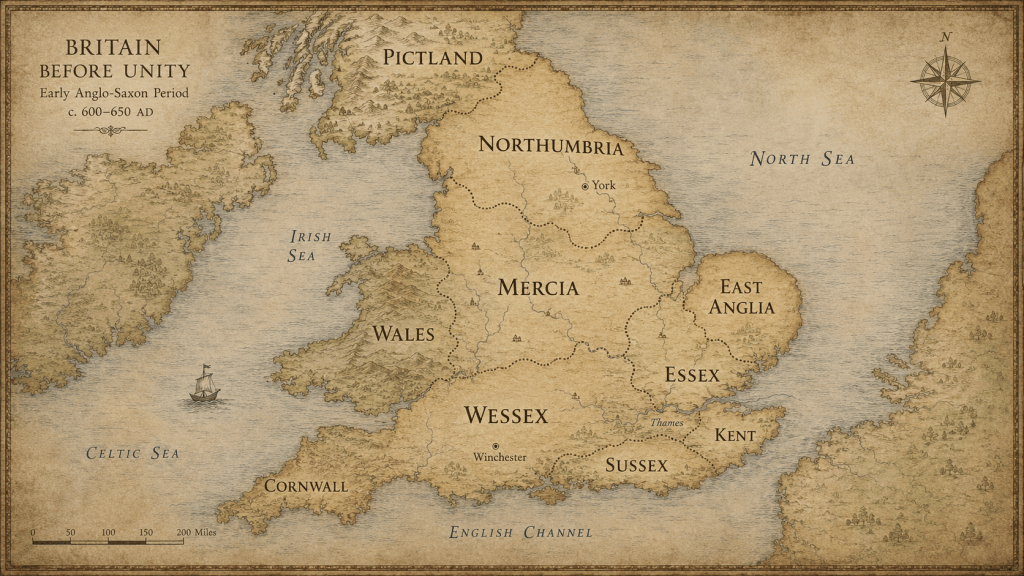
Before one crown claimed the name of England, the island was divided between rival kingdoms, fading powers, borderlands, and peoples who had no reason to imagine unity would ever come.
Before There Was England
The rain had passed before dawn, leaving the fields silvered beneath a low sky and the tracks between the settlements dark with water. Across the island, smoke lifted from timber halls, monastery kitchens, cattle folds, and watch posts set above river mouths, each thin column rising from a place that knew its own lord, its own laws, its own enemies, and its own memory of power. A traveller moving through Britain in the middle years of the eighth century would have found no single England waiting for him, no shared crown, no settled name that held the land together from sea to sea. He would have crossed borders marked by rivers, ridges, woodland, old Roman roads, and the reach of armed men. In one valley he might hear the speech of Mercia, in another the prayers of Northumbria, further south the commands of Wessex, and along the eastern fields the quieter strength of East Anglia. Beyond them lay peoples with their own histories and claims: Britons in the west, Picts beyond the northern lands, Welsh kingdoms watching the Saxon advance from older ground, and communities whose loyalties shifted with marriage, tribute, hunger, and war.
Power in that age rarely stood still. It moved with armies in the campaigning season, with hostages led from one court to another, with tribute paid in silver, cattle, weapons, and submission. Kings were anointed by Churchmen and tested by warriors; their names were praised in charters, carved into memory, then challenged by brothers, cousins, rivals, and neighbours before the ink had fully dried. Northumbria, once a kingdom of learning and saints, looked outward across the northern sea and inward upon its own divisions. Mercia, heavy with ambition and strength, pressed its authority across the middle lands like a great shadow stretching over smaller courts. East Anglia watched the coast and the rivers, its wealth tied to fields, trade, and sacred kingship. Wessex, still only one power among several, looked westward and southward, shaped by old frontiers and restless opportunity. Each kingdom carried pride enough to imagine itself favoured. None could yet see the shape of the future moving through the mist.
The monasteries kept their bells, their books, and their delicate records of land and souls. The halls kept their feasts, their oaths, and their knives close at hand. On market days, traders came with salt, cloth, horses, amber, iron, and stories from roads that crossed more borders than any king could hold for long. Some spoke of raids in distant seas, of ships seen where no fleet had been expected, of strangers who moved swiftly along coast and river. Such rumours belonged, for now, to the edge of the world, while the rulers of Britain looked first to one another, measuring weakness across familiar frontiers. The island was already full of struggle before the Northmen came. England had yet to be born, and across the divided kingdoms of the Anglo-Saxons, no one heard its first breath.
A Visual Chronicle
A visual companion to The Kingdoms Before England. Follow a lone traveller across the wet roads, guarded ridges and rival kingdoms of an island that had not yet learned to call itself England.
Timeline of Events
731 AD – Bede completes The Ecclesiastical History of the English People, preserving one of the clearest early accounts of the Anglo-Saxon kingdoms and their Christian past.
757 AD – Offa becomes king of Mercia, beginning a reign that will make Mercia the dominant power across much of southern and central Britain.
793 AD – Viking raiders strike Lindisfarne, marking the beginning of a new age of coastal fear and foreign attack.
825 AD – Wessex defeats Mercia at the Battle of Ellendun, weakening Mercian dominance and shifting power toward the south-west.
865 AD – The Great Heathen Army lands in East Anglia, turning Viking raids into a struggle for kingdoms, territory, and survival.
About the Creator
This Chronicle is written by Simon Phillips, author of several historical and speculative fiction works exploring forgotten worlds, myth, and the turning points of history.
The account that follows moves from the divided landscape of Britain into the rival kingdoms that shaped it, where Mercia, Northumbria, East Anglia, and Wessex each carried their own ambitions before the pressure of invasion forced the island toward a future none of them could yet see.
Readers supporting The Forgotten Chronicle may continue into the full record below.
The Chronicle: The Divided Island
The road between kingdoms was never only a road. It was a line of risk drawn through wet woodland, open pasture, river ford, and broken stretches of old Roman stone, where a traveller might begin the morning beneath one king’s protection and reach dusk beneath another’s suspicion. The land changed slowly beneath the feet, with cattle grazing behind wattle fences, smoke rising from timber halls, and church bells carrying across fields still silvered by rain, yet power changed more sharply than the landscape itself. A ridge, a river, a marsh road, or the outer reach of a lord’s armed household could mark the place where one claim thinned and another began. There was no England waiting behind these borders, no single crown looking out across the island with settled command. There were kingdoms, proud and wounded, each convinced of its own place beneath God, each guarding memory, land, and honour with the same care it guarded cattle and gold.
In Northumbria, the sea wind moved across monasteries and halls that had once made the kingdom famous far beyond its frontiers. Its churches and holy houses kept books, relics, and the memory of men whose names travelled through the Christian world with reverence. The learning of Bede, the sanctity of Cuthbert, and the wealth of monastic communities gave the north a spiritual authority few kingdoms could ignore. Yet beneath that sacred reputation lay a harsher world of rival bloodlines, broken reigns, and kings whose crowns sat uneasily upon their heads. A ruler could be lifted by noble support, blessed by the Church, then cast aside by the same forces that had raised him. The kingdom that had given Britain some of its clearest Christian memory also carried deep political fractures, and those fractures weakened the walls long before foreign sails darkened the horizon.
Mercia, by contrast, stood in the middle lands with the confidence of a great weight pressing outward. Its rulers understood the power of roads, river routes, tribute, marriage, and intimidation. Under kings such as Offa, Mercian authority reached across the island’s heart, drawing smaller kingdoms and border rulers into its shadow. Gifts became obligations. Alliances became restraints. A king who accepted Mercian favour might find that favour costly, while those who resisted learned how quickly diplomacy could harden into force. The great earthwork along the western frontier showed more than defence against Welsh powers. It marked ambition written into the soil, a statement that Mercia saw itself as a kingdom with reach enough to shape the lives of others.
Yet the strength of Mercia required constant renewal. Authority had to be ridden into the shires, spoken in councils, enforced through oaths, and remembered by men who might prefer forgetfulness once the king’s horse had gone from sight. The halls of dependent rulers were places of courtesy and calculation, where every gift had a second meaning and every feast could become a test of loyalty. The Church added solemnity to rule, blessing kingship and preserving documents that turned land into lawful possession, though holy houses also held their own influence and guarded their own privileges. To rule widely in such an age was to remain in motion, forever watching the men who smiled, bowed, and waited.
East Anglia lay lower and more open, rich in fields, rivers, and routes that ran toward the sea. Its strength was quieter than Mercia’s, though no less real to those who lived under its kings. The kingdom held its own sacred dignity, its own royal line, and its own place within the web of Anglo-Saxon power. Its coasts and waterways brought trade, news, and contact with a wider world, filling markets with goods and stories carried from distant shores. In peaceful years, such openness gave East Anglia life. In darker years, the same openings would invite catastrophe. Long before the great armies came, East Anglia lived with the double nature of the sea, a road of wealth and a door through which armed strangers could enter.
To the south and west, Wessex remained a kingdom with promise, though no certainty. Later memory would make it appear almost destined, the surviving root from which England would grow, yet no one in the middle years of the eighth century could have known such a thing. Wessex looked toward old British lands, toward southern seas, toward rival kings, and toward its own unsettled opportunities. Its rulers carried ambition, though ambition alone could never guarantee survival. Like every kingdom of the island, it relied upon harvests, warriors, marriages, judgments, oaths, and the fragile confidence that men would still answer when summoned. Wessex would one day stand where others broke, yet before that day arrived it was only one power among several, watched by neighbours and tested by time.
Around and beyond these Anglo-Saxon kingdoms lived peoples whose presence belonged to the island as deeply as any Saxon hall or monastery. Welsh kingdoms guarded the west with memories older than English speech. Cornish lands held their identity against slow pressure from the east. North of the Anglo-Saxon world, Pictish power remained distinct and formidable, shaped by kings, symbols, and traditions that refused easy absorption into any southern vision. These were no empty margins around an English centre. They were living realms, with their own saints, rulers, warriors, and claims. Britain before England was a crowded island of many stories, and the future would be formed as much by what resisted unity as by what moved toward it.
Across all these lands, the Church kept records while the warrior halls kept score. A monastery might hold a charter proving a royal gift, a gospel book adorned with patient beauty, and the bones of a saint believed to guard the surrounding people. Nearby, a hall might ring with boasting, argument, and the clatter of cups as men pledged loyalty to a lord whose strength had to be visible in generosity as much as victory. Faith and power stood close together. Kings needed blessing. Bishops needed protection. Monasteries needed land. Warriors needed reward. The sacred and the political were woven through the same fields, and few men of power could pull at one thread without stirring the other.
Then the sea began to speak in a new voice. At first the warnings arrived as stories from the edge: a holy place struck, a ship seen where no friendly vessel belonged, men from the northern waters moving with terrible speed. The attack on Lindisfarne entered Christian memory as a wound, a desecration that seemed to shake the order of the world. Yet for rulers inland, danger still wore familiar faces. A rival king gathering men near a border felt more immediate than a raiding crew vanishing back across the waves. Tribute disputes, royal successions, and old hostilities continued to demand attention. The kingdoms mourned, prayed, watched the coasts, and then returned to the struggles already before them.
That was the danger hidden within division. Each kingdom knew its own enemies too well. Mercia measured Wessex, Wessex measured Mercia, Northumbria wrestled with its own instability, and East Anglia guarded its place between stronger ambitions. The island possessed shared faith, related speech, learned traditions, and memories that crossed borders, yet those bonds were too fragile to overcome the habits of rivalry. No council of kings gathered with the power to bind all into one defence. No common army stood ready for threats that fell first upon one shore, then another. Britain’s kingdoms were skilled at surviving one another. They were far less prepared for a pressure that would make their old quarrels seem dangerously small.
The making of England would begin from that fracture. It would not emerge from peaceful agreement or a vision calmly shared among kings. It would come through the breaking of old powers, through the fall of cities, through exile in marshes, through fortified towns, hard laws, royal marriages, campaigns of recovery, and the slow understanding that survival demanded forms of unity earlier generations had barely imagined. The island before England was not empty, nor waiting, nor simple. It was alive with rival centres of authority, each one bright in its own firelight, each one certain enough of itself to resist being swallowed by another.
Before one crown could claim England, the island had to learn the cost of remaining divided. Its kingdoms stood beneath the same unsettled sky, listening to their own bells, sharpening their own blades, guarding their own borders, and watching their neighbours with suspicion. Beyond the sea, other men had begun to learn the shape of its coasts and rivers. Within the island, kings still looked first across land. History had already begun to draw the roads together, though no ruler yet saw the pattern clearly. The future was moving toward them through rain, smoke, prayer, and salt wind, carrying the first hard lessons of a country not yet born.
Britain before England: a divided island of rival kingdoms, borderlands, sacred centres, and shifting powers, long before one crown could claim the whole.
Inspiration Behind the Story
The beginning of this second series carries a quieter kind of drama than the Viking raids that came before it. There is no single burning monastery, no battlefield, no sudden moment when history turns visibly beneath the feet of those who stand within it. Instead, this Chronicle begins with division itself, with an island of rival kingdoms, borderlands, sacred centres, and competing memories that had not yet been drawn into the idea of England.
What makes this moment fascinating is the absence of inevitability. From the distance of the present, it is easy to look backwards and imagine England waiting to be formed, as though the later kingdom already existed in outline. The reality was far less certain. Northumbria, Mercia, East Anglia, Wessex, and the neighbouring non-Saxon powers each occupied their own world of ambition and fear. Unity was not the natural condition of the island. It had to be forced into being through pressure, collapse, survival, and adaptation.
For storytelling, this gives the period its power. The drama lies in watching a future nation emerge from people who were not trying to create one. They were defending borders, making alliances, preserving dynasties, guarding churches, answering raids, and surviving one crisis after another. History moves here through competing lives and local loyalties, long before anyone can see the larger shape forming.
This Chronicle matters because it restores uncertainty to the story. England was not born from certainty. It began in fracture.
From the Author’s Desk
This Chronicle begins the second movement of The Forgotten Chronicle, and in many ways it felt important to start before the familiar names became inevitable. Alfred, Æthelflæd, Edward, and Athelstan all belong to the later shape of the story, yet their world was built upon older divisions, older ambitions, and kingdoms that had no reason to imagine they were stepping toward unity.
While writing this piece, I found myself drawn to the tension between what we know now and what they could see then. To us, England appears as the destination. To them, the future was far more uncertain. Mercia could still seem dominant, Northumbria still carried sacred memory, East Anglia held its own dignity, and Wessex had not yet become the centre of survival. That uncertainty gives the period its strength.
There is something powerful in beginning with a divided map. Every border carried human consequence. Every alliance, feud, marriage, raid, and succession dispute shaped what came next. The making of England was never simply a political result. It was a long human process, formed through fear, loss, ambition, endurance, and the gradual narrowing of possibility.
This series will follow that movement from fragmentation toward crown, though the heart of it remains the same as always: history experienced as lived pressure, not distant summary.
The Anglo-Saxon kingdoms of early medieval Britain were separate political worlds, each shaped by its own royal line, local elites, military traditions, religious centres, and regional identity. The later idea of England can make this period appear as though unity was always waiting to happen, yet the eighth and ninth centuries were defined by competition between rival powers. Northumbria, Mercia, East Anglia, Kent, Sussex, Essex, and Wessex each occupied different positions within the island’s balance of authority, while Welsh, Cornish, Pictish, and other neighbouring peoples remained vital parts of Britain’s wider political landscape.
Mercia held particular influence during the eighth century, especially under King Offa, whose reign marked one of the strongest phases of Mercian power. His authority reached deep into southern Britain, and his dealings with neighbouring rulers, the Church, and continental powers reveal how significant Mercia had become. Offa’s Dyke, the great earthwork associated with his reign, remains one of the most visible signs of Mercian ambition along the western frontier.
Wessex’s later dominance can obscure how uncertain its position once was. Before Alfred and his successors, Wessex was one kingdom among several, shaped by rivalry with Mercia and by pressure along its western borders. Its later role in resisting Viking conquest and building the foundations of English unity came from survival, adaptation, and political opportunity, rather than from any clear destiny visible in the earlier period.
Related Events
The Viking raid on Lindisfarne in 793 signalled a new threat from the sea, yet the kingdoms of Britain were already shaped by internal conflict and shifting power long before Scandinavian armies began to settle. Rivalries between Anglo-Saxon kingdoms weakened any possibility of a shared defence, while royal succession disputes often left kingdoms vulnerable at crucial moments.
By the mid-ninth century, Viking activity had changed from sudden coastal raiding into larger military campaigns. The arrival of the Great Heathen Army in 865 placed extraordinary pressure on the divided kingdoms. East Anglia, Northumbria, and Mercia all suffered deeply under this new phase of invasion, while Wessex eventually became the centre of organised resistance under Alfred and his successors.
The road from divided kingdoms to a united English crown stretched across generations. Alfred’s reforms, Æthelflæd’s leadership in Mercia, Edward the Elder’s campaigns, and Athelstan’s eventual rule in 927 all belonged to a longer movement that began in the fractured world explored in this Chronicle.
Further Reading
The Anglo-Saxons – Marc Morris The Anglo-Saxon World – Nicholas J. Higham and M. J. Ryan The Formation of England 550 -1042 – H. P. R. Finberg Alfred the Great: Asser’s Life of King Alfred and Other ContemporarySources – translated by Simon Keynes and Michael Lapidge
Next Chronicle
Northumbria had once stood among the greatest kingdoms of early medieval Britain, a land of powerful kings, sacred islands, learned monasteries, and names that travelled far beyond its own borders. Its churches preserved memory, its saints drew reverence, and its rulers had shaped the northern world with ambition and force.
Yet beneath that reputation lay a kingdom increasingly divided against itself. Royal claimants rose and fell, noble factions shifted their loyalty, and the authority of the crown weakened under the strain of rivalry. Long before the Vikings entered York, Northumbria had already begun to fracture from within.
What makes this next Chronicle so important is that the fall of York cannot be understood only as a Viking victory. It was also the result of a kingdom whose internal wounds left it dangerously exposed at the moment pressure arrived from the sea. The invaders did not strike a united power at its height, but a realm distracted by its own disputes and unable to meet the coming storm with one voice.
The next Chronicle moves into that northern world, where sacred memory and political instability stood side by side, and where the struggle for power helped prepare the way for one of the most decisive collapses in Anglo-Saxon history.
Next Chronicle: Northumbria: A Kingdom Divided
Before England had a crown, it had borders, rival kings, sacred houses, old roads, and watchful kingdoms standing beneath the same unsettled sky.
History had not yet given them unity.
It had only begun to gather the storm that would make unity necessary.
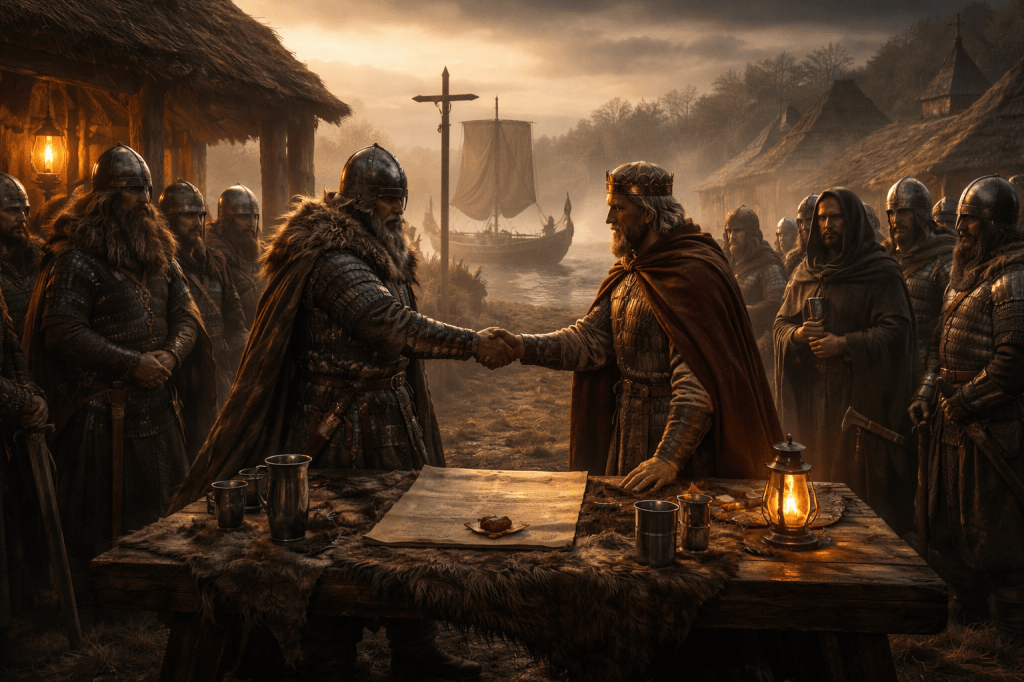
Where treaty replaced open war, and England was divided between Saxon and Viking rule.
Where the River Marked the Land, and England Began to Divide
The road east from Wessex held the rain from the night before, and every rut in the track carried a long strip of pale sky in broken reflection. Dawn had come slowly over the low country, drawing a thin silver light across meadow grass, reed beds, and the dark water gathered along the edges of the ford. Mist still lay close to the river, drifting in loose folds between willow trunks and alder roots, while beyond the crossing the land opened into wet pasture and scattered ploughland rising towards farms whose roofs shone faintly under the first weak sun. Crows moved over the fields in ragged lines, lifting and settling again as riders approached, and the whole countryside seemed to hold itself in a quiet that belonged to early spring, though the years behind it had left too many wounds for any English road to feel truly ordinary.
Osric reached the ford before the light had fully strengthened. He drew his horse to a halt on the western bank and sat for a moment with rain-dark reins gathered in one hand, looking across the water towards the shapes waiting on the far side. Three men stood beside a cart half veiled by mist, broad-shouldered and cloaked against the chill, with round shields hanging from the vehicle’s side and a pair of timber posts laid along its bed. One of them rested both hands upon the rim of the cart and watched the western bank with the still patience of a man long used to measuring strangers before he spoke to them. Behind Osric, a priest adjusted the folds of his travelling cloak, while two spearmen shifted their footing in the wet grass and looked towards the river with a wariness that came from memory as much as instinct. The battle at Edington had passed, Guthrum had yielded, Alfred had held his kingdom, and yet even now a crossing such as this carried the old feeling that one wrong word might wake the violence lying only just beneath the surface.
Osric had ridden through enough of southern England since the victory to know how little a peace could resemble rest. Villages stood where smoke still marked repairs made after winter raids. Churches had received new timbers where roof beams had burned or fallen. In market streets that had once emptied at the first rumour of a Danish force, traders had returned to their stalls, though every man still glanced towards the road when hooves sounded in the distance. The kingdom had survived, though survival had opened the way to a harder truth. Guthrum’s followers had come to England for war, yet many of them had stayed for land, silver, and harvests. Their camps had grown into settlements, their river routes into lines of trade, their winter quarters into defended towns. The war had changed shape before Edington, and what followed the battle would change it further still.
The ford before him formed only a small point on a wider map, though such places had begun to matter in a new way. Messages had gone out after Guthrum’s submission. Oaths had been taken. Priests, reeves, landholders, and armed escorts had travelled under the authority of kings to witness agreements that would define where one rule gave way to another. In time people would speak of the Danelaw, of those eastern and northern regions where Danish custom held force within England, though on mornings like this the change took form through timber posts, river crossings, and men standing in damp ground to decide how far a king’s reach extended. Osric understood that well enough, even if the full shape of what they were making still lay beyond sight.
The priest touched his sleeve and nodded towards the opposite bank. The men across the water had begun to move. Their horses stayed behind with the cart while the older of the three stepped down towards the shallows, boots sinking into the soft margin where reeds bent under his weight. He wore a dark wool tunic beneath his cloak and carried a sword of good workmanship at his side, plain in its fittings though well kept, with the sort of wear that came from long use rather than display. His beard showed threads of grey, and there was a heaviness around the eyes that made him seem older than his frame alone suggested. When he spoke to the two younger men beside him, the words came in a northern tongue that still sounded harsh and sea-shaped to Osric’s ear, though he had begun to hear it often enough in the months since Edington that certain phrases no longer passed entirely beyond understanding.
Osric urged his horse forward and entered the ford. Water rose around the animal’s legs with a low, cold rush, carrying broken reflections of sky and willow branches downstream. The priest followed, lifting his robe clear of the current, and the spearmen came after them in close order. By the time they reached the centre of the crossing, the men from the eastern bank had done the same, and for a few moments they all stood in the river itself with the current moving around them, as if the water marked the old uncertainty through which they had to pass before any new order could be fixed upon the land. Osric gave his name and the authority under which he rode. The older Scandinavian answered in careful English, shaped by a thick accent though plain enough in meaning. He called himself Hrafn and said he stood for those holding land in Guthrum’s peace east of the crossing.
They climbed together to the eastern bank where the ground rose into a strip of firmer meadow. The priest opened a waxed cloth and drew out a folded document, its edges damp from the journey though still carefully protected. He read the Latin first in the formal manner expected of him, his voice moving steady and low through words few men there could have followed in their fullness, then he gave the substance of it in English for all present. Alfred’s authority held west of the ford. Guthrum’s authority held east of it. The crossing itself remained open for lawful trade and passage under agreed tolls, and any dispute arising there would be judged according to the terms already witnessed by men of standing further south. Hrafn listened with his head slightly bent, his gaze shifting from the priest to the river and then to the western fields where farm smoke had begun to rise in straight pale threads now that the air was warming. When the reading ended, he gave a single nod and turned towards the cart.
The two younger Scandinavians lifted one of the timber posts and carried it to the edge of the ford. Osric’s spearmen stepped forward to help, and for a moment men who would once have met in shield walls stood shoulder to shoulder over a hole cut into wet ground. The timber smelled fresh from the axe. Earth clung dark and heavy to the spades. Hrafn measured the place with his eye, spoke a few words in Danish, then repeated them in rougher English for Osric’s sake. The marker would stand where road, meadow, and water met, visible from either side. No one argued. They lowered the post into the earth and began to hammer it down with wooden mallets taken from the cart. Each blow carried out across the meadow in a dull, deliberate rhythm, and with every strike the thing they had come to mark took on more reality. By the time the post stood firm above the wet bank, the mist had thinned to pale threads drifting away from the river into the open fields.
Life had begun to stir more fully around them. A woman from the nearest farm had come into her yard and stood with a bucket in one hand, watching the work with the guarded stillness of someone who had learned to measure change before she trusted it. Along the road to the north, three traders approached with packhorses loaded in wool wrappings and hide. They slowed when they saw armed men beside the crossing, and for a moment the old caution moved plainly across their faces. Then one of them recognised Osric and raised a hand. Another looked towards Hrafn and spoke a greeting in halting Danish that drew the first shadow of amusement across the older man’s face. The reply came in the same mingled way, half English, half northern speech, practical in tone and shaped by trade rather than friendship. Salt, wool, iron fittings, grain, silver by weight, tolls at the crossing, prices in the next market. Such words travelled more easily than oath or affection, and as Osric listened he felt with unusual clarity that the future of this boundary would depend as much upon men like these as upon the kings whose names stood behind the treaty.
The second post went up a little further along the road where the meadow narrowed and the higher ground began. By then the sun had risen above the low vapour of the river and the land lay open in full spring light, rich and raw from rain, beautiful in a way that only sharpened the memory of what had recently passed across it. Osric looked east along the track Hrafn’s cart had followed and imagined the settlements beyond, places where Danish speech had become the sound of household and market, where old English estates now answered to new lords, where children born after the first invasions would grow up knowing this mixed country as the only one they had ever had. He looked west and thought of Alfred’s lands, of churches repaired, burhs strengthened, and a kingship that had survived close to ruin and emerged from the marshes with greater purpose than before. The line between those worlds had now been marked in wood and wet earth, though he could already sense that no line would hold the deeper currents entirely apart.
That was the harder truth lying within the peace. Wessex had endured, and Alfred had forced Guthrum to accept terms, undergo baptism, and leave the south and west secure under Saxon rule. Yet England had not returned to the shape it held before the long years of invasion. Large regions would remain in Scandinavian hands. Their law would continue. Their customs would continue. Their farms, ports, and defended towns would root themselves more deeply into the country with every passing season. Over time their words would settle into place names and daily speech, their habits into trade and landholding, their presence into the ordinary fabric of life. The settlement born from Edington carried triumph for Alfred, and it also carried recognition that the Northmen were now part of England’s future.
When the work was finished, Osric and Hrafn stood a little apart from the others beside the first post. The river moved below them with a quiet, steady force, sliding over stones and through reed shadows as it had long before either of their kings laid claim to its banks. Hrafn rested one hand upon the damp timber and looked across the water. He said something then in his own tongue, low and thoughtful, and after a moment he gave the sense of it in English. Too many men had died for this stretch of land. Osric answered that too many more would die if peace failed now. Hrafn inclined his head, and for a brief instant the understanding between them felt less like trust than like shared weariness, though it held enough weight to matter.
They parted soon after. Hrafn and his men turned east with the cart, following the road into the country that would live under Guthrum’s settlement. Osric mounted and rode west with the priest and the spearmen, the hooves of their horses darkening the road as they passed back through meadow and ploughland towards Alfred’s side of the boundary. Behind them, the timber posts remained upright beside the ford, plain against the brightening day, though what they marked would reach far beyond that quiet crossing. The birth of the Danelaw had begun through moments such as this, through treaty after battle, through river lines and measured roads, through men who carried memory of war into the work of defining peace. England had been divided between Saxon and Viking rule, and from that division a new and lasting mingling would grow, shaping the land long after the voices at the ford had fallen silent and the spring water had moved on beneath the crossing.
Timeline of Events
878 AD – Alfred defeated Guthrum at Edington, halting the Viking advance into Wessex.
878 AD – Guthrum submitted after the defeat and accepted baptism, with Alfred standing as his sponsor.
879 AD – Guthrum and his followers moved into East Anglia, where Scandinavian settlement took firmer root.
c. 878–886 AD – A longer peace began to take shape between Alfred’s kingdom and the lands held by Guthrum, as the frontier between Saxon and Viking authority became more clearly defined.
c. 886 AD – The Treaty of Alfred and Guthrum set out boundary terms and the legal framework for peace, trade, and coexistence between the two sides. The exact date remains debated, though many historians place it around this year
About the Creator
This Chronicle is written by Simon Phillips, author of several historical and speculative fiction works exploring forgotten worlds, myth, and the turning points of history.
The account that follows moves from the quiet marking of a boundary into the wider transformation that followed Edington, as treaty, baptism, settlement, and law began to divide England between Saxon and Viking rule, and a new order slowly took shape across the land. Readers supporting The Forgotten Chronicle may continue into the full record below.
Subscribe to continue reading
Subscribe to get access to the rest of this post and other subscriber-only content.
When Viking raiders crossed the North Sea not for plunder, but for conquest, and the kingdoms of England faced an invasion unlike any they had known before.
East Anglia, AD 865
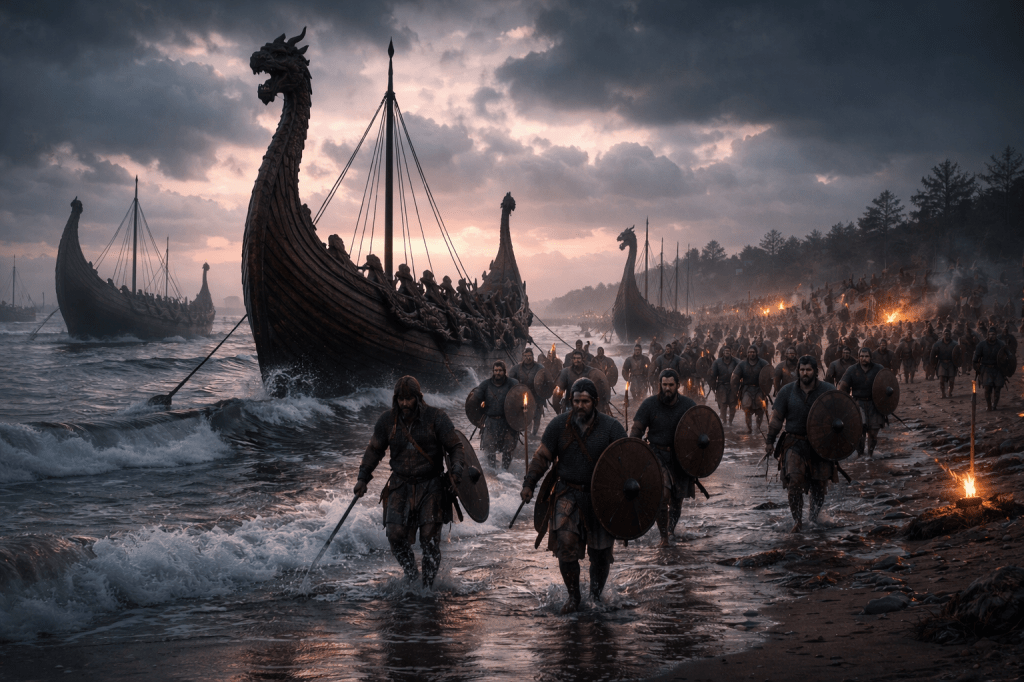
Late summer light lay across the waters of the North Sea as the longships came westward. Their prows rose and fell with the grey swell, carved beasts lifting above the spray as if ancient spirits guided the fleet across the restless tide. Sailcloth hung heavy with salt wind, striped patterns shifting beneath a sky where low cloud drifted in slow procession. Rowers moved in steady rhythm beneath the wooden ribs of the vessels, oars dipping and lifting as the shoreline of East Anglia began to gather form upon the horizon. From the sea the land appeared low and quiet, a line of marsh and sand broken by darker woods inland, fields stretching beyond toward villages where the harvest season had already begun.
Fishermen along the coast first glimpsed the shapes that morning, dark silhouettes rising from the mist beyond the shallows. At first glance the ships resembled many others that crossed these waters in trade, vessels from Frisia or the Danish coasts bringing amber, furs, iron tools, and news from distant shores. As the fleet pressed closer the number of hulls became clear, their ranks spreading across the sea in disciplined order. Shields lined the rails in painted rows of red, yellow, and black, a wall of colour against the pale surf. Warriors gathered along the decks in mail and leather, helms catching the muted light while spearheads glimmered above the gunwales. Word travelled inland through farm tracks and village paths as riders hurried across the fields, their warnings carried from settlement to settlement while the tide lifted the longships toward the beaches.
By afternoon the fleet reached the mouth of a quiet estuary where sandbars curved along the coast like pale ribs beneath the water. The first vessels grounded upon the shore with a grinding of timber and stone, keels sliding across wet sand as men leapt into the surf and hauled ropes forward. More ships followed in a widening arc, sails falling as crews dragged them higher along the strand. Smoke from village hearths drifted above the distant fields while the army gathered along the waterline in growing numbers, voices rising through the wind as banners lifted above the ranks. These arrivals carried a different purpose from the fleeting raids remembered along the coasts of Northumbria and Mercia. Camps began to take shape among the dunes as wagons were drawn ashore, horses led down the ramps of larger vessels, and scouts rode inland through the open country. The people of East Anglia watched from the edges of woodland and farmland as the strangers established their presence upon the shore, an encampment of warriors whose intentions stretched far beyond a swift strike against monastery or market town. Across the fading light of that evening the longships rested upon the beach in long dark lines, their carved prows facing the sea while the fires of the newly arrived host flickered against the gathering dusk.
Timeline of Events
793 AD — Viking raiders attack the monastery of Lindisfarne off the coast of Northumbria, marking the beginning of recorded Viking raids on England.
Late 8th to mid 9th century — Small Viking fleets strike monasteries, ports, and coastal settlements across Britain and Ireland, usually arriving in summer and departing with plunder before winter.
Early 860s — Scandinavian war leaders begin assembling larger forces across Denmark and Norway, bringing together warriors who had previously raided in smaller groups.
865 AD — A vast Viking host later known as the Great Heathen Army crosses the North Sea and lands in East Anglia, marking the shift from seasonal raids to organised invasion.
866–867 AD — The army marches north and captures York, overthrowing the Northumbrian kings and establishing Viking control over the city.
870–871 AD — Viking forces campaign across Mercia and Wessex, leading to major battles with the West Saxon kingdom.
About the Creator
This Chronicle is written by Simon Phillips, author of several historical and speculative fiction works exploring forgotten worlds, myth, and the turning points of history.