Where treaty replaced open war, and England was divided between Saxon and Viking rule.
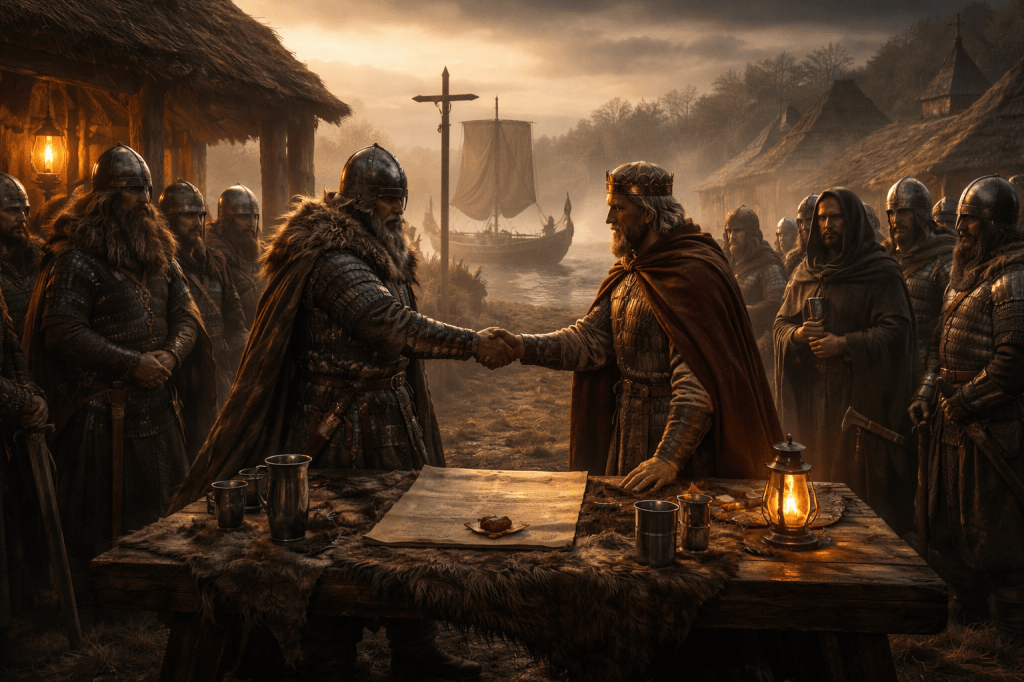
Where the River Marked the Land, and England Began to Divide
The road east from Wessex held the rain from the night before, and every rut in the track carried a long strip of pale sky in broken reflection. Dawn had come slowly over the low country, drawing a thin silver light across meadow grass, reed beds, and the dark water gathered along the edges of the ford. Mist still lay close to the river, drifting in loose folds between willow trunks and alder roots, while beyond the crossing the land opened into wet pasture and scattered ploughland rising towards farms whose roofs shone faintly under the first weak sun. Crows moved over the fields in ragged lines, lifting and settling again as riders approached, and the whole countryside seemed to hold itself in a quiet that belonged to early spring, though the years behind it had left too many wounds for any English road to feel truly ordinary.
Osric reached the ford before the light had fully strengthened. He drew his horse to a halt on the western bank and sat for a moment with rain-dark reins gathered in one hand, looking across the water towards the shapes waiting on the far side. Three men stood beside a cart half veiled by mist, broad-shouldered and cloaked against the chill, with round shields hanging from the vehicle’s side and a pair of timber posts laid along its bed. One of them rested both hands upon the rim of the cart and watched the western bank with the still patience of a man long used to measuring strangers before he spoke to them. Behind Osric, a priest adjusted the folds of his travelling cloak, while two spearmen shifted their footing in the wet grass and looked towards the river with a wariness that came from memory as much as instinct. The battle at Edington had passed, Guthrum had yielded, Alfred had held his kingdom, and yet even now a crossing such as this carried the old feeling that one wrong word might wake the violence lying only just beneath the surface.
Osric had ridden through enough of southern England since the victory to know how little a peace could resemble rest. Villages stood where smoke still marked repairs made after winter raids. Churches had received new timbers where roof beams had burned or fallen. In market streets that had once emptied at the first rumour of a Danish force, traders had returned to their stalls, though every man still glanced towards the road when hooves sounded in the distance. The kingdom had survived, though survival had opened the way to a harder truth. Guthrum’s followers had come to England for war, yet many of them had stayed for land, silver, and harvests. Their camps had grown into settlements, their river routes into lines of trade, their winter quarters into defended towns. The war had changed shape before Edington, and what followed the battle would change it further still.
The ford before him formed only a small point on a wider map, though such places had begun to matter in a new way. Messages had gone out after Guthrum’s submission. Oaths had been taken. Priests, reeves, landholders, and armed escorts had travelled under the authority of kings to witness agreements that would define where one rule gave way to another. In time people would speak of the Danelaw, of those eastern and northern regions where Danish custom held force within England, though on mornings like this the change took form through timber posts, river crossings, and men standing in damp ground to decide how far a king’s reach extended. Osric understood that well enough, even if the full shape of what they were making still lay beyond sight.
The priest touched his sleeve and nodded towards the opposite bank. The men across the water had begun to move. Their horses stayed behind with the cart while the older of the three stepped down towards the shallows, boots sinking into the soft margin where reeds bent under his weight. He wore a dark wool tunic beneath his cloak and carried a sword of good workmanship at his side, plain in its fittings though well kept, with the sort of wear that came from long use rather than display. His beard showed threads of grey, and there was a heaviness around the eyes that made him seem older than his frame alone suggested. When he spoke to the two younger men beside him, the words came in a northern tongue that still sounded harsh and sea-shaped to Osric’s ear, though he had begun to hear it often enough in the months since Edington that certain phrases no longer passed entirely beyond understanding.
Osric urged his horse forward and entered the ford. Water rose around the animal’s legs with a low, cold rush, carrying broken reflections of sky and willow branches downstream. The priest followed, lifting his robe clear of the current, and the spearmen came after them in close order. By the time they reached the centre of the crossing, the men from the eastern bank had done the same, and for a few moments they all stood in the river itself with the current moving around them, as if the water marked the old uncertainty through which they had to pass before any new order could be fixed upon the land. Osric gave his name and the authority under which he rode. The older Scandinavian answered in careful English, shaped by a thick accent though plain enough in meaning. He called himself Hrafn and said he stood for those holding land in Guthrum’s peace east of the crossing.
They climbed together to the eastern bank where the ground rose into a strip of firmer meadow. The priest opened a waxed cloth and drew out a folded document, its edges damp from the journey though still carefully protected. He read the Latin first in the formal manner expected of him, his voice moving steady and low through words few men there could have followed in their fullness, then he gave the substance of it in English for all present. Alfred’s authority held west of the ford. Guthrum’s authority held east of it. The crossing itself remained open for lawful trade and passage under agreed tolls, and any dispute arising there would be judged according to the terms already witnessed by men of standing further south. Hrafn listened with his head slightly bent, his gaze shifting from the priest to the river and then to the western fields where farm smoke had begun to rise in straight pale threads now that the air was warming. When the reading ended, he gave a single nod and turned towards the cart.
The two younger Scandinavians lifted one of the timber posts and carried it to the edge of the ford. Osric’s spearmen stepped forward to help, and for a moment men who would once have met in shield walls stood shoulder to shoulder over a hole cut into wet ground. The timber smelled fresh from the axe. Earth clung dark and heavy to the spades. Hrafn measured the place with his eye, spoke a few words in Danish, then repeated them in rougher English for Osric’s sake. The marker would stand where road, meadow, and water met, visible from either side. No one argued. They lowered the post into the earth and began to hammer it down with wooden mallets taken from the cart. Each blow carried out across the meadow in a dull, deliberate rhythm, and with every strike the thing they had come to mark took on more reality. By the time the post stood firm above the wet bank, the mist had thinned to pale threads drifting away from the river into the open fields.
Life had begun to stir more fully around them. A woman from the nearest farm had come into her yard and stood with a bucket in one hand, watching the work with the guarded stillness of someone who had learned to measure change before she trusted it. Along the road to the north, three traders approached with packhorses loaded in wool wrappings and hide. They slowed when they saw armed men beside the crossing, and for a moment the old caution moved plainly across their faces. Then one of them recognised Osric and raised a hand. Another looked towards Hrafn and spoke a greeting in halting Danish that drew the first shadow of amusement across the older man’s face. The reply came in the same mingled way, half English, half northern speech, practical in tone and shaped by trade rather than friendship. Salt, wool, iron fittings, grain, silver by weight, tolls at the crossing, prices in the next market. Such words travelled more easily than oath or affection, and as Osric listened he felt with unusual clarity that the future of this boundary would depend as much upon men like these as upon the kings whose names stood behind the treaty.
The second post went up a little further along the road where the meadow narrowed and the higher ground began. By then the sun had risen above the low vapour of the river and the land lay open in full spring light, rich and raw from rain, beautiful in a way that only sharpened the memory of what had recently passed across it. Osric looked east along the track Hrafn’s cart had followed and imagined the settlements beyond, places where Danish speech had become the sound of household and market, where old English estates now answered to new lords, where children born after the first invasions would grow up knowing this mixed country as the only one they had ever had. He looked west and thought of Alfred’s lands, of churches repaired, burhs strengthened, and a kingship that had survived close to ruin and emerged from the marshes with greater purpose than before. The line between those worlds had now been marked in wood and wet earth, though he could already sense that no line would hold the deeper currents entirely apart.
That was the harder truth lying within the peace. Wessex had endured, and Alfred had forced Guthrum to accept terms, undergo baptism, and leave the south and west secure under Saxon rule. Yet England had not returned to the shape it held before the long years of invasion. Large regions would remain in Scandinavian hands. Their law would continue. Their customs would continue. Their farms, ports, and defended towns would root themselves more deeply into the country with every passing season. Over time their words would settle into place names and daily speech, their habits into trade and landholding, their presence into the ordinary fabric of life. The settlement born from Edington carried triumph for Alfred, and it also carried recognition that the Northmen were now part of England’s future.
When the work was finished, Osric and Hrafn stood a little apart from the others beside the first post. The river moved below them with a quiet, steady force, sliding over stones and through reed shadows as it had long before either of their kings laid claim to its banks. Hrafn rested one hand upon the damp timber and looked across the water. He said something then in his own tongue, low and thoughtful, and after a moment he gave the sense of it in English. Too many men had died for this stretch of land. Osric answered that too many more would die if peace failed now. Hrafn inclined his head, and for a brief instant the understanding between them felt less like trust than like shared weariness, though it held enough weight to matter.
They parted soon after. Hrafn and his men turned east with the cart, following the road into the country that would live under Guthrum’s settlement. Osric mounted and rode west with the priest and the spearmen, the hooves of their horses darkening the road as they passed back through meadow and ploughland towards Alfred’s side of the boundary. Behind them, the timber posts remained upright beside the ford, plain against the brightening day, though what they marked would reach far beyond that quiet crossing. The birth of the Danelaw had begun through moments such as this, through treaty after battle, through river lines and measured roads, through men who carried memory of war into the work of defining peace. England had been divided between Saxon and Viking rule, and from that division a new and lasting mingling would grow, shaping the land long after the voices at the ford had fallen silent and the spring water had moved on beneath the crossing.
Timeline of Events
878 AD – Alfred defeated Guthrum at Edington, halting the Viking advance into Wessex.
878 AD – Guthrum submitted after the defeat and accepted baptism, with Alfred standing as his sponsor.
879 AD – Guthrum and his followers moved into East Anglia, where Scandinavian settlement took firmer root.
c. 878–886 AD – A longer peace began to take shape between Alfred’s kingdom and the lands held by Guthrum, as the frontier between Saxon and Viking authority became more clearly defined.
c. 886 AD – The Treaty of Alfred and Guthrum set out boundary terms and the legal framework for peace, trade, and coexistence between the two sides. The exact date remains debated, though many historians place it around this year
About the Creator
This Chronicle is written by Simon Phillips, author of several historical and speculative fiction works exploring forgotten worlds, myth, and the turning points of history.
You can explore his books here:
Books by Simon Phillips
You can watch his YouTube channel here:
Author Simon Phillips
Continuing the Chronicle
The account that follows moves from the quiet marking of a boundary into the wider transformation that followed Edington, as treaty, baptism, settlement, and law began to divide England between Saxon and Viking rule, and a new order slowly took shape across the land.
Readers supporting The Forgotten Chronicle may continue into the full record below.

Subscribe to continue reading
Subscribe to get access to the rest of this post and other subscriber-only content.
