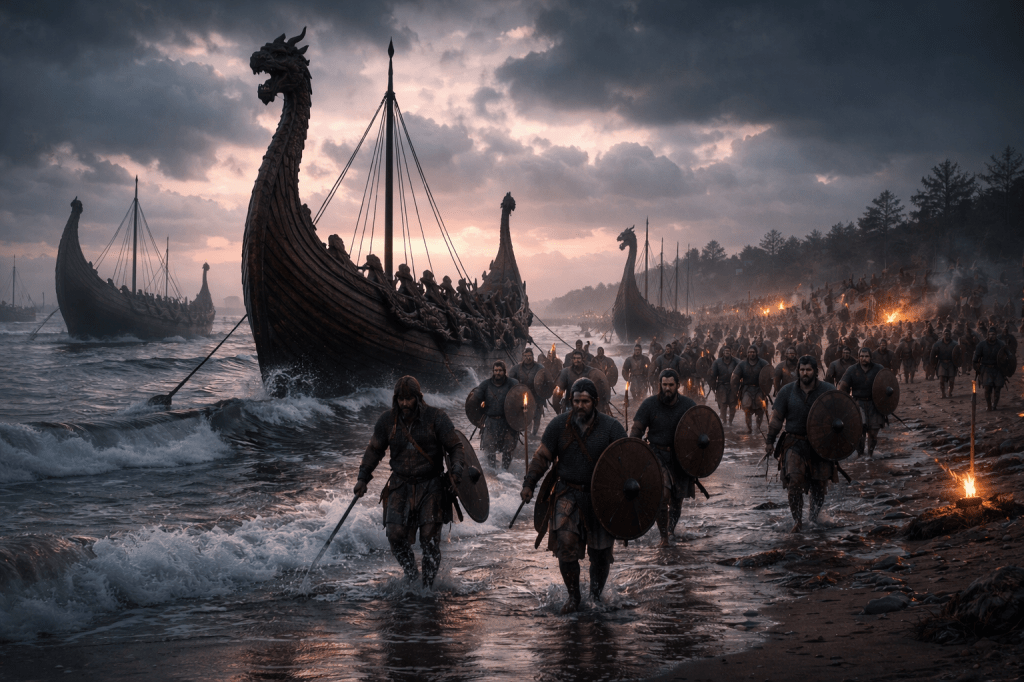
The Forgotten Chronicle: The Legacy of the Northmen

How the Viking Age reshaped England through towns, language, law, trade, and the long inheritance left by the settlers from the north.
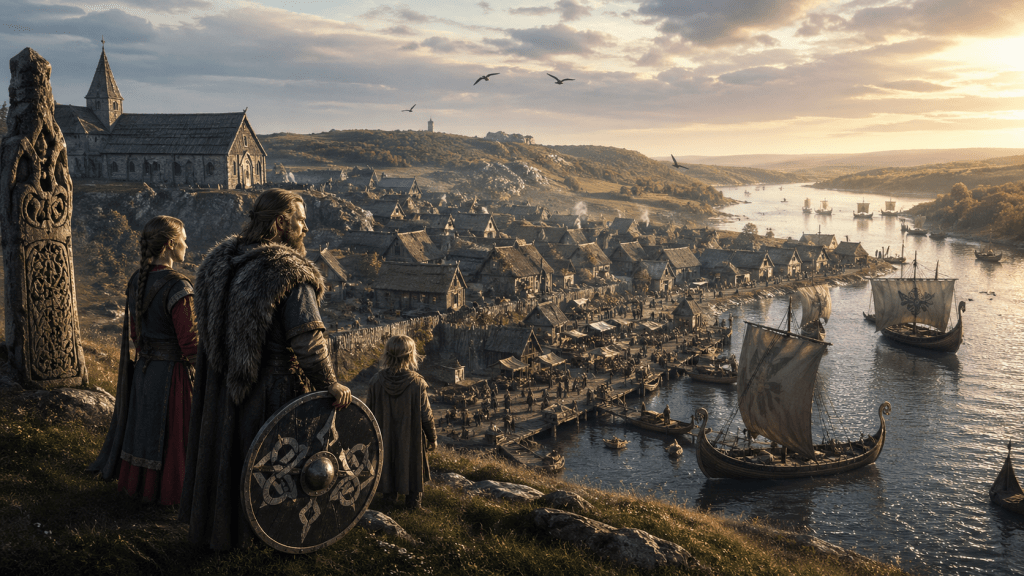

Where the Longships Became Streets

The morning light came slowly over York, spreading through river mist and smoke until timber roofs, wharf posts, church towers, and the old Roman stones emerged from the grey. The Ouse moved beneath a skin of pale silver, carrying scraps of reed, reflected cloud, and the dark shapes of moored ships along its current. Hearth smoke rose from the town in thin threads, smelling of damp wood, peat, fish, bread, and iron. Before the sun had cleared the eastern fields, men were already at work along the quay, boots striking wet planks as they hauled rope, shifted barrels, and called to one another across the water in speech shaped by more than one people. English passed into Danish. Danish returned softened by English mouths. The sounds had once belonged to enemies. Now they belonged to trade.

Eadwine stood near the landing stage with a folded length of wool across one arm, watching a ship drift in from the bend of the river. Its hull rode low from cargo, dark and broad against the water, while the carved prow leaned forward as if scenting the town ahead. Older folk still watched such vessels with care. A grey-haired woman near the fish stalls paused with her basket held close to her hip. A priest crossing from the churchyard glanced up from beneath his hood. Two boys who had been wrestling in the mud grew still for a moment, caught by the shape of the prow and the memory it carried through stories told beside winter fires. Then the rope was thrown, the sailors shouted, and the quay breathed again.

The ship had come with hides, antler, amber beads, iron fittings, barrels of salt fish, and men who expected prices, weights, ale, tolls, and gossip before sunset. Its arrival stirred alertness rather than panic. York had changed since the first terror of longships. The old fear had settled into habit, then into bargaining, then into the deeper pattern of life itself. Eadwine had been born after the fiercest years of invasion, yet their shadow lay across every street he knew. His father had spoken of Lindisfarne in a lowered voice, of monks surprised by the sea and holy places stripped by men whose names Christian scribes had written with horror. His grandfather had remembered riders coming inland with warnings from the coast, carrying stories of ships narrow enough to climb rivers and fast enough to vanish before help arrived.

Those stories still lived in England’s memory, though the town before Eadwine belonged to a later chapter of the same long struggle. The Northmen had come with sail and sword, then remained with plough, household, law, and market. They had taken towns, raised halls, married into families, buried their dead in English soil, christened children, argued over rents, weighed silver, and watched sons grow up speaking words from both sides of the sea. Their presence had altered York in ways a battle account could barely hold. It showed in brooches at women’s shoulders, in the cut of tunics, in the names shouted across the lane, in the way merchants judged silver by weight and witnesses settled quarrels before tempers drew steel.

A boy ran past with a basket of horn pieces clutched against his chest, laughing as a girl pursued him between the stalls. He shouted back in the mixed speech of the town, quick and easy, while she answered in words that would have sounded strange in a southern court yet ordinary beside the Ouse. Near them, a woman with a Scandinavian brooch fixed to her dress argued over a measure of wool with an English trader whose own household had kin under Danish law. Her voice rose. His hand struck the edge of the scale. A bystander offered judgement and earned a glare from both of them. A moment later the silver changed hands, the cloth was folded, and the quarrel passed into the morning like smoke.

Eadwine moved along the quay, greeting men as he went. Some answered in English. Some answered in Danish. Others gave only a nod, which served well enough among people who had hauled cargo together through rain, flood, and frost. He knew the men by work before he knew them by blood. Ketill with the scarred cheek handled rope as well as any sailor on the river. Leofric kept accounts for three merchants and cursed in Danish whenever his wax tablets went missing. Sigrid, whose mother had come from a settler family near the Humber, bought wool with a sharper eye than any reeve. These lives crossed so often that origin mattered less in the market than trust, price, and memory.

Above the stalls, the town opened into its full morning labour. Smiths fed their fires until orange light flickered under low eaves. Antler workers laid pale lengths of horn across benches, ready for combs, pins, and gaming pieces. Leatherworkers hung belts and shoes from hooks darkened by smoke. A boatman rolled a barrel towards the weighing place while a scribe from a church house lifted his robe clear of the mud and muttered at two sailors carrying a spar across his path. Bells sounded from a church whose stones had watched rulers change, tongues mingle, and old loyalties settle into newer shapes around its walls.

Eadwine’s own house carried that mingling in quiet forms. His mother’s family had farmed land outside the city before Scandinavian lords claimed power across the region. His wife’s father descended from settlers whose first holding had come through a warrior’s share, then passed into family labour and harvest. In their hall, feast days followed the Christian year, yet old sea-borne names clung to cousins, fields, tools, and tales. His youngest son bore an English saint’s name; his daughter answered to a name brought across the water generations earlier. They ate from the same hearth. They learned the same prayers. They quarrelled in whatever words came quickest.

At the end of the wharf, the toll keeper sat beneath a patched awning with a stylus in hand and a wax tablet balanced upon his knee. He marked goods as they came ashore, each barrel and bundle folded into the town’s obligations. Law here carried deep traces of Danish rule, especially in compensation, oath, local judgement, and the value placed upon witness. Yet authority from the south had begun to press more firmly upon such places, drawing older territories into wider English ambitions. To men in halls, these matters belonged to kingship and settlement. On the quay, they became tolls paid grudgingly, disputes recorded carefully, and the steady question of who held the right to judge when anger turned to injury.

The incoming ship kissed the landing stage with a long wooden groan. Ropes flew. Men hauled the vessel tight, their bodies leaning as one against the pull of the river. A red-bearded sailor climbed over the side, his cloak stiff with dried salt, his grin broad beneath a cap darkened by spray. He called Eadwine by the shortened name used by traders along the quay and asked whether wool prices had grown kinder since his last journey. Eadwine lifted the folded cloth on his arm and told him kindness belonged to saints, while markets belonged to men with sharp eyes. Laughter moved along the wharf, brief and warm in the morning chill.

Beyond the laughter lay the inheritance that no single man there could fully see. The first longships had carried fear into England; the later settlements carried change into speech, law, trade, and belonging. Village names across the east and north held the memory of Scandinavian settlement. Fields, roads, lanes, and farmsteads carried sounds born across the sea, repeated so often that their foreignness faded from ordinary mouths. Words entered the language through labour, household life, law, weather, seafaring, quarrels, and bargains. What people needed, they kept. What they kept, they passed on.

A cart creaked past with grain sacks bound for a storehouse near the old walls. The driver clicked his tongue at the horse and cursed the mud with words Eadwine recognised from both sides of his family. A monk might have separated the tongues with ink and care. A trader simply understood. Further up the street, men gathered outside a hall to hear judgement in a dispute over damaged tools and unpaid labour. Witnesses had been called. Reputation would matter. Compensation would matter. The settlement of the dispute would keep neighbours from carrying resentment back to blade and blood. Law lived in such moments, carried through memory, custom, shame, and the hard need to keep peace in streets where old violence had left long echoes.

The sun cleared the rooftops at last, laying gold across wet thatch and river water. The carved prow of the ship shone for a brief space, the old sea-beast bright under the light before shadow returned to its weathered face. Eadwine looked from the prow to the town rising behind the wharf: workshops open, bells sounding, smoke lifting, stalls filling, children shouting, traders weighing silver in the mud. York had been seized in war, yet war alone could never explain what it had become. It had turned into a place where conquest hardened into settlement, settlement into habit, and habit into the daily shape of a changed country.

Across England, the same transformation had unfolded in many forms. It lived in fortified towns, in river ports, in farms carved from old estates, in markets where men tested weights under watchful eyes, and in households where children inherited names from both peoples. It lived in laws spoken over compensation, in boats drawn up beside English riverbanks, in churchyards where Scandinavian families buried their dead beneath Christian signs, and in the speech of those who grew up with more than one world at their tongue’s edge. The scars of the Viking Age remained, deep and undeniable, yet beside them grew an inheritance of trade, craft, settlement, and mingled life.

By midmorning the quay had filled. Goods came ashore. Silver passed from hand to hand. Bells rang again from the church, their sound mixing with gull cries, shouted prices, and the heavy splash of oars beyond the moorings. Eadwine turned back towards the market with wool across his arm and river damp at the hem of his tunic, moving through a town made from memory, labour, old fear, and new belonging. Behind him, the ship rested quietly against the wharf, its prow facing inland, as if the sea had delivered its last threat long ago and left England to live with what had followed.


Timeline of Events

793 AD – The raid on Lindisfarne marked the beginning of the Viking Age in England, bringing sudden northern violence into the Christian memory of the island.

865 AD – The Great Heathen Army arrived in England, shifting Viking activity from coastal raiding towards conquest, occupation, and settlement.

866 AD – York fell to Viking forces and became one of the most important Scandinavian centres in England, later known as Jórvík.

878–886 AD – Alfred’s victory over Guthrum and the later settlement between them helped define the division between Saxon and Viking authority.

9th–10th centuries AD – Scandinavian settlement reshaped towns, trade, law, speech, and place names across eastern and northern England, leaving a legacy that endured long after the first Viking armies had passed into history.


About the Creator

This Chronicle is written by Simon Phillips, author of several historical and speculative fiction works exploring forgotten worlds, myth, and the turning points of history.

You can explore his books here:
Books by Simon Phillips

You can watch his YouTube channel here:
Author Simon Phillips


The Chronicle

The river carried York’s morning into the wider world, bearing the smell of smoke, fish, tar, wool, and wet timber beneath a sky clearing after rain. Eadwine crossed from the wharf into the market street with the folded length of wool still over his arm, his boots darkened by river mud as voices rose around him. Men argued over tolls beneath a patched awning, while two women examined amber beads beside combs and bone pins. A priest moved through the crowd with his robe lifted clear of the ruts where cart wheels had churned the ground soft. Above them, the church bell rang again across a town whose stones and streets carried more memory than any single man could hold.

York had worn many faces before the settlers from the north made it their own. Roman walls still stood in places, weathered and proud, their old strength folded into the life of a later age. Anglian kings had known the city as a centre of power and learning, a place of bishops, traders, craftsmen, and roadways reaching deep into the north. Then the Viking army had entered the story with force. In the year 866, amid division among the Northumbrians, the city fell. What had first seemed like conquest became the root of a longer inheritance, for the invaders remained. They used the walls, opened the streets to northern trade, and turned York into Jórvík, where Scandinavian rule found one of its strongest English homes.

Eadwine had heard that older story many times, told in the lowered voices of men who remembered through older kin. The fall of the city had carried the violence of a broken age, with rival English rulers unable to hold the north as the army pressed inward. Yet the town surrounding him now held more than the echo of its capture. It had the energy of a place remade through use. Workshops lined the streets close to the river. Traders came from Ireland, Frisia, the north, and the English south. Goods passed through hands shaped by different customs. Silver was weighed, leather judged by touch, wool by eye, iron by ring and balance. The whole place moved with the restless patience of a town built upon exchange.

Near the antler workers’ stalls, Eadwine stopped beside a bench where pale lengths of horn had been sorted by size. A craftsman named Skuli sat hunched over his tools, cutting the teeth of a comb with slow care. His father had come from a settler family east of the city; his mother’s kin were English and had kept a small plot near an old church boundary for generations. Skuli spoke both tongues badly when drunk and both tongues well when bargaining. He lifted the comb to the light, squinted along its edge, and grunted in satisfaction before placing it with others bound for a merchant who would carry them south.

“Fine work,” Eadwine said, running a thumb carefully along the smooth spine of another finished piece.

“Fine enough for men who lose them in straw and mud,” Skuli answered, his mouth twitching beneath his beard. “A comb travels farther than its maker. That one may sit in London before winter.”

Eadwine smiled and laid the piece down. A comb from York, shaped by hands from a mixed household, sold through northern trade, carried into a southern town under a king whose ancestors had fought the people who once seized this place. Such things rarely entered chronicles, yet they told the truth of the age with quiet force. The Viking legacy endured in craft as much as conquest. It travelled in objects small enough to fit in a palm, in the habits of workshops, and in the river routes that turned a captured town into a trading centre whose reach extended far beyond its walls.

From the market, Eadwine walked towards the old street where moneyers, reeves, and merchants gathered near the weighing place. Men there spoke in lower tones, for silver drew caution from every eye. Coins from southern kings passed beside hacksilver, cut rings, weighed fragments, and stamped pieces whose authority varied according to who accepted them. One trader held a scale with careful fingers while another placed silver into the pan a sliver at a time. The balance dipped, steadied, rose slightly, then settled. Witnesses watched with grave attention. In such moments trust rested in weight, sight, reputation, and the remembered conduct of men across many seasons.

That afternoon, Eadwine followed a crowd to a hall near the edge of the market, where a judgement was being heard over a damaged shipment of iron tools. The hall smelled of smoke, damp cloaks, rushes, and ale. Men stood along the walls, arms folded, while the disputing parties faced the reeve and elders seated near the hearth. One was an English farmer from land south of the city. The other was a trader whose family came through Scandinavian settlement two generations earlier. Voices rose quickly, then fell as the elder nearest the hearth lifted one hand. A driver swore by Christ and by the honesty of his household that the tools had been sound when loaded. A boy from the stable yard said he had seen one wheel strike a stone hard enough to split the rim. A woman who kept accounts for the trader produced a tally stick, then demanded that all present look closely at the marks.

The reeve listened with the tired expression of one who had heard every shape of blame before. When judgement came, it required payment shared between the cart owner and the receiver, with a smaller penalty placed upon the driver for leaving the damaged wheel unreported until the matter reached the hall. Few left pleased, which was often the sign of a judgement strong enough to keep the peace. Men grumbled. Silver was promised. Hands were offered reluctantly. Outside, the street swallowed the matter as quickly as the hall released it, and market noise rose again around the departing crowd. Such scenes carried little grandeur, yet they showed how deeply the age had altered England, for Scandinavian custom and older English practice had begun to meet in halls, markets, fields, and family memory.

In the days that followed, Eadwine rode out from York with a small party carrying wool, straps, and ironwork towards villages east of the city. The road passed through fields newly green under spring light. Farmsteads stood with low roofs and fenced yards, smoke rising from hearth holes while geese moved in noisy clusters beside puddled tracks. Place names on the journey told their own history. A settlement ending in by sat beside another with an older English name. A thorpe lay near woodland. A thwaite opened where clearing had cut into rougher ground. Men might argue over rulers and borders, yet the land itself had begun to remember the settlers in its speech.

At one farm, Eadwine stopped to water the horses. A child came to stare at the strangers, her hair braided tight, her eyes bright with open curiosity. Her mother called her back using a name that would have sounded at home on a northern shore, then greeted Eadwine in English shaped by local vowels. Chickens scratched near the doorway. A plough stood against a fence. A carved hammer hung from a beam beside a small cross marked into the wood by a later hand. The pairing belonged to the wall as naturally as smoke belonged to the roof beams.

The woman traded cheese and oat bread for a strap fitting from York. Her husband, broad and quiet, examined the ironwork with the care of a man who trusted metal more than promises. He had an English mother, a Scandinavian father, and fields that demanded labour whatever kings claimed above him. When Eadwine asked whether the roads had been safe, the man glanced towards the horizon and said that safety depended on the season, the tax gatherer, and the temper of neighbours. Then he smiled briefly, as if he had offered wisdom enough for one morning.

Further along the route, the party crossed a stream where an old boundary marker leaned at an angle, its inscription half lost beneath lichen. Eadwine paused there as the others went ahead. The marker belonged to an earlier order of landholding, perhaps set before the great armies came, before Guthrum’s settlement, before York’s streets filled with the noise of Jórvík. Yet the road still used it. Drovers still passed it. Children still climbed on it when elders looked away. England carried its past in layers, each age laid over the previous one, leaving fragments visible through the surface. The settlers from the north had become one of those layers, deep enough now that tearing them away would tear part of the country with them.

That truth held greatest force in York. When Eadwine returned at dusk two days later, the city glowed under smoke and low red light. The river reflected the sky in broken streaks. Ships lay black against the wharf. Bells sounded from the church, while somewhere near the market a group of men sang in a language rough with drink and memory. He passed a doorway where an English grandmother scolded a child bearing a Scandinavian name, then crossed by a smithy where a craftsman hammered a hinge for a church gate using iron traded through northern hands. The city had ceased to be one thing alone. It had become itself, shaped by conquest, adaptation, endurance, and use.

The legacy of the Viking Age across England worked in that same manner. The earliest raids had carved terror into Christian memory, and the great armies had broken kingdoms, captured towns, and forced rulers into desperate action. Yet the deeper inheritance came through the decision to stay. Fire gave way to fields. Plunder gave way to tolls. War leaders gave way to households whose children belonged to the land their fathers had once approached from the sea.

Language held that inheritance with particular intimacy. A borrowed word could enter a household more quietly than an army entered a town, then remain there for centuries. It could pass from mother to child, from ploughman to neighbour, from trader to apprentice. Some words served work, some law, some weather, some body, some anger, some friendship. They survived because they were useful, because they belonged to daily need. Place names held the same power. They fixed memory to ground so thoroughly that future generations could speak the names of villages and fields while barely sensing the old crossings hidden within them.

Years later, Eadwine would remember that spring morning at the quay more clearly than many larger events. He would remember the ship’s prow shining in the sun, the red-bearded sailor laughing over wool prices, Skuli bending over his combs, the judgement in the smoky hall, and the farm where cross and hammer shared the same beam. None of those moments had the force of battle. None carried the thunder of Edington or the dread of Lindisfarne. Yet together they revealed the inheritance the Northmen had left behind, an inheritance built through ordinary life after violence had opened the door.

As evening settled over York, he stood once more by the Ouse and watched the water darken beneath the wharves. The ships rested close against the bank, tied firm for the night. Smoke drifted above the roofs. Voices carried from the market in mingled speech, rising and falling across the damp air as naturally as the bells, the gulls, and the river itself. England had been scarred by the Viking Age, and those scars would long remain. Over generations, they became part of the body that carried them. The Northmen had come as raiders, invaders, settlers, rulers, traders, neighbours, and kin. Their legacy endured in the towns they strengthened, the laws they shaped, the words they left behind, and the lives that continued long after the first longships had vanished from the sea road.
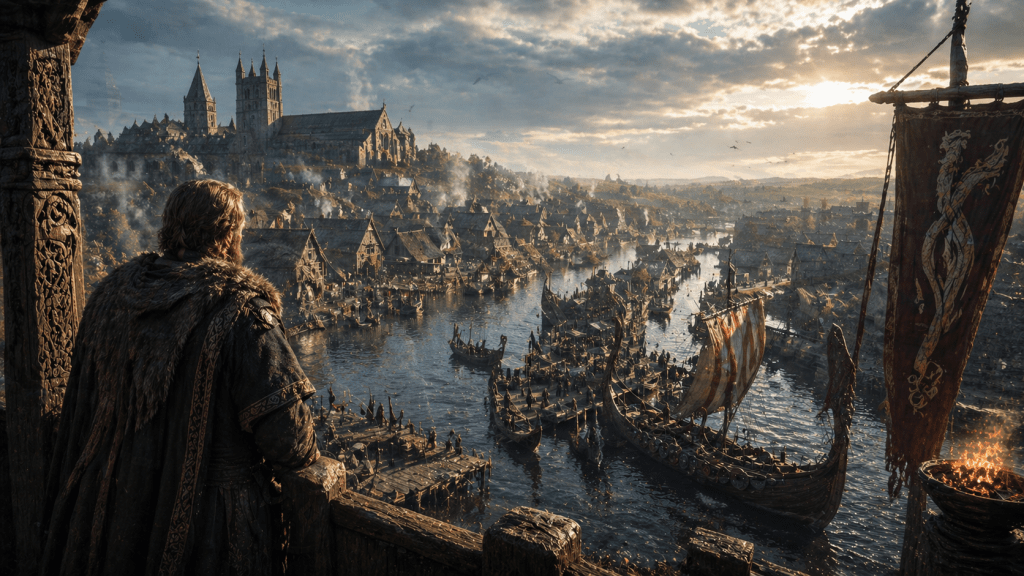

York, once seized in war, became Jórvík, a thriving centre of Viking trade, craft, settlement, and cultural exchange.


Historical Notes & Context

From Raiding to Settlement

The Viking Age in England began with sudden violence, remembered most sharply through raids such as Lindisfarne in 793. During the early phase, Viking activity often centred on coastal targets, monasteries, portable wealth, and swift movement by sea. Over time, this pattern changed. Raiding gave way to larger military campaigns, and those campaigns gave way to occupation, winter camps, political control, and long-term settlement.

By the late ninth century, the Northmen had become part of the English landscape in a far deeper way. They were no longer simply forces arriving from across the sea. They held land, controlled towns, raised families, traded goods, and shaped local custom. This shift from raider to settler created one of the most lasting legacies of the Viking Age.


York and the Rise of Jórvík

York became one of the most significant centres of Scandinavian power in England after its capture by Viking forces in 866. Known increasingly as Jórvík under Viking rule, the city became a major centre of trade, craft production, and political influence.

Its importance came from both geography and history. York already possessed old Roman walls, strong routes into the north, and an established urban identity. Viking rulers and settlers built upon that foundation, turning the city into a lively hub connected to wider trading networks across the Irish Sea, the North Sea, and continental Europe.

Archaeological evidence from York shows a rich urban world of workshops, metalworking, leatherworking, antler craft, coinage, imported goods, and everyday household life. This makes Jórvík one of the clearest examples of how Viking settlement became rooted in English towns.


Language and Place Names

One of the clearest traces of Scandinavian settlement survives in the language of England. Across the north and east, many place names preserve Old Norse influence. Endings such as -by, meaning farm or settlement, and -thorpe, meaning secondary settlement or village, reveal areas where Scandinavian communities established themselves.

These names matter because they show settlement at ground level. They suggest farms, villages, fields, and families rather than armies alone. The Viking legacy survived through the naming of places people used every day.

Scandinavian influence also entered spoken English. Some words came through law, trade, farming, weather, seafaring, and household life. Such words remained because they served ordinary need. Language changed through use, and that quiet change outlasted the political world that first allowed it to take root.


Law and the Danelaw

The word Danelaw refers to regions of England where Danish custom and legal practice held force. It was more than a simple frontier between two peoples. It marked areas where local justice, compensation, oath-taking, and community obligation carried Scandinavian influence.

This legal inheritance affected daily life. Disputes over land, injury, theft, trade, and debt had to be settled in ways recognised by local communities. In areas with strong Scandinavian settlement, older English practice existed alongside customs brought by the settlers from the north.

The result was a mixed legal landscape. English kingship expanded over time, yet local habits could remain deeply rooted. Law became one of the places where the Viking presence continued to shape England after the first age of invasion had passed.


Trade, Towns, and Craft

The Vikings are often remembered through ships and warfare, yet their long-term influence in England also came through trade and craft. Towns such as York became centres of production and exchange. Goods moved along rivers, roads, and sea routes, linking English settlements to wider northern and European networks.

Craft evidence from Viking-age York includes combs, tools, leather goods, metalwork, textiles, and everyday objects that reveal a busy urban economy. These items show a society concerned with work, status, repair, trade, and domestic life.

The same waterways that once allowed raiders to strike quickly also helped merchants move goods across regions. Over time, the ship became as much a symbol of exchange as of attack. This practical shift helped turn former centres of conflict into places of commerce and settlement.


Faith and Cultural Blending

Scandinavian settlers entered a Christian landscape, especially in towns and regions with long-established churches. Over time, many Viking settlers and their descendants adopted Christianity, though older symbols and habits could remain visible for generations.

This blending was rarely simple. It happened through marriage, patronage, burial, trade, politics, and household life. A family might carry Scandinavian names while worshipping in a Christian church. A settlement might preserve Norse place names while existing within an English ecclesiastical landscape.

The result was a society shaped by overlap. The Viking presence altered England, yet England also altered the descendants of the settlers. The legacy moved in both directions.


Why the Northmen’s Legacy Mattered

The legacy of the Northmen mattered because it reached beyond battle. The raids shocked England. The armies changed its political map. Settlement reshaped its deeper life.

By settling in towns, farms, river valleys, and market centres, Scandinavian communities became part of England’s future. Their influence endured in place names, speech, local law, urban trade, craft production, and family life. The Viking Age left scars, yet it also left structures, habits, and identities that became woven into the country itself.

This is why the final Chronicle in this series turns away from a single battlefield and towards inheritance. The Northmen first appeared as a threat from the sea. Over generations, they became neighbours, traders, rulers, craftsmen, and kin. Their legacy remained long after the first longships had vanished from the horizon.


Further Reading

For readers who wish to explore Viking settlement and the long-term Scandinavian influence on England in greater depth, several works offer valuable insight into the period.

The Anglo-Saxon Chronicle
One of the central primary sources for Viking activity in England, preserving accounts of raids, battles, settlements, and political change.

Asser’s Life of King Alfred
A near-contemporary account of Alfred’s reign, useful for understanding the crisis of Wessex and the wider consequences of Viking pressure.

The Vikings in England – D. M. Hadley
A strong study of Scandinavian settlement, local society, and the cultural impact of the Viking presence in England.

Viking Age York – Richard Hall
A detailed exploration of Jórvík, its archaeology, craft production, trade, and urban life.

The Viking World – Edited by Stefan Brink and Neil Price
A broad scholarly collection covering Viking society, expansion, settlement, trade, and cultural influence across the wider Viking world.


Inspiration Behind the Chronicle

The legacy of the Northmen carries a different weight from the earlier Chronicles in this series, because it moves beyond the first shock of arrival, invasion, battle, and settlement into the quieter question of what remained once the age had settled into ordinary life. The longships had first appeared as symbols of fear, carrying violence across the sea and into the Christian memory of England. Yet their deepest inheritance came after the raids, when the people from the north began to root themselves into towns, fields, markets, laws, and households.

What fascinates me here is the way history changed shape through daily life. A battle could alter a kingdom in a single day, while a settlement changed a country over generations. The Viking presence in England became visible in place names, speech, trade, craft, legal custom, and the growth of towns such as York. These were quieter traces than burned monasteries or battlefields, yet they reached further into the future.

For a storyteller, this final Chronicle offers a powerful kind of atmosphere. The drama lies in inheritance. A ship arriving at a wharf, a market argument, a judgement in a smoky hall, or a child speaking words from two worlds can reveal the long consequence of conquest more clearly than another scene of war. This is where history moves from event into memory, and from memory into identity.

This Chronicle closes the first Viking series by looking at the world left behind. The Northmen came first as raiders and invaders, yet over time they became settlers, traders, rulers, neighbours, and kin. Their legacy remained because England absorbed the shock of their coming and carried the imprint forward.


From the Author’s Desk

This Chronicle felt like the natural closing movement for the first Viking series, because it turns from the violence of arrival towards the world that came after. The earlier Chronicles carried us through raids, invasion, exile, battle, treaty, and division. This final piece looks at the quieter inheritance left behind, the changes that entered towns, speech, law, trade, craft, and family life.

While writing it, I kept returning to York. Jórvík offers such a powerful image for this legacy: a city taken in war, then reshaped into a living centre of trade, craft, and mixed identity. It reminds me that history rarely ends at the battlefield. The deeper consequences often appear later, in markets, workshops, river ports, and households where people learn to live inside a world altered by conflict.

That is what makes the Viking Age in England so fascinating to me. The Northmen arrived as raiders, yet their lasting presence became something far more complex. They changed the map, then the language, then the daily texture of life itself. Their influence survived because it became useful, familiar, and eventually ordinary.

This Chronicle closes the first journey of The Forgotten Chronicle, while also opening the door to future historical series built around the same question: what did it feel like to live through a world changing around you?

Alongside this Chronicle, my wider work continues through fiction and visual storytelling that explore memory, forgotten worlds, and the forces that reshape people over time.

You can explore my books here:
Books by Simon Phillips

You can watch my YouTube channel here:
Author Simon Phillips


Next Chronicle

With the first Viking series now complete, The Forgotten Chronicle will turn back towards the world that stood before, beside, and against the Northmen: the world of the Anglo-Saxons.

Before England became one kingdom, it was a landscape of rival realms, sacred places, warrior halls, royal lineages, frontier towns, monastic communities, and fragile alliances. Its story was shaped by kings and exiles, saints and warlords, scribes and shield-bearers, all living within a land where faith, power, memory, and survival pressed closely upon one another.

The next series will begin exploring that older England, the one whose fields, kingdoms, and people faced invasion, endured collapse, and helped shape the foundations of the country that followed. It will move through the atmosphere of early medieval England with the same quiet attention to place, conflict, and human experience that has guided this first journey.

The longships have left their mark upon the shore. Now the Chronicle turns towards the halls, churches, roads, and kingdoms of the Anglo-Saxons, where another part of England’s story waits to be remembered.

Next Chronicle: The Anglo-Saxon World Begins


The ships rested quietly along the river, yet the world they had carried into England would endure far beyond sail and timber, shaping the speech, law, towns, and memory of the land long after the age of the Northmen had passed into history.
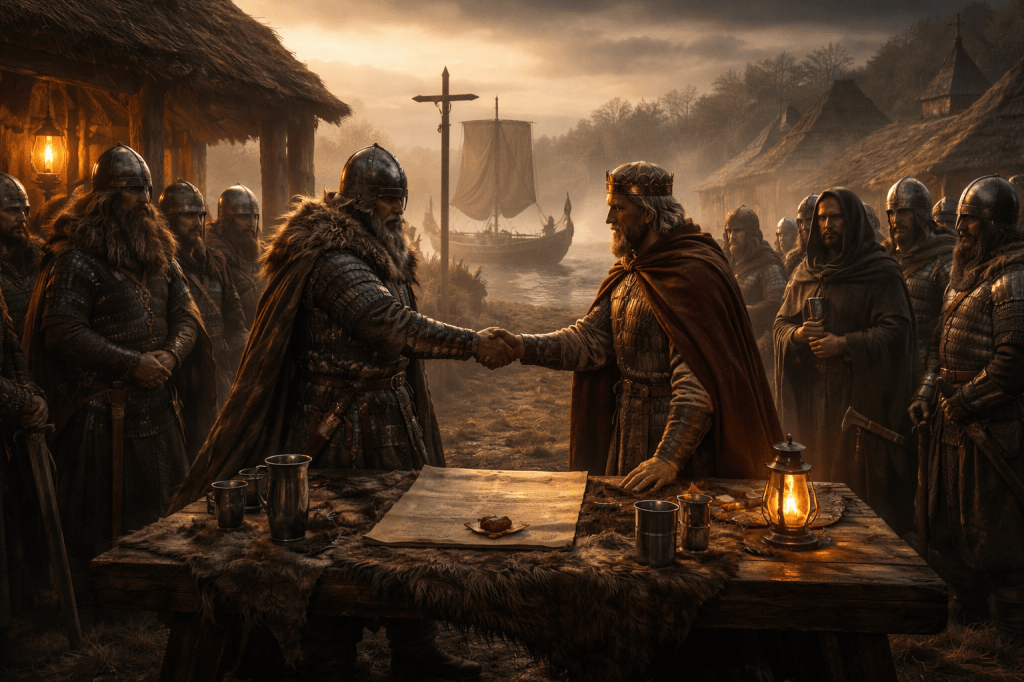
The Forgotten Chronicle: The Birth of the Danelaw

Where treaty replaced open war, and England was divided between Saxon and Viking rule.


Where the River Marked the Land, and England Began to Divide

The road east from Wessex held the rain from the night before, and every rut in the track carried a long strip of pale sky in broken reflection. Dawn had come slowly over the low country, drawing a thin silver light across meadow grass, reed beds, and the dark water gathered along the edges of the ford. Mist still lay close to the river, drifting in loose folds between willow trunks and alder roots, while beyond the crossing the land opened into wet pasture and scattered ploughland rising towards farms whose roofs shone faintly under the first weak sun. Crows moved over the fields in ragged lines, lifting and settling again as riders approached, and the whole countryside seemed to hold itself in a quiet that belonged to early spring, though the years behind it had left too many wounds for any English road to feel truly ordinary.

Osric reached the ford before the light had fully strengthened. He drew his horse to a halt on the western bank and sat for a moment with rain-dark reins gathered in one hand, looking across the water towards the shapes waiting on the far side. Three men stood beside a cart half veiled by mist, broad-shouldered and cloaked against the chill, with round shields hanging from the vehicle’s side and a pair of timber posts laid along its bed. One of them rested both hands upon the rim of the cart and watched the western bank with the still patience of a man long used to measuring strangers before he spoke to them. Behind Osric, a priest adjusted the folds of his travelling cloak, while two spearmen shifted their footing in the wet grass and looked towards the river with a wariness that came from memory as much as instinct. The battle at Edington had passed, Guthrum had yielded, Alfred had held his kingdom, and yet even now a crossing such as this carried the old feeling that one wrong word might wake the violence lying only just beneath the surface.

Osric had ridden through enough of southern England since the victory to know how little a peace could resemble rest. Villages stood where smoke still marked repairs made after winter raids. Churches had received new timbers where roof beams had burned or fallen. In market streets that had once emptied at the first rumour of a Danish force, traders had returned to their stalls, though every man still glanced towards the road when hooves sounded in the distance. The kingdom had survived, though survival had opened the way to a harder truth. Guthrum’s followers had come to England for war, yet many of them had stayed for land, silver, and harvests. Their camps had grown into settlements, their river routes into lines of trade, their winter quarters into defended towns. The war had changed shape before Edington, and what followed the battle would change it further still.

The ford before him formed only a small point on a wider map, though such places had begun to matter in a new way. Messages had gone out after Guthrum’s submission. Oaths had been taken. Priests, reeves, landholders, and armed escorts had travelled under the authority of kings to witness agreements that would define where one rule gave way to another. In time people would speak of the Danelaw, of those eastern and northern regions where Danish custom held force within England, though on mornings like this the change took form through timber posts, river crossings, and men standing in damp ground to decide how far a king’s reach extended. Osric understood that well enough, even if the full shape of what they were making still lay beyond sight.

The priest touched his sleeve and nodded towards the opposite bank. The men across the water had begun to move. Their horses stayed behind with the cart while the older of the three stepped down towards the shallows, boots sinking into the soft margin where reeds bent under his weight. He wore a dark wool tunic beneath his cloak and carried a sword of good workmanship at his side, plain in its fittings though well kept, with the sort of wear that came from long use rather than display. His beard showed threads of grey, and there was a heaviness around the eyes that made him seem older than his frame alone suggested. When he spoke to the two younger men beside him, the words came in a northern tongue that still sounded harsh and sea-shaped to Osric’s ear, though he had begun to hear it often enough in the months since Edington that certain phrases no longer passed entirely beyond understanding.

Osric urged his horse forward and entered the ford. Water rose around the animal’s legs with a low, cold rush, carrying broken reflections of sky and willow branches downstream. The priest followed, lifting his robe clear of the current, and the spearmen came after them in close order. By the time they reached the centre of the crossing, the men from the eastern bank had done the same, and for a few moments they all stood in the river itself with the current moving around them, as if the water marked the old uncertainty through which they had to pass before any new order could be fixed upon the land. Osric gave his name and the authority under which he rode. The older Scandinavian answered in careful English, shaped by a thick accent though plain enough in meaning. He called himself Hrafn and said he stood for those holding land in Guthrum’s peace east of the crossing.

They climbed together to the eastern bank where the ground rose into a strip of firmer meadow. The priest opened a waxed cloth and drew out a folded document, its edges damp from the journey though still carefully protected. He read the Latin first in the formal manner expected of him, his voice moving steady and low through words few men there could have followed in their fullness, then he gave the substance of it in English for all present. Alfred’s authority held west of the ford. Guthrum’s authority held east of it. The crossing itself remained open for lawful trade and passage under agreed tolls, and any dispute arising there would be judged according to the terms already witnessed by men of standing further south. Hrafn listened with his head slightly bent, his gaze shifting from the priest to the river and then to the western fields where farm smoke had begun to rise in straight pale threads now that the air was warming. When the reading ended, he gave a single nod and turned towards the cart.

The two younger Scandinavians lifted one of the timber posts and carried it to the edge of the ford. Osric’s spearmen stepped forward to help, and for a moment men who would once have met in shield walls stood shoulder to shoulder over a hole cut into wet ground. The timber smelled fresh from the axe. Earth clung dark and heavy to the spades. Hrafn measured the place with his eye, spoke a few words in Danish, then repeated them in rougher English for Osric’s sake. The marker would stand where road, meadow, and water met, visible from either side. No one argued. They lowered the post into the earth and began to hammer it down with wooden mallets taken from the cart. Each blow carried out across the meadow in a dull, deliberate rhythm, and with every strike the thing they had come to mark took on more reality. By the time the post stood firm above the wet bank, the mist had thinned to pale threads drifting away from the river into the open fields.

Life had begun to stir more fully around them. A woman from the nearest farm had come into her yard and stood with a bucket in one hand, watching the work with the guarded stillness of someone who had learned to measure change before she trusted it. Along the road to the north, three traders approached with packhorses loaded in wool wrappings and hide. They slowed when they saw armed men beside the crossing, and for a moment the old caution moved plainly across their faces. Then one of them recognised Osric and raised a hand. Another looked towards Hrafn and spoke a greeting in halting Danish that drew the first shadow of amusement across the older man’s face. The reply came in the same mingled way, half English, half northern speech, practical in tone and shaped by trade rather than friendship. Salt, wool, iron fittings, grain, silver by weight, tolls at the crossing, prices in the next market. Such words travelled more easily than oath or affection, and as Osric listened he felt with unusual clarity that the future of this boundary would depend as much upon men like these as upon the kings whose names stood behind the treaty.

The second post went up a little further along the road where the meadow narrowed and the higher ground began. By then the sun had risen above the low vapour of the river and the land lay open in full spring light, rich and raw from rain, beautiful in a way that only sharpened the memory of what had recently passed across it. Osric looked east along the track Hrafn’s cart had followed and imagined the settlements beyond, places where Danish speech had become the sound of household and market, where old English estates now answered to new lords, where children born after the first invasions would grow up knowing this mixed country as the only one they had ever had. He looked west and thought of Alfred’s lands, of churches repaired, burhs strengthened, and a kingship that had survived close to ruin and emerged from the marshes with greater purpose than before. The line between those worlds had now been marked in wood and wet earth, though he could already sense that no line would hold the deeper currents entirely apart.

That was the harder truth lying within the peace. Wessex had endured, and Alfred had forced Guthrum to accept terms, undergo baptism, and leave the south and west secure under Saxon rule. Yet England had not returned to the shape it held before the long years of invasion. Large regions would remain in Scandinavian hands. Their law would continue. Their customs would continue. Their farms, ports, and defended towns would root themselves more deeply into the country with every passing season. Over time their words would settle into place names and daily speech, their habits into trade and landholding, their presence into the ordinary fabric of life. The settlement born from Edington carried triumph for Alfred, and it also carried recognition that the Northmen were now part of England’s future.

When the work was finished, Osric and Hrafn stood a little apart from the others beside the first post. The river moved below them with a quiet, steady force, sliding over stones and through reed shadows as it had long before either of their kings laid claim to its banks. Hrafn rested one hand upon the damp timber and looked across the water. He said something then in his own tongue, low and thoughtful, and after a moment he gave the sense of it in English. Too many men had died for this stretch of land. Osric answered that too many more would die if peace failed now. Hrafn inclined his head, and for a brief instant the understanding between them felt less like trust than like shared weariness, though it held enough weight to matter.

They parted soon after. Hrafn and his men turned east with the cart, following the road into the country that would live under Guthrum’s settlement. Osric mounted and rode west with the priest and the spearmen, the hooves of their horses darkening the road as they passed back through meadow and ploughland towards Alfred’s side of the boundary. Behind them, the timber posts remained upright beside the ford, plain against the brightening day, though what they marked would reach far beyond that quiet crossing. The birth of the Danelaw had begun through moments such as this, through treaty after battle, through river lines and measured roads, through men who carried memory of war into the work of defining peace. England had been divided between Saxon and Viking rule, and from that division a new and lasting mingling would grow, shaping the land long after the voices at the ford had fallen silent and the spring water had moved on beneath the crossing.


Timeline of Events

878 AD – Alfred defeated Guthrum at Edington, halting the Viking advance into Wessex.

878 AD – Guthrum submitted after the defeat and accepted baptism, with Alfred standing as his sponsor.

879 AD – Guthrum and his followers moved into East Anglia, where Scandinavian settlement took firmer root.

c. 878–886 AD – A longer peace began to take shape between Alfred’s kingdom and the lands held by Guthrum, as the frontier between Saxon and Viking authority became more clearly defined.

c. 886 AD – The Treaty of Alfred and Guthrum set out boundary terms and the legal framework for peace, trade, and coexistence between the two sides. The exact date remains debated, though many historians place it around this year


About the Creator

This Chronicle is written by Simon Phillips, author of several historical and speculative fiction works exploring forgotten worlds, myth, and the turning points of history.

You can explore his books here:
Books by Simon Phillips

You can watch his YouTube channel here:
Author Simon Phillips


Continuing the Chronicle

The account that follows moves from the quiet marking of a boundary into the wider transformation that followed Edington, as treaty, baptism, settlement, and law began to divide England between Saxon and Viking rule, and a new order slowly took shape across the land.
Readers supporting The Forgotten Chronicle may continue into the full record below.

Subscribe to continue reading

Subscribe to get access to the rest of this post and other subscriber-only content.

The Battle of Edington (878)

Where a kingdom returned from exile and the fate of England was decided on open ground.


Where the Mist Lifted from Field and Shield, and a Kingdom Chose Its Ground

Morning gathered slowly over the fields of Wiltshire, where low hills rolled away beneath a sky still holding the pale remains of night. A thin veil of mist lay across the grass, drifting in slow currents that caught upon hedgerows and shallow rises, softening the edges of the land until distance and direction seemed to waver. Dew clung to every blade, and the earth beneath carried the weight of recent rain, dark and firm beneath the tread of men who had come in silence before the light.

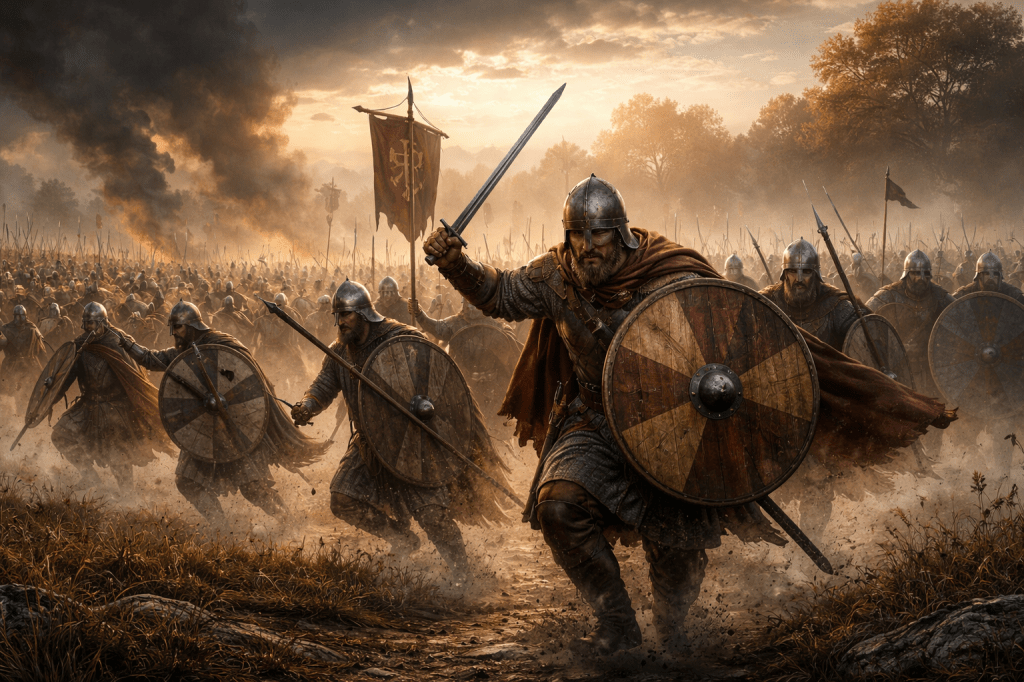
Along the higher ground, shapes emerged through the fading haze as lines of warriors took their places upon the slope. Shields rested against legs clad in wool and leather, their painted faces dulled by travel and long use, while spearheads caught the first suggestion of dawn as it pressed through the thinning cloud. Cloaks hung heavy with moisture, their edges brushing the grass as men shifted their footing upon ground that would soon bear the weight of something far greater than the quiet that held it.

There was little sound beyond the low murmur of movement, the creak of wood and strap, and the faint rustle of wind passing across the field. Voices were kept close, carried only as far as the man beside them, for the moment demanded a steadiness that words alone could not shape. Many among those gathered had come from scattered places, drawn by summons passed in secrecy through farm and village, through woodland paths and river crossings, until they had reached this ground where the fate of Wessex would be tested.

At the centre of the line, a figure stood with his gaze fixed upon the land beyond the mist, where another army waited beyond sight, its presence felt through the weight of expectation that settled across the field. The months that had passed since exile in the marshes had left their mark, shaping both the man and those who had followed him through uncertainty and loss. What had begun in concealment now stood revealed beneath the rising light, no longer hidden among reed and water, carried into the open where resolve would be measured against strength long established upon the land.

Beyond the slope, the ground fell away towards lower fields where the mist held thicker, masking the movement of those who had taken their own positions before dawn. Somewhere within that shifting veil stood the forces of Guthrum, hardened through years of campaign and settlement, their presence woven into the land through camps, roads, and the quiet control of fields once held by others. They had come to meet this challenge with the same certainty that had carried them across the island, confident in the strength that had already broken kingdoms and driven their rulers into exile.

Between these two forces, the field waited in a stillness that seemed to gather the breath of both armies into a single suspended moment. The wind moved lightly across the grass, lifting the mist in slow folds that revealed and concealed in equal measure, offering brief glimpses of shapes beyond before closing again upon them. Time stretched across that quiet space, held between what had been endured and what would soon unfold, as men stood with their thoughts turned towards the same uncertain horizon.

As the light strengthened, the shapes upon the far ground began to take clearer form, dark lines rising through the mist where the opposing force held its place. The distance between them shortened with each passing moment, not through movement, but through the slow unveiling of what had always been there, waiting beyond sight. In that gradual revealing, the field of Edington ceased to be a place of quiet gathering and became something else entirely: a ground upon which the struggle for a kingdom would be carried into the open, where concealment gave way to confrontation, and the silence of the morning prepared to break beneath the weight of shield and spear.


Timeline of Events

793 AD — Viking ships attack the monastery of Lindisfarne, marking the beginning of the Viking Age in England.

865 AD — The Great Heathen Army lands in East Anglia, signalling a shift from raiding to organised invasion.

866 AD — Viking forces capture York (Jórvík), securing a stronghold in northern England.

870–877 AD — Viking armies campaign across the Anglo-Saxon kingdoms, defeating Mercia and pushing deep into Wessex.

878 AD — King Alfred is driven into the marshes of Athelney after a sudden Viking advance in Wessex.

878 AD — From exile, Alfred gathers forces and calls his followers to meet at Egbert’s Stone.

878 AD — The armies of Alfred and Guthrum meet at Edington, where the future of Wessex is decided.


About the Creator

This Chronicle is written by Simon Phillips, author of several historical and speculative fiction works exploring forgotten worlds, myth, and the turning points of history.

You can explore his books here:
Books by Simon Phillips

You can watch his YouTube channel here:
Author Simon Phillips


Continuing the Chronicle

The account that follows moves from the stillness of the field into the moment when silence gave way to movement, as the armies of Wessex and the Viking host advanced across the ground at Edington, and the struggle for a kingdom was carried into open conflict.
Readers supporting The Forgotten Chronicle may continue into the full record below.

Subscribe to continue reading

Subscribe to get access to the rest of this post and other subscriber-only content.

The Forgotten Chronicle: Exile – The Marshes of Athelney

Driven into the marshes as Viking armies swept across England, the last resistance gathered in silence.


Where the Land Gave Way to Water, and a Kingdom Held Its Breath

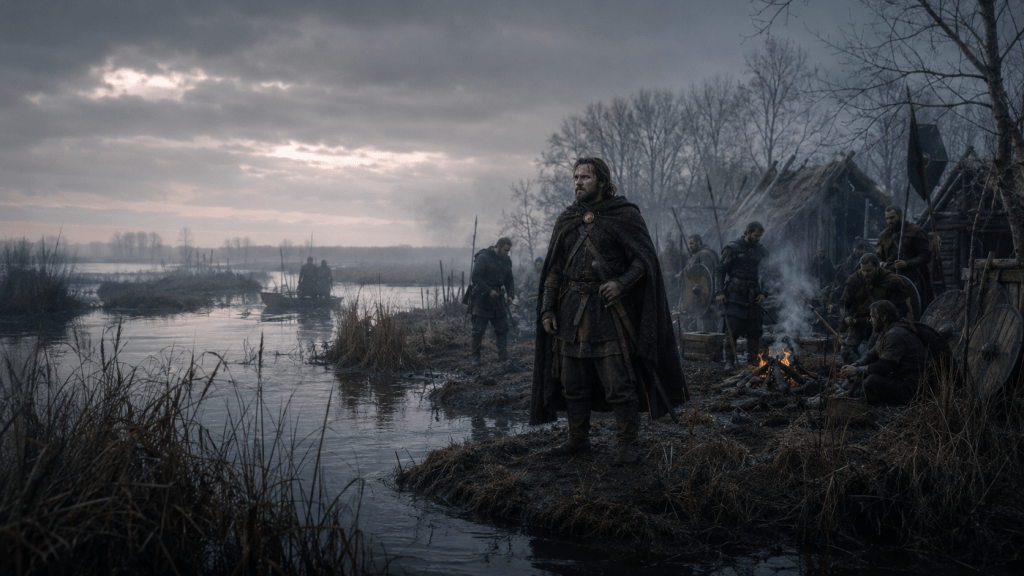
The marsh lay quiet beneath a low winter sky, where pale light drifted across pools of still water and reeds whispered in the cold wind. Mist gathered in slow folds above the channels, blurring the edges of land and water until the ground itself seemed uncertain, shifting between earth and tide with each step. Paths wound through the wet ground in narrow lines known only to those who had lived among the marshes, rising briefly above the water before sinking again into mud and reed.

Among these hidden paths, a small group of men moved in silence, their cloaks drawn close against the damp chill that settled into bone and leather alike. Their boots pressed into the soft ground with care, for a single misstep could send a man into water that reached the thigh or deeper, and the cold that waited there held no mercy. Spears and shields were carried low, their surfaces dulled by travel and use, while the sound of movement faded quickly into the wide hush that filled the marsh.

At the heart of this uncertain land, a rise of firmer ground emerged where timber had been cut and shaped into rough shelters. Smoke lifted slowly from a fire set within a ring of stone, its warmth held close by those who gathered near it as the morning light struggled through the mist. The air carried the scent of damp wood and ash, mingled with the faint trace of salt drawn inland from distant waters where rivers met the sea.

Here, far from the halls and strongholds that once marked the power of Wessex, a king kept his watch. His cloak hung heavy with moisture, and the weight of it seemed to settle across his shoulders as he stood beside the fire, his gaze fixed upon the narrow waterway that curved through the reeds beyond the camp. The world he had known had fallen away in the turning of a single season, leaving behind only scattered remnants of those who had escaped the advance of the northern armies.

Word had reached the marsh in fragments, carried by men who arrived alone or in small groups through the winding paths, their voices low as they spoke of what they had seen. Longships had moved far beyond the coasts, their prows cutting through rivers that led deep into the heart of the land, while settlements that once stood secure beneath their own walls had fallen in quick succession. Those who came spoke of halls abandoned in haste, of rulers driven from their seats, and of banners lowered where new powers now took hold along the rivers and fertile ground.

Such reports settled heavily among those who gathered in the marsh, for each account carried the same quiet weight, a sense that the balance of the island had shifted beyond easy recovery. Men who had once fought beneath strong kings now found themselves scattered, moving in secrecy through lands where the old order had begun to break apart.

Within the marshes, that resistance took on a different form, one shaped by patience, concealment, and the slow gathering of strength. Messengers passed through the hidden paths beneath cover of mist and darkness, carrying word to those who remained loyal to the king who now stood among reeds and water rather than stone walls. Farmers, hunters, and warriors moved quietly through the countryside, their journeys guided by memory and trust as they sought the place where the last hope of Wessex endured.

The marsh held them all in its quiet embrace, offering refuge through its shifting ground and narrow channels that confounded those unfamiliar with its ways. Fires burned low beneath the mist while men watched the edges of the water for any sign of movement beyond the reeds, and through these long days of winter a fragile resolve began to take shape among those who had gathered in exile. Here, in a land where the earth itself resisted certainty, the future of a kingdom rested upon the patience of those who waited for the moment to rise again.


Timeline of Events

793 AD – Viking ships attack the monastery of Lindisfarne, marking the beginning of the Viking Age in England.

865 AD – The Great Heathen Army lands in East Anglia, signalling a shift from raiding to organised invasion.

866 AD – Viking forces capture York (Jórvík), securing a stronghold in northern England.

870–877 AD – Viking armies campaign across the Anglo-Saxon kingdoms, defeating Mercia and pushing deep into Wessex.

878 AD – King Alfred is driven into the marshes of Athelney after a surprise Viking advance in Wessex.

878 AD – From exile, Alfred begins gathering forces in secret, preparing for a decisive resistance.


About the Creator

This Chronicle is written by Simon Phillips, author of several historical and speculative fiction works exploring forgotten worlds, myth, and the turning points of history.

You can explore his books here:
Books by Simon Phillips

You can watch his YouTube channel here:
Author Simon Phillips

Subscribe to continue reading

Subscribe to get access to the rest of this post and other subscriber-only content.

The Forgotten Chronicle: The Winter of the Vikings

When Norse raiders stopped returning home and began claiming the rivers and lands of England for themselves.


The Kingdom That Had Begun to Fracture

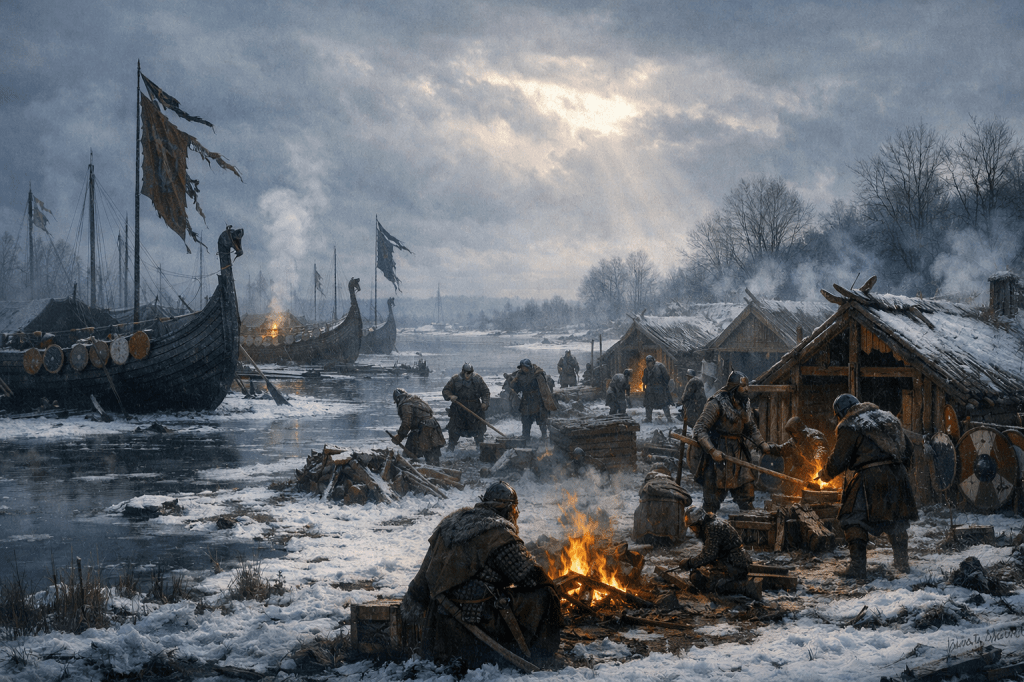
Winter settled slowly across the river valley. Frost clung to the reeds along the banks, and thin ice formed where the slow water touched the earth. A pale sky hung above the fields while smoke drifted in quiet threads across the cold morning air. Along the frozen shoreline a line of longships rested where autumn tides had left them, their dark hulls pulled high upon the bank, prows carved in the shapes of beasts that watched the empty countryside beyond. Shields hung along the sides of the vessels, their colours dulled beneath frost and travel. Around them moved men wrapped in wool and fur, their breath rising in the cold while axes struck timber and small fires burned among the ships.

The sound of labour carried across the valley. Trees fell along the riverbank, and heavy trunks were dragged across the frozen ground where rough walls began to take shape. Timber frames rose slowly between the ships while sod and straw gathered upon their roofs against the wind that swept across the open land. What began as a landing place for raiders had already begun to change its shape with the passing of the weeks. The ships remained where the storms of autumn had forced them ashore, while the men who arrived with oars and swords turned their attention toward earth, timber, and shelter. Smoke thickened above the camp as hearths burned through the long hours of winter light.

Beyond the river the English countryside stretched in quiet ridges and pale fields where distant villages stood among bare trees. For many years the sea had carried strangers across its grey waters, swift raids that struck monasteries and coastal towns before vanishing again beyond the horizon. Those earlier voyages followed the turning of the seasons. Ships appeared with the warmth of spring and faded from the coast as autumn winds gathered across the sea. This winter unfolded under a different design, as the longships remained along the rivers of England while their crews gathered supplies and watched the land that surrounded them.

Scouts moved along frozen tracks beside the water, learning the shape of the valleys and the routes that joined river and road. Each bend of the river revealed farms, cattle, and trading places where silver changed hands beneath fragile protection. Rival kings ruled these lands, their quarrels dividing the strength that guarded the countryside. The rivers carried quiet promise, for through their winding channels men could travel deep into the heart of the country where wealth waited beyond scattered defences.

Within the camp the rhythm of life settled into the long nights of winter. Fires burned while craftsmen repaired blades, shaped iron, and strengthened the ships that rested beside the frozen water. Leaders gathered beside the hearthlight, tracing the memory of rivers and valleys that reached far inland. Winter once meant departure, the season when raiders turned their prows toward distant fjords and narrow homelands across the sea. Along the rivers of England a different choice began to form among the timber halls and watchfires of the camp.

Storehouses filled with grain and salted meat while shelters spread across the frozen ground. Watchfires burned along the banks as though guarding a place newly claimed. The men who arrived with the tide lingered beside the land itself, their camp growing stronger with each passing week. Across the silent fields and frozen rivers a quiet transformation unfolded, one that would shape the fate of England long after the winter snow had melted from the banks.


Timeline of Events

793 AD – Viking ships attack the monastery of Lindisfarne, announcing the beginning of the Viking Age in England.

865 AD — The Great Heathen Army arrives in East Anglia, marking a shift from seasonal raids to organised invasion.

866 AD – Viking forces capture the city of York (Jórvík), securing a powerful foothold in northern England.

867–870 AD – Norse armies establish winter camps along rivers and fertile valleys, allowing them to remain in England year-round.

870s – Viking settlements begin spreading across northern and eastern England, laying the foundations of the future Danelaw.


About the Creator

This Chronicle is written by Simon Phillips, author of several historical and speculative fiction works exploring forgotten worlds, myth, and the turning points of history.

You can explore his books here:
Books by Simon Phillips

You can watch his YouTube channel here:
Author Simon Phillips


Continuing the Chronicle

The account that follows moves deeper into Northumbria’s troubled royal house, where rivalry between Ælla and Osberht weakened the kingdom from within and left its greatest city exposed at the very moment danger began to gather from across the sea.

Readers supporting The Forgotten Chronicle may continue into the full record below.

Subscribe to continue reading

Subscribe to get access to the rest of this post and other subscriber-only content.

The Forgotten Chronicle: The Fall of York (866)

How the Vikings captured one of England’s greatest cities amid the chaos of a divided kingdom.

A Kingdom Divided Beneath Quiet Skies

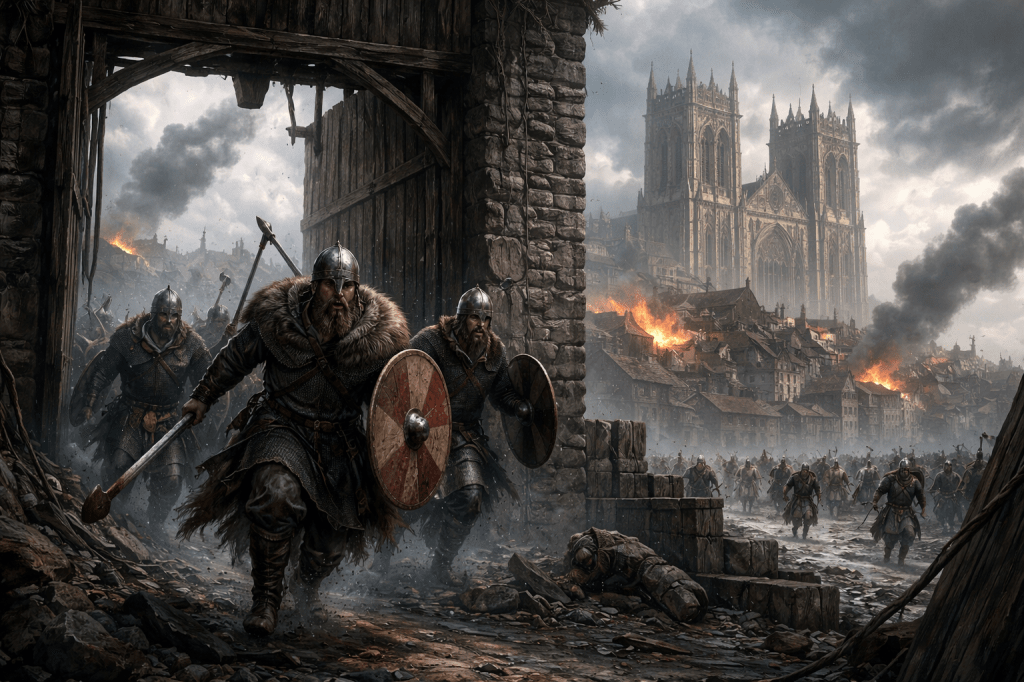
A pale autumn mist lay across the low ground around York as the morning light crept slowly across the fields and marshland that surrounded the ancient city. From the walls, the land appeared quiet and undisturbed, broken only by the distant movement of water birds rising from the River Ouse and the faint shapes of travellers moving along the Roman roads that had bound this place to the wider world for centuries. York stood as one of the great cities of the north, its stone and timber rising above the riverbanks, its markets alive with traders from across Northumbria and beyond, and its churches carrying the sound of bells over the rooftops and narrow streets.

Yet beneath this calm surface the kingdom that ruled the city had begun to fracture. Northumbria, once among the most powerful realms of early England, had drifted into bitter rivalry and suspicion among its own rulers. Two kings now struggled for control of the same crown, their followers divided across the countryside, their loyalties shifting with every rumour that travelled along the roads. Messengers rode between rival strongholds, and each gathering of warriors carried with it the quiet threat of open conflict. The walls of York still stood firm, though the authority that protected them had begun to weaken like timber left too long beneath the rain.

Across the North Sea another force had already begun to stir. Longships moved along the coasts and rivers of Britain with growing confidence as Norse leaders learned the weaknesses of the lands they visited. The raids of earlier years had revealed monasteries filled with treasure and settlements whose defences relied more upon peace than upon preparation for war. Those journeys had brought wealth and fame to the warriors who crossed the sea, and the tales carried home spoke of a divided island where opportunity waited beyond the horizon. The fleets that now gathered carried warriors, families, and leaders who sought more than plunder. They sought land, power, and a future carved from the struggles of others.

When these fleets turned their attention toward Northumbria, the fractured kingdom offered the perfect moment for conquest. Rival kings watched one another with suspicion while the great host of Norse warriors moved inland with speed and purpose. Their arrival fell upon a land already consumed by internal struggle, and the roads that led toward York soon carried the sound of marching men, creaking wagons, and the restless movement of an army that had crossed the sea in search of opportunity.

Within the city, the people continued their daily routines beneath the shadow of the walls, unaware that the fate of York had already begun to change. Markets opened, bells rang for prayer, and the river carried boats toward the bridges as it had done for generations. The great city remained confident in its strength, secure within its ancient defences and the authority of kings who claimed dominion over the north.

Beyond the horizon, however, a new power approached with patient determination. The struggle between rival Northumbrian rulers had opened a gate that no wall of stone could close, and the warriors who advanced toward York carried with them the beginning of a transformation that would reshape the history of England.


Timeline of Events

865 AD — The Great Heathen Army lands in East Anglia
A vast Viking host crosses the North Sea and lands in East Anglia. Unlike earlier raiding fleets, this army arrives prepared to remain through the winter, gathering horses, supplies, and intelligence for campaigns across the English kingdoms.

866 AD — Northumbria falls into civil war
The northern kingdom becomes divided as rival rulers, King Ælla and Osberht, struggle for control of the throne. Their conflict weakens the realm and leaves its greatest city vulnerable.

Late 866 AD — The Viking army marches north
Taking advantage of the division within Northumbria, the Viking host leaves East Anglia and advances toward the city of York, one of the richest and most strategically important settlements in Anglo-Saxon England.

November 866 AD — York is captured
The Viking army seizes the city with surprising speed. York’s strong Roman walls offer little protection against a kingdom already fractured by internal conflict.

March 867 AD — Northumbrian kings attempt to retake the city
King Ælla and Osberht temporarily unite and launch an assault on Viking-held York. The battle ends in disaster for the Northumbrians, and both kings are killed in the fighting.

After 867 AD — York becomes Jórvík
Under Viking control, the city transforms into Jórvík, a powerful Scandinavian stronghold and trading centre that anchors Norse influence across northern England.


About the Creator

This Chronicle is written by Simon Phillips, author of several historical and speculative fiction works exploring forgotten worlds, myth, and the turning points of history.

You can explore his books here:
Books by Simon Phillips

You can watch his YouTube channel here:
Author Simon Phillips

Subscribe to continue reading

Subscribe to get access to the rest of this post and other subscriber-only content.

The Forgotten Chronicle: The Great Heathen Army Arrives

When Viking raiders crossed the North Sea not for plunder, but for conquest, and the kingdoms of England faced an invasion unlike any they had known before.


East Anglia, AD 865

Late summer light lay across the waters of the North Sea as the longships came westward. Their prows rose and fell with the grey swell, carved beasts lifting above the spray as if ancient spirits guided the fleet across the restless tide. Sailcloth hung heavy with salt wind, striped patterns shifting beneath a sky where low cloud drifted in slow procession. Rowers moved in steady rhythm beneath the wooden ribs of the vessels, oars dipping and lifting as the shoreline of East Anglia began to gather form upon the horizon. From the sea the land appeared low and quiet, a line of marsh and sand broken by darker woods inland, fields stretching beyond toward villages where the harvest season had already begun.

Fishermen along the coast first glimpsed the shapes that morning, dark silhouettes rising from the mist beyond the shallows. At first glance the ships resembled many others that crossed these waters in trade, vessels from Frisia or the Danish coasts bringing amber, furs, iron tools, and news from distant shores. As the fleet pressed closer the number of hulls became clear, their ranks spreading across the sea in disciplined order. Shields lined the rails in painted rows of red, yellow, and black, a wall of colour against the pale surf. Warriors gathered along the decks in mail and leather, helms catching the muted light while spearheads glimmered above the gunwales. Word travelled inland through farm tracks and village paths as riders hurried across the fields, their warnings carried from settlement to settlement while the tide lifted the longships toward the beaches.

By afternoon the fleet reached the mouth of a quiet estuary where sandbars curved along the coast like pale ribs beneath the water. The first vessels grounded upon the shore with a grinding of timber and stone, keels sliding across wet sand as men leapt into the surf and hauled ropes forward. More ships followed in a widening arc, sails falling as crews dragged them higher along the strand. Smoke from village hearths drifted above the distant fields while the army gathered along the waterline in growing numbers, voices rising through the wind as banners lifted above the ranks. These arrivals carried a different purpose from the fleeting raids remembered along the coasts of Northumbria and Mercia. Camps began to take shape among the dunes as wagons were drawn ashore, horses led down the ramps of larger vessels, and scouts rode inland through the open country. The people of East Anglia watched from the edges of woodland and farmland as the strangers established their presence upon the shore, an encampment of warriors whose intentions stretched far beyond a swift strike against monastery or market town. Across the fading light of that evening the longships rested upon the beach in long dark lines, their carved prows facing the sea while the fires of the newly arrived host flickered against the gathering dusk.


Timeline of Events

793 AD — Viking raiders attack the monastery of Lindisfarne off the coast of Northumbria, marking the beginning of recorded Viking raids on England.

Late 8th to mid 9th century — Small Viking fleets strike monasteries, ports, and coastal settlements across Britain and Ireland, usually arriving in summer and departing with plunder before winter.

Early 860s — Scandinavian war leaders begin assembling larger forces across Denmark and Norway, bringing together warriors who had previously raided in smaller groups.

865 AD — A vast Viking host later known as the Great Heathen Army crosses the North Sea and lands in East Anglia, marking the shift from seasonal raids to organised invasion.

866–867 AD — The army marches north and captures York, overthrowing the Northumbrian kings and establishing Viking control over the city.

870–871 AD — Viking forces campaign across Mercia and Wessex, leading to major battles with the West Saxon kingdom.


About the Creator

This Chronicle is written by Simon Phillips, author of several historical and speculative fiction works exploring forgotten worlds, myth, and the turning points of history.

You can explore his books here:
Books by Simon Phillips

You can watch his YouTube channel here:
Author Simon Phillips

Subscribe to continue reading

Subscribe to get access to the rest of this post and other subscriber-only content.