When Norse raiders stopped returning home and began claiming the rivers and lands of England for themselves.
The Kingdom That Had Begun to Fracture
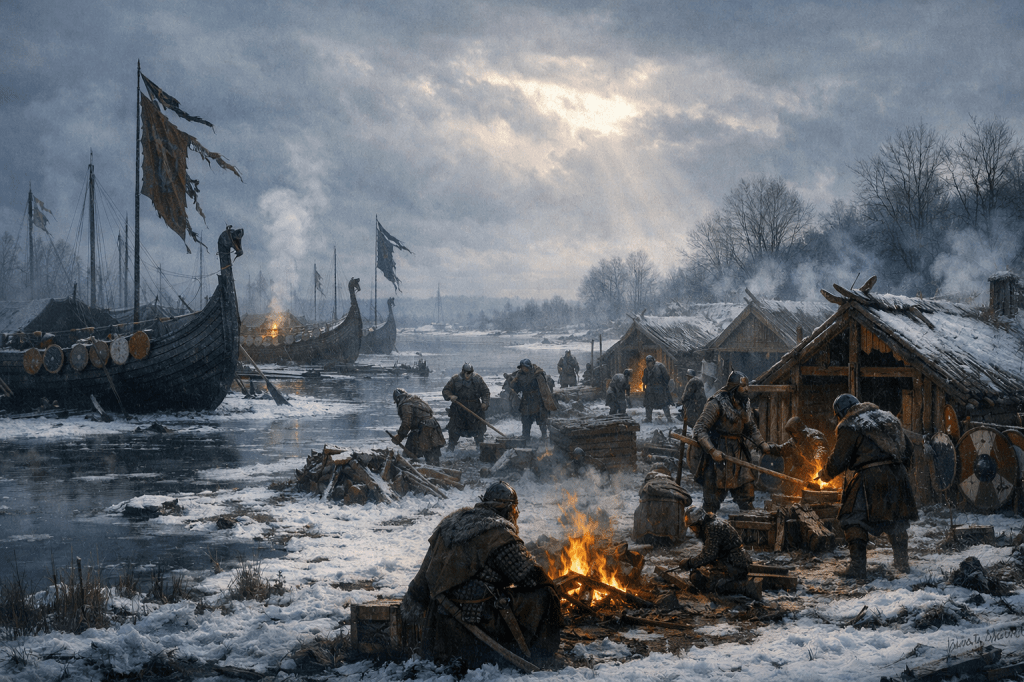
Winter settled slowly across the river valley. Frost clung to the reeds along the banks, and thin ice formed where the slow water touched the earth. A pale sky hung above the fields while smoke drifted in quiet threads across the cold morning air. Along the frozen shoreline a line of longships rested where autumn tides had left them, their dark hulls pulled high upon the bank, prows carved in the shapes of beasts that watched the empty countryside beyond. Shields hung along the sides of the vessels, their colours dulled beneath frost and travel. Around them moved men wrapped in wool and fur, their breath rising in the cold while axes struck timber and small fires burned among the ships.
The sound of labour carried across the valley. Trees fell along the riverbank, and heavy trunks were dragged across the frozen ground where rough walls began to take shape. Timber frames rose slowly between the ships while sod and straw gathered upon their roofs against the wind that swept across the open land. What began as a landing place for raiders had already begun to change its shape with the passing of the weeks. The ships remained where the storms of autumn had forced them ashore, while the men who arrived with oars and swords turned their attention toward earth, timber, and shelter. Smoke thickened above the camp as hearths burned through the long hours of winter light.
Beyond the river the English countryside stretched in quiet ridges and pale fields where distant villages stood among bare trees. For many years the sea had carried strangers across its grey waters, swift raids that struck monasteries and coastal towns before vanishing again beyond the horizon. Those earlier voyages followed the turning of the seasons. Ships appeared with the warmth of spring and faded from the coast as autumn winds gathered across the sea. This winter unfolded under a different design, as the longships remained along the rivers of England while their crews gathered supplies and watched the land that surrounded them.
Scouts moved along frozen tracks beside the water, learning the shape of the valleys and the routes that joined river and road. Each bend of the river revealed farms, cattle, and trading places where silver changed hands beneath fragile protection. Rival kings ruled these lands, their quarrels dividing the strength that guarded the countryside. The rivers carried quiet promise, for through their winding channels men could travel deep into the heart of the country where wealth waited beyond scattered defences.
Within the camp the rhythm of life settled into the long nights of winter. Fires burned while craftsmen repaired blades, shaped iron, and strengthened the ships that rested beside the frozen water. Leaders gathered beside the hearthlight, tracing the memory of rivers and valleys that reached far inland. Winter once meant departure, the season when raiders turned their prows toward distant fjords and narrow homelands across the sea. Along the rivers of England a different choice began to form among the timber halls and watchfires of the camp.
Storehouses filled with grain and salted meat while shelters spread across the frozen ground. Watchfires burned along the banks as though guarding a place newly claimed. The men who arrived with the tide lingered beside the land itself, their camp growing stronger with each passing week. Across the silent fields and frozen rivers a quiet transformation unfolded, one that would shape the fate of England long after the winter snow had melted from the banks.
Timeline of Events
793 AD – Viking ships attack the monastery of Lindisfarne, announcing the beginning of the Viking Age in England.
865 AD — The Great Heathen Army arrives in East Anglia, marking a shift from seasonal raids to organised invasion.
866 AD – Viking forces capture the city of York (Jórvík), securing a powerful foothold in northern England.
867–870 AD – Norse armies establish winter camps along rivers and fertile valleys, allowing them to remain in England year-round.
870s – Viking settlements begin spreading across northern and eastern England, laying the foundations of the future Danelaw.
About the Creator
This Chronicle is written by Simon Phillips, author of several historical and speculative fiction works exploring forgotten worlds, myth, and the turning points of history.
You can explore his books here:
Books by Simon Phillips
You can watch his YouTube channel here:
Author Simon Phillips
Continuing the Chronicle
The account that follows moves deeper into Northumbria’s troubled royal house, where rivalry between Ælla and Osberht weakened the kingdom from within and left its greatest city exposed at the very moment danger began to gather from across the sea.
Readers supporting The Forgotten Chronicle may continue into the full record below.

Subscribe to continue reading
Subscribe to get access to the rest of this post and other subscriber-only content.
