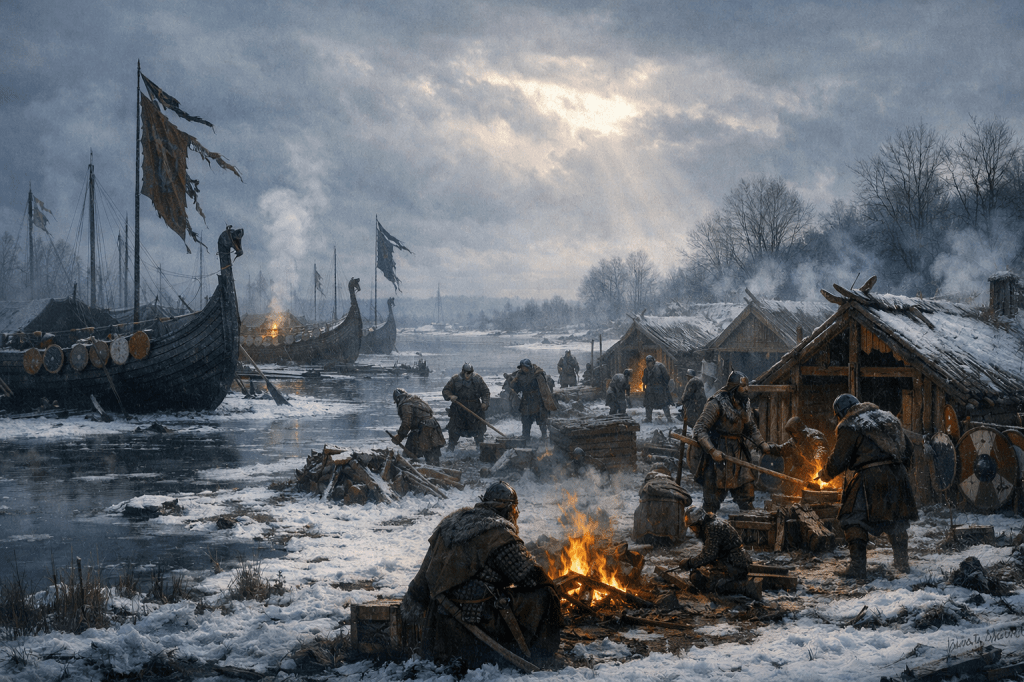
Along the Northumbrian coast, the sea was both boundary and road. Fishing boats worked close to shore, traders moved between communities that were far less isolated than they can appear from the present, and monasteries stood within landscapes shaped by farming, royal power, prayer, obligation and exchange. Beyond the horizon lay routes leading towards Ireland, Francia and Scandinavia.
In 793, one of those routes carried violence to Lindisfarne.
The Viking raid on Lindisfarne has become one of the most familiar markers in the history of Viking Age Britain. Its importance lies partly in the attack itself and partly in what Lindisfarne represented. This was no anonymous settlement on an exposed coast. It was one of the great religious centres of Anglo-Saxon Northumbria, closely connected to kingship, learning and the cult of St Cuthbert. English Heritage describes the attack of 8 June 793 as a devastating raid whose effect was psychological as well as physical.
To understand the shock, it helps to look beyond the image of ships reaching a beach.
Lindisfarne belonged to a world in which faith, political authority, land, memory and sacred objects were closely connected. An assault upon the monastery therefore reached much further than its buildings.
Lindisfarne at the Heart of Anglo-Saxon Northumbria
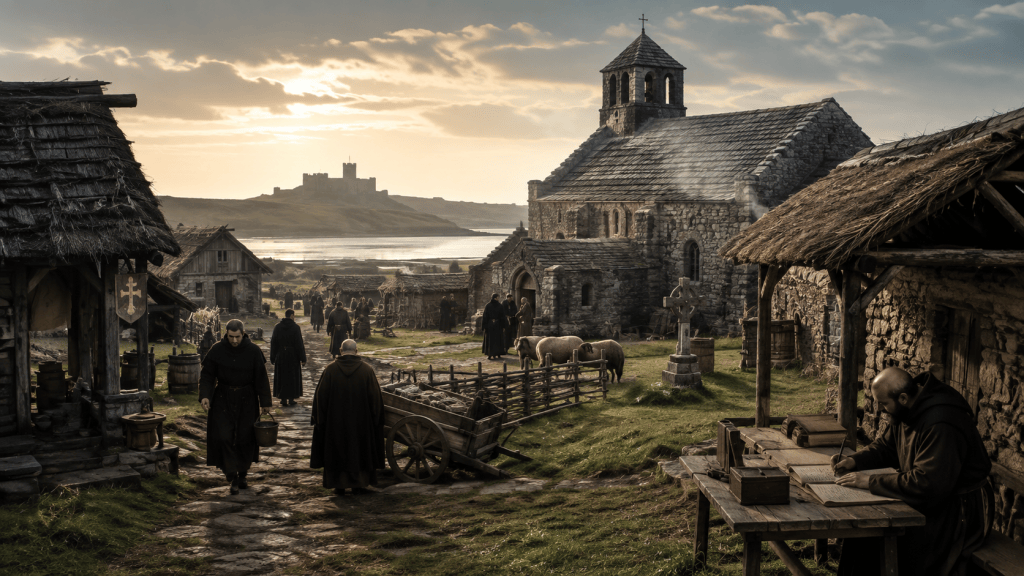
The monastery on Lindisfarne had been founded in 635, when King Oswald of Northumbria invited Aidan from Iona and granted him the tidal island as a base for Christian mission.
Its position mattered.
Bamburgh, one of the principal centres of Northumbrian royal power, lay only a short distance along the coast. Lindisfarne consequently developed close connections with kings and nobles while becoming an important centre of Christianity in northern Britain. St Cuthbert, who died in 687, became central to the island’s religious identity, and the growth of his cult brought pilgrims, gifts and further influence. The Lindisfarne Gospels were produced there in the early eighth century, evidence of a community connected not merely with worship, but with scholarship, artistic labour and the preservation of knowledge.
This is an important distinction when imagining Anglo-Saxon monasteries.
They were never simply lonely stone churches occupied by men removed from the concerns of the surrounding world. A major monastery could possess land, receive royal patronage, maintain relationships with other religious communities and participate in networks extending far beyond its immediate surroundings.
Daily life still depended upon ordinary things: food, livestock, firewood, weather, boats, labour and the arrival of travellers. Manuscripts required skins, pigments, time and trained hands. Communities required grain and shelter. Pilgrims had to be received. Messages had to travel.
Sacred importance rested upon a deeply physical foundation.
That is part of what made a monastery vulnerable.
Why the Raid of 793 Mattered
The Lindisfarne attack was not necessarily the first encounter between people in Anglo-Saxon England and Scandinavians. Contacts across the North Sea already existed, and other violent encounters may have preceded it. The significance of Lindisfarne comes from the combination of its date, the surviving written response and the religious importance of the place itself. English Heritage notes that it is the first Viking attack on what is now England that can be securely tied to a specific date, while earlier incidents may have occurred elsewhere.
Contemporary reaction shows how disturbing the attack appeared.
Alcuin of York, then living at Charlemagne’s court, wrote in horror about the violation of St Cuthbert’s church. His concern went beyond military weakness. The event raised a religious question: how could a place associated with such holiness suffer in this way?
For people whose understanding of kingship, morality, divine favour and earthly events could overlap, the question mattered.
Violence against Lindisfarne could therefore be interpreted through several layers at once. It was an attack by foreign raiders. It was a destruction of property and lives. It was an assault upon a religious community. It could also be read as judgement, warning or evidence that the expected order of the world had somehow failed.
The surviving sources reveal some of those reactions, even though they cannot tell us exactly how every monk, farmer, fisherman or household along the Northumbrian coast understood what had happened.
History becomes particularly human in that uncertainty.
A distant political crisis can remain distant. Ships appearing off a familiar coast cannot.
Northumbria Was Powerful, Yet Far From Stable
There was no single kingdom of England in 793.
The political landscape consisted of separate kingdoms whose strength rose and fell through war, marriage, inheritance, religious patronage and the ability of rulers to retain powerful supporters. Northumbria had once dominated much of Britain, while Mercian power had become increasingly important during the eighth century. The eventual creation of a unified English kingdom still lay generations ahead.
Northumbria itself had experienced serious political instability. King Ælfwald had been murdered in 788, only a few years before the Lindisfarne raid. Alcuin’s reaction to the attack was shaped partly by his anxiety about disorder within Northumbrian society and politics.
For ordinary people, royal instability was unlikely to arrive as a neat sequence of reigns remembered from a textbook.
It could mean uncertain loyalties, armed followers on roads, changes in obligation, rumours moving between settlements, demands from local authority, and the knowledge that a dispute among powerful families could eventually reach fields and households far from a royal centre.
This fractured political landscape matters enormously when approaching Viking Age Britain.
The Scandinavian arrivals of the following decades would encounter several kingdoms, regional identities and competing centres of authority. The later struggle that contributed to the formation of England cannot be understood properly if England is imagined as already waiting intact for the Vikings to attack.
It was still being made.
The Sea Was Never Empty
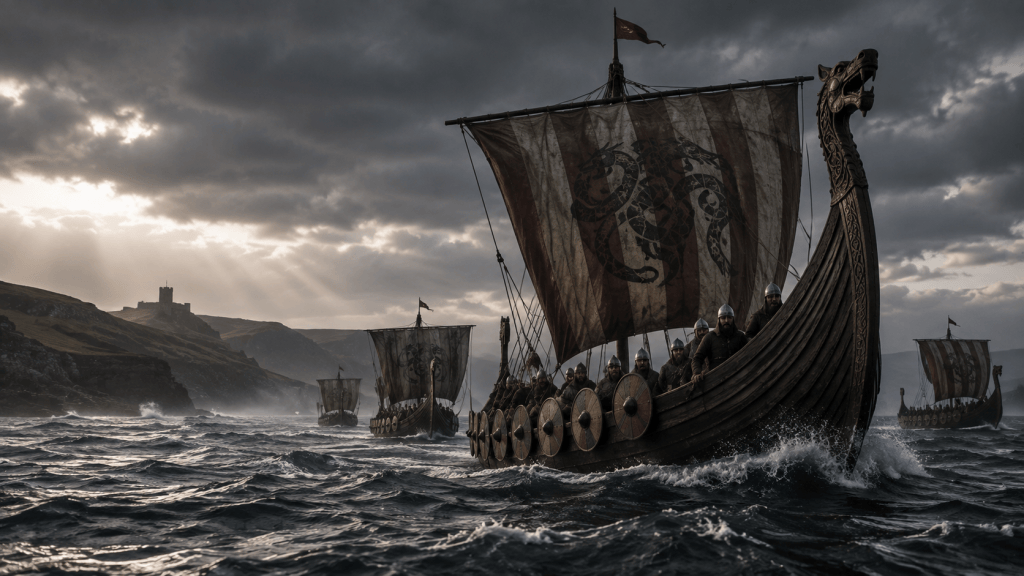
Modern maps can make the North Sea appear like empty space separating Britain from Scandinavia.
For early medieval communities, water connected as readily as it divided.
Ships carried goods, people, news and violence. Rivers extended those routes inland. Coastal communities lived with the practical knowledge that something beyond sight could eventually arrive upon the tide.
The Scandinavian presence in Britain would later include raiding armies, settlers, traders, farmers, political leaders and communities whose identities changed through contact with the people already living there. Reducing that history to raiders alone removes much of what made the period transformative.
In 793, however, the immediate experience at Lindisfarne was violence.
The broader cultural entanglement came over generations.
That distinction matters. The Norse presence in Britain became complex; the suffering caused by raids remains equally real. Neither truth needs to erase the other.
Faith, Relics and the Power of Objects
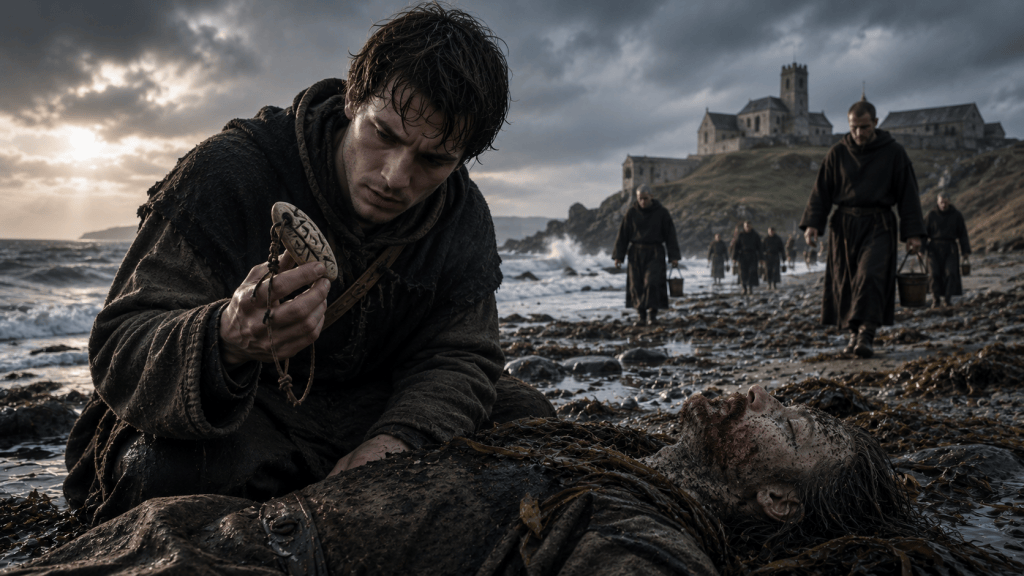
Sacred objects were already part of the real religious world surrounding Lindisfarne.
The remains of St Cuthbert became the centre of an important cult after his death, and the community’s guardianship of his shrine helped make Lindisfarne a major pilgrimage centre. Objects associated with saints could carry profound religious meaning for medieval Christians, while books, crosses, vessels and reliquaries could possess devotional, artistic and material value at the same time.
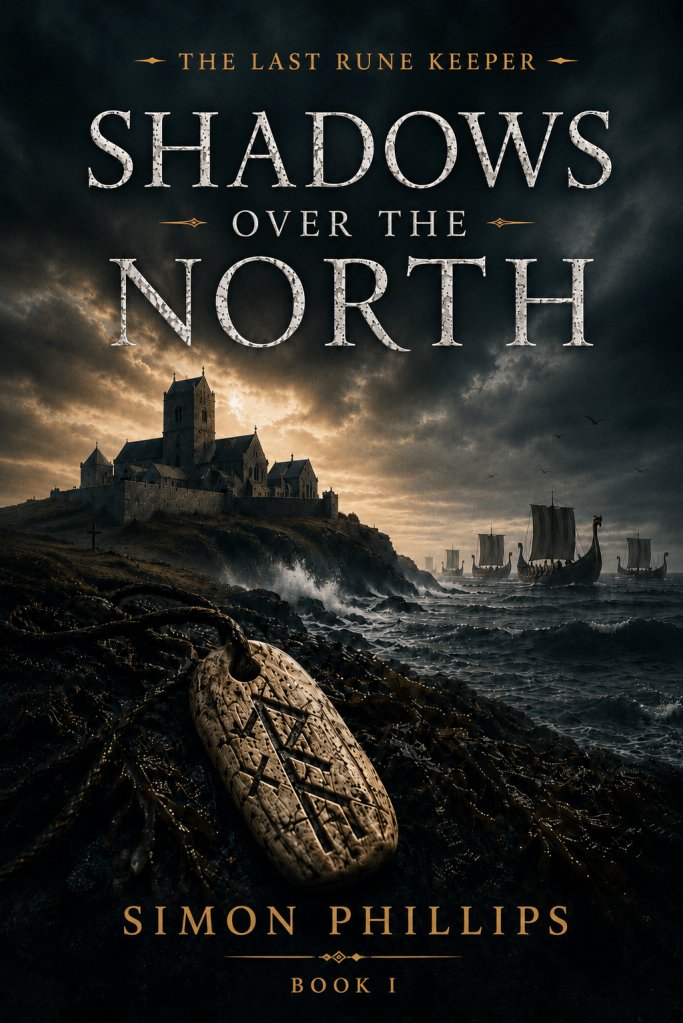
This historical relationship between belief and physical objects provides one of the points where The Last Rune Keeper moves from history into historical fantasy.
The distinction is important.
There is no historical evidence for the magical relic system found in the series, nor for Church relic-hunters performing the work undertaken by Eadric and Father Oswin. Those elements belong entirely to the fictional world.
What history provides is a society in which objects could matter intensely.
The fictional question then becomes more interesting: what if some objects carried something other than memory, holiness, craftsmanship or inherited meaning?
That is where the fantasy enters.
Shadows Over the North and the World Before the Breaking
Book One of The Last Rune Keeper, Shadows Over the North, begins inside this unsettled Northumbrian world.
Eadric is a young Church-trained relic hunter whose work brings him into contact with objects that the institution around him prefers to contain, remove or place beyond ordinary reach. His mentor, Father Oswin, provides experience and religious structure, while Eadric increasingly encounters things that resist the clear boundaries he has been taught to trust.
The book takes place around the Lindisfarne era rather than using the famous raid merely as spectacle. The monastery, shoreline, roads, battlefield remains and rumours of ships matter because they place Eadric inside a society already experiencing political and religious strain. The story’s movement begins with relics recovered from the shore and develops through Eadric’s growing recognition that these objects can respond to him in ways neither doctrine nor training entirely explains.
That approach reflects the wider identity of the series.
The historical world remains responsible for its own history. Kings, invasions, settlement, Christianity and eventual political consolidation are real forces rather than scenery surrounding a magical adventure. Eadric moves through that transformation. He does not replace it.
Magic at the Edge of Belief
The fantasy of The Last Rune Keeper is deliberately placed where historical certainty ends.
Early medieval people lived within cultures containing prayer, prophecy, signs, charms, sacred places, dreams, healing traditions and inherited stories about forces beyond ordinary perception. The evidence for individual practices can be fragmentary and difficult to interpret, especially when it survives through texts written by people who viewed older or competing traditions through their own religious framework.
Historical fantasy can enter that uncertainty while still preserving the boundary between evidence and invention.
Within The Last Rune Keeper, magic exists as something increasingly difficult for the changing world to sustain. Runes depend upon relationships between symbol, place and understanding. Relics preserve older conditions more stubbornly. Norse magical practice is embodied through culture, ritual and lived connection rather than presented as a universal system available to anyone who learns the correct words. Eadric himself interferes with these forces more readily than he commands them.
None of this is presented as hidden historical fact.
It is the fictional layer running beside history.
Its purpose is less to make the Viking Age more spectacular than to ask what happens when one understanding of the world slowly loses the conditions required for its survival.
Christianity Was Already Part of the Landscape
The eventual Christianisation and political consolidation of England can sometimes be described as though Christianity simply advanced across a pagan landscape from outside.
The history was far more complicated.
By the time of the Lindisfarne raid, Christianity had already been deeply embedded in Northumbrian political and cultural life for generations. Lindisfarne itself had helped drive that process since the seventh century. Bishops, monasteries, saints’ cults and royal patronage formed part of the structures through which communities understood authority and memory.
That makes the religious tension surrounding The Last Rune Keeper more complicated than a simple conflict between Christianity and paganism.
Eadric belongs to the Church. His faith is part of the way he understands himself. Oswin’s belief is equally genuine. The institution gives them purpose, language, protection and order.
The tension arises because the same structure that preserves one form of memory can help displace another.
Within the fictional series, fading magic becomes one way of exploring that process.
Before England, There Were People Living Through Change
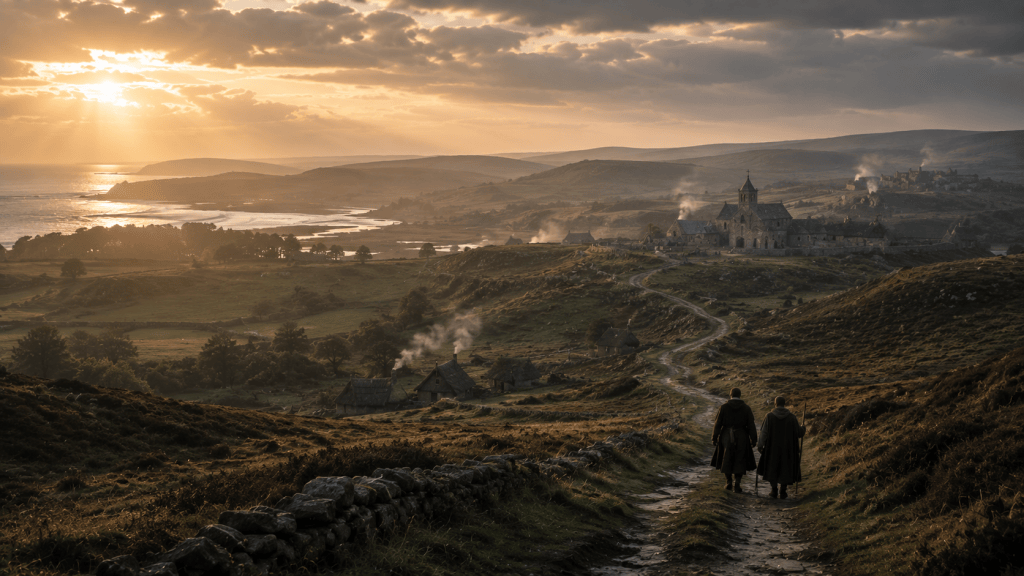
The political transformation eventually producing England took well over a century beyond the events of 793.
People living along the Northumbrian coast when the first Scandinavian raids intensified could not know where that process would lead. They could see local consequences: ships, burned buildings, altered routes, missing people, changing rulers, threatened monasteries and new communities arriving in lands that already possessed histories of their own.
Generations later, raiding would become settlement. Settlement would become political presence. Scandinavian and Anglo-Saxon communities would trade, fight, intermarry, convert, negotiate and reshape one another.
Kingdoms would fall.
Others would expand.
Christian authority would deepen.
Old identities would survive in altered forms.
Eventually a kingdom called England would emerge from a process far more complicated than any single victory or ruler.
That long transformation is the historical ground beneath The Last Rune Keeper. Its fading magic belongs to fiction, while the pressure causing people to reconsider loyalty, faith, land and belonging comes from a real world already changing beneath their feet.
Lindisfarne matters because it allows us to see that world near the beginning of one of its great disruptions.
The ships on the horizon had yet to become settlements, armies, political alliances and new generations born into mixed landscapes.
England itself still lay far ahead.
For the people standing on those shores, there was only the sea, the uncertain north, and the knowledge that something had reached them which would no longer remain beyond the horizon.