When Norse raiders stopped returning home and began claiming the rivers and lands of England for themselves.
The Kingdom That Had Begun to Fracture
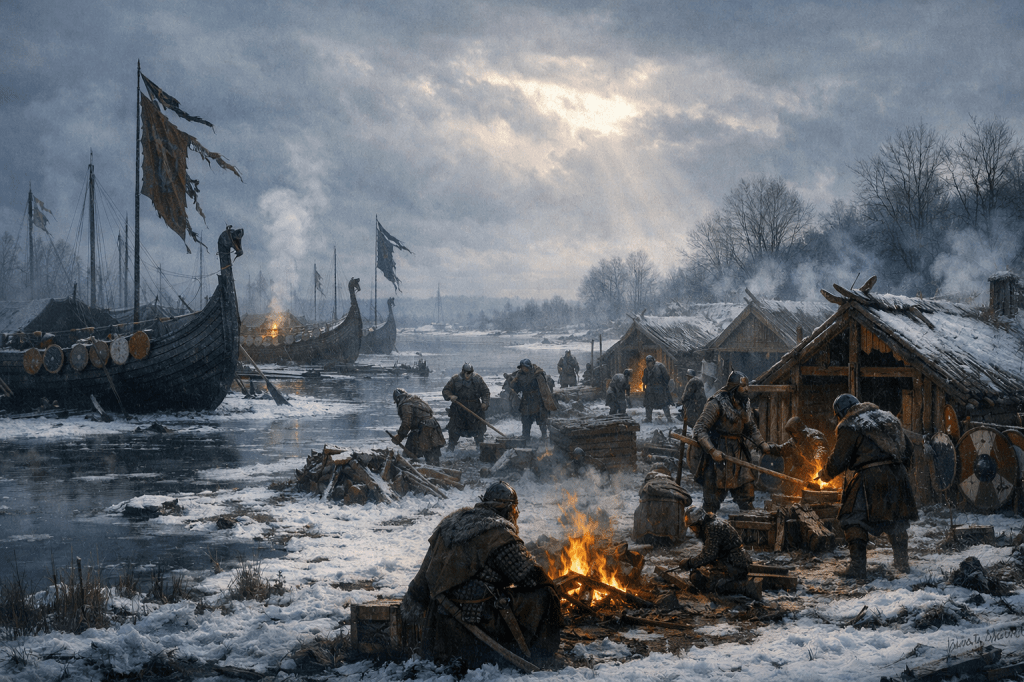
Winter settled slowly across the river valley. Frost clung to the reeds along the banks, and thin ice formed where the slow water touched the earth. A pale sky hung above the fields while smoke drifted in quiet threads across the cold morning air. Along the frozen shoreline a line of longships rested where autumn tides had left them, their dark hulls pulled high upon the bank, prows carved in the shapes of beasts that watched the empty countryside beyond. Shields hung along the sides of the vessels, their colours dulled beneath frost and travel. Around them moved men wrapped in wool and fur, their breath rising in the cold while axes struck timber and small fires burned among the ships.
The sound of labour carried across the valley. Trees fell along the riverbank, and heavy trunks were dragged across the frozen ground where rough walls began to take shape. Timber frames rose slowly between the ships while sod and straw gathered upon their roofs against the wind that swept across the open land. What began as a landing place for raiders had already begun to change its shape with the passing of the weeks. The ships remained where the storms of autumn had forced them ashore, while the men who arrived with oars and swords turned their attention toward earth, timber, and shelter. Smoke thickened above the camp as hearths burned through the long hours of winter light.
Beyond the river the English countryside stretched in quiet ridges and pale fields where distant villages stood among bare trees. For many years the sea had carried strangers across its grey waters, swift raids that struck monasteries and coastal towns before vanishing again beyond the horizon. Those earlier voyages followed the turning of the seasons. Ships appeared with the warmth of spring and faded from the coast as autumn winds gathered across the sea. This winter unfolded under a different design, as the longships remained along the rivers of England while their crews gathered supplies and watched the land that surrounded them.
Scouts moved along frozen tracks beside the water, learning the shape of the valleys and the routes that joined river and road. Each bend of the river revealed farms, cattle, and trading places where silver changed hands beneath fragile protection. Rival kings ruled these lands, their quarrels dividing the strength that guarded the countryside. The rivers carried quiet promise, for through their winding channels men could travel deep into the heart of the country where wealth waited beyond scattered defences.
Within the camp the rhythm of life settled into the long nights of winter. Fires burned while craftsmen repaired blades, shaped iron, and strengthened the ships that rested beside the frozen water. Leaders gathered beside the hearthlight, tracing the memory of rivers and valleys that reached far inland. Winter once meant departure, the season when raiders turned their prows toward distant fjords and narrow homelands across the sea. Along the rivers of England a different choice began to form among the timber halls and watchfires of the camp.
Storehouses filled with grain and salted meat while shelters spread across the frozen ground. Watchfires burned along the banks as though guarding a place newly claimed. The men who arrived with the tide lingered beside the land itself, their camp growing stronger with each passing week. Across the silent fields and frozen rivers a quiet transformation unfolded, one that would shape the fate of England long after the winter snow had melted from the banks.
Timeline of Events
793 AD – Viking ships attack the monastery of Lindisfarne, announcing the beginning of the Viking Age in England.
865 AD — The Great Heathen Army arrives in East Anglia, marking a shift from seasonal raids to organised invasion.
866 AD – Viking forces capture the city of York (Jórvík), securing a powerful foothold in northern England.
867–870 AD – Norse armies establish winter camps along rivers and fertile valleys, allowing them to remain in England year-round.
870s – Viking settlements begin spreading across northern and eastern England, laying the foundations of the future Danelaw.
About the Creator
This Chronicle is written by Simon Phillips, author of several historical and speculative fiction works exploring forgotten worlds, myth, and the turning points of history.
The account that follows moves deeper into Northumbria’s troubled royal house, where rivalry between Ælla and Osberht weakened the kingdom from within and left its greatest city exposed at the very moment danger began to gather from across the sea.
Readers supporting The Forgotten Chronicle may continue into the full record below.
Subscribe to continue reading
Subscribe to get access to the rest of this post and other subscriber-only content.
Autumn light could still lie gently across the fields around York in 866, turning the marshland beside the Ouse pale beneath the morning sky while bells carried over roofs, workshops, and crowded lanes. From the walls, the city seemed secure enough to trust its own long memory. Roman stone still held the heart of the settlement, trade still moved along the river, and Northumbria still imagined itself one of the great kingdoms of early England.
Security, however, had already begun to thin. York stood at the centre of a kingdom torn by rivalry between Ælla and Osberht, and the struggle for the Northumbrian crown weakened the very authority that should have guarded the city. When the Viking host moved north in late 866, it approached a prize of immense wealth and strategic value, though its greatest advantage lay beyond wealth alone. The kingdom behind the walls had opened wounds of its own, and the invaders understood exactly how to use them.
Each week The Forgotten Chronicle explores a moment when history quietly changed the world, and the fall of York belongs firmly within that tradition. The capture of the city marked far more than a single military success for the Vikings. It exposed the fragility of Anglo-Saxon power in the north, revealed how quickly internal conflict could unmake a realm, and prepared the ground for the rise of Jórvík, one of the most important Norse centres in Britain.
Why York mattered in ninth-century England
York was no remote settlement waiting on the edge of events. It was one of the great urban centres of early medieval England, a place shaped by Roman foundations, ecclesiastical prestige, and river commerce. Roads linked it to the wider kingdom, merchants moved through its markets, and the city carried a political significance that far exceeded its walls. Whoever held York held more than masonry and streets. He held a symbol of authority in the north.
That status made the city valuable to rival Northumbrian rulers long before the Viking army appeared. It also made York attractive to Scandinavian leaders who had already spent years studying the weaknesses of Britain through coastal raids and river movement. By the middle decades of the ninth century, Viking warfare had evolved far beyond sudden strikes on monasteries. Fleets carried seasoned warriors, commanders with wider ambitions, and a growing understanding of how divided kingdoms could be broken from within.
York offered everything such a force could seek. Wealth, infrastructure, position, and prestige all gathered there. Even more importantly, York sat inside a kingdom already distracted by its own contest for power. A rich city in a stable realm presents one challenge. A rich city in a fractured realm presents another entirely.
The civil war that opened the gates
The fall of York makes little sense when told as a simple story of Viking strength against English weakness. Strength mattered, certainly, and the Great Heathen Army had plenty of it. Yet the deeper drama lay within Northumbria itself. Osberht and Ælla struggled for the same crown, and that contest divided loyalties across the kingdom. Noble support shifted, military response lost coherence, and the authority that ought to have acted swiftly in a crisis became tangled in its own rivalries.
This is where the story acquires its real gravity. Stone walls still stood. The city still possessed defences inherited from an older imperial world. The river still carried wealth and communication through its heart. Even so, walls depend upon leadership, and fortifications become less impressive when the kingdom behind them has already begun to fray.
For the Vikings, this was a political opportunity as much as a military one. They moved toward York through a landscape already destabilised by distrust. Messages could travel slowly or arrive distorted. Decisions carried the weight of faction. Every delay favoured the approaching host. By the time the city faced the reality of the threat, the conditions for its fall had already been prepared by Northumbrian hands.
When the Viking army came north
The Viking army that advanced toward York in late 866 arrived with purpose. This was no fleeting raid launched for quick plunder before the sea turned rough. The Great Heathen Army had entered East Anglia in 865 ready to remain, gather horses, secure supplies, and study the kingdoms ahead. Its commanders understood movement, pressure, and timing. They also understood when a divided enemy had reached the point of greatest vulnerability.
York fell with a speed that still carries a sting. The city’s capture revealed how swiftly a major centre could pass into foreign hands when its defenders lacked unity. In that sense, the event feels almost eerily modern. Institutions often appear strongest just before fracture becomes visible. Streets remain busy, markets remain open, daily routines continue, and then the pressure already building beneath the surface suddenly finds its release.
For the people of York, the change would have felt immediate and disorienting. A city accustomed to its own rhythms found itself overtaken by an army whose ambitions reached beyond looting. The Vikings secured positions, established control, and transformed the political reality of the north in a remarkably short span. What had seemed durable in the morning could feel irrevocably altered by evening.
The failed recovery and the death of Northumbrian power
The tragedy deepened in 867, when Ælla and Osberht at last joined forces in an attempt to retake the city. Their temporary unity came too late. By then the Vikings had already taken hold of York and strengthened their position. The assault that followed ended in disaster, and both Northumbrian rulers were killed in the fighting.
That moment matters as much as the original capture. It meant the city’s fall was no passing shock that the kingdom could swiftly correct. The old order in Northumbria had suffered a wound from which it could no longer recover in the same form. Leadership had collapsed along with the effort to reclaim the city, and the Vikings retained the prize that could anchor lasting power in the region.
History often turns through such sequences, where one failure leads into another until a political landscape no longer resembles the one that existed a year earlier. York in 866 and 867 offers precisely that pattern. Civil conflict opened the way, conquest followed, and the desperate effort to reverse the loss only completed the ruin of the authority that had made the city vulnerable in the first place.
From York to Jórvík
The story gains even greater significance once York begins to change into Jórvík. Viking power in England is sometimes imagined only through warfare, ships, and raids, yet the Norse transformation of York points toward a broader historical reality. Scandinavian rule produced a thriving urban centre linked to trade networks stretching across the North Sea world. Craftsmen, merchants, and settlers entered the picture alongside warriors. Language, commerce, and daily life all began to absorb new influences.
This transformation is one reason the fall of York continues to hold such power for readers of the Viking Age. The city did not simply suffer conquest and pass into silence. It became something new. Jórvík emerged as a Norse centre of trade and influence, and that change left marks that endured far beyond the first battles. The event therefore belongs to the larger story of how Viking presence in Britain moved from attack to settlement, from seasonal violence to lasting political and economic power.
Seen in that light, the fall of York stands at a threshold. One world was collapsing while another was taking shape inside the same streets.
A visual route into the Chronicle
For readers who prefer to enter the subject through image and motion before moving into the longer historical piece, this visual companion can sit naturally within the blog as an embedded feature:
A short visual telling works especially well here because the fall of York carries such a strong sense of approaching pressure. Fields beyond the walls, rival rulers inside the kingdom, longships and marching columns closing the distance, all of it lends itself to a visual threshold that prepares the reader for the fuller Chronicle. The film offers a brief entry into atmosphere. The longer reading carries the weight of consequence.
That Chronicle approaches the event through atmosphere, political strain, and the slow recognition that a city can stand firm in stone while weakening in authority. It enters York before the collapse is complete, lingers over the rivalry that prepared the disaster, and follows the city into its Norse future as Jórvík. The reading experience is designed as an immersive threshold into the period, one that values tension, setting, and consequence over summary alone.
For a reader arriving through search, this piece can serve as an entry point into that wider archive. The Chronicle itself carries the fuller narrative pressure of the moment, while the surrounding publication continues to trace the Viking Age in England through conquest, settlement, exile, recovery, and legacy. In that sense, feels less like an isolated article and more like a doorway into a larger historical sequence.
Why this moment still draws us back
The fall of York continues to compel attention because it reveals a pattern that history repeats with unsettling regularity. External force matters, of course, though internal fracture often matters first. Cities and kingdoms rarely fall through assault alone. They weaken through rivalry, delayed judgement, contested legitimacy, and the gradual erosion of shared purpose. When the blow finally lands, it lands against something already strained.
York offers that truth in concentrated form. A major city, ancient walls, wealth, prestige, and memory all stood in place. Even so, division at the level of kingship made those strengths harder to use. The Viking army recognised the opening and moved through it with the kind of decisiveness that changes centuries.
There is also a deeper imaginative pull here. York sits at the meeting point of several worlds, Roman inheritance, Anglo-Saxon kingship, Christian identity, Viking expansion, and the emerging Norse city of Jórvík. The fall of the city therefore feels like a hinge in the history of England, a moment where power changed hands and the cultural texture of the north began to shift with it.
Closing movement
Across the fields outside York, the first signs of danger would once have looked small enough to misread, riders at distance, movement along the roads, rumours carried in fragments, uncertainty passing from voice to voice. Then the host drew nearer, the kingdom’s rivalries tightened into consequence, and the city that had trusted in its own standing entered a different future.
That is why the fall of York in 866 still lingers. It carries the chill of a warning and the force of a transformation. A divided kingdom lost one of its greatest cities, and from that loss emerged Jórvík, a Norse centre whose influence would shape northern England for generations. The walls remained, the streets remained, the river remained, though the world moving through them had changed.
Some moments in history vanish into sequence and summary. York resists that fate. The city still stands in the record as a place where ambition met opportunity, where internal fracture invited conquest, and where the north of England crossed into a new age whose echoes still move through the past whenever the Chronicle opens the gate again.