Along the Northumbrian coast, a monastery bell could carry across water and open ground, yet the meaning of the raid on Lindisfarne travelled far beyond the reach of any bell. On 8 June 793, Scandinavian raiders attacked the church of St Cuthbert on Holy Island, killing, plundering, and violating a place held among the most sacred centres of Northumbrian Christianity. English Heritage describes the assault as a shock that reached far beyond the island itself, while the response of the Northumbrian scholar Alcuin shows how deeply the attack unsettled Christian assumptions about sanctuary, divine protection, and the security of holy places.
The physical destruction formed only one part of what followed. News had to leave the island in the mouths of survivors, travellers, clergy, fishermen, and messengers, crossing stretches of coast and inland road where certainty could weaken with every retelling. A man several days away might hear first of smoke above the sea, then of monks killed beside their church, then of treasure carried towards waiting ships, with each account arriving through someone who had heard the story from another frightened voice. Long before any distant household understood exactly what had happened, people could understand something simpler and more immediate: the coast had become less certain, and holiness alone offered no protection against men arriving from the water.
For readers drawn to Viking Age Britain, that wider shock matters as much as the violence of the raid itself. Lindisfarne was bound closely to the cult of St Cuthbert and to the religious identity of Northumbria, which meant its violation carried a message that required no formal proclamation: a sacred place could be reached, its treasures could be taken, its clergy could be killed, and communities beyond the island had to reconsider what safety meant once that knowledge entered their roads, chapels, halls, and households.
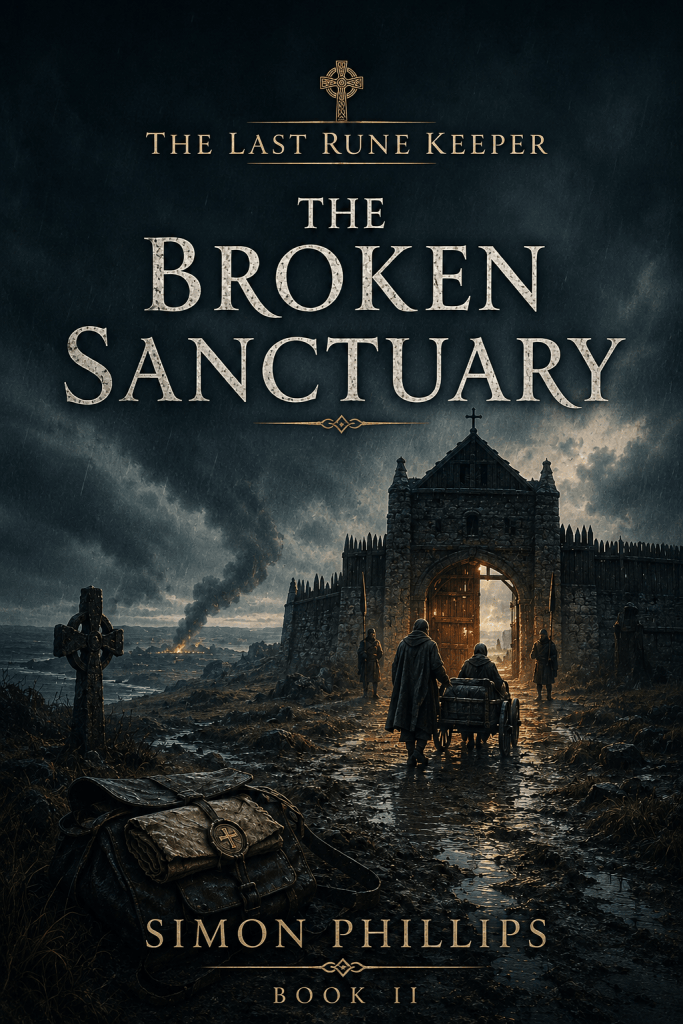
That change would have been felt through ordinary decisions long before anyone could see the larger historical pattern forming around them. A priest might wonder whether valuable church objects should remain near the coast, a farmer might listen more carefully when unfamiliar voices approached his gate, and travellers carrying Church business could find hospitality mixed with questions that would once have seemed unnecessary. The raid belonged to Lindisfarne, yet its consequences travelled with every person who carried word away from Holy Island, entering communities that had seen no longship and heard no weapon strike, while still learning that the sea could bring a danger their older habits of safety had failed to imagine.
When a Holy Place Could Be Broken
The modern image of a monastery can become too still, with stone, manuscripts, prayer, and isolation arranged into a peaceful picture that belongs more to memory than lived early medieval experience. Lindisfarne was a religious community, a centre of devotion, and the home of Cuthbert’s cult, with spiritual importance extending far beyond its shoreline. Its sacred status made the attack especially disturbing because the raid struck at a place whose meaning rested upon holiness, continuity, and the expectation that Christian order had substance in the world.
Alcuin’s surviving reaction gives that disturbance a human voice. Writing from the Frankish world, he wrestled with the question of how such a place could suffer so violently, framing the disaster through faith, judgement, sin, and the search for meaning inside catastrophe. He was living within a culture where theology shaped the interpretation of public disaster, so the fall of a sanctuary demanded more than military explanation and pressed upon belief itself.
The deeper historical pressure lay in what happened after the attackers had gone, when survivors, clergy, rulers, farmers, traders, and families had to continue living inside a world whose boundaries had changed. Christian life on Lindisfarne survived the raid, and later sculpture points to continued Christian presence after 793, which creates a more complex picture than destruction followed by silence. The sanctuary had been violated, while the community and its memory endured.
Roads Carried Fear Faster Than Certainty
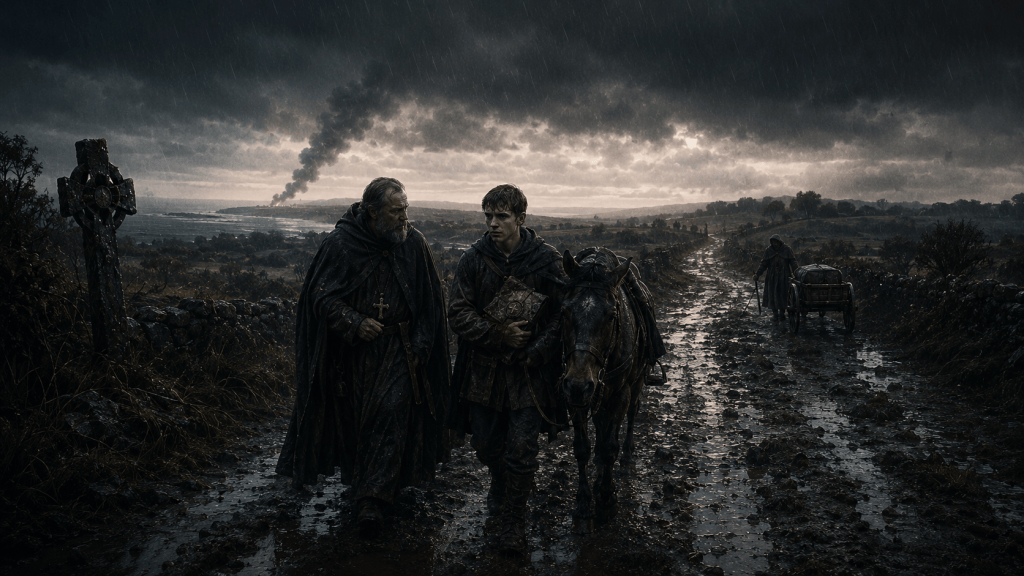
Early medieval Britain had no single mechanism through which reliable news travelled evenly across the country. Information moved with people, through clerical networks, royal households, merchants, messengers, travellers, river routes, and roads whose condition varied greatly from place to place. Some Roman roads remained in use long after Roman government had disappeared, and Historic England notes that such routes continued to matter in later periods as lines of movement, commerce, settlement, and property definition.
A report leaving the coast could change as it passed through several mouths, especially where fear had prepared listeners for worse news. One person might know of smoke, another of missing clergy, another of a vessel seen offshore, while someone farther inland might receive only a fragment joined to an older rumour. Medieval communication could carry urgency over distance, while certainty moved more slowly and became harder to preserve beyond major centres of authority.
This is why the world surrounding The Broken Sanctuary, Book Two of The Last Rune Keeper, is built around roads, crossings, names, guarded approaches, and the problem of deciding which account deserves belief. The completed book keeps Lindisfarne behind the characters once the scale of danger becomes clear, allowing the raid to be experienced through second-hand testimony, frightened households, Church messages, watched routes, and the gradual hardening of local caution into procedure. The Book Two report identifies this as one of the story’s central pressures, where fear travels through roads, farms, chapels, ferry crossings, and Church houses while the historical event remains fixed.
The exact checkpoints, households, and encounters belong to the fiction, while the wider landscape of inherited roads, local authority, river crossings, clerical communication, and uncertain travel is historically grounded. Historical fantasy gains strength when invention occupies spaces the record leaves open and allows recorded history to retain its own weight.
Sanctuary Meant People as Much as Walls
A sanctuary can be imagined as a protected building, yet early medieval safety depended upon relationships as much as timber or stone. A traveller needed shelter, food, water, local knowledge, a usable crossing, and people willing to recognise his purpose. A church or religious house could provide spiritual authority and practical support, while the value of that support still depended upon the condition of the surrounding country and the people responsible for maintaining it.
Lindisfarne exposes the fragility inside that idea. Its sacred standing could never make the island physically unreachable, and the raid forced contemporaries to confront the distance between holiness and earthly security. English Heritage describes the attack as physically and psychologically devastating, which helps explain why its significance endured beyond the immediate loss of treasure or life.
A broken sanctuary therefore means more than damaged doors. It can mean a family wondering whether the chapel near its fields remains safe, a cleric deciding whether sacred objects should be moved inland, a messenger carrying names because the road ahead has become uncertain, or a traveller discovering that welcome now comes after questions. These are smaller pressures than a raid seen from the shoreline, yet they are the pressures through which historical change becomes intimate.
Christianity After Violence
Christianity in Anglo-Saxon Britain belonged deeply to public and private life, shaping kingship, literacy, burial, memory, moral order, and the language through which suffering could be understood. The raid on Lindisfarne gained much of its force because the target was sacred, and Alcuin’s reaction shows that the attack was interpreted through a Christian search for meaning as well as through anger at foreign violence. The question reached beyond how armed men had reached an island and into how believers should understand a world in which such an event could happen.
That religious response deserves care in historical fantasy, since easy modern caricature strips early medieval people of the seriousness with which they understood faith. Prayer could coexist with fear, grief, practical defence, political calculation, and uncertainty. A priest could believe completely in God while still recognising that a door required barring, a road required watching, and frightened people still needed food, direction, and somewhere to sleep.
This tension sits close to the heart of The Broken Sanctuary. Father Oswin remains a man of faith and Church duty, yet the story places that faith inside exhaustion, responsibility, and the need to protect Eadric from dangers that include human curiosity as well as the sealed relic under their charge. The Book Two report describes Oswin as the story’s moral centre, with his role shifting towards active protection while Church order continues through writs, records, guarded gates, storage, witnesses, and procedure.
Seeing the Norse World Beyond the Raid
The word Viking can dominate modern discussion so completely that Scandinavians appear only at the moment of attack. Historical reality widened across the generations that followed, with raiding joined by trade, migration, settlement, political ambition, family life, cultural exchange, and communities that became permanent parts of Britain. Even in the early phase, Scandinavians should never be reduced to a single motive or social type.
The attack on Lindisfarne deserves its full violent weight, while the North Sea also connected communities through movement and exchange. English Heritage notes that Anglo-Saxon England already had peaceful links with Scandinavian lands before the best-known raids, a useful reminder that contact across the sea carried more than warfare.
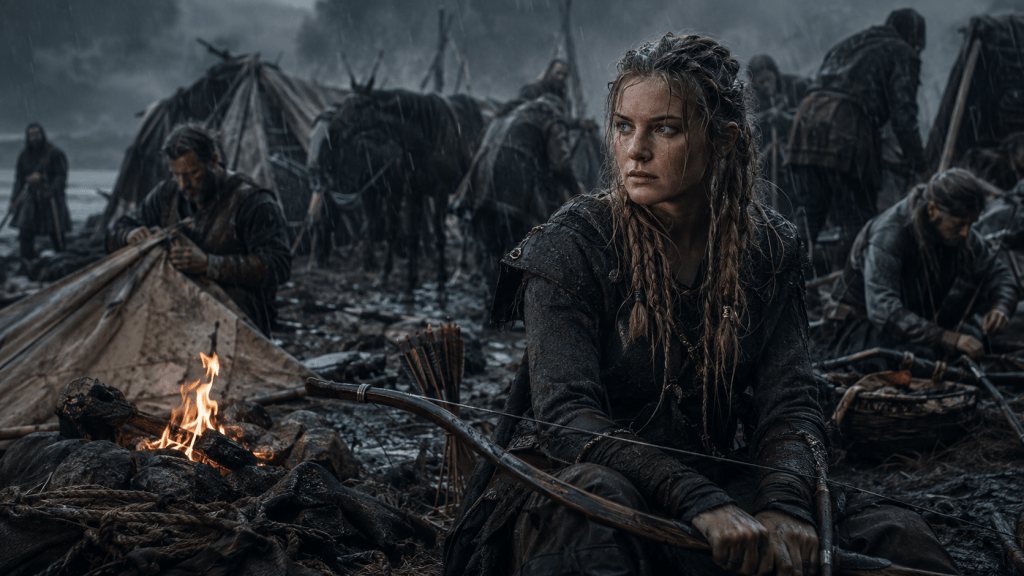
That complexity shapes the fictional treatment of Sigrun in The Broken Sanctuary. Her presence is restrained, first as an armed young woman watching Eadric from the willows, then through a vision that places her among people tending animals, repairing equipment, carrying arrows, cleaning blood from clothing, keeping watch, and enduring rain. Danger remains present throughout the scene, yet Eadric is forced to see human labour and community where fear had encouraged him to imagine only an enemy.
This matters because cultural collision becomes far more compelling once every side is allowed ordinary life. Norse people can raid, trade, farm, migrate, worship, negotiate, fight, raise children, and seek advantage, just as Anglo-Saxon communities can pray, defend land, fear strangers, offer hospitality, and misunderstand what approaches them. History becomes inhabited when broad labels loosen enough for people to appear inside them.
The Broken Sanctuary and the World of The Last Rune Keeper
The Last Rune Keeper follows Eadric through a Britain still divided among kingdoms, local powers, religious networks, and competing identities, with the long formation of England lying beyond the understanding of people living through the earliest pressures that will eventually help shape it. The series dossier places him inside a landscape where movement is uncertain, authority is experienced locally, Scandinavian presence arrives in different forms, and Church structure offers one of the strongest networks capable of carrying belief, records, instruction, and institutional memory across unstable territory.
The fantasy layer sits beside that history instead of claiming to explain it. Eadric’s relic work, his strange sensitivity to old objects, the rare presence of magic, and the fictional tensions surrounding sacred material belong wholly to the story world. The historical Lindisfarne raid remains the historical Lindisfarne raid, while the fantasy asks what it might feel like to carry an additional hidden burden through a society already learning that holy places, familiar roads, and inherited certainties can all be placed under pressure.
That separation allows the real history to keep its force. Lindisfarne mattered because people believed the place mattered, because St Cuthbert mattered, because Christian institutions mattered, and because violence against such a centre unsettled far more than a single religious community. The fictional magic of The Last Rune Keeper adds another layer of fear and memory at the edges, while the human centre remains recognisable through tired travellers, guarded thresholds, conflicting testimony, faith under strain, and the search for safety in a landscape where safety has ceased to feel permanent.
When Safety Changes Meaning
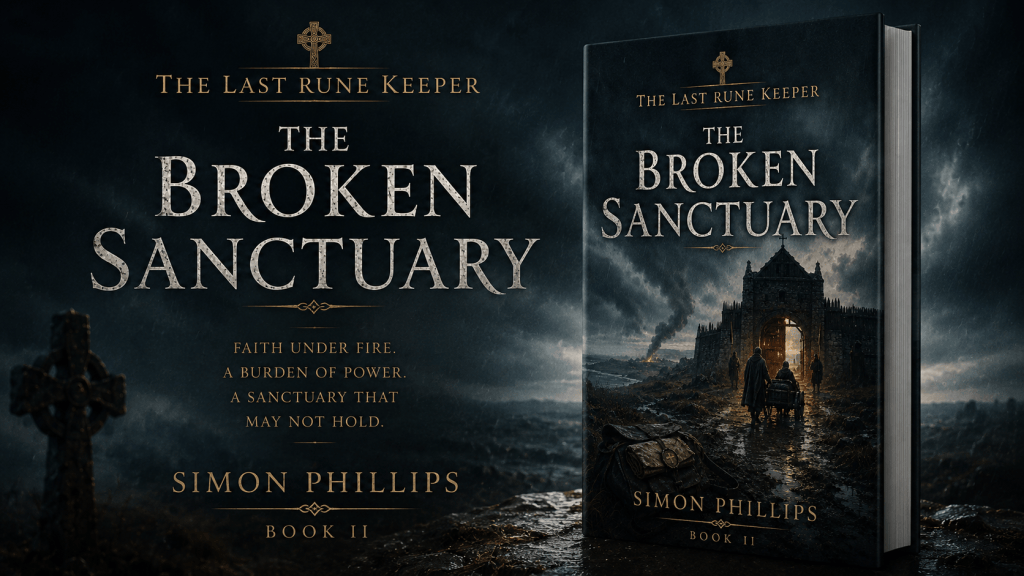
The deepest consequence of the Lindisfarne raid may lie in the questions it forced upon people who still had to wake, travel, pray, work, and care for others after hearing what had happened. A sanctuary could be sacred and vulnerable together, a road could connect refuge with danger, and a rumour could shape behaviour long before anyone possessed a complete account. The Christian community at Lindisfarne endured beyond 793, which makes the event a story of continuity under pressure as much as a story of devastation.
That is the historical ground beneath The Broken Sanctuary. The world has changed before most people have had time to understand the change, and the first response is made through small acts: a gate watched more closely, a name written down, a traveller questioned, a sacred burden moved, a stranger viewed with greater suspicion, or a prayer spoken by someone who still believes while fear sits beside belief. England lies generations away and the long Viking Age has barely begun, yet the pressures that will reshape kingdoms are already entering roads, households, churches, and memory, where history is usually felt first.
Discover more from Simon J. Phillips
Subscribe to get the latest posts sent to your email.
