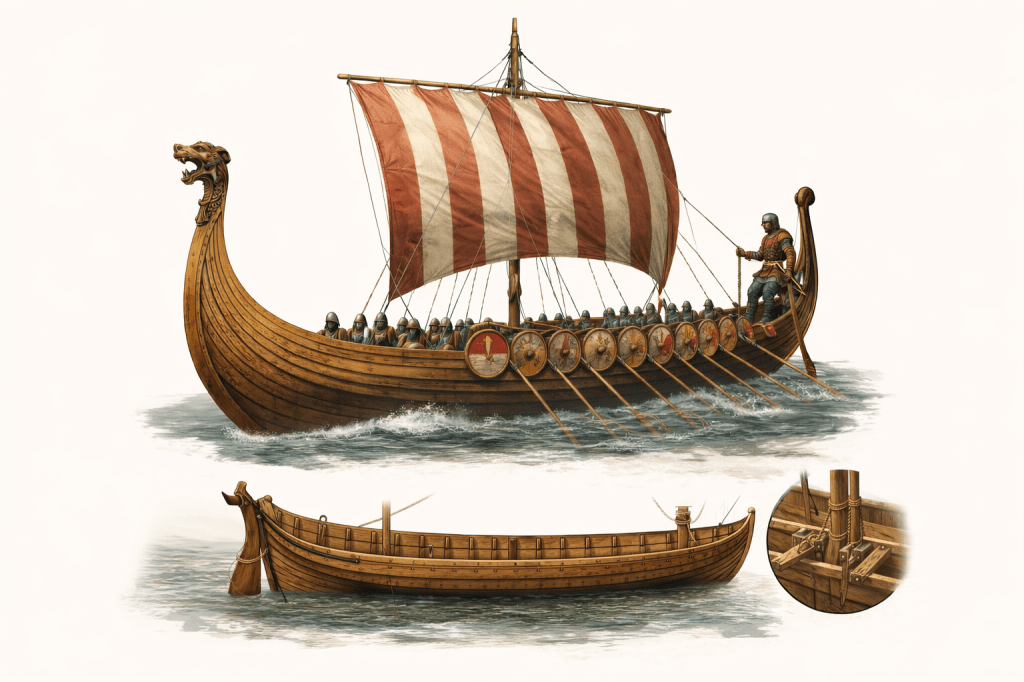
The Forgotten Chronicle: The Longship – Weapon of the Viking Age

The remarkable ship that turned the North Sea into a highway and allowed Viking sailors to strike the shores of Europe with speed and precision.

Northern Seas of Scandinavia: Early Viking Age

Along the windswept coasts of Britain, where narrow rivers met the restless waters of the North Sea and stone monasteries stood watching the long grey horizon, the monks who kept the written memory of the age had begun to record troubling reports carried slowly across the maritime world that connected the scattered shores of northern Europe.

Messages travelled gradually between the monasteries and trading settlements of the coasts, arriving with merchants who followed the sea lanes between England and the lands of the continent, with wandering pilgrims seeking distant houses of learning, and sometimes with fishermen who spoke of unfamiliar vessels sighted far beyond the shallows where the known trading ships usually sailed.

For generations the waters of the North Sea had served as a broad corridor linking distant communities, a place where commerce and travel moved with the rhythm of tide and weather as traders exchanged wool, timber, and crafted goods between the ports of Britain, Francia, and the Low Countries, while scholars and pilgrims crossed the same uncertain waters in search of devotion, learning, and sanctuary within the quiet walls of the monasteries that lined the northern coasts.

Yet beyond that familiar maritime world, along the broken coastlines and deep fjords of Scandinavia, a very different relationship with the sea had long shaped the lives of the people who lived among the mountains and narrow valleys of Norway and Denmark, where limited farmland and harsh winters had encouraged generations of seafarers to look outward across the northern waters in search of opportunity, trade, and sometimes plunder.

Within those northern communities, the craft of shipbuilding had developed steadily over many generations, as skilled builders shaped flexible oak planks along slender frames to produce vessels capable of moving with the motion of the sea itself while still remaining swift beneath both sail and oar, creating ships whose narrow hulls and shallow draught allowed them to travel across coastal waters, beaches, estuaries, and winding rivers that larger vessels could never approach.

The ship that emerged from this long tradition of experimentation and refinement would soon become known across the chronicles of Europe, for the vessel combined speed, balance, and adaptability in ways that made it uniquely suited to the restless northern seas, enabling its crews to cross the wide expanse of the North Sea with surprising speed before appearing suddenly along distant shores that had long believed themselves secure behind the uncertain barrier of the open water.

This vessel, which later generations would simply call the longship, represented far more than a tool of travel or trade, since its design embodied the accumulated knowledge of communities whose survival depended upon mastering the changing winds, tides, and currents of the northern seas, allowing its crews to approach almost any shoreline before withdrawing again into the wide waters from which they had emerged.

By the closing years of the eighth century, ships of this kind had begun to appear with increasing frequency along the coasts of Britain, sometimes arriving first as traders or explorers whose intentions remained uncertain, though the visits gradually became more troubling as small coastal settlements and isolated monasteries reported sudden attacks carried out by raiders who arrived swiftly from the sea before vanishing again beyond the horizon.

Word of these encounters moved slowly across the maritime world of the North Sea, recorded in fragments within monastic chronicles and carried through rumour and testimony between the scattered communities that depended upon the sea for travel and trade, while few at the time could yet recognise that these early attacks marked the beginning of a transformation that would soon reshape the balance of power along the northern coasts of Europe.

The quiet raids of the early Viking Age had begun.


Timeline of Events

793 AD — The attack upon the monastery of Lindisfarne sends shock across the Christian world, marking the beginning of what later generations would recognise as the Viking Age in Britain.

795 AD — Norse raiders strike the monasteries of Ireland, revealing that the northern seafarers have begun to range widely across the waters of the Irish Sea.

802 AD — Viking forces descend upon the sacred island monastery of Iona, destroying buildings that had stood for generations and demonstrating the growing reach of the northern fleets.

806 AD — A second attack upon Iona results in the killing of sixty-eight monks, an event recorded with deep sorrow in the surviving chronicles of the age.

820s AD — Raiding fleets begin appearing with greater regularity along the coasts of Francia and the Low Countries, extending the sphere of Norse activity beyond the shores of Britain.

830s AD — Viking expeditions increasingly follow the great river systems of Europe, travelling inland along waterways that lead deep into the heart of powerful kingdoms.


About the Creator

This Chronicle is written by Simon Phillips, author of several historical and speculative fiction works exploring forgotten worlds, myth, and the turning points of history.

You can explore his books here::
Books by Simon Phillips

You can watch his YouTube channel here:
Author Simon Phillips

Subscribe to continue reading

Subscribe to get access to the rest of this post and other subscriber-only content.

The Forgotten Chronicle: The Raiders of the North Sea

How the longships returned again and again to the coasts of Britain, and how the quiet raids of the early Viking Age began to reshape the shores of Europe.


North Sea Coasts of Britain: Late Eighth Century

Morning gathered slowly across the wide waters of the North Sea as a pale band of light lifted along the eastern horizon. The tide moved with quiet patience against the dark rocks of the English coast, while a thin wind travelled inland across fields where early mist rested upon the grass. Fishing boats drifted close to shore as seabirds wheeled above the surf, their distant cries echoing through the cool air while villages along the coastline stirred into the routines of another ordinary day.

Life beside the sea followed a rhythm shaped by weather, tide, and season. Small settlements clung to river mouths and sheltered coves where timber houses leaned against one another for protection from the wind. Smoke rose from hearth fires as fishermen prepared their nets and farmers walked the narrow paths that wound between grazing fields and low stone walls. Along these coasts monasteries and trading posts had grown over many generations, marking the frontier where the kingdoms of Britain faced the open sea. From these quiet harbours merchants sailed toward distant markets while travellers carried news between scattered communities that watched the changing waters beyond their shores.

For many years the sea had brought visitors whose arrival stirred curiosity more often than alarm. Traders appeared with furs, amber, and crafted goods drawn from the forests and rivers of the north. Pilgrims crossed the waters seeking holy places where prayer and learning flourished along the edge of the Christian world. Ships entered the estuaries under peaceful sails and anchored near wooden jetties, where voices in unfamiliar languages mingled with the sounds of trade and welcome. The sea served as a road linking distant lands, and those who lived beside it understood that strangers might appear with any turning of the tide.

Across the northern horizon another fleet moved through the morning haze.

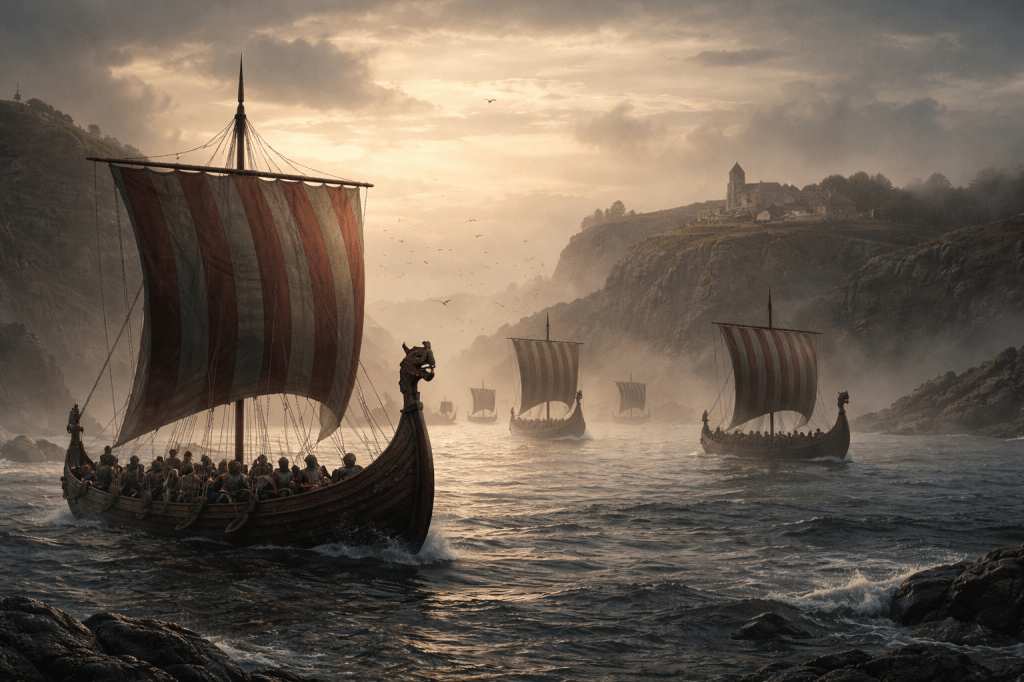
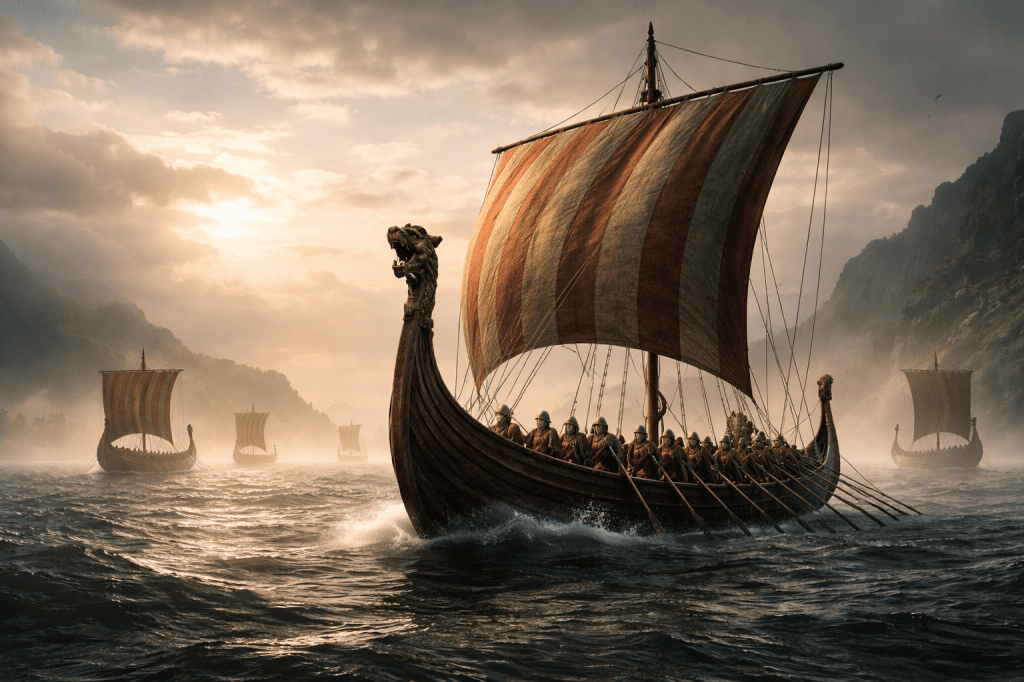
Long, narrow vessels advanced across the open water with quiet purpose, their tall masts rising above hulls shaped for both river and sea. Striped sails caught the wind while rows of oars rested along the sides of the ships like folded wings awaiting command. Carved figureheads gazed forward across the waves as the vessels travelled swiftly toward the coasts of Britain, guided by sailors whose knowledge of currents and shoreline had grown through countless voyages across the northern seas. These ships carried crews drawn from fjords and islands far beyond the horizon, men whose world stretched across harbours and hidden inlets scattered throughout Scandinavia.

The appearance of such vessels along the coasts of Britain soon became a familiar sight. Word of rich monasteries and prosperous settlements travelled easily along the trade routes of the North Sea, and stories carried home by sailors opened new paths for those willing to cross the water in search of wealth, adventure, and reputation. Fleets gathered during the warmer months when winds favoured westward travel, and the longships slipped from their harbours to follow sea lanes known to generations of northern mariners.

From the shores of Northumbria to the estuaries of the Thames, watchers soon learned to study the horizon with a cautious eye. A distant sail rising through sea mist might signal traders seeking harbour or travellers searching for refuge from a storm. It could also announce the arrival of warriors whose swift ships allowed them to appear without warning along a coastline that stretched for hundreds of miles. Over the decades following the first raid upon Lindisfarne, these sudden arrivals began to shape the memory of communities scattered across Britain and Ireland. The waters of the North Sea gradually became a highway along which the raiders of the Viking Age travelled again and again.


Timeline of Events

793 AD — Viking raiders attack the monastery of Lindisfarne in Northumbria, shocking Christian Europe and marking the beginning of recorded Viking activity in Britain.

795 AD — Scandinavian raiders strike monastic settlements along the coast of Ireland, including the island monastery of Iona.

802 AD — Viking attacks intensify across the Irish Sea, with the monastery of Iona suffering a devastating raid that destroys much of the settlement.

806 AD — A further assault on Iona leaves many monks dead, forcing survivors to abandon parts of the island and carry the relics of Saint Columba to safer ground.

820s–830s AD — Viking ships appear with increasing frequency along the coasts of Britain, Ireland, and the Frankish Empire, targeting monasteries, trading settlements, and river ports.

Mid–9th century — Raiding fleets grow larger and more organised, signalling the gradual shift from seasonal coastal attacks to longer expeditions across the North Sea.


About the Creator

This Chronicle is written by Simon Phillips, author of several historical and speculative fiction works exploring forgotten worlds, myth, and the turning points of history.You can explore his books here::
Books by Simon Phillips

You can watch his YouTube channel here:
Author Simon Phillips


The Chronicle

Across the decades following the destruction of Lindisfarne, the coasts of Britain slowly entered a new relationship with the sea that lay beyond their eastern horizon. Communities whose lives had long unfolded beside quiet estuaries and wind-swept cliffs began to recognise subtle signs that the waters of the North Sea now carried travellers of a different character. Fishermen hauling their nets across the grey morning tide occasionally glimpsed unfamiliar sails moving along the distant horizon. Merchants arriving in harbour spoke of swift ships whose crews appeared without warning along the coasts of Frisia and the Frankish kingdoms. Word travelled along the trading routes that stretched from York to Dublin and across the Channel toward the markets of the continent, and with each passing season the stories grew more frequent.

The vessels responsible for these encounters possessed a design shaped through centuries of seafaring life within the fjords and islands of Scandinavia. Their narrow hulls rested lightly upon the water, allowing the ships to travel across deep ocean swells as easily as the shallow mouths of rivers. Flexible planks of oak overlapped along the sides of each vessel, creating a structure both strong and resilient beneath the shifting weight of wind and tide. A single tall mast carried a broad sail woven from wool, and when the wind failed the crews turned to their oars, sending the ships forward through disciplined strokes that drove the long hulls across the sea with remarkable speed.

Such ships allowed Scandinavian sailors to travel extraordinary distances with confidence. A voyage that might challenge heavier trading vessels became an achievable passage for the longship. Crews crossed the North Sea during favourable weather, guiding their course through knowledge of currents, migrating birds, and the faint outline of distant land rising through sea mist. These journeys formed the foundation of an expanding maritime world that connected the harbours of Norway, Denmark, and Sweden with the shores of Britain and Ireland.

For many communities along the British coastline the first sign of arrival appeared as a narrow line of sails emerging from the pale haze of the morning sea. Villagers standing upon the headlands sometimes watched these vessels glide along the horizon before turning toward a sheltered bay or river mouth. At times the ships carried traders seeking goods and silver through peaceful exchange. On other days the crews approached with a different purpose shaped by opportunity and ambition. The longships grounded upon the shore with the scrape of timber across stone, and warriors stepped into the surf carrying axes and round shields whose painted surfaces flashed beneath the rising sun.

Early raids unfolded with swift precision. Coastal monasteries and small trading ports presented tempting targets for seafarers aware that such settlements often stored precious metals offered through gifts and commerce. Within the halls of monasteries stood vessels of silver used during the liturgy, reliquaries decorated with gold, and manuscripts bound with ornate fittings that reflected the devotion of patrons who had supported the Church for generations. These objects possessed both spiritual significance and material value, and word of their presence travelled easily through the networks of northern trade that connected distant communities across the sea.

When the raiders arrived their actions followed a pattern that gradually became familiar along the shores of Britain and Ireland. Crews advanced quickly from the beach toward the buildings that marked centres of wealth or worship. Doors splintered beneath the strike of iron blades, storerooms yielded their treasures, and captives were gathered for the return voyage across the sea. The entire encounter could unfold within the span of a single morning before the longships lifted once again upon the tide and vanished beyond the horizon.

These raids spread gradually across the coasts of the British Isles during the early decades of the Viking Age. Monastic communities in Ireland experienced similar assaults, particularly upon isolated islands where small groups of monks lived in quiet devotion amid the winds of the Atlantic. The monastery of Iona, long revered as a centre of learning and pilgrimage, suffered repeated attacks that shocked the Christian world. Chroniclers recorded these events with sombre language that conveyed both grief and astonishment at the sudden violence carried across the sea.

The impact of these encounters extended beyond the immediate destruction of buildings or the loss of sacred objects. Coastal societies began to adjust their understanding of the sea itself. Where once the horizon symbolised trade, pilgrimage, and communication between distant lands, it gradually assumed a second meaning associated with uncertainty and watchfulness. Monasteries strengthened their defences, settlements organised watch points along the cliffs, and messengers carried news of approaching ships between neighbouring communities.

Kings and regional rulers also faced the challenge presented by these swift maritime expeditions. The political landscape of early medieval Britain consisted of several kingdoms whose rivalries often consumed attention and resources. Armies prepared for conflicts along land borders while the sea remained a frontier governed largely by trade and seasonal travel. The sudden appearance of seaborne raiders therefore exposed a vulnerability that rulers struggled to address during the early years of the Viking Age.

Despite the alarm caused by these attacks, the raiders themselves remained part of a broader world shaped by trade and exploration. Scandinavian sailors travelled widely across northern Europe, exchanging furs, amber, iron, and crafted goods within markets that linked the Baltic with the Atlantic. Many voyages unfolded peacefully as merchants sought profit through negotiation and exchange. The same ships capable of sudden violence therefore also carried traders, craftsmen, and travellers whose journeys formed the foundation of a complex maritime culture.

Over time the repeated voyages between Scandinavia and the British Isles created familiarity with the rivers, harbours, and coastal routes of the region. Sailors learned where tides ran strongly through narrow estuaries and where sheltered anchorages provided safety during harsh weather. Knowledge gathered through each expedition encouraged further travel, and the longships returned season after season along routes that gradually became well known to crews who regarded the North Sea as a navigable highway connecting distant worlds.

By the middle decades of the ninth century this pattern of raiding voyages had begun to evolve into something more organised. Larger fleets appeared along the coasts, and some groups chose to remain through the winter months within foreign lands. The transformation unfolded gradually through countless individual journeys undertaken by crews who sailed westward in search of opportunity. Each voyage carried the potential for trade, conflict, and discovery, and the shores of Britain formed a natural destination within the expanding horizon of the Viking world.

The quiet villages and monasteries that lined the British coastline therefore entered an era defined by the movement of ships across the northern sea. From the chalk cliffs of the south to the rugged headlands of Northumbria, communities watched the horizon with growing awareness that the waters beyond their fields and harbours had become a pathway linking their lives to the ambitions of sailors from distant fjords. The raiders of the North Sea would return many times in the generations that followed, and the memory of their sails rising through sea mist gradually wove itself into the history of every shore they reached.


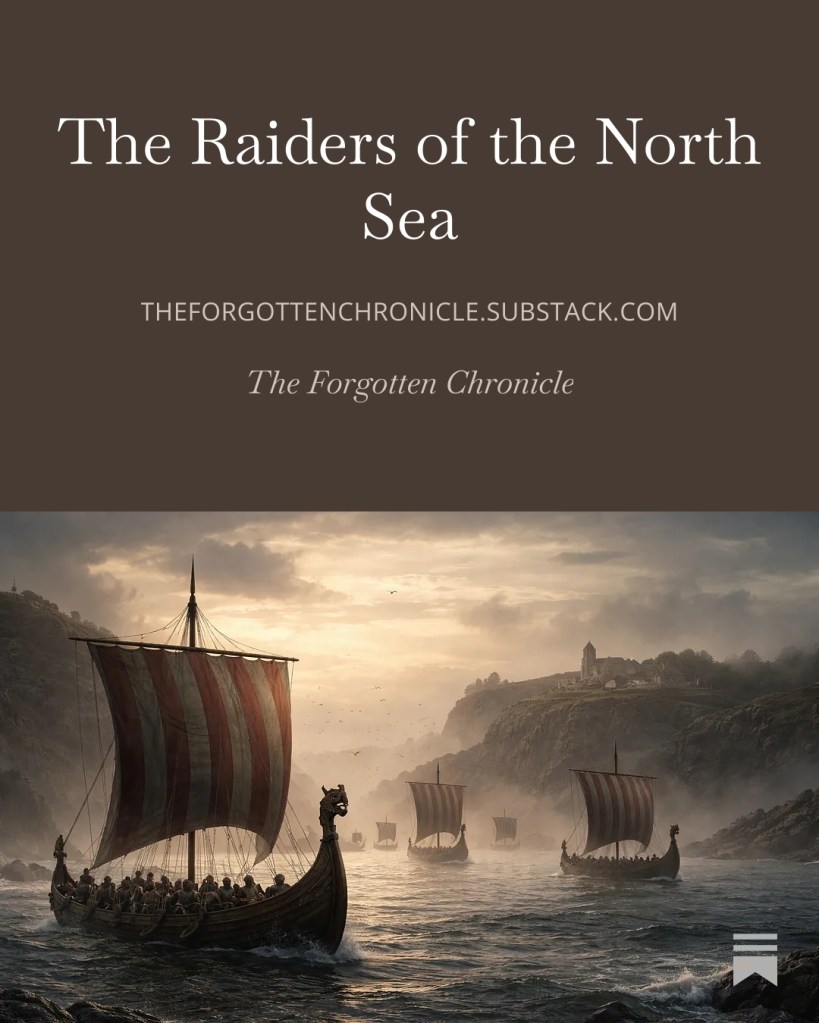
Illustration of a Scandinavian longship crossing the North Sea during the early Viking Age. Ships such as these carried Viking crews from the fjords of Norway and Denmark toward the shores of Britain and Ireland.


Historical Notes & Context

Additional Historical Notes

During the early Viking Age the longship represented one of the most effective maritime technologies in Europe. Its construction relied on overlapping oak planks fastened along a flexible wooden frame, allowing the hull to bend slightly with the movement of waves rather than resisting them with rigid weight. This design made the vessels both durable and fast, capable of crossing open sea while still navigating shallow rivers and estuaries.

The longship’s shallow draft allowed Viking crews to approach coastlines where heavier ships could not safely travel. Raiders could therefore land directly upon beaches, riverbanks, or tidal flats without requiring developed harbours. Once ashore the ships could be dragged back into the water with relative ease, enabling crews to strike quickly and depart before organised resistance could form.

These advantages gave Scandinavian sailors a mobility that surprised many communities along the coasts of Britain and Ireland. Monasteries and settlements built near the sea for convenience of travel suddenly faced visitors whose ships allowed them to appear with little warning and disappear just as swiftly.

Related Events

The pattern of early coastal raids gradually expanded throughout the ninth century. Scandinavian ships began travelling further inland along the major rivers of Europe, reaching trading towns and royal centres that had previously considered themselves secure from seaborne attack. In Britain the rivers Tyne, Humber, and Thames became important routes that allowed raiders to penetrate deep into the heart of the Anglo-Saxon kingdoms.

At the same time the nature of Viking expeditions slowly evolved. Early voyages often consisted of small crews seeking portable wealth before returning home. Over time larger fleets began to appear, and some groups chose to remain in foreign territories for extended periods. Temporary camps established along rivers and coastlines allowed these crews to repair ships, gather supplies, and prepare for further expeditions.

This gradual shift from seasonal raids toward longer occupations eventually led to the arrival of organised Viking armies during the later ninth century.

Further Reading

The Vikings – Else Roesdahl

The Viking Age – Anders Winroth

The Viking World – Edited by Stefan Brink and Neil Price


Inspiration Behind the Story

The early Viking raids remain fascinating because they mark the moment when the quiet balance of early medieval Europe began to shift in ways few people living at the time could fully understand. For the communities along the coasts of Britain and Ireland, the sea had long served as a path for pilgrims, merchants, and travellers. Ships carried news, trade, and the slow exchange of cultures across the northern world. When the longships of Scandinavia began to appear with different intentions, that familiar horizon suddenly carried a new uncertainty.

What makes this period so compelling lies in its human scale. The early raids were often small expeditions undertaken by crews whose journeys lasted only a season. Yet those brief encounters left a deep impression on the societies that experienced them. Monks who recorded the attacks viewed them through the lens of faith and fear, while the sailors who crossed the sea likely saw opportunity and adventure.

These moments continue to resonate because they remind us how quickly history can change direction. A handful of ships emerging from sea mist could transform the destiny of kingdoms, alter the course of trade, and begin a chapter of history that still shapes the cultural memory of Europe today.


From the Author’s Desk

Thank you for reading this Chronicle. Each week this publication revisits a single moment from the past, told through narrative so that the atmosphere of history can emerge through place, people, and consequence.

Alongside the Chronicle, my fiction writing continues across several projects. Short stories and novellas are available through Kindle, while my YouTube channel hosts regular Mini-Reads and Flash-Fiction episodes where short pieces of storytelling are presented in a visual format.

Readers who enjoy historical atmosphere, mythic themes, and narrative storytelling may find those projects worth exploring through the links included in this publication.

Readers who enjoy historical atmosphere, mythic themes, and narrative storytelling may find those projects worth exploring through the links included in this publication.

You can explore my books here::
Books by Simon Phillips

You can watch my YouTube channel here:
Author Simon Phillips


Next Chronicle

The sudden appearance of Viking raiders along the shores of Britain raised a question that troubled many kingdoms across northern Europe. How could small crews travel such distances, strike with such speed, and vanish across the sea before armies could respond?

The answer lay in the design of a remarkable vessel. Long, narrow, and built for both ocean travel and shallow rivers, the Scandinavian longship gave its crews a freedom of movement few societies of the time could match. These ships turned the North Sea into a highway and allowed Viking sailors to reach monasteries, towns, and inland rivers with unsettling ease.

In the next Chronicle we turn from the raiders themselves to the ship that carried them.

Next Chronicle: The Longship: Weapon of the Viking Age.


History often remembers the thunder of great armies and the rise of kings, yet the Viking Age began with something far smaller: a handful of longships appearing along distant shores, their sails dark against the northern sea, carrying with them the first quiet turning of an age.

The Forgotten Chronicle: The Burning of Lindisfarne

The raid that shattered the quiet of a sacred island and announced the coming of the Viking Age


Lindisfarne, Northumbria: June 793

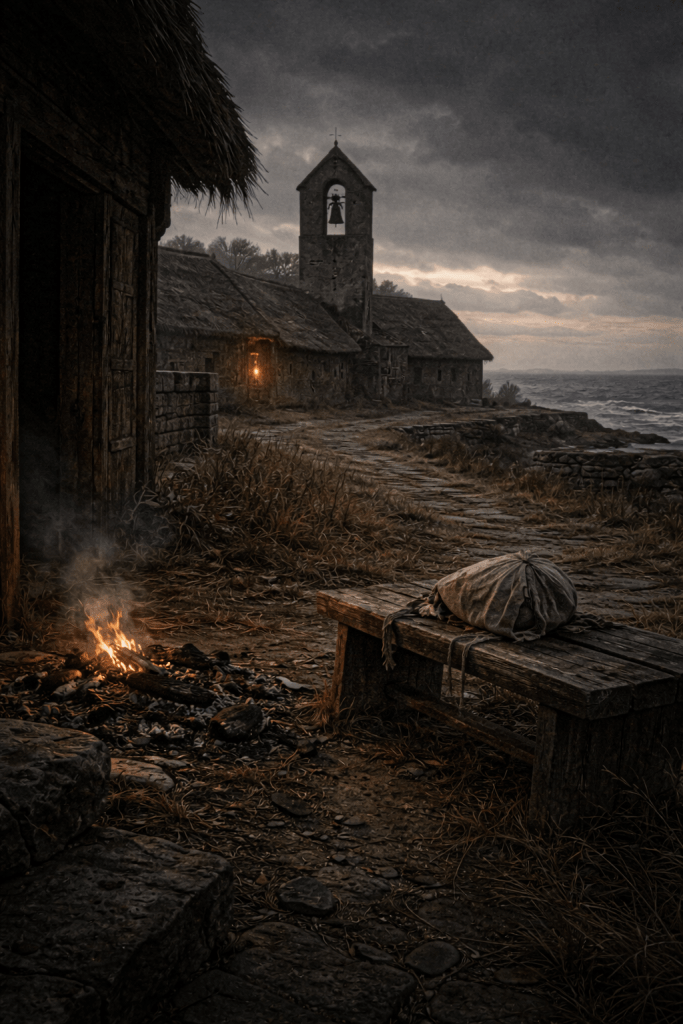
The first light of morning crept slowly across the waters of the North Sea, pale and uncertain beneath a sky still heavy with the fading colours of night. Lindisfarne lay quiet upon its small tidal island, the stone church and timbered buildings of the monastery rising from the grass like an outpost of prayer set against the restless edge of the world. Waves moved softly across the rocks below the cliffs while seabirds circled through the cold air, their distant cries carrying over the water as the monks of the island prepared for another day within the rhythm of worship and labour.

Within the monastery walls the brothers moved through familiar duties. Candles burned low along the chapel as morning prayers echoed through the stone interior, the voices of the monks rising together in measured devotion. Beyond the church, fields stretched toward the narrow causeway that linked the island to the mainland during the turning of the tides. Cattle grazed across the wind-bent grass, and thin smoke drifted upward from hearth fires within the small settlement that had grown around the sacred house over many years of peace.

Lindisfarne had long stood as a place of learning and faith upon the northern frontier of the Christian world. Pilgrims travelled from distant lands to visit the shrine of Saint Cuthbert, whose memory lingered within the island’s stones and stories. Monks copied sacred texts within quiet scriptoria while travellers carried word of the monastery’s holiness across the kingdoms of Britain. Here, at the meeting of land and sea, prayer and scholarship joined with the slow patience of monastic life.

Far out upon the grey water a shape moved through the morning mist.

At first it seemed little more than shadow against the horizon, rising and falling with the long swell of the sea. The island still slept beneath the calm of early dawn, and the watchers upon the shore paid the distant shape little attention. Fishing vessels sometimes crossed these waters, and traders occasionally ventured along the coast when the weather allowed. The sea had always carried travellers toward Lindisfarne.

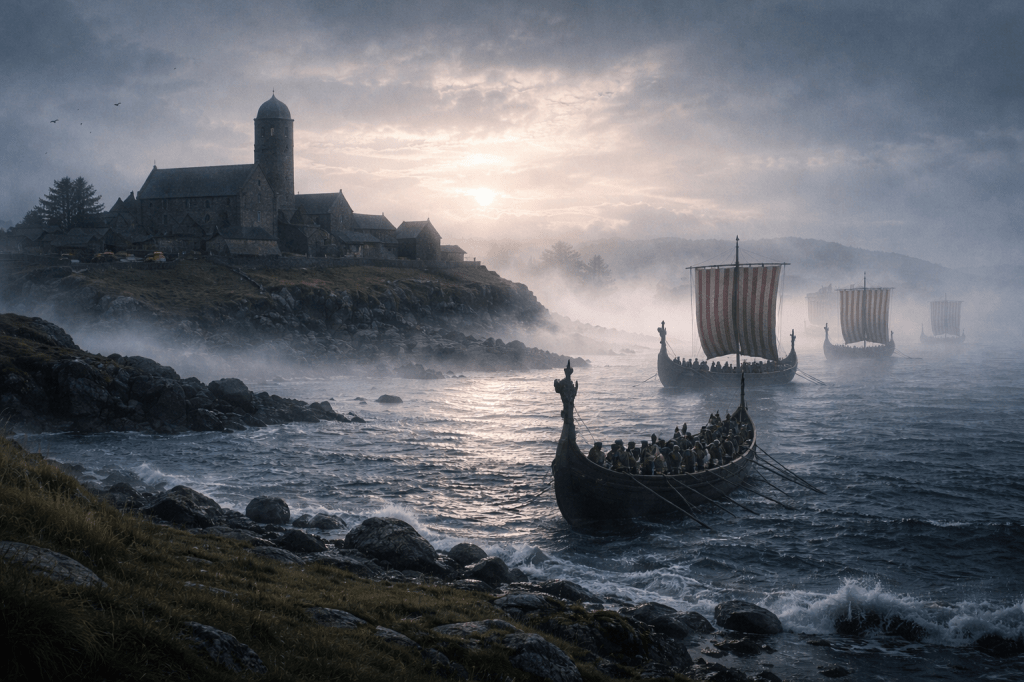
As the light grew stronger the shape divided into several darker forms, each carrying a tall sail striped with deep colour. The wind pressed against the cloth as the vessels advanced across the water with unsettling speed, their narrow hulls cutting through the mist that clung to the surface of the sea. Carved prows rose at the head of each ship, fierce figures of beasts staring forward as though guiding the fleet toward the island.

Along the monastery shore a few monks paused in their work and turned their eyes toward the approaching sails. The rising sun touched the striped cloth with a dull glow, revealing long rows of oars moving together against the tide. The vessels travelled with purpose, gliding across the water with a confidence that belonged to sailors long familiar with the harsh northern seas.

Lindisfarne had welcomed travellers for generations. Pilgrims, traders, and wandering priests had stepped upon its shores in search of blessing or refuge. Yet as the longships drew closer through the morning mist, a quiet unease began to settle across the island. The sea carried strangers once again toward the monastery of Saint Cuthbert, and the calm of that early morning slowly gave way to a moment that would echo across the centuries.


Timeline of Events

635 AD —The monastery of Lindisfarne is founded by the Irish monk Aidan under the patronage of King Oswald of Northumbria.

687 AD — Saint Cuthbert, one of the most revered figures in early English Christianity, is buried on the island, strengthening Lindisfarne’s reputation as a centre of pilgrimage.

8 June 793 AD — Viking longships land on Lindisfarne. The monastery is raided, monks are killed or taken as slaves, and sacred treasures are carried away.

794 AD — Further raids strike monasteries along the North Sea coasts, spreading fear across Christian Europe.

800–830 AD — Scandinavian raiders begin appearing regularly along the coasts of Britain and Ireland.


About the Creator

This Chronicle is written by Simon Phillips, author of several historical and speculative fiction works exploring forgotten worlds, myth, and the turning points of history.

You can explore his books here::
Books by Simon Phillips

You can watch his YouTube channel here:
Author Simon Phillips


The Chronicle

The longships grounded upon the shingle with the hollow scrape of timber meeting stone as the tide lifted gently around their hulls. Oars rose from the water and rested along the gunwales while the crews stepped down into the cold surf, boots pressing into the shifting pebbles of the shore. Sea mist drifted across the island in thin veils that softened the line between land and water, yet the figures advancing from the ships carried a sense of purpose that cut through the quiet of the morning. Shields hung across their backs, axes rested in their hands, and the carved prows of the vessels behind them watched the island like silent guardians carved from dark wood.

From the fields near the monastery the first witnesses stood in uneasy silence. A herdsman gathering cattle paused beside a low stone wall and stared toward the unfamiliar sails that now rested along the edge of the sea. The sight travelled quickly through the small settlement clustered around the sacred house. Doors opened, tools lowered into the grass, voices carried across the wind as neighbours called to one another across the narrow lanes. Life upon the island moved according to seasons, prayer, and the turning of the tide, yet the presence of armed strangers upon the shore stirred a tension that spread through the community with gathering speed.

Inside the monastery the brothers continued their morning offices as candlelight flickered against the worn stones of the chapel. Voices rose together in steady prayer beneath the timbered roof while thin smoke from the altar lamps drifted through the cool air. The bell had already marked the beginning of the day’s devotion, and the monks followed the rhythm that had shaped life on Lindisfarne for generations. Outside the chapel walls the wind moved through the long grass and carried faint echoes of movement from the shoreline where the strangers crossed the sand.

The first warning arrived through the courtyard with hurried footsteps striking the flagstones. A lay brother entered the chapel with breath still sharp from running, his words spilling through the quiet hall as he spoke of ships resting upon the shore and warriors moving across the island. The prayer faltered, voices fading into silence while several monks stepped toward the doorway to see the horizon with their own eyes. From the rise above the buildings the sails could still be seen above the mist, striped cloth lifting gently in the wind that had carried the vessels from distant seas.

The warriors advanced across the fields with measured confidence, their line spreading gradually as they approached the cluster of buildings that formed the monastery. Lindisfarne had stood for many years as a sanctuary at the edge of the Christian world. Pilgrims travelled from far kingdoms to kneel beside the shrine of Saint Cuthbert, whose memory shaped the identity of the island. Kings sent gifts of silver and gold to honour the holy place, and within its walls scribes laboured patiently over manuscripts that carried sacred words across generations. The quiet structures of timber and stone therefore held wealth that extended beyond prayer alone.

The raiders moved with the discipline of men familiar with coastal settlements and the riches that lay within them. Doors splintered beneath heavy blows from iron axes, wooden chests were dragged into the open courtyards, and the contents of storerooms spilled across the ground as warriors searched for vessels, ornaments, and coin. Monks scattered through the narrow paths between the buildings, some fleeing toward the fields while others gathered within the chapel where the shrine of Saint Cuthbert rested beneath its coverings. The calm order of the island dissolved into movement, shouts, and the crash of breaking timber.

Violence swept across the monastery with swift force. Several brothers fell beside the buildings where they had lived and prayed for years, while others were driven toward the beach where ropes bound their hands and forced them toward the waiting ships. The raiders carried away vessels of silver, reliquaries decorated with precious metal, and manuscripts whose value lay as much in the materials that adorned them as in the words written upon their pages. Leather sacks filled with ornaments passed from hand to hand while warriors moved between the buildings with practised speed.

Smoke soon lifted into the morning air as scattered fires began to take hold among the wooden structures that surrounded the stone church. Flames climbed along roof beams while sparks drifted across the grass that bordered the settlement. The sea wind carried the scent of burning timber across the island and mingled it with the salt air rising from the water below the cliffs. Beyond the smoke the longships waited upon the tide with quiet patience, their crews moving steadily between shore and vessel as the plunder of the monastery gathered within the hulls.

By the time the sun climbed higher above the sea the raiders had begun to withdraw toward the beach. Captives were driven ahead of them across the stones while the remaining warriors carried the final bundles of treasure toward the waiting ships. Oars slid once more into their places along the sides of the vessels, and the tide that had carried the fleet toward Lindisfarne now prepared to bear it back across the northern sea. When the sails lifted again above the water the longships glided away from the island with the same quiet certainty that had marked their arrival.

After the vessels vanished into the pale distance a heavy stillness settled across Lindisfarne. Smoke drifted above damaged buildings while survivors moved cautiously through the ruins that surrounded the chapel. The shrine of Saint Cuthbert remained standing within the stone church, though the community that had guarded it now faced a future shaped by loss and uncertainty. The island that had once seemed a place of safety at the edge of the world had learned that the northern seas carried forces capable of reaching even the most remote sanctuary.

News of the attack travelled quickly across the kingdoms of Britain. Messengers rode south through Northumbria bearing word of the assault upon the holy island, and chroniclers recorded the shock that spread among rulers and churchmen alike. The raid upon Lindisfarne soon became a symbol of a wider change unfolding along the coasts of Europe. From the fjords and harbours of Scandinavia seafaring communities had developed vessels whose speed and flexibility opened distant shores to sudden arrival.

In the years that followed, similar ships would appear along rivers and coastlines throughout the British Isles and the continent beyond. Monasteries once regarded as places of peace began to watch the horizon with wary eyes, and kings slowly recognised that the northern seas had produced a new power shaped by wind, timber, and the ambitions of sailors whose world stretched far beyond their home shores. The morning at Lindisfarne therefore marked more than a single raid upon a monastery. It signalled the arrival of an age in which the Northmen would travel across Europe, leaving traces of their voyages in the history of every shore their longships touched.


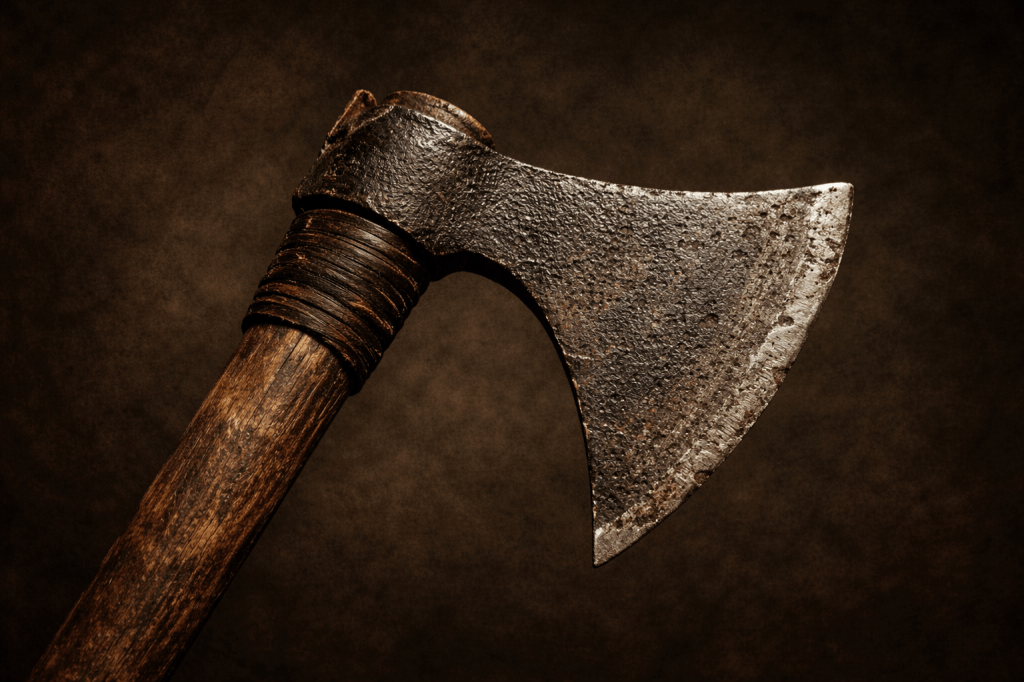
Iron Viking axe of the early medieval period. Weapons of this type were commonly carried by Scandinavian raiders during the first coastal attacks along the North Sea in the late eighth century.


Inspiration Behind the Story

Moments such as the raid upon Lindisfarne hold a powerful place in the imagination of history because they reveal how suddenly the direction of an age can change. The island itself was small and remote, resting quietly at the edge of Northumbria where the tides shaped daily life and the monks followed a rhythm of prayer that had endured for generations. Within those simple buildings lived a community devoted to study, worship, and the preservation of sacred texts that carried the memory of early Christianity across the British Isles.

The arrival of the longships transformed that quiet place into a turning point remembered across centuries. The attack carried a symbolic weight that travelled far beyond the stones of the monastery. Chroniclers across Christian Europe recorded the event with alarm, and their words preserved the moment when distant northern sailors first appeared upon the shores of Britain with violent purpose.

What fascinates many readers about Lindisfarne lies in this collision between two worlds that had grown apart across the sea. On one side stood a spiritual centre shaped by devotion and learning. On the other approached seafarers whose lives revolved around travel, trade, and the opportunities offered by distant coasts. The meeting of those two worlds created a shock that echoed through the chronicles of the age.

The raid therefore marks more than the destruction of a single monastery. It reveals the opening chapter of a long period during which Scandinavian voyagers would sail across rivers and seas throughout Europe. Lindisfarne became the moment when that wider story first entered the written memory of the continent, carried forward by the frightened words of monks who had witnessed the horizon change forever.


From the Author’s Desk

Thank you for reading the first Chronicle. Each week this publication revisits a single moment from the past, told through narrative so the atmosphere of history can emerge through place, people, and consequence.

Alongside the Chronicle, my fiction writing continues across several projects. Short stories and novellas are available through Kindle, while my YouTube channel hosts regular Mini-Reads and Flash-Fiction episodes where short pieces of storytelling are presented in a visual format.

Readers who enjoy historical atmosphere, mythic themes, and narrative storytelling may find those projects worth exploring through the links included in this publication.

You can explore my books here::
Books by Simon Phillips

You can watch my YouTube channel here:
Author Simon Phillips


Historical Notes & Context

Additional Historical Notes

Early medieval monasteries often stood in exposed coastal locations where travel by sea offered the easiest route for pilgrims and visiting clergy. Over time these communities accumulated valuable objects given by kings, nobles, and wealthy patrons. Silver vessels used in the liturgy, reliquaries containing fragments of saints’ remains, and manuscripts bound with decorated fittings gradually filled monastic treasuries. Word of such wealth travelled widely across the trading networks of northern Europe, and seafaring communities in Scandinavia understood that these quiet religious houses offered both treasure and limited defence.

Contemporary chroniclers reacted with alarm when news of the Lindisfarne attack spread. One of the most famous records appears in the Anglo-Saxon Chronicle, where the event was described as a fearful sign that struck the Christian world with dread. Other writers interpreted the raid as a divine warning, linking the violence to moral decline within the kingdoms of Britain. Such responses reveal how shocking the attack seemed to those who believed the monastery of Saint Cuthbert stood under sacred protection.


Related Events

The raid on Lindisfarne soon proved to be the beginning of a wider pattern. In the years that followed, Scandinavian ships appeared along other parts of the British coastline. Monasteries in Ireland experienced similar attacks, and by the early ninth century Viking raiders had begun to travel further south along the coasts of continental Europe. These early expeditions focused mainly on quick strikes against coastal settlements before returning home with captured wealth and prisoners.

Later generations would witness a change in these northern voyages. Larger fleets began to remain in foreign lands for longer periods, establishing winter camps and eventually settlements. The first appearance of the longships at Lindisfarne therefore stands at the threshold of a transformation that reshaped the history of Britain and much of Europe.


Further Reading

The Vikings – Else Roesdahl
The Viking Age – Anders Winroth
The Viking World – Edited by Stefan Brink and Neil Price


Next Chronicle

Within a generation of the raid on Lindisfarne, the longships returned to the coasts of Britain again and again. Monasteries and river settlements soon learned to watch the horizon with wary eyes as Scandinavian raiders pushed further inland along the waterways of Northumbria and beyond.

In the next Chronicle we travel forward to another moment when the northern sea carried warriors toward the shores of England, and a kingdom began to realise that the age of occasional raids was giving way to something far more enduring.


Across the grey waters of the North Sea the longships faded into the morning mist, leaving Lindisfarne changed forever and the horizon of Europe quietly altered.

Lindisfarne, Relics, and the First Fracture of Viking Age Britain

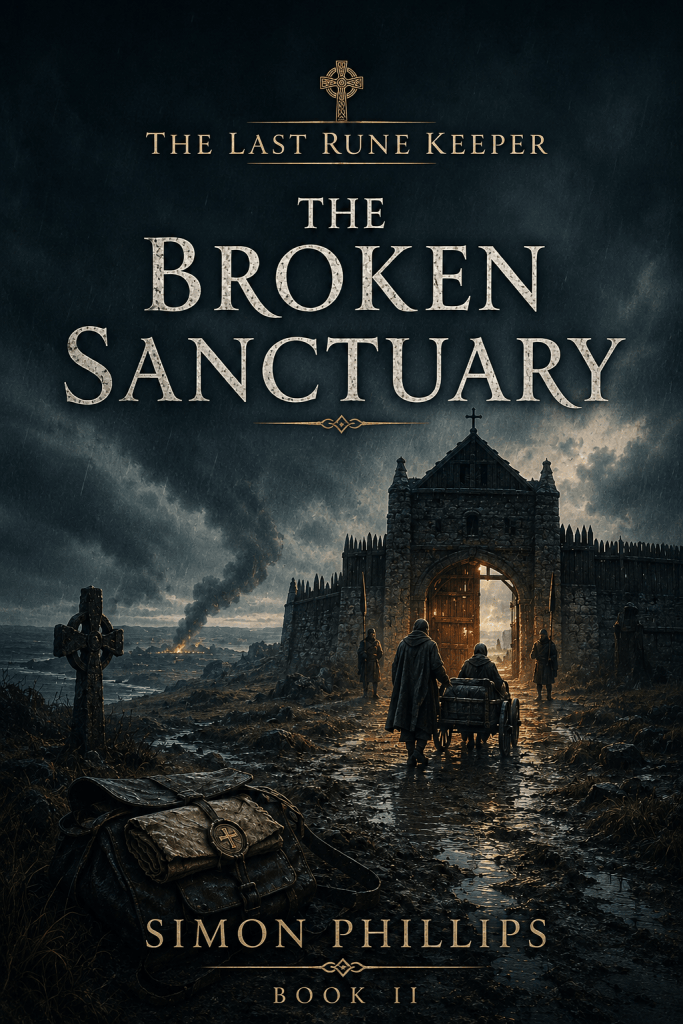
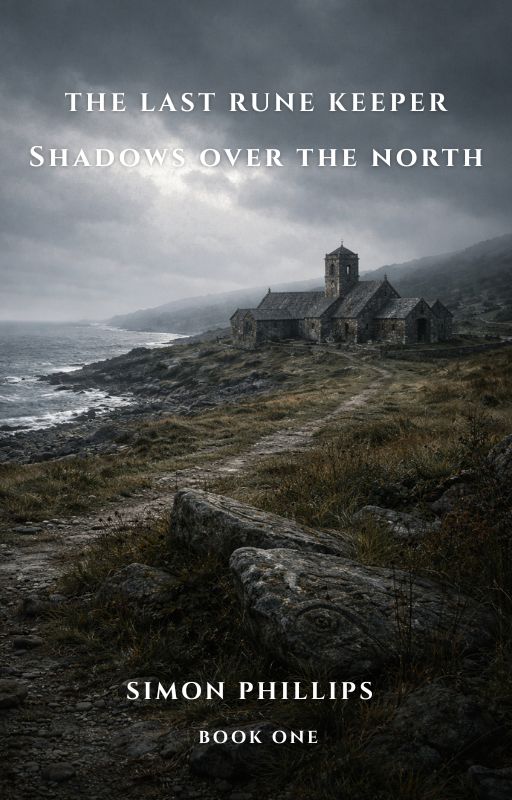
In the years before England carried a single name, Britain lived in pieces. A king might rule a hall, a monastery, a stretch of coast, a chain of roads held through oath and fear, yet the land itself remained uneven in its loyalties. Word travelled slowly. Protection travelled slower still. Along the eastern shore, where salt worked into timber and stone, people learned to read danger in weather, in sails, in the behaviour of birds, in the way a bell carried across water. The 793 raid on Lindisfarne stands at the opening of that fracture, and within The Last Rune Keeper it forms the first lived pressure point of a wider historical fantasy saga in which Eadric moves through Church authority, relic work, and the early violence of the Viking Age while magic remains active, feared, and unstable.


Britain before England

Early England historical fantasy works best when the land still feels unsettled, and this saga leans fully into that condition. Britain here is no neat kingdom map viewed from above. It is a scattered system of monasteries, halls, ports, burial grounds, rough roads, and local powers holding as much as they can hold. Coastal regions remain exposed. Inland authority reaches only as far as men can enforce it. Norse arrivals deepen that instability, since they come as raiders, settlers, traders, and warbands all at once, each movement forcing old boundaries to answer questions they were never built to answer.

That matters because the series never treats history as painted scenery behind a fantasy plot. The land acts more like a pressure field. Small disturbances travel. A relic hauled from a corpse on the shore, a ship seen in bad light offshore, a report carried from one monastery to another, each event gathers force as it crosses a fractured country. In a world like this, authority is local, memory is physical, and fear often arrives before explanation. That is part of what gives Anglo-Saxon and Viking historical fantasy its weight when handled with restraint. The world changes first. Understanding follows later.


The Church as road, record, and control

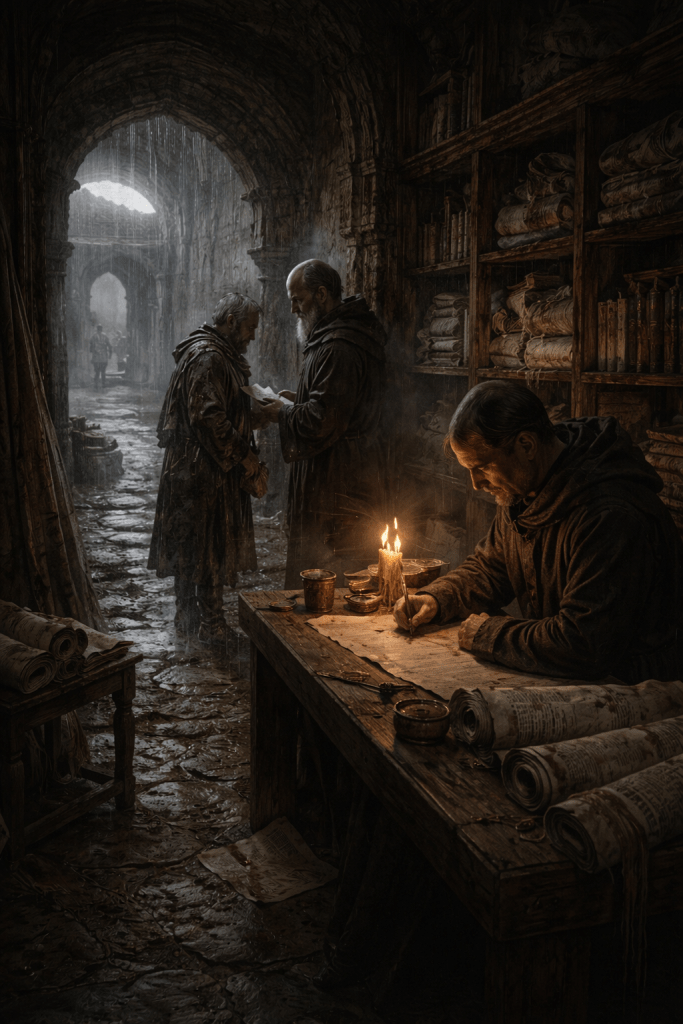
One of the strongest elements in this Viking historical fantasy series lies in how the Church is presented. It is never reduced to simple virtue or simple oppression. It is structure. In an unstable land, structure means survival. Monasteries preserve records, move messages, define law, shape moral language, and carry influence beyond the reach of a single local lord. A road to a minster may offer more security than a road to any noble hall. A prior’s judgement may travel further than a swordsman’s threat.

Yet the same system that preserves order also narrows what the world can sustain. The Church within The Last Rune Keeper accepts the reality of relics and older powers in practice, while condemning them in doctrine. That contradiction gives the saga much of its spiritual tension. Relic-hunters exist because magic is real. Relic-hunters remain half-hidden because magic is also incompatible with ordered faith and central control. A world that depends on relics, local rites, ancestral practices, and unstable places resists governance at scale. A Church network can live with that world for a time. It cannot build itself securely inside it.

That is where the series becomes more than a tale of raid and aftermath. It begins asking what gets lost when order hardens. In Church and pagan conflict fiction, the easy route is spectacle: priests against seers, miracles against curses, doctrine against blood. This saga chooses a quieter road. The real conflict lies in management, naming, classification, burial, transfer, suppression. The hand that seals a coffer may alter history more deeply than the hand that swings an axe.


Relics, runes, and the older memory of the land

The most compelling relics and rune magic fantasy often treats power as a residue held in things, in use, in memory, in the body’s response to place. That is the current running through this series. Magic here is a condition of the world, uneven and local, emerging where meaning, place, and belief still hold together. Runes function through preserved relationships. Relics preserve patterns within themselves. Embodied Norse practice moves through weather, body, breath, and rite. None of it feels tidy. None of it feels safe.

That gives The Last Rune Keeper an especially strong identity within dark historical fantasy Britain. The fear surrounding magic does not come from blazing displays. It comes from pressure in a room, altered light across timber, a waking sealed object, moisture gathering where it should never gather, a body marked by contact, a field that refuses to fall quiet after battle. These are smaller manifestations, though they carry greater unease because they suggest a world in which the sacred and the dangerous still overlap within daily life.

Eadric stands at the centre of that unease. He is valuable to the Church because he can interfere with magical conditions, suppressing or narrowing their force. Even here, at the opening of Arc One, his work carries a cost. He quiets, binds, observes, endures, and senses more than those around him can easily name. His role is already moving beyond simple obedience. He begins as a servant of containment. He is already becoming a witness marked by contact.


Where Shadows Over the North enters

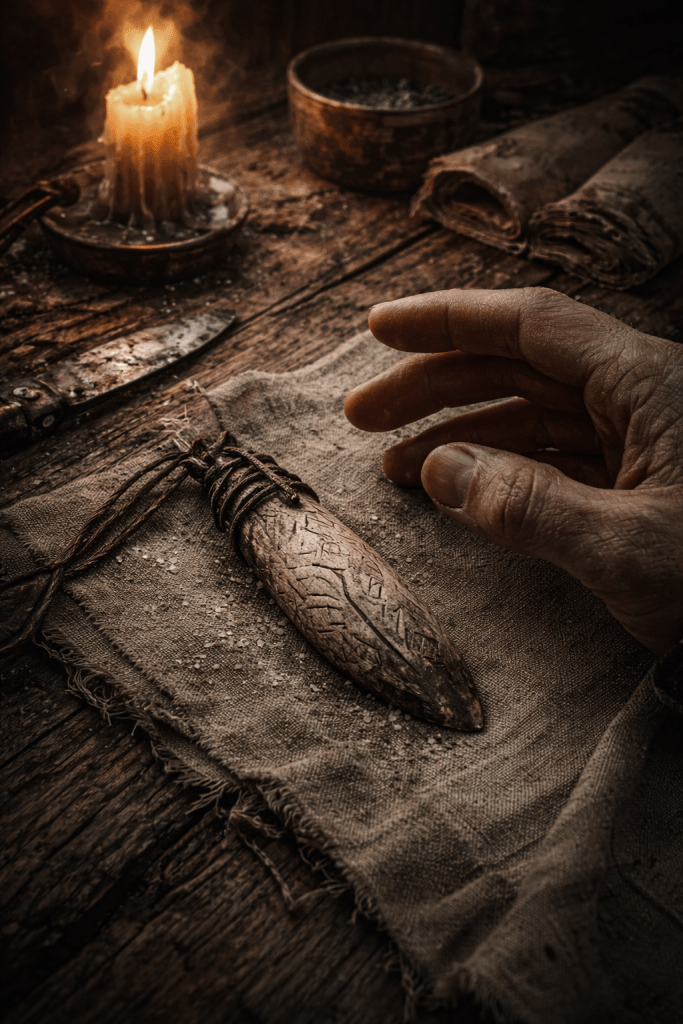
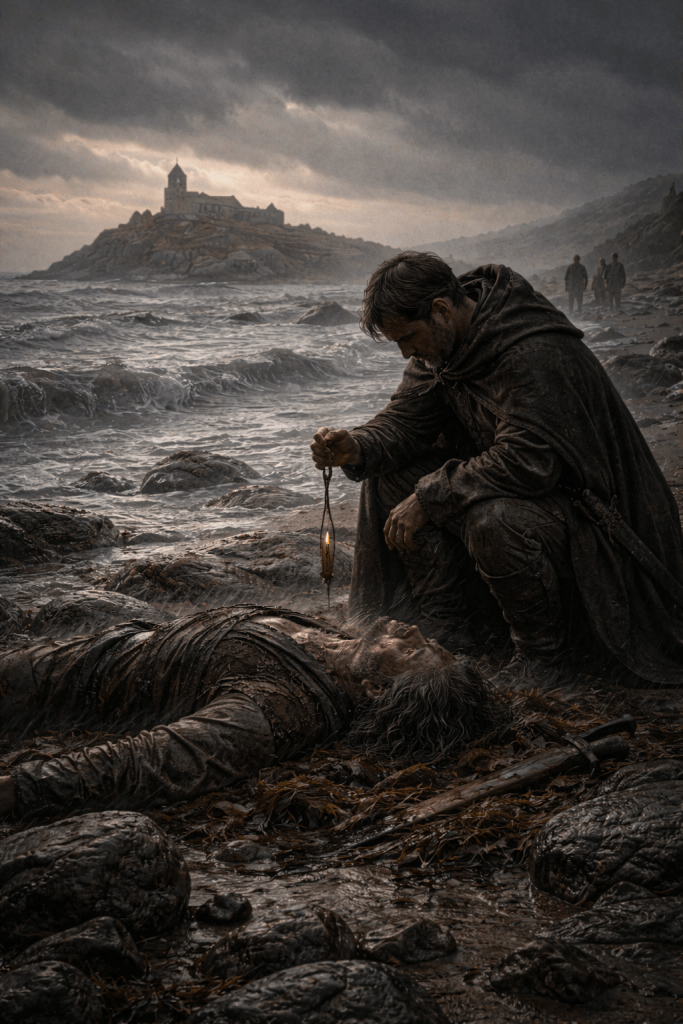
The Last Rune Keeper: Shadows Over the North enters this world at the right point: the shore, the monastery, the object taken from a corpse, the sense that something foreign has already crossed into local ground. As Novella 1 of Arc One, The First Wound, it establishes the 793 Lindisfarne era as lived experience rather than distant history. Eadric retrieves a whalebone charm from the shoreline, carries it into monastic custody, and from there the whole atmosphere of the novella begins to tighten. The Church answers with sealing, removal, and burial language. Eadric answers with touch, perception, measured restraint, and a growing awareness that the objects under his care are far from inert.

That difference between institutional response and bodily witness gives the novella its force. The first movement carries the chill of surf and stone. The second gathers unease inside cloister and storehouse. The later movement carries Eadric north toward a battlefield and then into a longhouse where a serpent pendant tests the line within him. The surface narrative is simple enough to describe: a young relic-hunter is sent into places where old force still lingers. The lived effect is far denser. Every threshold he crosses feels as though it records him as he passes.

This is also where the wider saga begins to show its design. Eadric’s conflict is never only personal. He stands inside overlapping systems: Church discipline, local fear, coastal instability, Norse approach, relic activity, the first signs that the world’s old continuity is under strain. Even Sigrun’s presence at this stage remains indirect, more pressure than person, which suits the novella’s mood. The Norse world is nearing the shore long before it stands fully before him.


A world moving towards exclusion

What makes this British historical fantasy novella feel larger than its immediate events is the sense of direction beneath everything. The saga’s deepest movement concerns displacement. Magic fades across the series, never through one grand extinction, though through systemic change. The more Britain moves towards doctrine, law, hierarchy, central authority, and the eventual formation of England, the less room remains for powers that depend on local continuity, inherited practice, unstable places, and meanings held in the body rather than in record.

That gives Shadows Over the North a special kind of gravity. It is early in the sequence, so magic still feels present and potent. Relics answer. Places react. Eadric feels the cost physically. Yet the direction of travel is already clear. The world capable of holding such things is under pressure. Monastic order expands even as coastal violence widens. Christian structure and pagan continuity press against each other across the same ground. The birth of England begins to appear, faintly, as the long narrowing of what the older world could carry.


What remains after the bell falls silent

There is a particular sadness in historical fantasy set in Viking Britain when it understands that survival and loss often arrive together. A stronger realm may emerge. Roads may become safer. Kingship may gather force. Records may grow cleaner. Yet every gain in structure asks something from the world that came before it. A grove loses meaning. A boundary stone goes quiet. A relic is buried, locked away, or carried south under seal. A man trained to suppress danger begins to understand that he is also helping to close a world.

That is the atmosphere Shadows Over the North leaves behind. It offers no clean ending, and it should offer none. Eadric leaves carrying more than metal and bone. The longhouse is altered. The road ahead has already taken notice. The first wound lies open, and Britain, still far from England, continues under a sky where bells, tide, prayer, weather, memory, and fear all move through the same air.

The Raiders of the North Sea: A Viking Age Coastal Mystery

The Raiders of the North Sea | Viking Longships & Coastal Raids Story

Morning gathered slowly across the wide waters of the North Sea as a pale band of light lifted along the eastern horizon. The tide moved with quiet patience against the dark rocks of the English coast while seabirds wheeled above the surf, their distant cries echoing through the cool air. Along the shoreline, villages stirred into another ordinary day, unaware that beyond the horizon, sails were already rising through the morning haze.


In the early centuries of the Viking Age, the coasts of Britain existed in a delicate balance between trade, faith, and quiet isolation. The sea brought merchants, pilgrims, and travellers whose arrivals shaped the rhythm of coastal life.

This Chronicle explores the moment that balance began to shift.

From the distant horizon came vessels unlike any seen before. Long, narrow ships capable of crossing open sea and shallow rivers alike. Their arrival introduced a new kind of encounter, one defined by speed, precision, and uncertainty.

What began as isolated raids would, over time, reshape the memory of the sea itself.


A Visual Chronicle

Watch a short visual interpretation of the events that marked the beginning of Viking activity along the British coast:


Chronicle Series Context

The Future Chronicle is a narrative publication that presents moments of history and speculation as immersive chronicles, allowing readers to experience events through atmosphere and lived perspective rather than explanation.

Each entry functions as a reconstructed record, blending storytelling with historical and speculative insight. This approach places the reader directly within the unfolding moment, where environment and detail reveal the deeper significance of each event.

The Chronicle you are reading forms part of a wider archive exploring turning points across time, from ancient civilisations to distant futures.


Continue the Chronicle

The arrival of the longships marked only the beginning of a much larger transformation.

Coastal settlements would soon learn that the horizon carried more than trade and travel. It carried a new kind of presence that would return again and again across the generations.

Continue the Chronicle on Substack: